



Abstract
Few studies have delved empirically into the various factors driving Islamophobia and negative attitudes towards Muslims, or the various forms they can take among individuals. To what extent does state secularism (or laïcité) policy, such as Bill 21 in Quebec, affect attitudes towards Muslims among the general public? What are the various dimensions of attitudes towards Muslims that can be measured in recent years? Using 2011–2019 Canadian Election Study data, the authors do not find a large impact of state secularism policy on public opinion towards Muslims, nor a strong dislike of organized religion explaining all negative attitudes towards Muslims in Quebec and in the rest of Canada. Instead, they find a wide variety of negative attitudes towards Muslims: some respondents specifically targeted Muslims with their discomfort and dislike, while others showed dislike towards Muslims tied to wider xenophobic attitudes towards racial minorities, immigrants, and other minority and vulnerable groups in society.
In societies where Muslims form a minority heavily fed by immigration – especially in the West – it is challenging to study the relationship that general populations have with the adherents of Islam. Those in politics and the media often approach Islam as a ‘social problem’ and, in sociology, Islam and Muslims are often framed as a ‘sociological problem’ (Amiraux and Garcia, 2020: 213). Quebec and the rest of Canada are no exceptions. The tragic, violent Islamophobic acts that have shaken society, as well as the political issues that have been debated for nearly 20 years surrounding state management of religious diversity, have pushed many scholars, including ourselves, to take a step back and reconsider our approach to understanding attitudes towards Muslims. 1 One way to do this is to base our reflection on a diachronic perspective that transcends specific events, as important as they each may be. Despite the majority of federal and provincial political actors calling for the continued fight against racism and Islamophobia every time a new act of violence is committed, some media and community leaders 2 have been questioning the role that Quebec’s new law on laïcité and state secularism, Bill 21, 3 along with its public discussion, has played in recent Islamophobic events. Has this recent public and media discussion, along with the enforcement of stricter laïcité measures, created a social environment that enables more negative attitudes towards Muslims to be further developed and expressed among the general population? Some claim it does, but none have empirically tested this claim with systematic high-quality and representative public opinion data over time.
Our objective is to examine the evolution of attitudes towards Muslims among residents of Quebec in light of legislative transformations over a nine-year period in the province. Using data from the 2011, 2015 and 2019 Canadian Election Study (CES), we treat the Quebec context during this period as a ‘quasi-natural’ experiment of sorts, to see how the ‘treatment’ of new state secularism legislation may or may not have coincided with changes in public attitudes towards the religious minorities targeted in this legislation. More specifically, we seek to identify whether there are certain groups of individuals in 2019 in Quebec who share specific types of attitudes towards Muslims living in Canada, towards other minority and vulnerable groups, and towards organized religion in general, and how such dynamics compare to those in the rest of Canada. Thus, we will be able to compare a province that has implemented a stricter model of religious management with the rest of the country, which did not follow such a path in the 2010s.
Laïcité and Quebec’s sociolegal context
The renowned sociologist of religion David Martin (1978: 19) put forward the argument in the 1970s that the historical religious monopoly of Catholicism in a region or country could lead to ‘abrasive division and militant secularism’. Yet Quebec underwent a process of fairly rapid but mostly peaceful secularization during the 1960s amid its Quiet Revolution (Laniel, 2022; Meunier and Warren, 2002; Meunier and Wilkins-Laflamme, 2011; Milot, 2009). Weekly attendance at Mass among the majority Catholic and French-speaking population plummeted; a large number of religious monks, priests and nuns left their calling and the Church; religious leaders lost much of their authority and respect among the public; and the provincial government took responsibility away from the Catholic Church for the running of key public institutions, notably in the fields of health, education and social services. This distancing of the state from the Church was not then defined as laïcité, a concept that would only be developed and used in the province in more recent decades, especially since the late 2000s. That said, already during the Quiet Revolution a certain form of laicization seemed to be on the horizon. The sociologist Jean-François Laniel (2016: 433) summarizes this moment as follows: ‘Quebec’s laicization unfolded quietly, almost unthinkably, implicitly, slowly and softly’ (our translation). The deconfessionalization of the education system, which saw the province’s public-school boards changed from denominationally based (Catholic and Protestant) to linguistically based (French and English) in 2000 with Bill 118, is usually seen to mark the end of the last ties between the provincial state and the Catholic Church (Tremblay, 2009).
Nevertheless, just when Quebec provincial governments probably felt that they had relegated matters of state and religion to the past, these matters came bubbling back up to the surface of public discussion with the highly mediatized crisis of ‘reasonable accommodation’ in the mid 2000s. Especially since the 1990s, immigration to the province of Quebec had become much more religiously diverse. Large Muslim populations were arriving from French ex-colonial countries such as Lebanon, Algeria, Tunisia and Morocco, and were establishing communities in the larger metropolitan centres of the province (Daher, 1998: 253). Although still proportionally small within the general population of the province, Muslims went from representing 0.7% of the Quebec population in the 1991 census to 1.5% in 2001, 3.1% in 2011 and 5.1% in 2021.
Despite many reasonable accommodations having been successfully agreed on and granted in the 1980s, 1990s and early 2000s without much public attention or fallout, in 2006 that all changed. In that year, a small number of highly mediatized and sensationalized cases of reasonable accommodation (notably, a Sikh student being allowed to wear his kirpan to school; gym windows being frosted over so as not to offend conservative religious adherents; and a prayer room being set aside for Muslims in a maple sugar shack) were suddenly the target of a lot of negative media and public attention for having gone too far. This media coverage also played a role in shaping attitudes towards religious minorities (Giasson et al., 2010). Whether the discomfort towards religious minorities reported in the media was real, or whether journalists and columnists were the driving force behind it in the manner of a self-fulfilling prophecy, the fact remains that Quebec was plunged into a debate that marked the province and its population’s image of new forms of religious diversity for years to come.
In response to this media storm, the Quebec premier at the time, Jean Charest, established the Bouchard–Taylor Commission in 2007. The objective of this commission was ‘to demystify both the extent and nature of requests for accommodation and the alleged over-accommodation of those requests by public institutions’ (Zubrzycki, 2013: 223). The commission’s report put forward a series of recommendations, which led to a number of legislative texts surrounding the management of religion and religious diversity by the Quebec state during the late 2000s, 2010s and early 2020s. Charest’s Liberal government developed Bill 94 in 2010–2011 to prohibit citizens from receiving government and public services with their faces covered, such as public schooling, health-care services, social services and childcare services. The bill was never passed. However, this was the beginning of state secularism measures specifically targeting religious minorities – notably, Muslim women wearing the niqab.
The Parti Québécois was up next and introduced Bill 60 in 2013, also known as the Quebec Charter of Values. This bill was another unsuccessful attempt to put an end to the debate surrounding reasonable accommodation, as it also wanted to broaden the government’s control over the wearing and management of religious symbols and clothing among its employees so these individuals would appear religiously ‘neutral’ (Laxer and Korteweg, 2016). Then came the Liberal government of Philippe Couillard and its Bill 62, which was passed in 2017 with the provincial Liberals’ majority government. This law incorporated some of the elements of the failed Bill 94. It insisted that public services be offered and received with an uncovered face, and it also outlined some of the issues – such as gender equality – regarding reasonable accommodation (Létourneau-Desjardins, 2020: 98). However, in November 2017, the Quebec Superior Court ordered the partial suspension of the law due to its unconstitutionality. 4 Most recently, the new Coalition Avenir Quebec government passed Bill 21 in 2019. It is the first law ‘to affirm the laicity of the state and to set out the requirements’ (CQLR c L-0.3, 2019). The law establishes a more formal framework for reasonable accommodation in the province; prohibits many Quebec government employees in positions of authority, including public-school teachers and principals, police officers, prison guards and judges, from wearing ‘ostentatious’ religious symbols; and requires citizens to uncover their faces when receiving certain government services. Bill 21 was adopted with the use of the notwithstanding clause, which is meant to protect it from court challenges of unconstitutionality, court challenges that are currently ongoing and will likely make their way to the Supreme Court of Canada.
Research questions
Critics of Bill 21, along with similar legislative measures that came before it, argue that recent Quebec governments have been pandering to the large electoral base of older francophones identifying as Catholic and living outside of Montreal, a demographic that tends to favour in larger numbers state secularism measures targeting religious minorities (Meunier and Legault-Leclair, 2021). In so doing, the state is participating in the creation of a social context that is potentially conducive to negative feelings towards minorities among its broader population. Yet how has public opinion in Quebec actually evolved since the reasonable accommodation crisis began in 2006, and with subsequent public debates surrounding the province’s state secularism laws during the 2010s?
Specifically, have attitudes towards Muslims deteriorated during this period among the general adult population? Or have the public debates led instead to a more complex understanding of religious diversity among important segments of the Quebec population, potentially improving attitudes towards Muslims as they become more ingrained in the fabric of the province while also facing adversity from the state? What are the dimensions of the negative attitudes towards Muslims in the province since the adoption of Bill 21? Are these negative attitudes targeted only towards Muslims, towards many minority and vulnerable groups including racial minorities and immigrants, or towards organized religion in general as a product of the Quiet Revolution? And how does the nature of the attitudes towards Muslims in Quebec since Bill 21 compare with those in the rest of Canada, where similar public debates and state secularism policies have not been developed to the same extent as in Quebec?
Potential dimensions of negative attitudes towards Muslims
Since the early days of the reasonable accommodation crisis, several studies have found negative attitudes towards Muslims in Quebec (Angus Reid Institute, 2017; Brodeur, 2008; Environics Institute, 2016; Helly, 2004; Rocher, 2015; Wilkins-Laflamme, 2018). These negative attitudes have been explained in a number of distinct ways. For some, these attitudes are first and foremost tied to Quebeckers’ own cultural insecurity as a minority within wider Anglo-American North America (Bilodeau et al., 2012; Turgeon and Bilodeau, 2014; Turgeon et al., 2019). For others, they reflect a more generalized discomfort and dislike of all groups considered as outsiders, including many racial minority and immigrant groups in the province (Bilodeau and Turgeon, 2014; Bolduc and Fortin, 1990). For others still, negative public opinion towards Muslims is part of a wider dislike of all forms of organized religion inherited from the Quiet Revolution of the 1960s in the province (Clarke and Macdonald, 2017: 154; Meunier, 2007: 302; Meunier et al., 2010: 114). Other observers also point to the unique nature of Islamophobia in the province and the targeting of Muslims specifically (Allen, 2010; Amiraux, 2014; Amiraux and Garcia, 2020; Kalin, 2011; Simmons and Sandhu, 2020; Zine, 2022). The relationship between Muslim communities and the province of Quebec has also been analysed in light of earlier failed attempts to legislate on religious symbols. The Environics Institute (2016: 5) has seen this as part of the explanation for the optimism expressed by Muslims about living in Quebec. Yet no study to date has empirically tested these explanations for negative attitudes towards Muslims in order to determine which seem to be most present, how these dynamics might have shifted in recent years with state secularism policies, and how the distinct social environment of Quebec compares with the rest of Canada in this regard.
Generalized xenophobia
Among all the attitudes and relationships that individuals may have towards minority groups, we consider that generalized xenophobia is one of them (Commission des droits, 2019; Goyer, 2020; Selby et al., 2022). By this, we mean fear and dislike of all or most individuals who are perceived as different from oneself and from one’s group of belonging. This fear of difference often manifests itself through negative attitudes towards constitutive aspects of ethnicity or of the ethnocultural out-group. These aspects can include language, religion, customs, place of birth, skin colour or other physical features (Commission des droits, 2019: 29; Labelle, 2006; Winter, 2000: 28). These differences can also be perceived as a threat to the sociocultural group to which one belongs.
Discriminatory attitudes and prejudice toward the out-group population can be a result of the majority population. That is, individual fear, regardless of their own self-interests, that the presence of out-group populations may constitute a threat to the collective identity and the cultural, national and ethnic homogeneity of the society. (Semyonov et al., 2006: 428)
Conceptualized in this way, generalized xenophobia makes it possible to account for behaviours and attitudes that affect a wide range of minorities and vulnerable groups. It then becomes possible to distinguish individuals who have negative attitudes towards several minority groups (e.g. racial minorities, immigrants, sexual minorities, Indigenous peoples) from individuals who have a negative attitude towards one particular minority group. This leads us to our first hypothesis with regard to the potential dimensions of negative attitudes towards Muslims: Hypothesis 1: Those who dislike most or all minority groups (such as racial minorities, immigrants, sexual minorities, Indigenous peoples) are also expected to dislike Muslims.
Dislike of organized religion
The relationship that Quebeckers have developed with religion in recent decades has been characterized as a ‘paradoxical tension’ (Meunier et al., 2010: 127) and a ‘love–hate’ dimension (Laniel, 2016: 450; Meunier and Legault-Leclair, 2021: 99). Anti-(Catholic) Church sentiment has been a prevalent part of the social imaginary since the Quiet Revolution of the 1960s in the province. The mid-19th to mid-20th centuries are often remembered as a ‘dark’ period of church and clerical domination, during which regular citizens, especially women and LGBTQ2S+ (lesbian, gay, bisexual, transgender, queer or questioning, two-spirit +) individuals, were kept under the yoke of the Catholic way of life (Meunier, 2013: 18). Strict sexual morals and gender roles were taught and enforced by means of the Catholic Church’s hold on social institutions and its general prevalence throughout social life. It was only with the ‘enlightenment’ of the Quiet Revolution that Quebec society was seen to be able to free itself not only from the economically dominant English-speaking minority in the province, but also from the Grande Noirceur (Great Darkness) of the Catholic Church’s domineering influence (Bouchard, 2019; Zubrzycki, 2020).
This view of the past has achieved a quasi-mythical status for most Quebeckers, being passed on to younger generations through family stories, pop culture and history lessons in school (Bouchard, 2019). Many of the nuances and other complexities of the period and the role of the Catholic Church in French-speaking Canada are also often lost in the tale (Christiano, 2007; Gauvreau, 2005; Koussens and Foisy, 2018; Meunier and Warren, 2002). This view of the history of the Catholic Church in the province, as well as a continued disagreement by many with its sexual morals and other institutional stances, translates into extremely low levels of regular religious-service attendance in present-day Quebec (Wilkins-Laflamme, 2014, 2020). It also translates into the negative sentiments held by many not only towards the Catholic Church but also, by proxy, towards religion in general. Negative sentiment towards organized religion can also be found elsewhere in Canada, especially in relation to child sexual abuse scandals, the running of residential schools in the 19th and 20th centuries by Christian churches, and, more generally, the socially conservative values that can be found among a number of religious groups, but this negative sentiment is potentially not as prevalent as in Quebec (Goulet, 2016).
Nevertheless, despite this particular history in Quebec, the negative views it often generates towards the Catholic Church as an institution and towards organized religion in general, and the recent push to legislate state secularism policies in the province, there is also a hesitancy among a majority of Quebeckers to relinquish all cultural and identity ties to Catholicism. Despite a degree of bitterness towards the institution, many Quebeckers have remained bound to a shared tradition, heritage and cultural identity (Laniel, 2016: 450). Fifty-four percent of residents in the province still declared themselves Catholic in the 2021 census, although only 7% among them attended Mass once a week according to Statistics Canada’s 2018 General Social Survey (Cycle 33) . A cultural Catholic identity, which is not to be mistaken for actual ties with the Catholic Church, is still seen as the default option among many Quebeckers. It is an important aspect of group identity that maintains a link with culture and family tradition and is often seen as a way to distinguish Quebeckers from a perceived Anglo-Protestant majority in the rest of North America (Lemieux and Montminy, 2000; Meunier and Nault, 2014; Milot, 1991).
This form of cultural Catholicism in the province is thus paired with a wariness inherited from the Quiet Revolution of institutionalized forms of religion – a wariness that may now extend beyond the Catholic Church to other religious traditions such as Islam and those who follow these traditions. The importance that the Grande Noirceur narrative plays in Quebec provides a significant key to understanding the relationship that Quebeckers still have with religion today. ‘A few decades later . . . [laïcité] would come back to the forefront, under very different circumstances, dominated by the integration of immigrants and their religious ties’ (Bouchard, 2019: 281). This distinct social and historical context brings us to our second hypothesis: Hypothesis 2: Those with low levels of confidence in organized religion are also expected to have negative attitudes towards Muslims.
Targeted Islamophobia
We can also consider negative attitudes among some individuals as only targeting Muslims, and not necessarily directed at other minority and vulnerable groups or members of other religious groups. In other words, we can also conceptualize a form of targeted Islamophobia that is distinct from generalized xenophobia as well as from dislike towards organized religion. Amiraux defines Islamophobia as a matrix of racialization of Muslim populations which operates historically by capillarity and at different scales in non-Muslim liberal democratic societies, notably in Europe and North American societies. It is embedded in interactions and unfolds in specific situations that actualize it in a differentiated way, always linked to the national history and culture of the place from which it operates. (Amiraux, 2014: 83)
A number of violent acts and hate crimes have taken place across Quebec and Canada against individuals specifically due to their Islamic faith and practice. Many Muslims report facing daily forms of discrimination at work, at school and in public (Commission des droits, 2019). Muslims are repeatedly ranked as some of the most disliked minority groups in Canada (Wilkins-Laflamme, 2018). This definition of Islamophobia also covers two dimensions that are particularly relevant to our study: the historical context and the sociocultural context. By placing Islamophobia within national and religious history, we can grasp the particularities of the context that harbour potentially distinct forms of Islamophobia while avoiding generalizations. This question of context is intimately linked to the cultural dimension of Islamophobia. For Modood (2015), Islamophobia can be a specific form of ‘cultural racism’ among some individuals who wish to forcefully maintain the elements of a specific culture.
This comprehensive approach to the context in which Islamophobia takes shape and the forms it can take allows for the identification of what specifically falls under its scope, particularly at times when debates surrounding various laws or court cases on religious issues have affected the whole of society. As the main goal of this study is to examine how attitudes towards Muslims in Quebec developed in the years leading up to and just after the adoption of Bill 21 as state laïcité policies were debated and enacted, we also aim to tease out the exact sources of more negative attitudes towards Muslims in the province among those who hold them.
Hypothesis 3: Negative attitudes will be specifically targeted towards Muslims among some individuals, rather than paired with other xenophobic attitudes or a dislike of organized religion.
Data
In order to answer our research questions and test our hypotheses, we used data from the 2011, 2015 and 2019 CES. This survey is run each time there is a federal election in Canada. In 2011 and 2015, the survey was conducted in a three-wave format: a series of questions asked by means of telephone interviews during the election campaign period and just after election day, and then through a follow-up self-completion mail-back or web questionnaire. For the 2019 CES, we use its online sample of 37,822 respondents procured through Qualtrics, with targets stratified by region and balanced on gender and age within each region. The sampling procedure of the CES is designed to represent the adult population of Canadian citizens aged 18 or older who speak one of the official languages (English or French) and reside in private households in one of the 10 Canadian provinces (excluding the northern territories). 5
The 2011 CES contains a total sample size of 4308 respondents, the 2015 CES a total sample size of 7560 respondents and the online 2019 CES a total sample size of 37,822 respondents, although not all of the questions are put to all of the respondents in the CES. The 2011, 2015 and 2019 waves were analysed together to observe trends in attitudes towards Muslims in Quebec and the rest of Canada between 2011 and 2019, and then a greater focus was placed on the more recent 2019 data for an in-depth analysis of how the respondents’ attitudes towards Muslims pair with their attitudes towards other groups and institutions in society.
The 2011, 2015 and 2019 CESs contain a feelings-thermometer question on how Quebec and Canadian respondents feel about certain groups in society, including Muslims living in Canada (values closer to 0 indicate that respondents really dislike Muslims living in Canada and values closer to 100 indicate respondents really like Muslims living in Canada). 6 The respondents’ feelings on this item are also compared with their feelings-thermometer scores for other minority and vulnerable groups, including aboriginal peoples, gays and lesbians, feminists, racial minorities and immigrants (group designations as worded in the CES). A comparison is also made with their feelings-thermometer scores for a majority group included in the 2015 and 2019 CESs: francophones in the case of the Quebec respondents.
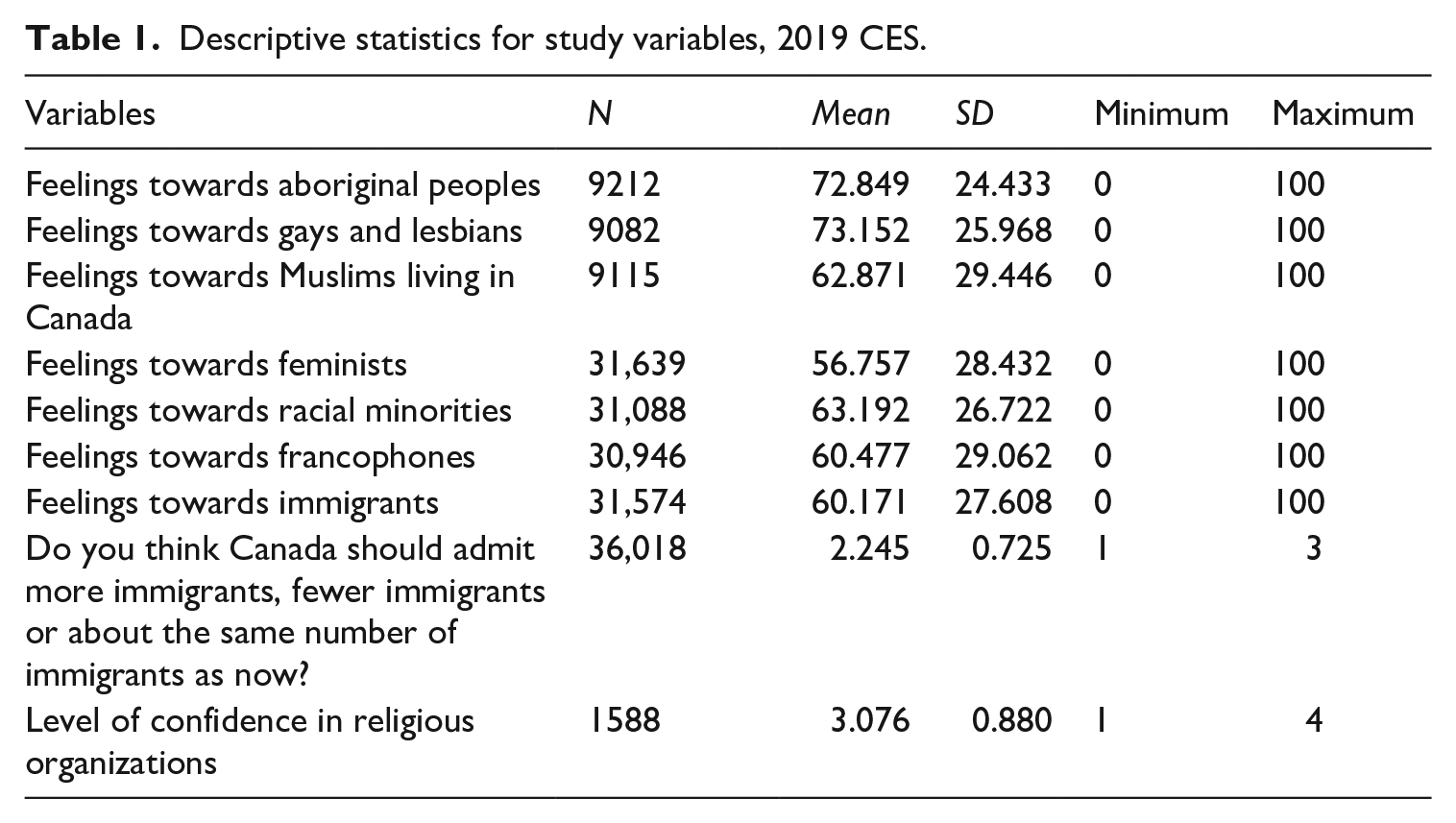
The first section of the results below contains descriptive statistics produced from these variables to measure and compare attitudes towards Muslims over time and between Quebec and the rest of Canada. The second and third sections of the results contain the findings from a series of latent class analyses to better tease out the different types of respondents who are showing signs of more negative attitudes towards Muslims. A latent class analysis is a statistical model that examines how respondents answered a series of questions in a survey and, from this information, extracts a number of underlying groups (or latent classes). In other words, this statistical analysis identifies patterns in the respondents’ answers to the survey questions and groups them accordingly into different underlying categories (or classes) of individuals. In our case, we examine how respondents who show signs of discomfort and dislike towards Muslims are grouped according to their answers on all the feelings-thermometer scales mentioned above, as well as when it comes to their attitudes towards immigration in Canada and their confidence in religious organizations in the country in the 2019 CES. These analyses allow us to determine whether respondents showing signs of discomfort and dislike towards Muslims do so in conjunction with wider xenophobia towards all minority groups or in conjunction with dislike especially towards immigration or especially towards religion, or are specifically targeting Muslims only with their negative attitudes. Table 1 contains the descriptive statistics for all the original 2019 CES variables used in these analyses. 7 Further methodological details are provided in each section of the results below.
Descriptive statistics for study variables, 2019 CES.
Results
Trends and comparisons, 2011–2019
We begin by examining how the respondents’ feelings-thermometer scores towards Muslims living in Canada have evolved between 2011 and 2019 in Quebec and the rest of Canada. The results in Figure 1 show that there is no significant decline in the average feelings scores over the entire period of 2011–2019 in Quebec and a decline of 9 points in the rest of Canada between 2011 and 2019. In the case of Quebec, we also note that there is no clear decline in the average scores in 2019 in the months following the passing of Bill 21 and the federal election debates surrounding that law. Rather, it was in 2015, when the issue of wearing the niqab during citizenship swearing-in ceremonies mobilized a significant portion of the federal election campaign, that attitudes towards Muslims seemed to be at their lowest. During this period, a poll conducted by Léger on behalf of the federal government indicated that 93% of Quebeckers and 82% of Canadians in the rest of the country disagreed with the wearing of the niqab (Teisceira-Lessard and Normandin, 2015). Nevertheless, the federal political opposition parties during the 2015 election campaign (the Liberal Party of Canada and the New Democratic Party) opposed forced unveiling during citizenship swearing-in ceremonies, arguing that such a measure infringed on individuals’ freedom of religion (The Economist, 2015; Environics Institute, 2016: 2).
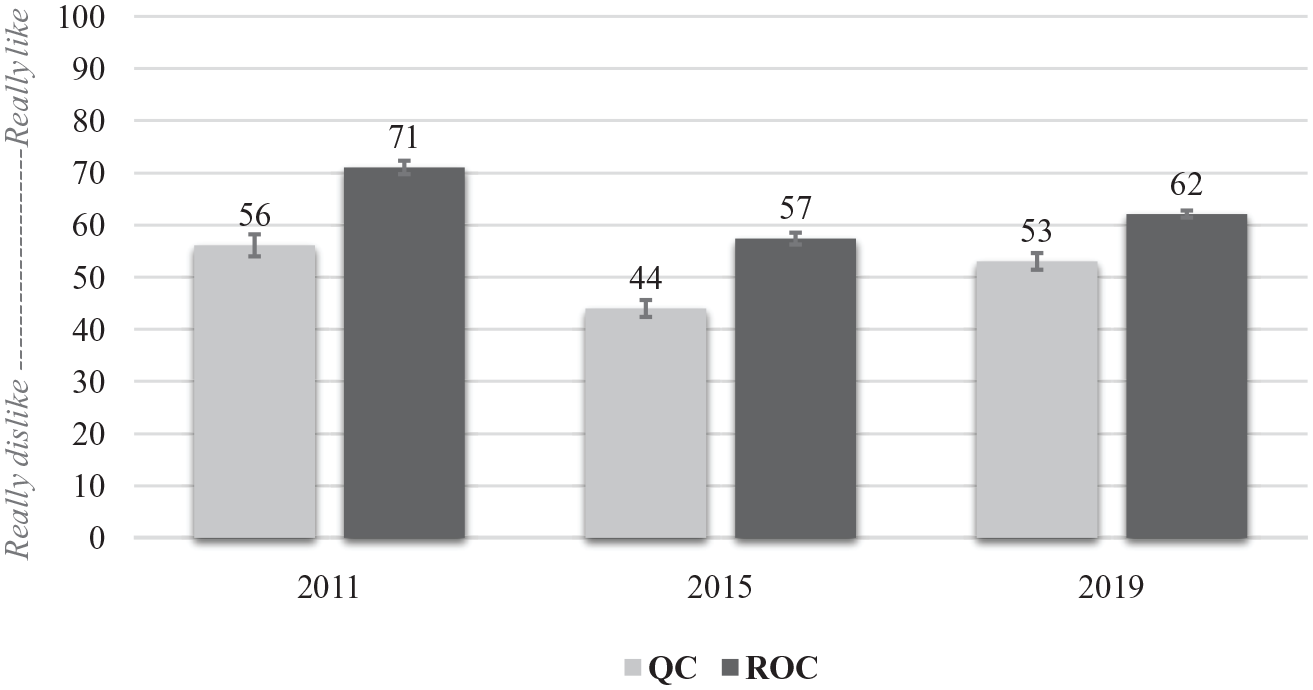
Feelings-thermometer scores for Muslims living in Canada (0 = really dislike, 100 = really like) for Quebec and the rest of Canada, 2011, 2015 and 2019, weighted to be representative of general adult populations, with 95% confidence intervals. QC = Quebec; ROC = Rest of Canada.
It is also worth noting that for each year of study, respondents in the rest of Canada have higher (warmer, more positive) average feelings scores towards Muslims living in the country than respondents in Quebec. These feelings scores have their limitations, however. Different respondents may assign different numerical scores to similar feelings due at least in part to cultural differences (Wu and Dawson, 2022). For example, Respondents A and B may feel the same but Respondent A may give a score of 70 and Respondent B may give a score of 80. Quebec respondents may just be scoring everything and everyone with lower numerical values, even if they may actually feel the same as respondents elsewhere in Canada. A more precise measure to use would be the gap each respondent has in their feelings scores between Muslims and members of other social groups.
In order to measure this gap, we first calculate a respondent’s average feelings-thermometer score for the other minority and vulnerable groups included in all the 2011, 2015 and 2019 waves of the CES: the average of the respondents’ feelings scores towards aboriginal peoples, gays and lesbians, feminists and racial minorities. With this average score calculated, we then subtract it from the respondents’ feelings scores towards Muslims specifically to create a new scale measure of negative attitudes towards Muslims. Respondents with positive values on this scale have more positive attitudes towards Muslims than their average feelings for other minority and vulnerable groups. By contrast, those who have negative values on this scale have more negative attitudes towards Muslims than their average feelings towards other minority and vulnerable groups. Figure 2 shows the proportion of respondents in each year in Quebec and the rest of Canada who have a negative substantial gap of 5 points or more between Muslims and their minority group average (a difference of 5% or more on a scale of 100). 8
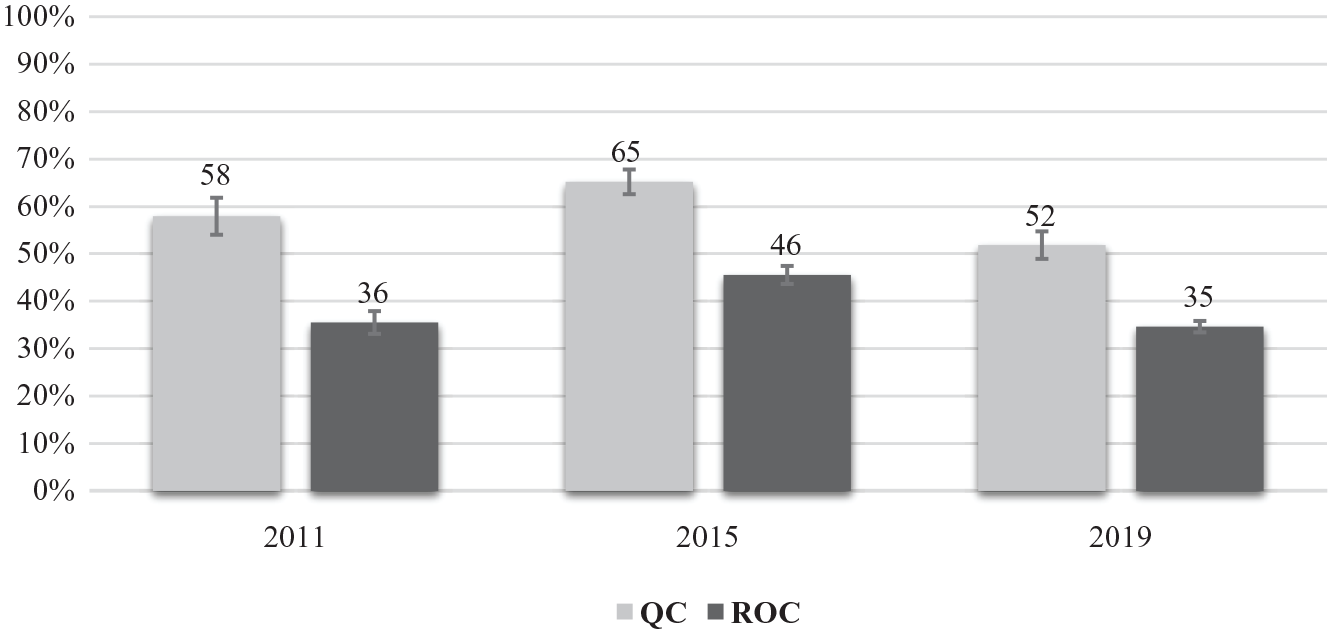
Proportion (in %) of respondents who have a negative feelings gap score of 5 points or more between Muslims living in Canada (more negative average score) and average feelings towards minority groups – aboriginal peoples, gays and lesbians, racial minorities and feminists (more positive average score) – for Quebec and the rest of Canada, 2011, 2015, and 2019, weighted to be representative of general adult populations, with 95% confidence intervals. QC = Quebec; ROC = Rest of Canada.
We see that the trends observed in Figure 1 remain in Figure 2. The highest proportion of individuals with distinctly more negative attitudes towards Muslims, when compared with their average attitudes towards other minorities, is found in 2015 in both Quebec and the rest of Canada. Again, it is among Quebec respondents that we find a larger proportion with more negative attitudes towards Muslims. In 2019, for example, 52% of Quebec respondents scored other minority groups (aboriginal peoples, gays and lesbians, racial minorities and feminists) 5 points or more higher on average on the feelings-thermometer scale than Muslims living in the country, compared with 35% of respondents in the rest of Canada. This does not mean that all these respondents score Muslims below 50 on the feelings-thermometer scale (indicating a stronger dislike), but they do score Muslims lower than their average towards other minority and vulnerable groups.
This measure has the advantage that it is comparable across Quebec and the rest of Canada with the 2011–2019 CES data. Yet it also has some limitations. It is not possible with this specific feelings gap scale to identify respondents who have negative attitudes towards all minority and vulnerable groups, including Muslims. This feelings gap scale only identifies respondents who have more negative attitudes towards Muslims than towards other minority and vulnerable groups. Consequently, it is harder to capture certain forms of generalized xenophobia with this specific feelings gap scale.
In order to overcome this limitation, we created another feelings gap scale, this time comparing Quebec respondents’ attitudes towards Muslims with their attitudes towards the majority group in the province (francophones) for 2015 and 2019 when a feelings-thermometer question was asked about francophones. We subtracted the respondents’ feelings score for francophones from their feelings score towards Muslims. The respondents with positive values on this scale have more positive attitudes towards Muslims than towards francophones. By contrast, those who have negative values on this scale have more negative attitudes towards Muslims than towards francophones. Figure 3 shows the proportions of respondents in 2015 and 2019 in Quebec who have a substantial negative gap between Muslims and francophones of 5 points or more. Using the francophone majority as the comparison group rather than all minority groups combined, we see that a greater share of the Quebec population has more negative attitudes (by at least 5 points) towards Muslims. However, this proportion declines from 80% to 67% over the two years, as we saw with the trends in Figures 1 and 2.
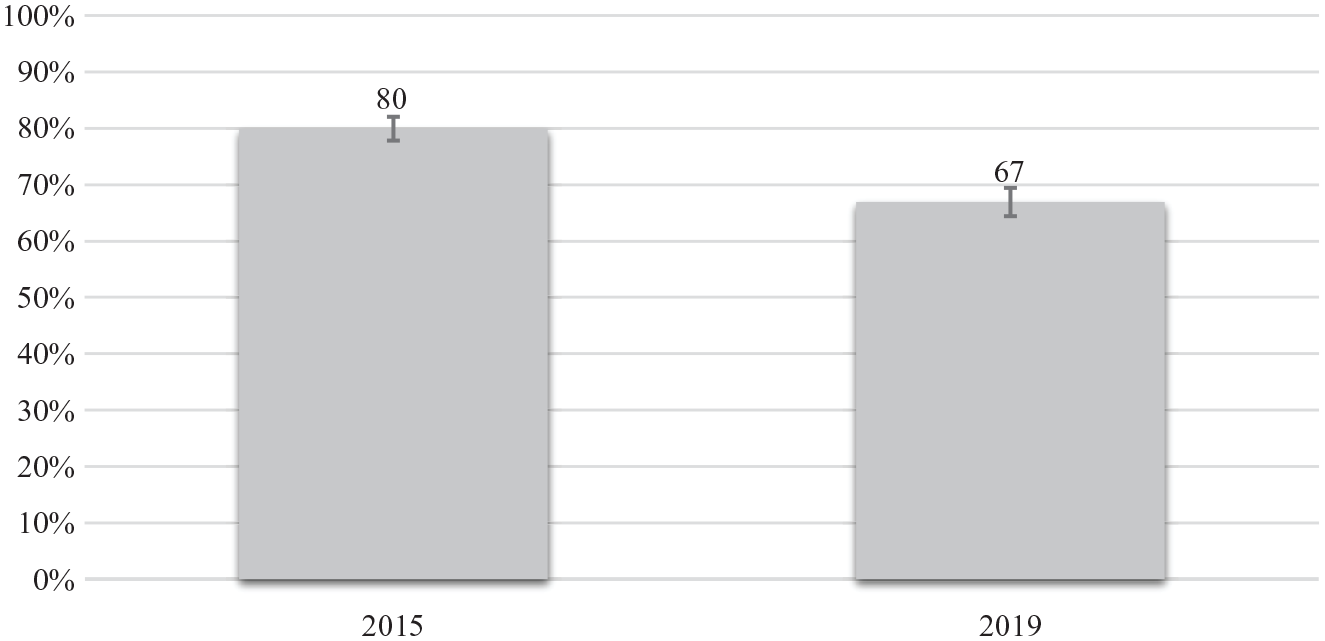
Proportion (in %) of Quebec respondents who have a negative feelings gap score of 5 points or more between Muslims living in Canada (more negative feelings score) and francophones (more positive feelings score), 2015 and 2019, weighted to be representative of general adult populations, with 95% confidence intervals.
In the 2015 and 2019 CES, no feelings-thermometer questions were asked about a comparable majority group in the rest of Canada. The 2011 CES did ask feelings-thermometer questions about ‘White people’ and ‘Catholics’. In 2011, 44% of the respondents from the rest of Canada had a 5 points or more negative gap between Muslims and White people (compared with 71% in Quebec). In the same year, 37% of the respondents in the rest of Canada had a 5 points or more negative gap between Muslims and Catholics (compared with 60% in Quebec). In the end, we find that attitudes towards Muslims are lower than attitudes towards what can be considered majority groups, especially in Quebec but also in the rest of Canada.
Latent class analyses among Quebec respondents with more negative attitudes towards Muslims
In this section, we examine in more detail respondents from Quebec in 2019 who showed signs of a substantial negative gap (5 points or more) between their feelings towards Muslims and their average feelings towards other minority groups, as well as towards francophones. The columns in Table 2 contain each of the four latent class groups extracted from our first latent class analysis with Quebec respondents who have a substantial negative gap (5 points or more) between their feelings towards Muslims and their feelings towards francophones. A model of four latent classes was selected over three here since there are important distinctions between Latent Class 2 and Latent Class 4, which we explore in some detail below. In turn, a model with five latent classes did not improve the model fit substantially compared with the model with four latent classes, and did not raise any clear important distinctions within each of the final four latent classes. 9 Table 2 also shows the predicted probabilities and means of each of the four latent class groups on the variables included in the latent class analysis: attitudes towards levels of immigration in Canada and confidence in religious organizations, as well as the feelings-thermometer scores on aboriginal peoples, gays and lesbians, feminists, racial minorities, Muslims living in Canada, and immigrants.
Latent class analysis for Quebec respondents who have a negative 5-point gap or more between their feelings towards Muslims (lower score) and their feelings towards francophones (higher score), 2019 CES.
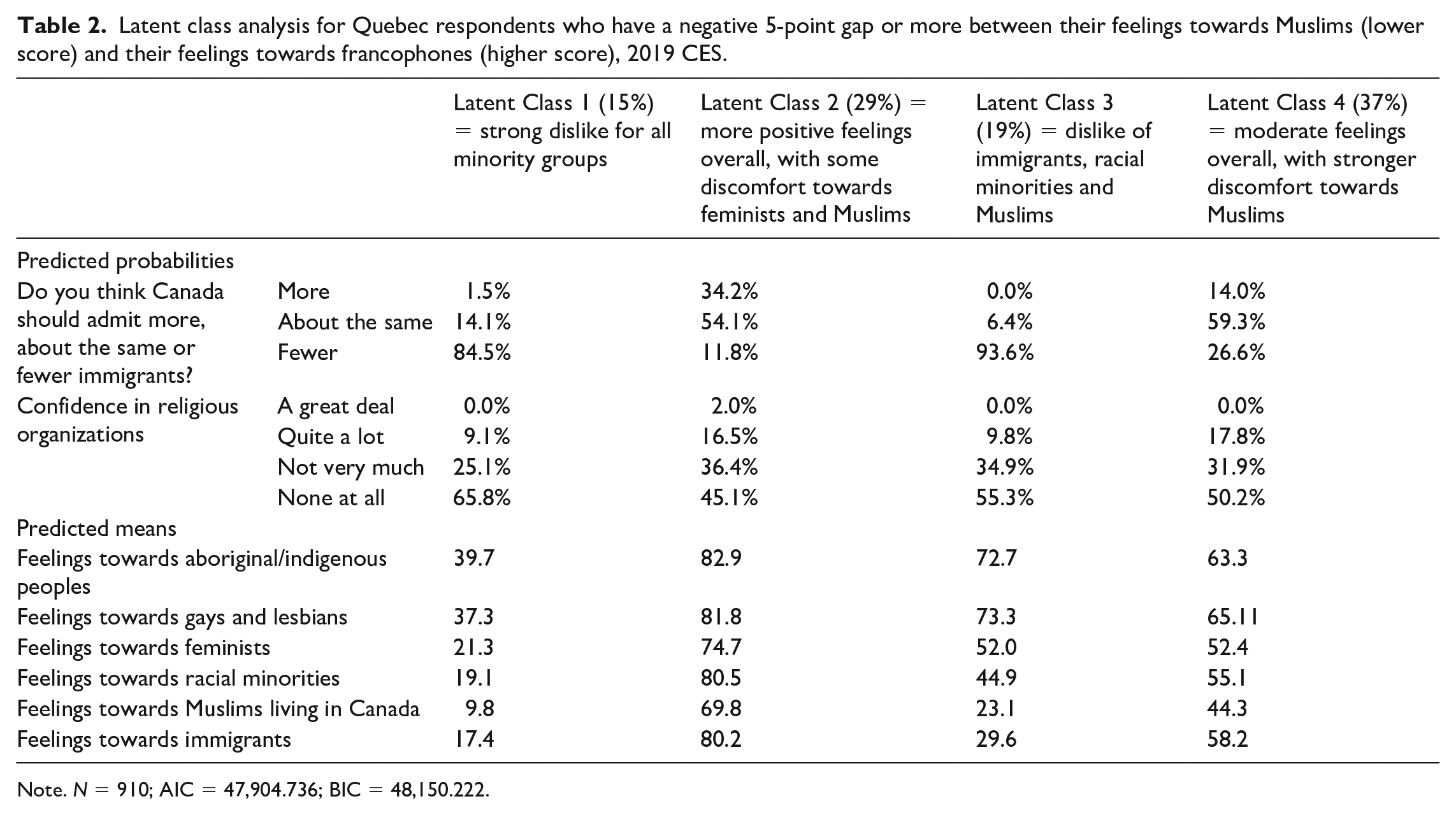
Note. N = 910; AIC = 47,904.736; BIC = 48,150.222.
The first latent class from this analysis is characterized by a high level of dislike of all measured minority and vulnerable groups. This latent class represents 15% of Quebec respondents with a negative feelings gap of 5 points or more between Muslims and francophones. The respondents in this latent class have predicted mean feelings scores of only 40, 37, 21, 19, 10 and 17, respectively, towards aboriginals, gays and lesbians, feminists, racial minorities, Muslims and immigrants. In addition, the vast majority of these respondents (85%) also think Canada should be accepting fewer immigrants. This is the group of respondents we would characterize as showing signs of generalized xenophobia.
The second latent class, representing 29% of Quebec respondents with a negative feelings gap of 5 points or more between Muslims and francophones in 2019, has by contrast more positive attitudes towards different minority and vulnerable groups. Eighty-eight percent of these respondents think Canada should be admitting the same number of immigrants or more immigrants. The predicted mean feelings scores towards minority and vulnerable groups are at their highest, with mean scores of 83, 82, 75, 81, 70 and 80, respectively, towards aboriginals, gays and lesbians, feminists, racial minorities, Muslims and immigrants. Despite these higher average feelings scores, feelings towards Muslims are slightly lower among this group of respondents, although their average feelings score towards Muslims remains quite high at 70. This would indicate some discomfort specifically towards Muslims among these respondents, with a bit of discomfort also directed at feminists, compared with warmer feelings towards other minority and vulnerable groups.
The third latent class, representing 19% of Quebec respondents with a negative feelings gap of 5 points or more between Muslims and francophones in 2019, contains those whose negative attitudes seem to be reserved specifically for racial minorities, immigrants, Muslims and, to a lesser extent, feminists. The predicted mean scores for feelings towards these groups are especially low compared with the respondents’ feelings towards aboriginals, as well as gays and lesbians. Additionally, 94% of these respondents think Canada should be accepting fewer immigrants. These respondents seem to group racial minorities, immigrants and Muslims together into one generalized category that they especially dislike.
Finally, the fourth latent class groups together the largest proportion (37%) of Quebec respondents with a negative feelings gap of 5 points or more between Muslims and francophones in 2019. While most of this group has a relatively positive view of rates of immigration in Canada, and moderate average feelings towards many of the minority and vulnerable groups (with mean scores above 50, but below 70), their attitudes towards Muslims are on average below the 50 mark.
Regarding the levels of confidence in organized religion, most Quebec respondents in the 2019 CES show low levels of confidence: 83% of all Quebec respondents said they had not very much or no confidence at all in religious organizations in 2019. We also see this lack of confidence across all four of our latent classes of respondents with a negative feelings gap of 5 points or more between Muslims and francophones. Consequently, there does not seem to be one latent class with especially low levels of confidence in organized religion to pair with their negative attitudes towards Muslims. Rather, low confidence in organized religion seems to permeate most Quebec respondents regardless of their more specific attitudes towards Muslims. The one latent class that does seem to have somewhat lower levels of confidence in organized religion than the other three is, in fact, the first latent class, which shows a strong dislike for all minority and vulnerable groups.
Figure 4 illustrates the estimated size of each of the four latent classes within the general Quebec adult population, along with the group of respondents who did not have a negative feelings gap of 5 points or more between Muslims and francophones in 2019 (33%).
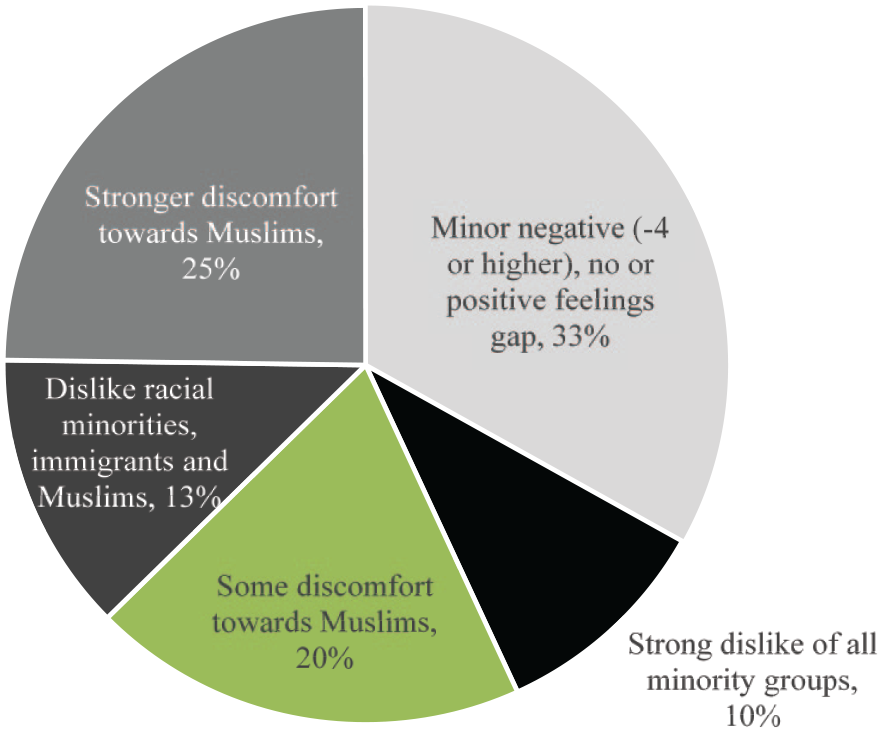
Estimated population distribution of latent classes of individuals with a substantial negative feelings gap between Muslims and francophones, as well as individuals with no substantial negative feelings gap, Quebec, 2019 CES.
We also ran the same type of latent class analysis for Quebec respondents who have a substantial negative gap (5 points or more) between their feelings towards Muslims and their average feelings towards other minority and vulnerable groups in 2019 (aboriginal peoples, gays and lesbians, feminists, racial minorities, and immigrants). The results of this second latent class analysis can be found in Table 3 and Figure 5. These results are similar to those found in our first latent class analysis: the number of latent classes extracted is the same and the profiles of each latent class show many similarities to those from our first latent class analysis. However, these latent classes overall represent a smaller share of the Quebec population. While 67% of the population have a negative feelings gap of 5 points or more between Muslims and francophones, only an estimated 50% of Quebec adults have a negative feelings gap of 5 points or more between Muslims and their average score for all other minority and vulnerable groups.
Latent class analysis for Quebec respondents who have a negative 5-point gap or more between their feelings towards Muslims (lower score) and their average feelings towards minority groups (higher score), 2019 CES.
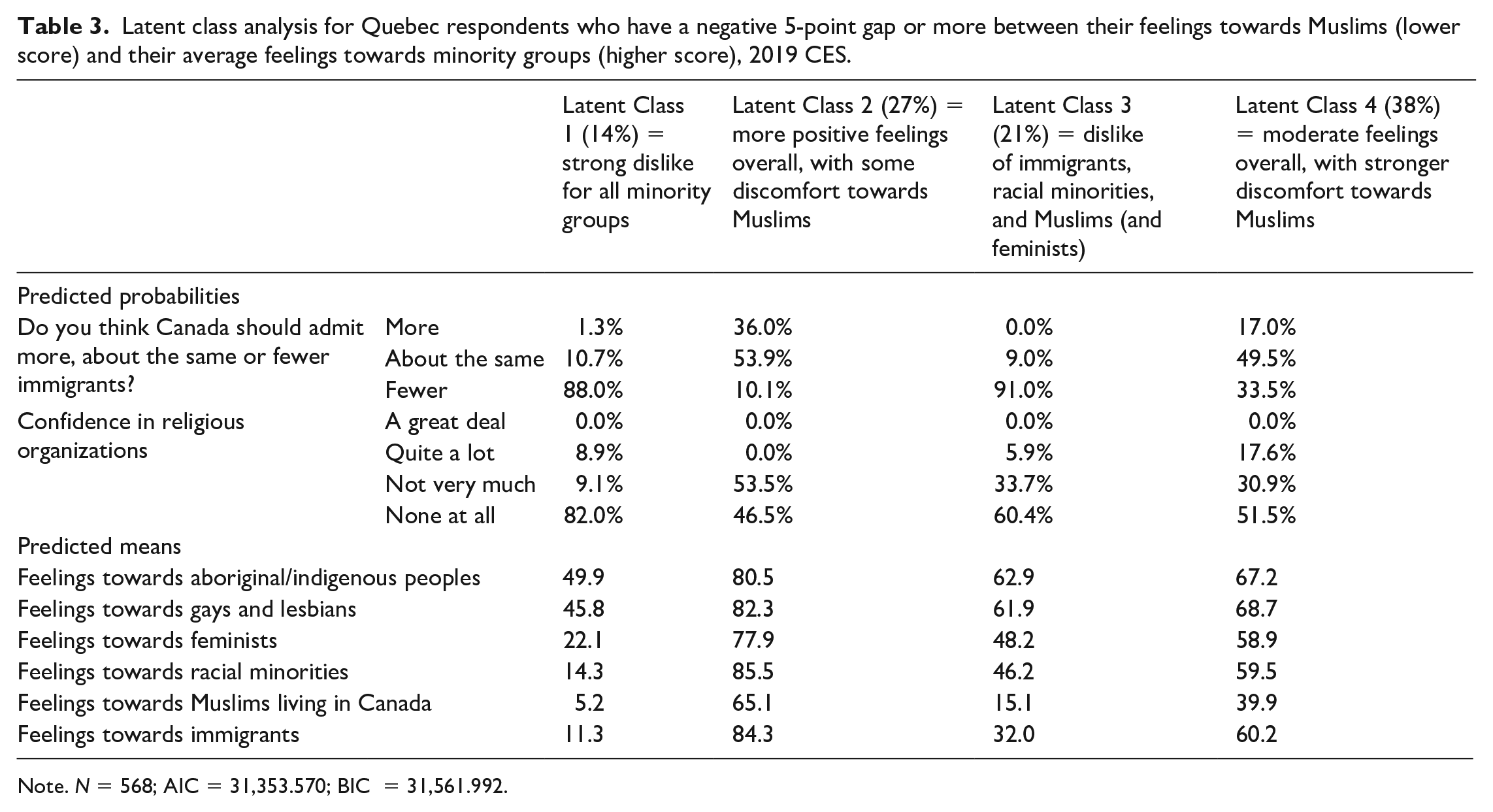
Note. N = 568; AIC = 31,353.570; BIC = 31,561.992.
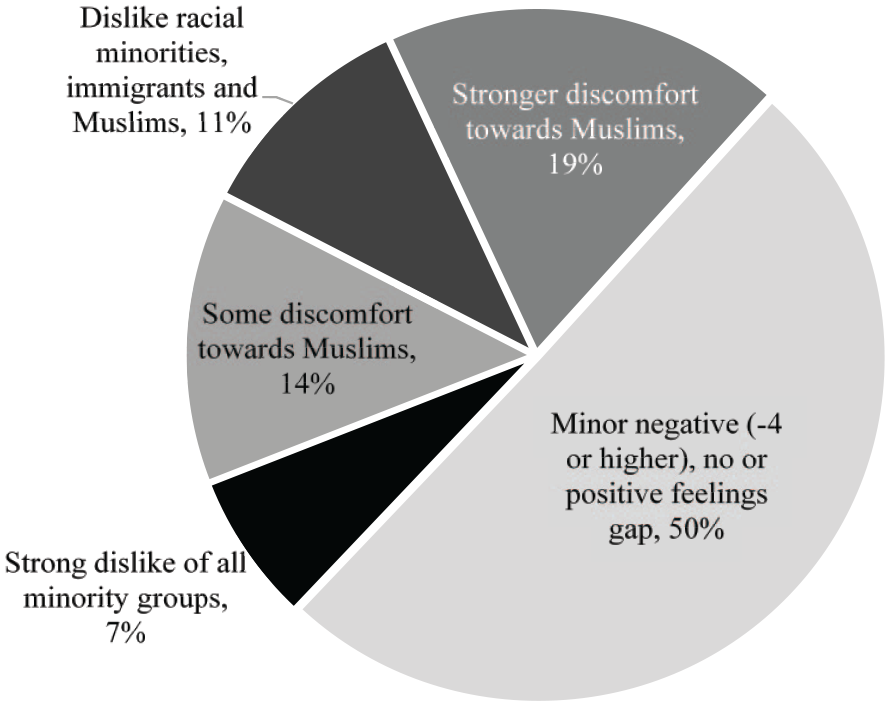
Estimated population distribution of latent classes of individuals with a substantial negative feelings gap between Muslims and average feelings towards other minority groups, as well as individuals with no substantial negative feelings gap, Quebec, 2019 CES.
There are also a few differences between the latent classes of the first and second Quebec analyses (i.e. the results in Tables 2 and 3). The predicted probabilities and means for the variables included in the analysis remain very similar for Latent Class 1 in Table 3 when Quebec respondents with a feelings gap of 5 points or more between Muslims and their average score for all other minority and vulnerable groups are analysed, except for an increase in the predicted probability of individuals who do not trust organized religion. In Latent Class 3, attitudes towards all minority groups are slightly more negative than in the first analysis. In Latent Class 4, there are more positive predicted mean feelings scores towards most minority groups than among the same latent class in Table 2, but slightly more negative feelings towards Muslims.
Latent class analysis among respondents in the rest of Canada with more negative attitudes towards Muslims
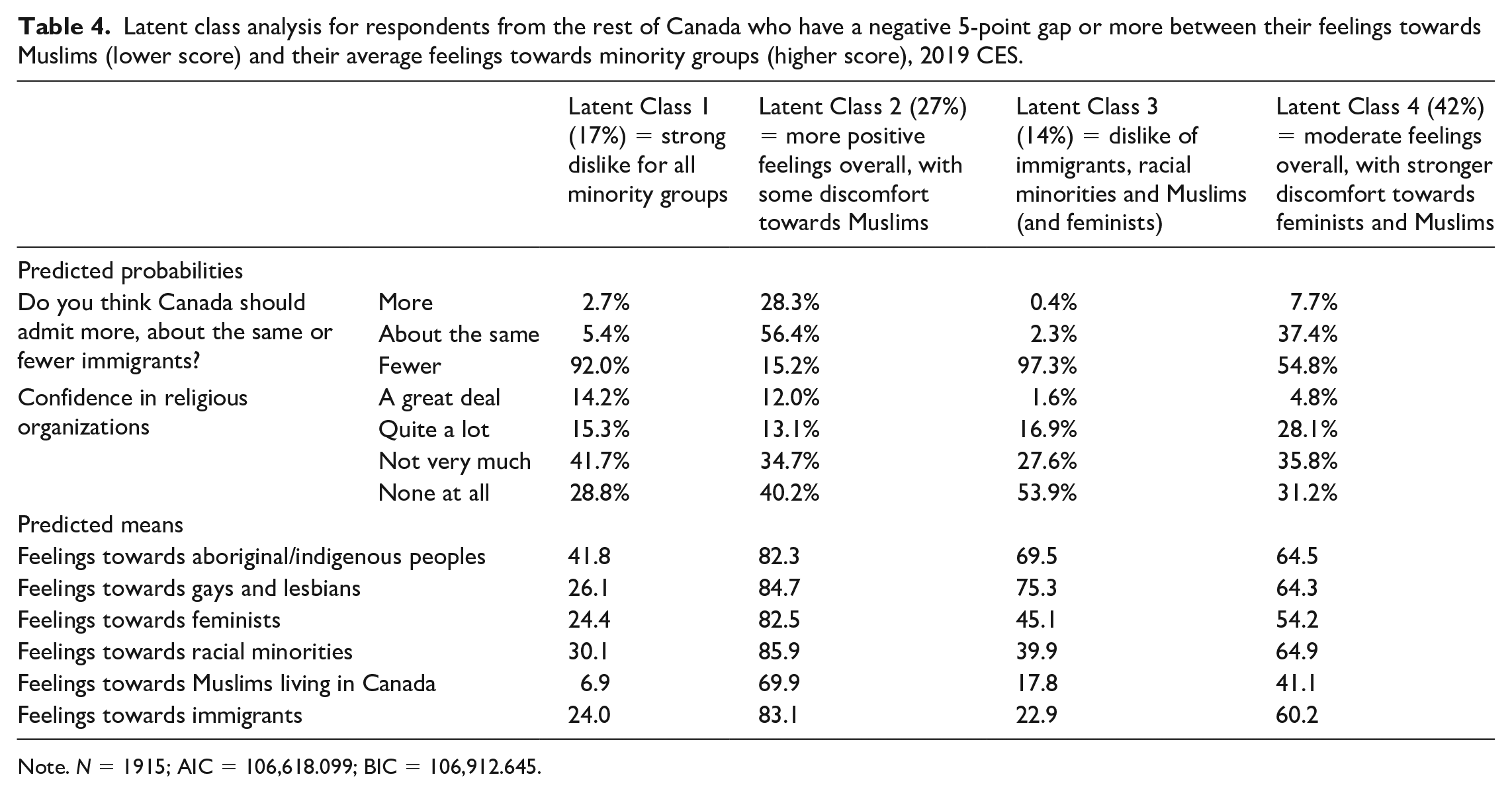
We also ran a similar latent class analysis among respondents from the rest of Canada in 2019 who show signs of a substantial negative gap (5 points or more) between their feelings towards Muslims and their average feelings towards other minority and vulnerable groups. The optimal model for the rest of Canada also has four latent classes. Table 4 shows these four latent classes, as well as each of their predicted probabilities and means for the variables included in the latent class analysis.
Latent class analysis for respondents from the rest of Canada who have a negative 5-point gap or more between their feelings towards Muslims (lower score) and their average feelings towards minority groups (higher score), 2019 CES.
Note. N = 1915; AIC = 106,618.099; BIC = 106,912.645.
The typical profiles found in the rest of Canada mostly correspond to those present in Quebec. However, each latent class represents a smaller proportion of the adult population in the rest of Canada than in Quebec, as illustrated in Figure 6. A few other differences between the rest of Canada and Quebec are worth mentioning here. It is Latent Class 3 that is the smallest in the rest of Canada, compared with Latent Class 1 in Quebec. There are also higher predicted levels of confidence in organized religion overall in the rest of Canada, especially among Latent Classes 1 and 4. In the rest of Canada, the predicted mean feelings scores are higher for feminists in Latent Class 2, whereas discomfort is still present for Muslims living in Canada. In Latent Class 4, the predicted mean feelings scores are lower for feminists (along with Muslims), and a higher rate of respondents in this latent class in the rest of Canada think Canada should be accepting fewer immigrants than what we see for the same latent class in Quebec.
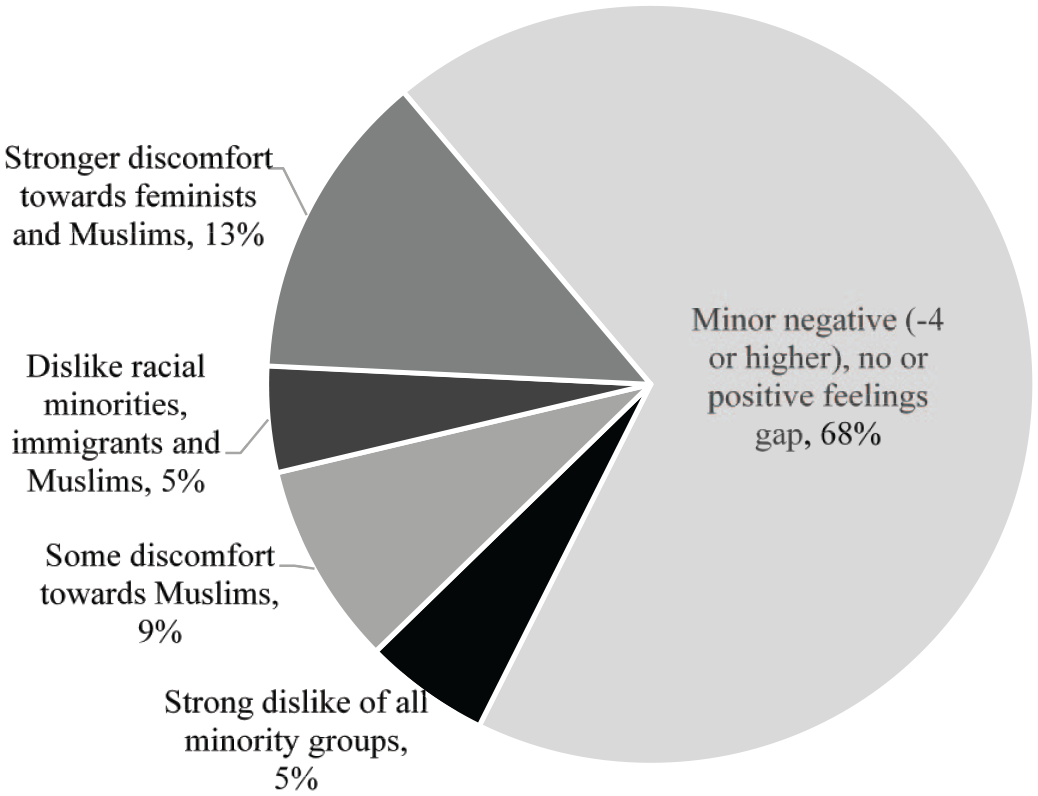
Estimated population distribution of latent classes of individuals with a substantial negative feelings gap between Muslims and average feelings towards other minority groups, as well as individuals with no substantial negative feelings gap, rest of Canada, 2019 CES.
Discussion and conclusion
In light of these results, we find that part of the adult population, be it in Quebec or the rest of Canada, holds certain negative attitudes towards minorities in general, and towards Muslims in particular. Yet there does not appear to have been an increase in the levels of negative attitudes towards Muslims between 2011 and 2019. Bill 21 itself and the public debates immediately before and after it do not seem to have had a significant effect on such attitudes, at least by the time they were measured later in 2019 during the federal election campaign – attitudes that may have already crystallized in an earlier period prior to 2011. The niqab debate during the 2015 federal election campaign, in fact, seems to have been a more important event impacting negative attitudes towards Muslims during the period covered by our study. Although the focus of our study has been on the potential impact (or lack thereof) of Bill 21 and its media and political debates as a contextual factor, future research with more detailed timed data could focus on other key events in the period studied and their impact on public opinion towards Muslims, such as the Quebec City mosque shooting (2017), the M-103 Systemic Racism and Religious Discrimination federal motion debate (2017), and even global events – for example, the attacks against Charlie Hebdo (2015), the Paris attacks (2015) and French state secularism militancy with the ‘burkini bans’ (2016), as well as violent Islamophobic acts in other western nations, like the Christchurch massacre in New Zealand (2019).
With our latent class analyses, we did find a number of distinct groupings when it comes to negative attitudes towards Muslims in both Quebec and the rest of Canada in 2019. These latent classes contribute to a more nuanced understanding of public opinion towards Muslims by differentiating the nature of the observed negative attitudes. We find some support for our first hypothesis of generalized xenophobia. Respondents in Latent Classes 1 and 3 show more negative attitudes towards a number of minority and vulnerable groups, including Muslims. In turn, this generalized xenophobia can be divided into two main subgroups: (1) those respondents who indicate a dislike for all the minority and vulnerable groups measured in our study and (2) those respondents who specifically target racial minorities, immigrants and Muslims with their dislike and discomfort. We also found support for our third hypothesis of more targeted Islamophobia among other respondents in our study. Latent Class 4 is characterized by lower feelings scores reserved mostly for Muslims.
What we did not find much support for is our second hypothesis of a distinct group who especially target their dislike at organized religion and Muslims only. A lack of confidence in religious organizations was instead found among most respondents, especially in Quebec, regardless of their feelings towards Muslims and other minority and vulnerable groups. In the rest of Canada, the latent class with the most negative attitudes towards Muslims (Latent Class 1) is not the one with the lowest level of confidence in religious organizations (Latent Class 3). Often perceived as visible minorities of immigrant origin, Muslims also carry the ‘religious’ attribute (Eid, 2014). In the Canadian context, and in Quebec in particular, this characteristic can be perceived negatively by many, notably because of the heritage of the Quiet Revolution and the love–hate relationship between many Quebeckers and religious institutions. We found quite similar latent classes of individuals with negative attitudes towards Muslims in both Quebec and the rest of Canada, indicating potentially similar underlying processes of racism, Islamophobia and anti-Muslim socialization at play in both regions among certain populations. That said, there does appear to be a contextual impact in that each latent class was proportionally larger in Quebec than in the rest of Canada. Although we did not find a distinct group who especially dislike all forms of religion, the lack of confidence in religious organizations in Quebec may be a key factor in Quebec’s higher average negative attitudes towards Muslims than was found in the rest of Canada.
It is again worth noting, as we did earlier in our ‘Data’ section, that our study only focuses on one dimension of Islamophobia – namely, negative attitudes towards Muslims expressed by individuals. Other dimensions of Islamophobia, such as discriminatory actions connected to implicit bias or structural and systemic discrimination and behaviours, which undeniably also have wide-reaching impacts (including the impacts of Bill 21 on Quebec society and public institutions, especially in the education sector), are not captured by the CES data and our study, and should be the focus of future studies.
What we can say is that Quebec’s broader socio-historical trajectory seems to be key to understanding attitudes towards Muslims in the province, rather than the sole influence of recent secularism laws such as Bill 21. Cultural insecurity and the tense relationship that Quebeckers have with religion are contemporary manifestations of this. Turgeon and Bilodeau have shown that Quebeckers’ attitudes towards immigrants are influenced by cultural insecurity, especially with regard to the French language and Quebeckers’ minority status in North America (Bilodeau and Turgeon, 2014; Turgeon and Bilodeau, 2014). Quebeckers’ relationship with organized religion adds to this in the case of their attitudes towards Muslims. While the positive dimension of Quebeckers’ relationship with religion is tied to their cultural identity and family heritage (Laniel, 2016: 450), their current relationship with Muslims may only leave room for a critical view of a religion that is not well known by the general public (Giasson et al., 2010) nor perceived to be tied to the history and traditional culture of the province. This distinct relationship with religion, which more Quebeckers seem to have than those outside of the province, is an additional way to analyse the complex ties that a province shaped by a certain image of the Church can have with members of a religious minority.
Supplemental Material
sj-pdf-1-sir-10.1177_00084298221149695 – Supplemental material for The many facets of negative public opinion towards Muslims
Supplemental material, sj-pdf-1-sir-10.1177_00084298221149695 for The many facets of negative public opinion towards Muslims by Jacob Legault-Leclair and Sarah Wilkins-Laflamme in Studies in Religion/Sciences Religieuses
Footnotes
Declaration of conflicting interests
The authors declared no potential conflicts of interest with respect to the research, authorship and/or publication of this article.
Funding
The authors received no financial support for the research, authorship and/or publication of this article.

Supplemental material
Supplemental material for this article is available online.
Notes
References
Supplementary Material
Please find the following supplemental material available below.
For Open Access articles published under a Creative Commons License, all supplemental material carries the same license as the article it is associated with.
For non-Open Access articles published, all supplemental material carries a non-exclusive license, and permission requests for re-use of supplemental material or any part of supplemental material shall be sent directly to the copyright owner as specified in the copyright notice associated with the article.
