




Abstract
This review article aims to reflect on the history of religion at home through testing the comparative promise of the Bloomsbury series A Cultural History of the Home. Through an extensive reflection on six historical periods of western history, the reader encounters key ideas about the historical-specific demarcation of the home, gender roles, and the domestic religious objects and practices that came to co-define those boundaries. Despite the comparative layout of the series, and the excellent contributions, A Cultural History of the Home never engages in explicit comparisons across the volumes, leaving space for future comparative work in the study of religion, gender and material culture.
Amanda Flather (Anthology editor)
London: Bloomsbury Academic, 2021
Andrew Wallace-Hadrill and Joanne Berry (eds)
Katherine L French (ed.)
Amanda Flather (ed.)
Clive Edwards (ed.)
Jane Hamlett (ed.)
Despina Stratigakos (ed.)
A cultural history of the home
The American British author Bill Bryson introduces his successful – and often disturbingly humorous – At Home: A Short History of Private Life with some defamiliarizing thoughts about houses: Houses are really quite odd things. They have almost no universally defining qualities: they can be of practically any shape, incorporate virtually any material, be of almost any size. Yet wherever we go in the world we recognize domesticity the moment we see it. (Bryson, 2010: 55)
Indeed, despite our immediate sense of familiarity when seeing historical houses, ‘everything [about the house] had to be thought of’ and, Bryson states, this ‘took far more time and experimentation than you might ever have thought’ (Bryson, 2010: 55). Historians and sociologists who are interested in everyday life have long employed similar interlocking strategies of familiarization and defamiliarization – although often less humorously – to contextualize and explain the home as an architectural, emotional, social and legal entity. According to early scholars of religion, like Durkheim’s teacher Fustel de Coulanges (1956: 42), religion played a key role in the definition of the home and family as ‘a group of persons whom religion permitted to invoke the same sacred fire, and to offer the funeral repast to the same ancestor’. Such early historicizing approaches coincided with widely read Protestant household manuals prescribing proper domestic conduct, in which the home was a quintessential religious space (e.g. Hall, 1883).
This review article aims to reflect on the history of religion at home through testing the comparative promise of the Bloomsbury series A Cultural History of the Home, Volumes 1–6. In the series introduction, Amanda Flather (‘Series preface’, in Wallace-Hadrill and Berry, 2021: ix) states that the volumes explore ‘the changing meaning of home, both as an idea and as a place to live, from ancient times until the present’. By employing an identical basic structure for the individual volumes with exactly the same thematic chapters, the series aims to enable the comparative study of the meaning of home (chapter one); family and the household (chapter two); the house (chapter three); furniture and furnishings (chapter four); work and the home (chapter five); gender and the home (chapter six); hospitality and the home (chapter seven); and religion and the home (chapter eight). Since each volume contains eight chapters written by individual specialists, the series brings together 51 scholars from a wide variety of disciplines – with more female (42) than male (9) contributors. Unfortunately, almost all the contributions remain primarily focused on western cultures.
To evaluate the success of this comparative structure, I will examine the various chapters related to religion, the meaning of home and gender with a focus on the role of women and the influence of institutionalized group-specific religions. The former focus derives from the problematization of the traditional public–private, male–female and work–religion binaries that are deeply rooted in the prescriptive realities of the above-mentioned Victorian-era household manuals. The latter focus on institutionalized religions relates to recent studies of lived religion, in which individual agency and bricolage are detected and highlighted (Ammerman, 2021). Underlying this approach is the assumption that we can detect comparable patterns in historical societies, allowing us to see where, when and how religious practices change with society and when they remain unaffected by societal transformations (Freiberger, 2019). 1
. . . in antiquity (500 bc –800 ce )
Victorian domestic literature does not stand alone in its moralizing prescriptives stressing a doctrine of separate spheres. The late-5th-century Athenian rhetor Lysias provided a page-turning legal thriller on the limits of a man’s legal right to kill the lovers of his wife (e.g. Odysseus’s return home) in the face of the state’s interests in intervening in the domestic sphere. His On the Murder of Eratosthenes also gives crucial snapshots of the idealized Athenian home, the separation of male and female quarters, and gender roles along the way. Xenophon’s household treatise Oeconomicus likewise resembles the Victorian literature, providing step-by-step descriptions of how a wife should run her domestic household in a manner that is not dissimilar to Mrs Beeton’s household manual, albeit with more space for the managing of slaves. Roman households and houses, although often described in contrast to their Greek equivalents, functioned similarly. They may have had more permeable boundaries between inside and outside, since ‘the separation of the “home” from work and its essential private nature is constantly breached in the Roman domus, and far more so than in the Greek equivalent’ (Wallace-Hadrill, ‘The meaning of home’). In fact, if Vitruvius is to be believed, Roman houses did not even have specific women’s quarters, making the separation of men and women flexible and situational. Even in the Christian era, the cubiculum (not entirely the equivalent of the modern bedroom) continued to be a place where wealthy virgins and widows received social visits.
Kate Wilkinson’s (‘Gender and home’, in Wallace-Hadrill and Berry, 2021: 119–140) analysis of the home as a reproductive and erotic space stresses the importance of the production of legitimate heirs, which gave women a key role in the continuation of male-line inheritance. This inequality existed not only in gendered relationships, but also in the social hierarchies, with enslaved men and women who worked alongside the free members of the familia in a wide variety of domestic duties, ranging from learned intellectual labour and skilled craftmanship to personal attendance and heavy work on the land. The basic gendered pattern of male work outside the house and female work predominately inside the home intersected, with social and status-based differentiations.
Religious practices at home followed gender and status-based differentiations. Despite the central role of women in the home, the male head of the household was responsible for most hearth rituals, with explicit exceptions where he could be replaced by female members of the household. The visual apotropaic images and objects in the home, moreover, were often sexual in nature, including phallic symbols, depictions of love-making and dwarfs with enormous erections – ‘a divinization both of male sexual aggression and of fertility’ (Wilkinson, ‘Gender and home’, in Wallace-Hadrill and Berry, 2021: 139). Since many of the portable religious objects from the Greco-Roman world – such as altars, statuettes and utensils – have been lost or found outside of their original contexts, permanent shrines and paintings in larger houses continue to define our knowledge of domestic religion. The spatial distribution of the so-called Pompeian lararia, in which Roman families venerated the Lares, Penates and ‘spirit’ (genius) of the father of the household, indicates degrees of accessibility and the intended audience – for example, slaves worshipping at the lararia in the kitchen (Graham, 2021; Haug and Kreuz, 2021). The deities included in these extant shrines give the impression of family traditions over generations, with very few indications of institutional pressure from outside the domestic realm. In fact, despite the intrinsic connection between ancient houses and family deities, new divine figures could be introduced easily. Carlos Machado (‘Religion and the home’, in Wallace-Hadrill and Berry, 2021: 161–180) highlights how houses and households played a role in the spread of new religious ideas – for example, in the introduction of the cult of Serapis in Delos through the patronage of wealthy patrons.
New Testament and early Christian authors also describe wealthy household networks as pivotal to the spread of Christianity, even though some biblical texts seem to demand a rejection of traditional family life in favour of a thorough devotion to Jesus (e.g. Matt. 10:35, where Jesus speaks about setting children up against their parents). In practice, Christianity had little influence on the gendered division of labour and traditional male authority. The house became a crucial meeting space and the home served as a metaphor for the assembly of the faithful: ‘despite the renunciations of these ascetic over-achievers, the home as the point of convergence between house, family, property including slaves, and sentiment survived unscathed’ (Wallace-Hadrill, ‘The meaning of home’, in Wallace-Hadrill and Berry, 2021: 33; see also Machado, ‘Religion and the home’, in Wallace-Hadrill and Berry, 2021: 175–180). Fourth-century Christian traditions, however, developed a more suspicious attitude towards domestic religious rituals as a potential source of heresy and illegitimate rituals. This double evaluation of the domestic sphere resulted in Roman legal prohibitions of some religious gatherings at home – for example, against the Manichaeans in the Theodosian Codex 16.5.3 (see Matsangou, 2017) – and a growing tradition of ascetics’ domestic retreat, defining the house as a sacred space and religious centre.
. . . in the medieval age (800–1450 ce )
A strong emphasis on emotional bonds among members of the household characterizes the second volume of A Cultural History of the Home, in which the medieval ‘home’ is defined through the shared activities and reciprocity of those living under the same roof (Roisin Cossar, ‘The meaning of home’, in French, 2021: 15). While, legally speaking, medieval societies continued to grant the head of the household full paternal control (patria potestas), local city records show that it was mostly an implicit organizing principle. Likewise, ideological ideas about female seclusion are better understood as prescriptive ideals, from which reality deviated. There are, moreover, many local and regional exceptions to the previously observed pattern of women being more restricted at home in southern Europe than in northern parts (chapter six has a strong emphasis on Scandinavia). Despite such observations, the long trend throughout this period leads to a stronger differentiation of gender roles. In the later Middle Ages, home language became associated with obligations, highlighting the intersection of social hierarchies and affective intimacy. The increasing spatial segregation of men and women led to more pronounced female seclusion, a pattern with many exceptions that was tied to social class and wealth differentiation. The spatial segregation of men and women in castles, for example, went hand in hand with prescribed elite ideals of female behaviour and masculinity (i.e. chevaliers in need of female adoration). Many ‘ordinary’ women routinely transgressed the idealized gender segregation when working in the fields, practising crafts and engaging in trade.
Elisheva Baumgarten and Katherine L. French’s chapter on ‘Religion and the home’, comparing Jewish and Christian experiences in Europe during the late Middle Ages, is one of the most elaborate examinations of religion at home in this series, including reflections on religious space and imagery, the use of books, rituals and objects related to eating, and life-cycle rituals. They conclude that domestic devotion was tied to institutional religion in parish churches and synagogues, while the political status of Jews in certain circumstances led to a more pronounced centring on domestic religiosity. Although Jewish and Christian homes had different daily routines and religious decorations, tied to their group-specific identities and repertoires, the chapter’s parallel discussion of Jews and Christians highlights similarities, like the use of prayer books (e.g. the Book of Hours in a Christian context) and domestic religious instruction manuals (e.g. Jonah of Gerona’s Iggeret HaYir’ah). A striking example of interreligious contact and boundary maintenance is the Jewish woman who refused the ritual with a stone offered by her Christian neighbour, as it was purportedly from Jesus’s tomb (Baumgarten and French, ‘Religion and the home’, in French, 2021: 169). With such neighbouring relationships in mind, the frequent absence of religious adornments most probably reflected familiar and personal choice rather than institutionalized religious mandates and concerns. Jews – who are missing in the first volume of this series – were less invested in the visually marked decorative and everyday objects that came to characterize Christian homes, although candles, brooms, embroidered cloth and amulets could carry specific Jewish connotations in light of the complex interplay of space and time – for example, cleaning the house on a Friday before the Sabbath begins (see Frankfurter, 2021). Particularly strong is the chapter’s focus on life-cycle rituals focused on women’s bodies, supporting and materializing divine favour during pregnancy and childbirth (Baumgarten, 2004, 2014). Despite group-specific repertoires, the physical and social needs of Christian and Jewish women were ritualized in a similar manner.
. . . in the Renaissance (1450–1650 ce )
Cultural and religious practice during the Renaissance formed conceptual distinctions between men and women in the home, invoking classical ideas about the virtues and vulnerabilities of the female body. Like many of the other volumes in the series, the contributors to Volume 3 stress the distance between such gendered ideals and day-to-day practice. Amanda Flather’s chapter on ‘Gender and home’ highlights female agency despite symbolic, legal and practical hierarchical distinctions between the genders. Since many husbands had to travel for political or commercial reasons, women frequently ran their households on their own, acting as business managers and primary caretakers at the same time (Flather, ‘Gender and home’, in Flather, 2021: 136). Despite earlier claims of two types of household (either the nuclear family or multigenerational systems), a broad variety of constellations is visible, frequently including slaves and servants, as well as dependent co-living apprentices. Cynthia Wall’s examination of the linguistic representation of ‘home’, itself characterized by a literary quality, considers the home as a ‘way of positioning oneself in one’s corner of the world’ (Wall, ‘The meaning of home’, in Flather, 2021: 15), pointing to the feeling of being ‘at home’ as frequently studied among modern migrants (see Boccagni and Duyvendak, 2020).
The technological and societal developments of the Renaissance strongly affected the religious currents and living situations of many. Protestant and Catholic reformations led to a fragmentation of religion and culture, which coincided with the widespread use of printing presses, colonial expansion and associated transregional warfare in Europe. Population growth and proto-industrial manufacturing, moreover, contributed to the rise of a so-called ‘middling order’, which benefited financially from the expanding market economy. As a result, the number of objects in houses increased rapidly. Another implication was the slow trend away from single-room dwellings with multifunctional spaces towards houses with more rooms, each with a specialized function. In elite circles, this connoted a reordering of social relationships, leading to the marginalizing and privatizing nature of some spaces, but neither stood in a one-to-one relationship with an increasing desire for privacy or gender segregation (Flather, ‘Introduction’, in Flather, 2021: 8). Still, the restructuring of domestic spaces affected the position of domestic religious objects, which were either displayed or hidden for fear of persecution.
Tara Hamling, in one of the most richly illustrated chapters in the series, argues that the Protestant Reformation was not a wholesale shift away from the use of devotional images, but rather represented a gradual ‘purging, editing, adapting and redirecting’ of visual culture (Hamling, ‘Religion and the home’, in Flather, 2021: 194). Large wooden cupboards, for example, had various functions. On the one hand, scenes of wildlife served to illustrate the family’s wealth, education and social status, while, on the other, biblical scenes could turn a cupboard into a domestic altar (Hamling, 2010). Particularly interesting, following her examination of continuity in daily rhythms and material items in England, is her analysis of depictions of meals in continental European prints and paintings. A painting of Hans Conrad Bodmer’s Swiss family illustrates well how social status relationships were expressed alongside strong religious messages. The family is depicted saying a prayer at table, demonstrating and memorializing their piety visually, and this message is underscored by the personified virtues depicted on the stove and in the windows. Such stove plates with biblical depictions combined, for example, the biblical message of the rich man burning in Hell with the viewer’s embodied experience of a stove’s heat (Hamling, ‘Religion and home’, in Flather, 2021: 188). Some of these objects can be directly related to gendered domestic rituals, like the miniature pipe-clay statuettes that belonged to a type of ‘hands-on devotion’, for which few literary sources remain (Smits, 2020).
. . . in the age of Enlightenment (1650–1800 ce )
The age of Enlightenment is known for a scientific revolution, in which human reason became central and democratic experiments led to major political events throughout Europe. Many of these ideas were developed and circulated at home. The central change during this period, moreover, was the reconceptualization of the home as a shelter for a family-based household, less a place of work, with special emphasis on child-rearing, privacy and self-contained ‘private’ identities. In most cases, the household continued to include lodgers, apprentices and servants. The European home was not yet as private as, for example, some of its Chinese equivalents (Amsler, 2018).
The literary ideas and architectural and decoration practices of this new ‘culture of domesticity’ came to emphasize comfort and intimacy. Late-18th-century novels describe and represent the intimate interiors of homes systematically for the first time, even including them in so-called conversation pieces in which men and women are depicted in richly decorated domestic settings (Lipsedge, ‘The meaning of home’, in Edwards, 2021: 20). Apart from establishing the home as a centre for social interactions, this trend identified the house’s interior and exterior as a public statement of personal virtue and character. English novels, for example, use the physical layout and decoration of the home as a metaphor for (the absence of) harmony in the family. Through the private reading of these novels, hominess and privacy were discursively constructed, as argued extensively elsewhere by Krista Lysack (2019).
The idealization of the domestic sphere was not limited to a particular vision of femininity, tied to the familial sphere and contrasted with public engagement. According to Ruth Larsen in her chapter on ‘Gender and home’, it also affected and created hegemonic masculinity. The ideal of the father as the godly patriarch shifted to an image of a sociable, polite gentility and sensibility that redefined male emotions just as much as female sentiment (McDannell, 1986). As a result, some rooms in the home were thought of as shared gender spaces where men and women were brought together, such as the libraries and drawing rooms of the upper middle class. Larsen’s outstanding chapter stresses the contested nature of separate spheres in the 18th century. Elite women also had an influence on local and national politics, used philanthropy as a public political tool, organized politicized dinner parties, and engaged in trade and social networks, which placed them in an influential social position and effective businesses (Larsen, ‘Gender and home’, in Edwards, 2021: 133). This tension between prescriptive literature and everyday realities remains a central theme throughout all of the volumes in the series. It is therefore surprising how heavily Matthew Neal’s chapter draws on so-called 18th-century religious conduct literature, which contained prescriptive instructions for a pious and orderly family life. Specifically, he aims to demonstrate the 18th-century domestic roots of Christian ideas about religious toleration. Although the Christian conduct literature cited throughout the chapter is very informative about religious expectations regarding domestic piety and harmony (often associated with Victorian-era conduct literature (see Gowrley, 2022)), it tells the reader little about the social dynamics of lived religion in the home. Eighteenth-century writers like Samuel Stennett, White Kennett and Thomas Gisborne stressed that domestic peace could be achieved through the cultivation of a ‘character of brethren’ and the virtue of friendship in and through Christian devotion (Neal, ‘Religion and the home’, in Edwards, 2021: 193). In this rhetoric, the husband was the head of the household but his power was limited by the virtues of brotherliness, harmony and tolerance, giving space for his wife and children to flourish.
. . . in the age of empire (1800–1920 ce )
The modernization of farming, increasing industrialization and the further expansion of colonial empires, ending in the drama of the First World War, set the stage for the fifth volume. As a general trend in this period, the home and family were seen as providing security and stability in a turbulent world of economic and political change. In this idealized image of the home, the mother was the ‘angel of the house’, and families would gather peacefully around the piano in their own parlour – a depiction far removed from the harsh realities of most working- and middle-class families. This volume stands out because of its explicit aim to examine the homes of working people, which is refreshing due to the extensive literature on the Victorian middle class (Davidoff and Hall, 2018), and its inclusion of two chapters on non-European homes.
Victorian-era households became the carriers of imperial and consumerist ideologies, including the representation of wealth through the acquisition of new luxury items that could be displayed in rooms with specific functions and dedicated furniture. The functional differentiation of rooms quickly became more common for a larger segment of the population. It was also combined with the idea of interior design as an expression of personal identity, which undergirded the early 19th-century transition from moralizing household manuals to homemaking advice based on principles of consumption and expressing individuality. Religiously motivated femininity, characterized by self-sacrificing love, came to be seen as the cornerstone of the household, and thereby of the entire nation: Home is a divine institution, coeval and congenital with man. The first home was in Eden; the last home will be in Heaven. It is the first form of society, a little commonwealth in which we first lose our individualism and come to the consciousness of our relation to others. Thus it is the foundation of all our relationships in life – the preparation-state for our position in the State and in the Church. (Phillips, 1859: 14–15)
How this played out in practice differed, as women in southern US households carried authority over enslaved people and domestic servants – a configuration that would change after the American Civil War. Late 19th-century female activism, moreover, redefined gender relationships by putting women’s suffrage, financial independence and sexual autonomy on the agenda.
Lucinda Matthews-Jones’ chapter on ‘Religion and the home’ is narrowly focused on the 19th-century English working class through the perspective of autobiographies collected in the Burnett Archives, London. One of her striking observations is that working-class fathers played a pivotal role in the religious instruction of their children, contrary to the earlier-mentioned thesis of a ‘feminization’ of religion (Douglas, 1977). In these autobiographies, we also get a glimpse of the institutional facets of domestic religion – for example, participation in Sunday schools and the regular singing of denominational hymns. The temporal rhythms provided by weekly and annual liturgical patterns shaped working-class households, even though this did not always include church attendance. One autobiography, for example, reflects on what literature was allowed during Sunday leisure and which books were deemed unsuitable (reading Gulliver’s Travels or Puss in Boots was not allowed). Such books belonged to the material religion of working-class families, who could also afford cheap scrapbooks, home-made needlework, and second-hand mugs and plates inscribed with religious messages. 2 Such objects have frequently been associated with the increasing commodification of religion, even though this development also gave rise to a new ‘age of homespun’, in which authenticity and Protestant work ethics were expressed in (mostly female) domestic manual labour (Ulrich, 2001).
. . . in the modern age (1920–2000+ ce )
The history of the home is not only a positive story of progress and sentimentality. For many people, the home is associated with repression, trauma and absence. Narrating histories about religion in modern homes therefore incorporates the technological innovations that facilitated changing styles and fashions in interior design, architecture and kitchen machines with the destruction of cities during the Second World War and the continuing displacement of many people in – and at the borders of – Europe. Despina Stratigakos’s introduction highlights ideological fears and home threats. Increasing homeownership, mass consumption and growing inequality during the 20th century were combined with the questioning of traditional domestic ideologies. Social developments like late marriage, female work outside the home, the legalization of same-sex marriages, the rise in divorce rates and the associated number of single-occupancy households were perceived of as challenges to traditional religious family values. One noteworthy shift is visible in the well-known television series Friends, which exemplifies a casual style of interaction at home, far removed from preceding hierarchical Victorian arrangements.
Rachel Hurdley’s chapter on practices of meaning-making stands out for its analysis of contemporary domesticity. Particularly interesting with regard to this topic, although mostly outside of the scope of Hurdley’s chapter, is Emily Matchar’s (2013: 5) work on ‘new domesticity’, designating a 21st-century rejection of societal norms of efficiency and independence, and turning to do-it-yourself home solutions instead as a product of this generation’s ‘longing for a more authentic, meaningful life in an economically and environmentally uncertain world’. In general, however, 20th-century houses transformed from sites of production to sites of consumption, with material objects representing family identity and memory. This identity was simultaneously shaped by consumption-based values and actively shaping human lives through assemblages of objects and attributed meaning to everyday places, such as domestic mantelpieces. 3
The home remained strongly associated with femininity, even though, legally, the husband was in charge of the household. Despite the women’s movement for equal rights, technological kitchen innovations were still advertised towards men, for example, announcing the opportunity to buy ‘a new kitchen to suit
Religious practice at home brings religious institutions together with people’s everyday lives, blurring the lines between the ‘private’ and the ‘public’ sphere. Domesticated media practices, such as televangelists bringing the gospel into the living room or the commodification of feng shui, have ritual implications. The intersection of religious holidays and rites of passage offers a window onto the role of consumption in the home, leading Klassen to point to the influence of late-19th- to early 20th-century domestic Christmas celebrations on the development of North American Hanukkah celebrations as typical Jewish practice with menorahs and dreidels (Klassen, ‘Religion and the home’, in Stratigakos, 2021: 196). Interfaith families, moreover, developed religious rituals at home that brought Jewish and Christian traditions together in what has been called ‘Chrismukkah’, combining and innovating dual religious loyalties. This celebration and embracing of the domestic sphere is also visible in the contemporary movements of home birth and home dying, which aim to take these important ritualized events away from the medical sphere and reintegrate them into a personalized home. Domestic spaces are thus designed to facilitate, and perceived of as facilitating, ritual practice, bodily experience and social relations.
Conclusion: social and comparative perspectives
The six volumes of A Cultural History of the Home offer a wide range of detailed examinations of home relationships. They also illustrate a profound academic change from single-authored histories, like John R Gillis’s (1997) A World of Their Own Making: Myth, Ritual, and the Quest for Family Values, to multi-authored histories examining the wide variety and diversity of homemaking and religious practices. This cultural history series is particularly successful in bringing a mosaic of perspectives and topics coherently together, without synthesizing them into a singular history of the home. The unavoidable overlap between the chapters is minimal, showing excellent editorial work. This series will undoubtedly be beneficial to a new wave of historical research pertaining to domestic spaces, threats and fears, and everyday religiosity following the COVID-19 pandemic.
Some key ideas, which recur in almost all of the volumes in the series, deserve to be mentioned separately. These ideas are at the core of current cultural history studies of the home, highlighting the constructed and contested nature of domestic spaces:
None of the editors of the volumes aim at a singular definition of ‘home’. Almost all of the chapters conceptualize it through a broad overlap of idealized cultural constructs, lived experiences, and physical structures associated with the family and household. Paradoxically, most of the historical ‘homes’ under discussion are organized around the nuclear family, although every volume reiterates the complicating factors of live-in slaves, servants and apprentices.
For most historical societies, the home was a place of work. This has complicated traditional ideas about a separation of the private and the public sphere. Any attempt to formulate a distinction between domestic and non-domestic space therefore has to reflect how this modern, western, urban binary shapes our perspectives of the dynamics of historical societies.
One common way of rethinking privacy and questions of accessibility is by using spatial analysis to map out how central a room was to a particular house, thereby reconstructing who could have had access to particular spaces. This is especially helpful when thinking about the function of domestic religious objects and images.
Women were frequently described as secluded at home, but there is a big leap between prescriptive domestic ideology and the reality of female agency in everyday life. Critical feminist scholarship has brought to light the many ways in which women participated in decision-making mechanisms, even if this was primarily through home-based activities and female-only networks.
Gender-related questions are important throughout the series – not only in the chapters on gender and the home. In most of the volumes, the social and religious roles of women are related to class-based differentiations, stressing the different experiences of enslaved, black or working-class women.
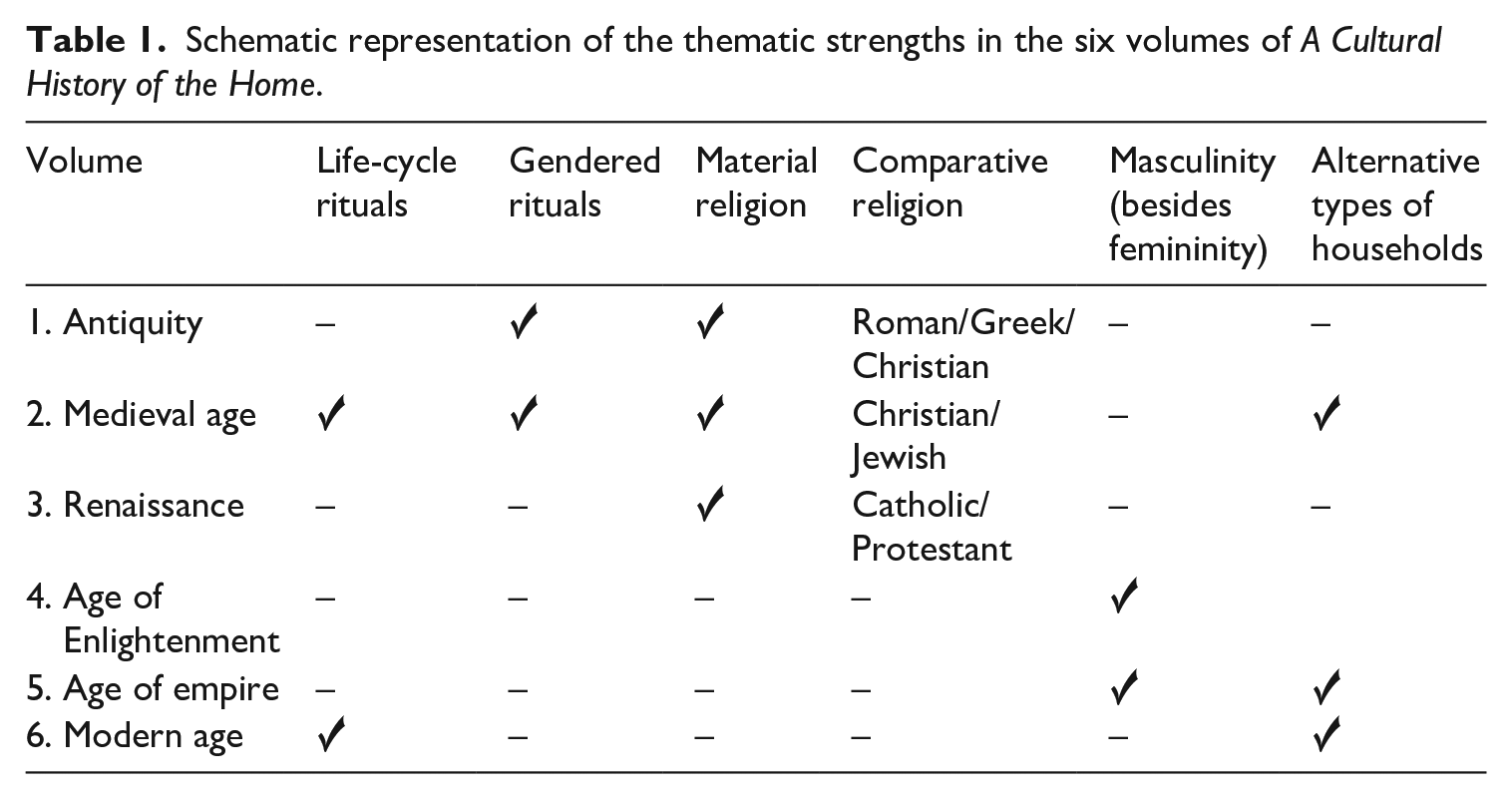
Despite these similarities, the six volumes are also different in the histories they present. Identical chapter titles are no guarantee for similar choices when representing religion, gender and historical definitions of the home. Table 1 gives a limited representation of the volumes’ thematic strengths, excluding many of the detailed and important observations about societal change, technological innovation and the home–work relationship. Significantly, the first three volumes contain reflections that one could categorize under ‘the historical and comparative study of religion’, while the other three volumes relate less to the (admittedly often institutionalized) religious diversity in the societies they study. Researchers interested in the gendered nature of domestic religious rituals – such as the practices of elderly Jewish women in Jerusalem, who ‘domesticated’ (i.e. personalized) rituals for the protection of their loved ones (Sered, 1988) – will find more elaborate observations in the first two volumes, while the performance of masculinity is an explicit theme in Volumes 4 and 5. The only instance where these differences in focus are problematic is in the relative absence of a material-religion focus in Volumes 4, 5 and 6. It remains important to stress that the turn towards analysing material culture is not only necessary to fill gaps in the extant literary record, but also presents an alternative perspective that holds the potential to change the way we see individuals and families negotiating religious ideas and practices in the home (Koch and Wilkens, 2019; McDannell, 1995).
Schematic representation of the thematic strengths in the six volumes of A Cultural History of the Home.
Finally, some critical qualms and observations arise from my own comparative ambitions and academic sensitivities in the study of religion. A major shortcoming of A Cultural History of the Home is its thoroughly western selection of homes, excluding almost everything outside of the European and North American realms. Volume 1 (Antiquity), for example, excludes the Persian Empire, Mesopotamia (Bodel and Olyan, 2008), Egypt (Boozer, 2021) and China. Discussion of medieval religiosity is restricted to Christian and Jewish traditions, leaving Islam mostly unmentioned. Religion in the modern age is limited to North American traditions and practices (with occasional European parallels). The only exceptions to this western focus are the chapters on the former British Empire in Volume 5, discussing homes in India and East Africa. While there are practical reasons for these choices, it continues a questionable academic practice that needs to be changed by new – call it ‘post-colonial’ – scholarship. 4
One of the fundamental tensions of A Cultural History of the Home is between the encyclopaedic ambitions of the series, on the one hand, and the value of individual case studies pertaining to a specific geographical area, on the other. Some chapters on religion are clearly designed to offer an overview over a long period of history, providing excellent summaries of current scholarship illustrated by historical sources and observations about longue durée trends. Other chapters are more specifically focused on case studies that present an example of domestic religiosity in a particular period of history. Jane Hamlett, for example, chose to include this latter type of chapter in Volume 5, presenting original research on religion among the British working class. Both approaches are valuable, but at times it gives one the feeling of unevenness between the volumes and topics (which has nothing to do with the quality of Matthews-Jones’ contribution).
A final concern is that A Cultural History of the Home barely engages in explicit comparative work nor relates directly to recent studies on religion and the domestic realm (Corry et al., 2019; Eibach and Lanzinger, 2020; Faini and Meneghin, 2019). It remains up to the reader to connect the observations from the series’ volumes to the recent theoretical and historical arguments put forward in studies like the multi-volume Religious Individualisation: Historical Dimensions and Comparative Perspectives (Fuchs et al., 2019). Such comparative historical work should, in my opinion, wrestle with explicit academic (etic) definitions in order to map out the diversity in historical definitions and practices (note that ‘gender’ is defined in Volumes 1, 2 and 6, but ‘religion’ is – in my reading – never explicitly defined in the entire six-volume series). The aim of this type of comparative work would not be to universalize and homogenize historically contingent phenomena, but rather to detect patterns in human interaction with postulated supernatural beings in the home.
Footnotes
Declaration of conflicting interests
The author declared no potential conflicts of interest with respect to the research, authorship and/or publication of this article.
Funding
The author received no financial support for the research, authorship and/or publication of this article.
