



Abstract
Introduction
The perception of occupational therapists is essential to the improvement of universal accessibility projects. However, there is little evidence on the involvement of occupational therapists in this field.
Aim
To explore occupational therapists’ perceptions of their professional experience and training in universal accessibility, and its integration into their practice.
Methodology
This study adopts a interpretative descriptive qualitative methodology. Semi-structured individual interviews were conducted with nine participants in Quebec, Canada. Thematic analysis was done.
Results
Interviews revealed three main themes: 1) knowledge of universal accessibility, 2) the accessibility project process, and 3) the occupational therapist's contribution to universal accessibility. Each theme also includes sub-themes: The main findings related to a lack of training in universal accessibility, the engagement and roles of occupational therapists in accessibility projects, and the added value of this professional's contribution to projects.
Conclusion
These results can help occupational therapists and other professionals in the field of universal accessibility better understand the role of occupational therapists in this field and can guide occupational therapy programs in improving academic training in this area. This could help define the occupational therapist's role in this field and optimize their contribution.
Introduction
Given the impact of environmental factors on participation (Egan & Restall, 2022; Fougeyrollas et al., 2018), occupational therapists can contribute to the creation of accessible environments, which are essential to promote the inclusion and participation of persons with disabilities (Egan & Restall, 2022). Universal accessibility is defined as “the quality of a product, process, service, information, or environment that, with the aim of equity and through an inclusive approach, enables any individual to carry out activities independently and to obtain equivalent results” (Rocque et al., 2011). Related terms such as “design for all”, “inclusive design”, and “universal design” emphasize the design process (Dolph, 2021; Persson et al., 2015), whereas universal accessibility refers to a characteristic of an environment, product, or service. Even though both concepts are close and complementary, universal design is associated with seven principles that orient this process (equitable use, flexibility in use, simple and intuitive use, perceptible information, tolerance for error, low physical effort, and size and space for approach and use) (Centre for Excellence in Universal Design, 2026; Preiser & Smith, 2010). By contrast, universal accessibility refers to a broader concept that is not limited to the design process and may also encompass other dimensions, such as the evaluation of existing environments or the development of standards to ensure accessibility.
Article 9 of the Convention on the Rights of Persons with Disabilities (United Nations, 2006), ratified by 192 countries, including Canada, stipulates that States Parties shall take measures to ensure to persons with disabilities access to key elements including the physical environment, transportation, and information on an equal basis with others. Furthermore, to ensure equal rights and inclusion for all, Canada aims to make the country barrier-free by 2040 through the Canadian Accessibility Act (Loi canadienne sur l’accessibilité, 2019). This could lead to more accessible public buildings, however, last available data show that 56% of the 8 million Canadians living with a disability have encountered one or more barriers in public places (Statistiques Canada, 2022). Physical, social, political, and regulatory factors can all act as barriers to universal design, limiting accessibility in public spaces and the participation of individuals in their communities (Fortuna et al., 2023; Iwarsson et al., 2004; Larkin et al., 2015; Moore & Lynch, 2015).
The inaccessibility of buildings can have several consequences. Specifically, it may restrict the economic, social, and community participation of certain groups, affecting their health, well-being, and quality of life (Law, 1991; Perea Burns et al., 2023; St-Louis, 2021). It also limits autonomy and increases dependence on external resources, which may in turn foster marginalization and exclusion (Egilson & Jónasdóttir, 2023; Iwarsson et al., 2004) and ultimately undermine fundamental rights (Gouvernement du Canada, 2020). For instance, the inaccessibility of parks can hinder children's development and create inequities (Law et al., 1999; Moore & Lynch, 2015), while inaccessible museums may limit cultural participation; yet relatively simple adaptations can improve accessibility, even in heritage sites that pose additional challenges (Fortuna et al., 2023; Perea Burns et al., 2023).
To enhance the effectiveness of accessibility and universal design projects, users engagement (Jones, 2014) and interdisciplinary collaboration between professionals with different backgrounds such as architecture, occupational therapy, physiotherapy, and design are essential (Lid, 2014; Zawadzka et al., 2022). The analysis of a problem by different specialists with different perspectives enables them to consider different approaches, share their knowledge and explore the best possible solution (Zawadzka et al., 2022). Occupational therapists bring valuable expertise to the universal design process. Their knowledge of how health problems, disabilities, and aging affect occupational performance allows them to propose context-specific environmental adaptations (Ainsworth & De Jonge, 2014). In addition, their skills in activity analysis and environmental modification (Trouvé, 2016), combined with a holistic understanding of people and their occupations (Hitch et al., 2012), enable them to promote equity and inclusion in accessibility projects. By sharing this expertise within interdisciplinary teams, occupational therapists help ensure that the needs of individuals with disabilities are effectively addressed (Zawadzka et al., 2022). Users of a place have different needs and habits and occupational therapists’ expertise in activity analysis is essential for these multidisciplinary consultations (Trouvé, 2016).
Adequate training in universal accessibility can support occupational therapists in this approach, foster their sense of competence and knowledge on the subject and help them to promote participation and inclusion (Bar & Ratzon, 2016; Watchorn et al., 2013). However, universal accessibility training is usually limited. In Canada, occupational therapy programs among different universities, have several gaps and universal accessibility is completely absent from some of them. These gaps include a lack of depth, limited collaboration with professionals involved in universal design, and content often limited to certain clienteles, such as wheelchair users (Ruiz-Rodrigo et al., 2025). Despite these obstacles, it seems relevant to explore the point of view of occupational therapists in the field of universal accessibility. Therefore, the aim of this study was to explore occupational therapists’ perceptions of their professional experience and training in universal accessibility, as well as its integration into their practice.
Methodology
This study used a qualitative interpretative description (Thorne, 2016) approach to understand occupational therapists’ perceptions of their role in universal accessibility through individual interviews.
Participants and Recruitment
The project sought occupational therapists who had participated in at least one universal accessibility project in their work and who had completed their occupational therapy training in Canada. Twelve occupational therapists were targeted for the project, selected through convenience recruitment. Occupational therapists were recruited through the Institut de réadaptation en déficience physique de Québec (IRDPQ) of the CIUSSS de la Capitale Nationale and by posting a recruitment flyer on occupational therapists Facebook groups in Quebec. All participants signed a consent form.
Data Collection
Data were collected through individual interviews using a semi-structured interview guide. This method was chosen because it allows to explore the beliefs and attitudes of occupational therapists regarding universal accessibility considering each individual experience (DiCicco-Bloom & Crabtree, 2006). One interview was conducted in person, and the others were conducted online via Zoom or Teams. The interviews were conducted in French by five master's and Ph.D. students with training in occupational therapy. Some interviews were conducted by one person and others by two, in order to facilitate the interview process and manage technical elements (e.g., audio recording). The questions posed to participants during these interviews focused on their training in universal accessibility and how they apply it to their professional practice. Each interview lasted between 30 and 90 min.
Data Analysis
This study uses inductive analysis (Braun & Clarke, 2006; Miles et al., 2014) to highlight the perceptions of occupational therapists to describe the phenomenon by delving into gathered information, avoiding predetermined categories to reveal new perspectives (Hsieh & Shannon, 2005). All interview recordings were fully transcribed to facilitate analysis. The thematic analysis was conducted by six team members and followed a series of rigorous steps to ensure the study's robustness. The coding process was carried out by five team members using QDA Miner Lite software (Provalis Research, 2025). First, one interview transcript was independently coded by all coders, after which a validation meeting was held to align code comprehension and generate a preliminary list. Next, coding was carried out in dyads, with two team members assigned to each of the two additional interviews, followed by validation meetings to ensure consistent interpretation and standardization across participants. The six remaining interviews were individually coded by the five research team members (one or two interviews per person). The content included in each code was then grouped into themes and sub-themes. Each theme and sub-theme were supported by quotations from the interviews. The English translation of the themes and participant transcript quotations was performed by the research team with the support of translation tools and artificial intelligence resources (e.g., DeepL, Copilot); however, all translations were produced, reviewed, and validated by the team members to ensure accuracy and fidelity.
The study was approved by the sectorial ethics committee on research in rehabilitation and social integration of the Centre intégré universitaire de santé et de services sociaux de la Capitale-Nationale (#2022-2422).
Results
A total of nine women occupational therapists participated in the present study (n = 9). The participants’ level of training and their experience in accessibility were both heterogeneous (see Table 1 for further participants’ description).
Participants’ Characteristics.
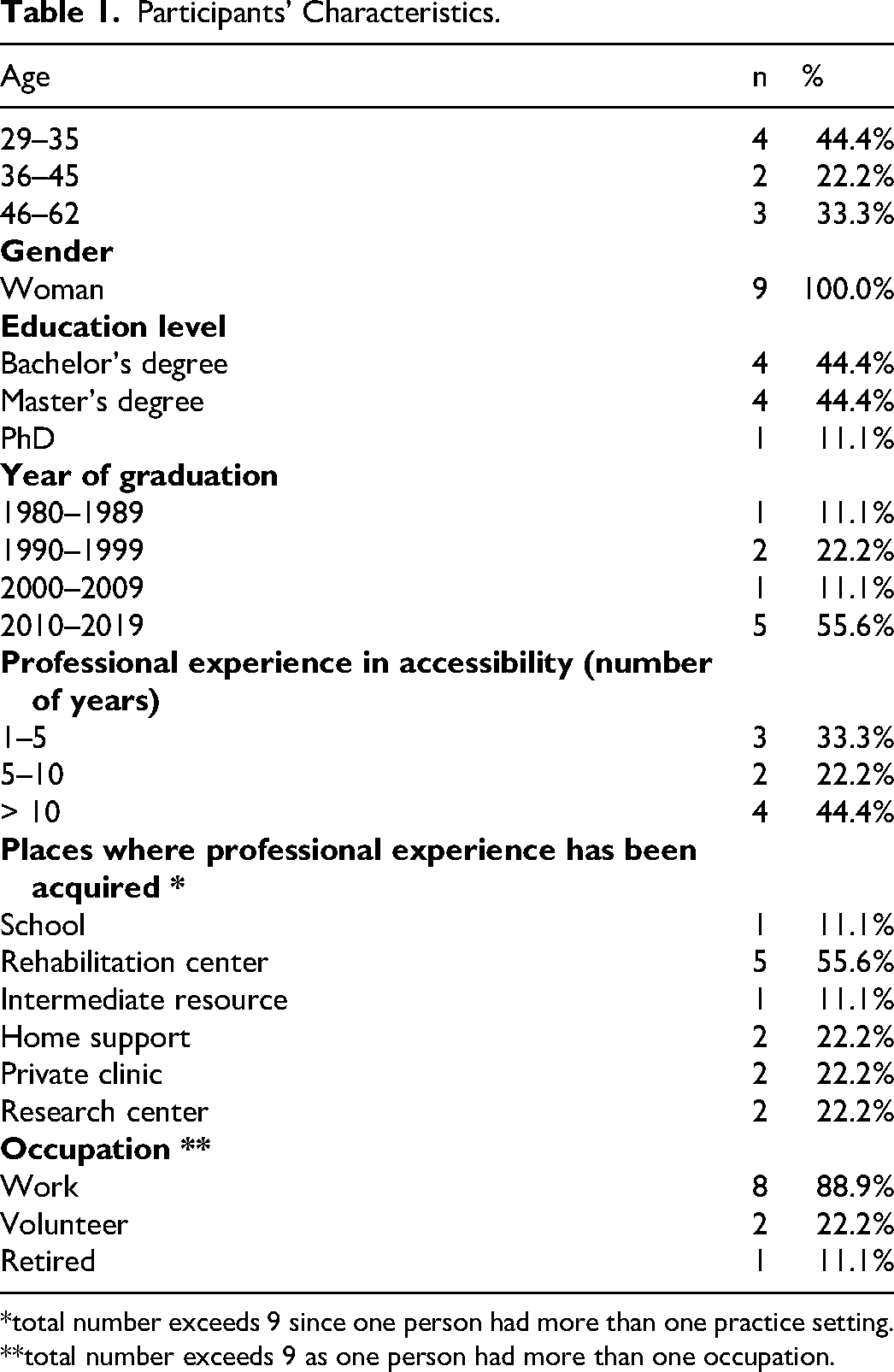
*total number exceeds 9 since one person had more than one practice setting.
**total number exceeds 9 as one person had more than one occupation.
The project's findings are categorized into three overarching themes, in addition to participants’ description, each comprising several sub-themes (see Figure 1). The first theme focuses on the knowledge of universal accessibility, encompassing university and post-graduate training. The second theme addresses the accessibility project process, including involvement, collaboration, partnership, and challenges, as well as evaluation and intervention. The third and final theme concentrates on the occupational therapist's contribution to universal accessibility.
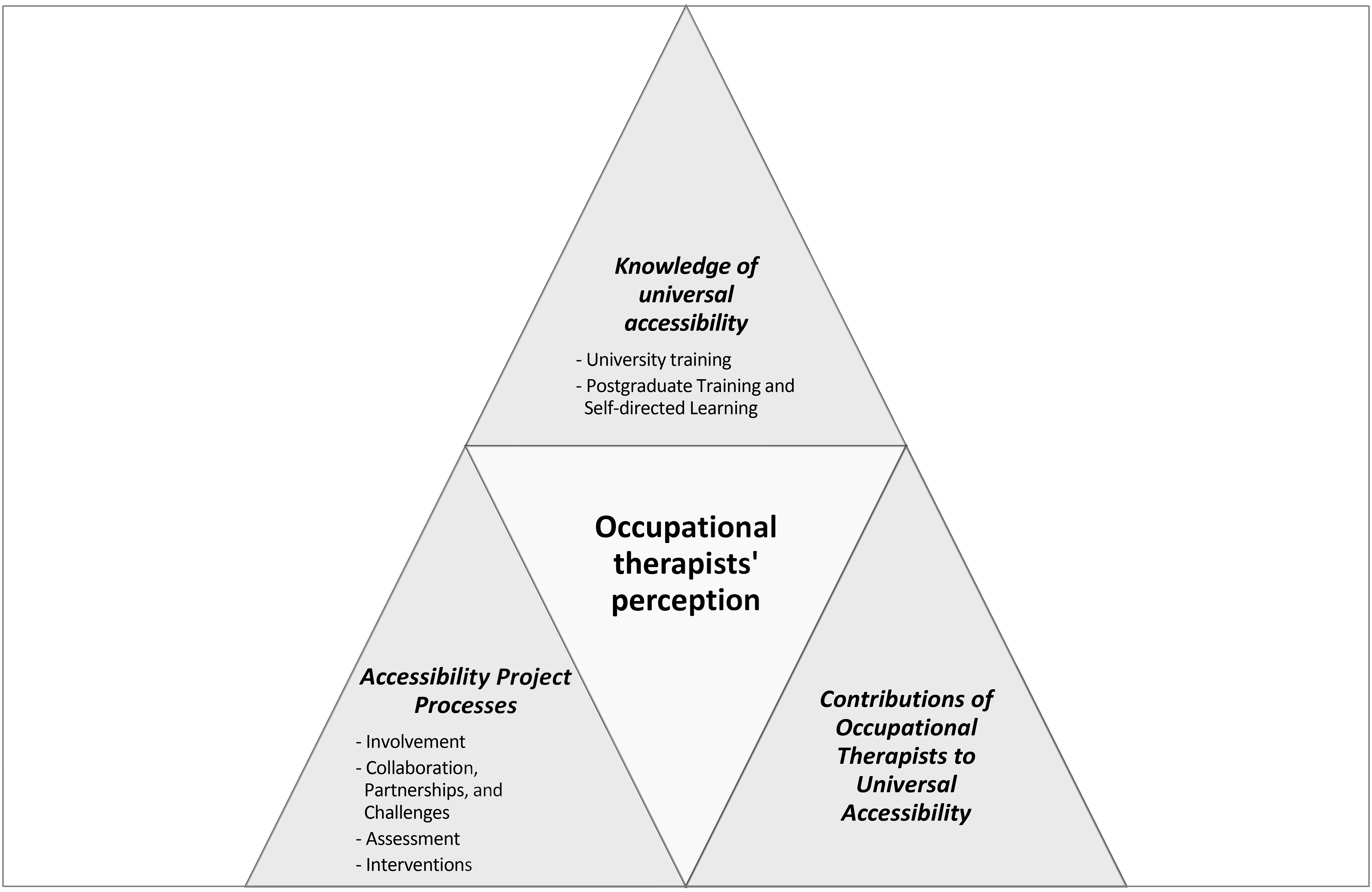
Themes and sub-themes. Note. Triangular diagram illustrating the results of the study. The triangle is divided into four sections. The top section represents knowledge of universal accessibility, including university training, postgraduate training, and self-directed learning. The bottom left section represents accessibility project processes, comprising involvement, collaboration, partnerships, and challenges, assessment, and interventions. The bottom right section represents occupational therapists’ contributions to universal accessibility. At the centre, an inverted triangle highlights occupational therapists’ perceptions, connecting the three surrounding components.
Knowledge of Universal Accessibility
The first theme was that of occupational therapists’ knowledge of universal accessibility. The theme is further divided into two sub-themes: 1) university training and 2) post-graduate training in universal accessibility.
In general, participants reported a lack of clinical cases and concrete examples of universally accessible environments in the teaching modalities. Furthermore, the curriculum is lacking in certain concepts, including an exploration of diverse materials (types and costs), an examination of the components of a universal accessibility project, and an analysis of the various clienteles that stand to benefit from universal design beyond wheelchair users (e.g., individuals with visual impairments, individuals with intellectual disabilities, and autistic individuals). One participant expressed a desire to learn more about relevant resources that could be downloaded (e.g., reference tools) to facilitate her future work in the field of accessibility upon completing her university studies. Furthermore, she expressed concerns regarding the comprehensiveness of the training with respect to the involvement of other professionals in universal accessibility projects. Specifically, she noted that the training did not adequately address the roles and responsibilities of these professionals, nor did it provide a sufficient foundation for them to fully understand their involvement. For example, when it comes to illumination and vision, it shouldn't be the occupational therapist who deals with that, we're not specialized in that […] it should be specialists in low vision rehabilitation or specialists in mobility and orientation who join us to be able to deal with those aspects, but I don't think we know those specialties very well […]. If we're going to train occupational therapists in what they can do and what they shouldn't do, we also need to know about other professionals, and I have to say that in my undergraduate training, at least, that was non-existent. (OT01).
A number of proposals for enhancement were put forth, including the implementation of a more society-oriented perspective and a reduction in the emphasis on the individual in all circumstances. Additionally, according to some participants, it is imperative to impart the standards that govern the design of layouts, thereby ensuring that students develop a comprehensive understanding of these principles and their underlying rationales. For instance, it is crucial to elucidate the rationale behind specific design choices, such as the precise width of a door. In addition to proposals regarding the content to be included and the perspectives to be adopted, proposals on teaching methods were also made. For instance, a proposal would be to teach the general process to be followed for an accessibility project; and finally, to offer opportunities to practise, improve and test students’ knowledge of universal accessibility during their studies. Furthermore, one participant articulated the importance of incorporating the experiences of individuals directly involved: I consider that the people who are directly affected are always the best trainers for us. So, perhaps there could be opportunities for users in X context and occupational therapists to meet and identify the obstacles, identify potential solutions, and then put different needs […] in opposition to each other to try to find solutions. Then just doing discussion workshops, without having to go into super-complex projects, just doing situation scenarios, could be interesting to see what the needs, opportunities and constraints are for each group, to show what could be done with this. (OT01)
Finally, participants held divergent opinions regarding the optimal approach for training universal accessibility. Specifically, there was a divergence in opinion as to whether the training should be more in-depth and compulsory during the bachelor's or master's degree program, or alternatively as part of postgraduate continuing education.
“Personally, I don’t feel very competent or like an expert, and sometimes I feel… overwhelmed. I think that when I’m directly concerned, I feel sufficiently competent—maybe 80–90%—to express my opinion on ways of doing things. But overall, do I feel comfortable all the time? No, I would lower my sense of confidence or competence to maybe 50%. Sometimes I wonder where my place is and how I can contribute more.” (OT06)
Occupational therapists with a higher level of education in universal accessibility, who had completed their entire master's research on universal accessibility, reported a stronger sense of competence.
Several participants noted that there were few training opportunities available on universal accessibility, and those that did exist were too basic for their level of knowledge. As a result, most of them expressed interest in having more continuing education opportunities. One participant even sought additional training in universal design in another country, as she could not find other options. Others reported not having pursued formal continuing education or not knowing what was available; instead, they filled their knowledge gaps through independent searches in the scientific and grey literature (e.g., identifying standards for outdoor infrastructures such as parks or schoolyards) and by consulting mainly with colleagues. Some also mentioned using Environmental Accessibility Measure (Mesure Environnementale de l’Accessibilté – MEA) or referring to the municipal accessibility guide of Quebec City that had been developed in collaboration with occupational therapists. One participant said: “Most of what I’ve learned has been in the field […] just by having cases, trying things out, reading online, and talking with colleagues.” (OT09)
In general, many occupational therapists stated that they had learned primarily through practical experience, reflection on each case, questions that emerged during their work, targeted searches, and feedback following projects. Because every project is different, they explained that they must continually reflect, experiment, and learn from each situation. One participant emphasized that having strong knowledge of diverse client groups is an asset for succeeding in the field of universal accessibility, given the wide range of needs. 90% of my learning has come from experience and fieldwork. […] You just have to start thinking like: “Okay, I don’t just have one wheelchair user to consider, I have many. I have people in manual wheelchairs, motorized wheelchairs, people with walkers, people with visual impairments, mothers with strollers.” You had to broaden your thinking a bit. (OT05).
Accessibility Project Processes
The second theme identified in the findings relates to the processes involved in universal accessibility projects for occupational therapists. This theme includes several subthemes: 1) the occupational therapists’ involvement in these projects; 2) collaboration, partnerships, and challenges encountered; 3) assessment practices; and 4) interventions carried out by occupational therapists within universal accessibility projects.
However, some occupational therapists reported divergences in how professionals perceive users’ needs and in the perception of the collaboration with occupational therapists. Furthermore, a lack of openness or awareness of the occupational therapist role among colleagues was noted, which may hinder the implementation of their recommendations. Thus, occupational therapists emphasized the importance of raising awareness about their role, past individual-level adjustments for which they are already acknowledged, while also seeking to understand the contributions of others to foster collaboration. Another challenge mentioned was ensuring that all stakeholders work toward a shared goal. Another form of collaboration involves participation in advisory committees or consultation tables to discuss universal accessibility projects. For example, one occupational therapist reported contributing to committees such as the revision of the Guide des normes en accessibilité universelle for the City of Quebec, school construction committees, and the board of a nonprofit organization. From the beginning of my employment at the Service Center, I was involved in that committee. Since then, I’ve really become quite a central member of the team. For anything related to facilities, furniture, or new constructions, I’m always involved. And my role in that committee is to try as much as possible to create layouts, furniture, and infrastructures […] that will respond […] to as many needs as possible. (OT07)
Tools are interesting because they make you think of many things, but at the same time, they’re limiting, because if you want to use a specific tool, you have to use it in the prescribed way if you want to comply with standards. So, I think it's good to have something concrete that brings all the standards together, but I find it constraining to follow a strict framework […]. Sometimes, it limits professional creativity. (OT03)
Overall, occupational therapists seemed to document the environment more extensively than person and occupation dimensions within accessibility projects. Regarding environmental assessment, participant OT07 emphasized the need for a model that includes the areas of the environment to be explored, but which would allow for greater flexibility than existing checklists and assessments, to guide occupational therapists in this area.
I had a project where he was building a building with universally accessible apartments for anyone who was going to live there and take that apartment, and I was told I had occupational therapist carte blanche —"tell us what you want for your client”—but that wasn’t true, because the room sizes had already been chosen, so yes, it was too late. (OT09)
Involving occupational therapists earlier in universal accessibility projects could help avoid rework, ultimately saving costs. Early involvement also makes it possible to validate proposed ideas and adapt them as needed to ensure that they truly lead to inclusive design. This is particularly important because the populations targeted by universal accessibility projects are highly diverse, including individuals with reduced mobility using mobility aids (e.g., wheelchairs), people with visual disabilities, and older adults, and other groups with diverse needs. A participant mentioned: When I joined the project, the walls were already up, the roof was on, and most of the work was done. My role was reduced to almost just recommending where to put the grab bars. I thought, “Saving money should have been considered earlier—not by sticking to the bare minimum, but by avoiding redoing things at the end.” (OT05)
Contributions of Occupational Therapists to Universal Accessibility
Interview findings indicated that occupational therapists are well-positioned to play a central role in promoting accessibility. The participants identified several skills and abilities specific to occupational therapy that justify the occupational therapist's unique contribution to universal accessibility, such as their analytical abilities, their expertise in health and human functioning, their understanding of the diverse needs of different populations and their holistic vision of the person and the environment. Several participants emphasized their ability to integrate multiple dimensions into a comprehensive analysis of environments, persons and activities. As one occupational therapist explained: We are versatile enough to understand the individuals and the different groups that need to be considered. […] An occupational therapist has strong analytical skills, the ability to understand the individuals involved, and to make sense of the connections between the person, their environment, and the occupation that will take place within that environment. Therefore, I believe that their ability to synthesize all these elements makes them, in my opinion, the best positioned person to gather everything together. (OT01)
Occupational therapists were also described as having the potential to foster awareness among other professionals and the public regarding accessibility and inclusive design. Occupational therapists frequently engage with individuals presenting a wide spectrum of abilities and conditions, enabling them to develop a global comprehensive perspective, refined observational skills, and the capacity to effectively advocate for accessibility considerations. In this regard, participants highlighted the importance of occupational therapists contributing not only to physical accessibility but also to social accessibility by considering the lived experiences of diverse populations. Three occupational therapists reported involvement in research activities, which included coordinating accessibility projects, serving as research professionals, and contributing to inclusive accessibility initiatives. These experiences were seen as opportunities to generate evidence and inform practice, although participants noted that such opportunities remain limited.
Overall, the expertise of occupational therapists in analyzing functional profiles and their holistic understanding of the person and the environmental barriers and facilitators represent a distinctive contribution of the profession. This underscores the relevance of their involvement in accessibility initiatives, both in practice and research. A participant mentioned: I find it unfortunate when people launch into major projects and build an accessible bathroom on the second floor, but there's no elevator—I’ve seen that before. I think it's a shame when projects are started with good intentions, but important details are overlooked. Of course, we might miss some things as well, but not those kinds of issues. (OT03)
Discussion
The objective of this study was to explore occupational therapists’ perceptions regarding their experience and training in universal accessibility, as well as its integration into their professional practice. Regarding occupational therapists’ perceptions of their knowledge of universal accessibility, this study revealed a lack of training in university curricula on this specific topic. According to Ruiz-Rodrigo et al. (2025), training on universal accessibility is sometimes absent in Canadian occupational therapy programs or contains significant gaps. Participants noted that university-level training is more focused on individualized home adaptations than on designing accessible environments for multiple user groups. While knowledge from individualized adaptations provides a foundational skill set, it remains insufficient (Trouvé, 2016). For example, occupational therapists’ expertise in activity analysis allows them to identify users’ needs and ensure they can carry out their activities (Trouvé, 2016). Another strength is their understanding of the environment, enabling them to propose context-adapted solutions (Ainsworth & De Jonge, 2014).
Concerning identified gaps in university training on universal accessibility, these include a lack of practice with clinical cases, limited access to relevant resources, and insufficient information on materials and clients beyond wheelchair users. These gaps mirror those identified by Ruiz-Rodrigo et al. (2025), notably the absence of diverse and in-depth content addressing the needs of a varied population regarding universal accessibility. They also align with the findings of Reda and Chidiac (2025), who showed that accessibility research primarily concerns people with disabilities. A more robust training curriculum covering the full spectrum of clients would enable occupational therapists to apply more equitable interventions, promoting the “equitable use” principle (Preiser & Smith, 2010) in universal accessibility initiatives. Gaps in academic training on the subject may consequently contribute to a lower sense of competence among occupational therapists, potentially affecting both their interventions in the field and their integration into interdisciplinary teams. Nonetheless, experiential learning and autonomous study, including colleague discussions and literature review, often mitigate this gap. This highlights the importance of comprehensive instruction from the outset of professional training and such instruction is essential to build competence and expertise in universal accessibility (Bar & Ratzon, 2016).
Regarding occupational therapists’ involvement in universal accessibility initiatives, the findings indicate that both the solicitation process and the time devoted to projects varied considerably. This variability may be attributed to the diverse practice settings, client populations (Canadian Association of Occupational Therapists, 2024), and partners involved, all of which influence how requests for services are prioritized, channeled, and addressed within accessibility projects. In terms of concertation and partnership, the results indicate that occupational therapists collaborate with a diverse range of stakeholders (e.g., partners, professionals) across various contexts (e.g., committees, concertation tables). Collaboration across disciplines, areas of practice (e.g., governmental, clinical), and types of expertise—including the experiential knowledge of persons with disabilities—may present barriers (Wagenfeld et al., 2017; Young et al., 2019), but facilitates the identification of solutions that better meet users’ needs and enhances project efficiency. As highlighted by Zawadzka et al. (2022), bringing together such diverse perspectives enables participants to contribute their unique expertise, generating innovative approaches and reinforcing the overall effectiveness of accessibility initiatives. This breadth of collaboration not only promotes comprehensive problem-solving but also strengthens the quality and impact of the interventions implemented.
Regarding the evaluation of accessibility, the findings show that several models and tools are available to help occupational therapists document universal accessibility. According to the Ordre des Ergothérapeutes du Québec (Order of Occupational Therapists of Quebec) (2024), environmental adaptation is part of occupational therapy practice and requires activity analysis and assessment of clients’ abilities. However, in the context of universal accessibility, directly assessing individual clients’ abilities is not possible, as it differs from individualized practice. The choice of tools depends on factors such as their relevance to the situation and the therapist's competencies. Watchorn et al. (2018) identified several types of environmental evaluation such as access audits, building user consultations or checklist. Variability in methods may stem from limited time and training in using certain tools, which may also explain the lack of consensus on preferred approaches and why some therapists rely on informal assessments. In terms of interventions, the findings indicate that occupational therapists contribute to accessibility projects in different contexts, such us by making recommendations for newly designed environments or for adaptations to existing ones (Semple et al., 2010). Participants in this study emphasized the importance of involving occupational therapists early, consistent with Trouvé (2016). Indeed, early involvement of occupational therapists can reduce project costs, enhance the effectiveness of interventions, and promote inclusion by addressing the needs of diverse client populations. In addition to directly participating in projects aimed at creating accessible environments, occupational therapists could act as change agents by promoting initiatives and programs that support universal accessibility. Such involvement would contribute to the implementation of the Canadian Accessibility Act (Loi canadienne sur l’accessibilité, 2019) as well as the Convention on the Rights of Persons with Disabilities (United Nations, 2006). However, a lack of knowledge and skills in this area may constitute a barrier to the performance of this change agent role among occupational therapists (Carrier et al., 2021).
The findings highlight that occupational therapists bring a broad set of knowledge and skills that allow them to assume diverse roles in universal accessibility. Their expertise contributes not only to raising stakeholder awareness but also to advancing research and the development of accessibility initiatives. Results further emphasized their pivotal role, rooted in a comprehensive understanding of how the environment influences users’ lives, informed by a global and human-centered perspective. These results are consistent with the perspectives of several authors and organizations (Ainsworth & De Jonge, 2014; Trouvé, 2016) who argue that occupational therapy fosters inclusion and enhances quality of life through a holistic analysis of needs. Moreover, the discipline has made notable progress in addressing universal accessibility, a field of growing importance within occupational therapy practice. However, results also point out the relevance of improving occupational therapy academic programs in order to better prepare future professionals.
Strengths and Limitations
The present study has several limitations. The sample was relatively small, with nine occupational therapists from Quebec instead of the twelve initially targeted. This outcome was anticipated given the limited number of professionals in universal accessibility, and the inclusion criteria reflected this reality by not requiring extensive experience. Consequently, some participants had only limited involvement in such projects. Despite the heterogeneity in the participants’ level of experience and training, similar experiences were reported, and no additional major themes emerged in the final interviews. Although language was not a selection criterion, all interviews were conducted in French, since all participants were from the province of Quebec. Finally, some of the interviewers had no previous experience conducting research interviews, but they were provided with coaching and supervision throughout the study and were accompanied by a member of the research team during their first interview. The involvement of multiple interviewers in data collection was guided by a semi-structured interview guide, ensuring that all team members followed a standardized framework while allowing space for questions and discussions adapted to each interview. In addition, team discussions (eights meeting of between 1 and 2 h) were maintained throughout data collection and analysis and contribute to strengthen the credibility and dependability of the findings. A description of the participants (detailed as much as possible while preserving their anonymity) is provided to enhance the transferability of the data. Furthermore, the prolonged data collection period and the iterative process contributed to enhancing the credibility and confirmability of the findings (Fortin & Gagnon, 2022; Guba, 1981). The use of rigorous procedures, including multiple coders and validation discussions, helped strengthen the trustworthiness of the results.
Conclusion
This project highlights key challenges for occupational therapy in the field of universal accessibility. These include limited knowledge and few opportunities to address clinical cases during studies. As a result, occupational therapists often develop competencies through field experience and self-directed learning, which may reduce their confidence in this area. Therefore, revising and expanding the content related to universal accessibility in occupational therapy programs is essential to better prepare future occupational therapists. While each project varies depending on context and needs, the occupational therapist's skills and holistic, human-centered perspective remain a key contribution. However, their involvement often occurs too late, limiting their impact; earlier participation could better support accessibility for all.
In conclusion, the findings may help clarify the occupational therapist's role in accessibility projects and interdisciplinary teams and they highlight areas that require further exploration and revision. Moreover, further studies across regions and professions would provide a more comprehensive understanding of this field.
Key Messages
- Opportunities for training in universal accessibility are limited both in university curricula and continuing education, potentially affecting occupational therapists’ sense of competence.
- Occupational therapists engage in diverse universal accessibility initiatives and contexts, but early integration into multidisciplinary teams and awareness about their role are crucial.
- The skills and competencies of occupational therapists, such as analytical ability and a holistic view of person and environment, make their contribution to universal accessibility indispensable.
Footnotes
Acknowledgments
Deep Land Copilot were used in this manuscript for the translation and refinement of the text.
Declaration of Interest Statement
The authors declare that there is no conflict of interest.
Funding
The authors disclosed receipt of the following financial support for the research, authorship, and/or publication of this article: This project received no financial support. However, several members of the research team are funded by the Fonds de recherche du Québec: FR is a Senior research fellow of the Fonds de recherche du Québec - Santé (Health). During the project, ARR was funded by a Doctoral Research Scholarship of the Fonds de recherche du Québec - Société et Culture (Society and Culture), by the Université Laval and by the Centre interdisciplinaire de recherche en réadaptation et intégration sociale.

Author Biographies
At the time this research was conducted,
At the time this research was conducted,
At the time this research was conducted,
At the time this research was conducted,
At the time this research was conducted,