



Abstract
Introduction
For many students, university life marks a significant transitional period into emerging adulthood (Arnett et al., 2014). The university experience is also associated with elevated levels of stress and mental health challenges, particularly anxiety and depression, related to academic performance as well as the ability to balance various work, extracurricular, and personal obligations (Linden et al., 2021; Sprung & Rogers, 2021). Students enrolled in intensive healthcare and allied health programs, such as Occupational Therapy (OT) and Physical Therapy (PT), may experience a greater strain. To illustrate, a study of undergraduate OT students in South Africa found that academic stressors (exams, lecture contents, clinical fieldwork, program expectations, time management) were most frequently reported among second to 4th-year students (Govendor et al., 2015). Similarly, Jacob et al. (2012) revealed that stress patterns related to academic demands were the most frequently reported among PT students in Australia, Israel, and Sweden. This is due in part to the pressures specific to these fields of study (Epstein et al., 2019).
The field of OT recognizes meaningful participation in daily occupations as an important factor that both promotes and maintains one's well-being (Reitz et al., 2020). Emotional well-being (EWB) describes both momentary emotional everyday experiences and reflective judgments of life, including life satisfaction and meaning (Park et al., 2023). The existing literature showing an initial positive association between participation and EWB focuses primarily on attendance (“being there”) or time use, often collected retrospectively. For example, allocating time to self-care, leisure, and social activities has been positively associated with students’ well-being (Jie et al., 2023). Concurrently, the quality of engagement, that is, involvement or “being in-the-moment,” is also important (Imms et al., 2017), especially when seeking to improve adults’ well-being (Haim-Litevsky et al., 2023; Kuykendall et al., 2015); yet, it remains understudied. Specifically, the literature lacks real-time evidence on involvement (quality of participation), not just attendance or time use, among OT/PT students. This calls for unique methodological approaches that can capture the interactions between two contextually driven variables: involvement—the subjective aspect of participation—and well-being. The Experience Sampling Method (ESM) is an example of such an approach.
ESM collects real-time data multiple times a day for several days or weeks, providing a detailed description of participants’ daily experiences (Csikszentmihalyi & Larson, 2014). It also addresses issues of recall bias that may arise in methods where participants are asked to answer in retrospect. As such, it can help better understand the link between daily life experiences and associated emotions and allows the comparison of these subjective experiences. ESM has been used with the university population to study the relationship between participation and well-being (Hong et al., 2023). King et al. (2020) found that U.S.-based undergraduate college students reported greater levels of subjective well-being when participating in active leisure as opposed to when engaging in learning activities. However, the quality of students’ participation, that is, involvement, was not assessed, especially among professional master's-level students enrolled in intensive applied programs.
This brief report, therefore, utilized ESM to examine how the level of involvement in activities outside of school is associated with momentary EWB in pre-masters and first-year master's OT and PT students. Additionally, it estimates whether this association differs by program (OT vs. PT).
Method
Study Design
To begin addressing this issue, this study employed a 2-week ecological momentary assessment using ESM. This method was selected due to its ability to capture real-life, “in-the-moment” data, minimizing recall bias. It is a valid and reliable approach for documenting patterns of daily activity and psychological states (Csikszentmihalyi & Larson, 2014). The m-Path app, a secure mobile platform for administering ESM surveys, was used to collect data on a daily basis (Mestdagh et al., 2023). This design enabled us to monitor participation, through level of involvement, and associated aspects of EWB as they occurred, testing the momentary relationships between these two constructs. Using involvement as a measure of participation addresses the gap in participation research, with participation being measured more often through attendance rather than involvement, despite claims by Imms et al. (2017) indicating that attendance alone is not sufficient in representing an individual's participation. Further, a measure of involvement may provide additional insights into the established relationship between participation and well-being (Haim-Litevsky et al., 2023). This study followed the checklist for reporting ESMs recommended by (2019).
Participants
Eligible participants included full-time pre-master's, or first-year master's students enrolled in a Canadian University's OT or PT programs, aged 18 or older, with an understanding of English or French, who had access to a smartphone/tablet and Wi-Fi/cellular data. A pool of 240 students was identified as eligible, 120 per program. A sample of 38 participants was recruited using a convenience sampling method, indicating an overall response rate of 16% (with 18% for the OT group, 13% for the PT group). This sample size was deemed appropriate for two reasons: (a) it aligns with the average sample size (36.7 participants) used in ESM studies, and (b) it provides in-depth data per participant (van Dalen et al., 2024). An e-poster was displayed on social media platforms and dispatched to email lists obtained with the help of clinical directors and student representatives of PT/OT programs of a large academic institution. Recruitment emails were sent out two weeks prior to our study, followed by a reminder one week later, and participants were provided with both English and French informed consent forms prior to data collection. All eligible participants who met inclusion criteria were invited to participate in the study. The study was approved by McGill's Institute Review Board (A01-B02-25B), and informed consent was obtained from all participants.
Data Collection
The m-Path app was used to collect data daily via multiple notifications over a course of two weeks. The m-Path platform enables easy-to-use, tailored, real-time ESM data collection on mobile devices, offering a secure platform to analyze momentary daily experiences (Mestdagh et al., 2023). Each notification prompted participants to complete five questions; two captured the outside-of-school activity currently being performed, and the level of involvement in said activity. These two questions were created in consideration of the important role that context, as determined by the participant, may play in an activity, and the participant's corresponding level of involvement (Imms et al., 2017). The question for the activity was thus presented with an empty text box rather than given categories. Additionally, the participant-report rating of their level of involvement was informed by Imms et al.'s (2017) description of involvement as an internal state, which cannot be easily measured through observation. The remaining three questions assessed momentary EWB, that is, happiness, cheerfulness, and sociability, adapted from a study by King et al. (2020) and found useful when assessing transitory aspects of subjective well-being (Diener, 1984). Specifically, at each occasion/notification sent, participants were asked to: (a) report/enter the activity they were currently doing and rate, using a 10-point scale, their (b) level of involvement in the reported activity (1 = minimally involved to 10 = very involved), and three emotional states including (c) happiness (1 = sad to 10 = happy), (d) cheerfulness (1 = irritable to 10 = cheerful), and (e) sociability (1 = lonely to 10 = sociable). Participants were notified to complete this five-item questionnaire twice daily during weekdays and three times daily during weekends for 2 weeks, from March 16–30, 2025, resulting in 32 data entries per participant. This timeframe was selected to avoid scheduling conflicts with clinical placements or exam periods. In addition, a 2-week period is often used in ESM studies (van Dalen et al., 2024). Notifications were scheduled outside of school hours, based on the cohort schedules provided by the clinical directors of the OT/PT programs. The m-Path app enabled us to pre-schedule randomized notifications for survey prompts and sent participants reminders 30 min after the initial prompt. During the weekday, two random notifications were sent between 5 p.m. to 10 p.m., whereas during the weekend, three notifications were randomly sent throughout the day (between 9 a.m. to 10 p.m.). On average, compliance rates were 78% (IQR 70% to 91%). No incentives were provided to ensure compliance.
Data Analysis
Initial data analysis was conducted via the m-Path platform. The data collected was organized individually for each participant in a tabular form in the m-Path's research dashboard. The dashboard provided additional information such as compliance percentages, time stamps, and missed surveys. This data was then consolidated/organized and placed into SPSS Version 29 and R for analysis. Individual-level correlations were used for descriptive, person-centered pattern identification, and mixed-effects models were the primary inferential analysis, accounting for repeated measures and testing program differences.
Three scatter plots per individual were generated to visualize the association between involvement with each of the three momentary EWB components (happiness, cheerfulness, sociability), and a fitted line was generated. To examine individual-based associations, 114 graphs (38 Participants × 3 Emotional Outcomes) were plotted, and analyzed using Pearson's correlation. A positive correlation coefficient (r) of at least 0.4 with p < .05 was considered significant. A coefficient level of 0.4 was selected, recognizing that EWB is complex and could be explained by many factors (Cohen, 1988). The number of graphs/trajectories illustrating a significant correlation between involvement and EWB was then counted and reported in percentages. To examine if the identified associations differed by programs (PT vs. OT), mixed-effect models were used. The three components of EWB were modelled separately to test the interaction of program type on the association between involvement and EWB.
The types of activities reported (up to 1,216 activity entries; 38 Participants × 32 Observations) were also analyzed. Specifically, reported activities were categorized into five participation domains: ADL/IADL, work, social, physical leisure, and non-physical leisure. Two groups of two authors each initially categorized the activities separately, and then together to cross-examine and verify the categorizations. Discrepancies were resolved through discussion. The percentage of activities that fell within each domain was described for the entire sample and for each program separately.
Findings
A total of 38 students participated in this study (42% PT, 58% OT). Thirty-three of them were first-year master's students. Most participants (87%) were female. The dataset contained up to 32 activity entries for each of the 38 participants, totalling 1,216 possible entries. Given that 259 observations/activities (21%) were missing, 957 data entries were analyzed. Out of the 957 reported activities, 765 (80%) were non-academic and 192 (20%) were academic activities. These included ADL/IADLs (sleep, eating, groceries, commute, and responsibilities), work (paid and volunteer), social activities (time with family and friends, talking on the phone), physical leisure (working out, sports, walking a dog), and non-physical leisure (watching TV, social media, reading, video games). The activity domain in which participants most often engaged outside of school was non-physical leisure (34%) and ADL/IADLs (32%), followed by social activities (15%), physical leisure (11%), and work (8%). This pattern was proportionally similar among OT and PT students.
The number of statistically significant trajectories/fitted lines illustrating the association between involvement and each EWB component (with r ≥ 0.4) was tallied. Specifically, the level of participation involvement was positively and significantly associated (p < .05) with both happiness and cheerfulness for 53% (20/38) of the participants, with correlation coefficients ranging from 0.4 to 0.9 and 0.4 to 0.88, respectively. Participation involvement was also positively and significantly associated with levels of sociability for 42% (16/38) of the participants, with moderate to strong correlations ranging from 0.4 to 0.73. For majority of participants (58%), there was no statistically significant association with a Pearson coefficient of r ≥ 0.4 between involvement level and sociability.
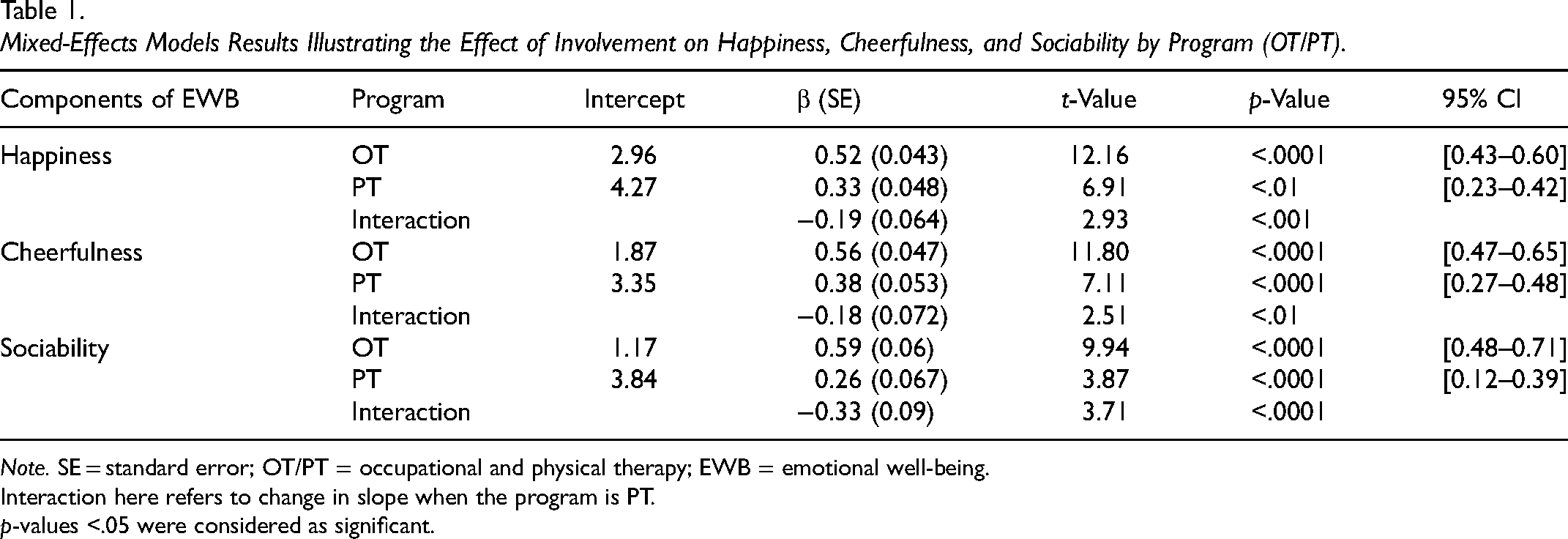
The results of the mixed-effects models testing the association between involvement and the three EWB components by program are presented in Table 1 and Figure 1. While both groups had a significant association between involvement and the three components of EWB, a significant interaction effect was observed (−0.33 > β > −0.19, p < .001). That is, a stronger association was seen in the OT group (0.52 > β > 0.59, p < .001).
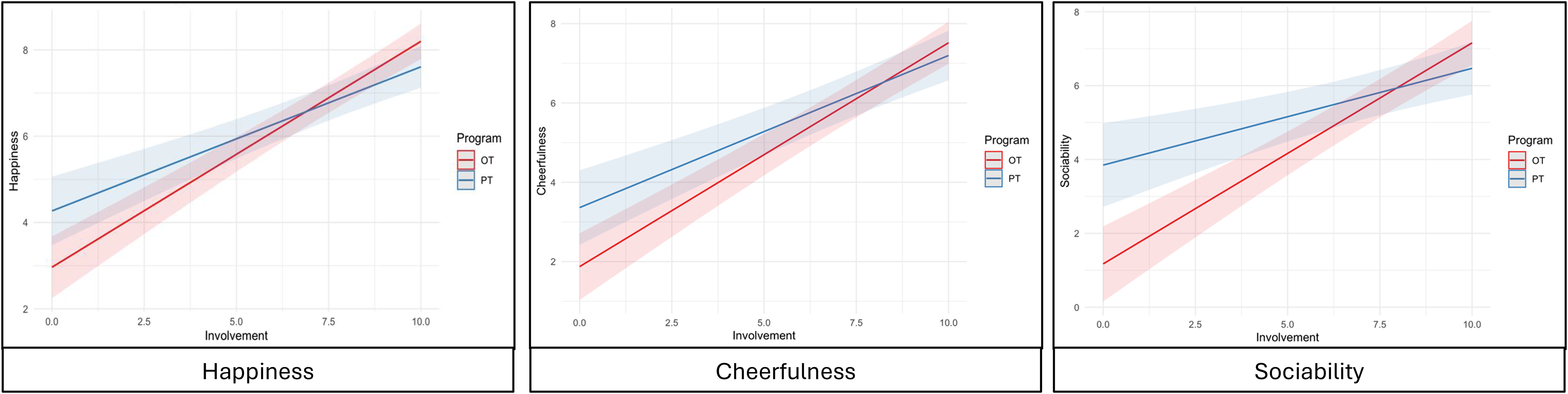
Interaction effect of the program (OT/PT) on the association between involvement and emotional well-being.
Mixed-Effects Models Results Illustrating the Effect of Involvement on Happiness, Cheerfulness, and Sociability by Program (OT/PT).
Note. SE = standard error; OT/PT = occupational and physical therapy; EWB = emotional well-being.
Interaction here refers to change in slope when the program is PT.
p-values <.05 were considered as significant.
Discussion
Using a unique approach to capture in-the-moment experiences, that is, the ESM, this brief report presents initial findings that further support the inextricable link between occupation and well-being, a central tenet in OT. Specifically, results indicate that in more than half of the participants (53%) level of involvement in occupation was associated with two of the three components of momentary EWB, those being greater happiness and cheerfulness. Involvement in an activity—distinct from mere attendance (Augustine et al., 2018)—can contribute to core aspects of the flow experience and support EWB among university students (Mao et al., 2024). Our findings extend those of (Haim-Litevsky et al., 2023) and (Eakman et al., 2010), that focus on adult groups, to post-secondary students (in OT/PT program(s))—an at-risk group for mental health challenges (Sprung & Rogers, 2021).
Our findings suggest that involvement was associated with well-being for some students (about 50%) but not for others. This variability at the individual level is worth reflecting on. Involvement may differentially impact students depending on activity type, interest, context, fatigue, or academic load, and person-specific patterns are consistent with OT's emphasis on individualized meaning and context. Further studies are needed to examine for whom and under what conditions involvement matters.
Notably, results of the present study indicate that the association between involvement and sociability, an essential component of well-being, including among college students (Holt-Lunstad, 2024; Yao et al., 2023), was less pronounced, observed in 42% of participants. This may be explained by various factors, including the patterns of social participation in our sample, observed in 15% of the reported activities. In a longitudinal study, Yao et al. (2023) illustrated that while it is not statistically significant, there was a noticeable decrease in participation in social activities among college students as their time spent in college increased, a pattern that may also correspond to the population in our study, who are in their third or fourth year of university. Overall, the impact of university on social activities and participation warrants future investigation to better understand how socialization affects the mental well-being of university students. Specifically, future research should explore how contextual factors such as the opportunities for social connectedness afforded during different segments of the day and the presence of others during an activity, influence the relationship between involvement and sociability. While the correlation between involvement and the three components of subjective well-being were statistically significant in both the OT and PT groups, the association was significantly stronger in the OT group. Our study did not explore potential causation factors for these differences; however, it is plausible that OT students are introduced to the idea of promoting well-being through occupation as part of their academic training, which may influence their awareness and participation choices. Further larger studies, including various academic institutions, are needed to examine this assumption alongside other potential explanations for the varying results among OT and PT students, such as program structures (demands, intensity, pedagogical approaches and workload), and availability of student support systems within the university. Additionally, sampling experiences at different times throughout the academic year is recommended. Nevertheless, findings may be of interest to OT/PT program directors, educators, and preceptors as well as university-wide services that support students’ well-being. Incorporating an educational module on engaging in rewarding (and health-promoting) activities is one initiative to consider, among others.
This brief report presents some limitations. Although it generated nearly 1,000 responses, it is based on a sample consisting of students from one academic institution, mostly those in their first year of their master's degree. This affects the generalizability of the results. Secondly, the use of ESM, while successful in recording real-time data, may have contributed to the missing data points as it is suggested that repeated assessment of the same variables may contribute to missing data and drop-out (Lohani & Blodgett, 2025). That said, the overall compliance rate reported in our study is within the range reported by other ESM studies (van Dalen et al., 2024). The missing data points may also incur an information bias, though efforts were made to minimize this bias, for example, by scheduling alerts according to periods where the students should be freer to respond (e.g., non-school hours). Moreover, during the 2-week data collection phase, the different cohorts and programs may have had different workload intensities at the given point in their semesters, impacting the accuracy and precision of results as some students may have been too busy to answer or too busy with schoolwork to participate in habitual non-academic activities. This was addressed by collecting our data during a period where students would not be too busy (i.e., avoiding exam periods), however variations in workload among students may have persisted.
Overall, our results contribute to the literature evaluation of occupational participation and EWB, especially among university students in OT and PT programs. Considering that healthcare program enrollment is associated with student burnout (Taylor et al., 2024), this study may provide potential strategies to reduce the occurrence of burnout and other mental health challenges among these students, such as encouraging meaningful involvement in activities. Including participation-focused strategies in healthcare curriculum and programs may promote student well-being. Future research could investigate the association between involvement level and EWB in undergraduate students, as well as students across other Canadian universities, as this approach is shown to be applicable and practical in OT and PT students who participated in our study.
Conclusion
This study provides initial evidence about the association between levels of involvement in out-of-school activities and momentary EWB among OT and PT students, particularly in relation to cheerfulness and happiness. Although our findings illustrated a less consistent association with sociability, they highlight the significance of involvement, and not just attendance, in non-academic activities as a factor supporting EWB. Moreover, the differences observed between OT and PT students suggest that the differences between both programs may have an influence on how participation impacts EWB. These findings lend further support to the importance of incorporating participation-focused approaches within healthcare programs, curriculums, and university-based student resources to better support the mental health of students. Further research is needed to more deeply explore these associations and to create targeted interventions that promote greater involvement in meaningful activities among healthcare students.
Key Messages
Participation involvement—not just attendance—in activities outside of class time is positively associated with happiness and cheerfulness among OT and PT students.
OT/PT program directors, educators, or student services should intentionally support opportunities for meaningful involvement outside of class time as a vehicle to maintain and promote EWB.
Integrating participation-focused strategies (e.g., workshops, information sessions) into student support services or healthcare education is warranted.
Footnotes
Acknowledgments
We are deeply appreciative of the students who chose to partake in our study.
Funding
The authors received no financial support for the research, authorship, and/or publication of this article.
