



Abstract
Introduction
Communities of practice (CoPs) are increasingly recognized as powerful vehicles for knowledge-sharing, professional development, and organizational learning. CoPs are defined as a group of individuals who possess a shared interest or incentive in a particular area, and they interact regularly to improve their proficiency in that domain (Wenger-Trayner & Wenger-Trayner, 2022). There are three key components to a CoP: a group of people, a field of interest, and a shared set of practices (Lysaght et al., 2018). CoPs can exist in diverse formats, such as online, teleconferences, or in-person settings (Barry et al., 2017). Virtual CoPs have become increasingly popular in recent years, providing professionals with readily accessible avenues to connect and share ideas, irrespective of geographic location (Hoffmann et al., 2011). While much research has focused on the structural and functional aspects of CoPs, including their formation, governance, and knowledge exchange mechanisms, there is less clarity around the subjective value that individuals derive from their participation in these communities.
In the field of occupational therapy, CoPs have been employed to explore and examine professional practice, leveraging collaborative reflection to generate knowledge (Marcolino et al., 2021). The existing literature has suggested that CoPs can significantly contribute to the professional growth of occupational therapists (Barry et al., 2017) through reinforcing social connections, improving collaborative systems of reflection and knowledge exchange, and expanding therapists’ knowledge by integrating new occupational perspectives (Galheigo et al., 2019). A study evaluating Australian occupational therapists’ perceptions of the use of an asynchronous online CoP found that networking opportunities and convenient access to information and resources were perceived benefits of CoP participation. However, some barriers to participation were also identified in this example, including individual preferences for varying communication methods and access difficulties (Hoffmann et al., 2011).
Previous research reveals that at least a quarter of Canadian occupational therapy faculty members across 14 Canadian occupational therapy programs were conducting education-focused research (Thomas et al., 2016). However, these faculty members reported challenges to educational research, such as scarcity of funding opportunities, insufficient training or support, time constraints, and minimal recognition of educational scholarship at the institutional level.
Background
To address the growing emphasis on evidence-informed educational practices in occupational therapy across Canada, the Research on Education (ROE) Committee of the Association of Canadian Occupational Therapy University Programs (ACOTUP) founded an online community of practice aimed at advancing research in occupational therapy education and pedagogical scholarship. This group consists of educators and researchers dedicated to generating scholarship and disseminating knowledge on educational approaches and innovations in occupational therapy curricula. The CoP is comprised of approximately 36 members representing 14 universities across Canada (Research on Education Committee, 2019). Each year, the group convenes virtually 3‒6 times and also meets in-person during the Canadian Association of Occupational Therapy (CAOT) national conference (Research on Education Committee, 2019). In its early stages, the CoP undertook several approaches to encourage continued engagement, such as the development of collaborative projects and activities, the establishment of a central platform for information exchange on funding and publication prospects, fostering connections and rapport among members, and creating efficient communication channels.
Aims
Despite evidence of the benefits of CoPs for professional growth in occupational therapy, and the increasing need for and value of educational research within occupational therapy practice (Thomas et al., 2016), there is a paucity of research focusing on educational researchers in occupational therapy. Further, little is known about how participants perceive and articulate the value of their involvement when participating in a CoP. Existing literature tends to emphasize outcomes like improved performance or innovation, but often overlooks the nuanced, personal and sometimes intangible motivations and rewards that sustain engagement in a CoP. This leaves a significant gap in understanding individual-level valuation of participation, insights that are critical to fostering and sustaining vibrant CoPs. Therefore, this study aimed to examine the value ascribed to participation in a research-focused CoP by members themselves. Understanding the value individuals ascribe to their participation can provide actionable insights for both researchers and practitioners aiming to design more meaningful and resilient CoPs.
Method
This study employed a mixed methods explanatory sequential design, which allows for in-depth understanding of participant experiences (Creswell et al., 2011; Roberts, 2015). An anonymous online survey was administered to gather preliminary data. The findings from the survey informed the development of focus group questions wherein members of the CoP were offered the opportunity to elaborate on and contextualize the survey data. Research Ethics Board approval was received for this study from the University of Western Ontario and the University of Toronto.
Recruitment
Participants for the study were recruited by email. Invitations to participate in the survey phase of the study were sent to all individuals on the CoP mailing list in April of 2020. Reminder emails were sent in May and June of 2020. The email invitations included the approved letter of information and a link to the Qualtrics form used to collect informed consent. Once the consent form was completed electronically, participants were automatically redirected to the survey via Qualtrics. Participants could save their responses and return to the survey as needed.
In February of 2021, a recruitment email was sent to all individuals on the CoP mailing list, inviting members to participate in a focus group to discuss their experiences in the CoP. It should be noted that this mailing list included new members to the CoP since the online survey, and all members were invited to participate in the focus groups, regardless of participation in the survey. The recruitment email included the approved letter of information, and a link to a Qualtrics consent form. Once the consent form was completed, a research assistant contacted participants to schedule focus groups.
Data Collection
The anonymous online survey was completed between April and July of 2020 (Appendix A). The survey incorporated a section to capture demographic information related to participants’ educational research and academic roles, as well as a section regarding participant's experiences within the CoP. Responses related to participant experience were reported both on Likert scales and through open-ended questions. The findings from the survey were analyzed to understand preliminary themes and to inform the development of focus group questions.
The focus groups were conducted over Zoom between March and July of 2022. Each focus group lasted 40–60 min, included 2–4 participants, and was facilitated by the research assistant. The focus group questions were developed through an iterative process whereby the findings from the survey and suggested areas of focus from the value creation framework (Wenger et al., 2011) served to inform question generation (Appendix B). While the focus groups followed a semi-structure guide, the facilitator allowed the conversation to flow as much as possible and found that the dialogue often naturally led to answering the research questions. The focus groups were recorded for verbatim transcription and independent coding.
Throughout the study, reflexive memo writing and journaling were used to document the researchers’ thoughts, decisions, and evolving interpretations. An audit trail was maintained to ensure transparency of the research process and analytical steps.
Data Analysis
Survey data were summarized using descriptive statistics and analyzed for potential themes. Given the lack of consensus among survey data, initial themes varied broadly, making it difficult to generate fulsome themes. As such, the survey data informed the development of the focus group interview guide and was used to triangulate and support findings from the focus group data.
Focus group transcripts were uploaded to Quirkos software, which was used to collaboratively code and organize transcripts. Focus group data were analyzed using the collaborative qualitative analysis method as outlined by Richards and Hemphill (2017). Researchers first listened to audio recordings of the focus groups to familiarize themselves with the data. After listening to each focus group, the authors met to discuss initial impressions. The first and second authors consensus-coded the first focus group transcript deductively according to the five cycles of Wenger et al.'s (2011) theoretical framework, which was chosen due to its usefulness in assessing value derived from participation in a CoP.
Specifically, in the Value Creation Framework (Wenger et al., 2011), value creation refers to the learning enabled through community involvement, including sharing information and advice, co-creation of knowledge, keeping up with the field, and offering innovative professional development opportunities. In this framework, value is identified as “experiences that are perceived by participants to be of relevance to personal, social, skill, study or context-related benefit” (Dingyloudi et al., 2019, p. 210). Five cycles of value creation are identified, and include: immediate value, potential value, applied value, realized value, and reframing value (Wenger et al., 2011). The ‘immediate value’ cycle examines activities and interactions within the CoP as they can produce value in and of themselves. This value may include: collaborative problem solving, networking, and deriving inspiration from others’ insight (Wenger et al., 2011). The “potential value” cycle recognizes that participation in a CoP can help participants develop knowledge capital from which they can draw in the future (Wenger et al., 2011). Knowledge capital in this cycle includes: human capital, social capital, reputational capital, tangible capital, and learning capital (Wenger et al., 2011). The “applied value” cycle examines value derived from leveraging knowledge capital gained through participation in the CoP to real-world situations. The “realized value” cycle seeks to acknowledge improvements in performance that arise as a result of applied value. The “reframing value” cycle “is achieved when social learning causes a reconsideration of the learning imperatives and the criteria by which success is defined” (Wenger et al., 2011, p. 24). This framework uses the term “value-creation stories” to identify data arising from the narratives of members who share their experiences with the CoP. While each cycle is presented separately, the framework recognizes that the cycles are intertwined and may overlap.
Inductive coding of the focus group transcripts identified additional key themes. Following discussions within the team to reach consensus on initial codes, the remaining transcripts were coded, with regular research team meetings to ensure consistency and consensus. Consensus was achieved through collaborative discussion among researchers, where initial codes and emerging themes were compared and refined. Discrepancies were resolved through review of reflexive memos and journals and discussion and reflection until agreement was reached. As adjustments were made to the codebook following these consensus meetings, the data were iteratively reviewed and coded to ensure consistent coding among all focus group transcripts.
Findings
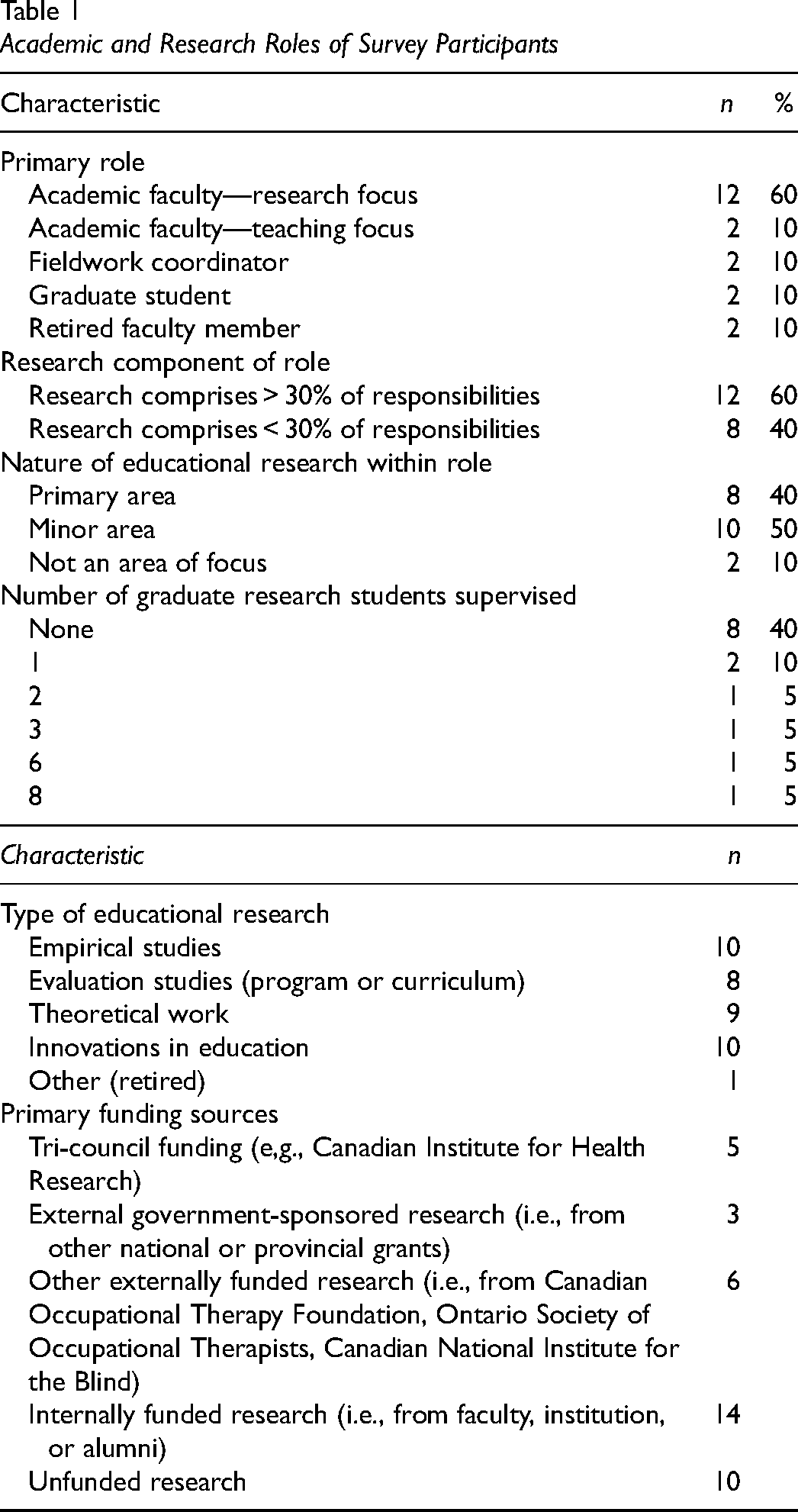
Twenty of the 33 COP members completed the online survey. Nine members participated in the focus groups. Demographic findings from the survey highlight diversity across roles, research interests, funding sources, and represented institutions. This data are presented in Table 1. Roles varied widely among participants, encompassing research-focused and teaching-focused faculty, fieldwork coordinators, graduate students, and retired occupational therapy educators. Research was identified as the primary academic responsibility for 60% of participants. Participants’ engagement in educational research, including empirical and theoretical studies, as well as innovations in education, is highlighted in Table 1. Focus group demographics echoed those for the survey respondents, highlighting diversity in academic roles and research interests among participants.
Academic and Research Roles of Survey Participants
Immediate Value
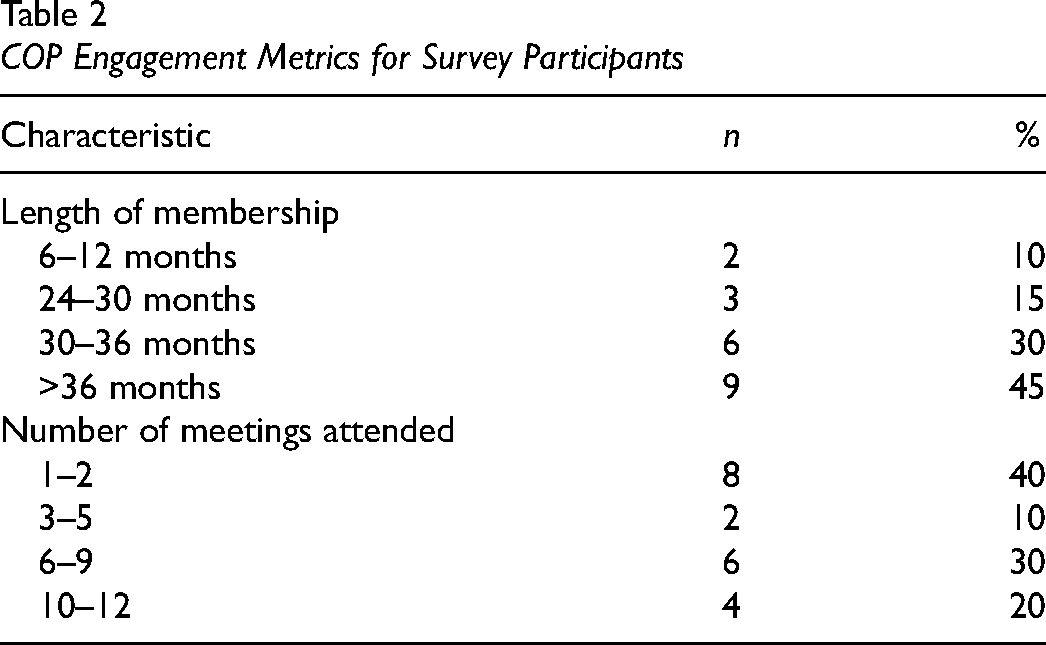
Wenger et al. (2011) note that this “cycle of value creation considers networking and community activities and interactions” as they “can produce value in and of themselves” (p. 22). Survey responses indicated a wide array of attendance at CoP meetings and length of CoP membership, as illustrated in Table 2. These findings provide context by describing the level and frequency with which members attend and interact with each other and the extent to which immediate value is actualized. Furthermore, the Likert scale responses, as summarized in Figure 1, show that all participants indicated that the CoP helped enhance their research networks and provide opportunities for discussing issues and exchanging ideas.
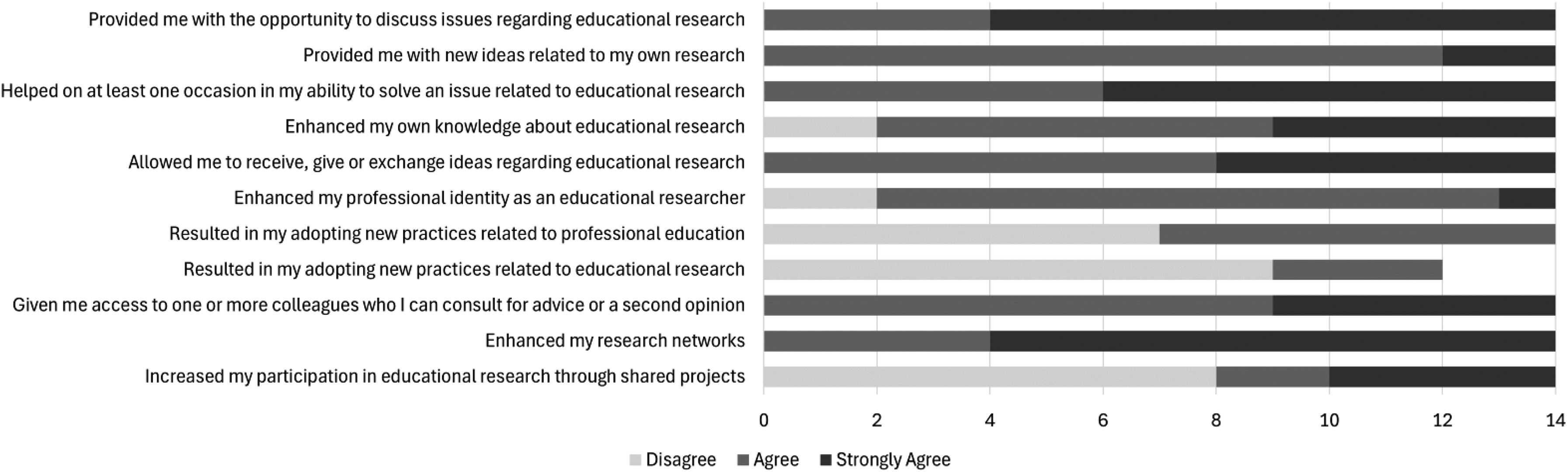
Likert scale responses from the anonymous online survey on participants’ experiences of the CoP. The survey prompted participants to consider the extent to which they agree that participation in the CoP has provided them with various benefits. The prompts are listed on the left side of the figure in the order they appeared in the survey, and participants could select strongly disagree, disagree, agree, or strongly agree for each prompt. No participants selected strongly disagree for any question. The numbers on the bottom correlate to the number of participants who completed this section of the survey, and the shading indicates the distribution of responses across the strongly agree, agree, and disagree categories.
COP Engagement Metrics for Survey Participants
In focus groups, participants discussed the immediate value they found through COP membership and participation. The most common value included finding enjoyment in the activities and interactions, such as networking, sharing ideas, receiving feedback, and gaining a new perspective. Participants indicated that opportunities to exchange ideas and stay up to date with current educational research across Canada were beneficial. They also discussed how connecting with colleagues about shared concerns and challenges provided a sense of support and validation. Some members noted a strong sense of belonging within the community, particularly in the face of feeling isolated in their research. As one participant summarized: I think I would say just the networking has been important for me. I was one of the only people focused on pedagogy and educational strategy at my institution and I didn’t always feel like my work was appreciated or seen as important. The community was a place to exchange ideas, get support, but also feel that sense of belonging, like there were other people who maybe felt isolated in their work, but then they could come together to share ideas and support one another. That's a powerful thing. (Participant 7)
Potential Value
Wenger et al. (2011) indicate that the value of social learning lies in its potential to be realized later. The various forms of knowledge capital that comprise potential value – human capital, learning capital, social capital, tangible capital and reputational capital – were clearly identified within each focus group.
Human Capital
Human capital is identified as the individual knowledge, skills, competencies, and capacities that members develop through participation in the CoP. Both survey and focus group participants agreed that the CoP provided opportunities to address issues related to educational research processes and gain new insights into pedagogical approaches. Several participants spoke about how participation in the CoP helped bolster their inspiration and motivation to continue working on their educational research pursuits. Likewise, the personal value of being amongst others with similar interests helped to boost confidence and their sense of the status of educational research. Several participants also mentioned that through keeping up to date with research across Canada, they experienced a broadening of their perspectives which helped contextualize their educational research pursuits within the larger Canadian occupational therapy context. Additionally, as illustrated in Figure 1, most participants indicated that the CoP enhanced their knowledge on educational research, their professional identity as an educational researcher, and offered new ideas related to their research.
Learning Capital
Learning capital encompasses the resources, tools, and practices that support ongoing learning within a community. Several focus group participants identified how discussions about educational research within the CoP facilitated new learning they could incorporate into their teaching practices. One member described how participation in the CoP has been enlightening for transforming teaching methods: [The CoP] is not a teaching where you try to disseminate knowledge, you construct your own knowledge of a process or a topic. So in that sense, the community of practice helps me reflect … when I do the teaching in the seminar. (Participant 2)
Social Capital
Social capital refers to the network of relationships, trust, norms, and mutual obligations among members that facilitate cooperation and knowledge sharing. Focus group participants frequently described how the community provided a space to consult with colleagues across different university programs about issues and challenges, such as the transition to online learning during the COVID-19 pandemic and the implementation of Competencies for Occupational Therapists in Canada (ACOTRO et al., 2021). Additionally, the CoP resulted in relationships with like-minded researchers and educators that members could potentially leverage for future collaborations. One participant described prospective collaborations: It has been nice to learn about opportunities to collaborate with others on different research projects. I haven’t really taken up the opportunity yet as I have been so busy with other projects, but knowing about the opportunities is great. If, you know, down the road I am looking for new projects, the CoP would be a place to find opportunities to collaborate. (Participant 8)
Furthermore, the survey data revealed that all participants indicated that the CoP has given them access to one or more colleagues who they could consult for a second opinion (Figure 1).
Tangible Capital
Tangible capital refers to concrete, measurable outputs and assets produced through participation in a CoP, such as documents, tools, models, processes, or innovations. While focus group participants did not specify particular research projects or grants, they did comment on the opportunities within the CoP to identify: upcoming conferences, journals accepting abstracts, research funding sources or opportunities, relevant evidence to inform research and educational practices, and collaborative projects and activities.
Reputational Capital
Reputational capital is the credibility, recognition, and influence that individuals or communities gain through their contributions and expertise. Members revealed how they take pride in being a part of a national level community amongst individuals who highly value educational research. The members highlighted the value they found through research dissemination, national level collaborations, and advocacy efforts for the valuing and increased recognition of educational research within Canada. They described how the community legitimized research on education which in turn, made them feel empowered in their pedagogical research. One participant highlighted this experience. I think I felt like I had to explain the importance of educational research over and over again … Being in the group with others who knew the importance of this research and were willing to advocate for it was refreshing and made me proud. It helped my motivation to keep doing this work when I was feeling discouraged and frustrated. (Participant 9)
Applied Value
Survey data indicated that some participants noted that their participation in the CoP resulted in their adopting new practices related to professional education and educational research (Figure 1). A few focus group participants commented on instances where they leveraged the various forms of capital gained through participation in the CoP to modify their educational style or collaborate on projects with individuals they met through the CoP. Their stories reflect the applied value that arose from the community's productive activities and interactions which were then translated into changes in practice.
Other participants commented on applying discussions within the CoP to progress their research projects and achieve new collaborations, as one focus group participant summarized: For me, some of my projects got a really significant push after having discussions in the community practice. So some of the connections that I made in the initial phases helped me get the collaborations and start working through on the projects - it was significant. (Participant 5)
One member identified that they translated the value of collective reflection and co-construction of knowledge acquired through participation in the CoP into their pedagogical approaches. One participant described modifying their evaluation style, and another participant described modifying how they approach teaching their seminar course: With a seminar group of eight to ten students, we are sort of using a community of practice approach in the sense that we reflect to others what we perceive, what we see. We suggest many ways of doing and try to understand their own projects. So in a way for me it's always a reminder when I am with the graduate students in a small seminar, it's always a reminder of exchanging, trying to get into depth into their projects and it is a different way of teaching. (Participant 3)
Realized Value
Realized value is achieved when the application of knowledge capital into practice leads to performance improvements (Wenger et al., 2011). Members who perceived value through the application of ideas or resources into practice have likewise noted the CoP's contributions to their personal and professional development. Some participants described how value gained from participation in the CoP led to noticeable improvements in student outcomes. For example, one participant incorporated the CoP's collaborative learning process into teaching their graduate seminar course and noticed a positive change in student engagement: I was proud when I had heard in the last seminar the student like reflecting to the others, saying things like and questioning like the methodology you are using because of the arguments you gave us, and having the students within the class, even if it was a class on Zoom like being able like to say it to the others I was glad to hear. (Participant 2)
A number of participants described the importance of ongoing discussion regarding evidence-based teaching practices in ensuring that future generations of occupational therapists (OTs) are well equipped to bring the greatest benefit to the healthcare system: As educators, we are shaping the future of our own profession. When we do this well, everyone benefits, you know, future clients, the students who become professionals, the health system as a whole. If we aren’t teaching using best practices or in ways that are evidence-based or support competency development, it's a risk to the whole profession. (Participant 8)
Reframing Value
When social learning leads to a reframing of strategies, values, and goals, a redefinition of success, or institutional changes, reframing value is achieved (Wenger et al., 2011). Participants commented on how the CoP changed the way they viewed educational research. They highlighted how the dialogue allowed them to think more broadly about research methodology, and to situate their research into the broader context of occupational therapy education. One participant described a reframing of their own valuing of the CoP considering the recognition of the relevance of the domain: Your sort of sense of value of the committee or the community sort of shifted as you realized there were other people out there and this was important work and they could kind of contribute to those professional goals. (Participant 4)
Members highlighted how ongoing discussions within the CoP around changes in pedagogy and curriculum help to maintain the group's relevance to both researchers and educators. Some participants commented on how advocacy efforts have helped legitimize educational research on a national level and that the CoP is contributing to the education of future professionals: I know that the CoP and ROE have helped to advocate within Canada for the value of educational research and that there are opportunities to publish and talk about educational research that wouldn’t exist if not for the group, which means some of my research would not have had a place to be published. (Participant 9)
Barriers to Participation
A major barrier to participation, across both survey and focus group participants, was scheduling conflicts with the demands of academic tasks. One focus group participant also hinted at a lack of support from their supervisor, and how that can pose a challenge to attending meetings for some members: The fact that educational scholarship is not always valued at universities and often people who are doing education, educational scholarship, are potentially not on the research track, but there might be on the teaching track, so they might even be more busy. (Participant 6)
In addition, participants of the CoP live in several time zones, which can add complexity to scheduling meetings. Some members described challenges communicating through a virtual platform, though proficiency with online communication reportedly improved over time. One participant described feeling “virtual burnout” during the COVID-19 pandemic. Another participant indicated that while they enjoy being part of the group and joining meetings, they were uncertain that they had much to contribute to the group given that educational research is not a large part of their current role. Only one participant mentioned a language barrier, indicating however that it did not limit their participation in the group.
Future Directions of the CoP
Participants expressed an overall strong desire to maintain the CoP due to its significant role in: connecting educational researchers, facilitating important discussions on how to best educate OTs, and collective efforts to prioritize and address educational research. Members also expressed a desire to recruit new members, including clinicians, to show them the value of research on education. Participants commented on the importance of maintaining a welcoming and supportive environment for new members and junior faculty. With respect to suggestions for improving value within the CoP, one participant highlighted that if the CoP is open to new researchers or occupational therapists who are not actively conducting educational research, this should be clearly stated in the CoP's recruitment efforts to ensure that all interested parties feel welcome. One survey participant described appreciation for unstructured meetings that allow for a natural dialogue and emergence of new ideas and projects, and several focus group participants alluded to the benefits they gained from open dialogue. However, most participants suggested that structuring meetings according to specific topics, such as research methods, pedagogical methods, or new curricula and competencies, would be beneficial.
Additionally, one focus group participant expressed a desire for more advocacy resources and support for a large project they were working on. Several survey participants stated that they hoped the CoP could contribute to evidence-based approaches to online teaching and remote learning, sharing the curation of resources related to teaching virtually, and more information on sourcing and applying for grants.
Discussion
This study set out to understand CoP members’ perceptions about the value of, and barriers to, participation in an educational research CoP. Results from both the focus groups and survey findings highlight the main purpose for joining and participating in the CoP resides in having an interest in educational research and a desire to keep abreast of research on education within the field of occupational therapy. Participants also identified interests in networking and seeking out collaborations with like-minded researchers. The results highlight that members of the CoP hold a diverse range of research and educational and exhibit a range of levels of engagement within the CoP.
Examining the perspectives of participants through the five cycles of Wenger et al.'s (2011) conceptual framework delineates value creation within the group across all five cycles. Immediate value was the most pronounced and primarily ascribed to interactions and networking opportunities amongst those with a shared passion, fostering a sense of enjoyment, belonging, and professional support. This aligns well with previous research on CoPs, which has found that networking and professional development opportunities are prominent within virtual CoPs. For instance, Hoffmann et al. (2011) put forth that the primary benefits of an online CoP that involved occupational therapy practitioners included building professional networks, overcoming isolation, and exchanging ideas.
Immediate value is foundational, often serving as a precedent for the development of knowledge capital. Focus group participants commonly expressed that meeting other educational researchers and openly discussing common issues they faced within the CoP led to new social connections, insights, and increased recognition of their research. This is in line with other research on virtual CoPs. For example, Booth and Kellogg's (2014) examination of value creation in online CoPs demonstrated that participants in virtual forums not only derived value through increased knowledge and access to new people, but also a sense of deepening in trust for one another.
The CoP offered a valuable forum for members to engage in mutual knowledge sharing, particularly around publication strategies and research dissemination. Such collaborative environments align with Wenger's (1998) foundational concept of CoPs as spaces where individuals deepen their knowledge through regular interaction. Participants in this CoP also expressed a growing need for targeted resources on online pedagogy and digital learning, needs that became especially pronounced during the COVID-19 pandemic. This echoes findings by Trust and Horrocks (2017) on the evolving priorities of online educator communities. Additionally, some members sought guidance on grant writing and funding opportunities, highlighting the potential of CoPs to support professional development across diverse academic competencies (Cox, 2013). While most participants did not yet report new research collaborations emerging from the group, this may reflect the early developmental stage of the CoP. As suggested by Roberts (2006), the maturation of CoPs often involves a gradual shift from peripheral participation to deeper engagement and joint enterprise, which can eventually foster collaborative projects and shared research initiatives.
Furthermore, competing demands, minimal recognition of educational scholarship at the institutional level, and insufficient funding prospects may hinder the group's ability to develop collaborative projects. This is mirrored by the findings put forth by Thomas et al. (2016), who report that some faculty positions have limited time and resources allotted for educational research and that such projects often fall outside the scope of major funding agencies. Nistor et al. (2015) highlight that academic CoPs can support fundraising for scholarly activities and lobbying for research and education-specific funding. Irrespective, members may value learning enabled through peer-to-peer processes in lieu of specific grants or tangible resources. Further research is warranted to examine the CoP's role in facilitating research grants and projects.
It is notable that there were few clear indications of realized or reframing value in participant responses, which may reflect the relatively early stage of the CoP. According to the Value Creation Framework (Wenger et al., 2011), it is common for deeper forms of value to emerge over time. While the focus group discussions did not emphasize outcomes typically associated with realized value (such as tangible institutional change or innovation), participants described outputs such as perceived improvements in pedagogical practices, research methodologies, and collaborative learning. These align with the forms of value Wenger et al. (2011) identify as potential and applied value, suggesting the groundwork for more concrete impacts is being laid. Moreover, as Cox (2013) notes, long-term participation and shared goals within faculty learning communities can foster changes in teaching practice, professional identity, and institutional culture. Future research could delve more deeply into how such communities evolve to foster professional growth, curricular reform, and the reframing of institutional norms over time.
Focus group participants identified various barriers to participating in the CoP such as time constraints, virtual communication fatigue, and the need for more structured meetings. These challenges mirror those found in other CoPs (Hoffmann et al., 2011) and in educational research activity (Thomas et al., 2016). The COVID-19 pandemic has caused a shift to virtual communication methods and has exacerbated pressures to attend virtual meetings, as noted by one participant and supported by Orejarena et al. (2021), who found increased burnout among educators due to virtual education during the pandemic. To address these issues, incorporating small group, in-person collaborative sessions, such as during the annual CAOT national conference or within smaller regional chapters, could alleviate these challenges by removing technological barriers and fostering trust among members. This type of shared experience is crucial for larger online CoPs (Booth & Kellog, 2014).
Despite perceived participation barriers, focus group participants indicated the importance of the CoP. They emphasize its role in networking, collaborative inquiry, problem-solving, promoting evidence-based teaching, and advancing research on occupational therapy education. Study findings will guide the Research on Education committee, as facilitators of the CoP, to address participation barriers across research domains. By foregrounding the voices and experiences of participants, this study contributes to a more holistic understanding of CoPs, ultimately supporting more intentional and impactful design, especially in increasingly hybrid and digital professional environments. Insights arising from this study can benefit facilitators of CoPs by enhancing knowledge exchange, collaboration, and professional development. In the field of educational research in occupational therapy, CoPs are crucial for connecting clinicians and researchers, validating their efforts. These findings can inspire interest in educational research and advocate for its institutional recognition within Canada's occupational therapy academic community.
Limitations and Strategies for Rigor
Demographic information was intentionally excluded from this manuscript to protect participation confidentiality. The CoP studied is a relatively small community, and thus typical demographic information would result in easily identifying participants. Member checking was not feasible in this study. As such, there is a risk that the findings may not fully reflect participants’ intended perspectives. The study included individuals who voluntarily chose to participate, which may have influenced the range of perspectives represented. As a result, their views might differ from those of the broader group.
Strengths of this study include the opportunity for the entire target population to engage as participants in the study. Approximately one-half of CoP members participated in the survey, and one-quarter participated in the focus groups, which allowed for strong representation and a diversity of perspectives in the data set. Furthermore, the validity of this study's themes is enhanced through the triangulation of data from both the survey and the focus group data, although it is unknown whether the same participants who participated in the focus groups also participated in the survey. Rigor was enhanced through reflexive memo writing, a journal and audit trail, and frequent reflexive discussion among the research team. Overall, this study contributes to understanding of the value contributions of CoPs, particularly in the area of educational scholarship.
Conclusion
The CoP on educational research provides value to educators and researchers in supporting their pedagogical practices and professional careers. Most participants gained immediate and potential value through their participation in the CoP, and participants described the value they gained as meaningful to them. The Research on Education committee and others interested in educational research CoPs can leverage the knowledge gained through this study to best support educational researchers to participate meaningfully in a CoP. Further, efforts to mitigate the identified barriers to participation and implementing participants’ suggestions for enhancing the effectiveness of the CoP are useful to consider. Participants of this study expressed a strong desire to maintain the CoP as a means to highlight the value of educational research and provide a support network for occupational therapists interested in educational research. Other professions and/or groups of occupational therapy researchers globally may benefit from CoPs of this type.
Key Messages
The community of practice (CoP) members who participated in this study described a variety of ways they derived value from participation in the CoP, which was meaningful to their roles as educational researchers.
The CoP offers a unique opportunity for national support to bolster capacity and access to educational research across institutions.
While the CoP appears to be an effective tool for networking and professional support in the area of OT educational research, the findings of this study may offer insights relevant to the design and facilitation of CoPs more broadly.
Footnotes
Funding
The authors received no financial support for the research, authorship, and/or publication of this article.

Author Biographies
Appendix A
The anonymous online survey was completed between April and July of 2020 and consisted of 12 items. The survey included a section to obtain informed consent, participants’ demographic information, as well as a section regarding participant's experiences within the CoP. Responses related to participant experience were reported both on Likert scales and through open-ended questions. The findings from the survey informed the questions asked in the focus groups. These questions were also informed by the theoretical framework for promoting and assessing value creation within CoPs (Wenger et al., 2011).
The focus group questions were open-ended in nature; however, the facilitator(s) allowed the conversation to flow as much as possible and found that the dialogue naturally led to answering the research questions. The focus groups were conducted over Zoom between March and July of 2022. Each focus group lasted 40–60 min and included 2–4 participants and a consistent facilitator. The focus groups were recorded for verbatim transcription and independent coding.
Research Ethics Board approval was received for this study from the University of Western Ontario and the University of Toronto.
Appendix B
Focus group transcripts were coded according to the five cycles of Wenger et al.'s (2011) theoretical framework for assessing value creation within CoPs: immediate value, potential value, applied value, realized value, and reframing value “Value creation” refers to the learning enabled through community involvement, including sharing information and advice, co-creation of knowledge, keeping up with the field, and offering innovative professional development opportunities (Wenger et al., 2011). This framework labels the narratives of members who follow the process of value creation across cycles, from doing the actual learning to implementing it in practice, as “value-creation stories.” They note that there are causal relationships between the different cycles, but learning does not necessarily follow a linear path where one cycle leads to another, and a community can still be successful without reaching the last cycle. Barriers to participation and suggestions for enhancing the CoP that participants alluded to were examined via inductive coding.