




Abstract
Background
Hair care, a component of grooming, can be considered a highly nuanced meaningful activity of daily living. Caring for one's hair requires various amounts of time, energy, dexterity, skills, tools, and products depending on hair type. In this article, the unique considerations of textured hair care as an occupation in the Black and Mixed race (i.e., multiracial individuals with Black ancestry) communities will be explored.
The term textured hair will be used to encompass Black, Afro-textured, natural, curly, kinky, coily hair, and hair in protective styles (i.e., hairstyles such as braids, twists, or wigs, that reduce manipulation of hair and protect it from environmental elements). Nontextured hair will be used to refer to all other hair types. The term Eurocentric will be used in the context of beauty standards that are based on European appearance which includes straight hair (Sekayi, 2003). This terminology is slightly different from current scientific literature on Afro-hair types. Notably, Daniels et al. (2023) highlight that hair can be classified into three groups: African, Asian, and Caucasian/European. However, as the authors discuss, these general classifications do not adequately encompass the global hair diversity and variation between groups in terms of color, size, curl patterns, and shape. Similar to Daniels et al. (2023), Oladele et al. (2024) and Davis-Sivasothy (2011) emphasize that Afro-textured hair has distinct qualities and characteristics based on physical hair structure and genetics that require unique and tailored care to manage.
Beyond understanding the unique impacts of textured hair from a structural perspective, it is important to consider the literature about the connection between textured hair and wellbeing. For example, literature exploring the meaning and impact of Black women's hair identifies positive implications for ethnic identity and satisfaction with one's body image (Walker Gautier, 2021; Maynard & Jules, 2021). However, Brown (2018) notes that Black and Mixed women's textured hair is also linked to experiences of discrimination, with a focus on the Canadian workforce. In the wider North American context, discrimination against textured hair in the United States is being exposed by the Creating a Respectful and Open World for Natural Hair (CROWN) research studies. The 2019 and 2023 CROWN research studies highlight the systemic and widely perpetuated discriminatory practices in professional settings, targeted toward Black women with textured hair (DOVE & The Crown Coalition, 2023). In 2021, the CROWN Research Study for Girls was released, demonstrating that experiences of discrimination are not solely in the workplace, with Black children as young as 5 years old experiencing textured hair-related discrimination (DOVE & The Crown Coalition, 2023). This research is accompanied by movements toward creating education modules and legislation in the United States that combat race-based hair discrimination.
When considering the intersection of hair care and healthcare, Mbilishaka (2018) notes that health care professionals often undervalue the importance of hair and its impact on Black women. This is reflected in the limited literature about textured hair care in the context of occupational therapy.
The American Occupational Therapy Association has taken steps to create resources to understand hair types and the impact of hair on identity, hair product use, and experiences of discrimination concerning culture and identity (Durbano, 2022). There are also further efforts in the United States to develop educational resources about Black hairstyling and hair care as an activity of daily living accessible via a student project and a paid educational course (Jones & MacDermott, 2021; Aspire, 2021). These resources and efforts indicate there is a small, but growing recognition of the importance of creating inclusive materials. It also shows that occupational therapists (OTs) are interested in learning how to become culturally safer.
However, in the Canadian occupational therapy context, there is a notable absence of recognition of textured hair care which contradicts professional standards.
In 2021, the Competencies for Occupational Therapists in Canada (COTC) was revised, adding a new competency domain: Culture, Equity, and Justice (Association of Canadian Occupational Therapy Regulatory Organizations [ACOTRO] et al., 2021). In 2024, the COTC domains, competencies, and indicators were adapted for occupational therapist assistants’ (OTA) professional roles and responsibilities (Canadian Association of Occupational Therapists [CAOT], 2024). These competencies encourage learning about how occupational therapy can either perpetuate oppression or adapt practice to promote culturally safer care. As per ACOTRO et al. (2021) and CAOT (2024), culturally safer practice involves professionals recognizing power dynamics, especially given the significant mistreatment marginalized individuals have faced within the health care system. Clients should define their own sense of safety, and professionals should draw on clients’ culture, identity, and community. Culturally safer practice is a continuous journey, not a fixed achievement, that the occupational therapy profession must actively work toward.
Despite the outlined standards, the lack of literature about textured hair care as a meaningful occupation implies a lack of understanding about the experiences of individuals with textured hair, and subsequently, how to address textured hair care within the profession. From a Canadian population perspective, between the years 2001 and 2021, Canada witnessed a 125% increase in its Black population (Hou et al., 2023). In 2021, Statistics Canada reported the Black population to be 1.5 million people, with 11% of the Black population identifying as Mixed race (Hou et al., 2023). These statistics do not dictate that this entire population will have textured hair, nor do they encompass all the individuals in Canada who have textured hair. However, as there is a genetic component between textured hair and ancestry, there is a plausible argument that many individuals of Black or Mixed race will have textured hair (Cloete et al., 2019). Given the current state of the literature and lack of clinical guidelines, there is a real risk of inadequately supporting individual needs and perpetuating harm within occupational therapy practice.
The purpose of this study is to explore textured hair care as a meaningful occupation through experiences and perceptions of Canadian OTs and OTAs who identify as Black or Mixed race. The objective is to gain insight from current OTs and OTAs to help identify a starting point for research, practice, and education to shift toward culturally safer practices, and ultimately, a culturally safer profession.
Methods
Design and Participants
A qualitative thematic design as outlined by Braun and Clarke (2012) was adopted to showcase the current perspectives and experiences of OTs and OTAs on textured hair care as an occupation. Following approval from an institutional research ethics board, participants were recruited through direct emails or emails sent to organizations for dissemination among group members. Organizations contacted include provincial associations, societies or colleges of occupational therapy, the CAOT, and the Black Occupational Therapists of Ontario Association. Lastly, word of mouth (snowballing) was used to recruit participants. Participants were eligible if they were practicing in Canada either as an OT or OTA, of African or Caribbean descent, identified as Black or Mixed race, classified their hair as textured (inclusive of natural, curly, kinky, coily, or in protective styles), and could participate in an online interview in English. All participants were assigned a pseudonym.
Data Collection
Eleven OTs and one OTA consented to participate in individual semistructured interviews between April and May 2024. All interviews were led by two student OT researchers using the virtual Zoom platform. Interview questions were centered on the experiences and perceptions of textured hair care within the context of occupational therapy practice. Zoom audio and transcripts were saved to a secure server and identifying data was removed from the transcript upon review. Following individual interviews, participants received a copy of the preliminary themes to review for member-checking. Participants were invited to one of two focus groups held in June 2024; seven participated in the focus groups.
Data Analysis
Zoom audio transcriptions were uploaded to Dedoose, a mixed-method online platform that supports thematic analysis. The student OT researchers became acquainted with the data by reading and re-reading the transcripts. Each researcher separately coded six individual transcripts and then researchers reviewed each other's coding. Finally, the researchers jointly reviewed all codes to establish themes and subthemes. To further enhance credibility, the identified themes and subthemes were reviewed by the project supervisor. All participants received a copy of the preliminary themes as a form of member-checking. Further opportunity for member-checking was provided during focus groups.
Positionality
The primary author has lived experience with textured hair care and informally supporting individuals in caring for their textured hair. With direct experience in understanding the complexities and challenges of textured hair care, the primary author recognized the gap in research and practice to address textured hair care as an occupation. As the occupational therapy profession is rooted in supporting participation in meaningful occupation, the goal is to expand awareness, start meaningful dialogue, and empower action toward a culturally safer profession.
Findings
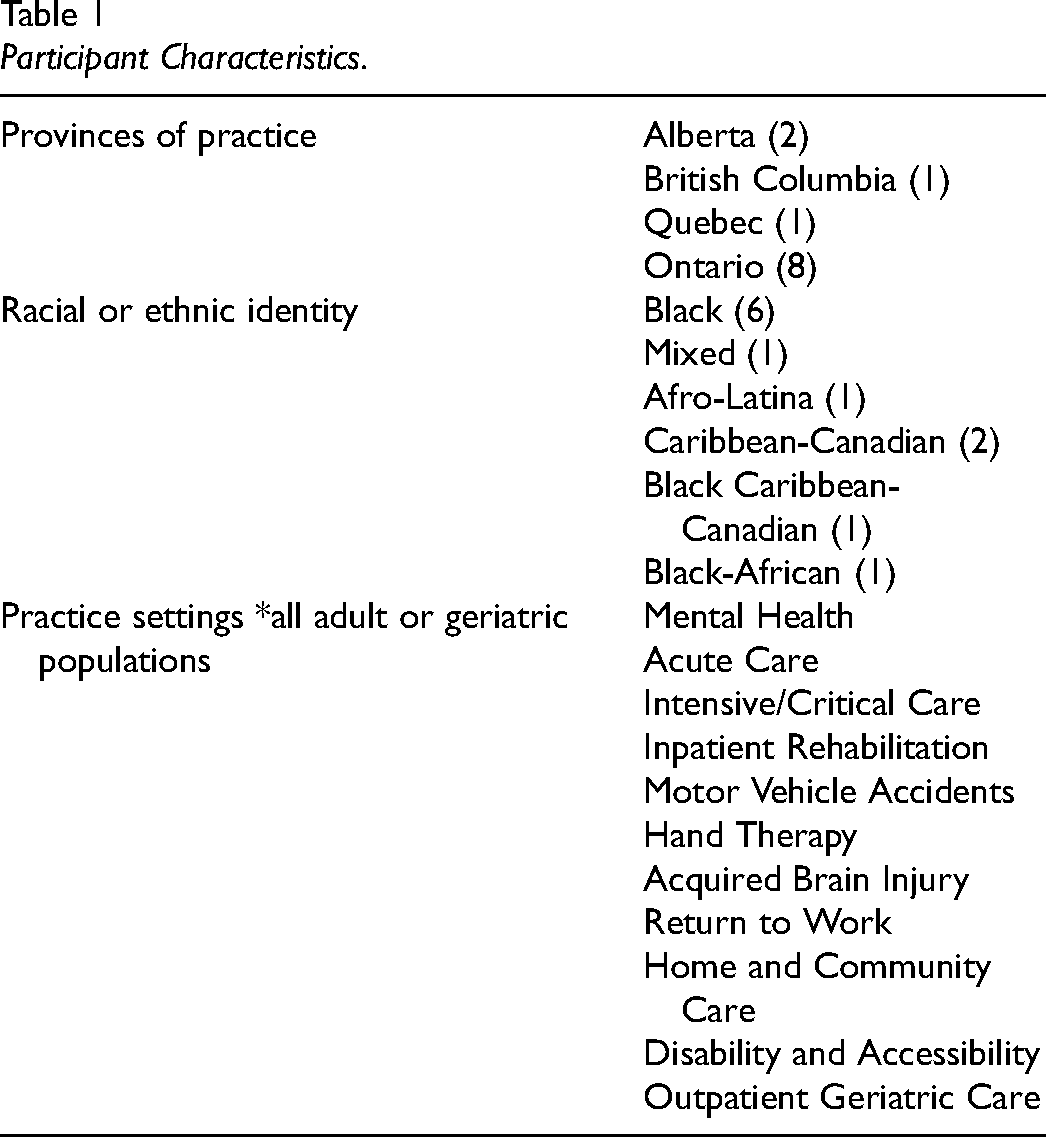
Twelve professionals across Canada participated in individual interviews: 11 OTs and one OTA. Provinces of practice are outlined in Table 1. All participants identified as female and varied in racial or ethnic identity (see Table 1). Participants’ years of experience ranged from 6 months to over 20 years, with the majority of participants practicing for 10 or more years. Throughout their careers, the professionals worked in numerous areas of practice (see Table 1).
Participant Characteristics.
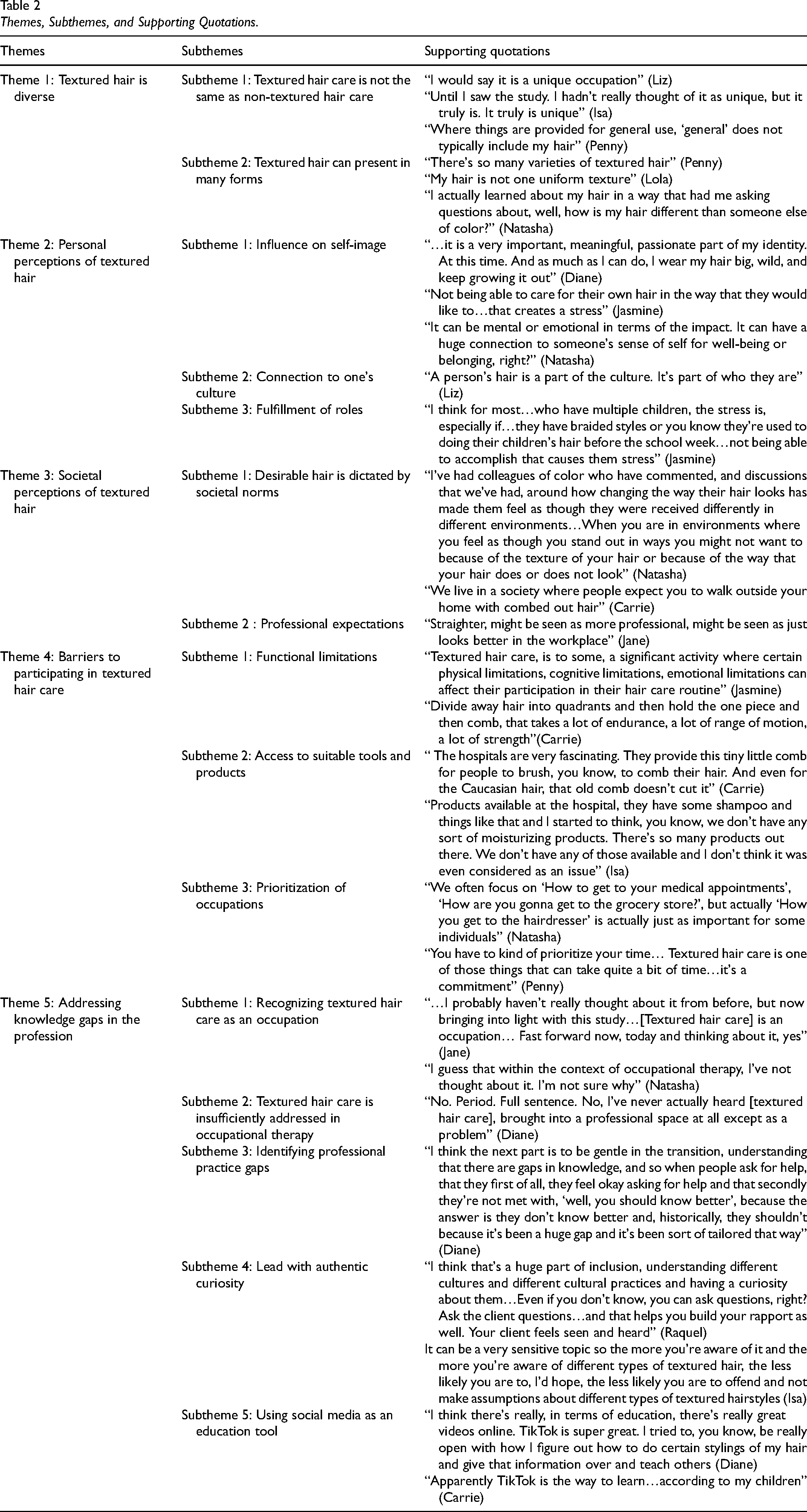
The interview analysis led to the identification of five themes: (1) textured hair care is diverse, (2) personal perceptions of textured hair, (3) societal perceptions of textured hair, (4) barriers to participating in textured hair care, and (5) suggestions for the development of the profession. These themes were then further broken down into subthemes and supporting quotations (see Table 2).
Themes, Subthemes, and Supporting Quotations.
Theme 1: Textured Hair is Diverse
Subtheme 1: Textured Hair Care is Not the Same as Non-Textured Hair Care
All participants acknowledged that textured hair has different requirements for styling, care, and maintenance than nontextured hair. As Isa explained, “I'd be concerned with people making assumptions that hair is hair is hair…There's a different type of care for each type of hair.” It was clear that although participants recognized the unique challenges for any hair type, there is typically more time and physical effort required to care for textured hair.
Subtheme 2: Textured Hair Can Present in Many Forms
All participants recognized that although textured hair should be understood as separate from general hair care, it in itself is an umbrella term. Quinn stated that “there's different gradients of textured hair,” highlighting that among individuals who identify as having textured hair, there are still many differences in how the hair looks and is to be cared for. Moreover, some participants also acknowledged the variability of texture within one's head of hair. For example, Hyacinth stated that she has “a lot of different types of curls across [her] scalp.” All participants had differences in how they cared for their hair, highlighting that there is no single correct method to care for or style textured hair; rather, textured hair care is specific to each person.
Theme 2: Personal Perceptions of Textured Hair
Subtheme 1: Influence on Self-Image
Participants differed in their ways of styling and caring for their hair yet all shared how hair influences their self-image. Raquel emphasized this when saying, “For me being able to manage my own hair…and do what I want to do with it makes me feel independent and confident. So, if I couldn't do that, I think that would be very difficult.”
Moreover, some participants expressed a desire to embrace longer or voluminous hair, while others opted for shorter styles that require less maintenance. For example, Carrie stated, “I ended up cutting my hair and I've never been happier…I feel comfortable now in my skin and do not care what anybody thinks.” A few participants revealed that having a lack of control over their hair (i.e., not being able to style it the way they wish) can create a negative internal dialogue and impact self-image. Jane illuminated this when she said, It affects a little bit of your self-esteem…I don't want to be, you know, walking around with hair that doesn't look so great, even though people say it looks really good, I know internally I want to have my curls looking right.
Subtheme 2: Connection to One's Culture
Some participants shared that being able to express themselves through the styling of their hair allows them to feel connected to their culture. Diane shared that “I think for me, my hair now, it speaks also to my ancestry… I absolutely embrace my ancestry and I want to take them with me.” Other participants also emphasized that regardless of how their hair was styled, simply having textured hair provided them with a sense of innate connectedness to their culture. For all participants, there was no one definition of culture, rather, culture was specific to the individual's personal contexts and experiences.
Subtheme 3: Fulfillment of Roles
A few participants discussed the role of parenting and parents wanting to fulfill their self-perceived roles as models for hair care and providers of hair care to their children. Penny shared her own experience stating, “I have a daughter…I feel like if she can see me doing my own hair, then that will hopefully, help her to love and appreciate her hair.” However, a few participants stated that as parents, at times, their hair care routines had to be altered to have sufficient time to care for their children's hair.
Theme 3: Societal Perceptions of Textured Hair
Subtheme 1: Desirable Hair is Dictated by Societal Norms
Many participants voiced they felt there was a societal norm to be perceived as presentable when out in public environments. For example, Carrie shared, …hair is part of our outward appearance…We live in a society where honestly we worry about that…Your first contact is how you look, is your appearance, that's how people will judge you in the first place… so hair is a big part of it… Being able to be presentable is important.
In most conversations, participants discussed Eurocentric beauty standards that impacted their hair care. For example, several participants discussed that the norm growing up was to use hot combs, cast iron combs heated up on the stove, or relaxers, chemicals, to straighten their hair. All participants who once frequently straightened their hair, through their own journeys, transitioned from processing their hair to using natural and protective hairstyles. Some participants stated that the rejection of Eurocentric standards contributed to positive feelings. For example, Raquel stated, “Keeping my hair in its natural state became a huge part of my identity.” Others, however, posed there should be a disconnect between societally imposed views of hair styling and one's racial identity, such as Isa, …some people get really wrapped up in natural versus processed in terms of what's more valuable in worth and how that ties into your blackness and all that sort of thing… It doesn't define who you are as a black person.
Subtheme 2: Professional Expectations
Some participants shared their experience of feeling the need to wear their hair in more Eurocentric styles to be perceived as professional in different settings such as work. This was highlighted when Quinn shared, I've also had my friends say like ‘Oh yeah I'm starting a new job and I'm gonna do my hair in this way so it's less like ‘boom black’… You feel like your hair being in certain styles makes you appear less professional and less serious which is a reality that I feel as well that people have this perception that you are unruly, unkempt, unclean, unprofessional. Again, because of your hair being in a style that maybe they cannot relate to.
Theme 4: Barriers to Participating in Textured Hair Care
Subtheme 1: Functional Limitations
Many participants discussed the physical requirements that go into caring for and styling textured hair. Diane shared, Certain styles take longer than other styles and so having your hands above your head, you can, you know, get some fatigue in your arms. And, you know, just different folks have different tolerances for how long they can hold their arms up like that.
Other participants highlighted how one's cognition, psychological health, and affect can hinder one's participation in hair care. For example, Penny shared, The effort and the time and the intentionality that it takes to do textured hair. If someone is not feeling well mentally, it's one thing to not be able to, say, stand under the shower and let the water kind of do its thing. But to consider all of the efforts that someone might have to, plan for and to prepare for, it might make it that much more difficult for someone to take care of that aspect of themselves when they're not well…The layers of literal work that it takes to do textured hair and what it would take to get the motivation to do all of that…The coordination and planning and organizing and sequencing and all the things.
Subtheme 2: Access to Suitable Tools and Products
Participants varied in their experiences of easily accessing tools, products, and services that were appropriate for their textured hair. Some participants struggled to find stores that sold affordable products or had trouble finding a hairdresser who understood how to care for, cut, or style their hair as desired. Other participants shared that they never had challenges finding products or services that met their needs.
Participants with work experience in acute hospital settings described how the tools and products provided by the hospitals were insufficient and not well suited for textured hair. All these participants voiced that the combs provided by the hospital cannot properly care for many hair types, especially textured hair. Further, some of these participants shared that the shampoos they had to use were not moisturizing enough for textured hair. Carrie shared how her team would keep a personal supply of products for their clients with textured hair, …privately like as a team we would buy different shampoos and keep that in a stash because if you have a patient who's staying in the [intensive care unit] for weeks and now their hair is completely matted and you know that one size fits all shampoo and body wash does not work.
Subtheme 3: Prioritization of Occupations
Many participants described feeling conflicted about time management. These participants expressed that they would often choose between dedicating time to their hair care at the expense of other important occupations or, conversely, having to restrict their routine or styling time to participate in other occupations. For example, Natasha shared “I didn't have time to do [my hair] as a student. I had enough other things.”
Some participants found that working in acute care settings, there are large time constraints which result in ADLs being prioritized based on the health care system's perceived importance of function and safety. ADLs, such as hair care, were not often, if ever, addressed with clients. Carrie shared, “I don't think it's gonna change. There's too many limitations, you know. There's limitations in terms of time, in terms of expectations, in terms of trying to get patients out, resources. It's just way too many constraints.”
Theme 5: Addressing Knowledge Gaps in the Profession
Subtheme 1: Recognizing Textured Hair Care as an Occupation
All participants voiced that before participating in this study, they had never considered or thought of textured hair as an occupation. For example, Lola stated, “This…is the first time anybody has ever mentioned [textured hair care] to me in my whole career in the context of occupational therapy.” However, participants shared that once they had the opportunity to reflect, they realized that they did perceive textured hair as a meaningful occupation.
Subtheme 2: Textured Hair Care is Insufficiently Addressed in Occupational Therapy
Participants unanimously expressed that textured hair was neither discussed nor addressed within occupational therapy. Natasha shared “I can't think of an experience where I've had a discussion about textured hair with respect to [occupational therapy] practice, either clinically and even in terms of my education as an OT as well.”
All participants indicated that there were no known textured hair-specific assessments or interventions within occupational therapy other than ones they creatively implemented into their own practices. Participants added that assessments that do acknowledge hair care tend to use language that positions straight hair as the standard or may be susceptible to unconscious bias. For example, Diane shared her experience when completing an assessment: “I remember looking at one of the questions about hair, and I was going, what is unkempt, unkempt hair?”
Moreover, all participants discussed how there were no specific occupational therapy education tools that would allow learners, practitioners, or researchers to better understand textured hair care as an occupation or the requirements of caring for textured hair care.
Subtheme 3: Identifying Areas for Professional Development
Most participants discussed the importance of increasing educational resources for all occupational therapy professionals to utilize to better understand the nuances of textured hair care. Diane added, It's important because so much of how we come into meeting people, to [completing an] assessment, to even building a body of education, it comes from this sort of assumed place of common sense and common sense is not common. It's very specific. It has a very specific ethnographic background and I think what we're trying to do is broaden the understanding of what common is and what common is for different people. So that's why I think it's so vitally important that we're actually building in more common sense around textured hair, around different demographics of people, ethnographi[es] of people.
Many participants expressed that this study provided the opportunity to reflect and start meaningful conversations that encourage professional development. However, participants expressed that further research and knowledge sharing is critical. Some participants discussed the creation of textured hair care-specific videos, modules, or handouts. One participant also discussed utilizing interdisciplinary resources, such as learning strategies from hairdressers to implement into occupational therapy practice. Jasmine also emphasized that occupational therapy programs should find ways to integrate conversations about textured hair care stating, I think if it's integrated into the curriculum of when you're talking about self-care, when you're talking about washing oneself, washing hair, how to look at different ways of assessing or discussing, you know, strategies to help with textured hair. So it starts really with education.
With all suggestions, participants discussed that the education should be for all occupational therapy professionals, regardless of ethnicity or race, as gaining awareness and comfort with textured hair care will serve to benefit the clinician's practice as well as the client's experience.
Subtheme 4: Lead With Authentic Curiosity
Many participants discussed that for all occupational therapy professionals, a direct way to address textured hair care is by being open to learning from the client and being humble about existing gaps in knowledge. This was emphasized by Lola when she stated, “Asking your clients and your future practice about [textured hair care], opens the floor for dialogue or for conversation about it…foster a climate of inclusion and belonging for all of your clients.”
Hyacinth also discussed authenticity in the context of reflexivity, emphasizing the importance of checking biases, language use, and nonverbal communication when working with clients with textured hair. Diane explained further that “being culturally sensitive or understanding allows everybody to thrive.”
Subtheme 5: Social Media as an Educational Tool
A few participants mentioned that social media platforms such as YouTube, Instagram, TikTok, and Pinterest, are useful resources to learn about textured hair care. Quinn shared, “I think education through Instagram has been so helpful. That's visibility. Instagram and Pinterest. I can make a Pinterest board of all the different styles and hair care products to fill my heart's desire.”
Discussion
Implications for Occupational Therapy and Occupational Science
Addressing textured hair care in occupational therapy is important as it can directly impact clients as well as clinicians in everyday practice. However, it is also a critical conversation to advance occupational science as it contributes to the growth of evidence and foundational knowledge in which understandings of occupation, health and wellbeing are rooted.
As this is a novel area of research, it is important to acknowledge that the term textured hair may not resonate with all individuals. There is no single term that can fully capture how each person defines their own hair. As research and practice grow in this area, further conversations with those with lived experience can help to evolve the terminology used.
Furthermore, this paper posits that occupational prioritization be recognized as a fundamental concept in occupational therapy and occupational science. Occupational prioritization recognizes that different occupations are given different levels of importance based on the context in which they are addressed. For example, for textured hair care, in a macro context such as a hospital, current practices dictate that ADLs such as bathing, toileting, and dressing be prioritized over hair care. With pragmatic clinical considerations such as hospital resources and time constraints, occupations that are deemed most important for independence and safety are prioritized. However, when contrasting this with the micro context of an individual and their identity, it can be argued that identity-affirming occupations such as textured hair care may be given a higher priority as they play a role in maintaining a sense of self and wellbeing. In many practice contexts, there may be conflict between the occupational prioritization of the practice setting and the meaningful occupations of the client. Understanding this can help occupational therapy professionals better identify barriers and facilitators to meaningful participation.
Working Toward a Culturally Safer Profession
Through this paper we seek to initiate discussions on culturally safer practices in textured hair care, aligning with OT and OTA competencies, particularly C2. Promote anti-oppressive behavior and culturally safer, inclusive relationships, and its related indicators (ACOTRO et al. 2021; CAOT, 2024). It is the duty of all occupational therapy professionals to seek out resources, learn from those with lived experience, and identify areas for personal and professional improvement.
In learning about and integrating strategies, care techniques, products, and tools that are commonly associated with textured hair into practice, many populations may benefit. All hair has unique qualities, requirements, and meaning. Any individual, no matter their hair type, can perceive their hair as part of their identity. It is also important to recognize that different races and ethnicities can have textured hair. However, one must acknowledge the impacts of history and systemic practices on occupational therapy to create professional spaces that better address the various intersections of race, ethnicity, culture, and hair.
Future Directions
Future research should include clients’ perspectives on textured hair care as an occupation. Additionally, the conversation should extend to interdisciplinary health professionals such as nursing and personal support workers, whose scopes allow them to address hair care tasks. Interviewing these professionals can reveal how they currently do or do not support textured hair care.
OTs and OTAs can build their knowledge and exposure to textured hair care while recognizing that no one strategy or video is a perfect representation of all individuals with textured hair. Understandings of textured hair care can be advanced using existing literature, modules, and social media resources, for example, The Science of Black Hair: A Comprehensive Guide to Textured Hair by Davis-Sivasothy (2011) and AOTA's Guide to Culturally Inclusive Hair Care Services and Incorporating Cultural Humility into Practice by Durbano (2022). However, more occupational therapy-specific education modules, handouts, and other resources on textured hair should be created. For example, resources with prompts, cues, and strategies for care should be created so professionals can better understand how care may differ depending on the client's hair texture or style. Regarding occupational therapy education programs, introducing conversations about textured hair care using case scenarios may be a good way to start broaching the conversation. Increasing the resources available to all occupational therapy professionals is critical as all should feel that they can and should start these conversations with clients.
There are also implications in how OTs can advocate for clients with textured hair. Professionals must start critically analyzing how current assessments, interventions, resources, and claims forms may or may not accommodate textured hair care needs. Some ways occupational therapy professionals can begin to reflect on the potential for bias in practice, assessments, and research is by asking themselves: How may my client identify with their hair? How can engaging clients in hair care work towards therapy goals? Do my current practices inadvertently perpetuate harm by insufficiently addressing an important aspect of their identity?
Limitations
There are a few study limitations. Firstly, the sample was small and predominantly OTs. A larger sample with a more robust OTA representation could have provided more comprehensive insights. Moreover, although the study was offered to all genders, only female-identifying professionals participated. This may reflect that occupational therapy is a female-dominated profession (CAOT, 2015). Furthermore, there was a larger representation of professionals from Ontario. This may be due to two of the authors having a larger professional network in Ontario. Additionally, Ontario has the highest number of practicing OTs and the largest Black population among provinces, which may be reflected in the participant demographics (Canadian Institute for Health Information, 2022; Statistics Canada, 2022). Moreover, some provincial occupational therapy associations did not respond to recruitment efforts, making it unclear if all contacted provinces circulated the recruitment information. Recruitment was not formally circulated in the Territories.
Conclusion
This article used qualitative thematic analysis to understand the perceptions and experiences of Black and Mixed OTs and OTAs in Canada. Participants identified that textured hair care is an important yet overlooked occupation. To strive toward a culturally safer profession, OTs and OTAs must continue the conversation and take action to create professional and educational spaces that recognize and address textured hair care.
Key Messages
This study aims to promote a culturally safer profession by starting the conversation about textured hair care as a meaningful occupation.
This study highlights the need to recognize occupational prioritization as a facilitator and a barrier to occupational participation.
Curiosity and recognition of deeply personal values behind textured hair should be foundational in all efforts to address textured hair care in practice, education, and research.
Declaration of Interest Statement
The authors declare no conflicts of interest with respect to this research.
Footnotes
Acknowledgments
This research was conducted as a project during two of the authors' Master of Occupational Therapy degrees. The authors would like to acknowledge Dr. Rebecca Gewurtz for her guidance, support, and encouragement, which made it possible to pursue this student project. Furthermore, the authors sincerely thank all participants, without whom this research would not have been possible.
Funding
The author(s) received no financial support for the research, authorship, and/or publication of this article.
