



Abstract
Students living with disabilities 1 face numerous systemic barriers when studying, graduating from, and working in health professions (Jarus et al., 2022; Mayer, Nimmon et al., 2024; Mayer, Shalev et al., 2022). A few of those barriers—such as a lack of accommodations, stigma, and prejudice that leads to fear of disability disclosure—have led to the underrepresentation of disabled students in postsecondary education programs (Dhillon, Moll et al., 2024; Dhillon, Stroinska et al., 2023; Grimes et al., 2017), and to lower graduation rates compared to their nondisabled peers (Morris et al., 2018; U.S. Department of Labor, 2021). This is especially discouraging as research has demonstrated disabled students in the health professions possess unique, experiential perspectives that benefit the client and the care they receive (Ozelie et al., 2019).
When examining barriers to equitable education for disabled students within health professions programs, one must consider both academic and fieldwork contexts. Fieldwork requirements differ across programs and align with each discipline's accrediting body (Stagnitti et al., 2013). Fieldwork education typically comprises multiple fieldwork 2 experiences throughout the program and is arranged in partnership with community health agencies. These experiences provide students with the opportunity to apply their academic knowledge and demonstrate competence within health practice settings under the supervision of a practitioner (Stagnitti et al., 2013; Wallingford et al., 2016).
Students Living with Disabilities in Health Professions Fieldwork Programs
Over the past two decades, research on disabled students in postsecondary education has increased. Yet studies focusing on fieldwork education remain minimal. Research across disciplines has found that disabled students experience greater emotional burdens due to the societal barriers they face (Brown et al., 2006; Bulk et al., 2017; Easterbrook et al., 2015; Norris et al., 2019) and stigmatisation in fieldwork (Fossey et al., 2017; Jarus et al., 2019; Luckowski, 2016; L’Ecuyer, 2019; Murphy, 2010). A recent study found that disabled students also experience more stress than their peers in fieldwork education due to stigma and barriers (Rajapuram et al., 2020). Further, like their nondisabled peers, they have limited knowledge of what to expect in future clinical settings owing to a lack of resources or explanations given by academic institutions (Horkey, 2019). These systemic barriers, in turn, can influence their decisions regarding disclosure of their accommodation needs (Kiesel et al., 2018). To the best of our knowledge, there is limited literature addressing the specific experiences of disabled occupational therapy (OT) students. The few available studies indicate that these students also encounter stigmatization within the field and are hesitant to disclose their disability statuses (Bevan, 2014; Chacala et al., 2014; Jarus et al., 2022; Meyer, 2014; Mayer, Nimmon et al., 2024; Ozelie et al., 2019; Stier et al., 2015). Further, the need to pursue accommodations may represent forced disclosure for some students (Dhillon et al., 2024).
Disabled students who wish to receive fieldwork accommodations must register with their institution's accessibility services office (Raue & Lewis, 2011). As in most countries, in Canada it is up to the student's discretion if they desire to register with the institution's accessibility services office, a necessary step in order to receive accommodations. Without support, disabled students are vulnerable to accommodation barriers in their fieldwork and may, as a result, abandon their studies (Canadian Human Rights Commission, 2017; Easterbrook et al., 2019; Meeks et al., 2018). Nevertheless, in a few studies, disabled students perceived their relationships and communication with accessibility services, faculty, and fieldwork educators, as well as the support they received, as ineffective (Botham & Nicholson, 2014; Epstein et al., 2020; Hill & Roger, 2016). These students desire to be involved in placement selections to ensure that a fieldwork site can accommodate their unique learning needs and interests (Hearn et al., 2014; Johnston et al., 2016; Langorgen & Magnus, 2020). Given the work required involving communication with fieldwork placements, a special academic role called “Academic Fieldwork Coordinator” (AFC) exists to help fit both nondisabled and disabled students in appropriate fieldwork positions.
AFCs’ Role in Supporting Disabled Students
AFCs in health professions programs are faculty members whose primary role is to manage fieldwork education. They are responsible for meeting the educational needs of students in fieldwork in diverse healthcare and community settings (Smith et al., 2013). The AFCs’ responsibilities include overseeing the professional practice curriculum of multiple student cohorts in different years within their program (Stagnitti et al., 2013; Stutz-Tanenbaum et al., 2015). Supporting disabled students in fieldwork adds to the complexity of the AFC role as the accommodation needs of students often vary by setting and students’ needs, thus benefiting from advance planning (Dhillon et al., 2024; Griffiths et al., 2010).
AFCs have an important role in bridging between the academic institution and the field for disabled students. Meeting the needs of disabled students in fieldwork can be quite challenging (Epstein et al., 2019; Griffiths et al., 2010; Storr et al., 2011; Tee et al., 2010). To the best of our knowledge, there are no evidence-based guidelines for equitable practice to inform AFCs with regard to fieldwork accommodation practices. While it is the responsibility of postsecondary institutions to ensure that fieldwork education is equitable, nondiscriminatory, and barrier-free (Government of Canada, 2017), most institutions are normed on students who are able-bodied with minimal research available on the effects their institutional structures place on the experiences of disabled students in fieldwork (Dolmage, 2017; Kimball & Thoma, 2019). This leaves AFCs to address the diverse needs of students in fieldwork on their own. The current study addresses this research gap and focuses on exploring the experiences of AFCs navigating through the systems trying to support disabled students. Further, OT is characterized by working alongside individuals that are experiencing social, emotional, or physical challenges (Dhillon et al., 2024). An examination of how the academic environment leads by example, or fails to, is especially vital as the OT field has the greatest opportunity to “walk the talk.” Our main research question was: What are the experiences and perceptions of AFCs in OT educational programs on accommodating disabled students? To examine this question we conducted an exploratory study in which academic AFCs from OT programs across Canada were interviewed.
Method
Study Design
This study used a sequential explanatory mixed methods design (Ivankova et al., 2006; Subedi, 2016). The study employed a two-phase data collection process. Initially, quantitative data was gathered through surveys, followed by interviews designed to aid in interpreting and understanding the broader context. This approach is based on the rationale that quantitative data and results offer an overall understanding of the research problem, while qualitative data collection is needed to further explore, refine, or elaborate on this general understanding (Creswell & Plano Clark, 2018; Ivankova et al., 2006; Subedi, 2016). Enhancing the quantitative data with qualitative data derived from interviews offered a richer understanding of AFCs’ experiences and strengthened the overall study findings (Creswell, 2003; Cronholm & Hjalmarsson, 2011; Ivankova et al., 2006). In line with our explanatory sequential design, we initially planned to present the results in a strictly sequential manner, with quantitative findings followed by qualitative explanations. However, we found that organizing the results around qualitative themes provided greater clarity and coherence, allowing us to integrate the quantitative findings more effectively within the qualitative framework. This approach emphasizes the central role of the qualitative phase in elaborating on quantitative trends while maintaining the integrity of the explanatory sequential design (Ivankova et al., 2006).
Settings and Participants
Participant recruitment from postsecondary OT programs took place across Canada using the inclusion criteria of: (a) A minimum of 6-month employment as an AFC in one of the OT programs, and (b) Experience working with disabled students. Following the University of British Columbia's ethics review board approval (approval number H19-01377), a request was emailed to the Association of Canadian Occupational Therapy University Programs to forward the study information with a link to the study survey to all 14 programs across Canada. According to a preliminary check we conducted at the time of this study, the total estimated population of AFCs in OT programs across Canada was 28, with programs averaging 1.74 (SD = 0.71) full-time equivalent positions for AFCs. The study data was obtained from August 2019 to January 2020.
Study Sample
Fifteen AFCs from all the Masters level OT programs in Canada (2019–2020) signed a consent form and completed the survey in phase one. Five of the respondents, each from a different institution, agreed to be interviewed and participated in phase two. The sample size for the interviews met the criteria suggested by Hagaman and Wutich (2017) in homogenous groups for inductive themes. Given the closeness of the AFC community and the study's small sample size, demographic information was limited and aggregated to protect participant confidentiality.
Data Collection and Analysis
Phase 1
As there was no previously established validated data collection tool, we developed a survey questionnaire based on current literature, the authors’ prior academic coordination experience, and similar survey tools used to study student accommodations in postsecondary health programs (see Meeks & Herzer, 2016; Stier et al., 2015). To ensure face validity of the tool, three expert AFCs (who were not part of the study sample) reviewed the survey and provided feedback on the relevance of the items (e.g., the included items are appropriate for studying the perspectives of AFCs on accommodating disabled students), comprehensiveness (e.g., no key concepts missing), and comprehensibility (e.g., the items are appropriately worded; de Vet et al., 2011; Terwee et al., 2018).
The survey comprised 43 items (see Supplemental Material 1), including open-ended questions and statement items with 6-point Likert scale responses. Topics included participant demographics, institutional norms related to AFCs’ role with disabled students, accommodation knowledge and practices, common accommodation issues, personal perceptions of their performance as an AFC, attitudes, relationships, and the work environment related to disabled students. A final survey item invited respondents to take part in the study interviews. The survey, hosted on Qualtrics, took 15–20 min to complete. We employed the SPSS26 statistical package to analyze all the survey data using descriptive statistics (Mean, SD, and frequencies analysis). Most of the participants (12, 80%) identified as women; had an average of 8.6 years (SD = 5.59) experience as an AFC with experience ranging between 6 months and >10 years; all were occupational therapists and, on average, had practiced OT for 25.67 years (SD = 11.49). None of the participants identified as living with a disability.
Phase 2
90-min semi-structured, individual or group interviews—3 participants in a group interview, and additional 2 participated in an individual interview—were conducted by the second author via Zoom with five AFCs. All interviewed participants were women, and each represented a different university. The decision to interview individually or in groups was based on participants’ time constraints and preferences. Interview questions focused on personal and environmental challenges, supports, and solutions the AFCs encountered in supporting disabled OT students in fieldwork. The semistructured interviews (see Supplemental Material 2) allowed consistent coverage and comparison of the key issues found in phase one, expanded on the survey findings, and reduced uncertainties that arose. Participants provided their informed consent prior to the interviews and again at the beginning of the interviews. Participants also chose pseudonyms to maintain their anonymity. All interviews were audio-recorded and later transcribed verbatim.
Clarke and Braun's (2013a) six-phase thematic analysis framework guided the qualitative analysis of the interviews. Our research was guided by these six nonlinear, recursive phases: familiarisation with the data, coding the data, searching for themes, reviewing themes, defining and labeling themes, and writing up the data alongside the analytic narrative (Braun & Clarke, 2023a, 2023b; Clarke & Braun, 2013b). Two researchers coded all transcripts. They discussed and aligned their codes for the first interview before proceeding with further interviews to increase rigor (Tracy, 2010). We returned to the data to develop the themes once initial codes were obtained. Additionally, peer debriefings, memos, and an audit-trail maintained throughout the process enhanced accuracy (Nowell et al., 2017). The team reached consensus on themes through multiple team meetings. Regarding member checking, we shared the results with the participants. They were an integral part of developing the next steps by confirming the themes the researchers identified as well as assisting in labeling them.
Researchers’ Positionality
The authors are diverse regarding their race, ethnicity, professional disciplines, and personal connections to disability. All of the authors have lived experience with disability and other marginalized identities and two authors are OTs. The second author served as an AFC for 9 years in an American postsecondary educational institution and has extensive experience in academic fieldwork coordination. Two coauthors have extensive experience in planning, conducting, and supervising qualitative and quantitative disability studies.
Results
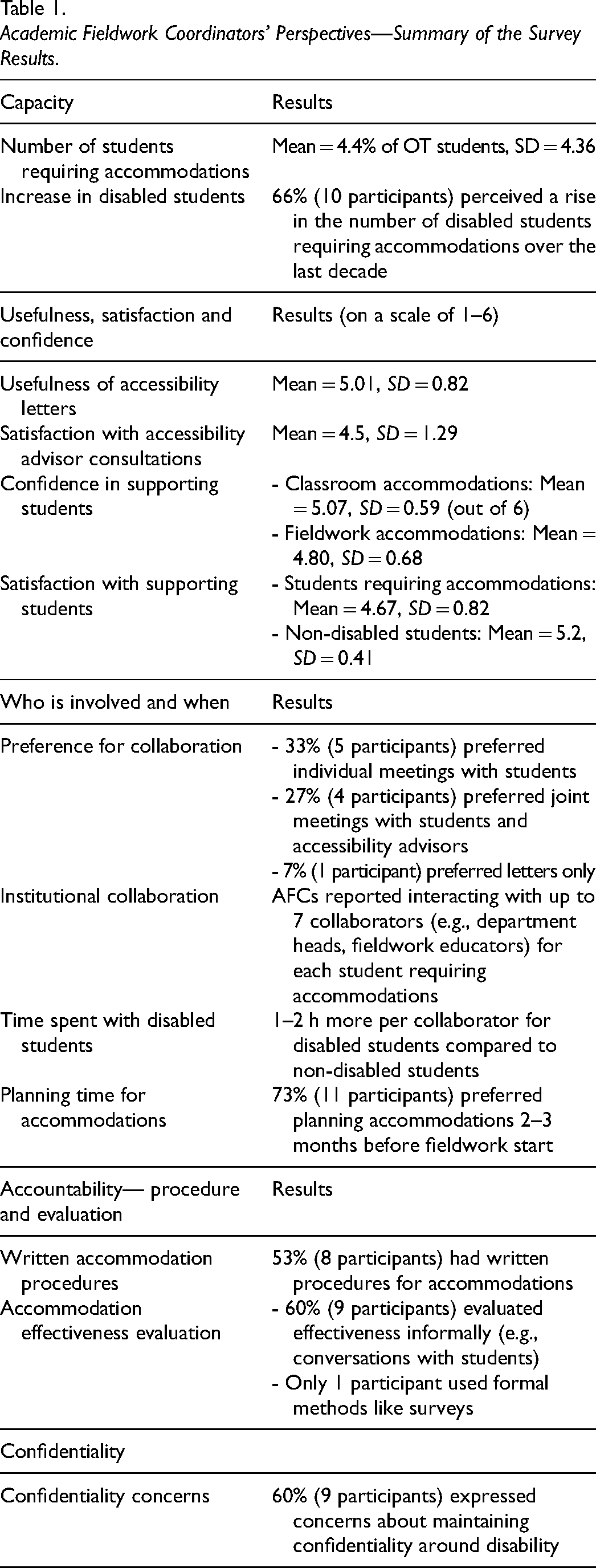
Participants’ experiences presented two main themes. The first theme, AFCs Constantly Navigated Tensions with Institutional Norms Regarding Fieldwork, relates to the barriers created by postsecondary institutions that AFCs faced in supporting disabled students. The second theme, AFCs Manage Fieldwork Accommodations within Ever-changing Human Dynamics and Social Norms, refers to their students’ decisions about disclosure and the ways that AFCs manage ever-changing fieldwork settings for disabled students. Table 1 presents the quantitative data. Table 2 presents the full list of themes.
Academic Fieldwork Coordinators’ Perspectives—Summary of the Survey Results.
Academic Fieldwork Coordinators’ Perspectives—Themes.
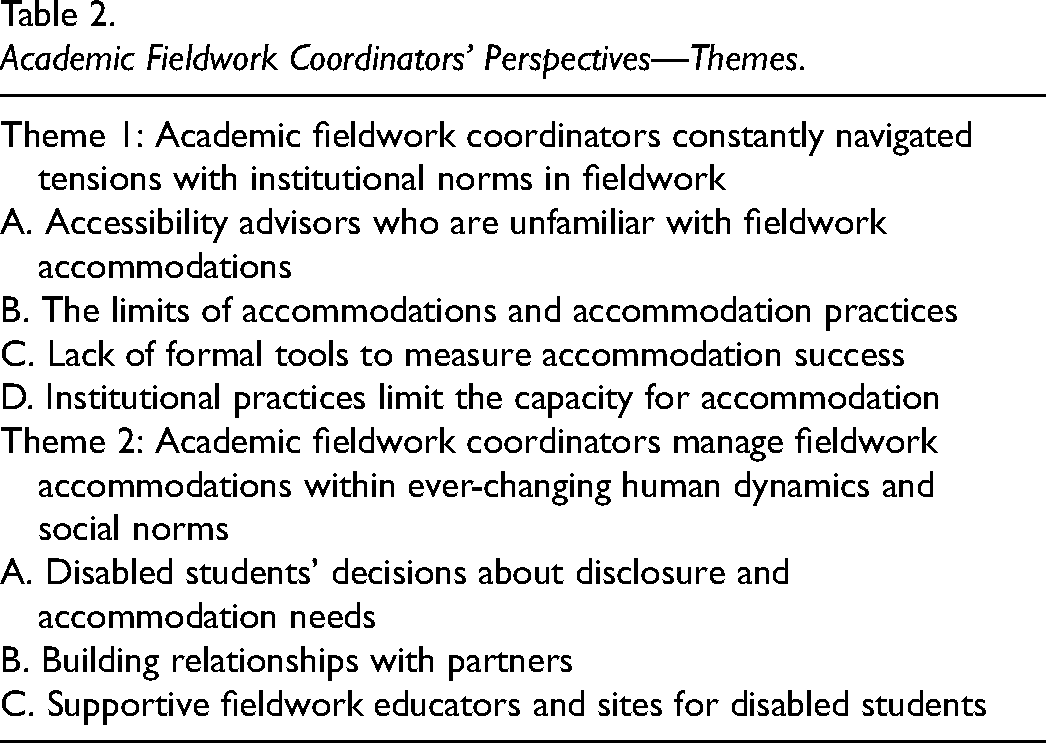
Theme 1: AFCs Constantly Navigated Tensions with Institutional Norms in Fieldwork
Interviewees reported encountering multiple issues that hampered their ability to support disabled students during fieldwork. Issues included fieldwork-related decisions that students, accessibility advisors, and AFCs made without a comprehensive understanding of fieldwork, accommodations, and student needs. Additionally, AFCs reported that limited resources and tools were available to them through their institutions.
Accessibility Advisors Who Are Unfamiliar with Fieldwork Accommodations
Most of the AFC survey respondents (11, 73%) received an official letter regarding the student's required accommodations from the accessibility center or when meeting a student prior to fieldwork placement. Survey results showed that, overall, the AFCs regarded these accommodations as “moderately useful” (M = 5.01, SD = 0.82). The remaining respondents (4, 27%) were not aware of their students’ accommodation needs. All interviewees indicated that they encountered problems with fieldwork accommodations. Several interviewees agreed that the disability advisors who are responsible for determining accommodations did not understand that fieldwork differed from academic studies. As Elizabeth stated, the letter's “language is more for the academic … Then, it's taking that and trying to translate it into what is really needed in a practical practicum sense.”
During the process of figuring out how to implement the accommodations to the specific fieldwork locations, most survey respondents collaborated with students while the involvement of the accessibility advisors varied. Survey results showed that a third of the surveyed AFCs (5, 33%) preferred to be involved in the accommodation process and individually meet with each student, and close to a third of the surveyed participants (4, 27%) preferred meeting together with the accessibility advisor and the student. Only one (1, 7%) preferred receiving a letter from their accessibility center without any consultation. On average, participants were “somewhat satisfied” with consultations with the academic advisor in the fieldwork accommodations process (M = 4.5, SD = 1.29).
Notably, over half of surveyed AFCs (9, 60%) expressed concern with confidentiality around a student's disability. Some interviewees, like Annabelle, mentioned their efforts to maintain students’ privacy, “I absolutely appreciate their privacy around disclosure … I speak with them about, ‘I don’t need to know what your condition is … they, [the site], don't need to know that.’” Annabelle overcame advisor access issues by brainstorming with the student and pulling together a list of informal strategies to use in fieldwork.
Limits of Accommodations and Accommodation Practices
Having faced complications in fieldwork accommodations, the interviewees regularly questioned their accommodation practices and its limits. For example, Elizabeth reflected on common AFC questions such as “What kinds of accommodations fit? … are reasonable? And how do we implement that as opposed to how much accommodation is reasonable? What's that line?” She also considered the possibility of excessive support: “I wonder if we accommodated too much; and, professionally, I know [that student] has had lots of issues moving in and out of positions [after graduation].” Many AFCs wrestled with what was reasonable. Such complex professional reasoning combines legal, academic, and healthcare realms; yet, almost half of the AFCs surveyed (6, 40%) functioned with no form of education from their institution on accommodations.
Several participants acknowledged that their biases impeded their placement decisions for disabled students. For example, Annabelle described her bias about the abilities of a student in a wheelchair: I said, “I guess I'll never place you in a home and community care placement because you won't be able to get into their homes.” [The student] said, “Why would you assume that of me?” … Now, [they work] in home and community care … I made wrong assumptions about [their abilities].
All interviewees wanted students to succeed. Elizabeth felt that fieldwork success “related to the amount of accommodation required.” Interviewees reported their involvement changed as the complexity of accommodations varied. For example, by finding a good fit for a student or by implementing frequent breaks within a fast-paced site. Several interviewees found that cognitive issues, learning disabilities, or emotional trauma were harder to fully support. At times, in complex fieldwork environments, AFCs found themselves without accommodation solutions for students with multifaceted needs.
Lack of Formal Tools to Measure Accommodation Success
Once students started their fieldwork, most interviewees left students to monitor their own accommodation needs in their placements. Interviewees described reducing collaboration and communication with students during placement unless, as Kim expressed, students had “previous [fieldwork] challenges” or “elaborate accommodations.” Instead, they commonly relied on fieldwork educators to “help keep the attention to how things are going,” as Elizabeth stated. Annie elaborated, “Sometimes we have to assume no news is good news,” because “there are [hundreds of] students we're dealing with and quite a large number having accommodation.” According to the AFCs surveyed, the percentage of students requiring accommodation was, on average, M = 4.4% (SD = 4.36) of all enrolled OT students. As this number only represents the students who chose to disclose and request accommodations, the true amount is unknown.
All interviewees expressed lack of accountability mechanisms. Kim acknowledged that they “have no formal mechanism for evaluating that [accommodation effectiveness].” Instead they relied on informal practices to measure accommodation success. Similarly, the survey results showed that while over half of the AFCs surveyed (9, 60%) stated that they evaluated accommodation effectiveness, only one respondent used formal methods such as surveys. More than half of the AFCs surveyed (8, 56%) used informal methods, such as obtaining data from students through conversation. Having a conversation with students about their ability to meet the fieldwork site objectives (6, 44%) was the most popular method used.
Institutional Knowledge Limits the Capacity for Appropriate Accommodations
Interviewees reported their accessibility center had expanded and improved its services over the years. For example, Annabelle reported, “They’re adding more advisors and now they've added this [health professional] … working with health students only.” Kim added, “They’ve now designated an individual over there who works with our department … It's ended up [an] advantage.” For many interviewees, these changes added to the efficiency of their accommodation practices. Specific to accommodation, Elizabeth found that remaining “fairly connected across the internet” with other AFCs across Canada was helpful. Annabelle related something similar: “Our [Canadian OT] practice education coordinators … absolutely rely on each other quite heavily.”
Although some of the AFCs benefited from improvements in their institutional environments, several interviewees identified institutional challenges related to their work with disabled students. First, some accessibility advisors continued to provide unfounded information because of gaps in knowledge. Annabelle described this lack of knowledge among accessibility advisors: “And then the issue is working with our Centre for accessibility, though I don't want to slam them. But they're busy and they don't have the knowledge of …, they can't possibly have the knowledge of the skills a nurse requires or an OT requires or physical therapist requires or pharmacist or physician out on practice. They don't get that.”
Second, for many interviewees, the rising number of disabled students felt challenging to manage. Most AFCs surveyed (10, 66%) perceived an increase in the number of students requiring accommodations over the last decade. Surveyed AFCs indicated that when an OT student required accommodations, they interacted with up to seven collaborators, which could include individuals from the university such as department heads, accessibility advisors, faculty, staff, students, or individuals from the fieldwork site like human resource personnel, directors, site fieldwork coordinators, and fieldwork educators. AFCs reported spending 1–2 h more per collaborator for disabled students compared to other students, especially prior to placement. The majority of AFCs surveyed (11, 73%) preferred to plan for fieldwork accommodations for disabled students at least 2–3 months before the fieldwork start date. Finally, just over half of the survey respondents (8, 53%) indicated they had a written procedure for fieldwork accommodations. Some interviewees emphasized that addressing the unique needs of students required a level of autonomy that allows AFCs the flexibility to determine how to best implement specific accommodations.
Theme 2: AFCs Manage Fieldwork Accommodations Within Ever-Changing Human Dynamics and Social Norms
Interviewed AFCs identified each student's need requires a different set of accommodations to meet the conditions of each unique fieldwork setting. To address this challenge, AFCs focused on building relationships to support disabled students with those internal to the institution (e.g., professors, instructors, disability advisors, academic advisors) and external to the program (e.g., preceptors, clinical supervisors) networks of relevant parties that constantly change. Underscoring the importance of the connection between the university and community healthcare providers, the AFCs understood the importance of the decisions they made in finding supportive fieldwork educators and sites for disabled students.
Students’ Decisions About Disclosure and Accommodation Needs
All interviewees acknowledged that disclosure was an active student choice. Many of the interviewees recognized multiple factors that influenced students’ disclosure decisions. Elizabeth shared that sometimes disclosure “delay is a result of students not necessarily recognizing what the demands will be in the site … I think it's very hard sometimes for students to anticipate that if they haven’t had the experience.” At the same time, some interviewees, like Annie, considered students “the expert of their condition” and “put the onus on the student to come and talk” about their accommodation needs without accounting for a student's expertise on fieldwork or accommodation. Several interviewees believed that disclosure could involve the risk of stigma. Annabelle shared, “I absolutely understand that they’re afraid of being labelled … that people are going to become the ‘deficit detective’ looking for their weaknesses.”
Following student disclosure, most of the surveyed participants (13, 87%) collaborated with the students to find solutions and more than half (9, 62%) consulted with the fieldwork educators. AFCs interviewed reported that following their interventions, a majority of the students ultimately received accommodations. A few interviewees reported adjusting a student's fieldwork following an unsuccessful placement by adding accommodations or, like Laura, finding “a place that does not count but will help them progress for the next time they go into a placement, so they will succeed.” Some of the AFCs interviewed stated that delaying disclosure could contribute to an unsuccessful fieldwork experience as they are left with insufficient time to implement accommodations.
Building Relationships with Relevant Partners
Interviewees emphasized key relationships with collaborators that functioned as support teams. These relationships varied based on students’ accommodation needs and fieldwork rotations. All interviewees agreed that building relationships with students and other partners was central to addressing students’ accommodation needs and to successful fieldwork implementation plans. Kim explained, “establishing of that relationship between the student and those resource people … as well as my communication and relationship with those resource people, is very important.” AFCs recognized supporting disabled students required a collaborative effort.
The only common practice that all interviewees shared was establishing relationships with the students during their pre-placement meetings, a practice aimed at facilitating effective site selection. During these meetings, interviewees explored the fieldwork interests and needs of students. Such early meetings with disabled students allowed AFCs to concentrate on student needs and to find ways to accommodate them. Face-to-face meetings helped maintain student confidentiality. However, developing rapport with students in such sensitive meetings was difficult in comparison to building rapport with nondisabled students. Interviewed participants believed that their use of what they themselves consider to be transparent, inclusive communication allowed disabled students to voice their needs. However, building respect and trust with students took time and often multiple interactions. Interrelated with the AFCs’ relationship with disabled students was their confidence in supporting them. Survey results showed that the AFCs were “somewhat satisfied” (M = 4.67, SD = 0.82) in their ability to support students requiring accommodations compared to “mostly satisfied” (M = 5.2, SD = 0.41) in serving other students. They also reported that they were “fairly confident” (M = 5.07, SD = 0.59) in offering accommodation support in classrooms before placements and only “somewhat confident” (M = 4.80, SD = 0.68) in overseeing accommodations in fieldwork sites. For most interviewees, career experience signified their level of confidence when navigating relationships and accommodations to support disabled students, as Annie shared, “I’ve been in this job for [over 10 years] … dealt with literally hundreds of accommodations.” Annabelle reminisced, “Years ago … I wouldn’t know how to do accommodation in the placement setting. [Now] I’m really confident and calm around trial-and-error.”
Several interviewees discussed trusting in trial-and-error and engaged continual reflection, especially after an unsuccessful situation. Laura shared, “How can I help more? What can we do next? And, how can we help the next [student]? It's always a reflection in progress to see what I can do better … How can I be empowering this student?” AFCs’ practices resulted from a continual refinement through success and error as they supported disabled students on their own.
Supportive Fieldwork Educators and Sites for Disabled Students
The pace and type of setting were a priority for the AFCs when selecting placements for disabled students—they were ranked first and second among factors that the surveyed AFCs considered when choosing a student's placement. All interviewees (5) specified that they considered both fieldwork educators and sites when locating placements and placed significant emphasis on the importance of fieldwork educators. Indeed, the fieldwork educators’ experience ranked third among factors that the surveyed AFCs considered when choosing a student's placement. Like Elizabeth, they sought a “key partner … that is supportive … a collaborator … who is able to look at … and say … how could this be modified?” Annie added, especially with “complex accommodations for a student, there are certain key partners that … [I] contact first.” Recognizing that disabled students are vulnerable to stereotyping, Laura explained, “The big challenge is to find a placement, find a supervisor who will be able to welcome the student … I think as much as we can prepare … it's just sometimes not enough.”
Discussion
The AFCs in this study described the need to overcome various institutional barriers to ensure disabled students received the fieldwork accommodations they are entitled to in order to succeed. Despite institutional awareness of an increased enrollment of disabled students in health professions programs and laws guiding postsecondary education (Dhillon et al., 2024), the time and human resources allocated to supporting disabled students remain insufficient. Recent studies found that a lack of representation of disabled people among policymakers and within institutions essentially render the needs of disabled individuals as something as a blind spot. The inclusion of disabled students in educational institutions is often an afterthought, weakening the foundations for their success and often leading to exclusion (Jarus et al., 2022; Jarus & Mayer, 2024; Mayer, Nimmon et al., 2024; Mayer, Shalev et al., 2022).
The first institutional barrier is associated with the current service provided by the disability centers of the universities. The AFCs reported encountering many accessibility advisors who were unfamiliar with the unique needs of students in health professions programs. This finding aligns with research by Gatto et al. (2020) that found advisors are well aware of their inadequate preparation in supporting disabled students in fieldwork education. The AFCs also experienced ethical turmoil as they attempted to balance the perceived rights of disabled students when accessibility services were unavailable. Although circumventing systemic obstacles increased the AFCs’ efficacy, it left students without legal accommodation rights and placed AFCs in a vulnerable position in terms of accountability. Moreover, while some of the AFCs found that early conversations held by disabled students with accessibility centers were beneficial to their AFC practices, others did not. Such social environments in postsecondary institutions dissuade disabled students from disclosing their disability and point to the absence of an inclusive systemic institutional culture. Previous research has also demonstrated that disabled students believe that using the accessibility center often, which is seen institutionally as a support, brings with it a sense of shame and stigmatisation (Dhillon et al., 2023; Hutcheon & Wolbring, 2012). Further emphasising the need for change, Griffiths et al. (2010) proposed that supporting disabled students in fieldwork required a proactive, planned approach. Nevertheless, our study found that proactive collaboration among the AFCs, disabled students, and accessibility advisors remains inconsistent across institutions.
Second, there seems to be limited institutional capacity building for supporting disabled students in health professions education despite rising levels of enrollment among disabled individuals. This increase in disabled students who require accommodations is hypothesized to be related to progressive legislature that aims to promote disabled students’ rights as well as general increases in disability awareness (Dhillon et al., 2024; Ozelie et al., 2019). Yet it is not enough for postsecondary institutions to merely support students in the primary academic site; fieldwork learning must be supported as well (National Education Association of Disabled Students, 2018; Tamtik & Guenter, 2019). Postsecondary institutions must proactively reexamine their infrastructures, personnel, faculty workloads, and capacity to ensure AFCs provide disabled students with equitable opportunities and support to successfully complete fieldwork. Limitations in fieldwork educators’ availability and fieldwork sites’ collaboration, as reported by the AFCs, have a negative impact on effective learning (Langorgen & Magnus, 2020) and, as suggested by a few studies (Botham & Nicholson, 2014; Easterbrook et al., 2019; Mayer, Hershler et al., 2024), assumptions about the abilities of disabled students impinge upon a student's autonomy and educational success. While Sowers and Smith (2004) have noted that education on accommodations and disabilities for fieldwork educators is beneficial, the AFCs reported inconsistent and minimal training. Moreover, limitations in available fieldwork settings for disabled students can suggest a larger issue with societal norms where not all sites are equally willing to hire practitioners who require accommodations despite empirical support demonstrating enhanced client care (Smedley et al., 2004). Our study conveys that there is a need for capacity building in education and implementing systems for supporting disabled students in health professions education and practice to promote fieldwork equity.
Participants in this study emphasized that preparation and preemptive action can create a supportive and inclusive fieldwork experience for disabled students. AFCs’ efforts of collaboration and allyship with OT students was paramount, especially in conversations regarding future fieldwork possibilities for disabled students, as previous research confirms (Botham & Nicholson, 2014; Epstein et al., 2019; Griffiths et al., 2010; Hearn et al., 2014; Hill & Roger, 2016; Rankin et al., 2010). However, while all interviewed AFCs outwardly expressed a desire to support disabled students and acknowledged the issues they face in accessing accommodations, their own language, actions, and inaction appeared at times to be unconsciously impacted by ableist assumptions, which are hidden in the day-to-day blueprint of institutional standards of operation as suggested by Dolmage (2017).
For example, while accommodation is a postsecondary institutional responsibility, the AFCs in this study believe that it is the responsibility of disabled students to initiate the accommodation process. Once the process begins, AFCs are then able to collaborate with the disabled student, academic institution, and fieldwork location in order to negotiate accommodations necessary for the student's success. This reinforces Bialka et al.'s (2017) argument for the need to supply those supporting disabled students with resources that help them explore their personal beliefs regarding disability and accommodation.
Lastly, there seems to be a lack of accountability in ensuring accessible fieldwork education. The AFCs in this study reported functioning without a formal tool to measure the effectiveness of accommodations or ensure accountability and the quality of their practices. Unfortunately, to the best of our knowledge, no formal tool for measuring fieldwork accommodation exists. Storr et al. (2011) found that there is a lack of evidence on the effectiveness of accommodations for students once implemented, drawing attention to the need to evaluate accommodations throughout the entire process and increase accountability (Griffiths et al., 2010; Storr et al., 2011).
Recommendations
Based on the interviews, three core initiatives to promote inclusive fieldwork education and support AFCs’ efforts were identified in this study. One key area for improvement is enhancing procedures and collaborations. Establishing a national fieldwork consortium that addresses the needs of the OT field can provide essential support, especially for disabled students seeking fieldwork placements. This consortium could involve academic institutions, fieldwork sites, AFCs, and disabled students, allowing them to share information, needs, and suggestions. Together, they can identify areas for improvement and promote equity for disabled students. Additionally, fostering collaboration between universities and their respective communities can contribute to a coordinated approach to equitable fieldwork. Institutions should also acknowledge the additional workload involved when negotiating with fieldwork locations on behalf of disabled students and provide the necessary support.
Another important focus is developing a process for evaluating the effectiveness of accommodations. It is crucial to proactively assess the infrastructure and workload to ensure that AFCs can offer disabled students appropriate opportunities and support during their fieldwork. For example, disabled students may require accommodations such as additional breaks, modified lighting, or quiet workspaces to perform effectively alongside their nondisabled peers (Ozelie et al., 2019). Developing formal, written accommodation processes would benefit all interested parties, particularly AFCs. These guidelines should be adaptable, open to revision, and continuously assessed to ensure they remain useful and effective.
Lastly, there is a need to establish educational programs for AFCs that help them reflect on their own attitudes and biases. These programs should support AFCs’ work, with a particular focus on facilitating placements for students with disabilities who require accommodations. Participants reported that those who lacked education on accommodations often had to invest additional time and effort to overcome the challenges created by accessibility advisors’ limited knowledge, including reinterpreting legal mandates. Despite their professional training in inclusion strategies, AFCs acknowledged an ongoing learning process about challenges, student capabilities, and accommodations. Some AFCs revised their assumptions about disabled OT students after interacting with them while others navigated the tension between societal ableism and their professional responsibility to support inclusive education.
Study Limitations
First, the AFCs’ recollection of events and personal biases towards disability may have influenced their perceptions of the experiences. Second, some of the AFCs may have been reluctant to openly participate in the survey and in the interviews or to fully disclose their practices for concern of employer retribution. Third, this study examined AFCs’ perspectives only. Examining the perspectives of disabled students, fieldwork educators, and faculty and staff members is essential in order to explore the full picture of accommodations in fieldwork education. Additionally, the sample represented in this study is small and geographically bound. Population samples from other AFCs around the world can provide a more diverse understanding of factors that support and challenge AFCs and disabled students in identifying appropriate fieldwork locations and accommodations. Lastly, the questions used in the interview portion of this study were based upon our survey material. It is quite possible our survey overlooked important topics.
Conclusions
Results of this study demonstrate insufficient institutional and communal resources and the limited perspectives of interested parties regarding students’ accommodation needs restricted the practices of AFCs when supporting disabled students. To overcome these constraints, AFCs used creative and collaborative approaches even though effective solutions were difficult to find. When viewing AFC practices through a rights-based lens, it is apparent that there is a lack of required policies, training, and tools. However, these gaps are opportunities for improvement in health professions education programs. Given the limited research examining disabled students in health programs, this study is valuable in understanding the barriers AFCs encounter in OT fieldwork. It contributes to fostering awareness of the adaptations AFCs must make in their practice to better meet student needs, particularly those living with disabilities, and promote degree completion and stigma reduction.
Key Messages
Reducing the stigma surrounding disabled individuals is particularly important in the field of OT as the reduction of stigma can promote the inclusion of disabled occupational therapists and better reflect the diverse community occupational therapists serve. The development and facilitation of measurement tools are imperative in assessing disabled students’ accommodation success. Preparation and preemptive action are the basis for creating a supportive and inclusive fieldwork experience for disabled students.
Supplemental Material
sj-docx-1-cjo-10.1177_00084174251331923 - Supplemental material for Inclusion in Fieldwork: Academic Fieldwork Coordinators’ Perspectives on Accommodating Disabled Occupational Therapy Students
Supplemental material, sj-docx-1-cjo-10.1177_00084174251331923 for Inclusion in Fieldwork: Academic Fieldwork Coordinators’ Perspectives on Accommodating Disabled Occupational Therapy Students by Yael Mayer, Fernanda Mira, Shahbano Zaman and Tal Jarus in Canadian Journal of Occupational Therapy
Footnotes
Funding
The authors received no financial support for the research, authorship, and/or publication of this article.

Supplemental Material
Supplemental material for this article is available online.
Notes
Author Biographies
References
Supplementary Material
Please find the following supplemental material available below.
For Open Access articles published under a Creative Commons License, all supplemental material carries the same license as the article it is associated with.
For non-Open Access articles published, all supplemental material carries a non-exclusive license, and permission requests for re-use of supplemental material or any part of supplemental material shall be sent directly to the copyright owner as specified in the copyright notice associated with the article.
