




Abstract
Abstract
This presentation stems from the work of occupational therapy and science scholars who have critically described how systems of dominance perpetuate health inequities and limit the occupational possibilities of those we aim to support. Liberation is discussed as a communal process and outcome of untangling, undoing, and reconfiguring systems of dominance that negatively impact health and limit the occupational possibilities of individuals, groups, and communities. In critically reflecting on my personal, professional, and ongoing journey toward liberation as a gay, white, able-bodied, man, I draw parallels between the systemic and intersecting oppressive forces that limit the occupational possibilities of historically marginalized groups and the need for our profession to consider its own liberation. Informed by queer theory, I question the binary discourses that separate the “Us” from the “Them,” illustrating how our struggles to transform practice based on anti-oppressive principles and the liberation of our full potential as occupational therapists must be tied to the liberation of the communities we aim to support. Drawing on lessons from liberation movements, I argue for the necessity of a representative and compassionate professional community to support collective action and to position the celebration of communal achievements as resistance and acts of gratitude.
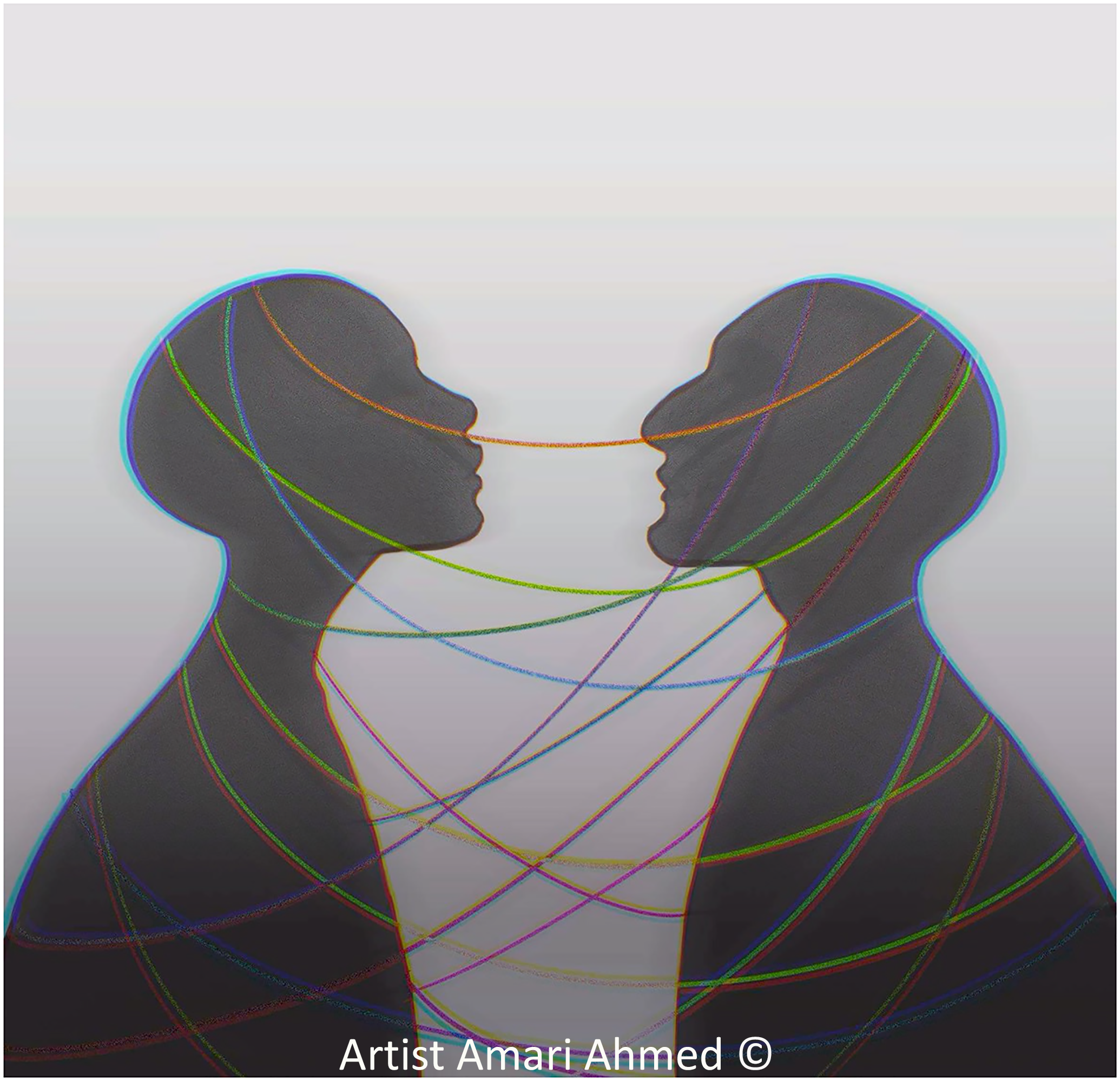
Barry Trentham
Introduction
I wrote this paper in what is now called Toronto, situated on the traditional lands of the Seneca, Huron–Wendat, and more recently the Mississaugas of the Credit. The name Toronto is believed to be derived from the Mohawk term, Tkaranto meaning, where there are trees standing in the water (Careless, 2022). The water referred to is Lake Ontario which is a short walk from my home. Lake Ontario offered a creative and hopeful space during Toronto's long-standing COVID-19 lockdowns as I spent many an hour walking along its calming shores as I thought about Muriel Driver and the challenge that her legacy presented me with, that is, to promote and celebrate the potential of occupational therapy.
Throughout this presentation, the words and ideas shared are drawn from the work of countless others. In my interpretation of these ideas, my privileged position may blind me from how they may be experienced by others as potentially problematic. I welcome feedback on any missteps as I view this paper as a means to stimulate further dialogue. At the same time, I bring my own lived experience of marginalization as a gay man with the aim to illustrate how the liberation of marginalized communities is very much linked to the liberation of our own CAOT community's occupational possibilities.
In preparing this lecture I asked myself, who am I most accountable to? Tellingly, the voices in my head that were most constantly reacting to my printed words, as I edited and re-edited, were the voices of former students, colleagues, and close friends from racialized, queer, or otherwise minoritized communities. In her 1993 Muriel Driver lecture, Townsend noted that “our language, ideas and practice are similar to civil rights, feminist, ethnic, gay and lesbian, disability and other social justice movements” (Townsend, 1993, p. 176). However, to what extent have we learned from these movements? And so, perhaps, deviating from our profession's norms, while I honour the remarkable contributions of our occupational therapy leaders, scholars, and founders, past and present, the perspectives that largely inform this work come from outside our profession's established borders and the wisdom wrought through years of struggle by those on the margins, including occupational therapists who identify as such.
A quote from Australian Indigenous activist and leader Lilla Watson formed the genesis of this paper. “If you have come here to help me you are wasting your time, but if you have come because your liberation is bound up with mine, then let us work together.” I grappled with Watson's offer, particularly with respect to my privileged identities as a white, able-bodied, settler, and as an occupational therapist. I wrestled also with naming the threads that tied her experiences of anti-Indigenous racism and colonialism with my lived experiences of heterosexism and homophobia. In our shared eagerness to help but without an ability to adequately name and frame the ways that my, and our, liberation is tied to the liberation of marginalized communities, are we, in Watson's words, “wasting our time”? And so, how is our liberation as occupational therapists bound up in the liberation of the communities we strive to support?
On Liberation and Grounding Assumptions
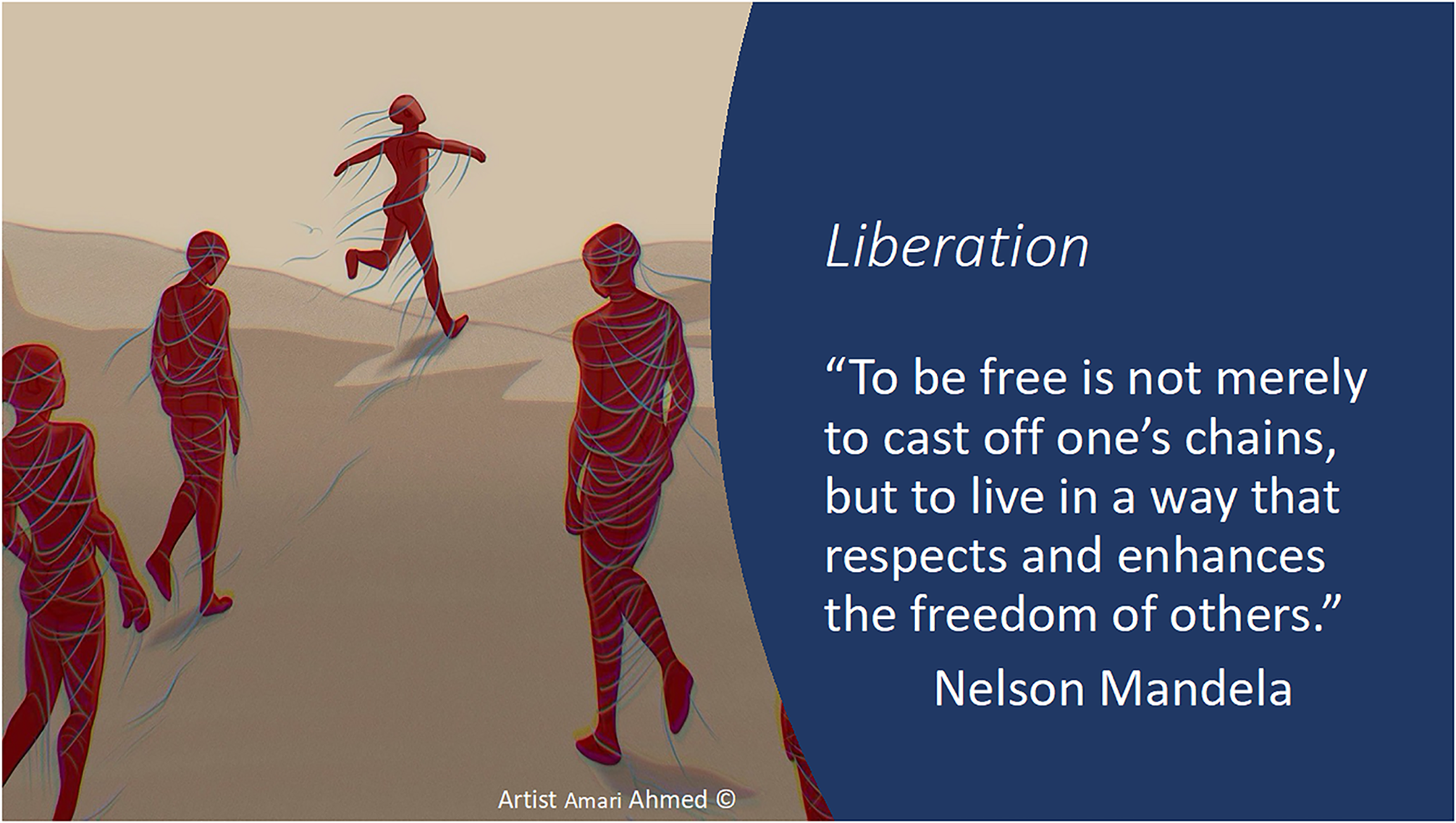
Liberation has been defined simply as the act of setting free from restraint or confinement (etymonline.com). But as Nelson Mandela cautioned, “To be free is not merely to cast off one's chains, but to live in a way that respects and enhances the freedom of others” (McKenna, No Date). Further, as Rhodes scholar, journalist, and community activist, Kofi Hope notes, “A free society is about everyone having an ability to make their own life choices. And for many, economic and social circumstances restrict them from living truly free lives” (Hope, 2022). Liberation is not just about freedom of expression or free speech.
Though liberation is an aspirational concept central to the efforts of many civil rights groups, it is rarely mentioned as such in our literature. However, when I began to engage with the concept, I started to notice brief side references to it in occupational therapy podcasts, personal conversations, and the writings of a growing number of occupational therapists/scientists (Lavalley, 2017; Musharrat et al., 2022; Ramugondo, 2018; Turcotte & Holmes, 2021; Zafran & Hazlett, 2022). Though not discussed as a grounding concept, at least in the Canadian discourse, the idea of liberation is beginning to bubble up. Perhaps it is worth a closer look?
This paper is grounded on some key assumptions and beliefs based on my own lived experiences and several theoretical traditions that inform my thinking. We live at a time of increasing social inequities (Public Health Agency of Canada, 2018) with root causes linked to the intersecting systems of dominance that limit the occupational possibilities of, in particular, women, Black, Indigenous, and other racialized peoples, disabled persons, queer/gender diverse people, old people, and poor people (Abramovich et al., 2020; Jumreornvong et al., 2020; Nixon, 2019; Hammell, 2020). While I believe that as occupational therapists we need to refine and further exercise our vision of justice and promote occupational participation for all people, it has been well argued, that though it has been 30 years since Townsend's (1993) Muriel Driver invitation to reimagine our social accountabilities, we remain constrained in our capacity to exercise our full potential in addressing the occupational participation rights of marginalized communities (Farias & Rudman, 2019; Gerlach et al., 2018; Kantartzis, 2019). I contend that the possibilities open to occupational therapy to address these issues of inequity and injustice are bound up in, and limited by, the same systems of domination that impact the communities we aim to support.
Methods
A Queer Theoretical Lens
I bring a queer lens to this discussion in terms of my experience as a gay man and as informed by several key concepts put forward by queer theorists. Queer theory, a term coined by Teresa de Lauretis (1991), is not so much a theory about queer people, but rather is about queering theory by exposing what is assumed when heterosexuality is viewed as universal (Bacon, 2006; Butler, 2014; Halperin, 2003; Sedgwick, 2008). Queer theorists disrupt binary, heteronormative categories and attempt to explain how oppression is maintained through discourse, silencing, and uses of language that shape how we perform gender and sexual identities (Pennell, 2020). It has been referred to as the theory of anti-normalness (Halperin, 2003). Of relevance to occupational therapists with our concern for the who, the where, and the how of everyday doing, is the need to question binary, gendered constructions of doing.
In addition, my ongoing struggle to loosen the threads that I have long felt constrain my, and our, ability to work to our full occupational potential feels, in some ways, very familiar to my own experience of the gay liberation process. And so, to respond to Watson's challenge to consider how our liberation is bound up in hers, I reflected on my own struggle toward liberation from a position of both unearned white male advantage and historical and ongoing gay subjugation.
Critical Auto-Ethnographic and Narrative Inquiry
I drew on critical auto-ethnography and narrative inquiry approaches that consider the power of individual and community narratives or stories as transformative learning tools and as inquiry methods that illuminate how broader social forces shape how we make sense of our lived experiences (Knowles & Cole, 2008; Medeiros, 2014). Importantly, however, in no way do I intend to conflate my narrated experience as a gay man, nor efforts to resist our, sometimes subjugated, professional voice with the experiences of Black, Indigenous, disabled, or other subjugated groups, but I do seek points of connection. To draw from Butler (2015), while a shared precarity may inspire our politics, precarity is clearly unevenly distributed.
A word on language. I use the term queer as an umbrella term that refers to those who do not identify with heteronormative, heterosexual, or binary expressions of gender and/or sexuality. I refer to myself interchangeably as either gay or queer. For me, queer denotes a more political response to one's identity whereas, for many, gay refers not only to same-sex attraction but also to the culture that surrounds it. When using terms like LGB or LGBT, I do so consciously of the sub-group that was being referred to at a given historical period.
Reflections
Coming to Consciousness and Learning How to Navigate a Heterosexist World
I grew up in the prairie town of Drumheller, Alberta situated on Treaty 7 territory, the traditional lands of the Blackfoot Confederacy. Originally a coal-mining town, it attracted immigrants from a diversity of European and, to a much lesser extent, Asian/South Asian countries. Though uncharacteristically diverse for a Canadian prairie town, it was not a gay-friendly town in the 1970s. As a teenager, I was constantly in fear of being “found out.” With a natural inclination toward being somewhat of a gender non-conforming boy, I had to learn how to perform straight. I learned what activities I was supposed to enjoy, and how to walk and talk like a real boy. I learned what I was supposed to talk about and with what words—words like fabulous, pretty, sweet, or gorgeous were avoided. I was conscious and vigilant about how, when, and with whom, I participated in any occupations gendered as feminine, lest my gayness be exposed. I was eager to escape this town and, not long after my 18th birthday I left for the big city of Edmonton, and its welcomed anonymity, where I attended the University of Alberta.
These small-town years are far behind me. They are a far contrast from the cosmopolitan urban spaces I now inhabit; however, they left their mark and continue to colour the way I perceive my place in the world. Not infrequently, I continue to feel out of place in many spaces, but being out of place is what came to feel “normal.” Hiba Zafran (2021) drawing on anthropologist Michael Jackson (2012) poetically refers to this as the “in-between spaces” or, for her, the experience of “un-belonging,” a positionality that offers space for both pain and healing and offering what I perceive as a vantage point from which to observe more clearly, how oppressive systems play out in everyday dramas. There is a certain power in this space. How often do we as individual occupational therapists feel out of place? What can we learn from these spaces and how might we seek them out? How might we find professional power in being on the “edge” of ,or in-between, healthcare discourses?
Do I Belong? Occupational Therapy School-Day One
Once at University, I continued to fine-tune ways to accommodate heterosexism and how to blend in:
On the first day of OT classes in 1982 at the University of Alberta's Corbett Hall, I realized how gender non-conforming my career choice was. That day we were to arrive early to have our class mug-shots taken. I was nervously excited. But when I joined the long line of women, I began to feel increasingly self-conscious and conspicuous. A feeling only exacerbated when an energetic and clearly, excited young woman joined the line behind me and upon seeing me in the line, blurted out (for all those around to hear), “Well this is interesting, now tell me, why would a guy want to be an OT?”
I have no memory of how I responded. I only recall how mortified I felt. Had I made a mistake? Did I belong here? Had I been exposed? Were my gender credentials as a real man in question?
When reflecting back on this incident, even though it took place some 40 years ago, it remains engraved in my mind. Had I been a straight man, more comfortable with my sexuality, and less impacted by internalized homophobia, perhaps I would have been more comfortable with resisting gender norm expectations. At that time, I did not have a language for what I was experiencing. I felt shame but viewed this as my own individual inadequacy. I individualized the problem not yet viewing it as a function of systemic heterosexism or heteronormativity.
Though we might like to think that this is just an old story from another time, it wasn’t that many years ago when, in my educator role, a young white, masculine-presenting lesbian OT student, early in her first term, came to me questioning her decision to become an occupational therapist. She told me that on her first day of classes, she looked around the room and, not seeing anyone that looked like her, questioned whether she belonged.
While this short story speaks to issues of male/queer or diverse representation in occupational therapy, it also speaks to the gradual process of how those of us who have been marginalized respond to oppression. Then, I was not yet able to liberate myself from heteronormative gender norms. I was in the “middle of my story” with a need to accommodate straightness and perform as a “nice, non-threatening, gay man,” diminishing my wholeness and limiting my occupational possibilities. I wasn’t at a place to resist, never mind dismantle, dominant heterosexist forces. Liberation is an ongoing process of untangling. As a profession, where are we in our story of liberation, of becoming conscious of how we are tied up in threads of dominance that limit our occupational possibilities and the possibilities of those with whom we engage as occupational therapists?
Separate Worlds, Untold Stories, and Bringing Our Whole Selves to Work
When I think back to my first few years as an eager, young occupational therapist, most of my colleagues knew that I was gay, but I did not generously share the queer ways in which my daily life diverged from theirs. Few of my colleagues heard about how I spent my evenings and weekends, though I heard lots about theirs. My “after work” occupations, however, would come to shape my understanding of systems of injustice.
Inspired to action after viewing a documentary on the assassination of Harvey Milk, a San Francisco gay city counsellor who was murdered by a homophobic opponent, I felt I had to choose between gay liberation efforts and my then volunteer work with Central American liberation movements. At that time, the two were incompatible. Intersectional consciousness had not yet penetrated the liberation discourse. And so, I spent several years volunteering at a Calgary-based LGBT peer support phone line. At that time, queer folk across the country were organizing in response to the discrimination and support needs of those impacted by AIDS/HIV. As with the COVID-related scapegoating and violence currently directed toward people of Asian descent, the scapegoating and violence directed toward gay men during the early years of the AIDS epidemic was ever-present (Lou et al., 2021; Rosenfeld et al., 2012; Shepard, 2009). Consequently, my work on the peer support phone line also included the provision of AIDS/HIV information and support. The AIDS epidemic shaped my life and work as an occupational therapist in significant ways, most notably in appreciating the power of community to find support, name oppression, resist, and speak out. We well knew that, YES, silence does equal death!
Despite being deeply engaged in the work of “enabling occupation” with queer folks when not at work, I never thought of sharing these experiences at work, nor did I feel safe to list these under “Volunteer Activities” on any future work resumes. I did not bring my whole self to work.
This same pressure for some of us to hide parts of ourselves in our work reflects a similar tension experienced by many of our clients. For example, decades later, during my doctoral research, I spent time interviewing several older gay men who often referred to as “cleaning up” (Trentham, 2010), a process they went through to clear their homes of any evidence of their gay identity. This was done when preparing their homes for visiting health care professionals or in preparation for their own passing. They feared what would happen should family members come across any incriminating evidence of their queer identities. This included any artifacts related to their queer occupations, including gay-focused volunteer work; in short, their occupational histories were thrown in the trash. Who else among us feels the need to “clean-up” resumes, identities, to straighten-up or whiten up our occupational stories to fit in?
As Beagan and colleagues (2022) point out, navigating systemic racism can be exhausting and depleting. This is an experience shared amongst all subjugated groups. The silencing of one's lived experience can lead to internalizing the message that our realities are not very important. Sometimes it's just easier to accommodate, to not “flaunt” our uniqueness. Silencing serves to keep us in our place!
In a similar vein, I’m reminded of the many parallel challenges that occupational therapists face when seeking liberation from the restraints of the powerful, seductive, and domineering forces of, in particular, biomedicine. I suspect many have experienced the challenge of being the minority occupational therapy voice in medical settings where power relations are maintained through silencing, by imposed procedures and language.
How do we continue to silence queer and other marginalized voices in the ways we do, or do not profile, market or sell our services products and ideas? How are we as occupational therapists silenced by internalized beliefs shaped by biomedical hegemony? Perhaps we need to better learn how to celebrate our “queerness”, our unique difference, our “not normalness”?
Toward Liberation: Untangling the Threads that Bind
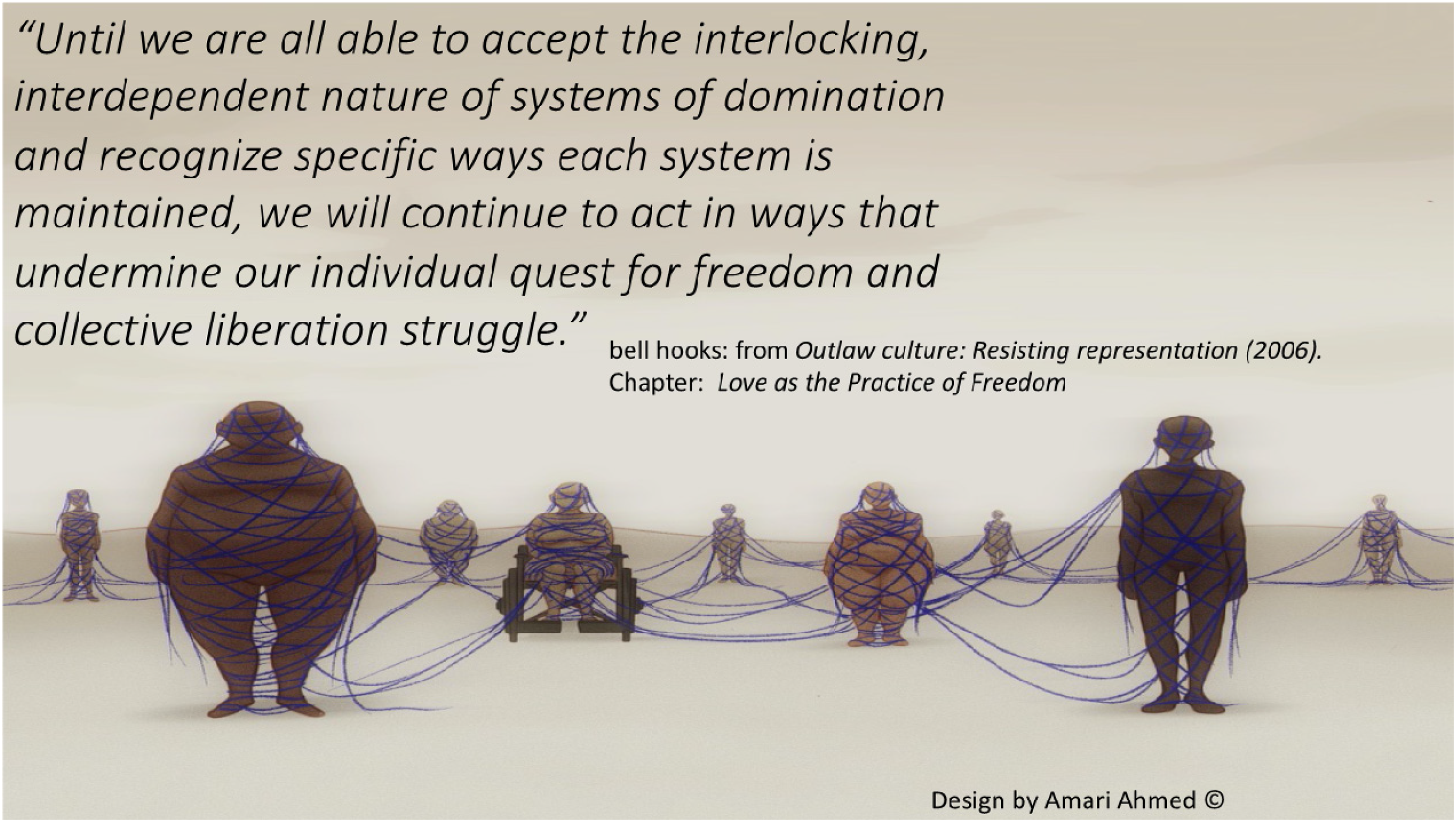
The stranglehold of biomedicine on occupational therapy and science is further strengthened through intertwined threads of dominance. These systems have been examined by occupational therapy and science scholars and include discussions on unrestrained capitalism (Beagan et al., 2022), white supremacy (Grenier, 2020), managerialism (Farias & Laliberte Rudman, 2019), neoliberalism (Kirsh, 2015; Laliberte Rudman, 2021), sexism and heterosexism (Beagan, Carswell et al., 2012; Beagan & Fredericks, 2018), colonialism (Egan & Restall, 2022; Gerlach et al., 2018; Hammell, 2019; Phenix & Valavaara, 2019; Trentham et al., 2018), ableism (Mahipaul, 2022), ageism (McGrath et al., 2016; Trentham & Neysmith, 2018; Trentham, 2019), and racism (Beagan et al., 2022; Johnson & Lavalley, 2020). These forces structure how we practice. I do not discuss each of these forces in this paper, but note the important work that has been done and that, as Black civil rights academic and activist, bell hooks, reminded us, “Until we are all able to accept the interlocking, interdependent nature of systems of domination and recognize specific ways each system is maintained, we will continue to act in ways that undermine our individual quest for freedom and collective liberation struggle (hooks, 2006, p. 290).
Though it is very clear that the COVID pandemic has exposed the long-standing fault lines in our social and health systems (Combden et al., 2022; Salerno et al., 2020), it has also forced us to recognize our shared inter-connectedness across classes, colours, and creeds through our shared humanity and shared vulnerability. As occupational therapy student Deanna Toews reminded me during a recent class discussion, “we are all earthlings” (personal communication, May 8, 2021). Collectively we are all in need of liberation, though clearly, some are more tightly bound than others.
While there is much to untangle, I aim to illustrate how I came to understand, in particular, the link between colonialism, and hegemonic heteronormativity as the warp through which other threads of domination are tightly woven. Let me illustrate with a story:
Not long ago, my partner and I hosted a New Year's dinner party with close friends, members of what I call, the “gay diaspora”: gay men who left their families, communities, or countries of origin, for safer and more queer friendly Canadian urban spaces. As is often the case, my partner's Belgian mother was the only woman at the table. Mama B, as she is affectionately known, is a very skilled knitter giving away most of her products to those in need. Partly to honour her, and partly as a function of the occupational therapist in me, as a party favour, I gave each couple a knitting themed gift. One of each of the couples received a pair of woolen socks, the other, a set of knitting needles and colourful wool. The plan was to have Mama B give us a knitting lesson after dinner. She embraced the idea!
What transpired as the guys opened their dinner gifts was truly illuminating. The ones who got the woolen socks were visibly appreciative! The ones who got the knitting needles and wool were, at first, seemingly unfamiliar with what to do with them. However, as soon as Mama B began her knitting lesson, it became quite clear that these guys knew much more about knitting than they had let on. They were slowly coming out as former knitters - all of them!
The atmosphere took an animated turn as we started reminiscing about other closeted occupations. Stories emerged of not only secret encounters with needle and thread but shared stories of being caught, when found engaging in other “gendered” occupations viewed by family members as the strict domain of girls whether that be cheerleading, skipping rope, or dressing up, to name a few. Stories then shifted to the remembered shame, stories of homophobia, stories of punishment for transgressing gender rules.
These shame stories resonated across religions, decades, countries, continents, and languages. Shame is a well-documented hurdle, particularly for gay men (Downs, 2012). However, naming the threads of oppression connecting this diverse group of men who brought the same meanings to the simple activity of knitting was a liberatory process.
Later I told this story to another friend of mine. Garry is a Secwepemc man, a residential school survivor well-acquainted with the violence of colonizing processes. He avoids labels such as gay as a colonial holdover and identifies with a related but distinct Secwepemc term, Tsk’ul’tsut, (pronounced ch kool choot), literally translated as he transforms himself (Gottfriedson, personal communication, February 27, 2022). Garry is also a poet, an educator, a craftsperson, a rodeo cowboy, a grandfather, and a self-described “bush Indian.” Clearly, a man with many occupational identities. He responded to my story with a chuckle,
You’ve all been colonized - you need to decolonize yourselves. In my culture growing up, we had to learn all the tasks of the men and the women - there was no shame attached to engaging in either, balance was key. I had to learn to hunt, to fish, to be a provider, and to bead, to cook, and to make baskets. We did it all together.
As Garry's words illustrate, the thread that connects this group of gay men (new and old settlers) is colonialism with its heteronormative entanglements; the same threads that bind Watson. It wasn’t always this way, and it doesn’t need to stay this way, but it remains in place.
Garry's observation is well-supported by Indigenous scholars who have drawn links between Euro-western and Christian hetero-patriarchal ideals that subvert queer, non-binary, gender fluid, trans, and same-sex relationships; relational forms that existed prior to Western colonizers’ dominance. These scholars expose how heightened, hegemonic, Indigenous masculinities in post-colonial Indigenous communities have led to the oppression of two-spirit people and women (Anderson & Innes, 2015). Further, the hierarchy of the idealized body is argued to be a legacy of colonialism and reinforced by a capitalist system where bodies are viewed as units of production and reproduction. Old, non-reproductive, non-productive, gender non-conforming persons are devalued. Indigenous scholar Scott Morgensen, drawing from Maori academic Hokowhitu analysis (in Anderson & Innes, 2015), goes further, arguing that settler societies need to transform their understandings of gender as a necessary step in the decolonizing process. Decolonizing is about liberation.
As these reflections reveal my struggle against oppression as a gay man, though most often framed in terms of homophobia—the fear of those attracted to their own sex—were largely related to my “gender-non-conforming doings.” My occupational forms, performances, and choices were/are not always aligned with societal norms. Though the simple knitting story does not speak to more complex and pressing social issues such as the theft of Indigenous land, poverty, or unaffordable housing, it does illustrate how White supremacist colonial thinking shapes the meanings we bring to everyday occupational engagement that in turn shapes how we occupationally participate in our social worlds. Though important work has been done on unraveling the complex interconnections among gender, sexuality, occupation, and heteronormativity (Beagan & Saunders, 2005; Beagan, De Souza, et al., 2012; Beagan & Fredericks, 2018; Lavalley, 2017; Swenson et al., 2022), a profession that is focused on human occupation should presumably have much more to say about systemic discrimination based on gender non-conforming doings.
I have experienced incredible social change in terms of LGBTQ civil rights over my lifetime. As a young therapist, I could not have imagined that a gay man would someday be sharing his queer story at the Muriel Driver Memorial Lecture podium. Fortunately, we now also have more affirming labels for our diverse gender and sexual identities. Hopefully, these are not just more boxes to fit into, but rather open up spaces to express our diverse and fluid identities through our occupational choices. A further positive sign is Statistics Canada (2021) reporting of non-binary and trans identity options in census data collection. However, as recent Census Canada data reveal, queer folks continue to face economic and mental health threats and are far too often the victims of hate inspired violence (Statistics Canada, 2021). Of particular concern for our profession is a recent American survey of health professional competencies related to LGBT care that found occupational therapists close to the bottom of the list (Nowaskie et al., 2020). I’d like to think we Canadians would do better, but who knows? Are we asking?
Community, Collective Liberation, and Occupational Therapy's Possibilities
So what does the above discussion have to do with the collective liberation of occupational (therapy's) possibilities? Collective liberation, as defined by Crass (2013), a white male, grassroots activist is “a way to imagine fighting interconnected power relations while recognizing that everyone has a stake in transforming systems of oppression” (p. 17). Collective liberation movements, as the label suggests, anchor their work in what Dr. Martin Luther King Jr. named the “beloved community.” Queer Black feminist, Audre Lorde (1984), reinforces this point noting that, “Without community, there is no liberation…but community must not mean a shedding of our differences, nor the pathetic pretense that these differences do not exist” (p. 112). With Lorde's words in mind, and as a former community development focused clinician and researcher, I fully embrace one of CAOT's 2019–2022 strategic plan directions to foster “a sense of community that encourages pride in, and strengthening of, the occupational therapy profession through networking, innovation, knowledge exchange, and caring.” Are we a community, the kind of necessary community described by Lorde, King, and Crass with the power to liberate?
Communities are fashioned, in part, through the same systems of dominance that limit the occupational possibilities of subjugated communities and can as easily be experienced as exclusionary; excluding the different, the disruptors, the misfits, or those without the resources to attend professional conferences. This reality with respect to racism was well-examined in Beagan et al.'s (2022) recent survey study of the experience of racism in Canadian occupational therapy. In my own experience, I have too often heard from minoritized students or colleagues that they don’t feel they belong, they feel like “misfits,” dismissed, and aggrieved, when their community's concerns are not seen as priorities. Sadly, some have left the profession or remain silent. A great loss! Building on writings from others including Laliberte Rudman (2019), Tsang and Haque (2022), and Mahipaul (2022), I believe, to be powerful, relevant, and accountable we need to learn how to weave together diverse perspectives to broaden our reach and realize our collective occupational possibilities as a force for justice, equity, inclusion, and liberation.
For the longest time, I knew very few other queer OTs. That changed in 1994 when attending the LGBT Caucus forum at the CanAm OT conference in Boston.
1
I recall entering a large, packed room - a gathering of hundreds. How exhilarating, to be around folks with shared humour, coded language, and shared experiences of marginalization. Speakers talked of reclaiming our profession's queer history. They shared emerging research on the experiences of LGB therapists and stories of some of our profession's earliest pioneers, women living in decades’ long relationships with other women.
I met one other Canadian OT at that Boston gathering. Both of us revelling in this queer space questioned, why not do this in Canada? We committed to setting something up for the 1995 CAOT conference. A year later in Edmonton my lesbian colleague and I self-consciously walked up to the conference bulletin board (nothing online then) and quickly pinned our handwritten Lesbian, Gay & Bisexual Gathering notice to the board and then as quickly walked off as if we had committed some OT misdemeanour. Others must have felt as reticent, as we ended up with just a small group of about five or six - the beginnings of, to my knowledge, the first LGBT OT CAOT network. 2 Queer OTs in Canada do have a history, but one that needs to be documented.
Citing Cameron, Isobel Robinson, in her 1981 Muriel Driver Lecture, In the Mists of Time, states “…it is only through our knowing whence we have come that we know who and what we are” (Robinson, 1981, p. 145). Occupational therapy history writer Judith Friedland (2011) writes about the need to know and learn from our history, but whose histories have we had access to?
Canadian Award-winning novelist, Esi Edugyan, in her 2021 Massey Lecture Series, speaks of the need to rediscover the stories of Black people as active players in Canadian history (Edugyan, 2021). Without such stories, she argues, a community's sense of belonging is threatened. We all need to be seen in our collective histories. I recall the feeling of looking into the mirror of queer history and seeing myself that day in Boston. It was liberating to bring my gay, male, and occupational therapy identities together in one room. This space and similar queer gatherings at WFOT conferences offered a link to the broader occupational therapy community and inspired hope for change. I could belong! I echo Omar and Gill's (2022) call to construct more narratives that convey critical hope 3 ; hope that recognizes the need for ongoing struggle but within a view of the possibility of change. And so, with the aim to liberate our potential for change, we need to examine and learn from the histories of queer, Black, Indigenous, religious minorities, men, disabled, and other racialized, or subjugated members of our professional community. I believe we need more stories and stories that convey critical hope!
Collective learning and unlearning across differences, however, can be uncomfortable and requires difficult emotional work. Amie Tsang, self-described as a queer, Chinese, occupational therapist and freelance journalist, reminds us that “Having a generous spirit is important in creating liberatory learning environments, as we all come to understand equity from different entry points and experience safety in different ways” (personal communication, April 28, 2022). In my conversations with students and colleagues I hear a rising call from young, committed, and diverse occupational therapy voices eager to play a role in the occupational therapy community, to share their stories, and imagine new ways of doing things.
In Closing: Celebration as Resistance and an Act of Gratitude
Leaders across liberation movements emphasize the need to celebrate collective achievements and look for joy in the pursuit of social justice (Crass, 2013). Celebration is a form of resistance against oppression as it sends a message of hope that change can and does happen. In a spirit of celebration, I conclude with an expression of gratitude for the hard work being done by so many in our community toward collective liberation. Practice networks like CAOT's Justice, Equity, Diversity, and Inclusion group co-led by Drs. Hiba Zafran, self-described as an Arab, queer, femme with pale passing privilege and Tal Jarus, self-described as a queer, white, cis woman, settler. They are working with the network to create “a space to collectively share and build occupational therapy's community and capacity for anti-oppressive and accountable systems and practices” (CAOT, n.d.). I celebrate the challenging work of the group which is developing the next Joint Position Statement on Equity and Justice that, “challenges our community to name and redress the systemic and intertwined oppressions that lead to inequities across health, social, and economic, systems, as they relate to, and can be actioned by, the occupational therapy community” (ACOTRO, ACOTUP, ACOTPA, CAOT, COTF, OTC, n.d.). I am grateful for the recent creation of multiple spaces opening up by and for minoritized groups to come together for storytelling, advocacy, mentoring, and mutual support (e.g., Occupational Therapists for Equity Advancement [OTEA], Black OT Association of Ontario, CAOT's Conversations that Matter). I also applaud the work of co-editors Drs. Gayle Restall and Mary Egan who brought together multiple and diverse voices to create what I suspect will be a ground-breaking and liberatory CAOT-sponsored textbook (Egan & Restall, 2022). To celebrate is to show gratitude. I am grateful and wish to celebrate the many achievements of those who, like those mentioned-above, are engaged in the emotionally difficult and necessary work of community healing and liberatory practice.
Footnotes
Acknowledgments
I wish to express my sincere appreciation to my nominators, Lori Letts from McMaster University, Catherine Donnelly from Queens University, and Jill Stier, Lynn Cockburn, and Heather Colquhoun from the University of Toronto. I hold each of these women in very high esteem and am incredibly honoured to know that they saw something in my work that warrants sharing with the CAOT community. Many thanks to colleagues Lynn Cockburn, Jane Davis, Judith Friedland, Debbie Rudman, Jill Stier, and Hiba Zafran who generously provided feedback on early ideas and drafts and to the CJOT editors who provided suggestions on the final mansucript. Thank-you to my friend Amari Ahmed for his haunting thread images and to my partner of 36 years, Lambert Boenders, who patiently supported me throughout my Muriel Driver Memorial Lecture journey. I also acknowledge and celebrate all the queer and other assorted misfits in my life who continue to liberate my thinking, share their stories, and encouraged me to speak on a topic that, for many, remains uncomfortable. It truly takes a community! Finally, I am so very grateful to the CAOT for allowing me this space to share my whole self at this concluding stage of my career.
