



Abstract
In 2015, the Truth and Reconciliation Commission of Canada (TRC) released their summative report comprised of Calls to Action for different sectors to review, reflect upon, and improve settler–Indigenous relationships (TRC, 2015). Seven of these Calls to Action address ongoing systemic gaps in health status and inequities experienced by Indigenous Peoples within Canada's health care system (Greenwood et al., 2018; NCCIH, 2019; TRC, 2015). Since the publication of the TRC report, critiques have been raised about the profession remaining complicit in perpetuating the marginalization and oppression of Indigenous Peoples in Canada based on a lack of responsive action (Restall et al., 2016; White & Beagan, 2020). In 2018, the Canadian Association of Occupational Therapists (CAOT) published a position statement in response to the TRC report which provided recommendations for occupational therapists spanning the domains of practice, research, and education (CAOT, 2018a). While time has passed since the publication of both documents, there are currently no published scoping reviews exploring the intersections between the occupational therapy profession and Indigenous Peoples in the Canadian context. Further injustices outlined in the report of the National Inquiry into Missing and Murdered Indigenous Women and Girls (Government of Canada, 2019) and by the ongoing recovery of unmarked graves at residential school sites in 2021 amplify the need for urgent structural and societal change. In mapping out the profession's historical and current engagement with practice, research, and education related to Indigenous Peoples in Canada, this scoping review aims to listen to, summarize, and amplify relevant voices and discussions to date to identify gaps and elucidate future directions for collaborative reconciliation in occupational therapy.
Background
In 2020, White and Beagan produced an integrative review that analysed relevant international literature published up to 2018 identifying how occupational therapy clinicians can improve practice with Indigenous Peoples. The TRC Calls to Action (2015) and CAOT position statement, Occupational Therapy and Indigenous peoples (2018), both identify that the realms of research and education are foundational in preventing oppressive health care practices with Indigenous Peoples in Canada. This scoping review both expands upon White and Beagan's (2020) work to include publications within these domains to define key directions for equity-promoting action, and narrows the lens to the Canadian context. However, the scope of this review remains general given the significant differences that exist within and between the many diverse Indigenous Peoples and communities across the country (Allan & Smylie, 2015; CIHR, 2018; NCCIH, 2020).
A secondary objective of this review is to appraise empirical occupational therapy research using adapted Indigenous Health Research appraisal criteria. While appraisal is not generally included within scoping reviews (Peters et al., 2020), guidelines for occupational therapy research outlined by Restall et al. (2019) highlight the need for reflection and ongoing engagement with cultural humility to avoid oppressive and harmful Western research practices. Thus, the use of adapted appraisal criteria to assess the quality and cultural relevance of empirical Indigenous health research captured in this review was justified. Together, these objectives inform the following research question: what is the current state of literature and research related to Indigenous Peoples and the occupational therapy profession in Canada?
Method
The lens through which this review was analysed and written is defined by the positionality of the first two authors who are student occupational therapists of settler–colonial (European-Canadian) heritage with linguistic and social privilege. In preparation for engaging with Indigenous health content with a critical lens, authors completed Tri-Council Policy Statement: Ethical Conduct for Research Involving Humans (TCPS 2) training and practised reflective journaling about personal life histories and participation in an occupational therapy degree program throughout the review. These are small steps toward cultural humility in research but reinforce the need for conscious and ongoing engagement in personal and professional discussion, learning with discomfort, and addressing knowledge gaps as settlers. While not intended to contribute to the breadth of literature written about Indigenous Peoples in Canada rather than with (Restall et al., 2019), this review lacks Indigenous authorship. Despite this being a limitation, the responsibility of defining the settler–Indigenous reconciliatory path forward within occupational therapy in Canada cannot lie solely on the shoulders of Indigenous occupational therapists. As the authors approach entry into a profession with colonial roots (Hammell, 2019), scoping the map of existing work related to Indigenous health marks a critical first step in a lifelong journey of learning and working toward equity.
A scoping review was identified as the appropriate methodology to meet the review objectives as it aligns with the exploration of concepts or themes that underpin a specific field of research (Arksey & O’Malley, 2005). In line with this methodology, a population, concept, and context format was used to develop the research question and inform key search terms (Table 1) (Peters et al., 2020). The protocol for this scoping review was registered prospectively to data screening, review, and extraction at the link: https://osf.io/fbhne. Review methodology was completed by the first two authors (H.B and E.N).
Population, Concept, and Context Components and Keywords
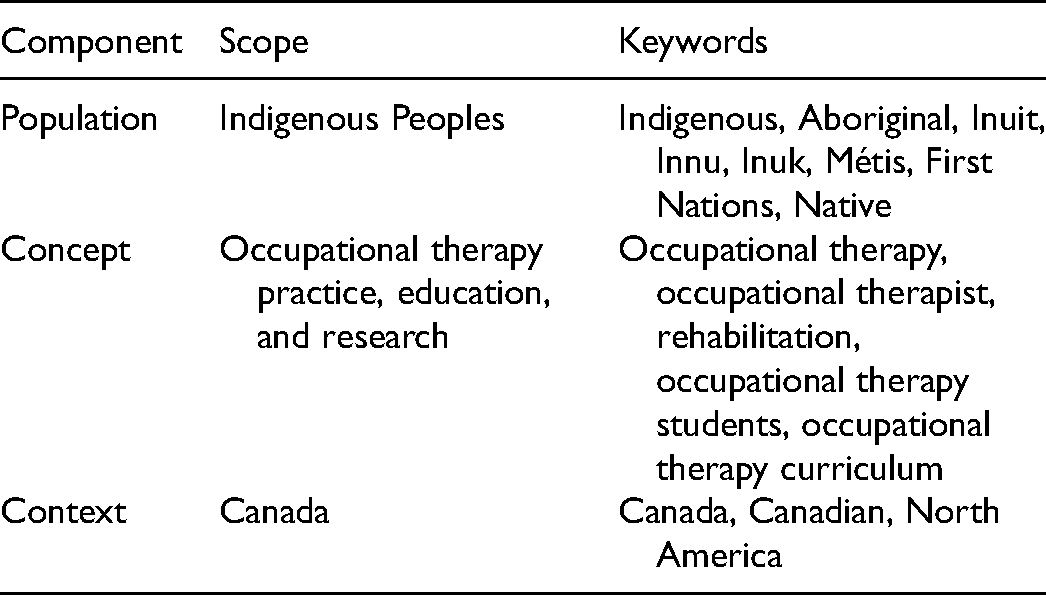
A systematic search was completed between February 15 and March 3, 2021 that included 12 databases, two custom search engines, and all occupational therapy professional associations and regulatory body databases across Canada (Figure 1). All available editions (2005–2021) of the Occupational Therapy Now (OT Now) practice magazine published by CAOT were reviewed for relevant articles. Reference lists of included articles were scanned. All citations were uploaded to Covidence. Detailed search strategies for all databases can be found at the link: https://osf.io/gya7j.
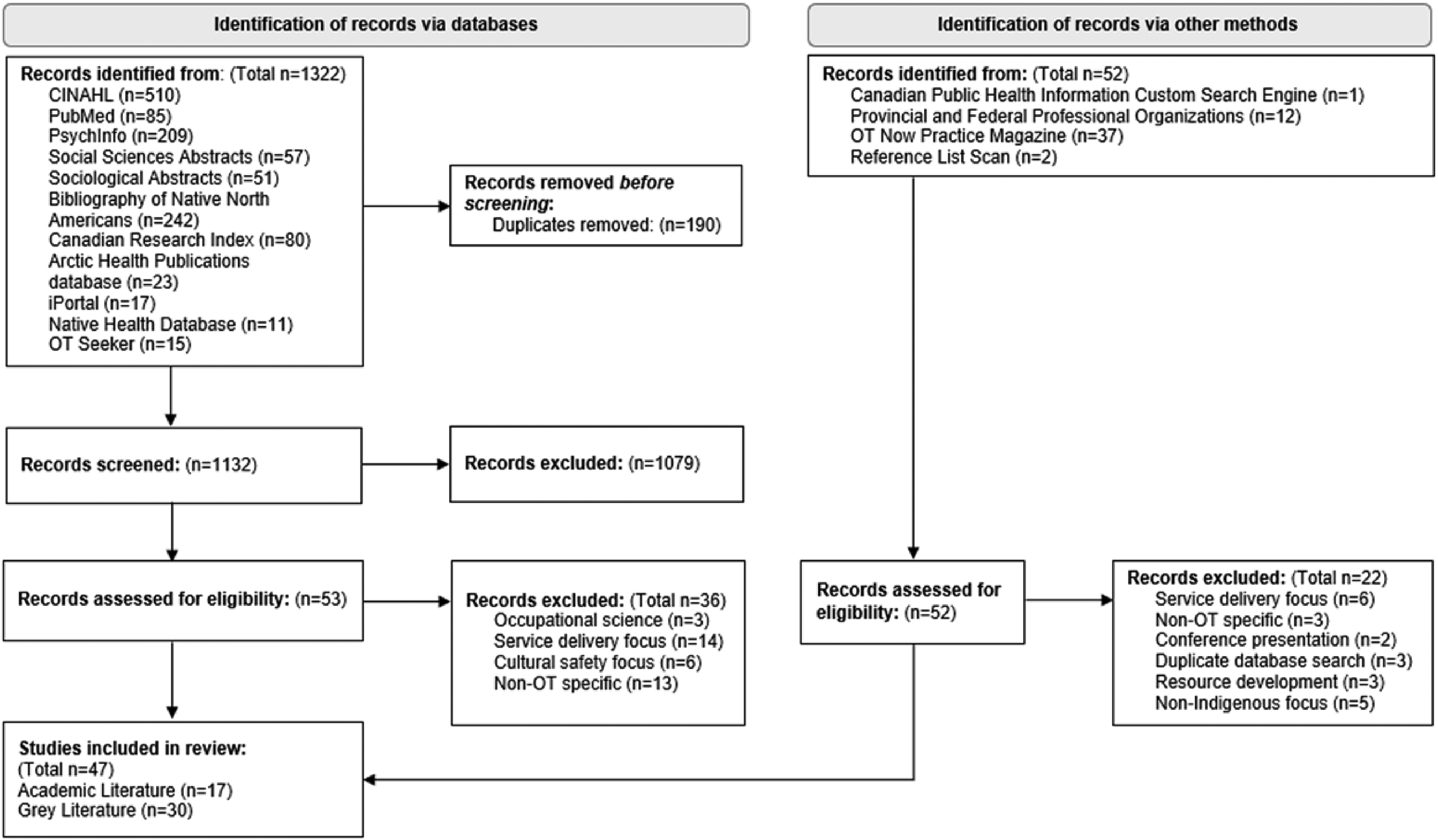
PRISMA flow diagram.
Title and abstract screening criteria included sources that were academic and grey literature, published in English, and emphasized or included a Canadian context. To capture the temporal evolution of occupational therapy literature, no limit was placed on publication date. Full-text inclusion criteria included quantitative and qualitative studies, reviews, theoretical and conceptual papers, dissertations, theses, position statements, policy documents, expert opinions, and discussions. These diverse criteria and inclusion of grey literature ensured that voices from organizations, researchers, students, and clinicians were captured, and that the search was inclusive to those outside of academia. Exclusion criteria included conference presentations, fact sheets, blog posts, or social media. As advised by Arksey and O’Malley (2005), exclusion criteria were dynamically revised to exclude both occupational science articles and conceptual articles discussing culture or cultural safety that were nonspecific to Indigenous Peoples. All sources were retrievable.
After collaboratively screening titles and abstracts of 100 articles to establish a consistent approach, articles (n = 1374) were screened independently, and conflicts were resolved through discussion. Similarly, full-text review of 10 articles was completed collaboratively followed by independent review of all articles (n = 53). An agreement rate of 93% for full-text review was achieved, indicating a high degree of inter-rater reliability. Before data extraction, a spreadsheet was developed by all authors and tested to support consistency. Initial data extraction was completed independently, followed by a duplicate review to confirm reliable interpretation. Data on publishing source, purpose, and outcomes was extracted for both empirical and nonempirical sources. For nonempirical sources, data were also extracted on the type of article to categorize the literature. For empirical studies, data were extracted on study design and population.
Data were also extracted from empirical research based on Indigenous Health Research appraisal criteria (Table 2) adapted from the Aboriginal and Torres Strait Islander quality appraisal tool created by Harfield et al. (2020) as no singular tool exists in the Canadian context to the best of the authors’ knowledge. It is important to recognize that literature related to Indigenous standards for ethical health research and community-based Indigenous Research ethics protocols are abundant in Canada (CIHR, 2018; Hayward et al., 2021; Kovach, 2021); however, the use of community-specific appraisal criteria was not feasible for the breadth of this review and a single tool was alternatively adapted for use across empirical studies.
Adapted Indigenous Health Research Appraisal Criteria for Empirical Research
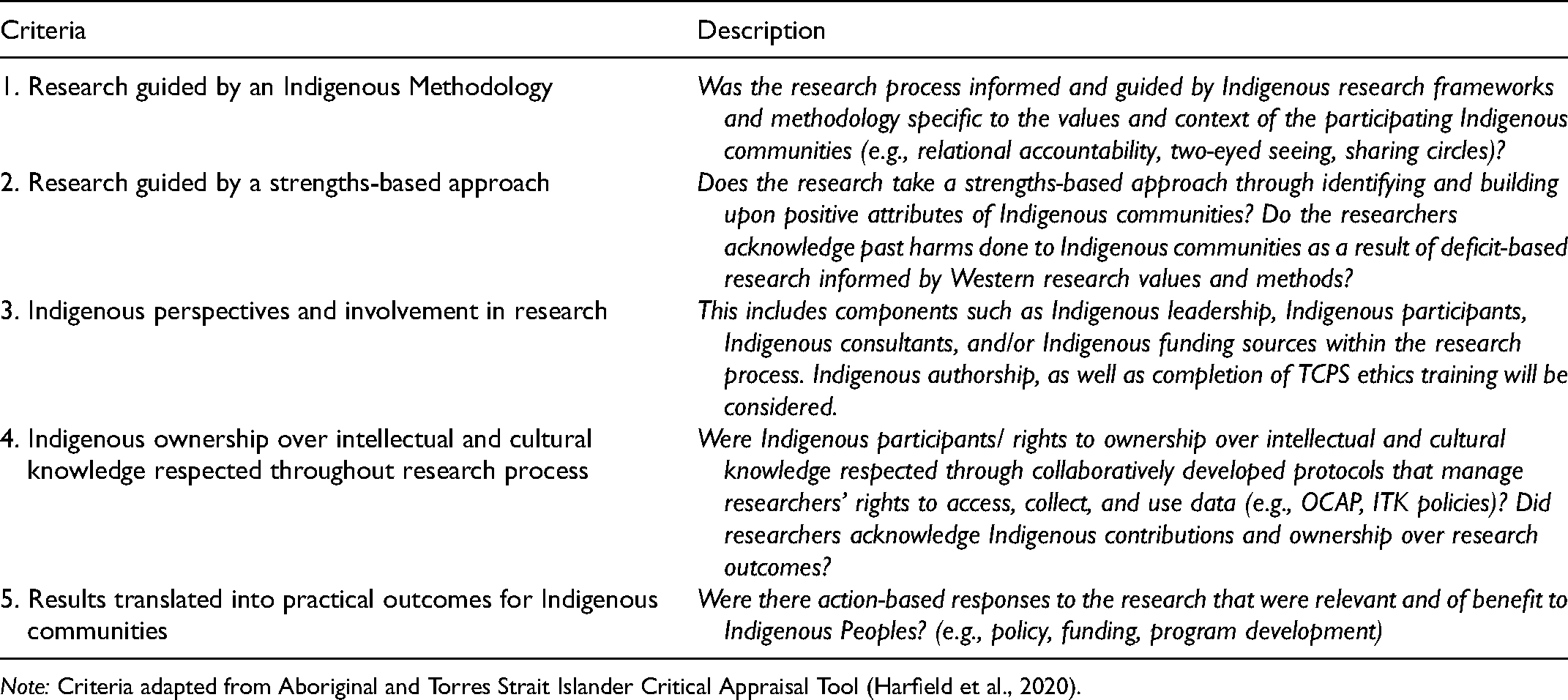
Note: Criteria adapted from Aboriginal and Torres Strait Islander Critical Appraisal Tool (Harfield et al., 2020).
The tool created by Harfield et al. (2020) was established to: “[appraise] the quality of research in Australian settings with Aboriginal and Torres Strait Islander Peoples, families and communities through an Aboriginal and Torres Strait Islander lens” in order to “…achieve appropriate, high quality and relevant health research that benefits Aboriginal and Torres Strait Islander Peoples” (Harfield et al., 2018, p. 5). The purpose of this tool is to assess and uncover dimensions of research that perpetuate colonization through Western epistemologies and methodologies, exploit or harm Indigenous communities, and limit the utility of research as a tool to improve health outcomes for Indigenous Peoples (Harfield et al., 2018). Given the authors’ settler lens and associated biases, the use of this tool was critical to illuminate these dimensions within occupational therapy research.
As this tool was developed in the Australian context, consultation with Canadian stakeholders was sought out to adapt items for relevancy in the Canadian context. Author collaboration and consultation with members of the CAOT Occupational Therapy and Indigenous Health Network (OTIHN) guided the iterative adaptation process of appraisal criteria for the purpose of this review.
Data were organized through an exploratory thematic survey defined by Sandelowski and Barroso (2003). This approach “conveys an underlying or more latent pattern or repetition discerned in the data” by identifying the “patterned responses researchers discerned from the topics raised” (Sandelowski & Barroso, 2003, p. 912). This method emphasizes the description of recurring themes, without the external interpretation or abstraction characteristic of thematic analysis approaches (Sandelowski & Barroso, 2003). Not only does this approach align with scoping review methodology, but it also aims to limit the subjective interpretation of themes potentially biased by researchers’ positionality (Restall et al., 2019). Results were organized based on this methodology and trends related to each appraisal criterion were summarized across empirical studies.
Findings
A total of 1,374 articles were identified through the search. One hundred five articles were retained after title and abstract screening, and 47 articles remained after full-text screening for data extraction (Figure 1). Of the 47 articles, eight were identified as empirical and 39 as nonempirical. Most included articles (25/47) were published in OT Now. Before the inception of the TRC in 2008, only six articles relevant to occupational therapy practice, research, or education with Indigenous Peoples in Canada had been published. During the TRC investigation from 2008 to 2014, eight more articles were published. Following the release of the TRC report in 2015, 33 articles have been published to date. While articles included in this review span the period of 1970–2020, the temporal distribution of publication strongly aligns with the development and release of the TRC's Calls to Action in 2015 (Figure 2).
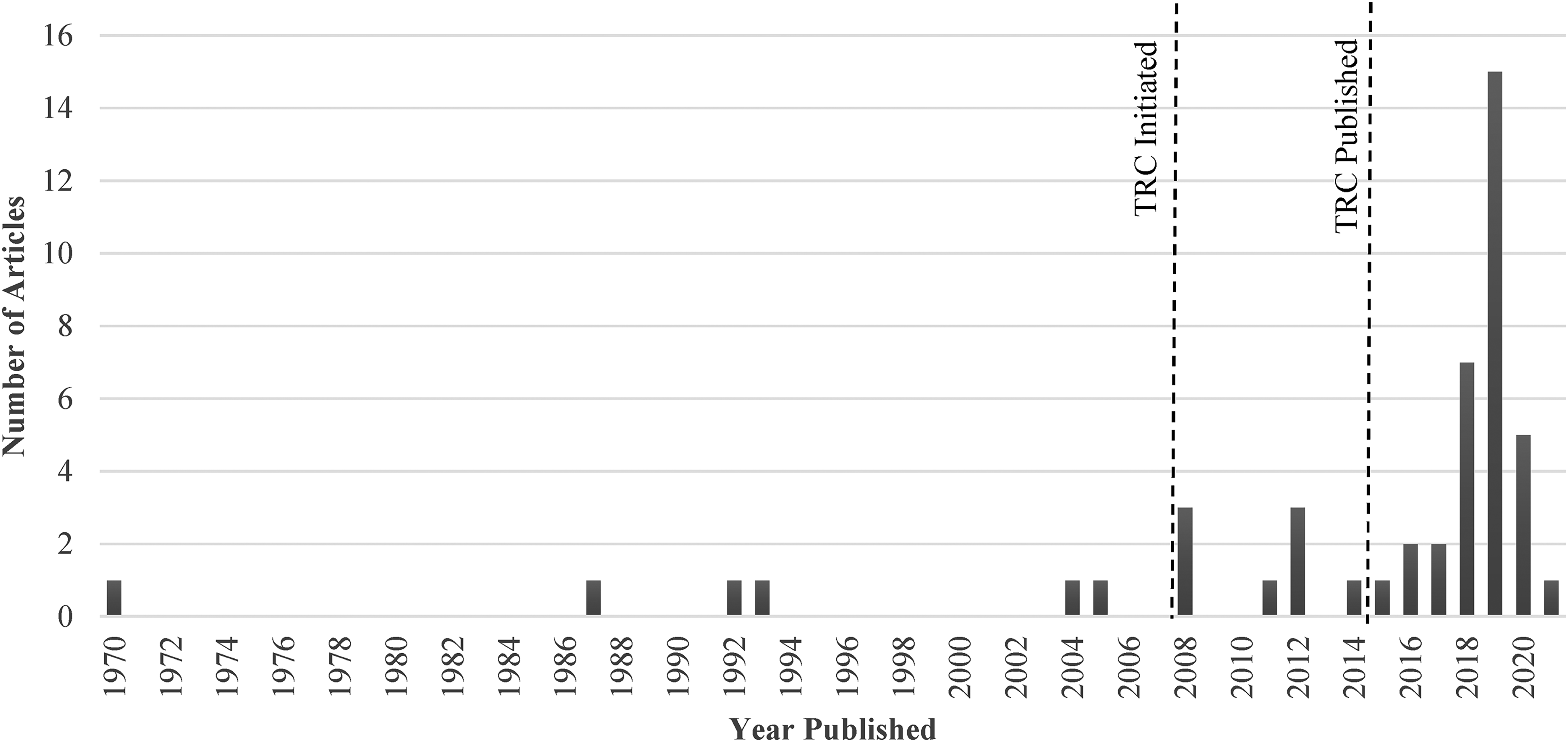
Time map of included literature from 1970 to present.
A majority of the nonempirical literature was classified as grey literature (n = 30) and included practice magazine articles (n = 25), profession issue forum reports (n = 2), a professional association position statement (n = 1), an opinion paper (n = 1), and a program description (n = 1). Other source types included program summaries (n = 1), theoretical and conceptual analyses (n = 5), guest editorials (n = 2), and integrative reviews (n = 1). The eight empirical studies spanned 1992–2020 and most (n = 7) were qualitative; only one mixed-methods study was identified. Empirical studies explored topics including occupational therapy practice within the specific contexts of traumatic brain injury (Keightley et al., 2011) and Fetal Alcohol Spectrum Disorder (Keightley et al., 2018), education approaches (Hojjati et al., 2018; Jamieson et al., 2017), practice delivery (Bryne et al., 2020; Gerlach, 2018), program development (Demars, 1992), and Indigenous perspectives of child development (Gerlach, 2008).
Empirical studies met the adapted Indigenous Health Research appraisal criteria inconsistently. Only two studies employed anti-colonial frameworks meeting the first criterion related to the use of Indigenous research methodology (Bryne et al., 2020; Gerlach, 2008). While most studies acknowledged the strengths of Indigenous Peoples (n = 5), only one (Gerlach, 2008) explicitly aimed to identify, learn, and build upon positive attributes of Indigenous ways of being and knowing to meet the second criterion of research being guided by a strengths-based approach. Two other studies acknowledged past research harms (Demars, 1992; Hojjati et al., 2018); one study was explicitly deficit-based (Jamieson et al., 2017). The third criterion related to Indigenous involvement highlighted that only two studies (Bryne et al., 2020; Keightley et al., 2011) integrated meaningful participation and perspectives of Indigenous Peoples within and across the research process. While many studies included Indigenous Peoples or organizations in some capacity as participants, consultants, or funding sources (n = 5), no primary researchers identified as Indigenous. The fourth criterion related to respect for Indigenous knowledge and ownership throughout the research process was not met by most studies (n = 5). However, one study (Gerlach, 2008) partially met this criterion through collaborative protocols and two studies met it fully (Bryne et al., 2020; Keightley et al., 2011) by respecting intellectual and cultural knowledge across all research stages. Finally, the application of the fifth criterion related to action-based responses highlighted that while half of the research studies resulted in tangible outcomes for Indigenous Peoples, half had unclear or significantly downstream impacts.
Themes of the Literature
Six recurrent themes were identified and organized through a thematic survey approach based on the frequency of occurrence in the literature: recognizing colonial history (n = 19), responding to the TRC (n = 19), personal and professional reflection (n = 24), Western ideologies of occupational therapy (n = 26), partnership in practice (n = 27), and social and systemic barriers (n = 20).
Recognizing Colonial History
Throughout the literature, individual authors and the federal professional organization call on the profession to acknowledge past and ongoing impacts of colonization on Indigenous Peoples in Canada (CAOT, 2018; Gerlach et al., 2014; Gerlach & Smith, 2015; Jacek et al., 2019; Phenix & Valavaara, 2019; White & Beagan, 2020). Occupational therapy students, therapists, and/or educators regularly engaged with the theme of colonial history through personal reflection (Forrest, 2019; Gerlach et al., 2014; Viengkone, 2019; Zafran, 2019). Other articles recognized the impacts of colonization in practice resources for rehabilitation professionals working with Indigenous populations (Bryne et al., 2020; Gerlach, 2018), and reconceptualized health care processes and policies that acknowledge this history (Boivin & MacLachlan, 2019; McDonald, 2019). Some authors highlighted the need for more specific education for occupational therapists related to trauma experienced by residential school survivors (Andrew, 2005; Gerlach & Smith, 2015; McDonald, 2019). This theme extended beyond clinical literature into education by highlighting current or needed changes to Canadian occupational therapy programs (Brown et al., 2019c; Brown et al., 2019d; Grenier, 2020; Hojjati et al., 2018; Trentham et al., 2019) and the development of occupational therapy models and frameworks that recognize colonial history (Fijal & Beagan, 2019).
Responding to the TRC
Recognizing and responding to the TRC's Calls to Action was the focus of relevant policy documents and professional discussions following their release (CAOT, 2018a; CAOT, 2018b; Trentham et al., 2018). This theme was also translated into recommendations for occupational therapy practice and research throughout the grey literature (Jacek et al., 2019; Moon et al., 2018; Phenix & Valavaara, 2016; Phenix & Valavaara, 2019; Restall et al., 2016; White, 2020b). In the academic literature, authors similarly identified the need to respond to Calls to Action through the development of alternative models of practice (Fijal & Beagan, 2019), and guidelines for occupational therapy research with Indigenous Peoples (Restall et al., 2019).
Grey literature articles described TRC-driven initiatives undertaken by occupational therapy programs at Canadian universities (Brown et al., 2019a; Brown et al., 2019c; Brown et al., 2019d; Moon et al., 2018; Trentham et al., 2019; Zafran et al., 2019), highlighting education and curriculum as key mediums for action-based responses. Similarly, two empirical studies explored how cultural safety curriculum and training impacts student knowledge related to working with Indigenous Peoples (Hojjati et al., 2018; Jamieson et al., 2017). Personal accounts from the perspectives of Indigenous students (Valavaara, 2012; White, 2020b) and a non-Indigenous educator (Zafran, 2019) identified necessary shifts in representation, the opportunity for shared perspectives, and tensions between efforts to decolonize and Indigenize a curriculum that is entrenched in Western barriers and biases. Finally, Grenier (2020) emphasized the need to redirect efforts away from a cultural competency-focused curriculum toward systems-level initiatives to appropriately respond to TRC recommendations.
Personal and Professional Reflection
The practice of reflection was a common recommendation for occupational therapists within the literature. Many articles highlighted the use of reflection as a tool to identify how one's position of authority, appearance, and personal beliefs may influence therapeutic interactions with Indigenous Peoples across practice settings (Andrew, 2005; Brown et al., 2019d; Bryne et al., 2020; CAOT, 2018a; CAOT, 2018b; Forrest, 2019; Gerlach & Smith, 2015; Hatchard, 2005; McDonald, 2019; Phenix & Valavaara, 2019; Restall et al., 2018; Viengkone, 2019; Wieringa & McColl, 1987). Articles also highlighted the importance of learning from mistakes and recognizing knowledge gaps (Viengkone, 2019), the need for constant role re-evaluation, and pausing to reflect (Brown et al., 2019b; Hatchard, 2005; Jacek et al., 2019; Russell et al., 2018).
Others emphasized the necessity to collectively reflect on core occupational therapy values and beliefs to address societal power imbalances (Bryne et al., 2020; Gerlach et al., 2014; Phenix & Valavaara, 2019), avoid the reinforcement of colonial practices (Gerlach, 2012; Jacek et al., 2019; Jull & Giles, 2012; McDonald, 2019; Trentham et al., 2018; White, 2020b; Zafran, 2019), and enhance the critical consciousness of educators and researchers (Grenier, 2020; Restall et al., 2016; Restall et al., 2019; Zafran et al., 2019). Most grey literature drew from the personal perspectives of student occupational therapists and practitioners (Brown et al., 2019b; Forrest, 2019; Hatchard, 2005; McDonald, 2019; Viengkone, 2019; White, 2020b; Wieringa & McColl, 1987); others represented reflective discussions held by occupational therapists at professional events (CAOT, 2018a; CAOT, 2018b; Gerlach et al., 2014).
Western Ideologies of Occupational Therapy
Many articles described how the occupational therapy profession is grounded in Western conceptualizations of health (Bryne et al., 2020; Forrest, 2019; Gerlach, 2008; Gerlach, 2012; Gerlach et al., 2014; Grenier, 2020; Jacek et al., 2019; Jull & Giles, 2012; Keightley et al., 2011; McDonald, 2019; Michaud, 2008; Phenix & Valavaara, 2019; Trentham et al., 2018; White, 2020b; White & Beagan, 2020; Wieringa & McColl, 1987). Keightley et al. (2011) and Boivin and MacLachlan (2019) provided specific examples of incongruencies between Indigenous and Western conceptualizations of health and health care through the topics of brain injury rehabilitation and informed consent, respectively.
Occupational therapy theories and practice models based on Western ideologies were highlighted as a source of conflict when working with Indigenous Peoples (Brown et al., 2019c; Bryne et al., 2020; Grenier, 2020; Jacek et al., 2019; Jull & Giles, 2012; Keightley et al., 2011; Phenix & Valavaara, 2019; Trentham et al., 2019; White, 2020b; Zafran et al., 2019). Grenier (2020) expressed that the profession's Western lens enables the othering of Indigenous Peoples and marginalized communities. Articles also highlighted the Western bias of assessments, deeming them unusable or requiring modification for use with Indigenous Peoples (Brown et al., 2019d; CAOT, 2018b; Gerlach, 2018; Jacek et al., 2019; Phenix & Valavaara, 2019; White & Beagan, 2020). While cultural competency and cultural safety were cited as frameworks to address potential harms associated with practising from a Western lens (Brown et al., 2019c; Gerlach, 2012; Trentham et al., 2019; Zafran et al., 2019), two articles critiqued the Western origin of cultural competency as a framework (Grenier, 2020; Jull & Giles, 2012). Cultural safety was highlighted as an alternative, non-Western approach to examine health care practices as self-identified by Indigenous clients, patients, or communities (Papps & Ramsden, 1996; as cited in Jull & Giles, 2012). Two articles discussed the importance of moving away from Western occupational therapy research methods to include Indigenous methodologies (Restall et al., 2019; Valavaara, 2012). Finally, education was identified as a domain that is perpetuating Western ideologies in practice (Grenier, 2020; White, 2020b), but also as an area well situated to stimulate change (Brown et al., 2019c; Forrest, 2019; Hojjati et al., 2018; Trentham et al., 2019; Valavaara, 2012; White, 2020b; Zafran et al., 2019).
Partnership in Practice
Overall, the literature describes a recent shift toward partnership with Indigenous Peoples: a focus of the 2008 CAOT conference, for example, was to increase access to occupational therapy for Indigenous groups, whereas collaborating with Indigenous stakeholders was emphasized at the 2018 conference. Most articles framed this shift toward partnership as an essential future direction for the profession (CAOT, 2018b; Gerlach et al., 2014; Jull & Giles, 2012; Phenix & Valavaara, 2016; Restall et al., 2019; White & Beagan, 2020) and a key practice recommendation for therapists (Andrew, 2005; Boivin & MacLachlan, 2019; Brown et al., 2019b; Bryne et al., 2020; Gerlach, 2018; Gerlach & Smith, 2015; Hatchard, 2005; Jacek et al., 2019; Keightley et al., 2011; Michaud, 2008; Viengkone, 2019; Viscogliosi et al., 2020).
Partnership was conceptualized as humanizing practice to combat the illusion of an objective therapist, honouring mutual relationships between the therapist, client, and community, and respecting the unique diversity of Indigenous identities and cultures (Andrew, 2005; Boivin & MacLachlan, 2019; Brown et al., 2019b; Brown et al., 2019d; Bryne et al., 2020; Demars, 1992; Gerlach, 2018; Gerlach et al., 2014; Gerlach & Smith, 2015; Keightley et al., 2011; Keightley et al., 2018; Viengkone, 2019; White & Beagan, 2020). Reciprocal partnership with Indigenous stakeholders and communities was also highlighted as a key recommendation for occupational therapy education (Brown et al., 2019a; Brown et al., 2019c; Brown et al., 2019d; CAOT, 2018b; Moon et al., 2018; Phenix & Valavaara, 2016; Restall et al., 2016; Zafran et al., 2019). Partnership in knowledge development and research initiatives was described by Restall et al. (2019) as resisting the colonial undermining of Indigenous Peoples’ self-determination.
Social and Systemic Barriers
Restall et al. (2016) and Jull and Giles (2012) emphasized the need to both identify social determinants of health and systemic barriers experienced by Indigenous populations and acknowledge that it is within occupational therapists’ roles to address the social and political systems perpetuating these inequities. Hojjati et al. (2018) and Trentham et al. (2018) framed colonization as a social determinant of health to contextualize health disparities in disease and disability experienced by Indigenous Peoples in Canada, and White (2020a) further described these disparities in the context of the novel coronavirus 2019 pandemic.
Other articles highlighted barriers to accessing occupational therapy services including the displacement of Indigenous Peoples from their communities to receive services (Callebaut, 1970; Staples & McConnell, 1993), Westernized models of service delivery (Brown et al., 2019b; Fijal & Beagan, 2019), attitudes, assumptions, stereotypes and colonial policies in health care settings (Gerlach, 2012; Gerlach et al., 2014; White & Beagan, 2020), the lack of funding available to Indigenous individuals living off-reserve (CAOT, 2008; Russell et al., 2018), the lack of funding for Indigenous traditional healers (Keightley et al., 2011), and the limited resources and services available to rural isolated reserves (Russell et al., 2018). Articles also highlighted barriers experienced by occupational therapists working with or conducting research with Indigenous populations, including geographical limitations (CAOT, 2008; Forrest, 2019; Gerlach, 2018; Russell et al., 2018), communication and contact challenges (Bryne et al., 2020), and language barriers (Callebaut, 1970; Demars, 1992; Wieringa & McColl, 1987).
Discussion
The purpose of this review was twofold: to provide an overview of the current state of literature related to Indigenous Peoples within occupational therapy practice, education, and research in Canada, and to use criteria to appraise research completed with Indigenous populations and uncover harmful colonial research practices that may be imperceptible from the authors’ settler lens. Pertinent literature to date reflects the profession's iterative and evolving understanding of its role and relationship with Indigenous Peoples through the six themes of recognizing colonial history, responding to the TRC, personal and professional reflection, Western ideologies of practice, partnership in practice, and social and systemic barriers. Trends and tensions in the landscape of literature, future directions for the field, and limitations of this scoping review are subsequently discussed.
Most of the literature captured in this review was published after 2015 when the TRC was released, with 59% of included articles published in 2018 or later. Most recent articles are grey literature, published in the practice magazine OT Now, and have frequently recurring primary authors. These qualitative dimensions of the literature base highlight that the article “explosion” post-2015 can be attributed to a small cohort of occupational therapists engaging in largely narrative, reflective, and descriptive-based writing. The five relevant primary research articles published after 2015 inconsistently met the Indigenous Health Research criteria, highlighting the continued conduct of occupational therapy research about Indigenous populations rather than with that draws from potentially harmful Western research methods (Harfield et al., 2020). These findings suggest that while the conversation has gained visibility and momentum in the grey literature, this trend is not reflected in the small pool of relevant primary research studies that lack Indigenous leadership or authorship. This disparity raises questions of whether the profession is doing enough to actively support the completion of Indigenous occupational therapy research by Indigenous researchers, and what barriers may be impeding peer-reviewed publication of work on this subject matter.
While earlier articles highlighted the negative impacts of colonization on Indigenous People's well-being and more recent articles heavily referenced the TRC, both subjects were equally represented across the occupational therapy literature. These two themes are inextricably linked in that reconciliation and responsive action first necessitates the honest and deep recognition of Canada's historical and ongoing oppressive treatment of Indigenous Peoples (Allan & Smylie, 2015). Many articles referenced the TRC as justification or inspiration for writing or completing projects, but few cited specific Calls to Action (TRC, 2015); only the 23rd recommendation related to the recruitment and retention of Indigenous health professionals (CAOT, 2018) and the 24th Call to Action related to “skills-based training in intercultural competency, conflict resolutions, human rights, and anti-racism” (Moon et al., 2018, p. 3) were cited. Direct, concrete responses to the TRC in future occupational therapy education, research, and practice are necessary. Although not represented as a theme in the literature, the Calls to Justice from the MMIWG report similarly necessitate substantive action among the profession given the high rates of colonial-based violence experienced by Indigenous women, girls, and 2SLGBTQ + people in Canada (Government of Canada, 2019).
The two themes of personal and professional reflection and the Western bias of occupational therapy were highly intertwined, and at times, in conflict. Many articles emphasized the importance of reflection as an actionable item to address individual and professional core values and beliefs that shape work with Indigenous Peoples. However, while reflection is a necessary, actionable item to work toward cultural humility in practice, it is not the entirety of the solution as it can potentially mask the need to instead “radically dismantle and rebuild the ‘biased’ frameworks and models on which the profession has relied for over a century” (Grenier, 2020, p. 640). Rather, the concept of critical reflexivity has been proposed as an approach to translate reflection into action, to engage with active recognition of how Western, White worldviews dictate practice, and to take an intentional, anticipatory approach to clinical interactions (Beagan, 2015; Hammell, 2013). Beagan (2015) emphasizes that while this is more likely to result in occupational therapists feeling uncomfortable, this uncertain state allows for the continuous questioning of our role in either contributing to or transforming social inequities.
Partnership in practice was highlighted as an essential step for the profession to engage with the TRC's Calls to Action and represented the most ubiquitous theme in the literature. Despite this prevalence, few articles provided concrete strategies to improve the partnership between Indigenous Peoples and occupational therapists. The related theme of social and systemic barriers may be a contributing factor to the challenges of partnership in practice, emphasizing the need for occupational therapists to examine these pervasive structural barriers. While the CAOT position statement (2018) calls for occupational therapists to “ensure collaboration … when working with First Nation, Inuit and Métis peoples in current systems” (p. 1), until these “current systems” that perpetuate power imbalances and health inequities for Indigenous Peoples are deconstructed and rebuilt, this may be extremely difficult to implement within the profession (Grenier, 2020; Restall et al., 2016).
Future Directions
Based on the small pool of empirical research that lacks consistent relevancy to Indigenous Peoples in the literature, there is a need to redefine the future role of occupational therapy research with Indigenous Peoples in Canada. Indigenous community leaders have called for research on Indigenous Peoples to end and for a necessary shift toward research through partnership to be meaningful and beneficial for communities themselves (Harfield et al., 2020). Although partnership in practice was a widespread theme across the narrative literature, application of appraisal criteria to the limited empirical literature base highlighted fundamental differences in understandings of knowledge content, gathering, and dissemination between Indigenous groups and non-Indigenous researchers (Restall et al., 2019; Social Sciences and Humanities Research Council, 2018), and amplified the pressing need for Indigenous-led collaborations within primary occupational therapy research.
The role of education in professional transformation was represented across all themes, but few articles cited concrete shifts within educational practices in the contemporary literature. Exemplified by Jamieson et al. (2017), the few efforts to evolve education practices and curriculum continue to align with a discourse of “competency” and maintain White supremacy within the academy (Grenier, 2020). Further, only four occupational therapy programs in Canada have published approaches and attempts to respond to the TRC in the literature (Brown et al., 2019a; Brown et al., 2019c; Brown et al., 2019d; Moon et al., 2018; Trentham et al., 2019; Zafran et al., 2019). Collectively, tensions across identified themes and the limited active reflexivity beyond reflection suggest the potential immobilization of the profession as we ask ourselves the uncomfortable question: what does a decolonized future for occupational therapy look like?
Limitations
The first limitation of this review is the potential impact of personal assumptions and preconceptions on the adaptation of Indigenous Health Research criteria and synthesis of themes. While consultation with the OTIHN was pursued, this does not replace collaboration with Indigenous Peoples. Additionally, the form of the appraisal criteria as a singular dichotomous checklist does not account for the subjective experience of participants and communities within the research process and, as a result, can risk falsely claiming safe or appropriate research. Future research approaches instead necessitate continued learning, reflexivity, and humility to address dimensions captured in these criteria, and further evaluation of this tool by Indigenous occupational therapists in Canada is warranted.
Given the large geographical range and diversity of Indigenous communities in Canada, the broad thematic synthesis in this review risks perpetuating the myth of generalizability for all Indigenous Peoples in Canada within occupational therapy. Furthermore, the methodology of this review aligns with Western approaches to evidence-based research. As highlighted by White and Beagan (2020), scoping reviews contain methodological rigor that can sacrifice interpretive depth to strive for objectivity and comprehensiveness (Greenhalgh et al., 2018) and contradict decolonizing research epistemologies (Chambers et al., 2018).
Conclusion
The unique temporal map of occupational therapy literature related to Indigenous Peoples in Canada reflects recent efforts to engage with reflexivity and learning at the level of the profession and among individual occupational therapists. Specifically, more than half of the articles included in this review were published during or after 2018, representing a rapid growth of work primarily within grey literature sources following the publication of the TRC report. Within this sharp increase, marked trends in narrative content have emerged.
Notably, the acknowledgement of past harms, the need to respond to the TRC's Calls to Action, and the role of occupational therapy in perpetuating Western and colonial ideologies in health care have dominated discourses. Studies related to the role and potential benefit of occupational therapy with Indigenous Peoples in specific practice settings and the desires and needs of Indigenous communities related to occupational therapy services are largely absent in primary research. In contrast to approaches represented within the current empirical literature base, these gaps must be addressed through decolonized and community-specific research methods that meet the evidence-based demands of occupational therapy practice (CAOT, 2009) without perpetuating the past harms and power imbalances of Western-based approaches (Hayward et al., 2021; Kovach, 2021).
Through personal accounts by occupational therapists in the grey literature, the narrative landscape has also begun to illuminate a shift toward accountable action through collectively refocusing on the social and systemic determinants of health, engaging in personal and professional reflection, and establishing meaningful partnership with Indigenous Peoples. Education has been identified as a critical nexus point to address these foundational changes both by the TRC and occupational therapy's national professional association (CAOT). However, based on the absence of numerous institutions in the literature and the patchwork of individual efforts made by occupational therapy degree programs in Canada, our education systems have the potential to perpetuate harm if not addressed immediately (Restall et al., 2016). While the body of occupational therapy literature describes a shift from acknowledgement to action-based responses, this needs to be done more intentionally, more urgently, and with reduced defensiveness to journey toward a culturally respectful, reciprocal, safe, and strengths-based future.
Key messages
Meaningful partnership with Indigenous Peoples in practice requires the critical examination of occupational therapy's Western underpinnings and the dismantling of health inequities across Canada.
Canadian occupational therapy programs must move beyond models of cultural competence to prevent ongoing and future harms toward Indigenous Peoples.
Future research with Indigenous Peoples should be Indigenous-led, use geographically and community-specific methodology, ensure Indigenous ownership over research outcomes, be strengths-based, and positively impact communities.
Footnotes
Acknowledgements
This review was completed as a final project for the Evidence-Based Practice course and presented at the Evidence-Based Practice Symposium as part of MSc (OT) course requirements at McMaster University in June 2021. We would like to acknowledge the Occupational Therapy and Indigenous Health Network for providing insight and feedback regarding the adaptation of the Indigenous Health Research Appraisal Criteria.
Funding:
The author(s) received no financial support for the research, authorship, and/or publication of this article.
Funding
The author(s) received no financial support for the research, authorship, and/or publication of this article.
