



Abstract
Introduction
Occupational therapy has been connected to art activities since the founding of the profession. Adolf Meyer, an early supporter of occupational therapy, famously cited the benefits of handwork and weaving in the first occupational therapy journal (Bissell & Mailloux, 1981). Over the past century, as the profession has grown, the use and meaning of art activities has also changed from early understandings of art as a ‘busy task’ to purposively including art as a therapeutic activity across practice settings (Bathje, 2012). While there is published literature about creative art occupations being used in occupational therapy (Perruzza & Kinsella, 2010), art-based drama techniques being used in occupational therapy in pediatric ( Fletcher, Parrish & Sherman, 2018) and mental health (Lloyd & Papas, 1999; Schmid, 2004; Thompson & Blair, 1998) settings, we identified little research exploring how art activities can be interwoven with occupational therapy with older adults. The purpose of this scoping review is to map the existing literature about how art activities are used in long-term care in order to inform how art-based techniques can be used in occupational therapy practice with older adults in residential care settings.
In this review, we are using the term ‘art activities’ to mean activities that include participating in the creation or experience of art (e.g., visual and material) and that can be incorporated into occupational therapy practice. Art activities are distinct from ‘art therapy’, which is practiced by professionally trained art therapists and is a process of combining creativity and therapy with the aim of facilitating self-exploration, deepening understanding and promoting the articulation and expression of thoughts and feelings (Canadian Art Therapy Association, 2020). When incorporating literature about these topics, if terms used were in line with our definitions, we maintained the terms that the authors used.
Background
Engagement with arts can contribute to increasing social cohesion; supporting child development; encouraging health-promoting behaviours; enhancing cognitive skills; reducing frailty; improving experiences of acute illness, injury, or chronic conditions; and improving well-being and mental health (Fancourt & Finn, 2019). These impacts greatly overlap with goals of occupational therapy.
There is a growing body of literature about the use of art with older adults for a variety of purposes including improving health and well-being (Gutheil & Heyman, 2016) addressing challenges related to mood (Zubala & Karkou, 2018) and promoting cognitive skills (Masika et al., 2020). A large focus of this literature is on how arts can benefit older adults living with dementia, though the evidence about efficacy is mixed. In one systematic review authors Cowl and Gaugler (2014) identified that creative arts therapies can contribute to health and well-being of adults with dementia by reducing emotional and behavioural manifestations of the disease and strengthening relationships with family members or caregivers that might be strained in light of the disease. In a similar review Chancellor et al. (2014) reported improvements in attention and benefits related to behaviour and quality of life, in addition to increased interest and self-esteem during art therapy sessions; however, it was not clear whether the benefits were sustained outside of the art therapy sessions.
Goals of occupational therapy with the population of older adults living in residential care commonly include improving or maintaining health and well-being through engagement in occupations (Dancewicz & Bissett, 2020). Interventions may be focused on improving specific skills and abilities, such as mobility skills (Smith & Kirby, 2015), or physical or cognitive abilities (Dancewicz & Bissett, 2020; Kern et al., 2020; Marangoni et al., 2020), or may target wellness more broadly (Devine & Usher, 2017). Evidence about effects of the use of art in improving health and well-being, as discussed in the results of a World Health Organization (Fancourt & Finn, 2019) report include for example enhancement of cognitive skills and improved well-being and health, which evidently overlap with goals of occupational therapy in long-term care. Such overlap is suggestive that the use of art activities may contribute to achieving occupational therapy goals with older adults living in residential care.
Looking however at the use of art with older adults, there is little literature focused on how art activities can be used by occupational therapists to better achieve occupational therapy goals in long-term care. We identified one doctoral dissertation by Dr. Reynolds (2011), an occupational therapist and artist in the United States who used therapeutic garden design to promote health and wellbeing of older adults in residential care settings. In another study, la Cour et al. (2005) explored how engaging in creative activities like woodwork, pottery, silk painting, soap making, knitting, and gardening enabled older adults living with terminal illness to deepen connections in their daily lives. Bathje (2012) suggested that a lack of research has contributed to a decline in the use of art activities in occupational therapy practice overall. An important suggestion from the literature is for occupational therapists to work in collaboration with art therapists (Davidow, 2018) in order to complement each field's unique contribution to achieving client goals. Given the limited literature about the use of art activities with older adults in residential care settings by occupational therapists and given the documented benefits and potential implications of using art in practice, we identified a need to explore the literature to ascertain how art activities are being used in long-term care settings and how these activities could be incorporated into occupational therapy practice with older adults in residential care settings.
Methods
Study Design
This scoping study was guided by the Arksey and O’Malley (2005) five-stage scoping study framework, as well as the recommendations of Levac et al. (2010) and Peters et al. (2020). In alignment with one of the goals of scoping reviews (Arksey & O; alley, 2005; Peters et al., 2020; Tricco et al., 2018), in this review we aim to map out the nature and extent of existing literature focused on how art activities are currently used in long-term care settings and to summarize existing knowledge. The guiding research question was: “How are art activities being used in long-term care facilities” to enable a wide breadth of exploration of the literature on this topic. In this review, art activities included visual and material activities (e.g., drawing, painting, photography) for therapeutic purposes, but excluded the use of movement and musical art (such as dance therapy or music therapy) and art created primarily as for a commercial purpose.
Data Collection
In collaboration with a healthcare research librarian, six electronic databases were searched including Ageline, Amed, CINAHL, Pubmed, PsycInfo, and OT Seeker. We used the following search terms: (art therap* OR colour therapy) AND (hospice OR residential facility* OR nursing home OR long-term care OR end of life (terminal) OR palliative care). Given we wanted to identify a wide breadth of literature, no date restrictions were applied. All retrieved articles were downloaded into the Zotero reference management software. The selection of articles was completed through the application of inclusion and exclusion criteria. Included papers were: original research about older persons living in residential care facilities (e.g., long-term care or retirement homes, hospice); about art activities; written in English; and available through McMaster University libraries. Two members of the research team were included in the literature identification process. Twenty titles and abstracts were reviewed by EC and ED to ensure reliability of the application of the inclusion criteria; the remaining titles and abstracts were reviewed by EC. In the full-text review process, two articles were reviewed by EC and ED to ensure reliability of the inclusion criteria to the full-text. The full text of the remaining articles was then reviewed by EC and the inclusion criteria were applied to the full text. Studies were excluded if they were: not focused on an older adult residential care setting; a book review or editorial; focused on the experiences of or outcomes for staff and/or caregivers rather than of older adults.
Data Analysis
Following the methods of qualitative description (Sandelowski, 2000), the data extraction was focused on the “who, what and where” (p. 338) of the use of art. Once we had identified the articles to include, relevant data was extracted into a Microsoft Excel spreadsheet as a data charting form. Information was described or cut and pasted into each of the columns. Column headers included article characteristics (e.g., journal discipline), research characteristics (e.g., population characteristics), and information about the art activities (e.g., who participated in the art activities; what was the art activity; how and where was the activity conducted; what was the purpose of using art etc.). Data from two articles was extracted by EC and reviewed by ED. Data from the remainder of the articles were extracted by EC under the supervision of ED.
The analysis focused on a close examination of the extracted data to enable the identification of patterns and discrepancies in order to better understand and describe how and why art activities are used in older adult inpatient settings. Characteristics of the included articles (i.e., research characteristics) were also considered and counted to quantitatively describe the sample of included literature.
Results
In the database search we identified 1,959 articles, from which 423 duplicates were removed. The inclusion criteria were applied in the title and abstracts of the remaining 1,536 articles. Of these, the full text of 29 articles were reviewed and 14 articles (starred in the reference list) were deemed to meet the inclusion criteria for this review. Please see Figure 1 for the details of the identification of literature.
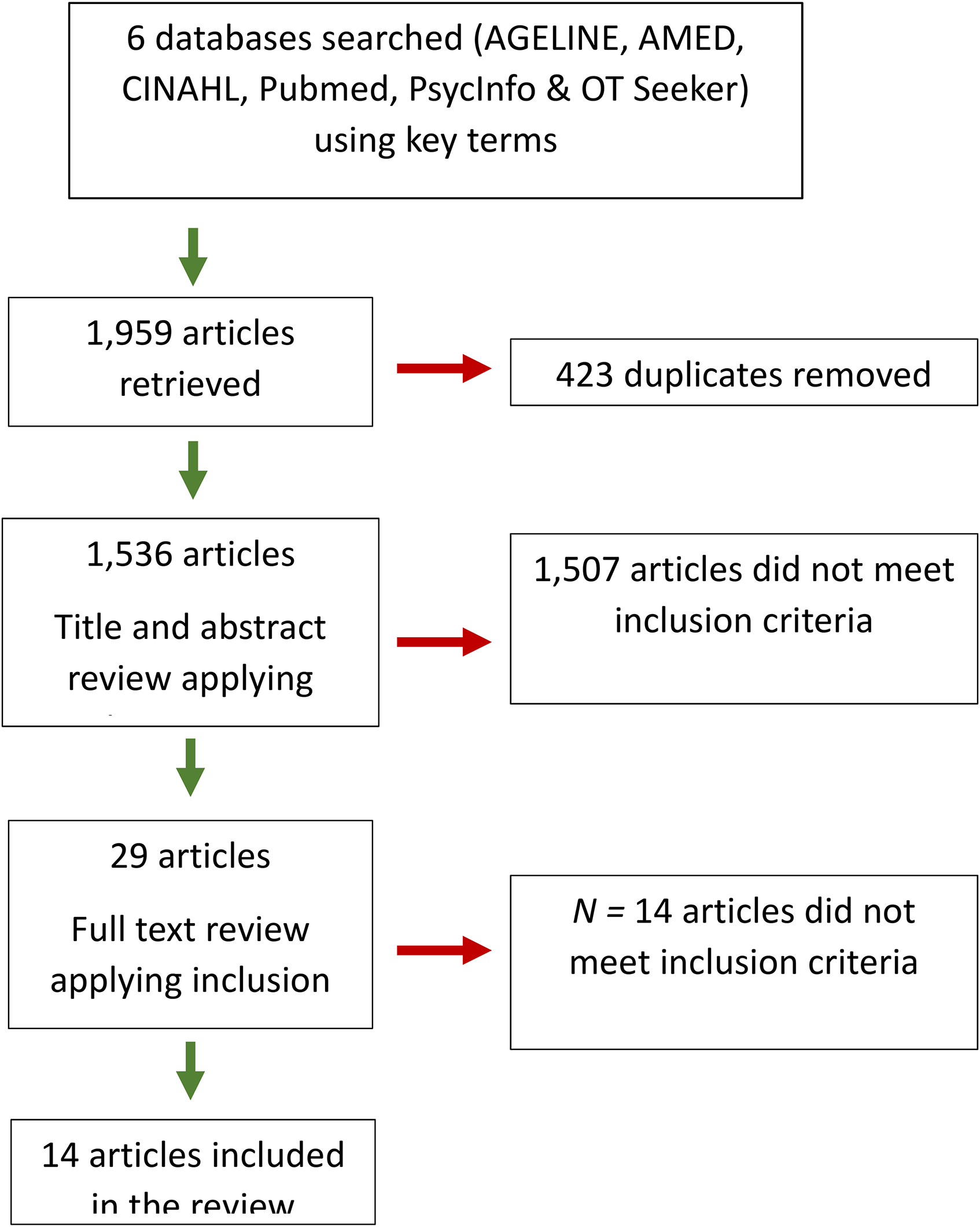
PRISMA diagram of search process.
Description of the Included Studies
The fourteen articles included in the review were published between 1979 and 2019 in journals focused on art psychotherapy or art therapy (n = 5), geriatric or long-term care (n = 4), dementia (n = 3) and social work (n = 1). The disciplines of the researchers included nursing (n = 6), art therapy (n = 7), psychology (n = 3), aging studies/gerontology (n = 2), sociology (n = 2), social work (n = 1) and health education (n = 1). All papers focused on the population of older adults in long-term care. Participants in the included studies were aged 65 or older with the exception of one 46-year-old participant living with dementia in a long-term care facility (Chung et al., 2016). Eight papers focused on dementia. Participant sample sizes ranged from 1 to 62. Nine studies were conducted in the United States, two in Canada, one in Turkey, one in the United Kingdom, and one in Taiwan. Eight of the articles utilized qualitative methods, one used quantitative methods, and five combined qualitative and quantitative methods.
Art Activities in Long-Term Care
The data suggests that art activities in long-term care are prominently conducted in a group (n = 13). The types of art used in the included articles included collage, photography, clay, fingerprints, crayons, scrapbooking, watercolours, acrylics, pottery, zines, ceramic painting, slide shows, to mixed media. The majority (n = 10) of studies included visual art methods such as drawing and painting. Stallings (2010) used collage to facilitate discussion and communication without the need for drawing abilities, which can be more difficult. The studies varied in relation to level of engagement (exposure to or engagement in creation of art). Chung and colleagues (2016) for example created media presentations (slide shows) of nature images to which participants were exposed. Graham and Fabricius (2018) provided participants the opportunity to choose their participation level; active, creative, passive, or receptive.
Outcomes of Using art Activities
In the data we identified four key outcomes of using art activities with older adults residing in long-term care: improved mood, increased quality of life and well-being, improved communication and reminiscence, and the formation of social relationships. These outcomes are described in detail below.
Mood
The results of the analysis suggested that art activities can improve mood by providing opportunities to better understand and express one's feelings.
Ching-Teng et al. (2019) explored the effects of art therapy on depression and self-esteem of 55 older adults in nursing homes in Taiwan. The art intervention employed various mediums for creation including clay, fingerprints, collages, watercolour, and crayons. The results from the Short Portable Mental Status Questionnaire indicated that art therapy can aid in alleviating symptoms of depression while improving self-esteem (Ching-Teng et al., 2019). Doric-Henry (1997) measured how participating in eight weekly pottery sessions affected long-term care residents. The participants identified improvements in self-esteem and recorded lower scores in depression and anxiety after completing the intervention. Çetinkaya et al. (2019) explored the effects of ceramic painting on the life satisfaction and cognitive status of older adults in nursing homes through a randomized controlled study. The study population included older adults at a nursing home in Turkey, and the ceramic painting sessions took place in groups of five, twice a week for a total of eight weeks. The investigators saw improved MMSE scores as well as increased life-satisfaction scores, however, the latter was not statistically significant (Çetinkaya et al., 2019). Çetinkaya et al. (2019) reported that art therapy could lead to decreases in grief, mourning, negative emotions, and depression while simultaneously promoting positive memories, recollections, socializing, language function, and quality of life. Chung and colleagues (2016) found that images of natural scenes may contribute to alleviating agitation and emotional distress for persons living with dementia.
The data suggest that participating in art activities can improve mood, which in turn contributes to quality of life and well-being, the focus of the findings in the next section.
Quality of life and well-being
Six of the included articles identified outcomes of improving overall well-being and quality of life scores (Çetinkaya et al., 2019; Ching-Teng et al., 2019; Chung, 2016; Doric-Henry, 1997; Rentz, 2002; Sauer et al., 2016).
Sauer et al. (2016) utilized the Greater Cincinnati Chapter Well-Being Observation Tool to measure the impact of Opening Minds through Art, a person-centred, creative-expressive method of art therapy on the well-being of residents of three long-term care facilities. Their findings suggested that the residents who engaged in the program showed significantly higher scores in the domains of engagement and pleasure, as well as significantly lower scores for disengagement (Sauer et al., 2016).
Rentz (2002) conducted an evaluation of Memories in the Making, an art program for individuals with Alzheimer's disease and other dementias. Participants used watercolours and acrylics with assistance from facilitators to create visual images, recreate memories, tell stories, and enjoy the process (Rentz, 2002). Utilizing Lawton's conceptualization of psychological well-being and quality of life frameworks, intervention focused on two domains of well-being; affect state and self-esteem. Sustained attention is one of the most positive indicators of well-being and participants had increases in sustained attention (Rentz, 2002). Indications of higher self-esteem were also recorded through verbal and non-verbal expression of pleasure and satisfaction (Rentz, 2002).
The use of art as described in these studies not only improved quality of life and well-being but also promoted expression and communication described in the next section.
Communication and reminiscence
Six of the articles included in this review discussed improvements in reminiscence as well as verbal and non-verbal communication during and following art interventions (Bober et al., 2002; Graham & Fabricius, 2018; Houpt et al., 2016; Leslie, 2001; Shore, 1997; Stallings, 2010). To help improve aspects of reminiscence, authors created opportunities to increase participants’ ability to remember, and share those memories and experiences with others. Five of the studies discussed how participation in art activities promoted and fostered connections among group members, allowed for opportunities to engage in reminiscence, and created important social bonds. Houpt et al. (2016) explored the role of art therapy through zine (i.e., booklet) making. The creation of zines enabled individuals to voice their experiences and lead to greater communication and connections amongst members and individuals who read the zines. Participants reported stronger personal connections with others, increased ability to express oneself, and opportunities to engage in intellectual discussion and critical thinking.
Stallings (2010) identified collage as a therapeutic modality for reminiscence. This author noted that traditional therapy places a heavy emphasis on verbal communication between therapist and client, which is not always appropriate for persons with dementia due to associated impaired cognitive and verbal abilities. Collage fostered reminiscence by allowing participants the opportunity to choose pictures for the collages, which tended to elicit verbalizations of reminiscence. Collages also provided participants a nonverbal mode of communication and allowed for expression beyond traditional verbal and cognitive abilities (Stallings, 2010).
Leslie (2001) suggested the therapeutic use of art for exploration of imaginative avenues of non-verbal communication. Participants in this study engaged in painting while sharing feelings and reminiscing about early life and social bonds. Outcomes of this therapy included an increase in communication and formed social bonds among participants (Leslie, 2001).
The data suggest that engagement in art activities can promote communication both verbally and in non-verbal ways, as well as opportunities for communication, which can inherently contribute to social relationships.
Social relationships
Another finding described in five of the articles relates to how participation in art activities can contribute to the creation, establishment, deepening and maintenance of social relationships for older adults in long-term care (Çetinkaya et al., 2019; Houpt et al., 2016; Leslie, 2001; Lewis, 1979; Zwick, 1978).
Zwick (1978) explored photography as a medium for art therapy with five participants residing in a retirement home and four in a nursing home. Zwick stated that the retirement and nursing home environments were repressive, impersonal, and socially isolated and that these observations led to the implementation of the photography intervention, aimed at increasing awareness of oneself and one's environment. Through picture-taking experiences, participants interacted with others in their environment and formed connections. In another study (Lewis, 1979) based on the ideas that humans are interconnected and that communication through art can facilitate the re-establishment of relationships, a small group of men engaged in visual art exercises. The participants would examine an object, draw the object, then discuss the experience with each other. After several months of the art group, residents began attending other activities just to visit each other (Zwick, 1978). This article showcases how important art activities methods can contribute to increasing and deepening social connections.
The data suggest that art activities can contribute significantly to the quality of life and well-being of older adults in long-term care settings, by enhancing mood, promoting communication and reminiscence, as well as providing opportunities for more and deeper relationships with others, aspects of life that contribute to each other.
Discussion
To our knowledge, there is no existing review or synthesis of the literature specifically about the use of art activities in long-term care facilities. This review offers a map of the existing literature about the use of art activities in long-term care and provides information about types of art activities being used in long-term care and the outcomes of such practices. In this scoping review we identified research spanning a 41-year period, with the majority (n = 11) of the included studies being published from the year 2000 onwards (73%). The increasing interest in the topic of using art activities in long-term care facilities highlights the growing importance of non-pharmacological therapy methods for older persons (Masika et al., 2020), and the need for a synthesis of this literature.
The findings of this review focused on the use of art activities in long-term care align with the existing literature about the benefits of incorporating art activities into therapy more broadly. From an occupational therapy perspective, in a 2010 literature review, Perruzza and Kinsella identified that using creative arts occupations contributed to: enhanced perceptions of control; augmented senses of self and purpose; increased communication and expression of feelings; and facilitated building social supports. More broadly, based on the results of their 2019 WHO scoping review, in which literature from multiple disciplinary fields was included, authors Fancourt and Finn (2019) suggested that exposure to and participation in art activities can indeed contribute to health and well-being through a variety of ways, including enhancing emotional regulation and reducing symptoms of depression and anxiety; increasing social connection and cohesion; and promoting culturally-diverse communication media. These findings in the field of occupational therapy and other disciplines align with our findings that the use of art activities with older adults in long term care can contribute to increased mood, quality of life and well-being, as well as enhanced communication and reminiscence and social relationships. The findings from all of these perspectives highlight the potential for the use of art to contribute to enhanced well-being in various ways and highlight potential benefits that the integration of arts activities into long-term care facilities could have.
Implications for Practice
The findings of this current and comprehensive review are applicable to occupational therapy practice as occupational therapists in long-term care settings can use art activities with older adults to foster a variety of occupations and to achieve occupational therapy goals. This is not to say that occupational therapists should practice art therapy, as art therapists are trained and registered professionals with their own scope of practice who utilize a psychotherapeutic perspective, but more so that art activities have been shown to have multiple benefits related to improving health and well-being (Gutheil & Heyman, 2016; Masika et al., 2020; Zubala & Karkou, 2018) that align with occupational therapy goals in long-term care, which frequently include improving or maintaining health and well-being through the enhancement or preservation of physical and cognitive abilities (Dancewicz & Bissett, 2020; Devine & Usher, 2017; Kern et al., 2020; Marangoni et al., 2020; Smith & Kirby, 2015). The use of art as an occupation or as part of an intervention could foster the achievement of goals related to social occupations, improving cognition for daily activities, and enhancing mood for increased participation across occupations, as well as to explore and communicate feelings and emotions that it might otherwise be difficult to identify and discuss with caregivers or family members, all of which are common goals of occupational therapy with older adults in long-term care (Dancewicz & Bissett, 2020; Devine & Usher, 2017; Kern et al., 2020; Marangoni et al., 2020). Art activities could thus be used as an additional intervention tool for practicing occupational therapists in long-term care. Ideally, occupational therapists would collaborate and consult with art therapists in order to complement, reinforce and enhance services each profession offers.
Importantly, art activities align with person-centered approaches, which are at the heart of occupational therapy practice (Durocher et al., 2015; Njelesani et al., 2015; Townsend & Polatajko, 2007; WFOT, 2010). In alignment with person-centred approaches, the choice of the art activity or medium, and the level of involvement of older adults could be tailored based on individual preferences, capabilities and needs. Only one study included in the review offered participants the choice of their level of participation; Graham and Fabricius (2018) allowed participants to choose their participation level in the live-mural painting sessions, acknowledging some may struggle with the skills required for such tasks such as fine motor skills and sustained attention. Considering how older adults can participate and tailoring the activities for each person will help to ensure that art is included in a client-centred manner in order to achieve outcomes that are relevant in relation to clients` needs and goals while also enabling engagement in what is meaningful and important for clients.
Future Work
Given the benefits of using art activities with older adults as well as the growing numbers of older adults (WHO, 2018), research about art activities and guidance about how to incorporate such approaches in occupational therapy practice should continue to be developed. Such research will be relevant in relation to individuals in long-term care facilities as well with other populations. In this review we focused on the specific population of older adults in long-term care settings. That more than half of the studies identified for this review were focused on the population of older adults with dementia, and that the needs of different individuals vary, suggests a need to conduct further research exploring the use of art in occupational therapy with specific populations and exploring ways that such practice can be tailored to meet different needs.
Limitations
This review included several limitations, the most prominent being the possibility of having excluded relevant papers. ‘Creative arts’ was not used as a search term thereby potentially excluding relevant studies. Despite attempts to retrieve all articles through a variety of means, the authors were limited to articles accessible publicly or through the McMaster Libraries. Library and its networks. Furthermore, articles were only deemed appropriate for the review if they were accessible in English, as some members of the research team only speak English.
Conclusion
As the world's population, and in particular the population of older adults, continues to grow at unprecedented rates (WHO, 2018), the population of older adults in long-term care and the prevalence of chronic illness and the associated need for interventions will also increase. The results of this review suggest that art activities can contribute to increasing quality of life and improving communication, and can provide opportunities for reminiscence and the deepening of social relationships for residents of long-term care facilities with various needs and capabilities. Occupational therapists in long-term care should consider the incorporation of art activities in practice as these offer a variety of therapeutic benefits for older adults, include a broad range of art mediums, and can be adapted to strengths and preferred level of participation.
Key Messages
Occupational therapists in long-term care settings can use art activities with older adults to foster a variety of occupations.
Art activities offer a variety of therapeutic benefits for older adults that align with occupational therapy goals.
Art activities align with person-centered approaches as the range of art mediums can be adapted to strengths and preferred level of participation of clients.
Footnotes
Declaration of Conflicting Interests
The author(s) declared no potential conflicts of interest with respect to the research, authorship, and/or publication of this article.
Funding
The author(s) received no financial support for the research, authorship and/or publication of this article.
