



Abstract
Background.
When acting effectively in their social change agent (SCA) role, occupational therapists can impact population health and occupational justice. However, empirical evidence of the influence of personal and environmental factors on their ability to act as SCAs is scarce.
Purpose.
To explore personal and environmental factors that influence the ability of occupational therapists to act as effective SCAs.
Method.
We conducted a descriptive interpretive qualitative study with 18 Québec occupational therapists recognized as successful SCAs. We collected data through semi-structured interviews with three focus groups and analyzed them thematically using a lexicon.
Findings.
We identified nine cross-cutting personal factors, including discovery, effective communication, and planning, that enable occupational therapists to act as successful SCAs. Six thematic groups of environmental factors facilitated or hindered their actions.
Implications.
To act effectively as SCAs, occupational therapists need to consider personal and environmental factors involved in their change project.
Introduction
Occupational therapists are expected to uphold their clients’ rights, be they individuals, groups or communities, and support their social inclusion and empowerment (Canadian Association of Occupational Therapists [CAOT], 2012). From an ethical perspective (Drolet & Hudon, 2014), these expectations require them to act as change agents. Acting as such, occupational therapists must “use their expertise and influence responsibly to advance occupation, occupational performance and occupational participation” (CAOT, 2012, p. 3) and, above all, increase social (Drolet & Hudon, 2014) and occupational justice (Kirsh, 2015). Indeed, “[o]ccupational therapists recognise that inequitable social circumstances shape the availability of the occupational opportunities that determine what people are able to do, can choose to do, believe they should do, or can envision doing.” (Hammell, 2020, p. 380). To increase occupational opportunities for vulnerable or deprived individuals, groups or communities, the usual range of clinical actions (such as defending a client’s choice in a team meeting) is usually not enough (Drolet et al., 2020). In light of systemic problems, including ableism, agism, and racism (Hammell, 2020), social actions such as assuming a formal duty in an advocacy organization or speaking publicly (Carrier & Beaudoin, 2020) are necessary to stimulate positive change.
The actions of social change agents (SCA) aim to stimulate positive changes in population health, occupational justice, and access to services (Carrier & Beaudoin, 2020). One example is the work of Bazyk and Cahill (2015), who developed a “…multipronged occupational therapy-led mental health promotion initiative…with the focus on helping all children…in order to succeed in school, at home, and in the community.” (2015, p. 650). Acting as SCAs, occupational therapists exert their influence beyond the clinical setting in order to modify laws, regulations, policies, or institutional procedures (Carrier & Beaudoin, 2020). Thus, social actions require knowledge, skills and strategies different from those usually used in everyday practice (Rahimaly et al, 2019). As with other occupations, the ability to successfully perform social actions might be influenced by occupational therapists’ personal factors. Their intrinsic characteristics, skills acquired through previous experiences, and strategies used can support or interfere with the attainment of their goals (Kielhofner, 2008). Micro-, meso-, and macro-environmental factors (Drolet et al., 2020), that is, physical, social, institutional, and cultural elements (Craik et al., 2013), also influence human behaviour and occupational performance (Dunn et al., 1994), which includes SCAs’ actions. For example, being in a powerful profession influences the ability to bring forward changes in one’s targeted arena (Clark, 2010).
Efforts have been made to clarify the conceptualization of the SCA’s role (e.g., Carrier & Beaudoin, 2020) and describe its fundamentals. For example, communication skills and strategies (e.g., Carrier & Contandriopoulos, 2015; Drolet et al., 2020; Freeman et al., 2017; Gerlach & Smith, 2015) as well as relationship and network building (e.g., Battilana & Casciaro, 2013; Dhillon et al., 2010; Freeman et al, 2017; Heard, 2014; Kirsh, 2015; Norbash, 2017) are deemed important when acting as effective SCAs. However, few empirical studies have examined which SCAs’ personal factors influence their actions. Furthermore, despite their potentially important influence, environmental factors have been addressed in very few articles and these articles are mainly situated in the micro-environment (clinical context), not in the meso- or macro-environments (societal context) (Kirsh, 2015). For example, a well-developed system of clinical leadership, a supportive environment, and advocates could support clinical leadership actions (Ham, 2003). Overall, there is not enough descriptive empirical literature to establish a knowledge foundation enabling occupational therapists and occupational therapy students to act efficiently as SCAs.
The experience of occupational therapists whose actions as SCAs are successful could provide compelling information about personal and environmental factors influencing their actions. On the one hand, knowing more about factors affecting the ability to act as an SCA, this crucial part of occupational therapy practice could be improved through reflective practice (CAOT, 2012). Indeed, combining evidence with reflective practice can “enable occupational therapists to respond creatively to the challenges they face when providing services” (Bannigan & Moores, 2009, p. 348). For example, SCAs could critically reflect on their actions and identify personal and environmental factors affecting their ability to act. Addressing these factors might lead to improved SCA practice and, as a result, greater occupational justice and empowerment for vulnerable populations. On the other hand, identifying influencing factors could inform course content in entry-level programs and continuing education. Currently, entry-level occupational therapy programs generally address the SCA’s role only briefly (Rahimaly et al., 2019). Incorporating knowledge about these factors in programs and continuing education would help provide occupational therapists with some of the tools they need to increase occupational justice as well as help them build an identity in which the SCA role is fully integrated and taken on.
Drawing from recognized SCAs’ experiential knowledge (Higgs et al., 2008), we wanted to answer the following research question: What factors influence the actualization of the SCA’s role? Our overall objective was thus to explore these factors from the perspective of occupational therapists who are successful in acting as SCAs. We specifically wanted to describe: (1) personal and (2) environmental factors involved.
Method
Study Design
To explore the factors influencing occupational therapists’ actions from their perspective, we conducted a descriptive interpretive qualitative research study (Gallagher, 2014) from January 2019 to March 2020. This design enabled exploration from the participants’ perspective of a phenomenon for which empirical evidence is scarce (Gallagher, 2014). Starting from their perspective allowed us to study the SCA role based on real actions that took place in a natural context (Gallagher, 2014). We conducted this study using inductive reasoning from a constructivist perspective, meaning that results are based on an egalitarian relationship between participants and researchers and describe the reality as interpreted by the researchers during data collection and analysis (Creswell & Poth, 2016). This study was approved by the Research Ethics Board of CIUSSS de l’Estrie–CHUS on April 18, 2019 (2019-2947).
Recruitment of Participants
We recruited participants via email invitations forwarded by the Ordre des ergothérapeutes du Québec (OEQ) to its members. We chose a convenience strategy (Fortin & Gagnon, 2016) because the characteristics of our study population were not formally documented (e.g., in the OEQ members list) or apparent. Interested occupational therapists who identified themselves with the inclusion criteria were asked to submit an online application. Occupational therapists who identified colleagues meeting the inclusion criteria were also asked to encourage them to submit their applications. They were then contacted by phone by one of the researchers. To be included, they had to (1) be members of the OEQ, (2) be able to express themselves in French, (3) have access to videoconferencing technology, and (4) have completed a change project with a significant impact. A significant impact meant a change “that is consequential” (Fortin & Gagnon, 2016, p. 449) in responding to the needs of a group or population (e.g., increased accessibility to care, reduced marginalization). To ensure rigour in the selection process, the research team discussed each potential participant with respect to criterion (d). We carefully considered the environments in which potential participants’ change projects were carried out in order to ensure a variety of characteristics (Gallagher, 2014). Out of 33 applicants, 25 met our inclusion criteria and provided sufficient environmental variability. Nineteen were available at the times allotted for the focus groups (FG). We assigned participants to one of three groups. We lost one participant due to technical difficulties at the beginning of the interview. The final sample, therefore, consisted of 18 occupational therapists divided into three FG comprising, respectively, seven, six, and five participants.
Data Collection
We obtained written consent from all participants, following which we sent them a preparatory document outlining the research objectives, the definition of the change agent role in the CAOT Profile of Practice (CAOT, 2012), and the themes to be addressed during the group discussion. We invited them to reflect on these themes based on their experience in carrying out the change project described during the selection process. From June to October 2019, using Zoom videoconferencing, we conducted three FG interviews each lasting approximately 2 h. We used this data collection method because we wanted participants to build upon each others’ answers and provide a group perspective (Baribeau & Germain, 2010). To ensure dependability, we audiotaped each interview. A student-researcher conducted the interviews, supported by a second student-researcher acting as co-leader. To increase confirmability, the research supervisor attended the interviews but did not intervene. Based on the Model of Human Occupation (MOH; Kielhofner, 2008), we developed a semi-structured interview guide that mainly focused on personal factors as the research team was interested in factors over which occupational therapists have immediate power. The guide was divided into four sections: (1) intrinsic characteristics, (2) required skills, (3) strategies used, and (4) environmental factors. For this last section, we questioned participants about factors that facilitate or hinder SCAs’ actions. The guide included open-ended questions, such as: “With your experience as an SCA in mind, what personality traits were useful to you in acting as an SCA?”; “How has the environmental context influenced your ability to act as an SCA, if at all?” We also asked clarification questions, for example: “You talked about getting support from collaborators. How did you go about getting that support?” Two methodological and content experts validated the guide and a group of three final-year occupational therapy students doing an SCA project as part of their entry-level program pretested it, which enhanced credibility. After the interviews, we asked participants to fill in an online sociodemographic questionnaire, which was completed by 13 of the 18 participants (72.2%).
Data Analysis
Consistent with dependability, a research assistant transcribed the tape recordings and a student-researcher verified each transcript. We conducted data collection and analysis simultaneously in three successive rounds, that is, we analyzed the transcripts after each group interview and before the next one. Consistent with the selected design, we were able to modify the interview guide to foster data saturation. Two student-researcher dyads co-coded the data from each transcript. To ensure inter-coder reliability and consistency between the two dyads, we developed a code lexicon and discussed the codes extensively. The initial coding grid included the following categories: intrinsic characteristics, skills, strategies, and environmental factors. First, one student in the dyad coded the data in a semi-open manner to allow for the emergence of new themes. The second student validated the coding. The dyad discussed disagreements and questions arising throughout the coding process and agreed on which codes to include in the lexicon. To further ensure confirmability and suggest alternative interpretations, the research supervisor validated the analyses after each round. Using team discussions, we gradually reduced the codes to categories, that is, we grouped interrelated codes together. Several intrinsic characteristics were grouped; for example, “flexible” and “patient” were grouped in the “Accommodating” category. We followed the same process with skills, strategies and environmental factors. Subsequently, it became apparent that most categories could be combined in cross-cutting personal factors. For example, the intrinsic characteristics category “Accommodating” was combined with the skills category “Adaptive skills” and the strategies category “Gradually develop the change project and their own expertise” to form the cross-cutting personal factor “Adaptability/Flexibility”. Like personal factors, environmental factors were grouped under six themes. These cross-cutting personal factors as well as the environmental factors are presented below and illustrated with excerpts from the transcripts, freely translated by the authors from French to English and verified by a professional translator.
Findings
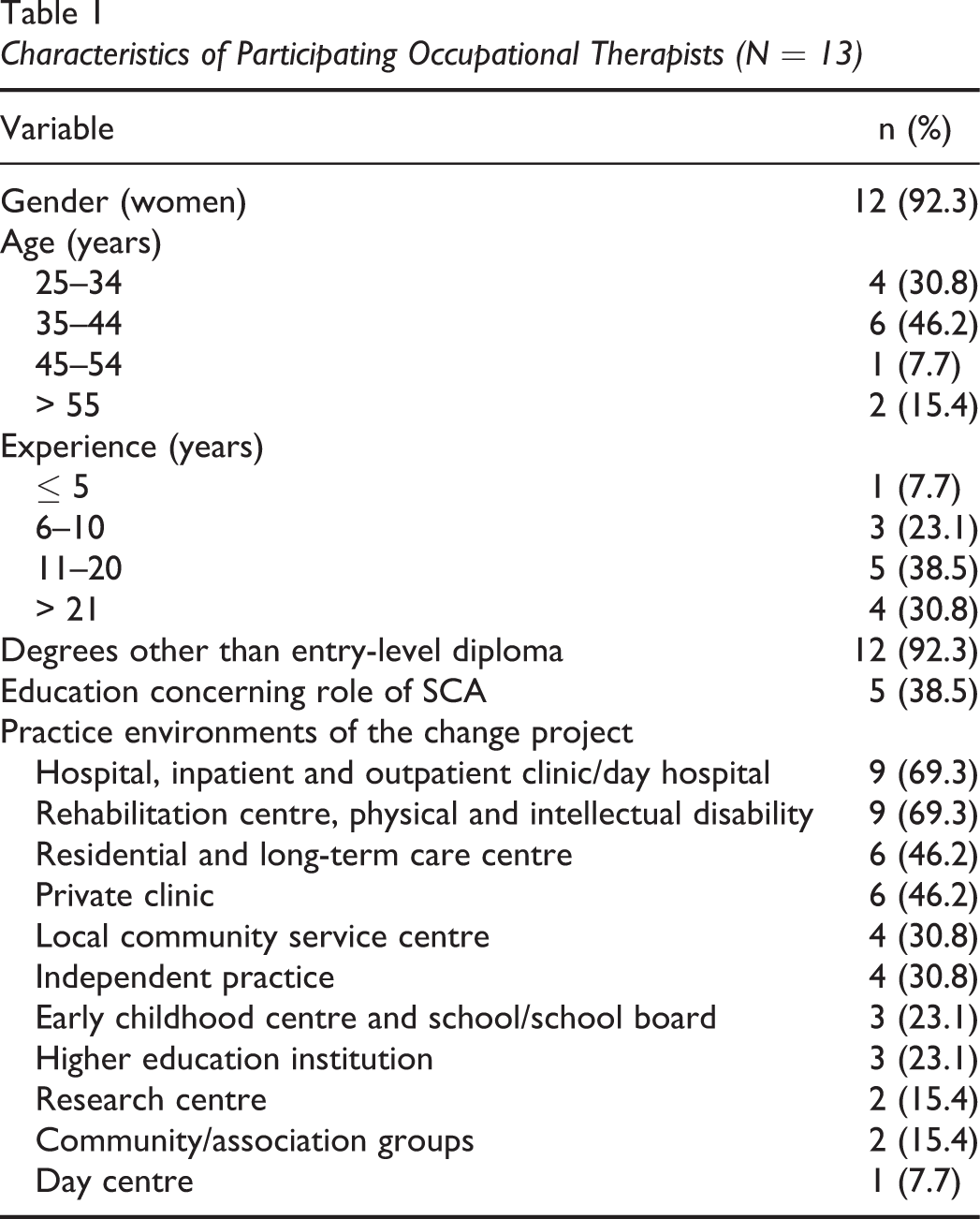
The great majority were women (n = 12; 92%) and the 35–44-year-old age group had the highest representation (n = 6; 46%; Table 1). Occupational therapists with between 11 and 20 years of experience constituted the largest subgroup (n = 5; 39%) and 12 (92%) had at least one degree other than their entry-level diploma. Five (39%) had also had some continuing education concerning the change agent role. Our participants’ change projects varied. Seven projects addressed unmet needs by creating private or community-based services (n = 4; 22%) or promoted occupational therapy in areas where its potential was little known or used (n = 3; 17%). Other projects changed procedures in the public healthcare system (n = 4; 22%), for example, by creating protocols for the use of physical restraints. Some participants worked on implementing prevention procedures or strategies with public authorities (n = 3; 17%), for example, as a consultant for a municipality. Three participants developed services in the public healthcare system, either previously not available (n = 2; 11%) or an occupational therapy service in an existing public program (n = 1; 6%). Finally, one participant developed an assessment tool to improve occupational therapy practice.
Characteristics of Participating Occupational Therapists (N = 13)
Personal Factors
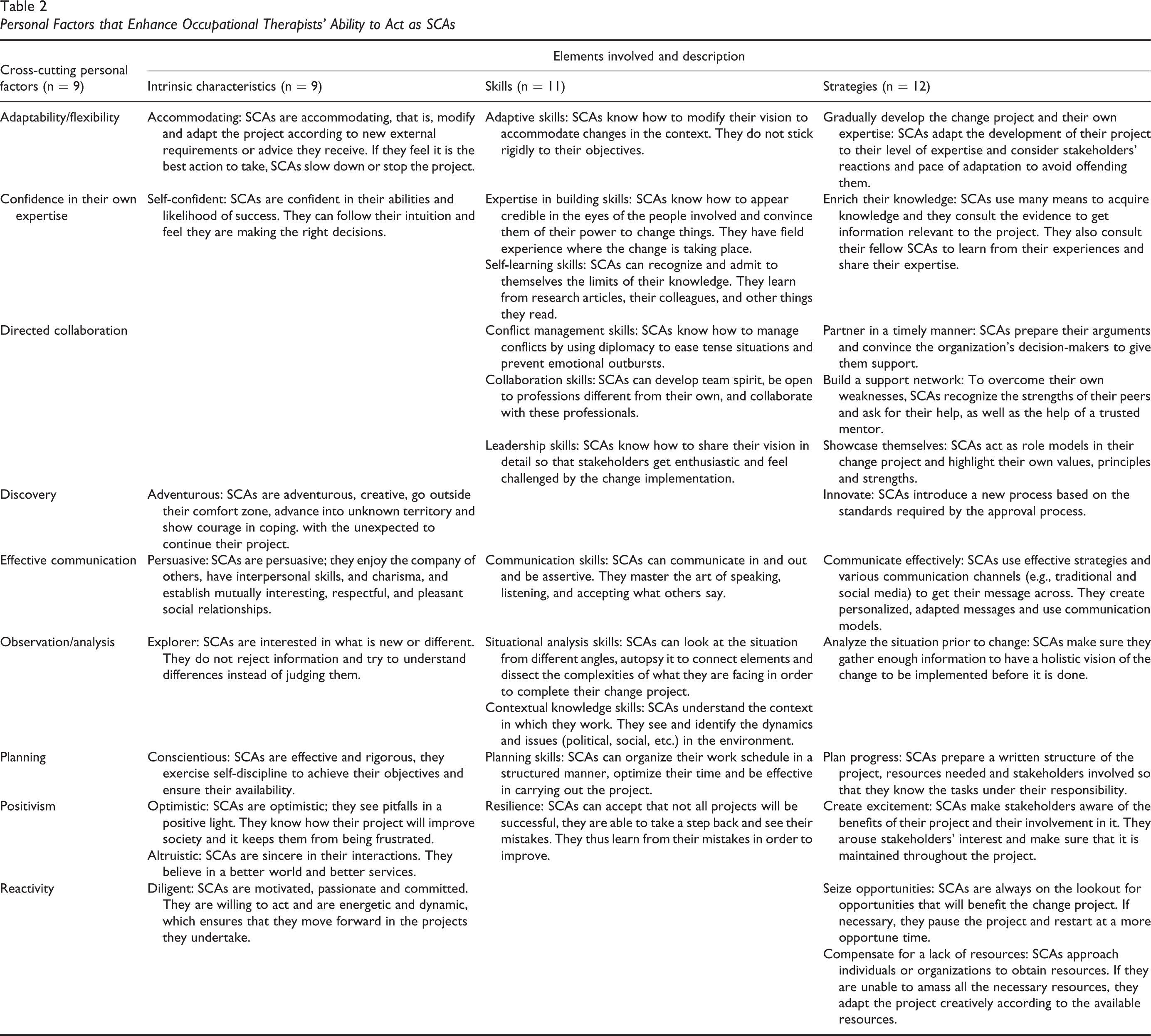
Nine cross-cutting personal factors that underpin the effectiveness of SCAs were identified (see Figure 1). These personal factors are defined and detailed below. The intrinsic characteristics, skills and strategies identified by participants were used to build the cross-cutting personal factors described in Table 2.
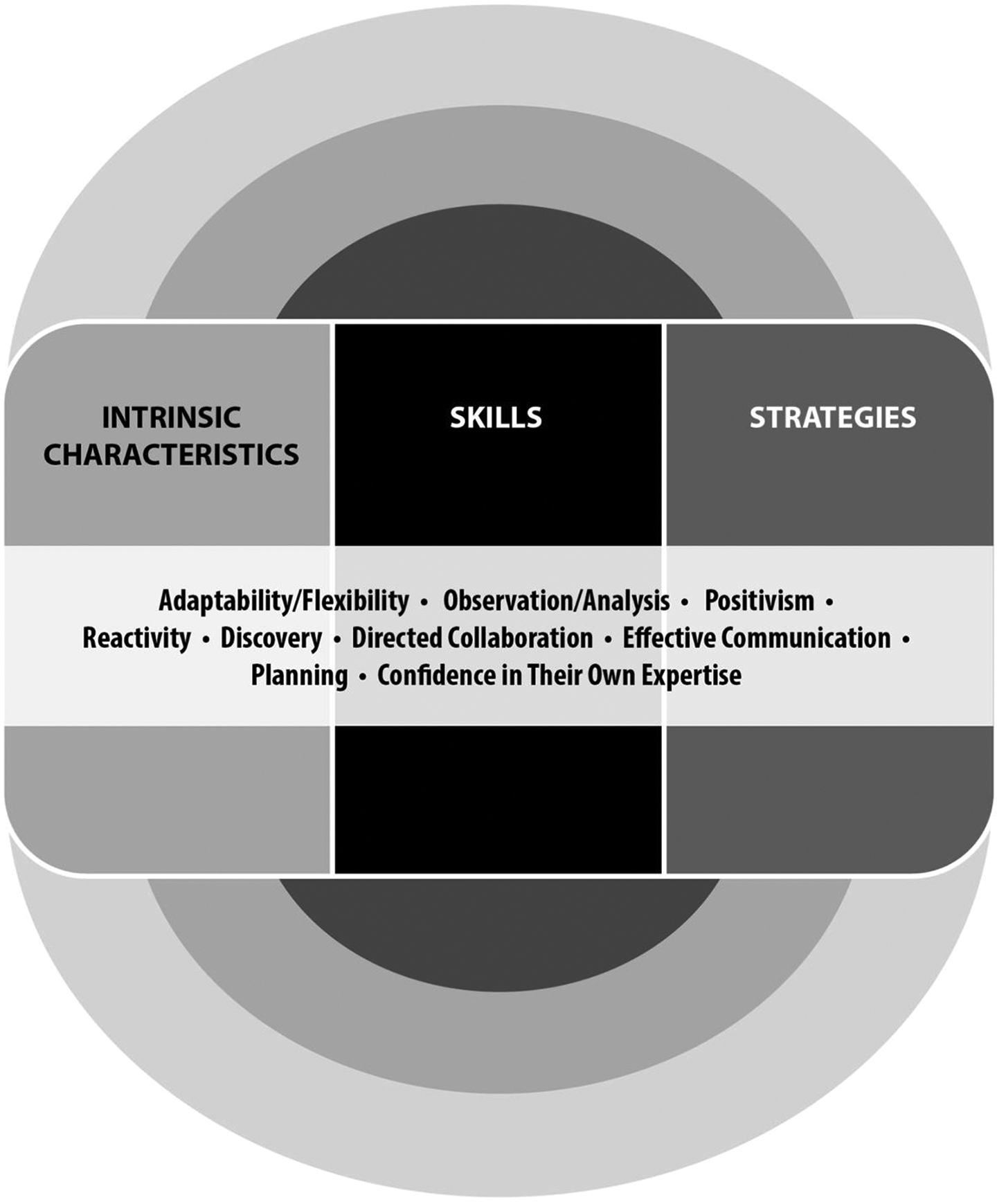
Factors influencing occupational therapists’ ability to act as social change agents.
Personal Factors that Enhance Occupational Therapists’ Ability to Act as SCAs
Adaptability/flexibility
SCAs adjust and adapt their change projects according to new external requirements and stakeholder needs. Participants reported that to succeed as an SCA, it is important to be accommodating, such as through patience: “…I think it takes patience; you don’t always get results in the short run so if people want very quick results, it’s not a trait that will help them…” (FG3). Good adaptive skills are also desirable: “…we wanted to have an agile project because we had to adapt so much along the way…” (FG1). Gradually developing the change project and one’s own expertise, while “…respecting the pace of the people with whom we are working on the change” (FG1), was deemed by participants to be a helpful strategy.
Confidence in their own expertise
Participants talked about self-confidence, for example, the importance of trusting one’s instincts: “…listen to your intuition…. I think that when you want to develop a vision, you are more likely to have some kind of intuition that you can rely on” (FG2). Participants also mentioned expertise in building skills so they are viewed as reliable: “All this helps your credibility and demonstrates your knowledge; it helps to get people to buy into the change or adopt what you say” (FG1). Autodidactic skills are also put to good use to acquire the necessary knowledge, including through research: “…also there are all the research skills that enable us to do action research or write research protocols in partnership with the community…” (FG1). Similarly, enriching knowledge was identified as a useful strategy: “I think that having the ability to make connections with evidence-based results to support what you propose is an essential quality” (FG1).
Directed collaboration
This personal factor means acting to create alliances and collaborate with partners. First, participants agreed that conflict management skills are necessary, which also means behaving diplomatically: “…we must also feel our way along and not suddenly impose the [change]…change must not be imposed, it must be brought about…” (FG1). Second, collaboration skills are also required, for example, in interdisciplinary situations: “I think the inter-professional system was favourable in our situation…Having people from different backgrounds brings new ideas and also gives us a broader view of the situation” (FG2). Leadership skills also appear essential: “…to be a mobilizer because you want to rally people around a common goal” (FG1). Participants discussed the strategy of partnering in a timely manner: “If we make alliances or discuss things with other colleagues beforehand, it can help us get our point across in a meeting where some people would like to preserve the status quo and not move forward” (FG1). They also highlighted the importance of creating a support network, including communication with an expert or mentor: “It’s about finding a resource and an expert where we are in our practice, but I think mentoring can be applied throughout a career; mentoring can be different at different points in a career…” (FG1). Finally, participants underlined the need to showcase themselves, according to the stakeholders’ interests: “You have to be able to suggest what the benefits of working together would be from the viewpoint of the person you are talking to” (FG2).
Discovery
To lead change, SCAs take new approaches. It is a positive trait to be adventurous, which means taking risks without any guarantee of success: “…it’s putting your heart into it even if you don’t have a guarantee that it will happen tomorrow morning” (FG3). The participants also thought that to be successful, it helped to be creative and innovation was required: “…but you have to find a new way of doing things…that can be an important feature to have in order to envision and add new elements” (FG1).
Effective communication
Participants described themselves as persuasive, which can be manifested through charm: “…one of the things I use a lot is my charm, which means not only having a charming attitude but also being a good listener” (FG3). Participants also mentioned that it was helpful “…to have the ability to rally people around, be sociable” (FG1). The groups agreed that communication skills are a must: “…it’s really the ability to communicate in both directions, how I explain my idea and how I get it across by giving concrete examples” (FG1). Along the same lines, the strategy of communicating effectively came up, including using humour at the appropriate time: “…I would say a strategy that works and is quite informal is humour. Using humour to defuse the situation or bring people on board has been very effective at times…” (FG1).
Observation/analysis
SCAs go through a process of reflection as they deconstruct the complexities they face in order to bring their planned change to fruition. The participants mentioned that effective SCAs are usually explorers by nature, which includes open-mindedness. Situational analysis skills, including identifying the objectives and targets for change, need to be acquired: “And I realize that being able to pinpoint the right target to work on, I think that starts with analyzing what’s happening, but it’s something that needs to be worked on” (FG1). Contextual knowledge is another essential element: “You have to understand the context and the culture in order to set things up properly without rushing” (FG1). Participants said they analyzed the situation prior to change: “…to see the holistic 360o angle, I think that’s really helpful when you look at a project” (FG1).
Planning
To carry out their projects, participants said they had to be conscientious and rigorous: “…it still takes a certain amount of rigour” (FG2), and assiduous: “That diligence was what really got them to follow me…” (FG1). Planning skills are also useful, for example: “…good work organization as well as good management skills” (FG1). Participants stressed the need to plan the project’s progress: “In fact, the action plan…was a shared plan. We were a team; there was a project leader but…everyone knew the plan” (FG3).
Positivism
Effective SCAs look on the bright side and do not allow themselves to be overwhelmed by the obstacles they face. Participants defined themselves as being optimistic and as persevering: “If we’re talking about change, it’s because it’s not easy to achieve…it will take perseverance…” (FG2). They also spoke about being altruistic: “…our intention is to do good, we want to bring good to the community; it’s not necessarily an egocentric desire, it’s really more of a need to improve the community and the well-being of society” (FG3). The groups agreed that resilience is a skill that SCAs need to develop: “It’s not always perfect the first time; you have to accept failure and learn from it” (FG1). Creating excitement around the project, including by demonstrating the benefits of change to others, is a good strategy for SCAs: “…and when I saw that I was having an impact…I started thinking: ‘maybe it would be really interesting if we could do a presentation to all the case managers’” (FG1).
Reactivity
SCAs are always available and committed to their project so they can act in a timely manner. Participants described the importance of being diligent and passionate: “…be passionate, love what you do because if you want to sell the change you are advocating, you have to make it come alive” (FG1). When resources are lacking, finding alternatives is an important strategy: “I’ve made presentations to business people and community leaders, to raise money, in the political and financial arena…” (FG1). While carrying out their projects, participants had to seize opportunities, which include choosing the right time to act: …I think you have to have a lot of continuity or be very agile when you’re pushing or leading and when you’re waiting or letting the partners or the chemistry work. Sometimes we want it now but the timing isn’t right or the environment isn’t ready. (FG1)
Environmental Factors
Eleven environmental factors, grouped under six themes, were identified, which could be placed on a continuum from facilitating to impeding SCAs’ actions (Table 3).
Environmental Factors that Influence Occupational Therapists’ Actions as SCAs
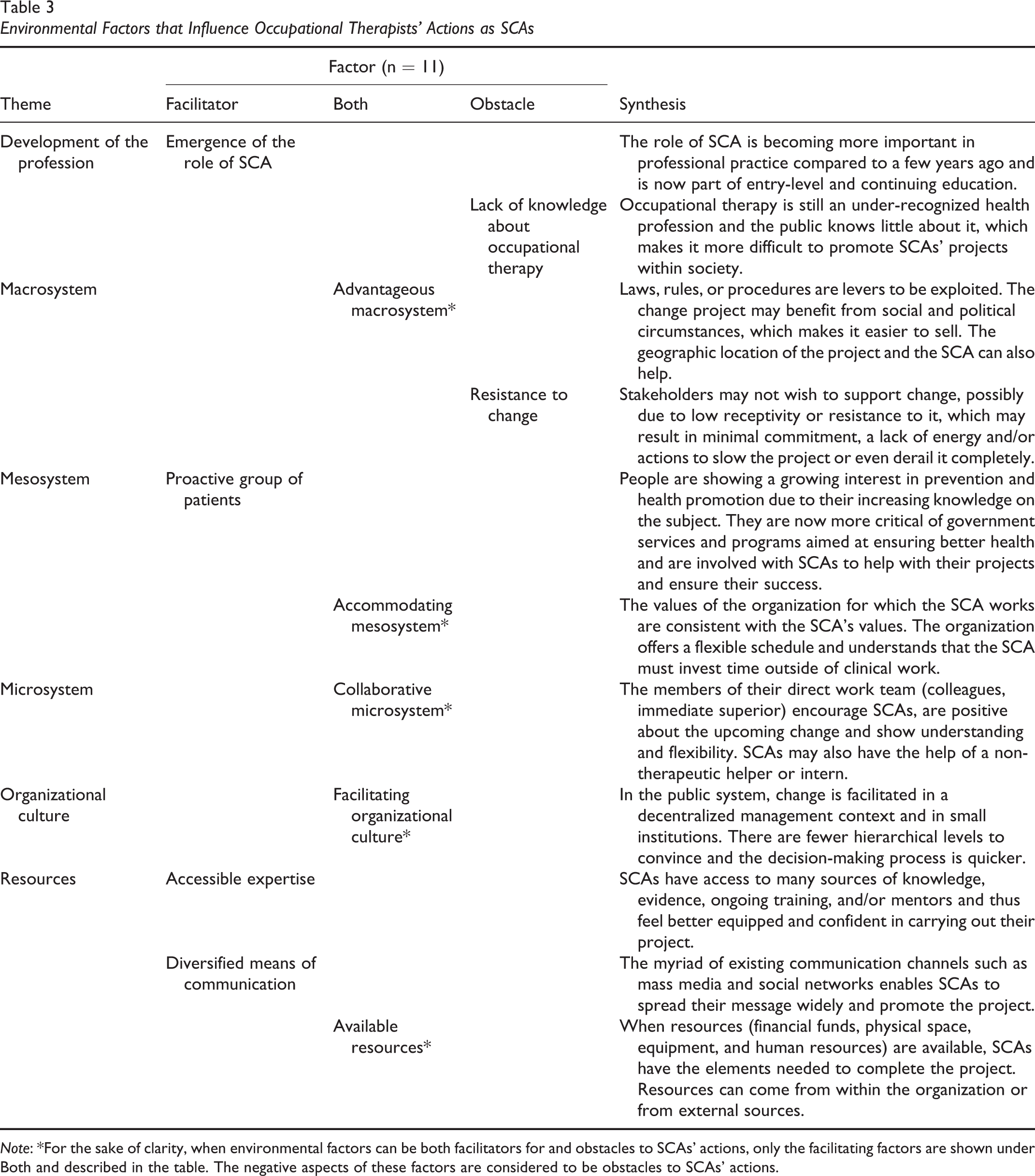
Note: *For the sake of clarity, when environmental factors can be both facilitators for and obstacles to SCAs’ actions, only the facilitating factors are shown under Both and described in the table. The negative aspects of these factors are considered to be obstacles to SCAs’ actions.
Development of the profession
In the specific context of the occupational therapy profession, the emergence of the SCA’s role, namely in entry-level training, is favourable to the social change actions of occupational therapists: “You have the opportunity to be trained as a change agent in your fourth year of university. Also, now there is continuing education offered through CAOT” (FG1). However, a lack of knowledge about occupational therapy has been described as limiting the actions of SCAs: “…we’re not yet a profession that is promoted to the fullest extent of its potential value because there is no one who necessarily goes out into the public arena to promote it more widely” (FG3).
Macrosystem
The participants explained that community or population level elements, as well as policies and laws, could make the macrosystem advantageous or not: “…the political aspect…remains very important because we can have completely different trends every four years. It’s something that can be favourable or unfavourable, depending on who’s leading…” (FG1). Individual resistance to change is a barrier that can occur in all environmental systems, including the macrosystem: “…we may have some people who are harder to get on board with our project even if they’ve been targeted…” (FG1).
Mesosystem
An accommodating mesosystem, that is, one with favourable elements at the organizational and institutional level can help. One example of an accommodating mesosystem is where superiors are tolerant of the SCA’s reduced performance according to institutional targets: “I’m lucky because I don’t really have any pressure to perform and people are not always looking at my statistics…” (FG1). Conversely, an unaccommodating mesosystem is counterproductive to the SCA’s actions. Facilitating these actions are proactive groups of patients: “…in our project, the population wants to become a partner in their own care, so it was easier to support the movement because we knew that the patients were going to get on board” (FG1).
Microsystem
Similarly, acting in a collaborative microsystem, which involves elements at the level of individuals and their interactions, is facilitating: “Certainly facilitating factors include openness, listening, peer support and support from the program leader” (FG2). Conversely, a non-collaborative microsystem is an obstacle to the deployment of change actions: “Then there is also the whole human aspect. When we encounter managers who are…unfavourable to the project…it can become…difficult to get the project going…” (FG1).
Organizational culture
According to participants, organizational culture can be a support or impediment to their actions. Projects that took place under decentralized management, that is, before the 2015 merger of public organizations in Québec, moved faster, as noted here: “…the process started before [organizations] merged; we were a small facility with 300 employees, where managers and everyone was close and certainly things could move faster” (FG1). Groups also reported difficulty reaching centralized management bodies: “Now, when I have questions, I have to ask my boss, who asks their boss, who asks their boss, so it takes a bit longer to get things done” (FG1).
Resources
Finally, participants agreed that resources had a big impact on their actions. In the group discussions, the availability of resources, including financial, was often described as facilitating: So, having the funds to be able to organize awareness campaigns; it’s really for practical reasons, it’s not to buy people or anything else. It’s to be able to go into detail with the options. Often, money facilitates all kinds of things. (FG2) …it’s often a challenge to come along with new projects and get the money, from the private or the public sector, to free up time or seek funding when you want to develop a new project. (FG1)
Discussion
Our study explored factors influencing the ability of occupational therapists to take on the role of SCA. Among the cross-cutting personal factors we identified, nine intrinsic characteristics are conducive to the effectiveness of SCAs, as are 11 skills and 12 strategies. Eleven environmental factors, grouped under six themes, can facilitate or impede work on a change project. Our results mainly confirm what common sense would lead us to expect. We will discuss these findings from three different angles. First, we will discuss personal factors in terms of developing occupational therapists’ ability to act as SCAs, including by going through a process of introspection. Second, we will show how our results shed light on the confusion in some of the earlier literature. Finally, we will look at how SCAs can consider environmental factors while carrying out their projects.
Several authors (Bhate & Loh, 2015; Carrier & Beaudoin, 2020; Kirsh, 2015; Rahimaly et al., 2019) have pointed out the need to modify the training of health professionals to better support the development of the SCA role. How this could be done and the elements to be included have also been explored from a theoretical perspective (e.g., Carrier & Beaudoin, 2020; Rahimaly et al., 2019). For example, the Québec chapter of CAOT and a research team offered Québec’s occupational therapists a continuing education training program on the SCA role as part of a research project (Rahimaly et al., 2019). Among the study objectives, the researchers wanted occupational therapists to “understand the process for planning SCA actions…and be ready to take concrete SCA actions” (Rahimaly et al., 2019, p. 3). Our results provide empirical support for the relevance of these objectives as our participants identified essential elements that need to be mastered, such as planning and observation/analysis, two of our personal factors. The good news is that skills and strategies can be taught and developed. However, our personal factors also include intrinsic characteristics.
Akin to the concept of volition in the MOH (Kielhofner, 2008), a person’s intrinsic characteristics are based on many influences (e.g., biological propensities, personal history), and therefore, have a variable propensity to change (Law et al., 1996; Kielhofner, 2008). Nevertheless, these factors could be taken into account by occupational therapists aiming to become effective SCAs. For example, an introspective approach to understanding one’s occupational SCA identity, that is “…a composite sense of who one is and wishes to become as an occupational being…” (Kielhofner, 2008, p. 106), could help occupational therapists recognize which of their characteristics are conducive to being effective SCAs. Then they could develop their projects using these traits as levers in their actions for change. Picus (2019) also suggests that the first step in carrying out a change project is to identify ideas for change based on one’s own motivations. Although our study did not directly address SCAs’ motivations, participants underlined the importance of being diligent, motivated, and passionate. These results, combined with Picus’s suggestion, point to the relevance of going through an introspection process prior to building a change project so that it is aligned with one’s characteristics. Indeed, a person’s characteristics, including personality traits (Holmes et al., 2020; Reichard et al., 2011), influence the acquisition of skills and the use of strategies as well as their effectiveness. Having identified their traits, SCAs can choose the most relevant strategies to use, with the aim of accentuating their strengths and compensating for their weaknesses. For example, an outgoing (persuasive) person might be more likely to develop strong communication skills than someone who is introverted but the latter could use the strategy of teaming up with someone who is very skilled in interpersonal dialogue.
Our findings might also shed light on the lack of conceptual clarity regarding the change agent role as described in the literature (e.g., Carrier & Beaudoin, 2020). Indeed, our cross-cutting personal factors reveal elements that have distinct natures but share commonalities, echoing what is found in the literature. For example, communication is sometimes referred to as a skill (Heard, 2014; Kirsh, 2015) and sometimes broken down into several specific strategies in order to generate strong messages (Carrier & Contandriopoulos, 2015; Drolet et al., 2020). Such similarities were evident in our participants’ comments; they said they had difficulty categorizing elements as intrinsic characteristics, skills or strategies. A potential explanation for this phenomenon is that, when recounting their experience, participants referred to the way they carried out their project, in other words, their occupational performance (Kielhofner, 2008). Performance is underpinned by a set of elements that are not always consciously identified and are interwoven in a dynamic process. Thus, in order to accurately describe and understand the outcome (SCA’s actions), the process (underlying components) must be analyzed (Dunn, 2017). Through our analysis, we were able to identify various components (personal factors) of SCAs’ performance. Detailing these could help clarify the conceptualization of the SCA’s role as the existing literature may portray the actualization of the SCA’s role as an outcome.
Finally, our findings point to environmental factors that influenced, positively or negatively, SCAs’ ability to act. Although not specifically applied to the SCA’s role, environmental influence is a fully integrated concept in occupational therapy. Dunn et al. (1994) describe the two-way influence between individuals and the environment and suggest that it is not possible to truly understand occupational performance by analyzing it outside of its context. Since environmental parameters can vary, it is important to consider them in order to adapt one’s behaviour and thus maintain the same level of occupational performance. Our results provide insight into which specific elements influence the occupation of acting as an SCA. For example, an SCA deploying a project in a context where financial resources are abundant will have to modify the action plan if there is a budget cut. Dunn et al. (1994) also explained the effect of individual characteristics on the way environmental parameters are used. For example, consider a person working on a project to reduce the environmental footprint of the health care system. Suppose this person is not an explorer by nature and does not use contextual knowledge skills to study trends in their macro-environment. They may not notice that this topic is of current interest and thus miss the opportunity to generate interest in their project by involving the public, even though they are capable of deploying and mastering this strategy. Considering environmental factors enables SCAs to overcome the obstacles they create (Dopson et al., 2001) or use the opportunities they offer (Dunn et al., 2014) by choosing the strategies best adapted to the context.
Implications for Practice, Education, and Research
The cross-cutting personal factors identified here are highly relevant for clinicians, educators, and researchers. First, clinicians could determine which ones fit their current characteristics and competencies, and then the associated competencies for which they may require additional training. For example, a clinician who recognizes themself as persuasive (charming, unifying, and/or sociable) could identify with the cross-cutting factor of effective communication. Then, if the matching skills (e.g., active listening, use of lay terms) or associated strategies (e.g., using humour at the appropriate time) are poorly developed or mastered, they could decide to take courses to improve their communication skills and learn how to use effective communication strategies. Based on our results, clinicians could also pay attention to their environmental context, analyze its influence on their project, and make decisions accordingly.
Second, occupational therapy program heads could review the aspects of the change agent role addressed during entry-level training. Occupational therapy training could be improved in that regard (Rahimaly et al., 2019) by adapting the content and pedagogical approach to the teaching context of different programs and countries, in both initial and continuing education (Carrier & Beaudoin, 2020). Similarly, occupational therapy associations that are responsible for providing continuing education for practitioners could also be mobilized. Finally, researchers could examine how the personal factors necessary for effective social change could be developed more effectively in occupational therapy. They could also document more systematically how environmental factors influence SCAs’ actions.
Strengths and Limitations
The methodological choices made, including validation of the research tools by experts, pretesting, and triangulation of the researchers enhance the rigour of our study (Creswell & Poth, 2016). However, our sampling technique may have excluded participants whose SCA projects may have provided different data. This process took place over a short period of time and participants were selected mainly based on their availability rather than solely on what they could contribute in terms of their perspective. Also, using the MOH to develop our interview guide led to a greater focus on personal factors, which may have affected the depth and extent of the environmental factors identified. The use of individual interviews might have yielded more controversial or surprising data. Social desirability (Fisher, 1993), as well as the familiarity of members of the research team with some of the participating occupational therapists, may have influenced data collection, either positively, through openness or increased trust, or negatively, through self-censorship by the participants. This risk was minimized by ensuring a climate of sharing and stressing that we expected no specific response from participants. Finally, for ethical reasons (risks to confidentiality), we could not provide a detailed description of our participants’ projects or environments; this could impact the transferability of our findings (Fortin & Gagnon, 2016).
Conclusion
In this study, we explored the intrinsic characteristics, skills, strategies, and environmental factors that influence the ability of occupational therapists to act as SCAs. Our results, which indicate that nine cross-cutting personal factors and six environmental factors positively or negatively influence the ability of SCAs to act effectively, complement the current literature depicting the importance of this role and describing its impact. They also help to understand the process involved in change actions. Consequently, they shed light on how occupational therapy entry-level and continuing education can further enable students and clinicians to act effectively as change agents. To ensure occupational justice for vulnerable populations, this effectiveness is pivotal.
Key Messages
The actions of social change agents (SCAs) involve the interaction of personal factors, many of which are modifiable, and observable environmental factors.
Knowledge of factors that influence the effectiveness of SCAs could be a catalyst for the development of this role through entry-level and continuing education.
By recognizing the influence of personal and environmental factors on their ability, SCAs could adapt their actions to increase social and occupational justice for their clients.
Footnotes
Acknowledgments
The research team would like to thank the Faculty of Medicine and Health Sciences of the Université de Sherbrooke for its financial support, as well as Pier-Luc Turcotte, MOT, MSc, Andrew Freeman, OT, Ph.D., Sarah Rahimaly, MOT, Frédérique Yvars, MOT, and Émilie Vachon, MOT, for their contributions to the methodology. We also thank Julien Bélanger for transcribing the tape recordings, Christian Audet for the graphic design, Tommy Désilets for his contribution to the research protocol, and all participants for their time and sharing their experiences.
Funding
The author(s) disclosed receipt of the following financial support for the research, authorship, and/or publication of this article: We received financial support from the Faculty of Medicine and Health Sciences of the Université de Sherbrooke.
