



Abstract
Background.
Occupational therapists, especially those in education systems, are challenged to define their professional roles and identities.
Purpose.
This research evaluated the Role-Perception Questionnaire for Occupational Therapists in the Education System’s (RP-OT) psychometric properties, the Professional Identity Scale (PIS) internal consistency among occupational therapists, and relationships among role perception, professional identity, and demographic characteristics.
Method.
A sample of 147 occupational therapists in education systems completed the RP-OT and PIS. We conducted exploratory factor analysis and calculated Cronbach alpha to evaluate the RP-OT and PIS psychometric properties. Relationships were examined using Pearson correlation.
Findings.
The RP-OT was found reliable and valid, with medium-to-strong correlations among role perception, professional identity, and demographics. Teamwork in the education system was the major predictor (82%) of professional identity.
Implications.
Teamwork is part of the professional role of occupational therapists in the education system and a significant component for developing their positive professional-identity perception.
Introduction
Occupational therapists have become integral in education settings for children with disabilities (American Occupational Therapy Association [AOTA], 2014; Individuals with Disabilities Education Improvement Act [IDEA], 2004). Federal law and policy for special education (e.g., IDEA, 2004) affect the design and delivery of occupational therapy services in education systems. Thus, the occupational therapist’s primary role in education systems is supporting the educational environment, academic achievement, and social participation of students with disabilities (AOTA, 2014; Clark & Chandler, 2013; IDEA, 2004). The intervention process includes locating, assessing, and treating students who show difficulty engaging in various occupations and addressing individual, occupational, and environmental dimensions.
Nevertheless, occupational therapists often report challenges in explaining the rationale for their treatment choices and approaches, especially when working in multidisciplinary teams (Turner & Knight, 2015). One reason for this is the many different roles of occupational therapists, which can cause confusion about the nature of the profession (e.g., Macky, 2007). This is particularly relevant for occupational therapists who work in education settings, where encounters between the educational and therapeutic cultures often intensify knowledge base and content differences between these cultures and challenge the clinician’s professional identity development (Kennedy & Stewart, 2011; Truong & Hodgetts, 2017). While the education system’s primary goal is to promote meaningful, quality learning that leads to academic achievement, self-realization, and excellence, occupational therapy’s goals are to promote daily functioning and independence in occupations tailored to each child’s needs. Additionally, much of the education system relates to universal age-group standards, measured by learning and behavioral aspects, and the students’ educational results are measured through exams and grades they achieve. Conversely, occupational therapists consider the children’s individual needs and desires and usually measure therapeutic outcomes in relative to the child’s preferences and abilities (Kennedy & Stewart, 2011).
Professional identity emerges upon an individual’s entry into professional education and is reconstructed through ongoing exposure to practice and professional development (Larson et al., 2013). The perception of professional identity varies among individuals because experiences and understanding are unique to each practitioner. Ascribing to a professional identity allows individuals to better understand their roles within their practice area (Rasmussen, 2015). This identity concerns not only how individuals perceive themselves, but also how others perceive them and, inevitably, will be influenced by interactions with work-based colleagues (Miller & Cable, 2011).
Over the years, the topic of occupational therapists’ professional identity has been raised at occupational therapy lectures and conferences and in scientific and professional publications (e.g., Turner & Knight, 2015; Weintraub, 2009). The profession’s unique beliefs, paradigms, respect for or awareness of practitioners’ values (Ashby et al., 2013; Murray et al., 2015; Turner & Knight, 2015), and ability to implement evidence-based and occupation-focused interventions (Wilding et al., 2012) have been found to correlate with occupational therapists’ professional identity. Despite positive literature, much evidence demonstrates professional identity uncertainty and confusion among occupational therapists who work with groups of all ages and functional difficulties (e.g., Ashby et al., 2013; Macky, 2007; Scanlan et al., 2010; Turner & Knight, 2015). Occupational therapists with a low sense of professional identity experience challenges in implementing evidence-based interventions and are at risk for burnout (Scanlan, 2018). Specifically, in the context of occupational therapy in educational settings, the tension between educational and therapeutic approaches may negatively influence occupational therapists’ perceptions of professional identity.
Few measures are available or appropriate to assess occupational therapists’ professional identity. For example, the Professional Identity Questionnaire (PIQ; Scanlan, 2018) is a short scale recently developed to address the lack of appropriate assessment tools. However, its initial analyses suggested the scale’s validity and ability to target item difficulty according to respondents’ abilities were not optimal. Thus, its authors recommended further research before the PIQ can be widely used. Moreover, there exists no professional-identity assessment tool specific to occupational therapists in education systems. In the absence of well-suited tools, adapting a PIQ that considers the unique characteristics of the educational environment (e.g., the Professional Identity Scale—PIS; Fisherman & Weiss, 2011), and that has been found to be valid in that environment, might be appropriate for assessing the professional identity perception of occupational therapists who work in education systems.
The aims of the current study were first to evaluate the psychometric properties and internal consistency of the Role-Perception Questionnaire for Occupational Therapists in the Education System (RP-OT) and the internal consistency of the PIS (Fisherman & Weiss, 2011) among a sample of occupational therapists working in education systems. Additional goals were to examine relationships among role perception, professional identity, and demographic characteristics and to assess which best predict professional identity.
Method
Instruments
Demographic questionnaire
We developed a demographic questionnaire for this study that included questions related to sociodemographic status and basic role characteristics, such as age, gender, employment status, professional seniority, seniority in the education system, full-time equivalency (FTE), advanced degree, and membership in professional organizations.
Role perception questionnaire for occupational therapists in the education system
Considering the lack of appropriate tools to evaluate role perception among occupational therapists working in education systems, we developed the RP-OT questionnaire. The development process was based on a three-pronged approach to evidence-based practice (Tickle-Degnen & Bedell, 2003). It incorporated theoretical literature (e.g., AOTA, 2020; Israeli Society of Occupational Therapy, 2003), clinical reasoning, and client perspectives. Therefore, the clinical knowledge base of the RP-OT tool was founded on several levels: (1) clinical information gathered through discourse and discussions as part of annual courses for occupational therapists who work in education systems; (2) the authors’ professional experience with mentoring occupational therapists in the National Ministry of Education; and (3) a focus group of mentors and researchers at the Occupational Therapy Services of the National Ministry of Education, who verified that the RP-OT items related to relevant aspects for content validity.
The RP-OT includes 22 items addressing occupational therapists’ role in the education system. For each item, occupational therapists rate how much they perceive that element to be part of their role using a scale of 1 (slightly) to 7 (very much). Exploratory factor analysis (EFA; Costello & Osborne, 2005) was conducted to examine the questionnaire’s construct validity and to assess its internal consistency.
Professional identity scale
The PIS (Fisherman & Weiss, 2011) originally was developed to assess teachers’ sense of professional identity. With the authors’ approval and after conducting a professional focus group, we adapted the PIS for use among occupational therapists who work in education systems. The adaptation process required replacing the words “teacher/teaching” with the words “occupational therapists/intervention.” However, no changes were made to the meanings of the items. The PIS includes 27 statements rated on a scale of 1 (very wrong) to 4 (very true) according to the respondents’ agreement and is calculated as an overall average score. Higher scores indicate more positive professional identity perceptions. According to factor-analysis procedure among the teacher sample, Fisherman and Weiss (2011) revealed four factors with moderate-to-excellent internal consistency (α = .59 to .94), which we also used for the current study: (a) career choice confidence, which expresses the degree to which the occupational therapist feels confidence that he or she chose the right profession; (b) professional efficacy, which expresses the degree to which the occupational therapist feels he or she has the knowledge, skills, and tools to be a good clinician; (c) sense of mission, which expresses the degree to which the occupational therapist feels his/her profession is a mission; and (d) professional reputation, which expresses the occupational therapist’s view of the profession.
Procedure
The Ariel University Institutional Ethics Committee (AU-HEA-YF-20191030) approved the study. With the assistance of occupational therapy supervisors in the National Ministry of Education, an email explaining the study and its requirements was sent to relevant occupational therapists. Interested participants signed online consent forms and then were provided links to online demographic, RP-OT, and PIS questionnaires.
Participants
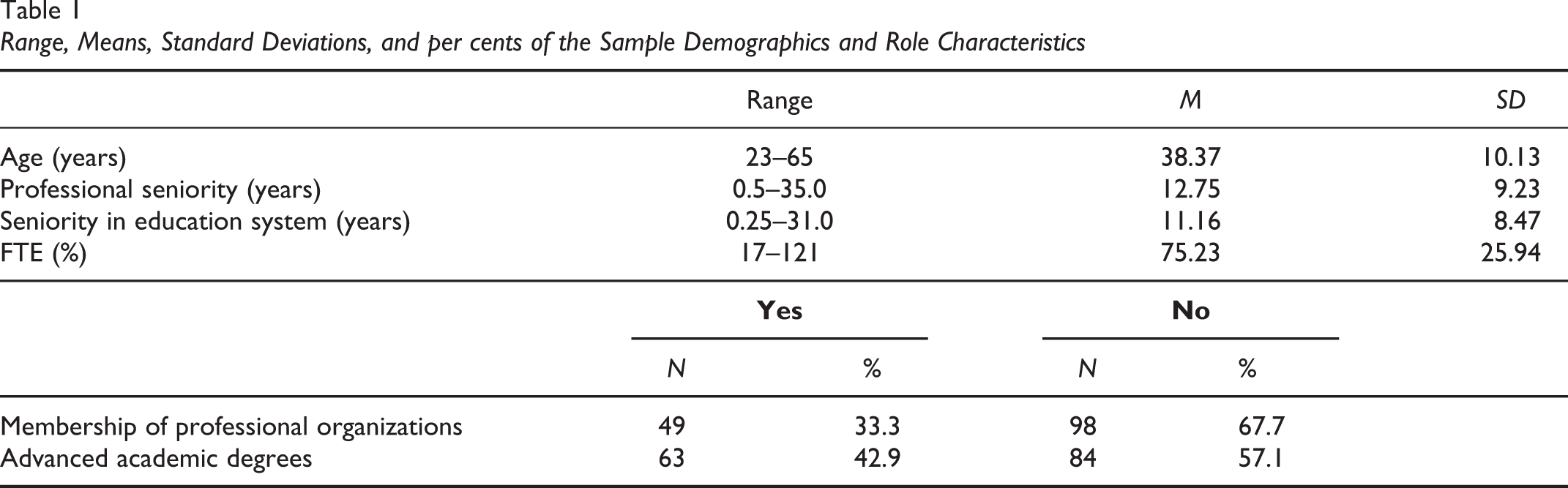
Study participants were recruited through online advertisements aimed at occupational therapists working in education systems (preschool to higher education) in various positions and seniority. A minimum sample size of 115 participants was determined using G*Power software guidelines, considering the medium effect size of 0.25, power = 90, and α = .05 (Faul et al., 2007). The sample included 147 participants aged 23−65 years (M = 38.37, SD = 10.13), of whom 144 (98%) were women and 3 (2%) were men. The sample’s demographics and role characteristics are presented in Table 1.
Range, Means, Standard Deviations, and per cents of the Sample Demographics and Role Characteristics
Data Analysis
We used SPSS version 25.0 to analyze the data. Ranges, means, and standard deviations were calculated using descriptive statistics. We first established the RP-OT construct validity and then its internal consistency. EFA with principal components extraction and varimax rotation were performed to examine the RP-OT questionnaire’s underlying construct validity (Altman, 1991). Items that yielded a factor loading value of less than .3 were eliminated from the pool. The factorial structure and final item set in each factor were subjected to revised EFA without the failed items. Paired-sample t-tests and Pearson correlations were conducted to further examine aspects of the RP-OT’s construct validity. Cronbach’s alpha was calculated to examine internal consistency of the RP-OT and PIS. Next, Pearson correlation tests were performed to assess correlations among demographic characteristics, professional identity, and role perception, and independent sample t-tests were calculated to assess differences among demographic groups. Finally, stepwise multiple regression was performed to assess predictors of professional identity. For all tests, p < .05 was considered significant.
Findings
RP-OT Construct Validity and Internal Consistency
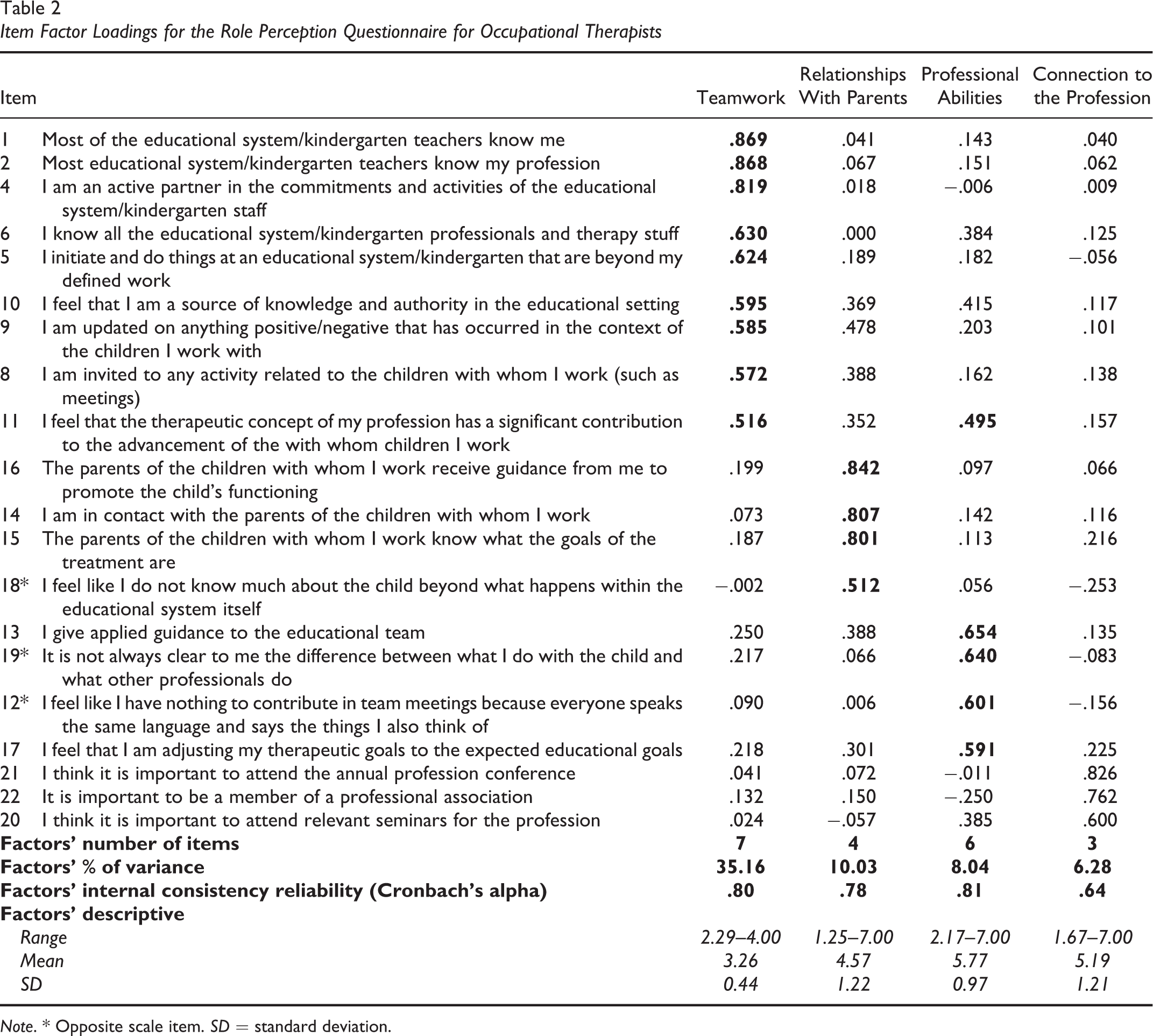
Following EFA, two of the 22 items were omitted from the RP-OT during statistical processing because their factor loadings were lower than .35: Item 3, I take part in students’ education system activities, and Item 7, I know what the role characteristics of any professional in education system are. The remaining 20 items were extracted into four distinct factors. The revised EFA without the failed items revealed similar extraction into the same four distinct factors. Final item factor loadings, factor percentage of variance, and internal consistency of each factor are presented in Table 2.
Item Factor Loadings for the Role Perception Questionnaire for Occupational Therapists
Note. * Opposite scale item. SD = standard deviation.
The four-factor titles were defined based on clinical and expert (e.g., focus group) discretion (Costello & Obsorne, 2005; Williams et al., 2010). Factor 1 included seven items related to teamwork in the education system; Factor 2, four items related to relationships with parents; Factor 3, six items related to professional abilities; and Factor 4, three items related to connection to the profession. However, cross-loading items (Items 10 and 11) were associated with one factor that fit the item’s content nature based on clinical and expert discretion (Costello & Osborne, 2005; Williams et al., 2010).
The RP-OT’s remaining 20 items had good internal consistency (α = .88). Following the EFA, Factor 1 (seven items; teamwork in the education system) had high internal consistency of .80, Factor 2 (four items; relationships with parents) had good internal consistency of .78, Factor 3 (six items; professional abilities) had high internal consistency of .81, and Factor 4 (three items; connection to the profession) had moderate internal consistency of .64.
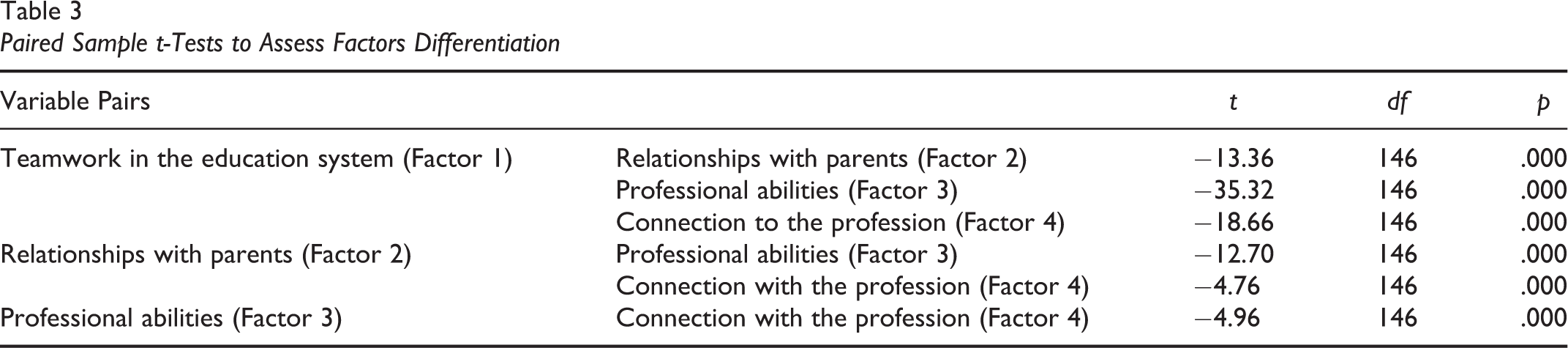
Paired sample t-tests revealed significant differences between all the four factors (Table 3), indicating the RP-OT factors’ distinct properties. Pearson correlations revealed significant correlations between teamwork in the education system (Factor 1) and relationships with parents (Factors 2) and professional abilities (Factor 3) (r = .26, p = .002 and r = .46, p < .001, respectively), and between relationships with parents (Factor 2) and professional abilities (Factor 3) (r = .47, p < .001). Those correlations indicate the general common content area of the RP-OT questionnaire.
Paired Sample t-Tests to Assess Factors Differentiation
PIS Internal Consistency
Cronbach’s alpha was calculated for internal consistency of the PIS total score and factors among occupational therapists. Cronbach’s alpha coefficient of .94 indicated high internal consistency of all items in the sample of occupational therapists. Internal consistency was excellent for the career choice confidence factor (α = .94 in the present study vs. α = .92 in the original study), good for professional efficacy (α = .89 in the present study vs. α = .88 in the original study), moderate for sense of mission (α = .62 in the present study vs. α = .65 in the original study), and low for professional reputation (α = .34 in the present study vs. α = .59 in the original study).
Correlations Between Role Perception and Professional Identity
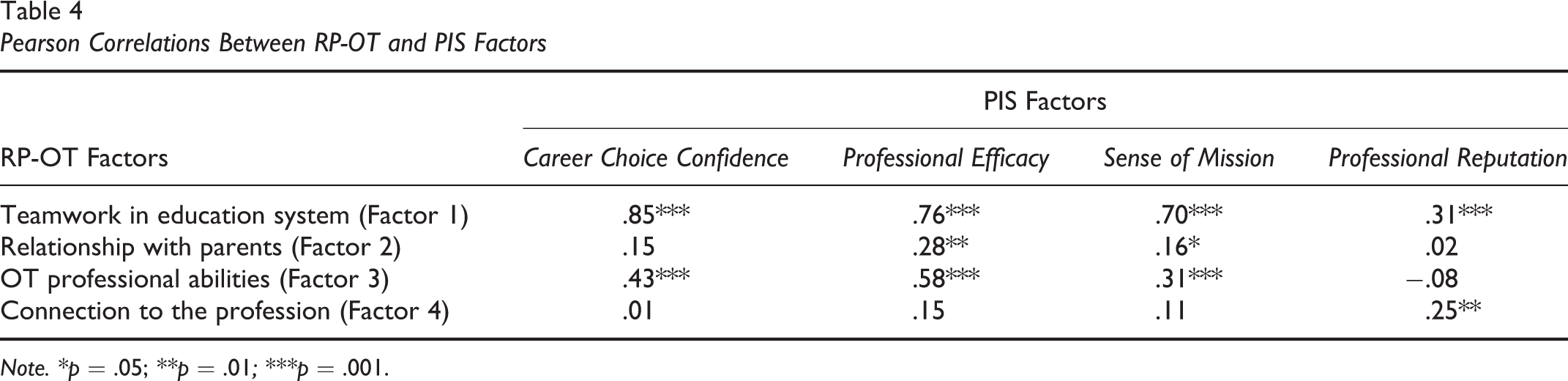
Pearson correlations revealed significant correlations between role perception according to the RP-OT total scores and professional identity according to the PIS (r = .38, p < .001). Significant correlations were also found between most RP-OT and PIS factors (see Table 4).
Pearson Correlations Between RP-OT and PIS Factors
Note. *p = .05; **p = .01; ***p = .001.
Correlations With Demographic Variables
The demographic variables addressed in the context of role perception (RP-OT) and professional identity (PIS) were age, professional seniority, FTE, advanced degree, and membership in a professional organization. Because 98% of the sample were women, we did not address gender.
Age
Pearson correlations revealed significant correlations between age and the RP-OT total score (r = .23, p = .006) and specifically with the teamwork in the education system factor (r = .28, p < .001). That is, younger occupational therapists were less likely to perceive teamwork as a part of their role. No correlations were found with the other RP-OT factors (p = .07 to .84). In addition, Pearson correlations revealed significant correlations between age and the PIS total score (r = .36, p < .001), especially with the professional efficacy (r = .37, p < .001) and career choice confidence (r = .36, p < .001) factors. As the occupational therapists’ age increased, they sensed higher levels of professional efficacy and confidence in being an occupational therapist.
Professional seniority
Pearson correlations revealed a significant correlation between professional seniority and the RP-OT total score (r = .25, p = .002). Examining correlations with each RP-OT factor revealed significant correlations between professional seniority and teamwork in the education system (r = .28, p < .001) and occupational therapist professional abilities (r = .22, p = .007), but none with relationships with parents (r = .08, p = .30) or connection to profession (r = .06, p = .46). A significant correlation was also found between the PIS total score and professional seniority (r = .36, p < .001). In examining correlations with each PIS factor, significant correlations were found between professional seniority and career choice confidence (r = .34, p < .001) and professional efficacy (r = .37, p < .001), but none with sense of mission (r = .14, p = .08) or reputation (r = .04, p = .66).
Seniority in education systems
Pearson correlations revealed a significant correlation between seniority in education systems and the RP-OT total score (r = .34, p < .001). Examining correlations with each RP-OT factor revealed significant correlations with teamwork in the education system (r = .35, p < .001) and professional abilities (r = .33, p < .001), but none with relationships with parents (r = .14, p = .09) or connection to profession (r = .12, p = .17). A significant correlation was also found between seniority in education systems and the PIS total score (r = .45, p < .001). In examining correlations with each PIS factor, significant correlations were found between seniority in education systems and professional efficacy (r = .45, p < .001), career choice confidence (r = .43, p < .001) and sense of mission (r = .23, p = .006), but not with professional reputation (r = .09, p = .30).
Full-time equivalency
Significant correlation was found between FTE and the RP-OT total score (r = .30, p < .001). Examining correlations between FTE and each RP-OT factor revealed significant positive correlations with teamwork in the education system (r = .37, p < .001) and occupational therapist professional abilities (r = .26, p = .001), but less with relationships with parents (r = .16, p = .05) or connection to profession (r = .09, p = .30). A significant correlation was also found between FTE and the PIS total score (r = .45, p < .001). In examining correlations between FTE and each PIS factor, significant positive correlations between FTE and career choice confidence (r = .43, p < .001), professional efficacy (r = .39, p < .001), sense of mission (r = .24, p < .003), and reputation (r = .17, p = .04) were revealed.
Advanced degree
Independent sample t-tests were calculated to assess whether there were differences in role perception and professional identity between occupational therapists with and without advanced academic degrees (MSc and PhD). A significant difference was found in the RP-OT total score, t(145,144) = 4.23, p < .001, Cohen’s d = 4.16, indicating that occupational therapists with advanced academic degrees (n = 63) had more extensive role perception (M = 5.02, SD = .13) than did occupational therapists with only required basic training (n = 84, M = 4.50, SD = .12). A significant difference was also found in the PIS total score, t(145,137) = 5.18, p < .001, Cohen’s d = .86, showing that occupational therapists with advanced academic degrees had more positive professional identity (M = 3.32, SD = .39) than did those with only basic training (M = 2.98, SD = .40).
Membership in professional organization
Independent sample t-tests were calculated to assess whether there were differences in role perception and professional identity between occupational therapists with and without membership in a professional organization. A significant difference was found in the connection to the profession factor of the RP-OT, t(145,110) = 5.38, p < .001, Cohen’s d = .96, showing that occupational therapists who were members of a professional organization reported a wider connection with the profession (M = 5.88, SD = 1.00) than did those without such membership (M = 4.84, SD = 1.16). No significant differences were found in the other RP-OT factors or the PIS total score or categories.
Predictors of Professional Identity
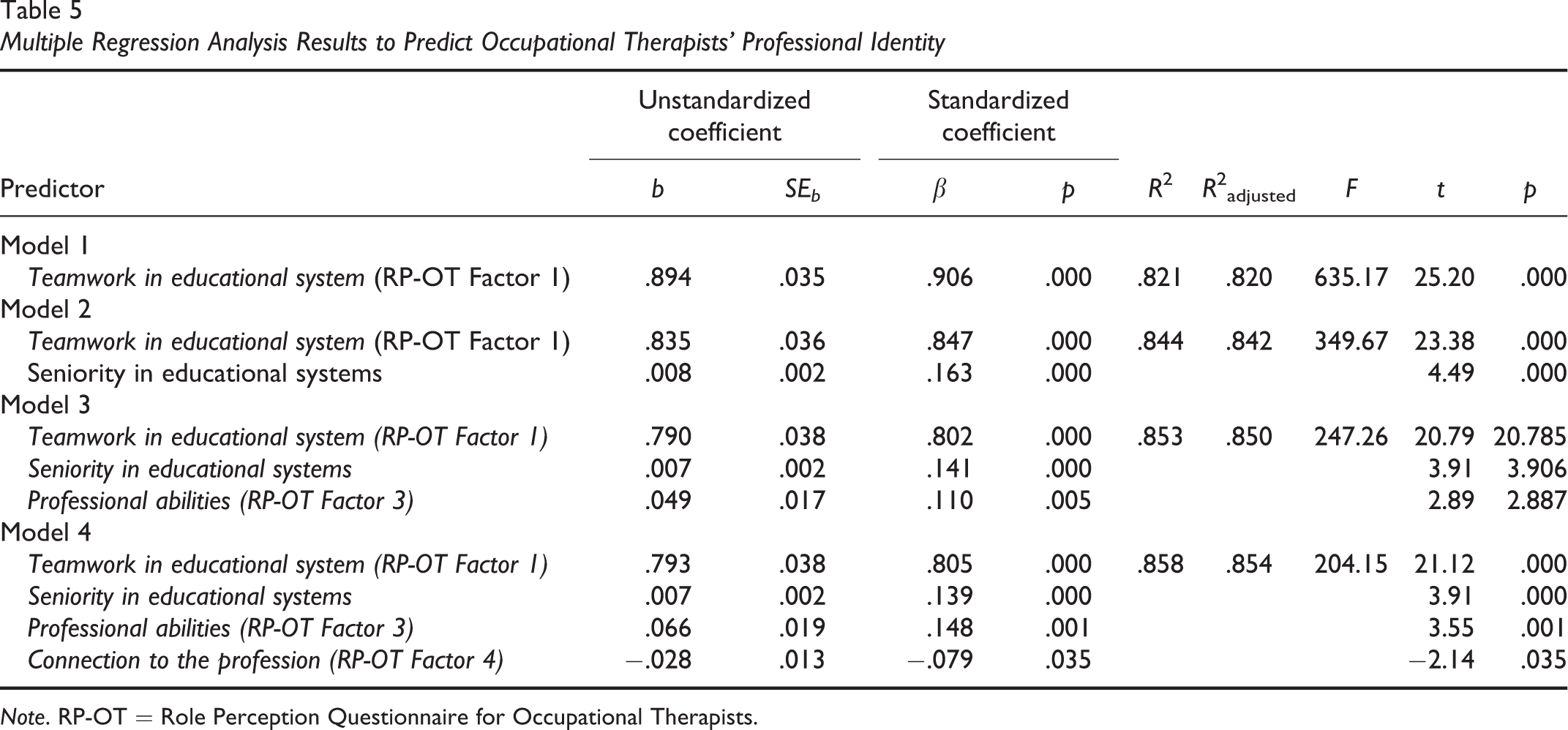
Stepwise multiple regression analyses to examine which demographic variables or RP-OT factors would predict the total professional identity score revealed four prediction models (Table 5). The regression analyses demonstrated that teamwork in the education system was the most influential predictor of professional identity. The mean score of the teamwork in the education system factor was 3.26 (SD = .44), and scores ranged from 2.29 to 4.00 (on a scale of 1.00−7.00). Hence, lower levels of teamwork seemed to predict more negative professional identity perception. Seniority in education systems, the professional abilities factor, and the connection to the profession factor also contributed to participants’ perception of professional identity.
Multiple Regression Analysis Results to Predict Occupational Therapists’ Professional Identity
Note. RP-OT = Role Perception Questionnaire for Occupational Therapists.
Discussion
This study was the first to examine role perception of occupational therapists who work in education systems. This section discusses the RP-OT’s psychometric properties in assessing role perception and the PIS’s internal consistency for use with occupational therapists who work in education systems. Next, relationships among role perception, professional identity, and demographic characteristics are discussed.
RP-OT and PIS
Lack of available tools to assess role perception and professional identity specifically for occupational therapists who work in education systems led us to develop the RP-OT. In this study, the EFA revealed good structural validity and high internal consistency for most RP-OT factors (teamwork in the education system, relationships with parents, and professional abilities), indicating the RP-OT’s ability to be a valuable assessment instrument (Anastasi, 1988). The connection to the profession factor had lower internal consistency, and its items’ content should be re-examined in future research. Although school occupational therapists are key contributors within the education team, occupational therapists’ role in that system requires them to bridge the familiar clinical world with the education world. Thus, they often have challenges in developing a positive and unique professional identity. Existing tools to measure the professional identity of occupational therapists are lacking or require further research (Scanlan, 2018), and no professional identity evaluation tool for occupational therapists working in education systems had yet been developed. We hypothesized that adjusting the PIS questionnaire, originally developed for educators, for use among occupational therapists might help fill this absence of appropriate tools. As with the original questionnaire for teachers, the high-to-moderate internal consistency for three of four PIS occupational therapy factors indicate the questionnaire’s reliability among occupational therapists. Although the PIQ has good internal consistency among occupational therapists, the professional reputation item-set has very low internal consistency and should be re-examined in future research (Cronbach, 1951; Davenport et al., 2015).
Relationship Between Role Perception and Professional Identity
We believe that a role perception that includes working in various professional channels (e.g., working with children, parents, educational staff, and colleagues) can contribute to a more cohesive perception of occupational therapists’ professional identity. Occupational therapists should know how to effectively present their roles to influence teachers’ confidence and decisions to refer students for occupational therapy services (Casillas, 2010; Hargreaves et al., 2012; Rens & Joosten, 2014). This study’s results highlight the significant relationships between role perception and professional identity among occupational therapists in the education systems. In the literature, school-based occupational therapists have variably defined collaboration and reported low confidence in providing best practices in schools (e.g., Clough, 2019; Hollenbeck, 2010); in that light, this study’s results are particularly important. Previous studies indicated that many therapists acknowledged the mismatch between planned interventions and educational activities (Truong & Hodgetts, 2017), sometimes after infrequent interactions with the educational staff (e.g., Clough, 2019; Turner & Knight, 2015) and sometimes when teachers do not understand the occupational therapists’ role or its potential breadth and scope in education settings (Casillas, 2010; Hargreaves et al., 2012; Rens & Joosten, 2014). In the current study, we present for the first time that lower teamwork levels with educational staff also lead to an unmatured and unclear professional identity, highlighting the importance of promoting that essential ability.
Relationship Between Demographic Characteristics and Role Perception and Professional Identity
This study’s findings show, as expected, that age and role characteristics relate to mature and positive professional identity. Along with teamwork in education systems, seniority in education systems contributes to the prediction of professional identity, indicating that as individuals acquire more professional seniority (i.e., more work hours over longer periods in a familiar work environment), they gain professional experience and capacities, strengthening their professional identity and job perception. The literature dealing with general professional identity showed similar results. For example, Joynes (2018) explored relationships among professional identity perceptions, interprofessional education, and collaborative practices and showed that professional identity becomes “stronger” with experience. That is, senior staff were more likely to claim strong professional identities, whereas recently qualified staff reported they had not developed a stable professional identity due to the rotational nature of their roles.
Barbarà-i-Molinero et al. (2017) suggested a roadmap for future research on career development and counseling to enhance professional identity as early as at the university level. The current study’s results show that acquiring knowledge, advanced courses, and degrees may improve professional identity. Although that may seem intuitive, this study may be among the first to report this finding in the literature. University students are exposed to worldviews, theories, skills, and languages embedded in the profession, which influence their identity development. Students begin to identify as belonging within the community of those studying “their” subject. Universities, therefore, play an important role in developing professional identity, and their curricula and resultant learning experiences can be designed to support identity development (Noble et al., 2014).
Limitations and Future Studies
This research is innovative in that the tools it used allowed quantitative estimation of the variables; however, it has limitations. The sample was 98% women; thus, differences between how women and men perceive their professional role and identity could not be identified. However, notably few men engage in the profession.
Future studies should deepen the questionnaires’ internal consistency and validity and examine variables other than those that emerged in this study, such as relationships between the occupational therapist’s professional abilities and professional identity. In addition, we suggest examining correlations between specific employability skills of occupational therapists in the education system with their role perception and professional identity.
Conclusion
The current study reinforces the importance part that role perception plays for occupational therapists’ working in education systems to promote their positive and mature professional identity. These initial findings about the RP-OT and PIS indicate that they might be used to identify areas that need improvement and strengthening for occupational therapists who work in education systems. However, further research is required for the connection to the profession and professional reputation components.
The occupational therapists in this study rated teamwork in the education system as playing a low part in their role perception. Notably, however, teamwork in the education system was found to be the major predictor of professional identity, highlighting this issue’s significance in the education environment. We recommend that occupational therapists familiarize the education staff with the profession. Appropriate lectures on occupational therapy, in general, and the education system context, in particular, can effectively expose staff to the profession and to what they will gain from their relationship with the occupational therapist. Mutual familiarity with all staff members at the beginning of a school year may help occupational therapists familiarize themselves with the occupational clinic and the essence of the profession.
Finally, persistence, stability, and accumulation of experience in the work of occupational therapists in the education system, alongside professional development through courses and training related to the occupational therapist’s work and how it is expressed within the education framework, will promote their positive role perception and self-identity.
Key Messages
The RP-OT is a reliable and valid tool pioneered to assess occupational therapists’ role perception in education systems.
Wide teamwork with educational staff predicts a more positive professional identity of occupational therapists who work in the education system.
Professional advancement programs should focus on promoting occupational therapists’ professional identity.
Footnotes
Acknowledgements
We thank Dr. Yonat Yavzori and Mrs. Merav Gelis, Israel Ministry of Education Supervisors for Occupational Therapists, for sharing materials, advice, and help with the research among the occupational therapists working in the education system.
Author Contributions
Liron Lamash and Yael Fogel contributed equally to this article’s project methodology, data analysis, and interpretation and both reviewed and approved the final version.
Author Note
MESH or CINAHL terms: professional identity, role perception, education, occupational therapy, teamwork
Declaration of Conflicting Interests
The author(s) declared no potential conflicts of interest with respect to the research, authorship, and/or publication of this article.
Funding
The author(s) received no financial support for the research, authorship, and/or publication of this article.
