



Abstract
Startup-corporate partnerships provide mutual benefits by combining startups’ innovation with established firms’ resources and processes. However, despite these clear advantages, initiating and nurturing such partnerships is often fraught with obstacles. Our research provides evidence-based insights for startup founders and corporate managers on how these partnerships unfold. Specifically, we identify two distinct pathways that can serve as a practical starting point for corporate managers. Also, we pinpoint three key “pathbreakers” in the formation process and offer strategies to effectively manage them. In addition, the article highlights the cumulative signals that both parties can use not only to create the potential for partnership but to bring the collaboration to fruition. This guidance to managers seeking to establish or engage in such partnerships includes outlining key factors to consider, potential challenges that may arise, and actionable strategies to address them.
The benefits of partnerships between startups and corporations are clear. Startups bring agility, talent, and fresh perspectives, complementing the established processes and risk-averse approach of large corporations. 1 This synergy fosters quicker adaptation to market changes and accelerates the development of cutting-edge innovations. 2 Consequently, many corporations, such as Volvo, L’Oréal, Microsoft, and IBM, collaborate with startups to address challenges that vary from technological advancements to market expansion. However, establishing such partnerships can be challenging owing to differences in pace, cultural clashes, and misaligned expectations. 3 High uncertainty that arises from both the innovation-driven nature of startups and the unpredictable nature of the breakthrough technologies sought by corporations adds another layer of complexity. 4 Hence, achieving strategic and operational alignment requires time, resources, and mutual effort to navigate and embrace this uncertainty. 5
Traditionally, corporations have relied on internal initiatives like innovation scouts, corporate incubators, accelerator programs, and corporate venture capital (CVC) to engage with startups. 6 Yet, these approaches often fall short of achieving strategic innovation goals. 7 Such methods tend to be costly, resource-intensive, uncertain, and complex to manage, often resulting in high investment lock-in. 8 Emerging as an alternative are startup supplier programs. 9 However, not all firms have dedicated units to facilitate engagement with startups, and some programs are overly restrictive, 10 limiting startups to partnerships with a single firm, typically based on a clear operational need.
Startups, on the contrary, struggle to initiate collaboration with established firms due to rigorous requirements, 11 as cold calls rarely yield results. 12 For example, BMW’s venture client model requires startups to graduate from a prestigious accelerator, secure professional venture funding, or include a successful serial entrepreneur in senior leadership to be considered for collaboration. 13 In addition, corporate decision-making can appear opaque and bureaucratic to startups. 14 Without a structured approach, partnerships are difficult to establish, involving tasks such as securing internal sponsorship, mobilizing teams, and monitoring impact. Therefore, both startups and corporations are increasingly seeking flexible approaches to building mutually beneficial partnerships. 15
This article focuses on the early stages of partnership formation and aims to enhance our understanding of how startups attract corporate interest and engage in the process of partnership formation. In a multiyear research project with Ignite Sweden, a national platform designed to facilitate interactions between startups and corporations, we studied the early stage partnership formation dynamics. Based on a dyadic processual understanding of startup-corporate partnership formation, our findings revealed two main pathways that startups can follow for initiating partnerships. In the first pathway, the partnership fit does not exist objectively but is rather co-created through ongoing interactions, where needs and solutions are redefined. The second pathway is more predictive, where the collaboration fit may exist objectively, and the characteristics of needs and solutions are observable, but still require discovery and refinement through further interactions. We also identified three major pathbreakers that often hinder the progression of these partnerships, along with evidence-based strategies for overcoming them.
The insights presented in this article provide a comprehensive, multisided perspective on early partnership formation between startups and corporations. Mainly, we offer guidance to startup founders and managers on how they can attract interest from their corporate counterparts. Using signaling theory, we propose actionable strategies to help startups secure and nurture commercial partnerships from the outset, increasing the likelihood of success. In addition, we outline the role corporations play in forming partnerships and offer guidance—especially to those using ad hoc approaches without systematic startup engagement strategies 16 who may not have dedicated corporate venturing units—in identifying pathways that best align with their needs. Thus, this research contributes to a deeper understanding of the early stage dynamics driving partnership formation and the factors enhancing success.
Asymmetrical Relations in Partnership Formation
Collaborations are essential for organizations to access necessary resources and expertise. 17 They are often driven by mutual resource dependence, with each party holding resources that the other lacks. 18 Startups typically offer innovative ideas and perspectives while seeking to scale quickly, 19 while corporations provide underutilized resources like capital, manufacturing capabilities, and marketing infrastructure. 20 These collaborations, while beneficial, are not without challenges. 21
Startups face significant obstacles when engaging with established firms. Beyond issues like adverse selection, power imbalances, and information asymmetries, 22 cultural differences often create friction. Startups prioritize agility and risk-taking, whereas corporations lean toward bureaucracy and caution. 23 Even after forming a partnership, progress may be hindered by competition for corporate resources, either with other startups or internal R&D projects. 24 Power imbalances also favor corporations, sometimes causing unfair terms, exploitation of intellectual property, or unwanted appropriation of resources. 25 Moreover, partnerships may hold unequal importance for each party. For startups, collaboration can mean “the difference between survival and closure,” while for corporations, it might have “marginal importance” with less urgency to generate immediate cash flow. 26 Startups, driven by the need for resources, legitimacy, and market access, often pursue these partnerships with more eagerness than corporations, who can afford to be more selective. 27
Corporations also face challenges in creating successful collaborations with startups as well. 28 While engagement models such as corporate incubators, accelerators, and venture programs have been well documented, 29 the early stages of forming collaborations 30 require deeper investigation. 31 The inherent uncertainty that surrounds the value and potential of new ventures impedes decision-making within corporations. 32 Many startups are in early stages of development or operate with unproven business models, making it difficult for corporations to determine whether a collaboration would add value. 33 In addition, studies reveal that identifying startups with goals aligned to corporate objectives through traditional venturing initiatives is a complex, resource-intensive task. 34 This complexity is further compounded by the vast number of emerging startups and the absence of standardized methods for evaluating their potential. 35 Resistance within organizations, arising from entrenched processes and a culture of risk aversion, 36 adds to the challenge by slowing decisions and delaying project timelines.
Because of the multifaceted challenges involved, corporations and startups are increasingly turning to intermediaries to enable smoother collaborations. 37 While earlier research explored engagement methods like corporate incubators, accelerators, and venture programs, 38 the dynamics of initial partnership formation, particularly when facilitated by external intermediaries, remain underexplored. 39 In these early encounters, corporations often relied on observable signals as proxies for less tangible attributes like entrepreneurial behaviors, affiliations, experience, and reputation. 40 At the same time, startups engaged in signaling efforts to establish legitimacy in the absence of a proven performance record. 41 Our work with Ignite Sweden allowed us to examine the early stages of the partnership formation process, analyzing the signals that startups use to attract corporate interest thereby helping to fill this gap in the literature.
Signaling Actions in Partnership Formation
Signaling theory explains how parties communicate and interpret unobservable qualities of an individual or a firm in the presence of information asymmetry. 42 Just as job seekers use education and experience to signal capabilities to employers, 43 and public companies signal reliability by appointing credible CEOs, 44 startups rely on signals such as founder credentials, accomplishments, and affiliations with prestigious entities to highlight attributes that corporations consider important for collaboration. 45
These signals serve a dual purpose: they act as observable proxies to assess startup quality, unobservable particularly in the early stages when factors like market fit, scalability, and long-term viability are uncertain, 46 while they also function as strategic tools for entrepreneurs, helping to mitigate the “liability of newness.” 47 Since corporations face significant uncertainty when evaluating early stage startups, entrepreneurs can “benefit from signals of quality that make them more attractive than other ventures.” 48 At the firm level, these signals typically include patents for innovative technologies, successfully completed pilot projects, or affiliations with prominent partners. 49 At the individual level, they often reflect specific social-symbolic qualities, such as passion, professionalism, and interpersonal skills that corporations consider crucial for a successful collaborative relationship. 50 For the corporate managers taking part in the partnership formation, signals from the startups help them make better decisions. 51
The core idea is that for a signal to be effective, it must be costly for the signaler to produce. This cost acts as a mechanism (and deterrent) to ensure that the signals are not just observable but also credible. 52 If a signal were easily obtainable, it will not be effective in reducing information asymmetry in a meaningful way. For example, obtaining a new patent to signal innovation capability requires significant investment in research and application fees, which many new ventures might be unwilling or unable to bear.
At the same time, signals must be relevant to the receiver. Corporations have diverse objectives for engaging with startups, 53 and a costly signal, such as a patent or an affiliation, may be ineffective if it does not resonate with these objectives. While cost motivates credibility, the message conveyed by the signal must align with the receiver’s priorities and expectations.
Hence, signals can be used in the entrepreneur’s favor by allowing them to strategically manage impressions surrounding the potential value of a collaboration, for example, by demonstrating how their solutions integrate into corporate systems without causing significant disruptions 54 or showcasing the practicality (and reliability) of their technologies. 55 However, this same lack of hard evidence—such as proven market traction or fully validated technologies—can also hinder credibility, making it more challenging for entrepreneurs to build a compelling case for collaboration. 56
This article focuses on the specific signals startups use to demonstrate their technological and market potential during the early stages of partnership formation. Emerging startups, often lacking a commercial track record or an established client base, rely on claims and accomplishments to attract the attention of established firms. 57 Founders use these as “observable signals” to convey favorable information about otherwise “unobservable qualities.” 58 However, partnerships cannot materialize without active engagement from corporate partners. Thus, beyond focusing on the signals startups use, we also examine how corporations respond to these signals and the role they play in initiating and fostering partnerships.
Method
As empirical context, our work with Ignite Sweden offers unique insights into the evolving landscape of startup-corporate partnerships. Ignite Sweden represents a model growing in global popularity and increasing as influential in intermediation—one focused on facilitating structured, needs-driven commercial partnerships between startups and established organizations. This trend reflects a broader shift in how both startups and corporations seek innovation: corporations increasingly look beyond internal R&D and traditional suppliers, while startups seek access to markets, customers, and infrastructure rather than just investment or mentorship.
What distinguishes Ignite Sweden is the scale, structure, and neutrality of the model. While other initiatives—such as corporate accelerators, innovation labs, or government-run programs—exist in countries like Germany (e.g., Start2Group), USA (e.g., Plug and Play), or Canada (e.g., MaRS), they often focus on investment or early stage support. Also, many are organized around specific sectors, driven by single corporate stakeholders, or limited in geographic scope.
In contrast, Ignite operates as a national, nonprofit platform with a mission to support all innovative Swedish startups regardless of sector, ownership, or investor ties. The program is explicitly demand-driven: corporations and public sector partners define their needs, and Ignite scouts and curates startup matches accordingly. Importantly, corporations are treated as paid partners—not mentors or investors—highlighting a commercially grounded approach. This positions Ignite as a neutral broker or third-party facilitator, minimizing conflicts of interest that can arise in other models.
Ignite also integrates deep ecosystem collaboration. It works through a national network of over 40 incubators and science parks, enabling wide access to local startup pipelines and business coaches. It combines this with artificial intelligence (AI)–supported scouting, structured coaching, and a digital infrastructure (Ignite Magic) to support matchmaking at scale. Since its inception, Ignite has facilitated over 8,000 meetings, resulting in more than 715 innovation collaborations.
Unlike more restrictive approaches, Ignite operates as a relatively open system allowing all startups and corporations within the ecosystem to access the platform if they meet minimum inclusion criteria. The model’s outcomes demonstrate both efficiency and selectivity: standard, established categories and businesses have an average success rate of 10% to 30% in B2B sales. Ignite’s primary focus is on startups under five years old, ranging from Technology Readiness Level (TRL) 3-9 within a pre-seed to seed investment phase. Often, the Ignite program offers startups their first reference customer nationally, or their first customer abroad as they begin their scaling journey. Although only 10% of initial meetings progress to full-scale collaborations—such as proof-of-concept (PoC) projects or product rollouts—those that do often report significant growth potential.
For context, Ignite Sweden can be considered as a new generation of startup-corporate intermediaries that are emerging globally but it is distinguished by its national scale, sectoral openness, and commercial focus. As such, these findings could be relevant and transferable to similar contexts. Researchers and practitioners exploring not only how to facilitate startup-corporate partnerships, but also how to design and scale similar intermediation models in other countries and contexts might find it relevant.
Our unique access to Ignite’s platform and the organizations utilizing its services enabled us to study partnership dynamics and uncover factors that contribute to successful outcomes from multiple perspectives. Thus, our research specifically focuses on commercial partnerships, 59 which differ from traditional corporate venturing strategies such as CVC or accelerator programs that typically involve upfront equity investment. 60 Instead, commercial partnerships aim to integrate startup solutions into corporate operating infrastructure—an important but underexplored area in the literature.
Data Sources
Our study drew on data from diverse sources, including observations, interviews, surveys, and archival material. We observed over 150 matchmaking meetings, conducted semi-structured interviews with 42 key informants, and analyzed surveys from startups and corporations. In addition, archival data from Ignite’s platform, “Magic,” provided insights into meeting outcomes, offering broader context for understanding partnership formation. Workshops with representatives from corporations, incubators, and science parks across Sweden further enriched our findings by providing valuable feedback. This multifaceted approach allowed us to develop a comprehensive understanding of the partnership formation process, identifying key success factors and offering evidence-based recommendations for startups and corporations.
Analysis
We employed an inductive approach to analyze our dataset 61 and systematically code and categorize data to identify emerging themes and patterns related to partnership formation, challenges, and success factors. Starting with notes from 150 meeting observations, we examined the dynamics of initial meetings, identifying characteristics that led to follow-up discussions. This analysis highlighted factors that sparked initial interest and paved the way for further collaboration, such as meeting with relevant stakeholders, including need owners and decision-makers within corporations.
Next, we examined partnerships (dyads) that advanced beyond initial meetings, including those that resulted in PoC projects, pilots, or full-scale rollouts. We interviewed startup founders’ corporate representatives and Ignite team members. Our analysis revealed recurring themes and challenges, such as aligning goals, managing timelines, overcoming internal resistance within corporate structures, and setting realistic expectations in partnerships. These interviews also identified strategies used (and that could be used) by successful startups to overcome these challenges, including building trust, communicating effectively, and achieving mutually beneficial outcomes.
We analyzed survey responses alongside interview findings, focusing on motivations, challenges, and reported benefits of partnerships. Archival data from Ignite’s matchmaking sessions helped trace the trajectory of successful matches, documenting the frequency and nature of follow-up meetings, types of collaborative activities, and timelines for achieving tangible outcomes. This analysis provided historical context to complement qualitative findings, revealing patterns in partnership evolution and engagement.
Our analysis uncovered two primary pathways to partnership formation. The first pathway involves a sequence of activities startups undertake to initiate and nurture commercial partnerships. The second is characterized by strong initial strategic alignment between the startup and the corporation. These pathways, along with associated pathbreakers and strategies, were validated with Ignite’s management team and presented at a summit with 300 stakeholders from Sweden’s innovation ecosystem where we received additional feedback and validation.
Benefits of Startup-Corporate Partnerships
Startups, despite limited commercial experience, are recognized as “an important source of innovation” for resource-rich corporations seeking to enhance their innovation capabilities. 62 By analyzing startups that successfully partnered with industry leaders, we identified benefits extending beyond gaining a new client or expanding networks. These partnerships often strengthened startup reputations and increased market legitimacy.
The founder and CEO of Kairos Logic, a dynamic warehouse optimization startup, noted: “As a startup, your visibility or footprint is pretty low . . . the corporate brings the branding, trust, and credibility.” Collaborating with reputed firms significantly enhanced startups’ external perceptions, elevating trust in their business models, technologies, and teams among other potential partners. These partnerships also provided a safe environment for testing new technologies, boosting confidence among startups. As Ignite’s sales coach aptly put it, startups became “next-customer-ready” through these experiences.
The benefits extended beyond reputation-building. Startups gained insights on how their technologies could be applied across different contexts, industries, and customer bases. They also developed a deeper understanding of corporate routines, processes, and operations, providing a realistic perspective on integrating their solutions within diverse environments. For example, Reliefed Technologies, a cleantech startup, successfully piloted a project with Alfa Laval, a leader in heat separation and fluid-handling technologies. Reliefed’s Head of Sales and Marketing remarked: “We’ve gained a lot of know-how and maturity in-house on what we can actually achieve with the technology.”
Partnerships offer significant benefits to corporations, primarily by providing a competitive edge. The managing director at Toyota Material Handling’s strategic innovation office highlighted that collaborating with startups often helped identify “white spots,” giving rise to innovative solutions for previously unaddressed problems and keeping corporations at the forefront of their industries. These collaborations also offered “both inspiration and knowledge about new technologies or ways of reaching the market” (Project Manager – Corporate Innovation Lab, FLIR). Despite extensive resources, corporations often lacked solutions to specific internal challenges, and startups excelled in providing creative answers. The manager of the Strategy and Innovation team at EoN remarked: “Often it’s about a specialized competence or some kind of technology, technical solution that we have not developed ourselves, but something that we need.”
In some cases, corporations did not even realize what they were missing until exposed to the technologies and ideas presented by startups. “There wasn’t an actual need; it was more that startups showed a new type of solution, and suddenly you see a need because now you have a new type of technology to solve your problems,” explained the Innovation Manager at COOR.
Considering the relatively modest investment required, working with startups through intermediaries like Ignite proved to be a cost-effective way for corporations to tap into the external innovation ecosystem. Many informants perceived these collaborations to be not just a way to address internal challenges but also as a space for exploring unforeseen opportunities.
Two Pathways to Partnership Formation
Our study identified two distinct pathways to startup-corporate partnerships (Figure 1). The first and most common pathway involves multiple iterations and progressive signaling to co-create a fit necessary for partnership formation. This pathway includes a series of signals designed to co-create partnership potential and materialize the collaboration. The second pathway occurs when there is strong initial alignment between the startup’s solution and the corporation’s specific needs; in this case, the fit is more apparent, unlike in the first pathway, where fit is co-created through ongoing signaling. Both pathways demonstrate that forming partnerships is not a one-time sales effort but an ongoing engagement process.
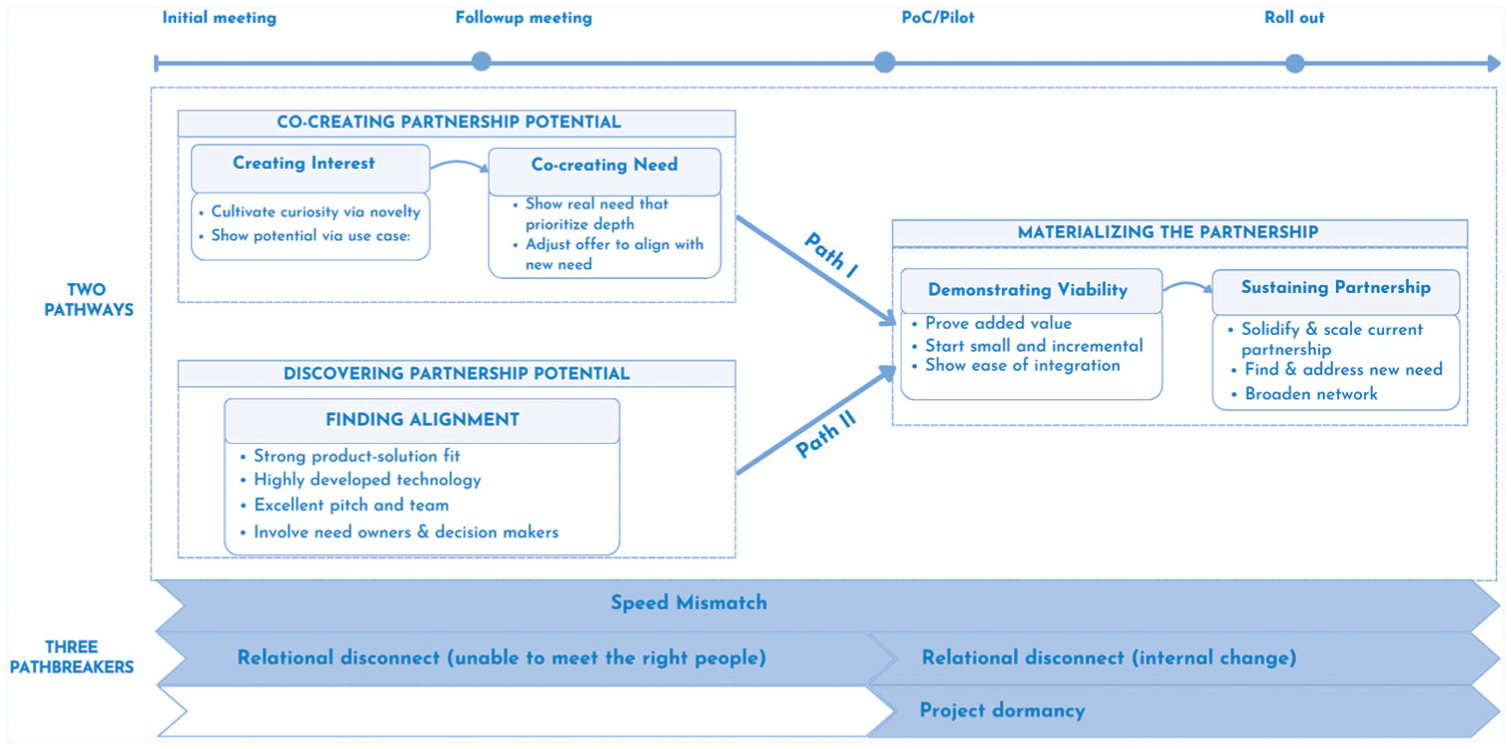
Two pathways for startup-corporate partnerships.
Path 1: Co-Creating Partnership
In the first pathway, partnerships are co-created. This approach assumes that not all partnership opportunities exist beforehand and must instead be developed through interaction, making the process non-predictive. This pathway comprises four interconnected stages: creating interest, co-creating a need, demonstrating viability, and solidifying partnerships.
Creating Interest
This is the first crucial step in forming successful partnerships. To initiate partnership, startups must quickly capture corporate attention, within a limited timeframe. This typically involves showcasing the relevance of their product or service, the novelty of their technology, or the quality of their team. Our observations revealed that many corporations attending matchmaking events do not arrive with well-defined problems or needs. Instead, they seek exposure to new technologies that could provide a competitive edge and better serve their customer base. Consequently, the specific characteristics of a fit are often unobservable to startups. However, startups can still identify industry characteristics, technological trends, customer segments, and potential needs. Head of Sales Coaching at Ignite Sweden, advises startups to align their offerings with a corporation’s strategic goals and “put significant effort into understanding how to add value to those goals.”
One effective way to create interest is to signal relevance by demonstrating strong technology-market fit, which refers to the broader alignment between the startup’s technology and the corporation’s operational domain, even without prior internal access. For instance, IPercept, a startup specializing in fitness trackers for industrial machines, successfully partnered with Toyota Material Handling to integrate its technology into industrial robots. This integration reduced the risk of costly and unforeseen breakdowns in mission-critical machinery. A Maintenance Manager at Toyota Material Handling noted: “IPercept’s novel technology has shown an unprecedented level of tracking mechanical degradation. We can now monitor each critical component’s performance over time, leading to smarter maintenance, reduced downtime, and energy savings.” What began as a PoC evolved into a successful commercial partnership, now implemented across Toyota Material Handling’s customer base.
Another signal of relevance for generating interest is by showcasing industry use cases of a startup’s technology. If the technology has been validated in other contexts, presenting real-world use cases can be compelling. Alternatively, startups can present corporate-specific mock use cases to signal observable qualities about how their technology could add value, encouraging corporations to consider potential benefits.
Co-creating a Need
This follows once interest has been established. At this stage, startups deepen their engagement by focusing on co-creating a need. This involves identifying and addressing specific organizational needs within the corporation. Often, corporations do not fully understand the presented technology or the potential value. “In some cases, we didn’t really understand the technology, but we liked the startup team’s approach to solving the problem. Then we met again and had a nice collaboration,” explained a Business Development Manager at ABB’s corporate accelerator program, Synerleap. Similarly, the co-founder and CEO of WAVR, an AI and sensor integration startup, observed: “I don’t expect the person on the other end to know exactly what they want unless they’re looking for something specific.” Thus, startups can establish themselves by defining and targeting a concrete organizational need. They benefit most from this process by signaling their willingness to adapt. Founders also signal willingness to adopt by seeing and integrating feedback—or what is often referred to as “coachability.” 63
For example, Ambicare, a visual noise-reduction startup, adapted its technology from classroom use to a workplace setting during the pandemic. By aligning its solution with the corporation’s immediate needs, Ambicare was able to conduct a successful pilot test of its technology in the company’s work environment. Startups benefit most from this process by signaling willingness to adapt solutions to the evolving needs and engaging in innovation driven by the synergy between both parties. One startup described the process as “very collaborative. We explained what we could do, and they enhanced the idea together with us.” Another added: “We received ideas from colleagues and employees at these companies, then discussed and solved them before presenting our solutions. We would sit down as a team, decide on an approach, and test its effectiveness.”
Co-creating a need is most effective when the right team from each organization is involved. Corporate representatives guide startups in refining ideas to align better with both immediate and future needs. Technical experts address specific requirements, while innovation managers and business developers consider the partnership’s long-term potential. Including individuals from various domains and areas of expertise in these meetings helps corporations understand how a startup’s technology or solution might integrate into their operations. The technology development manager at Alfa Laval’s Technology Scouting Division, explained, “We try to involve engineers from our organization in these activities to explore how new technologies can be utilized and brainstorm potential applications.” Such meetings, involving diverse participants, are essential for co-creating needs, especially when no pre-existing need owner within the corporation has been identified and needs must be developed collaboratively. One startup affirmed this by sharing, “We encountered an issue with classical optimization, and an expert engineer [from the corporate partner] was able to offer helpful advice.”
In co-creating needs, our findings suggest that startups who focus on depth rather than breadth in collaborations are more likely to succeed. Corporations value clarity and focus, and startups must signal these qualities to maintain interest and advance partnerships. A key insight from our interviews emphasized that startups should remain focused and specific rather than trying to address too many issues simultaneously. For instance, a senior project manager at FLIR, a global leader in thermal imaging infrared cameras, pointed out: “Sometimes, we meet startups that are confusing when they present. . . It’s too fluffy. We don’t understand what they’re really offering.” During a post-workshop discussion, another participant further highlighted the importance of startups succinctly summarizing their proposals to facilitate decision-making rather than vaguely stating, “We can do whatever you want.” Therefore, startups signal not only their value but also professionalism by showing a thorough understanding of corporate operations, preparing thoroughly, 64 defining and articulating a specific challenge, and presenting a compelling solution that stands out.
Once collaboration potential is established, startups must materialize the potential by demonstrating viability and identifying opportunities to solidify and expand the partnership. The initial phase, referred to as the creation of collaboration potential, is dynamic and can evolve in various directions: into a successful commercial partnership, an unexpected pivot, dormancy, or even dissolution. For collaboration to create value, this potential must transition into an active, ongoing partnership.
Demonstrating Viability
After a corporate partner shows interest and a need has been defined, the startup’s focus shifts to demonstrating viability. While proving technical feasibility is essential, signaling how the solution adds value to the corporation is even more critical. This can be challenging, especially as many startup pilots already compete with internal corporate projects despite clear strategic fit. A corporate representative shared that, although they recognized a startup’s technology aligned with their needs, “there are so many projects coming in, with different priorities in the company, that it’s hard to get to the point of starting a project. You see the interest and the fit, but then it freezes, and nothing happens.”
A successful approach involves starting with small, manageable projects—getting a “foot in the door”—and gradually expanding after demonstrating success. The managing director and co-founder of Ekkono Solutions, a startup specializing in machine learning for smart sensors, explained: “It’s better to get something small started. They’re a big company. That doesn’t mean they’ll be a big customer right away, but start small, get initial results, and then grow—land and expand.”
When startups demonstrate viability, they not only signal that their technology works but also instill confidence in corporations to deepen engagement. This progression could involve moving from PoC to pilot and eventually to full rollout. For instance, the partnership between Mavenoid, an emerging Swedish deep-tech startup, and Lindab, a leading ventilation firm, illustrates this approach. Mavenoid’s AI-guided product support system helped consolidate Lindab’s data and streamline customer support channels. However, internal challenges within Lindab slowed initial adoption. As the Head of the Innovation Hub at Lindab, recalled, “Everyone realized it was great, but [said] not for us.” The successful pilot, however, shifted perceptions, leading to full adoption of Mavenoid’s solution. He noted, “Once we got the pilot in place, everyone said, ‘Oh, this is what we should do—it’s obvious.’” Mavenoid’s Head of Growth highlighted the importance of delivering “small wins” and warned against letting pilots become “giant projects that never end.”
Corporations also advised startups for incremental integration to avoid disrupting existing operations. The technology scouting officer at Alfa Laval advised: “My take is to do it in smaller, pragmatic steps—digest it in smaller steps rather than trying to make it a big thing all at once.” When startups present solutions that can be integrated incrementally into existing systems, corporations perceive less risk in moving forward with the partnership. Startups often bring novel and sometimes disruptive ideas, making compatibility with corporate technologies and processes a challenge. By signaling strong compatibility and an ability for easier and streamlined integration, startups minimize perceived risks of operational disruptions, ensuring smoother progression from PoC to implementation.
Solidifying (and Expanding) the Partnership
Once partnership potential has materialized through completed PoCs, pilots, or rollouts, successful startups focus on solidifying and expanding the partnership. They continue to send signals of commitment to sustain and deepen the partnership, laying the foundation for future growth. Initially, PoCs and pilots must be scaled into full commercial partnerships. Startups also need to identify and co-create new needs, either stemming from an existing collaboration or representing entirely new opportunities.
Many startups expand their interactions to other business units or departments within the corporate partner. Some enhance their offerings or introduce new services, while others continue their involvement as external consultants. As the CEO and co-founder of SustainLab, a startup specializing in automating sustainability data collection and visualization, explained, “We need to ensure our products evolve and that we meet the wishes and requirements of our corporate customers.”
Startups can also solidify partnerships by proactively identifying new collaboration opportunities within the corporation and positioning themselves as reliable partners to address them. For example, an industrial AI startup that initially secured a joint project with a global mining company presented another working prototype that did not fully align with the company’s pre-partnership expectations. However, the startup effectively communicated how its technology could be adapted to optimize machine efficiency and reduce emissions, leading to additional projects. We also observed cases where technologies validated by one corporation were subsequently deployed by others, expanding the startup’s reach.
Path 2: Discovering Partnership
The second path we identified is grounded in the idea that a strategic fit exists objectively and must be discovered by startups through interactions with corporations. This fit occurs when a startup’s value proposition—through its products, services, or technology—aligns strategically with the specific needs and priorities of a corporate partner, making it relatively predictive.
In this path, corporate needs are typically well defined, and companies actively seek solutions through innovation scouts or external intermediaries. For instance, a digital marketing startup introduced interactive three-dimensional (3D) software to a leading electronics manufacturer, enabling customers to digitally explore devices through a digital twin before purchasing them. This solution perfectly aligned with the manufacturer’s goal of creating an immersive customer experience, thereby enhancing the sales process by allowing customers to explore and interact with products digitally. A solution that corporations believed would appeal to their customers and could be easily integrated into existing operations was a good starting point for fruitful collaboration. Similarly, a startup developed smart workwear for field personnel at the utility company E.ON. E.ON’s innovation business partner explained, “We were really interested in improving safety and working conditions. They [the startup] had a smart solution for workwear, and now we’re doing a pilot with our field teams.” Thus, early in the formation process, the primary focus for startups was to show this alignment by either adapting their solution to meet a specific corporate need or showcasing how their solution already addresses that need.
Another case involved a gaming startup’s collaboration with SAAB Avionics Systems. The innovation manager at SAAB described the project as “mixing sensor data in a smarter way—eliminating noise and enhancing certain data. These data are then presented to pilots through a head-up display, helping them during landings in challenging weather conditions.” For the startup, this was an opportunity to apply its gaming development expertise to new challenges, such as aiding airplane landings. The startup’s COO, reflected on how he realized that what he thought was “100% gaming-related . . . can also be applied to aviation.” This alignment quickly led to a successful PoC.
In this case, as in many others, the solution found the problem, echoing Steve Jobs’s famous quote: “A lot of times, people do not know what they want until you show it to them.” Another example comes from Coor, a facility management company, which experienced a shift in perspective after encountering a startup’s solution. As the innovation manager noted,
It wasn’t an actual need; it was more that startups presented a new type of solution, and suddenly, you see the need. The solution created the need, rather than us having an obvious problem to solve. Before we knew about the technology, it wasn’t clear that we needed it.
The corporate team was unaware of the potential solution until it was presented in a way that addressed their existing challenges. Thus, Path 2 goes beyond a typical “buyer-seller” relationship; it focuses on discovering a mutual fit through interaction. Startups must send the right signals to capture the attention of corporate managers, enabling both parties to identify the need and fit through collaborative exploration.
In Path 2, partnerships rarely begin when the startup is at an early stage of development. In most cases, corporations focus on integration rather than experimentation, and startups are expected to meet certain requirements. A senior R&D manager at Toyota explained, “[Startups] need to be at the upper end of the TRL. They shouldn’t be at levels one, two, or three because it takes too much of our energy to get them to a nine on the TRL.” Beyond technology readiness, successful startups distinguish themselves by signaling ease of integration in that their solution could seamlessly integrate with the corporate’s existing operations, enhancing the corporate’s value proposition to its own customers. These cases highlight that successful partnerships in Path 2 require not only novelty but also maturity in the startup’s technology to ensure seamless integration with the corporate’s operations. Timing and the corporate’s willingness to invest resources are also crucial.
Essentially, in Path 2, the fit was already there waiting to be discovered. Yet it should be noted that a startup does not need to work in the same industry as its corporate partner as illustrated by the case of SAAB and the gaming startup. Instead, innovative solutions can often emerge from different sectors. What matters most is that the startup identifies potential alignments, conducts thorough research to develop an understanding of the corporations, and effectively signals its ability to address these alignments through a well-prepared pitch. Ideally, this pitch should be delivered by a team with both technical and business development expertise, ensuring they can clearly articulate the practical applications of their offerings while addressing any technical inquiries. 65
Even after identifying the potential for partnership, the collaboration must still progress through phases of demonstrating viability and sustaining the partnership, as outlined in the co-creation path. Hence, the involvement of corporate representatives capable of envisioning practical applications for novel technologies can be essential for ensuring effective progression. 66 This is because, despite achieving problem-solution alignment, significant obstacles (or pathbreakers) may still hinder the collaboration process. Choosing which path to pursue depends on various factors.
Although these processes are described as pathways, they are better understood as a series of interconnected signaling actions. Rather than a linear “first this, then that” approach, forging a partnership is a dynamic and iterative process characterized by continuous signaling and dialogue. This involves frequent reassessments as new information or challenges emerge. The process is cumulative, unfolding progressively, though not necessarily in a sequential manner. While stages and signaling actions are common across cases, their sequence is neither rigid nor fixed. The dynamic and iterative nature of partnership formation is further amplified by the presence of obstacles, or pathbreakers, which require active strategies to overcome.
Three Pathbreakers and Their Coping Mechanisms
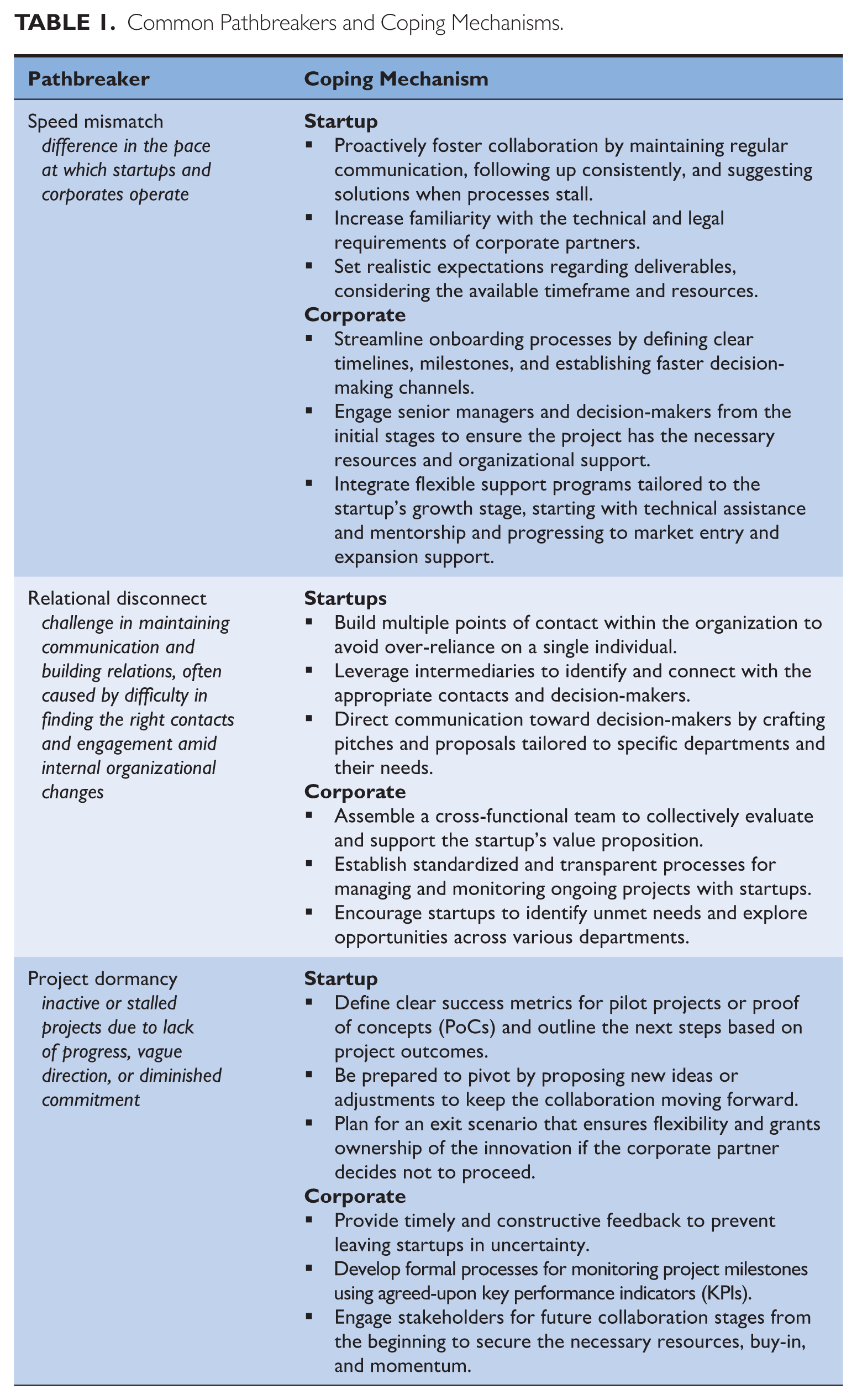
Our findings reveal that, while some partnerships succeed, many initial discussions that began with enthusiasm failed to make significant progress. In several cases, even after multiple follow-up meetings, partnerships did not yield concrete results. We identified three common pathbreakers that often hindered partnership progression: speed mismatch, relational disconnect, and project dormancy. We also propose several strategies to overcome them (see Table 1 for a summary).
Common Pathbreakers and Coping Mechanisms.
Pathbreaker 1: Speed Mismatch
The first pathbreaker, speed mismatch, is pervasive throughout the process. Startups are typically small, fast, and flexible, whereas corporations are structured and bureaucratic. This mismatch often results in unrealistic expectations and disappointment. As noted in the literature, 67 corporate representatives frequently encounter challenges in integrating startups due to differences in speed, culture, and resource needs. Lengthy decision-making processes, particularly during procurement phases, are often untenable for startups. Program manager—Strategic Innovation Office at Toyota Material Handling likened corporations to “oil tankers” when viewed from a startup’s perspective. So, how can the oil tanker and the racing yacht move in sync?
A streamlined onboarding process, with realistic expectations, timelines, and milestones, combined with fast-track decision-making and startup-friendly contracts, can help address the speed mismatch. Involving key decision-makers and stakeholders, such as senior managers, early in the process ensures that collaborations receive necessary support and resources. This approach expedites approvals, bridges the speed gap, and prevents frustration and missed opportunities.
Some corporations, such as IBM, have adapted by enabling quicker decision-making. Instead of avoiding difficult conversations, IBM engages in direct and transparent communication with startups. The IBM Innovation team has developed a structured process to involve the right individuals in sourcing relevant startups, drafting non-disclosure agreements, and preparing letters of intent. Similarly, Microsoft’s onboarding program for startup partners integrates their solutions into its ecosystem. This program supports startups at various stages by offering technical services, mentorship, and access to expert networks. As startups scale, Microsoft shifts focus toward market entry and expansion. “We help them understand what kind of support they can get from Microsoft . . . building solutions on Microsoft infrastructure, and then, as they scale up, we help them go to market,” explained the Partner Development Manager at Microsoft Sweden.
Addressing speed mismatches is not solely the responsibility of corporations. Startups must also familiarize themselves with corporate processes and take proactive steps. The CEO and co-founder of SustainLab, shared that she contacted her corporate partner to offer solutions when progress stalled. Similarly, the founder of Ambicare, emphasized pushing partnerships forward, stating, “As a startup, you have to push hard to get something back.” When her corporate contact stepped back, she managed communications and logistics directly with employees involved in the test. Startups must take responsibility for driving the process. The co-founder of Ekkono Solutions, noted: “It’s our responsibility as startups to sell. We can’t rely on others to do the work for us. If someone helps us get a meeting with the right people, it’s up to us to make the sale.” Corporations also value persistence. A senior program manager at Toyota Material Handling, shared the success story of IPercept, an industrial fitness tracking startup. The startup’s determined salesperson secured a pilot and framework agreement through persistence.
For corporations, implementing structured onboarding processes for startups helps in managing expectations, preventing misunderstandings, and ensuring that both parties work toward shared goals. Startups, in turn, play a critical role by setting realistic expectations and proactively advancing partnerships rather than waiting for slow-moving corporations to act faster than they are accustomed to.
Pathbreaker 2: Relational Disconnect
Strong, stable relationships are critical to partnership success. Relational disconnect, caused by difficulties in connecting with the right individuals and internal organizational changes, is a significant obstacle. Startups often struggle to identify appropriate contacts within large, siloed organizations. The co-founder of WAVR, explained: “Corporations are so spread out, with people in different roles and responsibilities. For a small company like ours, finding the right person usually involves navigating through a group of individuals.” Many corporations lack a clear point of contact for startups, 68 making it challenging to initiate and progress partnerships.
In addition, partnerships built through relationships can also break down due to internal organizational changes. Many collaborations depend on specific individuals within an organization, and their departure can disrupt ongoing efforts. The CEO and co-founder of Tendium, a platform-based startup offering public procurement software, shared: “If that person leaves, we’re in no-man’s land.” The CEO and founder of Gemit Solutions, echoed this sentiment: “You lose a personal connection, and then it’s dead. That’s super annoying.”
Assemble the Right Team and Systematize the Partnership
Effective partnerships often hinge on assembling the right team before engaging with startups. These teams should include technologists, business developers, and decision-makers capable of evaluating a startup’s potential. Intermediaries like Ignite Sweden play a vital role in addressing relational disconnect. With extensive networks, these organizations help startups connect with the right individuals. The founder of Spotscale, a 3D imaging technology startup, noted: “They know who the right person is from the start.” The COO at Ignite Sweden, added: “For us, it’s important that the corporations we engage with have both the mandate and the budget to work with startups. We also try to involve people with business-critical needs within the company.”
Systematizing the collaboration process is equally important for corporations and includes establishing clear communication channels, standardizing project management protocols, and defining roles and responsibilities for all participants. The Strategy and Innovation team manager at E.ON emphasized,
Involving not just one person, but a whole team ensures continuity . . . I also play an important role by asking how the pilot went and what the next step is. I support the team on their journey, helping to create a system rather than having everything depend on individuals.
Systematizing collaboration ensures that project details, milestones, and communication records remain accessible, even if the original contact person changes. This formalizes the process, making it more transparent and less reliant on individual relationships.
Pathbreaker 3: Project Dormancy
A significant pathbreaker in partnerships is the issue of dormant projects, where seemingly successful pilot or PoCs are left on the shelf, leading to uncertainty for startups. While not every project progresses, the lack of closure can be particularly frustrating leaving the startup stuck, as one founder lamented, “Our meetings just faded away . . . either the topics never became a priority for clients, or they found other suppliers.” Recent studies emphasize the importance of swiftly shifting from a hands-off relationship to a more collaborative approach. 69 Once a startup’s idea or technology is deemed viable, it is crucial for the corporation to quickly mobilize resources and scale the innovation. Delays caused by hesitation can result in missed market opportunities, with the startup potentially being taken up by faster-moving competitors.
Prepare, but be Ready to Pivot
How can startups avoid falling into the trap of project dormancy? The former CEO and founder of Ignite Sweden, suggested, “Set clear KPIs [Key Performance Indicators] to evaluate during the PoC . . . and involve stakeholders from the next phase during the PoC, gathering feedback from them.” The current CEO of Ignite Sweden, recommended defining the path forward before testing began, addressed critical questions such as, “What constitutes a successful pilot? What happens if the pilot meets or exceeds expectations?” Without addressing these questions early, there is a higher risk of inaction post-PoC, leaving no path toward a long-term partnership. From the corporate perspective, clear and decisive feedback—such as “come back in four months” or a definitive “this isn’t for us”—helps startups move on instead of remaining in limbo.
Startups can also take an active role in driving collaborations forward. By approaching corporations with a clear understanding of their operations and identifying specific challenges, startups can strengthen the case for collaboration. This targeted approach clarifies the startup’s value proposition and highlights the collaboration’s added value. Many interviewees stressed that when a startup’s solution is clear, well articulated, and focused on solving a specific problem, corporations perceive less risk in advancing partnerships. This also integrates the startup more deeply into corporate processes, reducing the risk of project dormancy.
Avoiding “problem-solution misalignment” is another key strategy. Startups must ensure their innovative technology addresses a concrete corporate challenge. The business development manager at Synerleap noted,
Startups need to listen to our needs. They should talk about ABB’s robots or motors, not about “our startup.” They may have the best technology, but they also need to promote it in a way that aligns with our needs.
When projects stall, startups can suggest adjustments, address concerns, or request additional support if needed. However, if these efforts fail to reignite momentum, disengaging with a clear exit strategy becomes necessary. The former CEO and founder of Ignite Sweden recommended seeking “non-exclusive agreements,” allowing startups to retain ownership of PoC results while offering corporations “the first buyer’s rights.” This arrangement ensures that if the corporation decides not to proceed, the project can officially conclude, enabling the startup to pursue other opportunities while preserving valuable time and resources.
Nonetheless, beyond these pathbreakers, even successful startup-corporate partnerships can lead to unintended consequences. First, startups risk overinvesting time and resources in a partnership that may not materialize, prioritizing a potential opportunity at the expense of alternatives and depleting already limited resources. Second, there is a risk of oversharing novel ideas with resource-rich corporations. At times, corporations participate in matching events merely to “shop around,” leverage ideas, and bring them to market faster than the startups that inadvertently shared them. Third, startups can become overly reliant on a single partner, making their success heavily dependent on corporate priorities. Any change to these priorities can jeopardize the startup’s growth trajectory. Thus, while relying on costly signals helps reduce uncertainty and increase the likelihood of collaboration, 70 such efforts can become sunk costs—or worse, constrain the startup’s flexibility and expose it to risks such as intellectual property leakage or missed opportunities elsewhere.
The unintended consequences of overinvesting, over sharing and over reliance underscore an inherent tradeoff in investing in high-cost signals when securing a partnership; while actions such as building customized prototypes or PoCs can enhance credibility and demonstrate technical expertise, they may also create unrealistic expectations or overextend the startup’s capacity. Similarly, certain signaling actions—such as aggressively tailoring a solution to fit corporate needs or overcommitting to pilot projects—can backfire when they are perceived as overly eager, unrealistic (e.g., misaligned with the startup’s existing capabilities), or simply misinformed. While such high-cost signals may be intended to show adaptability or commitment, they can instead raise doubts about the startup’s strategic coherence or capacity to scale.
Navigating Startup-Corporate Partnerships
This article examines startup-corporate partnerships as a unique form of interorganizational collaboration, complementing conventional corporate venturing strategies such as CVC, outside-in/platform startup initiatives, 71 and more recent startup supplier programs. 72 By focusing on the early phases of partnership formation, we investigate how startups attract corporate interest while also highlighting the role corporations play in establishing and shaping these partnerships.
Studies have predominantly focused on a predictive approach that emphasizes discovering a fit between existing corporate needs and well-developed startup solutions. This approach assumes that observable elements of fit, such as a startup’s product, service, or technology, align with corporate needs, goals, and resources. However, a major limitation of this approach is its failure to consider the uncertainty and unpredictability that startups bring to partnerships, particularly when corporations pursue innovative (or disruptive) collaborations. This uncertainty is amplified by the fact that corporations often remain a black box to new startups, 73 making it difficult to assess aspects of fit that depend on innovative and forward-looking processes.
Our findings address this uncertainty by recognizing that a fit is not always immediately apparent and must often be co-created. By examining the early formation phases of startup-corporate partnerships, we distinguish two unique pathways startups and corporations commonly follow, along with key pathbreakers—challenges that can disrupt progress. This distinction supports an alternative approach, where unobservable factors, such as a startup’s adaptability to corporate demands, 74 hold greater importance. It emphasizes the importance of a startup’s signaling actions, such as creating interest and co-creating needs to initiate and develop partnerships, especially when an observable fit is unclear. Our findings highlight the emergent nature of these early stage interactions. Even in cases where a fit exists and can be discovered, startups must still employ effective signaling actions to capture the corporate attention. This is because early-phase partnerships differ from traditional buyer-seller relationships as many established firms lack experience collaborating with startups, and effective signals can reduce search costs for potential corporate partners by making intangible qualities more visible and easier to assess.
This alternative approach aligns with the perspective that partnerships evolve dynamically, requiring both parties to be adaptive to overcome unforeseen challenges and capitalize on opportunities. 75 While our main emphasis has been on the startups and the signals they must send to initiate and advance the partnership, we recognize that forming a partnership is a mutual process involving both sides. Accordingly, our findings are relevant not only across different startup stages but also for corporations, especially those pursuing such collaborations without formal venturing structures. (We have also observed corporations with dedicated units for engaging startups use intermediaries to complement their approaches.)
This article contributes to research on startup-corporate partnerships 76 by highlighting the benefits, pathways, and challenges involved in forming and maintaining non-equity partnerships, integrating perspectives from both startups and corporations. The pathways identified in this research provide actionable starting points, while the pathbreakers highlight potential challenges that must be addressed by startups and corporations alike. Awareness of these pathways and pathbreakers enables both parties to secure and nurture commercial partnerships more effectively, increasing the likelihood of success.
This research also identifies key signaling actions that entrepreneurs use to facilitate and sustain these partnerships. Forming a partnership involves sending stronger signals progressively—from creating interest by showcasing practical use cases, to demonstrating the value and viability of a potential collaboration, and consolidating efforts to sustain and expand value through commercialization or deployment. In doing so, this article responds to calls to explore the temporal dynamics of signaling 77 by highlighting how startups progressively send signals (often through iterative and recursive process) to initiate and maintain partnership. These signals 78 highlight qualities such as the uniqueness of the firm’s technology, its compatibility with corporate infrastructure, team quality, and its ability to address organizational challenges or seize future opportunities. In addition, startups overcome obstacles through proactive problem-solving strategies, which send further signals of commitment. These complex patterns of signaling actions help maintain initial enthusiasm, which may diminish during the later stages of contract negotiations and legal reviews 79 or due to challenges like startups’ limited operational knowledge and competition from internal or external projects. 80
With the acknowledgment that partnership formation is a reciprocal process, startups in our article are the signalers yet without exploring the feedback to the signaler, 81 our explanation of the partnership formation could be incomplete. Thus, partnership formation is ultimately a two-way street. While startups play a critical role, corporations also must play a significant part in advancing the partnership and addressing potential pathbreakers, such as speed mismatch, relational disconnect, and project dormancy, to ensure collaboration success. Measures to overcome these challenges bridge operational gaps, enabling both parties to collaborate effectively. Since corporate structures, processes, and routines are not typically designed to accommodate such partnerships, 82 targeted interventions are necessary. For example, breaking down internal silos that hinder information sharing and collaboration across departments allows corporations to better understand their challenges and recognize potential solutions proposed by startups. By offering a comprehensive understanding of the dynamics involved in startup-corporate partnerships, this research contributes to the literature on interorganizational partnerships. 83 Moreover, it explores how firms use signaling actions to initiate and nurture new opportunities for collaboration, providing a practical framework to navigate the complexities of these partnerships.
Conclusion
While forming startup-corporate partnerships is challenging, these collaborations offer significant opportunities for those adept at navigating their complexities. This multifaceted look at early stage partnership formation provides a realistic and comprehensive view of how these partnerships are initiated and developed. We outlined the main benefits, pathways, and pathbreakers of such partnerships and offered actionable insights for startups and corporations to successfully navigate these intricate collaborations.
Footnotes

Notes
Author Biographies
Medhanie Gaim: Oslo Business School, OsloMet, Oslo, Norway and Umea Universitet, Umeå, Sweden (email:
Elie Saad: Umeå University, Business Administration, Umea, Sweden (email:
Sujith Nair: BI Norwegian Business School, Oslo, Norway (email: