




Abstract
As the access, sharing, and transfer of intellectual property (IP) are central to open innovation (OI) projects, preventing the leakage of IP is critical. The emergence of blockchain has prompted organizations to seek support from this technology to protect IP. However, the potential applications, challenges, and benefits for OI projects at the technology/legal interface are not well understood. This article shows that while blockchain technology is not the solution to all IP protection problems, it has the potential to significantly improve the status quo by creating an immutable record of the existence, integrity, and ownership of files at specific points in time. It also offers guidance to practitioners on how to extend and complement their existing IP protection, ultimately enhancing their negotiating leverage and collaboration with OI partners.
“In the first place, I feel much more secure because of this [blockchain-based IP protection] tool. . . . And still, there is uncertainty. The blockchain tool gives me additional security to conduct such talks [with potential customers] early. Without the tool, it would not be possible to talk to them at such an early stage.”
The importance of open innovation (OI) in addressing business and, increasingly, societal challenges will only continue to grow. 1 With OI comes the need to access, share, and transfer intellectual property (IP) assets. 2 As more IP assets flow across organizational boundaries, the risk of unintended leakage increases. Consider the initial IP exchange in an OI environment, where companies give individual innovators or teams a problem to solve. 3 Once innovators have a potential solution, they face what Arrow 4 refers to as the information disclosure paradox. A potential buyer of their solution needs some detailed information before finalizing the deal to assess its value and fit. However, the buyer can take the information without fairly compensating the innovator once the information is shared. 5
To resolve this dilemma, innovators often take protective measures to limit the risk of harmful misappropriation and to take control of the IP. 6 The extent to which companies face challenges in protecting and enforcing their IP rights depends on several factors, including the complexity and maturity of the underlying idea, invention, or creative expression that is to be protected, 7 the scope of the IP rights, 8 the time compression and speed with which IP protection must be secured, 9 and the international context and international differences in IP protection. 10 However, no IP protection measure is foolproof, and IP protection “is far from sufficient.” 11
While countries’ statutory requirements regularly consist of and protect patents, trademarks, copyrights, and trade secrets as IP rights,
12
their registrability and the registration process depend on national law. For example, copyrights are registrable in the United States, but not in Europe. In IP infringement proceedings for registrable IP rights, such as patents, the plaintiff can prove ownership of the IPs right with the relevant registration certificates from the patent office. In contrast, in IP infringement or misappropriation cases involving non-registrable IP rights—such as copyrights or trade secrets in Europe
13
—the plaintiff cannot rely on official registration certificates. Instead, the plaintiff must provide evidence and verifiable proof of the existence and ownership of the IP assets before a certain date. In the absence of a central and trusted registration authority, blockchain technology has been proposed as a technology to help companies provide evidence of the existence and timing of ownership of IP assets.
14
As Clark and Burstall
15
observed, blockchain technology provides possibilities for both IP protection/registration and evidence, either at the registry stage or in court. These include evidence of creatorship and provenance authentication, registering and clearing IP rights, controlling and tracking the distribution of (un-)registered IP, providing evidence of genuine and/or first use in trade (and/or commerce).
This makes it clear that blockchain cannot replace legal IP protection mechanisms and cannot act as an intellectual asset protection system on its own. However, blockchain can support and improve the speed and efficiency of the IP value chain or IP lifecycle, 16 facilitate a more open sharing of IP in OI projects, and thus be a catalyst for OI.
As blockchain technology is not yet widely used in the legal sector, the potential applications, challenges, and benefits for OI projects are unclear. Opportunities for blockchain-based IP protection are particularly promising for OI projects where the sharing of IP assets across firms is a prerequisite. 17 Given the increased threat of unintended IP leakage caused by digitalization, we argue that studying this gap is relevant since blockchain-based IP protection could change innovators’ protection practices and also the setup and outcome of OI projects in general. Thus, we study novel tools designed to protect IP through blockchain. We collected qualitative data from five European providers and users of a blockchain-based IP protection tool to further our understanding of how blockchain technology can assist organizations in their efforts to protect IP in OI projects.
Blockchain and Intellectual Property
As a novel distributed ledger technology, blockchain can be the foundation for a more trusted data-sharing environment by providing an immutable, digital record of ownership that complements existing IP protection measures. 18 While a centralized database system or data warehouse operated and maintained by a central regulatory and trusted organization could also assist in IP protection, blockchain technology offers several advantages. First, the focal firm operates in a single country or jurisdiction, while IP-related processes on blockchain can better support “lengthy value chains, dispersed geographical locations, and diverse institutional environments: in other words, international business contexts in which the need for trustworthy data transfer is particularly acute.” 19 Second, blockchain technology can host smart contracts, enabling instant, automated, and transparent IP-related transactions and payments between organizations without the need and cost of intermediaries. 20 Third, blockchain networks supporting IP-related processes are highly flexible, and adding new members to the consortium can facilitate growth and scaling. 21 The more organizations that adopt the blockchain, the more value it generates for IP protection and commercialization.
Since researchers have only recently begun to work at the intersection of blockchain and IP, it is helpful to situate our study in the larger literature on blockchain and IP. In this research domain, we have identified four research streams. The first stream sheds light on blockchain-related IP, such as the patenting of blockchain technologies or the development of blockchain-related patents over time. 22 The second stream investigates how blockchain is used for IP information management and explores patent databases, the identification of IP rights infringements, or patent interrogation. 23 A third stream on IP use and the commercialization of IP with the support of blockchain technologies discusses smart contracts and blockchain for IP transfer. 24
Finally, the fourth stream, into which our study falls, examines the opportunities and challenges of blockchain for the protection of IP. On the one hand, computer scientists develop technological solutions and algorithms used in blockchains for the security, traceability, and protection of IP. 25 On the other hand, researchers discuss how blockchain can be used to deter IP rights infringements and the challenges that blockchain technology must overcome to accomplish this task. 26 Some authors describe application domains of blockchain for the protection of IP in product development and OI processes. 27 The types of blockchain-based IP protection that this fourth stream considers include patents, 28 copyrights, 29 and trade secrets. 30 Given the novelty of the research domain, the studies are exclusively conceptual, or systematic literature reviews (SLRs), short exemplary use cases, or applications of mathematical modeling.
The setup and governance of blockchain networks to support IP protection (research stream 4) can range from decentralized to centralized governance and is “often more critical and complex than the decisions to use and implement the technology.” 31 Blockchain-based IP protection in OI projects is inherently interorganizational and therefore involves multiple nodes of organizations external to the focal firm that need to be coordinated and controlled. For the growth and scaling of blockchain-based IP protection networks, a custodian mode (where the blockchain is managed by an independent dominant node) or a consortium mode (where the consortium members jointly manage the blockchain) are possible governance options. 32 The dominant node under custodian governance must be independent, not an IP owner, and could be global, regional, or national IP offices, such as the United States Patent and Trademark Office or the European Union Intellectual Property Office. They could set the standards for the blockchain network and create the documentation standards for the IP that courts will recognize in IP infringement proceedings.
When blockchain is used for IP commercialization (research stream 3), such as in platform ecosystems like independent storage provider networks or music distribution and streaming platforms, the network governance mechanisms must ensure that organizations with complementary IP are added (access), determine how they interact (coordination and control), and how they are motivated to contribute (incentives). 33
In summary, this brief discussion of network issues underscores that companies will be able to support IP protection and/or commercialization in their OI efforts only by carefully setting up and governing blockchain networks.
About This Research
Given the scarcity of prior knowledge on blockchain-based IP protection, we follow a qualitative research approach to explore this nascent phenomenon. 34 We therefore adopted a multiple-case study 35 to compare different blockchain-based IP protection tools. To find a purposeful sample, we initially performed a market overview and identified 16 European providers of such tools in July 2020. We deliberately focused on providers within a similar jurisdiction to ensure comparability among cases. Five providers (Prov-A, Prov-B, Prov-C, Prov-D, Prov-E) agreed to contribute to this research. Prov-B reported being in an acquisition process during the initial contact phase while Prov-D had already shut down its operations. Nevertheless, we decided to include both programs because we are convinced that their experiences enhance the validity of our results.
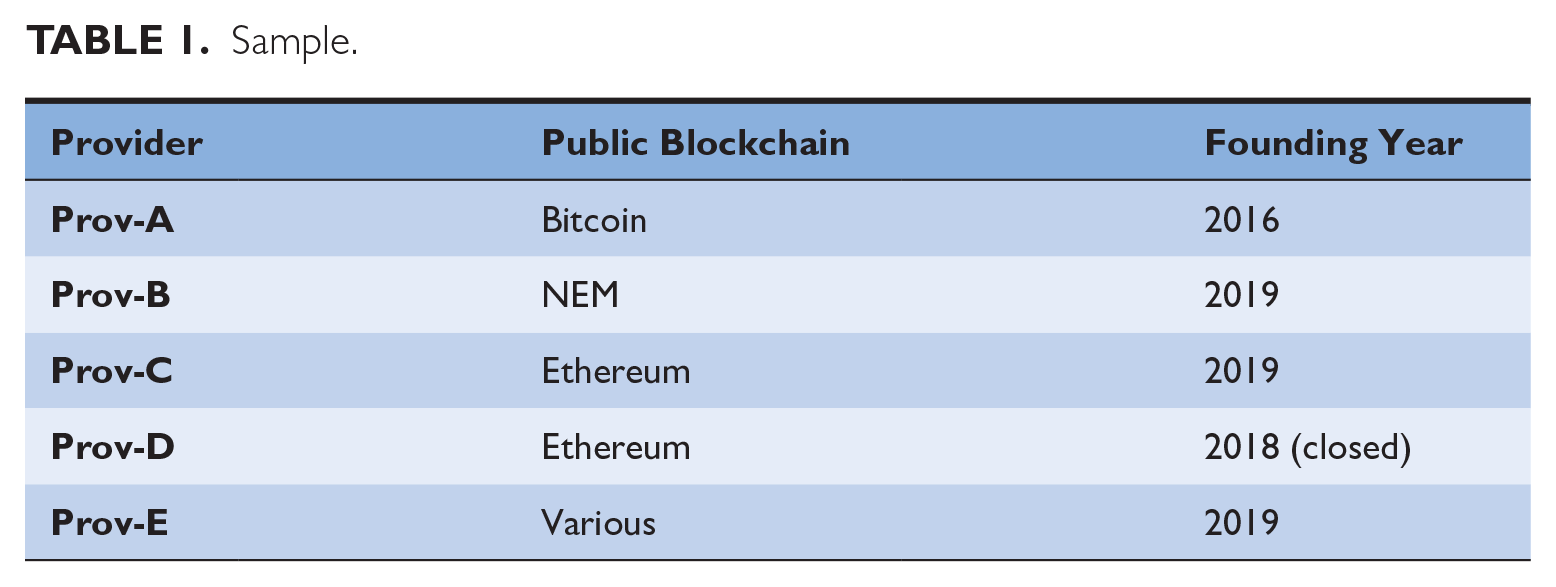
To limit bias risks, we also included informants, specifically some of the tools’ users and (patent) lawyers who have fewer commercial interests. 36 Recruiting user informants was particularly difficult for two reasons. First, since there are still few providers, the customer base is still small. Second, due to the deliberately confidential technical architecture of the tool, not even the providers know precisely who their customers are. For these reasons, we had to rely on the rare users who did reveal their identities. This happened, for instance, when the customer approached the provider during sales activities or developing white-label versions. We could convince (patent) lawyers of Prov-A and Prov-B, as well as three users of Prov-A, to participate in our study. Our user informants are a single entrepreneur offering a wide range of video productions or engineering services, a small innovation agency specialized in advising startups, and a large corporation with more than 50,000 employees. Table 1 summarizes our sample.
Sample.
We tested one of the tools to familiarize ourselves with the topic. Although the context might be different from a commercial OI project, we consider these tools equally relevant for academic settings. We conducted 19 interviews and collected 275 pages of archival material, four videos, and seven hours of observational data during visits and workshops to triangulate our data. The semi-standardized interviews (average 55 minutes each) were recorded, transcribed, and coded. Two researchers inductively coded the interviews following the recommendations by Miles and Huberman 37 on data visualization and within-case and cross-case comparison. The second author and an independent second coder reached an inter-coder agreement of Cohen’s κ = 0.70, which indicates a “good” or “substantial” result. 38
Findings
How Does Blockchain-Based IP Protection Work?
Verifiable documentation of an inventive process is relevant to enforcing IP rights and reducing appropriation concerns related to capturing a fair share of rents from collaborations 39 by signaling a degree of seriousness. However, creating and maintaining verifiable documentation is often demanding. For instance, innovators today rely on state authorities, such as notaries or governmental IP institutions, to receive a certificate of possession. Since applying at a notary with every new version of a file, collecting witness statements, or sending a letter is resource-consuming and seldom feasible, most innovators do not have solid documentation of their inventive progress.
Therefore, all providers aim to create a convenient tool that offers verifiable, immutable documentation of files for its users. This can be achieved with a timestamped record that shows who uploaded an existing unaltered file at a specific point in time. In other words, the record shows a file’s existence, integrity, and possession. Blockchain adds a novel way of proving the possession of files on a given date. Furthermore, a digital certificate facilitates not only the documentation of a file’s history, but also its authentication by third parties.
One might argue that this is nothing special since ownership records and timestamping have existed for centuries. Indeed, they existed in physical assets; blockchain technology, however, translates those into the digital world,
40
making its use feasible. As a result, it signals a degree of seriousness, which keeps the recipients more honest. As one of our informants pointed out, In the past, there was a seal, a signature, and a stamp of somebody. That showed that it was the original. . . . And the blockchain, I think, is just a modern replacement for such documentation with the latest technologies. (Prov-B)
When analyzing the providers’ technical architecture based on their software documentation and interviews, our data reveal four major processes. Despite our focus on standard processes and basic functions, we acknowledge that technical details might depend on the provider’s setup and unique selling point. Overall, the setup of a blockchain-based IP protection tool resembles encrypted data storage in combination with an external, public blockchain, such as Bitcoin or Ethereum. As Prov-A’s founders put it: “An encrypted Dropbox with some certification layer on top of it.”
Process 1: Creation of files and log-in on the tool. The user creates files that, for instance, depict the contribution to an OI project and logs in to the web application. An entrepreneur using Prov-A explains his initial process as follows:
Usually, I have an idea, do a sketch. . . . The product idea is then presented in a sketch, put on paper, and eventually, I create digital sketches. And then the next step is to start building the prototype. While I’m building a prototype, I document everything in the form of pictures and videos. . . . I have my account on the platform of Prov-A; and as soon as I have the data . . ., sketches, ideas, and a prospect for a profitable product, I load the data into the software. So I create a new project. (Entrepreneur using Prov-A)
Process 2: Local encryption and upload to storage. The files created in Process 1 will be encrypted in the second process to ensure confidentiality. The founder of Prov-A explains the importance of local encryption:
Everything you upload is encrypted locally with a key never shared with Prov-A. This guarantees the zero-knowledge trust architecture built into Prov-A. So, we never get in touch with the data. (Prov-A)
After encryption, the data is uploaded to storage. As the initial quote in Process 1 indicates, many file types can be stored. The entrepreneur using Prov-A determines what is uploaded: And when the finished prototype is there, and the whole thing has a chance of success, I already start uploading this idea . . . CAD designs, classic manufacturing instructions, and design data, which I create in my software tools. And then have an electronic data record that I can upload to the platform in a PDF and documents, Word files, and so on. (Entrepreneur using Prov-A)
Process 3: Blockchain transaction. In this process, the providers rely on public blockchains, such as Bitcoin or Ethereum (Table 1). The blockchain transaction is associated with a timestamp and proof of possession. Due to storage limitations and privacy concerns, not the file itself, but solely its hash value (i.e., a unique set of characters of a specific length produced by an algorithm) will be stored on the blockchain. The founder of Prov-B states in our interview and the archival data:
It is not the entire document [stored]. The blockchain is publicly accessible, i.e., everyone can read it, which leads to abuse by copycats and patent trolls, which can be dangerous. Accordingly, we have developed a hash procedure, which means that we make a unique fingerprint of this document and put it on the blockchain. You can only prove from one side that this is really the original document and not from the other side. (Prov-B)
Process 4: Issuing the certificate. In the last process, the user receives a certificate that states in a unique codification—among other information—an immutable timestamp and the possession:
We issue a timestamping certificate, a one-pager as PDF, where we store everything. So, “What is the file’s name?” “What kind of file format is it?” “How big was the file?” . . . “What hash has it?” and “In which blockchains are they stored, in which transaction?” (Prov-E)
How Does the Blockchain-Based IP Protection Tool Affect the User’s Innovation Activities?
Our data show that blockchain-based IP protection tools primarily affect the users’ IP strategies and OI projects. Concerning the first, a blockchain-based IP protection tool supports filing registrable IP rights and provides more tangible evidence for proving non-registrable rights. While not improving the legal position compared with timestamps or other techniques for proving possession, innovators can more conveniently track the original creation of a file. This critical and concrete evidence increases the chances of enforcing non-registrable rights when there is misappropriation. Regarding the OI projects, blockchain-based IP protection tools ensure reliable documentation for all parties before and during the collaboration. Signaling that protective measures are in place broadcasts a degree of seriousness and thus might mitigate appropriation concerns. Thereby, blockchain-based IP protection might enhance the project setup and execution.
Impact on IP Strategy
Due to the soaring promises and misunderstandings around blockchain-based IP protection, we consider it worthwhile to discuss the scope of these tools concerning IP protection. First, blockchain cannot act as an intellectual asset protection system on its own. Such tools do not offer novel IP protection mechanisms or grant IP rights but rather complement existing mechanisms by offering a new technique to prove possession. One founder put it in a nutshell: A timestamp is not “protection” as such. But it can be used as a piece of evidence in order to support other forms of protection. If you have only a date on a document, you don’t have any protection yet. (Prov-A)
Second, what blockchain can do is execute commercialization (e.g., licensing) agreements via smart contracts on the fly. However, these tools do not assist users in identifying potential IP misappropriation, nor do the tools offer IP commercialization options, such as licensing or IP transfer. The providers emphasized that such features will be considered in the future, along with defensive publishing options (Prov-A and Prov-D already offer defensive publishing options). Rather than facilitating the commercialization of IP, the strength of these tools lies in the verifiable documentation that ultimately creates evidence of IP rights. As summarized in Table 2, verifiable documentation has a mixed impact on IP rights. While it can streamline the application of registrable IP rights, it supports the proof of non-registrable rights.
Differing Impact of Blockchain-Based IP Protection on IP Rights.
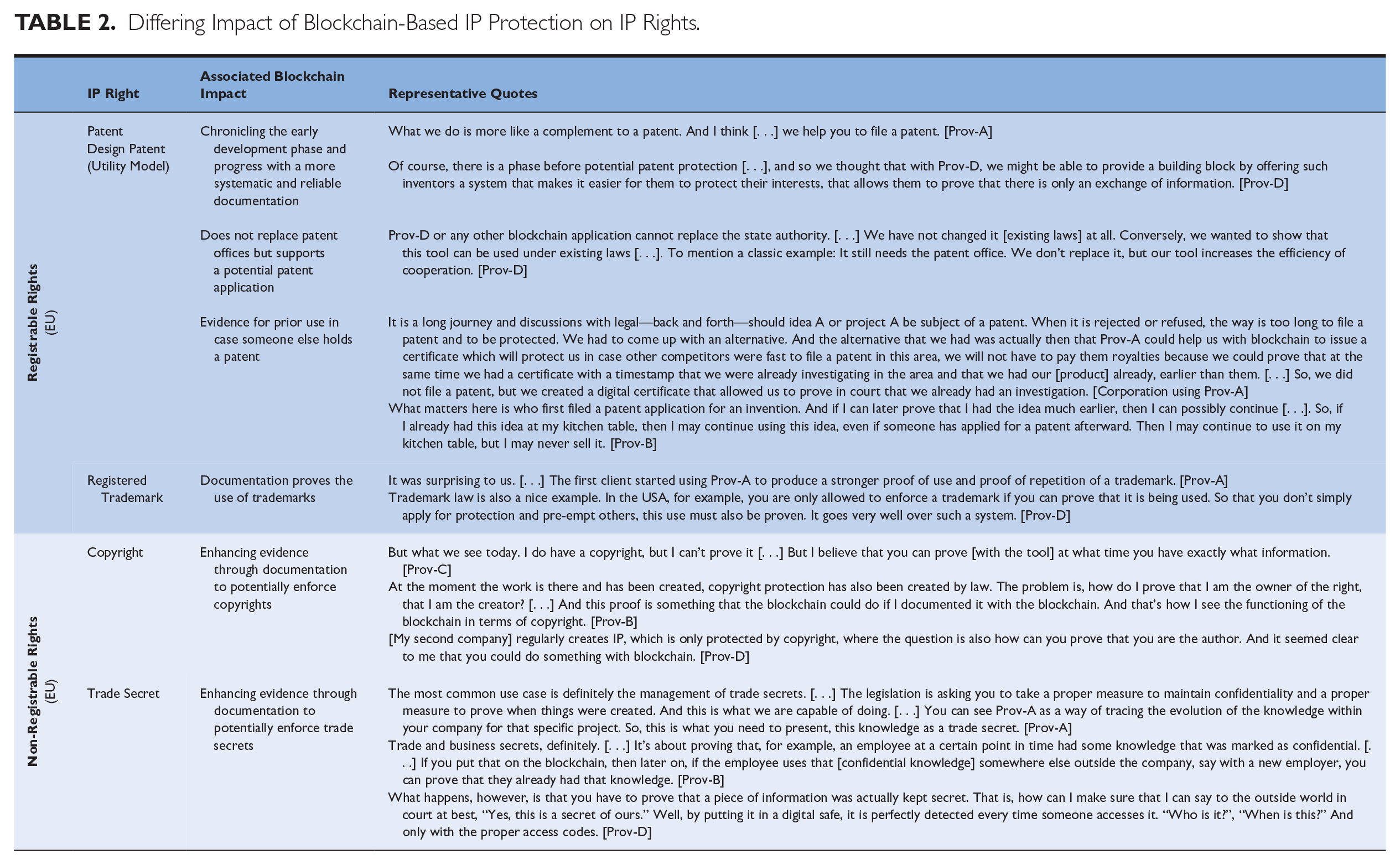
As the term implies, registrable IP rights require registration at governmental agencies, such as patent or trademark offices. Prominent examples of registrable rights are patents, industrial designs, or registered trademarks. To obtain a registrable IP right, specific requirements have to be met. Our informants explained that their tools are not intended to replace existing IP laws and IP protection mechanisms. Decisions on granting registrable rights remain with governmental institutions. To exemplify: Without a granted patent, there is no exclusivity, whether the applicant uses blockchain-based IP protection or not. The informants emphasized, The patent itself cannot be replaced. It is a guaranteed right that only patent offices can grant. (Prov-B) Regarding patents, we are not changing anything. . . . So we do not change the legal structure of a patent per se; we only improve the evidence [for the application]. (Prov-E)
As these quotes indicate, blockchain-based IP protection supports the application process by providing verifiable documentation of the inventive process: tracking the information about the inventor, dates, possession, the invention itself, and other formalities. By documenting the invention’s development, the inventor can more conveniently create a collection of files required for the patent application, such as timestamped drawings or first drafts of the patent claims. Although such a collection of files supports the inventor in the patent application process, this is not a requirement. Instead, the filing date at the governmental institution remains essential. As in most other parts of the world, Europe’s patent system follows a “first to file” principle. Again, this principle remains no matter if the applicant uses blockchain-based IP protection or not. 41
Moreover, the blockchain-based IP protection tools provide evidence of the prior use of an invention or a trademark.
42
As the founder of Prov-B explained, Then, there is the evidence for prior use. . . . For example, I have invented a new lamp; then I produce it, I sell it. Two years later, another company comes along and has filed a patent for exactly the same thing. Accordingly, the person who has the patent has a monopoly right. Only that person is allowed to produce this lamp, but two years ago, I had the idea and am already producing it. Do I have to stop my production now? . . . If you can prove that you had the idea before and are already actively producing and selling it, you are at least allowed to continue this product. (Prov-B)
Overall, instead of replacing the system for gaining registrable IP rights, the blockchain-based IP protection tools provide users with a more convenient way of documenting the inventive process, which forms a basis for a more streamlined registration and evidence of prior art.
Apart from registrable rights, implementing a blockchain-based IP protection tool might affect the use of non-registrable rights, such as trade secrets and copyrights (see Table 2). For such rights, registration at a governmental institution is not required in Europe. The right comes into existence upon the creation of the original work. Nevertheless, specific requirements have to be met. Trade secrets, for instance, require that the information not be known either by the public at large or by the experts of the sector in question; the information has commercial value; and measures are in place to keep the information secret (Directive (EU) 2016/943, 2016). In addition, the scope of the trade secret and whether the measures to keep it secret were successful are essential. The enforceability of non-registrable rights is frequently questioned due to the burden of proof in case of a dispute. The infrastructures of younger firms, in particular, are often insufficient to provide such proof. Hence, using blockchain supports improving the evidence for the right’s conception and qualification requirements. Prov-E stated, So, we are not changing the copyright law per se. We are only changing the “How can I better prove that I had this [file] at a certain point in time, or I was the owner?” This is what we are doing. (Prov-E)
Blockchain alone is insufficient and incomplete to prove trade secret misappropriation. However, this critical piece of evidence eliminates concerns about ownership and creation date (a prerequisite to being a trade secret), makes it easier for inventors to enforce their rights when misappropriation occurs, and signals seriousness to the recipient.
Impact on OI Projects
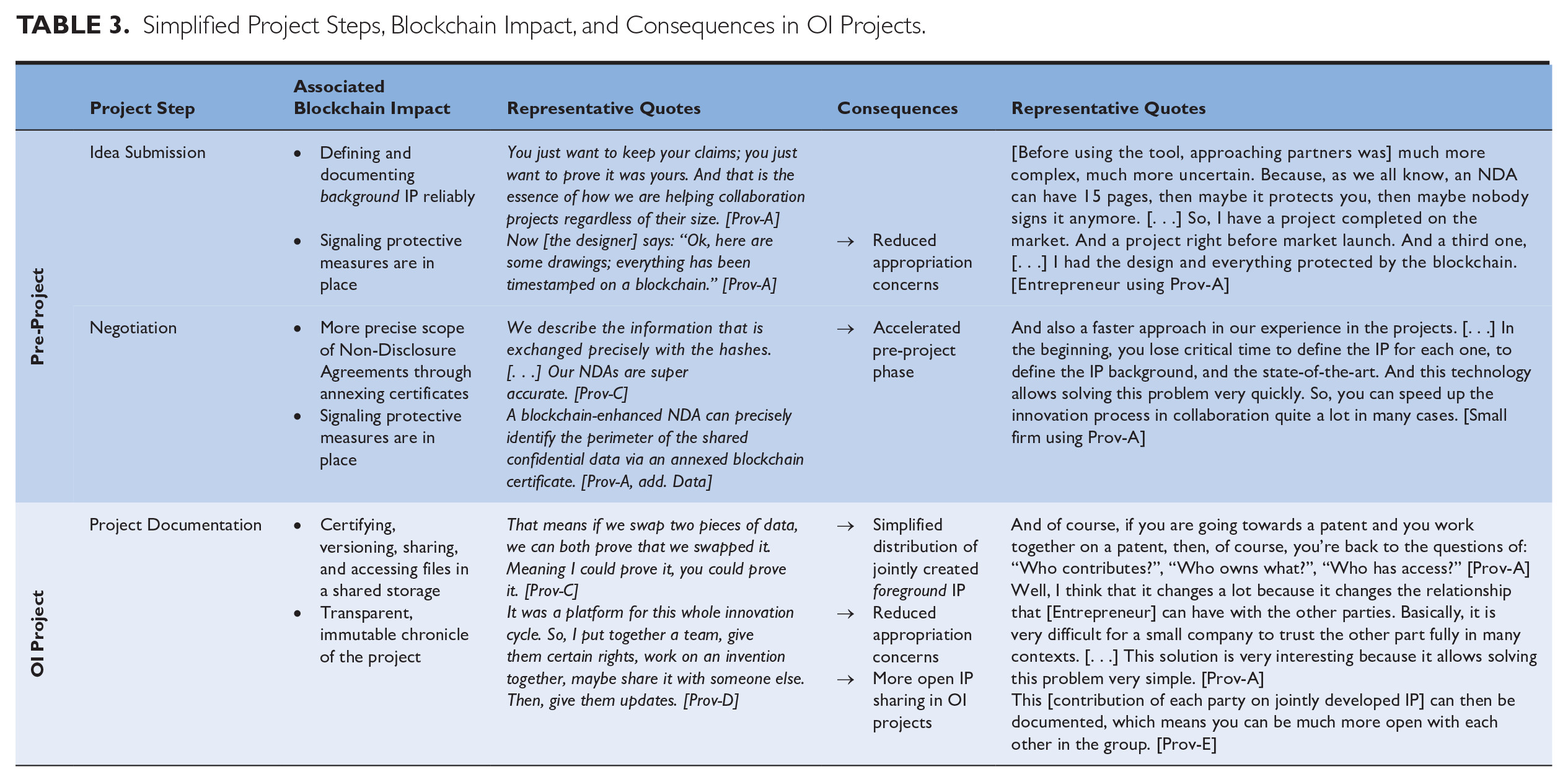
Although four of the blockchain-based IP protection tools that we studied are available, user experience is still at the infancy stage. Innovators are confronted with appropriation concerns throughout an OI project. Depending on the phase of the project, the concerns and the corresponding mitigating measures differ. While it is still too early to quantify results, our informants perceive the tool as supportive in protecting their existing IP more systematically prior to projects. This security layer can reduce appropriation concerns and speed up the pre-project phase. During OI projects, the immutable record eases the distribution of jointly created IP and stimulates IP sharing due to reduced concerns. Figure 1 provides an overview and Table 3 offers additional evidence of how blockchain-based IP protection influenced our informants’ OI projects.
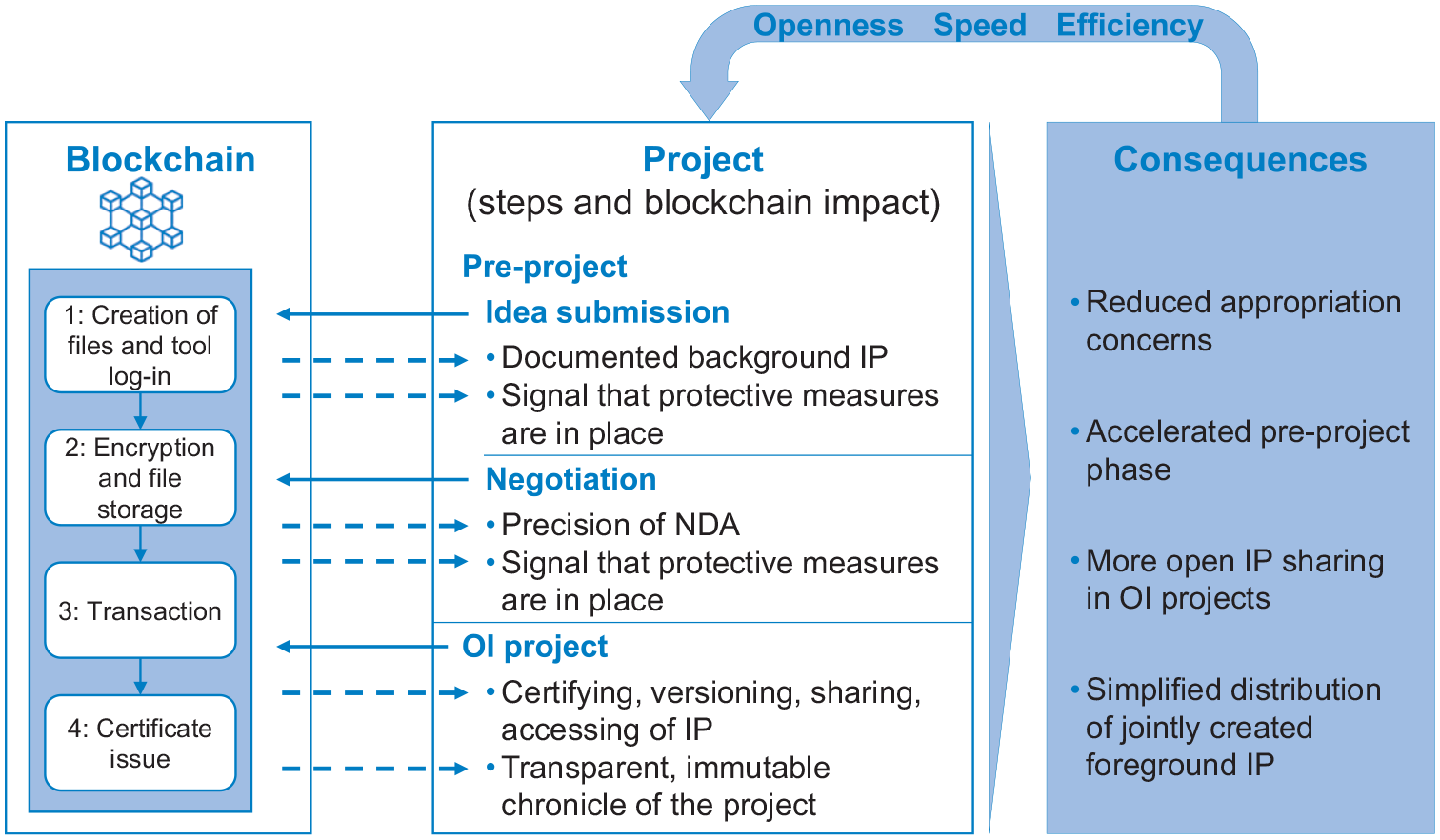
Blockchain and OI projects.
Simplified Project Steps, Blockchain Impact, and Consequences in OI Projects.
Even before an OI project starts, innovators have concerns. To reduce unintended IP leakage, innovators carefully choose which data they share and often share as little of it as possible. When submitting an offer, pitching to investors, or applying for a tender, innovators often worry that the collaborator might steal or obtain unintended access to valuable IP. The founder of Prov-B told us: But the biggest fear is that the idea will be stolen. That’s why you won’t communicate ideas or be very reluctant to do so. I noticed that a lot at business events. (Prov-B)
The blockchain-based IP protection tool eases defining and documenting each party’s background IP (i.e., the IP existing before entering a collaboration). A more reliable and precise record of existing IP even before the initial contact improves evidence of the innovator’s creatorship in case a dispute later arises. Hence, the tool contributes to reducing concerns. The founder of Prov-E emphasized, Of course, it is also crucial to document things properly beforehand. And what you take with you into conversations or what you make available to the other party . . . must be documented to prove that you have owned this information or this document before the conversation. There have been cases where people applied for patents based on the information from the initial conversation using similar texts and the same graphics, although they did not invent it. (Prov-E)
As a concrete example, one of our informants reported a designer using the tool for documenting watch designs before presenting them to watch manufacturers. The informant insisted that having basic protection measures in place at this initial stage was beneficial for both the designer and the watch manufacturer: The watch designer has now been more readily accepted at meetings [with watch manufacturers]. . . . it’s easier for watch brands to accept the visit, and it’s easier for both to define what belongs to whom. (Prov-A)
Besides documenting background IP, the blockchain-based IP protection tool supports contract negotiations and setting up non-disclosure agreements (NDAs). Blockchain can support closing and eventually enforcing NDAs by initially attaching certificates. 43
With the support of blockchain technology, the proprietary information is not described in the NDA but is encrypted in the blockchain. Since the linked hash values are not disclosing the file’s content, the innovator can embed IP into the contract’s scope without revealing it before signing the contract. An NDA with linked certificates can more precisely state the scope of the data to be shared while keeping the latter confidential. Furthermore, the NDA can specify that access to and disclosure of this proprietary information is limited to the parties holding the certificate. Subsequently, with the IP codified on the blockchain, blockchain can assist in case of misappropriation (ex-post).
Our informants explained, Suppose you want to prepare an NDA, for example, before having a meeting and discussing your inventions. . . . NDAs are fine. They are recognized by a patent court, by the patent office. But you don’t know what is covered by the NDA. . . . often, the NDA itself doesn’t say what will be discussed. And you don’t want to reveal everything. . . . Otherwise, people would just read the NDA and say, “Well, that’s very fine. There is all the information, but I don’t want to sign it.” . . . So what we do quite a lot: We recommend our clients to time-stamp everything that will be shared during the meeting and . . . include into the NDA a transaction number [referring to these documents]. (Prov-A)
Our informants also reasoned that a blockchain-based IP protection tool supports both parties in drafting, closing, and enforcing NDAs: I used to do an NDA on paper and send data around, maybe by post. After that, I made it digital. . . . I can definitely say that the willingness to enter into non-disclosure agreements has increased significantly due to [the tool]. (Prov-D) So, it’s better for the receiving party. It’s better for disclosing party, and in the end, it’s much easier to enforce because it exactly represents the knowledge without disclosing the knowledge in the contract. (Prov-A)
In sum, blockchain-based IP protection enhances the idea submission phase by helping parties define what IP they own, as well as the negotiation phase by providing more precise contracts, especially NDAs, by attaching certificates. The consequences are reduced appropriation concerns and an accelerated pre-project phase. The entrepreneur using Prov-A expressed their own experiences, concluding: For me, it is a tremendous advantage. . . . I act much more agile and faster. . . . I can enter partnerships much faster, develop much faster, and communicate with suppliers much earlier in every respect. Everything is faster and cheaper. . . . It [innovation projects] will also be accelerated. . . . Hiding my idea in the drawer is generally not good because then nothing happens. (Entrepreneur using Prov-A)
Moreover, using a blockchain-based IP protection tool produces common, verifiable documentation for all involved parties during OI projects. The tool creates a record with the files’ authorship and timestamps, as well as access and sharing history. This record serves as a transparent and immutable record of the project and its progress. As our informants explained, And today, managing IP is more than just applying for patents and registering. . . . But the actual issue in innovation is documentation and basically the questions such as: “Who did it? When was it done? Who had access to it? Who participated?” (Prov-A)
Our data show that this detailed file record has two main consequences. First, it helps define and apportion jointly created foreground IP (i.e., IP created through mutual collaboration efforts). Disentangling and allocating foreground IP is a major challenge in OI projects.
44
While a distribution of jointly generated value that is fair for all involved parties remains challenging, the tool supports collaborators in transparently tracing who contributed what during the project. Our informants outlined, It is easy then to define what was shared initially by the company and the additional part developed by the parties, i.e., in the collaboration. (Small firm using Prov-A)
Second, implementing documentation is not a legal protection per se. Nevertheless, blockchain-based IP protection signals that protective measures are in place should a dispute arise. Our informants perceived the protection measures as a prerequisite for collaboration. Raising awareness of the protection measures by actively communicating the use of the tool limits opportunistic behavior and mitigates appropriation concerns. The informants told us: Blockchain, so Prov-A, was giving us—not only to the startups—but for us the capability to be more protected and more relaxed in the development of new things when we were not able to file a patent. (Corporation using Prov-A)
As a result of these mitigated appropriation concerns, our informants reported being more open to the collaboration partner when relying on the tool. This, in turn, stimulates knowledge sharing between partners: Well, as I mentioned, in the innovation project, the basic benefit is that the companies are more willing to share information because they know that they can demonstrate what they share. (Prov-A) You are more open to talking about it because you know you’ve saved it. You have the feeling of security, which has a psychological effect on how I work with others. . . . Unfortunately, I can’t prove that; that’s what I heard in the conversations with customers and partners. (Prov-B)
Conclusion and Implications
This study explores novel tools to support IP protection by combining encrypted storage with a public blockchain. We map the workflow of these tools, clarify their scope, and explore the potential impact on innovators’ IP strategy and OI practices. While use cases are still rare and difficult to access, we collect empirical data from providers and users to understand the scope and limitations of these tools. Our results show that relying on blockchain technology is not a panacea for ending all IP protection problems but holds the potential to significantly improve the status quo by creating an immutable record of files’ existence, integrity, and possession.
Managerial Implications: How to Get Started?
Blockchain technology offers innovative firms opportunities to extend and complement their existing IP protection, ultimately leveraging their negotiating leverage and OI projects. Blockchain-based records can reduce appropriation concerns and impact innovators’ IP strategies by streamlining the filing of registrable IP rights and supporting the enforcement of non-registrable IP rights. In addition, it can facilitate the establishment of OI projects and help surmount well-known obstacles in the course of OI projects, such as the distribution of jointly created IP and the reluctance to share IP.
Using blockchain technology is not always useful or easy. Therefore, managers should carefully evaluate the trade-offs and determine whether and how to implement blockchain technology. The following five key steps provide guidance for the evaluation and implementation:
Evaluation of IP Strategy and Capabilities—IP rights can create and sustain a competitive advantage if strategically managed. Both formal (e.g., patenting) and informal (e.g., technological lead-time advantage, signaling seriousness about IP through blockchain documentation) mechanisms are relevant for IP protection strategy. Furthermore, an overarching IP strategy does not solely include measures to protect, but also to commercialize IP. Blockchain should not be used in isolation, but as a component of the overarching IP strategy. Thus, innovators should evaluate how blockchain technology might leverage the potential of IP protection to extend and contribute to their IP strategy. Since blockchain-based IP protection provides the most direct benefits for non-registrable rights, managers will need to discuss the current and future role of non-registrable rights in their IP strategy. When non-registrable rights play a negligible role, managers should refrain from investing in them. Furthermore, we advise innovators, particularly in smaller firms, to carefully evaluate their firm-specific IP contingencies and capabilities. For instance, the users in our sample differ considerably in size and experiences with IP protection. Hence, their resources dedicated to IP protection, the maturity of their IP strategy, and the tools operationalizing their IP strategy differ accordingly. Blockchain-based IP protection can have a more fundamental meaning for individual entrepreneurs and startups since it acts as an initial protective layer—from “having nothing” to “having something.”
Evaluation of OI Projects—Managers should closely analyze their existing and upcoming OI projects. Depending on the project type and related partnership, the involvement of IP and its protection will differ. Managers will need to ask: What type of OI projects and partnerships do we have? What type of IP is involved in these projects? How can this IP benefit from blockchain-based protection? Moreover, managers should carefully align their OI projects with their IP strategy to reap the benefits of blockchain-based IP protection. While the answer to the question of whether to use blockchain technology contains a large gray area, the simple evaluation matrix shown in Figure 2 is a starting point for companies to discuss the trade-offs and applicability of blockchain-based IP protection for their IP strategy and OI projects. The matrix represents a propensity rather than a clear binary decision tree. Once the firm decides to consider blockchain to support IP protection, steps 3 through 5 follow.
Scouting and Selecting a Blockchain-Based IP Protection Tool That Is Fit for the Purpose—There are many companies and platforms on the market that offer mature solutions for blockchain-based IP protection, such as Bernstein.io (founded in 2016) or IPwe (founded in 2018). Although the tools offer the services described in the findings section, the exact scope of the products offered often differs due to unique selling points and specific features. For example, IPwe offers additional features such as estimates of the financial valuation of the IP portfolio. Therefore, we recommend selecting a blockchain-based IP protection tool that meets the needs of the focal firm’s IP strategy and OI projects.
Gradual Implementation of Blockchain-Based IP Protection Tools—Since users and providers are obliged to wait for upcoming court decisions and legislation, they can primarily overcome obstacles that do not pertain to the remaining legal uncertainty. Innovators and innovating firms should start using the tool internally, relying on trial versions to determine whether it fits their firm-specific needs before expanding it to external stakeholders.
Development of Communication Guidelines—According to our informants, convincing other OI partners to use a relatively new technology might be an uphill battle. While financial reasons are a minor consideration, they encounter much skepticism about blockchain technology and the accompanying legal uncertainties. Thus, we strongly recommend developing a concise communication guideline when using the tool. This includes communicating the use, required changes, and potential consequences to internal stakeholders, such as an IP department in larger firms or co-founders in startups, and external stakeholders, particularly partners in OI projects. Fostering communication and exchange with associated departments and partners is necessary to align stakeholder interests. While our study was conducted in Europe, where IP enforcement is strong, these managerial recommendations are not only valid, but even more suggested when doing business in countries with weak IP protection, such as China, India, and Russia. Some of the claimed benefits of blockchain for non-registrable rights (in countries with strong IP enforcement) can also be reaped when IP enforcement is weak, thereby improving de facto IP protection. For example, an IP infringement recorded on blockchain may be easier to detect. While the breach may have occurred and damage may have been done, companies can take immediate action and refrain from doing business with the offending party in the future. Also, in countries with weak IP enforcement, plaintiffs’ attorneys require strong evidence of IP infringement and damages, 45 which blockchain-based documentation can provide.
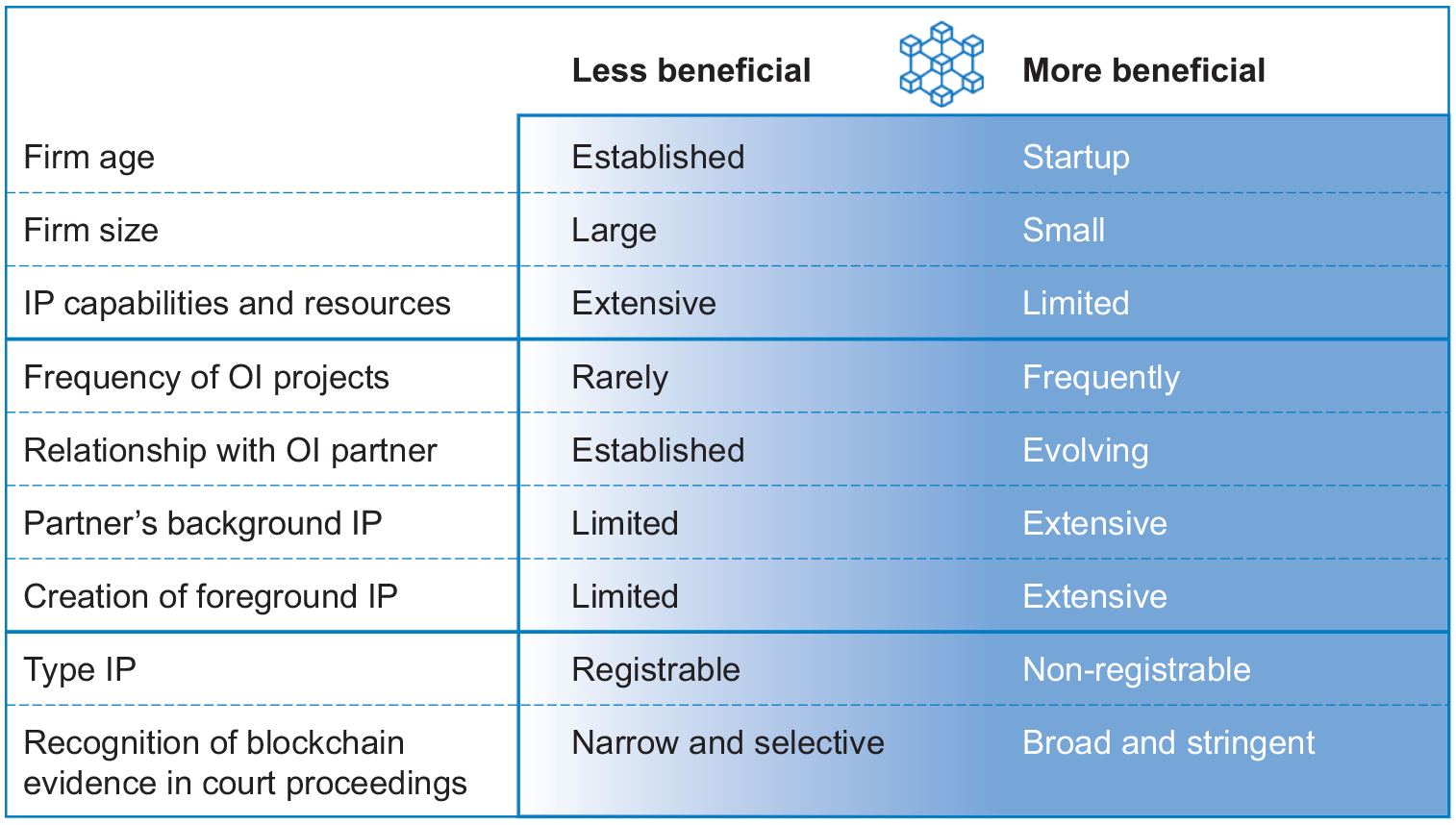
Evaluation matrix for trade-offs, applicability, and benefits of blockchain-based IP protection.
Some Considerations for the Legal and IP Systems
The assessment of the current IP system is puzzling. On the one hand, it is under pressure. The patent system, for example, dates back to the fifteenth century and largely follows the same principles, while being confronted with twenty-first-century technologies that allow data to be shared with extreme ease. As a result, many critics have predicted the end of the existing system, arguing that it is outdated 46 or even rejecting its basic principles. 47 On the other hand, especially in Europe, patents enjoy an excellent reputation; their signaling and marketing effects go beyond their protective purpose. 48 Patents are therefore very popular.
There is still legal uncertainty in Europe about whether courts will recognize blockchain evidence. While there are several laws and court decisions recognizing blockchain evidence in the United States and China, 49 the situation in Europe is more fragmented. However, at least three indicators point in the direction of the recognition of blockchain evidence in European courts: the blockchain-related initiatives and conferences by IP institutions such as the European Patent Office; the case-by-case acceptance in France and Italy; and the related existing recognition of digital signatures in the EU. 50 Despite these indicators, some managers are still reluctant to implement the tool before a final court decision or legislation is in place.
We argue that new technologies put pressure on the IP system and at the same time offer new ways to support it. In particular, blockchain technology affects the IP system at the institutional and user levels. With respect to the former, de Rassenfosse and Higham 51 propose that distributed ledger technologies can support the work of patent offices and fundamentally change the patent system by decentralizing it. This decentralization could rectify several well-documented shortcomings, such as inefficiencies in the patent examination process. 52
Footnotes
Acknowledgements
The authors thank the editor-in-chief and three anonymous reviewers for their helpful comments and suggestions on earlier versions of this article. We also thank our expert informants for their valuable contributions.

Notes
Author Biographies
Stephan M. Wagner is Professor of Supply Chain Management, Head of the Department of Management, Technology, and Economics, and Faculty Director of the Humanitarian Operations and Supply Chain Management Lab, ETH Zurich, Switzerland (email:
Alexander A. Fink was a Research Associate at the Chair of Logistics Management, ETH Zurich, and is now an Innovation Manager at Bechtle, Germany (email:
Jonas F. Ehrnsperger was a Doctoral Researcher at the Centre for Technology Management, University of Cambridge, and is now a Data Scientist at Mercedes-Benz Group, Germany (email:
Philipp Düpree was a Visiting Researcher at the Chair of Logistics Management, ETH Zurich, and is now a Senior Associate at PwC Switzerland (email: