



Abstract
Drawing on data from white-collar inmates in a United States Federal Prison, this article explains what causes individuals to commit misconduct. Flawed intuition captures the consistent pattern of instinctive, muddled logic by individuals who are influenced by a toxic mix of individual behavioral triggers, organizational context, and the wider industry environment. Combined with limited reflection and/or discussion with others, flawed intuition captures how people cross legal lines owing to a system where factors at multiple levels are working in tandem. This article provides practical recommendations for what can be done to prevent it.
Keywords
We use the term flawed intuition to capture the consistent pattern of instinctive, muddled logic by individuals who are influenced by a toxic mix of individual behavioral triggers, organizational context, and the wider industry environment. Combined with a lack of personal reflection and/or discussion with others, flawed intuition captures what causes individuals to cross ethical and legal lines, which can escalate if not corrected. Drawing on the reflections of 70 inmates who were serving sentences for white-collar crimes in a United States Federal Prison, we illustrate why individuals commit professional misconduct and provide practical recommendations for what can be done to prevent it.
Professional Misconduct
Professional misconduct is regarded as a continuum of incidences and actions that range from illegal (i.e., prohibited by criminal and civil laws) to unprofessional (i.e., against professional code of conduct and protocols) and unethical (i.e., contrary to societal norms and expectations). 2 Professional misconduct is not easy to define given it has been theorized not only as an individual but also a social phenomenon 3 that operates within the same organizational and industry contexts within which the law exists. 4 The boundaries between what is right and what is wrong are often narrow, confusing, shifting, and influenced by social relationships that require the co-operation of others, making it challenging to identify and prevent misconduct. These shifting and complex boundaries create a range of ethical blind spots, opportunities, and temptations that can contribute to individuals committing professional misconduct. 5
Individual, Organizational, and Industry Factors
Building on work that has sought to understand why people commit professional misconduct from the individual, organizational, and industry perspective, 6 we seek to extend individual-level explanations alongside considering the organizational and industry context that shapes individual misconduct. We move beyond the narrow “bad apple” explanation toward considering the influence of “bad barrels” and “bad cellars.” That is, we reverse the meme “It’s the people, stupid” to “It’s the system, stupid.” 7
Following the “bad apple” explanation, professional misconduct is considered rare and an outrageous departure from acceptable behavior, which reflects low self-control. 8 In his study of corporate executives, Soltes argues that despite their previous successes, wealth, and lives of relative comfort, they are not driven by greed or hubris, and they make decisions based on their intuition and gut feelings, just like anybody else, rather than cost-benefit analysis of their actions. 9 He observes that these gut feelings are often poorly suited for the realities of the modern business world, where leaders are far removed from the consequences of their decisions and actions. Arrogance, aggressiveness, and a tendency to distort reality on the part of successful professionals can result in a toxic workplace, tacit and dependent followers, and insidiously faulty decision making that results in misconduct. 10
The “bad barrel” explanation ascribes professional misconduct to internal factors such as aggressive target-oriented cultures, dysfunctional governance and structure, and practices that reward results at the expense of professional and social responsibility. 11 Some researchers have supported the idea of aggressive compliance and control regimes to curb professional misconduct, for example, in accounting and auditing. 12 However, others highlight that misconduct is also pervasive in such high-control environments. 13 Finally, the bad cellar explanation ascribes professional misconduct to external factors associated with complex jurisdictional, geo-political, and ecological boundaries. 14
While research into macro-level drivers provides a retrospective explanation of individual conduct, it does not help in prospectively identifying the specific experiences, circumstances, and triggers that predispose some individuals to make rotten decisions and commit professional misconduct. Nor do we really understand the intersection between individual, organizational, and industry factors in explaining why individuals commit professional misconduct. We need to better understand why individuals engage in misconduct, the structural opportunities that allow them to do so, and their subsequent rationalization for misconduct before making recommendations for how we can prevent misconduct. Hence, we ask the broad question of why individuals commit professional misconduct.
Methodology
We were presented with a unique opportunity to collect data from inmates at a Federal Prison in the United States. At the time of data collection, all the inmates who participated in this study were serving sentences for white-collar crimes related to professional misconduct. Participants worked in many sectors, such as financial services, law, management consulting, medicine, life sciences, government, military, information technology, startups, and family businesses. Hence, professional misconduct stretches into a wide range of workplace settings. One of the authors was serving a sentence for a white-collar crime at the same prison and had negotiated access and ethical approval with the Education Officer of the prison and with his affiliated university as part of his PhD research. In short, we had an insider lens on professional misconduct.
To achieve our objectives, we collected qualitative data for 16 months, from August 2018 to November 2019, to understand why and how individual professionals commit misconduct. In total, we conducted interviews with 70 inmates. All data were captured through detailed notes and cross-checked later, but not recorded given the US Federal Bureau of Prisons restrictions on using recording devices. The participants had all committed misconduct, which resulted in criminal charges, legal proceedings, sentencing, and eventual incarceration for white-collar crimes. The participants were all males, in the age range of 27 to 71, with a median age of 47.
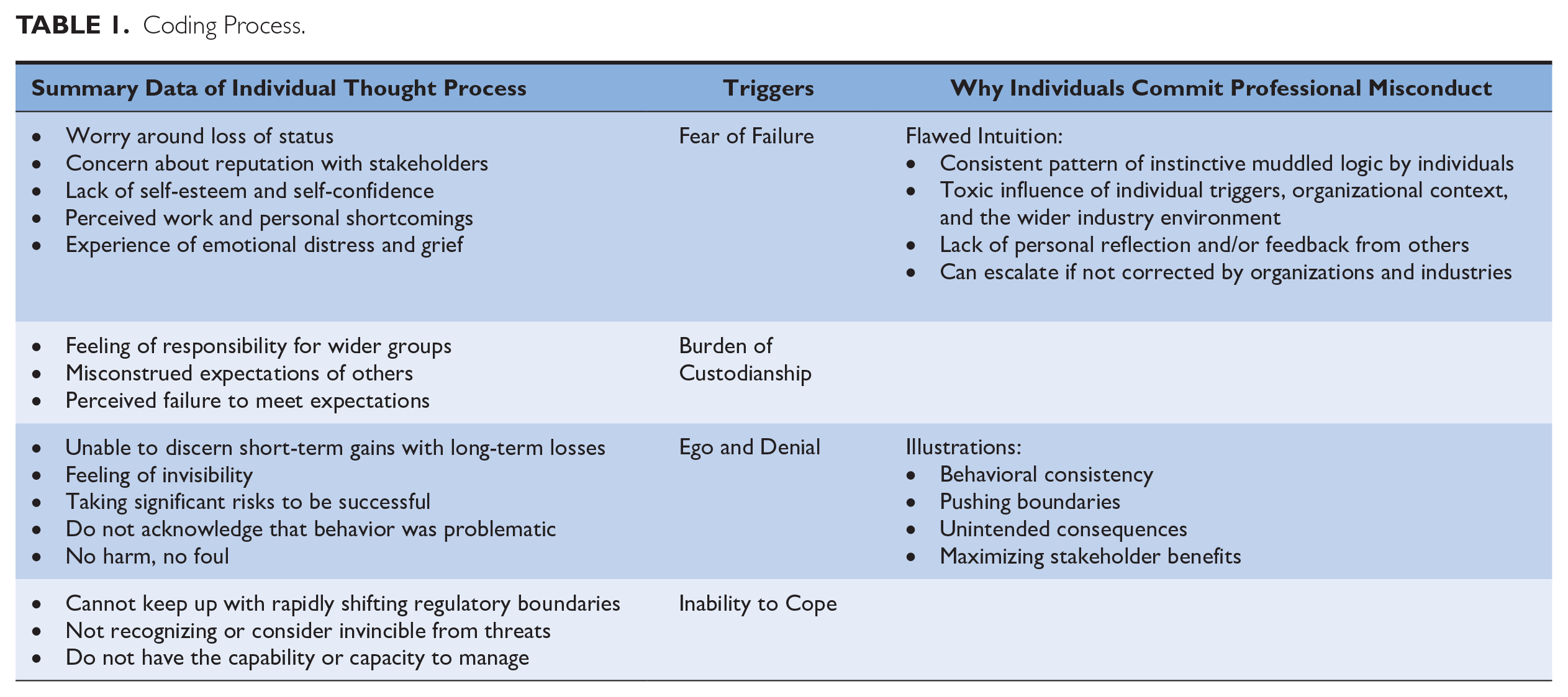
One of the authors had the advantage of insight in this research context, having experienced the same challenges as an “insider” inmate. However, he also had to step back, listen to, and understand the accounts of others as an “outsider” researcher. This required him to disentangle himself mentally as the researcher of the study and understand the mind of others in order to see it through their eyes. 15 The author had complete immersion in the field as he was spending 24 hours a day with the participants as a prison inmate. This enabled additional time for informal listening, understanding, clarifying, and asking questions, similar to an ethnographic study. 16 Furthermore, this helped build a level of relationship and trust that would have otherwise not been possible for an outside researcher. 17 Our analysis provides insight regarding the interdependency between an individual and the context in which they operate to understand how flawed intuition around misconduct emerges among professionals and how we might respond to prevent professional misconduct. Table 1 provides a summary of the themes (codes) we derived from an in-depth examination of the data collected during our 16-month study period.
Coding Process.
Findings
Our data show that many factors in tandem rather than in isolation explain why individuals committed professional misconduct. For example, when coding our data, we found that a large majority of participants mentioned two or more individual behavioral triggers and two-thirds of our participants each mentioned three or more of these triggers for why they had committed professional misconduct. In addition, as we explain below, these individual behavioral triggers cannot be divorced from contextual and environmental influences.
Context and Environment
When we spoke to participants in prison, their agency was evident in their decision to commit misconduct based on their flawed intuition. However, we did observe that their account of their individual behaviors was clearly influenced by other factors beyond their immediate control at the organizational and institutional levels. Based on evidence from these white-collar inmates, we see an opportunity for and a rationalization of professional misconduct in relation to individual behavioral triggers, organizational context, and the industry environment.
At the organizational level, we found that issues of cultural norms, weak signals, and perverse incentives help to explain individual behaviors. In terms of cultural norms, it was apparent that there were expectations from employers, customers, and clients around targets and outcomes. One former tax accountant said that he felt the constant reminder that his role was to save taxes for his clients rather than worry about the complexities of the law: It was a lot of pressure, and I had to protect their investments. I moved funds from one account to another that I should not have, but all I was trying to do was protect my investors.
In terms of weak signals, another interviewee said he found himself constantly working on the treadmill to generate new revenue with limited organizational support but mounting pressure to over-deliver rather than stepping back with his colleagues and asking themselves what they were doing for their clients and whether they were satisfied with their processes: I had toiled for years to get to where I was. My partners liked what I was doing and always encouraged me to do more. I still remember comments like “If anyone can do it, that is him. He is the rainmaker.” No one asked or worried about how.
In terms of perverse incentives, one interviewee referred to the escalating and unsustainable volume of business that was underwritten, with no questioning of what the impact would be several years later: The level of stress and pressure to meet our targets was bad enough, forget about the procedural checks and balances. And it got worse over the years. It was not about right or wrong but what helped us meet our business goals.
There was a recurring pattern that issues of ethics and responsibility were not discussed, and if the business was performing well, there were no questions asked, and there was no structure of accountability around ethical decision making. Many interviewees relied on third parties to advise them of whether they were acting within the law. This created tensions between what they saw as exciting business opportunities and their exposure to the law. In the words of one interviewee, My partners and I knew there was a large risk in what we were planning and that we were pushing the boundaries. We had always counted on our General Counsel and outside lawyers to cover us. They assured us that we were protected, and we thought the risks were worth taking given the benefits for the firm.
At the industry level, interviewees explained that there were three levels of challenges they faced. First, there was keeping up with mounting regulatory expectations. They argued that their colleagues and they themselves struggled to keep pace with the level of changes. This ranged from individuals managing changes with taxation for clients to doctors navigating the complexities of drug prescriptions for pain relief among their patients. This intersected with contextual factors at the organizational level, where clear guidance was needed to avoid giving weak signals. Second, there is a conflict between standards set at the industry level and targets set within the organization. One interviewee complained that: “No one got rewarded for being compliant, but you got penalized for not meeting your targets.” This suggests that there were gaps between what industry bodies were asking organizations to do and what organizations chose to communicate to their employees. Third, interviewees explained how business and ethical decisions were often conflated. For example, one interviewee felt overwhelmed by the burden of keeping up with the latest industry regulations and compliance, yet he also faced mounting pressure from his organization to deliver results: We were spending more and more money and time on compliance and transparency. There was so much pressure and when push came to shove, we made decisions based on cost and benefit analysis—the only thing anyone cared about at the end of the day. Ethical decisions should be binary, right or wrong, not grey like a business case.
The above participant highlights this tension between individual, organizational, and industry factors, retrospectively recognizing that ethical decisions should have been part of the conversation. While regulators were asking for more compliance, the individual’s interpretation of the signals from their organization was that business decisions should trump considerations over ethical choices: Learning how to build up our credit limit and ability to borrow was the right to passage. It was our part of our apprenticeship to learn the tricks of the trade, despite the highly regulated nature of the investment management trade. Or you follow the slow route to eventual exit. Yes, we would go to training sessions on professional ethics but then we talk about finding ways around them.
Another participant said that he used to set the rules and advise others on regulatory issues. He recognized the difficulties that clients faced with mounting regulation alongside their own business pressures to deliver. Because he knew the loopholes, he thought no one would ever question his position and the ethical conflict between setting industry regulations and helping clients overcome their business pressures. This has parallels with the 2023 PwC Australia crisis when a partner and international tax chief from the firm misused confidential tax information from the Australian government, which was seeking to design tougher multinational tax laws, giving over a dozen U.S. company clients early warning of the changes. 18
A further example from healthcare shows how different levels of factors collide when explaining why individuals committed professional misconduct: The government had launched a national campaign on pain management and encouraged new research and treatment protocols. I was a well-acclaimed medical doctor and researcher in the space, and I was doing my moral duty by treating my patients for chronic pain. Suddenly, the government took an aggressive stance on the use of opioids, and I was charged for over-prescription. My actions were still legal in [X state] but illegal at a federal level.
The above example shows that the participant was clearly aware of the risk he was taking and needed to take responsibility for the risky nature of his actions, particularly during a Federal Government policy change following the opioid crisis in the United States. There was a sense of flawed logic that somehow his mission to support patients with chronic pain, however important that was in fulfilling his duties as a doctor, could insulate him from the full force of the law, even if there were discrepancies between Federal and State law.
As they reflected for the first time on their past actions, individuals largely engaged in self-flagellation regarding their flawed intuition. Within the context and environment we outlined above, we found that four individual behavioral triggers captured the thought process and behaviors of inmates (see Diagram 1): fear of failure, burden of custodianship, ego and denial, and inability to cope.
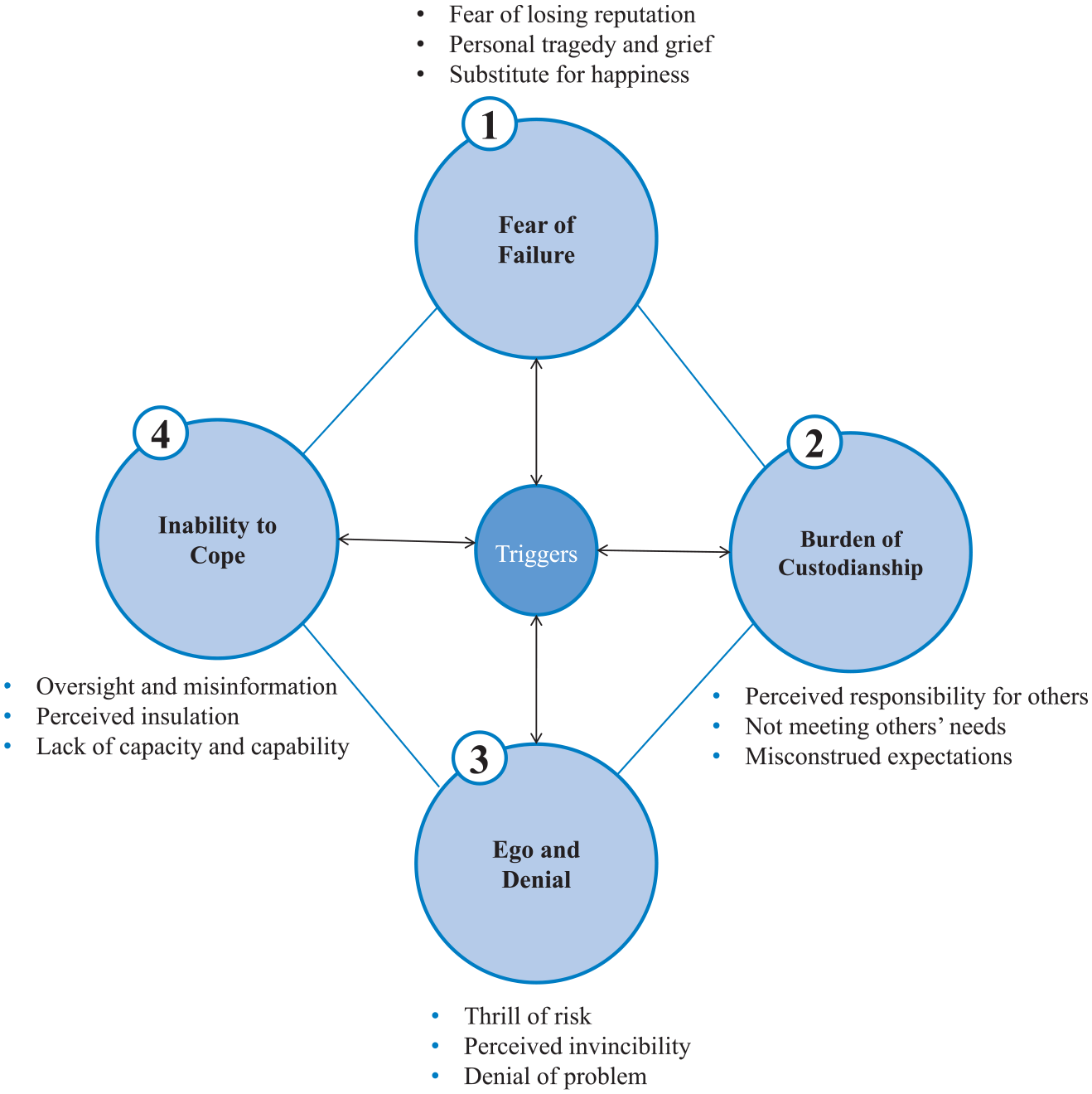
Explaining individual behavioral triggers and professional misconduct.
Fear of Failure
Many participants cited fear of failure as the individual behavioral trigger for explaining their flawed decision making. Our findings show that it was driven by their concerns with how they would be perceived by others within and outside of their organizations. As the following participant explains, the fear of losing his reputation within his company and sector was a key identity threat as a prominent, high-status founder: My intent was to protect the reputation of my company and my partners. They counted on me; I was the founder. The only people that got hurt were my family. My desire to save my reputation became my nemesis. I did not even think twice about it at that time, it is who I was. Moving money from one account to another was a short-term thing that would have saved us.
The fear of failure and the threat to his identity was anchored in short-term impulsive self-preservation and the need to protect what he had already achieved as opposed to the long-term need to achieve more in the future, as another interviewee explained: Getting to where I was, was a dream come true. Doing anything else was incomprehensible. The clients I had helped, people I had mentored, friends I had made. I wanted to continue doing that for the rest of my life. I was making enough money already . . . I never had the need or desire to earn more. The idea of losing that life sent me across the line.
This individual was not worried about financial failure, but more about losing his standing within his organization and wider environment.
Our data show a lack of self-esteem and confidence among participants seemed to stem from various life events and experiences beyond their immediate experience in the workplace. Some participants likened it to: “I never felt I was good enough,” “I don’t think anyone believed I could do it,” and “If only I had taken a different route.” One participant talked about growing up with the need to prove to his parents and highlighted how he never stopped to reflect on his choices: I had always wanted to prove to my parents that I was successful. My self-worth was tied to my success as an investment manager. Professional success at any cost became more important than anything else. I never looked back or thought twice.
Individual perceptions of their professional accomplishments versus their peers and friends also became part of their flawed framing. Participants felt that their actions served as a temporary substitute for short-term gratification and emotional titillation. The following quotation illustrates the stubborn conviction among a participant who considered that failing was not a choice, alluding to norms both within his family’s business and more broadly in the sector: I had two business failures in a row. Failing again was not an option. I grew up in a family business that sold new and used cars, and not winning a deal was not an option. You did anything to sell the car and win the deal before the customer walked away. I was determined to win it this time, and I almost did!
The Burden of Custodianship
Many participants also cited the perceived burden of custodianship as one of the contributing factors behind their flawed choices. Our data show that individual behaviors were driven by the perceived responsibility beyond themselves for diverse stakeholders. Such self-afflicted expectations, and at times failure to meet these expectations, led to warped judgments: With three young children and a fourth one on the way, I wanted financial security for my family. I joined a startup that seemed to be doing great but realized after a year that the founders were doing something unethical. I remained quiet, assuming I was insulated from their mistakes but could benefit financially if things went well.
Hence, family pressures coupled with the flawed logic of acting unethically in the short term to help others had far more damaging consequences in the long term. Another participant emphasizes their intent of seeking to help others, but their logic of how to help them through misconduct was flawed: I had chaired several city committees and played civic leadership roles and mentored people over two decades. People counted on me for help and guidance. I was trying to help, not hurt people. I know I crossed the line a little, but that was not the intent.
Ego and Denial
Participants also cited ego and denial as one of the contributing factors to their flawed decisions. Our findings show that opportunity and timing, inability to discern long-term losses versus short-term gains, and perceived invincibility explained much of their behavior. Participants emphasized that risk taking was needed in venture investment to be successful. If there were problems with taking aggressive risks, then a solution would be found: In the venture investing business, there are no hard lines, just soft lines that we have to blow away. If you are not willing to take risks, you cannot be successful in our business. We were problem solvers and aggressive risk takers who always found a way. It was business as usual.
The above participant alludes to norms within his sector about taking significant risks to succeed, which highlights that these individual behavioral triggers cannot be decoupled from their context and environment when explaining their flawed intuition. Near escapes and records of successes in the past seemed to fuel the intent of participants and cloud their moral intentions: No one talked about how we won the deals. All that mattered was winning or closing or dealing as a team. It was a rush our team was addicted to. Money was always there, but it was winning or losing that we really celebrated.
The above participant described the culture within his team, which was addicted to the rush of winning. Others talked about the environment around them with success celebrated and no one asking questions when things were going well, but where others would swiftly wash their hands when something went wrong: They called me the “deal machine.” No questions asked. When I was delivering, everyone was happy and took credit for the success; no one asked questions about how the transaction was put together . . . they did not even want to know or seem or care. But when something goes wrong, they all point the fingers at you.
While the above quotation does not negate the seriousness of the individual needing to take responsibility for their flawed choices, it does show how cultural norms, weak signals, and perverse incentives within can quickly pervade an organization. A small number of participants cited personal beliefs and values as the main and primarily the only explanatory factor behind their misconduct. Our findings relate it to perceptions of “no harm, no foul,” where it was harder for individuals to identify the victims at the point of their flawed choices. This was exacerbated by the common flawed logic of “others are doing it” within their organization or sector, as illustrated by the following quotation: We were a small company that was stealing share from large corporations that contribute to election campaigns and have a huge lobby in Washington, DC. The tax people came after us and charged us with baseless tax evasion issues. We are the victims here, not anyone else.
Other quotations highlighted self-rationalizing behavior driven by denial and disagreement with societal norms, laws, and regulations: What we were doing was legal and smart tax avoidance as permitted by law, not tax evasion . . . which is what they charged us with. I was accused falsely and will continue to fight my charges.
In both examples above, the individuals were either in denial of their misconduct or believed that they were personally scapegoated because they posed a threat to powerful institutions. They also perceived they were one of the unlucky ones who were targeted in their organization or sector, despite the fact their actions were rife. This latter argument is a warning for leaders of organizations and industries of how a lack of explicitness around expectations can latently contribute to individuals making flawed judgments and committing foul play.
Inability to Cope
Some participants cited the inability to cope, particularly around new regulatory and compliance requirements. They found themselves either not having the capacity or the capability to respond to changes. This again extends the notion of flawed impulsive choices beyond the individual, with the implication they needed industry and organizational guidance in terms of what they were being asked, why, and how they could navigate these new requirements. There was also a flawed perception of insulation and deniability from the misconduct and fraudulent activities of business partners, customers, and affiliates, as articulated by the following participant: We were a large commercial and residential real estate developer, and our customers were real estate investment firms. We were merely building to their designs and needs. We had no visibility into where their funds were coming from. When they got into trouble for fraud, we thought we were protected, but I guess we were guilty by association.
Like many others, the participant above was embroiled in misconduct via association, highlighting the blurring of culpability beyond individual behaviors to influences at the organizational and industry levels. Sometimes, individuals were aware of what their partners were doing and at other times not. In either case, their behavior was underpinned by flawed intuition with a lack of care or commitment to understanding the ethical and legal actions of their business partners, which influenced their own decision making and code of conduct.
One interviewee said that he lied about his sales with a bank because he believed it would salvage his startup and make up for prior failings: After three startup failures, things were finally looking up. Investors had committed funds, and everyone on the team was excited. Then the markets collapsed, and my capital call fell through. I was forced to go to a bank and ended up lying about sales receivables as collateral that did not actually exist. It would have all worked out, or at least that is what I had hoped for. I could not afford a fourth failure. That is what made the most sense at that time, and I didn’t blink an eye.
The above participant’s intuition shows the intersection of multiple individual triggers (e.g., Fear of Failure, Ego and Denial, and Inability to Cope), culminating in his flawed behaviors that led to his downfall.
Discussion
Our study is aimed at leaders who seek to proactively address professional misconduct within their organizations and sectors through understanding what it is, recognizing its pervasiveness, and why it emerges. Given its prevalence, our readers may shiver at how close they might find themselves succumbing to flawed intuition through walking between the lines of “right” and “wrong,” or “innovating” and “cheating.” We do not pass judgment since the potential aberration of conduct rules is an ever-present risk for us all.
In answering the question of why individuals commit professional misconduct, a popular explanation is greed, which relates to the bad apple argument. 19 This is convenient for an organization because it can sever ties and pass accountability onto their former employee, signaling the problem of misconduct as a function of a rogue individual rather than a wider cultural issue within the organization. It is convenient for news agencies and social media platforms because personal stories of prominent individuals falling from grace sell well and encourage views, clicks, and shares. It is convenient for film directors—for example, Oliver Stone’s 1987 Wall Street and its 2010 sequel Wall Street: Money Never Sleeps as well as Martin Scorsese’s The Wolf of Wall Street—because greed lends itself to sensational and dramatized storytelling. Charles Dickens’s A Christmas Carol, William Shakespeare’s Macbeth, and George Orwell’s Animal Farm are three of many classic books whose plots revolve around various forms of greed. Nevertheless, our data show that however convenient and popular greed may be as an explanation, on its own it does not provide a satisfactory theoretical or practical explanation for professional misconduct. When we checked the public records of our sample, we found few individuals stood to gain financially from their misconduct. Given the limited personal gain, this raises the question of greed as the main driving force for professional misconduct.
We find that individuals make flawed decisions and undertake actions that are consistent rather than contrary to their prior behaviors. This is important because these behaviors are observed and shaped by others. Communication and interactions with people, organizations, and institutions over time influence their perceptions of acceptable moral and legal boundaries. As others have argued, this can lead to a somewhat isolated case of professional misconduct by an individual or a small team pervading across the organization, 20 which can stem from multiple areas owing to different social psychological processes and organizational structures. 21 This is contrary to research where unethical behavior and misconduct have been referred to individuals taking “opportunistic” advantage of a situation, 22 and where greed and personal profit have been identified as the principal drivers of professional misconduct, despite the fact that empirical work is limited. 23 In other words, while individuals make their own choices and should be held responsible for them, when understanding why they act in particular ways, their own individual behavioral triggers should not be isolated from the context and environment in which they are operating.
Building on the insights from our data, we suggest that the concept of flawed intuition explains how different levels of influence (e.g., individual, organizational, and industry) intersect to cause individuals to commit professional misconduct.
Flawed Intuition
As we show from our data on white-collar inmates who were reflecting on their professional misconduct in a U.S. Federal prison, flawed intuition is informative for understanding why individuals commit professional misconduct (see Diagram 2). Distinct from the foundational work on intuitive heuristics 24 and blink 25 intuitions formed in the first two seconds, we define flawed intuition as the consistent pattern of instinctive muddled logic by individuals who are influenced by a toxic mix of individual behavioral triggers, organizational context, and the wider industry environment. Combined with a lack of personal reflection and/or feedback from others, flawed intuition captures what causes individuals to cross ethical and legal lines. This can escalate if not corrected by organizations and industries, contributing to moral failure and moral collapse at different levels. 26 Through the retrospective lens of white-collar criminals, we explain how flawed intuition intersects at various levels through four illustrations: behavioral consistency, pushing boundaries, unintended consequences, and maximizing benefits.
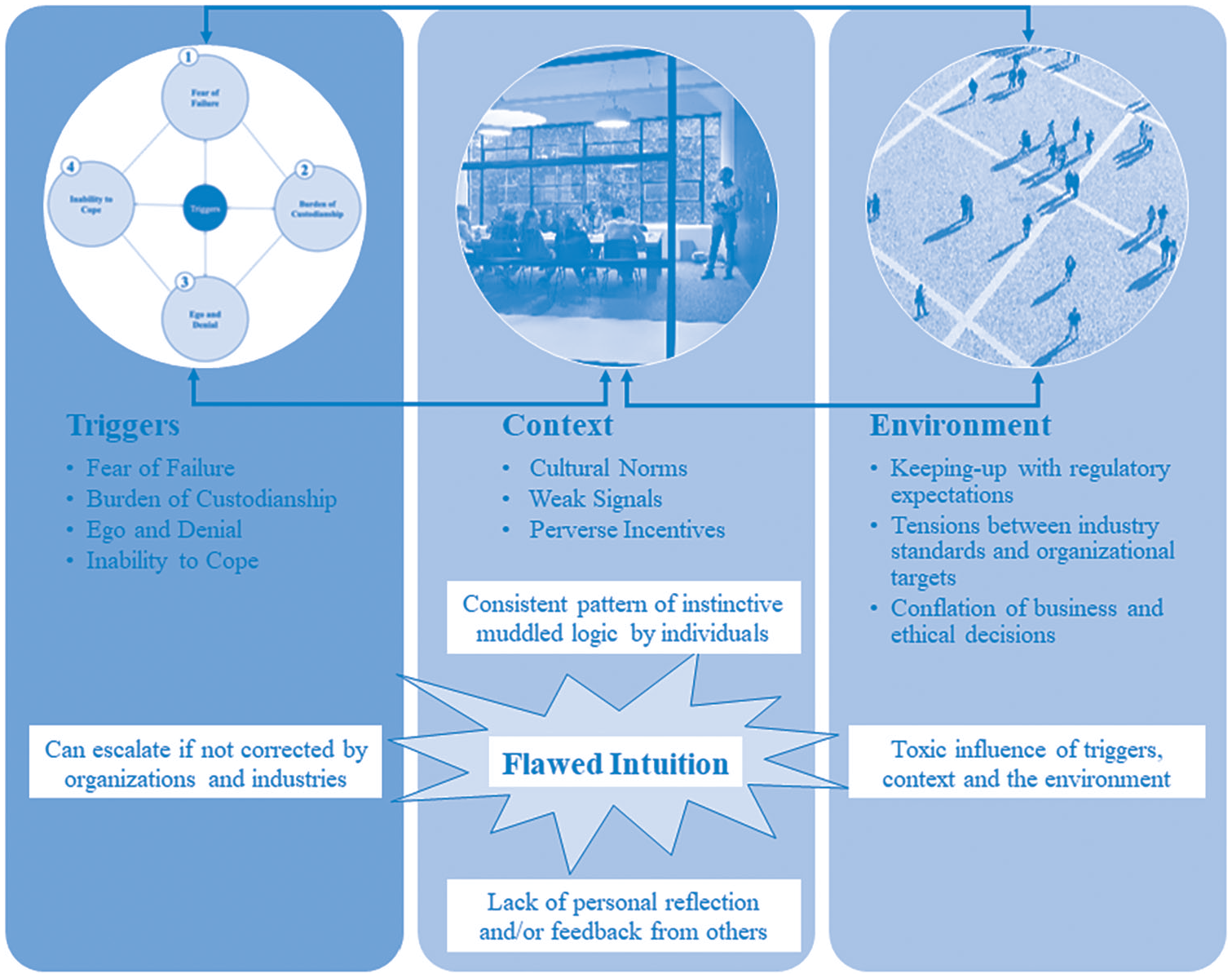
Flawed intuition intersects individual, organizational, and industry levels.
Behavioral Consistency
Managing under stress and emotional distress was “business as usual” for individuals. While they were emotionally distressed and their intuition was flawed, their decisions were deeply anchored in the interests of their stakeholders. The over-zealousness in their roles as custodians seemingly drove them to cross moral and legal lines. Several interviewees admitted that their own bar for custodianship was much higher than those of their stakeholders, which they only realized after incidences of misconduct.
While some of the literature refers to individuals deviating from previous behavior and overlooking blind spots, 27 we found that individuals made decisions and took action that was consistent with their intentions and beliefs. Instead of moral contradiction, we found behavioral consistency, which implies that within the organizational context and industry environment, these behaviors are not being observed or called out and therefore risk being escalated over time.
Pushing Boundaries
Pushing boundaries and finding innovative ways to serve the interests of stakeholders was a powerful instinct for participants. It was also something that led to them receiving awards in the past. This is consistent with research that winners of several annual CEO awards by business periodicals are more likely to fall from grace. 28 Not surprisingly, when there was no evidence of foul play, pushing boundaries was encouraged and celebrated by organizations. Flawed intuition contributed to breaking laws that participants admitted should not have been broken. Ironically, fear of losing their reputation contributed to their pressures and mistakes. Our findings provide empirical support for the argument that individuals can be more attentive to information based on their cognitive predispositions. 29 Surprisingly, given the weight they placed on reputation, we found that participants rarely heeded caution and counsel from their stakeholders. This shows the importance of individuals taking personal responsibility to address feedback, and it is a warning to leaders to swiftly identify and act when undesired behaviors are not redressed.
Unintended Consequences
Taking calculated risks was a key part of the identities of individuals, and they considered it an important attribute and requirement for success while working within their organizations and sectors. Yet, hubris and perceived invincibility from their past achievements—along with prior experience with managing uncertainty and risk with no organizational or industry repercussions—reinforced their confidence to mitigate and manage any unintended consequences. Building on the social-intuitionist model, which suggests that moral judgment is the result of quick and automatic decisions, 30 we use the term flawed intuition to capture the rapid and unreflective cognitive process that seldom involves consultation with others, and which lends itself to individuals making poor decisions without reflecting on their choices.
Maximizing Benefits
The notion of potential victims, especially in their own families, never really occurred to any of the subjects at the time of their flawed decision making. In their minds, they were working as custodians to protect the interests of their personal and professional stakeholders. Most of them expressed shock when they were blamed and charged for their actions. They were cognizant that one of the unintended consequences of their actions, pushing boundaries, would mean victims in the form of competitor companies, customers, investors, and others. However, they believed that in the long run, benefits for their wider stakeholders, particularly those who they considered most salient, would materially and significantly outweigh the detriment and harm to any potential victims. Our data show that under the pressure of aggressive control and compliance regimes, individuals conflate ethical issues with cost-benefit decisions, and therefore, organizational interventions need to focus on individual behaviors rather than be simply mandated and enforced. This would empower individuals to make the right ethical decisions within their organizational context and industry environment.
The uncomfortable reality is that the threat and reality of public vilification and tougher punishments, which are short-term and medium-term responses, are not effective at preventing professional misconduct. The reason for this is when individuals are making routine decisions at the point of misconduct, 31 they are not reflecting on or rationalizing their actions, but find themselves making flawed choices that cross moral and then legal boundaries. The solution is also not solely one for organizations in terms of addressing issues of cultural norms, weak signals, and perverse incentives. 32 Nor is it simply an industry problem related to excessive regulation, unwieldy demands, or unnecessary expectations. Professional misconduct is the outcome of actions and behaviors that occur at the macro-, meso-, and micro-levels of analysis. We do not pretend this is straightforward to solve, but it is a mounting challenge, particularly as the boundaries between home, work, and socializing become blurred through digital devices, technology, communication and social media platforms, gaming, the metaverse, and generative artificial intelligence. Our data show that it is the dynamic interaction of factors at multiple levels of analysis that, when combined, means that individuals are succumbing to flawed intuition and committing professional misconduct.
Limitations and Further Research
Extending the evidence beyond a group, especially to include personal and professional stakeholders, would provide a wider perspective from a multi-stakeholder lens that is increasingly becoming important for managing and sustaining reputation. 33 Exploring ways to understand and dynamically align expectations between professionals and their stakeholders can eliminate several blind spots and help mitigate incidences of misconduct. In addition, technology—especially social media and the sharing economy—featured extensively in our empirical research. The rise of new information and communication technologies—particularly the emergence of social media platforms, the metaverse, and generative artificial intelligence—have accelerated the volume and type of actors who have access to public information, which has intensified the speed at which news unfolds and heightened the risk of polarity around issues. Understanding the role of emerging digital technologies on professional misconduct is a further important area that requires greater exploration.
Finally, we were limited by the regulations and restrictions of a U.S. Federal Prison and had to adapt accordingly (e.g., not being able to record interviews) through extensive feedback loops to confirm and refine our dataset. We hope that this research will catalyze and inspire further research and generate practical insights into identifying and preventing professional misconduct.
Conclusions
Our study has focused on understanding why individuals commit professional misconduct, learning from the unique insights of 70 inmates who were serving prison sentences for white-collar crimes in a U.S. Federal Prison. This context provides a different lens to understand how flawed intuition captures why individuals make corrosive decisions. We define flawed intuition as the consistent pattern of instinctive, muddled logic by individuals who are influenced by a toxic mix of individual behavioral triggers, organizational context, and the wider industry environment. Coupled with a lack of personal reflection and/or feedback from others, flawed intuition explains how individuals cross ethical and legal lines, which can escalate if not corrected. This suggests that the problem is systemic, with individual, organizational, and industry factors working in tandem. We give examples, not to excuse but to contextualize how flawed intuition occurs from the perspective of white-collar inmates who were reflecting on their past actions in prison.
Practical Recommendations
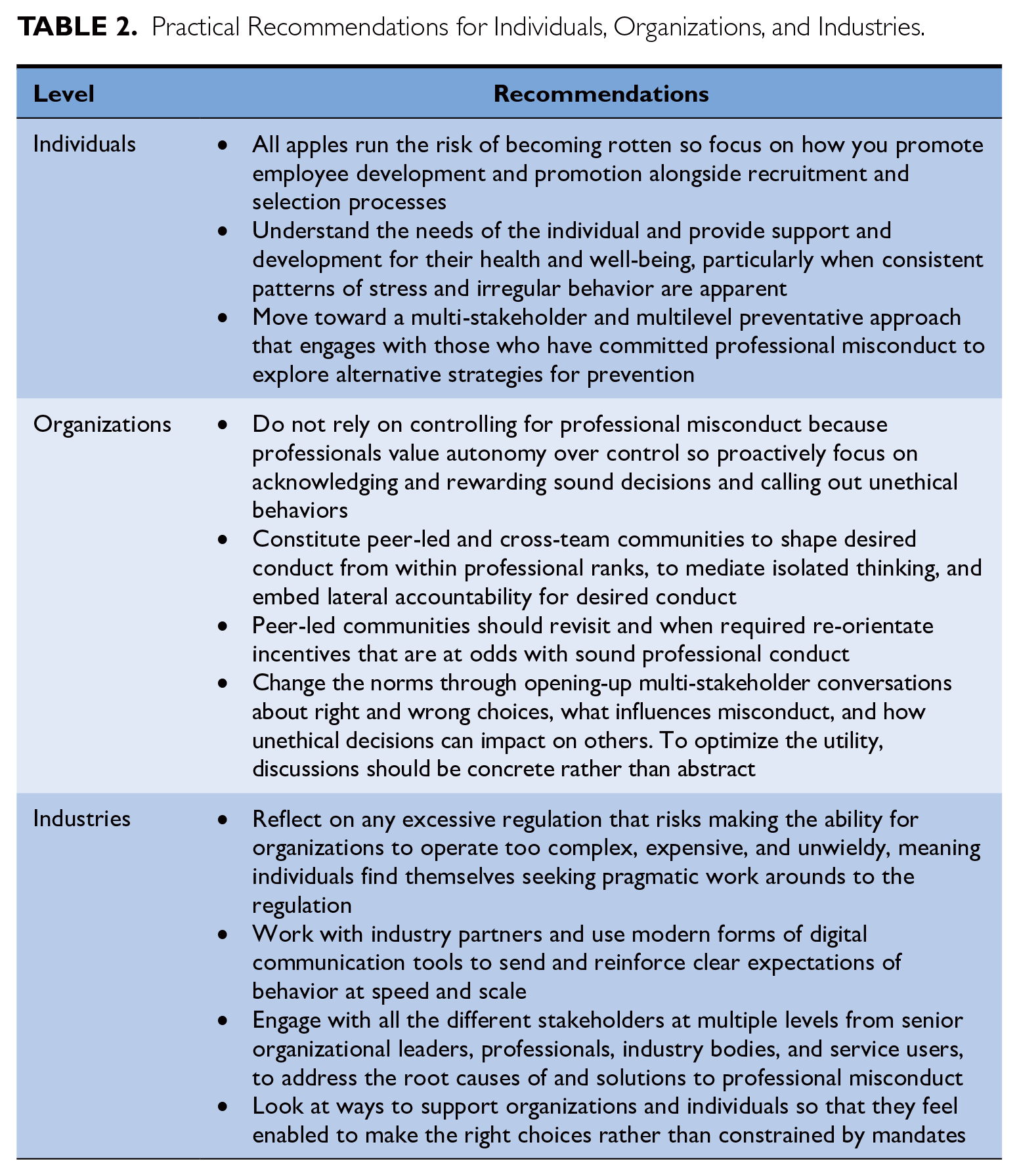
Professional misconduct, like existential threats such as climate change, social inequality, and polarization, does not have a simple fix. Because the problem cuts across multiple stakeholder groups and scales of analysis—from the macro-environment of regulators through to the meso-level of organizational cultures and teams and to the micro-level of individual behaviors—this requires a multipronged preventative approach. Higher walls do not prevent desperate migrants from climbing higher or tunneling lower to get to the other side, with often perilous implications, because the policy does not address the underlying reason why people are moving in the first place. There are no easy solutions to prevent professional misconduct. We hope our focus on what it is and why it occurs provides the necessary insight for leaders to take a first step. We provide some recommendations that derive from recognizing that risks of professional misconduct occur at different levels (see Table 2).
Practical Recommendations for Individuals, Organizations, and Industries.
Footnotes
Notes
Author Biographies
William S. Harvey is Professor of Leadership and Director of the Social Purpose Centre at Melbourne Business School, The University of Melbourne (email:
Navdeep Arora leads strategic transformations in the insurance sector, fostering partnerships between incumbents and insurtech startups (email:
Graeme Currie is Professor of Public Management at Warwick Business School, University of Warwick (email:
Dimitrios Spyridonidis is an Associate Professor at Warwick Business School, University of Warwick (email: