



Abstract
Novel bottom-up forms of organizing, such as agile, have become increasingly prevalent in companies. While such organizing forms emphasize bottom-up employee involvement, they also require commitment from top-level executives. However, knowledge about how companies can move from piloting to scaling agile and top-level executives’ role in managing this transition is currently limited. This article’s analysis of six leading organizations unveils the tensions that top executives need to anticipate and address in each phase of the implementation process to support and progress bottom-up organizing. It also suggests selective interventions that top executives can make to keep the agile implementation process on track.
Organizations must continuously adapt to changing circumstances. The pressure to adapt is exacerbated by tensions in geopolitics, volatility in economic cycles, the speed of innovation, and the war for talent, requiring organizations to make fast decisions yet include and empower their workforce across different levels of hierarchy. 1 In particular, the advent of digitalization and AI, which offer new ways of collaboration across distance and hierarchy, urges managers to rethink organizing approaches and governance models.
This challenge spans many sectors of the economy. For example, a European bank we researched faced the challenge of cost-cutting while needing to improve customer-centricity. An international non-profit organization was looking for ways to foster internal collaboration and help the organization remain relevant to the evolving needs of its clients and beneficiaries. A global pharmaceutical company needed to engage and empower its employees to increase the speed of its products to market. All of them were looking toward more adaptive, bottom-up organizing to address their challenges.
And there is no shortage of ideas about alternative organizing forms. Management scholars and consultants have suggested various forms of organizing that allow organizations to remain adaptive, including agile, adhocracy, and holacracy. 2 What these bottom-up approaches have in common is that they put “employees first”—they rely on more decentralized decision-making and greater levels of participation from frontline employees. They are often credited with increasing customer centricity, innovation, and adaptability more generally. 3 Importantly, these forms of organizing are “brought to life” through employee engagement, even if they are initiated by top-level executives. However, the track record of implementing such bottom-up forms of organizing is mixed. Many firms have tried them out, but attempts to move from pilot to scale-up often fail. 4 For example, while more than 200 international firms claim to practice Holacracy 5 (a specific form of bottom-up organizing built around distributed leadership), there are increasing reports of firms that abandoned it due to chaos and uncertainty as well as employee frustration. 6 Collectively, evidence suggests that bottom-up forms of organizing (such as agile) are often piloted, but afterward lose momentum, lack organizational support, and even create adverse effects when new models are found to be incompatible with existing structures and practices.
Extant research on bottom-up forms of organizing such as agile has examined elements of the change context, content, and process when scaling in an organization, 7 suggesting a taxonomy that includes, for instance, the scope of change, agents involved, corresponding structural changes, and characteristics of the implementation process and required employee development. Others have studied organizational agility as a dynamic capability 8 and have provided insights into multiple challenges and success factors of large-scale agile transformations, 9 focusing on the broader transformation without differentiating between different phases of the implementation process. However, a particular challenge with these novel forms of organizing is that they purposefully create tension between old and new ways of working. Researchers have been enthusiastic or doubtful about the potential of agile, 10 but we are lacking a nuanced discussion about the specific tensions in agile implementations. The literature is also silent about the role of senior leaders in bottom-up organizing, who seek to balance tensions as they move through the different phases of the implementation process.
Our research addresses this issue by focusing on two questions: We studied the attempts made by six organizations to implement a specific type of bottom-up organizing, namely, agile organizing or simply “agile.” Agile started as a software development methodology, and it has evolved into an organizing model built around cross-functional, self-organized teams that set their own schedule and targets and work in iterative cycles directly with users.
We found that the key to success in implementing agile lies less in the specific outcomes achieved and more in how the transition from piloting to scaling is managed. The organizations we studied had mixed levels of success, and for the most part, they did not sufficiently anticipate how the desired change might be achieved, faced tensions, and fell into traps. From our broader experience in this area, we have reason to believe they are not the only ones struggling.
An interesting insight is that bottom-up organizing is not “for employees only.” Half of the organizations we studied drove change toward bottom-up organizing from the top. This may seem self-contradictory at first, but it is, in many organizations, a critical starting point to move ahead with a change. We found that progress was made when top-level executives played an active role in empowering employees and integrating new ways of organizing within the existing organization. Unsurprisingly, too much direction from the top detracted from bottom-up buy-in. However, those organizations relying on employee ownership of the change process (consistent with the philosophy of bottom-up organizing) typically experienced a loss of momentum at critical points, as other priorities took over. Our case studies, therefore, underlined the need to balance top-down and bottom-up engagement very carefully when implementing bottom-up forms of organizing. Top executives need to anticipate where the likely tensions and problems will arise and to make selective interventions in the overall process to keep it on track.
Our qualitative research is based on case studies of six leading international (for-profit and non-profit) organizations in different phases of their change toward bottom-up organizing (PEACE, INSUR, BANK, CONSTRUCT, IT, and PHARMA; see Table 1). We focused on the implementation of agile as a specific form of bottom-up organizing, as it comprises team-based ways of working that can (in theory) be implemented in any kind of organization and allow for comparability across different organizational settings. Despite being initially designed for use in team-based software development projects, 11 many large and traditional organizations have embraced agile as a means of increasing their adaptability to changing circumstances. Agile is also a good example of bottom-up organizing as it involves self-organizing cross-functional teams with clear accountability and close customer collaboration, within an overarching governance structure. 12
Overview of Case Characteristics.
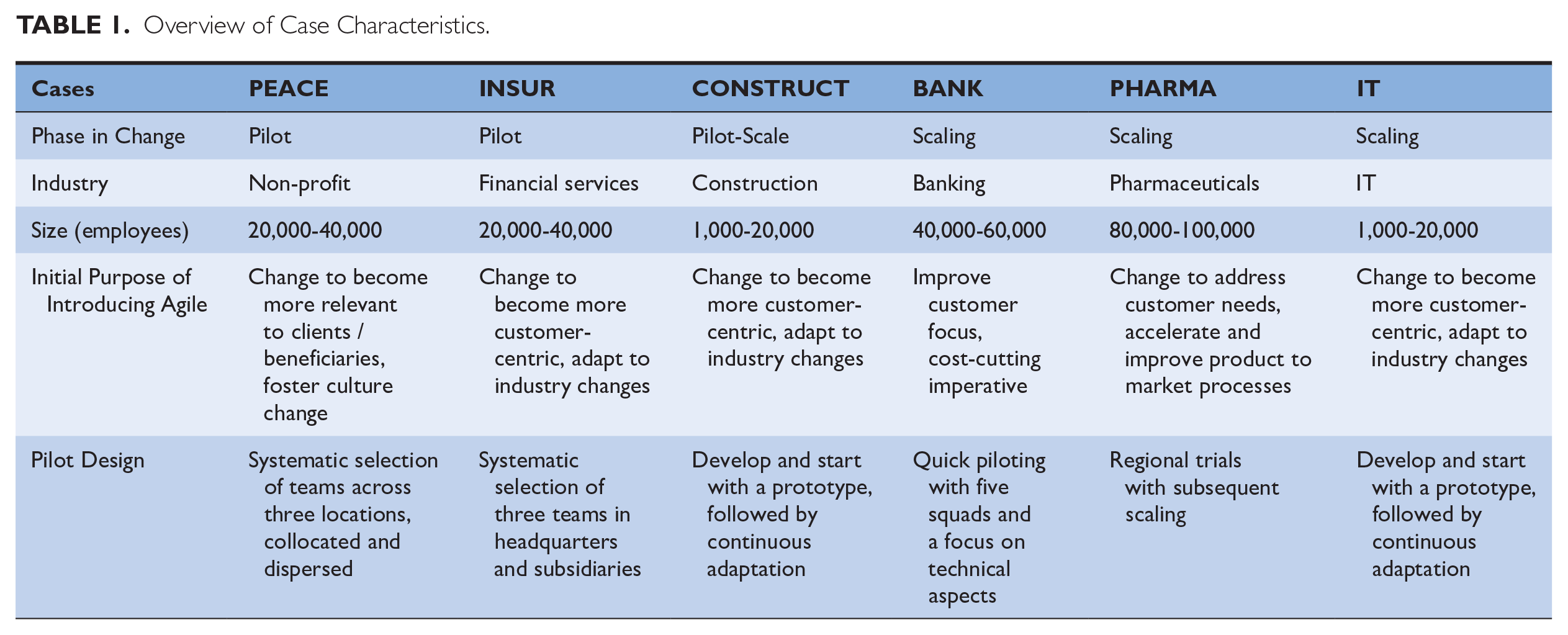
Our analyses reveal that all organizations face tensions relating to structure, process, and culture. But these tensions are experienced to varying degrees and organizations engage in different practices to address these. Collectively, our cases show that, to implement agile as a form of bottom-up organizing, top executives need to anticipate these several tensions in the piloting phase, that is, anchoring in the existing structure versus keeping agile in a separate unit; launching few or many agile teams; and preparing the organization for the change versus initiating without such preparation. In the scaling phase, the critical tensions managers must address are whether they aim at scaling agile broadly in the organization versus more narrowly, integrating agile processes in the structure versus creating dual processes, and imposing versus enabling cultural change in the organization. These tensions manifest themselves at different points, and they require careful attention to avoid the change process failing.
We contribute to the literature on agile organizing by unveiling the central structural, process-based, and cultural tensions that managers need to address in the piloting and scaling phase of agile implementation. Our study also uncovers different pathways of involvement of top-level executives in the agile implementation process, including the key choices they need to make during piloting and scaling and in the transition period between them. For agile implementations steered from the top, there is a need to back off during the scale-up phase to avoid employees becoming burnt out; whereas for those agile implementations that occur organically through bottom-up initiative or by consent from above, a more hands-on approach from top executives is useful as a means of enabling the transition from pilot to scale-up. Based on our findings, we propose selective actions top executives might take in each phase. Our template on the process of agile implementations helps leaders to discuss the right topics in different phases before being caught in an acceleration trap of scaling agile without a careful assessment of its benefits, challenges, and feasibility.
Methodology
To address our research question, we conducted a qualitative study of six cases from different organizations. We sampled based on where these organizations were in the process of change. Two cases (PEACE and INSUR) had piloted agile, three others (BANK, PHARMA, and IT) had scaled it, and one case (CONSTRUCT) was between the piloting and scaling phases. All companies were large and, with the exception of IT, internationally dispersed. All cases except for PEACE had a significant amount of top executive involvement, though the nature of that involvement varied.
PEACE is an international non-profit organization, characterized by a high level of bureaucracy and strong regulation. It started agile pilots to initiate culture change in a bottom-up process led by a cross-organizational staff initiative. INSUR, a financial services company, began its agile piloting upon an initiative from the CEO who aimed for more customer centricity and a better adaptation to a changing industry environment. CONSTRUCT, an international company in the construction sector, initiated the agile process with support from its senior management team, aiming at transforming the R&D organization into a customer-centric, innovative one. PHARMA, a global pharmaceutical company, started agile organizing to address unmet customer needs and accelerate the process to-market. The initiative was driven by top management and rolled out region by region in selected divisions. BANK, a European financial services company, adopted agile to improve customer focus and cut costs at the same time. There was strong leadership of the initiative from top executives. In IT, an organization that delivers information technology services to their clients, the rationale for agile emerged from customer pressure to become more customer-centric, but also from changing industry conditions.
Our data collection included interviews with company employees involved in and responsible for the agile implementation (ranging between three and eight interviews), company presentations as well as internal and publicly available reports. As with other forms of bottom-up organizing, agile initiatives are often used in isolation or for specific pilot projects. But to realize their full potential, there is typically value in seeking to scale them up, which requires careful attention to the organizational context in which they transpire. Yet relatively few scholars have discussed agile as an organizational change process, 13 and strikingly little research has examined the specific ways executives address the tensions when initiating and scaling agile. 14
Our data collection followed the six organizations for up to 12 months, including interviews with top executives and the agile teams themselves, plus archival material such as internal presentations and reports. We found some commonalities in the agile implementation process—for example, they all did a pilot—but we identified some big differences as well—for example, one process was driven purely from the bottom-up, and not all of them scaled up. We used a comparative case design, 15 analyzing the case data by coding tensions during the agile implementation process and approaches to resolve them. Then, we triangulated our interview notes with the secondary data per company and then contrasted our findings across the different cases. Specifically, we compared the three organizations that had piloted agile but not moved further in the implementation, against those that already considered scaling. Piloting means experimentation and testing without a clear concept of implementation, for example, in one unit or selected teams. In contrast, scaling refers to the adoption of agile as a management principle in several parts of the organization, which implies the decision to adopt a replicable agile core (that emerged from the piloting phase).
Three Types of Agile Implementation: Organic, Enabled, and Steered
We identified three types of agile implementation—organic, enabled, and steered—depending on how it was initiated. These types were characterized by different levels of top-executive involvement from none (in the organic case) to hands-off consent (in the enabled case) and high (in the steered case). IT, BANK, and PHARMA were all steered, CONSTRUCT and INSUR were enabled, and PEACE was organic. We observed different tensions across these three types and across the piloting versus scaling phases of agile implementation, which are summarized in Figure 1. The rating refers to where the cases were located regarding each dimension (e.g., one for structure in the pilot phase means that the cases started their agile piloting by first embedding agile teams within their existing organizational structure). After describing the tensions we observed across the implementation phases, we discuss how top executives can intervene to make the agile implementation process work more effectively.
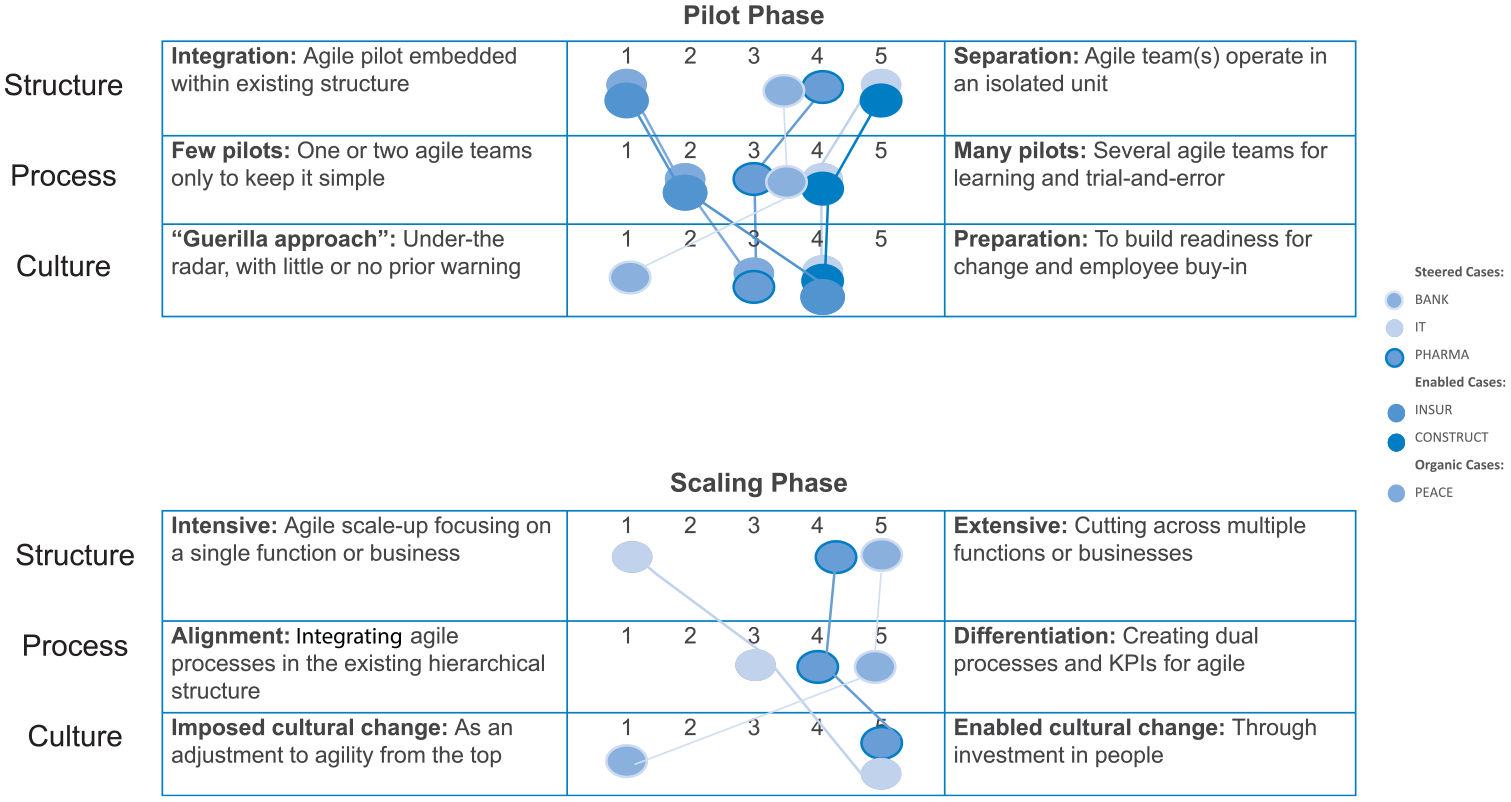
Tensions across the three types and the agile implementation phases.
Tensions in the Piloting Phase
The reasons for starting the agile implementation process varied across the six organizations. As shown in Table 1, the most frequently cited rationale was customer-centricity, in other words, a greater focus on understanding and responding effectively to the changing needs of customers. Other reasons were also offered. At PEACE, agile was seen as a way of improving internal collaboration and helping the organization to remain relevant to the evolving needs of its clients and beneficiaries. At BANK, there was a strong cost-cutting imperative alongside greater customer-centricity. At PHARMA, some people mentioned customer centricity, others talked about increased speed to market. Often, we observed significant differences in motivation. These differences created challenges later, as people at different levels were not focusing on the same objectives.
A frequent pitfall, in other words, was that decision makers within the same organization had different concepts of agile in mind and were also aiming to address different strategic challenges. One solution was therefore to engage in an awareness-building process to make sure all those involved were aligned. Looking across the three types of agile implementation, those organizations with a steered process found it fairly straightforward to create a shared understanding, because the process was driven from the top. BANK, for example, had a lengthy offsite meeting during which the imperative for change was formulated, and it was then communicated to those at lower levels. In organizations with an enabled process, top management supported the adoption of agile, but more work was needed to bring top-level and middle-level executives to a shared view. At INSUR, after some initial confusion, the senior team gathered a critical mass of people who were proponents of agile and gave them a mandate to move forward with the piloting. At CONSTRUCT, they did not resolve everything up-front. Instead, they agreed to do a pilot to help the various teams evaluate if and where agile organizing makes sense in their organization.
Finally, in the case of PEACE with its organic process, the rationale for the agile initiative was agreed upon among the mid-level employees but only in a very general sense of seeking to engineer a new way of working in the organization. Arguably, this lack of top executive involvement at the outset made the subsequent scale-up more difficult. Indeed, an important observation across the six organizations is that we saw relatively slow progress toward scale-up in those that did not have a strong shared understanding up-front.
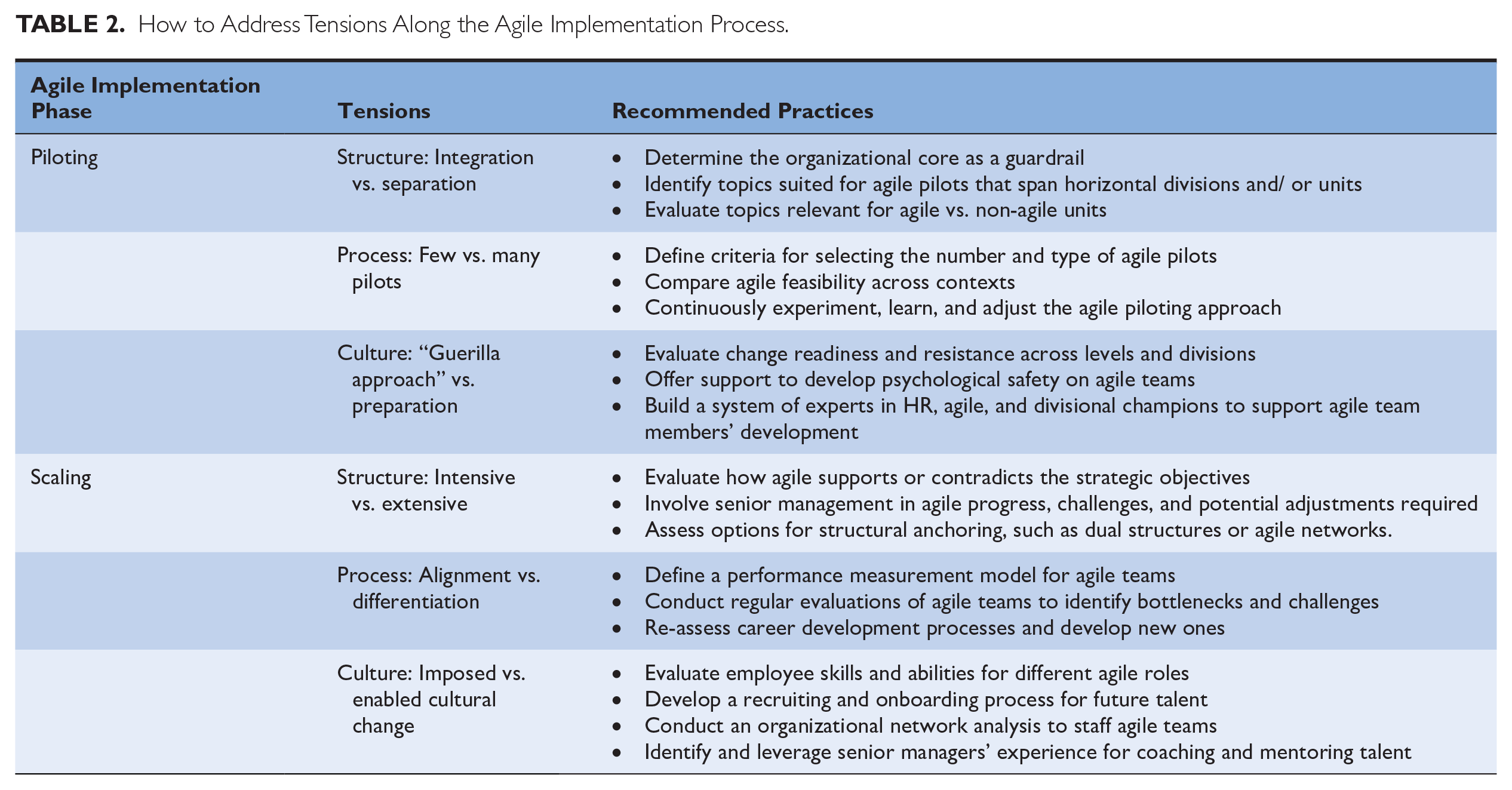
Comparing the cases, we found that three types of tensions emerged when piloting agile relating to structure, process, and culture. The design choices for the pilot showed quite a lot of variation in how they were anchored in the organizational structure, how they launched agile teams, and how the organization was prepared for the change. Of course, there is no right or wrong approach here: the choices made in each case were highly context-specific. The common tensions we identified may guide organizations to think through their options and how to address them. We distilled several useful practices to address these tensions, which we highlight in Table 2. And the choices made at this stage affected the subsequent choices in the scale-up stage.
How to Address Tensions Along the Agile Implementation Process.
Structure Tensions: Integration Versus Separation
Almost as a matter of definition, agile organizing clashes with the rules and procedures of the formal organizational structure. The first tension in the pilot phase, as shown in Figure 1, is whether to embed agile teams in the existing structure or to run them in a separate isolated unit. For example, in PEACE the three pilots were embedded in the existing structure. They were welcomed as a “workaround for bureaucratic, centralized decision making and outdated hierarchies,” but soon they met the “hard reality of the bureaucracy,” and they struggled to get traction. Others, notably CONSTRUCT and IT, started with agile organizing in a separate unit, which gave them useful protection in their initial work but little sense of what might come next in a potential scale-up.
One useful approach we observed was to define organizational guardrails 16 that could not be breached—particularly in mission-driven organizations with vulnerable stakeholders and beneficiaries, such as PEACE or in highly regulated industries, such as insurance or pharmaceuticals. As a Head of Quality Control at PHARMA told us, “The safety and quality control always come first. And we have to comply with the regulations in every country our products are registered, which makes it challenging to change existing structures.”
The steered cases leaned more toward anchoring agile teams in a separate unit—which is easier to govern from the top executives’ perspective. There was more variance among the other two types: CONSTRUCT, an enabled case, also opted for a separate structure for agile teams, while INSUR deeply embedded agile teams in the hierarchical structure to ensure knowledge exchange across the organization. PEACE, the organic case, also used such an integrated approach, not surprisingly, since agile was driven by employees in dispersed parts of the organization. No matter which approach was pursued, we found that driving the implementation forward while at the same time protecting organizational guardrails was most promising. Organizations such as PHARMA and INSUR that reflected on this early on were able to progress in their agile implementation more prepared.
Process Tensions: Many Versus Few Pilots
A second tension we observed was about the process of piloting—whether to start with many pilot teams or few. While INSUR started with three agile pilots, CONSTRUCT, BANK, and IT developed a prototype for the new agile organization with many teams. In PHARMA, the large number of pilots helped them to test agile organizing across several important areas, but it led to some uncertainty about the intended change and its consequences for employees. Conversely, a small number of agile pilots allowed decision makers in INSUR to keep the agile experimentation less visible (much like a “secret experiment”) and gave them more time to learn. However, it gave them less scope to test the applicability of agile in the broader, complex organization. Overall, we observed quite a lot of differences in the number of agile pilots used across the three types of agile implementation. Hence, whether agile was implemented from above or below played less a role in how things worked out than whether people took the test-and-learn approach to implementation seriously.
We found that tensions arose when the piloting decision was taken in an ad hoc way, without much thought about its consequences. A useful solution we observed was to systematically design a customized pilot concept to compare results by defining the criteria for selecting the number and type of agile pilots and involving different types of units for the agile team’s specific topic areas. Customization implies a careful context-specific design, rather than using criteria that are picked up from other companies. For this approach, a minimum threshold is needed to have a valid comparison. PEACE took such a systematic approach, selecting teams within divisions, across divisions, and internationally dispersed ones for a comparative study. One participant commented, “Where our client is questioning the usefulness of [our] work . . . experimenting and learning rapidly is very important to us to make us relevant, and it is important . . . to reflect and learn from our experiences and move ahead.” At the time of this writing, several divisions in the organization were discussing where and how the introduction of agile teams was useful and should be pursued further. In sum, our respondents argued there shouldn’t be too many agile teams (to allow for some “silent experimentation and learning”), but there had to be sufficient to test the new way of working with users in a concrete way.
Culture Tensions: “Guerilla Approach” Versus Conscious Preparation
A third tension arose in all six cases related to the cultural dimension around the level of tolerance for agile organizing among the mainstream organization. Leaders debated whether they should keep the pilot under the radar and pursue a “guerilla approach” to affect the remaining organization or whether to carefully prepare for change by building employee readiness and buy-in. Across all six organizations, it was recognized that agile organizing would be disruptive, pushing people out of their comfort zone, and that it would ultimately need a lot of commitment and trust to succeed.
We saw various approaches used to achieve the desired level of employee buy-in. Interestingly, BANK, a steered case with top executive-led initiation of agile, decided to experiment with agile with little preparation. A senior manager at PHARMA warned: “If you go on such a journey . . . you have to unlearn many things that made you successful in the past, and learn new things that may be uncomfortable for the first time.” Hence, there can be substantial resistance among employees to the agile organizing approach. We observed that resistance does not always come from the lower ranks—there were also cases where agile efforts were blocked by superiors. This required a focus on leadership from the top in facilitating the use of agile collaboration techniques and, most importantly, the support to foster a psychologically safe environment 17 (through both mindset changes at the top as well as resource allocation). In one of our workshops, a manager from PEACE said, “Psychological safety is really the prerequisite to use this in the work environment . . . That is the most difficult thing to create as a manager . . . giving this space to learn and to fail.”
In five of the cases, we observed those leading the agile initiative seeking to build readiness among employees, for example, through workshops and seminars that introduced the initiative. At INSUR, for example, the pilot included people from the strategy and human resource teams with a career history in the organization to raise awareness of (potential) employee resistance and the need to onboard motivated employees for the agile way of working. A manager of CONSTRUCT told us: “We ran an employee survey every two weeks in order to assess how the employees involved felt about agility and to receive feedback. We also collected regular feedback from our customers.” The one exception was BANK, which conducted its pilot quickly and with little attempt to build readiness in the organization because it was planning to move into scale-up mode within a six-month period. In other words, their pilot was intended to guide through the more technical aspects of how agile would work, rather than as part of the broader acculturation process.
We conclude that resistance to agile approaches does not have to be negative per se, but can provide important insights into how to pilot agile without overloading the organization or leaving employees who are not involved in agile pilots behind with frustration and anger. A key solution is to continuously monitor resistance and quickly address concerns.
From Pilot to Scale-Up (or Not)
The extent and speed of scale-up following the pilot varied dramatically across the six organizations. The three steered cases (IT, BANK, PHARMA) all embarked on a scale-up, though with different ways to address corresponding tensions and different levels of success. The two enabled cases moved forward more slowly. INSUR had been cautious and conscious of the potential challenges ahead. They were worried that there may not be enough employees willing and able to work in agile teams if they continued. CONSTRUCT had a prototype “agile organization” in mind, but they were also concerned about the level of motivation among employees for carrying on the initiative, and a couple of key individuals (who had been championing agile) left the organization. As a result, the agile initiative was put on hold at CONSTRUCT. Finally, the one organic case (PEACE) continued to make progress but very slowly, in large part because of the lack of top management vision. While PEACE seemed least prone to change, pilot participants told us they believed that agile principles could help create new ways of interacting as a team and change the organizational processes, making work less hierarchical and more collaborative in selected areas. This suggests that the principles of agile can have a positive impact even without a full scale-up process.
Across these cases, the extent of top executive support and commitment was a key predictor of whether the agile pilot was scaled up. However, the decision to scale up did not necessarily equate to success, because a premature or ill-conceived scale-up could also backfire. As we discuss below, the three organizations that scaled up had mixed outcomes, with some cases of cynical or burnt-out employees questioning whether agile was working for them.
A couple of points are worth highlighting about the process of transitioning from pilot to scale-up. First, communicating the results of the agile pilots was generally seen as a good thing to do, but in a measured and careful way. As a respondent at PHARMA commented, “It is tempting to dress up the outcomes as positively as possible to help build momentum for change, but this can also backfire if those results are not authentic or cannot be sustained.” Second, it is important to monitor the level of ongoing enthusiasm for agile at all levels. One manager told us, “Agility often means high initial excitement followed by reduced energy among the company leaders.” Another mentioned, “We used a bold approach going through sprints, which was great energy and great momentum . . . Yet, when you start to implement, the momentum is gone, the excitement is gone.”
The decision to scale up an agile initiative is therefore a difficult one because it cannot just be left to happen. We saw some cases where a conscious decision was taken to limit the new organizing approach to selected topical areas or divisions where the impact was highest and the organization was most accepting (see Table 1). And withdrawing did not mean that the initiative had failed; in some cases, the pilots left important marks in the organization, such as increased confidence, motivated employees, or a simplification of bureaucratic processes.
Tensions in the Scaling Phase
Scaling typically involves the replication of agile pilots across different parts of the organization while remaining adaptive in the approach to implementation. The main tensions that needed managing related to the further structural anchoring of agile are the aligned versus differentiated processes for agile and the imposed versus enabled cultural change. As before, there were no right or wrong choices here, with PHARMA and BANK opting for a more extensive scale-up and IT opting for a more intensive scale-up. It is also worth noting that, while all scaling cases were steered, that is, with high levels of top management involvement, the pathway for scaling agile varied considerably. The design choices in this phase were partly a function of the pilot’s results as well as top executives’ preferences and focus for organizational change.
Structure Tensions: Intensive Versus Extensive
The most prominent tension was how extensive the scale-up was made. Was it done broadly across the organization, which implied a major organizational change, or more narrowly by focusing on specific divisions or functions? To our knowledge, there are no large established organizations that are “fully” agile, so the question of how quickly and how extensively to roll it out is important. In our sample, IT chose an intensive scaling approach, focusing on a narrow area where agile was scaled deeply. Many of our respondents emphasized a clear rationale for scaling agile more extensively, which became more apparent once they had created a list of strategic or organization-wide ambitions that were suited for agile and could be addressed in a further roll-out process. One manager told us it was already important early on to “think about our approach and timeline for scaling, which does not have to be the case in all departments and functions.” Other managers highlighted the need to develop a solution within the portfolio of corporate activities that includes specific topics or areas suited for agile implementation while acknowledging the limits to how far agile should be scaled. This sets a pathway for an organizational change process with clear objectives and robust indicators.
An expert on digital transformation stated, Many organizations start agile in a wonderful way, with a manifesto, and then they make the mistake of going to and listening to consultants. They have frameworks . . . then they start defining the roles . . . so there is no agility left. What they completely miss is the user story. For whom? Why are we doing this?
Hence, to scale agile extensively, our data suggest it is important to maintain the agile organizing approach for specific objectives that suit it, such as focusing on enhancing customer-centricity. For example, PHARMA had created a number of innovations, but they were unable to bring them to the patient at a reasonable cost. They introduced agile in order to improve their proximity to the patient. The scaling process was then guided by the need to increase the speed to market while maintaining a high-quality standard at a reduced cost for society. With these clear and measurable goals (cost, quality level, and speed to market) in mind, they carefully selected topics within and also across regions, which created an adjustable road map for the scaling of agile.
Overall, we found that companies that engage in extensive agile scaling also select focal areas with measurable objectives to adjust the company structure and integrate agile teams gradually. This reduces the risk of agile principles clashing immediately with the existing structure and harming knowledge exchange across the organization. This risk is higher in companies that scale extensively compared to those that focus on scaling intensively, in a particular function or business, like IT did. PHARMA and BANK, therefore, opted for a mixed approach, with traditional hierarchy prevailing in some units and agile in others. Scaling extensively required involving senior managers in the progress made by agile teams, the challenges the teams encountered during their agile set-up, and the necessary adjustments for scaling further.
Process Tensions: Alignment Versus Differentiation
Our findings suggest that a key question in scaling agile is whether to align the organization with the increasing number of agile units or to maintain differentiation by keeping dual processes in place. Interviewees highlighted that this was particularly important for the organizations’ information sharing, career development processes (in terms of performance measurement), and customer interfaces.
Whether a more aligned or differentiated approach was taken, a key theme we observed was the establishment of a supportive infrastructure that would create the space for agile organizing. For example, IT sought to support its agile teams through a differentiated approach by accounting for agile in performance measurement. BANK put in place a new quarterly business review process that sought to reconcile the traditional top-down demands of the organization with the bottom-up information coming from the agile teams. The Quality Control Head in PHARMA explained the importance of adjusting KPIs: Being an organization with a strong purpose to increase benefits for our patients, there are high expectations of my team members: They have been given the challenge to develop a self-organized and empowered organization (which takes time and effort), while also delivering productivity gains (which creates tensions). So, we need to work together to align this. Over and over again.
In addition to KPIs and information flows, there was also concern about the recruiting processes for hiring suitable talent and creating the right incentives. We observed that the more employees became involved in agile teams, the more senior management had to re-think the conventional career trajectories and career development processes in the organization, coming up with a differentiated approach. As is widely recognized, agile tends to make vertical career development obsolete, so employees instead learn to build and leverage their social capital horizontally. We observed some managers taking over the roles of coaching and developing younger employees or moving into specialized roles, and it was clear that these organizations were still coming to grips with how to communicate different trajectories to their employees.
All organizations struggled with the adjustment of processes. Those who proactively reviewed their processes and selected where to integrate processes and where to create dual pathways to differentiate managed to ease tensions. There was, in sum, a balance to be struck between setting up new processes for governing and supporting agile teams and providing the freedom they needed to fulfill their activities, as suggested by a manager of IT: “Agile requires key processes and structure, but the key question is how many processes we established to avoid blocking agility and flexibility.”
Culture Tensions: Imposed Versus Enabled Cultural Change
The third tension focuses on how cultural change originated and was “lived” in the organization. Cultural change is sometimes imposed from the top, and employees face pressure to follow suit. Alternatively, cultural change can be enabled and “co-developed” through investment in employees and participation. The three organizations that undertook a scale-up differed in their approach to managing this tension, revealing that top management’s initiation of agile in steered cases does not imply that cultural change is also imposed from the top.
BANK adopted a radical and imposed approach to foster cultural change: It continuously emphasized the culture of the new agile organization from the top, especially when hiring and staffing agile positions, and let go of employees who did not show the change capabilities required to work in agile units. Conversely, IT and PHARMA emphasized cultural change by investing in employees’ capability development. These firms recognized that there was still considerable work to be done in building new skill sets for working effectively in this new way: We are asking our leaders, most importantly, to develop senior coaching skills. When applied for the first time, you really see how much you are struggling. How do we do this? Coaching buddies, simulations of employee conversations, iterative feedback sessions, and failing forward is becoming the theme . . . practice, practice, practice and seeing how others are also struggling and supporting each other is essential on this journey,
explained a seasoned manager at PHARMA. It was also pointed out to us that young employees may be willing to work on agile teams, but they can lack the maturity to face accountability. For instance, one manager at IT told us: “Young talent requires a lot of development and coaching to avoid burnouts. Our tribe leads are senior managers and take over strong coaching and mentoring roles for younger colleagues to avoid such burnouts.”
To address these tensions in the scale-up stage, a nuanced analysis of capability development provides organizations with critical information because agile organizing requires people to specialize in different roles (e.g., tribe lead, chapter lead, and product owner). As observed by a manager at IT, “We critically assess all employees’ competences, from product owner to tribe leads, via individual assessments and tests.” Regular “pulse checks” were important to keep an overview of major learnings, challenges, and potential resistance 18 toward scaling agile.
Overall, we observed a variety of approaches to identifying and developing people with the necessary capabilities. One approach mentioned was to use organizational network analysis (ONA). 19 Research suggests that staffing agile teams with star employees is ineffective—instead, they may compose teams of “hidden stars,” who face lower workloads and bring in employees who are well-connected to different functions to share their expertise as needed. 20 ONA helps to identify key relationships, opinion leaders, and well-connected employees in the organization. Table 2 summarizes the tensions and practices of the scaling phase.
Implementing Agile Organizing
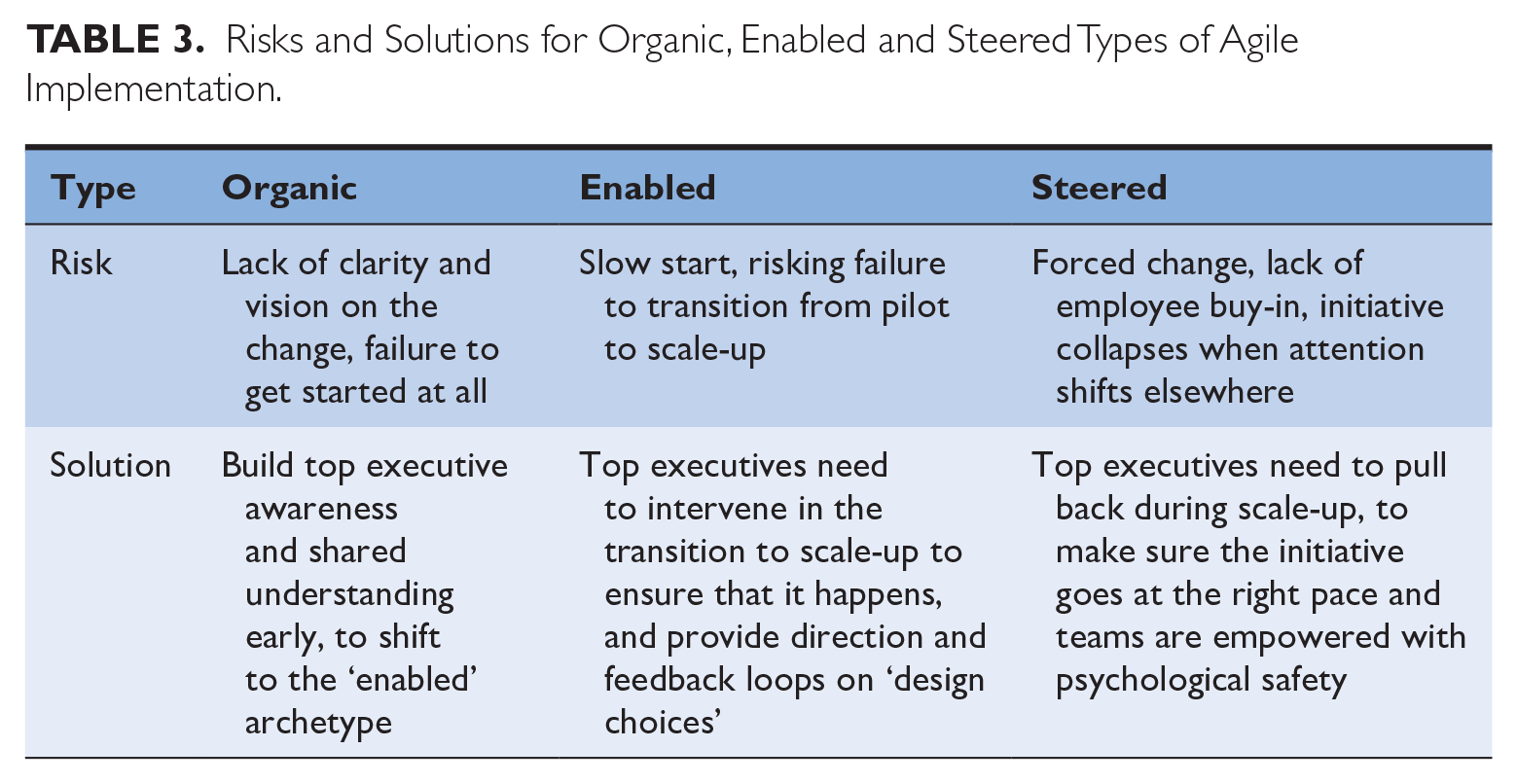
The cases we studied all started their agile implementation journey with a clear rationale for change. Despite the differences in progress between organizations, all showed that agile organizing is a continuous change journey that requires leadership support as well as employee buy-in for implementation. Our case studies suggest that each type of agile implementation has its own pros and cons. Those steered from the top (IT, PHARMA, BANK) tended to transition easily from pilot to scale up, but with concerns about burn-out and cynicism among employees and a worry that buy-in from lower level had not been achieved—which meant it would not be sustainable once top executive attention had shifted elsewhere. This challenge intensified as the more ambitious firms moved from piloting to scaling, as BANK did. Those enabled from the top (INSUR, CONSTRUCT) were likely to have higher levels of employee buy-in, but they took longer to get going, and our (limited) evidence suggested that they did not move readily into scale-up after piloting. Finally, the organic type (PEACE) was attractive in theory as a way of getting employees to take ownership of organizational development, but in our experience, as exemplified by PEACE, it runs a severe risk of not scaling up because of a lack of vision among top executives where this change might lead to.
We, therefore, came to the view that top executives have to be selective about when and for how long they intervene if their objective is to facilitate a bottom-up change process. For the steered type, our view is they should seek to involve lower levels of the hierarchy as the initiative moves into scale-up to ensure that they don’t overwhelm the organization with too much or too fast change. Checking how the organization adopts agile and change readiness 21 helps to assess potential risks and challenges, but the latter may not be resolved by top executives only. Instead, employees involved in agile initiatives need to be heard and empowered on a continuous basis to ensure that the agile scaling is paced appropriately—and does not run out of steam.
Conversely, for the enabled and organic types, top executives should selectively intervene more. They need to provide a clear direction about the type of change they are trying to achieve and link agile objectives to their organization’s vision. This need became evident in the early phases of seeking a shared understanding as well as in the transition to scale-up as a means of ensuring that it happens at all. For these types, it is essential to provide a clear purpose and commitment to agile by senior leaders in the organization and to establish feedback loops with agile teams to re-align.
While our research suggests that selective intervention is key during the agile implementation process, we noted that senior leadership interventions differed in their nature and over time. For instance, there might be several initial proponents and catalysts for agile in the top management team who are more involved in the early piloting phase, and the entire top management team may become involved later, before the decision to scale agile, to discuss corresponding implications for the entire organization design. Others mentioned that the senior executives became involved more punctually to remain informed about early agile pursuits but were certainly more involved before the decision to scale agile. Importantly, the top management may also change over time (as we saw at CONSTRUCT), which changes the dynamics in the team and the support and commitment to agile, implying adjustments to the change process. Table 3 summarizes the risks and solutions for each of the three types.
Risks and Solutions for Organic, Enabled and Steered Types of Agile Implementation.
An important contribution of our research is that it highlights the tensions that emerge during the piloting and the scaling phase. Agile is often portrayed as a solution to the ever-increasing quest for adaptability, but it also comes at a cost. 22 Senior leaders have to carefully prepare and pilot agile in order to evaluate whether and how scaling across the organization can be beneficial. 23 Since the identified tensions in structure, process, and culture provide threats to a successful implementation across all organizations, it is essential to anticipate and carefully manage them. An important aspect is to reflect on the learnings from piloting and include them in the assessment of scaling options.
We conclude that the above-mentioned selective interventions by top-level leaders are indispensable in a bottom-up change process. Organizations need to develop practices to address these emerging tensions (listed in Table 2). This process is not a linear one, where more agile teams equal more agile. Rather, it requires a constant reflection of where agile organizing makes sense and where it does not. And there may be a tipping point where the organization may not be able to sustain more agile approaches, as it is overburdened with managing the tensions that emerge along the process. As the organization transitions toward scaling agile further, there will be even higher pressure for larger changes in career trajectories, leadership roles, incentive systems, budgeting, and governance.
Our cases show that scaling agile (like other forms of bottom-up organizing) is challenging because it requires a fundamental rethinking of all aspects of the organization. But it is not impossible. Even if some firms may put it on hold or slow down with the implementation after experimenting with the first agile pilots, the agile mindset may prevail in these pilots, which can build the seeds for the subsequent and broader change process, as the case of PEACE showed. If leaders decide to scale agile beyond the first pilots but not organization-wide, the agile mindset likely prevails among (part of) the senior leadership team, and it becomes even more important to constantly assess the challenges and possible approaches to deal with intensifying tensions over time.
When discussing agile organizing with executives, we are often asked how long the different phases of an agile implementation should last. Our answer is, There is no single duration for each phase, but it must be consistent with several organizational contingencies. If leaders are fully committed to agile, have clear organization-wide topics for agile pilots in mind, and their change readiness assessment yields high scores, the organization may move quicker through the pilot phase compared to a traditional, large organization that hasn’t changed in a while. It is, however, important to develop a process and timeline for preparing and piloting agile.
In addition to these managerial insights, our research also provides a complementary perspective to the scholarly discussion on agile, 24 which has mostly taken a narrower perspective on specific functions. 25 This discussion has focused on people and teams 26 or has unveiled the broader challenges of agile implementation and change-related aspects such as the scope of change and the development and involvement of different employees. 27 Yet, this debate has left unanswered how large, established organizations may scale agile 28 while addressing the tensions associated with such a form of bottom-up organizing. Our study complements this research by unveiling the underlying tensions in structure, process, and culture, as well as how top executives can selectively intervene and address them. In this respect, our study calls for a shift in perspective to consider the different tensions associated with new ways of organizing. With our guiding template on the process of agile implementations, leaders can address the right structural, process-related, and cultural issues before scaling agile too fast and without a careful assessment of its benefits, challenges, and feasibility.
Footnotes
Notes
Author Biographies
Patricia Klarner is a Professor and Director of the Institute for Organization Design at Vienna University of Economics and Business (WU) and founding Director of the WU Leadership Conversation series (email:
Tina Ambos is Professor of International Management at the Geneva School of Economics and Management (GSEM), University of Geneva and Director of the Center for Innovation and Partnerships (email:
Julian Birkinshaw is Dean and Professor at Ivey Business School in Canada and Professor (on leave of absence) at London Business School, UK (email: