Abstract
This study presents a metaverse flywheel model providing insights into how the emerging layered modular architecture of the metaverse can enable new types of value-creation opportunities for organizations. Based on interviews with early metaverse adopters and innovators, this article identifies three key metaverse affordances: prospection of future conditions, persistence of editable and evolving virtual spaces, and integration between virtual and physical worlds. The findings enhance the nascent metaverse literature by highlighting that new organizing logics are required for metaverse-specific value creation, which goes beyond the previous generation’s isolated 3D models and other interfaces.
Although scholars have begun to converge on the contributing factors 8 that enable creating and experiencing virtual worlds, we have barely scratched the surface of how firms can create value in the metaverse. 9 Given the nascent state of the technology and the lack of dominant designs, standards, and business models, companies are struggling to concretize and scale their metaverse initiatives. It is not clear how firms can materialize the early vision of the metaverse into concrete strategic advantages that allow them to create value for their internal and external stakeholders. Indeed, notable firms such as Meta (which changed its name from Facebook to highlight its metaverse vision) and Disney have recently been scaling down their metaverse ambitions. To move forward from this transitional period where there is ambiguity over the winning technological architecture, it would be beneficial to focus on novel organizational practices and processes that help to create value on top of the continuously developing metaverse technological architecture. Against this backdrop, we pose the following research question: What are the emerging organizational logics of the metaverse for creating value across physical and virtual worlds?
Building on rich empirical qualitative data, our study addresses this research question by developing a model of the metaverse flywheel with two layers. The infrastructure layer relates to the emerging layered modular architecture, 10 including constantly evolving technological building blocks of the metaverse—its infrastructure, interfaces, devices, platforms, and design principles—which are the crucial “nuts and bolts” for the creation of virtual worlds. While the infrastructure layer is crucial for the metaverse to function, our study particularly focuses on the less-understood second layer, which we call the metaverse affordances. Metaverse affordances are the unique possibilities and opportunities emerging from evolving relations and functions between the technology and users of that technology, as well as between users. While the infrastructure layer represents the “nuts and bolts” of the flywheel, the metaverse affordances are the “bearings,” helping organizations to achieve value-creating outcomes over the ever-improving technological architecture. Since we expect the technology to improve gradually over the next years and decades, we believe it is important for managers and professionals to focus particularly on the new organizational logics enabled by the metaverse—i.e., the metaverse flywheel—to tap into the new strategic opportunities as they arise.
Based on a qualitative study with a data set of 25 interviews with early adopters of the metaverse holding different roles in the metaverse ecosystem, we identify three metaverse affordances: the prospection of future conditions and possibilities in metaverse environments, the persistence of editable and evolving virtual environments, artifacts, and identities, and the integration of insights and experiences in the virtual world to those in the physical world and vice versa. Our study contributes to the existing metaverse literature by developing a technology affordance view describing the organizational value-creation potential in the metaverse as a layered modular architecture. We further adopt a relational view of digital technologies, 11 as we portray metaverse technologies as relational entities that shape the organizational logics in a way that changes the relationships between the technology and its users, and between users, including both organizations’ employees and the customers. For managers, our study contributes by providing practical guidance on core business benefits, technological bottlenecks, and new organizing logics needed for creating value and identifying strategic advantages in the metaverse.
Conceptual Background
From Virtual Worlds to the Metaverse
The term metaverse first appeared in science fiction, in Neal Stephenson’s Snow Crash, published in 1992, where it is described as a virtual world that users can enter and interact with avatars to escape from a physical world that is under threat. From that moment, the literature has gradually moved from describing virtual worlds to characterizing a more overarching vision of the metaverse. We provide a summary of this development here to demonstrate how the early vision of the metaverse is gradually concretizing into something broader and more cohesive than the more elusive notion of virtual worlds.
In 2001, Schroeder and colleagues studied Activeworlds, a nascent virtual world allowing developers and users to generate virtual spaces for a variety of interactions with avatars. 12 A few years later, researchers started looking at whether multiplayer online games could be repurposed to serve more general functions in society. 13 More recently, scholars began paying attention to online electronic environments and computer-based simulations built on the foundations of Web 2.0, in which people can work and interact in a somewhat realistic manner while also creating and exchanging user-generated content and becoming developers of the system itself. 14 For instance, Bainbridge noted that a virtual world refers to an “electronic environment that visually mimics complex physical spaces, where people can interact with each other and with virtual objects, and where people are represented by animated characters.” 15
After these early studies recognizing the potential of virtual worlds, voices regarding their business opportunities, marketing potential, and avatars for consumers have populated practitioner-oriented and scholarly journals. 16 In 2009, for instance, Kaplan and Haenlein studied Second Life and emphasized the need to understand how firms can capitalize on these emerging virtual worlds for marketing and branding purposes, demonstrating how virtual worlds can be viewed as extensions of users’ physical lives. 17 It is important to note that in this early research, the term “metaverse” is scarcely mentioned, with the exception of an article by Bourlakis et al., who note that it refers to “virtual worlds extending our physical universe by adding new dimensions and domains for economic, social, and leisure activities.” 18 Thus, in the rare cases where the term “metaverse” was used, it was essentially synonymous with the notion of a virtual world.
Following Dwivedi et al., op. cit. we argue that the current vision of the metaverse differs from the previous concept of virtual worlds due to three factors: It offers greater immersion; it is accessible not only via personal computers but also via multiple devices including mobile, which provides greater continuity and integration between the real and the virtual worlds; and it is associated with Web 3.0 technologies such as blockchains which can improve stability and economic efficiency of virtual economy and ownership. Beyond these features, the metaverse is expected to extend beyond a single app or a single, separated virtual world, and rather constitute “a set of independent virtual worlds to an integrated network of 3D virtual worlds” that will allow richer interactions. 19
To understand the organizational and strategic potential of the metaverse, we draw on a relational view of technology as our overarching theoretical foundation 20 and build on the literature on technology affordances 21 and layered modular architecture of digital technologies. 22 Examining technology affordances from a relational view portrays affordances emerging through engagements with the metaverse’s different components and the relations among those. In particular, the relational view allows us to move beyond a “technology-centered, entity-focused approach by considering a broad range of entities beyond technology as a thing.” 23 Importantly, with this view, “technology is best represented via its constitutive relation to its subsystems and increasingly through its relations to external technologies,” given that any technology is seen as “a collection of other entities (components) placed in relation to one another in particular ways.” 24 Thus, combining the affordance theory with the multi-layered modular architecture theory, we pay attention to metaverse’s layered modular architecture and the possibilities for action that emerge through the relations among those components and how users engage with them to alter their relations with other entities.
Layered Modular Architecture of the Metaverse
When discussing the metaverse’s underlying technological architecture, it is useful to revisit the classic product design literature that has distinguished two types of design architectures: integral and modular. An integral architecture emphasizes the interwoven relationship between functional elements and physical components. This design approach forgoes standardized interfaces in favor of tightly coupled components, leading to a scenario where changes in one area might unpredictably reverberate throughout the entire product. On the other hand, modular architecture embodies a more flexible design philosophy. Unlike its integral counterpart, the modular approach builds on standardized interfaces, which fosters the easy interchangeability and reconfiguration of components. Rooted in Simon’s design theory 25 and the progress in understanding modular systems, 26 modularity thrives on reducing complexity by decomposing a product into loosely interconnected components through predefined interfaces.
Recently, information system scholars have highlighted the merits of “layered modular architecture,” where loosely coupled layers of device, network, service, and content augment the modular architecture of physical products enabling the generative functioning of technological systems such as mobile devices. 27 Layered modular architecture has been driving the recent developments in many prominent digital technologies and interfaces such as digital platforms and marketplaces, over which app developers, content providers, and a variety of entrepreneurs, firms, and individuals have been able to innovate and exchange in much more flexible ways than was possible with previous technological architectures. 28
The uniqueness of the metaverse, in its expansive, interconnected, and adaptable nature, lies in providing users with possibilities to enjoy a new type of layered modular architecture. First, the device layer includes the hardware devices that enable access to the metaverse. Examples include smartphones, computers, handheld devices, VR headsets, and AR peripherals, such as Microsoft HoloLens. In addition, this layer includes software that handles those hardware devices, such as operating systems and VR platforms, such as Unity. Second, the network layer includes not only physical infrastructure enabling connectivity but also protocols and standards ensuring seamless communication. Third, the service layer includes applications and services such as gaming environments and virtual event spaces, such as Fortnite as well as data storage and virtual currency systems. Fourth, the content layer includes the content with which users engage in the metaverse, including scenes, images, objects, text, sounds, voice, avatars, and information about users’ engagement with the content, such as tags, timestamps, and location data. As we transition into the era of the metaverse, this type of layered modular architecture becomes the dominant product design, which has important implications for how physical and digital components interact and, importantly, how organizations pursue digital innovation, i.e., “the carrying out of new combinations of digital and physical components to produce novel products.” 29
Emerging Technological Affordances of the Metaverse: A Relational View
Information systems literature has highlighted that adopting a layered modular architecture can lead to new organizing logics. 30 To understand what such logics would look like, we need to understand what new possibilities such architecture could enable for its users, and how it could change the relationship between the users and the technology. In this regard, we rely on the theory of technology affordances and related discussions of human and material agency. 31 This theory explains how humans exercise their agency (i.e., a sense of control) over technology, while technology implies “material agency” (i.e., technology being in control) that performs activities that are not fully controlled (or even understood) by its users. In the interaction of human and material agency, technology appears as both constraining the potential activities of its users and also affording new possibilities for individual and organizational action. Thus, technology affordances are defined as unique possibilities for action by organizational actors using a given technology. 32
What kind of technology affordances are enabled through engagements with the metaverse? The metaverse can be classified as an emerging digital technology whose “uses and effects are still varied and have yet to stabilize around a recognizable set of patterns.” 33 Yet, even with this caveat, we can already identify that there are two characteristics, technology affordances of the metaverse are both interactive and relational. First, they are interactive as they enable users to change the way the technology itself works and how its components can change and allow for new functions—a feature that seldom existed for pre-digital technology. For example, the intangible and malleable nature of virtual objects and artifacts in the metaverse creates practically limitless possibilities to create, modify, and apply functions with a variety of virtual representations. This enables individual users and also organizational users to build spaces and functionalities that create value toward the goals of those particular users and their stakeholders. Second, technology affordances of the metaverse are relational in two ways: as the metaverse is characterized by multi-layered modularity with multiple layers interacting with each other and as they enter existing linkages, trigger significant changes in how functions are performed, and reconfigure or expand existing relations. 34 In other words, the metaverse offers new possibilities for innovation and collaboration as the relations among the components of its layered modular architecture enhance changes in the functions users and organizations perform and how they relate to each other. For instance, through engaging with the metaverse and altering its relations with others, the user can be afforded the ability to build identities 35 that help them to showcase their personality (and, for instance, a job role) to other metaverse users.
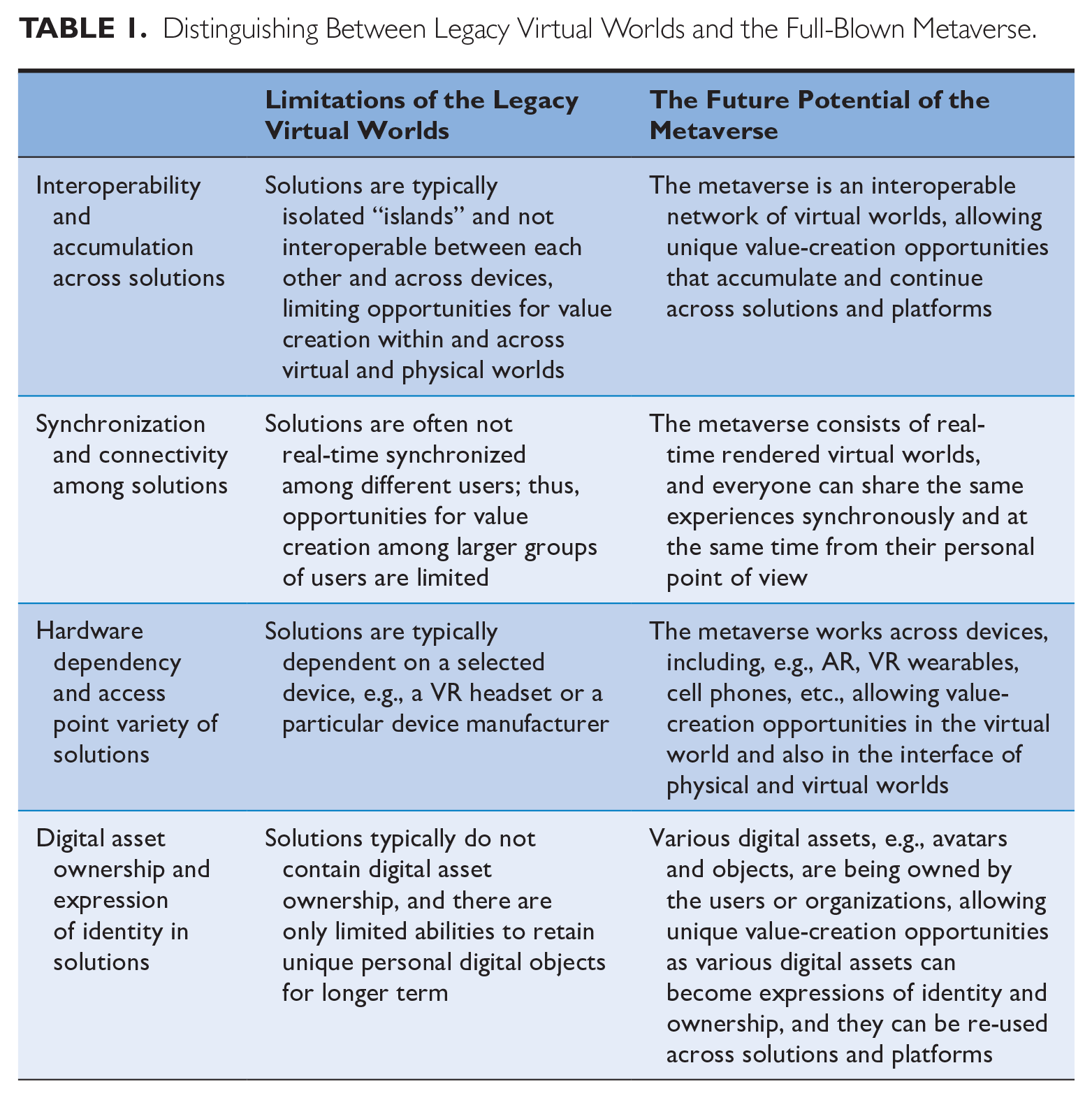
Based on the accumulating literature, 36 and by viewing the metaverse as a layered modular architecture, technology affordances can be uncovered by observing the metaverse’s layers and how they become an integrated whole that opens up new possibilities for action when enacted in the relations of individuals and organizations. Thereby, we identify several broad-based dimensions in which the future potential of the metaverse overcomes the current limitations of the legacy virtual worlds (Table 1).
Distinguishing Between Legacy Virtual Worlds and the Full-Blown Metaverse.
Method
We conducted a qualitative study of emerging metaverse strategies and use cases as implemented by early adopters of this technology, which gave us in-depth and context-sensitive insights into how leading organizations approach the metaverse for value-creation purposes. The qualitative approach is suitable for exploring novel phenomena, capturing the metaverse’s possibilities through the views and experiences of the very individuals investing in the metaverse, and creating rich narratives of those experiences to detail metaverse affordances.
Data Collection
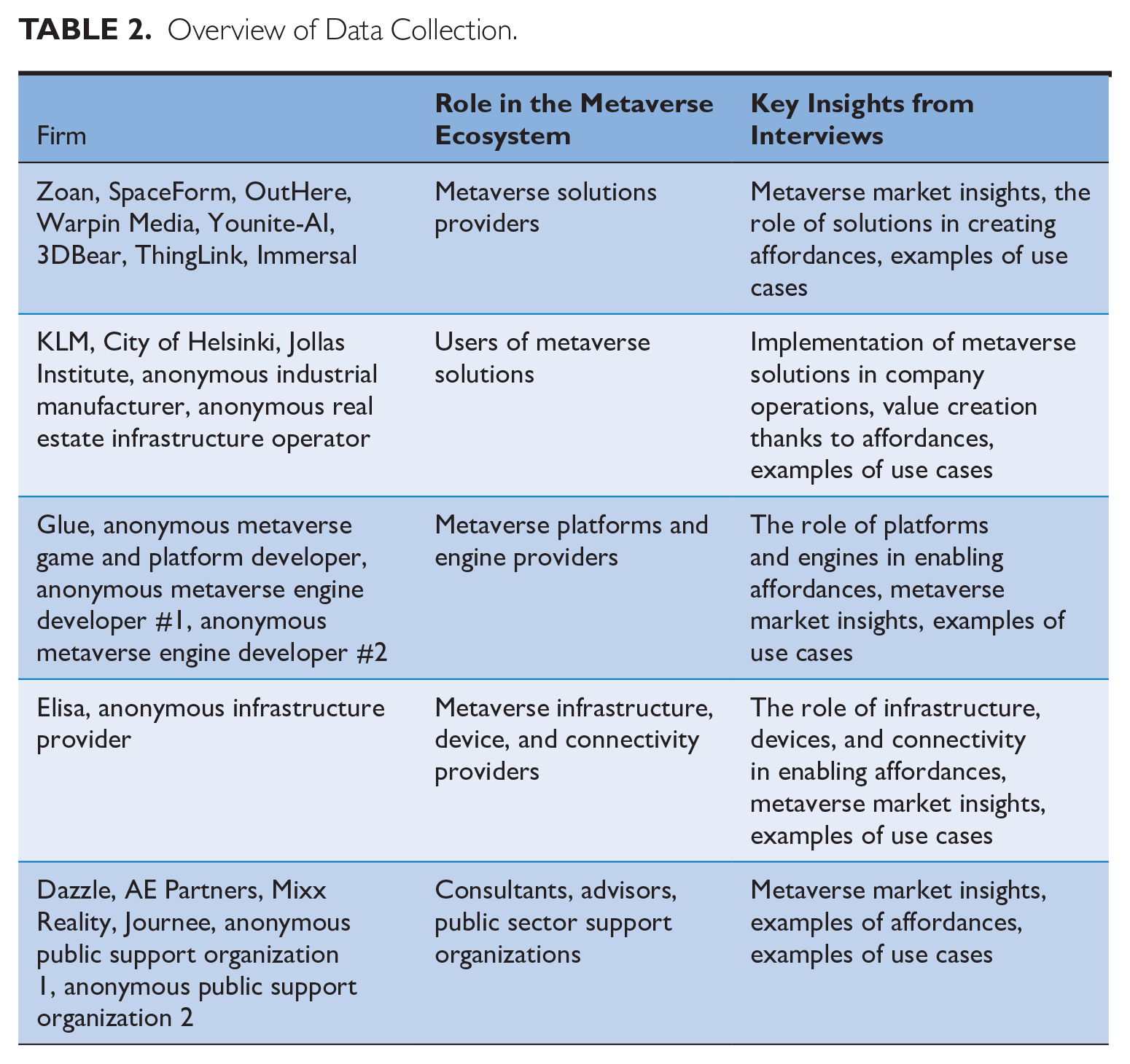
We conducted 25 interviews with early adopters of the metaverse who had different roles in the metaverse ecosystem, such as providers and users of metaverse solutions, content, and environments; platform and engine providers; and providers of metaverse infrastructure (see Table 2). Our selection of informants was aimed at obtaining a holistic picture of metaverse affordances as experienced by different firms that have already started engaging with the metaverse. Importantly, we selected firms based on the modular layered architecture framework and the argument that the metaverse augments physical products and experiences in the physical world through its loosely coupled layers of device (including the hardware and the software), network, service, and content. Following this logic, we selected firms that contribute to different layers and gather insights from multiple actors, as shown in Table 2. For instance, for the network layer, we interviewed Elisa, and for contributions to the content layer, we selected Zoan and similar firms. We did not limit our study to a particular industry or country, as we intended to identify generic affordances with which even organizations in less digitally mature settings can identify. Essentially, this approach was guided by a desire to construct a model that can be both of theoretical importance and of relevance for firms interested in the metaverse and in need of inspiration and guidance to jumpstart their metaverse journeys. When initially sampling the cases, we reached out to companies that are publicly promoting the metaverse in their communications; we also used the snowball sampling approach, which involved soliciting informants’ suggestions about which other firms to interview. Furthermore, we collected secondary data, such as online material and videos providing details regarding the use of the metaverse by the firms we interviewed. This material was critical to gaining context-sensitive insights, triangulating our interview data, and reaching a deeper understanding of how the metaverse is used in practice.
Overview of Data Collection.
Data Analysis
To analyze our rich empirical material, we relied initially on inductive data coding, 37 which was informed by our existing understanding of virtual worlds and the metaverse. After each interview, the author team would discuss major insights and any initial interesting or surprising quotes regarding the possibilities for action provided by the metaverse. These initial discussions turned out to be critical, as the analysis that took place later and the initial first-order codes were heavily influenced by them. After the interviews, each of the three authors was assigned several interviews to examine in greater depth and come up with altered or new first-order codes that were faithful to the words of our informants. Then, the authors had a series of coding meetings to create second-order themes, iterate a coding structure, debate their interpretations, use the patterns identified to construct aggregate dimensions, and elaborate on what those dimensions meant. Eventually, we identified three key aggregate dimensions, which correspond to three distinct metaverse affordances (prospection, persistence, integration), and identified sub-dimensions (second-order themes) that characterize the implications of each affordance. These aggregate dimensions were informed by our consultation with the literature on technology affordances and the relational view of emerging digital technology, as discussed in our conceptual background. In particular, we paid attention to how the engagements with the interrelated components of the metaverse’s modular architecture enabled new possibilities for action and further triggered new relations between the user and surrounding entities, be it human or material. We then created narratives of key use cases to compare and contrast the identified affordances in each case and to construct a theoretical framework (the metaverse flywheel model) based on them.
Findings
Our analysis was based on interviews with different actors in the metaverse ecosystem and revealed three metaverse affordances: prospection, persistence, and integration. The three affordances we identified fundamentally alter the process through which organizations prospect future conditions and possibilities, encounter persistent virtual spaces that involve editable and evolving digital artifacts and identities, and integrate insights and experiences from the virtual world into the physical world and vice versa. Together, the metaverse affordances enable the creation of a metaverse flywheel, a virtuous cycle that helps organizations and users alter existing functions and relations and create and capture value from the metaverse.
Prospection
Prospection refers to the ability of the metaverse to produce imagined future states and helps metaverse users engage in a forward-looking behavior. By immersing themselves in experiences in a virtual environment, metaverse users can anticipate alternative futures and define ways to cope with uncertain, unexpected, or risky scenarios and situations. Prospecting involves intentions, visions, and strategies that become concrete in a virtual environment and that link in various ways to the existing or future physical realm. Concretely, prospection can take place over virtual representations such as factory layout designs, architectural plans, product design templates, or nearly anything that involves a virtual sketch or simulation of some future potential reality. Our findings point to two different ways in which prospection supports firms in creating value in the metaverse.
First, in the metaverse, users can now overcome spatial limits and build things that have not yet or never will be materialized in the physical world. For instance, to anticipate the design of very large physical entities, design teams whose members are dispersed globally can now enter the metaverse and create virtual prototypes that are easy to edit and iterate. An interviewee at Glue, a metaverse provider of virtual meetings, explained, “The design of anything large can happen in 3D nowadays . . . take a factory or a ship or something similar. It is difficult to make physical prototypes of them; instead, the model evolves in the course of the construction project.” Similarly, an informant from the metaverse provider SpaceForm elaborated on the importance of spatial experience by discussing a large international project by UNStudio, a Dutch architectural practice, for the Korean national football team’s training facility: “They ended up using SpaceForm to communicate with the client, iterate the design, and experience it together with them. So, that becomes a very useful way to improve the experiential quality of the space and also be able to explain spatial conditions.” By overcoming spatial limits, metaverse users can effectively explore future realities that would otherwise be risky, costly, or impossible to pilot or test.
Second, prospection in the metaverse helps users overcome temporal limits by demonstrating future conditions and plans. For instance, a real estate infrastructure operator company in our sample is using the so-called 4D calendar, in which construction activities are pinned to a 3D virtual representation of the building, with the fourth dimension being the time at which a specific task by a specific person is anticipated to happen. Four-dimensional schedules have become a significant aid in managing building construction and maintenance projects, where various logistical steps and installations can be animated into a 4D virtual representation of the building. This enables the optimization of the entire project’s schedule and cost-efficiency.
While scheduling future activities is rather mundane and hardly unique to the metaverse, the combination of spatial representation and digital simulation with the time element provides new possibilities for planning the future. For instance, the metaverse environment enables planners and engineers to situate themselves in as-designed representations. Collaborating and adjusting architectural and technical plans become more concrete, as users can simultaneously observe how an imagined future might look and collaboratively edit, change, and visualize representations of the future.
Persistence
The metaverse occurs in parallel to the physical world and persists over time, providing a consistent basis for experiencing virtual environments with distinct digital artifacts, entities, identities, and relations. We find that the metaverse allows for three entities to persist and evolve, enabling consistency and development: the features of virtual environments (surroundings, landscapes, building environments), the digital artifacts involved (items, objects, devices, plans, sketches), and the entities’ identities (individual avatars, individual profiles, history, preferences). Ideally, these three groups of entities are stored in the metaverse as strategically important company assets and can be used or edited at a later point in time.
First, virtual environments do not reboot every time a user joins the metaverse. Instead, the environment persists and evolves due to users’ actions and interactions. This essentially means that every time a user re-enters the metaverse, a dynamic and potentially altered virtual world is encountered. In addition, as in the physical world, inputs and developments by others can trigger changes in the environment, but the fundamental features of that altered environment persist. Thus, the metaverse provides possibilities for both continuity and evolution in collaborative work in virtual spaces. With persistent environments, users can interact, nudge, and invite others to perform collaborative work or to alter features of the virtual environment.
The second facet of the metaverse that persists is digital artifacts that users come across, deploy, share, and accumulate in the virtual world. These artifacts include all virtual objects that can appear in the metaverse, such as sketches, building plans, coins, and drawings, that users engage with in the metaverse, and that they can often edit and modify. For instance, as shown in a use case of safety training for the construction company Skanska’s employees, a virtual construction site remains present and “live” even when all users exit the environment. This allows Skanska to design and use those environments consistently and to make any edits that become necessary.
Third, entities’ identities can persist in the metaverse. As many will know from gaming environments, users can be represented by customized avatars who accumulate experiences and memories that are stored under their profiles. In this way, users build distinct identities in the metaverse, and those identities can differ profoundly from users’ identities in the physical world. One of our informants confirmed this point: “In this virtual environment, you are there with your own personality.” However, even when users exit the metaverse, their metaverse identities and associated avatars remain in place and visible to others; their avatars can even be nudged so that users are invited to come back to the metaverse. This further suggests that the relational ties between users (avatars) persist and influence users’ actions, history of interactions, memories, preferences, and even identities. As interactions unfold, existing relations are altered, new relations are built, and identities are re-shaped and evolve.
Integration
The integration affordance emerges and becomes meaningful whenever the metaverse has implications for the physical world or vice versa. At a minimum, metaverse users bring their ideas and goals from the physical realm with them, but integration typically refers to even more concrete activities that involve designs to enable constant interaction and interoperability, for example, between existing physical spaces and their digital replicas. The possibilities for integration resemble the “digital twins” approach that uses a simulation of a physical world, such as a machine or factory design. However, the metaverse goes well beyond the digital twins concept because it enables integration in a myriad of configurations that create value for both physical and virtual realms.
First, integration can lead to improved user experiences and user value. The integration between physical and virtual worlds allows users to operate or choose between both realms, which leads to more immersive and engaging activities, ultimately creating value for several stakeholders. For example, during the COVID-19 pandemic, the City of Helsinki joined with the art museum Amos Rex to set up a virtual extension of an arts exhibition. This allowed users to access the exhibition without compromising their safety and provided the art museum with a broader reach.
Second, integration between physical and virtual worlds can enable more tailored and adaptive learning experiences for users. By leveraging learnings from both realms, the metaverse can offer customized educational content and simulations that allow users to develop new skills and knowledge in more engaging and effective ways. For example, an informant from the metaverse solution provider OutHere explained how its solutions can help assembly training in a way that leaves a lasting memory trace that is far superior to what 2D environments can offer. The metaverse learning experience is quite easy to recall when users adapt and hone their skills in physical situations because insights and experiences in the metaverse have implications for how processes unfold when the work is performed in the physical world. Later, users can naturally recall their physical experiences when engaging with the metaverse.
Third, the connection between the physical and virtual worlds can foster the cultivation of new products and innovations that can redefine the very identity of a firm. We found a cascading effect of universe/metaverse integration because experiences with the metaverse in one domain can make firms allocate resources to use the metaverse in another domain that has important implications for the firm’s focus and core market. For instance, a key member of the research team of KLM, one of the world’s largest airlines, noted that its experiences with the metaverse for virtual meetings and design reviews triggered an interest in devoting resources to broaden the firm’s offerings: “We want to change our product portfolio; we want to deliver new products that don’t exist at the moment.” Integrating physical and digital realms can provide opportunities for creating parallel virtual products that complement physical ones: “Wouldn’t it be cool if you go to a place where you could travel virtually first before you actually travel, and once you’ve done the real traveling, then you’re able to travel again and go to all the places that you went to?”
The Metaverse Flywheel
Each of the three affordances characterizes one crucial component of the metaverse. However, none is sufficient on its own for companies to capitalize on the full potential of the metaverse. It is only together that the three affordances form what we call the metaverse flywheel (Figure 1), in which several components work coherently, reinforcing and magnifying the impact of one another to create something that is vastly more powerful than the sum of its parts. Similarly, like the well-known artificial intelligence flywheel, 38 the metaverse flywheel builds on a continuous feedback loop of data, learning from data, and acting on those learnings. However, the unique thing about the metaverse flywheel is its potential to bridge goals, actions, and outcomes across physical and virtual worlds and augment firms’ value-creation activities. At the heart of the metaverse flywheel is the infrastructure that consists of metaverse software and hardware, often including a metaverse engine (from Unity, Epic Games, or some other provider) as the software and VR, AR, or XR interfaces as the hardware. Both the infrastructure and affordance layers need to work for the metaverse to create concrete business value. Together, the inner and outer layers of the flywheel help to continuously plan, build, iterate, and implement virtual and physical environments, artifacts, and identities. Our model thus portrays that value creation through the metaverse is a multifaceted process, where attention needs to be paid not only to different components and action possibilities but also to the coherence and interrelation between those.
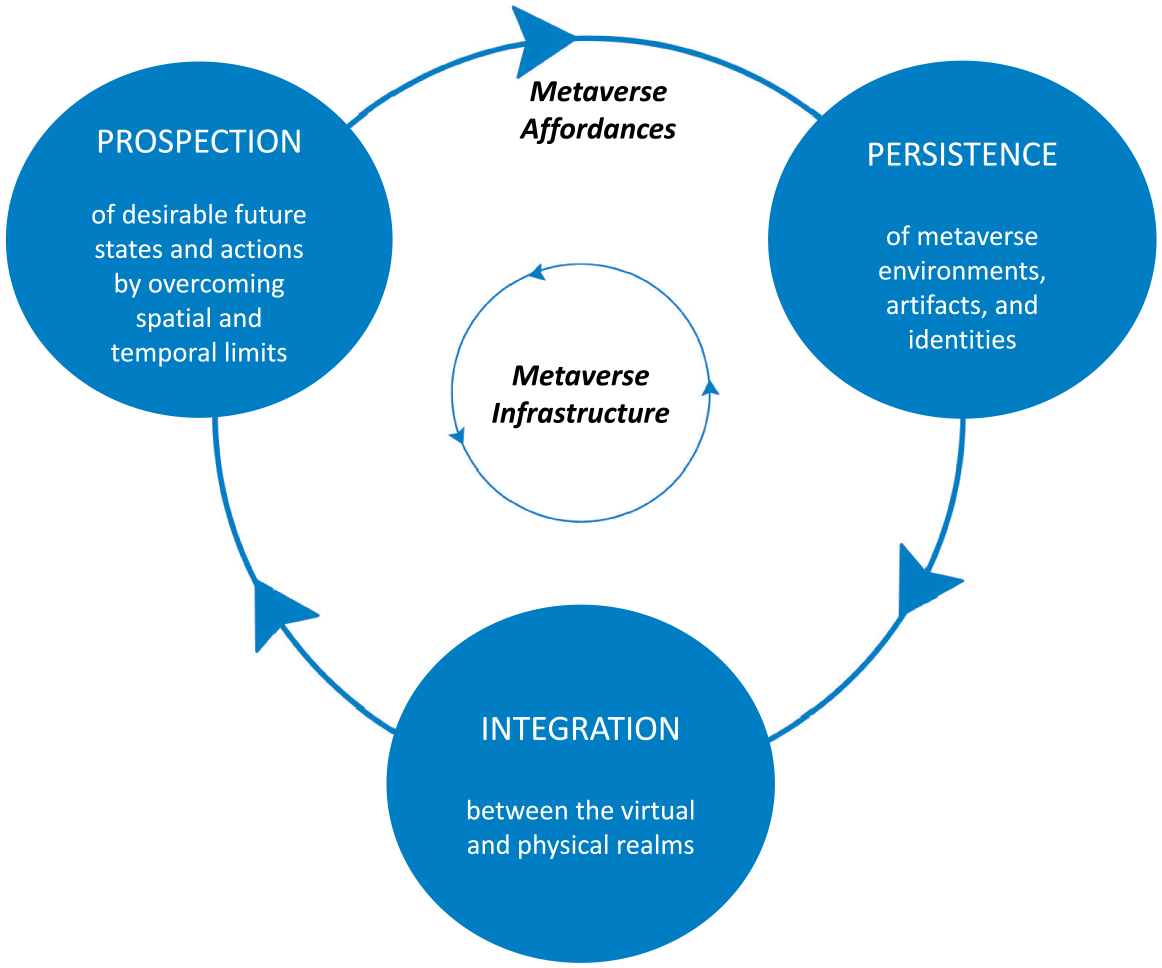
The metaverse flywheel.
Our model can be applied to both metaverse implementation in company-internal business operations (e.g., meetings, training, and product design work) and externally oriented purposes (e.g., customer and/or stakeholder interactions). A company’s internal use cases typically differ somewhat from externally oriented ones: They might be rather rudimentary, more complex, technically oriented, and not as polished in comparison to those meant for “non-professional users”; contain company confidential information or be otherwise controlled and regulated by/within the firm; and work in company-specific selected devices or only within certain settings. Yet, the same flywheel dynamics apply to a variety of internal and external use cases. Furthermore, as organizations progress with the metaverse, the internal and external uses might also converge, allowing them to discover new synergies between internal processes with customer-facing interfaces.
We illustrate the dynamics of the metaverse flywheel with four short narratives drawn from the use cases in our interview data. The two first narratives describe the metaverse flywheel in action in company-internal settings “only”, while the two latter narratives entail both internal and external perspectives since various parties benefit from the metaverse solutions simultaneously.
Flywheel Illustration 1: The Virtual Construction Site
To take advantage of the metaverse, Skanska, one of Sweden’s largest construction companies, collaborated with OutHere, a creative XR agency that specializes in creating immersive virtual spaces. Skanska identified a unique opportunity to improve its worker safety training program by creating a virtual construction site in which people could immerse themselves and experience everything that happens on a construction site, including small accidents and even near-death experiences. Workers can experience all the different processes and activities on a life-size construction site where they come across other people, vehicles, buildings, roads, fences, machinery, tools, building equipment, and other objects that can be found in the real world. In a virtual experience, workers can identify ways to eliminate risks at work: “By bringing you so close to accidents and events that could happen within these environments, the idea is to instigate a memory. When workers find themselves in a similar experience, they will remember, so next time they’re in a rush to solve an urgent issue in a construction environment, they will remember.” These remarks suggest that the metaverse offers unique possibilities for prospection because the simulation of working conditions and hazardous situations can support users in overcoming spatial and temporal limits.
Furthermore, our analysis of this case reveals that the persistence affordance of the metaverse is also evident in the fact that several facets of the metaverse persist and evolve. An OutHere informant put it vividly:
You have the same environment being experienced and used in the States, in Europe, in different offices in different countries, both at the same time and in a single user experience. And this environment has the ability to evolve, so what it started from has kept on evolving, so it’s becoming bigger; it has more elements within it, more characters, more scenarios, more scripts, but it’s a living working environment.
Finally, the integration affordance of the metaverse is also evident in this case. An informant from OutHere explained, “What we have done is we have spoken to a great number of people across the board in construction processes to see what an actual day in the life of a construction worker is. Obviously, they have data that tell them about the areas where, for example, most accidents occur.” In addition, capitalizing on insights and memories from metaverse experiences triggers changes in how work is performed in the physical realm, as users are offered learning experiences and organizations redefine how they provide safety training and even organize their activities on real-world construction sites.
To summarize, the virtual construction site is a good illustration of prospection (modeling working conditions and hazardous risks), persistence (delivering simultaneous and harmonious user experience globally), and integration (3D construction sites resembling real-world sites). In addition, Skanska and OutHere harness the layered modular architecture, including devices (displaying the virtual construction site), networks (ensuring simultaneous delivery across geographies), services (the existence of the virtually available construction site as a software), and content (events occurring in construction work) to deliver the full virtual experience for users.
Flywheel Illustration 2: Online Grocery Item Collection
Online delivery of orders from grocery stores is a major growth business, with the popularity of this service only increasing in light of the new shopping habits to which consumers have become accustomed since the COVID-19 pandemic. This has created a major demand for training staff to find, collect, and package items to be delivered to online shoppers. Metaverse solution provider 3DBear (a provider of immersive technologies for education) teamed up with Jollas Institute (the training arm of S-Group, a large Finnish retail chain) to deliver a metaverse environment in which newly recruited employees can all experience the item-collection process as part of their initial training before going to the actual warehouse or shop floor. A survey conducted on the employees provides preliminary evidence that this type of training is well received by the people involved and the VR equipment is perceived as purposeful.
The prospection affordance helps generate a new type of process learning without the need to conduct trial-and-error learning in an actual physical setting. The collection process simulation helps create safe learning environments in which it is impossible to make mistakes that are consequential or cause quality or other issues. The persistence aspect bolsters the constant improvement of virtual environments and the artifacts in those environments. For Jollas Institute, this involves simulating the actual collection process, a setup that can be revisited when needed and can also be configured based on user feedback. The integration takes place when the virtual learnings and insights are integrated into practices on the shop floor. This process is as convenient as it is scalable.
The layered modular architecture in the cases of Jollas Institute and 3DBear is about bringing together devices (displaying the training environment for the user), networks (connecting the user with the training environment and content), services (the virtual training environment as such, and the way it resembles the actual work process of S-Group in real life), and content (trial and error in item collection, and the artifacts of the store modeled virtually) so that learning of new important working skills is possible.
Flywheel Illustration 3: The Digital-Physical Real Estate Infrastructure
One of the case companies in our study is a real estate infrastructure operator that makes use of the metaverse flywheel by seeking to both enlarge and improve the real estate infrastructure and upgrade ongoing real estate operations. The full benefits of the flywheel are realized when the future building design is implemented over time in actual physical installations, while digital modeling and simulation continue to provide useful features in the present.
In terms of metaverse affordances, this company can undertake prospection by building architectural design templates of how the real estate facility will look in the future. This is done for several reasons, including compliance with regulations, informing local authorities about upcoming changes, engaging consumers to receive feedback before anything is built, improving the user experience in the facilities that are eventually launched, and so on.
It is thus important—if not essential—that these real estate design templates persist over time and can be edited and iterated during both the planning and construction phases. Finally, due to the persistence of the digital environment and embedded artifacts, the company can use virtual representations and data models to monitor and optimize how the physical space is operated and maintained. At best, virtual models will persist over the entire lifecycle of a building, which typically lasts many decades. The integration affordance is realized in these latter phases where the virtual representation starts to become reality and over time as the implementations conducted in the physical infrastructure are fed back into the virtual model. Timing is of the essence in the given industry sector, and the company needs to ensure that any architectural changes do not disrupt ongoing operations that must run safely at all times.
In this case, the layered modular architecture is demonstrated in using devices to display the real estate model to the user in a 3D format, harnessing networks in connecting the user with such a model, creating services (e.g., architectural design templates and the future real estate as a software) for users to visit, and finally, delivering the necessary content that might evolve over time, including, e.g., the specific virtual artifacts that are placed within the context of the future real estate in question.
Flywheel Illustration 4: The Virtual Capital City
The City of Helsinki strives to become a global forerunner in smart digital solutions and the “virtual capital” of the world. Helsinki partnered with Zoan, a local virtual solutions developer company, to launch several virtual solutions under the “Virtual Helsinki” brand. Virtual solutions are built for city public relations and marketing purposes and to attract and satisfy potential visitors, whether private citizens or company representatives. Today, there are nearly 30 virtual solutions in place, harnessing Zoan technologies and the Unreal Engine by Epic Games and covering both publicly owned city spaces as well as private and partner spaces like museums and concert venues.
The prospection affordance is critical in these virtual solutions because it enables travelers to explore Helsinki before actually visiting and/or enjoy audio and video tours when in the city. Crucially, it also enables elderly, disabled, and disadvantaged people to visit the city virtually when they physically cannot, thus helping various groups outside traditional travelers envision new realities. The persistence affordance in this case relates to the re-usability of virtual models of the city. The models of Helsinki that were originally created for tourists can also be redeployed for other purposes such as envisioning future city environments and spaces or educating schoolchildren on what the built environment could look like, to name just two.
Finally, integration in this case means that virtual models are closely linked with the physical urban environment and real places in the city. They can be used to improve existing infrastructure by, for example, identifying potential thermal losses in buildings or obtaining feedback regarding proposed changes to the city and its buildings by having residents vote for their favorite architectural solutions.
The layered modular architecture in this case of the City of Helsinki and Zoan consists of devices (displaying the city environment for the inhabitants and visitors of the city), networks (connecting the user with the various virtual models that are made of the different spaces of the city), services (the existence and evolution of such virtual models), and content (the specific images and artifacts that are linked with the specific physical location of the real-life city). Out of these layers, the quality and scope of services and content are particularly important as they need to match fully with the real city environment in a particular location.
Conclusion and Recommendations
The complete vision of the metaverse has yet to be realized, and its full potential will remain a mystery for several years to come. 39 However, based on the qualitative data and results of this study, that potential is already emerging. We expect technological progress to continue along an exponential growth path as bottlenecks are resolved in the mid-term future as the necessary technological building blocks converge and support one another. To understand how companies can already benefit from this development, we move in the present study beyond a technology-centric view to study the value-creating organizational processes, practices, and strategies enabled by the emerging technology affordances of the metaverse.
As depicted in the flywheel in Figure 1, three key metaverse affordances build on one another, effectively creating a virtuous cycle where organizations and individuals can anticipate and envision future goals (prospection); create virtual environments, artifacts, and identities that can be used and re-used over time (persistence); and create value in the interactions between physical and virtual worlds (integration). An informed utilization of these three affordances enables companies to approach metaverse technologies strategically by developing metaverse-related company assets and capabilities that open new business opportunities. The flywheel feeds itself in a cycle in which the integration of value creation between the physical and virtual realities creates new ideas for future strategizing and visioning.
Our findings help to demonstrate the difference between the fully applied metaverse flywheel model and the previous legacy virtual worlds and 3D simulations. It is noteworthy that the difference between virtual worlds (as we know them now) and the future vision of the metaverse is not binary, but rather a continuum. While the complete vision of the full-blown metaverse is not realized yet, we believe companies can already benefit from the “flywheel thinking” by strategically implementing combinations of the three affordances while working on their “proto-metaverses” and different use cases.
Managerial Implications
The metaverse flywheel framework developed in this study has concrete and actionable implications for managers and professionals working or intending to work with metaverse use cases. The big picture is clear: Companies should strategically and systematically seek to build metaverse flywheels to support tangible business cases. The business case for the metaverse needs to be embedded in a broader understanding of the company’s resources and capabilities, its ecosystem role, and its overall portfolio of different value propositions to different markets. Informed by the metaverse flywheel framework and building on crucially important company-specific strategic choices and priorities, managers can identify what they can accomplish in the metaverse with the help of prospection, persistence, and integration. Furthermore, companies and organizations looking to develop metaverse solutions should consider ways to build virtuous feedback loops that keep the flywheel running to accelerate synergies between organizational learning, customer engagement, and technological development.
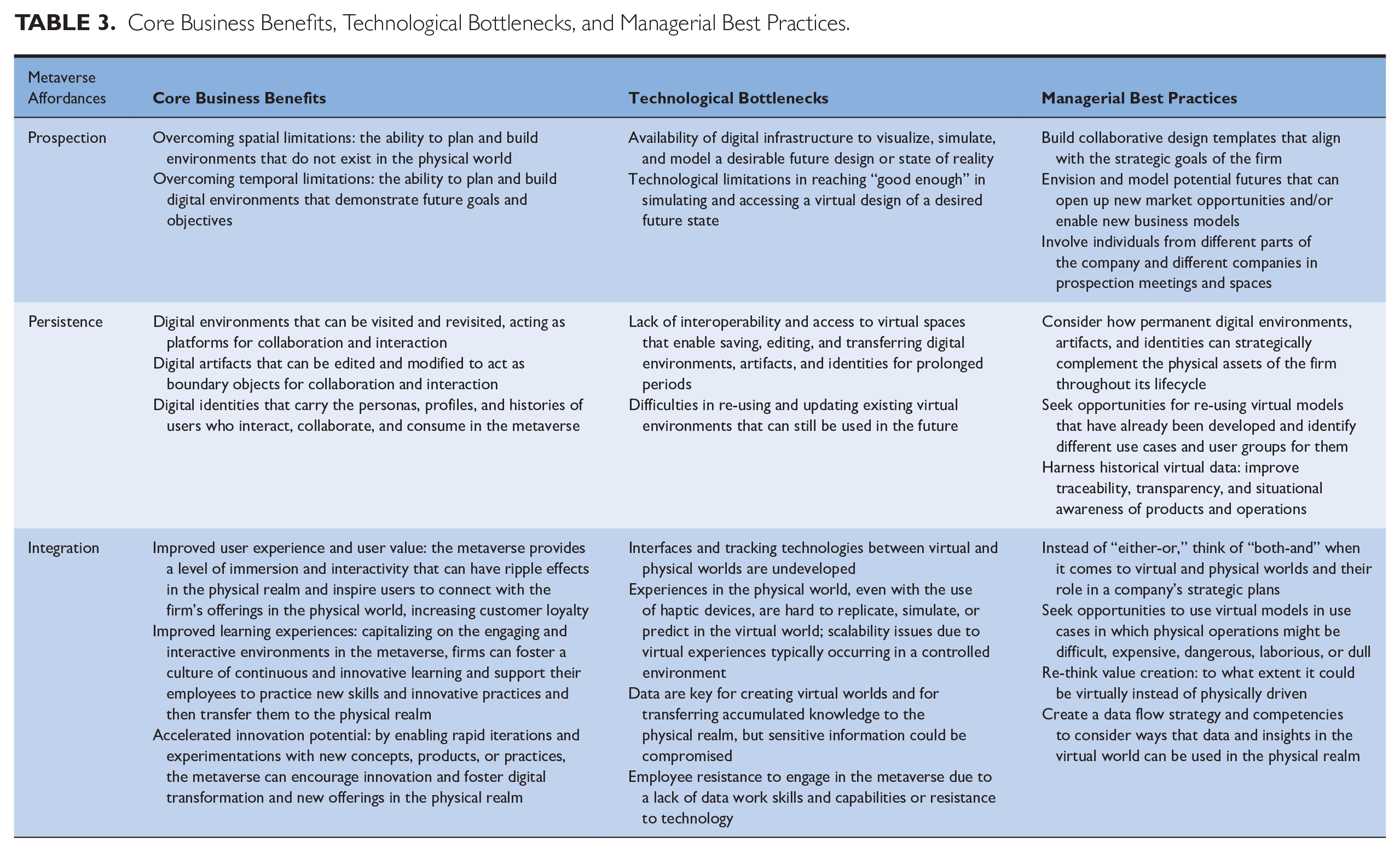
Managers and professionals need to look beyond the required metaverse technology infrastructure and focus instead on what the metaverse offers to organizations. Thus, attention needs to be paid to what strategies, processes, and practices should be in place to harness its transformative business potential. At the same time, companies should keep an eye on the key emerging technological building blocks of the metaverse and consider the relevant technological bottlenecks that exist due to the limits of existing technology. As technology advances, some of these bottlenecks will be removed, which will unlock more potential business benefits and use cases. With these implications in mind, Table 3 outlines key managerial implications in terms of core business benefits, technological bottlenecks, and managerial best practices for the three dimensions of the metaverse flywheel framework.
Core Business Benefits, Technological Bottlenecks, and Managerial Best Practices.