



Abstract
Two organizations that focus on tech-based health innovation have partnered to improve the mental health of young adults. In this “tech for good” project, Hopelab and Grit Digital Health worked together to create an app using human-centered product design. With the core needs of users at the forefront, the team developed an app both with and for college students to combat loneliness, a prevalent issue that can lead to other problems such as depression, anxiety, and even dropping out of college. The team also applied systems thinking to address the root causes of this “wicked problem,” resulting in their Nod app, which has improved outcomes for college students. This article is based on the author’s award-winning case study.
At SXSW, McCarthy facilitated a “storystorming session” that combined brainstorming and storytelling to crowdsource possible concepts and opportunities. In the crowd was Andrew Baker, VP of Product at Grit Digital Health, an app developer that creates behavioral health and well-being solutions. Both McCarthy and Baker were convinced that human-centered design—an approach that focuses on surfacing the core needs of users as part of the product and service development process—could be a powerful way to create more effective solutions to the growing mental health crisis facing teens and YAs. After the session, they agreed to seek out ways their two organizations might collaborate.
Wicked Problems and Systems Thinking for Improved Outcomes
Many mental health issues are considered wicked problems 2 —a class of social problems that are complex and dynamic, have multiple underlying causes, and for which simple solutions often reveal or create other problems. 3 McCarthy and Baker understood that this was the case with student well-being, so they embarked on a discovery journey to learn the factors and root causes of mental health issues facing teens and YAs, using a methodology called systems thinking. 4
“Systems thinking was our first step in more deeply understanding this space. The map connected many of the inhibitors and accelerators of mental well-being in young people. We identified seven areas, opportunities that we felt Hopelab or others could impact. In particular, we started to see and hear more stories about loneliness in young people—especially in universities and colleges—as both a growing problem and issue affecting mental and physical health,” said McCarthy.
A 2018 study of adults 18-22 found that they were the “loneliest generation.” 5 Other research revealed that college students who were more successful at making connections were more likely to stay enrolled, feel mentally and physically healthier, and were more successful in school. A lonelier college experience led to lower confidence in their employment prospects and ability to succeed later in life. 6 So, addressing the upstream issue of loneliness prevents significant health challenges from emerging later, including anxiety, depression, self-harm, and suicidal behaviors.
Strategic Alignment and Partnership Model
Hopelab and Grit Digital Health formed a working team in 2018 to explore solutions and soon landed on the idea of an app to support college students in making meaningful connections with others. The teams’ research also indicated that students often embodied a growth mindset during transition periods, such as high school to college, making them more likely to try something new.
“Hopelab took on the challenge of understanding the problem, designing for the problem, developing for the problem,” said McCarthy. “We have great behavior change scientists who build and test a pathway to impact. And we also have talented designers to build and test the form factor and user engagement.”
“Grit was the design and build arm of the project,” said Baker. “We prototyped the design and managed the software engineering.” Grit also brought its experience in developing and distributing behavioral health tools with creative branding and promotion—an important part of getting the app in the hands of the students who needed it the most.
Equally important to their complementary expertise was that the partners shared mission alignment. Both aimed to use technology to empower healthy behaviors. McCarthy and Baker felt they had the “special combination” needed to develop an app that was evidence-based so that it would be effective and trusted by both students and universities. One key to trust was involving and valuing students’ insights during the design process as opposed to after. Also, the public-private business model allowed the team to identify positive health outcomes as a key goal in addition to revenue goals that enabled the app to have a sustained impact.
Background on Hopelab and Grit
Hopelab
As a venture philanthropy, Hopelab “is dedicated to creating a world where all young people can be well.” Through targeted social impact investments, translational research, and advisory services that focus on advancing mental health solutions, young people can be resilient and thriving. 7 Hopelab was founded by The Omidyar Group, a philanthropic investment firm supported by Pam Omidyar and eBay founder Pierre Omidyar, which invests in a diverse collection of companies, organizations, and initiatives, each guided by its own approach, but all united by a common desire to catalyze social impact.
“Hopelab has always been focused on using technology to improve the health and well-being of young people,” said Hopelab President and CEO Margaret Laws. “The organization came to life when Ms. Omidyar had the insight to use video game interaction to improve outcomes in young cancer patients by helping them adhere to their regimes such as taking chemo drugs and antibiotics. Hopelab developed Re-Mission—which Laws said was one of the first digital therapeutics. Randomized controlled trials demonstrated use of Re-Mission increased compliance, resulting in better outcomes.” 8
For Nod, Hopelab took a similar product development approach by funding development, identifying an impact strategy, providing research and evaluation, and collaborating on product design.
Grit Digital Health
Grit Digital Health develops behavioral health and well-being solutions through design and technology aimed at new approaches to mental health and well-being. As the company states, it is the type of convergence that empowers individuals to make their lives and the lives of those around them healthier and more fulfilling. 9 The company’s multidisciplinary team includes experts in the fields of psychology, design, communications, and technology. Grit created “YOU at College,” a digital platform that personalizes well-being for students that was implemented at more than 180 campuses nationwide, and “Man Therapy,” a groundbreaking men’s mental health campaign that drew international acclaim for its creative approach to suicide prevention. 10
Grit founder and CEO Joe Conrad said social media platforms constantly track users’ habits to learn their likes and feed them more of the same content to keep them hooked. Conrad referenced the documentary The Social Dilemma which chronicles how companies such as Facebook and Twitter use manipulative techniques to addict their users, which can increase depression. 11 By contrast, Grit seeks to use connectivity for good by developing solutions in an evidence-based approach to ensure they improve well-being while encouraging students to form relationships outside their app. 12
For Nod, Grit worked with Hopelab to provide concept development, student co-design, prototyping, user testing, brand development, engineering, distribution, and monetization.
Understanding Root Cause
The purpose of root cause analysis is to get beyond symptoms (e.g., loneliness) and identify the underlying causes of issues so that they can be addressed: This is sometimes referred to as finding the “why behind the what.” 13
In the case of college student loneliness and isolation, the high-level issue was clear—in one study, 30% of college students self-reported feeling lonely in a two-week period, 67% felt “very lonely” in the past year, 14 and a study by the University of Washington 15 found depression and feelings of loneliness were cited as two of the top reasons for students dropping out. Looking deeper, the Hopelab/Grit team found that
There are huge expectations; college is supposed to be “the best time of your life!” If it isn’t, students feel there is something “wrong” with them.
There are major social shifts; students are leaving their home and high school support networks and are expected to make new friends quickly.
Expectations and pressures create a loneliness gap, which is the difference between the friendships that students expect to have and the ones they actually have.
For some college students, it is easy to fall back on pre-college relationships and avoid new friendship-building situations.
Intended Impact and a Theory of Change
Intended impact (or “impact pathways” as Hopelab refers to it) identifies which root causes to focus efforts on, and what specific outcomes are aspired to. 16 The theory of change explains the broad mechanisms by which the organization accomplishes the work. 17 Performing this work allows Hopelab to identify key strategies it might use in addressing and reducing loneliness and its impact on college students’ mental and physical health.
McCarthy said most existing social platforms simply brought strangers together with no guidance on how to make friends. However, research revealed that the approach was inadequate because many young people lacked confidence in their social skills. So, putting strangers together without first providing connection-building skills only added to their stress.
Hopelab first started with the intended long-term impacts of increasing college retention rates while reducing anxiety, depression, and suicidality. Next, it used research to identify the short-term measures necessary to generate those long-term impacts. Identified pathways to building social connections included managing expectations, belief in personal growth, willingness to take risks, and a focus on attention toward others. So, the intended impact was both to close the skills gap and encourage people to take small social risks. And the theory of change was to create and distribute a tool that could accomplish this—specifically a tool that could coach, support, and help college students develop skills to build supportive friendships.
Assessing Other Efforts
The combined team assessed how existing players in the “health apps for young people” space addressed the problem of college loneliness as a source of mental health issues. Unfortunately, the team had learned that loneliness often led to additional problems for students including heightened risk for anxiety and depression, poor sleep, drug and alcohol use, self-harm behaviors, higher dropout rates, and suicide. The solution did not lie with traditional social media tools that promised to connect people, but instead fostered toxic environments. Even some platforms that attempted to bring college students together had the opposite effect. For example, the Yik Yak app became popular with students by allowing them to share anonymous “yaks” within a five-mile radius. It failed in 2017 after the unmoderated environment was filled with hate speech and threats of bomb and gun violence that caused colleges to ban the app. 18 Yik Yak returned in August 2021 with leadership promising to combat cyberbullying. 19
“Higher education is seeking safe ways to help students connect on and off campus,” said Baker. “Nod is a science-backed intervention we designed and tested specifically to achieve positive health outcomes for students.” “Existing players weren’t getting at the root cause. Campus loneliness was skyrocketing, and yet there were no proven interventions,” said McCarthy.
Colleges were struggling to meet students’ increased requests for mental health counseling. Educational institutions knew that the emotional needs of students were linked to both academic success and dropout rates. Colleges could not ignore any reason a student might leave college before graduation since the average institution loses around $10 million per year due to attrition. 20 In one survey, feeling socially alone was cited as a reason for leaving by 41% of respondents. 21 So, encouraging social interactions over screen time made sense on all levels. Research pointed to social media as a big culprit in the student loneliness epidemic. One psychologist said, “Every time you check your phone in company, what you gain is a hit of stimulation, a neurochemical shot, and what you lose is what a friend, teacher, parent, lover, or co-worker just said, meant, felt.” The “always on” reality shifted attention away from conversations with classmates to smartphone screens. 22
Design Thinking and the Product Design Challenge
The team was armed with a clear theory of change—creating a tool that could coach, support, and help college students develop skills to build supportive friendships. They next used both design thinking and desk research methods to better understand how college students who are lonely think, feel, and behave within the college environment. A key to design thinking is to understand end-users deeply, 23 and to place their needs, hopes, behaviors, and pains at the front and center of product decisions. 24 In Hopelab’s case, this work included in-depth ethnographic interviews with a variety of first- and second-year college students.
As an example, one student told the team about her struggle to find meaningful friends in the first few months of college. Her therapist recommended that she “just try smiling at five people on campus today. Make eye contact and smile.” She reported that this simple intervention led to increased self-confidence and better social connections. This story and others like it led to the insight that “small doses of trusted advice and support can have a big impact.”
Other key insights were that
“People are around me but not with me—I feel left out.”
“Expectations are that college friendships are supposed to be like magic . . . Immediate. Big. Effortless.”
“Making friends can feel like an impossible challenge.”
Using this feedback, they set a design direction for the product:
Destroy the myth of “magical friendship.”
Empower students to try stepping outside their comfort zone.
Help process setbacks with compassion.
Build the friend-making muscle over time.
Co-creating and Testing Low-Fidelity Concepts
Using the principles of lean and agile co-creation, 25 the Grit-Hopelab team was committed to quickly testing and adapting possible solutions to the design direction with the participation and feedback of the target YA population. They developed storyboards for five concepts prototyped over two days and shared them with the target audience:
Risky Business: An app that gives you small daily social challenges. Think of it like a workout program for pushing yourself outside your comfort zone.
Try Guys: A video series of challenges that you see and then try. You see the awkwardness, the nerves, the excitement, rejection, or glory at the end.
Reflection Booth: A space to give students a moment during their day to stop and reflect and set intentions.
Therapy to You: Bringing therapy outside of the health center to students (i.e., residence halls, common spaces, fitness centers, etc.).
Design Your Experience: A way for students to plan how they want their college experience to be before they start at a new school. It might be a planning tool that they would start using the summer before freshman year.
More than 100 students contributed firsthand stories and feedback. Risky Business (see Exhibit 1) garnered the most interest—particularly the concept of the product as a “fitness app for your social life.” Through feedback on all concepts, they also discovered that active (doing) versus passive (learning) features, empathy for the struggle, and a focus on outcomes (more friends) versus the underlying loneliness issues were all highly resonant with YAs. They used these learnings to develop a Risky Business prototype, which would eventually become the Nod app.
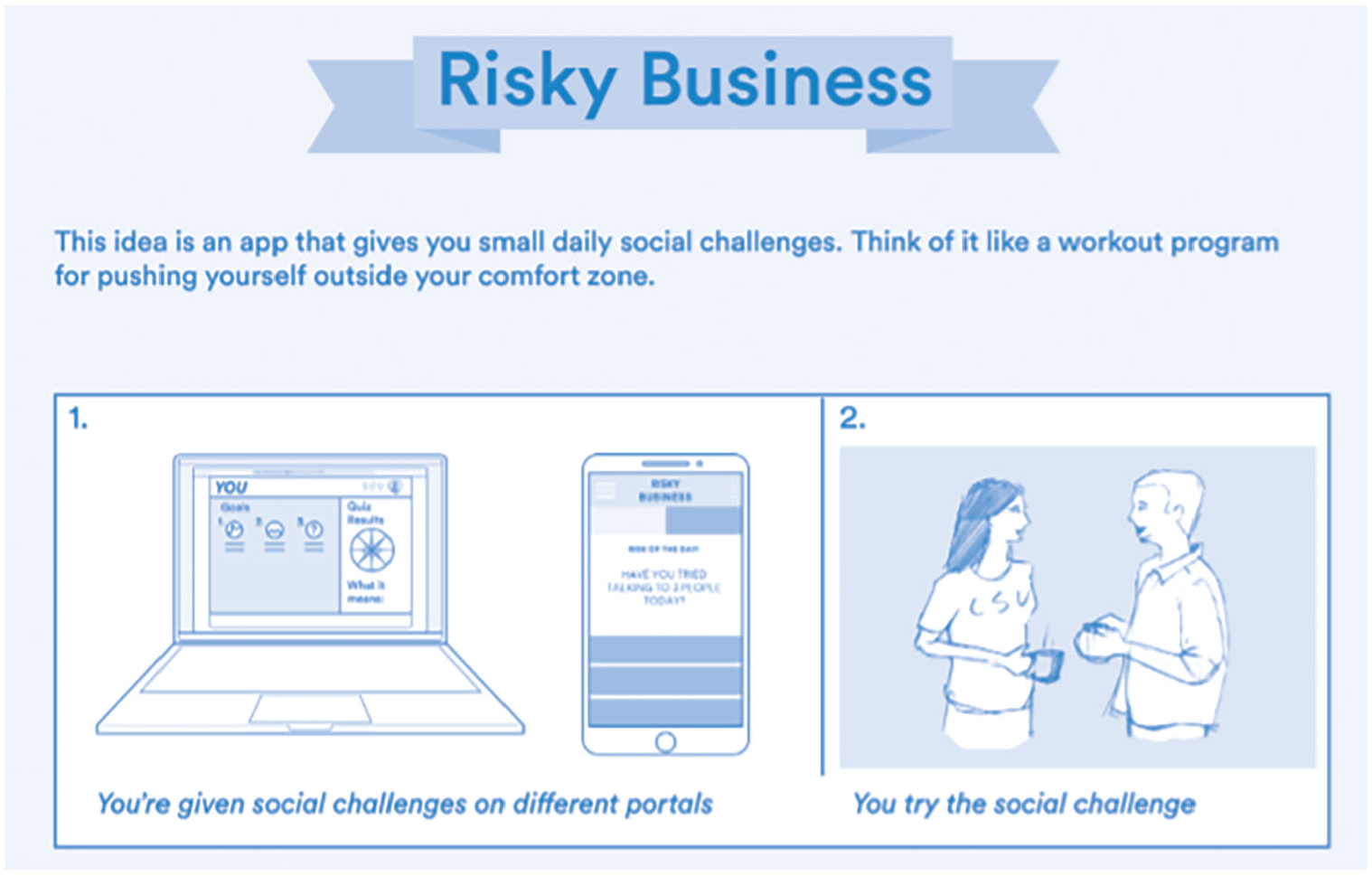
The most popular of five storyboards based on target audience feedback.
Building and Testing a Prototype
In late 2018, the combined team convened to spec out the prototype—including the background research, intended impact (impact pathway) and theory of change, key features/functions, the product experience, technical decisions (integrations, platform choices), as well as marketing considerations—particularly about how YAs would both find and share the tool (see Exhibit 2).
They agreed on three key product features:
Ideas: Prompts based on the science of social connection helped students take small, achievable steps to build social connections.
Reflections: Short in-app exercises helped students process social experiences, reduce self-criticism, and build resilience so they could progress toward their social goals.
Testimonials: Real student perspectives on social connection reinforced the message that building connections takes time and effort.
The team co-created the branding with students so that the visuals, messaging, and name of the app were relatable and “spoke their language.” Also, they paid attention to ensuring that Nod’s messaging could serve a diverse audience transcending race, orientation, gender, and ethnicity.
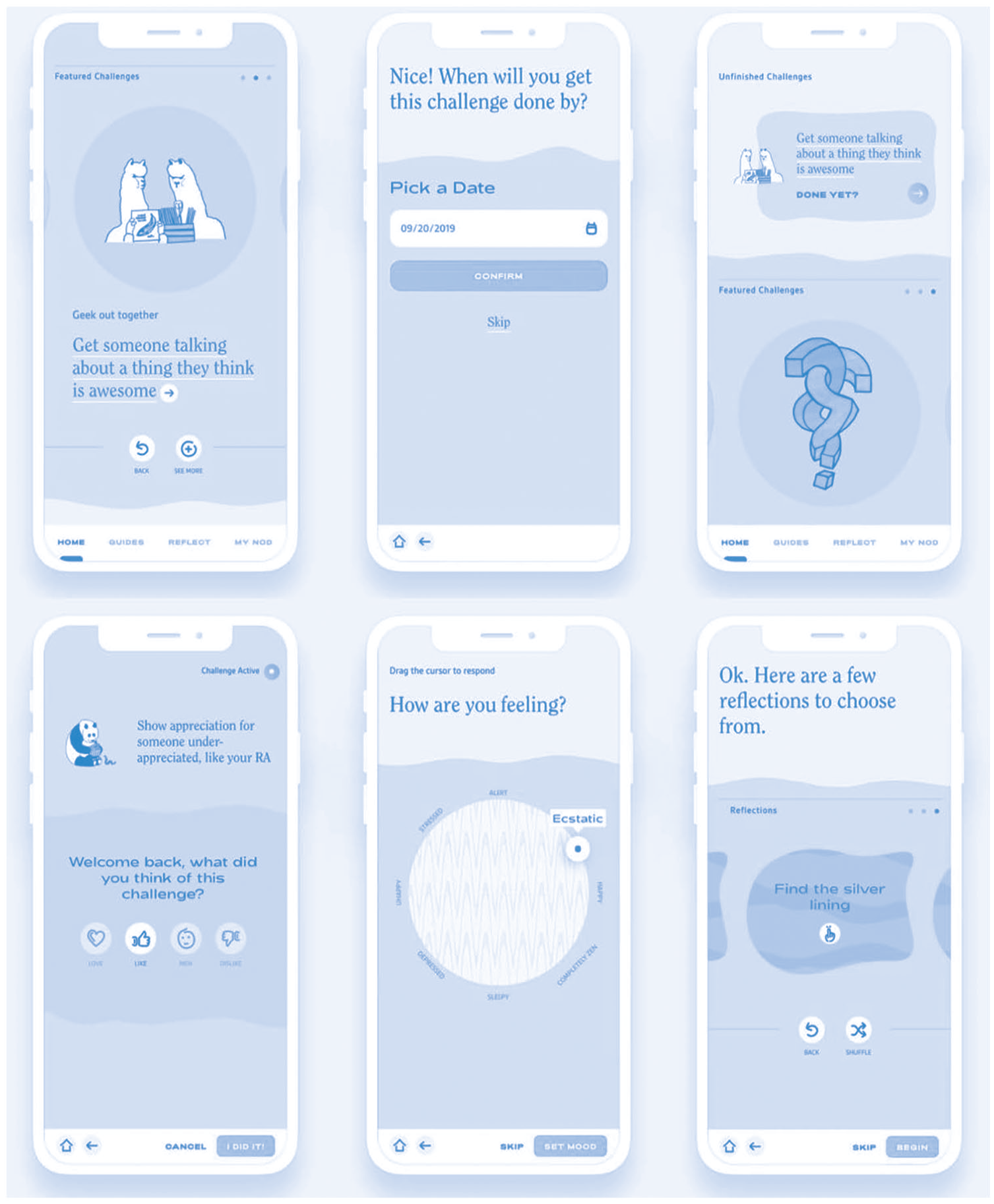
Nod early product experience prototyping.
Pilot and Feedback
The Nod “1.0” app was tested in a limited rollout in 2019 at the University of Oregon (UO)—in partnership with UO’s Department of Psychology and the Department of Psychiatry and Weill Institute for Neurosciences at the University of California, San Francisco. The purpose was twofold: to understand user feedback about product design and to understand the underlying efficacy of Hopelab’s “theory of change.”
From the incoming UO class, 220 students were selected and divided into an app-using and control group, with further subdivision between those who were experiencing high loneliness (using the standard UCLA scale) 26 and those who were not. The students were surveyed on a variety of “College Adjustment Indicators” both pre- and post-use, and were also asked to provide feedback on the app itself. 27
Nod would be rolled out through universities, meaning it would be introduced to students by a trustworthy source rather than a cold ad on students’ smartphones. The team had researched how much the messenger or recommender of an app mattered and found it was a large contributor to establishing trust. Once a higher education institution decided to partner with Nod and purchased a license, students at those institutions could download the app for free (see Exhibit 3).
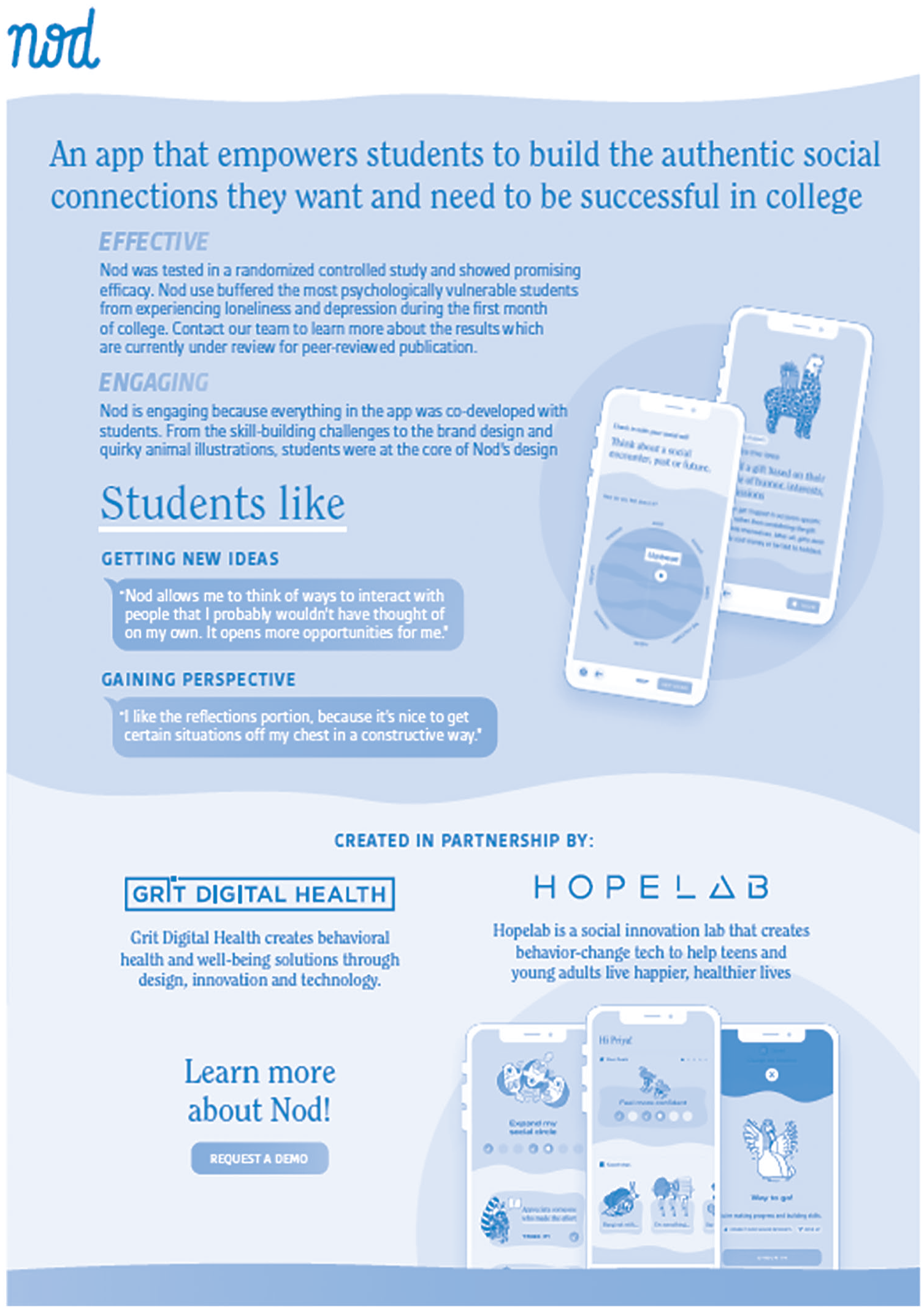
Nod sales collateral for marketing to higher educational institutions.
Efficacy
The pilot study found Nod had significant benefits for students who entered college with elevated risk (i.e., heightened loneliness and depression) relative to their peers, and that this protected against poor sleep quality, reduced social support, and reduced campus belonging.
This result was achieved even for students who had limited engagement with Nod. The research found that students in the experimental group viewed 36.69 pages in the app on average. One possibility is that the social growth mindset messaging woven into Nod might have set in motion recursive psychosocial processes that accumulated over time. The study stated, reading student testimonials that normalize feelings of nervousness or awkwardness, and receiving prompts to try out new social activities, may have encouraged vulnerable students to take small social risks early in college (e.g., to strike up new conversations or to go out to an event rather than staying home), which may have in turn set the stage for future patterns of positive interaction without requiring extensive engagement with the app.
28
The team’s goal for Nod was not engagement with the app, but rather YA engagement in behaviors that are the target of the intervention—in Nod’s case, supportive social interactions. Without measuring outcomes (vs. traditional app engagement metrics), the team could have misread the success of the pilot. This “tech for good” outcome-based model 29 is a contrast to traditional “big tech” engagement models, which emphasize growing and monetizing usage frequency and page views. 30 Instead, the Nod team designed its app to be like dosage-based medicine—eventually students should no longer need it.
Product Feedback
Participants’ usage data and qualitative feedback indicated several strengths of Nod, including the supportive approach, creative ideas for encouraging social experimentation, and accountability. But some suggested changes also emerged from the early pilot users:
The majority of participants expressed that Nod would benefit from greater personalization such as challenges that adapt to the user’s comfort level.
Participants also indicated that they would benefit from more and different types of push notifications and suggested providing more in-app incentives.
What Next?
By the end of 2020, the Nod app was launched in 11 pilot schools and had won two Fast Company Innovation by Design Awards in the “Social Good” and “App & Games” categories. In spring 2021, Grit and the Colorado Education Initiative received an Upswing Fund grant to bring Nod to high school students in that state. 31
Along with new partnerships and reaching new audiences, questions remained unanswered. The early work indicated significant benefits, without a clear understanding of which elements mattered most. User feedback indicated a need for boosting motivation and reminders to engage, as well as a clearer description of the potential benefits of app usage to students. While co-designing with YAs built trust, what role would universities play in user adoption? And since engagement decline was actually an indicator of impact for Nod, how might they think about business models?
Despite these questions, the combined team was excited about the future of Nod and expanding its footprint. They all felt that after the isolation driven by the COVID-19 pandemic in spring 2020, young people needed mental health support more than ever.
Conclusion and Implications
Increasingly, technology is being deployed to address complex large-scale social issues. The successful use of “tech for good” to create innovative solutions to wicked problems requires combining the best practices of both technology-based innovation and social sector solutions. As the case highlights, this includes elements of problem finding and selection, problem framing, root cause analysis, impact measurement, ideation and prototyping, agile development, and co-creation.
In particular, systems thinking creates clarity into the different variables and their interconnectedness, allowing for the informed choice of high-leverage intervention points. Theory of change models focus on finding the root causes of issues, articulating the intended impact, and developing an insightful problem frame to guide solutions. Design thinking ensures that solutions are developed with rather than simply for stakeholders, using an iterative and agile test-and-learn methodology.
While this process has an outcome-based focus, it also enables a learning-forward cycle of innovation. Product execution, the underlying impact change theory, and the choice of the focal issue as part of the larger systems map can all be assessed separately, creating the potential for a sustained progressive effort toward solving key social issues such as the mental health of YAs.
Footnotes
Notes
Author Biography
Dave Rochlin is both a Continuing Lecturer and the Executive Director of the Innovation, Creativity, and Design Practice at The University of California, Berkeley’s Haas School of Business. He is also a Consultant and Social Entrepreneur, focused on market-based approaches to social and environmental issues including deforestation, climate change, corporate social responsibility, sustainable business, “tech for good,” and ethical globalization (email: