



Abstract
Agile management prescribes a set of structures and processes to help teams respond to change. This article presents an in-depth case study examining how high- and low-agility nursing teams differed in their response to the COVID-19 pandemic, organizational restructuring, and floods. It unveils the crucial role of “affective leaders” in high-agility teams during those crises. These leaders constructed positive emotional experiences for their teams to successfully respond to adversity. The findings remind scholars and practitioners that agile management’s founding tenet of “valuing individuals and interactions” implies understanding, working with, and actively recalibrating emotions.
Organizations face and must adapt 1 to both external (e.g., floods, epidemics, technological disruption) and internal (e.g., mergers, leadership turmoil) changes. Agile management has been touted as a solution for responding to quickly shifting circumstances effectively. 2 Owing to this promise, 3 the adoption of agile management has spread like wildfire 4 from its original setting of product and software development 5 to teams in banking, 6 hospitals, 7 heavy equipment manufacturing, and entertainment. 8
Agile management involves releasing people from functional and rigid hierarchical silos, and placing them into responsive customer-centered, self-managed teams. 9 A plethora of agile methodologies have been developed, such as Extreme Programming, Adaptive Software Development, and Scrum. 10 Progress in the agile management literature has primarily focused on leveraging and adjusting various team structures, processes, and tools in face-to-face communications, stand-up meetings, Kanban boards, iterative working, and self-organization—which are where team leaders either are removed or operate with reduced roles. 11 Importantly, studies have also exposed these structural and procedural approaches as insufficient in explaining agile team performance. 12 This should not be surprising since the Agile Manifesto that sparked the movement emphasizes “valuing individuals and interactions over processes and tools” as a core tenet. 13
In fact, today’s fixation on structures and processes has left affective mechanisms—a key factor in team processes 14 —largely untended. The scant acknowledgment—let alone study—of emotions in agile management is startling. As opposed to conventional teams working in more stable settings, agile teams are specifically designed for work environments characterized by change and surprise. Such settings trigger heightened emotions in teams. So, stating the obvious may be necessary: individuals feel and care, and emotions embody adaptive responses to environmental demands. 15 Indeed, sudden change—to which agile teams respond—can induce intense emotions such as anxiety, fear, or conflict. 16
Critically, little is known about the underlying emotional processes within agile teams. For example, recent literature reviews on agile management seldom feature any of the human dynamics and behaviors that drive team members. 17 When we turn to related research streams on affective team climate, 18 organizational compassion, 19 and others, they unanimously agree that crises prompt emotions and that team affective mechanisms play critical roles in team outcomes. 20 Yet, again, scant attention has been paid to why teams differ in managing emotions and adapting. The gap in how teams emotionally experience and cope with crises merits concern 21 because team responses to crises can vary wildly. 22 The main motivation for this study arises from the juxtaposition of the critical role of team emotions and their corresponding absence in the agile management literature. Thus, we ask how do agile teams’ emotional experiences impact their agility during crises?
We probed this question through a two-year comparative case study of nursing teams who suffered floods, organizational restructuring, and the COVID-19 pandemic in sequence. By contrasting how agile teams with high versus low agility dealt with these crises, we unveil the critical role of affective leadership. While all teams master the traditional agile success factors (i.e., processes, structure), in effective teams, affective leaders grasp emotions’ individuality, meet team members’ emotional needs, and are especially adept in navigating members away from negative emotions toward constructing a positive, team-level shared emotional experience. Thanks to this emotion regulation, high-agility teams avoid cliques, and the team collectively unites to respond to crises and turn them into positive outcomes.
These insights have important implications for organizations that seek to become agile and implement agile ways of working. For instance, we propose to revisit traditional Agile Coach or Scrum Master roles in ways that tend to teams’ affective experiences. We further explain how to avoid harmful cliques forming around unmanaged emotions, and how to navigate teams toward positive dynamics that assure agility during crises. We thus remind agile scholars and practitioners of their oft-forgotten roots in valuing individuals and interactions over the mastery of processes and tools.
Methodology
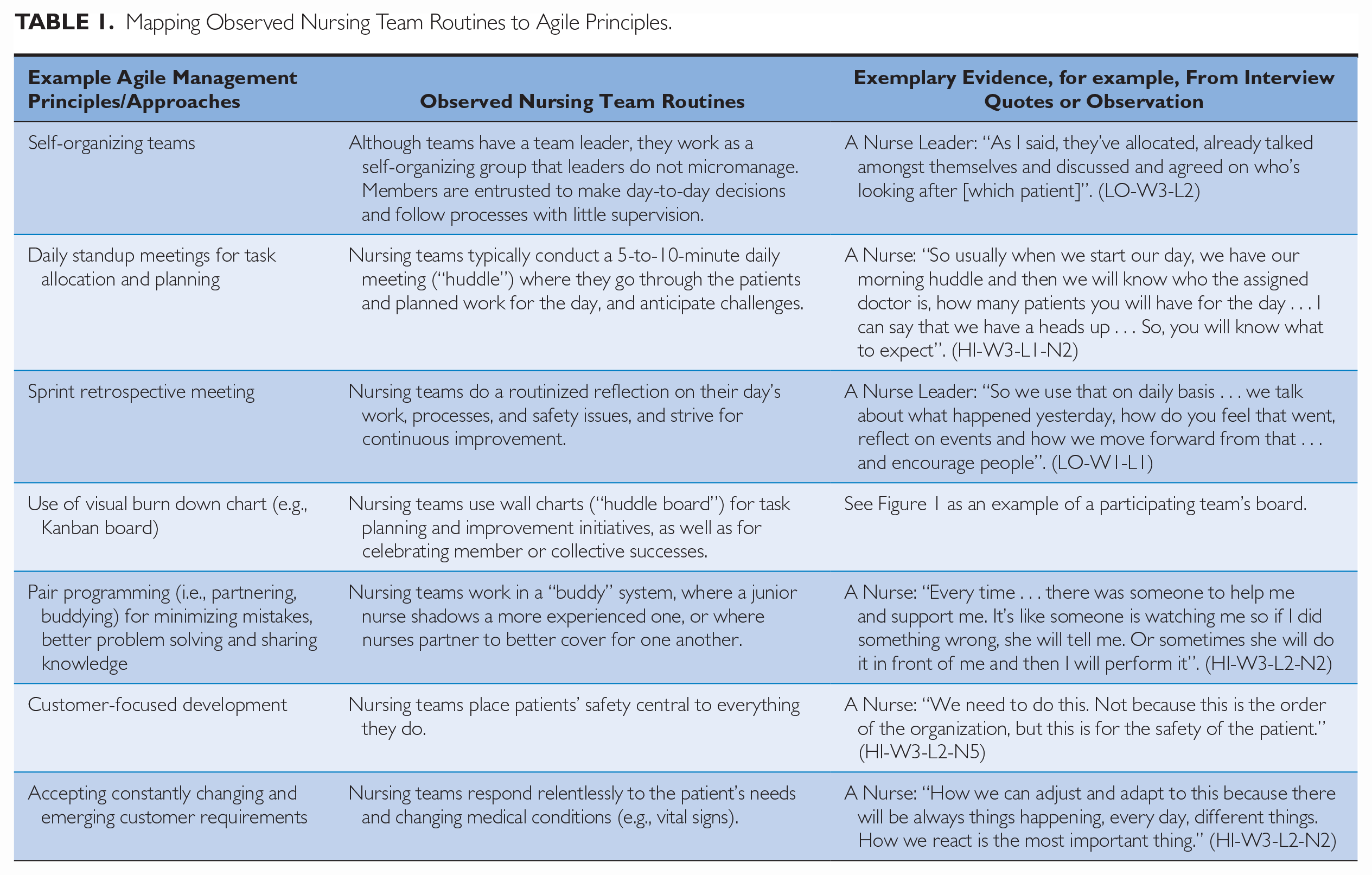
We conducted a two-year-long, comparative case study of nine clinical nursing teams that experienced consecutive crises in a recently opened pediatric hospital in the Middle East. The nursing teams in the chosen hospital operate in agile ways. First, nurses face relentless change and unpredictability and must respond rapidly due to patient safety implications. 23 This was exemplified through our interviews being repeatedly interrupted when nurses were summoned by their wearable Vocera communication devices to respond to urgent patient issues. Second, the nursing teams featured cross-functional, diverse teams that applied agile management principles and routines. For instance, the teams we studied are self-organized, conduct daily briefs, use team wallcharts, and are intensely focused on patient outcomes. Table 1 provides further evidence of how the nursing teams work according to agile principles. Patients and emergencies can be viewed as “projects” that nursing teams execute in alignment with the traditional project-based setting of agile management.
Mapping Observed Nursing Team Routines to Agile Principles.
We enlisted a theoretical sampling approach of polar cases 24 by selecting teams with high versus low agility (the outcome of interest) to detect contrasting team mechanisms leading to different results. At the study launch, we asked ward managers overseeing multiple clinics to assess the agility (i.e., speed, responsiveness, flexibility) of several teams within their wards (each team is managed by a clinical nurse leader, referred to as team leader hereafter). We selected five high- and four low-agility teams from that sample. The nine teams had on average 8.7 members, ranging from 7 to 11. All team leaders were international with no meaningful differences in terms of tenure, or age, and we observed no turnover during data collection. At the end of the study—and during the pandemic—we asked these ward managers to reassess the selected teams’ agility levels: without a reminder of rankings two years prior, they assessed teams in the same order. By contrasting the cases, our goal was to uncover the reasons behind the teams’ different agility. We note that no implicit assumptions were made in relation to team leaders’ styles, since this was not leadership research initially. In fact, we anticipated leaders acting mostly as Coaches or Scrum Masters—meaning, being primarily keepers of team organizing processes.
The successive crises consisted of sudden flooding, organizational upheavals, and the COVID-19 pandemic. Unexpected heavy rains (late 2018), the first-ever in the country’s recent history, flooded the hospital—making many offices and patient rooms unusable. Next, organizational upheavals spawned sudden restructuring changes that affected nurses’ roles and living conditions throughout most of 2019. Finally, the COVID-19 pandemic struck the hospital in early 2020, severely disrupting work and infection-prevention measures.
We conducted 45 semi-structured interviews with 29 nursing staff that included ward managers, team leaders, and nurses. Around the crises, we asked interviewees to describe their emotions and how their teams coped, also probing interpersonal relationships. To triangulate findings, we also attended 19 daily team meetings (known as “huddles”) where we observed and made notes of team processes, emotions, interactions, and dynamics. During the pandemic, we also surveyed nurses’ emotions and monitored the messages of two teams’ WhatsApp messaging groups: 1,235 text messages over 185 days. These added data sources required amending our hospital’s ethical approval. Most teams refused, save for two having polar performance: HI-W3-L2 (high agility) and LO-W3-L2 (low agility) according to the shorthand we used. 25
Our longitudinal research design allowed us to both investigate team history as well as track present team member states in real time throughout three consecutive crises. 26 First, nurses recounted the floods that had just happened a few weeks earlier and were still vivid in their minds. Next, we interviewed nurses as other organizational events occurred. Finally, throughout the pandemic, we held further interviews about the nurses’ first-hand experiences and team relations, conducted a survey, and accessed WhatsApp texts, allowing us to sense how emotions and team relational dynamics shaped agility over time.
We analyzed interview data using a grounded-theory approach that allowed novel insights to emerge organically. 27 The following sub-questions guided our analyses: How did individual members experience the crises? How did individuals interact and behave? How did the team collectively act and cope? We first manually coded the data starting with open coding (first-order terms). Next, we reduced initial data coding to second-order categories and finally aggregated them into theoretical concepts. To gain additional perspectives on our findings, we also manually coded two teams’ WhatsApp mobile text messages. We contrasted all coded data within and across our nine teams 28 to understand how teams coped and adapted differently with constant referral back to extant literature. We continued this iterative process, reaching theoretical saturation 29 after 45 interviews.
Team Emotions, Leaders, and Agility During Crises
Emotions During Crises
Crises trigger unpredictability, which challenges both individuals and teams. In our study, crisis-inherent surprise triggered strong emotions. At the start of the research, a ward manager related that the sudden floods were intensely stressful for all clinics and teams:
[The floods]—that was probably the biggest stressful change that we had to do . . . we were closing beds, found out we had mold everywhere . . . so it was difficult . . . and it was stressful for everyone. (W4)
Later, we surveyed members’ emotions using a standardized questionnaire a few months into the pandemic. 30 We specifically asked how the pandemic made the nurses feel (see Figure 1). Respondents all consistently reported that it made them feel distressed, upset, nervous, afraid, and scared. The difference, however, is that high-agility members reported superior levels of positive emotions—especially feeling proud, strong, active, and inspired.
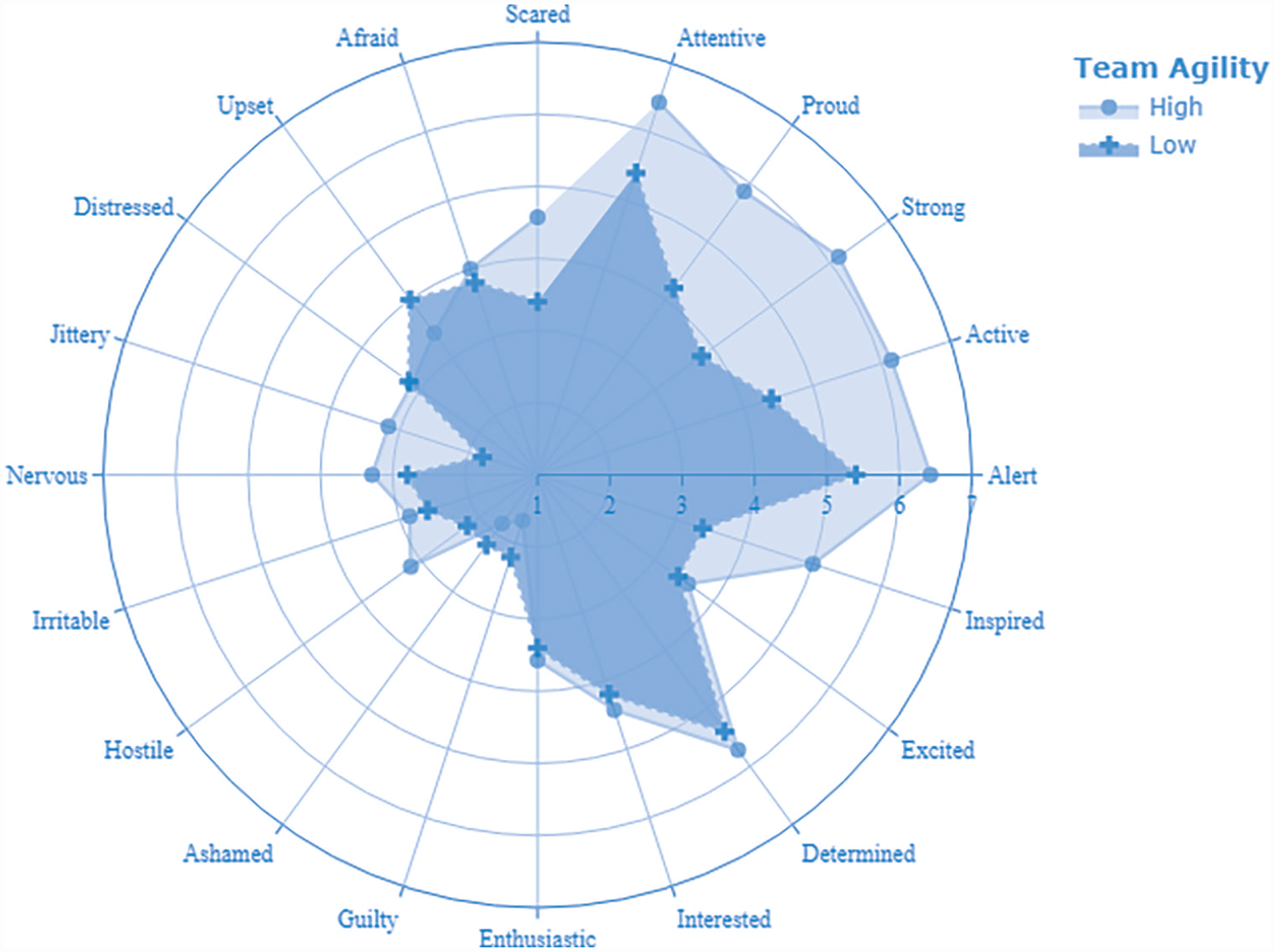
Emotions.
The interviews we conducted during the two-year study corroborate this observation as members of high-agility teams expressed feeling more positively about crises versus low-agility counterparts. For example, two nurses in low-agility teams discussed their emotional experience around the pandemic:
Well, it’s been quite stressful, to be honest . . . Oh God, I have to go to the frontline now. It’s quite scary and daunting because I have a child of my own. (LO-W1-L2-N2) For me, it’s getting me depressed . . . And then the patients; you don’t know if they’re lying when you’re asking them about COVID. So, it’s pretty scary. I’m scared. (LO-W3-L2-N1)
We contrast the above negative emotions and experiences to those of nurses in high-agility teams who were milder and more positive in their accounts of the pandemic:
It’s fine, the change. It makes me discover new things. I’ve become more flexible in COVID-19. It’s a new experience, and it’s fulfilling for me as a nurse. (HI-W3-L2-N1) I just came from quarantine because I was exposed to a [positive tested] mom of a patient . . . I had the fear that I would be positive as well. But later, I was fine. I got used to it. Personally, I’m able to cope with the pandemic. (HI-W3-L1-N1)
Individual emotions propagate and translate to emotional climate and experience within a team. The notes we took while observing huddles provided some early evidence of the opposing emotional dynamics in teams. For instance, our notes from the June 12, 2019 meeting of a low-agility team summarized: “It’s mostly the leader speaking, team ambience is low key, almost a little down.” In contrast, our July 28, 2019 huddle notes of a high-agility team read: “ambience is relaxed, open exchange, atmosphere upbeat. They laughed a few times.”
To further verify that highly agile team members appeared to experience more positivity within their teams, we turned to our mobile text data. During the pandemic, we contrasted a high-agility and a low-agility team by measuring team affective tone as the shared emotional experience of members, 31 in their WhatsApp text messages. We coded all texts according to positive versus negative tone. For instance, “Amazing, thank you team.” was coded as positive, whereas “I will never do it again, sorry.” was coded as negative. Overall, we found that 58% (389 out of 671) of the high-agility team’s messages conveyed a positive tone versus only 35% (200 out of 564) for the low-agility team. Thus, we observe that the differences in individual-level emotions spread into a team-level affective tone.
In summary, our diverse data substantiate that a crisis triggers emotions across team members. Under the same crisis, however, low-agility teams collectively experience fewer positive emotions and affective tone than their high-agility counterparts. Why? What allows high-agility teams to cultivate positive emotional experiences?
Role of “Affective” Leadership
The evidence of the contrasting experiences, behaviors, and agility between our sampled teams points to the criticality of the leader. But not any kind of leader: high-agility teams benefited from having an affective leader.
Grounded in our collected data, affective leaders grasp how their members feel during crises and proactively attempt to turn negative emotions into positive team experiences. We did not observe such behavior from low-agility team leaders even though their members experienced negative emotions (as did all the teams in our sample). We were first intrigued by a ward manager’s story about the floods; she related her observation around emotions: “You have to manage that and facilitate and support the negative ones” (W3). Consequently, our data surfaced affective leaders engaging in recalibration of negative member emotions into positive team experiences in times of hardship, for instance, during morning huddles. An affective leader explained how she handled crises:
We start with encouragement and positive words . . . We share some stories, we laugh about it, to create the harmony and that happiness. (HI-W1-L1)
Another affective leader expressed the importance of noticing how her team is emotionally impacted, and then trying to constructively navigate it away from the upheavals:
For my team, I’ve drummed it in . . . they’ve seen these really emotional things that happened before, and we’ve come to a state where we’re saying “change is not something you can run away from” . . . “so, what do you want to do about this change, let’s talk about it” . . . the key for me is to notice how everyone is affected by the change and how we can influence them to take the change. (HI-W3-L2)
In the interview excerpt that follows, another affective leader explained how she navigated her team away from negativity and into positivity, through optimism and laughter:
So, when they come with those stories, I try to create some positivity in them . . . they are doing a fantastic job, we are a happy bunch of people . . . we try our best, we don’t talk about negative stuff all the time, we talk about positive stuff, we laugh a lot, and that helps us. (HI-W1-L1)
To contrast this important insight on emotion recalibration, we turned to the WhatsApp data. We illustrate the lack of recalibration through a non-affective leader (LO-W3-L2), who, in relation to her nurses feeling distressed about a colleague testing COVID-positive, attempts no emotion recalibration. In fact, the emotional exchange deteriorated quickly (with no further texting about this episode):
Leader Is he positive? Nurse 1 Yes. OH [Occupational Health] called Nurse 2 OMG [Oh my God]!!!! Leader Better ring OH and tell them Nurse 1 or wait for their call . . . you know confidential thing Nurse 2 In the team room . . . he was using the computer next to me Nurse 5 Oh my God Nurse 1 OMG Nurse 5 God we are so unlucky
We found several instrumental ways that affective leaders behave in recalibrating emotions. First, they understand that each nurse experiences unique emotions while having different underlying concerns, needs, and motivations. The following affective leader explains:
We need to acknowledge the process of grieving when change happens. It will affect people differently, and we need to support each other regardless of how they’re affected. (HI-W3-L2)
Second, affective leaders prioritize their staff’s well-being by looking after their emotional needs and psychological welfare. Affective leaders deeply believe they are responsible for meeting those needs:
My duty is to ensure they are happy and lift their standards . . . it all goes with a lot of counseling, a lot of reassurance, a lot of fun. (HI-W1-L1)
Third, through our meeting observations and interviews, we noted that affective leaders tended to thank and praise their members more versus non-affective counterparts. To verify this, we used our WhatsApp dataset and coded the messages from leaders to their members—those showing appreciation, thanking, and praising. We counted these instances and, overall, the affective leader displayed such behavior three times more often than the non-affective one: 35% (27 out of 77 messages) versus 10.4% (28 out of 268 messages).
Fourth, and importantly, affective leaders play a proactive role in relation to cliques. A downstream result of negative emotional experience is that members’ emotional needs go untended. In such cases, we find members tend to withdraw and seek comfort within smaller cliques—meaning, members merging into subgroups (or silos).
32
Teams without an affective leader suffered from cliques whose emotion-based formation was recognized:
I can sort of see how people go into their little [sub]groups and stick together . . . because of their emotional state, I know recently they have felt unstable with the way things have been . . . and they’ve been particularly emotional about it. (LO-W1-L2)
Nurses experience supportive gestures and closeness more extensively within a subgroup, in which non-clique members are treated as outsiders. This experience further contributes to the disintegration of team unity in non-affective teams:
You can observe that there are [sub]groups who really are there for each other . . . They are close, but for an outsider or another person who is not part of the [sub]group, they wouldn’t be that much welcoming . . . We tried to do a team outing. You would see some [sub]groups would come, some [sub]groups wouldn’t come. Even if they go out together, or we do dinners, you see the [sub]groups sticking together. You don’t see them merge. (LO-W4-L1)
Critically, given cliques’ emotional undercurrent, during times of adversity teams’ interpersonal relations may worsen. A non-affective leader during the emotionally draining pandemic illustrates this exactly:
I think it’s a bit increased at this point [in COVID-19] because as I mentioned before, you can feel everyone has started to focus on themselves. You can feel some of them, they sit together more often than before . . . And there is conflict. With COVID-19, relationships became weaker. (LO-W3-L1)
In contrast, affective leaders proactively dispel cliques in their teams. Here are two instances:
They saw how I deal with it . . . when I notice these [sub]groups I would mention it to the group meeting, “I am seeing this” . . . and they know exactly what I am talking about! (HI-W3-L1) We don’t allow gossip. . .no one will come through this door and say anything about somebody because they know I don’t entertain these things. (HI-W1-L1)
Compare this to non-affective leaders, who did not heed the potentially destructive impact of cliques, and even condoned them:
In my team, they are pretty strong players this subgroup I’m thinking of . . . but unfortunately, those not in this [sub]group are some of the weaker links . . . the people who are on their own they are not on their own for no reason. (LO-W1-L1) I see it as a supportive thing when we have [sub]groups . . . because you always feel comfortable to approach someone from your [sub]group if you are feeling close . . . if you have people like that you can go for help, why not. (LO-W4-L1)
Clearly, affective leaders appreciate emotional individuality, believe in their duty to meet members’ emotional needs, regularly thank and praise, dispel cliques, and carefully recalibrate members away from negativity. These affective behaviors enable the response to crises.
How Leaders Foster or Stifle Team Agility
Negative team emotions that go unmanaged, and the resulting cliques, are problematic because they lower intra-team support, which is most needed during crises. In contrast, the ability of a team to unite during challenges and engage its members to perform often featured acts of supportive behavior. In teams with affective leaders, support for one another was a norm, like a reflex that unfolded progressively. Consider these contrasting quotes:
This [cliques] affects how much they are helping one another. (LO-W3-L1) I think, for me, it’s the little things that we do that help the team work effectively or achieve little goals, baby steps. Even without asking, we immediately do that. (HI-W3-L2-N5)
The result of the lack of support was that the much-needed teamwork—the principal known antecedent of agility—deteriorates, as confirmed by this non-affective leader:
Now [in COVID-19] the stress factor has become more individual . . . The teamwork, they support it. But they don’t support it like the regular days. (LO-W3-L1)
Importantly, the lack of affective relations and teamwork impede a team’s rapid and flexible response when it matters the most. The link between team members’ emotional state and crisis response was suggested early in our study by this non-affective team leader:
Since last time we spoke . . . when we talked about the flood and how people came together to get on with that . . . if you asked the question now, this year, if there was a flood . . . and thinking of the wellbeing and morale, I don’t know that my people would perform as well.” (LO-W1-L1)
This contrasts with an affective team whose nurses described the strong agility (e.g., flexibility, speed) they observed daily from their teammates:
We are more flexible now [in COVID-19]. One nurse was called to another unit; she went right away. We are flexible, stretching ourselves as much as we can. (HI-W3-L2-N3)
To further verify these links, we asked the ward managers—who two years prior had rated teams as high- or low-agility—to re-rate at the end of the study. We did not remind them of the original assessments. They ranked the teams in the same order, confirming that the affective dynamics we observed enabled teams to respond to crises with agility. Our results, therefore, advance that crises may be experienced negatively and that unmanaged emotions and cliques—in the absence of an affective leader—can impede team agility.
Contributions and Implications
How do agile teams experience and cope with emotions, and how do these experiences hamper or boost rapid, flexible responses to crises? Based on our comparative case study of nursing teams that faced events such as floods and the pandemic, we find that all teams similarly practiced prescribed agile ways of working, through agile processes (e.g., daily standups, retrospectives) and team structure (e.g., self-organizing). However, we uncovered two key differences between high-agility and low-agility teams.
First, in highly agile teams, we unveil the critical role of affective leaders. These leaders display key affective behaviors. They embrace individuals’ unique emotional experiences and proactively recalibrate team members’ negative emotions. They also address team members’ emotional needs and dispel cliques that form around negative emotions. Second, these behaviors turn negative crises into positive shared emotional experiences for the team, which in turn, enable the collective to come together and positively handle crises.
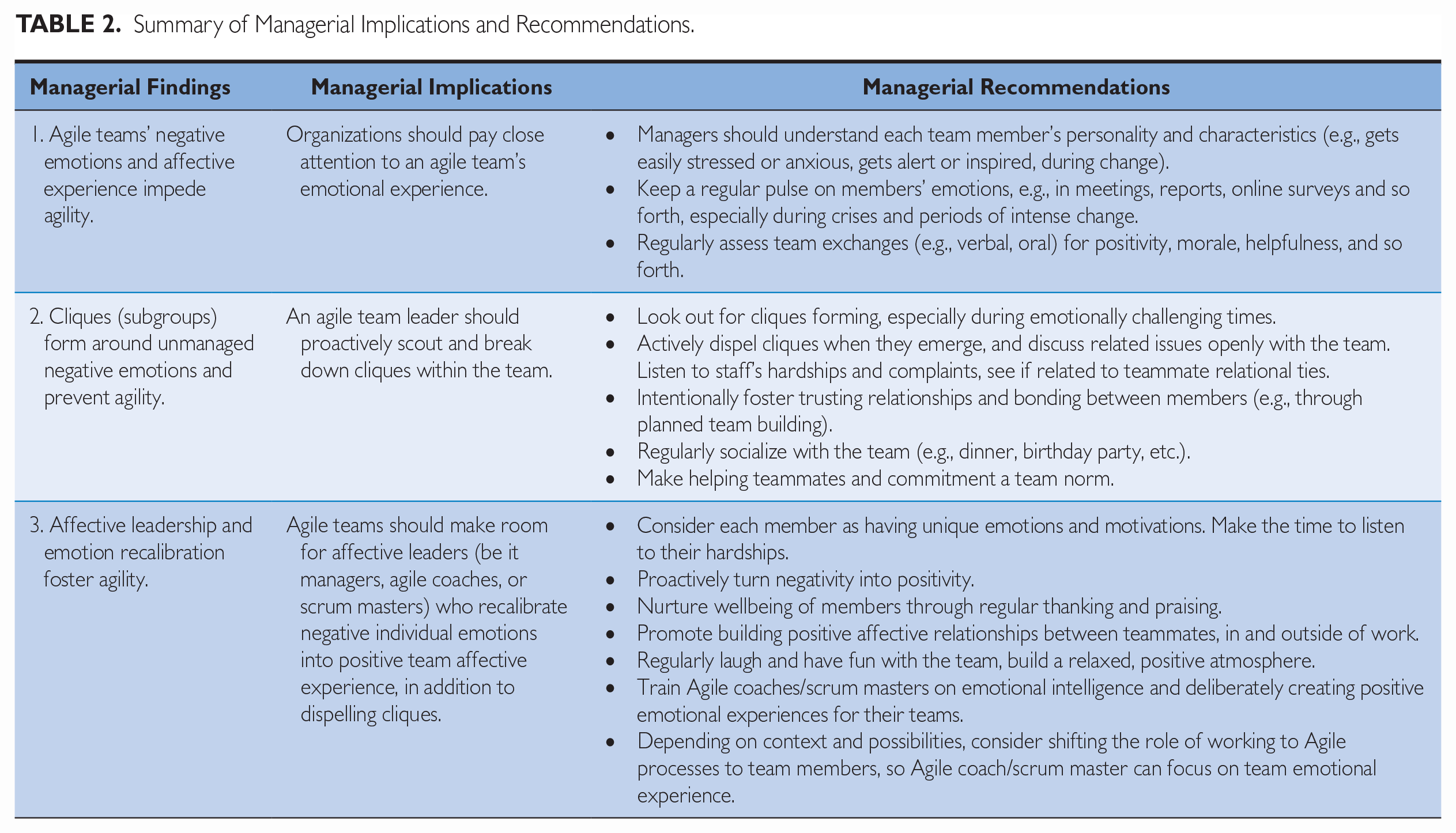
We present evidence that positive emotions, teamwork, supportive behaviors, and other relational team mechanisms, impact team agility. And in fact, such links are well documented in extant literature. For instance, the disintegration of teamwork reduces the team’s information-sharing and coordination, and adaptive performance. 33 Then, positive emotional states allow firefighters to more quickly respond to fires, 34 while negativity and conflict during crises cause lower performance of nuclear plant crews. 35 Finally, relational coordination foretells team performance in response to crises, 36 and psychological safety—related to trust and affective intrateam relations—is linked to teams adapting better to change. 37 However, past research has overlooked how agile teams can foster those positive emotional experiences. Perhaps paradoxically, while popular agile management practices extol leaderless teams, our study offers an argument in favor of a new breed of leaders. Consequently, we propose an affect-based theory of leading agile teams and processes, 38 as depicted in Figure 2. These contributions and implications are summarized in Table 2.
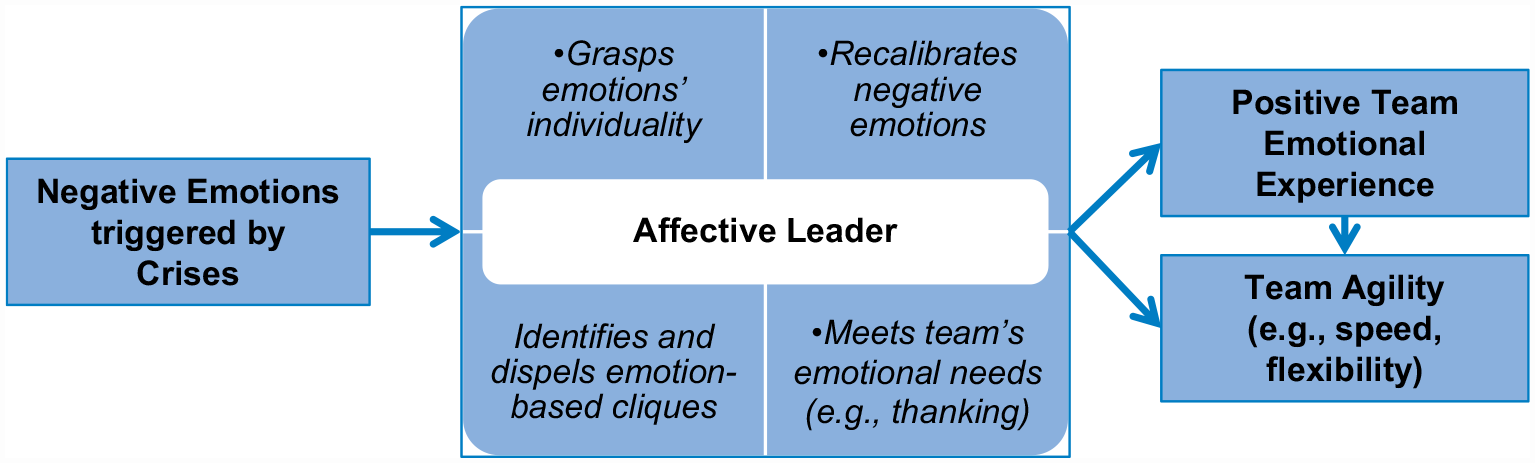
Theoretical model of emotions and the leader driving team agility.
Summary of Managerial Implications and Recommendations.
Agile Teams “Feel” Crises
We observed more positive individual-level emotions and team-level affective experience in high-agility teams than in low-agility teams. This is important for agile management research for at least two reasons. First, agile management has been prescribed for teams typically operating in dynamic and unpredictable circumstances. Our study shows that these circumstances trigger emotions, which subsequently impact team relational processes and interactions. Yet, research and practice in agile management have so far largely overlooked the role of emotions.
Second, agile teams differentially experience crises. While the literature has often emphasized crises as negative emotional events for people, 39 we further note how some experiences can be turned into positive ones. For the same events in our study, many negative emotions were similarly felt and freely expressed across teams. What differentiated high-agility teams was an elevated ethos of positive emotions. The significance of positive shared emotions in teams cannot be overstated because negativity and ensuing team behavior can lead to a team’s disintegration. 40 Rather, positive emotions help create bonds among members, 41 and this subsequently enables a team’s fast and flexible response to crises.
Our study offers immediate practical implications for agile management and team design, especially around processes concerned with attending to individual members’ emotions. In crisis-riddled times, managers should keep a regular pulse on members’ emotions, for example, how they feel about an event, about their work progress or teammates, and so forth. It is vital to have regular touchpoints and candid dialogues with members regarding their emotions using organizational practices and tools (e.g., one-to-one meetings, and surveys). As agile teams become more cross-functional and multicultural, rifts will inevitably arise among teammates in the face of emotional crises. All this suggests that managers must rein in team emotions, especially since they can enable or impede team agility during crises.
Managerial Implication 1: Organizations should pay close attention to an agile team’s emotional experience.
A word of caution is also needed. First, we do not advocate that negative emotions are always bad, or that they should be suppressed. In fact, negative emotions in crises can be good, for instance, in realizing the situation is potentially unsafe and triggering individuals to react and systematically process information. 42 Moreover, positive emotions (e.g., joviality) are not always good, for instance with firefighters they can lead to higher accident rates despite enabling faster response to fires. 43 Second, because each crisis varies in origin, nature, duration, and impact, 44 emotional team experiences may differ.
Agile Teams Suffer from Cliques
We reveal that negative team affect can spawn the proliferation of cliques that inevitably trigger the collapse of teams’ coping mechanisms. This novel affective understanding is crucial. Consider this: Agile management advocates diverse cross-functional teams because they pool extensive know-how to respond to crises. Yet, the very diverse nature of teams moves individuals to join cliques due to differences such as in experience, culture, and language. 45 Consequently, the new emotion-based formation of cliques significantly exacerbates problems agile teams face due to their ever-changing environments. Unmanaged negative emotions by the leaders and shared emotional experiences as enablers of cliques are vital because when negative emotions dominate, they can quickly create a destructive emotional spiral. 46 Resulting cliques further impair team affective behaviors (e.g., commitment, helping), as well as future adaptation to the detriment of team agility. Indeed, cliques are known to be divisive and pique staffing tensions 47 in ways that erode the collective sensemaking, decision making, and action-taking that teams need.
Cliques plague the agile team and are likely to occur given its typically diverse and cross-functional makeup. Because of the ensuing deterioration of collective processes, cliques undermine how well the team can unify during crises to self-organize and self-manage, conduct productive huddles and meetings, transparently reflect during retrospectives, buddy-up teammates, and more. These prescriptions work some of the time, but during crises, normal team functioning breaks down. This is because a crisis is an infrequent high-impact event that often requires swift action, causing intense difficulty and breakdown of team routines. 48 As a result, collapse in these team systems violates agile management’s core tenet of valuing individuals and interactions, and it is the very metaphor of a scrum in rugby teams. Therefore, one key recommendation is that managers must be aware of cliques and listen to members when they voice issues. When silos form, managerial interventions are necessary to dissolve cliques and remind teams of the importance of cohesion and unity. Managers may focus on intentionally forging trustworthy relationships and bonds among teammates, 49 for instance, through purposeful, well-designed team-building activities.
Managerial Implication 2: An agile team leader should proactively scout and break down cliques within the team.
Agile Organizations Need Affective Leaders
Agile management has long advocated self-managing, self-organizing teams where the role of the leader 50 is often relegated to a technical function of achieving team goals and increasing productivity. Often, instead of a leader, agile teams have a “Coach” or a “Scrum Master.” Their role is to ensure the implementation and following of agile organizing practices (e.g., standups, interactions, retrospectives, and so forth), and facilitate information exchange between members. Looking at our self-organized nursing teams, we indeed found the team leaders playing this Coach/Scrum Master role, ensuring that under normal changing circumstances, team routines were followed.
However, and critically, crises disrupt teams unlike anything else. Too often in the agile literature and in the implementation of agile frameworks, however, the importance of managing the complex relational and motivational dynamics of team members—and thus their underlying emotions—has suffered neglect. Often, the Agile Manifesto’s principle of “build projects around motivated individuals, give the teams the environment and support they need, and trust them to get the job done” 51 is (mis)interpreted to only mean tools, infrastructure, or systems. We understand this principle to also give teams a psychologically safe and trusting environment. In this light, we see emotion management as central to this principle, and this looms even more acutely in times of crisis. It is fitting that a recent McKinsey report discussed how “COVID-19 strips leadership back to its most fundamental element: making a positive difference in people’s lives.” 52 Our research has unveiled the vital role of affective leaders who attend to each member’s emotional needs and well-being, regularly thanking and praising them. Affective leaders dispel cliques and keep the team united and committed. Critically, such leaders recalibrate negative individual emotions into positive team-level experiences. And so, contrary to the (common) myth that team or middle managers’ importance is immaterial in agile settings, our study documents that agile teams during crises require leaders to be proficient in specific affective competencies and behaviors.
Although we have thus far focused on the leader acting affectively toward team members, our study also included nurses engaging in the affective behaviors displayed by their leader. A mature form of agile management 53 dictates self-managing leaderless teams and thus affective leadership might become distributed in agile teams. This view is in line with distributed (or shared) forms of leadership where members of an experienced team spontaneously and voluntarily offer their influence for the benefit of the team. 54 The implications of affective leadership and its emergent distribution within the mature agile team trigger the need to revisit traditional Agile Coach or Scrum Master roles, currently dedicated to primarily reinforcing teams working within a set of agile organizing procedures and structures. These roles alone may be insufficient in emotion-riddled dynamic settings. Consequently, we advocate that mature agile teams should consider freeing up the Coach or Scrum Master from being a keeper and enforcer of agile organizing processes to being an affective and relational coach whose role is to tend to member emotions and help instill a positive team affective environment. Indeed, because emotional dynamics play a critical role in team performance, 55 we believe this is a most worthwhile endeavor.
Managerial Implication 3: Agile teams should make room for affective leaders (be they managers, agile coaches, or scrum masters) who recalibrate negative individual emotions into positive team affective experiences.
We note how affective leadership is different from similar leadership styles and how it connects to leader emotional intelligence (EI). First, affective leadership is distinguished from similar relational-oriented styles. Echoing our findings, inclusive leaders use words and deeds that invite and appreciate others’ contributions. 56 Another example is that of considerate leaders who show concern and respect for individual team members and treat them as equals. 57 A final example is servant leadership, whereby leaders are focused on team members and prioritize individuals’ needs in an altruistic manner. 58 Although such relational leadership styles favor building follower respect and encouraging the team’s welfare, none specifically focus on regulating member emotions—and particularly building positive shared team-level emotional experiences through recalibrating negative individual emotions.
Second, affective leadership is closely related to EI, which refers to a leader’s individual capabilities (traits, skills). For instance, a popular EI framework proposes focusing on mental traits and abilities: perceiving emotion, facilitating thought with emotion, understanding emotion, and reflectively managing emotion. 59 The latter category also reflects the ability of the leader to manage others’ emotions and moderate negative ones. Another widespread model explicates EI through four domains that focus more on broader social skills and motivational constructs: self-awareness, self-management, social awareness, and relationship management. 60 Social awareness competencies imply the ability to feel empathy and sense the emotions of members through attentive listening. Relationship management refers to the ability to acknowledge others’ feelings and create collegiality.
These subdimensions of EI capabilities aim to be transformational, and they relate to affective leaders. However, there is also a prescribed, dynamic action component to affective leadership, which cannot be automatically assumed with emotional intelligence. The activation of emotional intelligence involves reflection and revelation 61 —but not necessarily purposeful action. Although we expect EI to pave the way for compassionate actions, affective leadership emphasizes consistently demonstrating specific, active actions and behaviors that in time transform distressed emotions into constructive emotional experiences. In summary, we view EI as an input to affective leadership, which puts emotion recalibration on centerstage, enriching the understanding and application of leader EI models in agile organizations.
Conclusion
Affective leaders (or coaches) are vital to recalibrating emotions, avoiding cliques, and steering teams to success through crises. During crises, stakes are high, and following prescribed agile processes and structures may not be sufficient. This article serves as a clarion call for valuing individuals’ emotions above blind adherence to packaged methodologies emphasizing mere tools and processes.
A new breed of leadership needs to be included in agile management practices. These affective leaders grasp the individuality of members’ emotions, actively recalibrate members’ negativity into positivity, work to meet members’ emotional needs, and break down cliques. Ultimately, these practices engage the team during testing times and lead to agility.
Footnotes
Acknowledgements
The authors would like to thank the special issue editor and four anonymous reviewers for their constructive and superb guidance. We also thank Luis R. Saraiva for enabling the study to take place at the Sidra Medicine hospital and facilitating ethical approvals for data collection for this article.
Notes
Author Biographies
Max-Antoine Renault is the Director of Research Operations at Sidra Medicine and a visiting scientist at Erasmus University’s Rotterdam School of Management, Netherlands (email:
Murat Tarakci is a Professor of Innovation Strategy at the Rotterdam School of Management, Erasmus University, Netherlands (email: