



Abstract
Little is known about how design leaders foster design excellence “at scale” within large organizations. To bridge this gap, this article reports on interviews with 59 senior design leaders. Using a paradox perspective to frame the findings uncovers major challenges when leading design teams inside large organizations. It also identifies five pairs of opposing leadership behaviors that address these tensions and balance the overarching paradox of integrating design into the fabric of an organization while maintaining its distinctive character: being transformative yet affirmative; being directive yet accommodating; being proactive yet responsive; being intuitive yet systematic; and being holistic yet specific.
An increasing number of companies are investing in in-house design teams and extending the influence of design to the executive level to stimulate creativity and innovation. 1 Examples of well-known companies that have built substantive in-house design teams include Philips, PepsiCo, 3M Company, Johnson & Johnson, and Apple.
For these in-house design teams to thrive, effective design leadership is essential. 2 Design leadership is operationalized here as the activities and behaviors of those leading in-house design teams to induce stakeholders to take action and create and maintain design excellence. 3 Those leading in-house design teams—that is, design leaders—must seek excellence in craft while optimizing business outcomes. 4
What falls within the remit of in-house design teams, although somewhat context-dependent, generally relates to creativity, user and brand experience, and innovation-related activities. Design generates value differently than R&D or marketing—for example, by fulfilling unmet customer and user needs from an experiential, sociocultural point of view, rather than from a (uniquely) technological or commercial perspective. 5 Furthermore, designers tend to work in an intuitive, iterative, and experimental manner. 6
Prior research has focused on how to integrate design within an organization. 7 While integrating design is an essential part of fortifying and scaling organizational capacity to innovate, effectively leading in-house design teams takes more than convincing others of its utility and stewarding its presence across the organizational grid. It also requires carefully curating design’s “differentness” compared with other disciplines or knowledge areas, as this is what adds value in the first place. A key challenge for design leaders is, for example, to build bridges between the design team and the rest of the organization by adopting established practices, while at the same time providing the design team the opportunity to adapt those practices to optimize creative outcomes.
Hence, in this article we use qualitative research to explore how design leaders can navigate the paradox of integrating, and yet differentiating, design. While the paradox of feeling “similar to” yet “distinct from” others in terms of identity has been identified in prior literature, 8 that experience has yet to be studied from the perspective of design leaders. We undertake that task here, using paradox theory as our analytic lens. We focus on senior leaders responsible for design teams in large, established organizations. Navigating the paradox of integrating yet differentiating design seems particularly challenging in these types of organizations considering their complexity and tendency to prioritize efficiency and short-term business results.
Design as a Strategic Asset
A greater appreciation of design as a strategic asset to enhance business outcomes and provide competitive advantage has resulted in an increase in the number of companies introducing in-house design professionals. 9 Compared with subcontractors, in-house design teams facilitate value capture by preventing knowledge spillover and increasing efficiency given their easy access and potentially lower design resource outlays. In addition, having an in-house design team facilitates overarching organizational integration, since internal designers gain an in-depth understanding of the organizational context in which they operate. 10 However, for organizations to truly benefit from creating and growing in-house design teams, effective leadership, design-wise, is essential. 11
Although design leaders need skills similar to those who are employed in other business and functional leadership roles, leading any team of design professionals generally comes with its own set of characteristics and challenges. Designers tend to be quite comfortable with the unknown, for example. They have a passion for exploring “what could be,” are open toward intuitive decision making, and tend to prioritize customers’ and users’ needs. By contrast, the people working in other disciplines (such as marketing, engineering, or project management) tend to be less open to ambiguity, prefer to exploit “what is,” prefer to make analytical decisions based on facts and figures, and/or tend to be technology or business driven. 12 Leading a design team thus requires a unique approach, when compared with leading those from other disciplines, like engineering or marketing. Prior research has identified a range of tactics that might serve design leaders in this capacity, including ways to provide feedback on creative work 13 and ways to cultivate a workable meta-identity for creatives who operate in commercial contexts (as “practical artists,” for example). 14 Other literature points to practices that help integrate intuitive decision making with rational approaches. 15 There is literature identifying practices or activities to integrate design within the organization, including persuading top and middle management to act as ambassadors for design, 16 showcasing successful small-scale design projects, 17 and appointing an executive design leader (e.g., a chief design officer) who has sufficient clout to influence strategic decision making. 18
A Paradox Perspective
In this study, we adopt paradox theory to examine how design leaders guide their in-house teams while operating in a commercial context. 19 Central to the paradox perspective is the notion of tensions arising from the presence of contradictory, yet interrelated, sets of goals and activities. 20 For example, organizations must explore new knowledge to ensure long-term growth, but they also must exploit existing knowledge to ensure short-term profitability. 21 Other examples of paradoxes include (groups of) individuals experiencing feelings of similarity with versus difference from others, 22 or striving for commercial versus artistic merit. 23
Following the tenets of paradox theory, effectively managing a paradox (e.g., exploring versus exploiting) does not imply either/or choices, with one option preferable to another. Instead, the idea is to leverage the paradox in a “both/and” manner, navigating between opposing options, and hence more effectively leveraging the outcome of both. 24 To manage paradoxes, prior research has proposed different paradox resolution strategies. 25 Some of the most prominent are strategies that involve actively balancing the needs of each pole of the paradox over time in a dynamic fashion. 26
Paradox scholars have highlighted the importance that leadership plays in managing paradoxes and implementing paradox resolution strategies. 27 However, paradox studies at the individual level, and particularly at the level of decision makers, remain sparse, with those available not focused on paradox-savvy leadership for design and innovation. 28 Our research is focused on behaviors displayed by design leaders when managing this integrating versus differentiating paradox: how design leaders gain acceptance of design’s “differentness,” while also effectively integrating design across the organization and managing the tensions arising from the paradox made manifest in their daily activities. Effectively managing this paradox is key to obtaining design excellence “at scale” and optimizing value today and in the future.
Research Base
In this study, an exploratory, qualitative method was adopted, interviewing senior design leaders. The leaders were not selected randomly to participate in this research. We based their selection on theoretical relevance. To this end, we interviewed senior leaders managing in-house design teams and working in relatively large, complex organizations with different business units and/or functions, both across geographies and across multiple existing processes, policies, and strategies.
We began by interviewing executive design leaders having the title of Chief Design Officer (CDO) who are also recognized thought leaders, and regularly referred to in the media. We asked them to suggest names of peers they respected, which resulted in a snowball selection approach. 29
In total, 59 senior design leaders from 50 organizations across three regions were interviewed. Of these, 54% were acting at the executive level (having the title of CDO, Head of Design, (S)VP of Design, or similar). Each occupied the most senior role within their organization’s hierarchy in terms of design. The remaining 46% were also working at a senior design leadership level (having the title of Design Director or similar) but were leading design efforts for a particular design competence area, business unit, or region of their organization. Whenever possible or deemed relevant, multiple senior design leaders from the same organization were interviewed. All the design leaders we interviewed worked within a design leadership role at the sampled company for at least one year. Many of the design leaders sampled (i.e., 76%) had a bachelor’s and/or master’s degree in design. 30 Of the senior design leaders sampled, 17% were female. The interviews were performed in the period between early 2018 and mid-2020.
The leaders’ employer organizations were predominantly for-profit, representing a broad range of industries. Each was large (a thousand employees or more), operating on a global scale in B2B and/or B2C markets, and had headquarters in Europe (34%), the United States (50%), and the Asia Pacific region (16%). Of the companies sampled, 88% were publicly traded.
The interviews were retrospective, semi-structured, and focused on three main topics: the leaders’ backgrounds and prior and current roles; their activities and behavior that sought to provide structure and direction to the design team and the organization at large; and the activities and behavior that enabled them to successfully foster and scale design excellence within the organization. 31 To enhance information sharing, we assured leaders up front that the conversations would be kept confidential and that results would be shared in an anonymized fashion. Each interview was audio recorded (with consent), transcribed, and sent back to the design leaders for fact-checking and reviewing. 32
Our data analysis followed a qualitative content analysis approach. 33 Two of the three co-authors read the transcriptions thoroughly to immerse themselves in the research context, identify relevant statements, and develop codes directly representing the language used by the informants. In subsequent rounds of coding, the codes were clustered into more abstract concepts (e.g., “tensions due to different priorities/values”; “qualitative scaling approach”), “lifting” the codes to a more conceptual level to describe and explain the phenomena we were observing. We used an iterative approach, having multiple discussions among ourselves to reconcile diverging interpretations and going back and forth between the data, emerging concepts, and relevant literature. The iterative approach helped us not only to identify more abstract concepts but also dynamic relationships between these concepts. 34 Our resulting framework, grounded in the data, is visualized in Figure 1. This figure can be summarized as follows: designers have a uniqueness in practice and craft that may contribute to tensions with other organizational actors. These differences can be clustered into three distinct categories: related to priorities/values, related to workflow/timing, and related to decision-making styles. We have distilled paradoxical leadership behaviors to address these tensions. The leadership behaviors do not solve the tensions but address them in such a way that design becomes integrated within an organization’s fabric yet remains differentiated enough to provide unique value. Doing so results in design excellence, with the design team operating “at scale” both from a quantitative and a qualitative perspective.
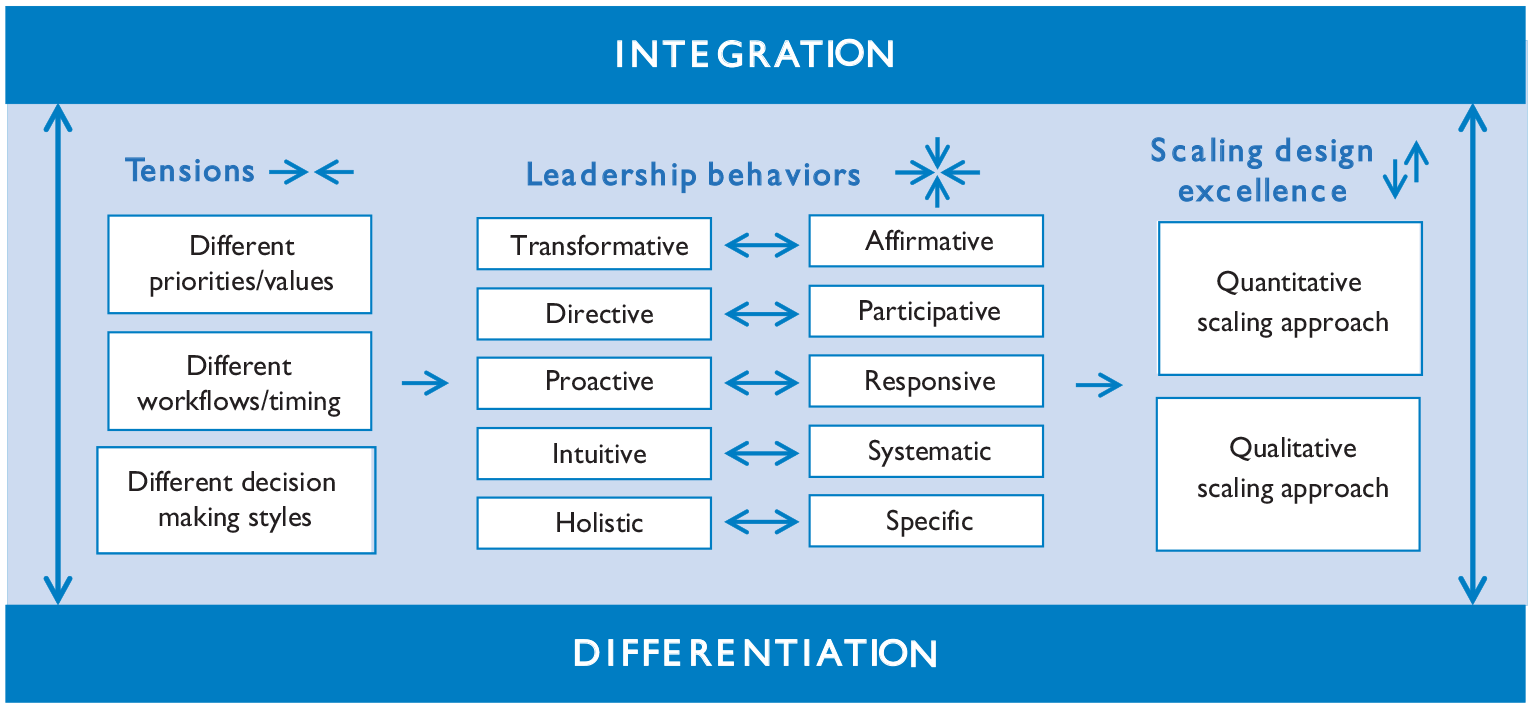
Framework for leadership behavior to obtain design integration and differentiation.
Tensions Associated with Scaling Design
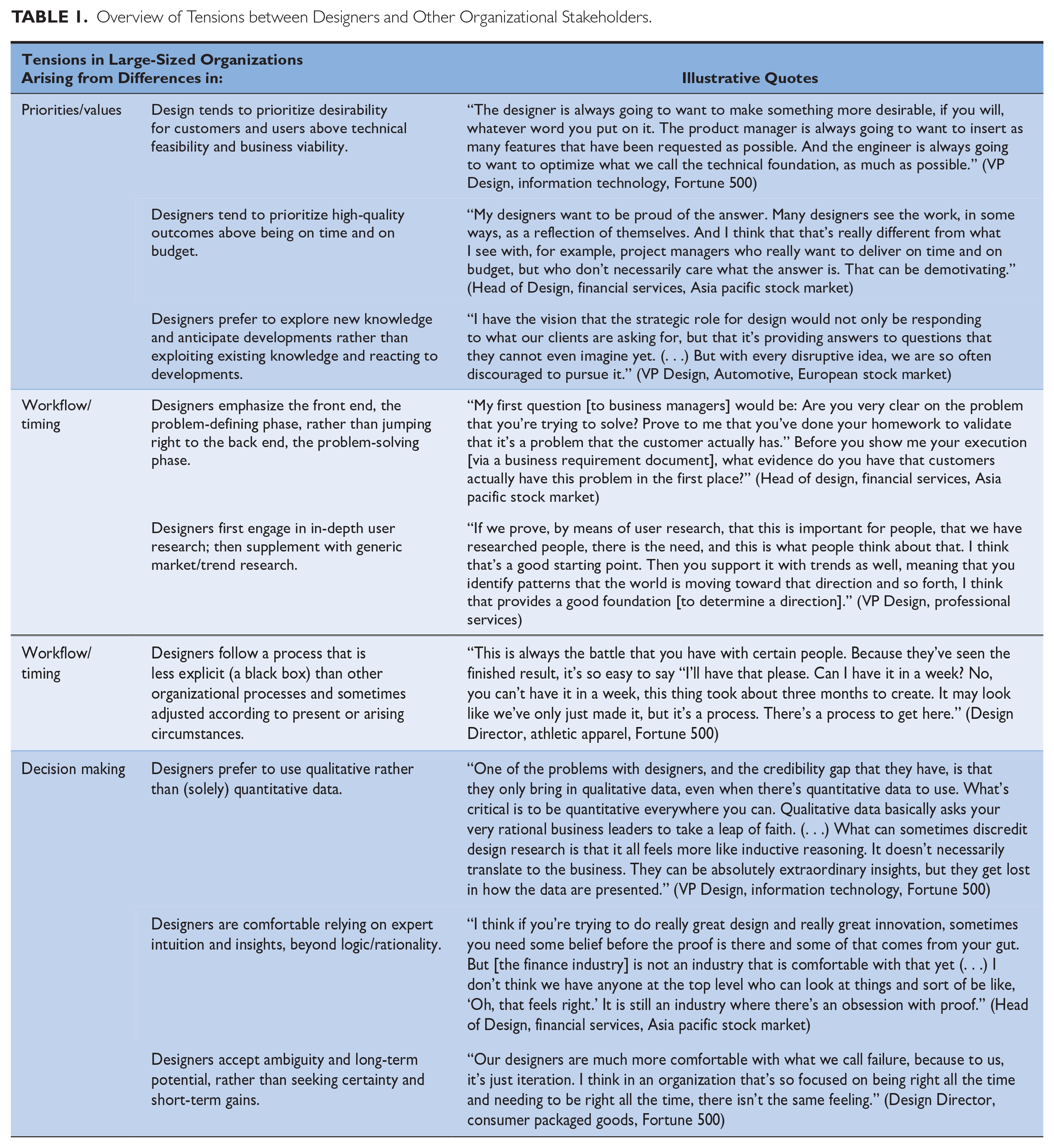
There was agreement among the design leaders that creating design excellence at scale in their respective organizations required effective management of major areas of tension and various challenges. We classified these tensions and challenges into three categories, as discussed below. Table 1 provides an overview of such tensions, including quotations from our data set to illustrate each one.
Overview of Tensions between Designers and Other Organizational Stakeholders.
Tensions Due to Differences in Priorities/Values
Some of the tensions or challenges the design leaders faced had to do with their design team having different priorities, values, or passions to other disciplines or knowledge domains within the organization. Each domain tends to foreground its own priorities and standards of excellence. Interviewed design leaders highlighted, for example, that designers tended to focus on desirability, wanting to fulfill (latent) customers’ needs and wishes, engineers foregrounded technological feasibility, and project management prioritized business viability. Due to resources generally being in limited supply, these diverging priorities or standards of excellence are not so easily combined without one or more of them being watered down.
Tensions Due to Differences in Workflow/Timing
According to our informants, their design teams tend to have different workflows and timing compared with people working in other disciplines or knowledge domains, which can result in tensions and challenges when scaling design within an organization. Designers prefer to invest a significant amount of time upfront in defining the “right” problem—for example, through in-depth customer interviews, ethnographic studies, and co-creation with users. Some degree of understanding may thus be required from those operating further down the track, but this is not always present. Sometimes, there may be unrealistic expectations on the part of other disciplines or departments about how long it takes to obtain specific outcomes: because the design process might not be transparent and well-integrated inside the organization, it may seem, when examining the design outcome, as if it was relatively easy to create that outcome. But, in general, making things seem easy, and look easy, requires a lot of effort and practice.
Tensions Due to Differences in Decision-Making Styles
The design leaders in our sample report that, to assess the soundness of a specific solution or opportunity, their designers tend to be guided more by qualitative insights than quantitative ones. However, for disciplines or knowledge domains used to working with large(r) data sets, such as R&D and marketing, results based on “a sample of only 20 people statistically means nothing” (Design Director, Healthcare, Fortune 500). In other words, those accustomed to using larger sets of data to support their activities, such as scientists and marketing experts, might not take the qualitative data obtained by designers all that seriously, or not seriously enough. A similar tension often emerged at business meetings attended by design leaders with their senior management and C-Suite colleagues: decision making is predominantly based on “running the numbers.” Business leaders prefer to make or justify decisions based on logic and analysis, and they often focus on short-term results rather than long-term, uncertain outcomes. Design leaders, on the other hand, are more open to relying on their expert intuition and creative sensibilities, also because it is sometimes difficult to find hard evidence for future-related customer behavior.
The Design Leader’s Challenge: Integrating versus Differentiating
The tensions listed in the prior section suggest that effective design leadership is challenging and must be adaptable, particularly in large, complex organizations. In most organizations, design is a relatively new business discipline and so is still seeking legitimacy, even if its leader has obtained a seat at the C-suite table. To cite the Head of Design of a global software company reflecting on the challenges of design leaders:
Just talking to other design leaders, everybody’s struggling with the same thing, pretty much: how do you integrate design into large organizations? . . . Chief Design Officer is the new title, but that doesn’t mean design is well respected or sufficiently trusted within an organization.
Overarchingly, we found that design leaders, on one hand, focus on integrating the design team into the fabric of the organization. Integration is required for design to effectively collaborate with other disciplines and knowledge areas and realize the value it can bring (in terms of design processes and outcomes). Because each discipline or area tends to have its own focus and priorities, design leaders need to find common ground and “build bridges.” Indeed, to effectively operate in a large, global organization, executive design leaders must, first and foremost, take responsibility for the business component of their work—if only to guarantee the longevity of the design team and not “trying to push design for the sake of design” (Design Director, Healthcare, Fortune 500). To quote the Head of Design from an automotive company (listed on the European stock market), “We can make beautiful cars—but if they don’t sell, then investment in design will dry up soon.” The design team operates in a broader organizational context. In it, resources are never unlimited; revenues and profits must be made to be sustainable. It is thus important for a design leader to empathize with the broader business context. “If we’re not enabling the company to make money, there is really no point having the design function, and that’s sort of my pragmatic approach to our design” (VP Design, automotive). This also implies that many of the design leaders we interviewed had “a very good understanding of how business operates” so they could create “that balance between satisfying shareholders and satisfying users” (Chief Design Officer, consumer electronics).
On the other hand, design leaders aim at differentiating the design team, and protecting its uniqueness, so that what design brings to the table is valued and incorporated. Ultimately, design needs to provide its unique perspective compared with engineering, marketing, or any other discipline or knowledge area in the organization if it is going to be of added value. What design brings, if anything, is “diversity of thought.” Design leaders preserve this diversity of thought and bring it to the fore. The head of design at a professional services company, for example, described the role of design leaders as providing “oxygen” for the design team, whose creativity might get smothered by large companies’ focus on efficiency:
Chief design officers . . . spend much of their time creating breathing space for designers to thrive. Because organizations are often focused on optimization, efficiency, replicability, and consistency—and also on lowering costs and avoiding risk—it is challenging for design to survive. It’s almost like you’re smothered by a blanket and you’re constantly trying to push it off by showing proof and results, bringing people along, communicating, showing commitment . . . getting things out of the way for your design team to actually empower them to deliver great results.
Similarly, a senior VP of design at a process transformation company, reflecting on his main tasks, emphasized the importance of creating a “creative bubble” for the design team—an environment in which the designers’ needs are met, and they can focus on their creativity. This was not experienced as an easy task, but certainly recognized as essential:
What is really important is to shield my designers from the corporate machine. This is crucial for their happiness, not necessarily mine. I have the stress and the ulcers —but that’s my job, right?
Leadership that effectively navigates between integrating and differentiating design will facilitate the establishment of “a culture that uses the users’ experience as the prioritization mechanism for all the possible work that needs to be done” (VP Design, information technology, Fortune 500) and will, ultimately, contribute positively to organizational performance.
Scaling Design Quantitatively and Qualitatively
Our findings suggest that scaling design and reaching design excellence across an organization refers not only to growing the design team in size (quantity), but also in caliber (quality).
From a quantitative perspective, “scaling design” refers to efforts to optimize the number of designers employed within the global design team. This happened in the companies we studied when a specific business unit within a company decided to build up in-house design capacity; when senior management provided investment to expand the number of satellite design studios across the globe; and when a company broadened the design areas it covered in-house (e.g., by growing the in-house UX design capacity).
When examined from a qualitative perspective, scaling design is related to talent management, making sure people within the design team have the requisite abilities and skills to act not only as effective tactical partners involved in back-end execution, but also as strategic partners involved in front-end planning. Qualitative scaling also relates to the extent to which designers are actively involved in strategic decision making at the executive level, at the middle management (business unit) level, and at the project level. As the head of design at a professional services company explained, “I would say there is design excellence if design is an integral part of the organization—meaning that design is there, always, when strategic decisions are made.” Being involved in the decision-making process upfront will ensure influence on directions taken and will bring design into the strategy realm. The design team is generally considered “at scale,” and design excellence is within sight when it contributes effectively and efficiently from a tactical and strategic perspective across all relevant business units, functions, and geographies of a company. We illustrate the approach and results of scaling design in the following case study, describing the efforts of Eric Quint, co-author of this article and former senior executive design leader at 3M Company.
Scaling Design at 3M Company
From 2013 to 2020, Eric Quint was responsible for bringing design “at scale” within 3M Company, being its Chief Design Officer (CDO). 3M Company is an American multinational conglomerate, with its headquarters (HQ) in St. Paul, Minnesota, and being recognized for its innovations by “applying science to life.” 35
At the start of Quint’s tenure, 3M had a relatively small internal design team (about 20 designers), mainly supporting the consumer business group as one of their five company’s business groups. The focus of design activities was foremost on industrial design, graphic design, and packaging design operations. The design team was predominantly situated at the headquarters of 3M in St. Paul; in addition, there was a small design hub in Milan (Italy).
To elevate design within 3M both quantitatively and qualitatively, the CDO developed a multi-year design strategy and roadmap. One of the first outcomes of his strategizing efforts was a global design mission, clarifying the “how,” “what,” and “why” of 3M Design. 36 This mission not only provided guidance to the design team; it also facilitated collaboration with other internal stakeholders. Internal collaboration was further facilitated by means of institutionalizing a global design governance, describing ownership of design resources (in terms of reporting and budget ownership), investment allocations, and scope of contribution. Together with HR, a “design taxonomy” was developed, defining all design roles, related competencies, and calibrated salary scales, offering transparency and career development tools to 3M designers.
Under Quint’s leadership, considerable investment was generated to build a new, state-of-the-art 3M Design Center at the HQ. This became a flagship location for the company, hosting high-profile events with business partners, educational institutes, and local communities. 37
Over the years, the design team grew significantly, both at 3M HQ and internationally. More specifically, at the end of 2020, the number of designers in the global design team had grown tenfold to nearly 200 design professionals, and design studios had been opened in Tokyo (Japan), Bangalore (India), and Shanghai (China). In addition, numerous new competences in brand design, UX design, and design research were developed, while existing design competences were further expanded. Also, over time, 3M designers were integrated into the innovation and brand activities of all 3M business groups, not just one business group.
This growth was, in part, the result of ongoing efforts to not only “tell” but also “show” the value of design to key organizational stakeholders. For example, a workbook on sustainability was developed by the design team, offering a guide for the 3M organization on how to design more sustainable solutions. 38 In close collaboration with internal stakeholders, the CDO and his team initiated and delivered a new brand platform and new company identity, which contributed to a substantial increase in the company’s brand value over time. 39 Quint expanded his sphere of influence into branding more formally when he became 3M’s first Chief Brand and Design Officer in 2019. During his tenure, the 3M Design team was awarded more than 100 international design awards, demonstrating external recognition for 3M’s design excellence. 40
Design Leadership Behaviors
To effectively navigate between integrating and differentiating the design team within an organization and reach design excellence at scale, seasoned design leadership is a prerequisite. We have identified five opposing pairs of design leadership behaviors as particularly effective in addressing the tensions associated with scaling toward design excellence. As shown in Figure 1, design leaders tend to “meander” between behaviors listed on the left (transformative, directive, proactive, intuitive, holistic) and seemingly paradoxical behaviors, listed on the right (affirmative, participative, responsive, systematic, specific). Our data suggest each opposing pair of leadership behaviors can be applied regardless of the type of tension identified.
Paradoxical Design Leadership Behavior (1): Transformative yet Affirmative
In line with the explorative attitude that characterizes design professionals, design leaders showcase transformative behavior, acting as change agents and instigating forward-looking directions and opportunities to drive progress within an organization. At the same time, to ensure design integration, design leaders are affirmative about the core strengths, goals, and priorities of the organization, and they use these to ground their transformative initiatives.
One of the core activities carried out by our informants is to (co-)formulate a future-oriented vision on the role of design within their organization and on the innovation pathway their organizations might take. In the words of the chief design officer at a home appliances manufacturer (European stock market listed), a “northern star” is needed “to break down the established pieces and be able to move the design function forward and move the organization forward.” Encouraging a forward-looking attitude was something that many of our informants felt the need to do on a continuous basis. As noted by a head of design from a large professional services company, large, incumbent organizations “tend to change ever so slowly. . . . Every day, the inertia of the organization must be faced.” At several organizations, the design leaders had to operate in a risk-averse culture in which short-term profitability and short-term results were prioritized over the long-term perspective. To deal with the resulting tension, some design leaders actively strived to amass a portfolio representing a variety of projects and goals, where future-oriented vision and projects related to it were balanced with projects focused on short-term benefits. “Helping the company imagine the future, and at the same time, have a more achievable present is the thing that is my tightrope-walk every day” (Head of Design, e-commerce).
A constant “tightrope-walk” is a good way of describing what design leaders actually do: cast future scenarios to explore “what might be,” while at the same time respecting business constraints in ways that creatively exploit “what is”:
We have two modes. There’s what we call the slow moving, the constant pushing of the granite wall [obstructing]. Then there’s the: “Let’s-design-shiny-bowls” that keeps the momentum moving forward. For me, there’s just constant striving for that balance. . . . The honest truth is, keeping that balance is difficult. With the “shiny bowls,” the business managers are often like, “We don’t even get that, what’s that got to do with us?” But it is about keeping the momentum going. Being the chief optimist. (Design executive, global distribution/logistics/retail services)
While there was acknowledgment that a good design leader is a “visionary,” and an “inspirational leader,” providing “energy and a vibe” to the design team, there was also recognition that a design leader needs to be affirmative to get things done. This executive design leader reflected on why being realistic and reducing your ambitions and compromise (“putting water in your wine”) is sometimes needed:
I think a design leader must be inspirational. But you sometimes have realistic and pragmatic kinds of challenges. So, you cannot be a utopian kind of figure, sort of like only inspiration. . . . If you go to a board meeting, for instance, and you’re not level grounded in what’s happening there, sort of aware of the politics and able to put some water in your wine, as we call it, then you have a problem. While you might inspire the design team, all your inspiration cannot be implemented because it is not based in the reality of the organization you are working for. (VP Design; professional services)
Put differently, a design leader must not only understand what motivates their designers and act accordingly, but also understand the business context. It is about understanding that “there are tradeoffs that take place in business decisions, and you need to make sure that you [as design leader] are not the bull in a china shop” (Design Director, Healthcare, Fortune 500). Being “a bull in a china shop” and hence acting in a rather inconsiderate, tactless way will negatively affect internal alignment with the other organizational stakeholders, and “getting things done” within the organization will become much more difficult. Hence, calibrating when to challenge the status quo and when to adapt to organizational needs will enable design leaders to manage cross-functional tensions related to different priorities and timelines, with positive consequences for their scaling efforts.
Paradoxical Design Leadership Behavior (2): Directive yet Participative
To preserve the distinctiveness of the design team, design leaders need to be directive, setting firm boundaries when interacting with their team and other organizational stakeholders. Design leadership requires fearlessness and resilience to help reach the vision set for the team. Even so, participative leadership is also sometimes needed, as it will enable further integration of the design team into new areas and into the organization more broadly. A more participative leadership style entails accommodating different stakeholder perspectives and adopting a collaborative mindset in certain areas of decision making to build bridges between design and the other main disciplines and businesses in the company.
Our informants suggested that good design leaders are those who have the willingness and ability “to stand tall and champion design” and thereby ensure that design priorities and values are sufficiently considered (Head of Design of a financial services company, Asia Pacific stock market). Another design leader tried to invert the trend of “management asks, we respond. Instead, we propose, and then they respond positively, hopefully”
A design leader needs to be participative, on the other hand, and empathetic to other stakeholders’ priorities and objectives. The goal is to “manage ideas through the organization” and facilitate collaboration. For example, in the following quotation, a design leader remembers a discussion with the Chief Technology Officer (CTO) about his designers’ way of working.
I was in a design review with the CTO, and he goes, “Every time I come to one of these reviews, the customer journey map looks different.” I said, “Well, that’s because they are designers; they are creative and it’s how they express themselves. It’s all the same information; it’s just visually different.” He looked at me and he goes, “But you’re making it harder than it should be. Do you really need to be so creative on something as simple as a journey map?” I said, “Well, that’s actually a good point.” So, then we agreed we didn’t need 24 styles of journey maps, that we probably only needed three or four. So then, for all the popular tools, we developed standards for how to express ourselves. (VP Design, technology conglomerate, Fortune 500)
Design distinguishes itself from other disciplines and knowledge areas by prioritizing what is desirable from a user perspective, “seeing the world through the eyes of the people that matter most—the end users, the customers, the patients, the travelers, the buyers of the products and services” (SVP Design, process transformation). However, at the same time, our design leaders acknowledged the need to consider business viability and technical feasibility criteria, thereby building bridges with other disciplines such as engineering and project management. As the CDO of a financial services company (Fortune 500) explained,
Through collaboration and diverse perspectives, you want to be able to strike that balance between what’s desirable, what’s business viable, and what’s technically feasible. Every role needs to care about all three of those factors. Sometimes there is tension between those three factors. . . . Holding that space of healthy tension takes some design leadership.
In their attempts to integrate the voice of design into the company, design leaders do not shy away from conflict—they acknowledge and protect its importance as constructive. To cite a design leader from an aerospace company who reflected on the importance of conflict:
It’s about meeting the needs of your [internal] stakeholders, but what I also strongly believe is that, to get good design, actually, it’s all about conflict, and maybe I need to be careful about the use of the word conflict, because it’s about positive conflict. That’s why a good relationship is really required, because we [designers] need to be able to challenge engineering, engineering needs to be able to challenge us, but we need to be able to do that in a really constructive way.
This example demonstrates that to persuade different organizational stakeholders to be perceptive and integrate the design perspective, it is essential to invest in solid, trust-filled relationships. Using formal authority—for instance, through a clear mandate from senior management—can accelerate the process of scaling design by creating resource availability, increasing visibility, and expanding opportunities for strategic collaborations. However, as explained by a seasoned design leader from a home appliances company, early attempts to scale design had limited success, despite CEO support, because the former design leader had failed to engage in dialogue and a process of alignment with business leaders at the middle management level. As a result, attempts to expand design were perceived as “interference,” threatening, and failed. In the words of an executive design leader of a technology conglomerate (Fortune 500 It doesn’t matter how brilliant you are, what a great designer you are, what a great leader you are, you can’t accomplish anything unless you have trusting relationships with your colleagues and the people around you and the company that you want to influence. Otherwise, they don’t want to work with you.
Hence, to be successful in scaling the strategic impact of their teams, design leaders need to balance a top-down approach with a collaborative one. They must empathize with the different priorities and ways of working with other stakeholders and build support from the ground up instead of initiating design initiatives via CEO mandate.
Paradoxical Design Leadership Behavior (3): Proactive yet Responsive
Good design leaders need to be proactive, to create and act upon opportunities to promote and deploy the unique capabilities of the design team. On the other hand, design leaders need to be responsive to their environment and to initiatives from colleagues, to adapt their scaling plans to changing circumstances, exploit the advantage of possible synergies, and facilitate implementation.
Often, the scope of leadership roles is not defined in detail up front, which offers design leaders room to be proactive and create opportunities that will further integrate design inside the organization. An example from our research is a design leader working for a telecommunications company who took the initiative to implement customer experience labs. This initiative was not part of the company’s strategic plans but was highly successful, not in the least because it provided a physical space for everybody in the organization to interact with customers. However, as noted by a design leader from a healthcare company (Fortune 500), “Doing new and interesting things that people didn’t ask you to do,” is not without risk, because “sometimes you get in trouble, sometimes you get nowhere. You fail at least as often as you succeed when you try to do new and interesting things that management did not ask you to do.”
A design leader having a sense of proactiveness was considered a good indication of being effective at the job. The design executive of a fast-moving consumer goods firm (European stock market listed) noted the following when reflecting on the need to be proactive:
I always take it as a failure of my leadership if someone, let’s say my boss, starts asking me, “Isn’t it time that you created a vision for design?” Then I’m too late. I should have done that already because I feel it’s my role, and my responsibility to lead the way, to come up with new ideas, new visions, new initiatives before the world starts asking for them.
Nontheless, our informants recognized the value of being responsive to projects and initiatives already occurring within their organizations. A design leader of a healthcare company (Fortune 500) indicated that, in the early stages of their scaling journey, the focus was on “finding partners inside the company who wanted to take a chance, who had problems that they couldn’t solve, and get them to collaborate with the design function to solve those problems.” That responsive approach, trying to solve an existing problem, facilitated stakeholder engagement.
Responsiveness was also evidenced in terms of scaling efforts. As we found in our study, scaling design did not necessarily always equate to scaling “up” (i.e., expansion) of the design team. It sometimes also required design leaders to scale the size of the design team “down” as a response to external and internal contingencies. For example, when an organization divested a certain business unit, one of our informants had to adjust the size and blend of competencies available in the design team to keep it relevant to the new course the organization was taking.
Finally, informants repeatedly mentioned the importance of balancing proactiveness in scaling efforts with outcomes that are consistent with what is already in place inside the organization. For instance, in an automotive company, the design leader focused their scaling initiatives on extending the scope of the design team to brand experience. The goal was to “introduce creativity within the different brands,” but with a clear recognition of established brand values and company ethos. In a similar vein, the design leader of a financial services company (Fortune 500) took the initiative to develop a problem-solving approach not only for design challenges, but also for business and technology challenges. While maintaining the central role of design priorities and ways of working, the design leader put much effort into harmonizing the new approach with other core priorities and practices well-ingrained inside the company (i.e., systems thinking, agile and lean methodologies), which facilitated acceptance of the new problem-solving approach beyond the design team. Overall, the ability to balance responsiveness and proactiveness requires sensitivity to context and a lack of hubris, while having an entrepreneurial attitude.
Paradoxical Design Leadership Behavior (4): Intuitive yet Systematic
The fourth opposing pair of design leadership behavior relates to how to take and substantiate decisions. It may not be possible to base every decision entirely on facts and figures, and design leaders might use their expert intuition or rely on the power of engaging storytelling to drive progress. However, there are also circumstances where a more systematic approach may be needed—using facts, rationality, structured processes, and methods.
Design leaders highlighted the importance of balancing quantitative data with qualitative data to support different decision-making approaches, and of presenting results in a way that is engaging and at the same time familiar to a larger variety of organizational stakeholders. This would allow them to address the rational and the emotional sides of business leaders, which can, ultimately, lead to real commitment to creative proposals. One design leader from a professional services company said this about interacting with top-tier management,
The C-Suite always likes numbers. And having a business case behind the design strategy that you’re putting forward is indeed really powerful and necessary. But I actually think that, for the C-Suite, good storytelling and conviction are also really powerful. Because at the end of the day, they’re also human.
Not everything can be expressed in hard figures—this includes the value design brings when generating future scenarios. When it comes to measuring the performance of the design team, several leaders opted for a combination of more traditional quantitative metrics with more qualitative metrics that capture the uniqueness of the design contribution. For instance, the global design director of a retail company combined qualitative metrics such as “improved customer perceptions” and “brand equity stewardship” with traditional quantitative metrics such as cost reductions and sales. Other design leaders pushed back on the executive need to be overly systematic when measuring performance outcomes.
We would like to avoid having something where every month we have to report on 50 different performance criteria and measures and show how good or how bad we are. That would be killing a lot of motivation and spontaneousness that we have. You know, keeping the passion that we talked about at the beginning of our conversation. (VP Design, automotive)
An ability to be intuitive and systematic is also important when interacting with the members of the design team. Design leaders who select among competing design proposals often use their expert intuition, cultivated over years of experience, but must at the same time justify their selection to maintain cohesiveness and motivation within the team. This is exemplified by one head of design of an automotive company (European stock market listed), who described how he goes about selecting the best car design among competing designs produced by his team:
It’s extremely important for me that I’m being honest and I give everyone a chance, but at the same time that I explain why I chose to go with this model or not. I need to do the latter really very well, because I cannot just choose the best design. I need to choose the best design and explain why.
Creativity and imagination are distinctive traits of the design practice, and thus something that design leaders need to preserve in the process of scaling. Indeed, many design leaders in our sample invested a significant amount of time and resources to create and cultivate a safe environment and culture for creativity to unfold and to pursue formal recognition and appreciation for creativity in the organizational structure and HR taxonomy. However, design leaders also promote a more structured way of working within and among their teams so that creativity is balanced with the need to deliver outcomes efficiently and on time. For example, the design leader of a globally operating DIY manufacturer (with their HQ in the Asia Pacific), recounted that, when he joined the company, the design team always delivered late. As a result, “they didn’t have the respect of the rest of the organization.” To change this, the design leader successfully incorporated certain project management skills into the design team, making sure they owned the whole process, including delivery.
In the end, they were able to design anything in eight weeks from start to finish. . . . That’s an example of professionalizing design, which gives them the power to make changes and be respected internally. That was the first step to getting them on a salary level which equaled engineers and beyond, which then allowed us to develop a stronger team.
Hence, being “intuitive yet systematic” requires design leaders to, on one hand, engage in activities that empower creativity within the design team and allow for expert intuition but, on the other hand, also align the design team with more structured ways of working and rational decision-making to integrate with other disciplines and functions in the organization.
Paradoxical Design Leadership Behavior (5): Holistic yet Specific
The fifth opposing pair of design leadership behavior refers to design leaders’ focus when creating design excellence at scale. On one hand, design leaders must be holistic, identifying and striving to reach the key milestones of the excellence process without getting distracted by details. On the other hand, design leaders must be specific and pay attention to particulars that have a substantive influence on design outcomes, to identify and incorporate diverse and at times contrasting perspectives of internal and external stakeholders.
To initiate the process of design excellence, leaders generally begin by defining an overarching vision of the desired state and determining the main building blocks needed to reach it. While this strategizing phase requires a holistic approach, our informants recognized the importance of focusing on specificities during execution.
To ensure that designers on the team and other stakeholders can understand, relate to, and act upon the vision and its building blocks, translation into concrete operational plans is needed. These plans will contain specific design objectives for the design team in general, and for individual designers specifically, while also reflecting the objectives of the business units that design is collaborating with. As a design executive at a professional services company explained,
We presented our design objectives to the whole team, and then we broke them down into hot topics. And then we had the team go away and work on statements in terms of how we might deliver on those key topics. That then became a set of initiatives and activities that we would perform to help us get there.
Communicating and openly discussing how specific design projects contribute to fulfilling an overarching vision and set of goals helps to engage the design team with the excellence journey. In the words of the design leader operating in the automotive industry, reflecting on the importance of communicating the “bigger picture”:
Involving people in the bigger picture is one of the most important things. People in the team should understand at any time how their work—even if they are only working on a small portion of a glove box in the car—fits the bigger picture from a business point of view, from a technology point of view. . . . It means making sure that they feel that what they are doing is really providing value.
The design strategy of a leader from a consumer goods company (Fortune 500) had defined a broad, generic goal of contemporizing the nostalgic feeling of the brand and how to bring this to life in new ways. This breadth of scope allows designers to be creative both with how they interpret the nostalgic feeling and with the means they use to express brand values. In a similar vein, a design director at a consumer packaged goods company (Fortune 500) pointed out that their holistic design mission facilitated effective collaboration across the company’s different business units.
It’s really about improving people’s lives. So it has very generic content. And then every division makes it a lot more concrete. For example, in the home care division, they identify areas in people’s lives where they want to drive innovation.
Hence, envisioning emerged as a balancing act between the specificity used to define the vision and strategy and the need to offer enough space to designers to be creative with it.
Conclusion
In the present research, we have focused on design leaders and how they can build and scale design excellence within globally operating organizations. We have identified a core paradox for design leaders at large organizations: the need to integrate design within the fabric of an organization to realize design-driven outcomes, but also to differentiate design because its uniqueness is what ultimately delivers value. Thus, the design leader is tasked to balance an approach of “we/together” versus “us/separate” and realize a design team that is highly integrated and differentiated at the same time. With our research, we complement prior research, which tends to be more focused on how to integrate design within an organization. 41
When it comes to differentiating design, we have illustrated design’s uniqueness through the tensions that emerge when designers collaborate with other organizational stakeholders. These tensions can be clustered into three categories: differences in priorities/values, differences in workflow/timing, and differences in decision-making style. Some of the tensions we identified have been discussed in other publications. 42 Nevertheless, our research contributes to the literature by expanding and systematizing these tensions from the perspective of design leaders.
Furthermore, our findings contribute to a better understanding of coping with paradoxes from a leadership perspective. Research on how leaders may approach paradoxes is in limited supply, especially in the areas of creativity and design. 43 This is problematic considering the preponderance of paradoxes in organizational settings. In this article, we provided insights into how design leaders may tackle the design integration and differentiation paradox. More specifically, our findings suggest the need for design leadership behavior that is fluid and adaptive, meandering between five opposing behaviors according to the situation and over time: being transformative yet affirmative; being directive yet participative; being proactive, yet responsive; being intuitive, yet systematic; and being holistic, yet specific.
Mastering and meandering between the above five pairs of opposing leadership behaviors will help leaders obtain design excellence at scale. “At scale” means design team optimization in terms of quantity (size) and in terms of quality (impact and value delivered). Design excellence at scale is a means to an end: it serves to support the organization in gaining and sustaining competitive advantage. Prior research has suggested company performance benefits when investing in design. 44
The identified behaviors point toward a leadership style that is both objective (cognition-driven, quantifiable, individualistic) and subjective (sensory, experience-driven, relational). Allowing for subjective dimensions and seeking excellence in craft (rather than purely objective, profit-seeking behavior) has been described in the literature as “aesthetic leadership.” 45 We have presented a set of specific behaviors that embody aesthetic leadership and pave the way toward its operationalization. However, rather than being purely subjective or objective, a leadership style is needed that incorporates both when operating in large, complex organizations.
Moving to the practical implications, our study highlights the importance of taking a paradoxical perspective to lead in-house design teams. To address the tensions deriving from the uniqueness of design, design leaders may want to learn to effectively balance the needs of their design team and of other organizational stakeholders. Our identified leadership behaviors offer design leaders a palette of behaviors to guide them in doing so effectively. Our findings sensitize design leaders on the importance of not only mastering behaviors that are traditionally in the chords of designers (e.g., being transformative, participative, holistic) but also embracing other behaviors essential for reaching design excellence (e.g., being affirmative, systematic, specific). Furthermore, consciously meandering between the pairs of opposing leadership behaviors identified in this research will require design leaders to be adaptive and context-sensitive. While this is no easy feat, 46 our research suggests it will help design leaders reach and maintain design excellence.
Supplemental Material
sj-docx-1-cmr-10.1177_00081256231169070 – Supplemental material for Leadership to Elevate Design at Scale: balancing conflicting imperatives
Supplemental material, sj-docx-1-cmr-10.1177_00081256231169070 for Leadership to Elevate Design at Scale: balancing conflicting imperatives by Gerda Gemser, Giulia Calabretta and Eric Quint in California Management Review
Footnotes
Declaration of Conflicting Interests
The author(s) declared no potential conflicts of interest with respect to the research, authorship, and/or publication of this article.
Funding
The author(s) received no financial support for the research, authorship, and/or publication of this article.
Supplemental Material
Supplemental material for this article is available online.
Notes
Author Biographies
Supplementary Material
Please find the following supplemental material available below.
For Open Access articles published under a Creative Commons License, all supplemental material carries the same license as the article it is associated with.
For non-Open Access articles published, all supplemental material carries a non-exclusive license, and permission requests for re-use of supplemental material or any part of supplemental material shall be sent directly to the copyright owner as specified in the copyright notice associated with the article.
