




Abstract
Research on prosocial entrepreneurship so far has focused either on ex-ante motives to create prosocial enterprises or on ex-post strategies to protect mission orientation. Surprisingly little is known about the prosocial entrepreneurial competences that help acquire resources to create blended value once a venture has been established. To fill this gap, this article presents a qualitative study in an Indian setting that shows how prosocial entrepreneurs adopt three types of competences to assemble resources when they establish their ventures.
This combination of missions raises concerns about incompatibility; ventures are likely to face complexities and tensions, as the two missions may clash with each other when situated in a single venture. These challenges can cause enterprises to drift from their overall mission to create social value. 2 We use the term mission drift to refer to organizational actions that move away from being highly consistent with their social mission toward excessive focus on their entrepreneurial mission. 3 Failure to incorporate both missions may derail efforts to achieve blended value, leading to betrayal of the stakeholders who commit resources to the organization.
Accordingly, prosocial entrepreneurs need to initiate and grow ventures while balancing multiple missions. There are two streams of literature that focus on decision making related to blended value creation. While entrepreneurship scholars have focused on the ex-ante motives that drive prosocial venture creation,
4
organizational scholars have focused on different mechanisms to address mission drift when a venture is growing.
5
However, as Baron and Shane emphasized,
once a new venture is launched, its founders face an emerging and complex set of issues. Instead of dealing mainly with ideas and plans, they must run a functioning company. This involves dealing with a wide range of people both inside and outside the new venture.
6
Furthermore, they must employ their competences to attract resources that will lay the foundations for blended value creation. Competence is defined as “individual characteristics leading to the accomplishment of a job role or organizational success.” 7
Despite the important role of competences in the post-launch phase, surprisingly little is known about the competences that prosocial entrepreneurs use to assemble the necessary resources in that phase. Understanding which competences they adopt is important, because the decisions that entrepreneurs make in the early stages determine their long-term capacity to achieve blended value. 8 Thus, we ask the following research question: How and through which competences do prosocial entrepreneurs build their ventures in the post-launch period to create blended value?
We adopt a grounded theory approach, interviewing 32 Ashoka fellows in India who founded ventures that create blended value. We make three contributions to the literature. First, we show that prosocial entrepreneurs adopt three types of competence (entrepreneurial, commercial, and dual goal-oriented) that encompass seven competence dimensions (innovation, communication, motivation, community and team dynamism, outward perception building, human resources, and nurturing the team). We argue that the competences necessary for blended value creation differ significantly from those required for commercial value creation. Second, we highlight that the bridging mechanism between social and commercial missions has been taken for granted in the prosocial entrepreneurship literature, and we address this deficiency by identifying the competences required to connect these two missions to create blended value. Finally, we emphasize that prosocial entrepreneurs imprint certain of their ex-ante motives (such as compassion, empathy, and an ethic of care) into their ventures as they assemble resources. In addition to these theoretical contributions, our findings have a number of practical implications.
Literature Review
Blended Value Creation
When prosocial ventures are able to combine both social and commercial missions and engage in the creation of blended value, they can take advantage of this novel combination to attract a new line of resources, offer solutions to stubborn social problems, and create social impact. 9 Moreover, adopting commercial approaches to address social problems enhances competitive behavior and organizational efficiency. For example, microfinance organizations and work integration social enterprises aim to create employment for poor women and unemployed people while ensuring their own financial sustainability. Such organizations are greatly valued in developing countries, as they exist not because of a strong institutional environment but because of the lack thereof.
However, blended value creation comes at a hefty price, as the combination of social and commercial missions creates complexity for ventures as they grow. As a result, prosocial enterprises experience both internal and external complexity. 10 Such a complexity may lead to mission drift that threatens the raison d’être of organizations, as prosocial entrepreneurs shift their focus from the social impact they initially aimed to achieve toward a more commercial orientation. For example, microfinance organizations in India that allowed their mission to drift ended up charging exorbitant interest rates, and some borrowers committed suicide because they were unable to repay the loans. 11 Thus, excessive focus on the commercial mission to the neglect of social interests inhibits the potential to create blended value. Consequently, the quality of the care that prosocial entrepreneurs initially aimed to provide may decrease over time, 12 to the extent that vulnerable clients are not adequately served.
Blended Value-Oriented Decision Making
Previous studies of prosocial-driven decision making have focused on two areas: ex-ante motives to initiate ventures and ex-post strategies to protect mission orientation.
Ex-ante motives
The role that other-oriented motives play in prosocial venture creation has been widely debated. Miller et al. 13 noted that compassion motivates individuals to explore the causes and consequences of social problems, thereby stimulating their interest in finding opportunities to address such problems and alleviate the suffering of others. Bacq and Alt emphasized that empathy mediates both self-oriented motives, such as self-efficacy, and other-oriented motives, such as social worth, to drive prosocial entrepreneurial intention. 14 In contrast, Younis et al. 15 claimed that it is self-efficacy that mediates between positivity, empathy, and entrepreneurial intentions. Further research draws upon the notion of an “ethic of care” to highlight that caregiving not only motivates individuals to address social problems, but also guides their work once they engage in the process of social value creation. 16
Ex-post strategies
The second stream of research is driven by organizational scholars who focus on organizational or frontline employee-level strategies to help prosocial organizations avoid mission drift. Organizational strategies include compartmentalization, in which operations concerning different missions are separated physically or symbolically, 17 and the creation of spaces of negotiation, where organizations allow multiple teams to interact to find a solution. 18 Studies have also shown that organizations may choose to reinterpret their organizational identity when they experience complexity. 19 Frontline employee-level strategies include segmentation, where skillful individuals handle different missions dynamically, 20 formalization, and collaboration, where organizational members codify their priorities and separate competing logics to allow actors to collaborate more often 21 ; and polysemy, where actors judiciously use their perspective in support of multiple logics. 22
While these strategies are useful for firms as they grow, it is the competences of the prosocial entrepreneurs that lay the foundation for ventures in the post-launch period and that determine their long-term potential to create blended value. 23 Building on Schumpeter’s work, we argue that competences are a unique set of intangible resources that are put into use to acquire, assemble, and recombine other homogenous and heterogeneous resources. 24 In the post-launch period, entrepreneurs need to negotiate, resolve conflicts, and influence and motivate everyone around them while also dealing with an array of people internally and externally. 25 This is particularly important in the context of prosocial entrepreneurship, where entrepreneurs engage in working around multiple missions. They need to recruit and retain high-quality employees and volunteers, obtain resources from the resource holders and choose an appropriate legal structure for the venture. Thus, in the absence of prosocial entrepreneurial competence, ventures may fail to acquire the necessary momentum in the post-launch period. This is because the decisions entrepreneurs take at the outset go on to determine their long-term capacity to achieve their objectives. 26
Competence-Based Approach in Entrepreneurial Decision Making
In entrepreneurship research, the competence-based approach has been instrumental in understanding venture creation and growth. For example, Obschonka et al. 27 emphasized that competences developed in adolescence are useful for entrepreneurs when initiating ventures. Governments across the globe aim to enhance entrepreneurial competences among their citizens, as they believe that enterprise creation results in economic growth and prosperity. For example, the European Union has recently proposed its Entrepreneurship Competence (EntreComp) Framework to enhance entrepreneurial potential in the European region. The Framework consists of 15 competences that span three phases, “ideas and opportunities,” “resources,” and “into action,” which correspond to different stages of venture creation. 28 Competences are also considered crucial for venture growth and success. Prahalad and Hamel noted the importance of the competence-based approach in securing a competitive advantage, which requires managers to place organizational learning at the core of their responsibilities. 29 Building on this work, Zahra et al. 30 argued that organizations need to drive knowledge creation, which helps to build and advance organizational competence. The dynamic capabilities perspective—which focuses on a firm’s capacity to assemble internal and external competences in order to adapt to a rapidly changing environment 31 —has clarified how firms develop the competences that allow them to compete and gain a competitive advantage. 32
Understanding the role of competences in prosocial entrepreneurship is in its nascent stage. Focusing on the U.S. education institutions that teach a social entrepreneurship curriculum, Miller et al. 33 analyzed the competences required to build a career in social entrepreneurship. They developed a list of 35 competences to understand whether the skills taught in the classroom address the needs of social entrepreneurs in practice. Further research has emphasized different competences that drive venture performance, 34 competence stock of employees, 35 using competence to engage in bricolage, 36 and how donors make their donations based on their perception of entrepreneur’s competence for ensuring the mission orientation 37
Despite this growing body of literature focused on ex-ante motives, ex-post strategies, and the role of competences in the process of venture creation and growth, we know little about the competence dimensions that prosocial entrepreneurs adopt to assemble the necessary resources in the post-launch phase.
Methodology
We adopted a grounded theory approach because it helps to understand the complex social processes that are typically present in India 38 (see Appendix: Research Setting). Grounded theory is also suitable for answering research questions framed in “how” terms, which is precisely our aim in this study. 39
Given the wide expertise Ashoka fellows have in the field and the social impact these prosocial entrepreneurs create, we selected them as our respondents. Ashoka fellows are generally successful entrepreneurs who are tasked with initiating interventions that address stubborn social problems. However, we were careful in selecting our respondents, as not all Ashoka’s prosocial entrepreneurs create blended value. To identify those prosocial entrepreneurs who have created blended value, we read the profiles carefully on the Ashoka website (www.ashoka.in). Our initial review indicated that 137 of the fellows were engaged in some sort of blended value creation.
In 2016, we approached 50 respondents to participate in this study, of whom 22 gave their consent. Our data collection took place in three specific stages: exploration, information seeking, and confirmation. The first 12 interviews, which formed our exploration stage, made us understand that, generally speaking, prosocial entrepreneurs have carried out a number of interventions, which are facilitated by the skills and knowledge they possess and their personality traits. The inclusion of personality traits and skills points toward the theory we discussed earlier, namely, that prosocial entrepreneurs adopt specific competences to engage in the post-launch stage. Taking cues from the early interviews, we then engaged in our second strategy: information seeking. We asked our next set of respondents about the role that competences played in building their ventures. However, after completing 22 interviews, it was clear that additional data collection was required; we had not achieved conceptual saturation, as new information continued to emerge. 40 Accordingly, we contacted an additional list of entrepreneurs, and we reached conceptual saturation after conducting a total of 28 interviews. Following Isabella, we engaged in our third strategy: confirmation. We approached another four respondents to confirm our findings around the different sets of competences we had identified. Apart from the primary data we collected, our analysis drew on archival records and field notes.
Data Analysis
Our inductive analysis and data collection proceeded together. 41 We adopted a constant comparison technique that helped us to build a bridge between the data collection process and the existing literature. 42 Drawing on the informants’ perspectives, we started developing first-order codes immediately after the first interview. Analysis of the first 12 interviews, which formed part of our exploration stage, yielded 73 first-order codes. As we moved to our next level of data collection, information seeking, we added further codes, all the while taking stock of the existing ones. During this stage, we were able to create 13 new codes. Referring to archival data helped us to add a further eight codes, which took the total to 92.
Following Strauss and Corbin, we used axial coding to find similarities and differences that allowed us to reduce these codes to a manageable number. 43 For example, we combined “community voice into account,” “co-creating solutions with communities,” and “ensuring community well-being” into one first-order concept called “take community voice into account and co-create solutions.” Here, well-being is implied as soon as community voices are taken into consideration and solutions are co-created. By following this approach, we were able to reduce the codes to 36 first-order concepts.
Once we had narrowed down the set of first-order concepts, we moved to the second-order analysis to identify abstract themes emerging from the first-order concepts. In this phase, we looked closely into the data to generate themes that would explain what was going on in the data. Our focus was on specific aspects that are underrepresented in the literature, and we derived 18 themes, which we refer to as competences.
As part of our third data collection stage, confirmation, we approached our final set of respondents and explained the 18 themes we had developed. We asked them to confirm, classify, and explain how they employed those competences in their day-to-day venture operations. There was an agreement of 91% among the four respondents, summarized by Respondent 31 as follows:
We focus largely on three levels: entrepreneurial level, which helps us to be entrepreneurial in order to create business models, community-oriented competence, which helps us to embed in the communities we serve and gain legitimacy, and a set of other competences with dual focus to ensure that the first two are connected well.
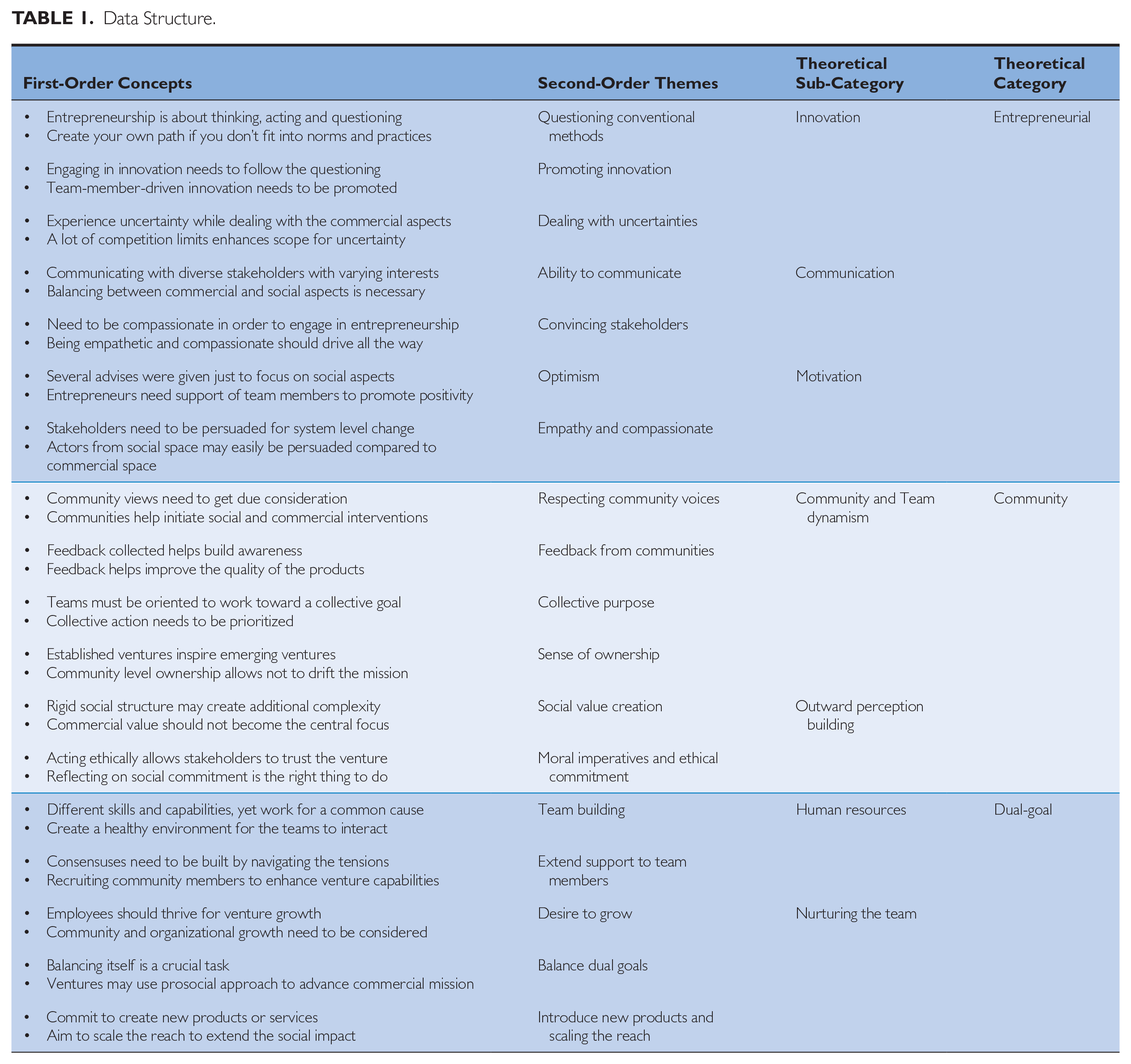
We took these three levels of competences as our theoretical dimensions. Although these dimensions reflect the practical reality, the second-order themes required us to include a theoretical sub-category to reflect the competence dimensions. Our data structure is summarized in Table 1.
Data Structure.
Findings
We now discuss the 18 competences in three clusters: entrepreneurial-oriented, community-oriented, and blended value-oriented.
Entrepreneurial-Oriented Competences
Given the advantages that an entrepreneurial orientation brings to the process of prosocial value creation, our respondents highlighted the need to be “entrepreneurial” in order to honor their commitment to the ventures and the stakeholders that trust them. In India, it is common for the social and commercial sectors to be promoted separately. Accordingly, there is growing concern about ventures that embed both social and commercial aspects, based on a mistrust about potential mission drift due to the lack of sectoral recognition in state policy. In particular, the lessons learned from the microfinance industry, which gained momentum in the 2000s and started exploiting communities commercially, continue to haunt the new generation of age prosocial entrepreneurs. Given this complex external environment, entrepreneurs adopt three different dimensions of competences within the entrepreneurial-oriented cluster: innovation, communication, and motivation.
Innovation
Questioning conventional methods
The prosocial entrepreneurs we studied were often asked to comply with the demands of the external referents who control key resources. However, most of the entrepreneurs questioned prevalent practices and chose to adopt innovative approaches. As Respondent 19 explained
In our case, mainstream banks did not want to lend money to the shepherd community with whom we are associated. In response, we are mobilizing the necessary capital to start a cooperative. Simply, if you do not fit in the existing rules, then create your own. This is how you not only question, but also show that you deliver on what you believe.
External actors may try to influence the way in which ventures are formed and the choices they need to make. Respondent 8 claimed that
There was a lot of pressure from our investors to create separate entities for both for-profit and nonprofit divisions. But we ended up establishing a not-for-profit because we didn’t want our investors to care about our profit version alone. Had we followed them, we would have ended up becoming another strong business venture with little relevance to social aspects that we care about. We may be doing good in the end, but not the way we want.
Thus, questioning predominant practices and pressures enabled them to position themselves uniquely in the field.
Promoting innovation
Questioning conventional methods is necessary for finding innovative ways of thinking and doing, a point that Respondent 5 emphasized: “Questioning old practices would not be enough. We need to take it to the next level, where new products or services are introduced that would dramatically help transform the situation. It could also be a new form of employment creation for our target groups. This is even more relevant if you have a commercial line, because typically donors and government funding do not allow us to exploit the innovation we would like to bring about.” In addition, internally prosocial entrepreneurs need to promote innovative ideas within their venture teams. Employees often come up with the best ideas, and they are better positioned to innovate and bring new products and services onto the market.
Dealing with uncertainty
In the process of questioning existing practices and offering new solutions, prosocial entrepreneurs attract external uncertainties. Respondent 20 emphasized that “when you attend investor events, then there is a lot of demand from folks who want to do things to create social value, resulting in higher competition. Most of the time, you won’t get the cash to proceed with the interventions.” Lack of experience in dealing with stakeholders from the commercial sector also results in uncertainty. When sharing life-changing stories about communities, prosocial entrepreneurs tend to find an encouraging reception from their audience; however, when sharing their entrepreneurial plans, they face questions and concerns about the approaches that fit with the social mission. Respondent 31 explained, “You may not have clarity in your business activities. People have many doubts and questions about how you would do this and that and how you manage. And the reality is most of the time, I myself don’t know the answers.” Accordingly, prosocial entrepreneurs need to prepare themselves to deal with the uncertainties they are likely to face when meeting with different stakeholders.
Communication
Ability to communicate
One way of handling these uncertainties is to communicate effectively with a variety of stakeholder groups. Stakeholders on the commercial side often find it hard to understand social value, just as social stakeholders find it hard to understand commercial value. Our respondents noted that although they did not find it difficult to connect and communicate with communities in need and those who can offer resources, including the government and donors, they found it hard to communicate with stakeholders in the commercial space, including customers and investors. The job of being a prosocial entrepreneur comes with the challenging task of interacting with stakeholders representing different missions as Respondent 7 explained: “In the morning, you may have to deal with the communities in a slum, in the afternoon, you need to rush to the local politician to seek resources, and in the evening, you may end up at a flashy investor event.” However, driven by their social objectives, prosocial entrepreneurs may continue to find it easier to interact with social stakeholders than with commercial stakeholders. Respondent 29 elaborated on this point:
You need to be careful while interacting with the investors, as too much focus on addressing social problems often creates discomfort for them. I personally feel we oversell our social angle. There is a difference between selling and overselling it. The key is in keeping it balanced while interacting with your business-side stakeholders.
Convincing stakeholders
Prosocial entrepreneurs need to convince different stakeholders to commit to the entrepreneurial drive, as implementing their interventions will often “require a perspective change at a larger level” (Respondent 8). In the process, given the resource-constrained environment they often face, entrepreneurs need to involve volunteers in co-creating value with government agencies and donors for the benefit of deprived communities; they must also call upon investors and other like-minded people to share their vision and interest. Although convincing actors who represent a social mission, such as volunteers, communities, and beneficiaries, is relatively unproblematic, understanding the social context remains a key factor in initiating prosocial enterprises. Respondent 23 emphasized the importance of this: “When dealing with investors or whoever can pump money into your business that enhances value for communities, you need to persuade them carefully to join the moment that you have initiated to make the communities better.”
Motivation
Optimism
Under these circumstances, prosocial entrepreneurs experience difficulties in approaching potential stakeholders on the commercial side. For our respondents, this hostile environment requires positive and optimistic behavior from entrepreneurs. For example, Respondent 10 highlighted that “Several people have advised me to just focus on addressing the social part alone, which will ensure that there are enough resources available. This is where I think you need to be entrepreneurial and be focused on the venture goals.” This is a two-way mechanism, as Respondent 16 explained,
The moment you are selling your idea and you need to impress multiple groups, who historically find themselves differentiated with a thick boundary, you need to either put your case strongly or shut up. You need to charge all your guns despite how hard and difficult it might be out there.
Empathy and compassion
Prosocial entrepreneurs must ensure that the compassion and empathy that motivated their initial venture intentions continue to help them to engage in commercial value creation. Several of our respondents were engaged in embedded blended value creation that involved generating both social and economic value from one specific product or service. For example, Respondent 4 stated that “our microcredit initiative offers loans to poor women.” By offering loans directly to the target communities, social value creation is embedded in commercial value creation. However, a majority of prosocial entrepreneurs initiate ventures that involve strong social value creation, such as offering education to children from deprived communities (like Respondent 17) or training rural women to be entrepreneurs (like Respondent 3). Such ventures then create interventions that focus on commercial value creation. If prosocial entrepreneurs fail to motivate their compassion and empathy when they initiate social ventures, they may become demotivated and limit their interventions to social value creation, seeking funds from donors and philanthropists and depending on government schemes. Respondent 8 reported one such experience: “I know someone who has had all these great ideas to build a business to help rickshaw pullers. But in the end, he was entangled by the social embeddedness. As a result, he could not make it to create a business opportunity out of it.”
Community-Oriented Competences
Whereas entrepreneurial-oriented competences stimulate interest in creating and fostering ventures to build a robust entrepreneurial intent, ensuring proper interaction with entrepreneurial stakeholders, community-oriented competences enhance strong social embeddedness. Thus, prosocial entrepreneurs need to take stock of their interactions with communities and prioritize their interests. This section covers two different competence dimensions: community and team dynamism, and outward perception building.
Community and Team Dynamism
Respecting community voices
Prosocial entrepreneurs often encourage communities to participate in team-level discussions to allow interactions between the internal teams and the communities. Respecting community voices allows communities to play a key role, for example, by designing a “water delivery program that is becoming a catalyst in their own development” (Respondent 3). Moreover, communities may bring commercial ideas to the attention of prosocial entrepreneurs. Respondent 14 emphasized that
Upon fulfilling our promise to help communities access the government-sponsored schemes and policies, they in return helped us to identify how we can make that initiative sustainable. When we informed them that we believe they have access to the necessary information and are more familiar with the local structures, then they internally discussed and came up with this idea where they would pay a service fee which would allow us to keep that initiative alive.
Thus, when encouraging communities to take ownership of interventions, it is “our responsibility to ensure that their views are respected (Respondent 19).
Feedback from communities
Existing organizations that offer services to underprivileged people often fail to collect feedback from the communities they serve or improve the service offering. In contrast, prosocial entrepreneurs collect feedback in order to improve the products they offer. As Respondent 18 noted: “The women who sell our solar products in the villages collect crucial feedback and help us improve the product line and build our strategy.” The feedback is also used to create awareness among other communities, as, for example, in “the feedback we receive from the communities about how their lives are improved by using the toilets we provided to popularize our scheme in other villages” (Respondent 7).
Collective purpose
Prosocial entrepreneurs have to ensure that everyone within the venture understands and works to uphold the mission. Our respondents emphasized the ways in which they ensure that internal teams that are involved in the social and commercial aspects understand the importance of both and work to promote a balance between them. As Respondent 26 explained, “One of the crucial things that may go wrong at the team level is that your teams may have different ideological orientations and views, but at the end of the day, it is all about moving forward to transform societies. Ensuring that everyone sticks with the vision of the organization is an essential component that not only enables the bonding but also helps to create and sustain impact.” In this connection, one of the biggest concerns in the social sector is that the overall venture often revolves around the founder’s interests and capabilities. If the founder switches the orientation from prosocial to commercial, then there is a likelihood that the rest of the team will follow the founder. In most cases, the resulting mission drift is caused by the founder’s failure to keep the initial momentum going. In order to avoid this situation, “entrepreneurs as change makers need to create a collective action within the ventures right from the beginning that gives opportunities for those who work in these organizations to ensure the balance between multiple priorities” (Respondent 9).
Sense of ownership
When creating a collective purpose, prosocial entrepreneurs need to build ownership at multiple levels. First, they have to own the projects being initiated, and then they need to mobilize their teams and the communities to do the same. Established organizations that let communities take ownership have inspired emerging prosocial entrepreneurs. Respondent 6 told us that “one specific organization we take inspiration from is Barefoot College. I have grown up listening to the success story of Barefoot to integrate communities in the implementation of the projects.” Community-level ownership allows organizations to avoid mission drift, as it embeds them in the “local cultural landscape and we can’t just run away from our promises” (Respondent 29).
Outward Perception Building
Social value creation
Despite their interest in blended value creation, entrepreneurs need to ensure that the prosocial motives that drove their initial interest in venture creation are sustained throughout the process. Communities in India are divided in different ways, including by caste, class, and religion. In the process of creating value for a certain community, ventures may attract criticism from other communities, which may create obstacles. Respondent 14 recounted one such episode: “A few months ago, we experienced a problem about helping the Dalit community. A dominant community in that village did not want us to serve them. Our internal team also believed that the dominant community might not allow us to work in that village had we continued with our approach. I had to then take a strong stand and educate our internal team members about our approach. Eventually, we were able to resolve the issue after a lot of struggle, but it was all worth it.” For this reason, commercial value “should never become our central focus. We draw a clear line of expectations and aims” (Respondent 22).
Moral imperatives and ethical commitment
Respondents emphasized that making an ethical commitment to social value creation is the right thing to do. Respondent 2 explained: “One has to understand what is right and wrong. When someone is able to do the right thing, I would say he or she is behaving ethically. In our case, for people to trust us, we must act ethically. There is no other way. You can’t start a social venture and behave unethically, such as practicing things that are not ethical, for example, collecting interest rates beyond the need for you to survive. This kind of behavior has drastically destroyed the reputation of the industry.” This ethical orientation is not restricted to what is shown outside the organization; “for the internal teams, we must show our ethical fiber in ensuring the tight coupling of multiple missions” (Respondent 2). Moreover, “those who come to talk to you are those who are interested in what you do, hence [we must] build on that to reflect on your social angle” (Respondent 24).
Dual Goal-Oriented Competences
Dual goal-oriented competences bridge the gap between community-oriented and commercial-oriented competences. This theoretical category is divided into two dimensions: human resources and nurturing the team.
Human Resources
Team building
Building a team is one of the most important tasks that prosocial entrepreneurs need to carry out in the post-launch period, as Respondent 11 explained: “The problem when you are dealing with two different missions [social and entrepreneurial] is that you will have to find different sets of people with different mindsets yet ensure that everyone is committed to the social cause.” As a result, it is important for prosocial entrepreneurs to create a conducive environment in the venture for everyone to share their concerns and address the problems they experience. The internal dynamic needs to accommodate different needs and demands. Respondent 5 observed that “An entrepreneur needs to maintain healthy relationships with both teams in the organization and provide avenues for them to interact, raise their concerns, and obtain redress.”
Extending support to team members
A connected yet distinct competence is extending support to team members. Prosocial enterprises often recruit community members who come from deprived backgrounds, with different aims: “to help them secure decent employment and help them in work integration” (Respondent 21), and to enhance their own competitive advantage, as the “inclusion of community representatives’ help builds unique organizational-level competence” (Respondent 30). These advantages can then be leveraged to improve the quality of the products or services they offer. When community representatives and employees from outside come together, consensus building may be difficult; multiple goals must converge, and tensions are an inevitable part of the process. As a result, when community-based emotions flow into the organization, team members “need to be constantly mentored and supported. The misunderstandings and emotions in group meetings about which approach to adopt and how to support a community may create unnecessary conflict if you don’t intervene” (Respondent 13).
Nurturing the Team
Desire to grow
Prosocial entrepreneurs support employees, and it is necessary for the organizational culture to ensure that employees “not only care about the organizational growth but also their own” (Respondent 4). Such a culture needs to be created from the outset. The desire to grow must encompass community-level growth and organizational growth, as both are essential for “social value creation for the communities and commercial value creation for the organization” (Respondent 28).
Balancing dual goals
Apart from having multiple teams that respect each other’s goals and aims, prosocial entrepreneurs need to balance dual goals in spirit and in practice. Respondent 16 argued that “The moment you can’t balance both lines of work, it becomes hard to keep the boat afloat. It may drift to one or the other side, which you don’t want. I would say that balancing itself is a crucial skill.” When prosocial entrepreneurs fail to balance the dual goals, mission drift is inevitable. In this context, prosocial entrepreneurs raised ethical concerns about commercial enterprises employing the language of prosocial entrepreneurship without addressing social problems. As Respondent 27 claimed, “What we see these days is that several entrepreneurs prioritize the needs and demands of the financial side of the organization and ignore the initial social commitments. We all attend the same social gatherings, and I know their business approach. I feel they are exploiting social and societal language just to run their businesses. This needs to be avoided.”
Introducing new products and scaling the reach
Prosocial entrepreneurs “need to have skills to guide the organization by not only creating products or services, but also taking the impact to new areas and to the neediest” (Respondent 21). Although most of the interventions initiated by prosocial entrepreneurs are small-scale in nature and focused on one geographical location, “apart from embedding the interventions locally, [they] need to look for avenues to scale the impact by expanding the operations to new geographical locations, thereby helping the needy” (Respondent 25).
Competences for Creating Blended Value
Founding and growing ventures require enormous courage and commitment from entrepreneurs. Matters become even more daunting in the case of prosocial ventures, where entrepreneurs are expected to assemble resources to deal with multiple groups of stakeholders with divergent objectives. As Baron and Shane highlighted in their process model, once entrepreneurs have established their ventures, they enter into another key phase, that of building success. 44 During this phase, they need to acquire additional financial resources and build a team of talented and motivated employees. In the process, they adopt a set of competence that help them acquire necessary resources and build their ventures. The three types of competence that we have identified (entrepreneurial-oriented, community-oriented, and dual goal-oriented) can be associated with seven competence dimensions. The competences mediate between the ex-ante motives that help prosocial venture creation and the ex-post strategies that organizations and their frontline employees adopt to avoid mission drift.
There are three dimensions of entrepreneurial-oriented competence: innovation, communication, and motivation. In terms of the innovation dimension, research has focused on how prosocial entrepreneurs question the status quo that constrains organizational potential to innovate 45 and how they enhance new forms of living and thinking. 46 In contrast, we argue that questioning conventional methods requires entrepreneurs to engage in innovation. In the process, ventures must resist pressure from stakeholders, who may seek to force them to adopt certain choices that are inappropriate for the social mission. As a result, prosocial entrepreneurs are often faced with uncertainty that they need to navigate as part of their innovation dimension.
Effective communication is the second dimension. Prosocial entrepreneurs need to communicate effectively with both internal and external constituencies. 47 Their communication strategy should serve to convince others to intervene and invest in innovations. Effective communication serves three specific purposes: motivating employees through active interaction and communication, attracting resources from investors, and attracting collaboration from organizations, governments, and other actors who can help create scale blended value. 48
The final entrepreneurial-oriented competence dimension is motivation. Although optimism has been articulated as a key trait of entrepreneurs in general, 49 the prosocial entrepreneurship literature shows limited recognition of its relevance, primarily in relation to initiating social interventions. 50 However, optimism is essential for prosocial entrepreneurs in their entrepreneurial orientation, as the innovations they adopt and the uncertainties they experience require an optimistic outlook. We also found that certain ex-ante motives continue to play a key role in entrepreneurial orientation. In particular, empathy and compassion are regarded as necessary in the post-launch phase. The choices of prosocial entrepreneurs in relation to their entrepreneurial vision are driven by compassion and empathy, which aid them in creating entrepreneurial ventures that lay the foundations for blended value creation. Thus, prosocial entrepreneurs imprint certain ex-ante motives in order to sustain their commercial orientation.
Competences in the community-oriented dimension resonate with the overall aim of benefiting communities. Community-level engagement is the key feature of prosocial entrepreneurship, as it allows the creation of social value. There are two dimensions under the community-oriented competence type: community and team dynamism and outward perception building. In relation to the former, prosocial entrepreneurs need to build structures in the venture that respect community voices and gather feedback that will be used to improve the solutions. In this process, they need to build a sense of ownership that allows communities to own the causes and consequences of the intervention and enables the stakeholders to take pride in addressing social problems. This arrangement creates a collective purpose, enabling prosocial entrepreneurs, employees, and communities to come together to address social problems in a sustainable manner.
In the second dimension, outward perception building, often prosocial ventures may experience tensions with regard to the social problems being targeted. This dimension requires ventures to show their commitment to the communities unambiguously. This may require chipping into the social context. Prosocial entrepreneurs work in complex social systems where social relations are complex, and not all problems can be addressed within an entrepreneurial agenda. 51 In such circumstances, entrepreneurs may need to start by addressing the root cause and navigating the complex social relations. For example, when Muhammad Yunus, the founder of Grameen Bank, reached out to women to lend them money to start their own microenterprises, the response from them was that they did not know anything about handling money and that this was a matter for their husbands. Realizing how the complex social system encouraged women to accept the dominance of a social order in which they are considered subordinate to men, Yunus had to first fight against that system and empower the women before he could lend them money; in the end, the women borrowers used the money for more productive activities than the men. Therefore, as part of the process, prosocial entrepreneurs need to ensure that they are ethically committed to making community-level contributions.
The dual-oriented competences consist of two dimensions: human resources and nurturing the team. The competences listed under the human resource dimension are team building and growth, which are applicable to any type of venture. However, for blended value creation, the adoption of multiple missions may heighten internal tensions among team members, who are ultimately responsible for enacting the missions. 52 Supporting team members is an essential competence, as recruiting needs to be followed up with blended value-oriented training to ensure that those tasked with achieving the prosocial mission respect and understand the value and co-existence of the entrepreneurial mission, and vice versa. Team members will only be able to work effectively toward achieving organizational goals if they are exposed to a clear and coherent set of values. 53 In addition, prosocial ventures often recruit individuals from deprived backgrounds who take the organizational vision to their communities and create a strong bond between the organizational interest in blended value creation and the interests of different communities. These employees require constant support during the process of socialization in the venture.
In relation to nurturing the team, prosocial entrepreneurs need to concern themselves not only with organizational growth, but also with providing the necessary conditions for the growth of employees. Accordingly, team building and organizational growth go hand in hand. The literature also notes that balancing the goals associated with both these missions from the outset is a prerequisite for convergence in the long run. 54 We further contend that prosocial entrepreneurs should create an environment in the organization that enables team members to understand the importance of sustaining the dual missions right from the beginning. Such an environment must be imprinted in the organization to drive the venture’s growth. The final dual goal-oriented competence is introducing new products or services and scaling the reach. Offering new products or services must be aligned with blended value creation. Although scaling a prosocial venture can increase its contribution to positive social change, it also raises tensions and increases the risk of mission drift. 55
Theoretical Contributions
Our research makes three main contributions to the literature. Our first contribution relates to competence-based research. Typically, the entrepreneurial journey starts with the identification of an opportunity, which is followed by a dynamic stage of initiating the venture and acquiring the resources necessary for success. 56 We clarify that prosocial entrepreneurs embrace three types of competence in order to acquire and assemble resources in their aim of creating blended value, and that these competences encompass the seven dimensions of innovation, communication, motivation, community and team dynamism, outward perception building, human resources, and nurturing the team.
We also argue that the competences necessary for blended value creation differ significantly from the competences required for commercial value creation. This is because blended value creation is costly and involves additional expense and resources. 57 We refer to two specific sets of competences drawn from the commercial entrepreneurship literature: the EntreComp competency framework from the European Union 58 and Baron and Shane’s process model. 59 Comparison of the blended value-oriented competences with their counterparts for creating commercial value shows that only a handful of competences match; these include mobilizing others, working with others, 60 influencing others, recruiting high-performing employees, building cooperation, managing conflict, and motivating employees. 61 Overall, the overlap in the competences is limited to the human resources and communication dimensions out of the seven dimensions we proposed. Despite these similarities, prosocial entrepreneurs and commercial entrepreneurs end up building different types of teams and mobilizing different types of stakeholders. Early research argued that social and commercial entrepreneurs utilize competences in similar ways. 62 Whereas our findings demonstrate that in light of the complexity and the constraints that prosocial entrepreneurs face, the ways in which they employ competences to acquire and combine resources differ significantly. Resource allocation is a subjective decision for the entrepreneur, and the subjectivity of prosocial entrepreneurs is connected to their ex-ante motives. This explains why, despite similar resources being used by both commercial and prosocial entrepreneurs, the ability to recombine resources to achieve different aims is what distinguishes prosocial entrepreneurs from their commercial counterparts.
Second, although bridging is a necessary process to connect social and entrepreneurial missions, the literature assumes that the presence of social and commercial missions is sufficient to create blended value, 63 thereby neglecting the competences required for combining the two missions. Our findings show that the competences related to entrepreneurship and community-related understanding are of equal importance to those related to achieving dual goals. The competences highlighted in this study are put into effect by prosocial entrepreneurs in their day-to-day governance and operations. The dual goal-oriented competences offer a balance between the coexisting social and entrepreneurial missions. Thus, social and commercial missions are embedded in the idiosyncratic imperatives of prosocial entrepreneurs, where dual goal-oriented competences help to achieve the necessary equilibrium. The balancing act thus relies on prosocial entrepreneurs employing all three dimensions of competences.
Third, whereas ex-ante motives help prosocial entrepreneurs to initiate ventures, and ex-post strategies are useful for avoiding mission drift, all three competence dimensions help prosocial entrepreneurs to assemble resources and deal with a range of people, both internally and externally. Ex-ante prosocial motives, such as caregiving, compassion, and empathy, may not be sufficient to manage the complex environment typically experienced by prosocial entrepreneurs initiating ventures. This explains the fact that the competences required in the post-launch period are different from the prosocial motives that facilitate the creation of the venture. However, our findings indicate that prosocial entrepreneurs imprint certain ex-ante motives (including compassion, empathy, and an ethic of care) into their ventures as they start to assemble resources. The competence dimensions we have identified help with negotiating, resolving conflicts, and influencing others to support the prosocial entrepreneurial movement.
Implications for Practice
First, when establishing their ventures, prosocial entrepreneurs need to build around the three types of competences we have identified in order to develop robust ventures that will eventually create and sustain blended value. They may also consider imprinting into the post-launch period the motives that drove their intentions for venturing in the first place. Although the motives of compassion, empathy, and caregiving are social in nature, we recommend that these ex-ante motives be deeply embedded in the entrepreneurial orientation of the venture to ensure that the entrepreneurial interventions are strongly tied to the overall mission of serving people in need. Finding a balance among the competences highlighted in this study will enable entrepreneurs to build good relationships with customers, communities, and other internal and external stakeholders.
The competences we propose require managerial cognition, which is based on accountability to external stakeholders and structural coordination of internal teams. 64 This recalls Emerson’s characterization of prosocial entrepreneurs as “twenty-first-century managers” who need to position themselves at the helm of blended value creation in order to survive. 65 By rigorously implementing activities in line with the three types of competences in the early stages, prosocial entrepreneurs can become resilient, benefiting from strong internal and external structures and avoiding the tensions related to mission drift. Although we have derived three types of competences that prosocial entrepreneurs need to consider, the achievement of social and commercial aims should never be seen as separate matters. Instead, the creation of economic value is pivotal to the creation of social value. It is also important to note that not all entrepreneurs possess the requisite competences for building ventures that are resilient to internal and external pressures. Hence, adopting the competences we propose is the first step toward building the necessary momentum.
Second, in the context of growing societal needs, a number of commercial ventures have shown interest in creating more than one type of value. If their intentions are to have constructive results, we believe that these ventures need to adopt the competences we have identified in this study. The same principle applies to nonprofit organizations that wish to adopt an entrepreneurial orientation in order to become more efficient, effective, and sustainable.
Third, an important feature of most of the competences highlighted in this study is that they can be learned through a systemic learning approach. For example, one of the key competence dimensions that prosocial entrepreneurs struggle with is communicating with commercial stakeholders. We therefore emphasize the need to learn the necessary competences at an early stage. Emerson earlier highlighted the importance of breeding 21st-century managers who are capable of blended value creation and can manage modern corporations sustainably. 66 In this regard, business schools have a unique opportunity to teach students about the importance of blended value creation by incorporating social and entrepreneurial elements and associated competences into their curriculum.
Footnotes
Appendix
Declaration of Conflicting Interests
The author(s) declared no potential conflicts of interest with respect to the research, authorship, and/or publication of this article.
Funding
The author(s) received no financial support for the research, authorship, and/or publication of this article.
Author Biography
Rama Krishna Reddy Kummitha is a Vice-Chancellor Senior Fellow at Newcastle Business School, Northumbria University, UK (email: