Suppose a random vector with values in the unit cube has a joint survival function:
given by an Archimedean copula
with generator , a smooth decreasing convex function such that . In this article, we provide a formula for the distribution of
where is an independent copy of and a method to simulate values from the distribution of Z in the bivariate case, that is, when d = 2. The case d > 2 does not seem to be tractable. As an application, we show how our result can be used to compute the limiting covariance of the empirical Kendall process corresponding to .
It is well known that if X is a continuous random variable with cumulative distribution function F(.), then both F(X) and 1 - F(X) are uniformly distributed over [0, 1]. This result is known as the probability integral transformation (PIT). Extension of the PIT to two or more dimensions is not at all straightforward, primarily because of the lack of linear order in higher dimensions. Note that in two dimensions, the problem would be to find the distribution of or , where are random variables with joint continuous distribution function F(.,.) and is the joint survival function. While partial answers are known for , nothing is known for . The goal of this article is to provide a partial solution to the latter problem.
This type of results are important because of their potential use in goodness-of-fit and estimation procedures.
We obtain our results in the framework of copulas. A copula is a tool for modelling a joint distribution in terms of its margins. More precisely, a d-variate copula is the joint cumulative distribution function of random variables . where . In particular, a bivariate copula is a bivariate distribution with the properties:
(1)
(2) ,
(3) and for and .
Consider a pair of real valued random variables with joint distribution and marginal distribution functions and .
By Sklar’s theorem,[1] the joint distribution , if continuous, can be expressed via a unique copula :
When considered as random variables, the distribution function and the copula (where and are two uniform random variables with joint distribution C) have the same distribution function, which is known as the 'Kendall distribution function' of the pair :
Chakak and Ezzerg[2] provided a general formula for the distribution of a copula :
where is the joint density of a pair and
for is the quantile function of the copula C. However, for numerical applications, the quantile function is not always available.
A particular class of copulas is the 'Archimedean' family. They are copulas such that , where is a continuous, decreasing convex function such that . Information about the bivariate distribution function is contained in the univariate function , called 'the generator' of the copula.
Genest and Rivest[3] established that the Kendall distribution function of an Archimedean copula is
As
K is important for identifying , hence C (in the case of Archimedean copulas).
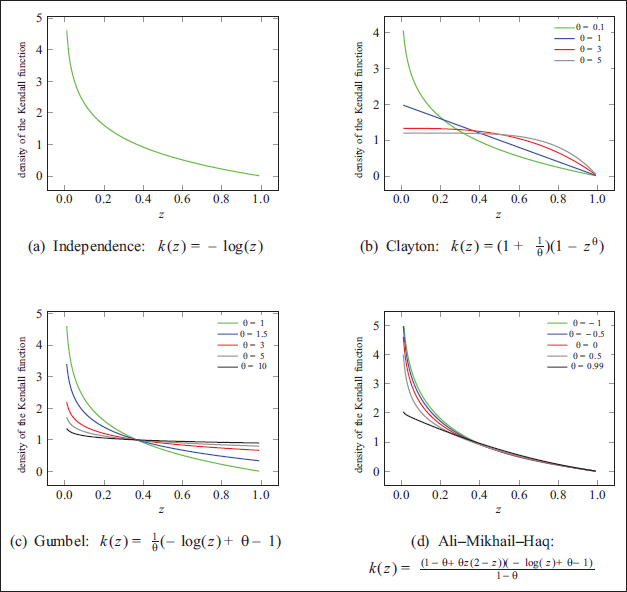
Figures 1a-d display the density of the Kendall function for some Archimedean copulas.
Density , of the Kendall Distribution for Some Archimedean Copulas.
The goal of this work is to obtain the density function of the 'joint survival function' of two standard uniform random variables with (joint) distribution given by an Archimedean copula C, that is, the density of
Note that
Note that Genest and Rivest’s[3] result (Equation (1.4)) is an analogue of the PIT for in the case of an Archimedean copula. We complement their result for
in the bivariate case.
We obtain the distribution by observing that has the same distribution as where W and T are independent, W has a uniform distribution on (0, 1) and T is from some density g (.) (see Equation (2.1), Theorem 2.1). T is linked to the copula by the fact that has the same distribution as (see Corollary 2.1).
As for applications, our result complements Equation (1.4) and may be used for copula-based estimation and goodness-of-fit procedures, as in Genest et al.[4]. We illustrate this in Section 3.2 using samples simulated from the Clayton copula. Another important application is given in our Theorem 2.2, where, following Barbe et al.,[5] we derive the weak convergence of the empirical Kendall process of . Here . is the empirical version of Barbe et al.[5]. Clearly, the covariance of the limiting Gaussian process in this theorem would be hard to compute without using our result (Theorem 2.1).
In Section 2, we present our result for the bi-variate case, that is, for , and the weak convergence result, in addition to examples from the models mentioned in Table 1. In Section 3.1, plots of densities of from these models are presented. In Section 3.2, we present a comparison between the density computed using our result and the density estimated from simulated values. Here we also present illustrations of distance-statistics based on the empirical process of simulated values, which can be minimized to estimate the copula-parameter.
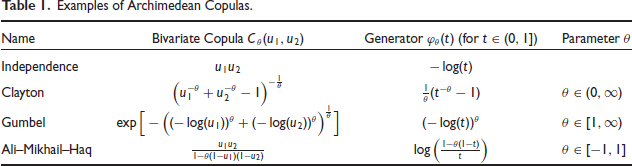
Examples of Archimedean Copulas.
Name
Bivariate Copula
Generator (for
Parameter
Independence
Clayton
Gumbel
Ali-Mikhail-Haq
Main Result
Theorem 2.1. Let U and V be two uniform random variables with joint distribution the Archimedean copula. The density of the survival distribution is
where
and
is the distribution function offor a given value.
Proof. With an integrable function h defined on [0, 1]:
Writing , we have:
From the properties of the generator, is decreasing with . Like is also continuous. Let us recall with Joe[6] (p. 32) that these properties suffice to make survival function. Let for some random variable . It has density
Further,
So that is decreasing and
is the joint density of on . To see that, note first that the joint density of is
Then, derive the density of as
Further,
(Recall that
Thus,
As any decreasing density on can be represented as a scale mixture of uniform densities (Williamson,[7] is of the form
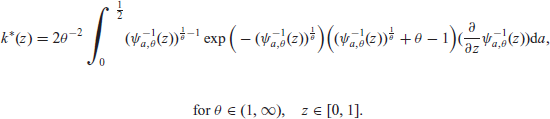
where G is a distribution function on , assumed to be absolutely continuous with density g. It is clear from Equation (2.7) that
With
Let
Fix a and let . As
we have that is increasing in b.
Put
We can then rewrite Equation (2.24) as
Hence, the density of is
Corollary 2.1. has the same distribution as that ofwhereare independent, W has Uniform (0, 1) distribution and T has density g(.), whereas has the same distribution as that of.
In general, letbe an integer, andbe a d-tuple of standard uniform random variables whose joint distribution is given by a multivariate Archimedean copula C with generator.
Let. Then, has joint survival function.
Withis distributed asandis distributed as.
However, a formula for the densities or simulation of C ordoes not seem to be tractable.
Remark 2.1. We can verify thatis a probability density on [0, 1] by noting that sinceis a density on(see Equation (2.23)), we have
where we have used the change of variablein the integral inside [...] and the fact thatis an increasing function (in fact, a quantile function) withfor each(see Equation (2.26)).
However, the quantile function of the distribution of may not have a closed form expression, hindering the numeric applications.
Similarly to Barbe et al.[5], we derive the limiting distribution of the Kendall process corresponding to . This is provided in the Theoren 2.2.
Theorem 2.2. Let
be the empirical counterpart ofand denote the distribution function ofby.
(H.1).admits a continuous density on that verifies
(H.2) There exists a version of the conditional distribution of the vectorgivenand a countable familyof partitionsofinto a finite number of Borel sets satisfying
such that for all, the mapping
is continuous onwith
Then the empirical process
converges in distribution to a Gaussian processwith 0 mean and covariance function
Where
and
withandthree independent copies of a random vector uniformly distributed inanddenotes the componentwise minimum of the vectors.
Moreover, the limiting process has the following representation
with
the (centred Gaussian) limit of the empirical process
for a set A of the form ofor.
Remark 2.2. Note that variance of the limiting Gaussian processis
since. This may be compared with the limiting variance for Kendall’s process obtained by Genest and Rivest[3] as well as Barbe et al.[5] (Theorem 2.1), namely,
Thus Equation (2.43) is quite similar to Equation (2.44), within the latter replaced byin the former, as is to be expected.
Proof. can be decomposed as where
and
It is then not hard to see that the proof of Theorem 5 of Barbe et al.[5] holds in our case too.
In particular, the covariance function of is obtained by computing the covariances
Next,
Interchanging the roles of s and t, one also gets
Finally,
Examples
Let us illustrate our formula for the density of the survival distribution through some examples.
Independence Copula
The independence copula , where , has generator .
We calculate:
The density of is
Clayton Copula
The Clayton copula
has generator
Then:
The density of is
Gumbel Copula
The Gumbel copula is
Its generator is given by
Then:
The density of is
Ali-Mikhail-Haq Copula
The Ali-Mikhail-Haq copula
has generator
Then:
The density of is
Illustration
In this section, we provide illustrations of our results.
Plots of for Some Copula Models
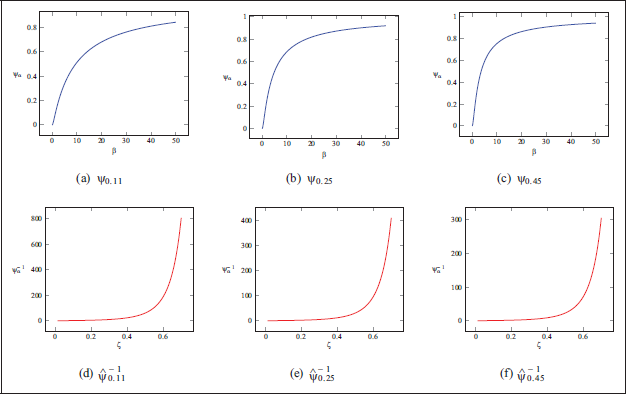
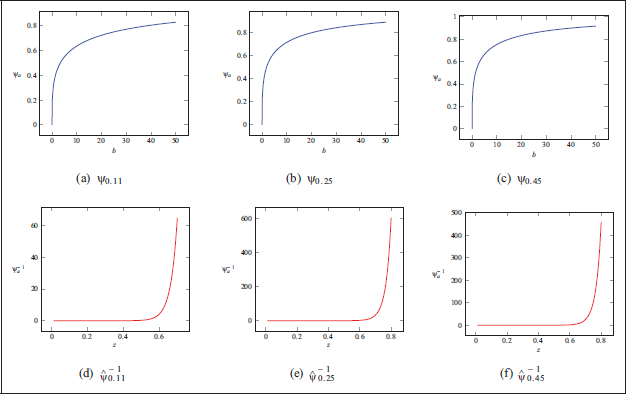
Figures 2 and 3 show graphics of the distribution function and the numerically estimated quantile function of for some values of :
Distribution Function and Its Estimated Inverse for a = 0.11, a = 0.25 and, a = 0.45 in the Case of the Clayton Copula with .
Distribution Function and Its Estimated Inverse for a = .011, a = 0.25, and a = 0.45 in the Case of the Gumbel Copula with .
For the independence copula,
As U1 and U2 are uniformly distributed on [0, 1], it follows that (gamma distribution of shape 2 and scale 1) and has density
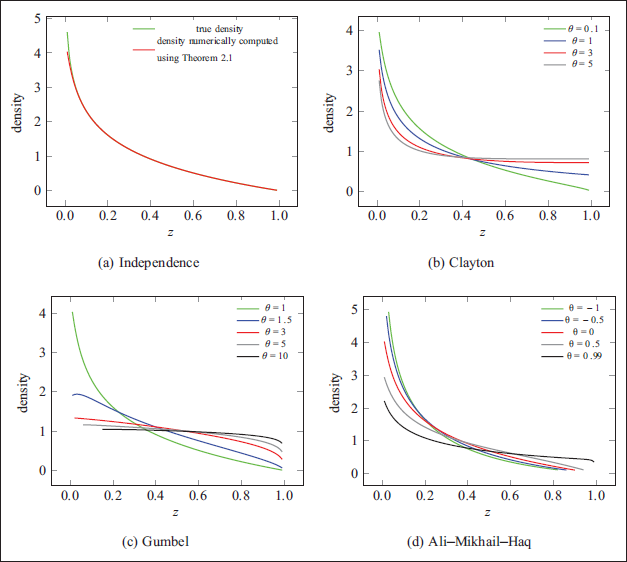
Knowing the density of , we can evaluate in this case how our method performs (in Figure 4a).
Density of for Some Archimedean Copulas.
Figures 4b-d show the density of for some Archimedean copulas:
Comparison of Simulated and Theoretical , and Minimum Distance Estimation
With and , an independent copy of ,
Taking advantage of the calculations in Section 2, we have
where
T can be simulated by noticing that has density for , which is of course the density of the Kendall distribution function ; see Figures la-d. For example, the density of is with for a Clayton copula and with for a Gumbel copula.
Then, from the simulated values of W and T, we can compute values of .
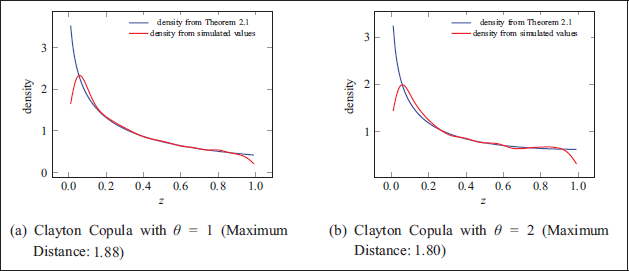
Figures 5a and b compare the densities obtained from application of Theorem 2.1 to those obtained from simulated values of for a Clayton copula:
Comparison of the Density from Application of Theorem 2.I and the Density Simulated Using Corollary 2.1.
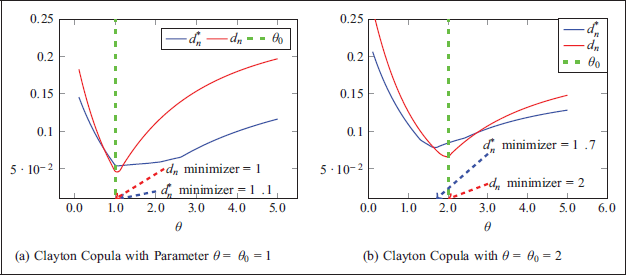
Figures 6a and b provide the plots , for the following distance-statistics:
where are the empirical distribution functions of and , respectively, is the Kendall function given in Equation (1.4), and is given in Equation (2.35). Here we have used the Clayton copula model to simulate (, as well as to compute and . The minimizers of the plots may be used as estimates of . This illustrates a possible use of our result for inference purposes.
Distance Statistics (n = 197).
Conclusion
Inspired by the importance of Kendall functions for identifying Archimedean copula models, we decided to examine the distribution of the survival functions from Archimedean copulas in this article. We were able to derive a formula for the density. This was achieved by observing that has the same distribution as where W and T are independent, W has a uniform distribution on (0, 1) and T is from some density g(.). Moreover, the approach used allows the derivation of the limiting behaviour of the empirical Kendall process and a representation that is useful in simulating the values of the survival distribution function of copulas. However, the difficulty in finding an analytical form of quantile functions in general limits the reach of the formula.
Footnotes
Acknowledgements
The authors would like to thank the referees and the Associate Editor for their critical comments that led to an improved version of the article.
Declaration of Conflicting Interests
The material in this article is from the PhD thesis of Magloire Loudegui Djimdou, submitted to Concordia University. Consequently, there are substantial overlaps between the thesis and the article. As per Concordia rules, the thesis has been archived in a repository called Spectrum at Concordia University by the author (https://spectrum.library.concordia.ca/id/eprint/990063/). The author has full copyright as per the rules of the copyright at Spectrum, as Concordia University does not claim copyright over anything deposited in Spectrum and is therefore free to use any part of the thesis in any of his future publications.
Funding
The author disclosed receipt of the following financial support for the research, authorship, and/or publication of this article: The research of Y. Chaubey and A. Sen was supported by the Natural Sciences and Engineering Research Council (NSERC), Canada.
Note
ORCID iD
Magloire Loudegui Djimdou
References
1.
SklarA.Fonctions de répartition à n dimensions et leurs marges. Publications de l'Institut de Statistique de l'Université de Paris1959; 8: 229–231.
2.
ChakakA and EzzergM.Bivariate contours of copula. Commun Stat Simul Comput2000; 29(1): 175–185.
3.
GenestC and RivestL-P.Statistical inference procedures for bivariate Archimedean copulas. J Am Stat Assoc1993; 88(423): 1034–1043.
4.
GenestC, QuessyJ-F and RémillardB.Goodness-of-fit procedures for copula models based on the probability integral transformation. Scand J Stat2006; 33: 337–366.