



Abstract
Business scholarship has long engaged with the natural environment, yet it rarely pauses to examine what is meant by nature itself. Most research reflects an atomistic orientation that fragments nature into measurable categories, such as carbon, water, and biodiversity, rendering it legible but stripped of interdependence, relationality, and deeper meaning. In response, in this perspective we advance an emerging holistic orientation to business–nature relations that reconceives organizations as ecologically embedded participants rather than external managers of nature. We contrast these orientations based on five dimensions: underlying logic, ethical framing, scope of responsibility, core proxies, and managerial responses. We then offer several promising avenues for future research to advance a holistic orientation grouped around three domains: worldviews, governance, and operations. Ultimately, we urge management scholars to think with, not merely about, nature, treating ecological complexity as a source of theoretical renewal, ethical reflection, and collective flourishing.
Keywords
Introduction
Management research has long engaged with environmental issues and concerns, yet rarely with nature itself. Although nature and the natural environment have featured prominently in the field (Starik & Rands, 1995; Whiteman & Cooper, 2000), scholars have seldom paused to interrogate what we actually mean by “nature.” In the absence of such reflection, the literature has largely adopted what we term an atomistic orientation to business–nature relations which, among others, equates nature with discrete environmental impact, for example carbon emissions, waste generation, water pollution, and land degradation, each examined largely in isolation (Bansal & Song, 2017). While this compartmentalization has yielded valuable insights within bounded streams of inquiry, it risks reducing nature to a collection of measurable proxies, thereby obscuring its interdependence, vitality, and fuller complexity.
Recent attention to biodiversity offers a partial corrective to how nature has been perceived in management research. As a politically resonant surrogate for nature writ large, biodiversity has mobilized new attention to ecological interdependence. Yet even within this more holistic discourse, reductive instruments persist, narrowing our understanding of nature to what can be counted or traded (Panwar et al., 2023). Framing nature through reductive instruments carries significant consequences. These instruments arise from the conceptual lenses through which business seeks to render nature legible, that is lenses that determine what organizations consider valuable, feasible, and ethically accountable, and thus how they act upon the natural world (Suddaby & Panwar 2022).
While ecologically attuned and relational framings of nature do appear in management scholarship, they are largely fragmented, speaking to specific topics and audiences (e.g., Dahlmann, 2025; Ehrnström-Fuentes et al., forthcoming). At the same time, they offer important building blocks for rethinking the business–nature relationship in a more systematic way. The planetary boundaries framework, for instance, has introduced ecological thresholds into management thinking, foregrounding the biophysical limits within which corporate systems operate (Whiteman et al., 2013). Socio-ecological resilience scholarship (Dentoni et al., 2021; Williams et al., 2021) emphasizes the dynamic interconnection and co-evolution of business and ecological systems. Place-based sustainability research (DeBoer et al., 2017) and Indigenous perspectives in management (Arjaliès & Banerjee, forthcoming; Salmon et al., 2023) have illuminated relational ontologies that position nature as more than a biophysical backdrop. Even natural capital accounting, despite grappling with the epistemic limits of abstraction and commodification, has sought to make ecological dependencies explicit within corporate decision-making (Sobkowiak et al., 2023).
To advance research on business–nature relations, we need a coherent framework that synthesizes these insights while preserving their ecological and relational depth. In this Perspective, we call for research grounded in what we term a holistic orientation to business–nature relations. This orientation represents a fundamental departure from the atomistic orientation that has shaped management scholarship and practice. Where atomistic approaches fragment nature into isolated challenges and components—carbon, biodiversity credits, and ecosystem services—a holistic orientation increasingly calls for business to operate not simply in alignment with climate or conservation goals, but in partnership with nature as a co-constitutive, life-enabling presence (Dahlmann, 2025; Waddock, 2024). This shift moves away from an organization- or issue-centric perspective toward nature-relational and nature-cultural worldviews that recognize the deep interdependence between human enterprise and the living world (Ergene & Calás, 2023; Ferns, 2025).
In what follows, we first establish the conceptual foundations by examining how nature has been understood across diverse cultural and philosophical traditions. This reveals nature as a deeply plural concept shaped by worldviews, lived experiences, and relational values that extend far beyond instrumental logics. Building on this foundation, we articulate the holistic orientation to business–nature relations and contrast it with the atomistic orientation. Finally, we outline three core domains (worldviews, governance, and operations) through which future research can advance this shift.
A Primer on Conceptualizations of Nature
Understanding how “nature” has been conceptualized across cultures and disciplines is foundational to advancing the scholarship on business–nature relations. Although the term appears frequently in corporate sustainability discourse, it is rarely elaborated in depth and often used interchangeably with “the environment.” Our purpose here is not to define nature or settle on a single meaning, but to foreground the plurality of ways in which it is understood and valued. Beyond inherent and instrumental values, research points to a vast range of relational values, including identity, livelihoods, sacredness, and sense of place, through which people experience and relate to nature (Pratson et al., 2023). These relational values emphasize that meaning does not reside in nature as an external object alone but emerges through socially embedded and culturally situated relationships between people and the more-than-human world (Díaz et al., 2015). This diversity shows that nature is not a fixed or uniform idea but a deeply plural and contested concept, shaped by cultural contexts, worldviews, and people’s lived experience (Ehrnström-Fuentes et al., forthcoming).
Some of the most enduring differences in how nature is understood can be traced to divergent philosophical traditions in Western thought, shaped by both Greek philosophy and early Judeo-Christian texts (Hines, 1992). Classical Greek thinkers such as Aristotle conceived nature (physis) as internally driven and purposive, emphasizing order and inherent tendencies within the natural world. This organic understanding, however, was later displaced by the mechanistic worldview that emerged during the Scientific Revolution, which recast nature as inert matter governed by universal laws. Thinkers such as Descartes and Bacon reinforced a dualism between mind and matter, and between society and nature, laying the foundations for a view of nature as external to human affairs and amenable to control and exploitation (Capra, 1996; Castree, 2013).
Early Judeo-Christian traditions have also been influential, particularly through interpretations of Genesis that emphasize human dominion over the natural world (Glacken, 1967). While alternative theological readings stress stewardship, care, and relational responsibility toward creation, dominion-centered interpretations have historically exerted substantial influence on Western ecological thought and governance. As Merchant (1980) famously argued, the convergence of these philosophical and theological shifts marked the symbolic “death of nature,” with enduring consequences for Western ways of knowing and governing the human–nature relationship (Warren, 1998).
Beyond Western traditions, conceptions of nature are grounded in ontologies that reject a sharp separation between humans and the natural world. In many Indigenous cosmologies, nature is understood not as an external object, but as a web of reciprocal relationships, where rivers, mountains, animals, and plants possess agency, moral significance, sacredness, and, in some cases, personhood (Kohn, 2013). In Andean worldviews, for instance, Pachamama (Mother Earth) is regarded as a living and a sentient being, capable of feeling and deserving of respect and care (de la Cadena, 2015). These relational understandings of nature have increasingly informed legal and institutional innovations. In New Zealand, the Whanganui River was recognized as a legal person in 2017, reflecting Māori ontologies that emphasize kinship between people and place (Charpleix, 2018). Similarly, Colombia’s Constitutional Court granted legal rights to the Atrato River, explicitly drawing on Indigenous conceptions of territory, relational responsibility, and guardianship (Rodríguez-Garavito, 2011).
Comparable relational understandings of nature are evident across South and East Asian traditions. In Hindu cosmology, natural entities such as rivers are revered as living deities, with the Ganges, for example, worshipped as a goddess and embedded in ritual, moral practice, and social life. Reflecting this worldview, an Indian High Court briefly granted legal personhood to the Ganges and Yamuna rivers in 2017, although the ruling was later overturned on jurisdictional grounds (O’Donnell & Talbot-Jones, 2018). More recently, the Indian Supreme Court characterized the felling of a mature tree as akin to the killing of a living being, framing trees not merely as ecological infrastructure but as subjects of moral and legal consideration (TOI, 2025). East Asian philosophical traditions likewise challenge Western nature–culture dualisms. Daoist and Buddhist cosmologies emphasize interdependence, co-arising, and the intrinsic value of nonhuman life, foregrounding relationality rather than separation between humans and the more-than-human world (Loy, 2003; Miller, 2017).
At the same time, portraying Eastern and Western conceptions of nature as sharply opposed risks oversimplifying both traditions. Western thought itself contains deep internal tensions, encompassing what Worster (1977) describes as an “imperial” tradition oriented toward domination and control, alongside an “Arcadian” tradition that values simplicity, restraint, and harmonious coexistence with nature. Romanticism, for example, emerged as a critique of industrial modernity by idealizing wild nature for its moral and aesthetic significance (Uggla, 2010). Contemporary movements such as degrowth and sufficiency extend this Arcadian impulse, calling for a deliberate scaling down of consumption and a reorientation of economic purpose toward ecological limits (Schneider et al., 2010). These ideas conceptually resonate with many Indigenous and Eastern ontologies that emphasize balance, restraint, and interdependence. Conversely, Eastern traditions are far from monolithic. As Guha (2000) argues, certain interpretations of Hindu cosmology revere nature symbolically while still situating it below human social hierarchies and economic priorities, complicating claims that such traditions are inherently ecocentric. Across both Western and Eastern contexts, conceptions of nature have been continually reshaped by political economy, institutional power, and development trajectories sometimes fostering reverence, sometimes enabling instrumentalization, and, in many cases, contributing to ecological degradation (Agrawal, 2005).
These entangled histories challenge the very idea of a universal, objective definition of nature. Defining nature is not simply a technical or scientific exercise, but one shaped by context-specific, normative, and dynamic worldviews and values (Keune et al., 2022). Recognizing this pluralism is therefore essential to avoiding approaches that privilege particular knowledge systems while disregarding or marginalizing others. Such paternalistic positions often generate resistance or antagonistic dialogue among stakeholders, whereas pluralistic approaches create space for more inclusive and constructive engagement (Gross et al., 2025). This orientation is reflected, for example, in the Intergovernmental Science-Policy Platform on Biodiversity and Ecosystem Services’ (IPBES, 2022) deliberate shift from “ecosystem services” to “nature’s contributions to people,” signaling an effort to accommodate diverse worldviews, including Indigenous and local knowledge systems even as this framing continues to reproduce a separation between people and nature. Relatedly, the concept of socio-biodiversity, advanced in Brazil and grounded in Indigenous and traditional knowledge, extends this perspective by emphasizing the co-evolution of biological diversity, cultural practices, and local governance systems (de Oliveira Adão, 2024).
Taken together, this conceptual plurality exposes the limits of dominant scientific framings that decompose nature into discrete, measurable stocks and flows. While analytically useful, such framings tend to abstract nature from its relational, cultural, and ethical dimensions, inadvertently reinforcing the nature–culture divide identified earlier. For business scholarship, this matters because atomistic representations of nature constrain how environmental responsibility, risk, and value creation are imagined and operationalized. Moving toward a more holistic orientation, which treats nature as relational, interconnected, and embedded within social systems, opens up a broader set of ethical questions and strategic possibilities for firms. The next section builds on this insight by contrasting atomistic approaches to business–nature relations with more holistic alternatives.
From an Atomistic to a Holistic Orientation to Business–Nature Relations
To facilitate this paradigm shift, we advance what we term a holistic orientation to business–nature relations. We do not present this orientation as a simple counterpoint to atomistic approaches, nor as a strict binary replacement. Rather, atomistic and holistic orientations are best understood as ideal–typical tendencies that coexist, overlap, and are often combined in practice. Elements of a holistic orientation are already emerging in recent management research, yet a coherent articulation has so far remained underdeveloped.
A holistic orientation moves fragmented or impact-specific views toward a more integrated understanding of how businesses relate to nature and are embedded within living systems. Importantly, it does not require abandoning existing analytical tools or frameworks. Instead, it calls for critically examining how these tools delimit what counts as nature, value, and responsibility, and for broadening them to better account for the full spectrum of relationships through which business activities both depend upon and shape nature.
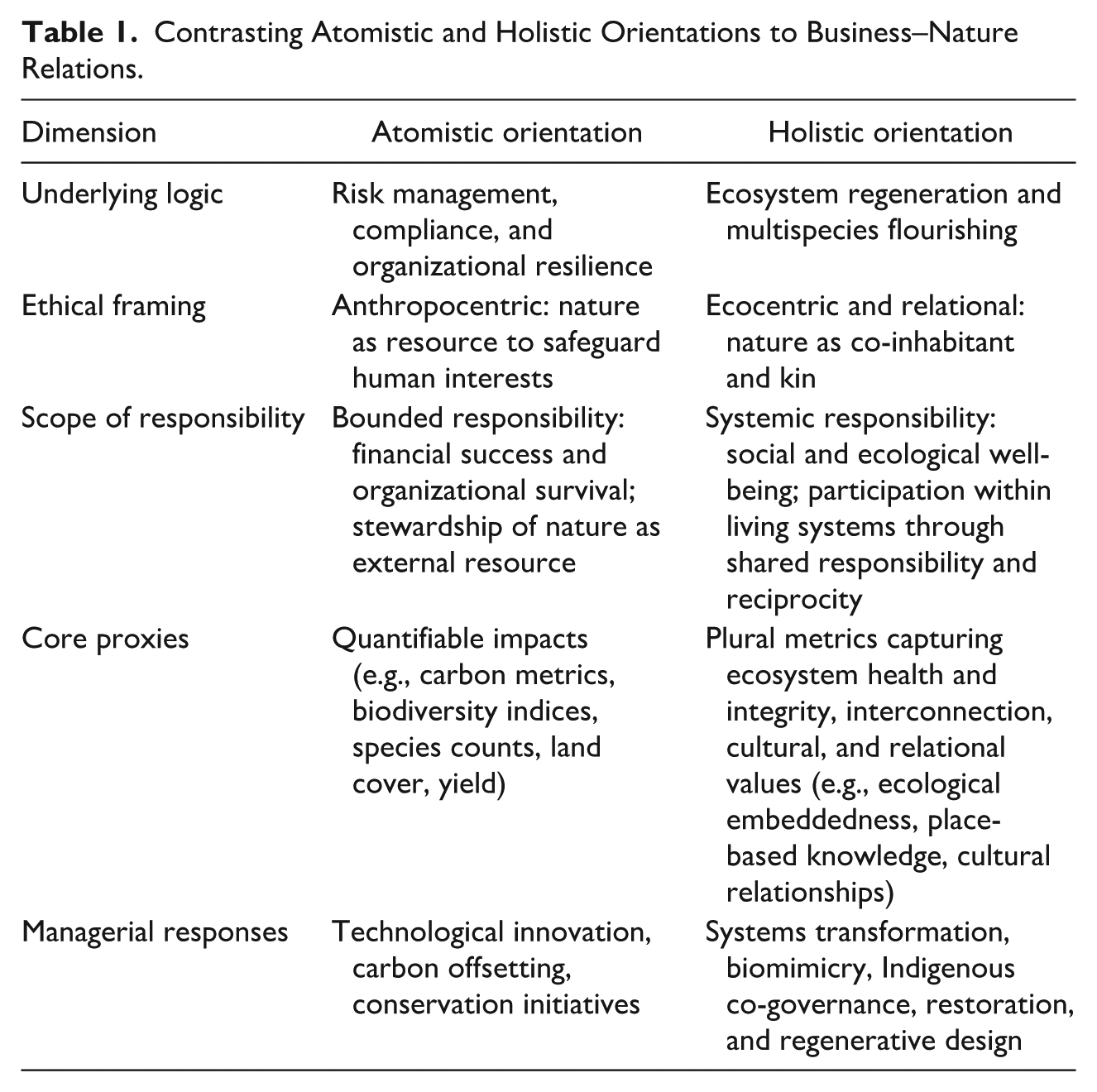
We contrast this holistic orientation with the dominant atomistic orientation that has historically shaped management research and practice. To do so, we organize the contrast across five important foundational dimensions (Table 1) that together capture how business–nature relations are conceptualized, evaluated, and enacted: the underlying logic through which nature is understood, the ethical framing that governs obligations toward it, the scope of responsibility attributed to firms, the core proxies used to represent nature in decision-making, and the managerial responses that follow. These dimensions are not meant to be exhaustive; rather, they represent analytically distinct but interrelated layers—from cognition and values to metrics and action—that structure how scholars perceive how firms engage with nature. Other dimensions could certainly be specified, but these five provide a coherent framework for highlighting the core differences between atomistic and holistic orientations. At the same time, the atomistic–holistic contrast should not be read as strict dichotomy. Rather than discrete categories, these orientations clarify heuristic poles while recognizing that in practice boundaries are often blurred.
Contrasting Atomistic and Holistic Orientations to Business–Nature Relations.
Underlying Logic
Underlying logic refers to the core reasoning that guides corporate strategy and decision-making in relation to nature. Under an atomistic orientation, this logic is dominated by risk management, legal compliance, and organizational resilience. Nature is primarily understood as a source of risk and liability, manifesting through climate disruption, resource scarcity, or regulatory pressure, that must be measured, monitored, and mitigated. This logic aligns closely with investor demands for standardization and financial materiality. Frameworks such as the Task Force on Climate-Related Financial Disclosures (TCFD) and the Taskforce on Nature-related Financial Disclosures (TNFD) exemplify this approach, translating nature-related concerns into formats legible to financial markets.
By contrast, a holistic orientation operates through a logic of ecosystem regeneration and multispecies well-being—that is, the flourishing of interconnected human and nonhuman life within an ecosystem (Shrivastava & Zsolnai, 2022). Rather than treating nature as an external risk to be managed, business is understood as embedded within living systems (Ehrnström-Fuentes et al., forthcoming). The guiding question shifts from How do we protect business’ operations from nature decline? to How do business’ activities contribute to the regeneration of planetary and local ecological conditions? Success is no longer solely defined by organizational endurance, but by contributions to the flourishing of entire ecosystems and their multispecies communities (Beacham, 2018).
Ethical Framing
Differences in underlying logic give rise to distinct ethical framings. Ethical framing refers to the values and norms through which actors interpret an issue and define what is morally salient (Rees et al., 2022). Under an atomistic orientation, ethical reasoning is predominantly anthropocentric: Nature is valued insofar as it serves human interests. This reflects both the historical roots of modern sustainability thinking in Western paradigms that position nature as external to human systems (Arjaliès & Banerjee, forthcoming), and managerial practices grounded in scientific management traditions. Within this framing, protecting nature is justified primarily through its instrumental value, whether through ecosystem services, resource inputs, or risk buffers.
A holistic orientation, in contrast, adopts an ecocentric and relational ethical framing, in which humans are understood as part of interdependent ecological communities. Here, responsibility extends to the more-than-human world, a term used to denote nonhuman beings and ecological systems that possess agency, intrinsic value, and moral relevance, rather than serving merely as resources for human use. Drawing on Indigenous relational ontologies and ecological ethics, this framing recognizes nature as having moral standing in its own right (Kohn, 2013; Warren, 1998). The ethical imperative thus shifts from protecting nature for us to acting with nature as co-inhabitants sharing a common ecological fate.
Scope of Responsibility
These differing ethical framings, in turn, shape how firms define the scope of their responsibility. Scope of responsibility refers to the boundaries within which a firm considers itself accountable for its relationship with nature. Under an atomistic orientation, responsibility is typically bounded and proximate: Firms focus on their direct environmental footprints, including emissions produced, resources consumed, and waste generated. Responsibility is framed around compliance, risk mitigation, and maintaining a social license to operate (Bansal & Song, 2017). Nature remains external to the firm’s core operations, something to be managed and monitored but not fundamentally integrated into organizational purpose.
A holistic orientation, by contrast, adopts a systemic understanding of responsibility. Firms are accountable not only for minimizing harm, but for actively contributing to the health and regeneration of the ecosystems of which they are part. Responsibility is therefore defined by ecological boundaries, such as watershed, landscape, and habitats, rather than by organizational or legal boundaries alone (Böhm et al., 2022). This reframes responsibility from asking what impacts business has to asking what role it plays within its broader natural ecosystem.
Core Proxies
How responsibility is defined strongly influences what managers choose to measure. Core proxies refer to the indicators and units used to represent nature in decision-making, shaping what is rendered visible and actionable. An atomistic orientation prioritizes quantifiable, discrete metrics, such as carbon emissions, biodiversity indices, species counts, and land cover change (Schaltegger et al., 2023). While useful for comparability and reporting, such metrics can obscure important ecological and social trade-offs. For example, monoculture afforestation may improve carbon metrics while undermining biodiversity, ecological resilience, and displacing traditional land uses (Bukoski et al., 2022). Similarly, climate mitigation technologies may reduce emissions while degrading soils or disrupting hydrological systems, a tension often dubbed the green–green dilemma (Seddon et al., 2021; Voigt et al., 2019).
A holistic orientation, by contrast, adopts plural and context-sensitive proxies that capture ecosystem integrity, interconnections such as feedback mechanisms of telecoupling and spillover effects, and relational values. These include plural valuation frameworks encompassing intrinsic, instrumental, and relational values (IPBES, 2022); biocultural indicators co-developed with Indigenous and local communities that incorporate place-based knowledge (Sterling et al., 2017); and ecosystem integrity metrics that emphasize functional complexity and ecological embeddedness rather than isolated variables (Hill et al., 2022). Although these tools challenge conventional expectations around standardization and comparability, they offer a more ecologically and socially grounded foundation for decision-making. Accordingly, core proxies shift from commensurating nature through calculable units to pluralizing valuation through constructs that remain situated in, relational and sensitive to system-level interdependencies.
Managerial Responses
Finally, differences in logic, ethics, responsibility, and measurement culminate in distinct managerial responses. Managerial responses refer to the practices companies adopt to integrate nature into their strategies and operations (Panwar, 2023). Under an atomistic orientation, these responses often emphasize technological innovation, efficiency improvements, carbon offsetting, and conservation initiatives such as renewable energy sourcing, carbon offset schemes, and protected area creations (Barnett, 2023). While these initiatives have value, they have also been critiqued for sidelining Indigenous governance systems and undermining community stewardship (Büscher & Fletcher, 2020).
By contrast, a holistic orientation emphasizes systems transformation through regenerative design, biomimicry, and co-governance. Illustrative examples include regenerative agriculture that rebuilds soil health while sustaining livelihoods (Newton et al., 2020); Indigenous co-governance arrangements that integrate traditional ecological knowledge into land management (Jessen et al., 2022); biomimicry approaches that align production processes with natural cycles (Eid et al., 2024); and watershed partnerships that reconfigure ecosystem governance through multi-stakeholder collaboration (Zuniga-Teran et al., 2022). These practices shift the way we position businesses from external managers of nature, to participants embedded within interdependent living systems.
Taken together, a holistic orientation to business–nature relations across these five dimensions—underlying logic, ethical framing, scope of responsibility, core proxies, and managerial responses—represents a fundamental rethinking of how nature is conceptualized, valued, and engaged within management literature. Rather than asking only how to prevent environmental collapse, this orientation foregrounds questions of ontological plurality, value complexity, and justice dimensions. If an atomistic orientation asks how business can survive environmental decline, holistic orientation asks how can flourishing be possible, and what role business should play in bringing this about.
Toward a Research Agenda on Holistic Business–Nature Relations
Building on this reorientation, we now turn to the task of charting a future research agenda for holistic business–nature relations. The contrasts outlined above underscore that realizing a holistic orientation requires more than rethinking conceptual boundaries. It demands transforming the underlying logics, institutional structures, and operational practices through which business engages with nature. We view such transformation as requiring changes across multiple issues and aspects, each offering a distinct pathway for reimagining firms as co-constitutive with living systems.
To achieve this, we present future research opportunities centered on three domains, namely worldviews, governance, and operations, that collectively offer promising avenues to reimagine how businesses relate to nature. These domains broadly cover the interconnected cognitive, institutional, organizational, and practical dimensions shaping business. While this list is by no means exhaustive, it helps translate our proposed holistic orientation into an actionable scholarly agenda.
Worldviews: Reimagining the Nature of the Firm
Worldviews define what businesses are and why they exist by shaping what is considered real, valuable, and possible; they determine the logic through which organizations relate to nature. A holistic orientation therefore encourages a paradigmatic shift, from seeing nature as a backdrop for economic activity to recognizing it as the living matrix within which organizational life unfolds. While such a transformation alone cannot overcome the structural barriers embedded in contemporary capitalism, it provides the ontological foundation without which governance and operational reforms remain constrained by extractive logics.
As such, it moves from traditional perspectives of management that have long rested on an ontology of separation toward emerging perspectives that view businesses as inextricably interconnected with the ecosystems that sustain them (Williams et al., 2021). This research reframes organizations as nodes in complex socio-ecological networks, emphasizing flows of energy, matter, and meaning rather than isolated exchanges. What is new is not the recognition of interconnection per se, but the ontological seriousness now afforded to it: Businesses are no longer merely influenced by ecological systems, they are part of those systems.
Key to this cognitive shift is research which illustrates how businesses can relinquish the quest for certainty and control and instead move toward working in evolving symbiosis with their surrounding ecosystems. As a first step, therefore, we need to examine the societal and managerial discourse on the nature of business more deeply and critically to unpack and reframe the (tacit) assumptions, beliefs, and meanings associated with the very essence of what businesses are or should be. Rather than asking how businesses can represent nature’s interests, researchers explore how organizational agency itself emerges from relational entanglements among human and nonhuman actors (Tallberg et al., 2024). Research suggests this approach is not simply romantic idealism but rather can create economically viable organizational forms while regenerating ecological conditions, often outperforming conventional models in terms of long-term resilience (Artelle et al., 2018; Dentoni et al., 2021). Yet, management scholarship continues to treat these forms as contextual curiosities or extreme cases rather than as a generative theory. We lack integrative frameworks to explain how relational ontologies translate into organizational design, governance, and value creation and how multiple ontologies can coexist within hybrid or globalized organizational fields.
As this ontological pluralism gains ground, it also compels a rethinking of both the purpose and ethics of firm. Conventional corporate purpose has been defined in instrumental and anthropocentric terms such as maximizing profit, efficiency, and stakeholder value. Yet, a growing body of work now advances life-centered and regenerative framings, arguing that the purpose and legitimacy of business rest on its contribution to the continuity of life (Dahlmann, 2025; Heikkurinen et al., 2021). Under this emerging paradigm, businesses are not ends in themselves but participants in the web of life, tasked with maintaining the conditions that make their own existence possible. Empirical examples of firms incorporating such a logic, however, remain elusive.
Taken together, these developments indicate that the paradigmatic shift toward a holistic ontology is already underway across multiple theoretical domains. The task for future research is therefore integrative and reflexive: to consolidate these dispersed efforts into a coherent understanding of what it means to organize within rather than against nature.
Future work can advance this agenda by
Theorizing ecological embeddedness as a constitutive property of organizations by examining how relational interdependence shapes identity, purpose, and adaptation in contexts where businesses face competing pressures from financial markets, regulatory regimes, and ecological constraints.
Elaborating ecological legitimacy as a biophysical process with material consequences for organizational survival.
Developing a relationship-based theory of organizational purpose and value creation that accounts for both economic viability and ecological regeneration.
Governance: Reconfiguring Accountability and Coordination Mechanisms
At the intermediate level of transformation lie the institutional architectures that determine how organizations distribute power, assign responsibility, and define accountability. Structures translate worldviews into practices, norms, and shape how business relates to nature in practice. A holistic orientation, therefore, entails a structural reconfiguration from institutions that externalize nature’s value to those that internalize ecological interdependence.
Emerging research, practice, and policy point to several promising directions for reimagining corporate governance in this vein. For example, a small but growing number of businesses have begun understanding nature as a director, stakeholder, and shareholder (Sedilekova et al., 2025). To illustrate, UK-based Faith in Nature appointed nature as a director, with its interests advanced by a rotating Nature Guardian (Sedilekova et al., 2025). Likewise, but from a different theoretical perspective, stakeholder theorists, many of whom increasingly recognize nature as a stakeholder (Driscoll & Starik, 2004; Haigh & Griffiths, 2009), have explored how artistic interventions like poetry and maps can help overcome some of the epistemic and ontological challenges of embracing nature and other nonhuman stakeholders’ interests (Gulari et al., 2025). Elsewhere, multi-stakeholder initiatives like the Forest Stewardship Council have been experimenting, with various degrees of success, with ways of representing the natural environment in decision-making through entities like non-governmental organizations (Moog et al., 2015).
Such work, however, is in its infancy. Even companies that explicitly consider nature as a stakeholder struggle to engage meaningfully with it on par with other stakeholders (Lischinsky, 2015). Research is needed to help further this important work by identifying other ways corporate governance, representation, and stakeholder engagement frameworks can change in line with a holistic orientation. Existing management theories can serve as a promising starting point. For example, corporate governance research, increasingly concerned with environmental sustainability (Aguilera et al., 2021), could broaden its gaze to focus on whether and how different governance actors like employees and top management teams can effectively channel nature’s interests. Research from other disciplines that has wrestled with similar questions, notably political science, can be a wellspring of ideas. As one example of a promising lens that could be translated to the management context, Celermajer et al. (2025) provide a useful overview of how nature has, and could be, integrated into deliberative forums like mini-publics. Future research could explore whether and how these tools could be translated into corporate governance arrangements to, for example, help bridge ecological, human, and business timescales.
When investigating how to effectively integrate nature into various governance arrangements, it is important to consider different organizational forms. We have seen a surge in interest in alternative forms of organizing like cooperatives and stakeholder firms that differ from the traditional corporation in terms of their purpose, ownership, and participation (Luyckx et al., 2022). Steward-ownership, which separates ownership and control rights and ensures the business’ assets are used to further its purpose, is gaining increased traction around the world (Manelli et al., 2025). This has significant potential for advancing a holistic orientation. For example, Patagonia’s new governance arrangement channels its voting stock to the Patagonia Purpose Trust and its non-voting stock (and thus, its dividends) to the Holdfast Collective, a non-profit focused on addressing environmental sustainability issues (Manelli et al., 2025). Yet it requires critical evaluation of which, if any, of those alternatives are suitable as a durable means of channeling and protecting nature’s interests and what trade-offs and unintended consequences might accompany each of them.
Furthermore, new forms of finance are emerging, many of which are specifically set up to bridge the finance–nature gap (Karolyi & Tobin-de la Puente, 2023). Instruments such as biodiversity credits, green bonds, and blended finance schemes are proposed not only as vehicles for resource mobilization but also for aligning financial flows with ecological priorities. Yet these tools are not merely accounting devices; they are interventions that can reshape land use, influence conservation priorities, and displace customary or Indigenous’ relationships to place (Wunder et al., 2025). For some, new financial instruments for nature reinforce “eco-colonialism” underpinned by new forms of land or “green grabbing” (Seddon et al, 2021). Others have shown the impossibility of financialization projects unless nature is turned into a passive object (Arjaliès & Gibassier, 2023). Future research should therefore examine how these emerging financing schemes affect companies’ governance arrangements (e.g., board representation, accountability systems, incentive schemes) and the extent to which they draw on either atomistic or holistic business–nature relations.
In sum, the task for future research is to identify and study new governance arrangements drawing on interdisciplinary work in order to discern which ones are likely to be the most effective.
Promising lines of inquiry include
Examining how, and to what effects, nature’s interests and perspectives can be integrated into various traditional and novel governance arrangements across jurisdictions and industries.
Analyzing the suitability of different organizational forms, particularly alternative forms of organizing like employee ownership, steward-ownership, for fostering durable transformations in nature-centered governance practices.
Investigating the intersection between emerging nature-focused financing schemes and governance arrangements.
Operations: Enacting Holistic Business–Nature Relations in Practice
At the most immediate level of impact lie the processes and decisions through which organizations act and interact within the living systems they inhabit. A holistic orientation requires reimagining business operations as regenerative processes that sustain the vitality of the ecosystems that sustain business.
Early approaches to sustainable operations emphasized efficiency-oriented logics rooted in an anthropocentric worldview seeking to sustain business through nature’s stability, rather than sustaining nature through business (Ergene & Calás, 2023). In contrast, a new operational ethos based on sufficiency and regenerative design (Jungell-Michelsson & Heikkurinen, 2022) positions businesses as potential contributors to the vitality of living systems.
Regenerative operations integrate ecological processes, such as nutrient cycling, biodiversity restoration, and soil regeneration, into production systems themselves. Examples include net-positive and nature-positive business models (Konietzko et al., 2023; White et al., 2024), biomimetic design, and circular bioeconomy innovations that treat waste as input for renewed cycles (Donner & de Vries, 2021). In forestry, for instance, regenerative principles underpin adaptive harvesting and multispecies replanting; in construction, they inform material choices that sequester rather than emit carbon, or nature-friendly design options that enhance biodiversity conservation.
Beyond their direct operations, businesses’ supply chains have also long been abstracted from place, obscuring the ecological and social systems on which production depends (Gualandris et al., 2024; Wieland, 2021). In response, emerging bioregional and place-based enterprise models (Brunckhorst, 2001; Shrivastava & Kennelly, 2013) seek to restore proximity between economic activity and ecological context.
From a holistic perspective, regeneration is not a specialized domain but rather acts as a guiding principle for organizing, grounded in different approaches to space and time (Hahn and Tampe, 2021; Slawinski et al., 2021). Efficiency itself is reimagined as ecological reciprocity, measuring not only resource optimization but also how organizational actions contribute to the replenishment of life-support systems. Yet how organizations operationalize this principle across diverse industries and contexts remains underexplored, as does the question of what capabilities, cultural shifts, and business model innovations enable firms to move from harm reduction toward active ecological contribution (Waddock, 2025). There is also a need for critical evaluation of such relabeling of sustainability efforts which some critique as fig leaves of business-as-usual approaches (Schleifer, 2025).
It is important to bear in mind that transformation ultimately depends on people: their perceptions, skills, and moral imagination, underscoring that change is enacted through practice, rather than policy. A holistic orientation will, therefore, emphasize cultivating social–ecological capabilities: abilities to perceive ecological feedback (Whiteman & Cooper, 2000), engage in systems thinking (Goodman et al., forthcoming), and act with humility toward nonhuman others (Lambert, 2024). They also reshape organizational cultures, fostering what has been described as ecological competence (Mirzaeva, 2019): a felt responsibility for the flourishing of interconnected life. Yet cultivating such capabilities requires more than individual transformation; it demands organizational structures, incentive systems, and professional norms that support rather than penalize ecological action (Colombo, 2024).
Taken together, these developments indicate that operational transformation toward a holistic orientation is emerging across multiple domains of organizational practice. The task for future research is to deepen our understanding of how regenerative operations are enacted, learned, and sustained in practice.
Future work can advance this agenda by
Critically examining how regenerative design principles are implemented across diverse industries and contexts, including the organizational capabilities, resources, and cultural shifts required for operationalizing ecological reciprocity.
Investigating bioregional and place-based models of production, exploring how businesses develop ecological literacy and contextual fit through continuous engagement with local ecosystems, and how place-based production is reconciled with global market pressures and competitive dynamics.
Studying the cultivation of social–ecological capabilities, including how experiential learning, cross-disciplinary collaboration, and embodied practice foster ecological competence.
Conclusion: Thinking With, Not Just About, Nature
As Egler once observed, “Nature is not only more complex than we think, it is more complex than we can think” (1970, p. 21). He was not writing to business scholars, yet his provocation could hardly be more relevant. It offers not only an epistemological caution but an invitation to humility, imagination, and theoretical renewal. Egler’s insight reminds us that the task is not simply to define or manage nature more precisely, but to reconsider how nature is positioned within the ontological and ethical assumptions that undergird prevailing management and organization theories.
What is needed, therefore, is a fundamental shift in how business scholarship theorizes nature, from treating it as a variable to engaging it as a participant. This requires moving beyond proxy indicators and siloed framings toward a more ecologically embedded, ethically expansive, and conceptually integrative orientation. Our proposed holistic orientation is offered not as an endpoint, but as an invitation to join emerging research (in various disciplines) and practice that seeks to reimagine the epistemic and normative architectures through which business engages with nature.
To “think with nature,” as we propose, is not merely to broaden the sustainability agenda but to recognize nature as a co-constitutive force in organizational life. It is to allow ecological complexity not only to inform but to interrupt and reshape the theories we build, the models we teach, and the futures we design. This sensibility resonates closely with Business & Society’s longstanding commitment to pluralism, reflexivity, and the critical interrogation of business in its broader societal and ecological contexts. As its founding editorial, A Declaration of Interdependence (B&S, 1960, p. 3; see, also, Arora et al., 2026), affirmed, business cannot be understood apart from the larger systems of which it is a part. The challenge ahead, then, is not to master nature’s complexity, but to live—and learn to theorize—within it.
Footnotes
Acknowledgements
The authors would like to thank Hendrik Vollmer, Debashish Munshi, Jacob Bukoski, attendees of the IABS 2025 conference, and especially Business & Society’s co-editors for their valuable comments and suggestions on earlier drafts of this article.
Declaration of Conflicting Interests
The authors declared no potential conflicts of interest with respect to the research, authorship, and/or publication of this article.
Funding
The authors received no financial support for the research, authorship, and/or publication of this article.
Ethical Approval and Informed Consent Statements
The authors declared no ethical approval was required for this article.
Declaration of the Use of Generative Artificial Intelligence
The authors declared that no generative artificial intelligence was used for this article.

Data Availability Statement
There are no data available for this article.