



Abstract
Corporate misconduct can have devastating consequences for organizational stakeholders. Yet firms diverge sharply in how their boards respond to such infringements, especially when deciding whether to dismiss the CEO. We theorize that boards interpret misconduct through the lens of organizational identity orientation—that is, the nature of assumed relationships between an organization and its stakeholders. Using a machine learning analysis of shareholder letters from S&P 500 firms (2004–2017), we show that organizational identity orientation shapes dismissal decisions. Firms with individualistic orientations, which emphasize personal achievement, are more likely to dismiss CEOs as misconduct is seen as an individual failing. In contrast, firms with collectivistic orientations, which emphasize interdependence, are less likely to dismiss CEOs as misconduct is interpreted as diffuse and systemic. These findings reveal how organizational identity orientation shapes boards’ interpretations of responsibility, offering new insights into why firms experience different accountability outcomes in response to wrongdoing.
Keywords
Corporate misconduct, or “activities and actions that organizational members engage in to deceive or swindle investors or other key stakeholders” (Fewer & Tarakci, 2025; Neville et al., 2019, p. 2541), poses a significant threat to organizations and society alike. Prior research has found that it erodes firm value, triggers extensive regulatory interventions, and diminishes overall societal well-being (Castro et al., 2020; Hersel et al., 2019). Because of these consequences, stakeholders often demand that the board of directors take swift and visible action, with CEO dismissal serving as a prominent response (Desai et al., 2006; Haleblian & Rajagopalan, 2006; Neville et al., 2019). The board’s decision to unseat the CEO signals how the organization addresses questions of leadership, accountability, and adherence to corporate and societal values (Aguilera & Jackson, 2003; Tihanyi et al., 2014).
Yet, despite the gravity of CEO dismissal decisions, boards differ dramatically in whether and how they pursue this course of action (Beneish et al., 2017). To explain these varying outcomes, existing explanations largely reflect two perspectives. Agency accounts focus on how attributes of the CEO or board influence directors’ responses to wrongdoing. For example, scholars have shown that CEO dismissal is shaped by director characteristics such as tenure, inside directorships, or political ideology (Gomulya & Boeker, 2014; Park et al., 2020; Weisbach, 1988). In contrast, situational accounts emphasize the features of the misconduct event itself, such as media visibility or the firm’s recent performance, as cues that drive dismissal decisions (Arthaud-Day et al., 2006; Busenbark et al., 2022; Wiersema & Zhang, 2011). In both perspectives, CEO dismissal functions as a strategic action to placate stakeholders, signal responsiveness, and reinforce the board’s control (Zavyalova et al., 2016).
Misconduct, however, rarely presents itself with clear-cut culpability; it is often murky, contested, and open to interpretation (Greve et al., 2010; Paruchuri et al., 2024). In these moments, board members must engage in sensemaking, that is, evaluating not only what occurred but also what it signifies about the organization’s leadership, values, and alignment (Palmer, 2012). This interpretive process is shaped by social and cultural structures within the organization itself. For example, research has shown that a leader’s status can protect their behavior from scrutiny and blame (Cannella & Shen, 2001; D’Aveni & Kesner, 1993), that workforce diversity can influence how divergent perspectives on responsibility are surfaced or suppressed (Foreman & Soebbing, 2015; Westphal & Zajac, 2013), and that shared understandings of acceptable conduct can shape if transgressions are framed as individual lapses or systemic failures (Fiordelisi & Ricci, 2014). These features constitute the backdrop against which boards interpret misconduct and assign accountability.
We propose that one critical yet underexamined feature of this process is the organizational identity orientation, that is, “the nature of assumed relationships between an organization and its stakeholders” (Brickson, 2005, p. 578). Brickson (2005, 2007) identifies three distinct orientations: individualistic, where relationships are instrumental and responsibility is individualized; relational, where relationships are dyadic and grounded in mutual trust and obligation; and collectivistic, where relationships are system-centered, emphasizing interdependence, shared purpose, and collective responsibility. Research has shown that organizational identity orientation influences how firms engage stakeholders (Brickson, 2007), respond to reputational threats (Elsbach & Kramer, 1996), and uphold internal consistency in times of crisis (Ravasi & Schultz, 2006). Crucially, organizational identity orientation also carries implicit assumptions about how responsibility is distributed. In some firms, the nature of relations is individualized, meaning that accountability and outcomes may be traced to specific actors. In others, collective systems and shared practices may diffuse responsibility across the organization. Thus, organizational identity orientation might shape how boards interpret misconduct and decide whether the CEO should be held personally accountable. In this study, we ask: How does organizational identity orientation shape the board’s decision to dismiss the CEO following corporate misconduct?
We theorize that in firms with a strong individualistic orientation, boards will be more likely to attribute misconduct to the CEO and seek individualized accountability through dismissal. In contrast, in firms with a collectivistic orientation, boards will be more inclined to interpret wrongdoing as a systemic failure, diffusing blame and reducing the likelihood of unseating the CEO. In firms with a relational orientation, continuity in valued interpersonal relationships will weaken the link between misconduct and dismissal. We examine these predictions using a sample of S&P 500 firms from 2004 to 2017, employing natural language processing on annual reports to capture organizational identity orientation. We draw from the Violation Tracker database to capture proven instances of corporate misconduct across a range of regulatory domains (e.g., labor, environmental, and financial). Our findings offer robust support for how organizational identity orientation shapes board responses to corporate misconduct.
Our study contributes to research on CEO dismissal by introducing organizational identity orientation as an important lens for understanding how boards of directors respond to wrongdoing in an era of mounting demands for corporate accountability (George et al., 2016). Whereas prior research has primarily emphasized the role of CEO characteristics and board attributes in influencing dismissal decisions (Gomulya & Boeker, 2014; Park et al., 2020), we highlight how a board’s interpretation of misconduct is shaped by organizational identity orientation. In doing so, we broaden existing perspectives by showing that dismissal decisions are not only rational assessments of risk or control but also shaped by identity-based logics. Second, we contribute to research on organizational identity orientation by demonstrating its relevance not only for strategic direction and stakeholder engagement (Brickson, 2007; Ravasi & Schultz, 2006) but also for corporate governance. By showing that organizational identity orientation acts as a mirror—reflecting back to boards what forms of accountability feel legitimate—we extend identity theory into the interpretive core of governance. Such an extension has important implications for both organizational studies and practice.
Organizational Identity Orientation and Corporate Misconduct
As a central, enduring, and distinctive understanding of “who we are” as an organization (Albert & Whetten, 1985; Pratt & Foreman, 2000), organizational identity orientation provides a foundational cognitive frame that shapes how organizational stakeholders evaluate whether actions align with the firm’s values (Golden-Biddle & Rao, 1997). At its core, organizational identity orientation captures the shared assumptions that organizational members hold about how relationships within and beyond the firm are structured, and what those obligations entail. While prior research has emphasized its role in shaping external stakeholder relations (Foreman & Whetten, 2002; Hutton et al., 2001; Scott & Lane, 2000), Brickson’s (2005, p. 577), empirical work shows that members perceive internal and external orientations as “tightly coupled,” suggesting that organizational identity orientation provides a generalized, organization-wide logic for how relational obligations are understood and enacted.
Brickson (2005, 2007) theorizes three distinct orientations: individualistic, relational, and collectivistic. In organizations with an individualistic orientation, members understand themselves and others as autonomous actors, and relationships tend to be instrumental and competitive. A relational orientation emphasizes dyadic bonds, mutual accountability, and personalized connections, such that enduring relationships with specific others is paramount. A collectivistic orientation conceives of the organization as part of a broader whole, foregrounding interdependence and shared responsibility (Brickson, 2005, pp. 579–580).
Importantly, these orientations are not mutually exclusive. As Brickson (2005) explains, “both pure and hybrid identity orientation types are relatively common” (p. 576), and orientations should be viewed as continuous, interdependent traits that co-occur in varying degrees. Empirically, Langer and Feeney (2025) find that organizational members often perceive their firms as simultaneously reflecting aspects of multiple orientations, such as being both self-interested and other-regarding. However, even in such hybrid configurations, certain logics tend to be more central than others. These dominant logics become the primary lens through which members understand what the organization stands for and how they relate to others within it (Besharov & Smith, 2014). This means that although organizational identity orientation is composed of overlapping dimensions, one orientation typically emerges as the “dominant relational logic” (Brickson, 2007, p. 866).
Prior research has demonstrated that organizational identity orientation has meaningful implications across a range of managerial scenarios. For example, firms with collectivistic orientations are more likely to implement shared socialization processes and humanistic human resource strategies, while firms with individualistic orientations often rely on transactional psychological contracts and innovation-based socialization (Brickson, 2007; Gooderham et al., 1999). Organizational identity orientation has also been shown to shape how members interpret organizational priorities (Baron & Kreps, 1999; Covaleski et al., 1998). Thus, organizational identity orientation shapes strategic decisions, relationship management, and the consistency of organizational practices.
Organizational identity orientation also provides an interpretive frame for the board of directors. As Brickson (2007) notes, organizational identity orientation serves as a social-cognitive structure through which members and stakeholders “observe” how the organization and its members interact with others and develop expectations about what kinds of behaviors are appropriate. Importantly, organizational identity orientation is a durable, “relatively stable facet of identity” which “may change over time” in response to leadership, turnover, and environmental shifts (Brickson, 2007, p. 869). However, such changes tend to be incremental and occur over long time horizons (Brickson, 2005). Organizational identity orientation is thus a relatively stable, but not immutable, feature of the firm.
Although directors are often formally independent outsiders, they are routinely exposed to organizational identity orientation through quarterly board meetings, executive interactions, and firm communications such as shareholder letters. 1 Furthermore, a major task of the board is to interact with various stakeholders such as employees, partners, and the public (Godos-Díez et al., 2018; Hillman & Dalziel, 2003); these interactions provide more opportunities for directors to be exposed to organizational identity orientation. Similar to the impact of institutional logics on the board of directors (e.g., Shipilov et al., 2010), these identity cues collectively reveal the firm’s assumptions about the nature of relationships and autonomy, obligation, and accountability.
In ambiguous situations such as corporate misconduct where the chain of causality is often diffuse and contested, such logic becomes especially salient. Prior work suggests that during crises, directors’ interpretations and actions are shaped not only by structural independence but also by identity-based considerations in relation to the organization’s values and obligations (Golden-Biddle & Rao, 1997; Withers et al., 2012). Accordingly, we hypothesize that board judgments about CEO culpability are filtered through the dominant organizational identity orientation, which influences whether wrongdoing is interpreted as the failure of an individual actor, a betrayal of a trusted relationship, or a breakdown of collective responsibility.
Individualistic Identity Orientation
The first orientation, individualistic, emphasizes an independent and self-centered perspective of relationships within the organization. Members of firms with a predominantly individualistic orientation conceive of themselves as distinct from others with greater concern for one’s own welfare (Brewer & Gardner, 1996). An individualistic orientation is exemplified in phrases such as “I am the best” and “I expect excellence” (Brickson, 2005). Consequently, an individualistic identity emphasizes autonomy, personal achievement, and individual responsibility, prioritizing performance-based outcomes.
In organizations with an individualistic orientation, the CEO plays a central role as the most visible and influential figure. The self-focused nature of these organizations means that social ties are typically “weak and fluid” (Brickson, 2005, p. 870). Relationships within these firms are often instrumental and maintained primarily for personal gain (Brickson, 2007; Rousseau & Judi, 1993). As a result, when misconduct occurs, boards in highly individualistic firms are more likely to seek out and isolate the source of wrongdoing to protect the firm’s image and preserve its logic of individual accountability. The CEO, viewed as the architect of strategy, moral tone-setter, and lead implementer, becomes the focal point for blame.
When individualistic identity orientation is high, the board is more likely to interpret misconduct through a lens that highlights personal agency and demands decisive, individualized accountability. Conversely, when individualistic orientation is low, this logic weakens; the board may instead consider broader contextual factors or systemic failures in assigning responsibility. Therefore, we propose that misconduct in firms with a strong individualistic orientation will be more readily attributed to the CEO. This attribution serves a dual purpose: it maintains the focus on individuals while simultaneously providing a clear target for accountability. We hypothesize:
Relational Identity Orientation
The second identity orientation, relational, emphasizes personalized bonds, mutual accountability, and concern for the well-being of others within the organization (Brickson, 2005). Members of organizations with a relational identity orientation understand themselves in connection with specific others, whether that is coworkers, supervisors, or stakeholders, with a focus on maintaining durable, trust-based relationships. These organizations foster strong interpersonal ties and a shared sense of obligation between individuals, which creates a norm of reciprocity and empathy across the firm (Brickson, 2007).
When misconduct occurs in relationally oriented firms, boards interpret wrongdoing through a lens that prioritizes relational preservation. Although misconduct raises concerns about accountability and reputational harm, relational norms heighten sensitivity to the interpersonal costs of punitive action. The CEO is not viewed merely as a role occupant or symbolic representative of the firm, but as a valued relational partner embedded in organizational networks of trust and obligation. Severing this relationship through dismissal can be seen as disproportionately disruptive, potentially undermining internal cohesion and relational stability.
Thus, when relational identity orientation is high, boards prioritize preserving trust, continuity, and valued interpersonal ties to the CEO, which weakens the extent to which misconduct translates into their dismissal. Importantly, this logic reflects concern for specific, ongoing relationships rather than a generalized diffusion of responsibility across the organization. In contrast, when relational orientation is low, these relational constraints are less salient, making boards more willing to convert accountability concerns into dismissal decisions. Although such concerns remain present, they are more likely to be managed through responses that maintain relational stability rather than through the removal of a central relational actor. Accordingly, we hypothesize:
Collectivistic Identity Orientation
A collectivistic identity orientation reflects a system-centered perspective in which the organization is characterized by interdependence and a collective interest (Brickson, 2007). In such firms, members view themselves as contributors to a shared purpose. Although this orientation does not necessarily entail self-sacrificing behaviors, it is marked by high mutuality among members and stakeholders. In such organizations, actions and outcomes are viewed as the result of collective efforts and shared responsibilities toward organizational goals (Brickson, 2005).
At first glance, one might expect that boards in collectivistic firms would be especially likely to dismiss CEOs following misconduct in order to signal the firm’s commitment to ethical standards. However, collectivistic identity orientation complicates this intuition. Because responsibility is perceived as diffuse and deeply embedded in organizational systems and relationships, blame is less likely to be assigned to a single individual. Misconduct is often interpreted as a failure of the collective, requiring a systemic response rather than the removal of a single figurehead.
When collectivistic identity orientation is high, boards are more likely to see misconduct as rooted in structural or cultural issues that implicate the organization as a whole entity. This diffuses individual blame and weakens the impulse to dismiss the CEO. When collectivistic orientation is low, boards may adopt a less diffuse view of accountability, heightening the likelihood that the CEO will be held personally responsible. Thus, while collectivistic firms may be highly attuned to collective impact, their attributional logic tempers the path from concern to punishment. Therefore, we hypothesize:
Method
We test our theory and hypotheses by examining all companies listed in the S&P 500 during 2004 to 2017. We collected data on these companies using the Wharton Research Data Services’ Compustat dataset. We selected these companies because employees of larger organizations are more likely to report wrongdoing (Jaeger, 2012), and these firms are vital to public interests and therefore subject to greater public scrutiny (Gupta & Briscoe, 2020). Thus, corporate misconduct is more likely to be identified. Furthermore, we selected this period as it coincides with increases in corporate misconduct around the great recession (Soltes, 2019). After exclusions due to missing data, the final sample comprises 672 firms from 252 industries, yielding 3,889 firm-year observations.
Dependent Variable
The dependent variable is a dummy variable indicating CEO dismissal. Using the Execucomp database, we first constructed a panel dataset at the firm-year level. From there, we observe CEO turnover in a firm-year if the listed CEO differs from the prior year. Because not all turnover events represent CEO dismissal, we supplemented with data from the Database for CEO Dismissal 1992 to 2018, which is an open-source dataset documenting the reasons for CEO departure (Gentry et al., 2021). We cross-checked our panel data of CEO turnover events with this database, keeping only those instances of turnover which were coded as involuntary and related to job performance and behavioral/policy-related problems. Consistent with prior work on corporate misconduct, we focused on a 1-year window after misconduct (i.e., the year of misconduct and next year) to minimize other influences (Desai et al., 2006; Park et al., 2020). 2
Independent Variables
Misconduct
We capture corporate misconduct using the Violation Tracker database. 3 This comprehensive dataset has been used widely in organizational studies on corporate misconduct (e.g., Campbell & Shang, 2021; Fewer & Tarakci, 2025). This dataset includes validated cases of corporate wrongdoing across multiple domains including banking, consumer protection, environmental violations, labor practices, health and safety infractions, discrimination, price-fixing, and bribery. For a violation to be included, cases must be fully resolved through legal processes and involve monetary penalties exceeding $5,000. We note that approximately 73% of sample firms experienced at least one violation during this period, with a median of one violation per firm-year.
Consistent with established research practices (Campbell & Shang, 2021; Fewer & Tarakci, 2025; Neville et al., 2019), we measure misconduct using the count of enforcement actions rather than monetary penalties as financial settlements may reflect factors unrelated to the misconduct itself, such as firms’ negotiating capabilities or legal strategies. This approach offers three advantages: First, it focuses on proven instances of wrongdoing rather than allegations or rumors. Second, regulatory violations represent serious organizational failures that demand board attention due to their impact. Third, using counts rather than dollar amounts prevents overweighting high-penalty but potentially idiosyncratic cases. Supplementary analyses confirm that neither the type of misconduct nor its severity significantly affects the relationship between organizational identity orientation and CEO dismissal outcomes.
Organizational Identity Orientation
We relied on letters to shareholders to capture organizational identity orientation. Through Mergent, ABI/Inform, and company websites, we were able to collect the annual reports for all of the companies in our sample. Within these reports are letters to shareholders, which provide a broad overview of the organization’s operations throughout the year and allow for key executives to speak directly to the organization’s shareholders. Because these letters reveal the beliefs and perceptions of organizational members (Hsu & Hannan, 2005; Rajan et al., 2023), this data source is appropriate to capture organizational identity orientation. We conduct a content analysis of the letters, identifying specific attributes of the organizational identity orientations and assessing the strength of these in the letters of different organizations (Ciuchta, 2010). Content analysis of letters to shareholders has been used to study a variety of phenomena, including to capture organizational values (i.e., the core beliefs and priorities guiding firms; Daly et al., 2004), attention (i.e., the issues and domains that receive managerial focus; Eggers & Kaplan, 2009), and temporal focus (i.e., the extent to which firms emphasize the past, present, or future in their discourse; Gamache & McNamara, 2019). Furthermore, research has demonstrated strong within-letter consistency and between-letter differences (Gamache et al., 2015) providing a consistent and unobtrusive measure of organizational features delivered through a stable form of communication (Gamache & McNamara, 2019). 4
To capture organizational identity orientation within the letters, we drew from prior conceptualizations of organizational identity orientation to create dictionaries of terms for each identity. Using Brickson’s (2005, 2007) organizational identity orientation framework, we had an independent coder analyze prior operationalizations of the concept and identify terms associated with each of the orientations. In total, around 60 terms per dictionary were identified. Three of the researchers then coded these terms based on their understanding of the concept, narrowing down the list to approximately 20 terms per dictionary (shown in Table 1). We then conducted a validation study on the dictionaries with two independent coders and observed an inter-rater reliability of .94. The two contested items were then dropped from the dictionaries. To expand the dictionaries along the appropriate dimensions, we identified synonyms of the dictionary terms according to the Dictionary by Merriam-Webster, expanding each dictionary to around 370 terms. 5
Initial Dictionary of Organizational Identity Orientation.
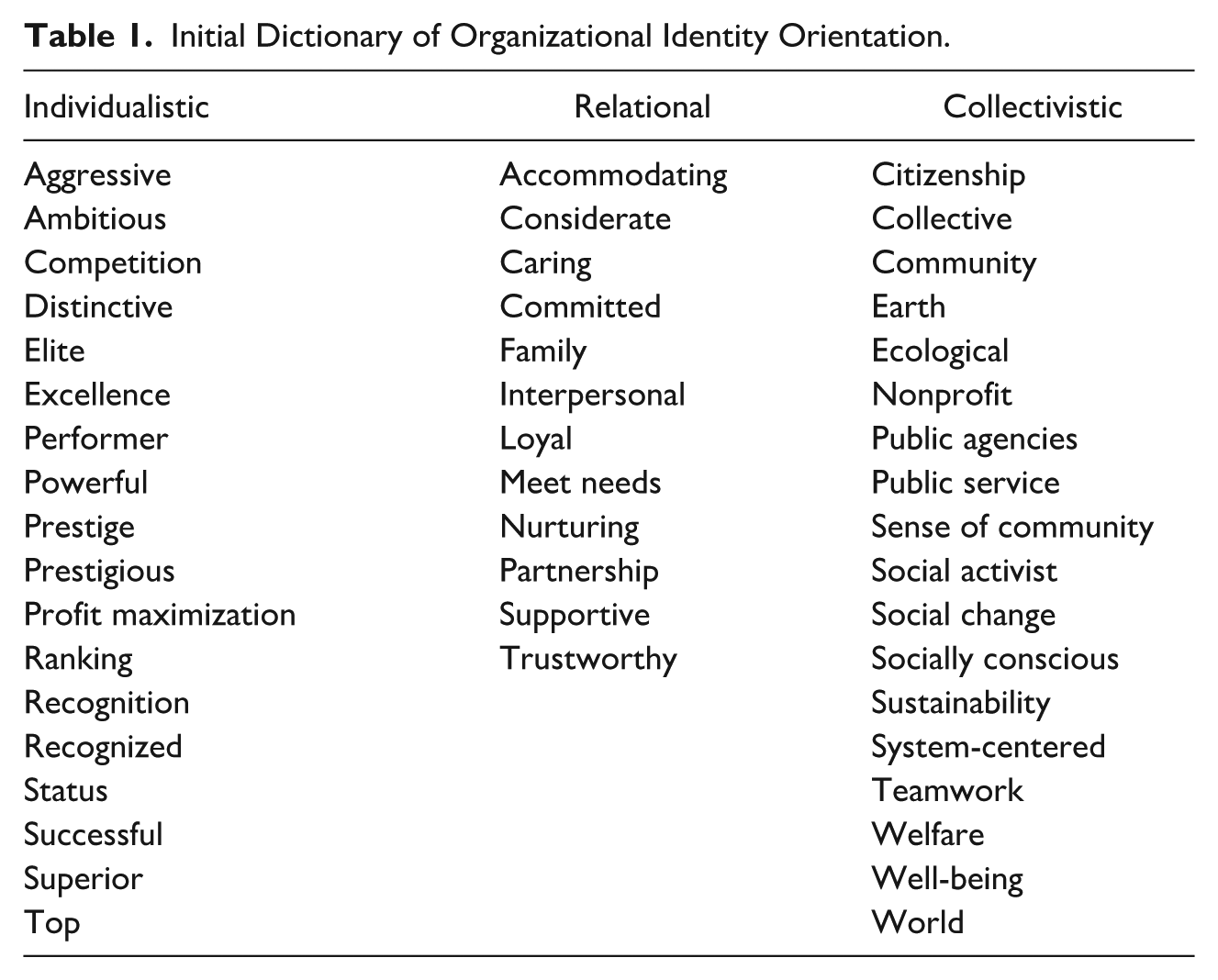
Using these dictionaries as our classification scheme, we then applied machine learning on the letters. Specifically, we use word embedding and natural language processing. The embedding can be learned automatically from a large corpus of text (in our case, the letters to shareholders). Once trained, the embedding model can then be used to represent words with numerical coordinate vectors, which enable quantitative analysis of text data. In this process, we use the word2vec algorithm to embed a large number of letters and the dictionaries of the organizational identity orientations. 6
First, given N statement documents and M keyword lists, we compute the average word embedding to represent each document and keyword list:

where Qn is the nth document, |Qn| is the number of words in the document, and Vn is the document embedding; similarly, Pm is the mth list, |Pn| is the number of words in the list, and Un is the list embedding. Each Vn (and Um) is a numerical coordinate vector of 300 dimensions.
Second, we use the cosine function to quantify the level of semantic similarity between the document and list embeddings:

Such a computation is effective since the design of the word2vec algorithm is to fit word associations. Words with similar semantics often appear closely in large corpus of text.
In the third step, we use the softmax function to map the semantic similarities into a probability distribution for each document:

where λ > 0 is a scale parameter. Note that Pnm ε (0, 1) and
Based on each firm’s yearly letter, the word2vec model produces a score for each of the three organizational identity orientations, ranging from zero to one and totaling one. 7 Because organizational identity orientation is a relatively stable but potentially gradually evolving organizational feature (Brickson, 2007), we smooth annual fluctuations by using a 3-year moving average of the scores produced by the word2vec model. 8 For each firm-year, we average the current year with the two preceding years (t, t − 1, t − 2) to capture organizational identity orientation.
Control Variables
To rule out alternative explanations, we included a number of controls known to influence the dependent variable. Following past work, we collected these variables at the time of misconduct (Desai et al., 2006; Park et al., 2020). We first control for CEO characteristics, as these have proven to shape board turnover decisions (Connelly et al., 2020). Using the Execucomp database, we control for the age and gender of the CEO, as older CEOs (Lausten, 2002) and those which are male (Gupta et al., 2020) have proven less likely to be dismissed than their younger and female counterparts. Next, we control for CEO duality and tenure, as both have proven to be negatively related to dismissal (Brickley, 2003; Firth et al., 2006). Finally, we control for the salary and total compensation of the CEO, as both are negatively related to CEO dismissal (Messersmith et al., 2011).
Next, we again draw from the Compustat database to include a number of controls related to firm characteristics. We control for firm size using market capitalization, as larger firms face different governance constraints and stakeholder pressures (Gupta & Briscoe, 2020). Because high performing companies are less likely to dismiss the CEO, 9 we control for both accounting and market-based performance (Puffer & Weintrop, 1991). We measure accounting performance using return on assets, and market-based performance using market capitalization change, measured as the year-over-year percentage change in market capitalization. We control for the capital adequacy of the organization, measured as the proportion of capital assets to risk-weighted assets, as firms with low capital adequacy experience greater sensitivity to financial losses and will be more likely to dismiss the CEO (Murphy & Zimmerman, 1993). Because firms that are highly leveraged are more likely to dismiss the CEO (Cronqvist et al., 2012), we control for the current ratio and debt ratio. We measure the current ratio as the proportion of a company’s current assets to current liabilities, and the debt ratio as the proportion of total debt to total assets. We also include a control for the percentage of institutional ownership, as large equity holders can influence the governance process (DesJardine et al., 2025).
We also include a number of controls related to the governance structure of the firm, as boards also differ in their ability to monitor misconduct (Schnatterly et al., 2018). Using the Execucomp database, we control for board size and board insiders, as more eyes might reduce the ability for misconduct to be overlooked. Independent board members are less likely to have close relationships with the CEO (Boivie et al., 2016) and thus will be more likely to attend to misconduct (Agrawal & Chadha, 2005). We also control for board interlocks, defined as instances where a firm’s director simultaneously serves on the board of another company whose executive sits on the focal firm’s board. Such reciprocal ties can create overlapping networks that influence how directors interpret and respond to misconduct (Haunschild, 1993). Recent research also finds that board ideology influences how the board perceives and attributes corporate misconduct to CEOs, with conservative boards being more likely to dismiss CEOs after financial misconduct (Park et al., 2020). Hence, we control for board political ideology captured by the director donations found in the Database on Ideology, Money in Politics, and Elections. We take a simple average of the ideology score measured by Bonica (2016), which is derived by number of donations, donation amount, and ideology of recipient. Additionally, we control for the state ideology to account for political differences across U.S. states where firms are headquartered, which may relate to the likelihood of enforcement regarding misconduct. This is measured as the proportion of votes to Democrat candidates divided by Democrat and Republican candidates in all national elections during the sample. Finally, to account for unobserved macro-level heterogeneity that could confound our estimates we control for year and industry by including both year and 2-digit SIC code fixed effects.
Estimation Model
We modeled CEO dismissal using a logistic regression, consistent with other recent studies on CEO dismissal (e.g., Gentry et al., 2021; Zhou et al., 2013). All models include cluster-robust errors at the firm level to address autocorrelation and heteroskedasticity in the panel data (Wooldridge, 2010). We also conduct supplementary analyses to confirm the robustness of our results to alternative model specifications.
For each of the interaction hypotheses, we regress the organizational identity orientations separately. This is because the organizational identity orientation scores for each firm-year total 100% and thus can be considered ipsative as the raw score for each dimension sum to a constant amount for every observation (Baron, 1996). Since scholars have urged caution with creating scales with scores that are ipsative with each other (Johnson et al., 1988), 10 our analytical approach is consistent with that of Brickson (2005) in addressing this caution.
Results
We summarize the descriptive statistics for all variables in our analysis in Table 2. We observe that the firms held a predominantly individualistic identity orientation (mean = 0.55), followed by collectivistic (mean = 0.25), and relational (mean = 0.18). All three organizational identity orientations are significantly negatively correlated, suggesting that our approach to adjust for the ipsative nature of the construct is appropriate.
Correlation Table.
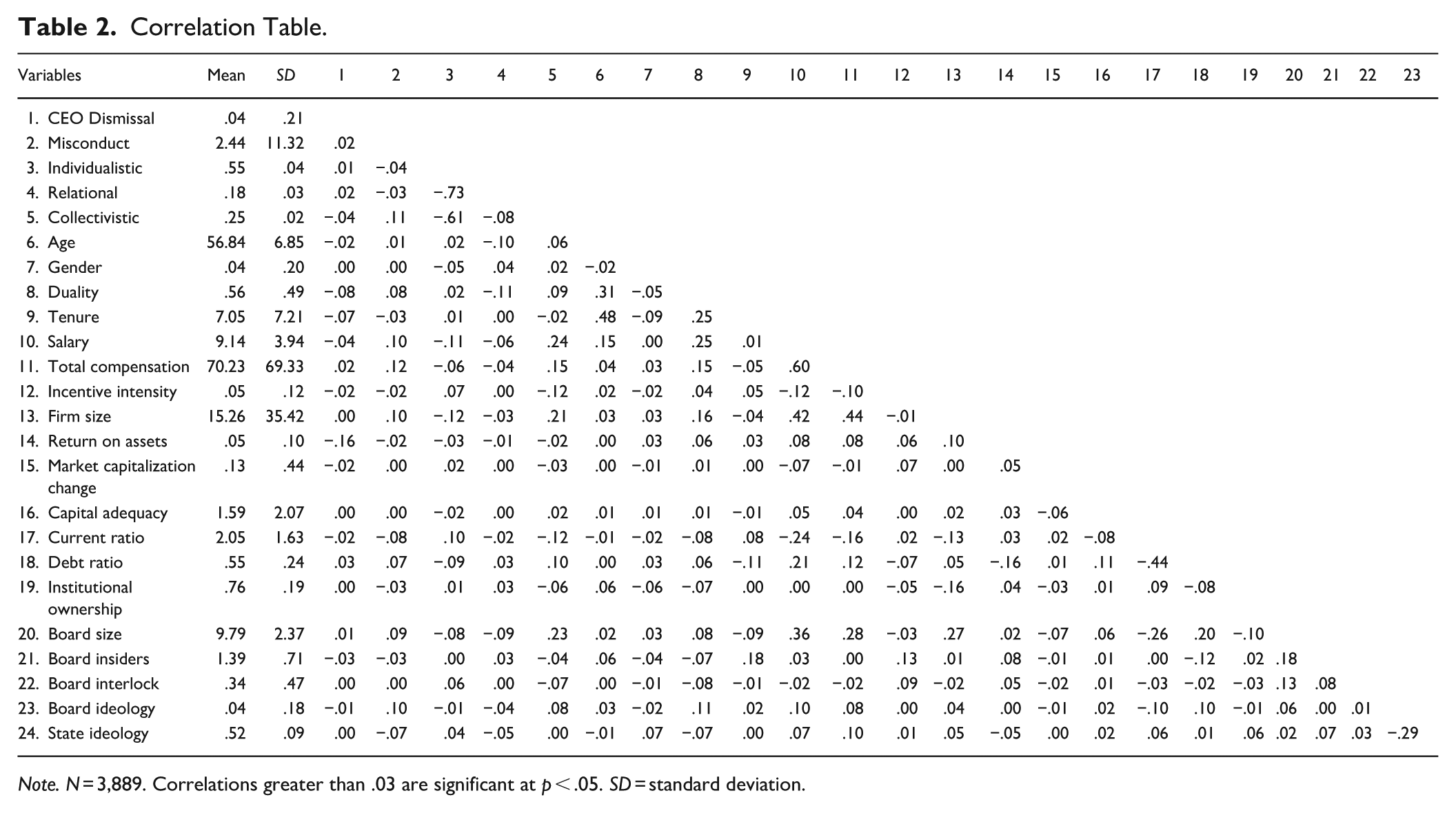
Note. N = 3,889. Correlations greater than .03 are significant at p < .05. SD = standard deviation.
In Table 3, we provide the results of our analysis. Model 1 includes only the control variables. In model 2, we add in the main effect of misconduct and observe that misconduct is positively and significantly related to CEO dismissal (b = 0.008, p = .008). In models 3, 4, and 5, we add in the interaction terms of each organizational identity orientation. In model 3, we note a positive and significant interaction between individualistic identity orientation and misconduct on CEO dismissal (b = 0.205, p = .016). This demonstrates support for Hypothesis 1 that companies with a predominantly individualistic identity orientation are more likely to dismiss their CEO following misconduct. In model 4, we observe no significance in the interaction between relational identity orientation and misconduct on CEO dismissal (b = 0.021, p = .753), suggesting that Hypothesis 2 is not supported. Finally, in model 5, we observe a negative and significant interaction between collectivistic identity orientation and misconduct (b = −0.365, p = .022), meaning that CEOs of strongly collectivistic firms are less likely to be dismissed from their organization following misconduct, supporting Hypothesis 3.
Results of Logistic Regression.
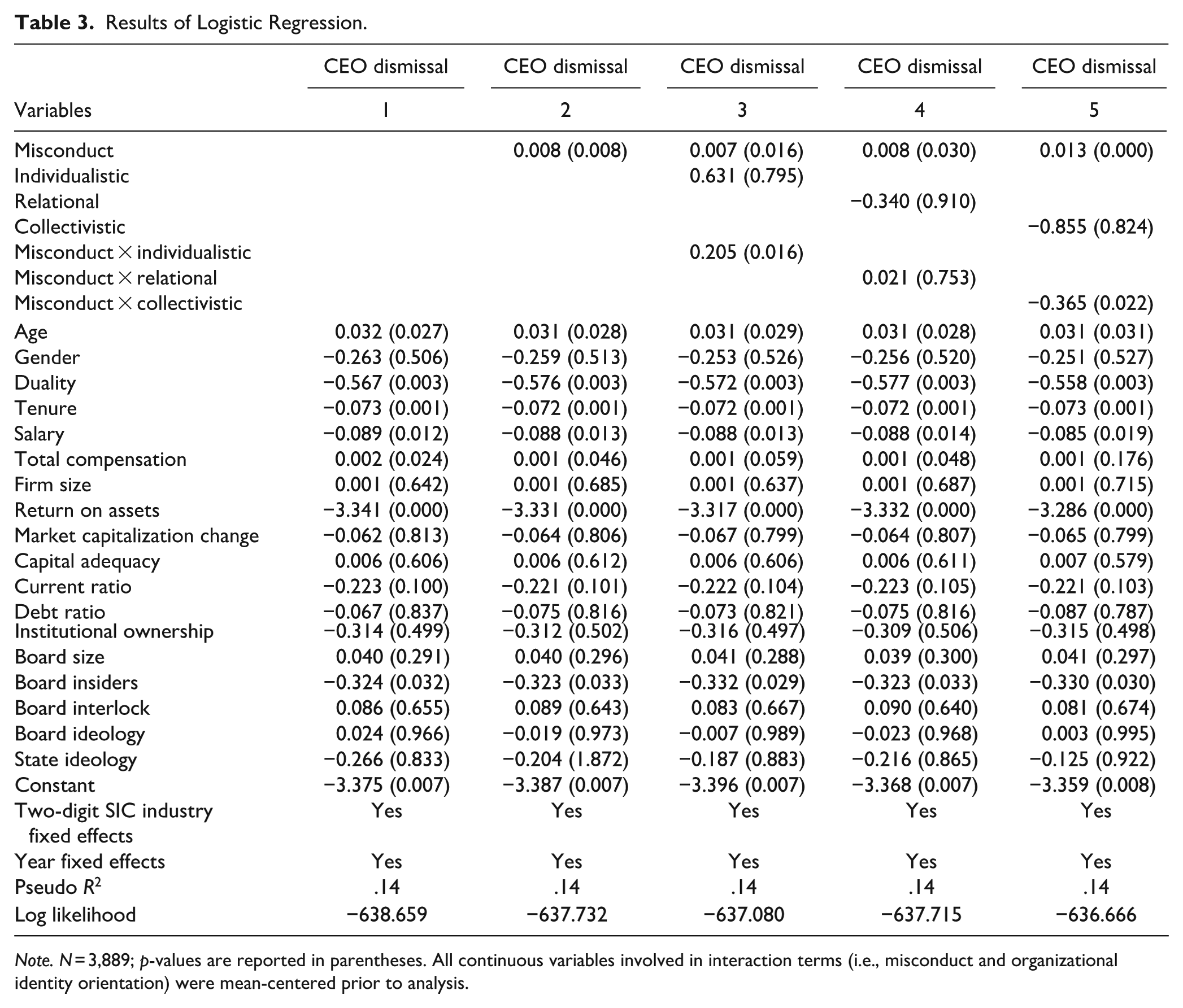
Note. N = 3,889; p-values are reported in parentheses. All continuous variables involved in interaction terms (i.e., misconduct and organizational identity orientation) were mean-centered prior to analysis.
In Table 4, we display the marginal effects of each organizational identity orientation on CEO dismissal deviation (i.e., dy/dx) at different values organizational misconduct, ranging from much lower to much higher than average. These results are consistent with the findings of our main analysis. These relationships are also depicted graphically in Figure 1. As shown, firms with individualistic orientations exhibit a steeper positive slope, while those with stronger collectivistic orientations show a negative slope, indicating a higher and lower likelihood of CEO dismissal following misconduct, respectively.
Marginal Effects of Logistic Regression.
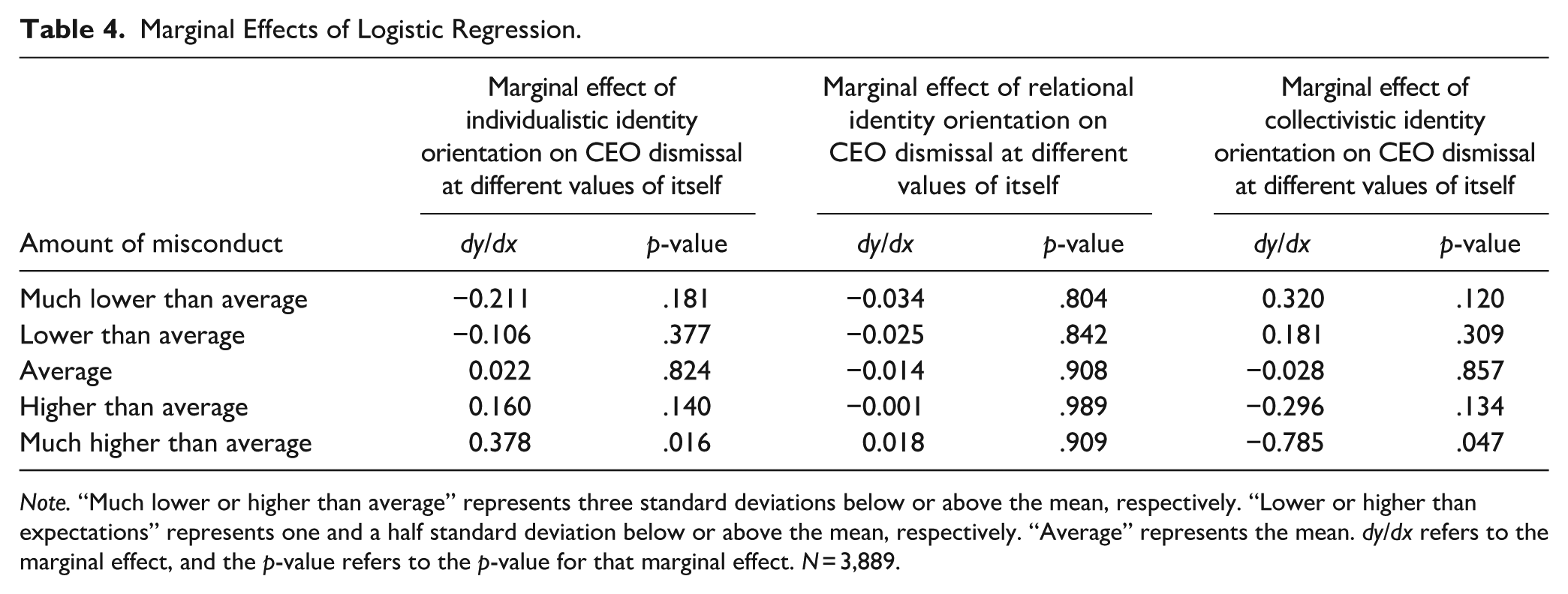
Note. “Much lower or higher than average” represents three standard deviations below or above the mean, respectively. “Lower or higher than expectations” represents one and a half standard deviation below or above the mean, respectively. “Average” represents the mean. dy/dx refers to the marginal effect, and the p-value refers to the p-value for that marginal effect. N = 3,889.
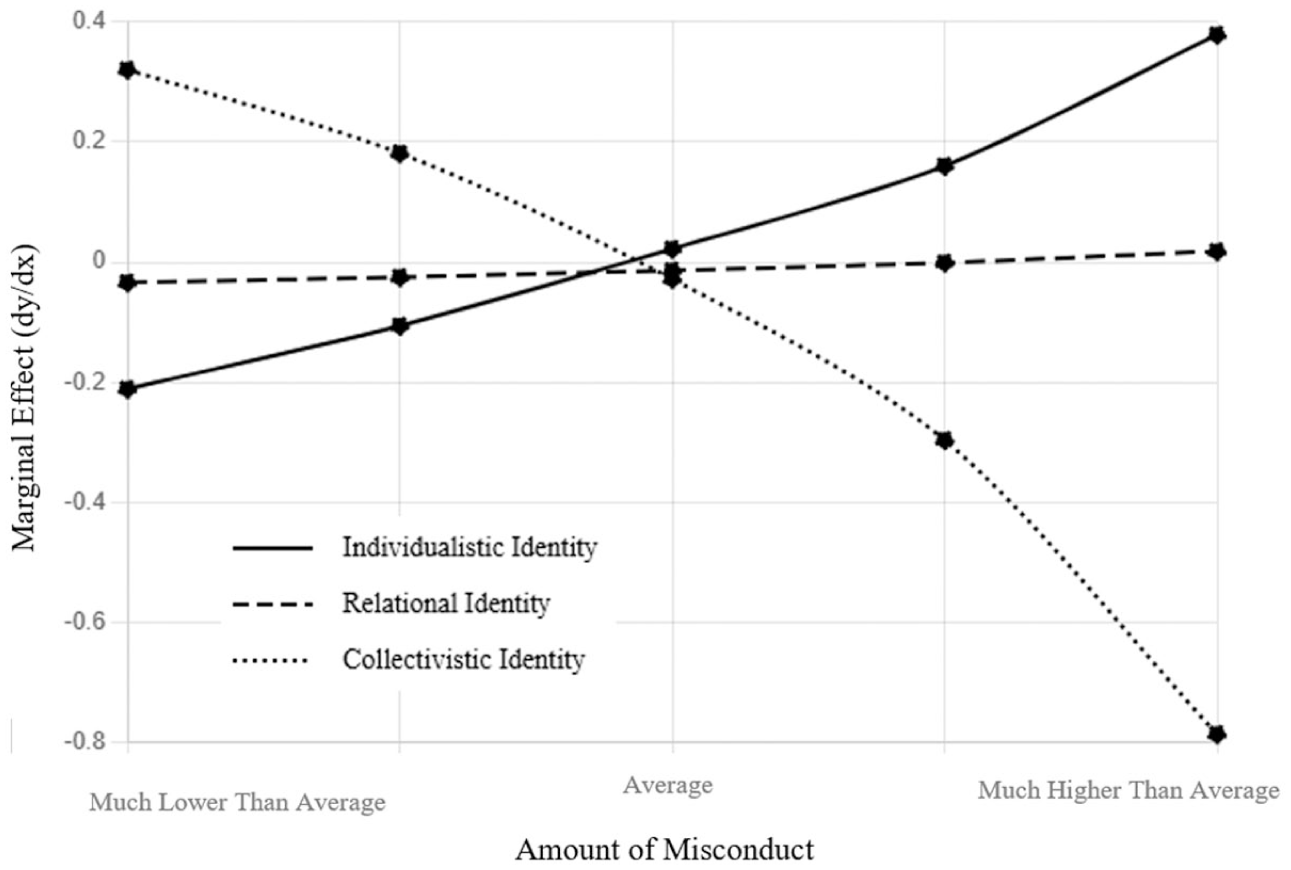
Logistic regression plotted marginal effects of misconduct on CEO dismissal by organizational identity orientation.
Robustness Test: Instrumental Variable Analysis
Because misconduct is not a random phenomenon, our results may be vulnerable to endogeneity problems caused by unmeasured confounding factors on both misconduct and dismissal (Hernán & Robins, 2006). 11 Consistent with prior studies on CEO dismissal following financial wrongdoing, we employ a two-stage instrumental variable analysis (e.g., Arthaud-Day et al., 2006; Desai et al., 2006; Park et al., 2020). In the first stage, we regress our instrumental variable, incentive intensity, on a dummy variable indicating whether or not misconduct occurred in a given firm-year. Incentive intensity is captured by taking the proportion of CEO pay from stock options. This instrument has similarly been employed in recent studies on financial misconduct on CEO dismissal (e.g., Park et al., 2020), as this influences the probability of misconduct (Burns & Kedia, 2006; Efendi et al., 2007; Harris & Bromiley, 2007) without having a direct impact on dismissal. We captured this as the total grant value of stock options as calculated by the Black–Scholes model over the total compensation of the CEO (Sanders & Hambrick, 2007). We also included the moderating variable of organizational identity orientation in the first stage to assess whether bias exists (Certo et al., 2016). The inverse mills ratio from the first-stage model (Table 5) was then included as a control in the second-stage dismissal model (Table 6; Busenbark et al., 2022). 12 In Table 6, we display the results, which are consistent with the main analysis.
First-Stage Models on Misconduct for Probit Regression with Instrumental Variables.
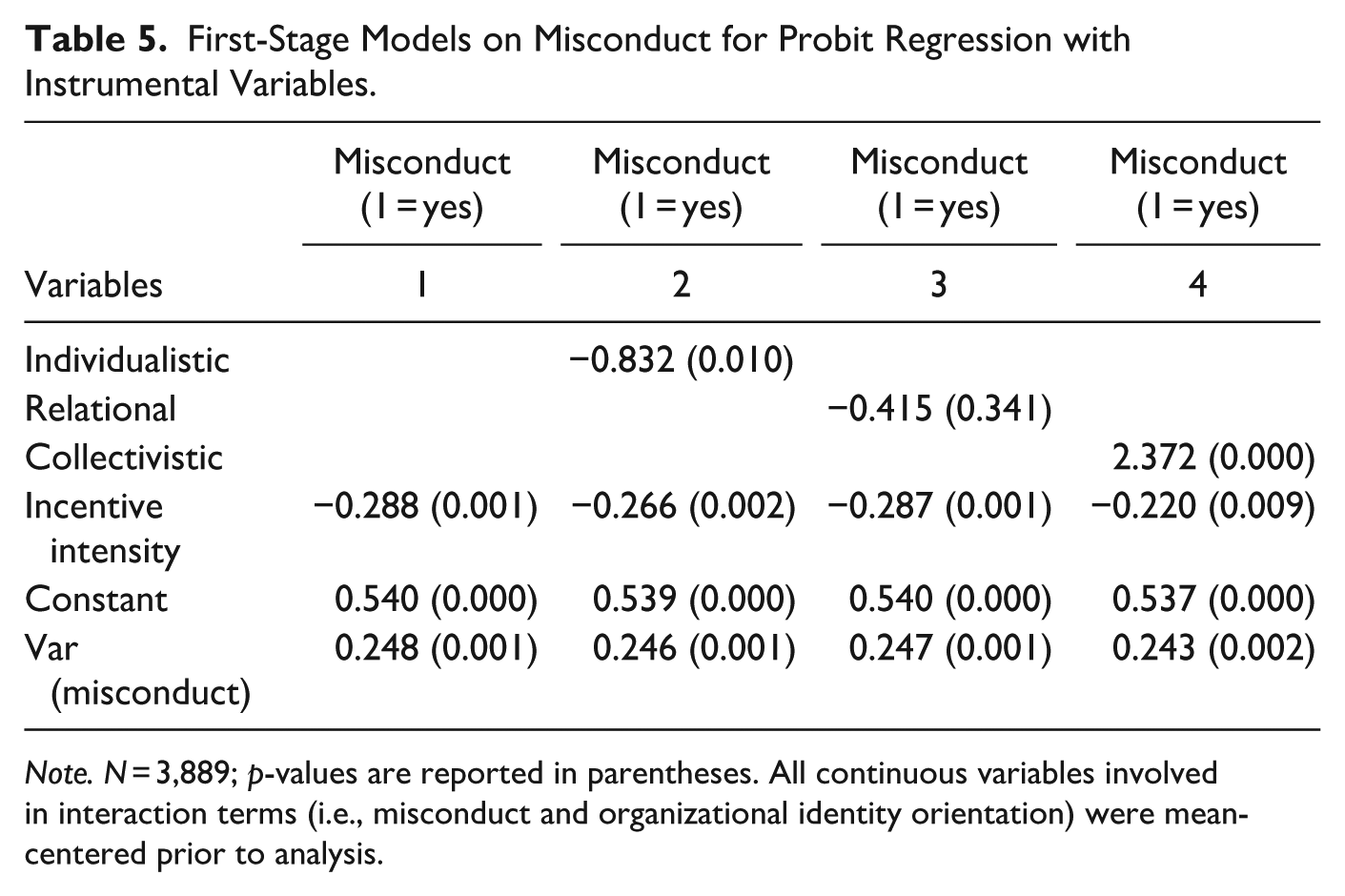
Note. N = 3,889; p-values are reported in parentheses. All continuous variables involved in interaction terms (i.e., misconduct and organizational identity orientation) were mean-centered prior to analysis.
Results of Probit Regression with Instrumental Variables.
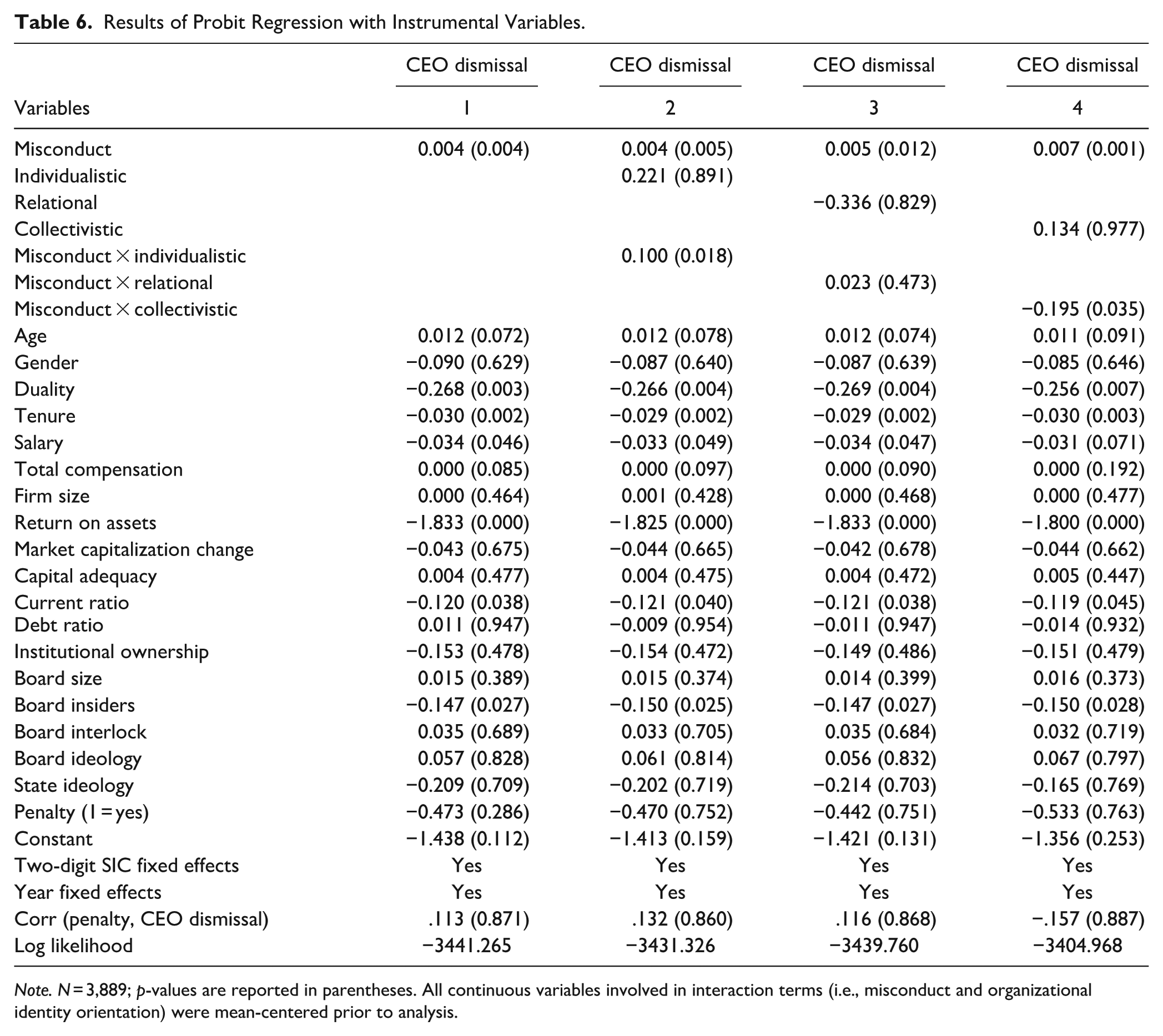
Note. N = 3,889; p-values are reported in parentheses. All continuous variables involved in interaction terms (i.e., misconduct and organizational identity orientation) were mean-centered prior to analysis.
Discussion
This study proposes that organizational identity orientation will influence the likelihood of CEO dismissal following corporate misconduct. Building on Brickson’s (2005, 2007) framework, we argue that the firm’s dominant organizational identity orientation shapes how boards interpret wrongdoing and attribute blame. Using natural language processing on S&P 500 shareholder letters (2004–2017), we show that firms with individualistic identity orientations are significantly more likely to dismiss their CEO following misconduct, while those with collectivistic orientations are less likely to do so, and that relational identity orientations do not systematically amplify or attenuate this effect. By linking firm-level governance responses to broader processes of responsibility attribution, our findings speak directly to debates about how organizations confront wrongdoing amid heightened societal expectations for accountability. These findings reveal organizational identity orientation as a powerful but underexplored factor shaping high-stakes governance decisions, with implications for research on corporate misconduct and organizational identity orientation.
First, by introducing organizational identity orientation as a determinant of CEO dismissal following misconduct, we contribute to the growing literature on governance responses to corporate wrongdoing. The literature has primarily focused on agency and situational contingencies to CEO dismissal decisions, which examine how board independence, director ideology, and characteristics of the misconduct event influence dismissal outcomes (Connelly et al., 2020; Gomulya & Boeker, 2014; Haleblian & Rajagopalan, 2006; Park et al., 2020). We extend this work by showing that these decisions are also shaped by organizational identity orientation, which guides boards’ attribution of responsibility. In doing so, we put forth a relational-cognitive explanation for why some boards view misconduct as a personal failing while others treat it as a systemic issue. This insight advances the misconduct literature by explaining why similar violations can generate disparate governance outcomes (Schnatterly et al., 2018). Such an insight also helps explain variation in how firms respond to societal pressures for transparency, legitimacy, and accountability.
By identifying organizational identity orientation as a lens through which boards interpret wrongdoing, we move beyond deterministic models of governance to one grounded in social cognition (Golden-Biddle & Rao, 1997; Van Maanen & Schein, 1979). For example, an individualistic firm may see firing the CEO as a necessary reaffirmation of its performance-based ethic, while a collectivistic firm may perceive the same action as unjustly targeting one node in a broader system failure. These logics also carry implications for how firms enact responsibility to external stakeholders. That is, whether boards treat misconduct as a personal lapse requiring symbolic punishment or a structural problem requiring cultural repair. This framing brings misconduct research into closer alignment with theories of stakeholder accountability and social control (Greve et al., 2010), particularly as firms face growing pressure to address their societal role in grand challenges like climate change, social injustice, and economic inequality (George et al., 2016; Gupta et al., 2024).
Second, we extend research on organizational identity orientation by demonstrating its influence on corporate boards. While previous work has shown that identity shapes strategic decisions and stakeholder engagement (Besharov & Smith, 2014; Brickson, 2007; Ravasi & Schultz, 2006), our study expands its theoretical domain into formal governance processes. In doing so, we show that organizational identity orientation is not merely a symbolic or cultural frame, but a foundational schema that informs how boards evaluate executive conduct and determine appropriate action under conditions of reputational threat. This extension reveals how organizational identity orientation provides the cognitive link between a firm’s relational logics and its governance actions.
This theoretical advancement clarifies how organizational identity orientation connects soft relational logics to hard accountability decisions. It builds on recent work on board sensemaking during crises (Bundy & Pfarrer, 2015; Bundy et al., 2017), making explicit how identity-based schemas guide whether misconduct is viewed as a betrayal of individual duty, relational trust, or collective norms. Our findings suggest that boards are not merely passive recipients of cultural cues, but active participants in a broader organizational meaning system that informs their judgments. In this sense, the absence of an effect of relational identity orientation on CEO dismissal reflects a more nuanced accountability process. On the one hand, misconduct threatens the integrity of trust-based relationships that relational firms value; on the other hand, those same relational commitments generate loyalty, empathy, and concern for continuity with a trusted CEO. As organizations face increasing scrutiny over their ethical commitments, this positions organizational identity orientation as a complex, cross-cutting construct central to understanding how firms navigate tensions between internal coherence, external legitimacy, and stakeholder expectations (Freeman, 1984; George et al., 2024; Gupta & Briscoe, 2020).
Limitations and Future Research
While our study highlights the role of organizational identity orientation in shaping CEO dismissal following misconduct, several limitations offer opportunities for future research. First, our measurement of organizational identity orientation is based on shareholder letters, which reflect the dominant communicated identity rather than nuanced internal variation or contestation. Future work could better understand how organizational identity orientation is perceived by different organizational actors, and how the CEO may shape this.
Second, our study focuses on misconduct broadly defined, rather than misconduct directly attributable to the CEO. Future research could distinguish between CEO-initiated misconduct versus misconduct occurring elsewhere to examine whether organizational identity orientation moderates these pathways differently. Future research may also consider the cumulative effects of misconduct or monetary penalty amounts on CEO dismissal.
Third, our finding that collectivistic firms are less likely to dismiss CEOs after misconduct raises important questions about the long-term implications of this leniency. While collectivistic organizations may prioritize shared goals, it may also create a tolerance for deviance if misconduct is not addressed. This resonates with research on ethical climate and organizational norms, which shows that perceived tolerance of unethical behavior can become self-reinforcing (Mayer et al., 2010). Future studies could explore whether leniency in collectivist firms sends implicit cues to employees about the acceptability of misconduct, potentially leading to recursive cycles of bad behavior.
Fourth, future research could extend our theory across cultural contexts, where norms surrounding authority, loyalty, and accountability vary substantially. Prior work shows that expectations are interpreted differently across national boundaries, even under conditions of shared goals and formal governance structures (Fewer et al., 2025). Applying an organizational identity orientation lens in multinational settings could reveal whether individualistic, relational, and collectivistic orientations operate similarly across contexts, or whether their governance implications are contingent on broader cultural logics.
Finally, while our focus is on CEO dismissal as a governance outcome, organizational identity orientation may also shape other misconduct responses, such as internal investigations (Miceli et al., 2009) and public disclosures (Lange & Washburn, 2012). Examining how these firm-level responses aggregate to influence institutional reform and societal progress represents a promising avenue for future research.
Implications for Boards and Managers
Our findings offer actionable insights for boards and executives as they navigate corporate misconduct amid calls for heightened societal responsibility. Directors should be aware that organizational identity orientation acts as a filter that shapes how misconduct is interpreted. In high-stakes moments, boards may default to responses that feel aligned with internal values but fall short of external expectations for accountability. To guard against this, boards would benefit from structured reflection, such as facilitated strategy sessions or third-party reviews, before deciding whether to remove a CEO.
Furthermore, in today’s environment of real-time transparency and social media pressure, CEO dismissal serves as a powerful signal of whether the firm takes responsibility seriously. Our findings suggest that boards in collectivistic firms should consider other visible accountability measures, such as detailed public disclosures or direct engagement with affected stakeholders, to uphold trust and credibility.
Conclusion
CEO dismissal represents a critical inflection point where organizational identity orientation meets societal accountability. Our study reveals how deeply embedded identity dynamics shape pivotal governance decisions, with organizational identity orientations creating starkly different paths in how firms respond to misconduct. In an era where corporations face mounting pressure to respond to their wrongdoing, understanding these contrasting responses becomes essential. As the boundaries between corporate and societal responsibilities continue to blur, these identity-driven responses to misconduct will likely play an increasing role in how organizations navigate their expanding obligations.
Supplemental Material
sj-docx-1-bas-10.1177_00076503261425350 – Supplemental material for Organizational Identity Orientation and CEO Dismissal After Corporate Misconduct
Supplemental material, sj-docx-1-bas-10.1177_00076503261425350 for Organizational Identity Orientation and CEO Dismissal After Corporate Misconduct by Thomas J. Fewer, Dali Ma, Andrea C. Farro and ChuanRen Liu in Business & Society
Footnotes
Acknowledgements
We gratefully acknowledge the helpful guidance of the editor, Kathleen Rehbein, and two anonymous reviewers. We thank Ankita Kulkarni and Stacy Boyer for their early support on this project. We are also grateful to the Drexel University Management Department and to participants at the Academy of Management Annual Meeting 2021 for valuable comments and discussions.
Declaration of Conflicting Interests
The authors declared no potential conflicts of interest with respect to the research, authorship, and/or publication of this article.
Funding
The authors received no financial support for the research, authorship, and/or publication of this article.

Supplemental Material
Supplemental material for this article is available online.