



Abstract
The relocation of corruption fugitives raises an important question: how does their presence in host countries affect the brand credibility of multinational enterprises (MNEs) from those destinations? Drawing on the reputation spillover perspective, this study theorizes and tests a ripple effect of reputational damage. Consumers in fugitives’ home countries attribute corruption-related reputational damage to the host country’s image and extend it to MNE brands originating there. This spillover effect is moderated by perceived corruption in consumers’ home country and by national animosity between the home and host countries. By uncovering how corruption fugitives indirectly shape foreign brand evaluations, this study broadens the understanding of nonmarket actors as carriers of reputational contagion across borders. It also highlights the paradox that anti-corruption efforts, while normatively desirable, can generate unintended reputational externalities that complicate the balance between global policy enforcement and international business legitimacy.
In recent years, corruption fugitives have drawn growing attention from media and scholars of business management and ethics (BBC, 2019; Yi et al., 2023; Zhu & Wen, 2022). Corruption, defined as the abuse of public power for private gain (Iriyama et al., 2016; Schembera et al., 2023), often prompts individuals accused of corrupt activities to flee their home countries to evade prosecution. Notable cases include Vladimir Plahotniuc, former chairman of the Democratic Party of Moldova, who fled in 2019; Yingluck Shinawatra and Thaksin Shinawatra, former prime ministers of Thailand, sentenced in absentia; and Diezani Alison-Madueke, Nigeria’s former Minister of Petroleum Resources, who has faced corruption allegations abroad. Similarly, Ashraf Ghani, the former president of Afghanistan, left his country under corruption allegations. Many fugitives also transfer illicit wealth overseas when fleeing (Zhu, 2021).
These fugitives, along with their illicit financial assets, undermine their own reputations. More importantly, their global mobility generates reputation spillovers that affect host-country institutions, creating a “trust gap” (Taylor, 2020) or “trust deficit” (Adelopo & Rufai, 2020) between the public and these institutions. A salient example is the reputational damage to British multinational enterprises (MNEs) associated with Russian fugitives in the United Kingdom (Krugman, 2022; Morgan & Kinossian, 2024). London, often labeled “Londongrad,” has become a haven for wealthy Russians, including oligarchs and politically exposed individuals accused of financial crimes. Exploiting lenient financial regulations, they have laundered money and shielded illicit wealth, which has damaged the reputation of the UK’s financial sector and MNEs. British banks, real estate firms, and professional service providers have been accused of complicity in financial secrecy. In response, foreign regulators, especially in the European Union and the United States, have imposed stricter compliance requirements on UK-based firms, constraining their ability to operate internationally.
The reputation spillover effect—where evaluations of one entity are influenced by another entity or event not directly connected to it—has long been recognized in management and marketing research (Fan et al., 2020; Ingenhoff et al., 2018; Kotler & Gertner, 2002). Yet, the cross-country reputational damage generated by the globalization of fugitives remains largely unexplored. Such spillovers traverse cultural, economic, and institutional boundaries, often distorting perceptions of reality (Arora et al., 2025). The reputational consequences for MNEs are especially complex, as negative perceptions may cascade outward in multi-ripple effects when these firms engage in other markets (Blumentritt & Rehbein, 2008; Popli et al., 2025). To our knowledge, few studies have examined such multi-ripple reputation spillovers. This gap raises a critical question: how does the relocation of corruption fugitives affect the reputations of MNEs from their host countries?
Addressing this gap has both theoretical and managerial importance. It helps explain how corruption fugitives—nonmarket actors operating outside firms—produce unintended societal externalities in host countries. While corruption has been extensively studied in management (Adelopo & Rufai, 2020; Lange, 2008) and international business research (Jeong & Weiner, 2012), most prior work has focused on how institutional environments shape corruption (Iriyama et al., 2016; Spencer & Gomez, 2011) or how host-country corruption affects MNE behavior and performance (Rabbiosi & Santangelo, 2019; Sartor & Beamish, 2020; Schembera et al., 2023). By contrast, the reputational effects of corruption fugitives on host-country institutions and firms—entities that may have no direct connection to them—remain poorly understood.
Drawing on the reputation spillover perspective, this study argues that corruption fugitives trigger ripple effects through which reputational damage diffuses across multiple entities. When fugitives settle abroad, consumers in their home countries may perceive host countries as corruption-tolerant for providing refuge. Such perceptions can, in turn, erode the credibility of MNE brands originating from those host countries, as firms become associated with compromised governance and weakened institutional integrity.
This study makes several contributions to the management and society literature. First, it introduces the notion of transnational reputational contagion, showing that corruption can have outbound effects—spilling over from one country’s actors to another’s institutions—rather than being confined within national borders. In doing so, it extends institutional studies by demonstrating that the relationship between corruption and institutions is mutual and cross-national: while institutions shape corruption, corruption can also reshape institutions abroad through reputational diffusion. Second, it expands research on reputation spillovers by identifying corruption fugitives as nonmarket catalysts of reputational risk. Unlike prior studies that focus on firms or industries as sources of spillovers, this study highlights individuals—particularly elites fleeing prosecution—as powerful transmitters of cross-border reputational harm.
Third, it contributes to the literature on global trust and legitimacy by showing how the settlement of fugitives in developed economies erodes societal trust not only in government institutions but also in firms embedded in those environments. It advances understanding of MNE vulnerability by revealing that firms’ global legitimacy can be undermined by external actors entirely beyond their strategic control. By linking societal trust at the institutional level with firm-level brand outcomes, this study provides a multilevel explanation of how macrolevel perceptions of governance spill over to affect microlevel evaluations of corporate credibility abroad. Together, these contributions advance understanding of how corruption fugitives reshape the interconnected relationships among institutions, society, and global business.
Corruption Fugitives and Global Reputation Spillover
Corruption, defined as the abuse of public power for private gain, remains a pervasive issue worldwide (Fleming et al., 2022; Lange, 2008; Schembera & Scherer, 2017). Some individuals involved in corrupt activities flee their home countries to evade legal prosecution and transfer illicit wealth abroad (Cooley & Sharman, 2017; Zhu & Wen, 2022). These corruption fugitives exploit weaknesses in financial systems and leverage host countries’ immigration policies to avoid accountability. Despite international frameworks, such as the United Nations Convention Against Corruption (UNCAC) and the OECD Convention on Combating Bribery, enforcement is often weak, and mutual legal assistance between countries is hindered by legal and political differences (Castro et al., 2020; Koehler, 2012).
The relocation of corruption fugitives often provokes strong social disapproval in their home countries (Castro & Ansari, 2017; X. Wang, 2021). Citizens tend to view these individuals not merely as offenders escaping justice, but as embodiments of unjust privilege and impunity (Zhu, 2021). Consequently, observers perceive fugitives as untrustworthy and illegitimate actors (Iriyama et al., 2016; Popli et al., 2025). This disapproval, however, extends beyond the individual level. It radiates outward, shaping how audiences evaluate the broader institutional and social contexts in which fugitives settle. In other words, corruption fugitives not only face legal repercussions but also transmit negative reputational associations to their surrounding environments. Such social disapproval forms the normative and emotional foundation for reputational evaluations to diffuse beyond individual misconduct, thereby creating the conditions for reputation spillover (Taylor, 2020).
Entitativity plays a crucial role in explaining why this disapproval extends to host-country firms (Ingenhoff et al., 2018). Entitativity refers to the degree to which a set of actors is perceived as a coherent, unified entity (Campbell, 1958; Pickett, 2001). When consumers perceive a high degree of entitativity—that is, they view host-country institutions, society, and firms as a coherent entity—the boundaries between state and market actors blur (Lickel et al., 2000). Under these conditions, negative judgments directed at fugitives readily “spill over” to encompass firms headquartered in the host country. In this sense, entitativity functions as the cognitive mechanism that connects corruption-related disapproval with corporate reputational harm (Crawford et al., 2002; Yzerbyt et al., 1998). High entitativity leads observers to cognitively bundle individuals, organizations, and institutions together, making reputational judgments about one member likely to affect others in the same perceived unit (Hamilton & Sherman, 1996).
Three primary cues drive perceptions of entitativity. First, perceived similarity among group members influences whether observers see them as a coherent unit (Brewer & Harasty, 1996; Yzerbyt et al., 1998). Second, interdependence among members—including shared goals, common outcomes, or observable interactions—signals the coherence of the group and strengthens attributions of collective responsibility (Freeman & Webster, 1994; Gaertner & Schopler, 1998; Lickel et al., 2000). In the context of corruption fugitives, host-country institutions, regulatory bodies, and MNEs may be perceived as interconnected, especially when fugitives exploit institutional gaps that implicate broader systems (X. Wang, 2021). Third, entities of a group are seen to share an essential core or basic nature (Yzerbyt et al., 1998). Perceivers may view some groups as having an essence in much the same way as they perceive biological entities as having an essence (Crawford et al., 2002).
Drawing on the reputation spillover perspective, we theorize a sequential mechanism through which corruption fugitives undermine host-country MNE reputation. The process begins with social disapproval: the relocation of fugitives is interpreted as evidence of impunity, reinforcing public expectations that corrupt actors warrant legal sanction and social censure (Hoor-UI-Ain & Wajidi, 2016). This disapproval activates entitativity perceptions, wherein observers construe host-country institutions and firms as a coherent collective linked to fugitives. In this view, the settlement of fugitives abroad signals institutional leniency, thereby heightening moral and social concerns. This perception of unity enables the attribution of reputational consequences to the broader host-country business environment. The final stage is reputation spillover, wherein the negative associations attached to fugitives extend to MNEs from the host country, reducing their perceived credibility and trustworthiness. This sequence illustrates how individual-level misconduct can generate nation-level and organizational-level reputational damage, even in the absence of direct links between firms and fugitives.
Institutions in both home and host countries influence individuals’ behaviors when they travel abroad (Arora et al., 2025). Institutions constitute the “rules of the game” in a society, constraining and shaping interactions among individuals and organizations (Arora & De, 2020). Interactions between individuals and societal constituents—such as governments, communities, and the media—serve as a key source of legitimacy for both individuals and organizations (Arora & Petrova, 2010). These institutional arrangements create the environments within which corruption either occurs or is curtailed (Castro & Ansari, 2017). In the international context, institutions from both home and host countries can influence MNEs’ exposure to and engagement with corruption, even when the firms themselves are not directly involved in corrupt acts (Iriyama et al., 2016; Li et al., 2015b).
Two contextual factors further influence the intensity of spillovers. First, perceived corruption in the home country reinforces social disapproval and amplifies reputational consequences abroad, as observers interpret the persistence of corruption as systemic (Arikan et al., 2020; Iriyama et al., 2016). Second, national animosity—historical or political hostility between home and host countries—can exacerbate reputational spillovers by heightening negative sentiments toward foreign governments and firms (Klein et al., 1998; Gineikiene & Diamantopoulos, 2017). Together, these factors shape how strongly reputational associations attached to fugitives extend to host-country MNEs. Figure 1 summarizes the relationships between the constructs discussed above. In the next section, we develop hypotheses to test these relationships.
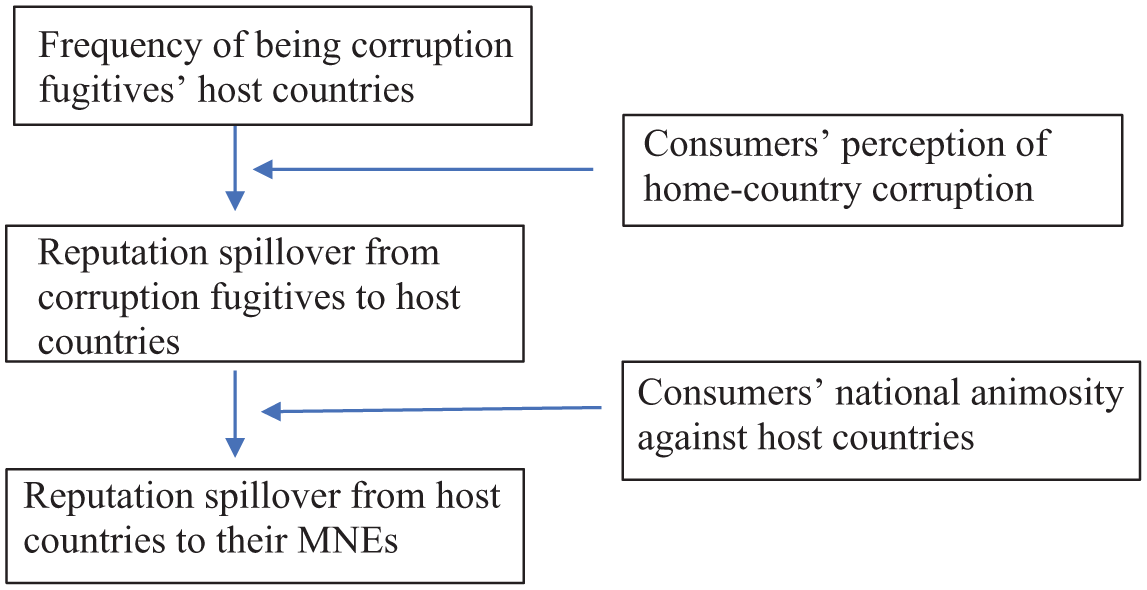
Conceptual Model of Corruption Fugitives Shaping Consumer Perception.
Hypothesis Development
Reputation Spillover From Corruption Fugitives to Their Host Countries
Corruption typically involves bribe payers seeking government-controlled goods or services and bribe receivers who grant access in exchange for bribes (Castro et al., 2020; Jeong & Weiner, 2012). Such transactions span multiple sectors, including resource extraction, the military, the judiciary, finance, and real estate (Zhu & Wen, 2022). In many countries, both bribe givers and takers face legal consequences, including imprisonment (Shleifer & Vishny, 1993).
A significant number of corruption fugitives originate from emerging economies with underdeveloped legal institutions (Luo, 2011; Stevens & Newenham-Kahindi, 2021). For instance, the Chinese Academy of Social Sciences estimates that about 18,000 individuals fled China for corruption-related reasons between the mid-1990s and 2008 (Zhu & Wen, 2022). Many resettle in developed countries, aided by legal and political barriers, such as the absence of extradition treaties, investment-based residency programs, and divergent legal frameworks (Cooley & Sharman, 2017). Among 100 Chinese corruption fugitives for whom the Chinese government requested Interpol Red Notices, 40 resided in the United States, 26 in Canada, 11 in New Zealand, and 10 in Australia (Zhu, 2021).
The reputations of corruption fugitives are severely damaged (Hoor-UI-Ain & Wajidi, 2016). This damage manifests in three ways. First, corruption is criminalized in most jurisdictions, and perpetrators face detection and punishment (Stevens & Newenham-Kahindi, 2021). Second, corruption harms economies and politics by draining capital and weakening state authority—illicit financial flows from China, for example, totaled about US$1.08 trillion between 2002 and 2011 (Gascoigne, 2014). A prominent case is Odebrecht, the Brazilian multinational construction firm, which allegedly secured contracts across Latin America and Africa through bribery (BBC, 2019). Third, corruption provokes strong negative emotional responses. It is associated with abuses of power, illicit financial gain, and public disillusionment (Moura-Leite et al., 2014). In China, judicial corruption has sparked public outrage (Y. Wang, 2013), while military corruption has eroded soldier morale (P. Wang, 2016).
Consumers in fugitives’ home countries often transfer corruption-related blame to the host countries that harbor them, perceiving these nations as complicit. From a reputation spillover perspective, countries may be discredited through their association with individuals or groups engaging in contested practices (Gotsi et al., 2011; Ingenhoff et al., 2018). That is, sub-country entities (e.g., individuals) are linked to countries, transferring impressions between levels (Crawford et al., 2002). When perceived association is high, observers hold nations collectively responsible for individual wrongdoing (Ingenhoff et al., 2018; Lickel et al., 2003).
The relocation of corruption fugitives to host countries poses three distinct reputation threats to those host nations. First, corruption signals lawlessness. The presence of fugitives in a country without legal consequences fosters perceptions that the host nation lacks strong anti-corruption laws or enforcement. Consumers, often unfamiliar with foreign legal systems, rely on simplified narratives in forming such perceptions (Diamantopoulos et al., 2017). Since deterrence depends on the risk of punishment (Stevens & Newenham-Kahindi, 2021), the failure to prosecute fugitives may be interpreted as tolerance of corruption (Jeong & Weiner, 2012). Studies on entitativity highlight the role of collective responsibility (Ingenhoff et al., 2018; Lickel et al., 2003): when perceivers believe national institutions collectively enable fugitives’ legal settlement, blame shifts from fugitives to the host country.
Second, corruption harms the home countries of consumers. The settlement of fugitives abroad undermines anti-corruption efforts in their home countries and reinforces negative perceptions. Capital flight weakens home economies and incentivizes further corruption (Yao, 2012). Politically, some host countries grant fugitives asylum by framing them as political dissidents rather than criminals (Zhu, 2021). While such claims are often situated within debates about authoritarianism and human rights (Yao, 2012), many home-country consumers perceive fugitives as escaping justice rather than persecution (X. Wang, 2021).
Third, corruption evokes disgust. The luxurious lifestyles of fugitives in host countries elicit visceral emotional responses, particularly among poorer audiences in their home countries. Many fugitives secure residency through investment programs, injecting capital into host economies (Cooley & Sharman, 2017). Their visible wealth—contrasted against socioeconomic inequality in their home countries—fuels perceptions of injustice. For instance, Yang Xiuzhu, dubbed “China’s most wanted fugitive,” was repeatedly portrayed in Chinese media as living lavishly abroad after embezzling millions (BBC News, 2016). Such reports amplify negative sentiment toward host countries, heightening perceptions of entitativity (Lickel et al., 2003).
These dynamics are particularly evident in the cases of Chinese fugitives’ host countries, which have been portrayed in Chinese media and public discourse as “havens for corrupt officials.” Through the lens of entitativity, host countries are perceived as cohesive entities whose institutions act collectively, meaning the failure of one institution (e.g., to enforce extradition or financial transparency) reflects on the entire nation.
Role of Perceived Corruption in Home Countries
Consumers’ perceptions of corruption in their home countries shape how they interpret the relocation of fugitives abroad, thereby facilitating reputation spillover to host countries. When individuals are acutely aware of domestic corruption, they become more sensitive to unethical behavior and more emotionally reactive to corruption fugitives (Luo, 2006). Political and social awareness influences “practical consciousness,” often producing unintended evaluative consequences (Giddens, 1995). As consumers encounter greater evidence of unethical conduct, their perceived corruption level rises, reinforcing distinctions between acceptable and unacceptable behavior and strengthening their motivation to detect transgressions and hold responsible parties accountable (Luo, 2006; Sartor & Beamish, 2020). Under these conditions, consumers are more likely to attribute corruption not only to weak home-country institutions but also to failures in host-country legal systems, thereby amplifying the reputational damage of host countries.
Similarity-based judgment further intensifies this image transfer. As an inductive generalization process (Naumovska & Zajac, 2022), similarity-based reasoning leads consumers to extend negative evaluations from specific offenders to other entities they perceive as institutionally alike (Hudson & Okhuysen, 2009). When corruption fugitives are able to settle abroad, consumers often assume that host-country institutions—such as immigration systems, financial regulators, or legal frameworks—share characteristics with their own corruption-ridden institutions. This perceived institutional similarity creates a psychological bridge between the home and host countries, making reputation spillover more likely. Consumers often interpret the act of admitting or tolerating fugitives as a collective failure of the host nation’s institutions, not simply the decision of a single agency. Entitativity amplifies this perception: if consumers see host-country institutions as a cohesive whole, the actions (or inactions) of one institution are generalized to the entire nation. As a result, when home-country consumers view their own institutions as deeply corrupt, they are more inclined to project these flaws onto host countries that accommodate fugitives, thereby strengthening the association between fugitives and host-country reputational damage.
Reputation Spillover From Host Countries to Their MNEs
When a country’s image is tainted, the reputational damage extends beyond its government to firms and brands originating from that country (Askegaard & Ger, 1998; Pope & Kim, 2022). The Odebrecht bribery scandal illustrates this dynamic: the Brazilian conglomerate’s admission of $788 million in bribes across 12 countries not only devastated Odebrecht’s global standing but also undermined “Brand Brazil.” Internationally, Brazilian MNEs were increasingly viewed as competing through corruption rather than competence, forcing firms to overcome suspicion in foreign markets. Similarly, the “Abacha loot” scandal reinforced global narratives of Nigeria as a kleptocracy, creating liabilities of origin for Nigerian MNEs and entrepreneurs. Even highly competitive firms, such as the Dangote Group, faced heightened scrutiny and were compelled to invest heavily in corporate reputation management to counteract the negative country-of-origin effect.
Research on country-of-origin effects shows that stereotypes strongly shape consumer expectations of firms’ competence, morality, and trustworthiness, particularly when consumers lack direct knowledge of the firms or products (Fan et al., 2020; Magnusson et al., 2014). Stereotypes operate through oversimplification: consumers make broad judgments about firms from a given country based on limited or highly visible cues (Gineikiene & Diamantopoulos, 2017; Kotler & Gertner, 2002). Due to information asymmetries and imperfect data across countries, consumers often face uncertainty when assessing foreign firms (Erdem & Swait, 2004; Mandler et al., 2021). To reduce this uncertainty, they rely on available information, and the limited information availability often leads to biased judgments (Ozsomer & Altaras, 2008). In this process, easily accessible information—such as tainted country images—becomes the dominant influence on their evaluations (Tversky & Kahneman, 1974). Once established, such stereotypes guide consumer inferences for long periods (Chae et al., 2021; Yousaf, 2017).
Entitativity perspective further explains this spillover. Countries are perceived as collective entities, and sub-entities such as firms and brands are seen as part of a cohesive whole (Lickel et al., 2000). This perception stems from both phenotypic entitativity (shared visible attributes such as nationality or regulatory context) and genotypic entitativity (perceived shared essence, goals, or institutional linkages; Yzerbyt et al., 2001). Because governments regulate, support, and interact with domestic firms, consumers often assume that MNEs embody the same institutional qualities as their home countries. Consequently, when a host country’s image is damaged by harboring corruption fugitives, this negative perception extends to its MNEs. From a consumer standpoint, brand credibility—the perceived trustworthiness and expertise of a brand (Erdem & Swait, 2004)—becomes directly threatened. Consumers infer that firms from corruption-tolerant host countries are less reliable, face weaker regulatory scrutiny, and may not deliver on their promises abroad (Shleifer & Vishny, 1993).
The mechanism unfolds in three ways. First, consumers assume that MNEs from corruption-tolerant countries operate in weak regulatory environments and may be complicit in corrupt practices. Second, they infer that these MNEs will reproduce such practices abroad, colluding with foreign officials and exacerbating governance risks (shared essence and interdependence). Third, the visible luxury lifestyles of corruption fugitives abroad evoke moral disgust among home-country consumers. This emotional response strengthens collective blame toward the host country and spills over to its firms, leading to sanctions, boycotts, or heightened skepticism (Yu, 2008).
Role of National Animosity
Studies on entitativity argue that a country image reflects subjective attitude toward a nation, comprising specific beliefs and general feelings in diverse dimensions, including emotions such as affection or animosity (Ingenhoff et al., 2018). The emotional dimension feeds into functional, normative, and esthetic dimensions of the image to form a general or summative image of the sub-entities of the nation (Buhmann & Ingenhoff, 2015). International business literature confirms that consumers’ national animosity toward a specific nation reflects strong hatred and prejudice, intensifying the negative reputation spillover to the sub-entities (Gineikiene & Diamantopoulos, 2017). National animosity refers to deep-seated hostility, resentment, or enmity between the people of two nations (Bar-Tal, 2000). Military, political, or economic conflicts—whether historical or ongoing—often create divergent national interests and opposing actions, fueling animosity between citizens of the affected nations (Shenkar & Arikan, 2009). These conflicts are frequently interconnected, beginning as economic rivalries, escalating into political disputes, and sometimes culminating in military confrontations (Xue et al., 2022). As tensions persist and worsen, mutual hatred and prejudice among consumers become more pronounced (Arikan et al., 2020).
In international business literature, national animosity is an important component of liabilities of foreignness (Barbarossa et al., 2018; Li et al., 2015a, 2018; Westjohn et al., 2021). It amplifies negative stereotyping of MNEs and their countries of origin, sometimes leading to MNEs being “completely misunderstood” by host-country audiences (Ramachandran & Pant, 2010, p. 250). Such negative stereotyping often has political roots and triggers strong emotional reactions, especially when local consumers perceive their norms and values as being threatened (Ritvala et al., 2021).
In the presence of national animosity, consumers are more likely to perceive host countries as actively harming their home countries, with MNEs serving as vehicles for this harm (Xue et al., 2022). The perception of the common goals, essence, and collective responsibility shared by the sub-entities of the hostile countries fuels the negative effect of the country image on the MNEs’ brand credibility (Ahluwalia et al., 2000). The perceived lawlessness of host countries reinforces consumers’ subjective belief that MNEs exploit weak legal systems to advance their interests at the expense of host countries (Fan et al., 2020). For example, Stevens and Newenham-Kahindi (2021) found that MNEs often adopt “novel” and “counterintuitive” strategies, increasing rather than reducing engagement with corrupt host-country stakeholders to maximize their benefits.
Research Method
This study employs a multi-method approach. A pilot study was conducted to gather qualitative data, which guided the development of variable measurements. Experiments were then performed to examine the relationships between the variables proposed in the hypotheses. Finally, a market survey and regression analyses were conducted to further test the hypotheses.
Pilot Study and Variable Measures
A pilot study was conducted in China to develop variable measures. China was chosen as the study setting for several reasons. First, existing research indicates that while corruption is a global issue, it is more prevalent in developing economies with weak institutional structures (Castro & Ansari, 2017; Transparency International, 2021). As the world’s largest developing economy, China lacks an established institutional framework (Cunningham & Dibooglu, 2020). Second, China has experienced a recent surge in the globalization of corruption fugitives. According to a report by the People’s Bank of China, between the mid-1990s and 2008, approximately 16,000 to 18,000 government officials and executives at state-owned enterprises embezzled around $120 billion and fled overseas (BBC News, 2011). More recently, the Ministry of Public Security reported that since the 19th National Congress of the Communist Party of China, over 5,000 economic crime suspects who had fled abroad have been apprehended from more than 100 countries and regions, with direct economic losses exceeding 280 billion yuan (approximately $39.28 billion) recovered (Global Times, 2023).
Third, corruption fugitives have become a highly visible social issue in China, as the Chinese government has launched multiple programs and campaigns to “trace the money and seize the fugitives” (BBC News, 2016; X. Wang, 2021; Zhu & Wen, 2022). For example, in 2015, the China National Bureau of Interpol issued Red Notices for 100 wanted fugitives, a list commonly known as baiming hongtong renyuan in Chinese. This campaign, labeled the “Skynet” operation (tianwang xingdong), has been widely reported in Chinese media (Zhu, 2021). The operation aims to track down and repatriate corruption fugitives who have fled abroad, coordinating efforts across multiple government agencies to recover illicit assets and bring fugitives to justice. Finally, existing studies confirm that MNEs are highly active in China, and Chinese consumers are well aware of their presence (BBC News, 2016).
For this study, 15 Chinese university students participated in open-ended interviews. The students read two news reports on the “Skynet” campaign and then provided their perspectives on the country images of the United States and Canada, as well as the brand credibility of MNEs from these two countries. The study focused on the United States and Canada as host countries for corruption fugitives, as the majority of the 100 wanted Chinese fugitives discussed earlier had settled in these two nations (Zhu, 2021). The interviews, which lasted between 40 and 60 min, revealed that social audiences associated a corruption-based reputation damage with both the host countries and MNEs from those countries.
Drawing from the qualitative data collected in the pilot study, we developed measurement items for two key variables. The frequency of being a host country for corruption fugitives (FHF) was operationalized using three items: the frequency with which a country becomes a destination, the number of fugitives who select the country, and fugitives’ preferences for the country. These measurements were informed by insights from the pilot study’s qualitative data.
Corruption-related damage of host-country reputation was operationalized using six items adapted from existing reputation spillover and corruption literature and refined through primary qualitative data collected in a pilot study. We began by systematically reviewing country-image damage and reputation spillover literature (Fan et al., 2020; Ingenhoff et al., 2018) and studies on corruption’s impacts on country image (Castro & Ansari, 2017; Hoor-UI-Ain & Wajidi, 2016; Lange, 2008). This review focused on identifying key dimensions relevant to our context, such as symbolic distancing, moral judgment, social exclusion, perceived institutional integrity, and expectations for government control. These theoretical foundations informed the construction of our initial item pool. The data collected in the pilot study—semi-structured interviews with university students familiar with high-profile international corruption cases—were used to refine the measures. Thematic analysis of the interviews revealed three recurrent concerns: (a) visual and symbolic degradation of the country’s image, (b) reputational harm to ordinary residents, and (c) expectations for stronger institutional accountability. These themes guided the refinement of the final six items, ensuring contextual specificity and linguistic clarity. The resulting scale exhibited strong internal consistency and construct validity (Cronbach’s α = .942), reflecting a rigorous integration of conceptual grounding and empirical insight.
The qualitative data collected in the pilot study also informed modifications to the variable measurements derived from extant research. Perceived corruption in the home country was measured using items adapted from Luo (2006), which were originally developed by Transparency International (2002) to assess corruption and bribery indices. Luo (2006) validated these items with Chinese audiences. Brand credibility was operationalized using items developed by Erdem et al. (2002), a widely used measure in marketing research (Mandler et al., 2021). National animosity was assessed using items developed by Gineikiene and Diamantopoulos (2017), which align with the types of animosity frequently measured in marketing studies, such as general animosity, economic animosity, and war animosity (Ettenson & Klein, 2005; Klein et al., 1998). A list of the individual measurement items we used, along with validity assessments conducted in Study 2, is provided in Supplemental Appendix 1.
Study 1: Experiments
The experiments consist of two separate phases: phase A and phase B. Phase A tested H1 and H1a. A total of 118 students from a Chinese university participated in this study on a volunteer basis (Mage = 25.7 years, 53.1% male). These students were enrolled in a business course and were randomly assigned to one of the 2 (frequency of being host country: high vs. low) × 2 (home corruption perception: high vs. low) between-subjects conditions.
Sixty students read five articles about corruption fugitives settling in a foreign country. These articles were adapted from real newspaper reports, but the names of fugitives, their home, and host countries were fictionalized. The fictitious home country was the People’s Democratic Republic of Sorok, and the host country was Genovia. Participants were instructed to assume that Sorok was their home country. Among the 60 students, 31 read four additional articles depicting severe corruption in Sorok, while the remaining 29 students did not. The other 58 students did not read the five articles about corruption fugitives; among them, 30 read the four articles on severe corruption in Sorok, while 28 students did not. All participants then assessed the extent to which they perceived the host country’s image as damaged using six items (1 = very positive, 5 = very negative; α = .942) as detailed in Supplemental Appendix 1.
A two-way ANOVA on country-image damage revealed a significant main effect of the frequency of being host countries, F(1,113) = 1,234.0, p < .01, η2 = .92. Participants perceived that a high frequency of being the host country led to greater reputational damage (M = 3.72, SD = 1.02) compared to a low frequency (M = 1.78, SD = 0.41), supporting H1. Additionally, this effect was moderated by the level of home corruption perception, F(1,113) = 107.80, p < .01, η2 = .49. When home corruption perception was high, the effect of being a frequent host country on reputational damage was stronger (Mlow FDC = 2.13, SD = 0.15 vs. Mhigh FDC = 4.64, SD = 0.35). Conversely, when the home corruption perception was low, this effect weakened (Mlow FDC = 1.40, SD = 0.23 vs. Mhigh FDC = 2.77, SD = 0.39). Thus, hypothesis 1a was confirmed. Table 1 summarizes the ANOVA results of phase A.
ANOVA Summary of Phase A in Study 1.
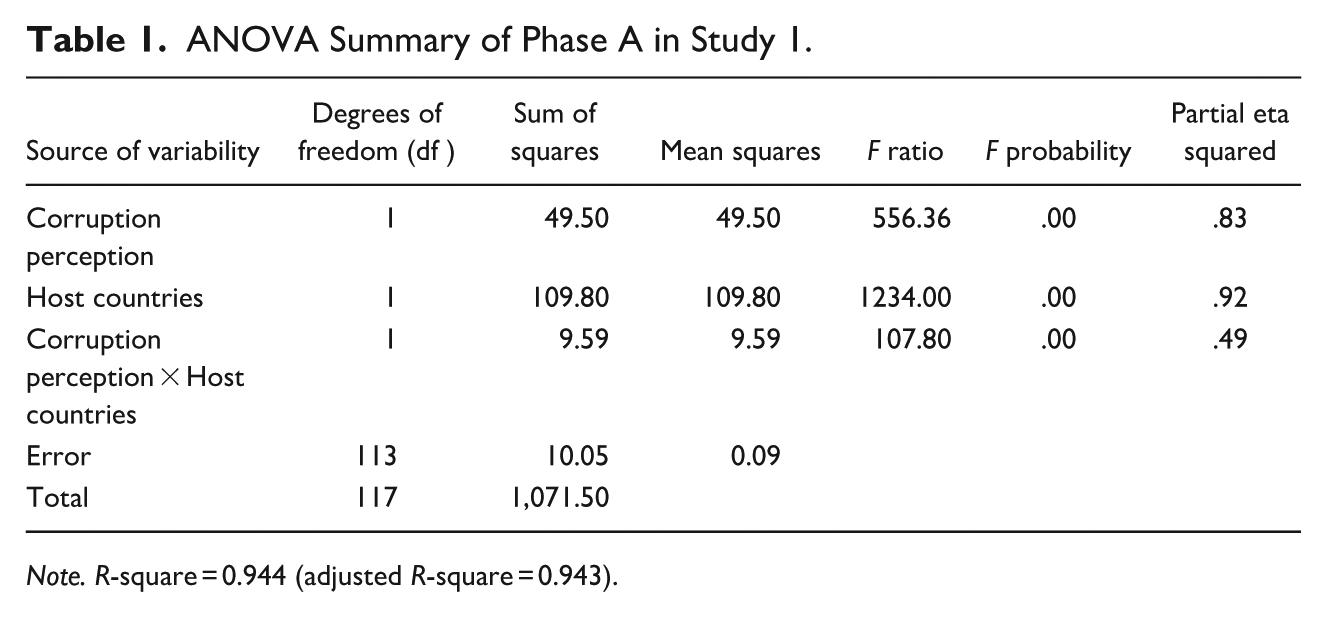
Note. R-square = 0.944 (adjusted R-square = 0.943).
Phase B tested H2 and H2b. The 118 students who completed phase A continued to participate in phase B. Sixty students read five articles about corruption fugitives settling in Genovia, Genovia’s ineffective governance in combating corruption, and its corruption-friendly business environment. Among them, 32 students also read four articles describing Genovia’s hostile policies toward Sorok, while the remaining 28 students did not. The other 58 students did not read the five articles about corruption fugitives; among them, 30 read the four articles on Genovia’s hostile policies toward Sorok, while 28 did not. All participants then evaluated the perceived brand credibility of MNEs from Genovia using four items (1 = very positive, 5 = very negative; α = .939), as detailed in Supplemental Appendix 1.
A two-way ANOVA on MNE brand credibility revealed a significant main effect of country-image damage, F(1,114) = 172.98, p < .01, η2 = .60. Participants believed that high country-image damage led to lower MNE credibility (M = 1.74, SD = 0.72) compared to low country-image damage (M = 3.04, SD = 1.06), supporting H2. Furthermore, this effect was moderated by national animosity, F(1,114) = 37.26, p < .01, η2 = .25. When national animosity was low, lower country-image damage resulted in significantly higher MNE brand credibility (Mlow CIS = 4.04, SD = 0.51 vs. Mhigh CIS = 2.12, SD = 0.43). However, when national animosity was high, the effect diminished (Mlow CIS = 2.12, SD = 0.33 vs. Mhigh CIS = 1.41, SD = 0.76). Thus, H2a is supported. Table 2 summarizes the ANOVA results for phase B.
ANOVA Summary of Phase B in Study 1.
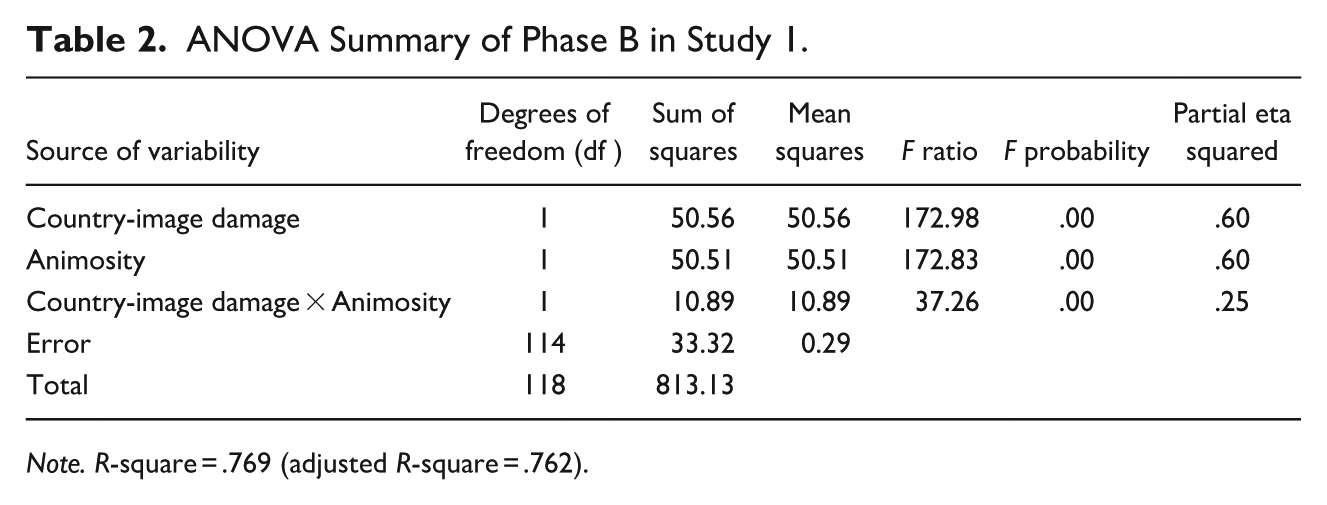
Note. R-square = .769 (adjusted R-square = .762).
Study 2: Market Survey
The goal of Study 2 was to test the tenability of Study 1’s results using a different research method—namely, a market survey—conducted in a different location, Hong Kong. We selected Hong Kong for several reasons. First, Hong Kong residents are well-informed about the Chinese fugitives due to extensive media coverage (Song, 2018). Second, while fugitives remain a sensitive topic, Hong Kong residents enjoy relatively higher levels of freedom of expression (Qin & Torres, 2018). Third, due to its historical ties with Western countries, Hong Kong is a city where people have considerable familiarity with Western doctrines, ideologies, values, and brands (Joy et al., 2020). Consumer research indicates that Hong Kong consumers value branded goods and maintain strong emotional attachments to international brands (Chan, 2006).
The on-site questionnaire survey was conducted in Mandarin at a Hong Kong park. We approached 286 individuals, of whom 208 agreed to participate. Among them, 28 did not return the survey, and 9 questionnaires were not complete due to missing data. The final sample consisted of 171 individuals, yielding a response rate of 59.7%. Supplemental Appendix 2 provides background on the respondents. Responses were recorded on a 5-point Likert scale, ranging from 1 (extremely disagree) to 5 (extremely agree). Before starting the survey, we provided participants with detailed news reports about the 100 wanted fugitives, their host countries, and the “Skynet” operation. To increase the response rate, each respondent received HK$50 in cash as an incentive upon completing the questionnaire.
Following existing studies (Diamantopoulos et al., 2017; Xue et al., 2022), we included three control variables that may influence customer behavior: consumer ethnocentrism, brand familiarity, and customer product judgment. Consumer ethnocentrism was measured using a three-item scale adapted from Klein et al. (1998) and Gineikiene and Diamantopoulos (2017). Brand familiarity was assessed with three items adapted from Diamantopoulos et al. (2017). Customer product judgment was measured using four items modified from Klein et al. (1998) and Gineikiene and Diamantopoulos (2017). Supplemental Appendix 1 details the measurement items and validity assessments conducted in Study 2.
We administered the same questionnaire in a small-scale survey among 46 university students at a Mainland Chinese university. Spearman correlation tests (interrater reliability) were conducted to determine the consistency of results across the two surveys. Except for perceived corruption (rs = .455), all correlations were significant at the 1% level, demonstrating a high level of consistency across constructs (rs ranging from .842 to .988).
Confirmatory factor analysis was performed to assess the reliability, validity, and dimensionality of the constructs. This study comprises eight variables, each consisting of multiple items. The original measurement model (ex ante method) demonstrated a strong fit (χ2/df = 1.41, CFI = 0.985, TLI = 0.983, RMSEA = 0.041, SRMR = 0.047).
To test for common method variance (CMV), we constructed a second measurement model (ex post method) incorporating a single latent CMV factor that loaded on all items and compared it with the original model. The results indicated no significant difference in key indicators between the models. After incorporating the latent CMV variable, the goodness-of-fit statistics remain similar (χ2/df = 1.34, CFI = 0.988, TLI = 0.986, RMSEA = 0.044, SRMR = 0.034), suggesting that CMV was not a significant concern.
As reported in Supplemental Appendix 1, the Cronbach’s alpha values ranged from .808 and .964, all exceeding the recommended threshold of 0.7, confirming the reliability of the constructs. In addition, all individual items exhibited strong loadings on their respective constructs, with the lowest value (0.678) well above the recommended 0.5 threshold, providing strong evidence of convergent validity. Discriminant validity was evaluated by comparing the square root of the average variance extracted (AVE) for each construct against its correlations with other constructs. The square roots of AVEs (ranging from 0.792 to 0.923) exceeded the correlation coefficients, demonstrating adequate discriminant validity.
Summary statistics for all variables are presented in Table 3. Correlations between variables ranged from low to moderate. An examination of variance inflation factors (VIFs) indicated minimal collinearity concerns (mean VIF = 1.53, max VIF = 1.88 for country-image damage as the dependent variable; mean VIF = 2.04, max VIF = 3.02 for MNE brand credibility as the dependent variable). Significant correlations between image damage, fugitives’ destination frequency, and brand credibility provided preliminary support for H1 and H2.
Means, Standard Deviations, and Correlations (Study 2).
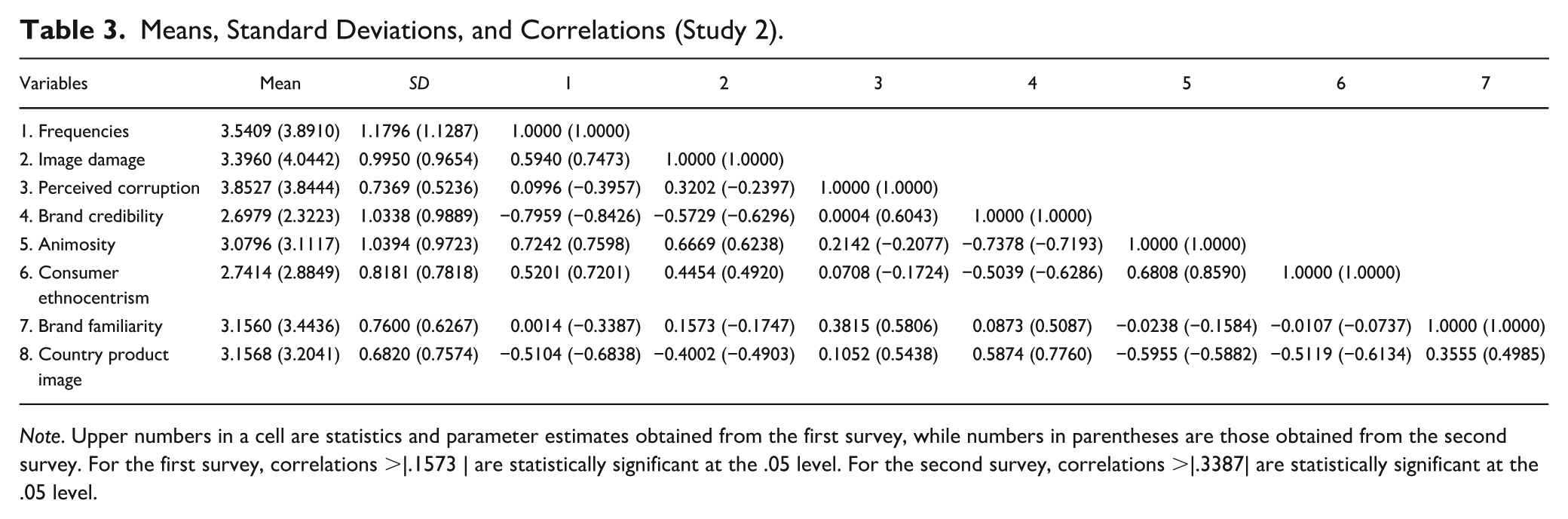
Note. Upper numbers in a cell are statistics and parameter estimates obtained from the first survey, while numbers in parentheses are those obtained from the second survey. For the first survey, correlations >|.1573 | are statistically significant at the .05 level. For the second survey, correlations >|.3387| are statistically significant at the .05 level.
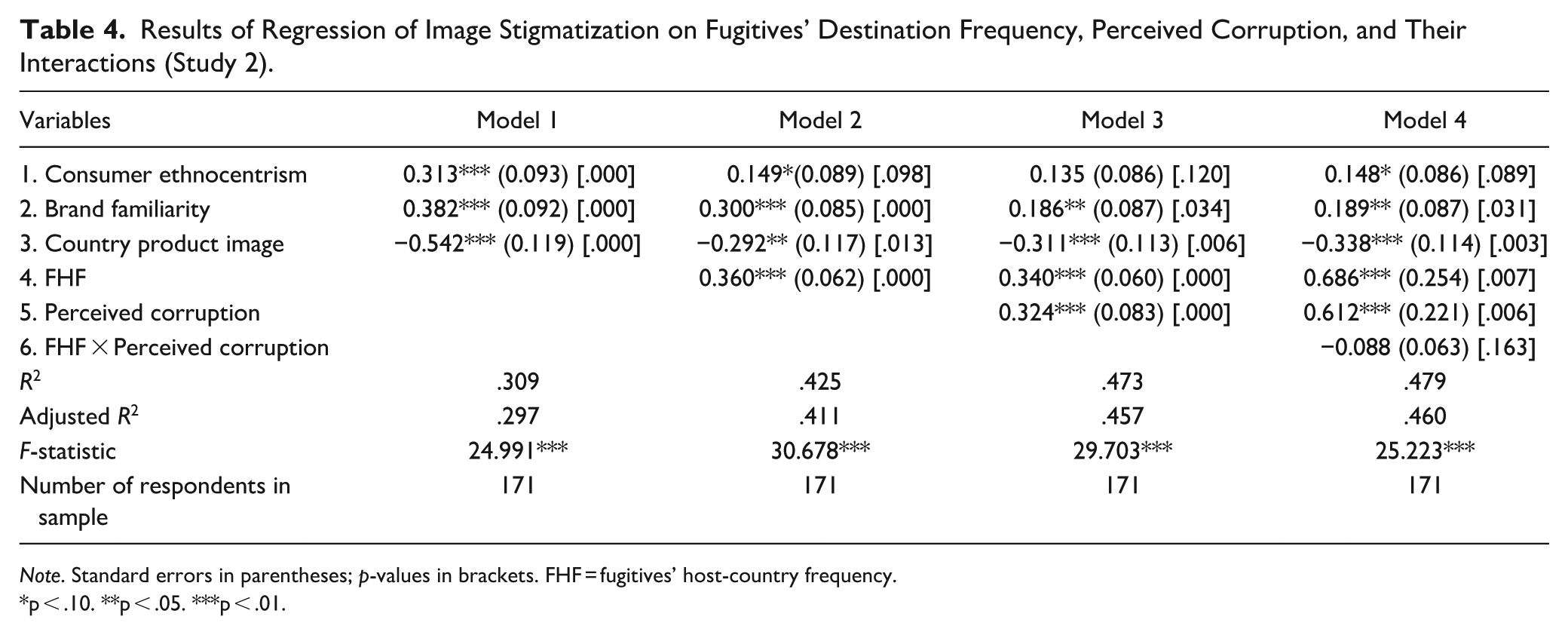
Table 4 presents the results of regression analyses with the damage of host-country images as the dependent variable (DV). Four hierarchical models were tested. Model 1 included all control variables. Model 2 tested H1, examining the effect of fugitives’ host-country frequency (FHF) on damage of host-country images. Model 3 introduced perceived corruption as a moderator, while Model 4 assessed H1a, the moderating effect of perceived corruption at consumers’ home countries. Interaction terms were mean-centered to mitigate multicollinearity.
Results of Regression of Image Stigmatization on Fugitives’ Destination Frequency, Perceived Corruption, and Their Interactions (Study 2).
Note. Standard errors in parentheses; p-values in brackets. FHF = fugitives’ host-country frequency.
p < .10. **p < .05. ***p < .01.
H1 predicted that host-country reputational damage increases with FHF. In Model 2, the coefficient for FHF was positive and significant (β = .360, p = .000), supporting H1. However, Model 4 found no support for H1a, as the interaction term of FHF and perceived home-country corruption was not significant (β = −.088, p = .163).
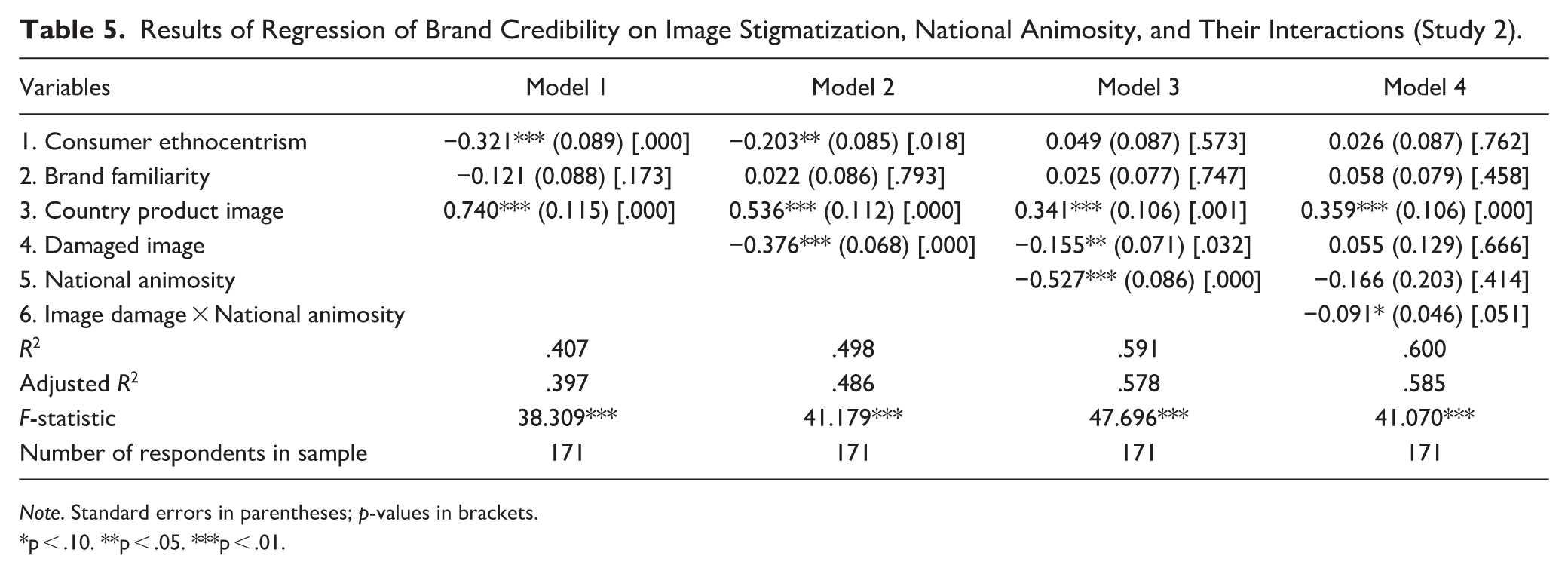
Table 5 reports regression analyses using MNE brand credibility as the DV. In Model 2, damage to host-country images was introduced as an independent variable. The coefficient was negative and significant (β = −.376, p = .000), supporting H2. Model 4 introduced the interaction term of country-image damage and national animosity, which was negative and weakly significant (β = −.091, p = .051), providing partial support for H2a.
Results of Regression of Brand Credibility on Image Stigmatization, National Animosity, and Their Interactions (Study 2).
Note. Standard errors in parentheses; p-values in brackets.
p < .10. **p < .05. ***p < .01.
Beyond the direct effects in H1 and H2, we examined whether country-image damage mediates the relationship between FHF and MNE brand credibility. 1 The essential prerequisite for mediation is a significant direct effect between the independent and dependent variables. The relationship between FHF and MNE brand credibility was negative and significant (β = −.575, p = .000), satisfying this prerequisite. After significant correlations have been established, that is, the path of FHF to country-image damage (in Model 3 of Table 4) and that of country-image damage to MNE brand credibility (in Model 3 of Table 5), we used both FHF and country-image damage as predictors of MNE brand credibility. The simultaneous entry allows for controlling the effect of FHF while the effect of country-image damage on MNE brand credibility is examined, and controlling the effect of country-image damage while the effect of fugitives’ destination frequency on MNE brand credibility is examined (Baron & Kenny, 1986). The results show that the sign and significance level of FHF remained exactly the same (β = −.527, p = .000) after controlling for the effect of country-image damage (β = −.131, p = .000). The path of FHF to MNE brand credibility is not reduced to zero, indicating that country-image damage does not have a mediating effect. In other words, multiple mediating antecedents coexist.
It is insufficient to rely solely on p-values, as they indicate whether an effect exists but do not capture the magnitude of that effect. Because statistical significance depends on both sample size and effect size, we conducted a power analysis to determine the necessary sample size and ensure that meaningful effects could be detected with a desired level of confidence. To assess substantive significance, we calculated effect sizes, which provide an indication of the strength of relationships independent of sample size. Across our analyses, Pearson’s r values were consistently high (lowest r = .82), indicating strong associations. Regression analyses further confirmed large effect sizes (lowest f² = 0.39), suggesting that the likelihood of detecting true effects was high and that the risk of making Type II error was minimized. These results indicate that the study possessed adequate statistical power and that the observed effects are both statistically and substantively meaningful. Moreover, the combination of high power and consistent effect sizes across studies reduces the likelihood that the findings are driven by confounding factors or methodological artifacts.
Discussion
This study presents several key findings. First, among consumers of corruption fugitives’ home countries, corruption-related reputational damages spill over from the fugitives to their host countries. However, the moderating effect of consumers’ perceived corruption in their home countries is mixed: it is significant in Study 1 but not in Study 2. One possible explanation is that in Study 1, participants relied on imagination to form judgments, which may have exaggerated the effect of corruption perception in fictional countries. In contrast, participants in Study 2 may have become desensitized to corruption due to its prevalence in their home countries, reducing their sensitivity to the issue.
Second, consumers further transfer corruption-related negative reputation from the home country’s image to MNEs from that country, diminishing the brand credibility of these MNEs. In addition, consumers’ national animosity toward the destination country positively moderates this reputation transfer. Third, reputational damage to host-country country images does not mediate the relationship between fugitives’ settlement in the host countries and the brand credibility of MNEs from the host countries.
Theoretical Implications
These findings underscore the importance of integrating societal dynamics and institutional perceptions into international business research. Corruption fugitives are not merely isolated cases of individual misconduct; they serve as catalysts for transnational reputational contagion—a previously undocumented process through which the reputation damage of corruption diffuses across national and organizational boundaries, influencing how societies perceive institutions and MNEs. This study identifies this contagion mechanism as a new channel of reputational spillover in the corruption literature. Moreover, our findings reveal an unintended paradox: anti-corruption campaigns intended to strengthen institutional integrity in one country can lead to the relocation of corruption fugitives abroad, thereby transferring reputational risks to the host countries that receive them. Hosting such individuals may undermine public trust in the host country’s institutions and, by extension, in its MNEs operating globally. While policy enforcement against corruption fugitives is often framed as strengthening institutional integrity (Castro & Ansari, 2017; Hoor-UI-Ain & Wajidi, 2016; Lange, 2008; Popli et al., 2025), this paradox reveals the complex trade-off between enforcing anti-corruption policies and preserving institutional legitimacy in the interconnected global marketplace.
Our findings also explain how individual-level misconduct can escalate into collective reputational harm. Although previous research has documented reputation spillovers at the individual, organizational, and national levels (Ingenhoff et al., 2018), no prior study has identified spillover effects that traverse these levels simultaneously. This study shows that reputational damage travels across multiple levels—from individuals to countries and corporations—illustrating the interdependence of reputational outcomes in global contexts. Consumers in fugitives’ home countries interpret their settlement abroad as a sign of institutional tolerance or complicity, which weakens trust in host-country firms. Such transnational trust deficits demonstrate how corruption produces cross-level externalities that extend beyond economic or political costs, affecting the moral credibility of firms embedded within those environments.
Furthermore, this study advances the business and society literature by identifying corruption fugitives as a new class of nonmarket actors who can generate reputational risks for firms without any direct engagement or transaction. Market actors’ impacts on society have been widely discussed in ethics and stakeholder literature (Dahlmann, 2025; Stubbs et al., 2022). Unlike market actors that intentionally shape firm legitimacy, fugitives unintentionally create reputational vulnerabilities through their mere presence and association with host-country institutions. This dynamic links societal trust in institutional integrity directly to firm-level credibility, bridging macrolevel institutional conditions with microlevel consumer evaluations.
Taken together, these insights highlight a multilevel process of reputational interdependence. Corruption fugitives’ relocation not only erodes perceptions of institutional probity in host countries but also undermines the legitimacy of firms embedded in those environments. This reflects the need for scholars and managers alike to recognize how societal trust, reputational contagion, and nonmarket actors jointly shape the global business environment.
Practical Implications
The findings have important implications for policymakers, managers, and society. At the policy level, governments should recognize that hosting corruption fugitives may bring short-term capital inflows but carries long-term reputational costs for MNEs from the host country. Policymakers must therefore weigh the economic benefits of inward wealth against the reputational costs to national competitiveness and institutional credibility. Maintaining transparent legal frameworks and cooperating with international anti-corruption initiatives can help safeguard the host country’s institutional reputation.
For management, the study highlights the importance of institutional reputation management at both firm and country levels. Because consumers often generalize perceptions of a country’s integrity to all of its firms, MNE managers must proactively manage these associations. This requires both defensive measures—such as targeted advertising, consumer education, and public relations—and proactive efforts to build resilience against reputation risks. Managers should monitor transnational political developments, strengthen internal ethical standards, and collaborate across industries to promote country-level credibility. Collective initiatives such as joint corporate social responsibility (CSR) programs or cross-firm campaigns can be especially effective in signaling integrity and rebuilding consumer trust.
At the societal level, corruption fugitives represent more than a legal or political issue; they erode public trust in markets and institutions. If unaddressed, such erosion risks delegitimizing entire industries and amplifying geopolitical animosities. MNEs can mitigate these broader effects by partnering with governments and communities to promote transparency and social responsibility. These partnerships not only repair reputational damage but also contribute to restoring institutional credibility and strengthening societal trust.
Limitations and Future Research Directions
Several limitations of this study warrant further exploration. While the findings suggest that corruption fugitives’ globalization generates reputational spillover from host-country image to MNEs, the absence of mediation indicates that unknown factors may shape this relationship. One possibility is that MNEs’ efforts to counteract reputational threats—through CSR or transparency—may offset the impact of spillover. Future research should therefore investigate whether firms with stronger ethical reputations are more resilient, potentially benefiting from a “halo effect” that shields them from negative consumer perceptions. Cultural and institutional contexts also matter. For instance, the United States’ enforcement under the Foreign Corrupt Practices Act (FCPA) may alter how consumers interpret corruption fugitives and their host-country implications, suggesting a promising direction for comparative studies.
In addition to firm-level strategies, future research could examine how collective action among multiple stakeholders might mitigate the reputational contagion triggered by corruption fugitives. The corruption literature emphasizes that coordinated efforts—rather than isolated CSR initiatives—are often necessary to address systemic legitimacy challenges (Arora & Petrova, 2010; Castro et al., 2020). Scholars could explore what types of collective action are most effective in countering transnational reputational diffusion, and which actors (e.g., MNEs, home and host governments, civil society organizations, and international agencies) should be involved, and in what capacities. Such an inquiry would clarify how institutional collaboration across home and host contexts can restore societal trust and strengthen global anti-corruption governance.
Moreover, this study highlights that reputational spillover can operate both directly (from fugitives to host-country image) and indirectly (from host-country image to MNE brand credibility). Yet, it remains unclear whether direct spillover exerts stronger or weaker effects than indirect spillover. It is plausible that reputational damage diminishes in intensity but broadens in scope as it moves further from the source. Future research should empirically test these dynamics.
Moreover, our analysis is limited to home-country consumers, which narrows the scope of our findings. Reputation spillovers may operate differently across host-country audiences: in contexts where corruption is normalized, spillovers may be muted, whereas in countries with traditionally low perceived corruption, the negative spillovers could be more pronounced. Future research could explore these cross-country differences to enrich our understanding of reputation spillovers. Furthermore, while this study centers on consumers from fugitives’ home countries, little is known about the reactions of third-country consumers, who may interpret corruption-related cues with less emotional intensity. Research examining whether third-country audiences exhibit attenuated reputational responses would deepen understanding of spillover boundaries.
Another important direction concerns the mediating role of media exposure. This study does not directly capture the extent to which consumers are aware that corruption fugitives from their home country have relocated abroad. Media coverage, scandalization, and public discourse are likely to play a central role in shaping this awareness, as illustrated by high-profile cases such as Julian Assange or the widely reported “Londongrad” phenomenon. Without systematic measures of such public awareness, it remains uncertain whether all consumers form perceptions based on these relocation events. Future research could incorporate media data or survey measures of awareness to examine how coverage intensity and framing influence the strength of reputation spillover media’s role requires closer scrutiny. On the other hand, state and international outlets often sensationalize corruption fugitives by highlighting their wealth, misconduct, and betrayal. For example, Yang Xiuzhu’s high-profile embezzlement and repatriation (BBC News, 2016) and Xu Chaofan’s guilty plea for large-scale misappropriation (X. Wang, 2021) were framed as symbolic of moral decline and national disgrace. Such portrayals amplify reputational contagion by reinforcing public indignation and state narratives, thereby intensifying spillover effects.
Future research could also explore whether MNEs with stronger ethical reputations or transparent governance structures are more resilient to reputational contagion—perhaps benefiting from a reputational halo effect that buffers them from external shocks. Integrating insights from the ethics, stakeholder, and signaling literatures, scholars could investigate how specific firm-level practices—such as anti-bribery certification, compliance disclosure, or ethical branding—moderate consumers’ reactions to national-level reputational threats.
Finally, this study’s methodological design highlights several opportunities for future research practice. The experimental study was not preregistered and did not include explicit manipulation checks. While the convergence of findings across three independent studies, including two market surveys, provides greater confidence in the robustness of the results, the absence of these safeguards raises valid concerns regarding transparency, interpretive validity, and potential researcher bias. Manipulation checks are particularly important in experimental research because they verify whether participants understood, attended to, and interpreted the scenarios as intended. Although the consistency of results across student and nonstudent samples lends support to the validity of the manipulations, future research should incorporate direct manipulation checks, such as comprehension questions, attention filters, or perspective-taking measures, to confirm participants’ engagement and interpretation.
Similarly, the lack of preregistration represents a methodological limitation, as preregistration is increasingly viewed as a best practice in experimental and behavioral research. Preregistration of hypotheses, design elements, and analytic strategies (e.g., on the Open Science Framework or AsPredicted) would strengthen the credibility of findings by reducing concerns about selective reporting, researcher degrees of freedom, or post hoc rationalization. While the present study mitigated these risks by triangulating across three independent studies that consistently supported the theoretical model, future work would benefit from the added transparency and credibility afforded by preregistration.
Future research should also further empirically examine the mechanisms underlying the reputational spillover dynamics identified in this study. While the present research employed experimental and field designs to establish causal links between corruption fugitives’ relocation and changes in consumer perceptions of host-country MNEs, additional approaches could deepen this understanding. For example, longitudinal experiments could manipulate information about fugitives’ settlement and track changes in brand credibility over time, whereas large-scale surveys or secondary data analyses could investigate how media coverage and public discourse amplify or attenuate spillover effects. Cross-national comparisons would also help clarify boundary conditions by examining how variations in institutional integrity, media freedom, and corruption tolerance shape the strength and direction of these effects. Such empirical work is crucial for moving beyond correlational insights and uncovering the psychological and institutional pathways through which individual misconduct diffuses across countries and influences firms’ reputational standing in global markets.
Conclusion
This study extends the understanding of corruption’s global reach by conceptualizing fugitives as nonmarket transmitters of transnational reputational contagion. It demonstrates that corruption travels not only through financial flows or illicit transactions, but also through perceptions—spreading across borders and shaping the legitimacy of both institutions and firms in host countries. Corruption fugitives, although operating outside formal markets, serve as symbolic carriers of their home countries’ governance failures. Their presence in foreign societies can evoke moral outrage and skepticism among observers, prompting negative inferences about the integrity of host-country institutions and the MNEs associated with them. By linking macrolevel societal trust to microlevel brand credibility, this study reveals how reputational contagion bridges individual misconduct and collective legitimacy judgments. The findings underscore that reputational capital—once thought to be managed solely through corporate behavior and communication—is also shaped by broader social and moral dynamics beyond firms’ direct control. The movements of corruption fugitives illuminate how legitimacy and distrust circulate across borders, challenging firms and policymakers to address not only economic interdependence but also reputational interdependence in a morally interconnected world.
Supplemental Material
sj-docx-1-bas-10.1177_00076503251393953 – Supplemental material for The Ripple Effect of Reputation Spillover: How Corruption Fugitives Shape Consumer Perceptions of Fugitives’ Host Countries and Their MNEs?
Supplemental material, sj-docx-1-bas-10.1177_00076503251393953 for The Ripple Effect of Reputation Spillover: How Corruption Fugitives Shape Consumer Perceptions of Fugitives’ Host Countries and Their MNEs? by Lee Li, Pan Xu, Gongming Qian and Yushuang Pan in Business & Society
Footnotes
Declaration of Conflicting Interests
The authors declared no potential conflicts of interest with respect to the research, authorship, and/or publication of this article.
Funding
The authors received no financial support for the research, authorship, and/or publication of this article.

Supplemental Material
Supplemental material for this article is available online.
Notes
Author Biographies
References
Supplementary Material
Please find the following supplemental material available below.
For Open Access articles published under a Creative Commons License, all supplemental material carries the same license as the article it is associated with.
For non-Open Access articles published, all supplemental material carries a non-exclusive license, and permission requests for re-use of supplemental material or any part of supplemental material shall be sent directly to the copyright owner as specified in the copyright notice associated with the article.
