




Abstract
Corporations increasingly blend philanthropy programs with commercial activities, in line with recommendations to integrate corporate social responsibility into their core businesses. In this light, data philanthropy has emerged as a novel approach, in which corporations provide access to their data to support a social cause. To introduce this phenomenon to management research and enrich prior perspectives on corporate philanthropy, this study leverages 22 in-depth interviews with corporate managers responsible for data philanthropy programs to derive a model of data philanthropy and specify foundational mechanisms characterizing this phenomenon. The findings reveal that data philanthropy tends to be intrapreneurial, driven bottom-up by intrinsic motives, then becomes more instrumental as the organization works to capture value. From a resource-based view, data are contested assets for philanthropic giving; while they enable integrating philanthropy with the core business, they also present significant ethical challenges for corporations and societies, beyond just data protection and privacy. The authors contribute to hybrid organization research by introducing blurred philanthropy as inefficient state of objective ambiguity. For data philanthropy as a hybrid phenomenon that balances commercial with society-oriented activities, a dual-mission success is more likely if corporations establish one dominant strategic contribution, business or philanthropy, thus avoiding blurred philanthropy.
Keywords
Our Data for Good program provides partners with data to help them make progress on major social issues across disaster response, health, connectivity, energy access and economic growth. (Meta, 2023)
Corporations in many industries share their digital data with selected nonprofit or public organizations or with the broader public, claiming to support societal goals. Such data philanthropy (DP) is both promoted by the United Nations as “a private sector priority” (Kirkpatrick, 2013, para. 9) and recognized in regulatory and legal frameworks (Data Governance Act, 2022). It presents a potential shift in the landscape of corporate philanthropy: whereas traditional forms of philanthropy require donations of money or time, DP allows corporations to help others simply by “copying” digital data that they already possess and sharing those for the public good.
DP is also increasingly discussed for its potential impact. Building on company-specific business data might enable corporations to act philanthropically in a way that leverages their own core competencies. Therefore, DP might facilitate organizations’ philanthropy and corporate social responsibility (CSR) efforts and align them better with the core business, which could support synergies between business and social initiatives (Porter & Kramer, 2002)—that is, integrated CSR (Aguinis & Glavas, 2013; Siltaloppi et al., 2021). Practitioners discuss that DP might, for example, facilitate effective disease prevention and emergency responses, foster financial inclusion, underlie scientific findings related to treatments of disease, encourage energy savings, and increase transparency in public infrastructure to support fact-based decisions and social opinion formation. For the current research, we use the term “social” to refer to all activities (including environmentally oriented ones) that address at least one of the United Nations sustainable development goals (SDGs), with the ultimate goal of promoting the public good.
Data sharing also confronts some significant obstacles and tensions for organizations (Levitin & Redman, 1998). Because data constitute strategic resources, DP might threaten corporations’ sustained competitive advantages (Barney, 1991). Such concerns might explain why, despite its prospects, DP has not spread widely. Nor do we find many academic studies of its organizational aspects. Rather, discourse about DP appears mostly in practitioner-oriented publications and reports by governmental and nongovernmental organizations (NGOs) (Manning et al., 2020), which focus on best practices for overcoming data-related challenges, like privacy and security. In academic literature, early insights indicate a positive effect on firm value (George et al., 2023), though empirical findings about corporations’ approaches and the likely implications of using business data for social and philanthropic purposes are rare.
To understand the phenomenon in its organizational context including its idiosyncrasies and potential impact on the tension between business and social goals, we examine the following research questions: (a) Through what organizational processes do corporations engage in DP and (b) how do characteristics of DP affect these processes? For this exploratory endeavor, we conducted 22 interviews with corporate managers responsible for DP programs and one industry expert to derive a model of DP and propositions about its mechanisms. We triangulated our data with corporate publications and practitioners’ reports. Conceiving of DP as a hybrid phenomenon (Battilana et al., 2017), we discover synergies between philanthropic action and the core business, but we also identify key challenges to its implementation, mainly involving organizational aspects, such as balancing conflicting demands and motives. These insights go beyond previously cited, technical challenges, like data security and privacy (Lev-Aretz, 2019; Pawelke, 2013).
We contribute to scientific discourse in three ways. First, we advance corporate philanthropy research (Gautier & Pache, 2015; Liket & Simaens, 2015) by introducing and characterizing the phenomenon of DP. Unlike traditional forms of philanthropy, which often appear detached from the actual business (Halme & Laurila, 2009), DP epitomizes integrated CSR. The philanthropic action is connected to and potentially integrated with the core business, which supports synergies and greater impact but also creates a new risk through the marketization of philanthropy (Manning et al., 2020). Thereby, we propose that what we conceptualize as blurred philanthropy can arise from blending philanthropy with business operations. This state of objective ambiguity implies greater risks that the philanthropic program will fail or be discontinued. Establishing a dominant strategic contribution (business or philanthropy) instead increases organizations’ chances of achieving dual-mission goals.
Second, by describing data as a resource that can support corporate philanthropy but that also require protection—due to their potential systematic influence on society, as well as for security and privacy reasons—we characterize them as contested assets for philanthropic giving. As we show empirically, and similar to Alexy et al.’s (2018) effort to reconcile openness with the resource-based view, DP can create bottom-line value by opening access to data, even though data constitute valuable resources for competitive advantages (Barney, 1991). At the same time, we show how DP’s mechanisms reinforce challenges resulting from the concentration of power (West, 2019; Zuboff, 2015) and thus raise ethical concerns about actual societal impacts, beyond questions of data protection discussed in existing DP reports.
Third, beyond the immediate DP sphere, this study clarifies how employees, through intrapreneurship, can initiate CSR activities that the organization can capture. Building on the distinction between moral and instrumental initiatives (Hahn et al., 2016), we identify the ability to balance these aspects within a single initiative over time as a key determinant of CSR success. In determining that DP generally is initiated by employees in functional departments, and later is accompanied or absorbed by a CSR department, we also identify an often-overlooked role of functional departments for CSR implementation (Risi et al., 2023).
Theoretical–Conceptual Background
The Phenomenon of DP
The term “data philanthropy” allegedly was coined in 2011 at the World Economic Forum (Lev-Aretz, 2019). It offers a novel way for corporations to address social issues (Kirkpatrick, 2013) through corporate activities “where (1) privately-held data or proprietary data-driven insights (2) are shared or given access to (3) for the public good” (Lev-Aretz, 2019, p. 1498). Such efforts are also referred to as (big) data for (social) good (Alemanno, 2018) or data altruism (Data Governance Act, 2022). Corporations typically share their data with selected third parties in the nonprofit or public sector, such as research groups or sustainable development organizations, or they make open data available to the general public. These activities generally signify that they are taking on social responsibility.
Conceptually, we can distinguish DP from similar but distinct phenomena. First, it does not entail data analysis assistance, as when a corporation helps nonprofit organizations (NPOs) analyze their data to derive insights, though practitioners and researchers sometimes include such activities in their definition of DP (George et al., 2020). Second, with regard to the data-giving entity, as DP constitutes a corporate activity, it is distinct from individual people’s data donations—such as when individuals share their health data via an app for medical research. Third, data provided in response to legally mandated disclosure requirements are not DP, which instead must be voluntary.
Several examples of DP have been publicized, typically in reference to efforts by large, well-known corporations. In some cases, their business model is based on data but also corporations in other industries engage in such practices. For example, Mastercard grants anonymized financial transaction data to public agencies or NPOs that seek to increase financial inclusion: In a partnership with Unilever, transaction data gathered by Kenyan shop owners were aggregated in such a way that they supported reliable credit score calculations to support applications for local bank loans (Anzilotti, 2017). During the COVID-19 pandemic, mobile operators and social media platforms shared mobility patterns, which helped governments develop more effective lockdown strategies (Open Data Institute, 2021). Other use cases involve learning from corporate data to prepare emergency responses or gain transparency about migration patterns (Pawelke, 2013).
Such initiatives of DP are primarily encouraged by the UN Global Pulse program, which promotes the use of big data to address the UN’s SDGs (Kirkpatrick, 2013). In the early 2010s, this program presented DP as promising and superior to traditional corporate philanthropy, piloted by a few corporations but beset by obstacles, such as data protection as well as potential threats to corporations’ competitive advantage (Pawelke, 2013; Verhulst, 2014). Subsequent reports, mainly published by NGOs involved in sustainable development or digital technology, further explored and supported this movement (Harris & Sharma, 2017; Klein & Verhulst, 2017; McKeever et al., 2018).
Several prominent investigations of DP take a practitioner view; comparatively few academic studies are available (Manning et al., 2020; Susha et al., 2019). Empirical studies of DP are especially rare. Researchers have conceptualized DP as a benefit to the corporation (George et al., 2020) and offered some initial evidence of its positive impact on firm value (George et al., 2023). Overall, DP appears across various literature domains and has been investigated from diverse conceptual perspectives (Verhulst, 2014).
Although we lack insights into organizational, managerial aspects of DP, a broader discourse deals with two topics of fundamental relevance to it: data, including data sharing, and integrated CSR. For this study, we therefore propose an organizational perspective on DP that reflects the idiosyncrasies including ethical challenges and hybridity tensions discussed in these adjacent discourses.
Discourse on Data and Data Sharing
DP requires digital data, which are key resources for corporations that can enhance decision-making and support innovation as well as growth (Manyika et al., 2011). Beyond a business perspective, such data can prove beneficial for the public good (United Nations, 2014). As effective methods are required to extract such value from the data, a self-contained research stream investigates ways to analyze, for example, human mobility patterns but still protect individual privacy (González et al., 2008). Comparable to business-to-business data collaboration, corporations work together with NPOs and/or public organizations to exploit digital data for the public good (Susha et al., 2019; Verhulst et al., 2019). Management research accounts for such data collaboratives or data partnerships as a type of cross-sector partnership (Rasche et al., 2021) and indicates that determinants of their success largely parallel those of traditional partnerships, except that data collaboratives struggle more with finding a shared value proposition and matching the available data to societal problems (Susha, 2020), which necessitates an examination of the organizational aspects and processes of DP.
Data sharing generally is controversial because of its possible negative consequences; these are explored by the field of critical data studies (Hepp et al., 2022). Even when data sharing benefits the public good, it remains critical to protect individual privacy and autonomy (Taylor, 2016). Moreover, the datafication underlying DP—turning more and more aspects of life into data—can undermine philanthropic intentions by changing the balance of power and knowledge: Data are becoming essential to the functioning of our society (Mejias & Couldry, 2019), while access to, control over, and representation in data are increasingly imbalanced across and within societies, causing an injustice also known as the digital divide (boyd & Crawford, 2012). For corporations, new responsibilities related to the values and norms underlying their data handling arise (Flyverbom et al., 2019), implying the notion of corporate digital responsibility (CDR; Lobschat et al., 2021).
Thus, even if sharing data through DP is promising, it raises risks at both organizational and societal levels. For an organizational perspective on DP, we need to understand how business and social goals might be reflected in the managerial approach toward DP.
Organizational Perspective on Corporate Philanthropy and Integrated CSR
DP represents a subtype of corporate philanthropy (George et al., 2023). Typically, corporate philanthropy, defined as voluntary, unconditional offerings by private firms (Gautier & Pache, 2015), involves monetary, time, or in-kind donations. Its mechanisms differ from those of CSR practices that are expected or legally required (Schnurbein et al., 2016), though it might represent a particular format or building block of CSR overall (Liket & Simaens, 2015). An organization does not expect direct returns on its philanthropic donations, such that a “nonreciprocity condition becomes the acid test of philanthropic activity” (Godfrey, 2005, p. 778). However, it likely benefits in other ways, as corporate philanthropy can increase organizational legitimacy (Jeong & Kim, 2019) and reputation (Gardberg et al., 2019), and in turn firm value (Helmig et al., 2016; Wang et al., 2008).
In pursuit of tangible outcomes for the corporation, some seek to link corporate philanthropy with their core business, whereas this discretionary activity previously tended to be detached from the core business and its processes (Marquis & Lee, 2013). Research has called for more integrated approaches that support synergies between business and social goals (Porter & Kramer, 2002). Likewise, corporations have been urged not to separate CSR from their business activities (Margolis & Walsh, 2003). When corporations integrate CSR activities into their core business, it informs their business strategy, operational practices, and organizational culture (Siltaloppi et al., 2021). If such integrated approaches can leverage the corporation’s strategic resources, assets, and know-how, they might generate more social impact (Halme & Laurila, 2009; Weaver et al., 1999).
Data and data-driven insights are specific to the organization (Manyika et al., 2011), in contrast with money donated by a corporation. Because DP leverages firm-specific data, which are strategic resources (Barney, 1991), it has the potential to integrate philanthropic activities more closely with the core business (George et al., 2023). Though integrated approaches promise synergies, ambidextrous business and social ambitions also can create challenges for organizations, especially if they exist in tension (Hahn et al., 2015). As organizations find ways to balance these different demands and cater to distinct organizational logics, they engage in hybrid organizing (Battilana et al., 2017). To analyze how organizations approach and manage DP and the possible tensions associated with this phenomenon, it thus is critical to understand how they thereby balance business and social aspects.
Method
Study Design
For this exploratory study, we adopt a qualitative research approach and seek to develop grounded theory (Glaser & Strauss, 1967). To explore organizational processes and approaches, we mainly rely on interview data that support in-depth explorations of complex processes (Yeo et al., 2014). Given our ontological position of realism (Ormston et al., 2014), we followed an interpretivist approach and generate knowledge on DP through subjective experiences. We interviewed executives and senior leaders with substantive expertise and secure status, who have initiated or led a DP project. We challenged the interview participants to justify their claims and positions, such as about the actual motives or intended outcomes of their philanthropy efforts (Kvale & Brinkmann, 2009).
Sampling and Data Collection
The data collection process spans three phases (see Table 1). In phase I, we sought to understand the field, so we consulted existing literature, including practitioner publications and studies in adjacent fields. This review provided the base for our in-depth exploration of organizational DP processes and later helped triangulate our findings. We also conducted an interview with an expert from one of the leading NPOs that facilitates corporate DP. In phase II, we explored the corporate perspective by reviewing existing DP programs and investigating corporations not active in DP but that achieve best-in-class status for their CSR or CDR efforts. This phase also helped reveal potential hurdles to DP. With each interview and pertinent supplemental sources, we learned relevant aspects about each DP program, such that second interviews per organization offered only marginal additional insights. Therefore, in phase III, we focused exclusively on organizations’ DP programs as the unit of analysis (Miles et al., 2014), and we sought to maximize variation across these cases, to achieve more comprehensive coverage as a sufficient basis for grounded theory development.
With a theoretical sampling approach, we learned from preliminary findings and continuously adapted the sampling process (Ritchie et al., 2014). In selecting potential interviewees, we determined that specific DP program leads, rather than CSR heads, represent the most informed position for answering our inquiries. This theoretical sampling choice had virtually no effect on the selection of DP cases per se; because relatively few DP cases exist and are publicly findable, we reached out to all that we could identify.
Specifically, we performed a desk search for the key terms DP, (big) data for (social) good, and data donation, starting on Google, where we identified DP projects mentioned in corporate websites or publications, general news, conferences, practitioner reports, and dedicated platforms (datacollaboratives.org, odimpact.org). Then we entered the search terms into the Factiva database of corporate publications and news, for the past 10 years, and screened all available results for further DP projects. Later, we relied on snowball sampling. We explicitly included projects that appeared to have been discontinued, to learn from potentially unsuccessful examples.
Data Collection Phases.
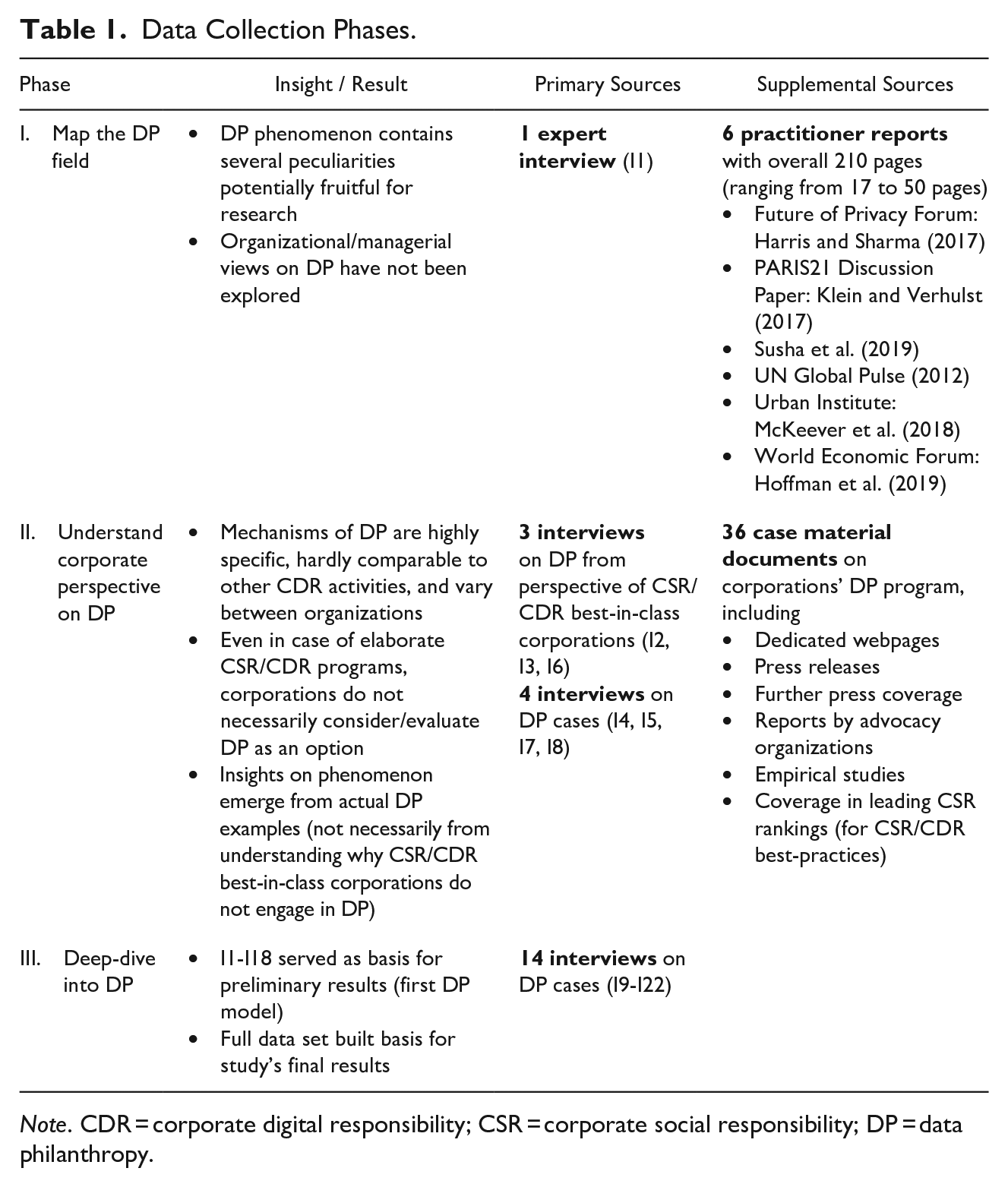
Note. CDR = corporate digital responsibility; CSR = corporate social responsibility; DP = data philanthropy.
For all identified cases, we detected the responsible manager through internet search (typically identifiable in press statements as “head” or “initiator” of DP) and contacted them via LinkedIn or email. By interview 18, we had derived a data model that appeared stable; we conducted four further interviews to validate the results. Because they corroborated the model, we concluded that we had achieved theoretical saturation (Glaser & Strauss, 1967).
Interview Overview.
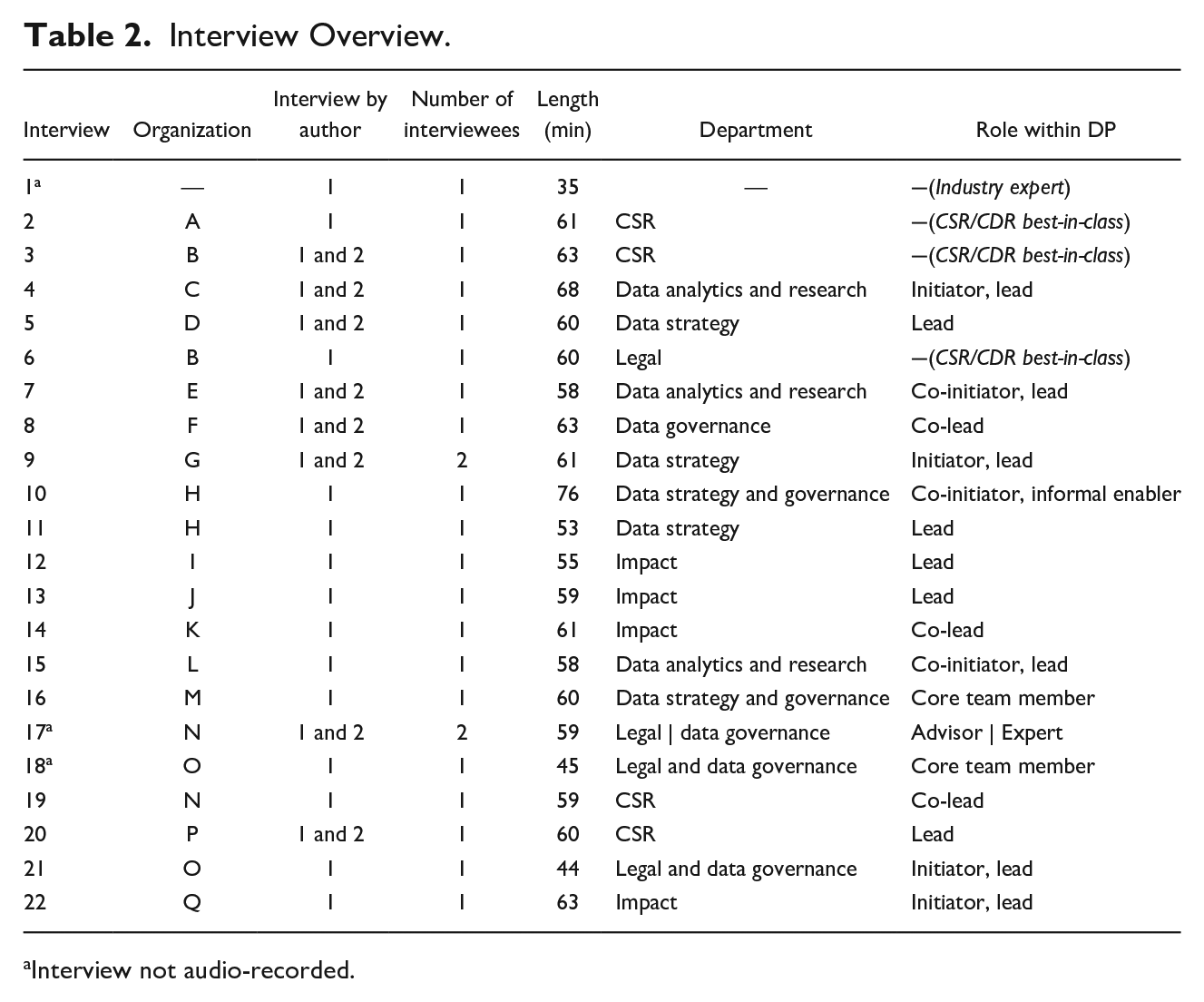
Interview not audio-recorded.
To prepare the interviews and enrich case insights, we collected information about the DP program from the corporations’ websites, press statements, and external reports, which included a total of 36 documents that we analyzed carefully, revealing insights regarding the scope of activities, the programs’ origin and changes over time, the data supplied, as well as the targeted usage, beneficiaries, and cooperation partners. The interviews were conducted and recorded on Zoom and lasted 58 minutes on average. The interview guide reflects our preliminary research questions. Deep-dive questions addressed the program’s initiation and development, its role within the organization, and the participant’s personal and organizational evaluation of opportunities and risks, including relevant decision processes and responsibilities. Overall, we conducted 22 interviews with 24 individuals, with an overall duration of 21 hours (see Table 2). The interviewees all held top or middle management positions, but they noted diverse professional backgrounds and worked for diverse functions, such as corporate strategy, data analytics, CSR, and corporate communications.
The interviewees represented 17 organizations that are located in European countries and in North America, and they compete in agriculture, banking, infrastructure, IT, pharmaceutical, retail, and telecommunications sectors. Each of the studied DP programs contributes to at least one SDG, with Goal 3, “Good Health and Wellbeing,” being the most frequently represented. Additional goals identified in multiple organizations include SDGs 1, 9, 10, and 11.
Data Analysis
The recorded interviews were transcribed verbatim and analyzed using MAXQDA. At three interviewees’ request, due to confidentiality concerns, their interviews were not recorded, but the interviewers took extensive notes that we used as substitutes for the verbatim transcripts. For the qualitative data analysis, we followed the procedures established by Glaser and Strauss (1967) in an iterative three-step approach where we repeatedly revisited and refined our codes and categories as well as our underlying research question.
In a first step, our analysis focused on the first part of our research question, that is, on the organizational processes of DP. We inductively coded the interviews (first cycle) by themes (Saldaña, 2016) that related to the organizational processes of DP, and, while still collecting data, began clustering these codes into categories to form a preliminary DP model. As we iterated through the data—discussing problematic codes and clustering decisions within our research team—we triangulated our findings with six supplementary practitioner reports and studies, which informed our understanding of DP aspects such as different governance modes, data-sharing structures, and observed opportunities and challenges. As the analysis progressed, distinctive characteristics of DP emerged—particularly in relation to the interplay of its constituent elements and their influence on organizational processes. These characteristics clearly differentiate DP from traditional forms of philanthropy and align closely with the discourses on hybrid organizing and the integration of CSR into the core business. This insight prompted an inductive broadening of our research focus beyond the initially static process model, leading us to examine how characteristics of DP shape underlying organizational processes. Consequently, we formulated the second part of our research question.
Second, having coded all interviews, we conducted a second coding cycle based on the initial codebook. The coding cycles were led by two different researchers. To ensure researcher triangulation, we compared the results of the second cycle (kappa = .85; Brennan & Prediger, 1981) and discussed them to resolve discrepancies. While the codes relating to the first part of the research question remained stable, this iterative refinement yielded more nuanced characterizations of DP approaches, highlighting its hybrid nature and how this affected DP processes balancing social and business aspects. Third, we abstracted away from the data to identify higher-level concepts—that is, the DP model and DP mechanisms—and thereby build grounded theory (Corbin & Strauss, 2015).
The coding system in turn evolved around the core theme (Glaser & Strauss, 1967) of DP as an integrated approach to CSR. According to the two aspects of our research question, codes on the one hand were ordered and clustered along the DP process, representing building blocks of a DP model (Figure 1). On the other hand, several codes described characteristics of DP and their interplay. They described different themes, but for each theme, codes were spread across several process steps of our DP model, making it impossible to clearly allocate them within the process model. Because they hence span and contextualize the DP model’s building blocks, we established a parallel code system in which we recombined these codes into pattern categories that refer to six different topics, which we define as DP mechanisms (Figure 2). These mechanisms connect the process steps or building blocks of DP and provide explanatory insights into how characteristics of DP affect the DP processess—such interrelations constitute an essential element of grounded theory (Hedström & Swedberg, 1998).
Findings
DP Model
Our proposed model of DP (Figure 1) features processual steps as building blocks of DP (in the following presented in italics). Corporations’ DP programs vary, as the individual steps are occasionally quite pronounced, while at other times they are barely noticeable; in some instances, they also take place in parallel. The map of these elements, however, reflects the common ground and similarities we identify across DP approaches we studied. The model ranges from the initiation to the management to the outcomes of the organizational program; it also accounts for factors in the institutional environment. Exemplary quotes from our interviews for each building block can be found in the Supplemental Material.
DP starts from some trigger (action), which gets combined with data as organizational resources (assets). The trigger typically emerges from an internal, individual level; employees working with data realize their potential value for not just the organization but also some social cause and initiate a discourse about how to leverage them. Alternatively, the trigger might come from an internal strategic initiative, reflecting the organization’s attempt to increase its transparency or be perceived as socially engaged. In several cases, external initiatives provide a stimulus, such as when employees entered into professional exchanges with experts from academia or NGOs, during which they came to the recognition that their organization may have data that could be used to address a socially relevant question. Also, regulatory triggers, such as data disclosure requirements in the public sector or pharmaceutical industry, can spark internal discussions about whether to go beyond the requirements and voluntarily share data at a wider scale.
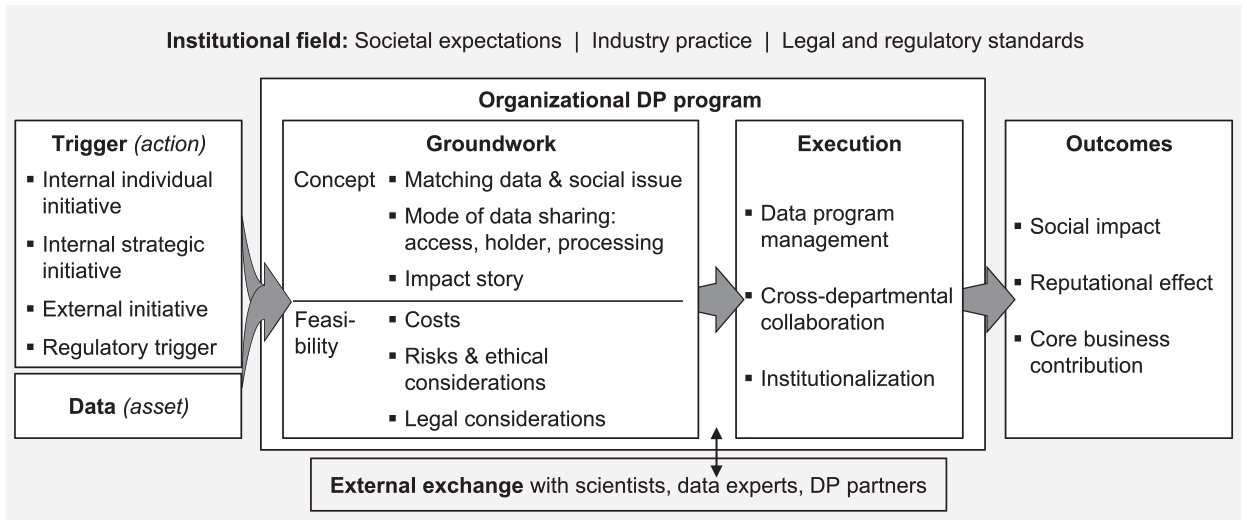
Data Philanthropy Model.
The organization then conceptualizes a potential DP program and evaluates its feasibility. Different aspects of the groundwork conducted in this phase are closely interconnected and often addressed iteratively. To conceptualize the program, the organization works to match data with a social issue. In some cases, instigators know of a rich data set and look for promising questions to answer with those data; in others, specific societal problems arise, and the goal is to evaluate if the organization can contribute to their solution with its available data. Several modes of data sharing emerge, varying on three aspects. Data access can be limited to one or a few preselected beneficiaries, typically NPOs or public entities that form data collaborations or closed data partnerships with the corporation; otherwise, access might be granted to a specific group, such as academic researchers, or to everybody, generally referred to as open data. The data holder can be the corporation, the beneficiary, or some intermediate third party. The form of data processing can vary from making the data available in raw format to processing and analyzing the data to share insights. Finally, an internal impact story as a rationale for investing resources into the DP program is required, one that is “all about demonstrating value for the organization—and that does not need to be diametrically opposed to benefit for society” (I14, organization K).
The evaluation of the feasibility of the program thus devised includes three elements. First, the costs are determined, including direct costs and opportunity costs linked to alternative commercial uses of the data. In some cases, only data that cannot be sold will be shared, but in other situations, corporations balance the value of reputational gains achieved from sharing the data against the value of selling those data and decide in favor of DP even when aware that “social projects can actually cannibalize part of normal revenues” (I9, organization G). In this example, DP involves sharing mobility patterns with governments, which could otherwise be paying clients for such data. Second, organizations assess several kinds of risk. Stakeholders such as customers likely are concerned about data sharing; even if fully anonymized, DP can be perceived as a privacy infringement, for example, when DP insights are based on end-user contract data and individuals fear they might be tracked (organizations G, H, O). Data might also lead others to come to “the wrong conclusions [especially if they] don’t know how to interpret it” (I8, organization F) and spread uncontrolled and misleading messages. Several organizations decided against open sharing of some data to avoid being associated with public controversies, for example, as a detailed electricity distribution grid map made available as open source to the public by an infrastructure provider might be misinterpreted, potentially leading to the perception of infrastructure deficiencies (organization F). In addition to reputational risks, overly transparent data sharing might undermine business operations or present a security risk. Simultaneously, ethical considerations apply with regard to protecting data versus being transparent.
As a third feasibility evaluation, the organizations address legal considerations involved with data protection and establish boundaries for what can be shared and what aggregation or anonymization procedures are required. While most examples conduct extensive groundwork before starting the following execution, in organizations C and E, organizational support to perform the DP activity in the beginning was so strong that groundwork activities were conducted in parallel to the execution and cost and risk considerations gained relevance only in later stages of the program.
In the execution phase, data program management is essential because the data must be collected, standardized, and analyzed. Continuous cross-departmental collaboration is necessary to align relevant departments, such as sales, marketing, CSR, finance, and legal. The program’s institutionalization also must be shaped, to determine the extent to which the program is part of organizational structures and processes, as well as its organizational role (e.g., contributions to organizational goals, location within the organization). These decisions often get renegotiated or evolve over time, particularly as increased maturity leads to revised objectives, and managers realize they “need to make [the DP program] fit into the business, fit into the operations” (I9, organization G). In this example, the DP lead recognized that their initial approach of managing DP in a separate department with a use case not directly aligned with the core business was unsustainable, so that it became necessary to integrate DP activities into the organization’s daily operations. While the execution phase in some organizations (e.g., D, I, P) is less pronounced and focuses solely on the specific use case at hand, other organizations (e.g., C, H, N) establish comprehensive data program management, collaboration, and institutionalization frameworks. This broader approach enables them to later expand their DP activities to encompass additional purposes (see also Proposition 5).
With regard to outcomes, DP can contribute to organizational goals and beyond. First, it leads to tangible benefits for the beneficiaries, constituting social impacts. Notably, DP projects can support specific NPOs’ social missions or public sector actors’ contributions to the public good, but open data for a general audience also can contribute to the broader public’s general causes. Second, reputational effects arise that become salient for various stakeholder groups (e.g., customers, employees, investors, political bodies). In addition to “telling a sustainability story” (I16, organization M), DP projects a data-driven and forward-thinking image. For instance, evaluating mobility patterns in partnerships with governments in organization E is “belonging for sure to the top two to three innovation topics in the whole corporation, (. . .) where you can be seen as an innovative firm” (I7, organization E). The cutting-edge image then can be “promoting the company for acquiring new talent, for discussing science, for increasing the scientific reputation” (I15, organization L).
As third outcome, core business contributions result; the effort invested in DP likely includes building or testing new business models, which then advance the company’s innovation and product development. The DP team in organization D, in collaboration with an NGO, explored using financial transaction data for more targeted development aid. This initiative evolved into an “innovation center (. . .). We were exploring, we were developing pilots and prototypes” (I5, organization D) which later became standard data analytics products within their business model. Moreover, DP creates connections and collaboration with new partners, which implies potential new clients and markets. It also can contribute to internal capability building.
An organization’s DP is closely related to its institutional field. Factors shaping (and, from an institutionalist view, being shaped by) DP include societal expectations about sharing or protecting data, peers that lead the way for industry practice, and legal and regulatory standards. Societal expectations also shape what employees demand from the corporation, especially if they perceive that it possesses valuable data that could be shared for social purposes. Over the course of a DP program, organizational members typically enter into close external exchanges with beneficiaries but also with scientists and data experts who support the social cause and assist in conducting the program, such that DP often takes the form of a partnership or interorganizational collaboration. The external exchange is associated with more innovative methods of using data for DP, for example, as the external partner introduces new techniques for analyzing and anonymizing data, enabling the sharing of novel insights. In contrast, the few examples where this external exchange was not observed (organizations H, M, N) can be characterized as employing more traditional approaches with regard to the DP concept.
Across observed DP programs, we find that the corporation’s business model affects its emphasis on different aspects of the DP model. If its business model is based on selling data and data-based insights, its DP becomes less complex, because the corporation already has data sharing procedures in place. In extreme cases, DP means providing free access to data insights that the corporation would otherwise sell to clients, similar to in-kind donations and individual volunteering. For instance, in organization P, a data company shares some of its data solutions with NGOs. This collaboration enables NGOs to better understand their stakeholders and develop more targeted measures to support disadvantaged individuals.
DP Mechanisms
Building on the DP model, we introduce six mechanisms of DP based on identified pattern categories (in italics) to characterize DP, offering explanatory insights for interrelations and contingencies of the phenomenon’s building blocks (Figure 2).
Mechanism 1: Empowering Autonomy and Improvisation
With regard to organizational aspects, a challenge arises because DP’s value is unknown ex ante and develops over time. For extended periods, it remains uncertain if and how the program is valuable to the beneficiary and the corporation. Furthermore, DP typically emerges unforeseen and bottom-up, triggered spontaneously and on an individual level, rather than representing a manifestation of the corporation’s strategic, long-term plan. In the cases we analyzed, DP appears particularly evident when employees have the freedom to try out new things, as part of or in addition to their core job. In several cases, DP managers cite the need for safe spaces, outside organizational processes and structures, that grant them freedom and do not require them to subject their ideas immediately and directly to a business logic.
From these observations, we infer that a trial-and-error culture may be required to devise viable DP solutions. An ability to react flexibly and improvise, depending on what the DP initiative provides, allows the organization to realize value from it. These observations imply that organizational autonomy with safe spaces, such that the activities are not fully organizationally embedded, prove beneficial to DP. We conclude:
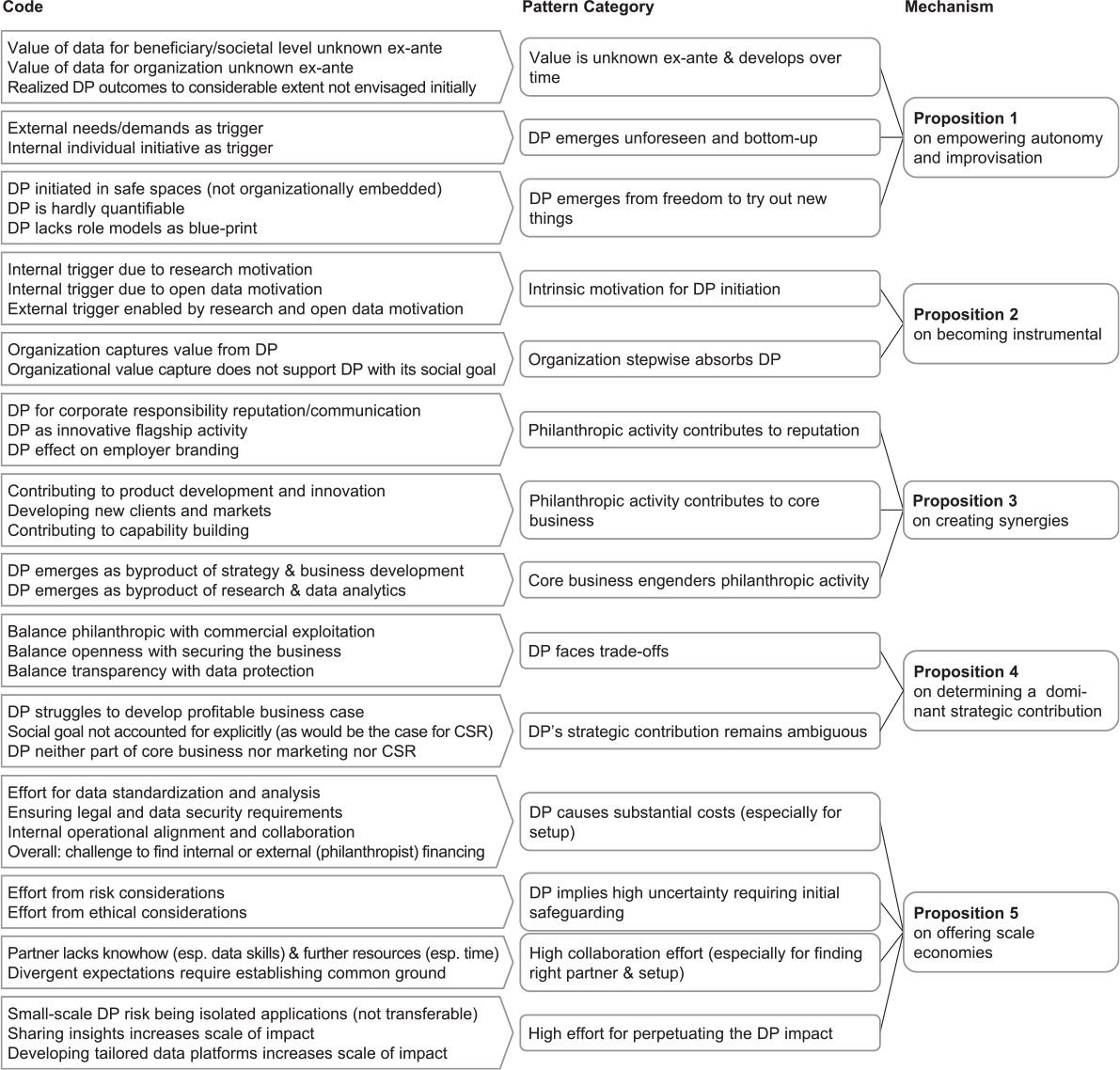
Data Philanthropy Mechanisms.
For example, in organization C, a manager in the data analytics department was able to develop an approach for using the company’s telecommunication data for public purposes, without having a specific benefit for the corporation in mind. The department was regarded as a cost center anyway, and because research activities are hard to quantify, his situation provided substantial degrees of freedom. Once the company began successfully sharing anonymized data about mobility patterns (triggered by intrinsic activity in expert networks; Mechanism 2) that could help public authorities and health organizations develop pandemic prevention measures, the company’s CSR department expressed interest in supporting the project for marketing purposes (I4, organization C). The eventual DP outcome for the corporation, in the form of marketing effects, was not envisaged initially when developing the data sharing approach; the actual DP outcome then represents “more or less a side effect, because it was absolutely not the objective of the team at the beginning” (I15, organization L).
Mechanism 2: Becoming Instrumental
In most cases, DP activity is driven by intrinsic motivations. Interest in addressing a practice-oriented research question or problem emerges as individuals recognize some societal issue and realize that available data could contribute to its resolution. For instance, in organization I, sharing customers’ energy consumption patterns with scientists promised to facilitate the identification of energy efficiency initiatives for increased sustainability of households. Others engage in DP based on a general conviction that data should be shared openly and constitute public goods. In either case, DP comes “down to personal motivation” (I12, organization I) to engage beyond the job description. In a commonly observed process, the organization stepwise absorbs the DP program and benefits in various ways as it capitalizes on any outcomes the DP yields. Such efforts to capture value constitute an important capability for achieving success (i.e., improvisation, Mechanism 1). But if organizations fail to support the initial DP idea and its intrinsically social motivation, it provokes internal tensions, particularly if the ultimate organizational execution seems to conflict with the initial motivation.
Thus, as a form of intrinsic intrapreneurship, DP can be absorbed by an organization that aims to capitalize on the initiative, but such absorption might undermine the credibility of the initiative or create internal tensions that require the organization’s attention. In turn, we propose:
In organization H, the founder of the DP program, who self-describes as a supporter of the open data movement, developed a small open data program as part of their work in the data strategy department, mainly due to the own value conviction and without sparking much executive management attention. After the successful launch of the program, the question arose about whether it should be continued and expanded, because it needed continuous financing. When executive management evaluated the program with a cost–benefit analysis, it determined that most of the data could be sold, and only minor, less relevant parts of the data should still be shared, to gain reputation benefits. When the open data program was subjected to marketing considerations and focused on the most marketable stories, it undermined the founder’s initial ambitions. As a result, the founder devoted less effort to the initiative and reported disillusionment, because even as DP was being promoted externally as a flagship activity, “we didn’t have support, [the managers] weren’t interested in” (I10, organization H) achieving the underlying social goal.
Mechanism 3: Creating Synergies
Different triggers and outcomes exhibit crossovers between social and business activities. Philanthropic activity can contribute to the firm’s bottom line: DP contributes to reputation among external stakeholders and employees who sense that DP gives purpose to their job, and it contributes to the core business by encouraging product and market development and increased capabilities. At the same time, the core business engenders philanthropic activity. Rather than being initiated by a detached CSR department, DP usually emerges as a byproduct of core business activities, as when it provides the means used to develop and pilot new products or access new customer groups. Overall, DP activities offer the potential to combine business and social goals to the benefit of both. We propose:
For example, organization I achieved synergies between philanthropy and its core data analytics work: “There was this sort of impact-oriented philanthropy. But definitely at the same time, we were building up our internal data science” (I12, organization I). Organization K started to share data with researchers who helped the company analyze and evaluate those data’s potential for business purposes, and “only thereafter we realized that there is tremendous kind of marketing potential to come out of this program” (I14, organization K). During this collaboration, the data analysts also realized that the data held great interest for the researchers. Together with the social impact department, they then institutionalized data sharing, to ensure a positive research effect, which in turn enhanced the company’s reputation among its own employees and external stakeholders.
Mechanism 4: Determining a Dominant Strategic Contribution
Even if DP allows synergies, the trade-offs it induces must be managed carefully. Corporations need to balance philanthropic goals with commercial exploitation, weigh openness and transparency against being too open, and risk the loss of strategic resources or fail to protect sensitive data.
A key challenge arises when DP’s strategic contribution remains ambiguous. To become sustainably institutionalized, DP programs need a business case that justifies their existence and defines their contributions to strategic targets. In several of the cases we study, the DP programs represent neither the core business nor a CSR function. The primary logic of action and target remains uncertain, featuring links to both business and philanthropy. If the expressed goal is to conduct DP successfully and pursue business and social actions “conjoined right now, I think you kind of have a weaker version of both” (I13, organization J), such that DP appears stuck in the middle. Eventually, it likely fails to achieve a sufficient strategic contribution to either the core business or social goals and thus is at greater risk of termination.
Even if DP aims for dual-mission impact, our results indicate that such programs benefit from embracing one dominant strategic contribution. Doing so clarifies the logic of action and the program’s goal, whether primarily contributing to business development, specific marketing targets, or broader social impacts. Such clarity allows actors to gain a shared conviction that guides their individual actions and evokes purposive organizational support. For example, a dominant business logic would evaluate a DP program on the basis of its returns; a philanthropic logic would prioritize its social contributions. We propose:
Taking Propositions 1 to 4 together, we conclude that DP typically originates from individuals, transforms into an instrumental means over time with the potential to generate synergies, but also requires a focused approach to ensure sustained success. For example, DP in organization D started with ambitious social goals but later functioned like a pilot project for a new data-based product (core business). It was therefore reorganized as part of the central business function. The DP program leader still held the ambitious social goals but lacked support for social impact activities. The team now had a “different profile, more a business entity, more results-oriented, [not accounting for] non-tangible KPIs” (I5, organization D). Over time, because the DP managers lacked support either from the core business or the CSR side that both worked in silos, the organizational and societal impacts remained vague, and the program disappeared into oblivion.
In contrast, organization I realized after its DP pilot phase that the program had significant marketing potential, which would be more valuable than selling the data, because it showcased a clear sustainability contribution that appealed to stakeholders like customers and employees. Therefore, DP was organized as a CSR initiative by the marketing department, expected primarily to contribute to the idea of being an “impactful (. . .) and mission driven company (. . .). You would see that in our marketing, you would see it in our corporate values, you will see it in our employee expectations” (I12, organization I). The program, with its clear strategic focus, in turn was able to expand its activities and social impact which then also contributed to the firm’s bottom line.
Mechanism 5: Offering Scale Economies
For corporations, DP imposes substantial costs, especially for laying the initial groundwork. In data-sharing contexts, decision-makers also experience high uncertainty about the outcomes. Thus, to be conducted thoroughly, DP requires extensive upfront deliberation, followed by continuous risk management and accompanying measures to educate the public about the kind of data shared, garner trust, and reduce the risk of negative backlash.
When DP involves partnerships with beneficiaries, it also requires high collaboration effort to ensure NPOs or public-sector partners have sufficient know-how and resources to use the provided data, so that ultimately, they can work with the data autonomously. The parties also need to establish a common ground for the collaboration in a deliberate way. Some DP managers struggle if their partner by default has “a premise that things almost should be free” (I4, organization C), despite the significant costs the corporation accrues to gather and provide the data. Perpetuating the DP impact demands substantial effort too. If they arise from a specific demand or opportunity, DP programs often emerge as isolated applications, not transferable to further partners or use cases. To establish more standardized, transferable solutions requires effort that can be dauntingly high.
These findings suggest that DP projects require substantial expenditures, largely independent of the size of the project. Therefore, larger projects may appear comparably more favorable, whereas smaller initiatives tend to be isolated and fail to achieve sustainable impact. This characteristic clearly differentiates DP from traditional philanthropy. We therefore propose:
For example, after an employee in organization Q came up with an idea to share data on market insights with a single NGO, the company also decided to develop a DP platform with standardized interfaces, so that “you do not have a hundred NGOs trying to contact you to build the same thing” (I22, organization Q). Multiple NGOs could easily access the platform that provided raw data but also data visualizations to facilitate shared insights. Even for the relatively large organization Q, the required effort turned out to be so substantial that it sought external philanthropic funding. In contrast, organization G implemented a few highly specific pilot projects for selected NPOs, but because it lacked funding to scale and standardize the solution, the scope of its DP activities remained limited.
Mechanism 6: Establishing Data Governance
Internal data transparency is required to make evident which corporate data are available. Our results indicate that such data typically are used on demand, not according to their availability. Rarely do CSR departments conceive of data as valuable organizational assets or engage in supply-side evaluations to leverage data strategically for philanthropic purposes: “There is no ‘data philanthropy scout’ who evaluates our data for their DP potential” (I2, organization A). It is rather that people working directly with data (e.g., data analysts) realize their potential value, then initiate DP. If employees have transparent access to available data, it increases the likelihood of supply-based DP initiatives. The execution of DP moreover relies on the organization’s data (systems) quality. If data are scattered across systems and departments, it impedes DP, by reducing interoperability and the simplicity of collaboration. In contrast, DP managers benefit from common platforms and formats that facilitate sharing.
Organizationally embedded data governance thus can support DP. Several cases embed the data governance function in the organization, with the intention of contributing to and shaping business operations and the data culture. In contrast, if data governance is purely risk-focused (e.g., legal perspective), the protectionist setting thus created imposes a major impediment to DP.
Therefore, we propose a key role of data governance that can specify the responsibilities, standards, and procedures for data handling (Abraham et al., 2019). Such specificity can facilitate exchanges and avoid data silos, by establishing a central, unified perspective on the company’s data stock. From a DP perspective, this function seems most helpful if it creates close links across departments and is embedded in organizational structures and processes so that it supports business functions. We accordingly propose:
For example, the DP program in organization O emerged from the start with the support of its data strategy and a privacy department that regarded its role as moving beyond “a compliance function (. . .) to be more about how do we innovate with data in a way that garners customer trust, and earns and maintains it” (I21, organization O). These employees realized that DP offered an opportunity to foster a data culture and therefore worked to enable the DP program, together with their colleagues from the CSR department, and encouraged all the business functions to share their data.
Discussion and Implications
The findings shed light on how organizations employ DP, as a novel approach to corporate philanthropic action, as well as how they balance business and social goals and demands in doing so. This contributes to discourses on hybrid organizing in corporate philanthropy, digital responsibility, and intrapreneurship. We outline these contributions next, along with avenues for further research that arise from this study.
DP as Hybrid Organizing in Corporate Philanthropy
This study contributes to corporate philanthropy literature by introducing DP as a novel approach and identifying a DP model of processes and building blocks, as well as foundational mechanisms. Against the backdrop of the discourse on hybrid organizing, this study shows how DP as an integrated form of CSR creates both synergies and risks for the organization and philanthropy, due to its very foundations.
We introduce DP as a multifaceted phenomenon, relevant to the field of corporate philanthropy. Despite some similarities with in-kind giving and employee volunteering, especially in relation to the data-driven business models, DP differs fundamentally, due to its explicit, purposeful integration with the core business, as reflected in synergies between business and social goals in both the initiation and outcomes of DP. This aspect also determines the organization of the philanthropy, because DP is not initiated or managed top-down by a central corporate philanthropy department or CSR officer, nor is it located in a support function like public relations, marketing, or human relations. Rather, it is initiated and driven bottom-up by employees, typically as part of their core business activity. Because DP by its very nature can integrate societal activities and goals with the core business, it should not be dismissed as a mere legitimacy strategy (Espinoza & Aronczyk, 2021). With DP, organizations can address critiques of corporate philanthropy as unrelated to the corporation (Halme & Laurila, 2009; Porter & Kramer, 2002). This novel perspective on corporate philanthropy, with DP sharing commonalities with business concepts and leveraging data as a new asset class, affirms its role as a distinct phenomenon (Liket & Simaens, 2015), positioned between virtue and profit (Godfrey, 2005).
Despite this potential for synergies, such as through integrated CSR, our results also indicate that the hybrid nature of DP can lead to inefficiencies if there is no dominant logic (Proposition 4). We introduce this specific circumstance as blurred philanthropy, defined as a state of objective ambiguity in corporate philanthropic activities, where the strategic contribution of the philanthropy is unclear. This ambiguity leads to inefficiencies, as organizational roles and goals may become indistinct, causing the philanthropic activity to be perceived as somewhat philanthropic, but with uncertain expected outputs and appropriate inputs. This scenario is disadvantageous for corporations because it limits their ability to achieve business goals. Social goals also are less likely to be realized, such that DP runs the risk of being perceived as window-dressing. While the hybrid nature of DP generally offers opportunities, the specific blurred state is by its nature suboptimal for corporations. In several of the cases we studied, these inefficiencies represented a critical challenge to DP and even led to project termination. They appear even more fundamental than challenges like data protection and privacy requirements, which typically have been discussed as the main barriers to successful DP (Lev-Aretz, 2019; Pawelke, 2013).
To avoid blurred philanthropy, programs need to establish their strategic contribution to the organization. In the initiation phase, DP does not yet struggle with such blurring, as long as it grows in safe spaces that are “not too closely integrated with core business activities” (Hahn et al., 2016, p. 225) and allow employees to “pursue their personal sustainability agendas” (Hahn et al., 2015, p. 304). Later, when DP becomes an organizational program though, operating outside of organizational structures and processes proves challenging. As our findings reveal, DP programs benefit from a dominant strategic contribution, whether business or philanthropy. In line with prior findings about the importance of clear responsibilities in hybrid settings (Battilana et al., 2015), we conclude that a clear, one-mission goal avoids the risk of the firm being stuck in the middle between business and social logics of action, and it fosters synergetic dual-mission impacts.
Apart from the possibility of blurred philanthropy, an integrated DP approach may jeopardize the philanthropic nature of the activity and undermine the promised societal impact. As we propose, DP in the corporation tends to become more instrumental over time, even if its initial impetus came from motives targeting the societal level. Due to its hybrid nature, DP defies any clear separation of profit and social goals. Even efforts that are explicitly labeled as socially targeted might make diminishing contributions to the public good. Reflecting this temporal insight, we find that in the short term, DP can support synergies that increase the dual-mission impact, but in the long term, DP can lose its original philanthropic substance and shift to serving exclusively corporate goals. In this way, our study provides empirical evidence in support of Manning et al.’s (2020) assertion that new, disruptive approaches like DP are especially likely to lead to a marketization of philanthropy. However, we do not find that this outcome is automatic. In some cases, the philanthropic mission grows stronger through its collaboration with the core business. Taken together with the risk of blurred philanthropy, our study reveals that not (only) the increasing market centricity of philanthropy challenges its contribution to sustainable development (Brooks & Kumar, 2023) but (also) the lack of a dominant strategic contribution of philanthropy can impede dual-mission success.
To scrutinize philanthropic success, especially in relation to its contribution to the public good, continued research might focus on specific social impacts of DP, such as through detailed, small-scale studies that can provide insights into causality (Barnett et al., 2020). To advance conceptual understanding of DP, continued research into stakeholder perceptions and reactions might identify how they perceive of DP, especially if “their” data are being shared. Such an endeavor may require natural or laboratory experiments. Organizational scholars could explore the process by which philanthropic programs successfully establish their envisaged strategic contribution (or not), perhaps by using longitudinal case studies to identify factors that can cause blurred philanthropy. Moreover, we call for tests of the proposed mechanisms, which might use common corporate social performance indicators as outcomes or else approximate the established strategic contributions according to the different organizational locations of the philanthropic program.
Digital Responsibility and Data as Contested Assets
Our findings enrich discourse on CDR and the critical data discourse, by characterizing data as valuable but contested assets for philanthropic giving. The notion of data as resources for the public good deserves attention from a resource-based perspective. We identify how sharing data and giving up exclusive control over those assets can prove beneficial for the business too. Sharing data as strategic resources promises beneficial outcomes for the corporation, as theoretically modeled by Alexy et al. (2018), who reconcile openness and the resource-based view. We offer support for this model. Due to its evocation of open innovation and collaboration, DP can constitute a means by which strategic openness contributes to organizational success. Thereby, our results not only confirm the importance of data quality and standardized systems (Janssen et al., 2012) but also point to the critical function of embedded data governance that supports organizational actors’ efforts to find a well-balanced approach to using and protecting data.
On a societal level, DP reinforces some of the potential negative consequences of datafication. Our findings indicate that—in contrast with traditional forms of philanthropy, like giving money—economies of scale are inherent to DP. Larger corporations with sufficient resources are more likely to succeed in employing DP and sharing data on a large scale; smaller ones might struggle to extend beyond isolated DP initiatives. In our DP model, the risk assessment stage shows that corporations rigorously analyze which data to share and the public discourses they might prompt. Considering that DP tends to strengthen the position of larger corporations that already possess substantial data, they arguably gain greater control over which data (not) to share and what impacts to have. Such increasing control constitutes a power that is not democratically legitimized and might enable privacy violations and surveillance, which creates a new form of systematic influence on society that challenges democratic norms (Zuboff, 2015). In noting these characteristics and mechanisms of DP, our research gives further momentum to what West (2019) and others refer to as data capitalism.
We observe a duality: Sharing data, in the form of DP, can prove beneficial, but it gives rise to several concerns and tensions. We therefore define data as contested assets for philanthropic giving. On the one hand, corporations are expected to be transparent and contribute to the public good by sharing data. This expectation is intensified because stakeholders perceive that data can be shared (“copied”) at almost no cost, and their proprietorship is controversial anyway. On the other hand, corporations need to protect data and individual privacy, and concentration of power in their hands tends to be viewed critically, particularly because the power of data can be leveraged more readily by algorithms and artificial intelligence (Kellogg et al., 2020). As these combined findings show, even DP as philanthropic activity supports the concentration of (data) power, giving further substance to the argument that data should be “decolonized” (Ramanathan et al., 2022, p. 59). This means, the power over the data should be given to the individuals or groups where the data originates from so that they own the data and decide what to share under which conditions. Another way to reduce the concentration of power would be to treat more data as public goods and making their disclosure mandatory. Some initial steps in this regard might include the introduction of neutral data trusts (cf. e.g., European Data Governance Act) or establishing mechanisms for NPOs to run their algorithms on corporations’ data without disclosing the raw data. Such solutions could still disseminate the insights but avoid privacy and data autonomy concerns.
Additional research along these lines could benefit from interdisciplinary approaches that include ethical controversies and information system perspectives. We call for research into the contingencies of successful data governance that includes a CDR perspective and acknowledges the societal value of data; a qualitative comparative analysis of case studies might be instructive. Building on our initial reflections on individual and corporate responsibilities in a data economy, we call for continued debates about obligations to share data, or not, by weighing data privacy and risk considerations against the potential value for market and non-market actors.
Intrapreneurship in CSR Contexts
Our findings characterize DP as a vehicle of intrapreneurship and contribute to this research field by determining that the process the organization uses to capture value from individual initiatives determines the success of its implementation. As with intrapreneurship, DP emerges at an individual level within the organization; it requires safe spaces, outside formal structures, to create value (Blanka, 2019). What has been conceptualized previously as social intrapreneurship (Geradts & Alt, 2022) can lead to dual-mission impacts, such as when employees use their existing freedom of action to drive CSR engagement (Rupp et al., 2018). In line with Risi et al. (2023), we find that employees in functional departments are critical for implementing CSR, but our findings also suggest CSR departments might be obstructive if they do not sufficiently reflect the initiative’s moral core.
The findings reveal how DP can evolve from a moral to an instrumental effort. The multilevel concept of value capture and creation (Bowman & Ambrosini, 2000), together with the distinction of moral and instrumental motives and activities in CSR literature (Hahn et al., 2016), offers an appropriate framework for analyzing DP: Whereas value creation, especially through social impacts, is driven by individual-level, intrinsic motivations (moral intention), value capture for the organization’s bottom-line ultimately prevails (instrumental intention). We thus can offer an explanation for Sendlhofer’s (2020) observation that employees drive CSR, in ways that reflect their moral motives, but then face organizational resistance and disengagement: The organizational value capture process can absorb individual initiatives, possibly leading to dissatisfaction and resignation when the social initiative loses its credibility. The identified value capture process implies a temporal sequence of moral and instrumental initiatives, challenging a commonly applied, static view in which they either coexist or conflict. We also complement Hahn et al.’s (2016) assertion that organizations must balance and link moral and instrumental initiatives for successful CSR, by proposing a further determinant of CSR success, namely, the ability to balance social and instrumental aspects within an initiative over time, especially if individual members’ initial goals are not aligned with business objectives, and the organization captures value from their initiatives.
Continued research could clarify the transitions from moral to instrumental activities, by identifying conditions in which this transition is more likely to succeed. Accounting for social goals, it would be interesting to specify circumstances in which social aspects get perpetuated, as well as those in which business goals crowd out social motives. A multilevel analysis might capture the negotiation between individual and organizational levels and account for the emergence of tensions. Longitudinal case studies could shed light on how the value capture process evolves over time.
Limitations
Due to the limited number of publicly identifiable DP programs, our study is based on a comparatively small sample. However, with our grounded theory approach, we aimed at theoretical rather than representational generalization (Lewis et al., 2014). The senior interview partners and supplemental sources provide rich insights, so our findings offer good coverage of the theoretical phenomenon, and the convergent results across interviews suggest adequate theoretical saturation. To gain a holistic view on DP, we also included terminated projects as negative cases in the sample. Most cases rely on information gathered from just one interview, so some degree of key informant bias is likely. Yet with our interpretivist approach, we can draw general theoretical conclusions, because we purposefully raised challenging questions to provoke diverse perspectives on the phenomenon of DP. Moreover, we triangulated the findings with additional material. Therefore, we believe we have addressed this concern effectively.
Our study is based on observations at one point in time, yet we make claims about the DP process over time. This variance is unlikely to create data quality concerns because prior developments mostly involve relatively objective structural changes. Still, we encourage researchers to address multifaceted DP as a promising phenomenon for studying more granular processes by which organizations balance demands over time.
We focus on organizational processes in the context of DP. Because organizational processes are oriented toward higher-level organizational goals and the strategies derived from them, we touch on the question of DP success in our analysis, particularly when considering the complex interaction between business and social goals. In so doing, we apply a restricted definition of success that focuses on the existence and continuation of a DP program designed to combine business and social goals. Although we identify both potentially positive and negative social outcomes, we do not measure the actual societal impact of DP, highlighting the need for further critical investigations of DP success.
Conclusion
This phenomenon-driven research manuscript introduces DP as a novel concept within corporate philanthropy, characterized by its potential to integrate philanthropy into core business operations through the sharing or donation of data as a strategic resource. By elaborating on the concept of blurred philanthropy and embedding DP in the discourse on digital responsibility and intrapreneurship, the study highlights both the synergetic potential and the challenges associated with DP. The findings suggest that while DP can create significant value for both corporations and society, it requires careful management to avoid the pitfalls of blurred strategic contributions. Future research should delve deeper into the multifaceted impacts of DP, employing interdisciplinary approaches to encompass both business and social perspectives and account for its ethical implementation.
Supplemental Material
sj-docx-1-bas-10.1177_00076503251348710 – Supplemental material for Blending Business and Philanthropy in the Data Economy: Insights from the Emerging Field of Data Philanthropy
Supplemental material, sj-docx-1-bas-10.1177_00076503251348710 for Blending Business and Philanthropy in the Data Economy: Insights from the Emerging Field of Data Philanthropy by Moritz Motyka, Benedikt Englert and Bernd Helmig in Business & Society
Footnotes
Acknowledgements
We wish to thank the four anonymous reviewers for their valuable and constructive feedback on earlier versions of the paper. We especially would like to thank associate editor Dr. Arun Kumar for his precious guidance throughout the entire review and publication process. The authors also thank all interview participants for generously sharing their time, insights, and expertise, which were invaluable to the development of this study.
Declaration of Conflicting Interests
The author(s) declared no potential conflicts of interest with respect to the research, authorship, and/or publication of this article.
Funding
The author(s) received no financial support for the research, authorship, and/or publication of this article.

Supplemental Material
Supplemental material for this article is available online.