



Abstract
Although a stakeholder-inclusive approach to corporate governance is becoming accepted more widely, we have little idea on how it can be achieved in practice or understood theoretically. B Lab Australia and Aotearoa New Zealand requires certified B Corporations (B Corps) to include in their corporate constitution formal commitments to pursuing a pro-social purpose and taking their stakeholders’ interests into account. Through interviews with 20 B Corp leaders, we explore how this model of stakeholder governance is implemented. We find that an organization-specific corporate purpose helps leaders to attract, select, and retain supportive stakeholders and minimize stakeholder conflicts. We identify three decision-making processes (Establishing, Applying, Developing) and three signaling processes (Announcing, Demonstrating, Sharing) through which stakeholder governance is achieved. Our findings extend emerging theories of stakeholder governance by moving away from a focus on conflict resolution to demonstrate its potential to foster collaborative systemic change. B Corps display a helpful model for purpose-led stakeholder governance with the potential to be applied more widely.
The longstanding debate over the purpose of the corporation has been revived in recent years both in theory and practice (Clegg et al., 2021; Mayer, 2021; Ocasio et al., 2023). The World Economic Forum notes several developments in the business world that support the idea that corporate purpose should be about producing solutions for society, not just profits. These include the U.S. Business Roundtable statement (Business Roundtable, 2019) recognizing the need for business to benefit all stakeholders—customers, employees, suppliers, communities, and shareholders; the call by the U.K. Institute of Directors for the adoption of business purpose clauses as part of its Manifesto on Corporate Governance (IoD, 2019); the British Academy report on Principles for Purposeful Business (British Academy, 2019); and the Enacting Purpose Initiative (2020). Certainly, there are strong indications that acceptance of the shareholder primacy view of the corporation is on the decline and a stakeholder theory approach to corporate governance is becoming more mainstream (Clarke, 2020; Eccles et al., 2020; Kavadis & Thomsen, 2023; Stout, 2012). The move in this direction can be partly attributed to global social movements that have influenced law and policy and pushed business toward corporate social responsibility and stakeholder-oriented governance (Aguillera, 2023; Davis et al., 2022; Georgallis, 2017).
In this article, we explore the role of one such movement in encouraging the transition toward a stakeholder-oriented model of corporate governance. This global movement is embodied by B Lab, a not-for-profit organization that has the objective of “transforming the global economy to benefit all people, communities and the planet” (B Lab Global, 2025). B Lab has developed standards and a certification process to help certified corporations (known as B Corps), and any other corporation looking to understand its social and environmental footprint, to improve their accountability and social impact. B Lab’s mission is to transform the global economy such that “all stakeholders, not just shareholders, are valued and prioritized” (B Lab Global, 2025). Hence, this is a global movement that seeks to have a direct influence on corporate governance systems across the world, challenging shareholder value maximization as the primary logic for how corporations should be run (Besharov & Mitzineck, 2023). At the time of writing, B Lab was operating across 102 countries and 160 industries with 9,552 certified B Corps in existence (B Lab Global, 2025).
B Lab is active in lobbying for legislative change to support new models of corporate governance (Moroz et al., 2018). It was instrumental in lobbying for the passage of laws in the United States that created a new legal structure for business, the public benefit corporation (Cetindamar, 2018; Levillain & Segrestin, 2019). B Lab played an important role in the drafting of model legislation, which served as a template for the benefit corporation laws that, since 2010, have been enacted across around 35 States (Baudot et al., 2020). This legal business structure provides protections for directors who choose to pursue a pro-social purpose by clarifying their legal duties. Adopting the public benefit corporation as a formal legal structure is different from becoming a B-Corp, which involves only a voluntary certification process (Hiller, 2013). However, in U.S. States where the benefit corporation structure is available, certified B Corps are asked to adopt it as their legal structure.
In other countries, B Lab has lobbied for benefit corporation-style legal structures with varying degrees of success. In 2021, in the United Kingdom, B Lab put forward the Better Business Act, which proposes changes to section 172 of the Companies Act 2006 (B Lab UK, 2025). This law already requires directors to consider the interests of all stakeholders—the B Lab proposal would take this further to advance the “purpose” of the company rather than its “success,” imposing a duty, rather than a recommendation, to consider stakeholders’ interests for all companies. In France, B Lab has supported legal changes around “raison d’etre” that allow any company to assign social or environmental purposes to itself (Segrestin et al., 2021). In Australia, B Lab’s attempts at lobbying for benefit corporation legislation were unsuccessful so it has taken a different approach of requiring certified B Corps to include formal commitments to purpose and stakeholder governance within their corporate constitution (Ramsay & Upadhyaya, 2023). This approach has been taken in many other countries where dedicated legal structures are unavailable (Moroz & Gamble, 2021; Villela et al., 2021).
Despite these progressive legal changes, skepticism about stakeholder governance abounds. Although the idea of business pursuing a pro-social purpose that benefits all stakeholders is popular, is it practical? Academically, the concept has been criticized on the basis that achieving stakeholder governance is impossible or “an illusory promise” (Bebchuk & Tallarita, 2020, p. 91). The argument is that it is impossible to serve multiple principals: without the clear goal of maximizing shareholder wealth, how can corporate directors know whose interests to prioritize when those interests conflict? Even if stakeholder governance could be practiced effectively, is there any motivation to do so? Sceptics argue that many efforts to integrate stakeholders’ needs into governance are superficial rather than substantive and amount to greenwashing or “woke”-washing (Vredenburg et al., 2020).
In practice, the extent to which any corporation pursues stakeholder governance is, in most jurisdictions, left to the discretion of directors. Corporate law in many countries has settled on an approach whereby directors are encouraged to pursue wider stakeholder interests as long as shareholders also benefit in the long term (Keay, 2012). Although this argument is persuasive, empirical evidence demonstrates that, in practice, there are many barriers to setting long-term horizons in modern markets: smaller private companies may be focused on financial survival, while publicly listed companies are under constant pressure to maintain their short-term share price (Anderson, 2015; Davis, 2021). We are left in a situation where a stakeholder approach to corporate governance is deemed desirable, yet we have very little idea of whether and how it can be achieved (Durand, 2023; Tihanyi et al., 2014). The governance model promoted by B Lab and implemented by certified B Corps provides a living test case for stakeholder governance. The directors of these companies have voluntarily decided to follow a path that requires a legal commitment toward purpose and stakeholder governance and can be seen as early adopters and influencers in a market where most companies are just beginning to think about corporate purpose in this way (Marshall & Ramsay, 2019).
Our objective, in this article, is to learn from the B Lab model of stakeholder governance to understand more about how corporate purpose and stakeholder governance interact to change business practice (Marquis, 2020). Certified B Corps provide a model of purpose-driven governance which in theory could be replicated in any company. In countries like Australia where there is no dedicated legal structure for purpose-oriented business, this model (with or without full B Corp certification) may become a popular way to implement stakeholder-oriented governance (Langford, 2020).
As well as assisting practitioners, this research has the potential to ground new theories of corporate governance that go wider than shareholder–director–manager relationships by incorporating the relationships firms have with other stakeholders (Amis et al., 2020). We respond to the call by Amis et al. (2020) to explore different theories of stakeholder governance by investigating the role of corporate purpose in stakeholder governance as exemplified by B Corps. Amis et al. (2020) present four possible approaches to thinking about stakeholder governance: as a bargaining game; a mediating forum; a way of setting priorities; or a conflict resolution process. Our article begins the process of grounding Amis et al.’s (2020) theories using empirical data, by exploring how B Corp leaders in Australia and New Zealand are implementing corporate purpose and stakeholder governance. We ask, as our primary research question, how is B Lab’s purpose-oriented governance model implemented in practice and what does it tell us about processes of stakeholder governance? What lessons can we learn from implementation of the model in B Corps that could be applied more widely?
We find that the B Lab model of stakeholder governance combined with an organizational-specific purpose embeds pro-social corporate values and guides corporate behavior. Purpose plays six key roles in stakeholder governance, three involving decision-making and three involving signaling or communication processes. In terms of decisions, purpose guides (1) proactive board decisions setting strategy and establishing governance structures (Establishing role); (2) reactive managerial decisions applying purpose-oriented policies and principles (Applying role); and (3) cooperative decisions made together with stakeholders to develop new ways to align interests (Developing role). Purpose also helps the firm to signal and communicate its values and priorities to stakeholders through: (4) proactive public signaling of purpose to potential stakeholders (Announcing role); (5) reactive signaling to specific stakeholders through relationships and behavior (Demonstrating role); and (6) collaborative signaling to share practices thereby extending purpose outside of the firm (Sharing role). Our rich data reveal the underlying processes and dynamics of stakeholder governance helping to explain “how” it is achieved (Crane et al., 2016b).
This article proceeds as follows. After this introduction, we present a review of the literature on stakeholder governance and corporate purpose to help define and distinguish these terms. We then describe our research context and methodology based on 20 interviews with B Corp leaders. The findings of our qualitative analysis are presented, followed by a theoretical discussion of these findings from the perspective of the corporate governance literature. The final sections summarize the implications of the study and mention its limitations while highlighting research avenues for future studies.
Literature Review
Stakeholder Governance
There is increasing agreement in scholarly debate that the time has come for the concept of stakeholder governance (Amis et al., 2020; Bridoux & Stoelhorst, 2022). Corporate governance scholarship is slowly moving away from its fixation on agency theory and the relationship between senior managers and shareholders (Mayer, 2021). It is broadening its scope to consider the governance of relations between the firm and its multiple stakeholder groups, including employees, customers, suppliers, and local communities (Freeman et al., 2004; Klettner et al., 2014; Tihanyi et al., 2014). In other words, there has been a shift away from a shareholder primacy view of corporate governance toward a stakeholder theory approach, despite both approaches remaining contested terrain (Clegg et al., 2021; Freeman et al., 2020; Stoelhorst & Vishwanathan, 2024).
At its simplest, stakeholder governance is the notion that the concerns of all the firm’s stakeholders should be brought into the governance of the firm (Greenfield, 2007). It is a pluralist approach that accepts that “corporate governance is not only conditioned to the economic logic but shaped and influenced by ideologies, philosophies, legal rules and social conventions” (Letza et al., 2004, p. 258). In a practical sense, stakeholder governance exists along a spectrum in terms of the power and influence given to stakeholders in corporate decision-making. At their most powerful stakeholders might be included on a company board, such as the employee representatives on German boards (Sheehy, 2005), or they might collectively control that board through a form of stakeholder democracy (Moriarty, 2014). More commonly, firms will engage with stakeholder groups via customer surveys, employee consultations, or investor briefings to better understand stakeholder concerns which then may, or may not, be considered in decision-making (Spitzeck & Hansen, 2010; Wood et al., 2021). Most discussion of stakeholder governance, certainly when it comes to Anglo-American corporations, lies at the latter end of the spectrum, presuming that corporate leaders maintain the decision-making power yet are committed to considering others. This is termed a “hub and spoke” model with the corporate board at the center and each stakeholder group a separate spoke (Bridoux & Stoelhorst, 2022). Alternative models include shared governance where all stakeholders are involved in decision-making through a networked structure, and lead-role governance where stakeholders choose to give managers a central leadership role (Bridoux & Stoelhorst, 2022).
In this article, we assume that most B Corps will operate using the traditional hub and spoke model, with leaders maintaining decision-making power. Therefore, we understand stakeholder governance in B Corps to mean a commitment by the corporation and its directors (legally entrenched in the corporate constitution) to consider the interests of all stakeholders when making decisions. If corporate governance is defined as the way a company is directed and controlled, the change is around the objective of this direction and control, from governance that focuses on the interests of shareholders to governance that “could enable a firm to work with all of its stakeholders in creating and distributing economic value” (Amis et al., 2020, p. 499).
Amis et al note that “the analysis of stakeholder governance seems likely to be a more difficult problem than the governance of manager-shareholder relations” (Amis et al., 2020, p. 499). Indeed, the concept has been criticized on the basis that achieving stakeholder governance is impossible in practice (Bebchuk & Tallarita, 2020). The argument is that it leaves directors without a clear goal and reduces their accountability (Sternberg, 1997); it fails to assist in ethical decision-making (Orts & Strudler, 2009) and places managers in a difficult situation where they must cope with multiple objectives (Dent, 2007; Mainardes et al., 2011).
The counter argument made by stakeholder theorists is often the “win-win business case,” which suggests that everyone, including the shareholders, benefits from decision-making that considers all stakeholders (Donaldson & Preston, 1995). A stakeholder approach to governance maintains the firm’s reputation and long-term sustainability, encouraging joint creation of value (Bridoux & Stoelhorst, 2022). Some commentators term this an “enlightened shareholder view” of corporate governance, which permits short-term sacrifice of shareholder profits as long as there is longer-term gain (Keay, 2012).
Despite the increased discussion around a stakeholder approach to governance, we have surprisingly limited understanding of how corporate executives might go about the process of taking into account the diverse interests of organizational stakeholders (Ranängen, 2015; Tihanyi et al., 2014). Stakeholder management scholars (as opposed to governance scholars) tend to approach the issue from a point of whether, when and how managers should meet stakeholders’ demands (Minoja, 2012). This is a reactive (rather than proactive) approach and struggles with the dynamic and reciprocal nature of most stakeholder relationships (Fassin, 2012; Sachs & Maurer, 2009). Some scholars take a more relational, process-oriented view that emphasizes interactions with stakeholders, discovering that relationships can be transactional, transitional, or transformational, depending on whether the firm is engaging in one-way passive signaling or two-way active engagement (Bowen et al., 2010; Morsing & Schultz, 2006). The choice of stakeholder engagement strategy is likely to be context-dependent, determined by the balance of power and whether the stakeholder relationship arises through conflict or collaboration (Onkila, 2011).
We have reached a stage where there is a lot of interest in the concept of stakeholder governance but little theory or empirical evidence, on how such a model might function (De Graaf & Stoelhorst, 2013). It seems that if stakeholder governance is to be effective, it needs to be more deeply entrenched into corporate governance structures and firm processes rather than left entirely to the discretion of directors (Davis, 2021). Identifying the processes involved in implementing stakeholder governance is a first step toward understanding the contexts in which they are likely to be most or least effective.
Corporate Purpose
Corporate purpose has been defined as a “concrete goal or objective for the firm that reaches beyond profit maximisation” (Clegg et al., 2021; Henderson & Van den Steen, 2015); or, “an overarching, relevant, shared ethical vision of why a company exists and where it needs to go” (Bhattacharya et al., 2023). This modern iteration of corporate purpose has a pro-social element, rejecting the idea of a purpose focused solely on maximizing shareholder value (Besharov & Mitzinneck, 2023). Of course, many companies are still focused on profit maximization but this is not the kind of purpose that we focus on in this article. As George et al. (2023, p. 1841) state, in managerial communities, the term corporate purpose is now used to “define a firm’s benevolent and pluralistic approach to its stakeholders beyond its focus on shareholders.” It is discussed as a way to achieve sustainable success; maintain identity and reputation; and hold a value-creation mindset together (Freeman, 2010; Henderson & Van den Steen, 2015; Hollensbe et al., 2014). Freeman emphasizes that trade-offs between different stakeholders are not inevitable; rather, it is possible to find a balance that creates as much value as possible for all stakeholders (Freeman, 2010, p. 7). This does not mean that all stakeholders must be treated equally but that their contributions to joint value creation should be recognized equitably (Phillips et al., 2005). Corporate purpose can provide the “key idea that holds this value creation mindset together,” speaking to the “hearts and minds of key stakeholders” and thereby making sustained success more likely (Freeman, 2010, p. 8).
Mayer (2021) has championed the economic arguments for corporate purpose in terms of how it can improve the functioning of markets through internalizing costly externalities. He describes corporate purpose as solving society’s problems in a way that is profitable without being harmful (Mayer, 2021). Patriotta (2021, p. 2) describes it as “identifying the types of problem a corporation is trying to solve and devising profitable solutions to these problems without causing damage to people or the planet.” It can be more specific than simply committing to having an overall positive impact or public benefit. Some examples might be to find the best way to treat diabetes, to improve the diets of young babies, or to reduce the use of disposable plastic cups. Thus, corporate purpose, as understood in this article, is an organization-specific goal with a pro-social element, shifting corporate objectives away from shareholder primacy toward stakeholderism and sustainability.
Thus, stakeholder governance and corporate purpose are separate concepts with similar objectives—both aim to include wider interests than just those of shareholders in the operation of the firm. We wish to explore how they interact using the B Corp model as a living test case. In particular, our research aims to explore the role of corporate purpose in implementing stakeholder governance.
Research Context and Methodology
Context
The changing requirements around B Corp certification in Australia provided us with the context for this research. B Corps are for-profit companies that have chosen to align themselves with a global movement that advocates a more sustainable business model whereby profit is balanced with positive social and environmental outcomes (Hiller 2013; Stubbs, 2017). At the time of our research, there were around 500 certified B Corps in Australia and New Zealand with numbers growing strongly. The B Corp movement, led by non-profit organization B Lab, certifies companies that meet rigorous standards of social and environmental performance, accountability, and transparency (Blasi & Sedita, 2022). In this sense, B Corps comprise businesses that have voluntarily taken steps to develop, assess, and communicate their efforts to be more responsible (Moroz et al., 2018). Research shows that often the motivation behind becoming a B Corp is to distinguish the business as authentically ethical or “green” against a background of unsubstantiated claims of corporate responsibility (S. Kim et al., 2016). Academic study of B Corps is increasing as they can offer important lessons for how to manage and develop sustainable business more generally (Blasi & Sedita, 2022; Gehman et al., 2019; Stubbs, 2017).
The legal and regulatory foundations of B Corps and sustainable business models have long been at the heart of research in this area as they provide the institutional framework for management action (Blasi & Sedita, 2022; Klettner, 2019). In the absence of a dedicated legal structure in Australia, in 2020, B Lab decided to make it mandatory for Australian B Corps to amend their corporate constitution to include two clauses: a commitment to corporate purpose and a commitment to stakeholder governance:
Purpose clause: The purpose of the Company is to deliver returns to shareholders while having an overall positive impact on society and the environment.
Stakeholder clause: In discharging their duties under this constitution, the Corporations Act and the general law, the directors or other officers of the Company:
a. will include in their consideration the following factors: i. the likely consequences of any decision or act of the company in the long term; and ii. the interests of the company’s employees; and iii. the need to foster the company’s business relationships with suppliers, customers and others; and iv. the impact of the company’s operations on the community and the environment; and v. the desirability of the company maintaining a reputation for high standards of business conduct; and vi. the interests of the shareholders of the company; and vii. the ability of the company to create an overall positive impact on society and the environment; and
b. Need not give priority to a particular factor referred to in paragraph (a) over any other factor (included in paragraph (a) or otherwise).
Against this background, our research explores how B Corps understand and implement corporate purpose and stakeholder governance and how these two concepts interact. While the data are from Australia and New Zealand, the findings are relevant to all businesses that wish to implement stakeholder governance because they center on “how to” processes that are not reliant on any particular legal structure (Crane et al., 2016a). As governments place pressure on corporations to be more socially responsible, tried and tested models for achieving stakeholder governance will be in great demand.
Methods
As we wished to understand how the B Lab stakeholder governance model is implemented in practice, it was vital to use a method that involved direct engagement with corporate governance actors (Bruni-Bossio & Kaczur, 2022; Erakovic et al., 2022; McNulty et al., 2013; Veltrop et al., 2021). Direct study of the phenomena of interest, through rich qualitative data, is more likely to result in findings that can inform both policy and practice. In terms of theoretical contribution, qualitative research has been shown to play an important role in challenging dominant theories and extending theoretical boundaries (Bansal, 2013; McNulty et al., 2013). In this sense, we wish to contribute toward scholarly efforts that challenge the theory of shareholder primacy by providing insights into how stakeholder-oriented governance models can be understood. Much qualitative work starts with an empirical puzzle that existing theory struggles to explain (Bansal, 2013). The puzzle here is how stakeholder governance can be achieved, in other words, “how firms can reconcile the conflicting economic and non-economic interests of its multiple stakeholders” (Amis et al., 2020, p. 500). By choosing an unconventional context for our research—the B Lab movement and the governance of B Corps—our aim is to spark new ideas and explore new ways of doing corporate governance that can inform existing theories (Bansal, 2013).
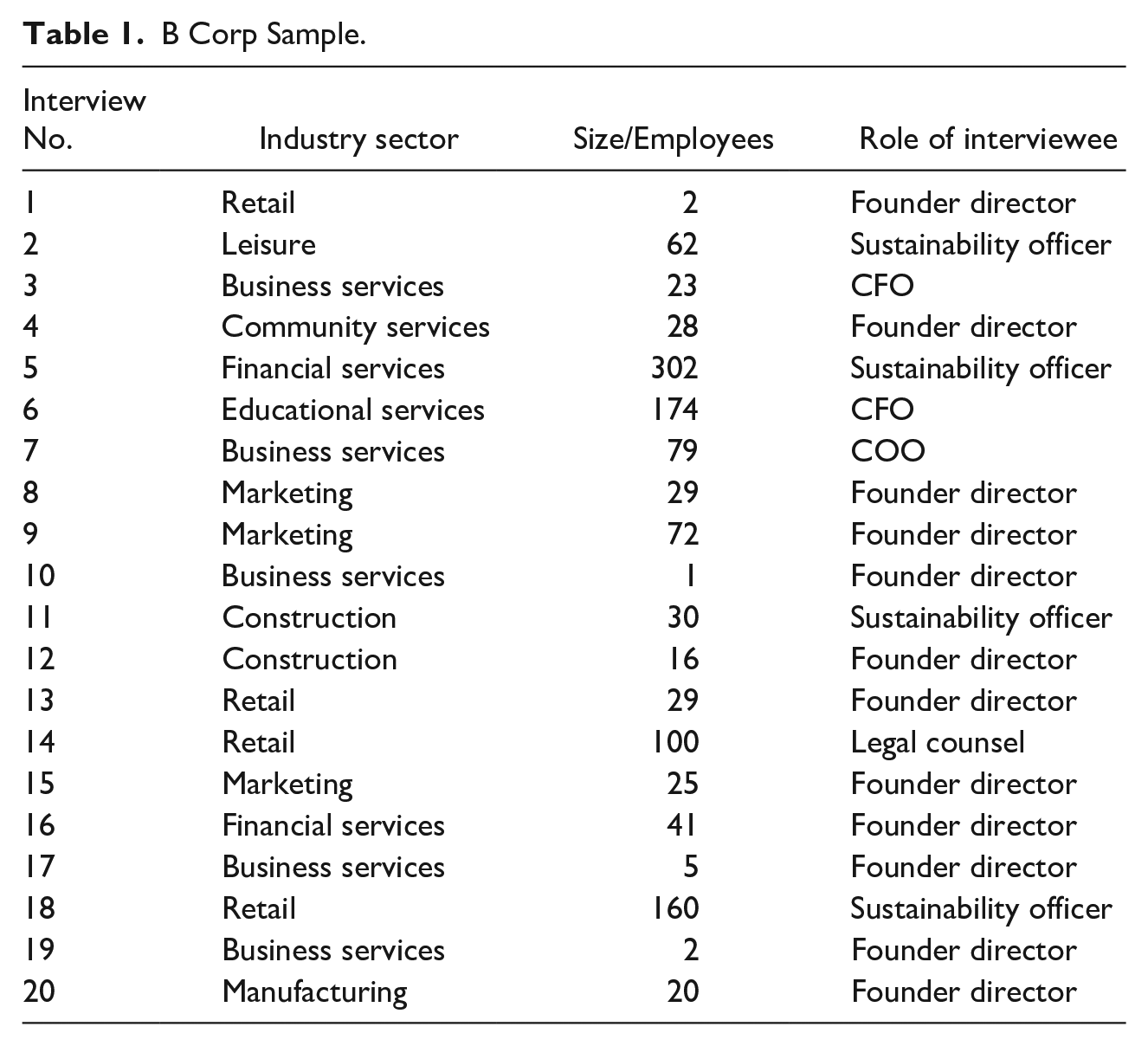
The challenges of accessing governance actors are well known (LeBlanc & Schwartz, 2007); hence, we sought the assistance of B Lab Australia and New Zealand in contacting a range of B Corp leaders. B Lab provided us with an initial email introduction to 60 B Corps, leaving us to follow up independently, again via email, to request and arrange interviews (UTS Ethics Approval No.: ETH21-5893). Our response rate was approximately 33% as, during the second half of 2021, we conducted semi-structured interviews with leaders of 20 B Corps (some interviews obtained through onward recommendations rather than being on the original list). Interviews were conducted through an online video-conferencing platform, and two of the researchers were present at each interview, most of which lasted between 45 and 75 min. Each interview was recorded, and the audio then transcribed while ensuring participant anonymity. The interview protocol comprised semi-structured questions exploring the ways these companies defined, understood, and implemented corporate purpose and stakeholder governance and how the constitutional changes required by B Lab would impact on their decision-making and governance systems. Bearing in mind that interview participants may be selective in the examples they give to researchers, choosing to show the company in its best light, we asked for examples of challenges rather than successes. Some of the companies had already amended their constitution and others were preparing to do so prior to their next certification. Not all interviewees were directors, some were senior executives, yet all had first-hand knowledge of strategic decision-making. As shown in Table 1, the B Corps in our sample ranged from small founder-led companies with no employees, to large multi-national companies and spanned all kinds of industries.
B Corp Sample.
Samples in qualitative research tend to be small to permit in-depth case study analysis (Beckett et al., 2022; Bruni-Bossio & Kaczur, 2022). Crouch and McKenzie (2006) argue that small samples of 15 to 20 facilitate a close association with the participants, enhancing the validity of fine-grained in-depth inquiry. Nearly all qualitative studies rely on the concept of theoretical saturation or information redundancy, that is, sampling can be terminated when no new information is being elicited by adding to the sample (Bowen, 2008). Our interviews elicited rich data and strong themes emerged early on giving us confidence that, at 20 interviews, we had reached theoretical saturation. The primary sources were the interview transcripts, B Corp websites, and any notes or memos written during or after each interview. These were uploaded into the qualitative software platform, Nvivo where they could be coded and analyzed. Our data analysis did not follow a pure inductive approach as traditional grounded theory methods might suggest (Strauss & Corbin, 1997), because our coding procedure was also informed by our theoretical pre-understanding of key concepts. Thus, it is more appropriate to describe our data analysis as abductive in character since it involved back and forth movements between the empirical material and theoretical concepts (Ketokivi & Mantere, 2010). This is a common approach to qualitative analysis as it can reveal inconsistencies between the data and the claims of existing theories, helping to challenge, refine, and extend those theories (Bansal, 2013).
More specifically, the research team’s data analysis process used a three-step process to code and group the data, as demonstrated in Figure 1. Initially, we applied first-order codes based on grounded “in-vivo” terms and phrases found in the data (Charmaz, 2014). Each member of the research team reviewed the data independently in this first stage to then compare and agree on initial codes. Second, we grouped together the first-order codes to form second-order codes that represented dominant themes (Braun & Clarke, 2006). This involved considering the narratives around the shorter first-order codes to understand the context and actions involved (Bruni-Bossi & Kazcur, 2022). Next, we added the abductive element by comparing our grounded themes with the ideas discussed in the literature, going back and forth from the transcripts to explore the theoretical elements that were supported (or not) by our data. This stage of analysis involved each member of the research team in discussion to agree on the emerging theoretical constructs around how purpose helps to implement stakeholder governance.
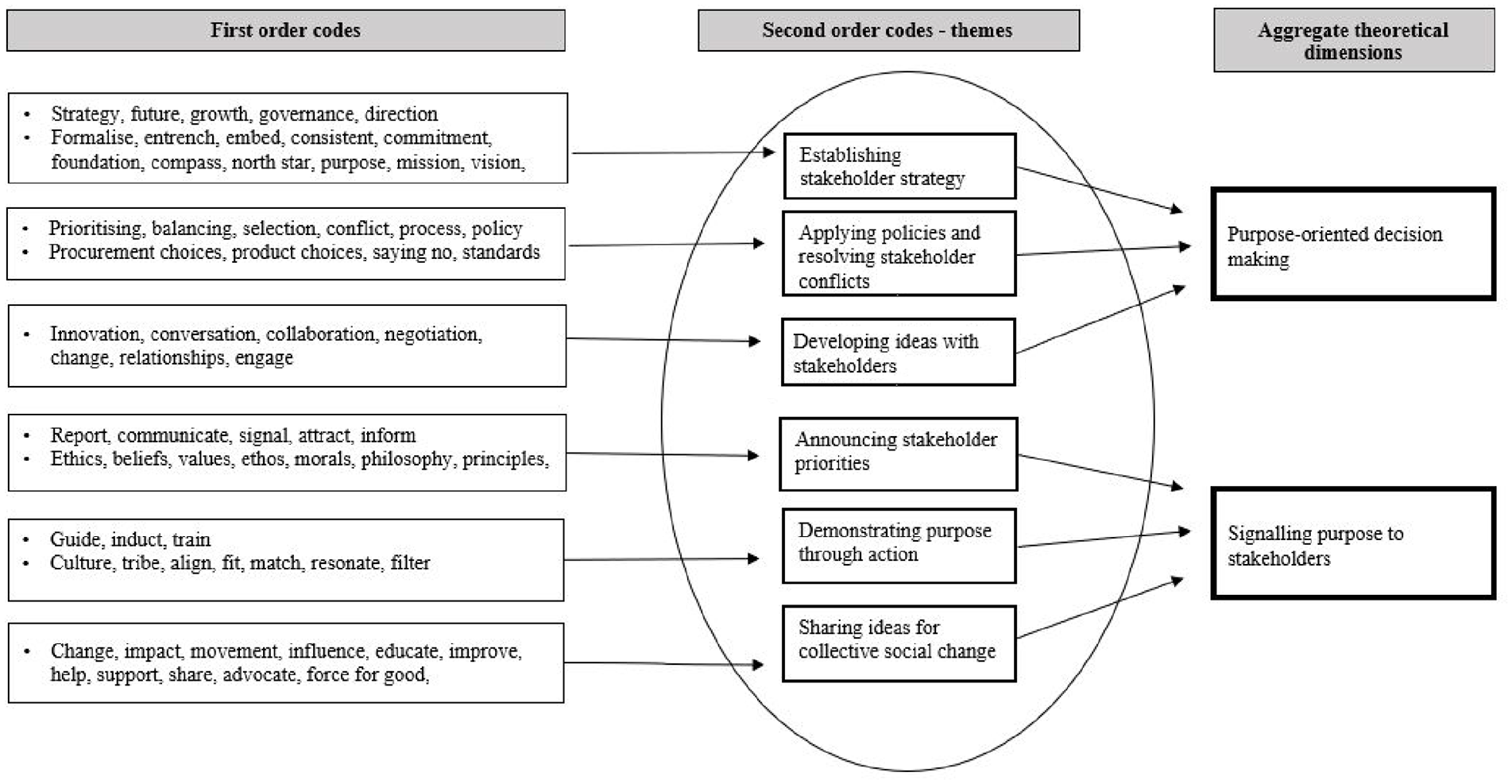
Data Analysis.
Findings
We set out to investigate the role of corporate purpose in stakeholder governance, as exemplified by B Corps. We found that the overarching role that corporate purpose plays in stakeholder governance is to act as a moral compass. It embeds pro-social values into the company’s reason-for-being. Just as the norm of shareholder primacy has given direction to profit-seeking corporate governance, a values-based purpose gives direction to stakeholder governance. We wished to focus in on “how” purpose-oriented stakeholder governance is implemented to better understand the processes and practices involved.
The Roles Played by Corporate Purpose in Stakeholder Governance
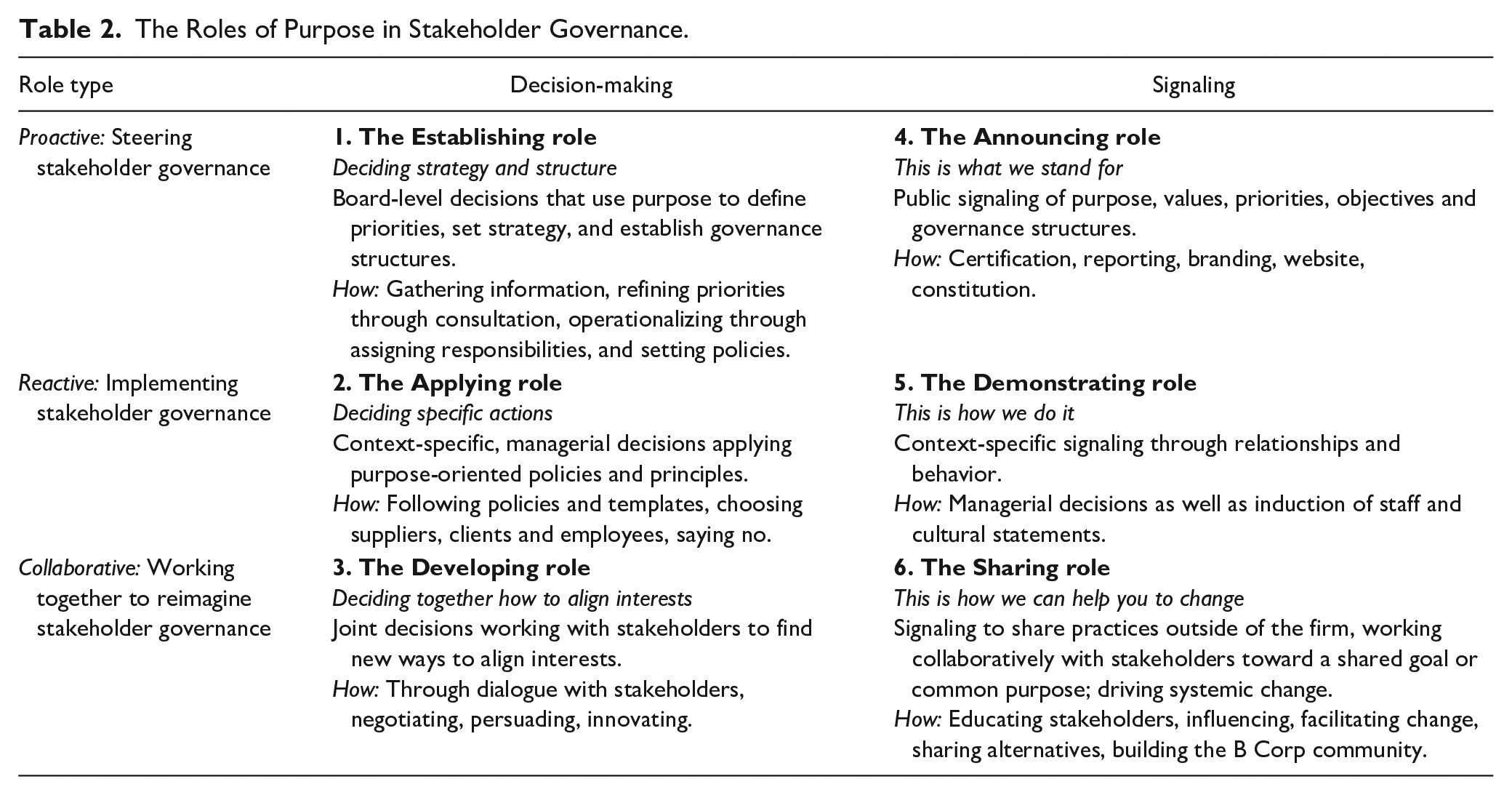
Our qualitative analysis revealed six themes, corresponding to six roles that corporate purpose plays in the implementation of stakeholder governance. As shown in Table 2, three roles involve decision-making and the incorporation or prioritization of stakeholder interests in those decisions, while the other three roles comprise signaling and communication processes. Table 2 demonstrates that these six roles can also be categorized based on whether they are proactive, reactive, or collaborative. The proactive roles form part of board level governance—setting strategy and establishing governance structures to achieve purpose (Establishing role) and publicly signaling the firm’s priorities to potential stakeholders (Announcing role). The reactive roles involve application of these priorities in specific situations, whether during regular stakeholder engagement or when responding to stakeholder conflicts. These form part of day-to-day management decision-making, guided by governance policies and processes (Applying role) and communicated through behavior (Demonstrating role). The collaborative roles extend the influence of purpose outside the traditional boundaries of the firm through developing new ways to work with stakeholders that align interests (Developing role) and actively sharing practices that extend purpose outside the firm (Sharing role). They demonstrate how purpose and stakeholder governance can act as a catalyst for systemic change (Besharov & Mitzinneck, 2023). It should be stressed that the six roles are not mutually exclusive. An activity might fulfill more than one role, for example, strategic decisions can act as signals, and the process of resolving a conflict can build collaborative relationships. As well as identifying these six roles, our data revealed how they are achieved: the detailed processes and actions that underlie implementation of purpose and stakeholder governance. We summarize in Table 2, and discuss further below, these “how” processes and their dynamics, paying attention to the areas where the different roles of purpose interact.
The Roles of Purpose in Stakeholder Governance.
Decision-Making Roles
When we analyzed the narratives around decisions that were guided by purpose, we could see three types: (1) the Establishing role involves proactive decisions that determine priorities, set strategy and establish governance structures to achieve purpose; (2) the Applying role involves reactive, context-specific decisions applying purpose-oriented policies; and (3) the Developing role involves collaborative decisions made together with stakeholders to find new ways to align interests with purpose.
The Establishing Role: Proactive Decisions Setting Strategy and Establishing Governance Structures
The Establishing role involves strategic decisions that proactively steer the course of the company based on long-term goals. There were many processes and tools involved in the making and implementing of these decisions. First, companies went through a process of gathering information through measuring, consulting, and benchmarking to understand their capabilities and objectives. The B Lab impact assessment was an important tool in assessing and auditing performance across social and environmental dimensions thereby helping to set goals.
We have tried the last few years to really almost use it as a metric for us to judge, you know, how we can push ourselves to be better. (#17)
Gathering information assists corporate leaders to refine purpose and determine priorities often through internal workshops or consultation processes.
Management and the board had workshops that have really kind of honed down into what is the purpose? What is our goal that we want to do with the organization, both at a long term, at a macro level, but also in the next five years? (#17)
Finally, purpose must be operationalized, especially in larger organizations, through assigning responsibilities and putting policies in place.
We are actively starting to engage our people more closely on our internal processes and systems to enable us to grow in a more controlled or more streamlined manner, and that has manifested in the general manager operations role. (#18) Now one of our pay principles is that the highest paid and the lowest paid salary will never exceed five to one. and that’s directly from the B Corp process. (#17)
Thus, the Establishing role includes processes that help to understand firm performance across social and environmental domains, determine firm priorities for improvement, and integrate these into firm strategy and structures, thereby establishing a framework that incorporates stakeholder interests into firm governance.
The Applying Role: Reactive Decisions Applying Purpose-Oriented Policies
The second form of decision-making that we identified involved more immediate decisions with direct impact on certain stakeholders. These decisions were guided by the strategies and structures discussed above. For example, formalizing the commitment to purpose and stakeholder governance in the constitution or otherwise was important in permitting and ensuring consistency in decision-making as well as conferring legitimacy on stakeholder-oriented decisions.
It gives everybody the sense that they can make decisions based on the commonly understood principles and they won’t be shut down for doing that. (#11)
Decision-making in this category was primarily achieved through applying purpose-related filters or policies to make choices around who to work with, whether clients, suppliers or staff. The important consequence of this active selection of stakeholders was that it made it less likely that future conflicts would occur. For example, the corporate purpose provided a guide for decisions around whether to make an investment or which product lines to pursue.
What investments do we make, what investments do we not make? Our goal is to try to make our purpose tangible and actually make it a decision-making tool. (#17) There are certain products we forgo because they don’t fit into our ethos. Rather than making something, a cheap product. (#1)
Participant companies had created tools to assist in this decision-making including templates, checklists, and interview questions that they would apply when deciding whether to enter into a contract with a potential client or employee.
It just made me think about that no-go template we have. So, we do have a structured way of reviewing whether we take on a job, whether we actually put forward a proposal for a job. (#18) Some of the interviews will be just about figuring out whether the people are a match for the type of company that we are (#7)
Of course, not every conflict can be avoided, and our interviewees gave examples of where their purpose had facilitated decision-making to resolve stakeholder conflicts. Many companies had faced conflicts between client demands and employee well-being, or between client needs and shareholder profits, and their purpose had helped them to stick to values that balanced these interests or prioritized particular stakeholders in accordance with corporate values.
So we do some work with some very large companies who basically go, “Well, we want this done.” And we’re like, “That’s going to be a 50-hour week for someone. No.” . . . we will always prioritise our internal team. (#7) Obviously, the members are much better off, the lower fees are, and shareholders are much worse off, and so, constantly, every few months, we’re looking at our projections on where we want our fees to be. (#17)
Thus, the decisions we placed in the Applying role were those that involved B Corp management making decisions by applying firm priorities in a particular situation. They might be prioritizing certain stakeholders over others or working to achieve a balance that has been pre-determined through the Establishing role. Here, purpose guides the way that stakeholder interests are managed.
The Developing Role: Collaborative Decisions to Find New Ways to Align Interests
The third form of decision-making was very interesting as it involved using a shared sense of purpose to drive cooperative ways of working together with stakeholders through negotiation or innovation. Cooperative decision-making connotes working together due to “mutually compatible interests” to achieve individual or private goals (Castañer & Oliveira, 2020, p. 975). Rather than say no to a client or supplier, it was often possible to negotiate to find innovative solutions to align interests. For example, “we got them to agree to go carbon neutral for the website” (#9) or, “we seek all avenues to see if they can find a recycled fabric or an alternative to their current way of making” (#13).
What defined these decisions was that they were not one-sided but involved two-way engagement and purposeful cooperation or collaboration for mutual benefit. For example, the unusual circumstances of the COVID-19 pandemic had led B Corps to work with their customers or employees to find innovative solutions to business problems: In COVID, we decided to approach all our customers and suggest they stop paying and take account of where they were, and then recommence their payments. And so by doing that, we’ve actually built a huge amount of goodwill with our customers. (#5) The accountant said, “I need a list of eight people. Who are you going to let go, because you don’t have the money to do this, and you don’t have the future sales and this is not going to work.” And, of course, job keeping at that point was the idea . . . And so how we balanced it is we actually went back to the team and said, pretty plainly, we want everybody to take a hit, by reducing your hours by 20%, and if you want to take that as leave and you’ve got leave, you can. (#9)
These Developing role decisions can be seen as ways to resolve stakeholder conflicts; however, their nature is fundamentally different from that envisioned by many stakeholder theorists. It is not a question of the firm single-handedly considering stakeholder interests and making choices over who to prioritize. Our research reveals stakeholder governance as much more nuanced and relational than previously imagined, moving toward the cocreation of solutions on a task-by-task basis (Ferraro et al., 2018; Kaplan, 2023). As one interviewee commented, “It’s a two-way trust system. I don’t think stakeholder governance or engagement should ever be a one-way street and needs to be on both sides” (#6). Purpose provides new perspectives on stakeholder relationships, enabling stakeholder input into decision-making.
Signaling or Communication Roles
A strong theme emerging from our data, that has not yet been highlighted in the governance literature, is that corporate purpose can be used proactively to reduce potential stakeholder conflicts through signaling (Connelly et al., 2011). Importantly, this includes signaling to both internal and external stakeholders. If stakeholders (such as potential future customers, employees, suppliers, or investors) are fully aware of the firm’s purpose, they can make an informed choice about whether to interact with the firm. Thus, stakeholder governance incorporates processes that communicate the firm’s priorities, permitting stakeholder self-selection or attraction of supportive stakeholders. The overt and transparent commitment to purpose adopted by B Corps, if signaled effectively, means that they are unlikely to then attract employees, investors, or clients who disagree with their objectives. We identified three signaling roles (numbered Roles 4–6 in Table 2): (4) the Announcing role: proactive public signaling of purpose through reporting, branding and other communications; (5) the Demonstrating role: reactive signaling through specific relationships and behavior; and (6) the Sharing role: collaborative signaling to share practices through education or advocacy.
The Announcing Role: Proactive Public Signaling of Purpose
The Announcing role is an extension of the Establishing role, in that, once a clear purpose has been defined, companies will communicate this widely. They do this using their website, public reporting, and branding. Interviewees also felt that the required changes to their constitution provided a means of communicating company purpose and values to future investors, helping to entrench values through periods of growth or leadership change and prevent “mission drift” (Ebrahim et al., 2014; Grimes et al., 2019). A clear purpose increases the likelihood of attracting investors who accept the company’s balanced mission, thereby reducing the risk of future conflict: I think embedding it into the legal sort of thing, so say for example in the future we want to expand, and we want to grow, we want to borrow capital. I think having it embedded there, if somebody comes in, they know this is what they’re coming to. (#1) We did a cap raise and we bought in some new shareholders this year. I think because this was in our constitution, that would obviously have an impact on what type of shareholders we can bring in. (#2)
Communication of corporate purpose was also directed to customers and suppliers, often to pre-empt any conflicts and ensure everyone was on the same page. This might be achieved through marketing or branding.
Certainly, with this marketing rebrand we’re going to say it loud and proud, “This is who we are, and this is what we do, and we’re unashamed about it.” That brings the right type of clients to us. (#8)
Another benefit of formalizing and communicating purpose identified by participants was that it helps firms to attract and retain employees who value pro-social action and are aligned with corporate values (Henderson & Van den Steen, 2015; Mourkogiannis, 2008).
I guess there’s a there’s a natural filtering there as well. Those people wouldn’t apply if they didn’t resonate with something with respect to what we have in place. (#18)
Thus, we found that public signaling of purpose, through a variety of means, was being used proactively by B Corps to avoid stakeholder conflicts by attracting supportive stakeholders.
The Demonstrating Role: Reactive Relational Signaling Through Behavior
The Demonstrating role is an extension of the Applying role in that the day-to-day application of policies and procedures demonstrates the values of the firm to specific stakeholders. Making a decision is one thing, but then explaining and communicating the reasons and principles behind that decision promotes wider learning. Within the firm, this signaling plays an important part in building organizational culture and embedding purpose into relational behavior. Purpose needs to be communicated to new staff through training and induction processes: It’s on the website. But it’s also in internal documentation as well. We have brand guidelines and that sort of thing, it’s all in there. And we have our values and mission, and we also do training on it, so it’s in presentations as well. And it’s part of induction. (#9)
Interviewees also explained how they communicate their values to clients, suppliers, and potential employees sometimes with the help of specific tools: We’ve got a new client kit, an onboarding kit, and it’s all about how we work and why we are different from other agencies and how you can work best with us. (#15)
This signaling is important in confirming the firm’s identity and culture, thereby reconciling potentially competing logics, for example, financial success versus environmental protection. The Demonstrating role facilitates socialization processes, whereby desired behaviors, that pursue purpose and take stakeholder interests into account, are demonstrated and encouraged through training, promotion, and incentive systems (Battilana & Dorado, 2010).
The Sharing Role: Collaborative Signaling to Share Practices
As well as signaling to attract and retain stakeholders with similar values, we found that B Corps use signals to educate, facilitate and disseminate ideas for purposeful business. If the Announcing role communicates “this is what we stand for” and the Demonstrating role, “this is how we do it,” the Sharing role communicates, “this is how we can help you to change too.” B Corps are engaged in long-term relationship-building with like-minded suppliers, customers and investors, guided by a mutuality of purpose and a goal of wider system-change (Besharov & Mitzinneck, 2023). As discussed in the Developing role, communication is often a two-way process rather than a one-way signal permitting the building of transformational relationships based on collaboration, learning, and collective sense-making (Bowen et al., 2010).
Many B Corps were actively using these relationships to educate and influence stakeholders in order to widen and extend their pro-social impact, thereby building collective action within the B Corps community. As demonstrated by the Developing role, potential conflicts do not have to be resolved in favor of one stakeholder or another, a win-win situation can be found through collaborative discussion, compromise, innovation, and shared values. Here B Corps are actively and openly aiming to persuade and change client behavior.
We can come from the outside throwing rocks or we can be on the inside of the tent creating change. (#9) We stand for this. This is our purpose; we stand for this. We can’t profit from you; we can’t work with you. We could only help. We would only work with you if you were interested in changing. (#8)
Firms were driven by a desire to influence and educate, spreading the word that you can combine profit with social or environmental purpose, similar to the way some companies use their corporate social responsibility reports to influence external stakeholders (Yang & Basile, 2022). These findings demonstrate the social movement aspect of the B Lab model whereby the definition of a pro-social corporate purpose helps to transmit the “business for good” concept beyond the boundaries of the firm through stakeholder relationships.
That is where we saw an opportunity to have a far greater impact on both the industry, and the broader public, by acknowledging, that people aspire to what [we] produce. (#12) The influence we have over all those small businesses and operators within the industry. And so just that alone, the opportunity to influence others to think about using business for good, as well as using our various platforms to talk about prioritising, and purpose and impact . . . (#5) We had so many suppliers who made an effort, who moved on and looked for paper tapes and all this stuff. Which is great, I think helping each other to develop and improve as well. (#1)
This is how purpose-led companies can act as a catalyst for wider changes in behavior outside of the firm, the systemic change envisaged by the B Lab movement (Besharov and Mitzinneck, 2023). These educative efforts extend cooperation to working together for a shared goal or common purpose. They encompass norms of reciprocity, solidarity, and mutual assistance, supported by shared understanding of language that facilitates collaboration (Castañer & Oliveira, 2020).
Discussion
Amis et al. (2020) pose the question of whether stakeholder governance can be understood as (1) a bargaining game between stakeholders; (2) a mediating forum; (3) a way of setting priorities; or (4) a conflict resolution process. Each of these approaches assumes that stakeholder governance is centered on resolving conflict. Indeed, the question for Amis et al. is “how firms can reconcile the conflicting economic and non-economic interests of its multiple stakeholders.” Our research suggests that this may be the wrong question if we are to understand the full scope of stakeholder governance. Reconciling conflicts is only a small part of the puzzle. Our findings reveal stakeholder governance as a much more proactive and collaborative process extending into collective action (Kaplan, 2023; Mahoney, 2023). It is not something that occurs only in a conflict situation, rather it hones in on the “jointness of stakeholder interests” (Freeman, 2010, p. 7). Indeed, the processes of stakeholder governance detailed above primarily involve making decisions and actively communicating priorities in a way that avoids conflict situations and fosters collaboration with stakeholders. We contribute to the literature by extending the concept of stakeholder governance to include the relational dynamics of cooperation and collaboration that in turn facilitate innovation and cocreation of value (Besharov & Mitzineck, 2023; Kaplan, 2023).
We see B-Corps as using corporate purpose to proactively set and communicate stakeholder priorities, build pro-social culture through consistent and transparent decision-making, and extend the “business for good” movement through active cooperation and collaboration, thereby demonstrating the “role of firms in shaping the broader economic, political, social and natural systems in which they operate” (Besharov & Mitzinneck, 2023, p. 240). In addition to understanding the decision-making and signaling roles of corporate purpose, we provide evidence of the “how” of stakeholder governance by drawing out the detailed processes and tools used to implement and achieve purpose-oriented governance.
Roles 1 and 4, the Establishing role and Announcing role, show that the gathering of information is an essential precursor to stakeholder governance just as it is in corporate governance. Strategies and public communications must be based on valid information, which means that processes must be put in place to ensure that the board receives relevant information both from and about its stakeholders. In larger companies, this requires surveys and formal engagement processes, but in smaller firms it may involve direct discussion. The B Impact assessment tool helps companies to understand the type of information they need and provides a way to measure progress. This information can be used to make strategic decisions and as the basis for signaling. It provides a platform for consultation with internal stakeholders on corporate purpose and can influence internal policies, such as remuneration or diversity and inclusion policies, helping the firm to set key performance indicators for environmental or social goals that communicate clear expectations. B Corps use information-based signals to communicate their quality and intent to external stakeholders (Beyhan et al., 2024; Y. Kim, 2021) who are then able to better understand the B Corp’s pro-social corporate purpose and respond. Our data show how B Corps engage in signaling their purpose through a variety of means including the B Corp certification, changes to corporate constitutions or business structures, governance frameworks and policies, and through branding and marketing. Each of these processes helps to communicate the organization’s purpose to different stakeholder groups.
Roles 2 and 5, the Applying role and Demonstrating role, show how decision-making and signaling occur internally within an organization to create an appropriate organizational culture. This is supported by the Establishing role, which embeds the organizational purpose into internal policies and processes so that it ensures consistent decision-making across the organization. It is only by actively demonstrating the application of policies through day-to-day practice that values become reality and are socialized into the organization (Battilana & Dorado, 2010). To enable stakeholder governance to be implemented, corporate purpose must be embedded into corporate governance processes and remuneration schemes as well as into hiring procedures, procurement guidelines and client contracts. Demonstrating this through action is vital in bringing policies to life and giving them meaning.
Roles 3 and 6, the Developing role and Sharing role, show that although most of the time B Corps operate using a hub and spoke governance model, with decision-making remaining with corporate leaders, there are circumstances when this extends toward networked governance (Bridoux & Stoelhorst, 2022). Decision-making is more dynamic and relational than might be expected: leaders are not making decisions about stakeholder interests in isolation; they are engaging with stakeholders, perhaps negotiating a little and resolving issues through two-way communication akin to Bowen et al.’s (2010) concept of transformational stakeholder relationships. These processes of dialogue and negotiation might be easier in smaller firms where there is a high level of skill and trust placed in the managers liaising with stakeholders. Our data demonstrate the relational nature of stakeholder governance and how corporate purpose facilitates cooperative and collaborative behavior through information exchange and the building of shared language and values. Open sharing of purpose-oriented practices to those interested within the same industry provides an educative platform, which extends purpose outside of the firm. This Sharing role may be more easily and safely managed than the context-specific innovation that occurs through the Developing role.
Overall, corporate purpose can be seen as a governance tool that helps companies to be proactive in finding supportive stakeholders and avoiding those who may put their mission at risk. It is the company steering stakeholders (either away from or toward the company) rather than the stakeholders steering the company. This might raise questions of ethics and accountability if management were to use their power in a self-interested manner. We should not forget the problems of managerial hegemony common in the 1980s and 1990s where corporate managers were able to manipulate stakeholders to avoid accountability (Huse & Eide, 1996). Nevertheless, we believe that corporate purpose in B Corps facilitates a form of stakeholder selection whereby the stakeholders, not corporate managers, are doing the selecting. Signaling of corporate purpose is the mechanism that permits stakeholders to determine whether they wish to have a relationship with the corporation based on the terms signaled by that corporation. This process significantly reduces risk for the corporation in terms of potential shareholder complaints around their pro-social purpose.
Conclusions
Our aim in this article was to empirically explore the B Lab model of stakeholder governance as implemented in B Corps in Australia and New Zealand. Our observations shed light on how this purpose-oriented model assists corporate leaders in attracting supportive stakeholders and building collaborative relationships with them, revealing the “black box” of stakeholder governance as not simply about conflict resolution but also proactive signaling and sharing.
Implications for Theory
Theoretical contribution is not just about filling the gap in the literature but about changing the way scholars conceptualize phenomena (Bansal & Corley, 2011; Crane et al., 2016b). Our contribution is therefore threefold—firstly we demonstrate how stakeholder governance can be given direction by combining a commitment to stakeholders with an organizational purpose, permitting new perspectives on managing stakeholder interests. Purpose can provide direction on how the firm balances or prioritizes the different interests of its stakeholders, providing an alternative to shareholder primacy. Secondly, we show that stakeholder governance should not be explained simply as a reactive process of considering different stakeholder needs or demands and resolving conflicts. A firm does not have to passively acquire or inherit a bundle of stakeholders; rather, the firm can proactively seek stakeholders who will help to further the corporation’s purpose and provide vital resources. Our theory is that stakeholder governance, when guided by purpose, is not so much a conflict resolution process but a proactive method of stakeholder selection that reduces the risk of shareholder complaints. As shareholder power is arguably still entrenched within the corporate law of many countries, the B Corp model uses private law mechanisms (such as contract) to reduce that power in a voluntary manner (Klettner, 2024). In other words, by building consensual agreements with investors, customers, suppliers, employees and others that accept and support the firm’s pro-social purpose, that purpose gains some protection from market pressures to prioritize profit.
Lastly, we show that relationships with stakeholders can be collaborative rather than based on power or conflict, driving joint responsibility and triggering systemic change (Onkila, 2011). Signaling is a vital part of the mechanism that enables the building of these relationships, which has to date been somewhat overlooked as an element of governance. While corporate law sets out a multitude of rules around communication between the firm and its shareholders, communications processes between the firm and wider stakeholders remain mostly voluntary and rather ad hoc. This research reveals some of the practices and processes involved in the signaling of purpose and their consequences for cooperative behavior. We suggest that discussion of these signaling processes must be more central within debates over stakeholder governance.
Implications for Policy and Practice
B Corps in Australian and New Zealand provide a helpful template for purpose-led enterprise based on a small adaptation to the standard for-profit corporate constitution. This approach may not be a first choice in countries with dedicated legal structures for hybrid business, such as the United States and France, yet it provides an alternative that is possible in almost any jurisdiction. By imprinting a specific corporate purpose into the DNA of the corporation, the B Lab model seeks to re-imagine stakeholder governance and ensure that corporate responsibility moves from the superficial or symbolic toward substantial cultural change, making mission drift less likely and entrenching core values as companies grow (Ebrahim et al., 2014). Even without making changes to the corporate constitution, companies are free to use B Lab’s impact assessment tool to help them identify and implement policies that protect against social or environmental harm. Hence, policymakers have an opportunity to work with social movements such as B Lab to collaboratively transform corporate mindsets toward responsible, purpose-driven stakeholder governance. This, in turn, has the potential to trigger system change, at least within certain markets and industries as the influence of each B Corp spreads through supply chains.
Limitations and Suggestions for Future Studies
Limitations arising from the nature of our sample include the fact that some of the B Corps were small- or medium-sized private companies. Small, privately owned companies are not faced with the same share-price pressures as publicly listed companies and are not subject to corporate reporting requirements that would necessitate extensive signaling of performance. In these circumstances, maintaining legitimacy and reputation through other signaling mechanisms including direct stakeholder engagement may take on increased significance. Indeed, the proactive, reactive, and collaborative signaling mechanisms revealed by this research may be particularly helpful for new start-ups and small social purpose organizations. Signaling of purpose can be relatively easy in a small founder-led start-up but requires more structure and process to remain effective and authentic in a larger organization. Future research might explore further the changes needed to ensure effective internal and external signaling as an enterprise grows and matures, revealing different stages of stakeholder governance over time. In addition, the size of our sample was designed to enable in-depth discussions with company representatives but was not large enough to permit analysis of relationships between our themes and B Corp features such as industry, size, or ownership structure. Future research, perhaps using surveys to cover a much larger sample, might be able to explore these factors.
Finally, the context of our study prevents the separating out of corporate purpose and B Corp certification. First, the participants in our study had been able to make a commitment to purpose and stakeholder governance in their constitution, meaning that they already had shareholders sympathetic to their pro-social purpose. Not all companies wishing to pivot toward a pro-social purpose will be able to steer 75% of shareholders in this direction (the number needed for a special resolution to amend the constitution). Second, our participants were committed to the B Corp certification process, which requires an assessment of their performance across metrics such as employee well-being, diversity and inclusion, environmental protection, and community impact (Villela et al., 2021). Without this assessment process, accountability to corporate purpose can be lacking, even in jurisdictions with special legal structures (Levillain & Segrestin, 2019). Even if a company was able to clear the first hurdle of implementing the B Lab constitutional clauses, this may not result in committed behavior without the accompanying B Corp certification process. Thus, future research might explore how other types of corporate reporting could work in tandem with purpose commitments to improve accountability. The B Lab model shows how stakeholder governance can be achieved but we may need stronger corporate social responsibility regulation to provide the motivation for a significant shift across mainstream corporate governance.
Footnotes
Acknowledgements
We would like to thank B Lab Australia & Aotearoa New Zealand, as well as the B Corp leaders who participated in our study, for their time and enthusiasm in supporting this research.
Declaration of Conflicting Interests
The authors declared no potential conflicts of interest with respect to the research, authorship, and/or publication of this article.
Funding
The authors received no financial support for the research, authorship, and/or publication of this article.
Ethics Approval
The questionnaire and methodology for this study was approved by the Human Research Ethics committee of the University of Technology Sydney (Ethics Approval No. ETH21-5893). Informed consent was obtained from all individual participants included in the study.
