




Abstract
Organizational values are intuitively important to business life, yet we know little about what happens when there is a clash of values between businesses and stakeholders. What we do know stems from two often disconnected streams of literature, one which has taken a descriptive empirical approach and another which has valorized a normative theoretical perspective. In contrast, and by means of drawing on the empirically accessible context of the small firm in tandem with Deweyan ethics, this article evidences the process by which values conflict arises and how firms seek to respond via a process of inquiry. Through drawing on pragmatist theorization to bridge this descriptive–normative dualism, insights into the nature of values conflict, including the maintenance of moral habit and the fluidity of “correct” moral responses are outlined.
Keywords
Values are intuitively important to business life. Values in business per se have long been of interest to business and society scholars (Agle & Caldwell, 1999; Hauserman, 1999). Scholars have argued that values underpin business practice at the most fundamental level of value creation (Donaldson, 2021) and through the practice of management and leaders (Ciulla, 2020; Sharfman et al., 2000). Business and society research examining values conflict, defined as the occurrence of normative dissonance between the values of two or more parties (Aubert, 1963; Pless et al., 2021), is however, still in the relatively early stages (Arenas et al., 2020; Risi & Marti, 2022; Vogeley et al., 2023).
As part of a broader literature focusing on the inherent conflict that exists between stakeholders (Hatherly et al., 2020; Zietsma & Winn, 2008) and in contrast to more traditional investigations into values (Jonsen et al., 2015; Marinova & Park, 2019), this stream of research accounts for the dark side of values, including their role in perpetuating grand challenges (Risi & Marti, 2022) and generating division, exploitation and suffering (Kraatz et al., 2020). In response, some scholars have sought to provide guidance to allow firms to engage with and manage such plurality and conflict. Van Der Linden and Freeman (2017) emphasize the importance of ordinary language, and the implicit evaluative content therein, in situations where multiple values are present and the means by which thick evaluation can be used to consider and account for differing values within decision-making. Equally, Garst et al. (2021) unpick how firms respond to societal values, highlighting that firms take divergent approaches to values reflexivity, either engaging in a responsive approach where they are open to adjusting their practices or a defensive approach characterized by resistance to values changes. This work has nonetheless broadly bifurcated into that which has taken a descriptive empirical approach to examining the outcomes of values conflict (e.g., Vogeley et al., 2023) and that which has taken a normative theoretical approach to argue in favor of morally desirable or principled responses to values conflict (Dawkins, 2015; Schormair & Gilbert, 2021). However, these two streams of work have remained largely disconnected, and accordingly, we lack a detailed understanding about how firms seek to deal with values conflict in practice and associated insight into where descriptive and normative approaches to responding to values conflict overlap. To address this lacuna and bridge this descriptive empirical/normative divide, we draw on theory from the American pragmatist movement alongside empirical data from the small and medium-sized firm context (herein referred to as small firms). Recognizing their economic and social importance, small firms have become a vibrant and growing focus for business and society research, particularly in the last two decades (Brammer et al., 2022), unusually penetrating both Global North (cf. Burton & Goldsby, 2009) and Global South contexts (Jamali et al., 2017). Defined in the UK/European context as those organizations in possession of fewer than 250 employees (European Commission, 2022), small firms represent over 90% of businesses globally (The World Bank, 2020). The small firm setting is particularly useful when considering values conflict given the key role that values play in small firm ethical decision-making (Oldham & Spence, 2023; Schaefer et al., 2020) and the power asymmetries that such firms frequently face within stakeholder relationships which often lead to the application of coercive moral pressure on their values or moral practices (Spence & Bourlakis, 2009).
Drawing on John Dewey’s pragmatist thought, and a pragmatist tradition of breaking down dualisms (Gross, 2009), the paper seeks to draw together the descriptive and the normative via acknowledgment that, for situated decision makers, no such distinction exists. From such a perspective, context provides rich color and nuance to ethical issues and ethical judgment, such as that required in response to values conflict, and is located within a process-based view of moral engagement and reasoning known as inquiry. Our purpose is to answer the research question: What drives values conflict between firms and their stakeholders and how do firms seek to maintain values fidelity in response? We identify three drivers of values conflict—values salience, values hypocrisy, and values praxis non-conformity—and a range of responses that firms seek to enact to ensure that values fidelity is maintained. In drawing on pragmatist ethics, we conceptualize the account that such firms provide where responses to values conflict are considered to be dynamic and iterative processes heavily shaped by context which are triggered by disruption to moral habit. In so doing, we seek to provide a nuanced theoretical contribution to the emerging vein of research into inter-firm values plurality and conflict. This contribution emphasizes how, from a moral standpoint, values conflict can and arguably ought to be dealt with via a process of moral reflexivity, so-called moral inquiry, as suggested by recent work within the field (Pless et al., 2021; Van Der Linden & Freeman, 2017), while demonstrating the worth of not drawing lines between descriptive and normative responses to values conflict. In doing so, the paper contributes to a growing body of research that has drawn on pragmatist theory to (re)frame issues of ethics and social responsibility (Pouryousefi & Freeman, 2021; Risi, 2020).
To this end, the paper begins with a discussion of values and values conflict. An overview of John Dewey’s application of pragmatist theory to ethics is then provided alongside the empirical setting and methodological grounding of the study. Drivers of values conflict and the strategies deployed by firms to manage this conflict are outlined within the findings section before the contributions of the paper are discussed, where an emphasis on the value of pragmatist ethics to the issue of values conflict is highlighted.
Values Conflict
Values are widely regarded as normative trans-situational beliefs concerning desirable modes of conduct or end-states of existence (Rokeach, 1973). They possess an inherently normative component, such as in the case of responsibility, integrity, or care, and “embody a moral imperative” (Tsirogianni & Gaskell, 2011, p. 442). By contrast, organizational goals are broadly defined as targeted organizational outcomes, such as efficiency, productivity, or growth and profit (England, 1967) that may have normative implications but are primarily distinguished by the functionality of their character, intimately connected as they are to the achievement of the organization’s designated or stated function or mission (Mohr, 1973). While some research has argued that values are meaningless marketing tools with little impact on organizational practices and are epitomized by “bland, toothless, or just plain dishonest” corporate values statements (Lencioni, 2002, p. 113), a significant body of evidence has accrued with respect to the role that values play in guiding individual decision-making (Finegan, 1994; Weber, 2019). A parallel stream of research has evidenced the salience of values in determining the moral stance of organizations, notably through their role in shaping the norms and culture present within organizations, for instance, related to practices and decision-making (Agle & Caldwell, 1999; Gehman et al., 2013). Values have been considered as analogous to a moral compass that guides decision-making and is of particular relevance when social actors are faced with navigating complex and uncertain environments (Jonsen et al., 2015; Treviño et al., 2006). This occurs by means of their shaping of perception and interpretation of an issue or situation while also providing both prioritization of a course of action and moral motivation to follow through in enacting moral action (Schaefer et al., 2020; Treviño et al., 2006). Importantly, values fidelity characterized by adherence to a consistent set of values is an important normative concept closely linked to that of integrity, where moral virtue is associated with a consistent unimpaired moral state (Jacobs, 2004). Within the real-world confines of values practice, it must be noted, however, that values fidelity is often a relative and aspirational absolute goal or practice given conflicting demands, interests, and values. At the organizational level, research indicates that values are pivotal to how organizations determine their moral responsibilities toward not only external stakeholders but also internally through their embeddedness within organizational culture, as they communicate to employees what is valued within their organizational environment (Bourne & Jenkins, 2013; Marinova & Park, 2019).
An emerging vein of research has recognized that although values have the power to unite, dominant values including economic freedom or purity perpetuate grand challenges, such as social inequality (Risi & Marti, 2022), and that values can be exploited for division and suffering (Kraatz et al., 2020; Risi et al., 2023). In doing so, this literature emphasizes that incompatible values are a key source of conflict within organizational and institutional life (Brand et al., 2020; Kraatz et al., 2020). As Risi et al. (2023) indicate when it comes to corporate social responsibility, “given value pluralism within a particular context, businesses increasingly find themselves torn between heterogeneous and potentially conflicting values concerning ‘right and wrong’ as expressed by various societal stakeholders” (Risi et al., 2023, p. 15). Such research represents a shift from a focus on conflict incited by factual disagreement or conflict of interests to conflict concerning disagreement or challenge of normative beliefs of right and wrong (Garst et al., 2021), characterized by “dissensus concerning the normative status of a social object” (Aubert, 1963, p. 29). In contrast to values congruence, characterized by a compatible alignment of moral principles (Bundy et al., 2017), values conflict is typically marked by both parties bringing what they likely believe to be a “morally correct” set of beliefs to a situation that are in practice mutually incompatible (Pless et al., 2021). Drawing on the work of (Aubert, 1963; Pless et al., 2021), we conceptualize values conflict as the occurrence of normative dissonance between the values of two or more parties in relation to the nature or importance of a value as well as the means through which values ought to be enacted via organizational practices. This conflict is often acute when firms operate outside of their standard area of operations, socially or geographically speaking, where they may interact with stakeholder groups, which possess strongly contrasting values to their own (Donaldson, 1996). For example, Calvano (2008) highlights the fundamental disagreements that exist relating to key values including economic rationality, profit maximization, environmental protection, and quality of life that often arise between multi-national corporations and local indigenous communities. Such conflict is often attributable to or compounded by the perception of hypocrisy or duplicity in instances where professed values do not align with expected or claimed behavior or actions as perceived by outsiders, such as stakeholders (Graham et al., 2015). While values conflict may often primarily be associated with fundamental disagreements between the importance of values, often termed inter-values conflict, values conflict may also occur where agreement between fundamental values exists, but disagreement is present in relation to how a value may be best operationalized (Garst et al., 2021). Critically, both forms of conflict, especially when present in stakeholder relationships where power asymmetries exist, often represent a threat to the values fidelity of the firms or other stakeholders through the forceful downgrading of the importance of values or alteration of the means by which values are operationalized.
Research focused on the meeting of incompatible values within an organizational context has bifurcated into that which has provided rich empirical description of responses and associated outcomes (Garst et al., 2021; Vogeley et al., 2023) and that which has taken a more normative theoretical approach, stipulating what should be done in such situations (Arenas et al., 2020; Dawkins, 2015; Schormair & Gilbert, 2021; Van Der Linden & Freeman, 2017). While this body of research has provided admirable insight into values conflict, we are lacking an empirically grounded and contextualized account of values conflict and how organizations seek to respond to them (Risi et al., 2023); one which acknowledges that in the real world “descriptive” and “normative”—from the perspective of the decision maker—are one and the same, and thus normative insights can be derived from descriptive accounts of practical decision-making. An important benefit of taking such an approach is that because real-world ethical decision-making is often far less perfect than that suggested by normative theoretical literature, by studying the descriptive, we can gain more realistic normative frameworks for ethical decision-making. For example, while valuable theoretical suggestions have been made for reconciling values through the use of an arbitrator (Dawkins, 2015) or discursive value-sharing processes (Schormair & Gilbert, 2021), in reality powerful stakeholders may be unwilling to compromise and therefore marginalized firms or stakeholders may only have limited resources and control over their own actions. Accordingly, this work draws on the pragmatist tradition of breaking down dualisms between theory and practice in seeking to unify such normative and descriptive approaches and in doing so gain valuable normative insights from descriptive accounts of values conflict, in the form of both drivers and responses. To theoretically frame values conflict and accompanying organizational responses, John Dewey’s work on pragmatist ethics is outlined in the following discussion before the methodological approach taken to empirically research values conflict in small firms is introduced.
Deweyan Pragmatist Ethics
To theoretically frame the phenomenon of values conflict, we employ John Dewey’s work on the application of pragmatist thought to ethics. Such a theoretical standpoint legitimizes a focus on and framing of values conflict, especially within the small firm setting given typical close stakeholder proximity, as highly emotive issues grounded in real-world contexts that require attention and resolution (Kujala et al., 2022; Spence & Lozano, 2000), thus acknowledging the continuity between descriptive and normative ethics (Risi, 2020). As in practice, values conflict cannot simply be resolved through the prescription of fixed, rational normative solutions, as has often been suggested within previous research (Hamilton et al., 2009), pragmatism is a decidedly useful tool. In particular, from a pragmatist perspective, the practice of moral integrity, and thus values fidelity, is not static, but subject to revisability through a process of evaluation, action, and learning (Jacobs, 2004), thus allowing a realistic and nuanced standpoint from which to examine phenomena and contexts that are both fluid over time and space. Related to this, pragmatism seeks to account for the role of context and experience—both pertinent concerns within the small firm environment given the heterogeneity of such firms as well as the importance of experience, markedly that of owner–managers, in maintaining and managing small firms (Jansen et al., 2013).
Classical pragmatism developed over the late 19th and early 20th centuries and was grounded in a rich philosophical heritage, including that bestowed by the German Idealists and British Enlightenment-era thinkers, with the movement’s title derived from the Greek “πράγμα,” meaning action (James, 1907). Although expansive in nature, pragmatism was broadly predicated on a number of unifying tenets. Principally, a commitment to anti-foundationalism “as neither the whole of truth nor the whole of good is revealed to any single observer, although each observer gains a partial superiority of insight from the peculiar position in which he stands” (James, 2009, p. 26). This position was evident within the movement’s rejection of grand, abstract theorizing and its acknowledgment of the importance of the dynamic, relational, and pluralistic nature of contextual lived experience (Simpson & den Hond, 2022). Fierce opposition to dualisms, notably that of theoretical reasoning-practical action, in tandem with a commitment to meliorism and resolution of real-world issues, were further integral to such a standpoint (Gross, 2009), characterized by Dewey as “a return to the idea of philosophy which prevailed when reflective thought was young and lusty, eager to engage in combat in the public arena, instead of living a sheltered and protected life” (Dewey, 1928, pp. 3–4). While a small number of scholars have argued for a pragmatist turn in the field of business ethics (Margolis, 1998) and the movement’s applicability to issues of ethics and its explanatory power have been evidenced (Martin & Freeman, 2004; Surie & Ashley, 2008), its potential remains largely underappreciated within the field of organizational ethics (Pouryousefi & Freeman, 2021). This contrasts with the broader field of organization studies, where a pragmatist turn has been evident for a while now, and pragmatist theory has increasingly been advocated and deployed (Elkjaer & Simpson, 2011; Farjoun et al., 2015; Simpson & den Hond, 2022).
Contrary to much mainstream traditional normative ethical theory, Dewey argued that every deed is individual and that “What is the sense in having fixed general rules, commandments, laws, unless they are such as to confer upon individual cases of action (where alone instruction is finally needed) something of their own infallible certainty?” (Dewey, 1922, p. 240). Given the heterogeneity of human experience and context, his conception of pragmatist ethics sought to avoid the prescription of universal, normatively grounded solutions to ethical issues while recognizing the inevitability of moral plurality and conflict: “But let the value of one proposed end be felt to be really incompatible with that of another . . . We have alternative ends so heterogeneous that choice has to be made; an end has to be developed out of conflict” (Dewey & Tufts, 1909, p. 207). Dewey’s position therefore largely valorized the practice of casuistry which, until its usurping from common moral reasoning in the late 17th century, had cast off dogged adherence to fixed ethical principles in favor of situationally specific, case-based reasoning and judgment (Jonsen & Toulmin, 1988).
The conceptualization of pragmatist ethics employed within this paper emphasizes the importance of three inter-related constructs: experience and context, habit, and reflexive moral inquiry. It brings these together to reconceptualize morality as a fluid and iterative process of thought, action, and reflection that is laden with conflict and trade-offs and as a result of revisability is always ongoing or in process (McVea, 2007). Given his disbelief in the notion of the perfect truth, Dewey viewed the experience as that which is real for an individual, considering it to be a continuous process, “a continuum of perception, experience, and action. The seeing-that informs the doing-that, and vice versa” (Aikin, 2009, p. 23). Allied to this, he elevated the importance of context to morality given the inseparability of moral agent and environment not least the need for moral agents to consider relevant context-bound norms, values, and outcomes when engaging in moral reasoning due to the lack of a priori solutions that exist for them when dealing with morally problematic issues (Buckholz & Rosenthal, 1995).
Dewey argued that much moral behavior is habituated, unthinking, and heavily shaped by previous experience (Surie & Ashley, 2008). These habits, or default modes of operation, function in the background, unconsciously guiding much moral behavior; they may however be disrupted when uncertainty or conflict arises. The latter can be characterized by interactions with others in possession of contrasting values or situational changes (Altman, 1982). According to Dewey, given the heavily context- and experience-bound nature of morality and the individuality of each moral situation, the requisite course of action is the utilization of moral reflexivity in the form of flexible and creative processes of thought and action (Sorrell, 2013). Such a process, referred to by Dewey as inquiry, of dramatic rehearsal entails the imagination and deployment of possible courses of action which are devised, constructed, and evaluated on their potential to bring the situation at hand to a satisfactory conclusion, allowing moral choice to be made between the manifold possible courses of action (Ezorsky, 1958). Dewey, therefore, located moral agency within this process of inquiry and constituent consideration of the relative outcomes and value associated with potential courses of action, including their social effects and impact on the satisfaction of other values. This situationally located hypothesizing of potential courses of action and their likely consequences legitimize emotion alongside rational consideration to determine tentative but practical moral judgments (Jacobs, 2004) to allow, for example, the resolution of values conflict.
Methodology
Research Context
To further understanding of values conflict, we look to the small firm context, where the importance of values, notably those of owner–managers, to firm identity, moral standards, and social responsibility engagement, and thus attempts to build social and environmental value, has gained increasing traction (Kearins et al., 2010; Oldham, 2024; Schaefer et al., 2020). The small firm case is a conspicuously revealing context for understanding values conflict as it is close to the surface in day-to-day practice—there are no complex hierarchies, systems, and structures behind which to hide. Instead, we can more readily observe embodied values in practice as a result of the typical lack of codified values and formalized engagement in social responsibility (Oldham & Spence, 2022), while the presence of values conflict is often heightened as corporate customers presume to exert a moral monopoly over small suppliers (Baden et al., 2009; Spence & Bourlakis, 2009), dictating the “correct” norms and practices to which small firms should adhere. This phenomenon is observable within social responsibility governance dilemmas in the context of small firm–stakeholder relationships, where attempts to control or co-opt implicit communication strategies may involve stakeholder values control as well as efforts to commercialize small firm authenticity (Morsing & Spence, 2019). Such pressure to conform with the values and practices of stakeholders is frequently enforced through formal, contractual control and penalties, including withdrawal of purchases or supply, as well as support.
Sample
The South West of the United Kingdom is a diverse region composed of large urban areas and rural communities, which collectively contribute 7.1% of UK GDP (European Commission, 2020). The region was selected as the context from which to draw a sample given its high concentration of small firms as well as the lead researcher’s familiarity with and contacts within the region. The region’s geography, primarily its fertile farming land, areas of natural beauty, and temperate climate, has largely shaped its regional economic activity, culture, and traditions (Howard & Pinder, 2003). It possesses a strong heritage in and significant levels of alcohol production, traditionally of gin and cider, and retailing—especially due to high levels of tourism. These sectors were selected given their deep embeddedness within and reflectiveness of the historical and sociocultural milieu of the region alongside their significant differences. In particular, alcohol-producing firms tend to possess higher levels of product ownership and are located higher up the value chain, leading them to have a contrasting set of stakeholder relationships and associated power differentials from firms within the retail sector. At the sectoral level, further contrast has been evident as alcohol production has experienced prodigious growth over the last two decades in terms of new market entrants and product categories, leading to a large number of young firms often seeking to take advantage of the favorable regulatory changes, in the form of tax incentives for small breweries, and the ongoing fashion associated with niche alcohol production and consumption (Euromonitor International, 2021). The retail sector has experienced a significant downturn as a result of increasing rent and rates, as well as difficulties associated with the United Kingdom’s departure from the European Union.
By means of internet-based research and personal contacts, a pool of over 100 small firms across the retail and alcohol production sectors was generated. Each firm was approached via telephone call and a follow-up email to explain the research and garner participation from either owner–managers or senior managers to speak on their behalf. The final sample was composed of 40 firms, split equally between those in the retail industry and the alcohol production sector (see Table 1). Firms within the sample were heterogeneous in nature. In terms of size, the sample was split equally between micro- and small-sized, with fewer than 10 employees and between 10 and 49 employees respectively, while medium-sized firms with more than 50 employees were excluded as prior research has suggested that the approach to ethics of medium-sized firms often emulates that of larger firms (Preuss & Perschke, 2010). Firms were also differentiated in terms of location, namely, rural versus urban; products sold, including books, jewelry, and automobiles, or produced, such as gin, cider, and beer; and product distribution channel, for example through their own stores, both physical or online, or via pubs and wholesaler intermediaries in the case of the alcohol production industry.
Research Sample Demographics.
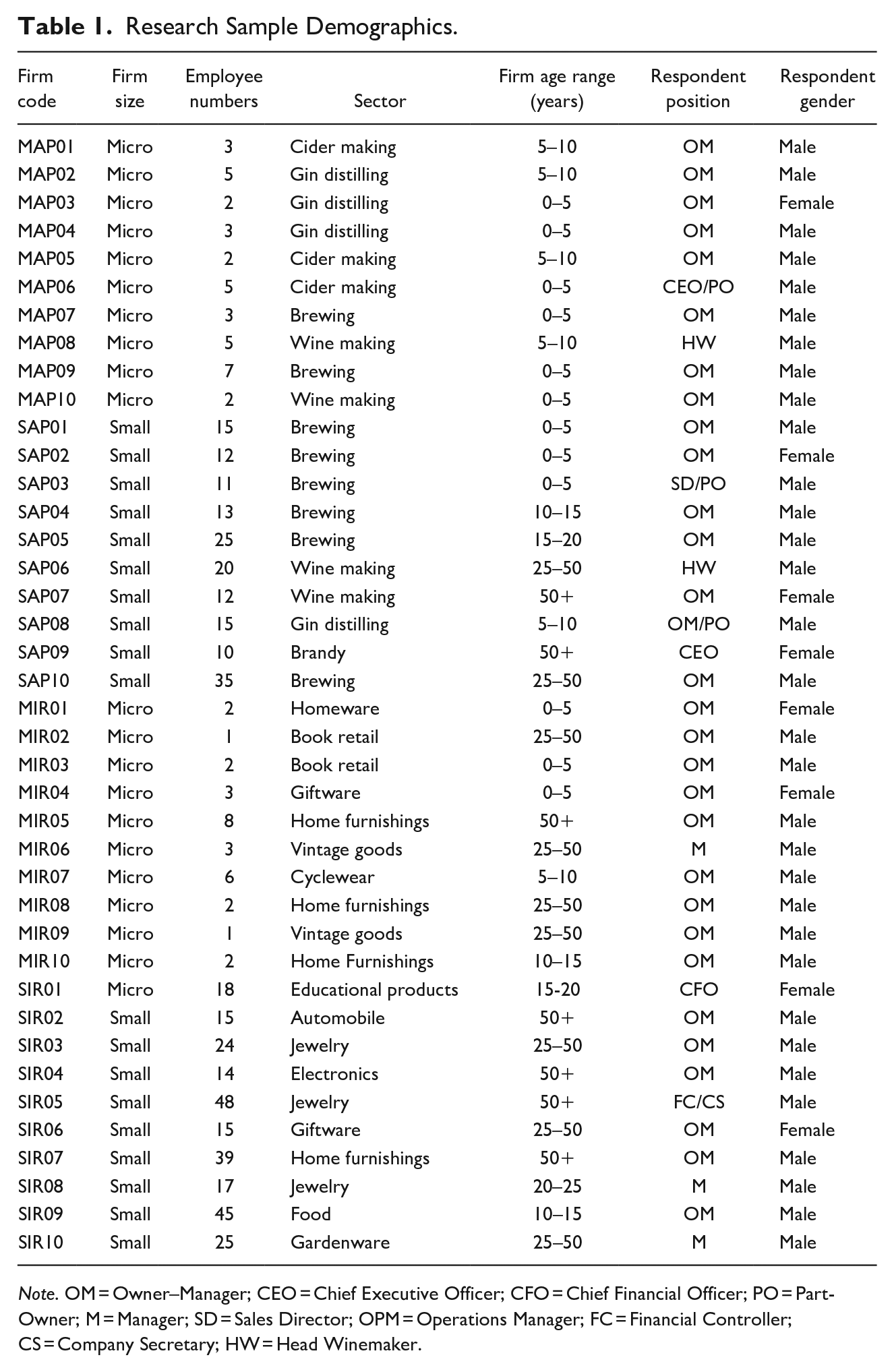
Note. OM = Owner–Manager; CEO = Chief Executive Officer; CFO = Chief Financial Officer; PO = Part-Owner; M = Manager; SD = Sales Director; OPM = Operations Manager; FC = Financial Controller; CS = Company Secretary; HW = Head Winemaker.
Data Collection
Semi-structured interviews were conducted in 2019 with participants from each of the 40 firms within the sample by the lead researcher—35 within the business premises of the firm and 5 over telephone or videoconferencing software. The interviews on average lasted 50 min and were designed to gain an in-depth and nuanced exploration of the moral beliefs, stakeholder relationships, and examples of values conflict across a range of small firms (Alvesson, 2003). To garner a detailed understanding of the context of the firm, each participant was asked in the primary part of the interview to describe the organization in terms of age, scope of operations, key members, how it was founded, and its mission, ethos, and values. The interviewee was then encouraged to reflect on the stakeholder relationships of significance to the firm, how these were established and maintained, and significant critical incidents where values conflict had arisen within stakeholder relationships. As per the tradition of critical incident elicitation (Flanagan, 1954), interviewees were asked to provide specific examples of values conflict, through the provision of narrative descriptions of the causes, key events, and outcomes, with the interviewer using additional questions and prompts to encourage detail and reflection on the part of the interviewee. Interviews were closed by means of an invitation for interviewees to add any other pertinent information and observations on stakeholder relationships and values conflict. Where relevant, organizational websites were used to triangulate interview data, particularly in relation to the values, ethos, and mission of the firm. Within each interview, an individual account of the specific context of the firm and the experience of the key decision-maker was sought given the salience of experience and contextual influence on moral issues from a pragmatist ethics standpoint. Nevertheless, through the inclusion of firms in the sample that were in close physical proximity or possessed relationships with one another, a deep contextual understanding of local or historical norms, including common values, was contemporaneously sought.
Analysis
A process of abductive thematic coding, characterized by a “combination of inductive and deductive elements . . . cycling back and forth between data and theory” (Skjott Linneberg & Korsgaard, 2019, p. 264), was employed by the lead researcher post transcription to sort, code, and categorize the data (Braun & Clarke, 2006). This approach allowed a set of broad themes to emerge that conveyed “something important about the data in relation to the research question, and represents some level of patterned response or meaning within the data set” (Braun & Clarke, 2006, p. 10) to be captured (see Figure 1 for summary of data structure), while recognizing that data analysis is a dynamic, creative, and intuitive process (Basit, 2003, p. 143).
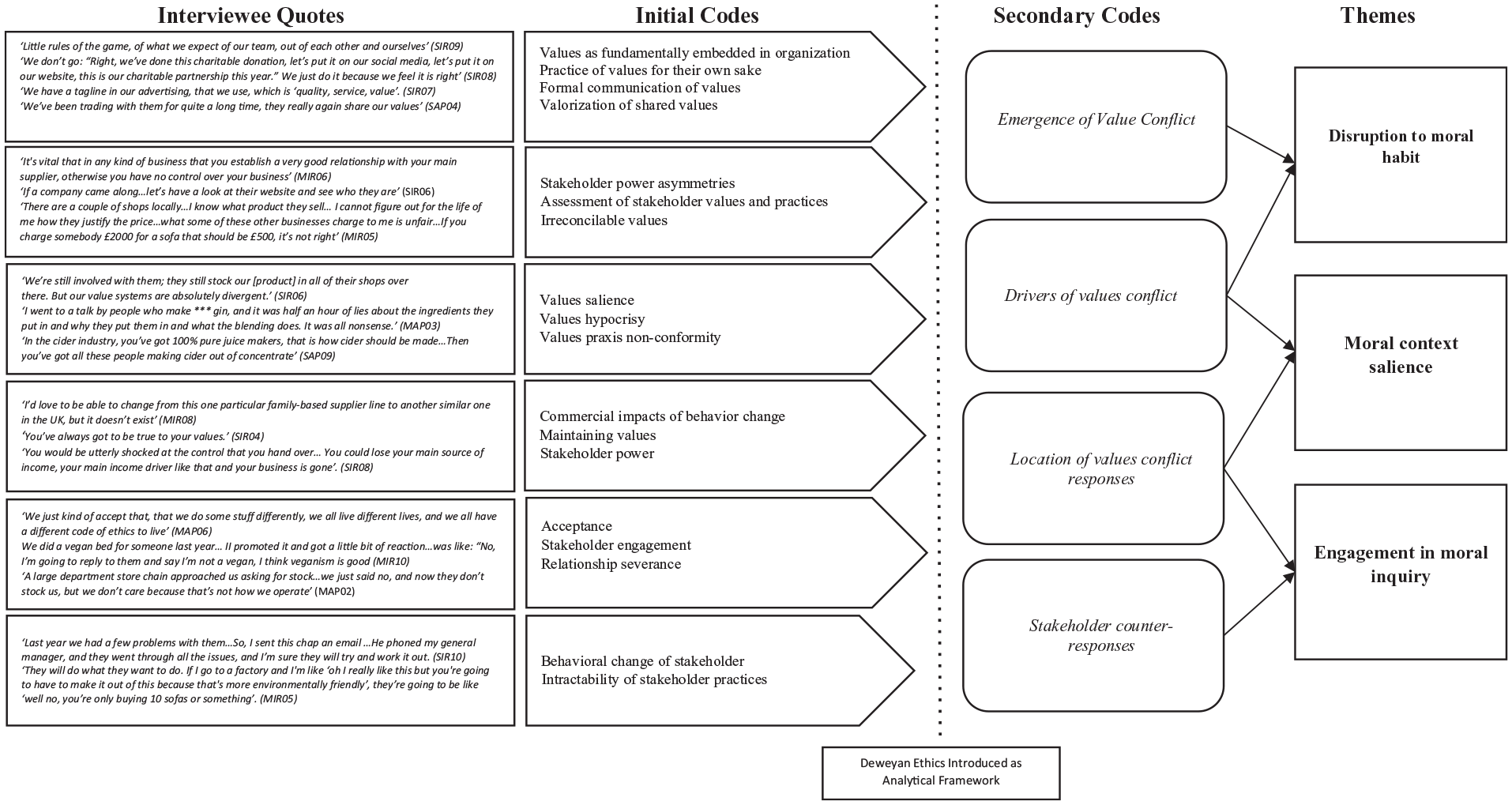
Data Structure.
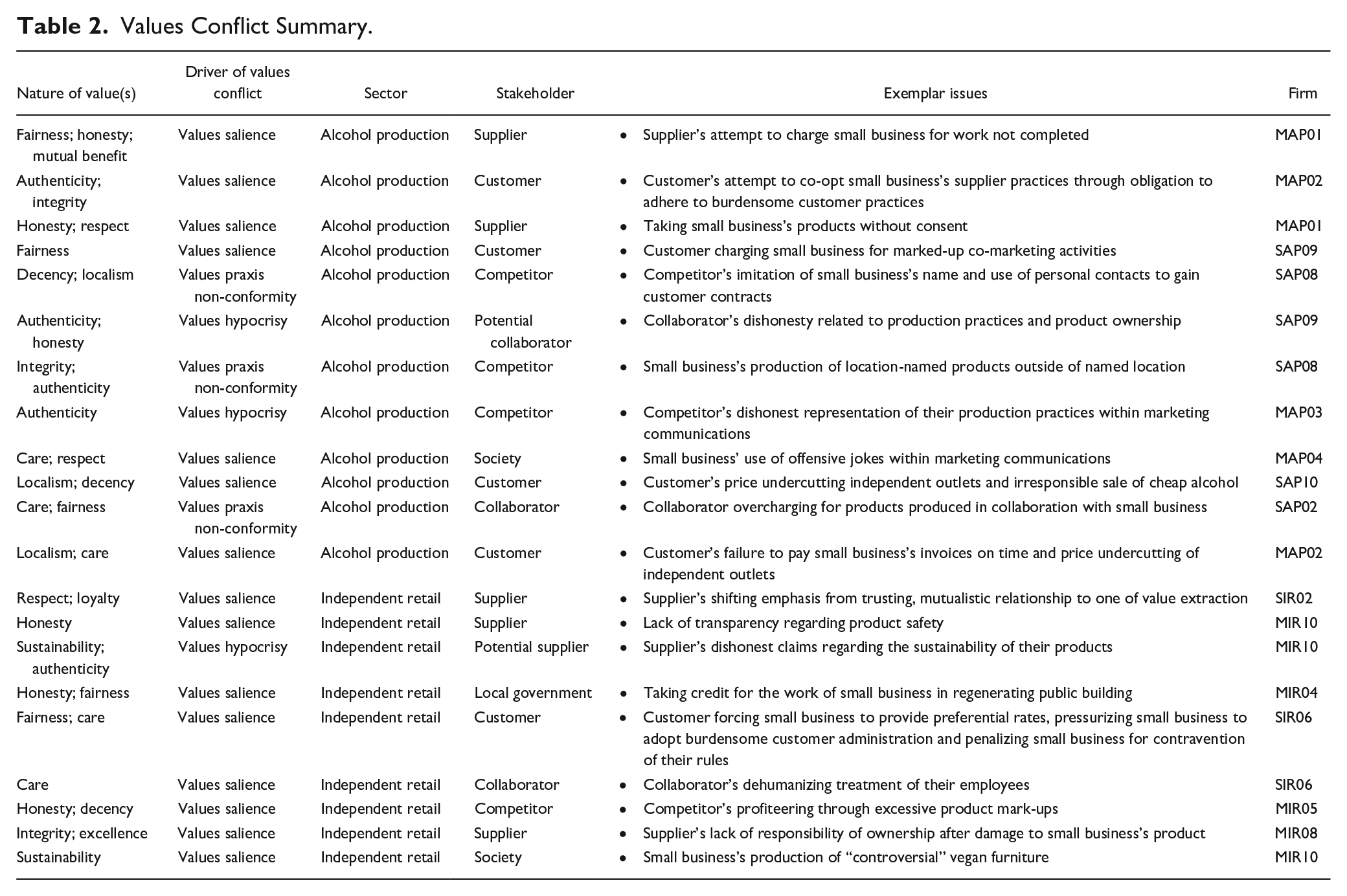
Critically, unlike analysis conducted within the mainstream grounded theory tradition, data analysis was not inductively led by an a priori theoretical framework but began by deep immersion within the empirical data with close attention paid to significant insights that emerged therein (Timmermans & Tavory, 2012). In practice, this involved manual transcription of each interview recording by the lead researcher and then multiple readings of each transcript to enable a depth of familiarization with the data to be gained. Second, each transcript was uploaded to NVivo Pro and a tentative process of initial coding was conducted to identify units of meaning, such as words or sentences that conveyed for example beliefs, ideas, or events of relevance to the overarching themes of interest of the research (Fereday & Muir-Cochrane, 2006). Critical incidents of values conflict and their salient details were recorded (see Table 2 for summary). Values and conflicts of values were operationalized within such analysis via recognition that they may simultaneously be explicitly and implicitly discussed through both their direct reference, for example in overt references to values and conflict with stakeholders, as well as indirect discussion, such as via description of normative beliefs embedded within practice (Waeraas, 2022). Alongside this immersion within the empirical data, and in accordance with the abductive approach taken to analyze the data, the lead researcher simultaneously returned to theoretical domains, including ethics, sociology, and politics, to points of coherence and coalescence between the empirical insights unearthed and pre-existing theory (Earl Rinehart, 2021). After significant investigation, the relevance of Deweyan pragmatist ethics was recognized as a potentially valuable theoretical frame to help structure and explain the data, with such creative inference substantiated with more detailed reference back to the empirical data (Timmermans & Tavory, 2012). At this point, two rounds of deductively centered coding were engaged in drawing on the core themes of the theory, notably those centered on the salience of context, the habituated nature of morality, and the role of reflexive processes of inquiry. Third, secondary coding involved the analysis of these initial codes, alongside a re-reading of each transcript, to draw, collate, and refine together the initial codes into broader analytical categories, especially through identification of inter-relations (Williams & Moser, 2019). Fourth, these secondary codes were further analyzed and rolled into themes, namely categories based on inter-relation and pattern (Hsieh & Shannon, 2005), ensuring they were distinct from one another while being representative of the overall data set and providing insight to answer the overall research question (Braun & Clarke, 2006).
Values Conflict Summary.
Findings
Emergence of Values Conflict
Participants emphasized how integral their values were to their business and associated salience of their consistent communication and practice over time throughout the organization, and within stakeholder relationships. One micro retailer epitomized this perspective through articulating that “All values need to work across all parts of your business” (MIR01). While some participants noted that they avoided stakeholder relationships where they thought values conflict was likely to arise, 21 key critical examples of values conflict concerning normative dissonance between their values and the values of stakeholders, for example relating to keystone moral values including fairness, integrity, care, sustainability, and respect, were identified within the research data (see Table 2 for summary).
Such values conflict followed a process (illustrated in Figure 2) characterized by disruption to moral habit triggering engagement in moral inquiry, heavily shaped by moral context salience. Primarily, these values conflicts primarily precipitated disruption to moral habit in the form of the embedded and taken-for-granted value-driven norms of the small firms (Surie & Ashley, 2008) in the form of value-driven norms, practices, and processes, which until conflict had arisen had largely existed as default modes of thought and practice. Such moral habits typically concerned specific ways in which firms sought to account for and treat stakeholders with fairness and care, genuinely portray the firm and its products within marketing activities and reduce the firm’s ecological impact. Disruption to these moral habits primarily revolved around interference related to the importance of individual values or sets of values, the ability of the small business to practice their values through obstruction of embedded practices at the firm or institutional level, or removal of key values-enabling resources. Critically, moral context salience, pointedly in the form of situational and local norms, pressures, and outcomes, was integrally embedded within each value conflict, owing to specific notions of values and associated values practices, that is, taken for granted ways of practicing values. In response, to such values conflict and accompanying moral habit disruption, engagement in moral inquiry was triggered. Such moral inquiry was characterized by cycles of reflexive thought, evaluation, and actioning of potential responses to values conflicts available within each given context, as well as attendance to stakeholder counter-responses. Such a process sought to locate context-sensitive responses to values conflict which would enable the value conflict to be concluded and values fidelity to be maintained. To explore this values conflict and associated disruption to moral habit, particularly the moral context salience therein, in further detail, the three main drivers of these conflicts are outlined within this section in the form of: values-salience, values hypocrisy and values praxis non-conformity before firm responses to values conflict and accompanying moral inquiry engagement are discussed.
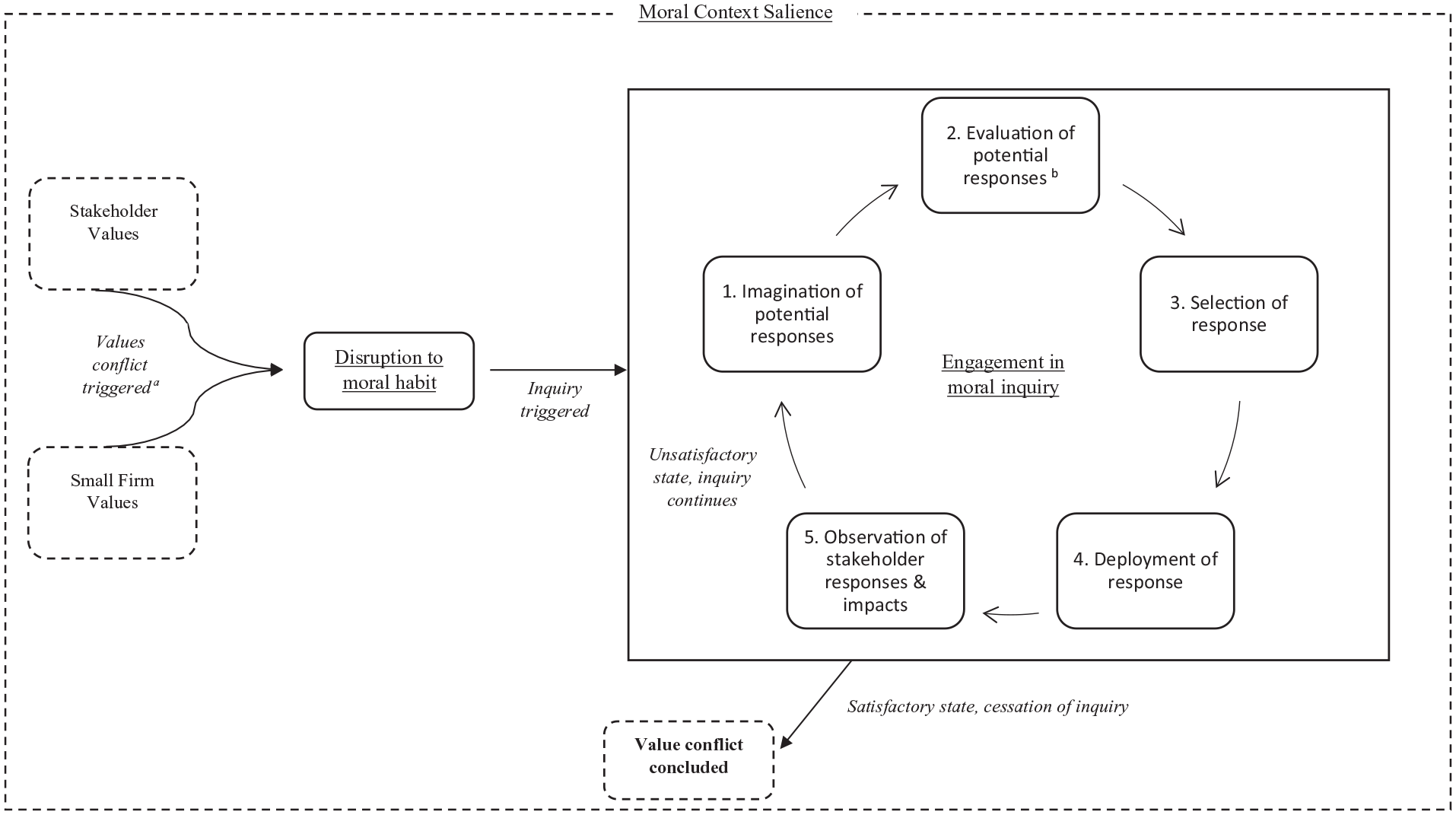
Values Conflict.
Drivers of Value Conflict
Values Salience
The empirical data evidenced values conflict, and resulting moral habit disruption, arising between small firms and external stakeholders due to conflict in terms of the importance of values (including MAP01, MAP03, SIR06, MIR10). Such inter-values conflict was often present in relationships between small firms and larger firm partners, typically buyer and supplier firms. Fundamental to this form of conflict was a set of localized norms regarding both stakeholder treatment and informal organization, endemic to the small firm context (Russo & Perrini, 2010). This form of conflict was driven by small firms receiving pressure from such stakeholders to disregard their own habitualized values typically embedded within their own stakeholder relationships, specifically the values of equity, respect, and trust, and acculturate values typically through practices associated with a commercial logic, including efficiency, objectivity, and rationality. Larger firm partners frequently sought to utilize their value-centric, formalized procedures, processes, and norms to dictate the norms and practices that small firms should adhere to in order to ensure the continuance of their commercial relationship. Such pressure is typically related to a range of issues, especially regarding what constituted fairness in terms of product pricing, payment terms, delivery, and marketing. As one small retailer-producer noted of one of their large buyer partners, the terms of the relationship and the values to which they “ought” to be adhering were heavily dictated: They have a de-humanizing degree of corporate . . . If you’re working as a supplier for them, then they want better rates than everybody else, and they try and impose things, like, if they pay on time, they want an even bigger percentage . . . If they perceived that you’d done anything wrong—quite often you hadn’t—they would arbitrarily whack bits off what you were supposed to be owed, and it just became such a job trying to actually get what little money they were willing to pay. (SIR06)
Likewise, some firms in the alcohol production sector, where collaboration and provision of help and support to neighboring and competitor firms was cited as a highly normalized practice at least within the local region, noted direct conflict between their own entrenched values, such as those of fairness and mutual benefit, and those of larger firm partners, which often heavily revolved around self-interest and profit making. This was apparent within the context of a relationship between one micro cider producer and a bottling firm: They once tried to charge me. I needed some quick bottling done. I called them and I said: “How much would it cost to do this much, and when could you do it?” They sent back an email with their quotes and their time frame of when they could do it. It didn’t fit in, and stupidly I just ignored it, but I then, a few weeks later, had an invoice from them for failure to deliver the stock that I’d booked in. I called them and said: “What on earth is this all about, well?”, and they said: “If we send out a quote, we consider that a booking.” I mean, you can consider it whatever you want though. It’s just all the time, it’s just this attitude of trying to just screw people. (MAP01)
While at times pressure to adhere to values and accompanying norms and practices was indirectly exerted by firms, direct pressure and penalties for non-conformity were often present in the form of removal of access to key resources, including support, information, and advice, loans of physical assets, and marketing, supply, and procurement of goods. Beyond values conflict driven by overt incompatibility of incongruent values, values conflict often manifested itself more covertly through that driven by judgments based on fidelity to values commitments and adherence to institutionalized values practice.
Values Hypocrisy
Alongside conflict driven by dissonance in terms of the salience of values, values conflict was also precipitated by perceived values hypocrisy on the part of stakeholders (e.g., MIR10, MAP03, SAP09), driving moral habit disruption. Primarily, this form of conflict manifested in a perceived dissonance or conflict on the part of small firms between the professed values of a stakeholder and the practices exhibited or observed. The importance of context in shaping such values conflict was typically apparent in relation to small firms’ own relationship with the value in question, with their own professed commitment to a value and attempts for its consistent practice often elevating their awareness of claims related to the values and associated practice. Such sensitivity to values hypocrisy was often underscored by the particular affordance paid to authenticity within the small firm context, where honest representation and walking values is particularly significant (Morsing & Spence, 2019). The value of sustainability was, for example, cited as an emotive and conflict-laden value due to the existence of stakeholder claims, which indicated a commitment to the value of sustainability but, from the perspective of the small firm, such a commitment was not substantiated by the practices of the stakeholder. A micro furniture retailer, whose founding ethos was centered on being as environmentally friendly as possible, discussed the importance of sustainability to the business cited an instance where, upon looking for “green” furniture, they had come across one firm who professed a strong commitment to sustainability. However, further interaction had subsequently led to values conflict as a result of a dissonance between the walk and talk of the supplier: They [one furniture maker] said: “Oh, yeah, it’s all sustainable timber,” but they buy French oak and then send it to China where it’s milled . . . It’s been to China and back; from Europe to China, back to Europe. (MIR10)
Similarly, in the case of a multi-generational family cider-producing business that was founded and run on an absolute dedication to honesty and integrity, the owner–manager related an incident where a collaborator had discussed their commitment to the value of authenticity and associated practices, but the cider produced had latterly discovered the significant gap between the collaborator’s professed values and actual practices.
I had some people who sent me some rum today . . . They gave me this whole story, and they told me what the rum was like and all of this sort of stuff. I looked them up on the internet, and they have their rum made by someone that actually just flavors industrial alcohol and say that they are the best distiller in the UK and all this stuff. So much of it is a con, that’s marketing and branding, and it’s a sad state of affairs really. (SAP09)
While arguably such conflict was being driven by disparate conceptualizations of values, many small firms in the sample regarded values hypocrisy with respect to stakeholder values to evidence a lack of integrity or deliberate attempts to mislead key stakeholder groups, particularly consumers. Importantly, small firms often noted the potential or actual ramifications of this for their own habituated values practices, with concern expressed that stakeholder values hypocrisy may disrupt their value-driven habits relating to the values of integrity and authenticity and by extension their values fidelity. Alongside this, firms expressed concern related to the potential damage that stakeholder values hypocrisy could have for their own reputation in the eyes of other stakeholder groups.
Values Praxis Non-Conformity
Running parallel with conflict attributable to values hypocrisy, values conflict was also driven by dissonance in the way that organizations sought to practice or enact values, especially through a lack of adherence to institutionalized values practices (SAP02, SAP08). In particular within the alcohol production sector, a lack of adherence and thus disruption to moral habits embedded at the industry or sector level practices, in terms of production and marketing which were heavily associated with keystone values of heritage, authenticity, and honesty, was frequently acutely apparent. This form of conflict was exceptionally emotive in the alcohol production sector where many firms and individuals possessed decades of experience within the industry. This had led to significant affordance given toward these values and associated highly ingrained practices across the sector. Given a large recent influx of entrants to the alcohol production sector, values conflict was often apparent within relationships between well-established firms and firms newer to the market. Notably, in relation to conformance with traditional production methods, for example what ingredients were used, their origin, and whether elements of production were outsourced, were used to assess whether a stakeholder was conforming to the traditional values of the sector. A lack of conformance to these practices both directly and indirectly disrupted the moral habits of small firms through direct undermining of and pressure to alter their values-based practices, as well as via broad erosion of these embedded practices within the industry. One traditional maker in the industry noted how relational norms concerning the values of care and fairness within an arrangement with a collaborator where a product was co-produced within the collaborator’s brewery had not been adhered to: The parameters weren’t clear so we came out the end and it was like: “Oh OK, that’s what’s happening is it!? Right, OK!” . . . (The collaborator) sold a portion of the beer to us, for us to sell down here, for not much less than it was retailing for. And we were like “Oh OK!?” I think an accepted convention for collaborations is cost price plus 10% or whatever for the hosting brewery’s time and tank space and packaging time and that kind of thing. It makes it quite difficult to make any money on if you haven’t got much of a margin to add on. (SAP02)
Some newer entrants to the alcohol production industry within the research sample noted how the contravention of habitualized industry norms, especially the outsourcing of production, had led to values conflict relating to their practices of the values of authenticity and integrity versus that of competitors, negatively impacting the reputation of the firm: We made a big mistake when we first started: we got the first few batches of gin made elsewhere; this created such waves in the industry. Like *** (place name) gin’s not being made in *** (the named placed) . . . So, (people thought we were) acting as though we are this micro distillery, with our gin being made here, but actually getting it made elsewhere. So, that was a big old hoo-ha . . . But people saw it, people latched on to it. (SAP08)
Evidence of values conflict leading to disruption to habitualized beliefs and practices, markedly as a result of both explicit and implicit pressure for small firms to disregard values and value-driven norms and practices, was garnered through the empirical data. The means by which small firms sought to respond to such conflict and maintain values fidelity via inquiry-based processes of moral reasoning and action are outlined within the following discussion.
Location of Responses to Value Conflict and Stakeholder Counter-Responses
With no “off-the-shelf” moral solutions, such as formalized ethics pledges or codes of conduct, available to the small firms to respond with sufficient acuity given the moral context sensitivity the values conflict and accompanying moral habit disruption were steeped in firms recounted the processual response, the engagement in moral inquiry, that was triggered (see Figure 2). Such a response was intended to correct or dampen disruption to their habituated norms and practices while remaining faithful to their values. The creation and consideration of these responses through a process of inquiry sought to balance values fidelity with other contextual factors, such as difficult commercial decisions, fidelity to other values and avoidance of stakeholder harm, for example to employees. Such action was often primarily designed to ensure that values conflict did not impinge on the firm’s ability to practice their values in the manner in which they perceived they ought to or to avoid any lapses in their own integrity through potential lack of values fidelity. However, given the dynamic nature of the values conflict, small firms often sought to adjust their strategy or responses to values conflict over time, particularly as a result of changing context as well as stakeholder action or responses. This engagement in moral inquiry is illustrated within the following section through the presentation of a number of cases, which demonstrated the three main, but overlapping potential responses that were refined and deployed based on the context and nature of the values conflict: relationship severance, stakeholder engagement, and acceptance.
Relationship Severance
Through engaging in a process of inquiry in response to values conflict, some small firms concluded that despite the costs inherent to such a strategy the correct course of action to maintain integrity and mitigate stakeholder harm was to sever the stakeholder relationship. Such a response was conspicuous in the context of stakeholder relationships where fundamental values salience-based conflict was present. These firms noted that the presence of values conflict as well as the oft-associated demands or pressures of the stakeholder were onerous and unfair. The dissonance caused by the conflict and engaging with stakeholders with such different values led to moral discomfort for the small firm, especially when it required alterations to ingrained practices and processes. At times, such an approach involved a negative commercial impact on the small firm, thereby demonstrating an emphasis on “values over value” on the part of the small firm, as well as potentially broader ramifications where the stakeholder was in possession of power, for example as a result of significant standing within the industry. Micro-brewery SAP02, a small but growing brewery with an emphasis on doing business fairly and creating relationships with likeminded stakeholders, described an instance where a relationship that promised commercial benefit had led to values conflict, requiring inquiry to be utilized to determine whether the relationship should be maintained for commercial benefit or severed due to a lack of values alignment. Specifically, values conflict had arisen as a result of a collaborator overcharging them for co-produced products. In response, the owner–manager had engaged in a process of moral imagination, reflecting on the motivation of the firm to pursue the relationship, the juxtaposition in values between their own and those of the other firm and the nature of relationships with other stakeholders, where values congruence was substantially stronger. As a result of this process, the owner–manager conveyed how they had come to the conclusion that the decision to form the relationship in the first place “was probably taken for the wrong reasons, probably more for commercial reasons than anything else.” Accordingly, after considering the potential courses of action available and the likely outcomes of each, including continuance of the relationship in the short term for the financial and reputational benefit of the business, the small firm had sought to readjust their relationship with the firm. This involved distancing themselves from the firm, avoiding a reciprocal brewery visit and additional co-produced product regardless of internal pressure from their own employees to enjoy the likely financial benefits: They then said “Can we come down and brew with you?”, and our sales guy is saying “We should do this, we should do this,” because it makes sense in the way that we work with them. My partner and I are like “Well we’re not really that bothered about it to be honest . . .” We would rather work with those we know, we like, we believe in what they are trying to do and we think that they believe in and like what we’re trying to do. (SAP03)
In the same vein, one micro alcohol producing firm, a gin distillery that actively sought to be grounded within its locale and support other small independent businesses, cited an instance where values conflict in the context of a relationship with a customer had led a process of inquiry. The firm had begun to sell their products via a “volume customer,” a wine merchant to increase their sales, but after doing so values conflict had arisen which prompted reflection on the ethos and values of the business and whether such a stakeholder relationship allowed them to be upheld. In particular, the owner–manager considered the firm’s commitment to support other local, independent businesses, as the stockist was undercutting these other local stockists, and the trade-off between this and the need for the business to make money, particularly as “We have families, we have mouths to feed.” To resolve this values conflict, the owner–manager sought to weigh up these factors and the possible courses of action that would allow the values conflict to be resolved; ultimately concluding that the only course of action to maintain their own values fidelity was to terminate the commercial relationship despite its economic benefits: Briefly, we stocked into a wine merchant, and we realized pretty quickly that was an error. They didn’t pay their bills on time, they weren’t very nice to deal with, they undercut some local independent outlets, and we took one look at it and thought: “No.” So, we delisted all our products from their outlets. Even though they were a volume customer, it didn’t fit with what we are and what we do. (MAP02)
Such a response was also frequently evident where values conflict driven by values hypocrisy was present within a stakeholder relationship. In such instances, the lack of perceived stakeholder integrity was often an issue that the small firm simply could not overlook, especially as such values hypocrisy could practically or potentially threatened to impinge on their own habitualized moral practices and integrity. In the case of MIR10 where a factory visit led the firm to realize that one of its suppliers was overstating its commitment to the value of sustainability, the owner–manager related that a process of inquiry had been deployed, Specifically, given the firm’s commitment to sustainability and local sourcing, it frequently encountered issues with finding suppliers “because there are not many left” and thus found it challenging to navigate conflict with local suppliers who professed the importance of sustainability but did not meet the standards of sustainability which the micro retailer expected. As such, after a factory visit where the owner–manager became aware of such values conflict, they had to evaluate the trade-offs between finding a local supplier which met many of the criteria the business was looking for but on the other hand did not possess the sufficiently high levels of sustainability practice with which the firm was comfortable. After such reflection and consideration of the potential values trade-offs involved in either commencing or not commencing a commercial relationship with the supplier, the retailer in question concluded that the right course of action would be not to source from the supplier: You will find other companies, there is one not too far from here, another little pocket of makers, there is not many left there now there is a big one called **** that I went to see. They said ‘oh yeah it’s all sustainable timber and this sort of thing’, I was looking around this quite impressive factory, there were 4 hangars and it was all going through this big production thing, ‘and this is where it all comes back from China’. I was like ‘what!?’, ‘well we buy French Oak and then we send it to China where it’s milled. They were getting the crappy bit of oak in the middle and then putting two nice bits of oak either side then chamfering off the edges. ‘So you send it to China?’. Oh god right I’m not touching that. It’s ridiculous ‘oh, yes this is all sustainable timber (mocking tone), but it’s been to China and back; from Europe to China, back to Europe’.
Nonetheless, where some small firms rejected the continuance or establishment of relationships with stakeholders where values conflict would be present, others framed such relationships in an almost antithetical way as spaces for them to disrupt and challenge the deep-rooted values and practices of stakeholders through engagement.
Stakeholder Engagement
Through processes of inquiry and in some particular cases of values conflict, a number of small firms perceived the correct course to be engagement with stakeholders in an attempt to shift values into a space of non-conflict through either seeking to influence the values and associated practices of the stakeholder or to adjust their own values or practices. Such a course of action required a more protracted process of inquiry than in the case of relationship severance given attendance to and consideration of stakeholder responses and potential counter-responses by the small firm. Such an approach was often characterized by attempts to educate stakeholders regarding the importance of values or, for example where values praxis dissonance was present, through seeking to persuade stakeholders to alter their practices to adhere to dominant norms. The intent behind such a strategy was that the disruption to their habitualized values and value-driven practices might be mitigated or eliminated: We try to always deal with people who share our ethos, but we wouldn’t cut somebody out that doesn’t because we see that as a really good space to educate. (MAP06)
Such an approach typically involved direct engagement with, and persuasion of, the stakeholder in an attempt to try and alter their core values or entrenched practices. One such example of inquiry leading to an iterative stakeholder engagement strategy was evident in the case of a small retailing business built on the back of a multi-generational family farm with values focused on maintaining the heritage of the farm, especially local production and sourcing. Value-salience-based conflict had occurred when new member of staff had brought a profitable trade contract to the business, but the provenance of the products the customer was requesting contravened the small firm’s values. Notably that of localism, given that the customer wanted the products to be sourced from outside the UK. In response, and through a process of inquiry the firm, particularly the owner–manager had considered a range of responses and creatively imagined how a process of stakeholder engagement and education might be successful in balancing the values of the firm and its commercial interests. Specifically, through actively engagement with the customer the small firm might be able to educate them on the benefits of British farming and in doing so alter their practices and potentially their values through persuading them to buy, despite the price premium, British-sourced products. Nonetheless, on the basis of the counter-response of the customer, the firm then planned to go on and supply them locally sourced products or, if the initial strategy was not successful, then the small business would have to end its association with the customer: I’m going to go back to our wholesalers and try and find UK versions of all of this stuff and then try and wean them (the customer) onto a new product list. And we are doing this process at the moment. It’s not going to be as cheap, and we are working at the moment with the client, but those are my values, so I just have to take a step back from that. (SIR09)
Conversely, through engaging in inquiry, some small firms realized that values conflict represented an opportunity to engage with and learn from stakeholders, particularly where a realization took place by means of such reflexivity that the firm itself was acting in an immoral manner. One micro alcohol-producing firm committed to authenticity and a punkish style of non-conformity noted an incident where their launch of a new product, from the perspective of the general public and customers, had made light of a high-profile public incident involving loss of life. Initially, the product sold in significant numbers and raised the profile of the firm through media coverage of the product. However, as the public backlash grew, and the values conflict became more apparent a process of inquiry was triggered where the small firm considered and deployed a number of solutions while seeking to understand the perspectives of the key stakeholder groups involved: We sold about 400 bottles in two days and then we kept on selling it . . . We put all the bad comments that people wrote on Facebook, we put them on the back of the bottle with people’s names . . . And then all the shit went down . . . It just went all over the place . . . (MAP04)
Initially, through taking time to evaluate the initial decision to launch the product and its subsequent impact, the firm struggled to see an issue with their risqué marketing campaign and thus concluded that leaning further into the marketing strategy in an attempt to try and justify it was the correct course of action, even including the negative comments they had received on their bottles. However, after pursuing such a strategy further reflection was required as to whether and what further action should be taken in response to growing stakeholder ire as well as the threat of potential legal action against the firm and increased media coverage of the incident. Through such a process the firm concluded that even though they had no meant to cause upset and hurt through launching the product in question and were leaning into the value of fun which was core to the business, and they could simply carry on selling the product that given such reflection an adjustment in action was required to deal with the values conflict. As such, the firm chose to provide a public apology and in the short term discontinue the controversial product.
Such an approach typically involved the owner–manager of the small firm directly communicating or engaging with stakeholders or stakeholder representatives, such as the owner–managers of other small firms or customers via social media. Given the lack of power that small firms often have within stakeholder relationships and the entrenched nature of values, trying to alter stakeholders’ beliefs was viewed by many firms as a fruitless drain on the resources of the firm and as something to be attempted before severing the relationship.
Acceptance
Within the context of some values conflicts, the correct course of action produced via a process of inquiry was acceptance of the values conflict. Such a response was common where an attitude of acceptance of values plurality or high commercial reliance on the stakeholder and associated power asymmetries was present (as per a resource dependency theory perspective; Hillman et al., 2009; Pfeffer & Salancik, 1978), and therefore firms chose to accept the conflicted nature of specific values and continued, or chose to begin, a relationship with stakeholders in which values conflict had arisen or was likely to arise. This response was often heavily influenced by the risk or opportunity costs associated with losing key customers as well as a pragmatic acceptance that to ensure that some values, including care for employees, were maintained through ensuring the firm’s survival, some values conflict could be accepted or overlooked. One brewery owner–manager noted how their stance on engaging with supermarkets, with which they perceived a values conflict with respect to the values of sustainability, fairness, and care, had evolved over time through a process of inquiry. Primarily, as a result of such values conflict, the firm had chosen not to engage with supermarkets as a route for vending their products given a belief in the lack of social responsibility associated with the sale of cheap alcohol by supermarkets. However, as a result of the growing size of the brewery and changes in the competitive landscape, with more brewers supplying supermarkets, as well as a relative lack of cash flow in comparison to other larger businesses the firm had reflected on their choice not to supply supermarkets via a process of inquiry. In particular, given these changes, the possibility of scaling down the size of the business. Through such a process, one infused with moral imagination, the firm decided to change their stance through reframing engagement with and supply to supermarkets as a pragmatic compromise that while uncomfortable would help to preserve the business and therefore its values, particularly its ethos of looking after its staff and contributing to the local region: We always said that every bottle sold in a supermarket is one less pint sold in a pub, which is true, it’s so true, and we were proud of that . . . But in the meantime, every other brewer is going to cut deals with supermarkets and is selling cheap beer in them . . . So, we now sell into three of the big four supermarkets as well as another big one, which we actually supply direct, but the other three we use an agency. We are in a couple of hundred of each of those stores and it’s fine, our sales rates are good. (SAP10)
The location of such a strategy for responding to values conflict through a process of inquiry was also apparent when, due to a supplier buyout, values conflict had been triggered between a small firm customer and its large firm supplier. While the two firms had traditionally had strong values congruence, owing largely to the family ownership-based nature of both businesses, upon the supplier’s buyout values conflict had arisen with regard to the values of respect and loyalty. The small firm noted that they would typically terminate or avoid relationships where values conflict had arisen or may arise. However, through a reflexive process of inquiry in which the potential impact of terminating a supplier contract was considered, especially in terms of outcomes on the business given that is constituted one of the firm’s core suppliers, fidelity to their own values, particularly care toward their employees and loyalty toward the supplier’s longstanding employees and the supplier brand’s customers, a readjustment in the firm’s relationship with the stakeholder was imagined and implemented. The small firm sought to acknowledge and accept the values conflict which had arisen within the relationship and continued to buy from the supplier, while at the same shifting toward the nature of the relationship to a more arm’s length and distanced one: Basically, they’ve changed since they were selling out and they were bought out recently . . . It is sad because we’ve always had a very close relationship with them as a brand . . . I don’t know what it is but you get phrases now like I think they feel like we are taking money that they could be making . . . I think their core family values have shifted . . . I was pretty close to them, I was on the dealer committee with everything, with all the decisions, events, I was privy to. I think it’s probably (a) healthier relationship being at an arm’s distance anyway and taking emotions out of your dealings with them. (SIR02)
Such a process of inquiry and constitutive thought and action had also led the small firm to readjust its stakeholder engagement strategy with other key suppliers more being more formal and distanced.
In summary, small firms within the sample sought to employ a number of different approaches when evidence of values conflict within the context of stakeholder relationships arose. Such decision-making and action taken in response to values conflict were primarily driven by an attempt to maintain fidelity to their own values and ensure the maintenance of firm and owner–manager integrity. However, such strategies were by no means mutually exclusive. The means by which small firms sought to exert moral agency through responding to values conflict was typically reflexive, iterative, and thus evolved over time to respond to the changing nature of the context and the issue at hand.
Discussion and Theoretical Contributions
The primary goal of this research was to heighten comprehension of the phenomenon of values conflict. Through taking a pragmatist theoretical approach to empirical examples of small firm–stakeholder conflict we both: (a) evidence the worth and applicability of John Dewey’s approach to ethics as an empirically validated framework capable of explaining what drives values conflict and how firms seek to maintain values fidelity in response via, in the latter case, a process of inquiry; (b) highlight that descriptive and normative accounts of responses to value conflicts can be considered as one and the same thing from the perspective of situated decision-makers, with a congruence evident between what they do in fact do and what they should do. Our work, through drawing on a Deweyan approach to ethics (Dewey & Tufts, 1909) and the pragmatist tradition of breaking down dualisms thus locates the normative neither within ends or means as in traditional approaches but offers a juxtaposing and practical account through casting light on the ethical judgment embedded within a process of inquiry, which is inherently and simultaneously both descriptive and normative from the perspective of contextually embedded decision makers. In particular, we reveal accounts of the process of inquiry, characterized by moral imagination and iterative cycles of action, reflection, and readjustment, which is conducted in context within the experiential confines of a distinct values conflict and is located within a broader organizational and institutional milieu. Through demonstrating the practical lack of existence of descriptive–normative dualisms present within real-world value conflicts and the value of inquiry as a theoretically grounded, but practical tool our stance contrasts to extant work that has either taken an empirical approach to describe outcomes of values conflict (Garst et al., 2021; Vogeley et al., 2023) or taken an abstract approach to values conflict (Dawkins, 2015; Schormair & Gilbert, 2021), unmoored from a specific empirical context and the realities of stakeholder relationships where powerful stakeholders may be unaware of values conflict or may be unwilling to alter values or practices, particularly given the power asymmetries present within relationships with relatively weak stakeholders. Both streams of literature, while providing valuable insights, have broadly cleaved the descriptive from the normative, with the former stream under-focusing on broader normative implications and the latter stream disregarding the practical pressures and experience of values conflict where relevant decision-makers “find themselves torn between heterogeneous and potentially conflicting values concerning ‘right and wrong’” (Risi et al., 2023, p. 15). Such an approach strongly contrasts with work that advocates in favor of universal heuristics to deal with ethically problematic situations which are insufficiently flexible to account for the complexity and nuance of normative, organizational, and institutional context (Hamilton et al., 2009; Schormair & Gilbert, 2021). Instead, it builds on previous work on values conflict yielding a grounded example of the moral imagination recently called for in the literature (cf. Pless et al., 2021). It empirically demonstrates that normative work, such as that by Van Der Linden and Freeman (2017) which argues for a thick evaluation approach to reconcile different values, has significant practical application given similarities to the substantive ethical decision-making that takes place within organizations.
This work contributes to the broader literature that has refocused scholarly inquiry on values (Kraatz et al., 2020; Risi & Marti, 2022), particularly that which has taken a practice-based approach (Gehman et al., 2013; Wright et al., 2021), providing theoretical footing that allows for values to be subject to conflict, fluidity, and embedded within the intricacies of practical ethical decision-making. Furthermore, and principally via identifying drivers of values conflict, it contributes to the values conflict-based literature through emphasizing, as Dewey suggests, that morality is often deeply ingrained within habits, preferences, and purposes (Dewey & Tufts, 1909). In doing so, it provides greater evidence that alongside overt instances of values conflict where explicit values clash, more covert values conflict may occur between firms in the form of disruption to taken-for-granted practices, processes, and norms (Garst et al., 2021). Such covert values conflict typically arises through dissonance between practices, processes, and norms that are inherently values-laden, especially as they are often the most tangible manifestation of values within organizations. Importantly, they may often be obscured from sight by powerful stakeholders who are able to mask them by using the language and justification of a commercial logic. This research also contributes to the values literature through underscoring the importance of considering contextual features when researching values (cf. Garst et al., 2021). While a significant portion of the previous literature has drawn on theoretical or quantitative methods to investigate values and associated conflict (Arenas et al., 2020; Gruys et al., 2008), pragmatist ethics accentuates the fact that when moral decision-making occurs within everyday life, social actors cannot escape the confines of both context and experience. Values conflicts are therefore materially shaped by the nature of what has caused them, other values present within the given situation, and stakeholder impacts associated with potential responses.
Future Research, Limitations, and Broader Implications
While this research has generated empirical and theoretical insights into values conflict and firm responses, some limitations and unanswered questions that might be addressed in future research inevitably remain. First, while the research has evidenced the value of taking an empirical approach to investigating and theorizing the phenomenon of values conflict between firms and their stakeholders, the research context was limited to small firms within one region of a country located in the Global North, which would likely have impacted the normative understandings, values, and power dynamics at play. Supplementary research could seek to apply the theoretical framing and approach developed within the paper to alternative settings, such as values conflict within multi-stakeholder initiatives or that which arises within relationships between local communities and businesses. Second, the research relies on a broad sample of firms to explore values conflict. Further, research could take a more in-depth, longitudinal, and processual approach to dissect a small number of values conflicts from the perspective of multiple stakeholders. This would allow greater exploration of the role of the experience of individual actors involved both in pre and post-values conflict, for example, to understand how values conflict alters individual framing as well as to gain a more precise understanding of the specific interactions or actions, which reveal the presence of values conflict to constituent parties. From a theoretical perspective, this would enable further opportunities for engagement with Dewey’s broader canon beyond his conceptualization of pragmatist ethics. Chiefly, his work on valuation (Dewey, 1939), which regards context-bound and fluid processes of value assignment to objects as fundamental to the constitution of values over time (Joas, 1997). Third, given the theoretical value that Dewey’s pragmatist ethics has brought to this study, future research in the field of business ethics could invest substantially more time in exploring and deploying pragmatist theory. In particular, as many of the issues which scholars in the field are currently seeking to understand, such as the impact of time, perspective, and context on ethics, the role and importance of social norms, and the contributions of research in creating a better world, directly relate to the preoccupations of the movement’s founders (Pouryousefi & Freeman, 2021).
The implications of this research for practitioners, including small firm owner–managers and more broadly individuals that have a role in shaping stakeholder relationships, for instance, procurement managers, are the benefits of appreciating the importance of values and being mindful of the high moral and financial costs which can result from exerting value-based pressure on stakeholders. Importantly, a vital implication is that possession of a clear understanding of values dissonance can yield benefits in the form of stronger, closer relationships based on mutual understanding and trust. Gaining an appreciation that mutually beneficial compromise can be attained through enhanced dialogue and a willingness to flex attitudes, practices, and processes can help to avoid difficult, costly, and potentially reputationally damaging instances of values conflict. More broadly, while large firms, such as pub chains or retailers, often enjoy the benefits of a small firm’s values, for instance through the values of authenticity and sustainability that are implicit within their products, they should not seek to pick and choose the values of small firms and co-opt those which they may view as little more than an inconvenience.
Policymakers could benefit from understanding that values conflict and the means by which such conflicts are managed can and do impact the amelioration and resolution of sustainability issues, including climate change, especially as they can filibuster potentially productive relationships, such as those between small and larger firms. To circumvent such issues and gain the requisite level of consensus and coordinated action required for progress to be made in tackling sustainability issues, policymakers could seek to facilitate the resolution of such values difference and conflict through creating spaces for “broad processes of argumentation and conflict resolution among stakeholders” (Head, 2019, p. 182). Given the pressing nature of the issues at hand, policymakers may well further benefit from taking a pragmatic (or pragmatist) approach which seeks to accept that achievement of only partial agreement and minimization of conflict are sufficient to allow progress to be made (Sager, 2014).
Conclusions
This research has sought to contribute to the literature on values conflict by means of exploring the drivers of values conflict and the means by which firms seek to respond. Through drawing together these empirical accounts with novel theoretical framing in the form of pragmatist ethics, a robust, theoretically grounded conceptualization of firm responses to values conflict via inquiry is presented. This view importantly seeks to acknowledge the nuanced contextual background that accompanies values conflict, in tandem with the trade-offs that accompany the attempted maintenance of values fidelity. Such a conceptualization bridges extant descriptive and normative work on values conflict and provides a platform for further research and exploration in the area of values conflict, as well as research more broadly focused on values. The paper also adds to the growing calls for enhanced engagement with and deployment of pragmatist theory within business and society research.
Footnotes
Declaration of Conflicting Interests
The author(s) declared no potential conflicts of interest with respect to the research, authorship, and/or publication of this article.
Funding
The author(s) disclosed receipt of the following financial support for the research, authorship, and/or publication of this article: The research leading to these results received funding from the Economic and Social Research Council Funding under Grant Agreement No. ES/P00072/X.
