




Abstract
Corporate accountability is central for dealing with environmental and health effects in complex supply chains. When companies hold their suppliers accountable to certain rules or standards, these become disseminated in the supply chain. This study analyses how voluntary restrictions of per- and polyfluoroalkyl substances (PFAS) in paper-based food packaging in Sweden are translated as they travel down the supply chain and their relationship to supplier practice. The multidisciplinary approach draws on both interviews with key actors and chemical analysis of PFAS in food packaging. It shows how demands for accountability for chemicals are translated both horizontally in the industry and vertically in supply chains resulting in a set of interrelated voluntary standards and rules. The chemical analysis detected PFAS in almost half of the samples, but at levels indicating non-intentional use, thereby complying with the disseminated rules. The result shows that the standards largely institutionalize established practices in support of “laggards” rather than push the industry to more radical phase-out of PFAS.
Keywords
Introduction
Chemical pollution is an urgent environmental and health issue and has already transgressed its planetary boundary, the “novel entities” boundary (Persson et al., 2022). Potential hazardous chemicals are produced and put on the market by businesses at an increasing rate and—similar to other scandals around health, safety, and environment—this generates demand for extended corporate accountability (Djelic & Sahlin-Andersson, 2006). Although corporate actors are increasingly held accountable for chemical pollution by consumers, investors, and governments, it has received little attention by business scholars (Scruggs & Van Buren, 2016).
Corporate accountability involves answerability for the firm’s actions and omissions (Gilbert et al., 2011), which are evaluated according to some normative rules and with some implied consequences (Lerner & Tetlock, 1999). Such rules or standards that aim to govern sustainability issues may not only take the form of legal requirements but also often incorporate aspects that exceed regulatory requirements, so-called “private” rules (Bartley, 2022; Grimm et al., 2016). The rules are not only used to govern the company’s own employees but also companies the organization interacts with, for example suppliers (Jayasinghe & Cao, 2024; Spence & Rinaldi, 2014). When the parties in a supply chain act to hold their suppliers accountable in this way, the rules or standards become disseminated and in turn affect multiple tiers in the supply chain (Grimm et al., 2016).
A key concern in this literature is whether the disseminated rules affect supplier practices. While certain studies report that such rules do shape practices in the supply chain (Grimm et al., 2016; Spence & Rinaldi, 2014), others have shown that private rules are routinely evaded, watered down, or redefined on the ground (Bartley, 2022). The adopted rules’ weak impact on practice has mainly been studied in the form of suppliers’ decoupling of rules from practice (Dietz et al., 2021; Gilbert et al., 2011; Jamali et al., 2017) or recoupling and contingent coupling (Bartley & Egels-Zandén, 2016; Egels-Zandén, 2014). Although the literature recognizes that the formulation of the disseminated standards matters (Dietz et al., 2021), it mostly assumes that the rules remain intact while the local practice more or less deviates from the rules and resists change.
An alternative explanation is that the rules themselves are transformed while being passed on, that is, that when the private rules are materialized in new contexts, they are affected by the process. How private rules are translated (Røvik, 2016; Sahlin-Andersson, 1996) as they “travel” (Czarniawska & Joerges, 1996) and the translations’ relationship to local practices we know less about. Consequently, the aim of the present work is to extend this so far limited understanding of how private rules are translated while disseminated in an industry and its supply chain and the implications for corporate accountability practices.
To achieve this aim, the present work investigates corporate efforts to control chemicals in the Swedish food packaging industry and supply chain, using the example of accountability for PFAS in paperboard packaging. The study addresses the aim by using two different methodologies, combining both social and natural science. First, we conducted a qualitative document and interview analysis of the PFAS restrictions in the industry and their dissemination into the supply chain. Using Røvik’s (2016, 2023) work as a resource, this part of the study seeks to answer the research question: How are demands for corporate accountability for PFAS translated in the food packaging supply chain?
While this qualitative methodology may also be used to shed light on supplier practices, it has its limits. In the case of unregulated chemicals invisible to the human eye, chemical information may not be available even to the supply chain actors themselves. To complement the interview data, we conducted chemical analyses of actual PFAS content in food packaging from the companies in the study, thereby seeking to answer the research question: to what extent does food packaging from accountable companies contain PFAS?
This combination of social and natural science methodology allows us to contrast various rules, and their translations, of PFAS restriction with actual practices and resulting PFAS content in corporate products. While previous studies have raised the issue of suitable research data that reflect the outcome of voluntary accountability standards (cf. Egels-Zandén, 2014), this study illustrates how a multidisciplinary approach, involving natural science, can be put to use for this purpose. However, the analysis is not an attempt to establish causality or evaluate the effect of specific rules on practice, but to enable a discussion of how far these demands for corporate accountability take us toward effectively handling chemical pollution.
The following section discusses corporate accountability for sustainability in supply chains, corporate use of standards and rules in this process, and the travel and translation of ideas as theoretical resources. Then follows a section on case selection, materials, and methods used in the data collection and data analysis. Subsequent section presents the findings and the article ends with a concluding discussion.
Theoretical Framework
Corporate Accountability for Sustainability in Supply Chains
The last decades, voluntary rules, or standards used to guide corporate sustainability practices and hold companies accountable have proliferated (Gilbert et al., 2011). Organizations may choose to follow ready-made rules, standards, or models of accountability, or they may choose to implement their own tools. When deciding on sustainability commitments, the abundance of concepts, norms, standards, and storylines around what constitutes ethically beneficial conduct can be a promising source for forming clever (but not necessarily responsive) arguments (Boström & Garsten, 2008).
When using third-party standards to regulate suppliers, for example by requiring that suppliers adhere to rules published by third parties and/or become certified, the company outsources the formulation of the rules to a professional rule-setter. Such standards often refer to scientific knowledge or general fundamental values and are sometimes more authoritative than any rules that the company itself can generate (Ahrne & Brunsson, 2004). In particular, third-party standards are beneficial when governing issues where companies feel they lack knowledge and also experience difficulties gaining knowledge, as in the case of chemicals (Börjeson et al., 2015).
These rules can in turn be used by stakeholders—such as NGOs, owners and customers—when holding the company accountable for social and environmental impact (Gilbert et al., 2011), but also by the company itself holding their suppliers accountable (Egels-Zandén et al., 2015; Spence & Rinaldi, 2014). When the parties in a supply chain act to hold their suppliers accountable to private rules or standards, these become disseminated in the supply chain. Diffusion may start with large companies with complex supply chains adopting sustainability rules that then are recognized by industry peers as best practice (Altura et al., 2021). Adoption may spread both across the industry peer group and into the supply chain. Hence, sustainability rules tend to diffuse both across organizations and supply chains (Altura et al., 2021; Dietz et al., 2021).
Ensuring compliance with the rules is often difficult and much of the “proof” that the company and/or its suppliers are complying with the demands is restricted to formal proofs such as signed code of conducts and certifications and other documents (Grimm et al., 2016). Indeed, researchers argue that “decoupling” between the adopted standard and actual corporate practices is one of the biggest problems of sustainability accountability standards (Dietz et al., 2021; Gilbert et al., 2011), for example, when small businesses in global supply chains routinely resist or decouple from standards (Jamali et al., 2017; Soundararajan et al., 2018).
Thus, it may be questioned whether accountability tools and arrangements have the potential to bring about reforms or rather legitimize “business as usual” (Boström & Garsten, 2008). As Dietz et al. (2021) conclude, there is uncertainty over the effectiveness of voluntary sustainability standards. One reason for why uncertainty remains, according to Egels-Zandén (2014), is the lack of research data on the outcomes of the private rules. Given the complexity of contemporary supply chains, such data are not easy to obtain and often involve secondary sources and announced visits to factories. Lindholm et al. (2016), for example, rely on audit reports by the Fair Wear Foundation to investigate chemical safety in garment factories and find that 43% of factories did not comply with basic health and safety precautions. While this kind of data highlights the gap between the standard and local practice, it does not reveal if/how the buyer and its imposed rules have in any sense affected supplier practices.
In order to address such data issues, Egels-Zandén (2007) investigates working conditions at Chinese toy suppliers to Swedish retailers using unannounced and unofficial interviews with suppliers’ employees to analyze breaches with the retailers’ code of conduct. He finds that suppliers typically responded with symbolic actions. Revisiting four of the nine toy suppliers five years later, Egels-Zandén (2014) instead finds a “recoupling” of policy and practice. Seeking to explain this recoupling, Egels-Zandén (2014) argues that also unrelated trends, in his case local economic development, affected the increased adherence to the standard, what he calls “accidental” recoupling.
Another example of how authors have addressed the issue of outcome data is provided by Dietz et al. (2021) investigating compliance with coffee certifications in Honduras. These authors surveyed coffee producers both subject to sustainability standards and those without a standard to discern whether the farmers subject to standards are more likely to adhere to certification criteria. While they found important implementation gaps and only select changes in behaviour when comparing certified to non-certified farmers, the authors argue that the type of standard, e.g. how strict it is, in combination with farmers’ knowledge of it impact implementation.
The Translation of Sustainability Rules
While the institutional perspective has thus been extensively used in this literature to explain how and why rules spread across organizations and become decoupled from practice (e.g. Bartley & Egels-Zandén, 2016; Dietz et al., 2021; Jamali et al., 2017), this perspective has brought a static view of the rules that are disseminated, that is, that rules and standards remain intact. It has also overlooked how standards in a sector may be interrelated. In contrast to this approach, the translation theory in organization studies and authors such as Sahlin-Andersson (1996) argue that what is being spread may not remain intact and unchanged by its diffusion. Instead, rules are shaped and reshaped in the various stages of diffusion. In Czarniawska and Joerges’ (1996) terms, we can follow how ideas travel. The present study is informed by their theorization of the materialization of ideas into forms of writings. In this way, private rules take the material form of various written documents: roadmaps, policy statements, and documents of compliance. By theorizing the materialization of ideas, Czarniawska and Joerges (1996) connect the ideas embedded in certain documents to those occurring at other places and moments in time. The materialization may cause change: unknown objects appear, known objects change their appearance, practices become transformed. Tracing the repeated communication of ideas, we can study how ideas travel.
In this process of translation, editing takes place (Sahlin-Andersson, 1996). Røvik (2016) has added to this theory of editing and translation by outlining different ways in which ideas are translated. While previous work in this area has focused on single instances of translations and heterogeneity in outcomes, Røvik (2016, 2023) has integrated insights from translation studies into translation theory in order to compare and generalize about how translation processes are likely to proceed under various conditions. He distinguishes between when the receiving party seeks to reproduce, modify, or radically create their own versions. Røvik (2016) proposes a typology of three ideal types, that is, three modes of translation, each with their own characteristics. Modes refer to both the intention and style of translation. The translation modes are likely to lead to either low, medium, or high transformation of the transferred ideas.
The reproduction mode echoes a deliberate replication strategy, whereby organizations aim to systematically mimic others’ best practices, for example, because innovations are costly or because of current fashion. The typical way in which reproduction is done is by copying. This refers to actions that aim to replicate in a recipient context certain practices and/or results found in the source context. Copying clashes with the axiom that translations inevitably lead to transformations and emergence of new local versions (Czarniawska & Joerges, 1996). However, Røvik (2016) argues that copying may undoubtedly take place in translations and may involve a great deal of effort in terms of decisions about what to copy and how to stabilize the replicate.
The modifying mode constitutes a pragmatic approach to translation and is characterized by the translators’ awareness of the challenges of balancing replication and adjustment. On the one hand, the translator seeks to include the essentials of the desired source practice in the translated version, but on the other hand, the replicate should work in the recipient’s organizational context, which often implies that it must be adjusted to fit into existing practices. These concerns typically take the form of cautious minor adjustments of the source version. This can be done through additions, that is, adding a few elements when translating the recipient version. One form of addition is explication, which refers to making certain implicit information explicit in the translated version. Another form of addition is combination, which refers to adding certain elements from existing practices in the recipient unit and mixing them with the received idea. Modifying can also be done through omission, that is, toning down or subtracting certain aspects of the source version in the recipient version.
Radical translations can stem from rational calculations, habitual practices or be the unintended outcomes, or even failures of translation processes (Røvik, 2023). In the former case, it might be the translators’ intention to invent something that can be considered new not only by them but also by organizations with which they are related. The radical mode typically involves alterations in the translations, that is, comprehensive transformations and mixing of one or more source versions, creating a unique version in the recipient organization. Such adaptations may be so radical that they are hardly accepted as translations.
These theoretical resources, and Røvik’s (2023, 2016) addition to translation theory, offer useful tools to analyze how rules travel into corporate supply chains. Specifically, we use the different modes, and their characteristics, proposed by Røvik (2023, 2016) to analyze the several instances of translations occurring in our case (see Figures 1 and 2 in Appendix 3) and to decipher how the chemical restrictions thereby become more or less transformed in the process (see examples in Appendix 4).
Case Selection, Materials, and Methods
Case: Corporate Accountability for PFAS in Swedish Food Packaging
Like other sustainability issues, corporate accountability for hazardous chemicals involves public legislations as well as an increasing number of private regulatory schemes (Hall & Hysing, 2019; Hysing & Du Rietz Dahlström, 2024; Scruggs & Van Buren, 2016). It is complicated by the fact that chemicals are mostly invisible, requiring specific equipment to detect and typically involve global supply chains with varying chemical knowledge and legislation (Börjeson et al., 2015).
The present study investigates corporate accountability specifically for PFAS chemicals, a group of thousands of substances (OECD, 2021) of which many are toxic, bioaccumulative, and resist natural processes of degradation. PFAS has been detected on every continent and in the blood of nearly all humans (Cousins et al., 2019). While food and drinking water are the most common exposure pathways (Renfrew & Pearson, 2021), humans are also exposed to PFAS through contact with consumer products such as nonstick cookware, waterproof and stain repellent textiles and food packaging (Cousins et al., 2019).
Manufacturers (or their representatives), importers, or distributors are legally accountable for their products and processes living up to national and EU regulations. The only PFAS restricted on a global level are perfluorooctane sulfonic acid (PFOS) and perfluorooctanoic acid (PFOA) which are included in the Stockholm Convention, Decisions (2009). At EU level, some additional long-chain PFAS, such as perfluorocarboxylic acids (PFCAs) with a chain length of 9 to 14 carbons and perfluorohexanoic acid (PFHxA), are restricted through REACH which brings more extensive responsibilities when it comes to register products and communicate hazards in the supply chain and to consumers (EU Regulation 2019/1021). Still, these PFAS represent only a limited number of the many thousands PFAS existing on the market and other PFAS chemicals are free to use in products at the time of study. A proposal for a general restriction of manufacture, use, and import of all PFAS compounds, however, has been submitted by the chemical agencies of five EU member states (ECHA, 2023), which is in line with the aim of the EU Chemicals Strategy (European Commission, 2020) to phase out all nonessential PFAS in a range of consumer products.
The present study focuses on PFAS in paper food packaging, since the recent shift from single-use plastics toward paper packaging (European Commission, 2019) involves risk of further PFAS use. PFAS in food contact materials can further migrate into food, and thus pose a risk to human health (Begley, 2007). PFAS in food packages are also an obstacle when recycling paper and board and thus a barrier for a circular economy (Geueke et al., 2018). EU does not regulate paperboard packaging specifically, apart from food contact materials, and thus paper food packaging remains the weakest regulated type of food packaging. To cover for this lack in EU regulation, the supplier requirements typically state that suppliers should adhere to the German legislation for paperboard food packaging. In addition, individual countries have introduced regulations on PFAS in food contact materials (e.g. Denmark).
In practice, the public regulations are thus paired with a range of private regulations for food packaging, organized and adopted by different actors in the sector. A customer may, for example, require the organic food label, which in the Swedish case involves requirements for packaging such as prohibiting the use of specific substances. On top of these requirements, the customer, typically the food retailer, may have individual demands, typically influenced by recent food packaging scandals (e.g., bisphenols or mineral oils).
Lately, and as we will see in the findings, a certain law-like but voluntary list of chemical substances has emerged as a standard and an extra demand, on top of the previously used standards, the Substitute-It-Now (SIN) List issued by the Sweden-based non-profit organization, the International Chemical Secretariat (ChemSec). The SIN List is an assessment, given the EU REACH regulation process, of which substances might become prohibited in the future. These SIN List chemicals follow the criteria for Substances of Very High Concern (SVHCs) within the REACH regulation. The SIN List was developed by ChemSec because companies had asked them which substances are next in turn to be prohibited in the EU. While the REACH Candidate list of SVHCs already outlines substances likely to be prohibited in the near future, among which some ten PFAS, the SIN List uses the REACH methodology to extend the list of substances likely to feature on the Candidate list in the future. At the start of this study, the SIN List contained 46 PFAS. However, the SIN List was updated in February 2023 with an additional 370 PFAS.
Managing chemicals in complex global supply chains has been shown to be challenging since it is difficult for companies to obtain information on the chemicals used and their potential hazards (Scruggs & Van Buren, 2016). In addition, upstream companies do not employ the right competences to secure, interpret, and assess the safety of chemical information provided (Börjeson et al., 2015). In the case of food packaging, compliance with demands is accounted for by the supplier in some form of statement, for example for food contact materials in a document called “Document of Compliance” (DOC), which is delivered to the corporate customer and accepted in a spirit of good faith. The rules these statements respond to typically originate from the food retailers who forward their demands to food producers who then forward the demands to food packaging converters who forward demands to paperboard producers.
In summary, corporate accountability is central in public and private regulations of PFAS. Only a few PFAS are legally restricted and while private rules restrict a broader set of PFAS, most substances are free to use. Still, consumers—expecting the products to be “safe”—may hold companies accountable for any PFAS content in a product. Thus, in practice, consumer goods companies are primary targets for demands for corporate accountability, required to inform consumers and expected to place demands on their suppliers (Börjeson & Boström, 2018; Hall & Hysing, 2018). However, the “normative standard” against which to hold companies accountable is both varied and diffuse, and ensuring compliance in global supply chains can be challenging for companies.
Methodologies
Two types of methodologies were used to answer the research questions. To answer how are demands for corporate accountability for PFAS translated in the food packaging supply chain, we conducted a qualitative document and interview study of actors in the Swedish food sector. The study started with a document analysis of available sustainability reports from the five grocery chains dominating the Swedish food sector. The largest grocery chain holds around 50% of the market and the other four between 5% and 20%. In addition, policies outlining requirements for the supply chain were collected. These documents were summarized for each company according to corporate sustainability control tools, food packaging strategy and goals as well as chemical concerns.
During 2022–23, semi-structured interviews—that is, interviews based on, but not restricted to, an interview guide (see Appendix 1)—were conducted with Swedish food retailers, food companies, packaging material producers and converters, sector associations, government agencies, and non-governmental organizations. In the case of retailers, all but one was interviewed. In terms of food producers, we selected a sample of producers with common products on the Swedish market in paperboard packaging and sought to include a variety, for example, multinational and Sweden-based, producing for private and/or their own labels, distributing others’ versus their own brands, etc. In terms of packaging converter, we interviewed one major producer, a Swedish subsidiary of an international firm, and a paperboard supplier to the packaging converter, supplying recycled paperboard. This way, we have sought to capture an entire supply chain of food packaging, from raw paperboard to the food retailer.
Twenty interviews were conducted face-to-face or using video conference programs, depending on the respondent’s geographical location and preferences, and took 37–120 min (for details, see Appendix 2). The interviews were recorded and transcribed verbatim. The transcriptions were analyzed using a qualitative, theoretically grounded approach focused on creating a sequenced narrative (cf. Bazeley, 2013).
As a first step, interviews and documents were reviewed where we searched for instances of when PFAS restrictions have been disseminated and translated in the industry (see figure 1 and 2 in Appendix 3 for an overview). These instances were in a second step investigated using Røvik’s (2016, 2023) typology, in order to analyze in more detail how the demands had been translated, for example, if and how they had been reproduced or modified etc. Both interviews and documents were crucial in this step (see examples in Appendix 4). For example, documents such as roadmaps, policies of chemical restriction and chemical statements from suppliers were used to discern whether the demands were simply copied, altered, or modified, for example, if and which words had been added or omitted. The interviews, in turn, shed light on how the actors had reasoned when translating the demands and when and how demands were introduced. This sequence of translations was then composed into a narrative of how corporate accountability for PFAS has been disseminated and translated in the industry and supply chain.
When creating a narrative, more or less emphasis is necessarily put on certain voices rather than others (Czarniawska, 2004). In the cases when there have been conflicting statements on an issue, we have noted the conflicting accounts but also put more emphasis on the accounts by those who were themselves present at the time. It is also important to recognize that the interview situation provides an opportunity for respondents to reframe (and translate) corporate accountability in a partial and biased way. The analytic process thus paid special attention to consistency in stories across interviews and other materials.
While the interviews provide subjective accounts of supplier practices, we chose to complement these with natural science data of the outcome of their practice, thereby also answering the second research question to what extent does food packaging from companies held accountable (still) contain PFAS. We conducted chemical analysis of PFAS content in 60 food packaging put on the market by the Swedish food retailers, both packaging from their private labels as well as their suppliers’ own brands. The samples were collected from food packaging left for recycling in an apartment building with multiple households in a mid-sized Swedish city, and the selection was based on several criteria: frequency of occurrence, food categories, and producers. There are several thousand PFAS compounds (OECD, 2021), and analyzing a vast number of individual PFAS compounds is both time-consuming and analytically challenging, requiring knowledge about compound structure and accurate standards for quantification of PFAS concentrations. As an alternative approach, analysis of total fluorine (TF) provides a measurement of the total PFAS load of a sample, regardless of structure, known identity and standards available. TF analysis is especially suitable for broad screening amongst a large number of samples. Either a whole sample or the extract thereof, the extractable organic fluorine (EOF) fraction, can be analyzed using combustion ion chromatography (CIC). In this study, EOF was measured, resulting in a quantitative measurement of the summary of all PFAS in a sample (see Appendix 5 for a description of extraction and analysis methods).
Findings
The Voluntary Restriction of PFAS Emerges: Translating Chemical Concerns Into Food Packaging Requirements
While PFAS had been present in the public debate for a longer period of time, particularly two organizations—The Swedish Water and Wastewater Association (Svenskt Vatten, SV) and The International Chemical Secretariat (ChemSec)—played a role in PFAS becoming voluntarily restricted by the Swedish food retailers. The fact that PFAS tend to end up in the water supply requiring costly and technically difficult measures to clean the water, motivated SV to take upstream actions to limit PFAS in consumer products (Svenskt Vatten, 2015). By approaching and influencing food retailers, the idea was that they would pass restrictions on, creating a chain effect in the food industry. The head of sustainability at retailer C was SV’s entry point into the Swedish food retailer sector since SV had already collaborated with him/her on the phase-out of other toxic substances.
Retailer C, however, felt that it was beyond them to decide which substances should be restricted in their industry. At a meeting in Finland, retailer C came in contact with ChemSec and their SIN List, which provided a ready-made list for which substances are legal but potentially should be restricted. Retailer C subsequently consulted SV who considered the SIN List to be a useful tool. During these discussions, PFAS got special attention and the issue with water supply contamination and environmental pollution was in focus. However, as retailer C adopted the SIN List in 2015 the restriction of PFAS and the other SIN List substances was translated. In this process, the aim of the restriction and subsequent formulations changed: “From the beginning it was mostly the threat to the environment. Later on, we have gotten more knowledge about how SIN-substances end up in food. So there has been an increased focus on health. So when we took the decision, we purposely aimed at both intentionally added and process chemicals (. . .) but it is so difficult to get all this information from the suppliers so we focus on intentionally added and not on process chemicals.” (I-5)
Thus as the voluntary PFAS and SIN List restrictions travelled into the food retailer C’s demands on suppliers, the requirements became modified and adapted to their practices, a form of ‘explication’ (Røvik, 2016, 2023) where certain ideas were made explicit and specified. Retailer C’s initial idea about restricting process chemicals was omitted and an addition, intentionally added substances, became the focus of control practices: “what is added during the process or production, we cannot affect. It is very, very difficult to affect the contamination that arises. But what we can do is to make demands regarding what we add to the materials.” (I-4)
In addition, because of the large assortment the retailers typically market, a further delineation was made between restricted and prohibited substances: “we have an appendix with chemicals with demands towards our suppliers where we have prohibited substances and then we have substances that are restricted. So it’s really, for the SIN-substances, restricted. You cannot work with 68 substances concurrently, it doesn’t work. We have prohibited the substances on the [REACH] Candidate list.” (I-4)
Thus, in this translation by retailer C, the focus turned to intentionally added PFAS and other SIN List substances, leaving process chemicals and potential contamination aside. In addition, the SIN List substances were only restricted whereas the substances on REACH’s Candidate list are prohibited. PFAS as a group of substances, however, was specifically prohibited. Retailer C’s overall aim was further to have phased out all SIN List substances by 2022.
The Voluntary Restrictions Travel Into the Organic Food Label: Voluntary Restriction of PFAS Disappears
The sustainability director at retailer C played a role in further disseminating the SIN List into the Swedish organic food label’s (KRAV) requirements in 2016. The fact that KRAV at this time extended their requirements to encompass the packaging was a big step for the organization: “Because KRAV needed to make more demands on packaging and not only on how the food is produced in agriculture. So KRAV has adopted this rule and in turn clearly pushed the packaging industry. We chose the SIN List because we didn’t want to build an enormous investigative department, an authority of its own, to be able to evaluate hundreds of chemicals.” (I-5)
The idea of restricting SIN List substances in packaging was, however, further altered in this process. The KRAV packaging requirements, for example, state that the certified organization should map whether there are SIN-substances in the primary packaging (thereby covering more than the food contact materials but less than secondary packaging). Moreover, the KRAV certified producers do not need to consider the full SIN List, which at the time contained ca 46 PFAS substances. Instead, KRAV provides an appendix with a list of 63 SIN List substances common in food contact materials and asks that the producer makes a phase out plan for these. Among these 63 SIN List substances, the only PFAS listed is PFOA, an already legally restricted group. Thus, the KRAV translation of the SIN List meant that it did not really restrict PFAS use in packaging beyond legal requirements, and, as a result, did not constitute additional demands (“private rule”) of restricting PFAS. Furthermore, PFAS is not mentioned specifically in the packaging requirements and again, only intentionally added substances are considered since it is difficult, KRAV argues, to get information about the not intentionally added substances.
This alteration of the requirements by KRAV can be viewed as what Røvik (2016) calls an unintentional radical translation leading to the creation of a unique version in the recipient organizations. The KRAV respondent was unsure of if and how many PFAS were on their shortlist. When the ChemSec respondent was asked about the shortlist of SIN-substances in food contact materials, they explained that the shortlist was developed after several actors had expressed an interest about getting this information. In a follow-up email it was further explained that ChemSec had lacked resources to fully investigate the actual use of PFAS and they only wanted to add substances that were actually used in food packaging. In 2023, ChemSec launched a PFAS update of the SIN List and the food contact materials shortlist was subsequently updated with more PFAS substances. The KRAV shortlist, however, remained the same on the website.
The KRAV requirement did have an impact on the supply chain by bringing attention to the SIN List. As argued by food producer A: “a number of years ago, a rule came for all KRAV certified products. And then we became aware of the fact that this could, a thing we actually had not considered could occur. But then we became aware and actually found a SIN List substance in a glue on our outer cartons. And it was relatively easy to substitute, we just weren’t aware of it. Then we established the policy that there should be no SIN List substances in any of our coffee packaging, whether KRAV certified or not.” (I-7)
Food producer A treated this KRAV demand as best practice and replicated it also for their non-KRAV products. Their demands referred explicitly to KRAV’s appendix and reproduced its shortlist of SIN-substances and stated that they cannot be intentionally added to the primary packaging. Thus, the producers with KRAV-certified products tended to simply copy these chemical restrictions.
To facilitate for smaller food producers to also make these packaging demands, KRAV provides a standardized form outlining their demands, which their certified companies can send directly to packaging suppliers. This standardized form was also used by the larger food producers, for example, food producer C, who thereby also simply reproduced these demands.
The Full SIN List and Voluntary PFAS Restriction Become a Retail Sector Standard
In 2022, The Swedish Food Retailers Association decided on a road map for chemicals, which declared that all Swedish food retailers will require suppliers to not use substances on the SIN List. Unlike KRAV, the road map refers to the full SIN List and not only to the shortlist of food contact substances. In the first step, the road map states that the retailers will focus on the PFAS on the SIN List, but eventually they will extend the demand to all the SIN List substances. It was, again, the early adopter retailer C that had, together with SV, suggested that the entire food retailer sector should use the SIN List.
When the SIN List and PFAS restriction became a sector standard, yet another translation occurred. Indeed, the road map does not specify whether the focus is intentionally or unintentionally added substances or even process chemicals. In addition, it does not distinguish between prohibited and restricted substances, for example. It simply states that the SIN List is the sector’s core tool for phasing out hazardous substances and that between 2022 and 2024 PFAS in non-food products and packaging are a particular focus. The translation is thus a form of modification, where certain distinctions are omitted and even made implicit (Røvik, 2016).
Among the five retailers in the sector, retailer A had decided that very same year to voluntarily restrict PFAS in food packaging and have it phased-out by 2024, in line with the sector roadmap. They specifically listed in their supplier requirements that packaging may not contain intentionally added PFAS and that contamination only up to <10 µg TOF/dm2 was accepted, a modification of the sector requirements in the form of explication. This restriction of PFAS contamination was an influence from the recent Danish law, restricting PFAS in food packaging. However, retailer A had not specifically worked with the SIN List before but rather focused on the REACH Candidate list. Since agreeing on the road map, they would now work with both lists.
Retailer B, on the other hand, had not previously had any supplier demand that voluntarily restricted PFAS and was instead just starting to consider how to work with the road map: “When there are clear guidelines it’s quite easy for us to put together a quality assurance system for those parts. The hard part is, for example, in terms of PFAS that isn’t so big in Europe as in Sweden right now, so it’s more difficult to get at.” (I-2)
The largest retailer on the market, which declined to be interviewed for this study, also had voluntary chemical restrictions in place. The sustainability director shared their voluntary chemical restriction via email: “Chemical substances We strive to limit the use of chemicals that are harmful to health and/or the environment in the products we sell and in their production. Therefore, products and packaging: shall not contain substances of very high concern (SVHC) published on the REACH Candidate list, and should not contain other SVHCs according to REACH criteria.”
Although this retailer had previously worked with the REACH Candidate list, the SIN List would be a new addition to their practices. Moreover, PFAS was not specifically mentioned in this restriction.
According to the interviews, it appeared as if both retailer A and C had made the most progress in adopting rules in line with the road map and ensuring their compliance. Retailer C, for example, used a form of “desktop control” where DOCs and statements were used both to document that hazardous chemicals have not been added and to account for the use of the listed hazardous chemicals. Retailer C noted in their database which suppliers and products had substances on the SIN List. Retailer A had also started with a similar desktop control because they had recognized that although they routinely demand that suppliers should not use PFAS, this was not a sufficient guarantee.
“We have a supplier requirement that states that we don’t want it [PFAS] and we have had it [the requirement] for a while but now we realize that, well, things can still be hidden even though we have stated we don’t want it. So we have to do more, well, control the suppliers, that it is correct. And in some areas it might occur anyway, and then we have to see how to phase it out.” (I-1)
Since the retailers market a very broad range of products, they have limited capacity to go through every product and check every supplier. When conducting such extra checks, retailer A conducted some sort of risk assessment of products and then choose which products to prioritize. The risk assessment was based on their knowledge of what PFAS are typically used for, for example, grease repellence and water resistance.
While desktop control dominates the supply chain, only testing of actual chemical content could reveal when and how PFAS occur. Testing did occur but was limited. When testing is done, it is outsourced to specialist organizations and mainly done to test migration to food, that is, testing the capability for PFAS to migrate from the package to the food rather than the actual packaging content. When the retailers test products, they typically focus on products in relation to high risk consumers (for example baby food) or packaging (e.g. heated food) and in response to some scandal (for example bisphenols). One of the retailers had in fact tested PFAS in their micro popcorn packaging because of a scandal that had occurred a few years back. The respondent at retailer A explained the difficulty with testing PFAS: “It’s difficult with PFAS, it’s a gigantic area, which makes it hard. And there hasn’t been many established limit values, what is background contamination and what is purposely added because (. . .) with the analytical methods you can analyze a number of substances but there are many, many thousands so how do you know that you capture them.” (I-1)
Also retailer B had knowledge about the difficulties with testing PFAS, for example, that the company that did the testing for them only could test a limited number of PFAS when there in reality are thousands of them.
The Demands Travel into the Supply Chain and their Effects on Supplier Practices
Some of the food producers saw this new shared retail sector demand as a positive thing. Food producer E, for example, argued that the joint declaration from the sector organization might ease their work as a supplier because: “before they came directly [to us] and retailer X came one day and next week retailer C and then maybe retailer A and so on.” (I-12)
However, just as the Swedish retailers have specific demands, retailers in other countries have their specific demands. National markets tend to have slightly different emphasis on hazardous chemicals, depending on recent scandals and media attention. As a proactive response, food producer C collected common questions regarding chemicals from across national markets and forwarded them to their suppliers when developing new packaging.
“So we solve many problems by sending out the [accumulated] questions already from the start. It is heavy for the supplier to answer those, but avoids questions later.” (I-10)
While food producer C called the legal but voluntarily restricted substances as “boiling on a market”, food producer E instead called it “bubbling” substances that they put on their “bubbling list” of substances.
Thus, and as one way to solve the complexity of demands, the interviewed food producers just applied the strictest demands to all their packaging of a certain type, as it was not economical to source different versions of the same type of packaging for different customers. Hence, if any retailer demanded SIN List compliance and PFAS-free packaging, all packaging of this type would be free of it. Although unintentionally, one retailer’s demand could therefore remove substances from other customers’ packaging too.
The Swedish food producers also saw some benefit in the voluntary restriction of such substances, for example to avoid scandals and pre-empt future legislation: “. . . we have already solved the regulation so to speak, we are a little bit ahead. And then we don’t want the discussions we had for. . . now we were not hit that hard when the BPA discussions went on, but we learnt from it and we don’t want to be part of it.” (I-12)
To ensure that these voluntary restrictions are followed, the food producers conduct their own desktop control and thus demand documentation from their suppliers. In this process, a difficulty is getting the chemical information (cf. Börjeson & Boström, 2018), especially when their main contact is the supplier’s sales staff. Another issue for food producers who source pre-packaged food from outside of the EU is the lack of regulation on these markets. While desktop control and documentation were applied also in these cases, food producer E recognized that they “only get as far as we can” (I-12) and that if their suppliers stated that they do not use PFAS, they, at least for now, chose to trust such statements.
Foreign producers also appeared more willing to contest demands as discussed by Food producer A, representing large international producers on the Swedish market: “we actually had precisely the SIN List initially in our code of conduct but we had to promise to remove it because there were some international brand owners that questioned. . . some questioned the reference to the SIN List. Not because it’s not a legal requirement but more because some substances can be. . . I’m not so good at this to be honest. . . but some substances can be OK if used to a very small degree. (. . .) And there I guess we felt that we don’t really have the competence to argue against and they had much more competence on the whole. And you can see this also among many big actors in the above all the Chemtec area that they do not refer to the SIN List but have other policy documents for the issue. So we felt that ‘no, but it’s going to be difficult for us to have it in a code of conduct that encompasses all our product areas’.” (I-7)
Thus, while producer A’s non-food suppliers, and in particular Chemtec producers, resisted the SIN List, it was also the case that brand owners not producing within the EU simply did not know of the SIN List, which made it difficult to refer to. However, food producer A still asks their suppliers about the SIN List and sees it as a plus if the supplier is in compliance with it, although it is not required.
Only very rarely did demand for chemical restrictions appear to lead to a switch of supplier. Instead, the food retailers or food producers usually continued with the same supplier working with them to phase out the substances over time. However, what to replace the phased out substance with was usually a question for the supplier in question since the food producers at least felt that this was not their competence: “the industry has the competence around what they put into it [packaging] and we as customers to the packaging industry must make demands towards them to remove these substances, and then our starting point is these different lists. We don’t have the detailed knowledge around what exists and what can replace what. And in many cases it is actually not clear that this substance can be replaced by this [substitute].” (I-12)
The Voluntary Restriction’s Effect on Packaging Converter and Producer
Despite the now dominating voluntary PFAS-restriction in the Swedish food packaging supply chain, the first demand on the packaging converter had come from Denmark when their Fødevarestyrelsen banned intentionally added PFAS in packaging in 2020. Since then, the interviewed Swedish packaging converter produces statements to their customers that they do not intentionally use PFAS in their product and passes on these demands to their pulp and print media suppliers. The packaging converter argued that PFAS had never been part of their products but that they were now accustomed to delivering DOCs to confirm compliance with demands, such as adherence to the SIN List and the organic food label’s demands. While the packaging converter had controlled their added chemicals for PFAS, they had not done so for process chemicals and, like the others in the supply chain, they could not guarantee that no contamination might occur somewhere further down in the supply chain.
The recycled paperboard producer similarly also produces statements that they adhere to the SIN List and do not intentionally add PFAS to their products. The paperboard producer knew that they did not add PFAS to their product, but also that the PFAS contamination of their product was unknown. They had performed migration tests, that is, testing whether PFAS leaks into the food, which had shown that it does not, but not the PFAS content of the packaging. Thus, while these actors did not intentionally add PFAS themselves, they did not know the actual PFAS content of their products.
Testing the PFAS Content of Swedish Food Packaging
To shed light on the actual PFAS content of food packaging subject to these PFAS restrictions, a broad range of paperboard food packaging (60 items) on the Swedish market was tested for PFAS (total extractable organic fluorine), including products from both the food retailers (between 7 and 13 private label packages per retailer), food producers represented in their stores, the packaging converter and paperboard supplier in the study. In almost half of the packaging material (47%), some levels of PFAS were found, ranging from under the limit of detection to ca 2.3 µg flourine/dm2 (Table 1). There was no significant difference in frequency of detection or levels of PFAS in the packaging materials between the interviewed retailers. This is reasonable given that both food producers and packaging producers sell their products to several retailers. Retailer A, which did not allow PFAS contamination above the Danish indicator value, had detectable levels of PFAS in 69% of their tested packaging. Similar frequency of detection, 64%, was found for retailer C, which had implemented a form of desktop control according to the SIN List. Retailer B, which was in the starting phase of controlling PFAS content in their products, had nearly the same frequency of detection, 57%. The levels of EOF were similar to levels found in recent sampled food packaging (2021 - 2023) from Saudi Arabia, UK, and Germany (Nxumalo et al., 2024, Roesch et al., 2024) while 1-2 orders of magnitude lower than Swedish food packaging samples from 2012 (Schultes et al., 2019). This might indicate a decrease of PFAS in Swedish food packaging materials in recent years. It should be noted that the chemical method used in this study does not distinguish between PFAS regulated in REACH or added to the SIN List and other types of PFAS compounds. Therefore, it’s not possible to conclude whether any of the targeted restricted chemicals were present in the tested materials, or if the PFAS content originated from other, non-regulated PFAS compounds. However, the levels observed were below the Danish indicator value for intentional PFAS treatment, set at 10 µg/dm2, which suggest that there were only unintentionally added PFAS in the tested food packaging (Danish Vet and Food Administration, 2020). Since PFAS are persistent and water soluble, recycling such packaging could still prevent the phase-out of PFAS by passing PFAS onto the recycled materials or the water used in the recycling process.
Concentrations of EOF (µg/dm2) and Frequency of Detection in Food Packaging Materials from Food Retailers and Producers. For Calculation of Mean Value, Concentrations of Samples with No Detection Were Set to Half of Limit of Detection.

Concluding Discussion
The aim of the present work is to extend our understanding of how rules are translated while disseminated in an industry and its supply chain and the implications of such translations for corporate accountability practices. The study addresses this aim by answering two research questions: How are demands for corporate accountability for PFAS translated in the food packaging supply chain? And to what extent does food packaging from accountable companies contain PFAS?
While answering the first research question, we find not only differences in the type of translations, such as whether formulations are copied or altered, but also that certain types of translations where more common depending on whether the translations take place horizontally, that is, translations between retailers, or vertically, that is, between retailers, producers and their suppliers. Thus, and adding to Røvik’s (2016, 2023) typology, we find that demands for corporate accountability for PFAS in the form of private rules are translated in different ways vertically and horizontally, which we explore in the following sections.
Horizontal Translations
The initial demands by SV to address the sector’s water contamination, and the suggestion to use ChemSec’s Sin List to do so, triggered retailer C to adopt the SIN List as a voluntary chemical restriction and to specifically target PFAS substances. Retailer C, in turn, affected both the sector requirements and an organic food label. The sector requirement meant that the three other Swedish food retailers had to adjust their chemical restrictions. We view these instances of translations as horizontal translations.
In our study, these horizontal translations were not reproductions of the chemical restrictions. Instead, we find examples of both modifications and radical translations, but no instance of reproduction. Notably, when retailer C adopted their PFAS restriction, they qualified that it covered only intentionally added substances. Such modifications, the retailer argued, were motivated by the “realities” of their work. We see these qualifications as additions and thus as an example of modification (Røvik, 2023, 2016) in the translation. Already the modifications this way done by retailer C resulted in a loss of the original concern when focus shifts from environmental pollution, that is, water contamination, to PFAS as a health concern, which the respondent acknowledged.
However, when the chemical restriction disseminated to the organic certification further substantial alterations were made and the focus on PFAS was lost. The shortened version of the SIN List meant that it did not voluntarily restrict any PFAS. We see this as a radical translation. According to the KRAV and ChemSec respondents, this was likely an unintentional radical translation (cf. Røvik, 2023).
A final horizontal translation occurred a few years later, when retailer C together with SV made the food retailer sector association adopt a road map with chemical restrictions. Interestingly, when the sector association established a joint road map, there were again modifications. Although retailer C had a readymade restriction, adapted to the food retailer context, it was not reproduced in the road map. Instead, there were significant modifications, mainly omissions, which made the road map more general although it put a particular focus on PFAS in food packaging. As a result of the roadmap, the three other retailers started to map both PFAS and other SIN List substances in their packaging.
These horizontal translations of voluntary restrictions against which to hold companies accountable resulted in both more limited demands, most importantly by only targeting intentionally added PFAS, and more general demands, as in the case of the sector road map.
Vertical Translations
When it comes to vertical translation, the food producers, like food producer A, appeared to mostly reproduce the demands made by the retailers or the organic label. Indeed, those of the Swedish food producers who viewed the organic label’s demands as a form of best practice simply copied these demands, a form of reproduction (Røvik, 2023, 2016), thus the rules travelled vertically as copies into the supply chain. The organic label’s chemical restrictions were specifically adapted to the food packaging sector, which facilitated the reproduction of the demands by food producers.
This translation between retailers/certification and food producers appears to reflect status inequalities between source and recipient contexts (Røvik, 2016), where retailers control key resources and constitute so called “lead firms” (Bartley, 2022). However, there are several lead firms in the industry, that is, different retailers, which do not have identical restrictions. These multiple demands by different retailers on different markets meant that the food producers’ and packaging producers’ adopted chemical restrictions that were not identical to the restrictions passed on by the Swedish retailers. Instead, it made food producers adapt their production to the strictest demands. The latter can be seen as a “spillover effect” where the strictest chemical restrictions shape the entire production. The restrictions that, according to our respondents, created such spillover effects originated from an organic label, a frontrunner customer or national legislation in a neighboring market (Denmark). However, the diverging demands from upstream companies also allow multinational suppliers to contest special interest demands.
Despite the retailers’ status as lead firms, we also identify several challenges for retailers to ensure vertical corporate accountability, in line with previous studies of chemical management in supply chains (e.g. Börjeson & Boström, 2018). Lack of chemical knowledge and competence are influencing demands that can be placed on suppliers.
The Match Between Chemical Restrictions and Chemical Content in Products
Chemical analysis of PFAS in the retailers’ food packaging showed that PFAS were frequently present in the packaging but at lower levels than previously reported. Moreover, since the food packages mostly contain PFAS at levels indicating unintentionally use according to the Danish indicator value, they comply with even the strictest (retailer A and C’s) demands. As indicated by the screening of products, although only testing a subset of food packaging materials on the market, the retailers’ individual standards seem to be successful in this regard.
We thus find coupling between policy and practice and the question remains how to interpret this finding. We could of course argue that the private rules are successful. However, and as warned by Brunsson and Jacobsson (2002), a standard may be adopted when companies already comply with their requirements. Hence a successful phase out of intentionally added PFAS may result in the adoption of PFAS restrictions that match this practice. Indeed, as one respondent argued, the actors in the supply chain worry about being accused of greenwashing and thus they would be more likely to adopt strict requirements when they already know that they comply with them (cf. Scruggs & Van Buren, 2016). Still, we also know that three out of the four Swedish retailers adopted chemical restrictions (the roadmap) before they had controlled their entire product portfolio for it. On the other hand, the retailers translated the rules so that they were more “achievable”, for example, leaving contamination aside. Taken together, we find that the chemical restrictions the retailers adopt are at least somewhat influenced by current local practices and capacity.
A key question then is to what extent these private rules are helping/pushing the industry to take responsibility for PFAS pollution or simply reflect what they have currently achieved. Based on our findings of how the demands have been translated horizontally and vertically, we would argue that these standards support progress largely by institutionalizing practices and demands already in place among the frontrunners and help spread them to laggards, rather than pushing for more transformative actions. Moreover, for a high volume product such as food packages, spillover effects may occur so that also laggards receive products complying with the strictest restrictions even without/before adopting the restrictions.
As argued by our respondents as well as shown in previous studies (Cousins et al., 2019; Hysing & Du Rietz Dahlström, 2024; Scruggs & Van Buren, 2016), public regulations are critically important to further companies’ actions, including establishing private rules. For example, the packaging converter had started to control PFAS in their production because of the Danish law in 2020. Thus, for sub-suppliers accountable also in markets with stricter chemical regulations, it was not the voluntary Swedish restriction that had made them control PFAS in food packaging but rather national legislation in neighboring markets. This resonates with the idea of “accidental recoupling” (Egels-Zandén, 2014), that is, that factors unrelated to the private rules play a role in bringing about the practices the rules prescribe. However, it is likely that packaging producers with big interests in the Scandinavian market are more affected than global actors. Indeed, we show an example of large multinationals resisting national demands, which they perceive as narrow and special interest.
Summary
Park et al. (2022) remark that business scholars have yet to take an interdisciplinary approach to inherently interdisciplinary research subjects. In response, this study has combined natural and social science methodologies in the study of sustainable business practices. This approach enables us to contrast the respondents’ claims about chemical management and restrictions to the actual chemical content in packaging. This multidisciplinary set of methods thus provides a novel source of research data on outcomes of voluntary accountability standards, useful when the standard social science methods have limits, as in the case of chemical pollution. While the natural science methodology complements the social science study, the interviews also enrich the former by offering insights and possible explanations to why we find certain PFAS levels in the packaging. While the multidisciplinary approach cannot prove causal effects, it gives an indication of how far we have come not only in policy but also in practice.
Overall, this study concludes that private rules to hold companies accountable for chemical pollution do travel both vertically and horizontally in a supply chain and that the demands are translated in the process, that is, the standards can be modified when disseminated. When horizontally translated, across the industry, the rules tend to be changed to a greater degree, both adding and omitting details, or even significantly altering the rules. When travelling vertically down the supply chain, the rules were typically simply reproduced and/or added together. In neither instance are rules automatically “watered down.” Neither do we find evidence of decoupling between rules and actual chemical use. Instead, the chemical content of products matches well the chemical restrictions that were adopted by the retailers, limiting PFAS content to unintentionally added levels. However, this study also indicates that such voluntary rules, even when directly copied by suppliers, do not necessarily substantially change supplier practices, raising questions on how far these private rules will take us when it comes to phase out PFAS.
This study thus raises further questions around the limits to corporate accountability (Messner, 2009). Accountability campaigns typically target consumer product companies (see e.g. Cousins et al., 2019), however, non-intentionally added substances that appear in products because of widespread environmental PFAS contamination are difficult for these companies to address. Chemical producers play a key role in chemical pollution and could be held accountable for these levels, but are, as in the present case, not addressed because they are considered “difficult to get at”. Given the extent of global chemical pollution and the role of businesses in this area, this sustainability issue warrants special attention. This will also require further multidisciplinary collaboration and overcoming institutional as well as epistemological challenges.
Strengths and Limitations
The study makes both empirical and theoretical contributions. It adds empirical insights into how businesses address a central sustainability challenge that so far only received limited attention by business scholars. By employing a case-study design, the study brings a nuanced and contextual understanding of how key actors have acted and reasoned when responding and developing chemical restrictions. Adding to translation theory, the study also brings important theoretical contributions. The findings illustrate, as well as elaborate on, the modes of translation developed by Røvik (2016, 2023) and differentiate between horizontal and vertical translation. Also, the study takes on the challenge of doing multidisciplinary work on a truly multidisciplinary issue, combining social and natural science approaches and research focuses; going beyond actors’ perceptions about chemical management to also test the real world situation in terms of chemical content.
The study also has limitations that need to be discussed. First, the study is based on a single case study focusing on one group of chemicals, one sector and one national context. The findings, both theoretical and empirical, add insights that should be further developed and tested in other contexts. Second, the empirical approach was to cover the supply chain of food packaging, bringing forth important insights into translation but also requiring us to restrict the number of companies in each category (see Appendix 2). Also, non-response may have affected our findings. While we in this study aimed to cover all retailers in the Swedish sector, unfortunately one declined to be interviewed. However, we were still able to get some information from this retailer via email. Similarly, we might have a bias in our selection of food producers where we have only been able to interview those that agreed to be interviewed. On the other hand, while discussing our preliminary results with industry representatives during a seminar, they concurred with our overall analysis of the case, thereby supporting its validity. Finally, in our chemical analysis, we did not test individual PFAS and thus were unable to specifically distinguish between PFAS substances on the SIN List and/or Candidate List. Such analysis could provide further understanding of how restrictions match chemical practices in an industry as well as serve to characterize the PFAS contamination.
Footnotes
Appendix 1
Appendix 2
Appendix 3
Appendix 4
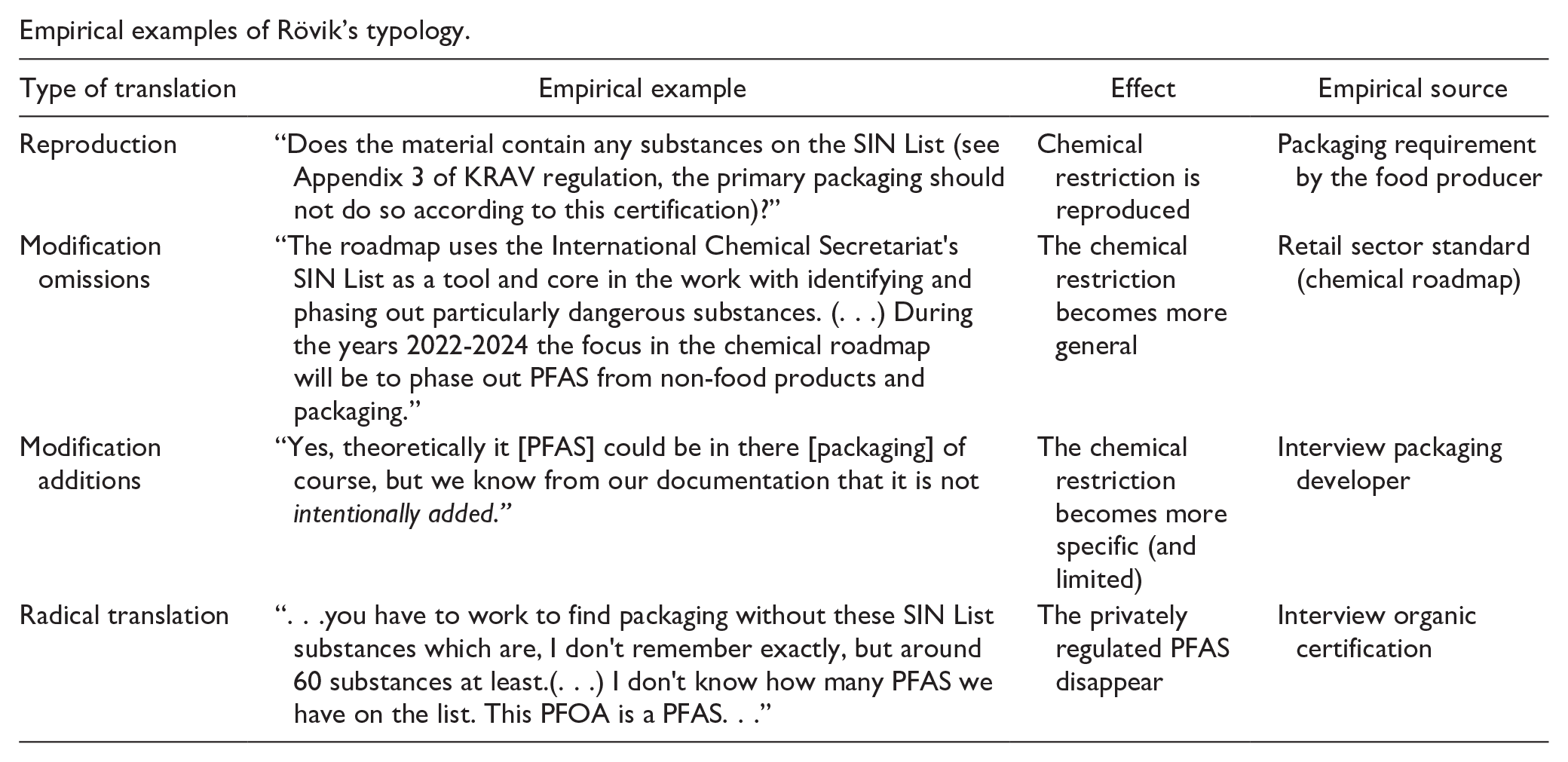
| Type of translation | Empirical example | Effect | Empirical source |
|---|---|---|---|
| Reproduction | “Does the material contain any substances on the SIN List (see Appendix 3 of KRAV regulation, the primary packaging should not do so according to this certification)?” | Chemical restriction is reproduced | Packaging requirement by the food producer |
| Modification omissions | “The roadmap uses the International Chemical Secretariat’s SIN List as a tool and core in the work with identifying and phasing out particularly dangerous substances. (. . .) During the years 2022-2024 the focus in the chemical roadmap will be to phase out PFAS from non-food products and packaging.” | The chemical restriction becomes more general | Retail sector standard (chemical roadmap) |
| Modification additions | “Yes, theoretically it [PFAS] could be in there [packaging] of course, but we know from our documentation that it is not intentionally added.” | The chemical restriction becomes more specific (and limited) | Interview packaging developer |
| Radical translation | “. . .you have to work to find packaging without these SIN List substances which are, I don’t remember exactly, but around 60 substances at least.(. . .) I don’t know how many PFAS we have on the list. This PFOA is a PFAS. . .” | The privately regulated PFAS disappear | Interview organic certification |
Appendix 5
Declaration of Conflicting Interests
The author(s) declared no potential conflicts of interest with respect to the research, authorship, and/or publication of this article.
Funding
The author(s) disclosed receipt of the following financial support for the research, authorship, and/or publication of this article: The research is funded by the Swedish research council Formas – a Swedish Research Council for Sustainable Development, grant number 2021-00460.
