




Abstract
Corporate social responsibility (CSR) is often criticized for being undertheorized, contested, and largely redundant in the field of business and society. Yet limited attention has been paid to diverse ways of theorizing CSR. Driven by the identified weaknesses in the theoretical development of CSR, this research aims to explore the potential of theory elaboration implemented via grounded theory (GT) in strengthening CSR theorization. In doing so, the study offers a unique contribution by being the first study to offer actionable steps and guidelines for implementing theory elaboration via GT in CSR research. The study also offers a typology that can serve as a decision-making tool for researchers seeking to implement theory elaboration through GT in their CSR studies. Lastly, as a result of conducting two sets of literature reviews, the study outlines a number of CSR topics that can benefit from the proposed research pathway, and the particular theoretical CSR benefits theory elaboration via GT can offer. Hence, the study aspires to serve as a “stepping stone” for offering enhanced CSR theory.
Corporate social responsibility (CSR), or the actions that go beyond the immediate interest of the firm and that which is required by law for the purpose of offering some social good (McWilliams & Siegel, 2001), has gained a prominent position in the business and society literature. Despite its notable role, there is strikingly little unanimity among scholars concerning the theoretical evolution of CSR (De Bakker et al., 2005). This observation has led to an increasing interest in theorizing CSR in the last two decades (Frynas & Yamahaki, 2016; Suddaby et al., 2011) for the purpose of generating theoretical CSR insights that incorporate abstracting, generalizing, and synthesizing empirical findings (Swedberg, 2012; Walsh et al., 2015b; Weick, 1995; Weick et al., 2005), so that a sound, “good theory” that presents “explicit treatments of: Who? What? Where? When? Why? and How?—as the greatest of these is Why?” (Van de Ven, 1989, p. 486), within a set of boundary conditions and constraints (Bacharach, 1989) can be presented.
Special issues offered by prestigious journals such as Business & Society (Hofman et al., 2017; Mitnick, 2019; Van Wijk et al., 2019), Journal of Business Ethics (Arora et al., 2020; Painter et al., 2019; Spence, 2022), and Academy of Management Review (Bies et al., 2007; Fisher et al., 2021) have provided platforms for scholars to offer the products of their CSR theorizing. However, the academic community is divided in terms of the theoretical evolution of CSR, and it remains unclear to what extent CSR can be considered a “good theory” (Van de Ven, 1989).
Some scholars suggest that CSR is undertheorized and that the field has not evolved theoretically (Bass & Milosevic, 2018; Frynas & Yamahaki, 2016; Wang et al., 2020) due to the absence of a firm theoretical foundation and coherence. Other authors suggest that CSR is not undertheorized but essentially contested (Mitnick et al., 2021) due to its normative origin (Matten et al., 2003), which makes CSR mean “something but not always the same thing to everybody” (Votaw, 1972, p. 25). A third perspective, stemming from the first two, views CSR as “largely redundant in the field of business and society” (Van Oosterhout & Heugens, 2006, p. 28), due to a lack of clarity regarding what CSR is, or its causes and consequences.
In this study, we take a middle ground between these views. We argue that although CSR was introduced in academic research almost a century ago (Donham, 1927, 1929), and has become a widely accepted field with substantial literature (Carroll, 1999; De Bakker et al., 2005; M. D. P. Lee, 2008; Rowley & Berman, 2000), scholars have not yet addressed the pressing problem of enhanced theorization (Davis, 2010; Fisher & Aguinis, 2017; Suddaby et al., 2011). Instead, CSR’s theoretical evolution has been obscured or even hampered by the continuing introduction of new constructs and accumulation of ostensibly different but potentially identical constructs without necessarily adding anything new to CSR (De Bakker et al., 2005). As a result, the term CSR is used almost interchangeably with concepts such as shared value and corporate citizenship. It is exactly this construct proliferation (De Bakker et al., 2005; Shaffer et al., 2016) that results in CSR being considered as contested (rather than its alleged normative origin), undertheorized, and confounded with various concepts and theories. In fact, extensive CSR literature reviews (De Bakker et al., 2005; M. D. P. Lee, 2008) suggest that only a small percentage of the reviewed papers (3.2% in De Bakker et al., 2005, p. 300) are normative, demonstrating that the normativist view of CSR development cannot be substantiated.
Stemming from the perspective that CSR has already experienced a substantive proliferation of definitions (Carroll, 1999) where multiple constructs have been offered without suggesting anything new (De Bakker et al., 2005), we emphasize the urgent requirement to clarify existing central constructs of CSR and the relationships between them, for the purpose of offering enhanced CSR theory (as suggested by De Bakker et al., 2005). This requires scholars to unpack existing theoretical constructs (causes, conditions, and consequences required for the development of a theory as per Strauss and Corbin, 1990, 1998) that can constitute a CSR theory and to present “explicit treatments of: Who? What? Where? When? Why? and How?” (Van de Ven, 1989, p. 486) in order to fulfill the necessary requirements for offering a CSR theory (Suddaby, 2014).
We propose that this can be done by adopting a theory elaboration approach applied through a grounded theory (GT) research strategy. This will allow for conceptualization and execution of empirical research by using pre-existing conceptual CSR ideas or a preliminary CSR model as a basis for developing new theoretical CSR insights by contrasting, specifying, or structuring theoretical CSR constructs (discussed through specific, actionable steps in section “CSR Theorization: Achieving CSR Theory”) and relations to account for and explain empirical CSR observations (Fisher & Aguinis, 2017). As such, theory elaboration can be regarded as particularly suitable for strengthening CSR theorization (Fisher & Aguinis, 2017; T. W. Lee et al., 1999), and it is thus no surprise that scholars call for more theory elaboration in CSR research (Acquier et al., 2017; Crane et al., 2014; Rhou & Singal, 2020). Moreover, GT is viewed by scholars as particularly useful when conducting a theory elaboration study (Behfar & Okhuysen, 2018; Gephart, 1997; Koleva, 2023; Koleva & Quinn, 2021; Locke, 2001; Timmermans & Tavory, 2012), and as a particularly potent research strategy for offering the required “empirically grounded theory development and testing” (De Bakker et al., 2005, p. 286) to strengthen CSR theorization.
Therefore, stemming from the perspective that theory elaboration in the face of GT strategy can foster the development, expansion, and tightening of existing theoretical CSR ideas and the discovery of new theoretical CSR frontiers (Fisher & Aguinis, 2017; Koleva, 2023), this study proposes that theory elaboration applied through GT strategy can serve as a powerful tool for strengthening CSR theorization. This, therefore, underpins the study’s primary aim—to critically examine how theory elaboration implemented through GT can be used for the purpose of strengthening CSR theorization. To fulfill its purpose, the article presents detailed guidance and actionable steps (sections “CSR Theorization: Achieving CSR Theory” and “How GT Can Facilitate Theory Elaboration, Strenghten CSR Theorization and Offer CSR Theory”) of how theory elaboration in conjunction with GT strategy can be applied to address areas of theoretical void (section “Using Theory Elaboration and GT to Offer Theoretical CSR Advancements and Enhanced CSR Theory”) in order to strengthen CSR theorization and offer enhanced CSR theory.
The study offers a number of important contributions. First, although the concept of theory elaboration was first alluded to in the 1990s (T. W. Lee et al., 1999), there are no guidelines regarding when, why, and how a theory elaboration perspective can be used as a viable means for advancing CSR theorization. This lack of guidance is the likely reason why only a limited number of scholars have adopted it as a basis for conducting CSR research (see section “CSR Theorization: Achieving CSR Theory”). Our study thus makes a unique contribution by defining and describing the potential of theory elaboration as a perspective that allows scholars to systematically evaluate observable CSR phenomena in relation to existing conceptualizations as a basis for strengthening CSR theorization. The study also describes concrete and actionable implementation tactics for scholars interested in conducting a theory elaboration study which can serve as valuable guidelines in future CSR research.
Our second contribution relates to outlining a pathway for the implementation of two contrasting GT approaches and key GT relevant aspects that are uniquely appropriate for theory elaboration and strengthening CSR theorization. The same is supplemented with a typology that can serve as a decision-making tool for scholars interested in implementing theory elaboration through GT. As a result, researchers will be able to make an informed decision when deciding on the most appropriate theory elaboration and GT approaches to adopt in their CSR research. Moreover, there is currently only a handful of studies that discuss the process of theorization in a single GT approach (Urquhart et al., 2010), and no research that demonstrates in a comparative fashion the practical differences between different GT approaches in terms of theorization, and especially CSR theorization. Therefore, the study is novel in that it examines the peculiarities of two GT approaches, and it is the first to examine this problem in relation to CSR theorization.
Third, as a result of conducting two sets of literature reviews, the study contributes to the CSR literature by offering a number of CSR areas that require the attention of scholars. The study outlines in concrete steps how theory elaboration implemented through GT can help scholars to address those gaps and hence to strengthen CSR theorization. In doing so, the study also proposes possible solutions to the criticisms expressed above (and developed further in section “Issues in CSR Theory”) and the potential role of theory elaboration and GT strategy in this regard. As such, the study aspires to serve as a “stepping stone” for the development of a CSR theory, as well as for future theoretical CSR contributions.
The article is structured as follows. Section “Issues in CSR Theory” presents dissenting voices in terms of CSR theorization and different critiques related to the theoretical evolution of CSR. In section “CSR Theorization: Achieving CSR Theory,” the article outlines a path toward achieving a CSR theory; we introduce theory elaboration, and we outline a pathway that is highly appropriate for this particular purpose. Section “How GT Can Facilitate Theory Elaboration, Strenghten CSR Theorization and Offer CSR Theory” presents how GT can facilitate that process, focusing on aspects of GT that are uniquely appropriate for the implementation of theory elaboration, for strengthening CSR theorization, and for offering a CSR theory. We also support our discussion in section “How GT Can Facilitate Theory Elaboration, Strengthen CSR Theorization and Offer CSR Theory” with concrete recommendations in relation to the pressing issue of construct proliferation as well as other critiques presented in section “Issues in CSR Theory”. Section “Using Theory Elaboration and GT to Offer Theoretical CSR Advancements and Enhanced CSR Theory” outlines the results of two literature reviews, for the purpose of demonstrating how GT has been used to date to advance the CSR field, what more needs to be done, as well as the potential benefits of using theory elaboration through GT to offer a CSR theory and to advance CSR research. The article concludes with a discussion of its main contributions and directions for further research.
Issues in CSR Theory
As indicated earlier, a theory represents a statement of relations between concepts within a set of boundary assumptions and constraints (Bacharach, 1989), and it is important for the same to be distinguished from a concept as the latter serves as a set of properties that are associated with each other in memory and thus form a unit (Gelman, 1996). Therefore, some well-known concepts within the CSR field that have sometimes been labeled as a CSR theory, such as corporate citizenship and Carroll’s pyramid (Garriga & Melé, 2004), do not qualify as a theory (Frynas & Yamahaki, 2016). Indeed, in their original contributions, Carroll (1991) presented his CSR pyramid as a typology, while Matten and Crane (2005) presented corporate citizenship as a theoretical conceptualization. Although concepts are important for the advancement of a particular field, researchers cannot make deductions from concepts alone but should highlight relationships, connections, and interdependencies in the phenomenon of interest (Weick, 1989), as this will ultimately help to theorize CSR by offering “explicit treatments of: Who? What? Where? When? Why? And How?” (Van de Ven, 1989, p. 486), which according to scholars has not been achieved yet (Bass & Milosevic, 2018; De Bakker et al., 2005; Frynas & Yamahaki, 2016; Van Oosterhout & Heugens, 2006; Wang et al., 2020).
As mentioned above, one stream of scholars perceives CSR as undertheorized (Bass & Milosevic, 2018; Frynas & Yamahaki, 2016; Wang et al., 2020) and as not having evolved theoretically for the following reasons. First, the CSR field is considered lacking in solid theoretical foundations and coherence, as CSR is complex and represents diverse areas of study; it can be considered both as a firm behavior that potentially affects the bottom line (viewed instrumentally) and as a goal in and of itself that exists simultaneously alongside financial goals (Barnett, 2019; Frynas & Yamahaki, 2016; Hilliard & Hilliard, 2019; Okoye, 2009; Wang et al., 2016).
A contributing critique is the dependency of CSR on theories that are still in a process of refinement, such as stakeholder theory (Barnett, 2019; Laplume et al., 2008) which is “a general perspective on strategic management and offers various applications that are entirely unrelated to CSR” (Frynas & Yamahaki, 2016, p. 260). CSR may be seen as relying on theories that have been generated in other fields and for other purposes; such theories may not fit well within the CSR context without substantial advancement or adaptations (Wang et al., 2016). For example, theories in the tradition of economics and finance are largely based on the shareholder primacy model; they may be more suitable for situations that require the single objective of shareholder value maximization, and they may not always be in line with the goals of CSR that attend to multiple stakeholders (Wang et al., 2016). With the increasing recognition that economic, social, and environmental interests are highly intertwined and that achieving all three requires an understanding of their intersection (Hilliard & Hilliard, 2019), the application of these singular-focus theories may be constraining. This in turns results in CSR being regarded as not sufficiently developed to inform practice (Wang et al., 2016), as lacking internal consistency due to limited multi-level CSR research (Aguinis & Glavas, 2012), as a concept that is fuzzy and unclear (Gond & Moon, 2011), and as lacking theoretical advancement and coherence (Hilliard & Hilliard, 2019).
Second, CSR is considered to have phenomenological origins due to early CSR research focusing primarily on empirically examining the relationship between CSR and corporate financial performance (CFP), aiming in this way to inform financial decisions and not necessarily to provide theoretical insights (Wang et al., 2016). Third, CSR research is often criticized for a lack of practical implications, as studies seldom address what firms should do in CSR terms, and fall short in informing strategic decisions (Mazutis, 2018; Wang et al., 2020). For example, it has been argued that we know little about how culture, practices, and interactions shape CSR (Bass & Milosevic, 2018). It is also suggested that CSR is not very helpful in understanding and making explicit what is desirable or required at the business-society interface (Barnett, 2019; Mazutis, 2018).
An alternative stream of literature argues that CSR is not undertheorized but essentially contested (Mitnick et al., 2021) due to its normative origin (Matten et al., 2003). As a contested concept (Gallie, 1955), CSR features multiple, typically complex, rival, but equally reasonable and perhaps irreconcilable interpretations (Mitnick et al., 2021), which potentially explains the substantive number of CSR definitions evident in the literature (Dahlsrud, 2006). The same is also very much driven by the lack of clarity in terms of what CSR actually means. Although it is very well established in the CSR literature that CSR concerns certain social aspects, some form of responsibility, and the role of the corporation as a whole, these three elements are extremely broad, undefined, lacking specifics, and open to various explanations (Van Oosterhout & Heugens, 2006). Founded on such generic descriptions, CSR is open to multiple interpretations and endless construct proliferation (Carroll, 1999; Shaffer et al., 2016). Stemming from the broad nature of CSR, scholars (Mitnick et al., 2023) realize that it is not fruitful to offer concrete direction and guidance but prefer instead to focus on the canonical core of CSR and what is most consistent with CSR. Even Archie Carroll prefers a “domains approach” to CSR (Carroll, 1991) instead of referring to concrete explanations.
A third view regarding the theoretical evolution of CSR is a combination of the first two, that is, it draws on the undertheorized as well as the contested views of CSR. As a result, CSR is regarded as “largely redundant in the field of business and society” (Van Oosterhout & Heugens, 2006, p. 28), since: (a) there is a lack of clarity regarding what CSR is, or its causes and consequences and (b) CSR is not very helpful in understanding and making explicit what is desirable or required at the business-society interface (Van Oosterhout & Heugens, 2006). In relation to the first point, extensive reviews of the CSR literature (De Bakker et al., 2005; Rowley & Berman, 2000) demonstrate that corporate social performance (CSP) and CFP are very often used to explain and define “the philosophically challenged CSR” (Van Oosterhout & Heugens, 2006, p. 13). Critiques of this perspective, however, state that such research disregards the fundamental epistemic insight that potential operationalizations of CSR (in the face of CSP and CFP) require, as they only make sense when they are closely related to a clear theoretical definition of CSR (Van Oosterhout & Heugens, 2006), which due to the substantive construct proliferation (Carroll, 1999; Shaffer et al., 2016) is not evident. The second point comes from the widening gap (Jenkins, 2004) between the interests of business and society, as CSR is considered unable to address constantly increasing societal concerns (Mazutis, 2018), or to explain why organizations would do so (Barnett, 2019). As a result, CSR fails to fulfill Van de Ven’s (1989) criteria and to offer explicit treatments of key constructs in a potential CSR theory (Suddaby et al., 2011).
Moreover, in line with calls for a shift toward multi-level CSR theorization (Aguilera et al., 2007; Aguinis & Glavas, 2012; Van Wijk et al., 2019), we argue that a CSR theory should also be capable of explaining phenomena across multiple levels, as multi-level CSR theorization can help scholars identify and test predictors, moderators, mediators, and outcomes—or, as labeled by Strauss and Corbin (1990, 1998), causes, conditions and consequences required for a theory development. However, such a CSR theory is currently missing from the CSR field (Aguinis & Glavas, 2012; Athanasopoulou & Selsky, 2015; De Bakker et al., 2005; Wang et al., 2020).
Furthermore, while there are many different paths toward developing theory in business and society research, the CSR field lacks diverse processes of theorizing CSR and relies primarily on deductive and quantitative approaches (Aguinis & Glavas, 2012; Delbridge & Fiss, 2013; Okoye, 2009). This is despite the numerous calls for more pluralistic approaches (Grodal et al., 2021; Welch & Piekkari, 2017) which results in the criticism expressed above in terms of CSR being considered fragmented and undertheorized (Aguinis & Glavas, 2012; Davis, 2010; Suddaby et al., 2011; Wang et al., 2020). However, we propose that a possible solution for such fragmentation challenges is the creative discovery and theory advancement offered by theory elaboration via GT strategy.
CSR Theorization: Achieving CSR Theory
Contrary to inductive theory generation and deductive theory testing, theory elaboration allows theorization when an existing conceptual model, ideas, or phenomenon are partially explained, as that can be a basis for the collection and organization of data in order to contrast, specify, and structure theoretical constructs to refine existing theories and relationships (T. W. Lee et al., 1999).
Accordingly, there are several ways in which theory may be advanced as part of a theory elaboration study: (a) through enhanced construct validity so that the constructs become more clearly defined and distinguishable from other similar constructs; (b) when construct scope is adequately captured and sufficiently reflects the phenomenon in question; (c) when proposed relations have greater logical adequacy such that the implicit or explicit logic of a relation is clearly specified and nontautological; (d) when relations have greater empirical adequacy such that they better reflect organizational realities, and (e) when theoretical relations have greater explanatory potential and predictive adequacy such that they can more accurately explain and/or predict outcomes of interest (Bacharach, 1989). In order to be considered a theory elaboration study and as a study that is adequately advancing a theory, a study needs to address at least one of these criteria (Fisher & Aguinis, 2017).
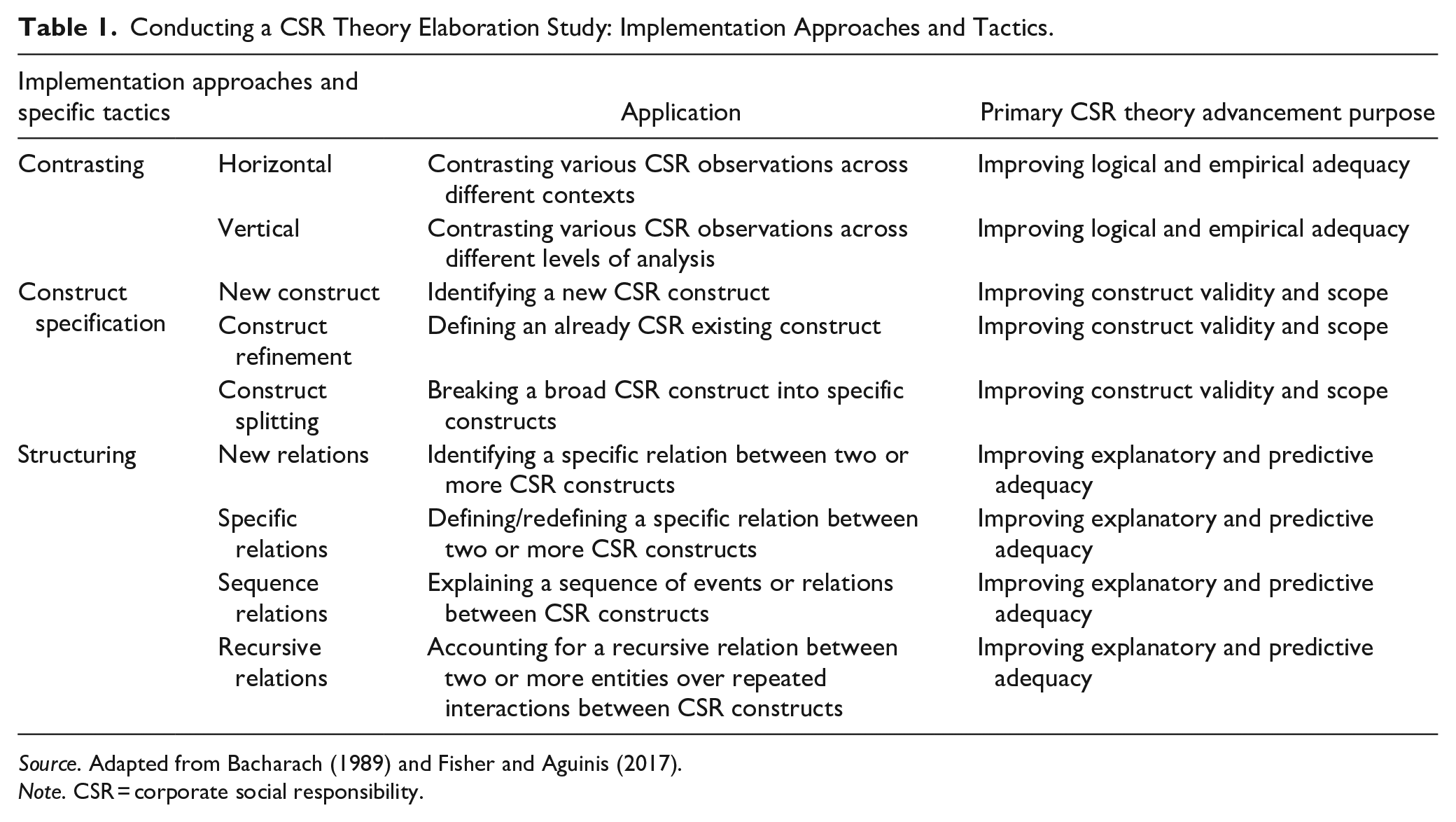
We now combine Bacharach’s (1989) criteria with an amended version of Fisher and Aguinis’ (2017) criteria for applying theory elaboration for the purpose of presenting how theory elaboration can help address the CSR critique presented above, and effectively strengthen CSR theorization (Table 1).
Conducting a CSR Theory Elaboration Study: Implementation Approaches and Tactics.
Source. Adapted from Bacharach (1989) and Fisher and Aguinis (2017).
Note. CSR = corporate social responsibility.
Contrasting as a theory elaboration approach can be applied in multiple settings for the purpose of developing a deeper understanding of the nature of a theory and identifying which theoretical aspects are generalizable across diverse settings and which can be considered as context specific. Contrasting can be done across industry, organizational, geographical contexts (i.e., horizontal contrasting) or across different levels of analysis (i.e., vertical contrasting).
This approach to theory elaboration can enable scholars to improve the logical and empirical adequacy (Bacharach, 1989) of a CSR theory. The fundamental nature of existing theoretical relations in CSR can be scrutinized by carefully considering whether such relations make logical sense as they are applied in different settings. For example, if we are to take “moral” as the canonical core of CSR as discussed in Mitnick et al. (2023), would that canonical core have the same connotations in different industry or geographical settings, or at different levels of analysis (e.g., dimensions of “moral” as the canonical core of CSR at the individual, meso, and macro levels of analysis)? In this way, scholars can aim to identify if theoretical relations in CSR remain the same or change across contexts and in doing so, explore the driving mechanisms that influence those relations and respective changes. Moreover, by applying contrasting approaches to theory elaboration across different contexts, the empirical adequacy of a CSR theory can also be advanced (Bacharach, 1989). For example, empirical evidence for attitudes of managers toward “moral” as a canonical core of CSR (according to the study of Mitnick et al., 2023) can be studied across diverse geographical contexts, or across industries.
Construct specification in theory elaboration allows for a theoretical CSR construct to be specified or refined to more accurately reflect the realities and insights that emerge empirically. Based on such empirical work, new constructs may also emerge, or the need to split already existing theoretical constructs may become evident.
Construct specification allows for new constructs that have not previously been considered in a CSR theory to be identified, as identifying and defining previously unspecified constructs creates opportunities to recognize new theoretical relations that accurately depict reality (Suddaby, 2014).
On the other hand, theory elaboration also allows for construct splitting of existing constructs into specific dimensions to provide accurate presentations of different properties composing those constructs (e.g., “social” as per the critique of Van Oosterhout & Heugens, 2006). In this way, researchers may identify that a single construct has multiple dimensions. If partitioned into two or more dimensions, the validity and scope of the construct may be enhanced, and it becomes easier to account for outcomes of interest when taking the different dimensions into account (Bacharach, 1989).
Although not considered by Fisher and Aguinis (2017), we also add construct refinement (Table 1) as a possible approach to conducting theory elaboration, as implemented in the theory elaboration study of Amaeshi et al. (2016). Amaeshi et al. (2016) implemented theory elaboration (T. W. Lee et al., 1999) for the purpose of refining and clarifying what could be considered institutional accounts in Nigeria and exploring how the same influenced CSR practice. Therefore, construct refinement was included as a theory elaboration approach in Table 1. For example, scholars can shed more light on already existing constructs such as “responsibility” (which according to Van Oosterhout & Heugens, 2006 is completely lacking in clarity); this can in turn improve the construct validity and scope (Bacharach, 1989) of a CSR theory.
Structuring may be used to identify relations that have not previously been identified or may be used to explain complex relationships concerning sequential or repeated interactions that have not been sufficiently considered in prior CSR theory. Building on the work of Fisher and Aguinis (2017), we add that theory elaboration can be conducted by identifying new relations (Table 1) between two or more constructs that have not been considered previously by scholars. The theory elaboration study of Tate and Bals (2018) is an excellent example of this approach, where the researchers revised the resource-based view and the natural resource-based view of the firm to lay the theoretical foundation for exploring how the social dimension of the triple-bottom-line might be addressed. Such an approach to conducting a theory elaboration study for the purpose of identifying new relations can allow for improved explanatory and predictive adequacy of a CSR theory (Bacharach, 1989).
Another way to improve or advance a CSR theory is by identifying and describing specific relational structures between constructs that have been insufficiently described. This may include clarifying the relationship between two or more CSR constructs or variables in order to isolate and understand how variance in one can account for variances in another; or understanding the driving CSR antecedents and mechanisms (e.g., the need to address the widening gap between business and society, and the role of CSR in addressing constantly increasing societal concerns as in Jenkins, 2004; Mazutis, 2018; and Barnett, 2019).
Theory elaboration can also be applied through the examination of sequence relations. Research here can focus on understanding the temporal ordering and probabilistic interaction between variables (e.g., to arrive at C, you first need to go through A and then B). In other words, researchers can aim to build CSR process theories that provide explanations in terms of the sequence of events leading to a particular outcome; for example, what are the emotions that internal and external stakeholders experience as a consequence of CSR initiatives, and what is the role of such microfoundations in helping scholars understand the underlying processes linking CSR with an organization’s financial performance (Aguinis & Glavas, 2012)?
The last approach to applying theory elaboration (Table 1) is through recursive relations. This will require scholars to account for and describe recursive CSR interactions between different constructs in a CSR theory. An existing CSR theory may already reflect a relation between two constructs, yet the recursive nature of the relation between such constructs may be poorly understood or ignored. Therefore, a prior theoretical CSR model can serve as a basis for designing and conducting a study to examine how a relationship develops and evolves as two (or more) constructs interact repeatedly over time. Hence the structuring approach to theory elaboration has the potential to substantially enhance the explanatory and predictive adequacy of a CSR theory (e.g., using institutional theory to identify the effect of institutional-level regulations on institutional-level stakeholder relations and CSR orientation, as per Aguinis & Glavas, 2012).
With the overview of the potential of theory elaboration to offer CSR theoretical advancement and to strengthen theorization offered in this section, we aim to outline a path toward building a CSR theory. This discussion is supported with reference to some of the CSR critique presented earlier in the study. Despite its potential to offer theoretical advancement, as recognized in multiple fields (e.g., organizational and management research, education, educational technologies, and psychology), theory elaboration seems to be a largely unknown research approach in the CSR field (for notable exceptions from this observation see Amaeshi et al., 2016; Stutz & Sachs, 2018; Tate & Bals, 2018).
In the next section, we present in more concrete steps how theory elaboration applied through GT research strategy can strengthen CSR theorization.
How GT Can Facilitate Theory Elaboration, Strengthen CSR Theorization and Offer CSR Theory
GT is a research strategy relying on abduction (in the GT versions of Charmaz, 2006 and Glaser, 1978), or induction (in Strauss & Corbin, 1990, 1998; Glaser & Strauss, 1967) 1 that forms and evaluates hypotheses in order to make sense of puzzling facts (Koleva & Ocler, 2018; Peirce, 1935; Thagard & Shelley, 1997; Thornberg, 2012). It is closely related to the theory-building, theory-testing, and theory-refining logic of theory elaboration (Fisher & Aguinis, 2017; Ong, 2012).
We have chosen Charmaz’s (2006) constructivist grounded theory (CGT) and the classic GT version of Glaser (1978) to present the potential of GT for theory elaboration, not only due to their extensive application in business and society research (Dougherty, 2015; Walsh et al., 2015a) but also because of their contrasting philosophical positions and differences in treatment of data that can ultimately result in addressing different aspects of the CSR critique presented earlier. It is exactly the differences in philosophical underpinnings and treatment of data—discussed in greater detail below—between CGT and classic GT that distinguish how these two approaches can be applied to conduct theory elaboration and to strengthen CSR theorization.
Both approaches implement standard GT tools such as constant comparison, theoretical sampling, and even abduction. Although Charmaz (2006) explicitly states that CGT relies on abductive reasoning, Glaser (1978) does so by focusing on conceptualization, theoretical coding and theoretical sampling, and ultimately engage in abduction too (Bruscaglioni, 2016; Nathaniel, 2019). However, beyond these similarities, there are a number of important differences between classic GT and CGT.
The constructivist turn in CGT underpins the data treatment and the researcher’s role in the inquiry, as the latter engages actively in the data collection, analysis, construction, and co-construction of the phenomenon (Charmaz, 2008). The influence of its constructive underpinning is further evident in the analytic question “What is happening here?” (Charmaz, 2011) used for data coding, which aims to identify actions, motivations, and perceptions related to the phenomenon construction and co-construction (Fairhurst & Putnam, 2018); this can ultimately result in a CSR theory with exploratory and analytic power that illuminates and provides an understanding of the observed phenomena (Koleva, 2023).
Therefore, due to its constructivist stance, its active involvement of the participants and social context in constructing data, as well as its treatment of data, we consider CGT as particularly suitable for conducting theory elaboration studies that focus on illuminating the importance and active involvement of the social context and social actors in creating and co-creating relationships and links within a CSR theory. Such studies will be concerned with actions, motivations, and perceptions that collectively result in the construction of CSR. Their theoretical product will have exploratory and analytic power and will therefore be concerned with providing understanding related to Why? and How? questions (as per the requirement of Van de Ven, 1989) in a CSR theory. Therefore, we suggest that contrasting and construct specification as approaches to theory elaboration (Table 1) can be implemented through CGT.
If contrasting is considered to be a theory elaboration approach, CGT will allow for various CSR-related factors to be examined in multiple settings and across multiple levels, to develop a deeper understanding of their nature and to identify which theoretical aspects are generalizable across diverse settings/levels and which could be considered as context specific (e.g., “moral” as the canonical core of CSR across different industry/geographical settings and levels of analysis). CGT can be applied for horizontal contrasting (e.g., perceptions of “moral” across geographical contexts), as well as vertical contrasting in theory elaboration studies—especially where perceptions, actions, and motivations are concerned (e.g., “moral” related CSR inquires at the micro, meso, and macro levels of analysis).
Implemented in this way, theory elaboration through CGT can allow scholars to improve the logical and empirical adequacy (Bacharach, 1989) of a CSR theory. The fundamental nature of existing theoretical relations in CSR can be scrutinized by carefully considering whether such relations make logical sense as they are applied across multiple contextual settings and levels of analysis for the purpose of identifying whether theoretical relations in CSR remain the same or change, and in doing so, to explore the underlying mechanisms that drive such change.
Considering the constructivist philosophical stance and treatment of data, CGT will also be appropriate when theory elaboration with a focus on construct specification (Table 1) is applied. Here, an existing theoretical CSR construct can be specified or refined to more accurately reflect the realities and insights that emerge empirically. New constructs may also emerge, illuminating links and relationships in a CSR theory (as in Amaeshi et al., 2016).
CGT can also help scholars to shed light and clarity on existing CSR constructs (construct refinement), such as “responsibility” (e.g., by highlighting perceptions of responsibility, actions that could be considered responsible, motivations for doing so) in order to improve the validity and scope (Bacharach, 1989) of a CSR theory, especially if the focus of such research is to examine the influence of and role of the social context in the construction and co-construction of the examined construct. On the other hand, scholars can implement construct splitting of existing CSR constructs into specific dimensions to provide accurate presentations of different properties composing those constructs; for example, dimensions of “social.” If partitioned into two or more dimensions, the validity and scope of the construct can be enhanced, and it may become easier to account for outcomes of interest when taking the different dimensions into consideration (Bacharach, 1989).
Contrary to CGT, the classic GT of Glaser (1978) focuses on answering questions related to description, explanation and prediction of phenomena that exist in a single reality which a neutral observer can discover (Birks et al., 2019). The importance of the social context in formulating the phenomena is erased, which makes Glaser (1978) appropriate for studies interested in the practical and operational dimensions of CSR; this includes obtaining information about chronology, events, concerns, and CSR problems that the participants are seeking to resolve (Koleva, 2023). Therefore, Glaser (1978) is suitable for CSR studies that aim to achieve “parsimony and scope in explanatory power” (Glaser, 1992, p. 116). The final theoretical product is a CSR theory that provides a descriptive explanation and prediction of the participants’ experiences with CSR (Glaser, 1978).
Accordingly, we propose that the approach of Glaser (1978) will be particularly suitable when structuring (Table 1) as a theory elaboration approach is applied, due to classic GT’s focus on offering descriptive explanations of empirical observations. The structuring approach to theory elaboration in all its possible implementations (new, specific, and recursive structures) aims to enhance the explanatory and predictive adequacy of an existing theory which corresponds to the aim of classic GT to offer theories that have “parsimony and scope in explanatory power” (Glaser, 1992, p. 116), and can answer questions related to: Who? What? Where? When? (Van de Ven, 1989, p. 486).
Therefore, theory elaboration can be implemented through Glaser’s (1978) approach, enabling the identification of new relations between existing constructs(see Tate & Bals, 2018) and explaining the underlying factors between such constructs which can allow for improved explanatory and predictive adequacy of a CSR theory (Bacharach, 1989). Glaser (1978) can also be implemented for identifying and describing specific relations structures between constructs that have been insufficiently described in previous studies. This approach provides descriptive accounts of factors that can influence such relations (i.e., the need to address the widening gap between business and society, and the role of CSR in this process; Barnett, 2019; Jenkins, 2004; Mazutis, 2018).
Due to its descriptive nature, CSR elaboration studies conducted by implementing Glaser’s (1978) approach can be applied through the examination of sequence relations. Research here can focus on understanding chronological events, orders, sequences, and interactions between variables that collectively influence CSR. As mentioned above, an excellent example in this regard will be CSR studies focused on describing CSR emotions that internal and external stakeholders experience because of CSR initiatives and their role as microfoundations in linking CSR with an organization’s financial performance (as per Aguinis & Glavas, 2012).
Scholars can also conduct a theory elaboration study focusing on recursive relations by implementing Glaser (1978), as classic GT will enable the researcher to account for and describe recursive interactions between different constructs in a theoretical model (e.g., using institutional theory to identify the effect of institutional-level regulations on institutional-level stakeholder relations and CSR orientation, as per Aguinis & Glavas, 2012).
Therefore, based on the review of GT’s potential to work through theory elaboration to offer enhanced CSR theory offered in this section, we propose the following decision-making tool that will help scholars choose between CGT and classic GT approaches (Figure 1). Depending on the specific worldview adopted by the researcher, and their approach toward the treatment of data, Figure 1 depicts relevant GT and theory elaboration approaches, as well as the potential theoretical outcomes and results the researcher can achieve. The typology can be used in the reverse manner as well. Depending on the intended theoretical product, perceived outcomes, and in general how the researcher intends to strengthen CSR theorization/offer CSR theory, the researcher can identify which theory elaboration and GT approach will be most suitable, and correspondingly the most appropriate data treatment and worldview to apply.
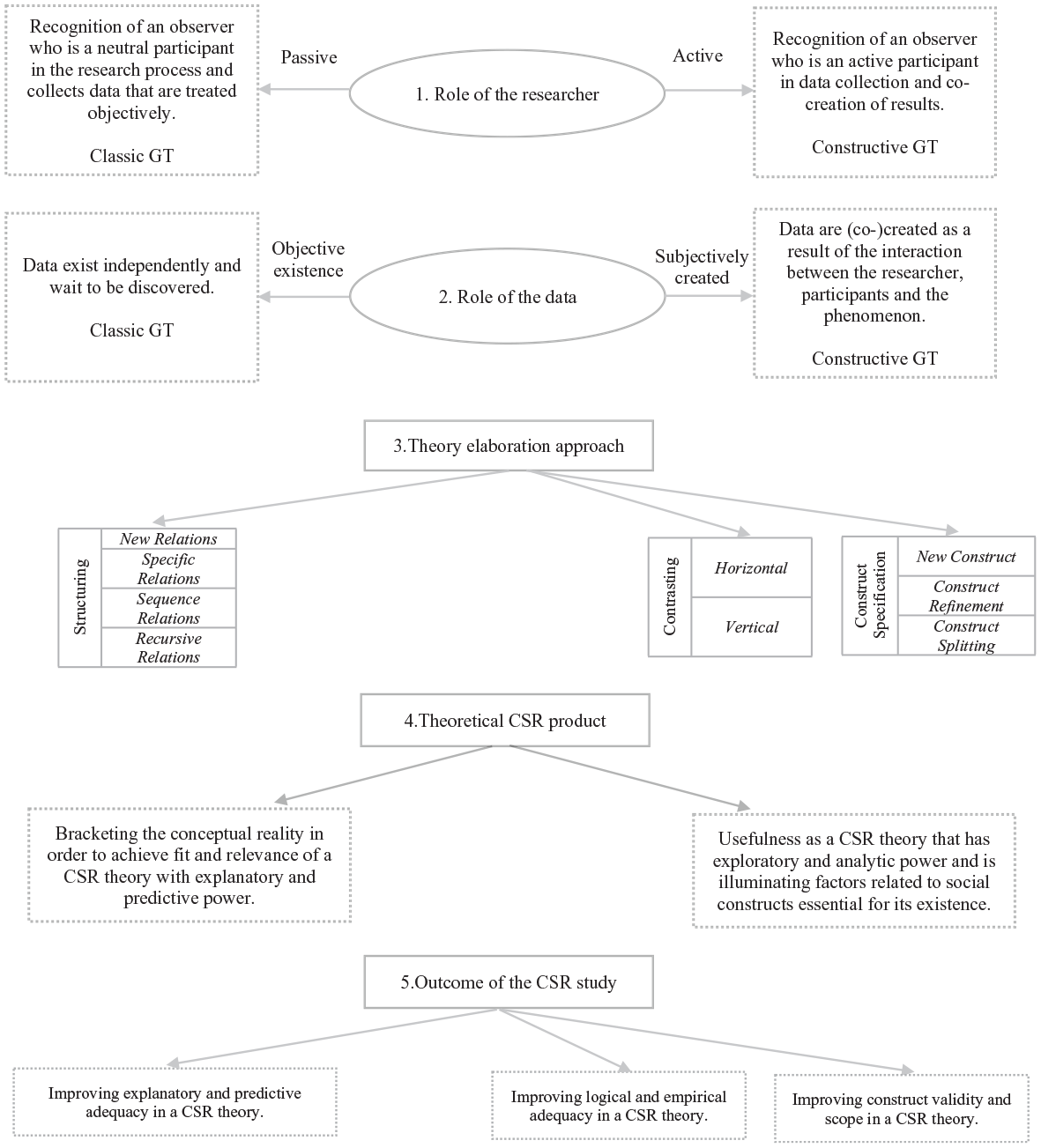
Typology for Selection of a Grounded Theory Version for Conducting a Theory Elaboration Study for the Purpose of Offering a CSR Theory.
In the next section, we highlight relevant CSR research areas where scholars can apply the proposed typology (Figure 1) for the purpose of offering theoretical CSR advancements and enhanced CSR theory.
Using Theory Elaboration and GT to Offer Theoretical CSR Advancements and Enhanced CSR Theory
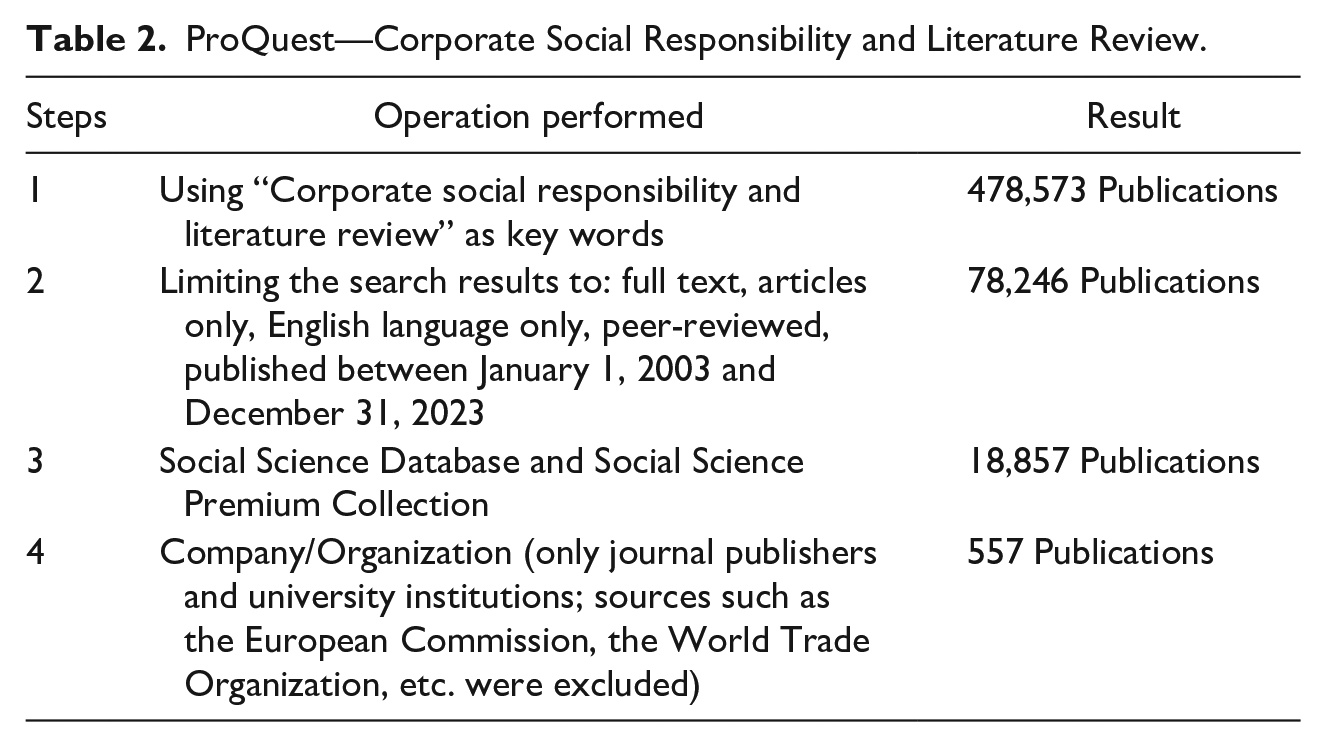
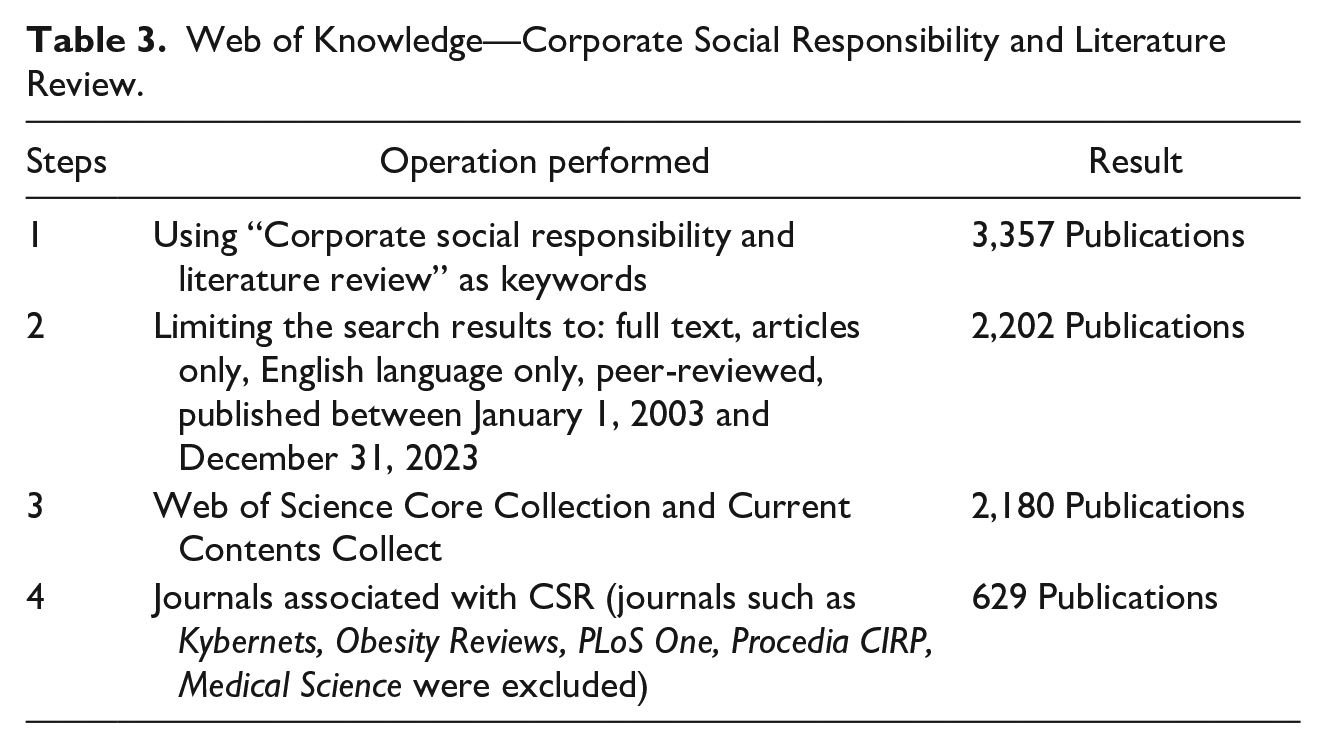
The purpose of this section is to present areas of conceptual and practical CSR void that could be addressed using the typology offered in Figure 1. Therefore, a search for CSR literature review papers was conducted with the aim of identifying areas of conceptual and practical gaps. The search for publications was initiated using Web of Knowledge and ProQuest as research databases, with “CSR and literature review” as keywords, within the time frame 2003 to 2023. This 20-year time frame was chosen to enable us to identify the latest developments and theoretical advancements in the CSR field, as well as any limitations, and—to address the purpose of this study—to suggest how CSR theorization could be further strengthened and CSR theory could be offered by using theory elaboration implemented through GT strategy. Our literature search (Tables 2 and 3) considered articles written in the English language only; newspapers and book chapters were excluded from the search, as well as journals that are not associated with CSR (e.g., Obesity Reviews, Medical Science), and publications from non-academic and other non-traditional sources (e.g., the European Commission, the World Trade Organization). Based on the proposed search criteria, 557 publications were identified from ProQuest and 629 from Web of Knowledge. The same were further assessed by checking their title, abstract, and content to determine their fit with the search criteria. This narrowed the search results to 156 publications that were recognized as CSR literature reviews. The 156 publications (a complete list is provided in the Supplemental Appendix) were then carefully read for the purpose of identifying contributions, suggestions, and recommendations for offering theoretical CSR advancements.
ProQuest—Corporate Social Responsibility and Literature Review.
Web of Knowledge—Corporate Social Responsibility and Literature Review.
The articles were grouped into three broad areas (Table 6): intra-organizational matters (covering internal organizational issues such as CSR disclosure and reporting, organizational performance, stakeholders, philanthropy, financial performance and CSR, CSR commitment, corporate governance, and CSR-washing); inter-organizational matters (e.g., industry specific matters, supply chain, and ethical sourcing); and cross-sectional matters (the perception, implementation, and practice of CSR in different contexts) that would benefit from theory advancements and require the attention of scholars.
Upon reading the 156 publications and assessing their suggestions for advancing the CSR field, we aimed to examine whether and how GT was used for that purpose. However, only 21 of the publications provided an analysis of the methodological approaches applied in the reviewed publications. From the same, a common observation is that quantitative and deductive methods largely dominate CSR research (Fatima & Elbanna, 2023; Gatti et al., 2019; Mariani et al., 2023; Ortiz-Avram et al., 2018; Pisani et al., 2017; Stock et al., 2023; Zaman et al., 2022), which is also one of the main critiques identified earlier regarding the lack of diverse methods in CSR theorizing (Aguinis & Glavas, 2012; Delbridge & Fiss, 2013; Okoye, 2009); scholars recommend that more qualitative CSR research should be conducted (Bolourian et al., 2021; Minh et al., 2022; Nicole et al., 2022). Exceptions here are topics such as ethical sourcing (Kim et al., 2018), CSR reporting discourse in developing countries (Mehjabeen & Bukth, 2020), ethics and entrepreneurship (Vallaster et al., 2019), and CSR in the apparel industry (White et al., 2017) where we observe a strong presence of qualitative studies (conducted through case study research design, content analysis, as well as conceptual papers). A limited number of qualitative studies (using content analysis) were identified in articles examining CSR in small and medium enterprises (SMEs) (Ortiz-Avram et al., 2018). However, none of the literature reviews identified GT (neither CGT nor classic GT) as a research strategy employed in the reviewed CSR studies.
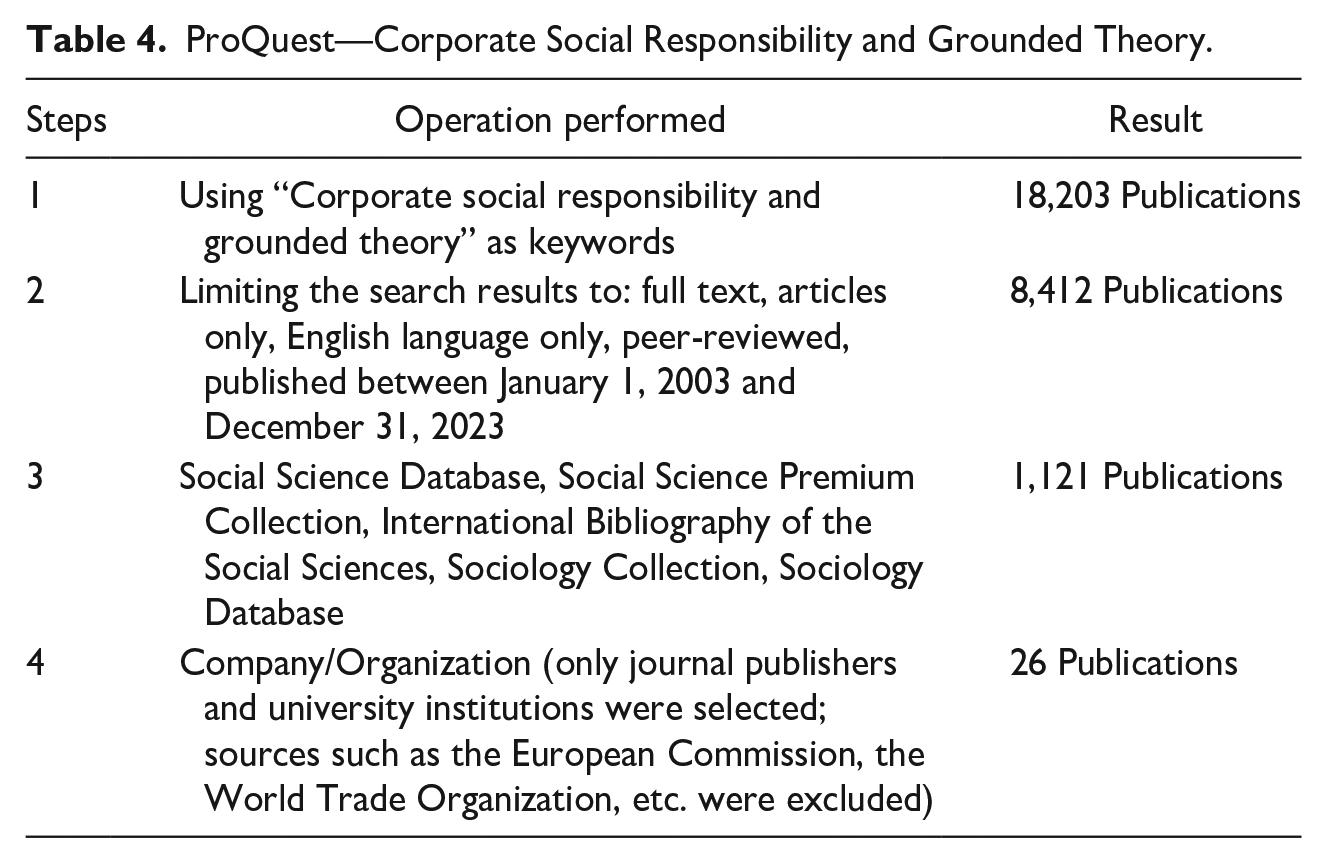
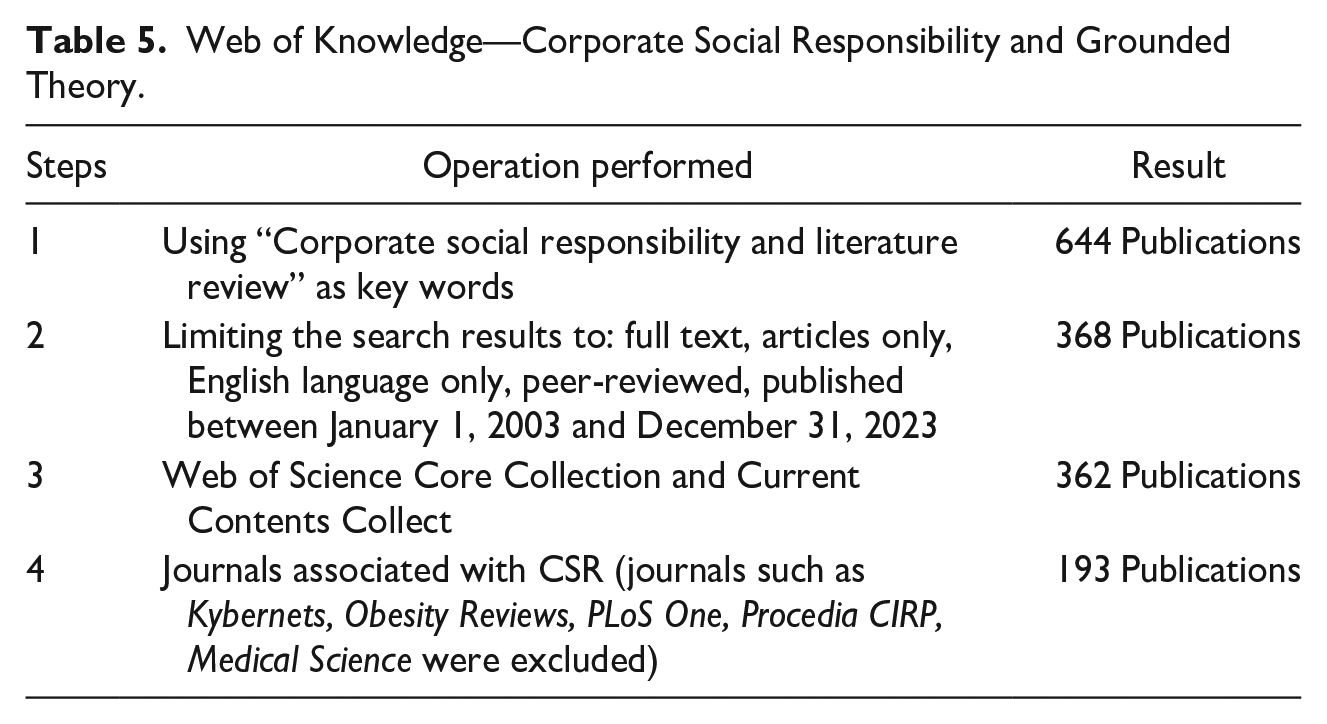
Accordingly, a second literature review was conducted to identify how GT (CGT and classic GT) has been used to advance the CSR field. This was performed by utilizing Web of Science and ProQuest as research databases where “corporate social responsibility and grounded theory” were used as keywords. Once again, the chosen time frame was 2003 to 2023, in order to focus on the latest applications of GT in CSR research. The search results were assessed against the criteria available in Tables 4 and 5, which narrowed the search to 26 publications from ProQuest and 193 from Web of Knowledge. Their methodological sections were then assessed for evidence of the application of a GT (CGT or classic GT) research strategy. Publications that only mentioned names of grounded theorists (e.g., in relation to inductive approaches) but did not implement GT as a research strategy were excluded. Publications applying approaches by other grounded theorists were also excluded (see Note 1), as their approach to GT is beyond the scope of this study. The publications’ content was also retrieved to assess if the publications were indeed CSR-focused. This last step helped to identify 12 studies (see the Supplemental Appendix for a complete list) meeting all criteria. From that number, eight studies were found to employ Charmaz (2006), and four implemented Glaser (1978). The findings of the first and second literature searches were used to create Table 6.
ProQuest—Corporate Social Responsibility and Grounded Theory.
Web of Knowledge—Corporate Social Responsibility and Grounded Theory.
Opportunities for Theory Elaboration through Grounded Theory Research Strategy for the Purpose of Strengthening CSR Theorization and Achieving a CSR Theory.
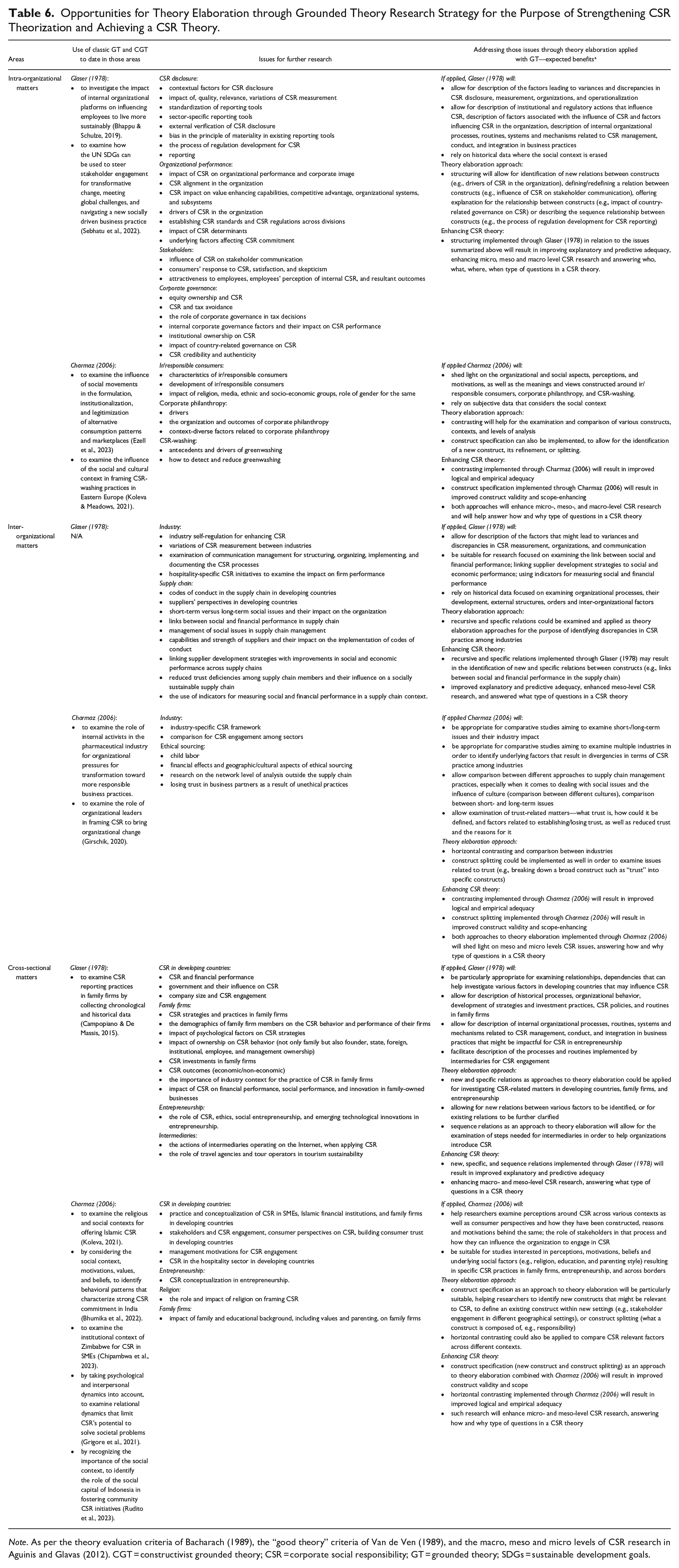
Note. As per the theory evaluation criteria of Bacharach (1989), the “good theory” criteria of Van de Ven (1989), and the macro, meso and micro levels of CSR research in Aguinis and Glavas (2012). CGT = constructivist grounded theory; CSR = corporate social responsibility; GT = grounded theory; SDGs = sustainable development goals.
The results presented in Table 6, that is, how GT (CGT and classic GT) have been used so far to advance the CSR field, support the proposed typology in this study (Figure 1) in relation to how GT and CGT could be implemented and used for theory elaboration, the type of questions CGT and GT can answer, and the potential theoretical CSR outcomes.
Table 6 (first column) suggests that Glaser’s (1978) approach has been used to address intra-organizational CSR matters concerning stakeholder engagement in creating shared value (Bhappu & Schulze, 2019), as well as to shed light on how the UN sustainable development goals (SDGs) can be used to steer stakeholder engagement for transformative change in the organization (Sebhatu & Enquist, 2022). The work of Glaser (1978) has also been applied to examine cross-sectional matters concerning CSR reporting practices in family firms (Campopiano & De Massis, 2015). The review revealed that three studies (Bhappu & Schulze, 2019; Campopiano & De Massis, 2015; Sebhatu & Enquist, 2022) have adopted a consistent application of Glaser (1978); their approach is also in line with the application of classic GT discussed in section “How GT Can Facilitate Theory Elaboration, Strenghten CSR Theorization and Offer CSR Theory,” as well as with the typology illustrated in Figure 1. For instance, the studies rely on historical and situational data (Campopiano & De Massis, 2015), internal practices, processes, and routines (Bhappu & Schulze, 2019; Sebhatu & Enquist, 2022) that collectively explain the operationalization of CSR, as well as offering description and prediction of CSR functionalities (again, consistent with Glaser’s approach to GT).
However, we argue that the classic GT approach of Glaser (1978) has the potential to advance the CSR field and to strengthen CSR theorization beyond the work that has been undertaken by scholars so far. Table 6 (column 3) suggests several promising CSR research areas that are insufficiently investigated and need the attention of scholars. Particularly demanding is the area of inter-organizational matters, where no prior applications of Glaser (1978) were found during the literature search, but a substantive number of topics were identified where classic GT could be applied. We therefore suggest that Glaser’s (1978) approach can be particularly suitable for application in the proposed, insufficiently explored areas (Table 6, third column); it can allow for the description of the factors that may lead to variances and discrepancies in various CSR related aspects (such as measurement, reporting, organization, and operationalization), particularly if such studies are based on historical and chronological data, and are focused on examining organizational and industry-related processes, their development, internal and industry structures, orders and intra-organizational factors. Glaser’s (1978) approach will be particularly appropriate in enhancing knowledge around institutional and regulatory actions that influence CSR, factors that transcend social and cultural settings, description of factors associated with the influence of CSR and factors influencing CSR, description of routines, systems, and mechanisms related to CSR management, conduct, and integration in business practices.
Structuring as an approach to theory elaboration (T. W. Lee et al., 1999) will be particularly suitable for intra-organizational matters (Table 6) investigated through Glaser (1978), as it can enable researchers to identify new relationships between constructs (e.g., drivers of CSR in the organization), define or redefine relationships between constructs (e.g., the influence of CSR on stakeholder communication), offer an explanation for the relationship between constructs (e.g., the impact of country-related governance on CSR), or describe the sequence relationship between constructs (e.g., bias in the principle of materiality in existing reporting tools for CSR disclosure) as suggested in Table 6 (fourth column). This can in turn result in improving explanatory and predictive adequacy (Bacharach, 1989), enhancing micro-, meso-, and macro-level CSR research (Aguinis & Glavas, 2012) and answering Who, What, Where, and When questions (Van de Ven, 1989) in a CSR theory. Table 6 (fourth column) offers a detailed description of the benefits of implementing Glaser (1978) in relation to the identified issues, the specific theory elaboration approach that can be implemented through Glaser (1978), and the potential benefits of applying theory elaboration through Glaser (1978) for inter-organizational, intra-organizational, and cross-sectional matters.
Our second literature search suggests that the work of Charmaz (2006) has been used in CSR research rather more than Glaser’s (1978). This could be due to the exploratory research questions that those studies aimed to answer, as they relied on data concerning the social context (and its role in constructing and co-constructing CSR) that would illuminate actions, perceptions, motivations, and beliefs related to CSR. It is therefore perhaps unsurprising that Charmaz (2006) has been more widely used to investigate cross-sectional and intra-organizational matters that concern the application and perception of CSR across geographical contexts (Bhumika et al., 2022; Chipambwa et al., 2023; Grigore et al., 2021; Rudito et al., 2023) and industries (Girshik, 2020), the role of religion (Koleva, 2021), and cultural factors (Koleva & Meadows, 2021) in formulating CSR, or how social actors frame their company’s responsibilities (Girshik, 2020) and instill meaning in consumption patterns (Ezell et al., 2023).
Arguing that CGT has much more to offer to CSR research, we suggest several areas (Table 6, third column) that require the attention of scholars. If implemented in those areas, Charmaz’s (2006) approach can shed light on the organizational and social aspects, perceptions, and motivations, as well as the meanings and views constructed around CSR—not only in the organization but also across industries and geographical contexts. Charmaz (2006) can also be appropriate for comparative studies aiming to examine both short- and long-term issues and their impact on the organization. For this reason, theory elaboration with a focus on contrasting will help scholars to examine and compare various constructs, contexts, and levels of analysis. This can result in improved logical and empirical adequacy (Bacharach, 1989) in a CSR theory. Construct specification can also be implemented, allowing for the identification of a new construct, its refinement or splitting; this can in turn result in improved construct validity and scope in a CSR theory (Bacharach, 1989). Implemented in this way, Charmaz (2006) can help to enhance micro, meso, and macro level CSR research (Aguinis & Glavas, 2012), and to answer how and why questions (Van de Ven, 1989) contributing to a CSR theory. Table 6 (fourth column) offers a detailed description of how Charmaz (2006) can help address the issues in Table 6 (third column), the specific theory elaboration approach that can be implemented through Charmaz (2006), and the potential benefits of applying theory elaboration through Charmaz (2006).
In the final section of the article, we outline our main contributions and offer directions for further research.
Discussion, Conclusions, and Future Research Agenda
Stemming from the perspective that CSR theorization needs to be strengthened, and guided by the aim to critically examine how GT can be used for theory elaboration for the purpose of strengthening CSR theorization, this study offered a detailed presentation of scholarly critique related to the theoretical development of CSR. The same was supplemented by a discussion outlining how that critique, and associated weaknesses in CSR theorization, could be addressed through theory elaboration and GT, for the purpose of offering enhanced CSR theory. In our last section “Using Theory Elaboration and GT to Offer Theoretical CSR Advancements and Enhanced CSR Theory,” we also demonstrated how GT implemented via theory elaboration can help address gaps of theoretical void in CSR research. The section also outlined how the proposed approach can help fulfill all of Van de Ven’s (1989) criteria for achieving a good CSR theory.
It is well established that “science thrives on diverse, eclectic methods of discovery in general, which includes theorising (Folger & Turillo, 1990, p. 754.” Theorizing as a process plays an important role in understanding, constructing, improving, or challenging theory (Swedberg, 2014), and hence it can shape the future development of the CSR field. However, CSR has been viewed as undertheorized (Bass & Milosevic, 2018; Frynas & Yamahaki, 2016; Wang et al., 2020), contested (Mitnick et al., 2021), and largely redundant (Van Oosterhout & Heugens, 2006) by scholars. Although different in their reasoning regarding the theoretical evolution of CSR, these three schools of thought (discussed in section “Issues in CSR Theory”) share three similar critical perspectives regarding the theoretical evolution of CSR, namely: (a) it lacks a strong theoretical foundation, (b) it lacks clear meaning, and (c) it lacks practical application. With the proposed guidelines in this study, and with due attention to the identified areas of theoretical void (Table 6), we believe that all these three points can be addressed, and solutions proposed.
The school of thought suggesting that CSR is undertheorized (Bass & Milosevic, 2018; Frynas & Yamahaki, 2016; Wang et al., 2020), and the school claiming that CSR is largely redundant (Van Oosterhout & Heugens, 2006), highlight the lack of strong theoretical foundation underpinning the CSR field. We are in agreement with Carroll (1999) that the solution to this problem lies not in the introduction of new constructs but in the unpacking of existing constructs; this can offer not only a stronger theoretical foundation but also greater clarity in the meaning of CSR, as well as strengthening its practical application (thus addressing two of the other critiques shared by scholars). Clarification of existing constructs could be achieved through the implementation of approaches and tactics for theory elaboration (summarized in Table 1), and the adoption of the most appropriate GT strategy (discussed in section “How GT Can Facilitate Theory Elaboration, Strengthen CSR Theorization and Offer CSR Theory”) depending on the desired theoretical product. The result will be advanced CSR theorization with strengthened logical and empirical adequacy, explanatory and predictive adequacy, and improved construct validity and scope of CSR theory as per Bacharach (1989). Moreover, through section “Using Theory Elaboration and GT to Offer Theoretical CSR Advancements and Enhanced CSR Theory” and Table 6, we argue that theory elaboration implemented through CGT and classic GT can answer “Who? What? Where? When? Why? and How?” questions (Van de Ven, 1989, p. 486) that can collectively constitute a good theory, as well as presenting causes, conditions, consequences as per the “good theory” definition of Strauss and Corbin (1998). Theory elaboration implemented through CGT and classic GT can offer methodological direction and guidance in order to enhance micro-, meso-, and macro-level CSR research (Aguinis & Glavas, 2012) which can collectively address criticisms related to its current fragmentation and lack of coherence (Barnett, 2019; Bass & Milosevic, 2018; Hilliard, 2019; Laplume et al., 2008; Wang et al., 2016), lack of clear meaning (Barnett, 2019; Van Osterhourt & Heugens, 2008), and its limited applicability in business practice (Van Osterhout & Heugens, 2008).
In relation to the last two points of criticism between the three schools of thought, that is, lack of clear meaning and practical application, we believe that Table 6 offers an extensive range of areas of theoretical void that scholars can address, in order to enhance, strengthen and clarify what CSR means, and more specifically the constructs that it entails (De Bakker et al., 2005). By addressing the issues in Table 6, scholars can also enhance the practical application of CSR which will have a positive impact on closing the business and society gap (Jenkins, 2004), and on offering enhanced CSR theory (De Bakker et al., 2005).
Therefore, the critical examination of the potential of theory elaboration implemented through GT, as offered above, constitutes a novel and important attempt to enhance CSR theorization. As a result, the study offers a number of contributions. First, the study provides guidelines regarding when, why, and how a theory elaboration perspective can be used as a viable means of advancing CSR theorization—which is currently largely missing in the CSR literature. Through the extensive presentation of the potential of theory elaboration to address various CSR criticisms and the ways in which theory elaboration can help to achieve enhanced CSR theory (sections “How GT Can Facilitate Theory Elaboration, Strengthen CSR Theorization and Offer CSR Theory” and “Using Theory Elaboration and GT to Offer Theoretical CSR Advancements and Enhanced CSR Theory”), the study offers a unique contribution that serves as a basis for strengthening CSR theorization by applying theory elaboration strategies. Although theory elaboration is largely lacking in the CSR field, we hope that through the guidelines offered in this study, we will inspire CSR scholars to explore the potential of theory elaboration in their research.
Second, our study outlines a pathway for the implementation of two contrasting GT approaches supported with actionable steps outlined through the typology in section “Using Theory Elaboration and GT to Offer Theoretical CSR Advancements and Enhanced CSR Theory” that can serve as a decision-making tool for scholars interested in implementing theory elaboration through GT. Such work can address current criticisms of CSR research, including the argument that it is not sufficiently developed to inform practice (Wang et al., 2016), not useful in understanding what is required at the business-society interface (Jenkins, 2004; Mazutis, 2018), or too limited in explaining phenomena across multiple levels (Aguinis & Glavas, 2012),
Third, through the literature reviews undertaken, we outline a number of areas that require the attention of scholars. We also present actionable steps toward the implementation of theory elaboration through GT, demonstrating how this can help scholars strengthen CSR theorization and achieve the potential benefits of applying theory elaboration through GT strategy. In doing so, the study also proposes possible solutions to criticisms expressed earlier, such as a current over-reliance on quantitative and deductive research (Delbridge & Fiss, 2013; Okoye, 2009); we also further highlight the potential role of theory elaboration and GT strategy in this regard.
We hope that the detailed exploration offered in the study, as well as the actionable steps we set out toward implementing theory elaboration through GT strategy, will serve as a “stepping stone” for further theoretical CSR advancements. The guidance and direction offered in this study can be further explored and applied in empirical CSR work, as well as in relation to specific theories that can help theorize CSR to address important research questions. For example, integrative social contract theory could be explored in conjunction with the proposed guidelines, to answer research questions related to how and why an organization commits to CSR (one of the areas proposed in Table 6 as requiring scholarly attention). As a further example, resource dependence theory could be explored through the proposed guidelines to answer research questions around CSR implementation (as above, also highlighted in Table 6).
Supplemental Material
sj-docx-1-bas-10.1177_00076503251315697 – Supplemental material for Exploring the Potential for Theory Elaboration to Strengthen CSR Theorization and to Offer Enhanced CSR Theory: The Role of Grounded Theory
Supplemental material, sj-docx-1-bas-10.1177_00076503251315697 for Exploring the Potential for Theory Elaboration to Strengthen CSR Theorization and to Offer Enhanced CSR Theory: The Role of Grounded Theory by Petya Koleva and Maureen Meadows in Business & Society
Footnotes
Acknowledgements
The authors want to express their deep appreciation and gratitude to Professor Colin Higgins and Professor Tobias Hahn, and three anonymous reviewers for their invaluable suggestions and guidance during the review process.
Declaration of Conflicting Interests
The author(s) declared no potential conflicts of interest with respect to the research, authorship, and/or publication of this article.
Funding
The author(s) received no financial support for the research, authorship, and/or publication of this article.

Supplemental Material
Supplemental material for this article is available online.
Notes
Author Biographies
References
Supplementary Material
Please find the following supplemental material available below.
For Open Access articles published under a Creative Commons License, all supplemental material carries the same license as the article it is associated with.
For non-Open Access articles published, all supplemental material carries a non-exclusive license, and permission requests for re-use of supplemental material or any part of supplemental material shall be sent directly to the copyright owner as specified in the copyright notice associated with the article.
