




Abstract
Motivated by controversies surrounding the continued employment of poverty porn in humanitarian business, we initiated two 2 × 2 × 2 experiments to examine the extent to which humanitarian ads that utilize poverty porn images weaponize fundraising. Informed by negative state relief and Affect Intensity Theory, the two investigations explored the effects on study participants of the inclusion within ad appeals of images of starving children, ad spokespeople of disparate gender and ethnicity, and different types of message frame. A 2 (protest emotive vs. informative message) × 2 (male vs. female announcer) × 2 (White British or Black African ethnicity) between-subjects eye track experiment (n = 236) revealed that an informative message with a White female announcer attracted the most attention. Next, a survey (n = 667) was completed, which recorded participants’ levels of affect intensity, advertising skepticism, and donation intention. The results suggested that a White British female announcer was more likely to engage potential donors than a male and/or non-White spokesperson. The implications of the findings are discussed in light of how poverty porn might work in practice.
The commodification of humanitarianism, or humanitarian business (Weiss, 2013), rests on using poverty porn, or the “begging bowl” and “infantilising” stereotype of beneficiaries (Cooke, 2015). By degrading the projective agency of beneficiaries (Martin de Holan, 2019), this outdated, and yet contemporary, colonial trope of the helpless “other” continues to serve as an important vehicle in sustaining humanitarian business (Weiss, 2013). The pernicious effects of poverty porn are exemplified by the Indian National Commission for the Protection of Child Rights recently asking foreign NGOs to refrain from depicting vulnerable children consistently in negative appeals for fundraising purposes, as such imagery constitutes a “violation of children’s rights” (Pradhan, 2022).
Despite its widespread condemnation, and a growing debate on the ethics of humanitarian representation, poverty porn remains prolific in the Western-centric world of humanitarian business. Its persistence is linked to its geo-political function as a proselytizer of neo-liberalism’s moral and relief economy (Götz et al., 2020). More specifically, it reifies the paternalism embedded in “White saviourism,” that is, the impression that White people have the necessary knowledge, skills, and ingenuity to rescue non-White communities (Larsen & Jensen, 2020). The idea that White donors are interested in saving the Black or Brown “other,” within a comfort zone of reactive donor behavior, thus limiting engagement for more pro-active change (Grimms, 2022), is central in the conceptualization of poverty porn (Chouliaraki, 2010). Although much has been written on poverty porn, there is little empirical work on its operationalization. With the exception of Baker (2015), empirical testing of race-related giving behavior in a foreign aid context remains scant, and yet without this knowledge, our understanding on how to counter poverty porn remains limited.
While Baker (2015) found evidence for paternalism as a key driver for White Americans supporting foreign aid to Africa, numerous gaps in our knowledge of how poverty porn works in practice remain. Specifically, our knowledge on how race-related humanitarian imagery works remains limited. The objectives of our study are designed to address two important knowledge gaps. Limiting donor engagement and White saviourism are widely recognized characteristics of poverty porn imagery (e.g., Bandyopadhyay, 2019; Chouliaraki, 2010; Kennedy, 2009; Roth, 2015) but suffer from a lack of empirical validation. Our study therefore seeks to understand how poverty porn limits donor engagement and aims to determine the nature of White saviourism perpetuated by poverty porn. In addressing these gaps, we add to our knowledge on how poverty porn imagery works in practice.
To address if poverty porn limits donor engagement, we assessed the differential effects of protest, or pro-active change-based vs informational, or descriptive narrative-based humanitarian appeals. While both types of frames are commonly employed in fundraising appeals, the comparative effects of both have not been validated, and yet understanding this difference may shed light on how poverty porn limits donor engagement. Since protest appeals typically call for amplifying levels of engagement and support toward the cause (Snow & Benford, 1988; Ward & Ostrom, 2006), they are relatively more antithetical to the simplification of poverty communicated by humanitarian business (Chouliaraki, 2010; Weiss, 2013). By ascertaining if predominantly White audiences disengage with protest framed poverty porn imagery, we also add to the literature on defensive responses toward calls to action on poverty (Grimms, 2022).
To address the nature of White saviourism in poverty porn imagery, we measured the effects of ethnicity or gender of spokesperson characteristics on audience attitudes. The use of White spokespeople in humanitarian appeals has recently attracted topical attention, especially with the recently celebrated Médecins Sans Frontières campaign, apologizing for historically using predominantly White spokespeople in their appeals. Disproportionately using White, and especially White female spokespeople, has been a key mechanism through which humanitarian business has conditioned poverty porn with White saviourism (Bandyopadhyay, 2019; Roth, 2015; Shome, 2014). By assessing for these effects in a poverty porn context, we contribute to existing knowledge by validating the role of the White female spokesperson effect on donor attitudes. In doing so, we add to the general body on fundraising communications research, wherein the effects of ethnicity and gender identification of spokespeople remain largely unexplored (Wymer & Gross, 2021).
This article is structured as follows. First, we begin by reviewing the literature on poverty porn and then review message framing, protest vs. informational and spokespeople characteristics. Then, we explain the research methodology and present the logic of Study 1 and Study 2. Study 1 deals with an eye-tracking investigation of our manipulated stimuli for poverty porn, and Study 2 involves a large-scale survey on donor attitudes along with our analysis and findings. In Study 1, we examine whether poverty porn imagery or message content and what type of spokesperson (based on gender and ethnicity) attract the most engagement. Study 2 was built on the outcomes to Study 1 and sought not only to validate the key outcomes of Study 1 but also to develop a more in-depth understanding by measuring additional donor attitudes, such as intention to donate. We also incorporate the effects of high-intensity arousal and ad skepticism in Study 2, to further ascertain the mechanisms behind donor disengagement. Finally, we discuss our findings, as well as suggestions for future work, study limitations, and implications for humanitarian communications.
Merchants of Misery
Danish Aid worker Jorgen Lissner, in the Merchants of Misery (1981), first proposed juxtaposing non-inclusive humanitarian imagery with pornography since it often “exhibits the human body and soul in all its nakedness,” thus denigrating the dignity of the people involved. Poverty porn has since become a moniker for breaches in humanitarian ad-based imagery, especially those directed toward African or Asian children, but also toward domestic audiences (Jensen, 2014). The proliferation of such imagery has become normalized in the Western-centric advertising of humanitarian business (Kapoor, 2013). The history of such imagery however is steeped in humanitarian colonialism and the Scramble for Africa (Bandyopadhyay, 2019), where dehumanizing the colonialized was marketing rhetoric for fostering White colonial paternalism (Easterly, 2006). At a macro-level, such imagery continues to displace discourse on unequal global power relations and instead creates the impression that poverty alleviation, and development in Africa for instance, can readily be resolved by supporting voluntary organizations alone (Plewes & Stuart, 2007). The failure of such imagery to address the root causes of problems, while enabling an impression of change, fosters limited transformational change (Chouliaraki, 2010; Lentfer, 2018; Vestergaard et al., 2020), and therefore what Grimms (2022) describes as defensive, as opposed to pro-active, solutions to poverty alleviation. Not unlike the intersection between corporate social responsbility and capitalism (Schneider, 2020), the nexus between humanitarianism and neo-liberalism’s moral economy “limits the potential of the former to address the problematic implications of the latter” (Vestergaard et al., 2020, p. 1328).
Humanitarian Business
Humanitarian business works because it derives its normative power from universalizing and essentializing human polity in Western-centric terms (Aaltola, 2009). It does this by positioning itself as apolitical, erasing the racialized aspects of humanitarianism, and thus making the structurally racial underpinnings causing global poverty acceptable (Pallister-Wilkins, 2021). Well-intentioned donors are directed toward limited engagement to resolve global poverty (Grimms, 2022) and with the distant other (Chouliaraki, 2010), or as Kennedy (2009, p. 13) states, “We see, we react, and, often, we forget.” The pursuit of short-term income goals compromises the development of long-term cognitive compassion (Kennedy, 2009), or sustainable support for the cause and beneficiaries (Lentfer, 2018). Conditioning the universalizing ethics of humanitarianism, with dehumanization embedded in humanitarian imagery, reifies neo-liberalism’s moral economy of relief (Götz et al., 2020), reinforcing the notion of Northern hemispheric superiority (Ninaber & Mittelman, 2021). This effect is enhanced by implying that local people, and agencies, are incapable of helping themselves, despite the presence of local expertise (Goudge, 2003; Heron, 2007). This dual paternalism—and especially maternalism (Jones-Rogers, 2019; Shome, 2011)—while promoting the “other” as a second-class world citizenship mirrors the extractive relationship between the Global North and the Global South (Plewes & Stuart, 2007). As rich countries rely on a net extraction of resources from the Global South (Hickel et al., 2022), a reverse extraction of stories of helping those being extracted from, serves to sustain a self-image of moral superiority (Bell & Coicaud, 2006), giving a “happy face” to underlying structural inequalities (Aaltola, 2009).
The net effect of perpetuating this imbalance is consigning the “other” to an indefinite victimhood (Wasserman, 2013). As Hesford (2021) elaborates, the visual figuration of the child-in-peril has been the most constant visual rhetoric in the evolution of humanitarianism but has also essentialized violence as exceptional, thus mystifying the ordinary and systematic violation of children’s human rights. The code of supplication, which the child-in-peril humanitarian appeal has become (Fassin, 2011), also feeds into essentializing the White mother trope (Shome, 2011). Historical and contemporary child-in-peril imagery conditions the idea of indigenous maternal neglect with redemption and saviourism from White, often women, saviors (Eves, 2006). The notion of “Maternal Africa” as spoiled, and therefore in need of saving (Comaroff, 1993), remains instrumental in the marketing of neo and liberal humanitarianism. Although an historical and on-going prevalent practice, scholarly attention on empirically evaluating the framing effects of poverty porn imagery remains limited.
Framing of Poverty Porn
A frame, according to Goffman (1974), is the nexus of representation and interpretation which people rely on to understand reality. The frame of a fundraising appeal comprises its executional components: its headline, pictures, body copy, and layout. Benford and Snow (2000) suggested that an effective frame for a fundraising appeal will forcefully identify and interpret a problem, state the parties involved, and offer solutions. Properly framed fundraising appeals, according to Noakes and Johnston (2005), will therefore display the cultural symbols that resonate with audiences to motivate them to action. Many (though not all) studies of advertisement framing have concluded that audiences respond better to positively framed messages than to negatively framed messages (see the study by Janiszewski et al., 2003), possibly because the former evoke favorable mental associations. Nevertheless, unpleasant images that communicate the horrors of suffering (Chouliaraki, 2010) may in certain circumstances be more attention-grabbing and convincing (Chang & Lee, 2009).
Studies that have examined negative, or sad, emotional elicitation from beneficiary imagery find that such imagery can generate more income (e.g., Burt & Strongman, 2005; Small & Verrochi, 2009). In the study by Burt and Strongman (2005), images of children that evoked more negative emotions lead to greater potential donations than those that evoked positive emotions. In the study by Small and Verrochi (2009), sad faces elicited greater donation intentions than happy and neutral faces, an effect which diminishes with deliberate thought or when cognitive load is increased. Chang and Lee (2009) examined message framing and image valence effects and found that when the image and message are congruent, especially when both are presented negatively, advertising effectiveness improves.
One theoretical underpinning for understanding the direct and immediate effects of such imagery on audience responses is the hypodermic needle theory, also known as the magic gun theory. The theory suggests that mass mediated imagery can influence audiences by directly and uniformly “shooting” or “injecting” them with imagery designed to stimulate desired reactions (Baran & Davis, 2006). A key effect of such immediate imagery is reducing audiences to cognitive passivity (Folkerts & Lacy, 2004). The automaticity of audience responses proposed by this theory has found some credence in studies explaining the effects of negative imagery on donor psychology.
Small and Verrochi (2009) for instance suggested that emotional contagion, or automatic empathy, is activated by “catching” another person’s emotions through their facial expression. This in turn leads to sympathy and a desire to help others. For Ong (2015), poverty porn works because seeing pictures of people in distress leads to vicarious emotional arousal as a sense of suffering, activating compassion and hence a desire to help. Negative-state Relief Theory (see the study by Cialdini et al., 1981) and Affect Intensity Theory (Larsen & Diener, 1987) posit that negative and extreme message contents can trigger negative and extreme emotions, which motivate individuals to intensify information processing in attempts to alleviate their state of discomfort (Bennett, 1997; Moore & Homer, 2000; Schwarz, 2012). Then, a combination of negative and positive emotion-eliciting content could substantially increase a viewer’s psychological engagement with a message (Haugtvedt & Wegener, 1994; Sherif & Sherif, 1967). Content that initially elicits negative emotions can therefore engender a desire to avoid the resulting negative state, thus increasing a viewer’s attention to the subsequent positive component of the advertisement’s call for resolution, that is, responding to giving requests (cf. Nabi, 2015).
Poverty porn imagery therefore may capitalize on what Larsen and Diener (1987) described as arousal hungry individuals or people in need of higher levels of daily sensory and emotive arousal. For Chouliaraki (2010, p. 19), these forms of “intensity regimes” in poverty porn foreground the power of personal over collection action, thus limiting the cognitive processing of projective agency afforded to beneficiaries (Martin de Holan et al., 2019). Projective agency, or empowerment, works by decoupling beneficiary circumstances from the factors that have caused the exclusion of beneficiaries in the first place, such as consistent portrayals of misery, and associated emotional states in viewing audiences which further limit the cognitive capacity to imagine alternatives to being “cold, hungry, sick, or dirty all the time” (Martin de Holan et al., 2019, p. 951). To counter this, audiences need to be embedded in relational contexts that limit the automaticity of such imagery by encouraging mechanisms of challenge, respect, presence, and availability.
Essentially, negative imagery, and consequently the ensuing directed donor behaviors, encourages limited or defensive responses to global tensions linked to poverty, as opposed to proactive and transcended solutions for the long-term alleviation of poverty (Grimms, 2022). Therefore, when a culture of poverty paradigm (Grimms, 2022) pervades communications, it conditions paternalistic approaches to poverty alleviation, encouraging defensive approaches to helping behaviors, such as ambivalence, and facilitating lukewarm solutions or marginal compromises (Grimms, 2022). Indeed, in the only study to date to measure the racial effects in a giving context, Baker (2015, p. 93) found that White Americans support foreign aid to Africa, not due to a greater perceived need, but rather because of an underlying paternalistic savior motivation. Although the recent study by Clough et al. (2023) on negative imagery did not measure giving intentions, nor assesses for racial effects, they did find viewers scored victims of poverty in negative imagery appeals as lower in agency.
Fundraising practitioners argue that negative imagery is essential to inform the public about the horrors of situations arising from famines, warfare, natural disasters, or environmental degradation (S. Cohen, 2001; Ong, 2015). For instance, members of the public may first learn about these situations from humanitarian appeals (Martinez-Rodrigo & Marfil-Carmona, 2017). Appeals launched immediately following a disaster might also need to present simple, hard-hitting messages that influence potential donors directly and uniformly via statements designed to trigger compassion and donations (Baran & Davis, 2006, p. 12). Viewers must be impelled to donate without hesitation and, because some potential donors “need to see to believe” a catastrophe, before they donate (Martinez-Rodrigo & Marfil-Carmona, 2017, p. 1558). Images of destitute and starving people might comprise the immediacy needed in such contexts. Studies directly asking beneficiary views on their representation are fewer still but also indicate to a need for re-calibrating the way they are depicted in appeals.
Chung’s (2013) ethnographic account of Ugandan local people found that respondents from the Ugandan middle classes preferred more inclusive imagery than respondents from the “slums,” children preferred happy faces and adults preferred sad faces, conditional to support. Bhati and Eikenberry (2016) found Indian respondents preferred a more positive representation, including their stories to enrich the narrative that emerges from traditional sad face imagery. Breeze and Dean (2012) in a domestic poverty porn context, homelessness in the UK, also found respondents understood the need to share their stories for maximizing support, but that such stories should also consider richer representational content. Our study adds to the limited literature on poverty porn from a donor’s viewing perspective (Baker, 2015) by assessing whether poverty porn limits engagement with the cause (Chouliaraki, 2010) and what ethnicity-gender dynamics exist in spokespeople effects, thus tapping into White saviourism effects (Easterly, 2006). We do this by assessing the comparative effects of protest vs informational message framing, and spokesperson gender and ethnicity, on donor attitudes. Given the rich trajectory of protest vs informational frames, as well as spokesperson characteristics in advertising research, but their paucity in humanitarian communications research, we review these concepts further.
Protest vs Informational Frames
Protest frames are a type of emotional appeal, which present sets of beliefs as grievances, to activate mass mobilization or activism, by emphasizing the injustice of the target social issue (Snow & Benford, 1988; Ward & Ostrom, 2006). Not surprisingly, the effects of protest advertising have been demonstrated across a wide range of contexts, ranging from animal welfare (Campaign, 2016) to unsafe products (Ward & Ostrom, 2006) and community mobilization (Snow & Benford, 1988) to disability discrimination (Corrigan et al., 2004). For Burton (2014), protest communications work by emphasizing creative confrontation, or fusing an adversarial stance with the delivery of innovative copy. The dichotomy created in the creative confrontation often rests on activating a perceived injustice, and therefore mobilizing the audience into opposing the wrong (Ward & Ostrom, 2006). Confronting injustice however can also lead to a backlash from the in-group, where protest proponents can become labeled as troublemakers (Kutlaca et al., 2020). Therefore, protest frames, especially those linked to attributing discrimination, carry an additional high social cost and may risk being perceived as complaining and can therefore be evaluated less favorably (Kaiser & Miller, 2001).
In contrast, informative frames are a form of rational narrative-based appeal, often adopting a neutral position, by using facts and figures (Amaldoss & He, 2016). They are commonly found in social, political, religious, and consumer-based advertising campaigns (Hoveland & Wilcox, 1989). Audiences may find information-based ads more truthful, believable, and reliable than other forms of appeal (Ling et al., 2010). Aaker and Norris (1982) reported significant correlations between informative advertisements and viewers regarding messages as convincing, effective, and interesting. Arguably, informative advertisements can legitimize an appeal (Rotzoll et al., 1986) and thus create positive attitudes (Y. Wang et al., 2009). For the purpose of our study, a protest appeal, given its additional request for engagement, may generate a reduced response in a predominantly White donor sample.
Role of the Announcer
Announcers (sometimes referred to as “spokespeople”) are important determinants of audience attitudes toward advertisements (e.g., De Pelsmacker et al., 2022; Wolin, 2003). An announcer’s role is to convey information in an appealing manner and to persuade viewers to act in a certain way (Wymer & Drollinger, 2015). Two aspects of announcers that past studies have found to exert powerful influences on responses to advertisements are gender (Dwivedy et al., 2009; Grau & Zotos, 2016; Wolin, 2003) and ethnicity (Hazzouri et al., 2017). Gender and ethnicity have also been suggested as characteristics that warrant further research in understanding announcer effects generally in fundraising appeals (Wymer & Gross, 2021). For the purpose of our study, when combined, they may also shed important insights into how White saviourism works through poverty porn.
Gender
The effects of an announcer’s gender have been researched extensively (e.g., Grau & Zotos, 2016; Matthes et al., 2016; Wolin, 2003). Gender is immediately obvious, and the viewer’s perceived (desirable or undesirable) attributes of a particular gender might then attach to an advertisement (Matthes et al., 2016). Wolin’s (2003) review of 76 articles on gender effects in advertising concluded that an announcer’s gender significantly affected attitudes toward advertisements. Overall, audiences have been found to prefer male announcers to female announcers due to values in society often favoring males (Dwivedy et al., 2009; Grau & Zotos, 2016). Grau and Zotos’s (2016) review of gender effects in advertising over 50 years concluded males were routinely shown as relatively more independent, authoritative, and professional, while females were mostly depicted in traditional roles and in relatively inferior roles to their potential capabilities. In the analysis by Dwivedy et al. (2009) of 1,400 print advertisements, males were mainly depicted as homemakers, authority figures, as analytical, independent, strong, and dominant, while females were depicted as sensitive, compassionate, and understanding.
Ethnicity
Studies have concluded that members of particular ethnic groups respond more positively to advertisements that feature announcers of their own ethnicity (Hazzouri et al., 2017). In addition, several studies of advertising and ethnic heritage found that the degree of an audience’s identification with its own ethnic group helped determine the persuasiveness of messages conveyed by people from different ethnic backgrounds (Wilson & Sherrell, 1993). Individuals of a certain ethnic group might regard their own in-group as superior to others (Ho et al., 2015), and hence may pay more attention to announcers of the same ethnicity (Lyubomirsky & Ross, 1997). An important question is how members of one ethnic group react to disaster relief advertisements featuring an announcer from another ethnic group (cf. James & Zagefka, 2017). Deshpandé and Stayman (1994) found that members of minority groups regarded an announcer from their own ethnic group as more credible and trustworthy than announcers from other ethnic groups. However, the situation regarding announcers from majority groups remains uncertain (De Pelsmacker et al., 2022).
In humanitarian appeals, we would expect a “White women’s saviourism” effect to dominate. Although it raises difficult questions about the role of White women in development projects, White women continue to occupy privileged positions in the development sector (Syed & Faiza, 2011). While associations of compassion and empathy are more in line with women generally (Dwivedy et al., 2009), and in-group identification stronger with announcers (Hazzouri et al., 2017), this association in a poverty porn context can become amplified (Ware, 2015). The use of White women to legitimize poverty porn reifies the perpetuation of White women as transnational, that is, the global mother trope (Ware, 2015), or when White female benevolence becomes conditioned with the multicultural global family (Shome, 2011). Indeed, the conditioning of White female saviourism with the failure of non-White indigenous motherhood is central to poverty porn’s etiology (Hesford, 2021; Shome, 2011). White women have traditionally been weaponized to essentializing “White benevolent love” (Shome, 2014), or heroic identities of White women in relation to people of color (Bauer, 2021), especially in the context of humanitarian business.
Methodology
We addressed these issues via a 2 × 2 × 2 randomized factorial design that involved an eye-tracking exercise (Study 1), followed by a sample of UK charity donors (Study 2), ascertaining dimensions of donor behavior potentially affecting responses to poverty porn appeals. The purpose of the eye-tracking study was exploratory but sought to determine the features of a poverty porn-based advertisement that invoked the most engagement. While existing studies on “catching” the emotional responses from charity ads rely on survey-based experimental approaches, we suggest the automaticity of eye-tracking responses can provide additional insights into immediate responses to such images. This was important since humanitarian imagery can operate through direct and automatic effects on respondents (Small & Verrochi, 2009). Moreover, while eye tracking can capture automatic responses, in processing sad imagery, these effects can also become diluted with more deliberate or cognitive loaded tasks, such as a direct mail appeal or filling in a survey (Small & Verrochi, 2009). We therefore felt a survey-based approach would add additional validity to the key findings from eye-tracking poverty porn effects and capture the effects of more deliberated processing of such appeals in direct mail channels for instance. For both studies, the effects on engagement (Study 1) with and attitudes (Study 2) toward a poverty porn ad were based on stimuli which comprised:
The way in which the advertisement was framed: protest (emotional appeal) versus informative (rational appeal).
Whether the announcer (spokesperson) within the advertisement was (a) male or female and (b) of White European ethnicity or of the same ethnicity as victims of the country in which a catastrophe had taken place.
We used the charity advertising literature summarized above, plus a content analysis of 29 recent charity adverting campaigns, to inform the construction of eight “typical famine fundraising adverts,” identical apart from the gender and ethnicity of the announcer and the nature of the advertising copy: protest or informative.
Study 1. Eye Tracking of Poverty Porn Advertisements
We completed an observational eye track study in a Behavioral Science Research Laboratory. Research has established that monitored eye movements are potential signals of a variety of responses to advertisements, including attention, involvement, attitude formation, recognition, and recall (see the study by Bebko et al., 2014). A participant was presented with a charity fundraising appeal and eye tracked as the person viewed the advertisement. We employed contrasting 2 × 2 × 2 factorial design configurations, that is, message (protest vs informative); male versus female announcer; and White European announcer versus African heritage announcer. Each individual viewed an advertisement from a total of eight. Participants were randomly allocated to groups with the proviso that no more than of 12.5% of the sample were in any one group. Thus, when the first group was full, the next participants were randomly allocated to the other groups, and so on. Then, we interviewed the participants about their thoughts and feelings regarding the advertisement. The layouts of the eight advertisements (2 × 2 × 2) followed the standard recommendations of literature in the field (e.g., Farnsworth, 2018; Richardson & Spivey, 2004) and were pilot tested via discussions with two charity fundraising practitioners. In line with established practice (see Bebko et al., 2014) each advertisement was on the screen for 10 seconds.
Two pictures of emaciated African children were included in the advertisements, selected to mirror closely two pictures chosen from seven pictures of starving African children extracted from the websites of famine and disaster relief charities. We emailed or showed the seven pictures to 40 adults who were asked to select the two they felt were the most “heart-wrenching.” Seventy-one per cent of the respondents chose two of the pictures. Hence, we included two near-identical pictures from a copyright-free source in the study. 1
The pictures of the four announcers (two males and two females, White or Black) placed in the advertisements comprised images of (a) the “average” UK man and the “average” UK woman, as shown in composite overlays of numerous photographs of people with the characteristics of average UK people and (b) an “average” Black African man and of an “average” Black African woman compiled from multiple overlays of African people. 1 These composites were created by the FaceResearch Center at Glasgow University. Knight (2013) reported how the FaceResearch Center combined the faces of women and men around world to approximate the average face of people in each country. Multiple images of faces were aligned and composited together to form the final result. The procedure for forming the averages (described in the studies by De Bruine & Jones, 2015; H. Wang et al., 2014) involved the creation of composites of full-color face images of adult men and women between the ages of 18 and 35 years who posed front-on to the camera with neutral emotional expressions and direct gaze. Images were aligned on pupil position and masked so that clothing was not visible. Celebrities were not used in the advertisements as the sample members’ responses might then have been affected by attitudes toward the celebrities shown. The pictures are displayed in Exhibit 1 below.
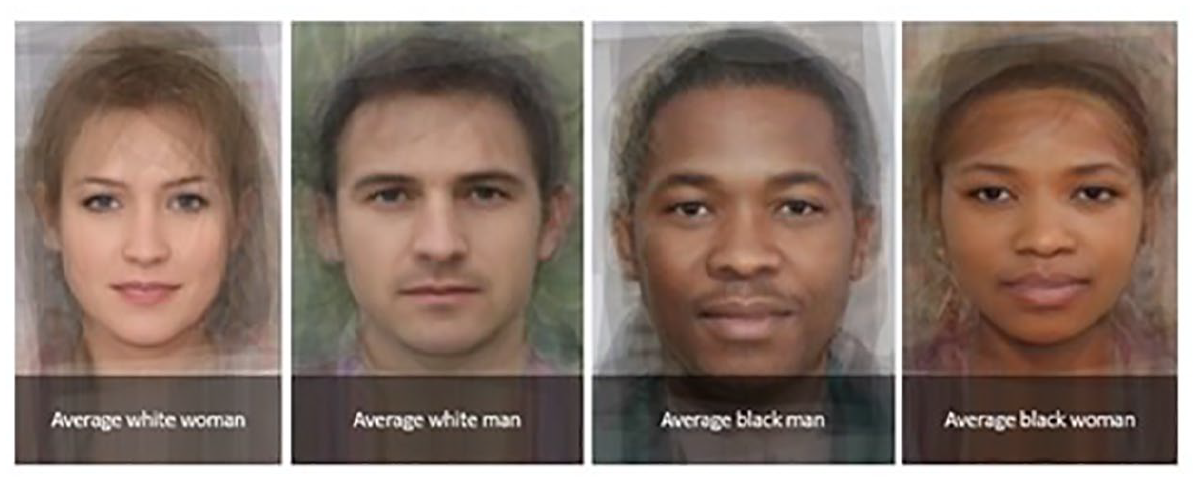
Announcers.
It can be seen from Exhibit 1 that the White and Black faces are the same in terms of facial symmetry, eye line, mouth and lips position, hair style, and expression; the only substantial difference comprised gender and skin color. Viewing physically attractive faces can elicit greater cognitive activation (see the studies by Carbon et al., 2018; Langlois & Roggman, 1990; H. Wang et al., 2014). The four images, given the similarity of the facial elements depicted in terms of the major accepted features of attractiveness (see the study by Carbon et al., 2018), can be regarded as comparable in relation to attractiveness. Average features within a composite represent those of a normal, healthy human being, and the averaged images presented reflect common levels of attractiveness across composites of both genders and both ethnicities (Knight, 2013). The pictures are displayed in Exhibit 1.
We created text to accompany the images by assembling sentences appearing in actual fundraising appeals and modifying them slightly to create four protest messages and four informative messages. These were emailed or shown to a different group of 40 members of the UK public and asking, “which of these statements arouses the most emotion in you,” and “which of these statements is the most informative.” All the statements referred to a fictitious charity named, “International Child Relief.” Consequent to this exercise, we discussed the messages with two highly experienced fundraising managers in a disaster relief organization. Exhibit 2 displays the two messages finally selected within two examples of the eight advertisements, that is, White female informative and Black male emotive.
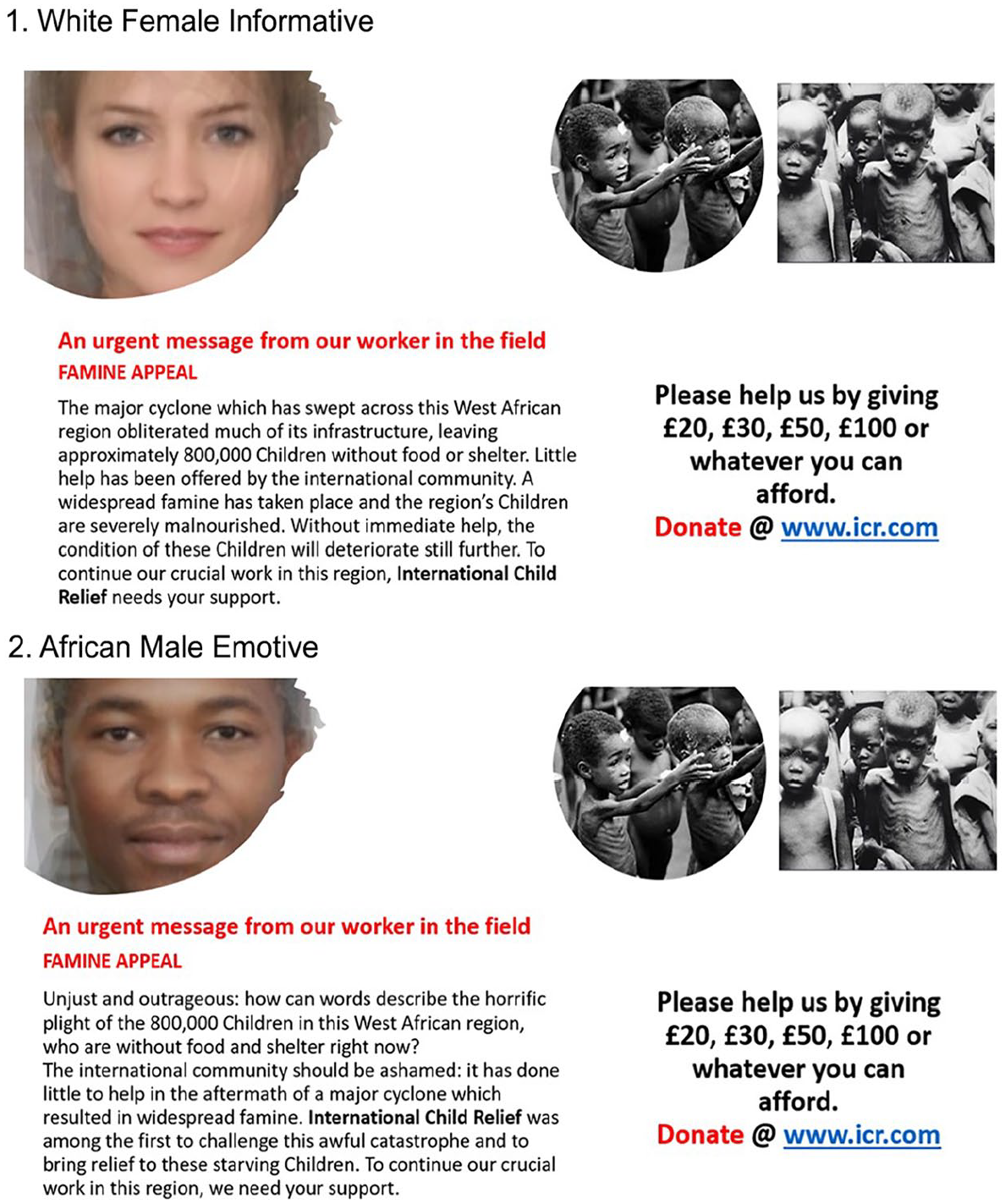
Examples of Advertisement Executions.
Study 1 Sample
The sample for the eye track exercise comprised 52 university administrative employees, 63 parents of potential students attending university open-days, 38 maintenance and catering workers, 40 part-time MBA and other postgraduate students (mostly in full-time employment), and 43 members of university academic staff. As recommended by J. Cohen (1988), the sample size was set for a power value of .8 with an effect size of (medium value) .25 and alpha (probability) value of .05. Fifty-six percent of the participants were female, and the ethnic mix of the sample was similar to that found in the universities hosting the study. Forty-eight percent were White, 12% Black, 19% from the Indian sub-continent, and 21% “other” including mixed-race individuals. As the eye track study involved the participants’ attitudes regarding people in African developing countries, the ethnicity and gender of an announcer within an appeal, and advertising in general, we did not collect primary baseline data on these matters as this could have primed the participants and possibly influenced their responses. However, secondary data on these issues for UK residents are widely available (e.g., Austin & Newman, 2015; Butt et al., 2022; Duffy et al., 2021; Gaston, 2021; IPSOS, 2020; Statista, 2023a, 2023b) and are in line with our study’s sampling.
On entry to the eye-tracking laboratory, a participant was not aware of, and not informed of, the particular appeal to be presented to that individual. Participants remained blind to their intervention condition until they had completed the exercise. Levels of attention were measured by a Tobii X60 eye-tracking device (Tobii Technology, Sweden) which uses near-infrared light to illuminate participants’ eyes, causing a reflection pattern on the corneas and pupils. An area of interest (AOI) was created for each naturally encountered image, that is, the pictures of emaciated children, the written message, the announcer, and the appeal for donations. Cumulative fixation duration (i.e., the total duration of all fixations within an AOI) on each AOI was measured together with fixation speeds and frequencies. All the people who had been recruited and allocated to view a particular appeal were included in the final analysis, and all followed the instructions given. Every participant completed both parts of the exercise. Each person’s results were processed in the same way in order to provide unbiased comparisons of the outcomes from the eight groups.
Study 1 Findings
Cumulative fixation duration assesses the viewer’s level of attention to and psychological processing of an element (Celsi & Olson, 1988). Longer cumulative fixation duration indicates more extensive and deeper information processing and shows a person’s involvement with the matter within the section (Aribarg et al., 2010). We found that, on average and across all conditions, participants spent most time looking at the message (protest or informative) (mean [m] = 4.18, standard deviation [sd] = 2.50). However, there was no discernible difference in the time spent on each type of message. Then came the time spent looking at the headline (m = 1.51, sd = 1.23), and third, at the emaciated children (m = 1.17, sd = 0.99). Contiguously, total fixation counts, that is, the number of times a person fixated on a certain AOI, were highest for the message (whether protest or information) (m = 15.55, sd = 10.11) and for the picture of the children (m = 7.73, sd = 3.73), suggesting that these elements had the most influence on persuasion.
According to Rayner (1998), the quicker the first fixation on an AOI, the greater the impression of the AOI on the viewer. Advertisements with female announcers were associated with the lowest periods before participants fixated on the starving children (m = 2.89, sd = 2.89 for females vs m = 3.79, sd = 2.77 for males). Advertisements containing White females had high cumulative fixation durations (m = 0.49, sd = 0.63 for the informative execution; m = 0.45, sd = 0.33 for the emotive execution, compared with the all-execution average of 0.36, sd = 0.5) and high fixation counts (informative m = 1.94, sd = 1.14; emotive m = 1.4, sd = 1.21; compared with all execution average of 1.33, sd = 1.6). Differences relating to the cumulative fixation durations were significant at the .01 level, and for the fixation counts, at the .05 level. Hence, in terms of the three forms of fixation data, the execution “White female narrator and information message” seemed to hold participants’ attention and to have the greatest influence on persuasion (detailed eye-tracking results are available from the authors). Further to the identification of the significant interaction of White female announcers affecting fixation, data were examined for further possible significant interactions (male/informative; Black African/protest, etc.), with no additional significant interactions emerging.
Post-Eye-Track Qualitative Interviews
After the eye-tracking task, we interviewed the participants about their thoughts, feelings, and intention to donate in relation to the advertisement to which they had been exposed. We used the KH Coder package (khcoder.net/en), which examines word frequency, word co-occurrence, and word proximity, to identify major themes within the interview transcripts. The participants’ reactions to the advertisements are shown in Figure 1, which indicates that 58% of the participants reported feelings of sadness and empathy, and that a further 8% stated that the advertisements had made them feel “emotional.” Thus, two thirds of the respondents were emotionally affected by the poverty porn-based advertisements. In contrast, over 1 in 10 were disinterested, due perhaps to either having habituated to the appeal or having questioned the efficacy of charity campaigns. Skepticism in charity advertising is well documented (see, e.g., Forehand & Grier, 2003; Obermiller & Spangenberg, 1998).
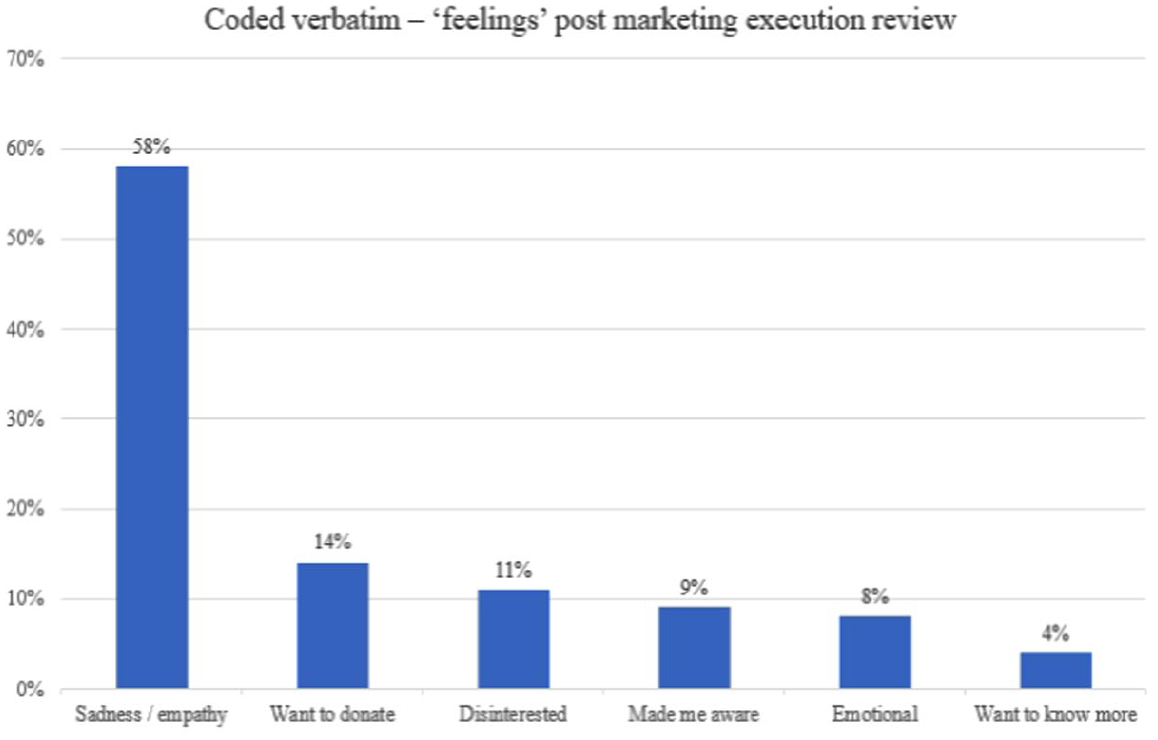
Reactions to the Advertisements.
Study 2. Survey of Charity Donors
Study 2 incorporated the aforementioned findings, augmented by an examination of the contents of literature in the field. Figure 2 shows the conceptual model developed from relevant literature and the results of Study 1. We also included variables that existing research have found to affect charity donation decisions, that is, the levels of a person’s (a) affect intensity and (b) skepticism regarding advertising in general.
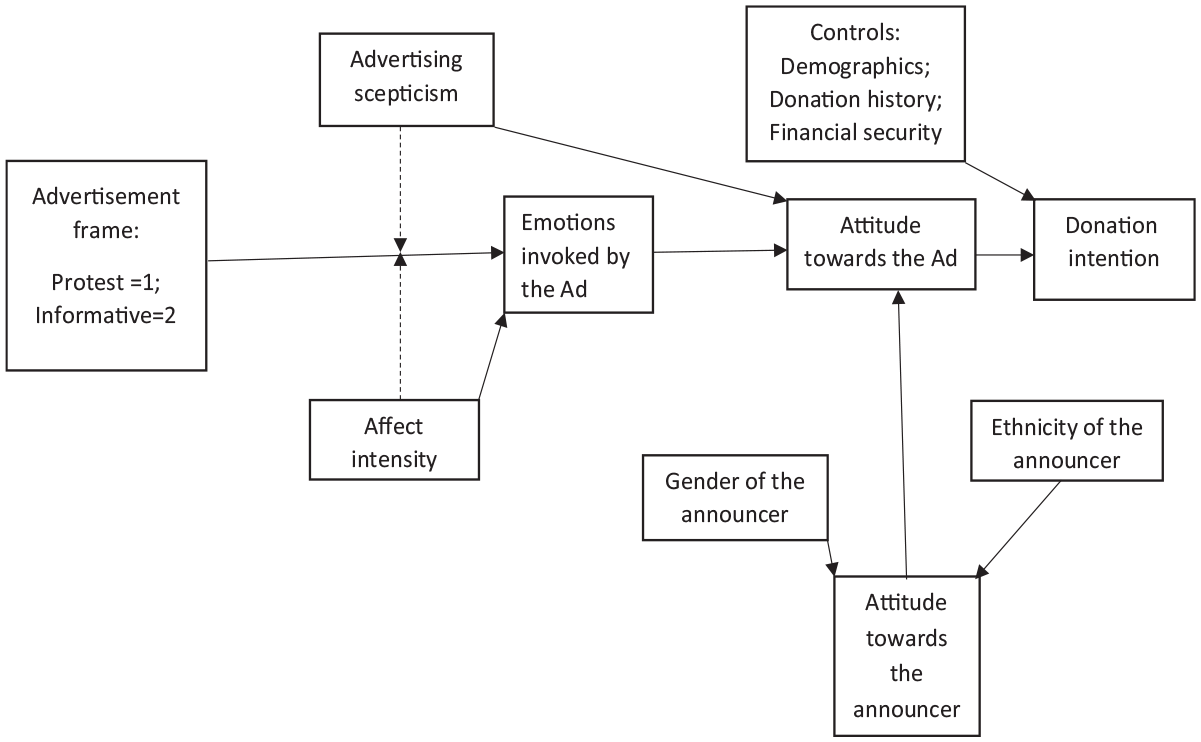
The Model.
Affect Intensity
Although attitudes toward and engagement with an ad can be stimulated by the emotional intensity conveyed by the ad (Bagozzi et al., 1999), some people experience their emotions more intensely than others. The term affect intensity refers to the strength of differences with which individuals experience extreme emotions, positive and negative (Moore & Homer, 2000). Levels of affect intensity may significantly affect people’s emotional experiences invoked by an ad (Moore et al., 1995). High affect intensity is associated with exceptionally strong emotions felt when responding to an emotion-inducing appeal (Bennett, 1997). Hibbs (2011) observed that, in general, strong emotions experienced in reaction to charity ads frequently drive individuals to donate.
Moore and Harris (1996) suggested that affect intensity only influences emotional responses when viewers are exposed to positive emotional appeals. Conversely, high-affect-intensity individuals can also be deeply affected by negative emotional appeals, possibly because they find negative appeals so overwhelming and disturbing that they experience psychological discomfort (Bagozzi et al., 1999; Bennett, 1997; Bhati & Eikenberry, 2016; Larsen, 2009). Consequently, they might seek positive sensory stimulation in an attempt to mitigate the distaste arising from a negative stimulus, by donating to a charity for instance (Moore & Homer, 2000). To the extent that high-affect-intensity individuals respond more favorably to emotionally charged appeals (as opposed to non-emotional informative appeals), it would be expected that protest frames will trigger more favorable responses than informational frames (Moore & Homer, 2000; Zhang et al., 2014). This implies that affect intensity will exert a direct effect on a person’s emotional reaction to an ad and may have an impact on the strength of the connection between liking for an emotionally framed protest ad and the degree of emotion engendered by the ad.
Advertising Skepticism
As the degree of a person’s ad skepticism (i.e., tendency to disbelieve advertising claims) increases, the persuasiveness of the ad seen by the individual is likely to fall (Forehand & Grier, 2003; Obermiller et al., 2005). As an individual encounters differences between what advertisers promise and what they deliver, skeptical attitudes toward advertising can develop (Vakratsas & Ambler, 1999). In the charity context, skepticism could result in prospective donors disbelieving important aspects of a charity’s claims (cf. Obermiller & Spangenberg, 1998) and/or doubting its motives and sincerity (Chang & Cheng, 2015). Trust in a charity is crucial for effective fundraising (see the study by De Pelsmacker et al., 2022). In the UK, however, certain charities have been embroiled in scandals, leading to diminishing levels of public trust in the entire sector (Brindle, 2019; Plummer, 2019). Lack of trust in the sector could have spillover effects on responses to any or all ad messages constructed by charities. Thus, advertising skepticism may be anticipated to have a direct effect on attitude toward the advertisement and a negatively moderating influence on the link between advertisement frame and the arousal of emotions.
Conceptual Model
Figure 2 proposes that a certain advertising frame will evoke significant emotional responses to a poverty porn advertisement. We tentatively suggest the typically emotionally charged effect of protest appeals (Benford & Snow, 2000; Snow et al., 1986; Snow & Benford, 1988; Ward & Ostrom, 2006) will not hold in a poverty porn context, given its potential to de-legitimize further engagement for change (Chouliaraki, 2010). This is also tentatively supported by the eye-tracking data, and there is evidence that in discrimination-linked protest appeals, a reverse effect may hold for protest framing (Kaiser & Miller, 2001). Emotional responses are posited to affect attitudes toward the advertisement (Taute et al., 2011; Vakratsas & Ambler, 1999), which in turn influences donation intention (cf. Ranganathan & Henley, 2008; Wymer & Gross, 2021). Attitude toward the announcer is assumed to help determine attitudes toward the advertisement and to be affected by the gender and ethnicity of the announcer. Controls within the model are (a) an individual’s charity donation history (frequency and levels of donations) and (b) self-perceived degree of financial security (high levels of financial security should encourage charitable giving), plus standard demographic factors (age, gender, etc.). Donation history was included as it captures several aspects of a person’s overall involvement with charities: altruistic and empathetic tendencies, personal experiences of charities, perceptions of the efficiency of fundraising organizations, social norms, and warm glow experienced when giving (see the study by Bennett, 2019).
Study 2 Sample
We used a commercial data-collection company (Qualtrics UK) to distribute a questionnaire to a panel of people known to have donated to charities, resulting in 667 responses, approximately evenly divided across the eight advertisements. Characteristics of the sample members are given in Table 1.
Characteristics of Questionnaire Survey Sample Members.
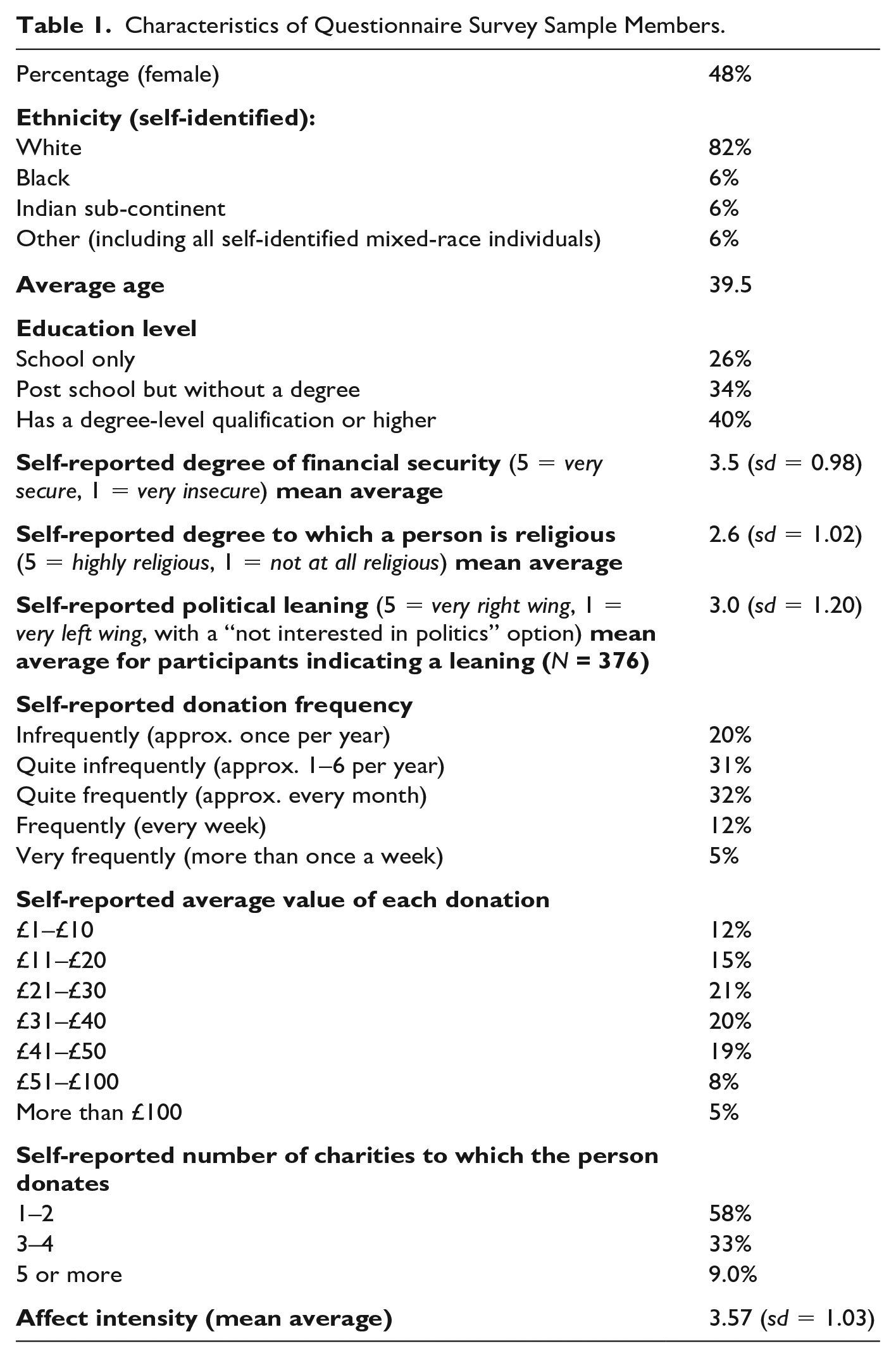
Eighty-two per cent of the sample were White and generally well-educated, with 40% having a university degree. However, this ethnicity profile was not regarded as a problem, as the literature on disaster relief fundraising indicates that regular and substantial donors to these types of charities are predominantly White and tend to be better educated (see, e.g., the studies by James & Zagefka, 2017; Zagefka & James, 2015).
Study 2 Findings
Nearly a third of the survey participants gave £40 or more each time they donated. On average, the participants were relatively high on both affect intensity (m = 3.47, sd = 1.05) and advertising skepticism (m = 3.67, sd = 0.99). Less well-educated individuals in the survey sample were less skeptical about the advertisement they were shown (F = 2.30; sig = 0.049). Higher value and/or more frequent charity donors were more likely to report that the advertisements made them feel sad, angry, and depressed (F = 4.80, sig. = .02). (A detailed breakdown of the survey results is available on request from the authors.)
The Appendix to the article summarizes the questionnaire and gives the sources of measurement items and alpha values for each construct. As regards the “general” items of the questionnaire listed in the Appendix, a substantial majority of the sample believed that the advertisement to which they were exposed showed the injustice experienced by the children portrayed in the advertisements (78%) and that the advertisements “clearly show the problem that needs to be addressed” (80%). However, the advertisements were not regarded as “disrespectful to the people featured” in the appeal (18%).
We assessed discriminant validity among the multi-item constructs using the Fornell-Larker criterion. In all cases, the correlations of items within constructs exceeded correlations between the constructs. Initial examination of the data determined that certain variables (participant age and gender, religiosity, political inclination) were not significantly connected with any of the dependent variables shown in Figure 1 and thus were excluded from the analysis. Advertising frame, announcer gender, and announcer ethnicity are binary state variables without variation, and all the other variables in the model satisfied standard tests for normality. Hence, we estimated Figure 1 using AMOS 28 package. We used averages of the items that measured constructs in the estimation; the average for “donor history” was formed by multiplying the specified amount donated, on average each month, by frequency of donations.
Table 2 gives the results of the estimation, which indicates the presence of only a weak (p < .1) link between advertising frame and emotional arousal, with informative advertisements having the bigger (but insignificant at the .05 level) influence (cf. Ling et al., 2010). As expected, the protest message did not appear to have stimulated viewers’ emotions more than the informative text. As expected, affect intensity had a powerful impact on the level of emotional arousal (cf. Bennett, 1997; Hibbs, 2011), and in addition, it significantly modified downward the link between advertising frame and emotional arousal. Advertising skepticism exerted a highly significant effect on attitude toward the advertisement (cf. Obermiller & Spangenberg, 1998), and a marginally insignificant negative impact (p = .056) on the connection between advertising frame and emotion arousal. Links between emotional arousal, attitude toward the advertisement, and donation intention were highly significant, in line with previous literature on these topics. Both the covariates (donation history and financial security) exerted significant influences on donation intention (cf. Bennett, 2019).
Test of the Model.
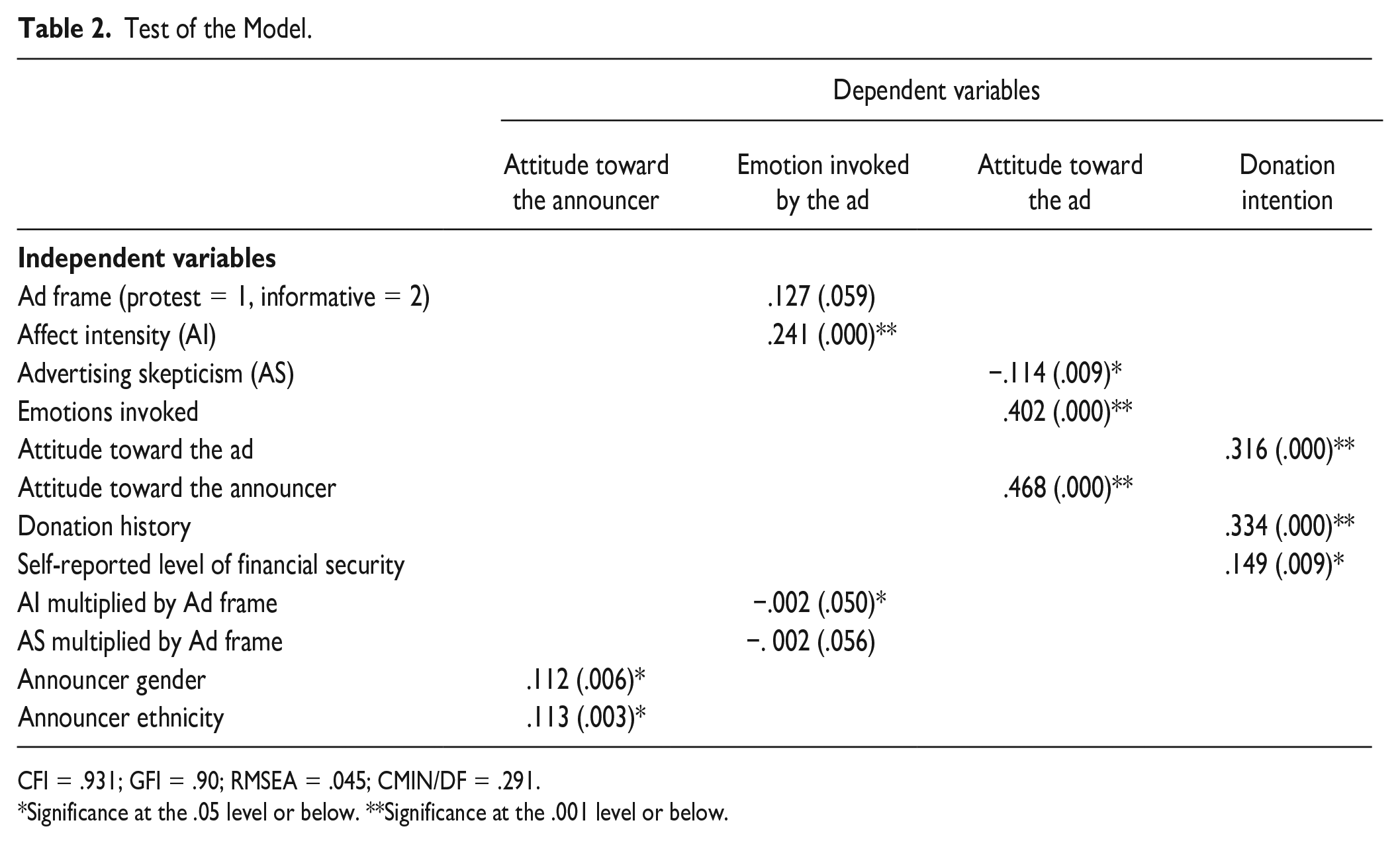
CFI = .931; GFI = .90; RMSEA = .045; CMIN/DF = .291.
Significance at the .05 level or below. **Significance at the .001 level or below.
Announcer gender (coded as 1 = male, 2 = female) had a significantly positive impact on attitude toward the announcer, suggesting a preference for female announcers. This contradicts much prior research, which found preferences for male spokespeople (for details, see the studies by Grau & Zotos, 2016; Wolin, 2003). Ethnicity (coded as Black = 1, White = 2) was also a significantly positive predictor of attitude toward the announcer, implying a predilection in favor of White announcers. The latter outcome confirms the findings of several past studies (e.g., Brumbaugh & Grier, 2006; Hazzouri et al., 2017), although an experimental study of De Pelsmacker et al. (2022) failed to find any relationship in this regard. We checked the result of Study 2 that the sample members tended to favor White female announcers by rerunning the investigation using a binary variable where 1 = a White female announcer and 2 = all other announcers, which replaced the gender and ethnicity variables shown in Figure 1. The coefficient on the new variable was highly significant (b = −.210, p < .001).
Discussion
Theoretical Implications
Our study found framing types, informative and protest, did not have significant positive effects on donation intent, nor affect viewing patterns or emotional arousal of respondents. However, high-affect-intensity individuals negatively mediated the effects of frame types on emotional arousal further, suggesting emotional elicitation from poverty porn imagery is counter-productive in fostering emotional engagement, when framing requests for additional engagement are made. Critics of poverty porn suggest it disengages viewers from emotional engagement, but this effect has yet to be validated. Our study provides tentative evidence for this effect and contributes to Chouliaraki’s (2010) proposition that “intensity affect regimes” encourage short-term agency, at the expense of sustainable engagement. While Chouliaraki (2010) argued that post-humanitarian appeals, or those with “positive imagery,” encourage low affect intensity which disengages viewers, we find that high affect intensity also has the same effect but for the more traditional shock and negative poverty porn imagery.
We also expected informative frames to have stronger effects than protest frames in our sample, given the predominant White sample we used. To some extent, this effect was found, since informative frames had a stronger effect, although the effect was non-significant. Additional research would be needed to verify if predominant White samples emotionally “switch off” when “asked to do more” for the cause in protest framing for instance. Although we did not measure for its effects, the “spoken down” effect of protest frames (Kutlaca et al., 2020) may also have generated this effect. However, and given the large-scale and intuitive evidence of reactions from people of color during the Black Lives Matter movement, and the heightened use and celebration of protest frames, we would expect a reversal in this effect had our sample been predominantly people of color. Therefore, our findings should be seen in a poverty porn context, in that it is likely protest frames reinforce emotional responses where underlying viewer values are in synergy of the protest frame’s appeal. While the protest frame did communicate greater emotionality, this was not translated into emotional response and was further diminished by affect intensity.
Another key finding from our study was the role of the White female announcers. On average, the mainly White members of the sample for Study 2 had more positive attitudes to announcers of the same ethnicity (cf. Lyubomirsky & Ross, 1997); yet the same result occurred in Study 1 where the sample was ethnically more diverse. Indeed, in Study 1, White females had the highest fixation durations, with the “White female and informational frame” holding the highest attention. This result is not in accord with a study completed by Calvo and Lang (2004), which found that emotional images captured a respondent’s attention considerably more quickly than unemotional images, and that both pleasant and unpleasant emotional images resulted in quicker first fixations and longer amounts of viewing time. The criticality of the White female effect clearly warrants further exploration. Moral identity associations, such as compassion and empathy, are gender-dependent (Shang et al., 2020), in that different genders differ in their perceptions of these associations, but no such differential effect was noted in gender, nor in age and political orientation toward the White women effect. Therefore, the White female effect may be due to the legacy of poverty porn imagery in conditioning the effects of White female imagery with benevolence.
Implications for Policy and Practice
The implications of our findings corroborate critiques of humanitarian communications (e.g., Chouliaraki, 2010; Martin de Holan et al., 2019; Pallister-Wilkins, 2021). While humanitarianism intends to relay a universalistic ethics of embodying human polity, dignity, essence, and inclusion in its entirety, its utilitarian focus remains short term and racialized and stops at the level of donations, or limited engagement (Kennedy, 2009). Changing the ethical configuration of such imagery would entail an overdue deontological shift. First, it requires recognizing and re-calibrating the humanized, often-White, donor-dehumanized, often non-White, beneficiary formula. While this formula may work in generating funds in the short term, it also internalizes and perpetuates racial stereotypes, as well as limits pro-active engagement in resolving grand humanitarian challenges such as global poverty (Grimms, 2022). Prioritizing the projective agency of beneficiaries should therefore be paramount in humanitarian and fundraising appeals (Martin de Holan et al., 2019). Moral emotions linked to giving behaviors, such as empathy and sympathy, should be decoupled from racializing creative content. If racialized contours exist to stimulate giving behaviors, then the type of respect and presence advocated by the projective agency of Martin de Holan et al. (2019) cannot be actualized. Therefore, and second, a shift from a donor public alone to a more engaged civic public (Kennedy, 2009) is necessary. The authors contend with Lentfer (2018) to empower and entrust the civic public to embed more strongly a “moral education” (Chouliaraki, 2010) component in fundraising appeals. This would enable what Kennedy (2009) envisioned as a sustainable form of compassion, or cognitive compassion. If the moral agency of the giving public is re-constituted toward solidarity with and care for vulnerable others (Chouliaraki, 2010), the humanitarian sector will need to re-visit its moral imagination first. A failure to embrace this will simply perpetuate mutated forms of colonial tropes, with circular consequences for those at the bottom of the pyramid. As Grimms (2022, p. 2107) reminds us, the conditioning of weak characteristics of the poor with a homogeneous group can become a gateway for “racist reflections.” While our study indicates toward the existence of the White woman saviourism effect in humanitarian appeals, more empirical evaluations on poverty porn will be warranted to disentangle the full complexity of humanitarian business’s role in contributing to the “racialized assemblage,” which has become foundational to humanitarian business (Pallister-Wilkins, 2021, p. 101).
Conclusion and Outlook
This article provides an initial foray in empirically mapping the effects of poverty porn from a donor perspective. We examined two key concerns of poverty porn: first, its limiting attitudinal engagement toward the cause, and second White saviourism. An eye-tracking study and large-scale survey of donor attitudes was used to assess these effects. In both cases, we found White female and informational frame conditions to generate the most engagement. Although a small but important body of studies has investigated beneficiary attitudes toward poverty porn (e.g., Bhati & Eikenberry, 2016; Chung, 2013), with the exception of Baker (2015), no previous study has empirically investigated donor attitudes in a poverty porn context.
Although our survey sample comprises a predominantly White sample, this profile also matches that of people who regularly give to international relief charities (see the studies by James & Zagefka, 2017; Zagefka & James, 2015). Future studies should examine comparative effects of mixed ethnicity samples. A matter for future research concerns how ethnic minorities’ reactions to advertisements that feature other minorities differ among donors with varying levels of ethnic self-identification. It is clear that matching the ethnicity of an announcer to an audience is complex. The psychological factors underlying this issue require detailed exploration in humanitarian fundraising appeals. Important unresolved questions included why exactly were male and non-White announcers less favored? What are the specific mechanisms which may shape the “White women effect” in humanitarian appeals? How prevalent has this image become in humanitarian imagery?
Study 1 took place in laboratories, thus predisposing the findings to the Hawthorn effect, that is, bias arising from the very fact that participants knew they were being observed. While beneficiary attitudes toward poverty porn have been investigated from an ethnographic (Chung, 2013) and interpretivist (Bhati & Eikenberry, 2016) lens, donor attitudes toward poverty porn would also benefit from adopting increased mixed-method designs. As regards Study 2, only a limited set of independent variables could be included, and several known antecedents of each regressor were necessarily omitted. It would be interesting to test the influences of such variables on donor attitudes toward poverty porn (cf. Chang & Cheng, 2015). Deconstructing White female saviourism for instance may seek to explore further the racialized conditioning of attractiveness and likeability of spokesperson dynamics further. As with the majority of donor behavior studies, our investigation was also cross-sectional in nature. To assess the long-term effects of protest messages, in, for instance, creating the type of cognitive compassion and sustainable engagement advocated by Kennedy (2009) and Chouliaraki (2010), a longitudinal assessment would be warranted. Our study used an emotive shock example of poverty porn, and while these types of imagery remain embedded in contemporary humanitarian communications, alternative post-humanitarian appeals depicting beneficiaries could warrant interesting insights into future studies. Given the paucity of empirical studies examining poverty porn, our study raises several important questions on creative content for humanitarian appeals. Since protest and informative messages did not significantly affect emotional arousal, what sorts of message would have made a substantial impact? What is the effect of beneficiary generated content? Were the results unique to newspaper or magazine-type advertisements, or would responses differ for messages delivered as videos on social media? Can humanitarian imagery be tested for fostering a solidarity-care ethical orientation and cognitive compassion?
Further research is clearly warranted and important considering that the incidence of natural disasters, refugee crises, famines, and environmental and other catastrophes has increased substantially in recent decades, and while poverty porn imagery remaining all too prevalent in humanitarian communications. It follows that disaster relief charities will have to raise large amounts of funds regularly and quickly more than ever before, while ensuring the dignity of beneficiaries remains paramount in communications. Understanding how poverty porn works may help ultimately mitigate its pernicious long-term effects.
Footnotes
Appendix
Declaration of Conflicting Interests
The authors declared no potential conflicts of interest with respect to the research, authorship, and/or publication of this article.
Funding
The authors received no financial support for the research, authorship, and/or publication of this article.
