




Abstract
Scholars are increasingly exploring community-supported businesses (CSBs) as promising alternatives to conventional ones. However, researchers are so far overlooking that CSBs vary in their underlying business models, that is, how they propose, create, and capture value. We apply a multi-staged qualitative research process to carve out the differences between community-supported business models (CSBMs) that exist in practice. Our research shows that transactional and relational CSBMs differ in how they propose, create, and capture value which, in turn, has implications for the resources required to thrive.
Keywords
In the face of worldwide societal challenges, exploring sustainable businesses is a vital step toward a livable future (Ferns & Amaeshi, 2019; Pinkse & Kolk, 2012; Rey-Garcia et al., 2021). Community-supported businesses (CSBs) have gradually attracted scholarly attention as a novel type of enterprise (Salladarré et al., 2018) that appears to be economically resilient in times of crisis (Brumbauer, 2021; Rommel & Koch, 2021). CSBs are typically founded by individual entrepreneurs or small teams (Löbbering, 2018; Rommel, 2017) who build up a community of members. The entrepreneur(s) provide the products and services to the community, while the members guarantee the financial and social resources for the entrepreneur to run the business.
This definition already points toward an important complication in the current academic discussion on CSBs: Researchers usually talk about the CSB and thereby mix community-supported ventures with divergent underlying business models. We argue that there are important differences in community-supported business models (CSBMs), that is, how CSBs propose, create, and capture value. The differences bear important implications for how CSBs interact with their members and what resources they may consider critical for thriving. Hence, we suggest exploring community-supported business models (CSBMs) to pave the way for understanding CSBs in greater detail, helping to distinguish different types of CSBMs and consequently supporting researchers in enhancing research validity and generalizability.
We apply a sustainable business model (SBM) lens (Aagaard et al., 2021; Dembek & York, 2020; Stubbs & Cocklin, 2008) encompassing sustainable value proposition, creation, and capture (Bocken et al., 2013; Oskam et al., 2021; Pedersen et al., 2021) to analyze and differentiate CSBMs. To elaborate on the research question of “Which types of CSBMs exist in practice and why do underlying differences matter?,” we use a multi-staged qualitative research process. First, we identify 23 CSBs from various business fields such as food, health, and energy in Germany, as this country possesses two large entrepreneurial networks for CSBs, an extraordinarily large number of CSBs, and thus seems to be a hot spot for community-supported ventures (Saunders et al., 2009; Saunders & Lewis, 2017). Second, we collect secondary material for each CSB (Glaser, 2001; Glaser & Strauss, 2010), conduct a qualitative content analysis to explore how those CSBs propose, create, and capture value (Kelle & Kluge, 2010; Miles & Huberman, 1994), empirically develop a typology of CSBMs (Kelle & Kluge, 2010; Kluge, 2000), and triangulate, validate, and enrich our findings through two focus groups (Powell & Single, 1996; Stewart & Shamdasani, 2017). After that, we present the differences in the resources that transactional and relational entrepreneurs emphasize as being necessary for running and sustaining their CSBMs.
Our study contributes to CSB research (Bloemmen et al., 2015; Rommel & Koch, 2021; Salladarré et al., 2018) by carving out two different types of CSBMs that have been lumped together so far. Unconsciously mixing those types bears the risk of overseeing important differences in CSBs in practice and may reduce research validity and generalizability (Carlson et al., 2021; Medici et al., 2021). For example, research validity can be affected by the omitted variable bias when the explaining variable type of CSBM is missing. Moreover, researchers might not be aware of the proportion of transactional and relational types of CSBMs in their sample which affects the generalizability of their results. Hence, scholars can build on our typology to enhance research validity and generalizability. The article is structured as follows: We start by presenting information on the origin of CSBs and sustainable business models, followed by an explanation of the methodology and a presentation of the findings. A discussion of the contribution and the limitations rounds off the article.
Background
Origin and Emergence of CSBs
The idea behind CSBs originates from agriculture. In the 1960s, Japanese farms began cooperating directly with consumers (Medici et al., 2021). Their goal was to provide regional, healthy, uncontaminated food to Japanese consumers concerned about food safety, a result of the Minamata disease (Tang et al., 2019). Later, similar close relationships between producers and consumers spread worldwide, becoming popular under the name of community-supported agriculture (CSA). Since the 1970s, these initiatives have emerged mainly as a response to global societal challenges such as climate change and loss of biodiversity (Elmes, 2018; O’Hara & Stagl, 2001). They thus have typically been politically motivated.
The concept of CSA has been increasingly transferred to other fields of business in the recent years. Entrepreneurs have built CSBs in various business sectors in different countries. For example, in Southeast Asia, community-supported fisheries are an attractive alternative for fishermen to secure their income, have a closer relationship with consumers, and simultaneously pursue sustainable fishing. Also, in the United Kingdom, community-supported stores focus on more regional and direct contact with consumers, as community-supported restaurants in the United States do as well (Zhao & Jia, 2020). And even in the energy sector, community-supported initiatives are becoming increasingly popular (Reis et al., 2021).
Definition of CSBs and Differentiation by Related Concepts
CSBs are characterized by close relationships between the providers of products and services and a community of consumers (Debuquet et al., 2020). The community does not necessarily share a common place but is characterized by a common interest in a provider’s products or services (De Bruin et al., 2023; Rommel & Koch, 2021). The members’ role is to support the entrepreneur, that is, take on responsibility for the endeavor by providing the financial and social resources like “time, effort, [and] money” (Debuquet et al., 2020, p. 444) that the entrepreneur needs to run the business for a particular period of time (usually 1 year; Rommel & Koch, 2021). In turn, the entrepreneur exclusively serves the members of the community with products and services. Here, products and prices are detached from each other: Consumers no longer pay for individual products, but more generally pay a monthly share and, independent of the amount, receive products or services. Rommel and Koch (2021) explain that detaching products and prices “may fully circumvent the market’s price mechanism” (p. 389).
Differentiating between CSBs and community-based businesses (CBBs), it becomes apparent that, in CBBs, a group of people mutually establishes a business, often to revitalize regions (Peredo & Chrisman, 2006; Peredo & McLean, 2013; Sinnicks, 2020). Thus, CBBs are founded by a community of people who usually provide products and/or services to (potentially) everybody on the market (Bacq et al., 2020; Boehm, 2005; Kobeissi & Damanpour, 2009; Valente, 2012). In contrast, CSBs are usually founded by single entrepreneurs or small teams for a community of people (Löbbering, 2018; Rommel, 2017) and exclusively provide the products and/or services to consumers who seek to be part of their community (see Figure 1). Hence, the main differences between CSBs and CBBs lie in who is found and who is served by the business.
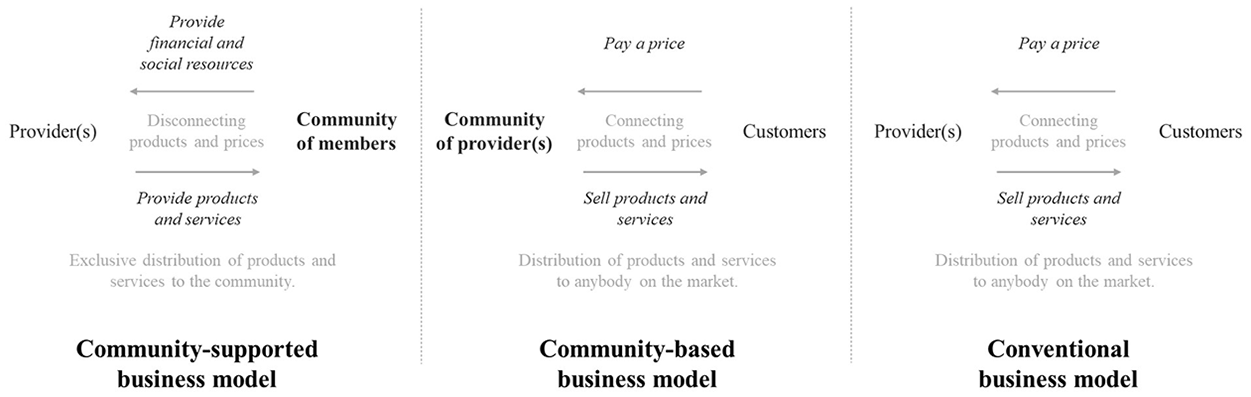
Comparison of Community-Supported, Community-Based, and Conventional Business Models.
It is also important to disentangle CSBs from cooperatives. A cooperative is a legal form that may be suitable for CSBs, but neither is every cooperative a CSB nor does every CSB have the legal form of cooperation. Cooperatives are democratically owned by their members (Voorhis, 1962) and are controlled by this community of people (Bacq et al., 2020; Davila & Molina, 2017). This ownership is not a necessary trait of CSBs, but it can provide members a legal framework for participation and is therefore often used as an organizational form of CSBs (Löbbering, 2018). CBB-based cooperatives provide products and/or services to (potentially) everybody on the market, while CSB-based cooperatives solely serve their community of members.
Exploring CSBs Through a Sustainable Business Model Lens
Sustainable business models describe the architecture of businesses (Dentoni et al., 2021). It’s important to notice that there are several approaches regarding how to conceptualize and analyze sustainable business models. For example, Fritz and Lara-Rodríguez (2022) propose a community-business model canvas as a novel framework, while Spieth and colleagues (2019) use an activity system approach to analyze social businesses. We selected the conceptualization of sustainable business models encompassing the triad of sustainable value proposition, sustainable value creation, and sustainable value capture, one of the most established approaches in SBM research (Bocken et al., 2014; Lashitew et al., 2020; Lüdeke-Freund & Dembek, 2017). This value triad originated in business model research (Osterwalder & Pigneur, 2010) and was later adapted and enriched by SBM researchers (Bocken et al., 2013). For example, Bohnsack and colleagues (2014) applied this conceptualization to explore business models for sustainable technologies; Bocken and colleagues (2014) built on this conceptualization in their seminal article on sustainable business model archetypes; Lashitew and colleagues (2020) used it to analyze social value creation; while Schaltegger and colleagues (2016) developed one of the most influential definitions of SBMs based on this triad: A business model for sustainability helps describing, analyzing, managing, and communicating (i) a company’s sustainable value proposition to its customers, and all other stakeholders, (ii) how it creates and delivers this value, (iii) and how it captures economic value while maintaining or regenerating natural, social, and economic capital beyond its organizational boundaries. (p. 6)
Value proposition encompasses the description of products and services, as well as environmental and social benefits offered to the customer (Ordonez-Ponce et al., 2021); it additionally depicts a business’ market segments and customer relationships (Grimm, 2020; Lashitew et al., 2020). Value creation specifies how value is generated (DiVito et al., 2021; Husted et al., 2015) and includes defining key activities to create the value proposed, distribution channels, core competencies, resources and capabilities, and strategic partners (DiVito et al., 2021; Lashitew et al., 2020; Oskam et al., 2021). Value capture describes how the business handles economic value “while maintaining or regenerating natural, social, and economic capital beyond its organisational boundaries” (Schaltegger et al., 2016, p. 6), which encompasses cost and revenue streams (Dembek & York, 2020).
Recapitulating the literature review, it becomes apparent that scholarly interest in CSBs is rising, but CSBs have not yet been explored through the lens of sustainable business models. Doing so can shed light on how CSBs differ in value proposition, creation, and capture, which, in turn, can have important implications on the resources different types of CSBMs need to thrive.
Methodological Approach
We applied a qualitative comparative research design that is particularly suitable to systematically compare cases and to develop a typology (Roig-Tierno et al., 2017). While qualitative research usually focuses on an in-depth understanding of single cases, and quantitative research supports deriving generalizations from large amounts of data, qualitative comparative research helps to uncover patterns from a small or medium-sized sample. This approach supports understanding a case not as a whole but as a configuration of individual attributes. Hence, this method is suitable for decomposing CSBMs, exploring differences in their dimensions and attributes, and developing a typology of CSBMs.
Stage 1: Document Analysis for Exploring a Variety of CSBMs
We applied a purposive sampling technique (Saunders et al., 2009; Saunders & Lewis, 2017) that enabled us to select particularly informative cases to answer our research questions (cf. Illia et al., 2023; Kurki & Lähdesmäki, 2023). Our sampling scheme encompassed three criteria: First, we included initiatives that defined themselves as CSBs by being a member of CSB networks. 1 To apply this criteria, we scanned the websites of two established CSB networks: 2 One is MYZELIUM, an educational institute for community-supported initiatives. The other German network is CSX Network which fosters the dialogue between various actors in the context of CSBs. These networks provided rich lists of CSBs from various fields of business. Second, we included those CSB initiatives in our sample which provided publicly available information on value proposition, value creation, and value capture. Wherever we found publicly available information on the individual CSB, we included the information in our sample; wherever we didn’t, we excluded the initiative. This procedure led to a sample of 23 CSBs in various business fields, including food, health, and energy (see Table 1).
Study Sample Consisting of 23 Cases From a Variety of Business Sectors (According to Statista’s Classification Scheme).
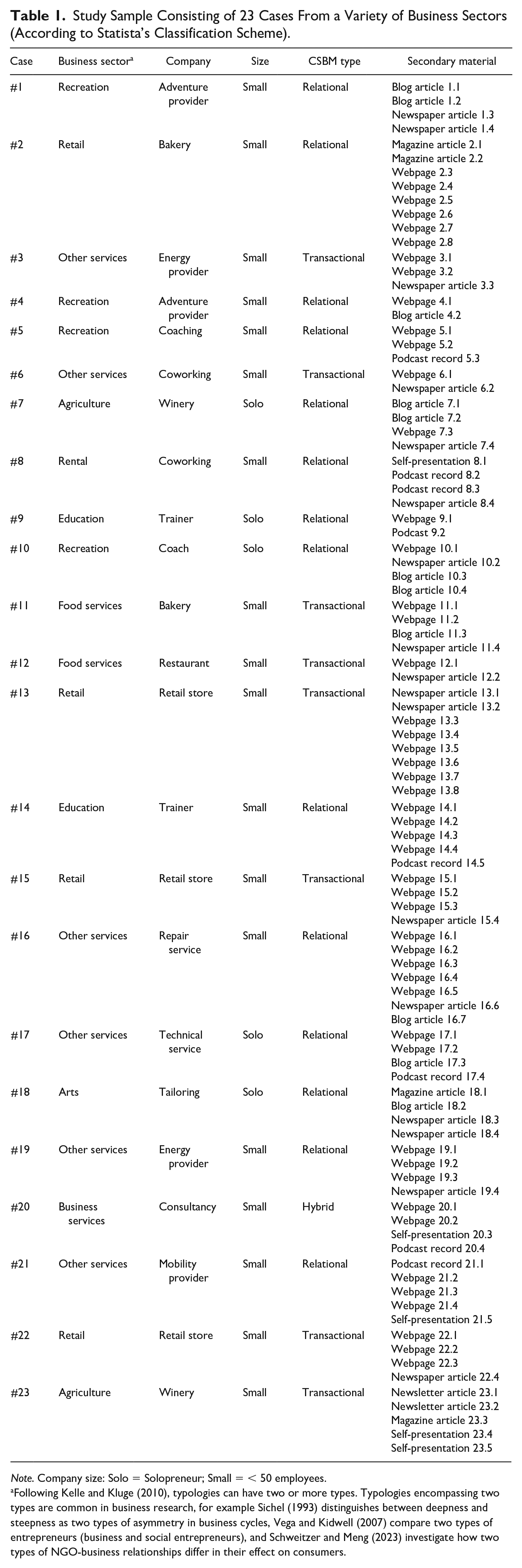
Note. Company size: Solo = Solopreneur; Small = < 50 employees.
Following Kelle and Kluge (2010), typologies can have two or more types. Typologies encompassing two types are common in business research, for example Sichel (1993) distinguishes between deepness and steepness as two types of asymmetry in business cycles, Vega and Kidwell (2007) compare two types of entrepreneurs (business and social entrepreneurs), and Schweitzer and Meng (2023) investigate how two types of NGO-business relationships differ in their effect on consumers.
After that, we collected secondary material for each of the 23 CSBs (Glaser & Strauss, 2010; Saunders & Lewis, 2017) which provided a large body of information on the nature of the CSB initiatives. In line with Glaser (2001), we collected document types such as website screenshots, downloaded newspapers, magazines, and blog articles, and transcribed podcasts to enrich the analysis while thoroughly considering the adequacy of the collected material (Saunders & Lewis, 2017). Focusing on our research question, we included only those documents for further analysis that provided information on value proposition, creation, and capture as part of a business model.
We analyzed the material using qualitative content analysis (Kelle, 2007; Miles & Huberman, 1994), first employing a subsumptive approach to code our material (Kelle, 1995; Miles & Huberman, 1994), meaning that we built on so-called sensitizing concepts encompassing the three value elements of sustainable value proposition, sustainable value creation, and sustainable value capture to analyze the cases. Building on this pre-existing knowledge, subsumptive coding fostered the constructive handling of a considerable amount of data while at the same time leaving space for developing empirically grounded dimensions and attributes for each of the three value elements (Kelle & Kluge, 2010).
After coding the entire material along the three value elements, we enriched these with empirical dimensions derived from the concrete text passages in the material. We intentionally decided not to build on preexisting dimensions of value elements (e.g., distribution channels, core competencies, or strategic partners as value creation dimensions), as these would have limited our exploration of CSBMs (Kelle, 2007; Miles & Huberman, 1994). Instead, we intended to be open to upcoming new dimensions (e.g., the role of the community, participation of members, and financial contribution), as CSBMs are a very recent phenomenon in research. Finally, aiming to derive empirical attributes that lead to a clear differentiation between the cases (e.g., community as a means versus community as an end), we iteratively conducted several rounds of differentiation (i.e., we checked for differences between the cases again and again, back and forth) until we derived our final scheme encompassing the three sensitizing concepts with eight dimensions and 19 attributes (see Online Appendix A).
To make our initial findings more assessable, we applied a typology formation process as proposed by Kelle and Kluge (2010) and Kluge (2000). Following this process, we first aimed to develop and define relevant dimensions that helped us compare and distinguish the individual cases. This step tied into our qualitative content analysis, in which we derived eight differentiating dimensions with 19 attributes. Second, we grouped the individual cases according to the dimensions, analyzing empirical patterns that indicated the presence of an empirical typology encompassing two types 3 (Kelle and Kluge, 2010; see Online Appendix A). We then qualitatively evaluated the internal homogeneity by checking whether one group’s cases were similar and assessed external heterogeneity by investigating cross-group differences.
After this, we analyzed contextual relationships among the empirical groups. Following Glaser’s (1978) concept of theoretical sensitivity, we deliberately integrated our knowledge of existing concepts and theories, using theoretical terms to reflect on the empirically derived types (Glaser, 1978). Recalling literature on SBMs (Aagaard et al., 2021; Dembek & York, 2020; Reed, 2009) and CSBs (Debuquet et al., 2020; Löbbering, 2018; Medici et al., 2021; Rommel, 2017; Tang et al., 2019; Zhao & Jia, 2020) helped direct our awareness to transactional and relational interactions, which in turn shaped the process of finding a suitable designation for the types in our typology. Finally, we characterized the constructed types based on their dimensions and attributes.
Stage 2: Focus Groups for Triangulating, Validating, and Enriching the Findings
In this second stage, we invited a total of 13 community-supported entrepreneurs to two online focus group sessions (Powell & Single, 1996; Stewart & Shamdasani, 2017). Focus groups belong to the most common methods of data collection in qualitative research (Morgan, 1996). We used them as supplementary data sources to validate our findings and explore the implications. Specifically, the focus groups provided valuable insights into the resources each type of CSBM builds on. We preferred conducting focus groups over individual interviews because we were especially interested in bringing together entrepreneurs who have set up different types of community-supported business models. We recruited the participants through MYZELIUM and the CSX network. Four of them brought experience in founding transactional CSBMs, four were experienced in founding relational CSBMs, and five participants have even set up both transactional and relational types of CSBMs. The business models of five out of the thirteen entrepreneurs have also been analyzed as part of the documentary analysis.
The first round took place in December 2021, encompassed eight community-supported entrepreneurs, and took 1 hr and 20 min. In this first focus group, one of the authors first briefly shared the preliminary results of the research conducted so far and then allowed the participants to support or challenge the results. The second round took place in January 2022, again encompassed eight community-supported entrepreneurs (three entrepreneurs took part in both the first and the second round), and took 1 hr and 10 min. In this second round, the focus was on the typology of CSBMs, as well as on the characteristics and resources of each type. One of the authors presented the typology (that has been revised based on the feedback from the first focus group), invited the participants to reflect on their own business models in light of the typology, and asked the participants to discuss the typology’s practical implications.
Again, we analyzed the material using qualitative content analysis, but this time we did not use concepts as a template to analyze the material. We rather suspended prior theory to be open to our participants’ experiences as far as possible (Gehman et al., 2018; Gioia, 2021). Following the ontological perspective of bounded relativism, we are aware that it is impossible for us to make ourselves completely free from prior knowledge. However, we did our best to impartially work through the material and to carve out our participants’ views on the typology, characteristics, and implications of each type.
Findings
This section presents eight (numbered) dimensions and 19 attributes of CSBMs derived from qualitative content analysis, followed by a portrayal of two types of CSBMs that emerged through typology formation, and a discussion of the typology’s characteristics and resources considered vital for thriving.
Dimensions of CSBMs
Value Proposition
(1) Community was the central value proposition topic recurring in all 23 CSBs in our sample. In all cases, customers became members and formed a community (Rommel & Koch, 2021), while the community members took on responsibility for the initiative, payed a monthly contribution, and received a share of the products or services each (doc. 7.4, 8.1, 18.1). The 23 CSBs in our sample nevertheless differed in their understanding of community in the value proposition. Some CSBs referred to their community as a means to generate value for the entrepreneur. For example, on the website of Case #11, the CSB postulated that “the community facilitates a more straightforward [entrepreneurial] planning process and reduces entrepreneurial risks” (doc. 11.4). In other words, the community members secured the CSB’s existence for a certain period. Other CSBs presented their understanding of the term “community” as an end in itself, meaning that building a community had value in itself. For example, in a podcast interview with Case #21, the interviewee said: “you experience the community and a feeling of belongingness. And you realise that this is much more than the product or service. The community is core, and it is of greatest value” (doc. 21.1). The proposed value for the single member thus lay in being part of the community in which its members shared similar values, rather than emphasizing the value lying solely in the products and services CSBs offered. Our secondary material supported this finding:
What became clear very quickly: His community-supported winery is about much more than just the harvest. It is about a dialogue between winegrowers and wine drinkers, about learning together, about mutual exchange. Understanding, appreciation, conviviality and relationships are at its core. (doc. 7.1)
(2) Moreover, the CSBs in our sample varied according to their result orientation in the value proposition. Some of them proposed purely output-oriented values, specifically focusing on the products and services (Cases #11, #12, #23). For example, Case #23 offered “six bottles of wine in return for a monthly contribution” (doc. 23.2). Others moved beyond output orientation, aimed at achieving outcome-related goals, and thus strived for medium-term positive effects. For example, Case #7 proposed “mutual learning” as a medium-term effect (doc. 7.2). Case #15 promised “fair and sustainable supply chains” as medium-term outcomes (doc. 15.1). Some CSBs even stressed the need to achieve long-term impact-oriented results, such as contributing to societal change toward sustainability. For example, Case #20 aimed “to contribute towards a sustainable economic transformation” (doc. 20.1), while Case #21 was furthering “mobility transformation towards sustainability” (doc. 21.1).
Value Creation
(3) The CSBs our study focused on also varied regarding how they organized the degree of participation of their community members in value creation. In some CSBs, the role of community members in value creation was described as relatively passive. For example, Case #23 informed its members “via newsletter about changes concerning the products or internal (re)structuring processes” (doc. 23.1). The main role of passive members was to pay their monthly contribution, whereas the entrepreneurs were responsible for the process of value creation. In contrast, other CSBs assigned their members a relatively active role. For example, the different documents of Case #1 illustrated that their members actively participated in organizing CSB events (doc. 1.2). In Case #8, the members were integrated into internal decision processes (doc. 8.2), and in Case #1, the members even thought about possible solutions in times of economic crises, such as during the COVID-19 pandemic (doc. 1.1).
(4) We identified three foci within the key activities of CSBs. Some of the CSBs in our sample focused on creating products or services as their key activity. Case #16 explained its core activity as “repairing and maintaining their members’ bicycles” (doc. 16.5). Others argued that they concentrate on “creating ‘spaces’ for people’s personal development” (doc. 8.2). For instance, Cases #5, #8, and #14 focused on providing a structure and space for the self-organization of members (doc. 5.1, 8.2, 14.2). Third, several CSBs mentioned community building as their crucial activity in value creation. For example, Case #22 explained its key activity of community building in-depth, which starts with an “orientation phase,” i.e., processes of dissolving individual barriers and flows into a phase of mutually gaining experiences and a way to deal with the ups and downs in the community (doc. 22.1).
(5) The third dimension that we identified as distinguishing value creation was the relevance of process transparency within CSBs. Some ventures regarded process transparency toward the members as important, fostering mutual trust (between the provider and the members) and stabilizing the organization (doc 14.4, 17.3, 19.1). These CSBs stressed the need for entrepreneurs to provide insights into production processes as well as business strategies to members, and cared for the mutual communication of ideas and needs between the producer/provider and the members (doc. 7.1, 8.2). We not only identified process transparency as an important dimension in CSBs that produced a certain product, such as wine, pastries, or textiles, but in CSBs that created services as well. For example, the community-supported outdoor adventure provider in our sample stated that
we are transparent at all times, whether it’s in communication, expenses, or if something doesn’t go as planned. Of course, this distinguishes us from classic leisure activities where you book an event for a weekend, pay, and make use of a service. (doc. 1.1, p. 3)
Similarly, the founders of the bike repair shop in our sample stated that it is our declared goal to [. . .] make joint, collective decisions, [. . .] fair and open contact with our members, as well as taking ecological aspects into account in our everyday work. These important points should not be neglected in addition to our enthusiasm for bicycle technology. (doc. 16.3, p. 1)
Other CSBs in our sample did not emphasize transparently disclosing their internal processes.
Value Capture
(6) The CSBs in our sample varied considerably regarding the type of financial contribution the members provided. In Cases #11 and #23, the members contributed a fixed monthly amount of money (e.g., 25 or 50 euros per month), a source of value capture revenue for the provider (doc. 11.4 and 23.4). Other CSBs set up a staggered member contribution. For example, in Case #15, the standard contribution was 19 euros per month; low-income members were allowed to pay only 13 euros. In contrast, high-income members were asked to contribute 25 euros monthly (doc. 15.3). A third group of CSBs conducted bidding rounds once a year to agree on solidarity-based contributions each year anew (Cases #1, #4, #7). Case #19 explained bidding rounds as follows:
This means that we first determine an amount that we need for our work. Then, in a secret ballot, each member votes on the amount of money they can and would like to contribute to financing our work. As soon as we reach the amount needed, we get started. (doc. 19.1)
In bidding rounds, individual contributions varied substantially across members, which enabled members with highly divergent financial budgets to participate (doc. 1.1, 7.1). Finally, it is essential to mention that those cases that applied a solidarity-based contribution strategy with bidding rounds deliberately used the term contribution instead of price. By doing so, these cases aimed to stress that products and prices are detached from each other and that the members provide the financial and social resources necessary for the venture to operate instead of buying a specific product (doc. 18.1, 21.1).
(7) CSBs in our sample also vary considerably in the importance they place on ensuring financial transparency (to members) in value capture. Half of the cases presented financial transparency as an essential component of their revenue model (Cases #7, #8, #17). For example, in Case #2, the entrepreneurs argued that “financial transparency is crucial as it enables their members to trace back all costs, assure themselves of the fair payment of producers, and share costs in solidarity” (doc. 2.2). Others did not mention financial transparency in their external communication materials.
(8) The last dimension in which the investigated CSBs considerably varied in their value capture was the relevance they place on financial needs orientation. Financial needs usually encompassed covering the entrepreneurial costs of the venture and ensuring a stable income for the founder for a certain period, most often for 1 year (doc. 2.5, 7.3, 17.3). Among CSBs, needs orientation was usually understood as an antagonistic attitude toward profit orientation. The entrepreneurs aimed to cover the financial costs to be able to offer a sustainable product or service instead of maximizing their profits (doc. 8.2, 16.4, 21.1). For example, in case #13, the entrepreneurs stated that “the big food companies control the prices, push each other down and ultimately determine what wages the producers receive and at which prices the customers consume” (doc. 13.7). This challenging market mechanism is why they strived for
fair working conditions and wages, environmentally friendly and sustainable production. Fair prices and wages are those that enable producers to make a living from their labour without having to rely on subsidies. We see this as a step towards a way of life based on solidarity between consumers and between food consumers and producers. (doc. 13.7)
Other entrepreneurs in our sample explained that this gives us the financial security that we can cover our expenses, regardless of season and capacity utilisation. And we are not dependent on having to sell you individual services or fancy parts that you don’t really need. You can be sure just to receive those products and services that your bike does really need. (doc. 16.4)
Some CSBs did not mention needs orientation in their external communication; which we understood as CSBs placing less emphasis on needs orientation.
Definition and Typology of CSBMs
Consolidating the insights gained so far, we define CSBs as businesses that enable a close relationship between producers and consumers. They are founded and run by a single person or team that provides products and services for (and to some extent with) a community of consumers. The community of consumers provides the material and immaterial resources 4 required and, in turn, receives the product or service (often regularly; see Online Appendix B). Furthermore, we define CSBMs as business models that describe the architecture of CSBs, i.e., how CSBs propose, create, and capture sustainable value beyond organizational boundaries. The community of members is usually a core element in CSBMs and runs like a common thread through CSBs’ value proposition, creation, and capture. There are two types of CSBMs that considerably differ in their value proposition, creation, and capture: transactional and relational CSBMs. In the following, we portray their characteristics (see Table 2) and suggest definitions for each type:
Typology of CSBMs.
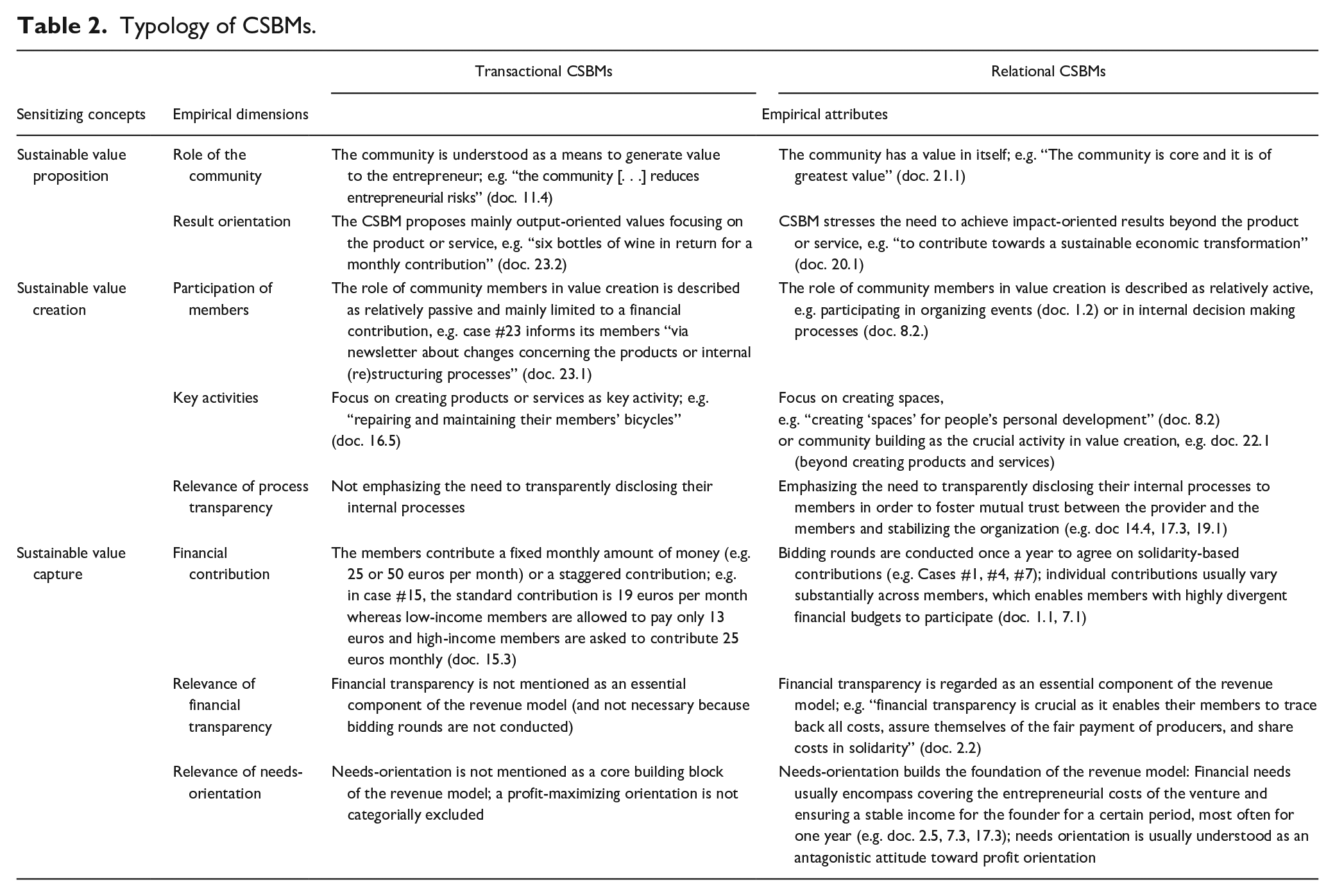
Transactional CSBMs
We identified eight CSBMs out of the 23 CSBs in our sample as transactional CSBMs (Cases #11, #12, see Vignette 1 5 ). These initiatives followed a relatively mechanical way of using the community-supported approach. In their value proposition, transactional CSBMs understood community as a means to achieve a particular goal (doc. 3.1, 6.1, 11.4). For them, the community did not usually mean an end in itself. Transactional CSBMs created value among low participation of community members (doc. 11.4, 12.1, 15.1). This passivity of community members went along with a comparatively low relevance of transparency regarding the information about their production and service generation (doc. 23.1).
Transactional CSBM by the Bread Heaven Bakery.
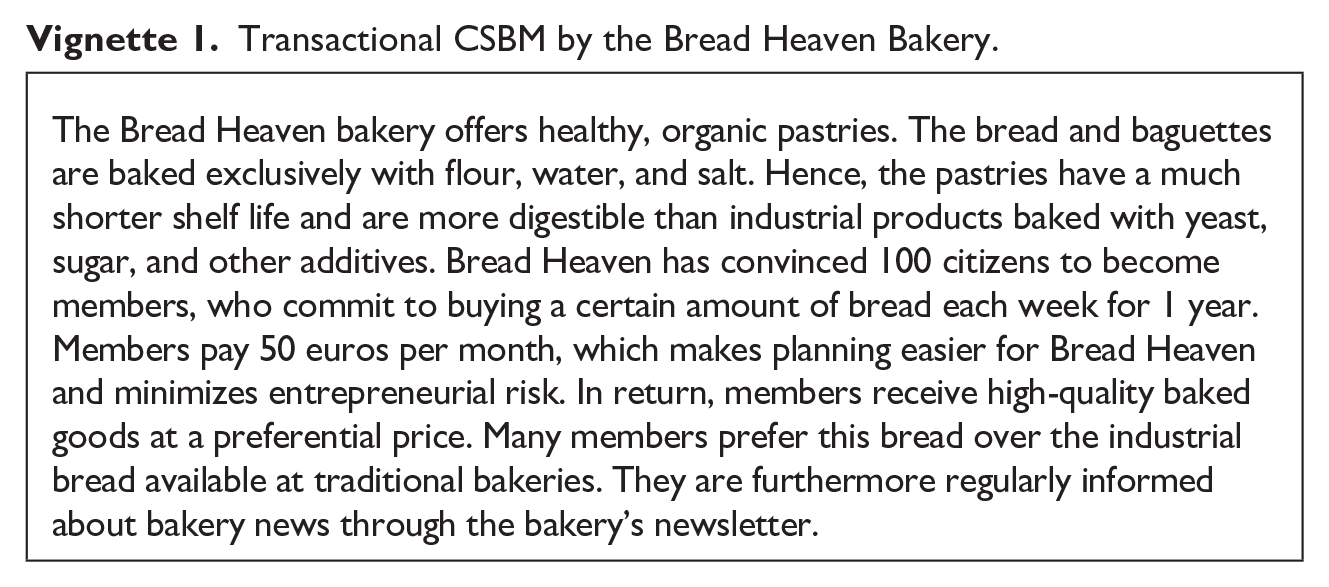
Moreover, transactional CSBMs mainly focused on producing and offering products and services in value creation, thereby tending toward output orientation and focused on using the community’s financial contribution to achieve their goal (11.4, 12.1, 22.1). Value capture of transactional CSBMs was characterized by a fixed or staggered contribution, a low relevance of financial transparency, and a low relevance of the providers’ and members’ needs in the process (11.4, 15.3, 22.1, 23.4). Transactional CSBMs focused on the transaction between the respective venture and community members without building personal relationships (Jensen et al., 2010; Rousseau, 1990). Hence, we define it as follows: Transactional CSBMs focus on the economic exchange between the organization and its community of members. They understand community as a means to achieve a particular value. Ventures that operate according to a transactional CSBM create value with low participation of community members and capture value with a fixed or staggered contribution (see Online Appendix B).
Relational CSBMs
Among the CSBs in our sample, we identified 15 CSBMs that we refer to as relational CSBMs (Cases #1, #7, #10, #14; see Vignette 2). These CSBMs were often set up as alternatives to market-based mechanisms, i.e., those that use market forces (e.g., competition) to achieve a sustainability impact (8.2, 16.4, 21.1). Relational CSBMs used community-based mechanisms (e.g., cooperation) to achieve their impact. They understood community as an end in their value proposition, i.e., community is a value in and of itself to them (doc. 1.1, 7.1, 21.1). In addition, relational CSBMs are typically aimed at achieving more than a specific output. They stressed the goal of achieving an outcome in the value proposition, for example, mutual learning (doc. 7.1) a sustainable supply chain (doc. 15.1), or a broader societal impact, for instance, fostering a sustainable economic transformation (doc. 20.1) or furthering mobility transitions toward sustainability (doc. 21.1).
Relational CSBM by the eCarsharing Provider Drive Together.
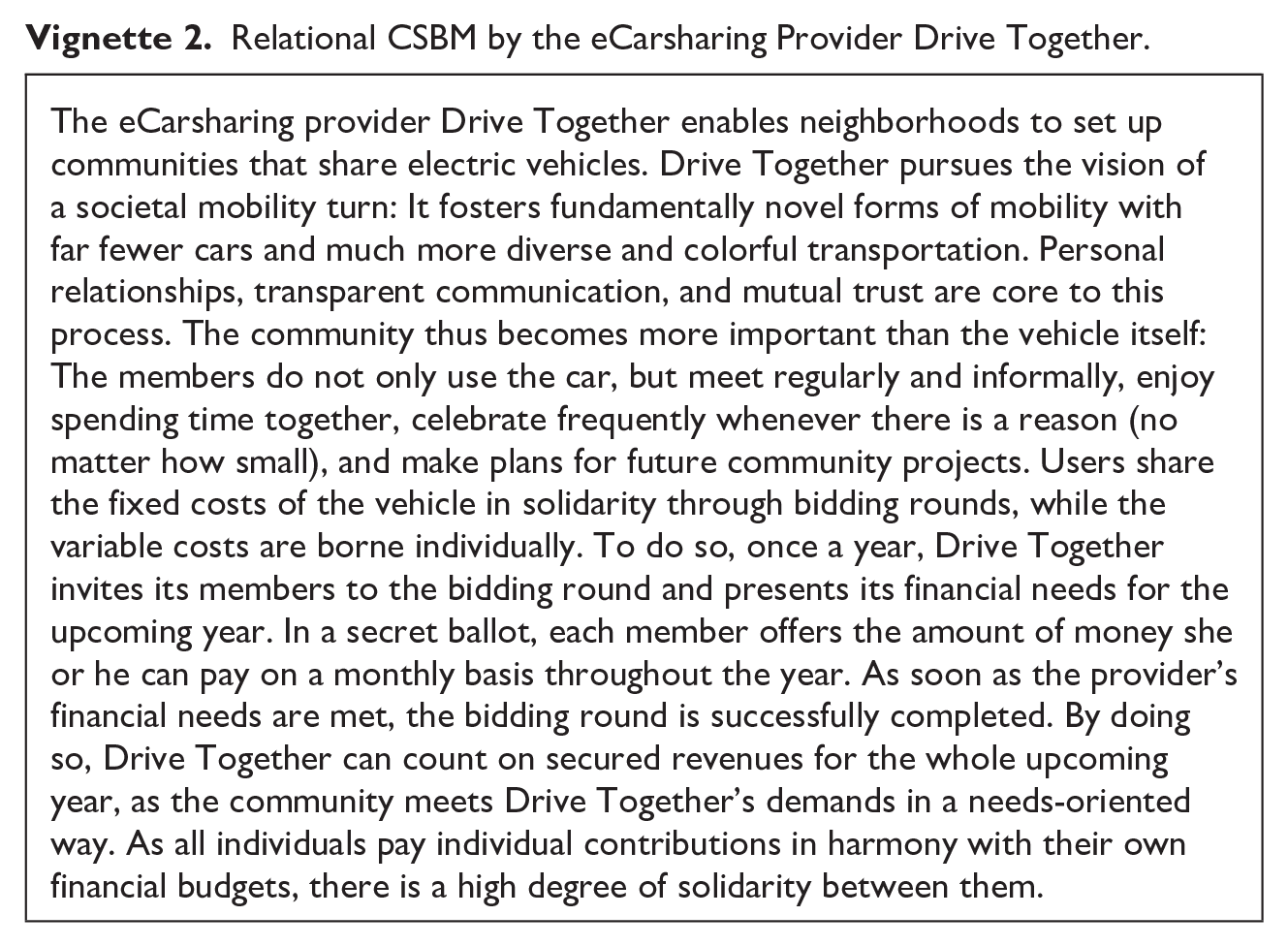
Relational CSBMs’ value creation depended on the active involvement of community members (doc. 7.1). The founders organized vital activities that helped building a community with a high degree of mutual trust among the members (doc. 1.1, 7.1). They created spaces for active participation and stressed the need for high process transparency (doc. 8.2). Relational CSBMs’ value capture was usually characterized by a solidarity-based financial contribution (Cases #1, #4, #7) along with a high relevance of financial transparency within the community and an orientation toward the providers’ and members’ needs (Cases #7, #8, #17). Relational CSBMs positioned meaningful relationships at the center of all three dimensions of their business model (Le Ber & Branzei, 2010; Luo & Zhao, 2013). The term “relational” referred to an ongoing process of meaning-making and reflection (Kurucz et al., 2017, p. 189) between entrepreneurs and members as well as among members in this type of CSBM. These relationships provided a stabilizing buffer in the case of sudden emergencies, ensuring that the required resources were available and hence, were crucial for the success of relational business models (Le Ber & Branzei, 2010). For example, during the COVID-19 pandemic, traveling or getting together with others was sometimes not permitted, which had negative consequences for many travel agencies and hotels. In contrast, community-supported adventure providers were able to find solutions together with their members. In Case #1, the entrepreneurs and members jointly developed the solution that they would all individually experience an outdoor adventure and share their experiences via a digital platform. Hence, the community-supported entrepreneurs were able to continue their business activities while maintaining stable income even during economic crises because of the trust-filled, close relationship with their members, as well as an ongoing process of meaning-making and reflection (Kurucz et al., 2017, p. 189). With these insights in mind, we define relational CSBMs as aiming at building tight relationships between the venture and its community of members. They understand the community as an end in itself, create value among high participation of its community members, and capture value with a solidarity-based proportional pricing model (see Online Appendix B).
Our analysis has shed light on eight dimensions and 19 attributes that supported us in understanding, describing, and differentiating CSBMs. These insights have also shown that CSBs do not all apply the same business model, but that there are instead two types of CSBMs in practice that differ in sustainable value proposition, creation, and capture.
How Transactional and Relational CSBMs Differ in the Resources Considered Vital for Success
Organizations usually possess internal and external resources, such as financial, human, or organizational, that contribute to competitiveness and sustainability (Barney, 1991). Those resources cannot generate value themselves, but through a combination of resources and the process of using them (DaSilva & Trkman, 2014). Our analysis has shown that transactional and relational CSBMs consider divergent resources as vital for their success. Hence, we discuss how transactional and relational CSBMs differ in the resources they emphasize and how they use these resources in the following. Thereby, we pay more attention to the relational than to the transactional CSBM, as the relational type differs from classical market principles to a higher degree.
Vision
According to Barney and Arikan (2005), a distinctive vision is one of a firm’s most important internal resources. Transactional and relational CSBMs vary fundamentally in their vision, as relational entrepreneurs are usually driven by the vision to change the economic system, while transactional entrepreneurs rather envisage becoming successful within the economic system. Relational entrepreneurs criticize the market economy for being responsible for social exploitation, economic inequality, and environmental damage. For example, one of the focus group participants discloses that In my twenties, I have been a member of quite a few community-supported farms in Berlin and, to be honest, I have always been displeased with those rather transactional CSBMs. What I missed were much more radical CSBMs, not such disguised veggie boxes. That’s why I today, as an entrepreneur, really want to set up relational CSBMs to show the world that another way of doing business is absolutely possible. (FGP4)
The market economy is usually understood as an economic system that is mainly coordinated by supply and demand while being less controlled by a central authority or state (Patnaik, 2015). The opposite is a planned economy (McMillan & Naughton, 1992). Here, the government controls the economy, possesses the production factors, and decides which products and services are produced when and where. CSBMs seem to constitute another alternative, beyond the market and the planned economy, which is set up independently from the government but nevertheless undermines market economic principles. In this respect, another founder explains that “relational CSBMs build on responsibility, cooperation, trust, and transparency, whereas market-based businesses build on competition, growth. . . faster, higher, further. And transactional CSBMs are somewhere in between—similarly to subscription models, but with a better image” (FGP7). Hence, transactional and relational CSBMs build on different visions and relational entrepreneurs are driven by the vision to change the economic system.
Company Size and Complexity
In management literature, being a small company is usually not seen as a resource, but as a burden due to resource scarcity (Löfqvist, 2017). However, being a small and non-complex community-supported venture also bears opportunities and can be seen as a valuable resource. Establishing close relationships as needed for relational CSBMs takes time and effort and becomes more difficult with increasing business size. The two wineries in our sample support this assumption, as the relational CSBM in our sample has been established by a solopreneur, whereas the transactional CSBM has been built by an existing winery, a small company. Company size also played an important role during our focus groups, especially with regard to the number of members (that we explicitly regard as part of the company size in CSBMs due to the important role of the community). For example, one of the entrepreneurs argues that I’m just realising that the differentiation between transactional and relational types can be applied to all CSBMs. The large Kartoffelkombinat with thousands of members in Munich clearly is a transactional one, whereas our CSA with its twenty members clearly constitutes a relational one. Solo entrepreneurs and small organisations are definitely better able to build close relationships among members, so they are better equipped for relational CSBMs (FGP4).
Community Management
Our findings indicate that one of the main resources in relational CSBMs is to care for the community and to nurture a feeling of community among the members. In the same line, one of the founders in our focus groups argued that “the sense of community is even more valuable than the product itself. Both entrepreneurs and members bring in more commitment and energy in relational CSBMs compared to transactional CSBMs” (FGP8). Another founder explains that community building requires recurrent opportunities for mutual exchange (FGP13). According to relational entrepreneurs in our focus groups, it is necessary for the community members to overcome their market socialization: “Members should learn to ask the question ‘What can I give’ instead of ‘What do I get?,’ and it’s the entrepreneurs’ exercise to support their members in this perspective shift in relational CSBMs” (FPG13). Supporting this mind shift is part of the community work in relational CSBMs. Similarly, a founder in our sample puts a high emphasis on fostering a community spirit: “The community is our core business and we really do a lot to maintain this we-spirit” (FGP7). In transactional CSBMs, the community does not need the same degree of care. One of the transactional founders explains that “once you have built up your community, you can concentrate on your core business, produce your product, and hand it over at the time and place agreed” (FGP6).
Self-Reflection
In the literature on human resources development, self-reflection has already been identified as a valuable resource for firms (Nesbit, 2012). Our research indicates that self-reflection is especially important and a permanent task for relational entrepreneurs. One of the relational entrepreneurs in our sample stated that “inner work is what we all permanently need to do our job” (FGP13). Another founder explained that whether relational CSBMs are successful or not depends on the entrepreneurs’ ability to question their own thoughts. We all need to question and realign our attitudes all the time. It does not stop when the organisation has successfully been established. Here, the work just starts. It’s all about lifelong learning. But it’s really tough to do it, so I really understand people who don’t have the guts to do it and who therefore decide to build up transactional CSBMs (FGP4).
This comment suggests that transactional CSBMs require lower levels of self-reflection. In line with this hypothesis, one of the founders explains that in transactional CSBMs, entrepreneurs focus much more on the product. Once the community has been built up, the entrepreneurs do not need to care that much about the people anymore compared to relational CSBMs. And as transactional CSBMs are more comparable to conventional market-based businesses models, entrepreneurs do not need to overcome their market-based socialisation all the time. That means that self-reflection as a resource is not as important here as in relational CSBMs (FGP7).
Risk Management
Especially small organizations are hit hard when losing customers because losing customers usually equals losing sales (Lu et al., 2022). Excellent post-sales customer services, tracking data, and giving free products and services are among the strategies to reduce the risk of losing customers (Lu et al., 2024). CSBMs add a novel approach to this range of risk management strategies. In transactional CSBMs, members commit to become members and pay a defined contribution for a fixed period of time, thereby reducing the risk of losing customers and, at the same time, losing sales. Relational CSBMs basically apply the same mechanism as transactional CSBMs, so their members also commit to a defined contribution over a fixed period of time. However, relational CSBMs do not only build on their members’ passive commitment, but they also actively engage in finding solutions during economic crises. One of the founders of a relational CSBM explained that: When I heard that restaurants were being closed [during the corona pandemic], I wished they’d made it community-based straight away! Then they wouldn’t have to close down their restaurant and they would have a secure income for the time being. As a consumer, you are aware from the outset that you are financing a provider for a year and practically according to your means. In a restaurant, you would perhaps help with the delivery. Obviously, as a member, you want the restaurant to run when you decide to take on the responsibility (doc. 7.2).
This active engagement in mutually finding solutions to economic or societal challenges adds another component to CSBMs’ risk-sharing strategies. It is not only about reducing the risk of losing customers but also about reducing operational risks while flexibly providing the (wo)manpower that physically can support changing the offer (for example, switching from face-to-face meetings to online meetings as in case #1). These insights add to the current understanding of CSBs: So far, a considerable number of non-scientific magazine articles and podcasts have argued that CSBMs are particularly resilient during economic crises (e.g., Brumbauer, 2021; Brumbauer & Puckhaber, 2021; Rommel & Koch, 2021). Our research indicates that all types of CSBMs reduce the risk of losing customers through defined contributions for a fixed period of time, and relational CSBMs additionally draw on a community of members that actively support in solving challenges.
Discussion
Summary and Research Implications
We started this study with the observation that scholars increasingly explore community-supported ventures, but usually focus on the CSB and thereby mix community-supported organizations with divergent underlying business models. Hence, we have explored differences in CSBMs in practice, carved out a typology, characterized each type, and delineated the divergent resources these ventures build on. We have shown that transactional CSBMs are characterized by a rather technical relationship between entrepreneur(s) and the community of members, while relational CSBMs focus on more than just the product or service by emphasizing the community as an end in itself and building on higher levels of trust, transparency, and needs-orientation. We have seen that these differences in transactional and relational CSBMs bear implications for the resources considered critical for running and sustaining the business. For example, the vision of changing the economic system and striving to show that another way of doing business is possible is a vital resource of relational CSBMs, while transactional CSBMs rather act within the classic economic operating mode.
Unconsciously mixing transactional and relational types of CSBMs bears the risk of overseeing important differences and can make the results less valid and generalizable. In this regard, differentiating between transactional and relational CSBMs can be seen as an important variable in quantitative research on CSBMs. A factor that may be beneficial to transactional CSBMs could potentially have a negative effect on relational CSBMs. Researchers who are not aware of the differentiation between transactional and relational types of CSBMs may not be able to explain these divergent effects or, even worse, attribute the effects of the missing variable (type of CSBM) to those that are included in the model. This problem is called omitted variable bias (Wooldridge, 2009). Moreover, unconsciousness about transactional and relational types of CSBMs can negatively affect the generalizability of both quantitative and qualitative research. For example, a researcher might not be aware that her study sample mainly consists of relational CSBMs. She might draw conclusions that are not generalizable to transactional CSBMs. Hence, scholars can build on our typology to clearly analyze and define their research subject and consequently better carve out the boundary conditions of generalizability.
These insights bear important implications for existing research. For example, in their seminal article on CSA as a microeconomic degrowth model, Bloemmen and colleagues (2015) build their argument on the examination of a single case study. They explain that the members of this CSA cannot be considered Homo economicus as in mainstream neoclassical economics. Their production and consumption behaviours are not based upon interest-seeking, self-centred behaviour. A more holistic understanding of human beings (Bina & Vaz, 2011) is needed in the case of such grassroots initiatives. Our observations of dominant trust, cooperation and self-giving attitudes corroborate many studies in the field of neurosciences and behavioural economics (p. 113).
According to the information given in the study (role of the community as an end in itself due to conviviality, active participation of members, high financial and process transparency), this case seems to constitute a rather relational CSBM, raising the question whether the findings would have been different for transactional CSBMs. Do entrepreneurs and members of transactional CSBMs apply a Homo economicus way of thinking or do they act similarly to relational CSBMs?
Similarly, Medici and colleagues (2021) show in their study on the economic, social, and environmental dimensions of CSAs in Italy, that CSAs in their sample can encounter organisational problems, as some members could not offer volunteer-based work, participate in CSA events, or contribute their time to other CSA activities, preferring to support the community in monetary terms only. In this case, enhancing member motivation was emphasised to let the community breaking through from a hybrid ethical purchasing group to a proper CSA (p. 5).
We question whether founders of both types of CSBMs have the same understanding of a “proper CSA” as mentioned in the text. In transactional CSBMs, entrepreneurs usually do not put that much emphasis on the participation of members, as members have a rather passive role in these ventures. We assume that, implicitly, the authors used the term “proper CSA” to refer to a relational one. Applying our typology of transactional and relational CSBMs can support the authors in making clear what they mean.
Moreover, in their study on community-supported fisheries in the U.S.A., Carlson and colleagues (2021) explore network resilience amid the COVID-19 pandemic. They find that demand-side seafood distribution has become more diversified and dispersed through a novel marketing strategy that increased the number of customers and augmented network redundancy and resilience while minimizing COVID-19 transmission. Applying the differentiation between transactional and relational to the study by Carlson and colleagues (2021) could have provided insights into whether and how the transformation strategies of different types of community-supported fisheries differ from each other. For example, based on our study’s findings, one could assume that in transactional community-supported fisheries, entrepreneurs develop solutions on their own, while in relational ones, entrepreneurs and members develop solutions together. And it could be possible that in relational ventures, a greater number and more creative solutions are developed than in transactional businesses.
Limitations and Opportunities for Future Research
This study has limitations that open avenues for future research: First, although the secondary material analyzed in this study and the primary data collected through the two focus groups offer valuable insights into the functioning of CSBMs, further primary material can refine and strengthen the scholarly understanding of these business models. We are aware that entrepreneurs do not necessarily publicly present all aspects of their business models. For example, in our research, some cases did not mention process or financial transparency in their external communication. Although we do not argue that these CSBs create value in a non-transparent manner, we do in fact see that process or financial transparency is comparably less relevant in their external communication. Moreover, our data only capture what entrepreneurs say or write they do, but not what they actually do. We as a result invite scholars to apply further primary qualitative, quantitative, and ethnographic research methods to dig deeper into CSBMs’ structure and functioning. Moreover, as our cases and focus group participants mainly stem from the German context, future research could include CSBs from a diverse set of countries to expand the sample scope. By doing so, researchers could also analyze whether culture affects the emergence and management of CSBMs.
Second, as previous research has shown that the business environment matters for the success of a business model, it would be very fruitful for scholars to determine which business environments favor transactional and relational CSBMs (Evans et al., 2017; Oskam et al., 2021; Stubbs & Cocklin, 2008). A business model that is successful in a particular context might not succeed in another surrounding with different habits or cultural rules. Interestingly, our sample identified both a transactional and a relational winery. We can therefore assume that the choice about whether to choose a transactional or a relational business model is rather a matter of preference than one of the business sector. For example, some entrepreneurs might be less open and willing to put effort into relationship building (Davila & Molina, 2017). Although being able to build up both transactional and relational business models in nearly every business sector probably holds true to some extent, we have already argued that it is a matter of company size and complexity whether it is possible to establish relational CSBMs. Establishing close relationships takes time and effort, and becomes more difficult with increasing business size. The two wineries in our sample support this assumption, as the relational CSBM here was established by a solopreneur, whereas the transactional CSBM was built by an existing winery (a small company). We invite future research to determine which specific contexts enable each of the two types of CSBMs to flourish.
Third, our sample contained one hybrid CSBM that applies transactional and relational attributes in equal parts. We assume that this CSBM is a special case because it operates in the B2B context. It would be very interesting to investigate other CSBMs in the B2B sector to check for a pattern of whether these CSBs mainly apply hybrid CSBMs or not. A larger sample would definitely enrich the empirical evidence.
Based on the discussion of our study’s limitations, we encourage scholars to explore CSBMs in greater detail, identify the individual contexts in which the two types will flourish, and either verify or see our propositions differently regarding the characteristics and resources.
Supplemental Material
sj-docx-1-bas-10.1177_00076503241271277 – Supplemental material for Relational or Transactional? The Importance of Distinguishing Two Types of Community-Supported Business Models
Supplemental material, sj-docx-1-bas-10.1177_00076503241271277 for Relational or Transactional? The Importance of Distinguishing Two Types of Community-Supported Business Models by Michaela Hausdorf and Jana-Michaela Timm in Business & Society
Supplemental Material
sj-docx-2-bas-10.1177_00076503241271277 – Supplemental material for Relational or Transactional? The Importance of Distinguishing Two Types of Community-Supported Business Models
Supplemental material, sj-docx-2-bas-10.1177_00076503241271277 for Relational or Transactional? The Importance of Distinguishing Two Types of Community-Supported Business Models by Michaela Hausdorf and Jana-Michaela Timm in Business & Society
Footnotes
Declaration of Conflicting Interests
The authors declared no potential conflicts of interest with respect to the research, authorship, and/or publication of this article.
Funding
The author(s) disclosed receipt of the following financial support for the research, authorship, and/or publication of this article: One author received a dissertation grant provided by the Heinrich Böll Stiftung.

Supplemental Material
Supplemental material for this article is available online.