




Abstract
This article contributes to research in Political Corporate Social Responsibility (PCSR) by developing the idea of “political corporate social irresponsibility” (PCSiR). PCSiR occurs when corporations provide what are expected to be public goods but, in so doing, create or exacerbate public problems and diminish social welfare. We examine PCSiR through the case of a “garbage mountain” located near Tripoli City, Lebanon. This accumulation of solid waste is a potent symbol of the corporate failure in delivering contracted social services. We question how and to what extent has the power and influence of political actors in Lebanon hindered environmental protection and sustainable business practices. In response, we investigate the relations between corporations, the state and civil society that led to the garbage mountain and corporate response to political activism. Drawing on a neo-Gramscian approach to PCSR, we show how an interplay of consent and coercion fosters effective PCSiR, shielding those in power from responsibility for their self-serving behavior.
Keywords
In July 2018, the Lebanese government issued warnings to the residents of the North Governorate (muhafazah) of Lebanon, particularly those living in Tripoli and its surrounding areas, to refrain from swimming, fishing, or consuming local seafood. This action was taken due to an extreme elevation in pollution levels and bacterial contamination in the surrounding coastal waters. Lebanon’s National Center for Marine Studies (NCMS) found high levels of harmful streptococci and coliform bacteria in the water. This level of pollution significantly exceeded World Health Organization guidelines in five coastal locations and was unsuitable for swimming. NCMS also found that the main cause of bacterial pollution in the Lebanese sea was organic waste and sewage, in particular, the flow of waste from power plants and “factories adjacent to the coast or near rivers into which industrial waste is dumped, much of which ends up in the sea” (Kadi, 2018, n.p.). Contaminates known to cause a range of diseases, including cancer and terminal organ failures, such as mercury, copper, and zinc registered at alarming levels (Yan, 2018). Another major source of contamination was seepage from the area’s major garbage disposal sites, including what Tripoli’s residents had come to refer to as the city’s “garbage mountain.” The rotting rubbish generated unbearable odors that spread across the city during hot weather and were linked to an increase in asthma, other lung diseases, and cancer (Hamza, 2018).
This article investigates the environmental crisis that the garbage mountain poses to northern Lebanon by examining the relationship between corporations, the political system, citizens and social services provision. We pose the question: How and to what extent has the power and influence of political and economic actors in Lebanon hindered environmental protection efforts and sustainable business practices? In addressing this question, we locate this discussion in relation to research in political corporate social responsibility (PCSR). The political dimensions of corporate social responsibility have begun to be studied in various national settings, especially when private corporations take responsibility for the provision of public goods (Frynas & Stephens, 2015; Scherer & Palazzo, 2007). Concurrently, the emergence of the idea of corporate social irresponsibility (CSiR) (Chatterji & Listokin, 2007) has highlighted “the dark side, as it investigates the wrongful and damaging business decisions that managers might take” (Popa & Salanta, 2014, p. 197). CSiR specifically refers to corporations’ actions that operate under the guise of being responsible but “can inflict harm with different levels of intensity, from death to material loss” (Alcadipani & de Oliveira Medeiros, 2019, p. 285).
The contribution of this article is to extend existing research on corporate social irresponsibility by drawing on our empirical study to examine what we call political corporate social irresponsibility. Extant work has contrasted corporate social responsibility with corporate social irresponsibility, the latter of which Pearce and Manz (2011) defined as intentional behavior where executives disregard the damage caused to their stakeholders or the society at large but deliberately seek to maximize personal gains and a profit maximization strategy. In the same fashion, we contrast political corporate social responsibility (PCSR) with the new concept of political corporate social irresponsibility (PCSiR). PCSR is generally understood as: responsible business activities that turn corporations into providers of public goods in cases where public authorities are unable or unwilling to fulfil this role. This includes, but is not limited to, corporate contributions to different areas of governance, such as public health, education, public infrastructure, the enforcement of social and environmental standards along supply chains or the fight against corruption, discrimination or inequality. These public goods are provided to resolve public issues with the aim of enhancing social welfare. (Scherer et al., 2016, p. 277)
In relation to PCSR, we consider PCSiR as a situation where corporations intentionally cause damage to social well-being while simultaneously using political means to avoid accountability. PCSiR occurs, we argue—when corporations are involved in providing what are expected to be “public goods” but, in so doing, create or exacerbate public problems and harm social welfare while simultaneously shielding themselves from having to assume responsibility for their actions. We argue that the garbage mountain is a physical manifestation of this form of irresponsibility; a material artifact that demonstrates how PCSiR can lead to environmental devastation and thwart the emergence of sustainable business practices. Our work exemplifies the deleterious effects of PCSiR in a political setting where social irresponsibility can be obfuscated and perpetuated through political means. We join other scholars who have investigated the politico-economic reasons behind grand challenges, including environmental crises and the failure of corporations to address them (e.g., Banerjee, 2008; Khan et al., 2007). We frame PCSiR in Lebanon through research into PCSR that draws on Gramsci’s (1971) theory of hegemony—the social domination of minority interests—through a combination of coercion and consent (Girei, 2016; Kourula & Delalieux, 2016; Levy & Kaplan, 2007). We understand PCSiR in relation to the complex social dynamics among corporations, civil society groups (Levy et al., 2016), nongovernment organizations (NGOs) (Levy & Egan, 2003) and other institutions (Kourula & Delalieux, 2016) shaping Lebanon’s politics, economy, society, and environment.
The article begins with a review of the literature and theoretical underpinning of the research to provide a framework to research PCSiR. This review also considers how PCSiR relates to Lebanon’s political, economic, and social specificities. We next describe the approach and methodology we used to study PCSiR in Lebanon and to study the political and economic machinations behind the creation of the garbage mountain. The case study is reported and analyzed in the two central sections of the article. The first section explores the background of the public–private partnership (PPP) created to manage solid waste management and how corporate employees perceive social responsibilities. We show how employees’ understanding of issues relating to social responsibility was opaque, and limited to specific philanthropic activities. In the second section, we show how social responsibility for the garbage mountain was obfuscated and avoided by both the corporation and the government through consensual and coercive means. We conclude by assessing our case in terms of its contribution both to understanding the disaster of the garbage mountain, and discerning the necessary conditions in place for PCSiR to be effective.
Political Corporate Social Irresponsibility
Politicizing Corporate Social Responsibility
In a foundational discussion of irresponsibility in management, Armstrong (1977) uses the word irresponsible to refer to “a gain for one party at the expense of the total system.”
Furthermore, “an act was irresponsible if a vast majority of unbiased observers would agree that this was so” (p. 185). From this antecedent, corporate social irresponsibility (CSiR) emerged as an object of research and theory in the early 2000s (for a review, see Riera & Iborra, 2017) as a means to describe corporate actions with a negative social impact. Moreover, CSiR was positioned directly as a corrective to the growth in theory and practice of corporate social responsibility (CSR) at the time: SR is the set of corporate actions that positively affects an identifiable social stakeholder’s interests and does not violate the legitimate claims of another identifiable social stakeholder (in the long run). In turn [. . .] corporate social irresponsibility (CSiR) [is] the set of corporate actions that negatively affect an identifiable social stakeholder’s legitimate claims (in the long run). (Strike et al., 2006, p. 852)
Corporate Social Irresponsibility (CSIR) extends beyond mere negligence or a company’s failure to act responsibly. CSIR is the outcome of a deliberate business strategy, decision, or action taken by a company, which has a direct impact on the interests of its stakeholders (Keig et al., 2015; Lange & Washburn, 2012).
CSiR surfaces how corporate activity can have risks and negative consequences beyond a corporation itself (Riera & Iborra, 2017). CSiR is the failure of CSR to live up to society’s expectations in a context where society is independently responsible for evaluating whether corporations are socially irresponsible (Herzig & Moon, 2013). CSR and CSiR can be intimately connected. This is because corporations can use CSR as “image washing” (Kotchen & Moon, 2012) to compensate for irresponsible behavior in a way that enhances their reputation and credibility with stakeholders.
Concurrent with the growth of research in CSiR has been the development of the idea of Political Corporate Social Responsibility (PCSR) as an extension of more established research into CSR. PCSR attends to the relationship between corporations and the political systems in which they operate, focusing especially on contributions corporations might make to activities traditionally understood as within the sole purview of the state (Boddewyn, 2003; Scherer et al., 2016). The PCSR literature is primarily concerned with corporations taking on political roles of provisioning public goods and establishing systems of self-regulation (Matten & Crane, 2005; Scherer & Palazzo, 2008, 2011). PCSR research has emphasized the role of corporations in maintaining social legitimacy by addressing political challenges such as human rights violations, environmental disasters, and global financial scandals (Matten & Crane, 2005; Scherer & Palazzo, 2007). More critically, PCSR has been interrogated as representing the enrolment of politics to pursue further individual or corporate interests rather than public ones (Fleming & Jones, 2013). These challenges have occurred where multinational corporations (MNCs) presume responsibility for public goods provision in emerging or “failed state” settings (Scherer & Palazzo, 2011).
PCSR has been framed from various theoretical perspectives (Frynas & Stephens, 2015; Scherer et al., 2016). Regarding politics, the most influential draw either on Jürgen Habermas’ notion of deliberative democracy (e.g., Scherer & Palazzo, 2007), John Rawls’s theory of justice (e.g., Mäkinen & Kourula, 2012), or Antonio Gramsci’s conception of hegemony (e.g., Levy et al., 2016). For our purposes, the latter approach offers an ideal way to study what we are calling PCSiR. This is because rather than focusing on ideal political systems that might be conducive to responsible corporate behavior, it allows for “the clearest sense of proactive corporate strategies [. . . used to . . .] obtain societal legitimacy” (Frynas & Stephens, 2015, p. 494). It does so by intertwining the “economic, normative and governance dimensions” of political activity (Levy et al., 2016, p. 5). On these grounds, Gramsci’s (1971) political philosophy, and particularly his theory of hegemony, has been used productively to investigate corporate political strategies and the role of a socially dominant power in the relationship between corporations and civil society (Kourula & Delalieux, 2016; Levy & Kaplan, 2007). Hegemony has also been applied to frame the complex “social dynamics” among corporations and other stakeholders (e.g., NGOs, civil society groups and others) (Kourula & Delalieux, 2016; Levy & Kaplan, 2007).
Hegemony and PCSR
Gramsci (1971) develops the idea of hegemony to register how dominant social groups achieve their interests through the maintenance of a social status quo that supports those interests. Importantly, this is not achieved purely by “command exercised through the State and ‘juridical’ government” (even though that is present) but also by the “spontaneous” consent given by the great masses of the population to the general direction imposed on social life by the dominant fundamental group” (p. 145). Gramsci is especially concerned with the domination of the state through social hierarchies to the extent that those less powerful accept the structures of inequality in which they are located. With hegemony, power is not simply a brute force. It is an “ethical-political” (p. 383) operation that establishes a status quo and common sense favoring a particular social group over others. Through these means, inequality is construed as both stable and normal, even by those who are impoverished. Importantly, hegemony asserts the collaboration and the active consent of the subordinated to their subordination (p. 549).
Gramsci’s theory of hegemony has been productively employed to theorize PCSR both as representing the social-political domination of corporations and exploring how that domination can be resisted. In an exemplary study, Levy and Egan (2003) employed Gramscian theory to illustrate the social dynamics among different parties in responding to climate change. They examined corporate responses to their socially dominant positions being challenged. In so doing, they elucidated the importance of political struggles within civil society if real change is to occur. The authors describe how nongovernmental organizations (NGOs) began actively building tactical alliances with nonnatural partners, such as insurance firms, once global warming was acknowledged. Following Gramsci, this activity can be understood as a counter hegemonic-movement against the hegemonic stance of historical blocs (S. Jones, 2006). Levy and Egan explore how environmental NGOs form partnerships with insurance firms by convincing them that controlling greenhouse gas emissions is in their best financial interests.
Levy and Scully (2007) extended the use of Gramsci’s hegemony in relation to corporations by analyzing strategies of institutional entrepreneurship. They argue that NGOs and activists seek to restructure failed institutions, such as business firms and governmental institutions, by promoting private mechanisms, such as certification. Similarly, Kourula and Delalieux (2016) investigated textile corporations’ responses to being accused of social transgressions in their offshoring supply chain in an emerging economy. They described the corporate responses in relation to what Gramsci called a “passive revolution”: the process by which dominant social groups instigate sociopolitical change to preserve their interests and prevent a more active revolution. For Gramsci (1971), passive revolution is where “the State replaces the local social groups in leading a struggle of renewal” (p. 288) to preserve its power. In the case of PCSR, the corporation takes on the position of the resistant political groups. Kourula and Delalieux’s (2016) analysis shows how, in their case, the corporation took the lead in forming alliances with an audit firm and with NGOs as a hegemonic strategy. This strategy served as a defense mechanism enabling the corporation to manage social resistance in the supply chain and operations. It also functioned to “image-wash” its reputation. Change happened, but the structures of domination remained steadfast.
Consensus and Coercion
We consider PCSiR in the specific context of Lebanon, how corporations have engaged in irresponsible behavior when relied upon to provide public services, and what the implications are more broadly for the position of corporations in the hegemonic social order. PCSR research has been criticized for failing to consider the role of different political environments in-depth (Eberlein, 2019; Korschun & Rafieian, 2019). Indeed, the majority of research in PCSR has been conducted in Western liberal-democratic nations, giving rise to the question of whether the associated concepts and theories are relevant in other political and cultural environments. This does not, however, mean that PCSR can only be used in Western contexts. Illustratively, Maier (2021) has successfully advocated that PCSR is applicable in the political–institutional context of authoritarianism. Maier’s (2021) caveat, and one that we heed, is that to do so requires a nuanced understanding of the role of government institutions in the context in which PCSR is being applied. Exemplifying this, Maier and Gilbert’s (2023) study of PCSR in Jordan effectively showed how “both governments and MNCs co-create a context hostile to socially responsible business conduct in the sense of Political CSR” (p. 11) in a politically authoritarian environment. In our case, we follow Maier (2021) in asserting that with a “higher degree of context-sensitivity, political CSR may still indicate ways in which firms can avoid becoming socially irresponsible actors” (p. 491) in contexts other than Western capitalist democracies.
Tripoli’s garbage mountain, as introduced earlier, is a material and olfactory symbol of how social responsibility for waste management and environmental protection has been ignored after the government privatized waste management. Environmental breaches have not been addressed, and corporations have been protected from any sanctions by the state. Through the case, we explore PCSiR as irresponsible corporate responses to societal needs in a failing political context in which the government is unable to meet social needs or is unwilling to implement governance frameworks for corporations. In so doing, our analytical framework applies Gramscian theory to understand how and why the travesty of the garbage mountain existed—that is how the organizations that were responsible for creating it got away with such extreme and manifest irresponsibility.
Central to our consideration of how hegemony enables the perpetuation of PCSiR is the interplay of consensual and coercive power on the part of corporations who behave irresponsibly. Indeed, this interplay is the central framework for our analysis and bears some explanation here. For Gramsci, hegemony is a form of domination that is not enacted by the state but by elite members of society—the ruling class. Hegemony is “rule by consent, or the cultural and intellectual leadership achieved by a particular class, class fraction, stratum or social group, as part of a larger project of class rule or domination” (Robinson, 2005, p. 560), with corporations and their leaders representing this elite group when it comes to PCSiR. Consent is primary in the way powerful institutions gain legitimacy that enables them to exert power without immediate recourse to the force of coercion. For Gramsci, this hegemony is achieved through civil society’s cultural and ideological mechanisms.
In civil society—schools, the media, churches and so forth—power is exercised by extending “the world view of the rulers to the ruled, and thereby secure the “free” consent of the masses” (Bates, 1975, p. 353). Specific to contemporary capitalist organizations, operating through civil society can thus provide “legitimacy through the assertion of moral and intellectual leadership and the projection of a particular set of interests as the general interest” (Levy & Newell, 2002, p. 87). Unlike corporate political activity, which seeks to enhance corporate power through influencing government alone (see Brown et al., 2022), hegemony achieves domination through moral legitimacy in the public sphere of civil society. While consent is primary to achieving hegemony, it does so with the ever-present possibility of a reversion to coercion should consensus fail or be threatened. Gramsci contends that ruling elites resort to more coercive forms of control to “discipline those who do not ‘consent’” (Bates, 1975, p. 353).
The neo-Gramscian approach (Gamu & Dauvergne, 2018; Levy & Egan, 2003) we draw on is concerned with the persistence of the dominant cultural, economic, and political role of business in society (Levy & Kaplan, 2007) through corporate support of a “passive revolution” (Kourula & Delalieux, 2016). Hegemony, as a specific form of political power enables “socio-economic and political orders [to be] reproduced by ruling elites exercising coercive power and undergirded by the consent of those ruled” (Gamu & Dauvergne, 2018, p. 960). It is important to note that what is specific about hegemony is that it is not simply a power applied from one class of people to another but involves the dialectic between the dominant and the dominated through the twin processes of coercion and consent (Girei, 2016). The nature of how these processes work and interact is the subject of our analysis that frames PCSiR.
Studying the Garbage Mountain
Lebanese political leaders commonly create and co-create their own business corporations under their relatives’ names or in partnerships with political allies. The state’s institutions are instrumentalized by the political “feudalists” as a position of influence to secure economic interests, both familial and factional (Safieddine, 2021). This risks corporations seeking political favor or using Lebanon’s internal divisions, discrimination and inadequate governance system for economic gain. Following the Lebanese Civil War (1975 to 1990), the state began to retreat from provisioning most public services, including health, electricity, water, and waste collection. Weak government institutions, poor infrastructure, corruption, and a dysfunctional waste disposal system led the Lebanese government to privatize waste disposal by partnering with the private sector, with the growth of the garbage mountain being a perverse outcome. More generally, this period saw the neglect of Tripoli by the Lebanese government and its inability or unwillingness to extend its support in part due to rising levels of poverty. Currently, 70% of all residents in Tripoli (regardless of nationality) live below the poverty line (Geldi, 2021).
In this national context, this article presents an explorative case study of the corporate provision of public goods in Lebanon. The study focuses on a private contracting corporation specializing in providing public services in partnership with the public sector. This case study seeks to provide a deeper and more comprehensive understanding of actors, relationships, and actions and embeds theory within practical reality (Borghini et al., 2010; Yin, 2009). We refer to this corporation for privacy and confidentiality purposes using the pseudonym “Delta.” This corporation comprises a group of subsidiaries operating in various industries, including solid waste management and construction. It delivers these services under PPP arrangements with the Lebanese government. Delta’s head office and its subsidiaries are located in Lebanon. Enginco (pseudonym) provides construction and engineering services, and Wasteco (pseudonym) is engaged in solid waste management (see Figure 1).
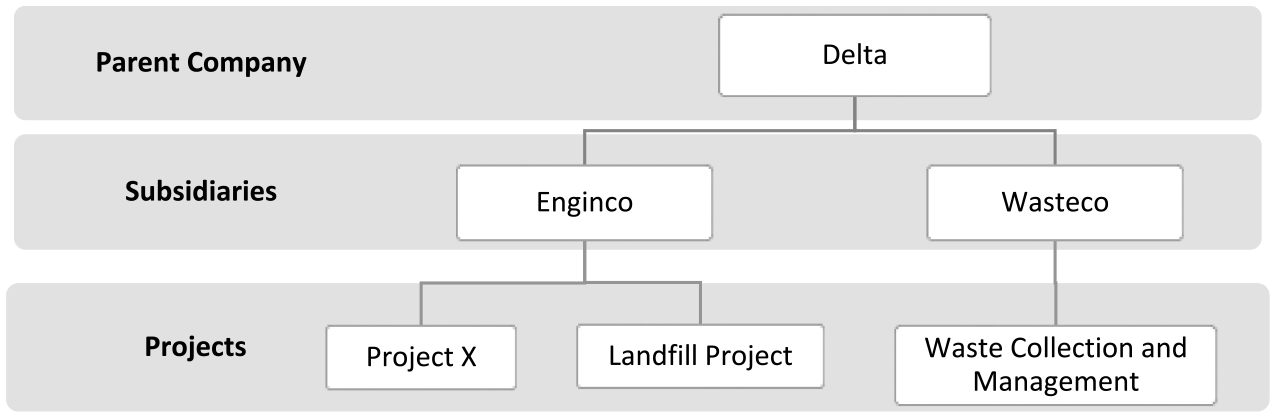
Delta Corporation Organizational Chart.
The research explores the relationship between the nature of PPPs with these subsidiaries and the creation of Tripoli’s garbage mountain. We also investigated the corporate response to civil society protests in response to the mountain led by various NGOs and social activists and examined the corporation’s relationships with local politicians. Following the neo-Gramscian approach discussed above, the study was directed at understanding the coercive and consensual power relationships between Delta, public institutions and parts of civil society. We focused on the Tripoli District, attending to the state’s role in governing and supervising the corporation’s projects.
The case study is based on primary data from interviews and secondary data from publicly available sources, including academic articles by Jabali et al. (2020) book chapter (El-hoz, 2019), German Federal Ministry for Economic Cooperation and Development (2014) reports and local scholar study (Ouwayda, 2018 “Why did the rehabilitation plan of Tripoli fail, and what is the solution?”). Primary data were gathered from a wide range of internal and external stakeholders. The main data sources were 24 interviews conducted in Beirut and the North Governorate in 2018. The interviews involved various direct stakeholders, allowing us to gain a broader understanding of the organizational and political context in which the corporation operated. Sixteen internal stakeholders were interviewed (representatives of different departments and positions) at the headquarters of Delta, Enginco, and Wasteco. Between August and October 2018, a further eight interviews were held with external stakeholders, including public sector workers (town council members), an environmental expert and social activists (see Table 1 for summary of the interview sample).
Primary Data Collection Summary.
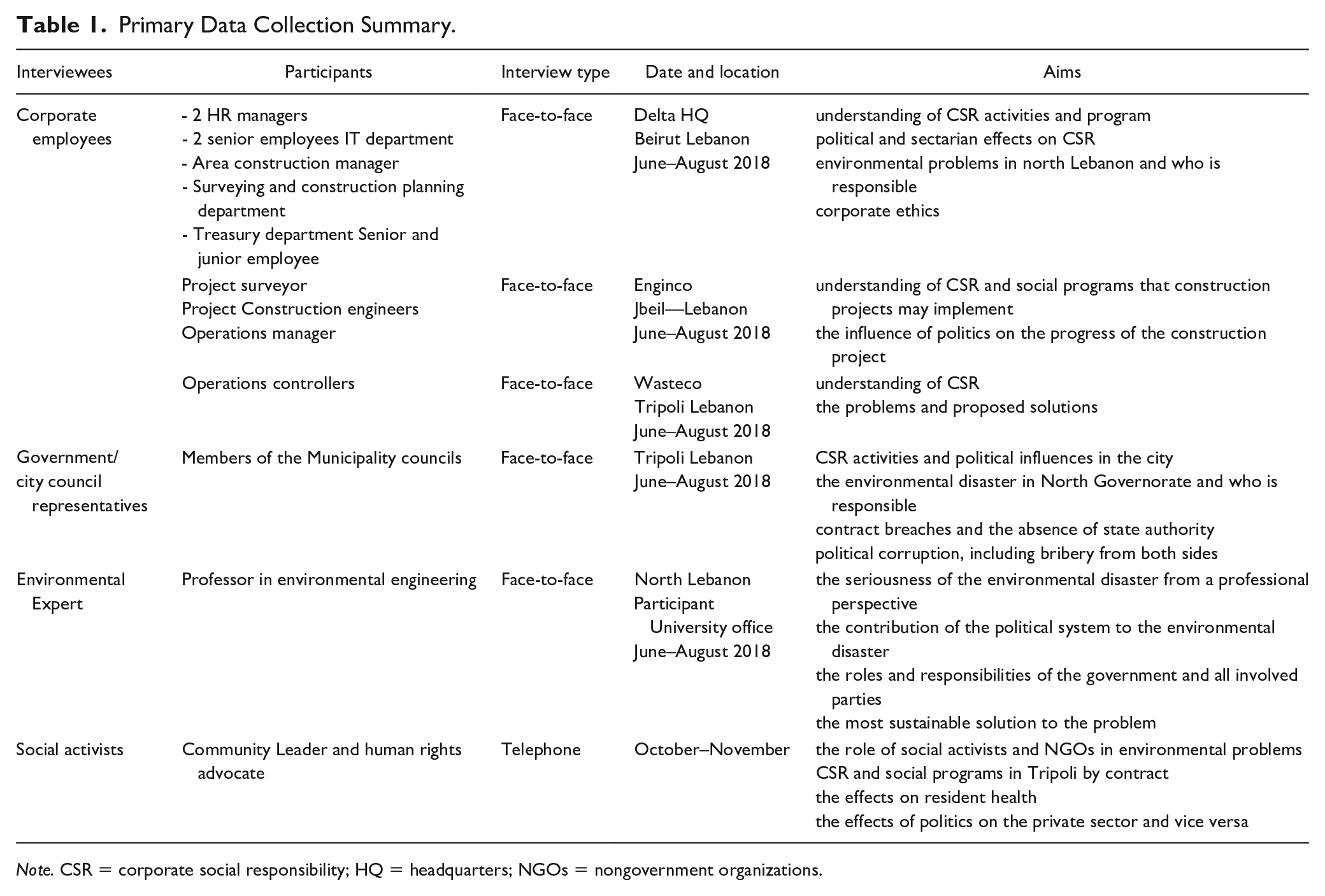
Note. CSR = corporate social responsibility; HQ = headquarters; NGOs = nongovernment organizations.
Delta’s human resources manager provided the initial list of potential internal participants that included representatives from all departments at the head office. Employees were contacted by the HR manager for confirmation. Five employees refused to participate, and four others were unavailable. The unavailability of some candidates or the refusal of others to participate led to further participants being identified using a snowball sampling technique. This was done to maintain the representation of perspectives from various departments. Snowballing provided the additional advantage of not all participants being directly selected or sanctioned by the organization, and hence the opportunity to generate “knowledge which is [more] emergent, political and interactional” (Noy, 2008, p. 327).
It is important to highlight that the interview process at the parent company, project level and subsidiary in Tripoli was done differently, considering factors such as socioeconomic, education level and the sensitivity of the location/area. Interviewees at Enginco were selected based on their availability and willingness to participate voluntarily. The selection of participants ensured different departmental involvement (project surveyor, construction engineer, and operation manager). At Wasteco, participants proved very difficult to recruit. However, one interviewee agreed to participate under one condition that his anonymity was guaranteed. This participant, who had been working for the company for 6 years, had introduced us to another two employees who had been working for the company for 10 and 17 years, respectively. Both agreed to be interviewed. Participants refused to meet on-site; instead, interviews were done in local cafes suggested by them. At first, participants did not feel safe sharing their thoughts because they were afraid to lose their jobs, but after assurance of the confidential nature of the study, they participated willingly.
As part of the fieldwork, the lead researcher personally visited the garbage mountain and met with the operation manager. Permission was not granted to take or share any photos. Further data were collected from a professor in environmental engineering for the technical assessment of the environmental condition of Tripoli and its consequences for society. Other data were collected from four current members of the Municipal government responsible for inquiries and complaints related to Wasteco’s operations and the legal framework of PPP. Each interview lasted between 40 and 60 minutes. The interviews were recorded with the participants’ consent. Finally, we contacted numerous local activists, although only one agreed to participate. This person had been actively engaged in every protest against the garbage mountain. The interview was done over the phone in two stages and was recorded and transcribed. Data were gathered until we felt we had reached data saturation in assessing that further interviews would not provide any additional relevant information (Fusch & Ness, 2015). All interviews were audio-recorded, transcribed, and translated from Arabic to English.
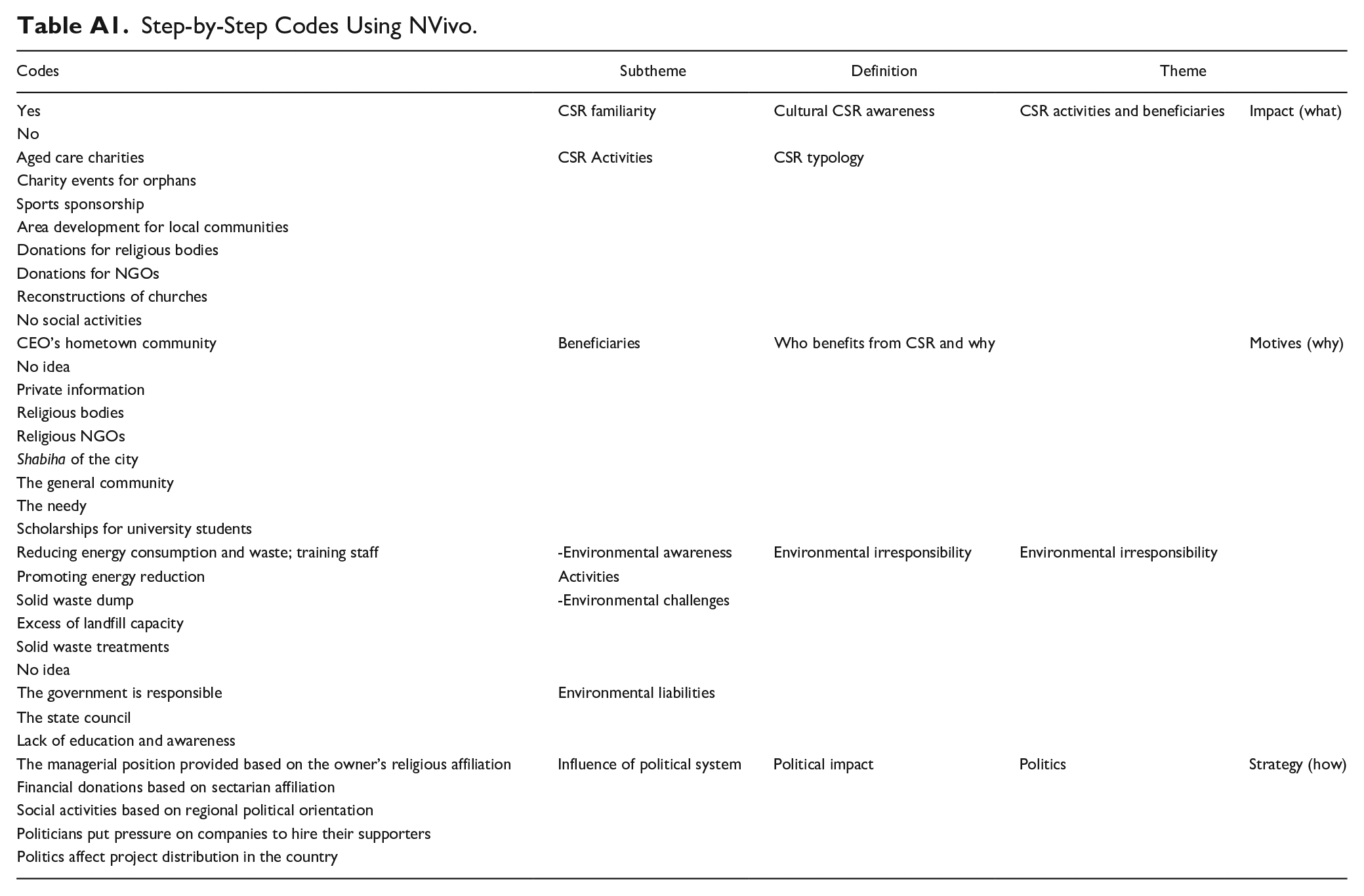
The interview questions were developed to learn about Delta’s corporate social responsibility activities, political involvement and environmental practices, as well as the participants’ understanding and evaluation of them. Given our focus on issues related to the garbage mountain, the questions particularly focused on Wasteco’s operations, the challenges of being involved in PPPs, the provision of environmental services on behalf of the public sector, and the relationship between the state and Delta. Following Bryman and Bell (2011), data were coded shortly after transcription using NVivo data analysis software. First-order codes consisted of descriptive and process codes and were grouped and categorized into subthemes. Table A1 in Appendix includes an example of the coding process. As described in the table, first-order codes were recorded for frequency. These included CSR activities and beneficiaries, environmental responsibility and the political impact on CSR. In the next step, we looked for relations between first coded subthemes and annotated and grouped them into broader themes (Gioia et al., 2013) for further analysis. This allowed for a thorough and systematic identification of the themes present across the different interviews (Guest et al., 2011).
Interview data were supplemented by desk analysis of relevant documentary sources concerning the Lebanese political system and history. This included academic articles, political commentary, news reports, and public speeches. The sources used were identified using a Google search of relevant keywords and local researchers’ studies. These secondary sources were important because the information they provided was not directly available from the interview participants. This provided the broader context within which the Delta corporation operated. We followed Ruckdeschel’s (1985) established assessment that “in addition to the normal use of observation and interviewing, qualitative researchers should make use of secondary sources, other studies, informants’ perceptions, natural experiments, and so on” (p. 20). Relevant to our study, a particular focus was on historical data and analysis concerning the development of public services following the end of Lebanon’s civil war in 1990. We focused especially on understanding the development of solid waste management practices, as it was relevant to our study.
The Limitations of CSR and the Provision of Public Services
Before we look specifically at social responsibility and waste management, it is important to contextualize the political developments that led to the PPP and how this relates to the environmental disaster of the garbage mountain. Following the long civil war (1975–1990), the reconstruction plan for infrastructure rehabilitation and the restoration of state institutions through the national Council for Development and Reconstruction (CDR) was burdened by significant debt. The state turned to the private sector for public services provision. As a result, many public services were privatized, including rural municipal solid waste management services (SWM). Scherer and Palazzo (2007) define PCSR as a condition where corporations assume a political role when the government is unable or unwilling to provide public services. This was indeed the case in postwar Lebanon, where the state was unable to provide public services, resulting in the privatization of much of the public sector as well as the creation of PPPs (Kostanian, 2021).
The state pursued partnerships with private corporations through competitive bids for public projects. At the same time, other services became part of the sectarian allocation system, in which recruitment and staffing were assessed on sectarian-based criteria (Salloukh, 2019). The move to nonstate providers was accompanied by a significant reduction in the size and power of the public sector. This occurred through deregulation, minimal state intervention, privatization, and heavy reliance on nonstate actors, including sectarian parties, religious charities, and NGOs (Cammett & Şaşmaz, 2017). With the growing economic power of corporations came increased social and economic inequality. For example, the top 10% of income earners can afford substitutes for limited public services, including health, education and electricity (Baumann, 2019), and access to electrical power is calculated based on political power and authority, sectarian preferences, and the social elite’s dominance in a given area (Salloukh, 2019). Minimal access to public services means citizens must depend on politicians (zu’ama) to access essential services such as jobs, education and health (Baumann, 2019). This reliance serves to reinforce established power relations. Political and sectarian leaders remain the brokers for access to basic services, reinforcing the hegemonic position of the zu’ama in society.
The garbage mountain presented in our study resulted from the state’s inability to provide adequate social services independently or through PPPs. The firm Delta was contracted by the council union of the Tripoli District in 2000. At that time, the state established two PPP agreements with the private corporation Delta, resulting in the creation of two subsidiaries: Wasteco and Enginco. Wasteco was responsible for collecting, managing, and treating solid waste. Enginco operated and maintained the pre-existing landfill (previously operated by Tripoli state council). The waste collection and operation partnerships were awarded for five years and set a limit for the elevation of the Tripoli dam by up to 25 meters. The contractual partnership with Enginco was for managing the dumpsite, treating the flaring biogas and controlling leachate following environmental standards. At the national level, the PPP legal framework for municipal solid waste management in the North Governorate, particularly Tripoli, is under the direct responsibility of the CDR and, to a smaller degree, the Ministry of Municipal and Rural Affairs and the Ministry of Environment. The role of the town council union was restricted to overseeing the work of the contracted firm for the SWM services of collecting and operating the landfill. In terms of monitoring the operation of the private contractor, the CDR’s duty was to assign an independent consulting firm responsible for providing technical assistance to the government through supervising the contractor’s activities, including compost facilities and landfills (Massoud & El-Fadel, 2002). The town council union was responsible for paying the private contractor, Wasteco, either from money raised by direct charges to users or general revenue and taxes paid by the community through the Ministry of Finance.
While the PPP was directly involved in the provision of social services funded by and through the state when asked about what they thought about the corporation’s social responsibilities, the Delta employees we interviewed consistently interpreted CSR as being limited exclusively to acts of corporate philanthropy. In contrast, the Wasteco interview participants appeared to have little or no understanding of social responsibility nor any knowledge of the firm’s social contributions, implying that any social contributions made by Delta were provided to particular beneficiaries rather than society at large. This was different when it came to the corporation’s core purpose. Delta’s employees indicated that the corporate philosophy was to protect the environment. Wasteco in particular was considered by many as a “good” corporation whose environmental contribution was realized through the waste collection and landfill services they provided. Waste collection was presented as a social contribution initiative rather than a profit-making enterprise. As we shall see later, this was so despite many public protests designed to build awareness about the severe environmental degradation caused by the garbage mountain.
The philanthropic contributions identified by Delta’s employees included school and university scholarships and donations to religious bodies. One participant stated, “the company certainly has many social activities, such as building churches” (Treasury department, Delta HQ), and another confirmed “the company provides many financial assistances to the Church of St. John, and it finances the charitable works provided by the church” (Operation Engineer, Enginco). Other philanthropic activities included Christmas charity events at named NGOs or financial donations for classified beneficiaries. The identities of their beneficiaries were kept private. As one senior manager explained, disclosure of sectarian alliances would not be considered appropriate: We cannot know who the beneficiaries are. The CEO is involved with many NGOs. [XY] is an organization for Christians. It is specialised in helping Christian Maronites to find jobs. (HR Department, Delta HQ; details in square brackets have been changed for anonymity)
Any understanding of socially responsible corporate activities at Delta and its subsidiaries was anchored in the context of philanthropic actions. None of the participants from Delta, including senior-level managers, referred to examples that included social activities or public service programs. Thus, activities including education, human rights, and civil rights did not appear to be understood or practiced in the Lebanese context, and certainly not in Delta.
There was an evident lack of transparency in disclosing information related to the firm’s social activities, including no discussion of identifying beneficiaries. One participant explicitly stated that financial donations and contributions were made confidentially through the CEO’s office or as per the CEO’s direction: I don’t know. I have only limited information and knowledge about these things. As for the number of payments and how often they pay, I have no access to this data. They usually deal directly with the CEO. (HR Department, Delta HQ)
In contrast, three interviewed participants at the solid waste management (Wasteco) believed this corporation made no social contributions whatsoever despite these employees having been with the company for 17 years and in senior positions. One participant explained that Wasteco’s employees suffered from poverty and deprivation, working long hours for around 675,000 LBP (approximately US$400 per month), this being the minimum wage in Lebanon (Xinhua, 2021). These participants believed that the company did not provide financial assistance or social benefits to its employees, let alone consider contributing to the rest of society: There are no contributions; the company here has about 500 employees [administration, observers and labourers], and the labour force earns the minimum wage of about 675,000 Lebanese pounds. However, there is still no company assistance or financial aid for workers. (Operations Controller, Wasteco)
The participants referred to how the terrible economic situation in Tripoli had led employees to work long shifts for relatively low pay. They added that Wasteco made no social contributions; instead, favors or other benefits were provided to particular individuals in return for other services. It thus appeared that the corporation did not make any kind of contribution to society, and if they did, it was of benefit only to a small number of individuals hand-selected by the CEO. One respondent even suggested that these beneficiaries include Shabiha (roughly translated as “thugs,” BBC (2012)), who use violence and the threats of force to serve a powerful person to extort and terrorize people. They benefit from specific amounts of money as a “gift,” said one Operations Manager at Wasteco: The corporation does not have any kind of contribution to society. If it exists, they are few and benefit particular people only, like Shabiha (the term Shabiha is possibly derived from the Arabic word for ghost [shabh], and it has come to mean “thugs” [BBC, 2012]. It also describes local individuals who use violence and the threat of force to serve a powerful person to extort and terrorise people). (Operations Manager, Wasteco)
Tripoli’s socioeconomic conditions and the lack of support from their employer compelled many of Wasteco’s employees to donate a small amount of their monthly low salary to a fund for co-workers in critical situations. This was a personal initiative among employees, as stressed by the participants. Management neither interfered nor contributed: The branch manager [of Wasteco] has invented the idea that each employee puts an amount of money from his salary every month as a collected donation, and then this amount will be given to those who need it most or to someone who has a specific condition, such as a pregnancy or for critical illnesses. (Operations manager, Wasteco)
The socioeconomic factors of the North Governorate play a critical role in the solid waste industry. Tripoli’s economy is also characterized by weak public infrastructure, low production, demand for labor, and poor governance (Kawar & Tzannatos, 2012). Also, the North Governorate is considered the most deprived part of the country, with high poverty, unemployment, and illiteracy rates. Tripoli city is marginalized and has always been ignored by the Lebanese Government (Volk, 2009). Interviewed participants expressed a lack of awareness of campaigns and activities to improve solid waste management for them or the general community. The state and town council also failed to educate citizens on appropriate waste handling, sorting and storing their bins in shops, households and other institutions before disposing of the waste at the communal storage points. Such practices are coupled with severe challenges and barriers to raising social awareness of solid waste activities, including cultural practices, socioeconomic conditions and weak legal and regulatory frameworks. Despite this, our investigation revealed that it was part of the PPP’s terms to raise the social and environmental awareness of the general community in the city, including a school campaign to educate children about the importance of the environment.
Avoiding Social Responsibility
Above, we saw how Delta’s social responsibilities were viewed and portrayed in a strictly limited way. Delta avoided communication about its social activities, and employees’ awareness of actions to address social responsibility was limited to philanthropic donations. On that basis, we now proceed to explore how Delta’s activities around the garbage mountain are related to what we call PCSiR, using the case to flesh out the contours of its meaning. Central to this investigation is to tease out the conditions that not only led to the creation of the mountain but also those that enabled it to remain unaddressed as a potent symbol of corporate irresponsibility. In other words, how did they get away with it? We draw on a description of the community complaints, investigative media reports and an activist, all of which indicated the seriousness of the environmental crisis and the lack of corporate responsibility. With this, we will show how the vast irresponsibility symbolized by the garbage mountain was enabled through a combination of the dual hegemonic strategies of direct power through coercion and indirect power through consent (Bates, 1975). This shows how hegemony can protect irresponsibility through an integration of social consensus to a “common sense” that protects the interests of the elite, working in tandem with an “armor of coercion that constrains dissenting voices” (Marston & Perreault, 2017, p. 258).
Consenting to the Garbage Mountain
Hegemony was actively maintained by Delta through political power and relationships with others who exercised direct influence over the town council members. As we shall see, this power achieved (albeit not fully) consent to the idea that Delta was not responsible for creating the garbage mountain. Moreover, following Gramsci (1971), this consent was not achieved through force but imposed through social life itself. This power manifested not so much in coercion of individuals but in the manipulation of the regulatory system that removed the ability of the state to directly intervene to address the social irresponsibility that was taking place. Self-regulation not only moved responsibility from public to private hands, but also allowed the private actors (Delta) to abscond from that responsibility. Again, following Gramsci (1971), this enabled injustice to be normalized, and attempts to investigate and supervise Enginco and Wasteco operations and socially responsible activities were diminished. Thus, the irresponsible behavior of the corporation was protected, and any opposing local town council members were silenced.
Contracts for public services were directly awarded for Wasteco and Enginco for 5 consecutive years through bidding performed by the Council of Development and Reconstruction (CDR)—the entity, together with the Tripoli District state council union, responsible for managing international funds and donations for various initiatives, including physical infrastructure and social services. Initially, a site (later to become the garbage mountain) was chosen by the state council union as a temporary solution for solid waste dumping. The environmental expert we interviewed said that “the dumpsite was supposed to be an interim solution until an alternative permanent solution was provided; however, 20 years later, the dumpsite is still in use” (Environmental Expert, August 2018).
The environmental expert explained the Lebanese government’s legal framework for managing the solid waste industry and the relationship between the different entities, including their responsibilities and the ways corporations were paid. The participant said, As per Lebanese law, the primary responsibility of the town council is to collect solid waste, while the state’s responsibility is to treat this waste. However, due to the council’s inefficiency, poor performance, lack of employment and inadequate administrative skills and materials, the council had to seek private sector expertise and engage in private-public partnerships. However, the city is in deficit with the Ministry of Finance, [so] the Council of Development and Reconstruction intervened and established a contract with the private sector, Wasteco. CDR agreed to pay on behalf of the Town Council and deduct it from their part of the governmental allocation. So, the relationship between CDR and Wasteco became direct. (Environmental Expert, August 2018)
The CDR renewed solid waste collection and landfill management contracts in 2004 and 2010. According to Tadmouri and Sief (2019), the waste generated reached 146,270,639 kg in 2014, and the garbage mountain became a serious environmental and health risk to 800,000 local residents. In 2018, the dump site’s elevated garbage reached over 40 m high across a 60,000 m2 area along the coastline and to the north (Hamza, 2018). Approximately 450 tons of rubbish were dumped daily, resulting in over 2 million tons of total landfill. Despite significant environmental violations, the garbage mountain remains active, and its cement support walls are now fractured and at risk of collapsing, threatening the lives of residents and the surrounding marine ecosystem (Hamza, 2018). That this mountain remains in place effectively demonstrates a result in a form of “active consent” (Gramsci, 1971, p. 244), whereby the existence of the mountain was neither contested nor rectified. Dissent dissipated through the exercise of hegemonic power.
Delta’s first response to accusations about the garbage mountain environmental disaster involved its representatives giving press interviews, during which they discussed the current conditions of the dump and highlighted their concerns for the community’s health and safety. However, in practice, they took no responsibility for the situation. Furthermore, Delta accused the local Lebanese state and town council of not supplying an alternative location for dumping. Our findings revealed that none of the entities involved claimed any liability for the disastrous state of the garbage mountain. Most respondents sought to blame the PPP for damaging the environment and that the board of town council was responsible for the current status of the dumpsite where two participants stated, “the state is the entity responsible, represented by the Minister of Environment and the local politicians” (IT Senior Technician, Delta HQ). This saw a manipulation of meanings that again resulted in a de facto consent that Delta was not responsible for the mountain. Delta’s approach was to take an educative role in bringing the public to the conclusion that they were not responsible. Gramsci (1971, p. 502) asks, “how will educative pressure be applied to single individuals to obtain their consent and their collaboration, turning necessity and coercion into “freedom”? Delta’s answer was to manipulate popular opinion through the press while redefining its regulatory position and defending its innocence.
One respondent added that the Lebanese government should be responsible for finding an alternative location for dumping solid waste, again shifting the blame away from Delta. This person said no alternative strategy regarding solid waste treatment had been proposed. Rather than building a landfill and adopting the same approach of operation that had been implemented since 2000, “it is the state that bears the primary responsibility, and it is the state’s duty to find another place for dumping” (Operations Manager, Delta HQ).
Interestingly, the environmental expert interviewed in our study, who acts as a referee to the Ministry of Environment, commented on the new sanitary landfill proposition as an interim solution, saying: The company has proposed the new sanitary landfill as a solution for the old landfill—they want to bury all the solid waste together. As a matter of fact, they do not want to recycle because if they decide to recycle, another industry will emerge, and then they would lose a part of this “cheese,” and they want to have it all.
The SWM industry is among the most profitable in the country. Thus, constructing a sorting and recycling plant would mean the corporation would potentially lose its whole contract.
In contrast, the town council members indicated that Delta, the CDR and the community’s lack of social and environmental awareness were together liable for the current condition of the garbage mountain and its consequences, saying: The state also bears a large part of the responsibility because it does not conduct public awareness campaigns about the dangers of dumping. There is also a responsibility for the companies imposed by the state. There is rampant corruption in the state, and the influential people [politicians] take massive profits from these companies and thus turn their faces away from monitoring the implementation of the terms of the contract strictly. (Town Council Member, 2018)
Meanwhile, social activists claimed that the political system, the lack of governance and corruption were key factors in the environmental disaster. These claims were broadcast on local and international television channels and newspapers. The social activist participants in this study held the stakeholders involved responsible and accused the corporation, town council members and local politicians of corruption, lobbying and theft: The corporation charges USD 900,000 a month and receives supplies and equipment from the town council in exchange for cleaning the city’s roads, and it is also responsible for the workers. However, this corporation does not perform its duties as necessary, and we were unable to obtain its book of conditions, and the amount the corporation is charging is very high for the work provided. Also, it bribes the union of town councils and offers services to those with political influence. (Social Activist, October 2018)
Despite these criticisms, Delta again ensured it was not considered responsible for the problem. The design of Lebanon’s political system produces a low-trust system that places more importance on ethnic representation than governance (Deets, 2018). This design affords operation and performance flexibility to all corporations, with minimal effective state governance. If they do exist, supervision and governance requirements can easily be altered and customized to serve corporations’ best interests. Through its relationships and involvement in the political sphere, Delta facilitated financial services and protected its PPP contract. Thus, the corporation was increasingly self-regulating while operating under the shadow of the public sector—an approach to regulation that has been identified as central to the practice of PCSR (Frynas & Stephens, 2015) and shows here to also enable PCSiR by shielding corporations from public scrutiny and control, and again ensuring active consent for their irresponsible behavior. Effectively removing the threat of opposition enforced through regulation, Delta could hide itself from scrutiny, removing potential dissent and paving the way to social acceptability. As Gramsci (1971, p. 145) comments, consent is “caused by the prestige (and consequent confidence) which the dominant group enjoys because of its position and function in the world.” In our case, Delta’s confidence grew as it worked to build a social conviction that it was not responsible for the garbage.
The waste management sector is failing in Lebanon because of the absence of a clear SWM legal framework, weak law enforcement, and political corruption. Moreover, the growth in population resulting from the influx of Syrian refugees has meant a need for greater levels of waste management services (United Nations Development Program [UNDP], 2016). In 2017, Tripoli’s “population grew by 17% (Ismail et al., 2017). The existing legal and institutional frameworks provided no transparent allocation of the different stakeholders” roles and responsibilities (German Federal Ministry for Economic Cooperation and Development, 2014). Our study highlights the near absence of governance and accountability for private contractors despite its knowledge of environmental harm, which encouraged Delta and its subsidiaries to engage in a self-governance strategy alongside other strategies to discipline those who challenged their authority or threatened their economic activities. It is in its self-governing capacity that Delta was able to achieve the hegemonic power to perpetuate its irresponsible behavior. The environmental expert confirmed that the main parties involved were directly responsible for the current situation. Lebanon’s highly political and institutional setting could not provide transparent supervision or governance over the operation of the private contractor. In addition, the inefficiency and lack of skills in all governmental bodies are other factors that enable the corporation to engage in self-regulatory practices. These elements altogether provided the foundations to justify and normalize Delta’s irresponsible social and environmental behavior and that of its subsidiary, Wasteco. While corruption is apparent in this case, it is one denominator of a larger image reflecting hegemonic domination that stood in the way of justice for social crime toward the vulnerable community.
Resisting the Garbage Mountain
Delta’s PPP was implemented more than 20 years prior to our study. It first started through a privatization framework to secure public services from dominant business entrepreneurs. Protecting these partnerships and ensuring their longevity led the corporation to adopt two different practices illustrated in (Figure 2) that benefited from the country’s political environment and sectarian division.
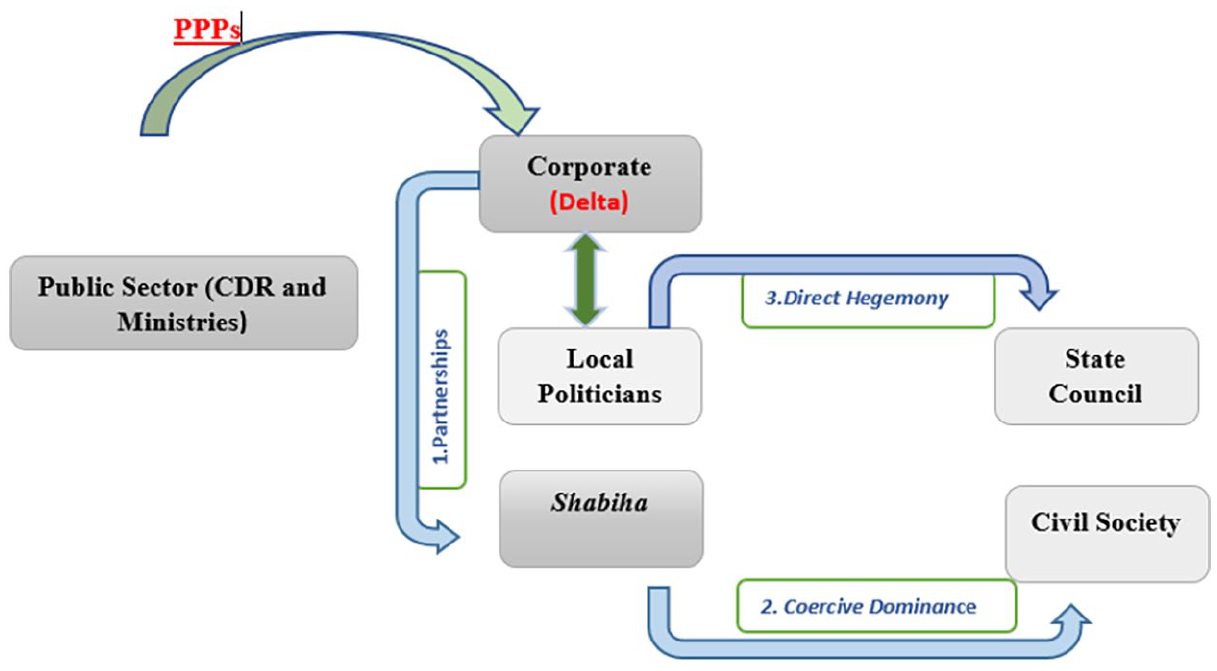
Hegemonic Dynamism of Corporate Operations and Socially Responsible Activities.
In response to the local residents’ movement against the garbage mountain, which directly affected their livelihood, Delta started to build alliances and strengthen its ties with local politicians and influential people. Delta made concessions in the form of philanthropic donations to appease local politicians and their supporters so they could leave the exploitative business model intact. One interview participant said, I am aware that politicians have demanded favours from the corporation (in the form of employment opportunities), and there are rumours that the president of the municipal union received a monthly stipend from Wasteco. (Town Council Member, August 2018)
First, Delta used its alliances with local politicians to silence members of the town council who were considered under the influence of these politicians based on political and sectarian affiliations. One of the interviewed participants (of the Municipality) commented: “Social activists have protested twice in front of the council building but, in both protests, they were physically beaten by the local politicians’ shabiha (In reference to the same people engaged with the corporate or at the payroll” to put an end to the protest, and then no one would dare to say anything.”
Another interviewed participant, Wasteco’s employee, provided an example for further explanation around the contract renewal of SWM with the municipality, which required the owners of Delta to reinforce their relationship with local politicians and members of the state council to guarantee they would work in the corporation’s best interests: “When the owner of this company wants to renew their contract/project with the state council, they start sending their representatives to the politicians of this city and the state council members to meet them with offers that start with coffee, dinner invitations, certain agreement so the corporate can guarantee that their contract will be renewed infinitely.” (Senior Operator, Wasteco)
Furthermore, they imposed pressure on town council members with opposing opinions in a way that guaranteed their silence against the corporate operations. Town council members were legally required to oversee the corporation’s operations and vote for a contract extension. Thus, through its political power and relationships, Delta successfully diminished any attempt to investigate or supervise its operations and silenced opposing local town council members through either politico-sectarian affiliations or political pressure. One of the study participants said, We in the Council of Tripoli are divided into two parties. A party that supports the mayor [of the muhafazah], which is mainly controlled by certain political parties, and another party of opposition that is always trying to fight any project that hurts the city. (Town Council Member, August 2018)
Second, these alliances came with the cost of allegedly providing jobs for the politicians’ supporters (Shabiha) and listing them on the corporate payroll. Through this practice, the individuals concerned remained financially dependent on patronage resources controlled by politicians. Thus, loyalty was bound to their capability to “put bread on the table.”
The politicians maintained the prevailing hegemony over the local community because they needed to retain control over the distribution of resources in the town and maintain a good relationship with the corporate owners for future benefits. Clearly at play here was a hegemonic strategy to both build consent and silence dissent. What was happening was that the ruling elite managed to maintain social control through cultural consent, with corporate owners using their social status to employ people in positions of political power through a strategic partnership. The result was a successful defense strategy for their general and corporate interests. In turn, politicians worked to indoctrinate their constituents to establish their consent through rational consciousness. In line with Achar, hegemony was achieved here through: passive consent obtained from a varying proportion of the population, thanks in large part to measures of social welfare and conveniently-timed increases in wages or social subsidies, as well as different forms of corruption/bribery—from the individual, by way of cronyism and clientelism, to the collective, by granting privileges to specific social groups needed by the regime’ and repressive force intimidation. (Achcar, 2021, p. 64)
A similar hegemonic dynamic mechanism is adopted in employing Shabihas, who were unaware that their consent was anything but spontaneous. In practice, however, their consent was garnered by providing them with a means to escape Tripoli’s dire economic situation and provide for their families, even if it required them to engage in violence. In a country of class disparities and social elitism, such as Lebanon, approaching political partnership is a good strategy to disguise corporate practices, promote corporate image, and ultimately maintain the reproduction of power through clientelism and corruption.
While practices were in place to silence dissent and create consent, the resulting hegemony was not total. Moreover, as Gramsci (1971) portended, when hegemonic consent fails, social elites exercise coercive control to maintain the status quo in their favor. This can be seen when social protests arose in Tripoli in 2017 and 2018 in reaction to the government’s failure to address the worsening garbage crisis following the closure of landfills near the coast. The untreated methane and carbon dioxide gas caused a choking smell in the town and surrounding areas. The activists were members of civil society operating as unorganized groups of low- middle-class residents and intellectuals. These people were outside the civil society over which Delta exercised hegemonic control. They were “not so directly linked to the economic structure of their particular society and, in fact, conceive of themselves as having no basis in any social class and adhering to no particular class discourse or political discourse” (Saba, 1982, p. 10).
Social activists highlighted the health consequences and protested the location and catastrophic environmental crisis of what they called the “Mountain of Death.” Furthermore, they demanded that the corporation cease dumping and apply all clauses of the PPPs, including social responsibility and community awareness. They accused the CDR, Delta, Wasteco, and the state council of corruption and stated that the service for collecting and treating waste combined the world’s highest cost for the world’s worst service. The collection cost to the town council in Tripoli is US$3,246,587 per year (estimated as US$31 per ton), in addition to the dumping cost of US$24.46 per ton. This is a relatively high cost for a poor-quality service. Social activist participants also accused Wasteco of failing to apply the conditions in its PPP contract, which led to emissions of carcinogens, unpleasant odors and contamination of water, air and soil (Social Activist interview, 2018).
Social protests examined in this study were led by the affected residents of the town and social and environmental activists who were threatened by the environmental breaches.
Social activists publicly, through the media, criticized the total absence of governance, accountability and oversight from Tripoli’s former and current consultants, politicians and members of the town council (Hamza, 2018). For a time, it seemed like the hegemony would fracture. In an interview with a social activist regarding the role of the government in the supervision and governance of Delta operations, the activist stated, There is no supervision or even constructive planning because the Council of Development and Reconstruction is carrying out suspicious deals at the expense of the city and its people, and so are not interested in the quality of work and its delivery. (Social Activist, 2018)
Another social activist interviewed confirmed that only 300 to 350 workers are required to maintain the city’s cleanliness. Wasteco has more than 650 workers employed as administrators, operators and laborers; however, the streets are piled with waste and rotten smells, and a mountain of solid garbage is located within hundreds of meters of the city. Tripoli is still a dirty, neglected and almost uninhabitable city.
In alignment with Gramsci’s (1971) theoretical framework, what we saw in the protests is how the dominant social class reinforced their power through the coercive apparatus to discipline those who failed to abide by consensual hegemonic control. To maintain its irresponsible behavior, coercive power was enforced in anticipation of crisis as a disciplinary action when consensual hegemony fails. This also involved the application of social stigma to those who resisted labeling them as servants of other foreign agendas or foreign embassies.
Delta’s response to these social movements was violent. Their middlemen (Shabiha), listed as employees on Wasteco’s payroll and operating with the protection of local politicians, engaged in physical violence with protestors and forcibly dissolved social protests against the corporation’s operations and behavior. Direct intervention in the creation of a hegemonic setup had proved necessary. Delta protected its hegemony through direct repression without being held accountable in any form. This exemplifies how hegemony is armored with coercion (Thomas, 2009).
Following Gramsci, citizens contribute to the creation of any hegemonic setup through either resistance or accommodation [. . .] In the latter scenario, they become, in their own right, producers of the hegemonic ideology, both in political society strictly defined (the state apparatuses, which include, in this context, parliamentary representatives) and in civil society. If, however, some groups decide not to comply, they are compelled to do so through coercion. This resource enables the rulers to force them to comply or turn the non-compliant groups into negative examples in the hegemonic narrative. (Zucchetti, 2021, p. 353).
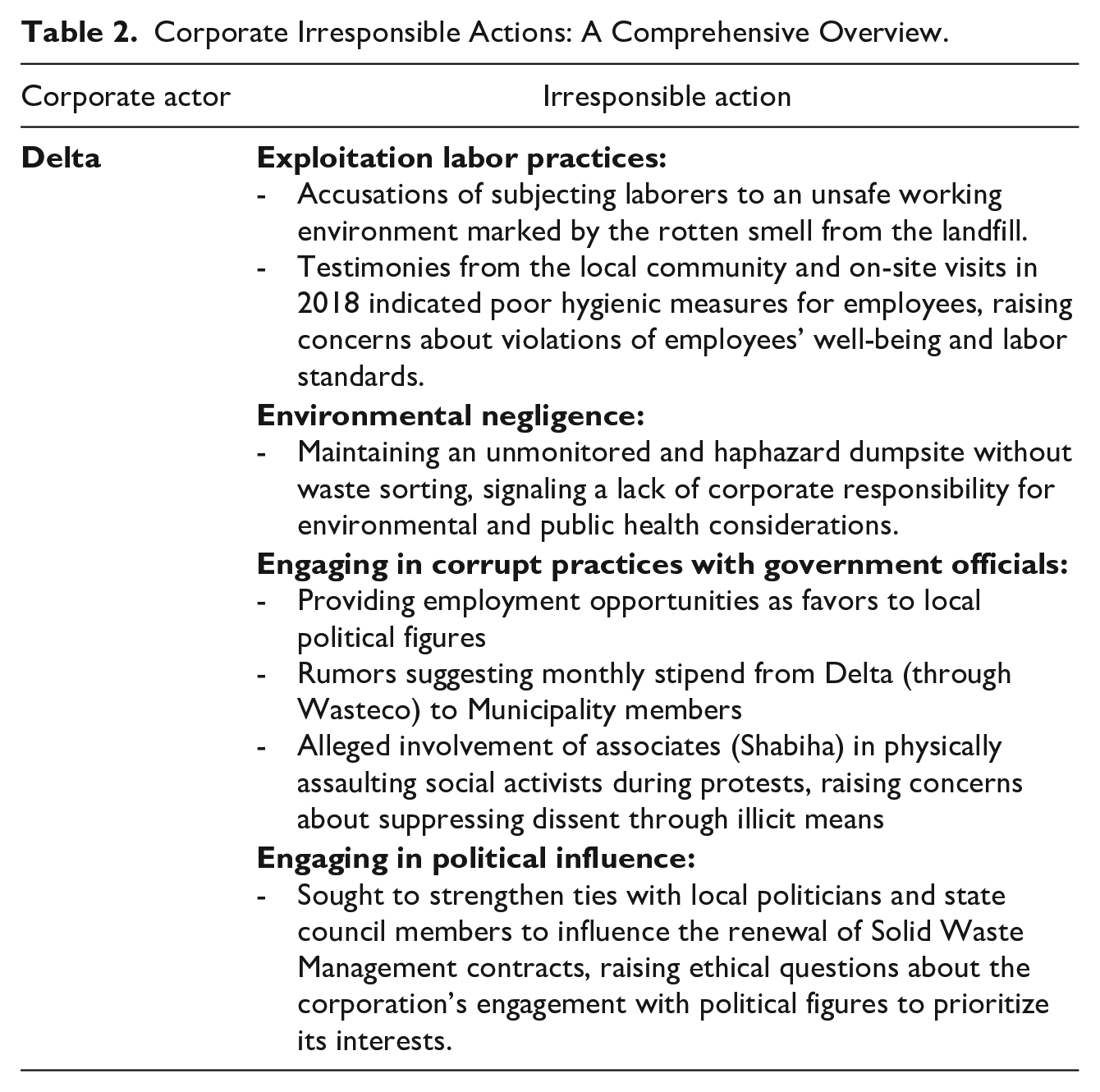
The corporate response involved mobilizing a host of agents (such as bureaucrats and NGOs) to maintain their ideological and practical supremacy. It is worth noting here that “counter-hegemonic efforts to curb corporate global rule [can result in] corporate counter efforts to silence, evade, oppose, and co-opt such unwarranted political pressures” (Shamir, 2004, p. 670). This is precisely what happened to the Tripoli protests, illustrating a key dimension of the operation of PCSiR. Delta responded to being held accountable for social responsibility by assuming a hegemonic position with the coercive domination enforced by their Shabiha, who physically abused social activists, leading to injuries and hospital admissions. As a result, the garbage mountain continued in a “business as usual” fashion, with vulnerable local community stakeholders having been systematically silenced. The corporate response to the protests enabled the perpetuation of its social and environmental irresponsible behavior under a political coverage that guaranteed the corporation’s continuity. (See Table 2 for a summary of corporate irresponsible actions.)
Corporate Irresponsible Actions: A Comprehensive Overview.
Discussion and Conclusion
This article has drawn on an empirical study of the environmental disaster of Tripoli’s garbage mountain, asking the question: how and to what extent has the power and influence of political and economic actors in Lebanon hindered environmental protection efforts and sustainable business practices. In response to this question, the article develops the idea of political, corporate, and social irresponsibility. Through PCSiR, we see in the case of the garbage mountain that the moralization of the corporation that is part of its hegemonic practice does more than create social legitimacy. It also opens the door for irresponsible corporate behavior to occur under the veil of consent and the threat of coercion (even when that irresponsibility is blatantly obvious). As we saw, hegemony, in relation to corporate irresponsibility, is exercised through a direct as well as consensual exercise of power for self-interest. This shows how corporations’ irresponsible provision of public goods and services can “get away with it” and retain their dominant and legitimized social and economic position. This is so even when they engage in irresponsible behavior clearly observable in practices such as nepotism, corruption, and misconduct (Ashforth et al., 2008; Griffin & Lopez, 2005; Kourula & Delalieux, 2016; Vaughan, 1999).
PCSiR highlights irresponsible corporate behavior where corporations are rightfully accused of environmental damage and violating social responsibility standards, potentially putting lives at risk. As we have explored, PCSiR involves compliance and protection of the state through different hegemonic strategies. Our study has shown how corporations’ involvement in the civil and political spheres as a subterfuge to obfuscate their irresponsible behavior while retaining their social legitimacy. This serves to maintain the system of hegemonic consent that allows them to retain their position as part of Lebanon’s ruling class. Based on this study, we can isolate five necessary conditions for the hegemonic adoption of PCSiR:
The corporation deliberately commits socially irresponsible acts and explicitly understands their harmful consequences for its stakeholders.
The corporation takes no action to rectify the consequences of their irresponsibility.
The corporation works through civil society to create a false consensus that they are, in fact, not responsible for the true effects of their actions.
The corporation builds political alliances to shield it from regulatory and legal interference in its irresponsible acts, commonly through the replacement of state regulation with self-regulation.
Where the hegemony fractures and outward dissent is voiced from civil society, a combination of direct violence and social stigmatization is used to quash the dissent.
It has been argued that “PCSR is a self-interested practice where business firms pursue a false political consensus and advance an elitist agenda that can only exacerbate global inequality” (Rhodes & Fleming, 2020). Our study paints a darker picture, where both consent and coercion can ensure an elitist agenda is still advanced despite the most obvious and evident violations of corporate social responsibility. In our case, this was so obvious that it could be seen and smelt from miles away. Despite this blatant travesty, corporate hegemony was maintained so effectively that nothing actually changed, and no one was held responsible.
Having discussed and analyzed the case of Tripoli’s garbage mountain, the contribution of our article has been to explore the practice of PCSiR in a cultural context where the provision of essential public services helps create a circle of patronage and advances social elitism. Using a neo-Gramscian approach, we have considered how hegemony was achieved through the dominations of citizens, opposing public institution representatives and social activists. Moreover, we have used this discussion to distill the necessary conditions for the companies to achieve hegemonic power to be able to shield their irresponsibility from both scrutiny and reform.
Our article is a first step in developing the concept of PCSiR, understanding how it operates, and how it can continue without leading to political or organizational change. This is not the “passive” revolution of PCSR (Levy et al., 2016), where “a hegemonic system adapts and evolves as it absorbs challenges and preserves essential features” (p. 3). It is more what we might call a “passive counter-revolution” where hegemony is maintained by shielding those in power from responsibility for the outcomes of, as well as others’ awareness of, their irresponsible behavior. In this case, the result of PCSR and PCSiR is the same: maintenance of the hegemonic system and a failure to address the inequalities and injustices that characterize it. With PCSiR, corporations are enmeshed in a system of hegemony where they can actively dismiss social responsibility for the authority ceded to them by the state to provide public services.
In the case of Tripoli’s garbage mountain, a cocktail of manufactured consent and coercive hegemony was practiced over civil society to secure a corporation’s financial and political interests at the expense of the residents of Tripoli. The political events surrounding the largely unsuccessful protests against the garbage mountain demonstrate how the corporations involved managed to relieve themselves of having to engage in any social responsibility. Through a multifaceted exercise of hegemonic power, they got away with behaving irresponsibly and creating the garbage mountain. The failure of the Lebanese state to fulfill public services created an environment of corporate political and social hegemony that justify any harm from social and environmental violations, breaches of human rights, safety and health standards to death. Such is the operation of political corporate social irresponsibility.
Footnotes
Appendix
Step-by-Step Codes Using NVivo.
| Codes | Subtheme | Definition | Theme | |
|---|---|---|---|---|
| Yes | CSR familiarity | Cultural CSR awareness | CSR activities and beneficiaries | Impact (what) |
| No | ||||
| Aged care charities | CSR Activities | CSR typology | ||
| Charity events for orphans | ||||
| Sports sponsorship | ||||
| Area development for local communities | ||||
| Donations for religious bodies | ||||
| Donations for NGOs | ||||
| Reconstructions of churches | ||||
| No social activities | ||||
| CEO’s hometown community | Beneficiaries | Who benefits from CSR and why | Motives (why) | |
| No idea | ||||
| Private information | ||||
| Religious bodies | ||||
| Religious NGOs | ||||
| Shabiha of the city | ||||
| The general community | ||||
| The needy | ||||
| Scholarships for university students | ||||
| Reducing energy consumption and waste; training staff | -Environmental awareness | Environmental irresponsibility | Environmental irresponsibility | |
| Promoting energy reduction | Activities | |||
| Solid waste dump | -Environmental challenges | |||
| Excess of landfill capacity | ||||
| Solid waste treatments | ||||
| No idea | ||||
| The government is responsible | Environmental liabilities | |||
| The state council | ||||
| Lack of education and awareness | ||||
| The managerial position provided based on the owner’s religious affiliation | Influence of political system | Political impact | Politics | Strategy (how) |
| Financial donations based on sectarian affiliation | ||||
| Social activities based on regional political orientation | ||||
| Politicians put pressure on companies to hire their supporters | ||||
| Politics affect project distribution in the country | ||||
Acknowledgements
We are grateful for the developmental and constructive feedback provided by the three anonymous reviewers, as well as Bobby Banerjee’s patience and support throughout the review process.
Declaration of Conflicting Interests
The authors declared no potential conflicts of interest with respect to the research, authorship, and/or publication of this article.
Funding
The authors received no financial support for the research, authorship, and/or publication of this article.
