




Abstract
This article develops the argument that the interplay between emotions and cognitive biases influences corporate decision-making on climate change adaptation. Our theoretical analysis examines how emotions can change the effect of cognitive biases on adaptation decisions by influencing how firms select, access, and process complex and uncertain climatic information. We draw on research on climate adaptation, social psychology, and managerial cognition and focus on three forms of bias: availability heuristic, framing, and anchoring. We explain how each bias shapes the decision-making process on adaptation and theorize how emotions of different valence and arousal affect this process. We shed light on the underlying mechanisms that explain how emotions influence the effect of cognitive biases as a source of inaction on adaptation in firms. Our analysis provides a new perspective on how firms approach the strategic decision to adapt to climate change by considering both cognitive and emotional aspects.
The climate emergency is high on the agenda of business and government. Most attention, so far, has been paid to the need for climate change mitigation by reducing greenhouse gas (GHG) emissions to keep global warming below the 1.5°C target of the Paris Agreement. There is an increased realization, though, that physical climate impacts such as severe droughts, sea-level rise, bushfires, and floods with direct and indirect consequences for business and society, are inevitable and that climate change adaptation is a must, too. However, there is still a surprising lack of studies on firms’ strategic decision-making on climate adaptation (Berkhout, 2012; Clément & Rivera, 2017; Linnenluecke et al., 2013). Early studies are mainly conceptual, explaining how firms make sense of complex climate impacts and why they fail to take adaptation measures (Linnenluecke et al., 2012; Winn et al., 2011). A few empirical studies focus on sectors highly vulnerable to climate impacts such as ski resorts (Hoffmann et al., 2009; Rivera & Clement, 2019; Tashman & Rivera, 2016), wineries (Galbreath, 2011), and the energy sector (Bremer & Linnenluecke, 2017; Pinkse & Gasbarro, 2019). For firms in these sectors, adaptation is a strategic imperative and a case of self-preservation which gives their executives an incentive to act.
For firms in less vulnerable sectors, not (yet) subject to largescale climate impacts, the strategic decision about climate adaptation is more ambiguous because they have neither incurred economic losses from such impacts nor identified opportunities from investing in profitable adaptation solutions (World Economic Forum with PWC [WEF/PWC], 2023). Research shows that in making strategic decisions about climate adaptation, executives rely on previous experience and neglect the potential consequences of climatic events they have never experienced before (Haigh & Griffiths, 2012; Pinkse & Gasbarro, 2019). Consequently, executives in less vulnerable sectors fail to reckon with the potential economic losses of climate impacts or opportunities from offering adaptation solutions (WEF/PWC, 2023). While they get multiple indirect signals such as alarming news about extreme weather impacts on firms and communities, and reports of how other firms are affected and trying to adapt, these firms do not directly experience such climate impacts firsthand. Although aware of climate impacts, they perceive their own exposure and vulnerability as very low and either do not adapt or take a reactive approach (T. Schneider, 2014). It has been argued that executives’ dependence on previous experience when making strategic decisions about adaptation leads to a state of complacency (Wade & Griffiths, 2022).
In addition to firm-internal factors such as organizational culture, resources and capabilities and external factors like the institutional and business context (Averchenkova et al., 2016; Berkhout, 2012; Berkhout et al., 2006; Biagini & Miller, 2013; Linnenluecke et al., 2013), research is increasingly considering managerial cognition as a key factor influencing firms’ adaptation strategies (see review by Wade & Griffiths, 2022). Studies have found that firms’ strategic decisions on adaptation are determined by how executives understand climate impacts and their strategic consequences, based on their perceptions (Bleda & Shackley, 2008; Linnenluecke et al., 2015), cognitive frames (Hahn et al., 2014), and awareness (Arnell & Delaney, 2006; Hoffmann et al., 2009). Firms with comparable assets and capabilities and operating in similar contexts can thus respond differently to climate impacts when their top executives perceive the strategic importance of such impacts differently (Lei et al., 2017).
Previous research has studied the cognitive processes involved in strategic decision-making on adaptation to establish why executives remain complacent about the climate emergency (Bleda et al., 2023; Wade & Griffiths, 2022) and posited that the roots of complacency and inaction lie in executives being subjected to cognitive biases (Mazutis & Eckardt, 2017). When facing strategic problems characterized by high levels of uncertainty, executives rely on cognitive shortcuts, or heuristics, to make sense of complex and ambiguous information (Bingham & Eisenhardt, 2011; Bleda et al., 2023; Hodgkinson et al., 2023; Schildt et al., 2020; Wenzel & Stjerne, 2021). Although quickening the decision-making process, heuristics can generate bias and errors of judgment which can, for example, lead to executives underestimating the frequency, magnitude, and probability of climate impacts, lowering their perceived levels of vulnerability and exposure, thus leading to inaction. These errors and biases are more prominent in sectors less vulnerable to climate change as executives rely on information from indirect climatic signals rather than direct evidence from their own experience (Mazutis & Eckardt, 2017).
While previous research suggests that, across the board, firms in less vulnerable sectors fail to strategically act on climate adaptation, there is evidence that some have woken up to the need to do so instead (Canevari-Luzardo et al., 2020). Why have some executives decided to act strategically on adaptation while others have not, while they are all in principle subject to cognitive biases and low vulnerability perceptions? We argue that existing research might have overlooked the influence of emotions in strategic decision-making on climate adaptation. As Wade and Griffiths’ (2022) recent review suggests, although factors shaping cognition are often considered in the literature, the role of emotions is rarely included, thus presenting an omission in the understanding of strategic decision-making on climate change. To address this omission, we build on behavioral research which suggests that decision-making under uncertainty is not affect free (Healey & Hodgkinson, 2017): both cognitive factors (thinking) such as mental shortcuts and heuristics (Das & Teng, 1999; Porac & Thomas, 2001) and emotions 1 (feeling; Hodgkinson & Healey, 2011, 2014) influence how executives make strategic decisions when facing uncertain and complex information (Das & Teng, 1999; Healey & Hodgkinson, 2017; Hodgkinson & Healey, 2011). While existing studies have mainly looked at climate-induced emotions related to adaptation in everyday life (Davidson & Kecinski, 2022; Van Valkengoed & Steg, 2019), or focused on mitigation (Lu & Schuldt, 2015), in line with behavioral strategy research (Hodgkinson & Healey, 2011, 2014) we argue that individuals will be influenced by emotions, too, in their role as firm executives involved in climate adaptation.
There is now increasing evidence of the devastating impacts that climate change can have for business and society. The media has provided wide coverage of extreme weather such as hurricanes, bushfires, and floods, linking these to climate change, which has led to poignant calls for action, also directly aimed at business. 2 Receiving information on the consequences of climate events can trigger different emotions in executives. Climate change elicits emotions of different valence, both negative (e.g., anxiety or fear) and positive (e.g., hope or pride; Doherty & Clayton, 2011). Climate events, or related news or other information items, also differ in the extent they spur emotional arousal. While receiving information on the consequences of extreme weather events such as floods, storms, and bushfires may elicit highly intense emotions such as fear, noticing or receiving information on more gradual changes such as a sea-level rise can lead to moderate or less intense but more enduring emotional states such as climate anxiety or sadness (Hickman et al., 2021).
Emotions influence firms’ strategic decisions in a direct way, for instance, via emotional frames (Raffaelli et al., 2019) and the affect heuristic (Mazutis & Eckardt, 2017). They also affect how executives select and use uncertain and complex information; that is, emotions influence what information they pay attention to, how they access and process this information, and their perceptions of risks depending on how this information is presented to them (Healey & Hodgkinson, 2017). Our analysis focuses on this latter effect of emotions (i.e., how emotions elicited by complex information about climate change influence the way executives process and use this information when making strategic adaptation decisions). Since both cognitive biases and emotions shape how executives select, access, and process information on complex and uncertain climate events, we argue that their interplay will influence their decision-making process and outcome.
Our study analyses how executives’ cognitive biases (as the root of inaction) and emotions (via their effect on information selection, access, and processing) interact to influence the strategic decision to adapt in firms. From the range of cognitive biases that the corporate climate adaptation literature has identified as sources of inaction, we focus on three information-processing-related biases that have previously been argued to greatly influence climate change decisions: availability heuristic, framing, and anchoring. Drawing on research on climate adaptation, (social) psychology, and managerial cognition, we develop a conceptual framework that examines how informational biases and emotions interact and influence executives’ strategic decision-making on climate adaptation. We first explain how each cognitive bias influences executives’ decision-making and then theorize how emotions of different valence and arousal shape this process. We do not conjecture each potential combination of climate event attributes, cognitive bias, and emotional state but shed light on the underlying mechanisms that explain how discrete emotions of different intensity influence the impact of the biases on the decision-making process. Our analysis provides a new perspective on how firm executives decide how to act strategically on climate adaptation and improves our understanding of the underlying decision-making process, considering both cognitive and emotional aspects.
The Interplay of Cognition and Emotions in Strategic Decision-Making
How executives make sense of ambiguous and complex signals in their environment and the impact these signals have on strategy and decision-making has been widely examined (Kaplan, 2011; Porac & Thomas, 2001). Within strategy research, managerial cognition has analyzed how gathering and processing information from the environment influences decision-making and strategy implementation (Helfat & Peteraf, 2015). Managerial cognition plays an important role in climate-related decision-making, because climate change is a complex and uncertain issue that poses significant cognitive challenges (Bleda et al., 2023; Wade & Griffiths, 2022): it has numerous and ambiguous signals which vary in type (direct and indirect signals 3 ), scale, and impact (Berkhout et al., 2006; Bleda & Shackley, 2008; Winn et al., 2011). Before taking action, executives must make sense of the different types of climate signals which can be contradictory due to conflicting information about the magnitude, proximity, probability, severity and salience of climate events (Linnenluecke et al., 2015; Nisbet, 2009). While there is broad consensus on the scientific evidence behind climate change, in public discourse and (social) media the evidence on climate events’ occurrence and causes keeps being contested and the debate is deeply politicized and polarized (Hoffman, 2011; Hulme, 2009). Executives face the complex task of collecting and processing relevant information to get a good understanding of what climate change means for their firms, now and in the future. The availability of organizational resources and capabilities and institutional and economic contexts also play a role, but whether firms decide to take adaptive action or not will depend to a great extent on how their executives cognitively process the information they receive and collect for this purpose (Das & Teng, 1999; Linnenluecke et al., 2015; Pinkse & Gasbarro, 2019; Porac & Thomas, 2001). Given the uncertainty and complexity of climate change information, executives tend to rely on heuristics that generate cognitive biases which lead to incorrect estimations of the frequency, probability, and magnitude of climate impacts (Mazutis & Eckardt, 2017).
Organizational behavior and psychological research has traditionally adopted a “cold” cognition approach to analyze the role of heuristics and biases in decision-making (Das & Teng, 1999; Tversky & Kahneman, 1974). Similarly, the climate adaptation literature has focused on the role of beliefs, perceptions, and awareness in climate-related decisions and strategies (Bremer & Linnenluecke, 2017; Galbreath, 2011). Work within behavioral strategy, however, shows that strategic decision-making under uncertainty is not affect-free and that the biases and inertial forces that undermine firms’ strategic adaptation are also influenced by executives’ emotions (Hodgkinson & Healey, 2011, 2014). Strategy and organizational scholars have begun “to eschew “cold” conceptions of cognition in favor of “hot cognition” alternatives” (Huff et al., 2016, p. 22). Cold cognition involves situations in which emotions do not influence decisions and cognitive processes (including heuristics and biases): executives are in low-affect states, and they are thinking, processing, accessing information, and assessing risks without feeling emotions, or feeling emotions whose intensity is not high enough to influence these processes. In hot cognition, executives are in moderate or high-affect states and emotions influence their thinking, information processing, and decisions. In hot cognition, thinking (cognition) and feeling (emotion) interact in shaping strategic decision-making (Healey & Hodgkinson, 2017).
Emotions influence strategic decisions directly when executives act on emotions evoked by an event, and make decisions based on how they feel about it, and not just based on what they think or know about it (Siegrist & Sütterlin, 2014). Recent research suggests, for example, that emotional frames influence firms’ decisions to adopt non-incremental innovation: if the innovation resonates with executives’ values, beliefs, and ideas, it resonates emotionally as an opportunity which increases the likelihood of adoption (Raffaelli et al., 2019). In the climate context, emotions directly create bias in making strategic adaptation decisions via the affect heuristic (Mazutis & Eckardt, 2017). Through this heuristic, executives use emotions as a mental shortcut to quickly assess consequences and outcomes, which biases their risk perceptions and decisions. A certain feeling toward a climate event, a “faint whisper of emotion” or gut feeling, provides a quick evaluation heuristic that can inform judgments and decisions (Brosch, 2021, p. 16).
Emotions also influence strategic decisions more indirectly by steering how executives select, access, and process information (Dorison et al., 2020; Healey & Hodgkinson, 2017; Schwarz, 2000), when thinking about and trying to understand uncertain and complex events. In firms, emotions matter because they shape what information executives attend to and how they use it (Healey & Hodgkinson, 2017): they influence what information executives pay attention to or ignore (Dorison et al., 2020; Finucane et al., 2000; Lerner et al., 2015), how they access and process this information, and how they perceive risks (Johnson & Tversky, 1983; Slovic & Peters, 2006). Our analysis focuses on this more indirect influence of emotions, that is, how the emotions elicited by climate-related events influence the information-processing elements of strategic decision-making.
In line with behavioral strategy research (Healey & Hodgkinson, 2017; Hodgkinson & Healey, 2011), our level of analysis is the firm. We examine how behavioral factors (cognitive biases and emotions) influence the information processing of firms’ top executives: CEOs or top management teams. In this area of research, there is a common assumption that top executives’ values, cognitive profiles, and biases significantly influence firm-level strategies and decisions, and firm-level decision-making processes and outcomes reflect the cognitive processing of these key individuals (Hambrick & Mason, 1984; Hodgkinson et al., 2023). Therefore, the cognitive biases and emotions that influence top executives’ individual decision-making processes will also steer or be reflected in the strategic decision-making at the firm level. As Healey and Hodgkinson (2017, p. 112) argue: “emotions are not only individually based. Individuals’ emotions can influence feelings and behaviors at the collective level,” because they can diffuse to others through processes of emotional contagion (Raffaelli et al., 2019). For instance, emotions such as anxiety can spread across individuals within a top management team. Through their emotional styles and behaviors, executives and senior teams can create an emotional climate that is inimical to strategic adaptation (Healey & Hodgkinson, 2017). Our analysis considers that information-processing-related cognitive biases in the top management team’s decision-making processes generate inertial forces and inaction on climate adaptation. However, these biases’ strength and direction can be modified through emotions, which will be reflected in firm-level adaptation decisions.
Climate-Relevant Emotions for Strategic Decision-Making
To capture emotions relevant to strategic decision-making about climate adaptation, we draw on the circumplex model (see Figure 1) which maps emotions along two dimensions: valence and arousal (Russell & Barrett, 1999). Arousal reflects the degree of intensity evoked by specific emotions, while valence reflects their degree of pleasantness (from positive to negative). Among low-intensity emotions, for example, relaxed and calm are positive, while depressed, fatigued, or bored are negative. Among moderate and high-intensity emotions, stressed, sad, and angry are negative, while happy, enthusiastic, and excited are positive. When experiencing emotions of moderate to high intensity, executives actively engage in information processing, whereas emotions of low intensity are associated with withdrawal and low engagement (Healey & Hodgkinson, 2017). As Maitlis and colleagues (2013) explain, low-intensity emotions do not provide the emotional energy to fuel sensemaking, whereas extremely intense emotions forestall sensemaking as they interrupt thinking, drain cognitive capacity, and move attention away from the triggering event toward the emotion itself (see lower gray area in Figure 1); moderately intense emotions energize sensemaking as they arouse stronger psycho-physiological responses, but not to the point of obstructing thought processes. Therefore, we argue that information about climate events and their impacts which elicit moderately, or highly intense emotions will most strongly influence executives’ information processing and cognitive biases. While many emotions could be relevant to strategic decision-making about climate change, in the remainder of the article we will focus on the five emotions—sadness, stress, fear, hope, and pride—which differ in terms of valence and arousal and are most widely discussed in the literature in the context of executives’ perceptions of climate change. 4
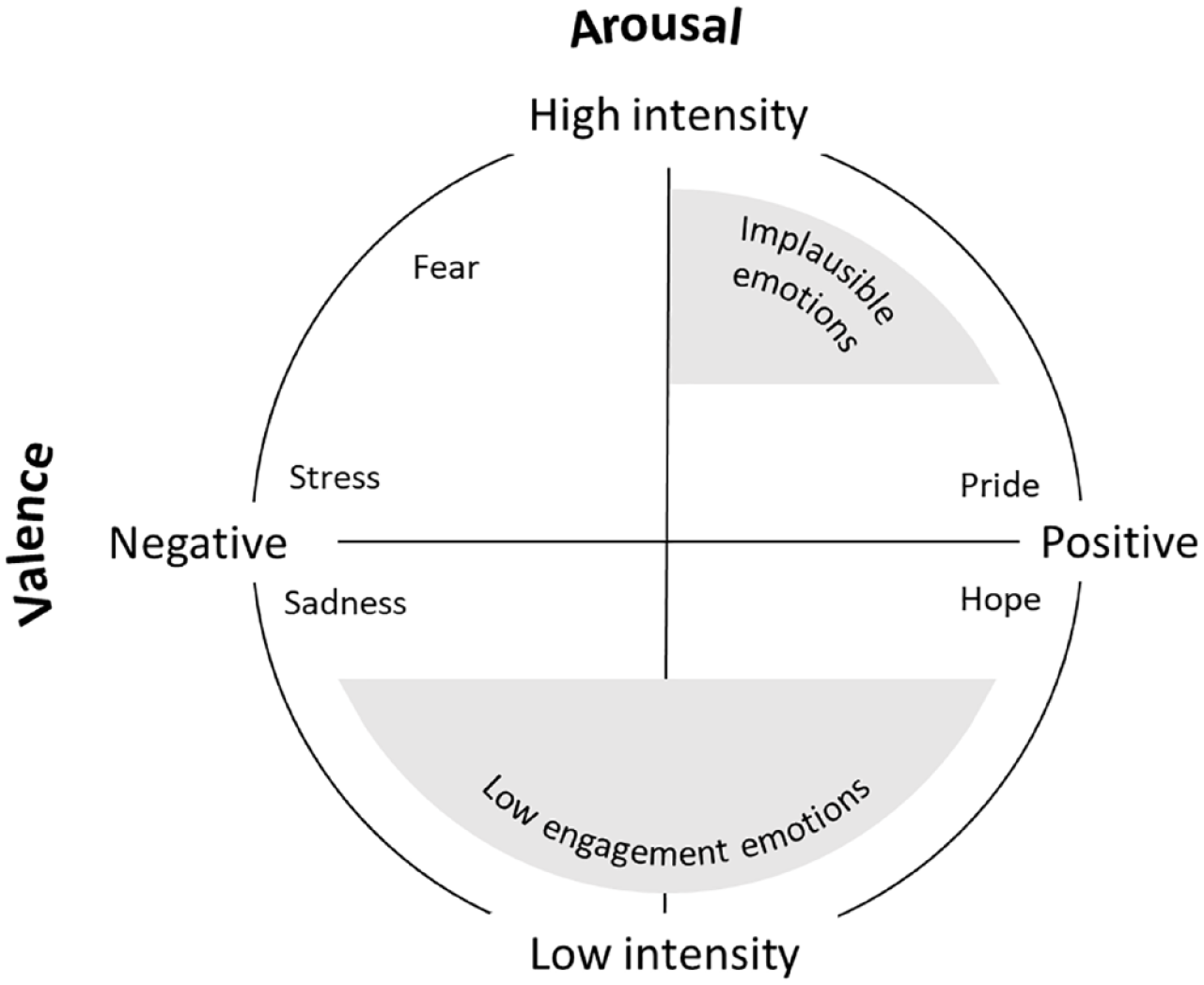
The Circumplex Model With Emotions Relevant to Climate Change Perceptions.
Climate-related information can trigger both positive and negative emotions of different intensity (Brosch, 2021; Rees et al., 2015). Information about the negative consequences of gradual climate events such as global temperature and sea-level change, weather events of moderate magnitude such as heatwaves and floods, or information about indirect climate-related impacts such as supply-chain disturbances and increasing stakeholder pressures trigger moderately intense negative emotions for executives such as sadness. According to a climate journalist who leads expeditions to Norway’s Svalbard archipelago with leaders from the corporate and financial sector to learn about climate impacts (ING, 2018): “The realisation of the effects human beings are having on the world makes some people emotional: we’ve had CEOs break down and become teary-eyed.” Similarly, a study on firms’ climate responses highlights the sadness a sustainability manager expressed about their children, and whether they would be able to “see the sun, and still see birds flying” (Wright & Nyberg, 2012, p. 1580).
Information on the negative impacts of climate events can lead executives to feel stress, too. As a recent Forbes article stated: “the world is at a tipping point when it comes to climate change, and over 80% of executives are concerned” and executives “increasingly understand [climate change] to be an existential threat that can have long-term impacts on their people and business operations” (Forbes, 2021). The article continues saying that: “life sciences/health care industries are the most worried about the business impacts of climate change, with over 80% of executives in these sectors expressing apprehension about the planet’s future.” A recent World Economic Forum (WEF, 2022) article confirms this sentiment, reporting that: “More than 2,000 C-suite executives across 21 countries have shared their apprehensions and strategies on climate change.” According to the article, climate change weighs heavily on the minds of the world’s executives, with “63% of those surveyed saying that their organizations are either concerned or very concerned about the harm it could continue to inflict” (WEF, 2022).
Executives can also experience highly intense, negative emotions such as fear from learning about drastic detrimental consequences of extreme weather events or sudden changes in temperature and sea levels. In interviews with CEOs, Board members, and department heads carried out by the ClimateWorks Foundation, an executive stated: “When towns start shutting down because of extreme weather, then surely that will change things. We are all going to die if we don’t do anything, it’s a scary trend” (Guyatt & Poulter, 2019, p. 39). Wright and Nyberg (2012, p. 1569) report what a sustainability manager stated when asked about climate change: “Well personally I think it is the end of world. I get the whole story and I have got to just paralyse my fear about the whole thing.”
In contrast, learning about new scientific evidence showing that climate impacts might be less severe than expected or successful adaptation practices and their benefits, promising new solutions, will elicit moderately intense, positive emotions such as hope or pride. Hope that climate change can be tackled, and adaptation is both possible and effective (Brosch, 2021); and pride that firms can play a pivotal role in this process (Nabi et al., 2018, 2020). In Wright and Nyberg’s (2012) study, when climate change was framed as a challenge and opportunity, the risks were countered by the potential for new products and technologies, triggering positive emotions of hope in the ability of the market and technology to resolve the climate crisis. The development of adaptation solutions is associated with feelings of pride, as a climate strategist for a major airline noted: “It is very personally satisfying to be involved in something so future facing . . . That is where my bias is, technology delivering a better world” (Wright & Nyberg, 2012, p. 1573). Similarly, Slawinski and Bansal (2012, p. 1549) highlight how managers of a firm which had developed a new technological solution in response to climate regulations “took pride in the significant strides the firm had taken in reducing its energy footprint.”
Strategic Decision-Making About Climate Adaptation: A Framework
Our conceptual framework starts from the premise in corporate climate action research that firms, facing uncertain and complex information, fail to adapt because their executives’ strategic decision-making is subject to cognitive biases. We focus on two perception biases—availability heuristic and framing—and one relevance bias—anchoring (Mazutis & Eckardt, 2017). To select the biases, our starting point was the literature on cognitive biases specific to corporate climate action. This literature distinguishes four main categories of biases that lead to inaction on the part of firms (Mazutis & Eckardt, 2017; Shu & Bazerman, 2012): perception, relevance, optimism, and volition biases.
Perception biases (including the availability heuristic and framing effects) influence perceptions of the problem of climate change in the present moment and come from executives’ inability to understand climatic events and consequences which they have not yet directly experienced and therefore lack firsthand information. Relevance biases (including anchoring effects) influence how executives use information to interpret the future in a way that minimizes or ignores extreme negative consequences of climate change on their future operations. Optimism biases include illusion of control (executives’ tendency to overestimate the ability of technology and their own capabilities to address climate impacts), and self-serving biases that lead executives to seek outcomes favorable to their own firms first, at the expense of the common good. Finally, volition biases prevent executives from assessing their firms as independent agents with control over specific actions. These biases include diffusion of responsibility to others (considering that the locus of control for corporate climate action lies outside of managerial powers), obedience to authority (considering that it is the authorities’ task to solve the problem), and professional bias (considering that business, society, and the biosphere are not all mutually dependent, and that adopting proactive initiatives would put their firms at a competitive disadvantage).
Our focus is on how the interaction between emotions and cognitive biases affects the way in which firm executives select, handle and process complex and uncertain information, and, in turn, steer their adaptation decisions. From these four types of biases, our analysis centers on perception (availability heuristic and framing) and relevance biases (anchoring) since they are rooted in information-processing issues. The origin of optimism and volition biases, as defined in the corporate climate action literature, is more related to firms’ characteristics and orientation rather than to how their executives access and use information in their decision-making. While previous research has argued that these cognitive biases lead to a lack of adaptation, we theorize how emotions can change their influence on the strategic decision to adapt.
Availability Heuristic
The availability heuristic is a cognitive shortcut by which people judge the probability of an event depending on how easily and quickly a piece of information, instance, or association to it comes to mind (Tversky & Kahneman, 1973). When information regarding an event can be easily retrieved or constructed, it is regarded as more salient and more likely to happen. Executives using this heuristic tend to draw on top-of-mind information and previous knowledge to determine the probability of events and give more weight to information that is vivid, rather than to other objectively more important facts (Tversky & Kahneman, 1974). Use of the availability heuristic can lead to assessment errors and biases in decisions since events for which there is easy-to-retrieve available information are perceived as more significant, frequent, and probable than they are. Events for which information does not come to mind easily are considered less probable and frequent, even if they are more likely to occur.
How executives perceive the need to adapt is partly based on probability estimates of the occurrence of climate events, and the magnitude and likelihood of their consequences. When firms have not yet experienced direct climatic impacts, they receive climate-related information only in the form of indirect signals. This lack of firsthand experience reduces the available information regarding the magnitude, frequency, and scope of the consequences that climate events might have for their operations. Information received in the form of indirect signals is also usually less available for executives as it is not vivid enough to come to mind easily. As previously indicated, executives tend to rely on their own experience and overlook events that they have not come into contact with (Haigh & Griffiths, 2012; Pinkse & Gasbarro, 2019). In addition, firms generally receive information from highly diverse sources ranging from non-scientific sources, such as stakeholders, media, and climate regulations, to scientific ones, such as science reports, reviews, and academic articles (Bleda & Shackley, 2008; Linnenluecke et al., 2015), or from third parties’ experiences (Arnell & Delaney, 2006; Pinkse & Gasbarro, 2019). This information tends to be abstract and vague, usually not applicable to firms and their context, which leads them to perceive climate impacts as psychologically distant phenomena (Leiserowitz, 2005; Spence & Pidgeon, 2010) and adaptation as less relevant or urgent. In summary, due to the lack of vivid instances and top-of-mind information about climatic impacts, the availability heuristic generates biases in executives’ assessments of their strategic relevance, leading them not to engage in adaptive action (Mazutis & Eckardt, 2017).
We argue that emotions can modify the effect of the availability heuristic on firms’ strategic decision-making on adaptation through two main underlying mechanisms: increasing vividness of information and directing attention to information. Research has shown that information tagged with positive or negative emotions of moderate intensity comes more easily to mind as it is more vivid and easily remembered (Bower, 1981; Keller et al., 2006). Emotions also influence attention allocation (Fenske & Raymond, 2006) as they guide executives toward events that elicit emotions (Healey & Hodgkinson, 2017; Slovic et al., 2004) and direct attention and action toward environmental signals based on their emotional content (Finucane et al., 2000; Hodgkinson & Healey, 2014). Positive and negative emotions of moderate intensity, therefore, can make abstract or vague information come to mind more easily and direct attention toward the information eliciting these emotions. Highly intense negative emotions, however, can have the opposite effect. Research shows that very strong negative emotions can cause information avoidance and denial (Spence & Pidgeon, 2010). Decision-makers can suffer from what is known as the ostrich effect: a tendency to shield from highly unpleasant and undesirable information (Hodgkinson & Healey, 2011; Karlsson et al., 2009).
Climate-related information, eliciting positive and negative emotions of different intensity (Brosch, 2021; Rees et al., 2015), can modify the availability heuristic’s influence on firms’ decisions for climate adaptation via these two mechanisms. First, emotions can counteract the negative effect on adaptation caused by the availability heuristic. Moderately intense emotions can make the information that executives use to understand climate events more vivid and easier to recall. They will also guide attention to information received about climate impacts’ likelihood and frequency as well as how, and to what extent, these might affect their firms. Emotions mentally transform difficult-to-access and abstract climatic information into more vivid and easier-to-access information, allowing executives to better remember and retrieve the information required to assess their need for adaptation. Having access to the relevant information to perform assessments with more accuracy will make them have a better appreciation for the need and urgency to act strategically and may lead them to engage in adaptative action.
For example, information about the negative impacts of extreme weather events (e.g., suppliers having to discontinue business due to bushfires) and gradual ones (e.g., a loss of biodiversity due to temperature changes) or about indirect climatic impacts (e.g., social activists’ protests causing supply-chain disturbances) will elicit moderately intense negative emotions such as stress. These emotions will make the information more salient for executives and lead them to perceive these events as more likely, frequent, and with more significant, harmful impacts. Similarly, executives reading or receiving information about positive impacts or best practices in climate adaptation will develop a moderately intense positive emotion of hope that successful adaptation is both possible and effective or pride that firms can play a pivotal role in tackling climate change. These emotions will also make information more salient and vivid (i.e., available) when they consider the decision to adapt. In both cases, moderately intense emotions make available and direct executives’ attention to information previously ignored. This information can be incorporated in firms’ assessments and help performing more accurate estimations of the probability, frequency, and magnitude of climate impacts. Emotions thus allow executives to achieve a better understanding of how climate change might affect their firms’ operations and the urgency to adapt which can promote adaptation action.
Moderately intense emotions, however, might make the heuristic work in the opposite direction, too. If they make information on specific climate events very vivid and strongly direct attention toward it, executives might overestimate their likelihood, frequency, and magnitude, and the need or urgency to act on these events. For example, climate events such as bushfires and floods are more newsworthy due to their devastating consequences (Berglez & Al-Saqaf, 2021) than events such as the impact of temperature change on biodiversity, with knock-on effects for the emotional arousal that they elicit. While the emotions will counteract the negative influence of the availability heuristic and promote action, in this case, the ensuing adaptive response could be ineffective or misguided because it is based on overestimates regarding the frequency, impacts, and scope of such events. Likewise, best practices in terms of climate adaptation that receive much attention in the business press may not be the right ones as they might be focused on solving problems of firms that operate in a different context. Since adaptation is highly context-specific (Wilson, 2022), doing what others have done, because feelings of hope have led their attention to it and made these practices’ positive impacts more salient, might be misguided.
Second, emotions can reinforce the negative effect of the availability heuristic and further foster firms’ tendency not to act, if negative emotions elicited by climate events are of a very high intensity. Reports and news on the negative impacts of extreme weather events or severe consequences of sea-level change such as islands in the Pacific disappearing altogether will trigger the highly intense negative emotion of fear. This strong negative emotion can lead to information avoidance and denial (Hodgkinson & Healey, 2011; Karlsson et al., 2009), and induce an ostrich effect as coping strategy (Davidson & Kecinski, 2022; Haltinner & Sarathchandra, 2018), which will reduce the amount of available information regarding climate impacts for firms to make their adaptation decisions. Executives will find it more difficult to mentally access information associated with intense psychological discomfort, with fear causing them to completely disregard this information. Research has shown that high levels of fear can result in the complete avoidance of related situations and information (Haltinner & Sarathchandra, 2018). Such a reinforcing effect out of fear is especially likely when executives receive information about extreme events which could put the survival of the firm at risk since they cannot see how to ever adapt due to a lack of means, or about severe impacts from more gradual changes such as disappearing glaciers affecting water supply in affected areas which could cause serious harm to their business and the communities they serve. The reduction of easy-to-retrieve or available information due to these extreme feelings of fear will reinforce the negative effect of the availability heuristic leading to an increased disengagement and a lack of action.
Framing
The framing effect is a cognitive bias by which people choose solutions regarding a situation or an issue based on how the issue is presented to them (Tversky & Kahneman, 1981). When individuals consider an ambiguous or uncertain issue, the different ways in which information about it is presented (e.g., the terminology used or the visual context provided) can influence how they understand and act on it (Nabi, 2003). Uncertain issues and their consequences are often framed or communicated to executives in terms of gains or losses. Framing information as losses is considered more effective to prompt action since research has shown that when equivalent gains and losses are compared, losses are more influential in guiding behavior (i.e., people are more likely to take risks and action to avoid losses than to achieve gains; Kahneman & Tversky, 1979; Tversky & Kahneman, 1981).
Gain and loss frames are among the most used and studied frames in climate communication (Nabi et al., 2018, 2020; Nisbet, 2009). Frames are particularly relevant for firm executives without firsthand climate experience, because their perceptions of climate impacts and associated risks (Nisbet, 2009; Spence & Pidgeon, 2010) depend on how these are presented and communicated by the media, scientists, and other sources (Swim et al., 2009). Information regarding climate adaptation can be presented to firms as gains with a focus on the business opportunities of adaptation or as losses with a focus on the costs of failing to adapt. Policy makers, the media, and the scientific community generally employ loss frames to communicate and prompt action regarding climate change because, as indicated, losses are considered more effective in guiding behavior (Bilandzic et al., 2017; Nabi et al., 2018). Loss frames are more likely to promote adaptation in firms because it is easier to make concrete the economic damage that is avoided by taking adaptive action to address these impacts. However, loss frames tend not to work in firms without firsthand climate experience since the information conveyed by the frames comes from multiple sources, tends to be abstract, and not applicable to them and their context. As a result, executives perceive that losses from climate impacts will not significantly affect their firms (Mazutis & Eckardt, 2017). Making the potential benefits from adaptation concrete for firms is more difficult, because for many the business opportunities of adaptation are not obvious yet (WEF/PWC, 2023), the only advantage boils down to sustaining business-as-usual (Andersson & Keskitalo, 2018). Gain frames are generally less effective in promoting adaptive responses in firms because it is unclear how adapting will benefit them, and whether costly adaptive measures will make any real difference.
We argue that emotions can modify the effect of framing on strategic decisions about adaptation. Frames evoke emotions (Bilandzic et al., 2017; Nabi, 2003). Loss frames, by emphasizing future damage that can result from inaction, can elicit moderately intense negative emotions such as sadness or stress and highly intense negative ones such as fear. Gain frames emphasize potential positive benefits of adaptation and can thus elicit positive emotions of moderate intensity like hope or pride (Nabi et al., 2018, 2020). Research has shown that emotions can change how frames influence behavior by acting on the cognitive processes involved in risk-related decisions and reverse their effect (Seo et al., 2010). Whether emotions reverse the negative effect of frames on adaptation decisions depends on the underlying mechanism by which emotions influence executives’ probability judgments (subjective probability judgments of the decision outcome) which depend on them being in a positive or negative emotional state (Finucane et al., 2000; Loewenstein et al., 2001). Executives that experience positive emotions, and are in pleasant emotional states, perceive positive events and outcomes as more likely to occur, which leads to risk-seeking tendencies and action. Conversely, executives in unpleasant emotional states assign greater probabilities to negative events and decision outcomes (Johnson & Tversky, 1983), which leads to risk aversion and inaction. These effects occur because pleasant and unpleasant feelings convey information that executives use to assess whether a situation is safe or problematic, which can modify subjective judgments of the probability of positive or negative events (Schwarz & Clore, 1983; Seo et al., 2010).
Although usually considered as an effective way of prompting risk-taking and action, loss frames emphasizing the negative impacts that a lack of adaptation might have for business and society generally convey information that is too abstract for firms and tend to be ineffective in promoting adaptive action. The negative emotions triggered by such loss frames might reinforce the ineffectiveness of loss frames. The information on the negative impacts of both direct gradual and non-extreme weather events, and on the consequences of indirect climatic impacts highlighted in loss frames (with different degrees of severity) will lead to the moderately intense emotions of sadness and stress, or, for the case of more drastic events and impacts, to the highly intense negative emotion of fear. Via their effect on subjective probability judgments, executives feeling sad or stressed will judge strategic action on adaptation and its outcomes as problematic. These moderately intense emotions will lead them to perceive that potential negative impacts of climate change (even if action is taken) have a higher probability (Schwarz & Clore, 1983; Seo et al., 2010) and that adapting will not work, which will reinforce their strategic decision not to act. This effect will be stronger when executives feel fear, as the highly intense emotion triggered by the frames will make them judge adaptation and its outcomes as highly problematic.
The effect of negative emotions on subjective probability judgments will be dominant in decision contexts in which potential future losses from adaptation are perceived as more salient than potential gains (Seo et al., 2010). We expect such a scenario to play out in places that see a regular occurrence of extreme weather events that keep on having negative consequences for local communities, such as people repeatedly losing their homes due to hurricanes, even if the focal firm is not affected itself. Regular harmful climate impacts amplify the influence of the negative emotions of sadness, stress, and fear, triggered by the loss frames on the subjective probability of losses. They make executives see any potential gains from adaptation as rather unlikely to materialize because they see no proof or evidence of it in their vicinity. Firms under this scenario mainly receive climate-related information that highlights that adaptation is probably ineffective and damage will be inevitable, rather than having any positive consequences, such as solutions addressing impacts or concrete business opportunities, making potential positive benefits of adaptation less salient for them.
Positive emotions, however, can reverse the ineffectiveness of gain frames on adaptation decisions. Gain frames highlighting information about successful adaptation practices and their benefits (such as new technologies or insurance solutions which better protect people against climate-induced losses and lead to profits for the firms offering them) elicit positive emotions that could lead to risk-taking behavior and action. Gain frames will trigger positive emotions in executives as they celebrate business success (Castelló & Lopez-Berzosa, 2023). They can lead to feelings of hope that climate change can be tackled and pride that firms are key actors in this process (Nabi et al., 2018, 2020). These positive emotions will affect subjective probability judgments and lead executives to judge adaptation as a safe, unproblematic decision. They will perceive that climate adaptation is effective, and that potential positive consequences of the decision to adapt have higher probability, which will prompt them to engage in adaptive action and exploit the opportunities they see in offering solutions themselves.
The effect of positive emotions on probability judgments will be dominant in decision contexts in which potential gains resulting from adaptation are perceived as more salient than potential future losses (Seo et al., 2010). We expect such a scenario to play out in places that do not see a regular occurrence of extreme weather events with negative consequences where initial adaptive action is showing positive results already (such as building new flood defenses built as a precaution in areas that only occasionally see high river levels and boosting business for the firms involved in their supply). A lack of negative climate impacts coupled with positive indirect signals about adaptation being effective and profitable magnifies the effect of the positive emotions elicited by the gain frames on the subjective probability of gains. Positive emotions make executives see no reasons to believe that potential gains from adaptation might not materialize because they see no proof in their vicinity that adaptation could be challenging. Firms under this scenario mainly receive climate-related information that highlights the potential benefits of adaptation, and that damage might be averted and business boosted, rather than information on any negative consequences, making possible positive benefits of adaptation more salient for them.
Given the role of emotions in framing, it is possible that only gain frames eliciting positive emotions will be effective in prompting firms to adapt. This effect is consistent with previous empirical research that links positive emotions to productive engagement in climate mitigation (Spence & Pidgeon, 2010) and other climate-related actions (C. R. Schneider et al., 2021). While this research is not specific to adaptation and does not investigate the cognitive mechanisms leading to these results, it suggests that prompting positive emotions through gain frames might be more effective in promoting climate action than prompting negative emotions through loss frames.
Anchoring
Anchoring is a tendency to estimate unknown values by starting with an initial piece of information, or anchor, and adjusting from that anchor until a satisfactory value is reached (Tversky & Kahneman, 1974). This process is also known as the anchoring-and-adjustment heuristic (Epley & Gilovich, 2006). Anchoring can lead to judgment errors and bias when people do not sufficiently adjust away from the initial value or information provided by the anchor (Jung & Young, 2019). Research shows that this bias remains robust even when the anchor is irrelevant for the decision at hand (Inbar & Gilovich, 2011). According to Estrada and colleagues (1997), the lack of adjustment in anchoring is rooted in a cognitive process characterized by inflexible thinking and information distortion: when adjusting from the anchor, people maintain their initial hypotheses by disregarding or distorting any non-supportive or anchor-disconfirming information. Anchoring effects reflect an inability or unwillingness to think in a flexible manner and be open to consider new information (Estrada et al., 1997). Anchoring biases also originate from cognitive mechanisms of selective accessibility (Bodenhausen et al., 2000). According to the selective-accessibility model (Chapman & Johnson, 1999; Mussweiler & Strack, 1999), anchoring effects occur because decision-makers selectively search for and activate anchor-consistent information (Epley & Gilovich, 2006). When people are given an initial value or piece of information, they start by testing the hypothesis that this value or information is correct. This hypothesis-testing process is normally biased in a confirmatory direction: individuals selectively look for and activate information that supports this hypothesis and confirms that the anchor value is correct, which results in an increased mental accessibility of hypothesis-consistent information (Bodenhausen et al., 2000).
Anchoring is relevant for climate-related decision-making because scientific anchors are often used to translate science to a wider public, including firms. Due to the difficulty to translate complex science into concrete facts and policies, the scientific community uses various ways to simplify information about climate change (Dessai & Hulme, 2004; Van der Sluijs et al., 1998). Anchors can convey information in the form of numerical values. For example, in their assessment reports the IPPC has referred to probabilities of future climate change (Dessai & Hulme, 2004), provided global temperature estimates of 1.5°C and 4.5°C to capture the sensitivity of the climate (Van der Sluijs et al., 1998), and referred to potential scenarios values for sea-level change (e.g., between 0.5 and 2 meters from 2010 to 2100; Nicholls et al., 2021). Anchors can also be positional statements that present potential climate impacts as happening within certain time ranges, such as in the coming decades or in an approximate number of years from now. Other anchors convey information about climate adaptation measures and technological solutions, or climate regulations and standards (Mazutis & Eckardt, 2017).
By communicating information via such anchors or reference points, the scientific community has inadvertently lowered the strategic urgency of the need to adapt. The confusion, for example, between daily or seasonal changes in temperature and the global average temperature increase, and the long timeframes used for climate scenarios and targets may have led firms to perceive that the frequency, scale, and scope of climate impacts are small and will not have significant impacts. Due to long timeframes lowering temporal immediacy, executives will perceive that adaptation is only necessary in the long run (Mazutis & Eckardt, 2017; Slawinski et al., 2017). Existing adaptation measures and current climate standards and regulation, usually focused on compliance and incremental improvements rather than radical action, have also reduced the perceived urgency of acting now and the imperative to adapt (Mazutis & Eckardt, 2017). Anchoring effects leading to inaction occur because executives insufficiently adjust from these anchors and/or disregard new evidence that disconfirms them, failing to update their assessment of the need to adapt. Despite new information emerging and signaling an increased urgency to take action, executives keep on thinking that existing measures will work and that continuing with business as usual is enough (Andersson & Keskitalo, 2018).
We argue that emotions can modify the negative influence of anchoring biases on climate adaptation decisions. Emotions will modify climate-related anchoring effects via their two underlying mechanisms: selective accessibility and insufficient adjustment. Negative emotions can modify the effects of anchoring on adaptation decisions via the selective accessibility mechanism. Studies have shown that a moderately intense negative emotion like sadness make executives more likely to engage in hypothesis-consistent and selective information processing and thus more susceptible to anchoring effects (Bodenhausen et al., 2000; Englich & Soder, 2009). While individuals experiencing positive emotions tend to rely on heuristics and generic knowledge structures to make decisions, those experiencing negative emotions use more extensive, detail-oriented, and systematic information processing (Forgas, 1995; Schwarz, 2002). Paradoxically, this decision-making behavior makes executives feeling negative emotions more susceptible to anchoring effects because the more extensively they test the validity of an initial anchor, the more anchor-consistent information they are likely to generate (Bodenhausen et al., 2000; Englich & Soder, 2009). Since negative emotions make them think more actively about the anchor, a greater proportion of information that supports the anchor value is likely to be mentally activated and to become selectively accessible in their decision-making, which will make their final estimates and decisions more biased in the direction of the anchor (Bodenhausen et al., 2000).
Anchor-disconfirming information and evidence signaling that continuing with business as usual is not enough and that strategic action is required will trigger moderately intense negative emotions like sadness and stress which will make executives more susceptible to anchoring effects. Despite evidence showing that the information conveyed by the anchors needs updating and the urgency to adapt should be higher, these negative emotions, via the selective accessibility mechanism, mentally activate more anchor-consistent information, making their adaptation decisions even more biased toward the anchors’ values. For example, executives experiencing stress due to new evidence showing that their surroundings will be affected by a global average temperature rise higher than 1.5°C or feeling sad due to the realization that existing measures are not enough and continuing with business-as-usual might be ineffective or insufficient will selectively search for information that support the initial temperature rise values and the effectiveness of current measures, and will stay focused on them, even if there is new evidence disconfirming them, which will reinforce their initial decision not to adapt. We assume that the decision not to act is reinforced, too, when the evidence triggers the highly intense negative emotion of fear. Fear will lead to information avoidance and denial, and in extreme cases to a disregard of any new evidence, and therefore to a complete lack of update of the anchor value.
Positive emotions can influence the effects of anchoring on adaptation decisions by affecting both the adjustment and selective accessibility mechanisms. Research has shown that positive emotions promote creative problem-solving and flexible and open evaluation and cognitive processing (Estrada et al., 1997; Isen, 1993; Isen et al., 2008). Executives experiencing positive emotions are less likely to think in an inflexible manner and distort evidence, which will lead to better adjustment of anchor values and thus to a reduction of anchoring effects (Estrada et al., 1997). Positive emotions can also reduce anchoring effects via the selective accessibility mechanism as positive affect is linked to less cursory and less extensive thinking which limits executives’ thinking about the anchor and thus the activation of anchor-consistent information (Bodenhausen et al., 2000). Executives receiving information on successful adaptation initiatives, such as the development of novel technologies that make crops more resilient to droughts to help reduce the detrimental effects of higher temperatures, will feel positive emotions like hope and pride. Feeling hopeful or proud will make them more flexible, more open to new information, and less likely to distort evidence. They will consider this new anchor-disconfirming evidence, signaling the potential benefits of deviating from the status quo, and will be more inclined to adjust away from the anchors’ initial reference points. A reduction in biases from anchoring effects will allow executives to better assess the strategic urgency of the need for adaptation and lead them to take adaptive action.
Discussion and Conclusion
For firms in what appear to be less vulnerable sectors (for now), adapting to climate change seems not to be a strategic priority (yet) when they neither experience any significant economic losses, nor identify business opportunities from offering adaptation solutions (WEF/PWC, 2023). The lack of direct experience and the complexity and unpredictable nature of climate events make it very difficult for executives in these sectors to assess the potential impacts on their firms’ operations and recognize the significance and strategic urgency of the need to adapt. To cope with this complexity and uncertainty, they tend to rely on heuristics to make strategic decisions about adaptation (Bleda et al., 2023). In addition to the influence of many firm-internal and external factors, research has found that the cognitive biases that these heuristics generate are a significant factor in explaining the lack of strategic action on adaptation (Mazutis & Eckardt, 2017; Wade & Griffiths, 2022). Although the role of cognitive biases has been analyzed in the literature on climate adaptation, how emotions moderate the impact of these biases on strategic decision-making processes has not yet been studied. In this article, we have drawn on research on climate adaptation, (social) psychology, and managerial cognition to analyze how emotions of different valence and intensity can change the influence of cognitive biases on the strategic decision to adapt to climate change, focusing on three heuristics: availability heuristic, framing, and anchoring. We have developed a conceptual framework that, based on social psychology research on the influence of emotions on information processing, identifies the underlying mechanisms via which the effect of each heuristic is modified through the impact of sadness, stress, fear, hope, and pride, respectively (see Figure 2).
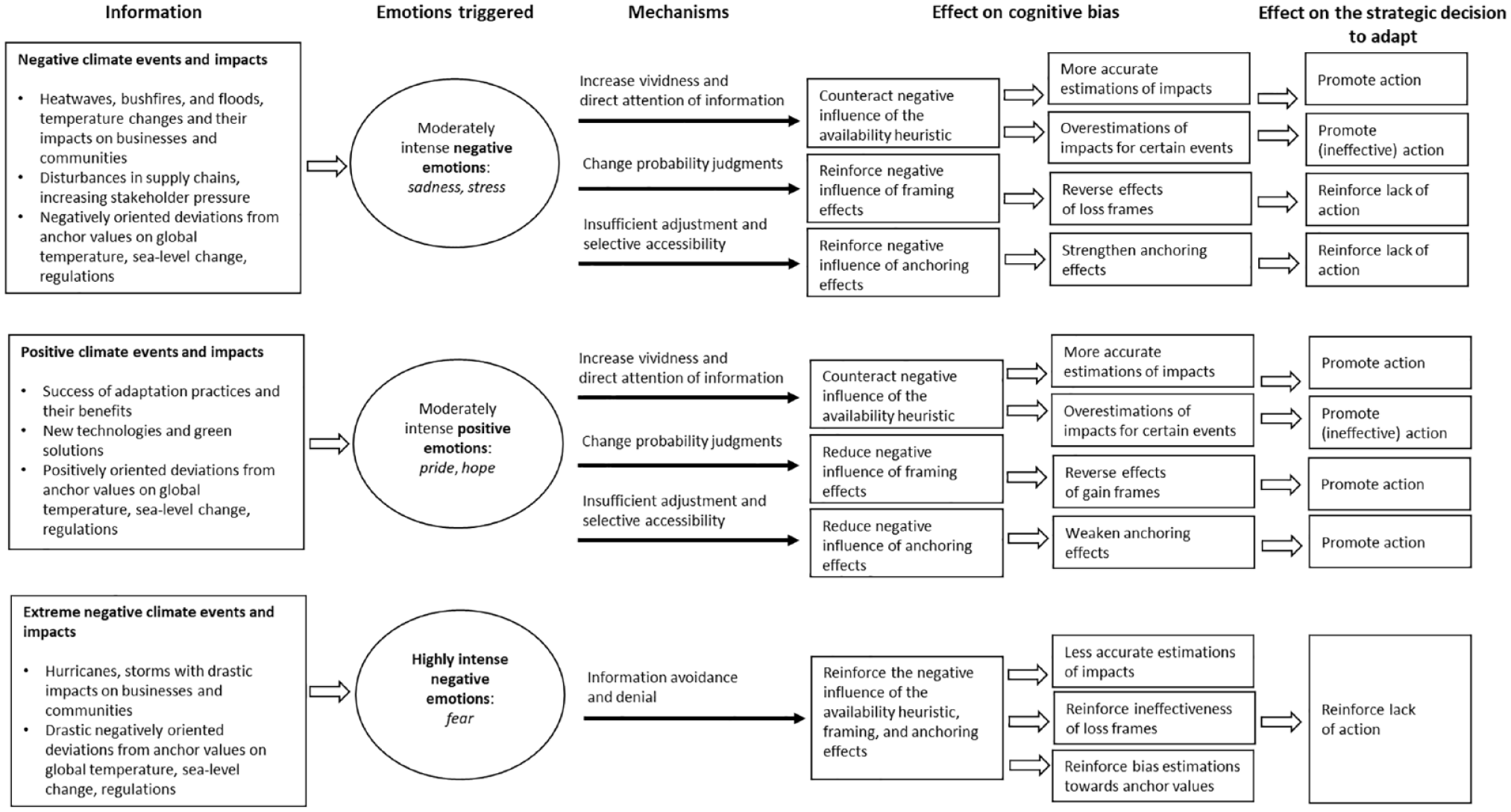
Conceptual Framework.
As our framework shows, emotions can modify the influence of the availability heuristic on the decision to adapt by increasing the vividness of information and directing attention to information. We have argued that emotions of moderate intensity both positive like hope and pride and negative like sadness and stress can reverse the negative effect of this heuristic by making relevant information accessible and easier to remember and by guiding attention to it. This process leads executives to take strategic action on adaptation because of more accurate assessments of the probability, frequency, and magnitude of climate impacts and a better understanding of how they might affect their firms’ operations. However, if moderately intense emotions make the information recalled very vivid and strongly direct attention toward it, executives might overestimate the need and strategic urgency to adapt to certain events and make the ensuing adaptive action potentially ineffective. Finally, we have argued that emotions might reinforce the lack of adaptation action due to using the availability heuristic if negative emotions, like fear, elicited by climate impacts are of very high intensity, leading to information avoidance and denial.
Emotions will modify the influence of framing on adaptation decisions through their impact on subjective probability judgments. We have argued that the negative emotions of sadness stress, and fear, triggered by loss frames will make decision-makers judge adaptation as problematic, assigning a higher probability to potential negative consequences to the decision to adapt. We have proposed that this scenario is likely for firms operating in contexts with regular occurrence of extreme weather events with significant negative impacts for business and society. This negative emotional state leads executives to reverse the risk-seeking behavior that the loss frames are expected to promote in situations of low affect (Kahneman & Tversky, 1979; Tversky & Kahneman, 1981). By contrast, gain frames could be more effective in prompting firms to adapt because the positive emotions of hope and pride that they elicit lead to risk-taking behavior and action. This scenario is relevant for firms operating in contexts without regular occurrence of extreme weather events or where adaptive action is showing positive (business) results, since the positive emotions triggered by the gain frame cause executives to perceive potential future gains of acting as more salient.
Finally, emotions will modify the influence of anchoring effects on adaptation decisions by insufficient adjustment due to inflexible thinking and information distortion, and selective accessibility of anchor-consistent information. We have argued that the positive emotions of hope and pride can reverse the effects of anchoring on adaptation decisions by promoting flexibility in thinking and reducing information distortion, leading to a better adjustment process. Emotions can also reduce the negative effects of anchoring on the decision to adapt via the selective accessibility mechanism. Moderately intense negative emotions like sadness and stress, on the other hand, reinforce anchoring effects and the decision not to act. They lead decision-makers to use more extensive information processing focused on the initial anchor value and activate more anchor-consistent information. Anchoring effects are reinforced by the highly intense negative emotion of fear, too, leading to information denial and a complete lack of adjustment of anchor values.
Our conceptual framework makes several contributions to the literature on firms’ adaptation to climate change (Berkhout, 2012; Clément & Rivera, 2017; Linnenluecke et al., 2013). First, our framework improves our understanding of firms’ strategic decision-making for climate adaptation by considering both cognitive and emotional aspects, highlighting the importance of cold and hot forms of cognition in the process. We concur with the argument that for many firms in less vulnerable sectors climate adaptation is not a strategic priority, and the roots of inaction lie in their use of heuristics and the biases that these generate (Mazutis & Eckardt, 2017; Wade & Griffiths, 2022). However, we argue that emotions can modify the negative impact of cognitive biases on strategic decisions about adaptation. While at times emotions further reinforce the dampening impact of cognitive biases on action, we identify several scenarios where they can reverse the influence of the biases instead. While the literature has paid attention to cognitive factors to explain different adaptation responses to climate change (Hoffmann et al., 2009; Pinkse & Gasbarro, 2019), it has mainly focused on cold cognition, overlooking the role of emotions. We add a key part of the puzzle for why some firms do act on climate change while others fail to do so by clarifying how emotions can interact with heuristics and biases in the strategic decision-making context of climate adaptation.
Our analysis of the interaction of emotions with the availability heuristic suggests that while moderate levels of positive and negative emotions can counteract the bias and promote adaptation action, highly intense emotional experiences like fear can have unintended consequences: such intense negative emotions lead to information avoidance and denial and reinforce the lack of action. Our analysis of framing and anchoring suggests that it is most likely positive emotions only that reverse framing and anchoring effects and lead to adaptation. While putting emotions into the equation does not fully reverse the bleak picture of the lack of corporate climate action (Gasbarro & Pinkse, 2016; Mazutis & Eckardt, 2017; Slawinski et al., 2017), it does explain why some executives have woken up to the need for adaptation.
Second, we identify the underlying mechanisms that explain how emotions can modify the impact of using heuristics to make decisions on climate adaptation. Our framework does not conjecture each potential combination of climate event attributes, cognitive biases, and emotional state, but it identifies the underlying mechanisms that explain how emotions influence the role of cognitive biases in this strategic decision-making process. Understanding these mechanisms can help tease out specific decision-making scenarios under which it is more or less likely that executives take the decision to invest in adaptation to climate change. In the case of the availability heuristic, the two mechanisms (vividness and directing attention) work in tandem to reinforce how they modify the impact of the cognitive bias on decision-making. In the case of framing (influencing probability judgments), the effect depends on the valence of the emotion. The dominance of the effect of emotions on probability judgments depends on the salience of gains and losses in a specific context due to a regular occurrence of climate events (or not) and determines if executives will take the decision to adapt or not. For anchoring, the two mechanisms again work in the same direction reinforcing each other to influence the susceptibility of executives to anchoring effects, and their decision to act.
Regarding implications for practice, our analysis suggests that both cognitive and emotional processes need to be considered to have a more complete view and a better understanding of climate-related strategic decisions. We propose that in the context of climate adaptation characterized by high levels of uncertainty and complexity, decision-making is largely a heuristically and emotions-led process, which leads executives to have different perceptions of the need and strategic urgency to act. Recognizing the impact of cognitive biases and emotions on decisions is fundamental for firms, as this will have implications for their strategic approaches to adaptation with concomitant consequences for society. Executives need to be aware that both mental shortcuts and emotions can influence their judgments and the entire decision-making process. Our conceptual framework can guide them to identify potential biases in their decision-making when they rely on a specific heuristic, and how emotions can influence the heuristic and decisions. Such awareness may help executives overcome such biases and reconsider their firms’ investments in adaptation measures. Well-designed programs and tools can help executives to identify the cognitive biases that are preventing them from taking action and to understand how their emotions can modify the effects of these biases which will increase the effectiveness of these type of tools. For instance, Lovallo and Sibony (2010) and Mazutis and Eckardt (2017) provide a list of tools that can be used to reduce climate-related cognitive biases such as training, simulations and experiments, and scenario planning, among many others. Healey and Hodgkinson (2017) propose several techniques that enable teams of executives to recognize their emotional reactions to particular strategic issues which could be adapted to the context of climate-related decision-making.
Our work has a few limitations, too, which create opportunities for future research. Given the fathomlessness of human behavior and cognition, there are other forms of cold cognition besides the availability heuristic, framing, and anchoring (information processing heuristics) that contribute to different decisions regarding climate change as well as cognition-related factors that our work does not incorporate such as dynamics within top management teams (Healey & Hodgkinson, 2017). Therefore, future studies could extend our framework, incorporating more heuristics or other factors relevant to explaining different organizational perceptions, reactions, and responses to climate events. Our framework could also be extended to gain understanding of other important sustainability issues such as biodiversity and deforestation and not just concentrate on climate adaptation. Although our article is conceptual, it relies on empirical studies about how emotions affect information processing and decision-making within social psychology and we hope that our framework provides opportunities for empirical studies in the context of climate-related decision-making. Future research could empirically test our framework to gain more robust explanations of firms’ strategic decisions about adaptation to climate change.
Footnotes
Acknowledgements
The authors acknowledge the contribution of Eleni Christodoulou to a previous version of this article. The authors also thank the Academy of Management’s Organizations and the Natural Environment Division for awarding a previous version of this article with the 2022 Divisional Best Paper Award.
Declaration of Conflicting Interests
The author(s) declared no potential conflicts of interest with respect to the research, authorship, and/or publication of this article.
Funding
The author(s) received no financial support for the research, authorship, and/or publication of this article.
