




Abstract
As founder of modern political economics and prominent theorist of the commercial society, Adam Smith’s importance is universally recognized. Little, however, has been done so far to develop Adam Smith’s virtue ethics in the context of modern business, characterized by digitalization. This article aims to rediscover Adam Smith’s virtue of prudence and its relevance for the “e-commercial society”: It presents a framework that considers the central place of prudence in the relationship between a prosperous e-commercial system and societal flourishing. In Smith’s view of the commercial society, prudence enables people to develop habits of character related to industriousness, genuineness, spirit of sacrifice, and self-command, which help in the conduct of a prosperous business activity. This article translates Smith’s virtue of prudence into a language typical of consumers in the current e-commerce scenario, considering their development as persons and the contribution of their activities to the good of society.
The importance of Adam Smith for economic theory is widely recognized. Rothschild and Sen (2006) refer to The Wealth of Nations as “a great book—the greatest book ever written about economic life” (p. 364). Winch (2004) affirms that it “had no rival in scope or depth when published” and has remained “one of the few works in its field to have achieved classic status” (p. 21). Campbell and Skinner (1982) go so far as to say that this book “has become one of the most influential to be published in the English language” (p. 168). Adam Smith is considered a renowned theorist of the commercial society (Douglass, 2018). Interestingly, his virtue theory is connected to his view of the commercial society itself.
Notwithstanding the impact of Smith’s scholarship, especially on the development of economic theory (Schumpeter, 1994), and also in the business ethics and business and society scholarship (see Bragues, 2009; Hühn, 2019; Wells & Graafland, 2012; Werhane, 2000), little has been done to develop his virtue ethics in the context of contemporary societal parameters and determinants of business, which are increasingly characterized by digitalization. E-commerce, located within the realm of digital business (Chaffey et al., 2019; Wirtz, 2021), can particularly benefit from the ethical analysis offered by Adam Smith: his solutions applied to the commercial society of his time might be, mutatis mutandis, beneficial for the current e-commercial society. As Hanley (2013) underscores, Smith had a twofold interest in developing a theory of virtue for the commercial society: first, a commercial society’s functioning presupposes the “widespread acceptance of certain moral norms and specific virtues” (p. 220); second, Smith realistically assessed the deleterious effects of a commercial society on its members. According to Smith, virtues mitigate these effects.
This article aims to show the relevance of Adam Smith’s virtue ethics within the business and society debate, and of his notion of prudence for our contemporary e-commercial society. Based on Smith’s notion of prudence, we develop a framework to assess e-commerce buyers’ behavior from an ethical perspective. Why Adam Smith? As founder of modern political economics, Adam Smith towers over all other economic theoreticians. He is a point of reference in many publications on business, economics, and society. We chose Adam Smith for two reasons. One, the explanations he gives of the role of prudence are, to a considerable extent, still valid. Two, his methodology of cultural transposition of an inherited tradition into a new social context deserves imitation and justifies the attempt to undertake something similar in our own time, albeit in the limited scope of an article. Indeed, Smith “still has much to offer, especially in his subtle account of the moral virtues and their relationship to institutional settings and flourishing” (Graafland & Wells, 2021, p. 32).
The article is organized as follows: The section “The Virtue of Prudence in Adam Smith’s Moral System” presents an account of Smith’s virtue of prudence, extracting from his work a reference framework to assess the strength of this virtue. The section “Adam Smith’s Virtue of Prudence in the E-Commerce Society” reviews the essential traits of e-commerce and highlights the pivotal role of prudence in the relationship between e-commerce systems and societal flourishing. The article concludes presenting four propositions, which describe the quality of the relationship between Smithian prudence and e-commerce. The conclusions summarize our findings and present future research.
The Virtue of Prudence in Adam Smith’s Moral System
The virtue of prudence plays a central role in Smith’s moral system as the virtue that directs the “selfish passions” toward the preservation of wealth, health, rank, and reputation. In his political economy, prudence generates the attitudes of industry, frugality, parsimony, and thrift, which are essential for the accumulation of capital through saving in the commercial society. Smith took the virtue of prudence from the classical tradition but transformed it to make it fit into the commercial society of his time. In his philosophical architecture, prudence allows the commercial society to flourish: Rediscovering this virtue is essential for the ethical assessment of the current e-commercial society. This section describes the place of prudence within Smith’s virtue theory and presents the Smithian portrait of the prudent person.
Adam Smith’s Virtue Theory
Scholarship of the last three decades has rediscovered Adam Smith as a virtue ethicist (Evensky, 2017; Fitzgibbons, 1995; Griswold, 1999; Hanley, 2013; McCloskey, 2008). Given the centrality of virtues in his moral and political system, we can number Smith among the virtue ethicists (Hanley, 2013), because he sketches “portraits of praiseworthy characters and their qualities,” as virtue ethicists do, rather than defining rules of morality, as with deontological or utilitarian systems (p. 221; see TMS I.ii.5.1, p. 41 as one example among many). However, positioning Smith as a virtue ethicist should not obscure the influence of other philosophical systems on Smith’s moral theory, in particular Stoicism and Epicureanism (Brown, 2008; Vivenza, 2001, pp. 41–83).
Fitzgibbons tries to do justice, as far as possible, to the original intentions of Smith in his cultural context. He demonstrates that virtues were a central part of Smith’s vision of life in society. Wealthy and liberal societies “could be stable and enduring, provided they encouraged the liberal version of virtue” (Fitzgibbons, 1995, p. 135). Griswold’s study is part of a larger intellectual project to save the Enlightenment from destruction by post-modern philosophy. In Smith, Griswold (1999) asserts, we possess a resource for “self-criticism and justification” from inside the Enlightenment itself (p. 7). Such a resource are the virtues that occupy Smith’s attention in The Theory of Moral Sentiments (Smith, 1976, from now on TMS). They are foundational also for The Wealth of Nations (Smith, 1979, from now WN). Griswold points out that in an approach typical of the Scottish Enlightenment, Smith articulates a notion of “middling” moral virtue, even while acknowledging that in some respects it is inferior to the aristocratic excellence praised by the ancients. This more achievable notion of virtue is taken as reconciled with the pursuit of fundamental goods as health, pleasure, “bettering of our condition,” high reputation, and “worldly goods.” It is available to nearly every decent adult and is more democratic and egalitarian than the ancient ideal. The defense of what Plato would have dismissed as “demotic virtue” is part of the enlightened moral outlook that grants ordinary people their place in the sun (Griswold, 1999, p. 13). Furthermore, McCloskey (2008) refers to Smith as “a virtue ethicist who learned his trade in a Stoic school” (pp. 53–54). Importantly, Adam Smith endorsed and implemented the technique of “ethical pluralism,” rejecting the reduction of morality to only one virtue as many ethical systems did after Smith (McCloskey, 2008, p. 57).
Smith likens his ideal of society to the harmony of an orchestra: “The great pleasure of conversation and society, besides, arises from a certain correspondence of sentiments and opinions, from a certain harmony of minds, which, like so many musical instruments coincide and keep time with one another” (TMS VII.iv.28; p. 337). Each one of us is an instrument in the orchestra that constitutes society. Like a musical instrument, our sentiments, emotions, and passions need the right “pitch” that allows the “fair and impartial spectator” (TMS III.1.2; p. 110), the “demigod in our breast” (TMS III.2.32; p. 131), to consider them consistent with propriety. With Aristotle, Smith defines propriety—synonymous with what Aristotle terms virtue—as a middle between extremes: “The propriety of every passion excited by objects peculiarly related to ourselves, the pitch which the spectator can go along with, must lie, it is evident, in a certain mediocrity” (TMS I.ii.intro.I; p. 27). But, departing from Aristotle, Smith does not consider virtue to consist in the heroic summit of aristocratic excellence that mediates between two bad excesses, but rather in a balance that does not perturb our personal tranquility of mind and the peaceful harmony of commercial society based on exchange, in which every man has become a merchant (WN I.iv.I; p. 37). “Adam Smith was a virtue ethicist for a commercial age” (McCloskey, 2006, p. 306), whose concept of prudence was not aristocratic-heroic but bourgeois (McCloskey, 2006, pp. 259–262). 1 Smith distinguishes five types of passion (understood as sentiment or emotion): those passions which originate from the body; those that stem from a particular turn or habit of the imagination (a special love for someone or interest in something); the unsocial passions (hatred, resentment); the social passions (generosity, humanity, kindness, compassion, mutual friendship and esteem, benevolence); and finally, the selfish passions, which take a middle place between social and unsocial passions. The selfish passions are not considered by Smith to be unsocial: they are the passions of “grief and joy, when conceived upon account of our own private good or bad fortune” (TMS I.ii.5.1; p. 40). This is where the virtue of prudence comes in.
Why the Virtue of Prudence?
Why do we focus on prudence and not on justice, benevolence, self-command or other virtues also important to Adam Smith? There are three reasons for our choice of prudence, rather than other virtues present in Smith’s moral architecture. First, Griswold (1999), in considering the virtue of prudence as a bridge between the TMS and the WN, affirms that for Smith prudence “is both a moral and an economic virtue” (p. 203). For Smith, prudence plays the pivotal role in his vision of business in society as he considers self-interest to be the propulsive force of economic activity; and prudence regulates self-interest. McCloskey (2006, p. 407) calls the WN “Adam Smith’s book about prudence.” That is a strong affirmation, considering that the WN is the founding document of political economics, thus not “about prudence.” However, according to Smith, prudence is the central virtue of economic life, thus, in a way, the WN is “about prudence,” but not “Prudence Only” (McCloskey 2006, pp. 407–441) because Smith embeds prudence in the other virtues, especially temperance and justice. Second, Smith understands justice as a “negative virtue.” This notion of justice limits its role in Smith’s moral architecture considerably. And third, prudence is the virtue of decision-making that guides all ethical reasoning, while justice is the virtue of healed relationships. Both are linked but our focus here is on the foundational role of prudence for all other virtues.
Therefore prudence, not justice, is the focus of this article even though justice is a very important virtue for Smith. In a kind of afterthought, Smith even refers to justice as “the most important of virtues.” (TMS VII.ii.2.11, p. 297). In that passage, however, the Scottish philosopher is not presenting his own system but criticizing the Epicureans for instrumentalizing “the whole virtue of justice,” correctly understood by Smith as a general righteousness of character that pursues moral action for its own sake and not for the sake of pleasure or avoidance of pain, like the Epicureans. For Smith, justice differs from other virtues in that it is rule-bound and calculable with absolute precision (Vivenza, 2001, p. 50). It is “prudence combined with other virtues” that constitutes “the noblest . . . of all characters” (TMS VI.i.16, p. 217). The observance of justice, in contrast, “seems scarce to deserve any reward” (TMS II.ii.1.9, p. 82). This is due to Smith’s peculiar understanding that justice “does no real positive good . . . Mere justice is, upon most occasions, but a negative virtue, and only hinders us from hurting our neighbour . . . We may often fulfil all the rules of justice by sitting still and doing nothing” (TMS II.ii.1.9, p. 82). When it comes to justice, our Scottish philosopher in a certain way stops being a virtue ethicist and waxes normative and deontological (see TMS III.6.10, p. 175). The chief reason for fulfilling just actions should be “a reverential and religious regard to those general rules which require them” (TMS III.6.10, p. 175). Smith compares justice to “the rules of grammar,” whereas the other virtues help us achieve “what is sublime and elegant in composition” (TMS III.6.11, p. 175).
The notion of “social justice” or other positive expressions of justice were foreign to Smith. However, he did recommend beneficence and benevolence toward others warmly. The “invisible spectator,” a central element in Smith’s moral argument, would condemn egoism and would not justify selfishness or unregulated laissez-faire markets with the metaphor of the “invisible hand” (Hühn & Dierksmeier, 2016, pp. 123–124). To the contrary, as “productive of the greatest good,” beneficence and benevolence merit “liveliest gratitude” (TMS II.ii.1.9, p. 81). In a fashion reminiscent of Stoic oikeiosis but in the context of the commercial society of his time (Montes, 2008, pp. 43–45), Adam Smith applies these active and positive virtues to societies in concentric circles, to family, friends, nation, and humanity (see TMS VI.ii.1 and 2, pp. 219–234).
In this context, we can address the question, related to justice and benevolence, how there can be a society if people do not know each other, as in the case of e-commerce. 2 Smith’s vision of society as circles of sympathy is important for the question how an economy based on remote digital interactions can form a human society, in which we can apply Smith’s logic. Precisely because Smith’s ethics of social interaction is a “sympathetic process” (Montes, 2008, p. 42) through which mutual sympathy is attained, we can transpose it into the e-commercial society. E-commerce is characterized by its vast global scale. In a way, it forms the outermost circle in Smith’s vision: Humanity as whole, in which individuals do not know each other. However, e-commerce has unique features that create new types of society, in comparison with the traditional form of commerce in retail storefronts. These “new societies,” which are based on “new markets,” form smaller circles of interested clients who do or do not know each other. In traditional commercial societies, some people seek out a retail storefront because they are looking for something specific, but others come in because they have walked past, and their curiosity aroused. In e-commerce this is different: People know about a product or service through advertisements, social media, and other forms of word of mouth. That is why e-commerce businesses create digital marketing content on their websites that matches what people are searching for. For instance, an online business that wishes to sell clothes that protect against ultraviolet rays publishes content related in different ways to UV protective clothes (e.g., skin cancer, sunscreen, sun-exposure times, UV indexes). One of the strategies in advertising for e-commerce consists in paying for the visibility of terms that people may search for. Such strategy works well with large audiences like the global one created by the internet. Continuing the example of ultraviolet protective clothes: Only a small number of people are interested in them. A brick-and-mortar storefront for ultraviolet-protective garb would not be sustainable due to insufficient clients. E-commerce benefits from a potentially global market that is sufficiently big for a niche business. E-commerce creates markets; thus, it creates societies of a new type, groups of people who would have not otherwise met but are interested in the pursuit of the same common good. 3 Moreover, it happens that consumers interested in specific products organize offline events to know each other. For example, the business model of Tesla (selling cars without car dealers) generated online communities that also organize events to meet in person (local groups of Tesla owners). This occurs also with other products or services.
Returning to the virtues of benevolence and beneficence in the context of justice, Adam Smith associates them, as active attitudes, with wisdom and virtues (see TMS VI.ii.3.3, p. 235), while he associates innocence and justice with the omission of harm to others:
A sacred and religious regard not to hurt or disturb in any respect the happiness of our neighbour, even in those cases where no law can properly protect him, constitutes the character of the perfectly innocent and just man. (TMS VI.ii.intro.2, p. 218)
Bragues affirms that justice, not prudence, “constitutes the principal virtue of Smith’s ideal manager. No virtue is cited more often in The Wealth of Nations. Prudence comes a distant second, with justice arising more repeatedly by a multiple of approximately five” (Bragues, 2009, p. 455). A careful analysis of the 133 mentions of the word “justice” or “injustice” in WN shows, however, that Smith arguably uses this concept in the sense of a natural virtue only four times, and even then, only in connection with law, government or international relations. 4 In all other cases, Smith understands justice as administration of justice by courts that creates the non-renounceable legal framework of economic activity driven by prudence (e.g., the whole section WN V.i.b, pp. 708–723 is entitled “Of the Expense of Justice” in the sense of administration of justice). Or he combines justice with other concepts as twin expressions: “law and justice,” “liberty and justice,” “justice and fair dealing.” Nearly always, Smith associates justice with the government or state, also when he uses, in various combinations, his famous template “natural system of perfect liberty and justice,” “liberal plan of equality, liberty, and justice,” “perfect justice, of perfect liberty, and perfect equality,” and so on. In all these cases, he has in mind the political and legal order of society not the virtue of the individual actor. Indeed, Bragues (2009) himself affirms that “Smith would be the first one to admit that there is nothing particularly glorious about complying with this conception of justice” (p. 457).
Our focus on the Smithian virtue of prudence does not demote the importance of justice, understood as the avoidance of harm to others, in his vision of society and commerce. This perspective underscores that Smith sees prudence not justice as the principal virtue of business in a society built on the foundation of justice, meaning a just political system.
Justice. . .is the main pillar that upholds the whole edifice. If it is removed, the great, the immense fabric of human society, that fabric which to raise and support seems in this world, if I may say so, to have been the peculiar and darling care of Nature, must in a moment crumble into atoms. (TMS II.ii.3.4; p. 86)
Vivenza (2001) points out that “. . . in the TMS justice is the virtue that prevents the individual from harming others; in the WN it guarantees a degree of impartiality in the social order, barring privileges and unfair restraints” (p. 53). In this sense, in the WN Smith foreshadows John Rawls’ description of justice as basic structure of society, but not as a virtue. Rawls is clear from the outset that his subject of justice is not the individual and their attitudes and dispositions (these would be a virtue) but the basic structure of society, which is not a virtue (Rawls, 1971, p. 7).
Differently from prudence, therefore, justice does not constitute a bridge between TMS and WN. Nor does social concern. When Adam Smith argues in favor of what we would term social concern, he does so in a rather utilitarian manner. He asks whether helping the poor is advantageous for society or an inconvenience. As the underprivileged make up the larger part of society, “[n]o society can surely be flourishing and happy, of which the far greater part of the members are poor and miserable” (WN I.viii.36, p. 96). And in words that were reflected in the first Catholic social encyclical Rerum Novarum in 1891, he adds:
It is but equity, besides, that they who feed, cloath [sic] and lodge the whole body of the people, should have such a share of the produce of their own labour as to be themselves tolerably well fed, cloathed [sic] and lodged. (WN I.viii.36, p. 96)
This is one of only two occasions in WN that Smith uses the concept “equity.” It is therefore prudence that captures our attention in this article, without disregarding the other virtues, in analyzing Smith’s ethical contribution to commercial society: the person “who acts according to the rules of perfect prudence, of strict justice, and of proper benevolence, may be said to be perfectly virtuous” (TMS VI.iii.1, p. 237). Having clarified the central role of prudence in Smith’s moral architecture, the next section presents in detail Smith’s understanding of this virtue.
Adam Smith’s Understanding of the Virtue of Prudence
Smith’s virtue of prudence has been the special focus of a series of studies (Randall, 2016; Viganò, 2017; Wells & Graafland, 2012), based on Griswold’s (1999) analysis of prudence as one of Smith’s cardinal virtues (pp. 203–207). Griswold (1999) asserts that “Smith is one of the last philosophers in the Western tradition for whom prudence remains a virtue, a morally praiseworthy disposition of character” (p. 20). After Smith, prudence is seen as cleverness or mere precaution, thus too selfish to be a virtue. The Scottish philosopher, in contrast, does not banish self-regarding motives and actions from virtue.
Smith seeks to explain “how ordinary people could lead ethical lives—even excellent lives—in the context of a commercial society with its new forms of activities and institutions, possibilities and pressures” (Wells & Graafland, 2012, p. 322). This explanation remains relevant today, as made clear by Randall’s (2016) article, in which he brings Adam Smith into conversation with Habermas. Randall (2016) points out that the transformation of the concept of prudence in Smith’s system is indebted to the amoral Machiavellian notion of prudence and to the development of the concept of “interest” during the Enlightenment (p. 339). Randall links individual prudence with the collective forces of the market because these forces discipline the individual’s behavior in the sense of Smith’s understanding of prudence. Viganò (2017) finely summarizes precedent literature. She underscores the hybrid nature of prudence and its role for a moral and economic agent (Viganò, 2017, p. 133).
Returning to the five types of passion distinguished by Smith (Section 1.1), the Scottish philosopher conceives prudence as the virtue that regulates the selfish passions (TMS VI) and the bodily passions to keep them within the limits prescribed by health and fortune (TMS I.ii.I.4; p. 28). This is at variance with the classical Christian understanding of prudence as the central moral virtue that regulates the whole of moral life. In that tradition, prudence is called the charioteer of all virtues and right reason in action (see Aquinas, 1920, II-II, q. 47, a. 8; Pieper, 1990, pp. 2–40). In classical Christian ethics, all virtue is necessarily prudent. Prudence is “cause, root, mother, measure, precept, guide, and prototype of all ethical virtues” (Pieper, 1990, p. 8). It must not be confused with timidity or mere precaution, cunning, or cleverness. Rather, prudence regulates the means to achieve the proper end of each moral virtue in conformity with right reason. For Aquinas, “it belongs to the ruling of prudence to decide in what manner and by what means the human person shall obtain the mean of reason in her deeds” (Aquinas, 1920, II-II, q. 47, a. 7).
On the contrary, Smith limits the scope of prudence to the propriety of our sentiments, which in turn achieve our good standing in commercial society. Smith’s gentleman is thus a man of “bourgeois virtues” (McCloskey, 2006). Shortly before his death in 1790, Smith published the sixth edition of TMS that added Part VI, “Of the Character of Virtue,” divided into three sections. Section 1 deals with the character of an individual in so far as it affects his own happiness; Section 2 with the character of an individual in so far as it can affect the happiness of other people; and Section 3 is on self-command. Part VI, Section 1 is central to our topic because it deals with prudence. The virtue of prudence keeps us “out of harm’s way” (TMS VI.i.I; p. 212) and gives us “the capacity to take care of [ourselves]” (TMS VI.i.16; p. 216). Smith describes the essence of the virtue of prudence as the “care of the health, of the fortune, of the rank and reputation of the individual,” these things being “the objects upon which his comfort and happiness in this life are supposed principally to depend” (TMS VI.i.5; p. 213). True to his method of conducting a descriptive moral psychology and sociology rather than prescriptive normative ethics, 5 Smith does not define but characterizes prudence through a description of what English and Scottish gentlemen of the eighteenth century would have commonly called prudence. With language of high literary quality, TMS offers a series of portraits of good and bad characters of reasonable and, in contrast, of foolish behavior. After his general description, Smith goes on to paint specific aspects of a prudent person.
The Portrait of the Prudent Person
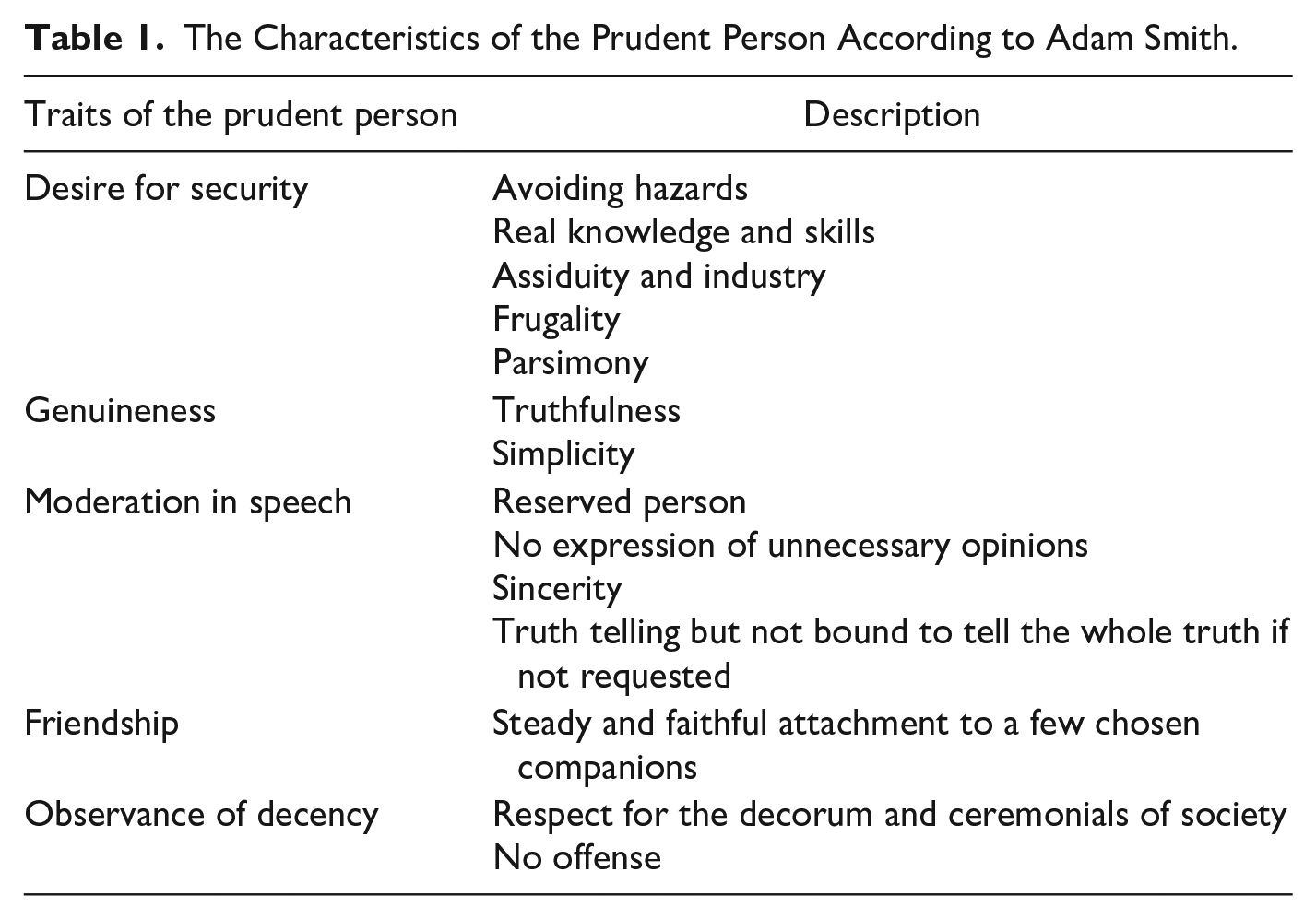
The prudent person, 6 first and foremost, desires security. This leads him or her to avoid “any sort of hazard” (TMS VI.i.6; p. 213). No doubt, Smith is aware that business, commerce, and enterprise require some degree of risk. However, Smith recommends caution and the preservation of present advantages rather than risky business adventures. The methods to increase wealth that Smith promotes are: “real knowledge and skill in our trade or profession, assiduity and industry in the exercise of it, frugality, and even some degree of parsimony, in all our expences [sic]” (TMS VI.i.6; p. 213).
Genuineness is the second aspect that Smith highlights in the character of prudent persons. With genuineness, Smith links prudence to truthfulness and simplicity. In his mind, “the prudent man always studies seriously and earnestly to understand whatever he professes to understand, and not merely to persuade other people that he understands it” (TMS VI.i.7; p. 213). Such genuineness is sought not as an aim in itself, as if it were a consequence of justice, but as a requirement of self-preservation. The maintenance of propriety before the court of public opinion is the result of a reputation built on the solidity of knowledge and abilities.
Prudence also regulates speech. A prudent person “is reserved in his speech; and never rashly or unnecessarily obtrudes his opinion” (TMS VI.i.8; p. 214). Such a person is always sincere and tells the truth. However, “he does not always think himself bound, when not properly called upon, to tell the whole truth” (TMS VI.i.8; p. 214). Truthfulness is an important element in human sociability, and thus Smith discusses how a prudent person relates to their friends and society at large.
A prudent person is “always very capable of friendship” (TMS VI.i.9; p. 214). This prudent form of friendship is “a sedate, but steady and faithful attachment to a few well-tried and well-chosen companions,” not an “ardent and passionate but too often transitory affection, which appears so delicious to the generosity of youth and inexperience” (TMS VI.i.9; p. 214). The natural desire for human sociability and company, in the prudent person, would never seek an outlet in “the convivial societies which are distinguished for the jollity and gaiety of their conversation.” These would be incompatible with “the regularity of his temperance, [they] might interrupt the steadiness of his industry, or break in upon the strictness of his frugality” (TMS VI.i.9; p. 214).
In society at large, the prudent person is “an exact observer of decency, and respects with an almost religious scrupulosity, all the established decorums and ceremonials of society” (TMS VI.i.10; p. 214). He or she never offends anyone, eschewing “petulance or rudeness” (TMS VI.i.10; p. 214). Many great people, Smith complains, “too often distinguished themselves by the most improper and even insolent contempt of all the ordinary decorums of life,” thus misguiding those who wished to imitate them (TMS VI.i.10; pp. 214–215). Table 1 summarizes the Smithian traits of the prudent person.
The Characteristics of the Prudent Person According to Adam Smith.
The Impact of the Virtue of Prudence on Business Activity
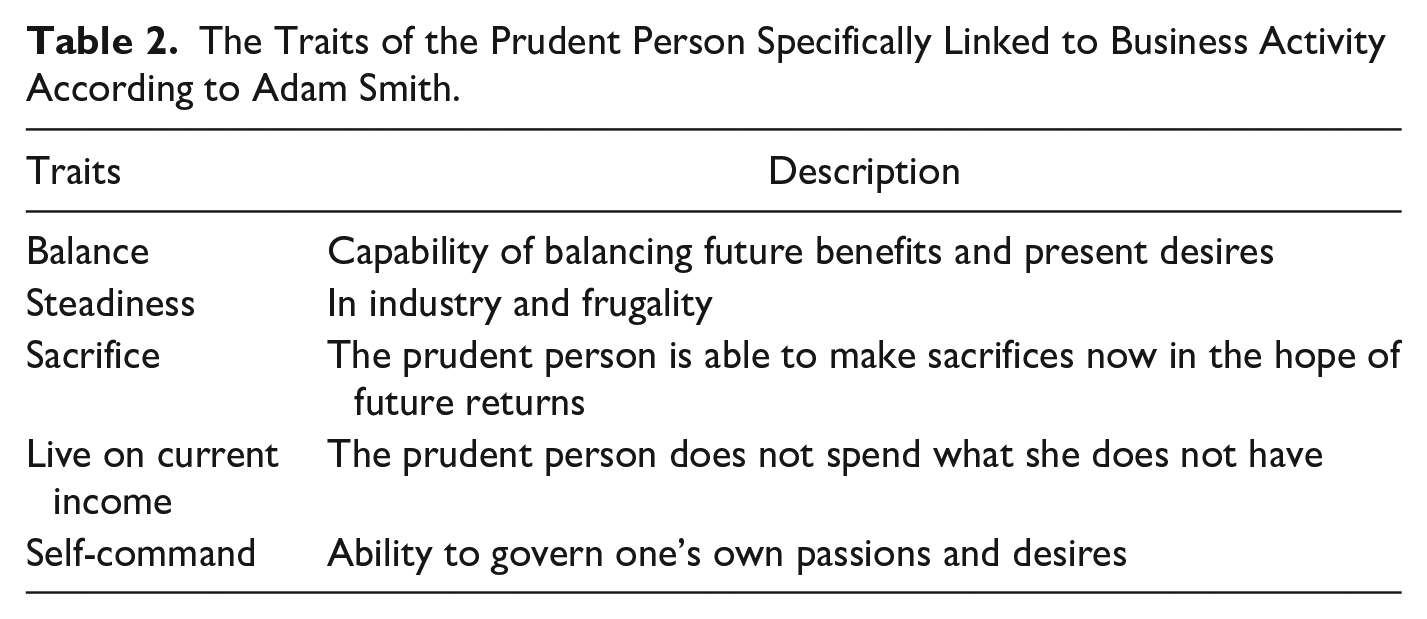
After considering prudence in the portrait of a gentleman, Smith turns to its impact on his business activities. Prudence leads us to exert that self-command over our expectations which makes us consider our future interests with the same degree of demand and urgency as our present desires. Prudence makes businesspersons steady in their “industry and frugality” (TMS VI.i.11; p. 215); it makes them sacrifice “the ease and enjoyment of the present moment for the probable expectation of the still greater ease and enjoyment of a more distant but more lasting period of time” (TMS VI.i.11; p. 215). The Enlightenment was clearly a time of optimism for a feasible improvement of individual life and society. We see this in Smith’s assumption of gradually increasing income, perhaps a reflection of his own biography. For Smith, prudent persons live within their income. Their situation grows better and better by the day through small but continual accumulations; “He has no anxiety to change so comfortable a situation, and does not go in quest of new enterprises and adventures, which might endanger, but could not well increase, the secure tranquillity which he actually enjoys” (TMS VI.i.12; p. 215). Such a prudent person can never be hurried into any new projects and adventures, but “has always time and leisure to deliberate soberly and coolly concerning what are likely to be their consequences” (TMS VI.i.12; p. 215).
It is important to keep in mind that in Smith’s moral system the utility of behavior is not the first ground for approving of it as virtuous. This is especially true of prudence. Prudence, according to Smith, combines “superior reason and understanding, by which we are capable of discerning the remote consequences of all actions, and of foreseeing the advantage or detriment which is likely to result from them” with self-command (TMS IV.2.6; p. 189). Prudence thus consists in the combination of understanding with self-command and is “of all the virtues that which is most useful to the individual” (TMS IV.2.6; p. 189). Nevertheless, it is the goodness of such prudent conduct in itself—not merely its usefulness—that elicits “wonder and admiration.” Only a few people are capable of “a steady perseverance in the practice of frugality, industry, and application,” and the resolute firmness of their character in the face of the difficulty of preferring the future to the present advantage, makes us approve of their behavior even though it is “directed to no other purpose than the acquisition of fortune” (TMS IV.2.8; p. 190). Smith does not admire the “penny-pincher,” nor does he glorify the miser, but he commends the fulfillment of duty in the interest of a personality that fits into the social structure of a civilized and polite society.
Underlying Smith’s system, therefore, albeit unclearly, we find Alasdair MacIntyre’s distinction between external and internal goods of practices (MacIntyre, 2007, pp. 187–203). Usually, virtuous practices aiming at an internal good also achieve the external goods of human success. However, the pursuit of external goods (money, power, pleasure) can corrupt the practices when they become the central motive of our actions. Smith’s version of prudence has health, wealth, rank, and reputation as objects. However, their attainment is not the reason for Smith’s approval of prudence as virtuous. In the divine order of things, Smith teaches, God has decreed that the pursuit of our individual happiness will result in the good of all. The Author of nature has tied “success in every sort of business” to reward for “industry, prudence, and circumspection” (TMS III.5.8; p. 166; see also TMS VII.ii.2.13, p. 298). These traits are virtuous because prudence is harmoniously part of the balanced personality of “the wise and virtuous man,” of whom Adam Smith asserts that he “is at all times willing that his own private interest should be sacrificed to the public interest of his own particular order or society” (TMS VI.ii.3.3; p. 235). Prudence is a virtue because it is one facet of the character of the “perfectly virtuous” person who “acts according to the rules of perfect prudence, of strict justice, and of proper benevolence,” and besides possesses “perfect self-command,” without which he or she could not fulfill their duty (TMS VI.iii.1; p. 237). The first duty entrusted to us is to care for ourselves. No one else is fitter and abler to do so than we (TMS VI.ii.1.1; p. 219). Self-care through the virtue of prudence is thus a duty alongside duties that refer to others. These considerations are an important framework for the following considerations that could otherwise, taken out of context, seem to promote selfishness. It is only in the balance of all virtues that prudence is also one.
The man of the most perfect virtue, the man whom we naturally love and revere the most, is he who joins, to the most perfect command of his own original and selfish feelings, the most exquisite sensibility both to the original and sympathetic feelings of others. The man who, to all the soft, the amiable, and the gentle virtues, joins all the great, the awful, and the respectable, must surely be the natural and proper object of our highest love and admiration. (TMS III.3.35; p. 152)
The virtue of prudence directs a person to confine him or herself, “as much as his duty will permit, to his own affairs” (TMS VI.i.13; p. 215). He or she is not “a bustler in business, where he has not concern; is not a meddler in other people’s affairs” (TMS VI.i.13; p. 215). Smith’s prudent persons hate faction and party disputes, but he also opens the gate to what Alexis de Tocqueville would later call individualism: the withdrawal of interest for public affairs.
When distinctly called upon, [the prudent man] will not decline the service of his country, but he will not cabal in order to force himself into it, and would be much better pleased that the public business were well managed by some other person, than that he himself should have the trouble, and incur the responsibility, of managing it. In the bottom of his heart he would prefer the undisturbed enjoyment of secure tranquillity, not only to all the vain splendour of successful ambition, but to the real and solid glory of performing the greatest and most magnanimous actions. (TMS VI.i.13; p. 216)
7
Such a character, focused on his own wealth, health, rank, and reputation, Smith sums up, is not very endearing, and commands not more than “a certain cold esteem” (TMS VI.i.14; p. 216). It is “inferior prudence” (TMS VI.i.15; p. 216). What if our aims in life are higher, greater, and nobler? This too is prudence and “superior prudence,” as we find it in the “great general, . . . the great statesman, . . . the great legislator” (TMS VI.i.15; p. 216). It is noteworthy that “great merchants” do not appear in this list. Scholarship on Smith points out that Smith’s superior form of prudence looks to the good of the community not to that of the individual—despite his appreciation of prudence as virtue required to become wealthy (Vivenza, 2001, p. 57). Superior prudence “supposes the utmost perfection of all the intellectual and of all the moral virtues. It is the best head joined to the best heart” (TMS VI.i.15; p. 216). Interestingly, Smith associates such superior prudence with the Platonic and Aristotelian tradition of practical wisdom, whereas inferior prudence with the Epicurean school. Smith expands on this remark in TMS, Part VII. He distinguishes three moral systems according to how each of them considers the nature of virtue (TMS VII.ii.3.19; p. 305). The first system posits the essence of virtue in propriety. These are Plato, Aristotle, the Stoics, and Smith himself. Smith sees great differences between his position and that of the Stoics (TMS VII.ii.I.43; p. 292), whereas he identifies with Plato “in every respect” (TMS VII.ii.I.11; p. 270) and with Aristotle “pretty exactly” (TMS VII.ii.I.12; p. 271). Smith’s description of classical ethics reveals that he was aware of the nature and importance of prudence in that school (TMS VII.ii.I.6; p. 268). He nevertheless opts for the bourgeois version of prudence described in this section, in contrast to Aristotelian excellence or the Thomistic understanding of heroic virtue. The second system are the Epicureans, who ground virtue in prudence (TMS VII.ii.2; p. 294-300), understood as calculus of pleasure and pain (TMS VII.ii.2.16, p. 299). Opposed to such reductionism, Smith stays faithful to his understanding of prudence as the “careful and laborious and circumspect state of mind” that is always watchful for the consequences of our actions for our individual happiness (TMS VII.ii.2.8; p.296). Finally, the third system, that of his teacher Hutcheson, was based on altruistic benevolence. Smith does not concur with Hutcheson because self-interest is universally accepted as good alongside benevolence, while “carelessness and want of oeconomy [sic] are universally disapproved of” (TMS VII.ii.3.16; p. 304). If, in contrast, the rule for the virtuous person were mere benevolence, the door would be propped wide open to a carelessness that Smith would consider imprudent. These considerations lead us to Adam Smith’s more specific thought on the economy and the role of prudence therein. Table 2 summarizes the Smithian traits of the prudent person specifically linked to business activity.
The Traits of the Prudent Person Specifically Linked to Business Activity According to Adam Smith.
Prudence in The Wealth of Nations
In his ground-breaking work on political economy, Smith did not develop a theory of prudence, but presupposed his TMS. Vivenza (2001, pp. 54–56) underscores the connection between the TMS and the WN, first, by identifying Smith’s own contribution to the classical sources he used in the TMS (Stoicism and Epicureanism among others) as his reference to economic behavior: “Hence arises that eminent esteem with which all men naturally regard a steady perseverance in the practice of frugality, industry, and application, though directed to no other purpose then the acquisition of fortune” (TMS IV.2.8; pp. 189–190). Second, by reflecting on the renewed attention that Smith gave to prudent business behavior after having written his WN. The TMS sentence quoted above was in the first draft of TMS and, therefore, written in the 1750s. In the TMS sixth edition, published shortly before Smith’s death in 1790, he expanded on his vision of prudence, with particular emphasis on business behavior (see TMS VI.i.4.5-14; pp. 213–216) directed to the “care of health, of the fortune, and of the rank and reputation of the individual” (TMS VI.i.4.14; p. 216). This shows that Smith wrote about prudence in the same terms throughout all his academic life and certainly also well after he had published his economic treatise. As previously noted, the virtue of prudence thus arguably is an important bridge between the two books. Prudence, as the virtue that regulates the selfish passions, cannot but play a pivotal role in Smith’s political economy. Smith links prudence with saving, industry, thrift, frugality, probity, and investment. He observes that most people are filled with the “generally calm and dispassionate” desire to better their condition by an “augmentation of fortune” (WN II.iii.28; p. 341). The most likely way to achieve this, states Smith, “is to save and accumulate some part of what they acquire, either regularly and annually, or upon some extraordinary occasions” (WN II.iii.28; p. 342). Prudence and frugality are thus predominant attitudes among successful businesspeople. However, there is also a clearly social message in Adam Smith’s condemnation of prodigality, the opposing vice. He is strict in saying that “[C]apitals are increased by parsimony, and diminished by prodigality and misconduct” (WN II.iii.14; p. 337). In Adam Smith’s optimistic vision of the economy, the accumulated capital is invested, creating greater prosperity, and benefiting especially the poor classes through rising salaries because of greater demand for labor due to more capital invested in business:
Whatever a person saves from his revenue he adds to his capital, and either employs it himself in maintaining an additional number of productive hands, or enables some other person to do so, by lending it to him for an interest, that is, for a share of the profits. [. . .] Parsimony, and not industry, is the immediate cause of the increase of capital. Industry, indeed, provides the subject which parsimony accumulates. But whatever industry might acquire, if parsimony did not save and store up, the capital would never be the greater. Parsimony, by increasing the fund which is destined for the maintenance of productive hands, tends to increase the number of those hands whose labour adds to the value of the subject upon which it is bestowed. (WN II.iii.15-7; p. 337)
What is not saved, added to the capital, and invested, is spent on unproductive things: idle guests, menial servants, and the like. This, affirms Smith, is a perversion of the proper destination of capital and therefore prodigality (WN II.iii.18-9; pp. 338–339). In contrast, a frugal man who saves and invests “establishes as it were a perpetual fund for the maintenance of an equal number [of productive hands] in all times to come” (WN II.iii.19; p. 338). And this dedication is guarded not by law but “by a very powerful principle, the plain and evident interest of every individual to whom any share of it shall ever belong” (WN II.iii.19; p. 338). The moral and social message is clear: saving and investment create work through greater specialization and further division of labor. Division of labor presupposes the accumulation of capital and the expansion of markets. “The quantity of industry, therefore, not only increases in every country with the increase of the stock which employs it, but, in consequence of that increase, the same quantity of industry produces much greater quantity of work” (WN II.intro.4; p. 277).
Adam Smith’s balanced presentation of saving and investment, his praise for frugality and parsimony are a consequence of his moral system, in which prudence is a virtue of the “wise and virtuous man” who manages to live harmoniously in a commercial society.
Adam Smith’s Virtue of Prudence in the E-Commerce Society
Reviewing Smith’s conception of prudence describes the multifaceted role of this virtue, not only in shaping the character of prudent people, but also in favoring their business success in the commercial society of Smith’s time. The COVID-19 pandemic has accelerated the movement of commerce into the digital space, and e-commerce is likely to become the norm of the present and future society (United Nations Conference on Trade and Development [UNCTAD], 2021). Similar to the birth of the commercial society in the seventeenth and eighteenth centuries (Turner, 2014), we are witnessing the rise of the “e-commercial society.” Although there is abundant discussion about the technical side of e-commerce, the impact that the ethics of e-commerce has on societal welfare has not received the same attention. However, the shift to e-commerce has deeply affected business and society at different levels.
This section looks at the characteristics of e-commerce. Then, it builds a bridge between Smith’s virtue of prudence and the current e-commerce society. Finally, it presents four propositions regarding prudence and the development of its traits for e-commerce users.
Essential Traits of E-Commerce
Definitions of e-commerce agree in characterizing an e-commerce transaction as “the sale or purchase of goods or services, conducted over computer networks by methods specifically designed for the purpose of receiving or placing of orders” (Organisation for Economic Co-operation and Development [OECD], 2011, p. 71). In this definition, the fact that the order is made online characterizes a transaction as an e-commerce transaction. The payment and the delivery of the good or service need not necessarily happen online. E-commerce transactions can involve different actors (businesses, individual consumers, institutions). More companies now offer the possibility of buying through their e-commerce platforms; more and different goods are offered through e-commerce to final consumers; and also new classes of consumers have entered the e-commerce market, for example elderly people (OECD, 2020).
There is abundant literature on technical aspects of e-commerce: business models for e-commerce (Wirtz, 2021), artificial intelligence in e-commerce (Bawack et al., 2022), marketing in e-commerce (Chaffey et al., 2019), technical aspects of e-commerce platforms (Laudon & Traver, 2019), and many other topics. Publications have also raised social concerns: e-commerce platforms and the widening of the “digital divide” (van Dijk, 2020), worsening inequality between countries (OECD, 2020), and creating the need for investment in digital literacy (UNCTAD, 2021). Furthermore, the expansion of e-commerce has been explored in the perspective of its impact on both business and society: Which new possibilities digital technologies offer for business to develop online, and what this shift implies in terms of job creation, allocation of resources, production processes, and so on (Flyverbom et al., 2019).
Although the academic, institutional, and corporate accounts of e-commerce abound in defining the advantages and risks of this phenomenon, and in characterizing the skills needed by companies (e.g., capacity to innovate) and consumers (e.g., digital literacy), the moral traits needed for a well-functioning e-commerce society are not discussed. However, as Adam Smith points out, the virtues are fundamental to sustain the smooth and prosperous functioning of a commercial society and so, we affirm, mutatis mutandis, of an e-commercial society. Thus, considering Smith’s account of prudence, we now describe the relationship between the e-commerce society, prudence, and the good of society.
Smith’s Virtue of Prudence in the E-Commerce Society
Literature in business ethics and business and society has reacted to the rediscovery of the relationship between Smith’s moral proposal and his view of the commercial society. The mistaken—and nowadays obsolete—assumption by a portion of academic literature that considers the Scottish philosopher as a supporter of the separation between ethical and economic motives was abundantly criticized. Hühn and Dierksmeier (2016) affirm the thesis underlying our own study, that Smith had a moral vision of business; Graafland and Wells (2021) confirm this thesis applying the method of digital humanities to Smith’s work. Thanks to these studies (and to those previously mentioned, together with other published works, see Hühn, 2019; Werhane, 2000), we have consistently argued that Smith was a strong advocate for the necessity of individual moral virtues in the context of the commercial society, and that his work is still relevant for the analysis of the relationship between business and society in our own time. We share the perspective of the “real Adam Smith” (Hühn and Dierksmeier, 2016) who has a lot to offer to us today. 8
In assessing Smith’s notion of prudence as fruitful for the e-commercial society, it would be an error to suggest Smith’s writings could provide a direct answer to the contemporary problems of society whose technological innovations and complexity he could not foresee (Graafland & Wells, 2021). It is, therefore, important to use his thought wisely as a lens to discern some dynamics of the e-commercial society. E-commercial activities are essentially commercial transactions, even though they are performed online. The essence of the transaction as intrinsically commercial is self-evident—this is why we can make use of Smith’s works—and we must acknowledge the specificity of the e-commerce setting if the cultural transposition exercise that we are conducting is to succeed.
Graafland and Wells (2021) study the essential place of the virtues and vices according to Smith in the relationship between free market economies and societal flourishing (Graafland & Wells, 2021, p. 40). Their study includes prudence and its frequency in Smith’s works. These authors affirm that the relationship between a free market economy and the virtue of prudence in Smith’s system is complex and ambiguous: In Smith’s works, there are 31 occurrences of the virtue of prudence as positively encouraged by a free market economy but also 23 occurrences that show how the free market economy can support the development of the opposite vices (such as imprudence, rashness, ignorance, negligence). Moreover, according to that study, prudence is the second-ranked virtue with regard to its capability to contribute to societal flourishing, preceded by temperance, and followed by benevolence, justice, industriousness, and courage (Graafland & Wells, 2021, p. 40).
From the data that Graafland and Wells use to construct their framework, it is possible to extract a sub-framework that specifies the relationship between a free market economy and the virtue of prudence, and between the virtue of prudence and societal flourishing. Although Graafland’s and Wells’ (2021) framework provides the evidence of the existence of a relationship between the free market economy, prudence, and societal flourishing, our framework describes the quality of the relationships whose existence they prove. To clarify how our study is positioned, Figure 1 synthesizes the place of the four distinct relationships that our thesis considers in the study of the traits of prudence and their impact on the behavior of e-commerce users.
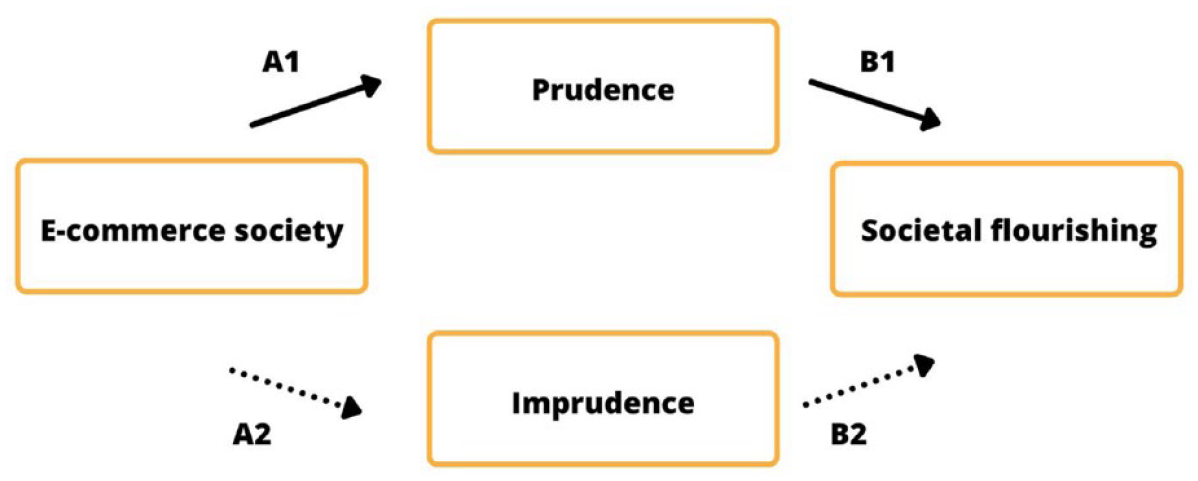
The Role of the Virtue of Prudence in the Relationship Between the E-Commerce Society and Societal Flourishing.
Two notes for the reader in looking at Figure 1: as point of departure for our framework we have chosen the concept of e-commerce society in particular, instead of the free market economy in general. Indeed, based on the definition that Graafland and Wells (2021) give of “free market economy,” 9 we can easily subsume the notion of “e-commerce society,” which we use in this article, under their research because e-commerce is a modus operandi of the current free market economy. Regarding the point of arrival of the framework, Graafland and Wells refer to societal flourishing, and they define it as “the collective prosperity and welfare of a society” (p. 35). They specify a wide understanding of the notions of “collective” and of “welfare,” making the concept of societal flourishing resemble or practically coincide with the “common good,” typical of a person-centered ethical approach (Schlag, 2017; Schlag & Mercado, 2012; Sison & Fontrodona, 2012). Given this resemblance, we will keep the expression “societal flourishing,” having in mind that its content can be further detailed in the language of the common good.
The relationships labeled as “A” (A1 and A2) describe how the e-commerce society can influence the development of the virtue of prudence (A1) or of the vices opposed to this virtue (A2). The relationships labeled as “B” (B1 and B2), describe how the cultivation of prudence can support the flourishing of a society where e-commerce operates (B1), or how, conversely, the cultivation of the vices opposed to prudence can affect it negatively (B2). The next section analyzes and describes the relationships A1, A2, B1, and B2 highlighted in Figure 1 in light of the analysis of the traits of prudence in general and in connection to business activity, as previously presented.
Smith’s Virtue of Prudence for Consumers in the E-Commerce Society
Applying Adam Smith’s thought to a reality that he did not experience himself, makes it impossible to retrieve in his writings the verbal occurrences of concepts related to e-commerce. Thus, we apply a conceptual methodology based on the accurate study of prudence in Smith’s writings and on e-commerce literature. This section combines the characteristic of the prudent person according to Smith (Table 1) and the traits of prudence specifically linked to business activity according to Smith (Table 2) with the characteristics of e-commerce from the perspective of users, with the aim of offering a descriptive account of the relationships A1, A2, B1, and B2 (Figure 1).
Our analysis builds on the study of prudence previously presented, instead of on the sub-virtues and sub-vices highlighted by Graafland and Wells (2021): The analysis offered in this article, not being bound to the strict parameters of the empirical methods imposed by digital humanities, is able to provide a narrative (thus, from a descriptive perspective, more accurate) characterization of the traits of prudence according to Smith. Differently from Graafland’s and Wells’ analysis, our exegetic methodology used throughout the first section of the article allows us to portray the prudent person more in-depth and in the context of a purely ethical methodology. We seek to explain how prudence contributes to business activity in a way that is closer to the mind of Smith and can extrapolate its impact on e-commerce from our analysis in a manner that is faithful to the intentions of the Scottish philosopher. The traits of the prudent person specifically linked to business activity (Table 2) are the ideal descriptors of the relationships A1 and A2, which are concerned with the way e-commerce creates the conditions (or not) for the development of the virtue of prudence. We have chosen the descriptors in Table 2 because with them Adam Smith applies his conception of prudence to the business activities of an individual in the commercial society. The characteristics of the prudent person as described by Smith (Table 1) are the descriptors we use to specify the relationships B1 and B2, concerned with the way prudence in e-commerce contributes to societal flourishing (B1) or, conversely, how imprudence hinders the development of societal flourishing (B2).
We reference our analysis with e-commerce literature. We tap mainly into literature on consumers’ behavior in e-commerce: The characteristics of the consumer are essential variables for purchasing behaviors. Among these characteristics are not just age, gender, education, and ethnicity, but also habits and personality (Turban et al., 2015, p. 406). This is where virtues come in.
How E-Commerce Boosts the Traits of the (Im)Prudent Person Linked to Commercial Activity
The relationships identified as A1 and A2 (Figure 1) are characterized here. They link the functioning of e-commerce with the virtue of prudence, positing e-commerce as a context for the potential emergence of two pathways, a prudent attitude, or an imprudent one. We show how e-commerce, as a context of human choices, can either boost or hinder the traits of the prudent person linked to economic activity: balance, steadiness, sacrifice, live on current income, self-command (Table 2).
Balance
Balance is the capability of balancing future benefits and present desires. On the one hand, e-commerce creates the conditions to develop balance. For example, e-commerce facilitates the evaluation of different options in a quicker and inexpensive way, thus favoring balance. Efficiency is considered one of the distinctive benefits of e-commerce (Gajewska et al., 2019), compared with brick-and-mortar shops: Customers can easily move between webpages, with no transaction costs, and take time to make their evaluation, having the opportunity to develop the Smithian trait of balance.
On the other hand, e-commerce can negatively affect balance if consumers cede to marketing strategies promoting consumerism, favoring the satisfaction of current desires. Digital advertising targets consumers in a personalized manner according to their demographic profile (age, gender, and other variables, see Sartor et al., 2021), thus inducing users to buy more or other goods than they need. Thus, e-commerce can foster imprudent purchases and unbalanced expenses.
An example of the exercise of balance is the “abandoned cart.” 10 From the consumer standpoint, an abandoned cart means loss of interest or prolonged reflection. In this latter case, the trait of balance is in action. Empirical studies of the abandoned cart phenomenon point to “evaluation” as one of the keys for this behavior: “online evaluation occurs when the online shoppers review the cart contents and analyze the items in the evoked set based on their past experience and unique purchase criteria” (Kukar-Kinney & Close, 2010, p. 242). This evaluation is a symptom of balance as trait of prudence. E-commerce companies have specific strategies to reach out to consumers who leave items in carts without purchasing them (e.g., follow-up emails, pop-up windows while the consumer still is on the website). The customers’ reactions to these prompts to act are indicators of their capability to balance “future benefits and present desires.”
Steadiness
Steadiness is described as perseverance in industry and frugality. E-commerce reduces the time that users would spend in malls and in trips to physical shops. It seems that consumers “are driven more and more by time poverty and not just by income” (Sheth, 2021, p. 599). This can increase productivity and generate more income, promoting high levels of steady engagement in other activities, especially in one’s work.
However, e-commerce and attractive web design can generate a lack of steadiness in industry and frugality in consumers, inducing loss of time and productive work due to excessive netsurfing in e-commerce websites. This attitude promotes laziness, which is directly opposed to industriousness (Rocchi & Bernacchio, 2022), thus also to steadiness as element of Smithian prudence.
An example of how e-commerce favors customers’ Smithian steadiness is the concept of user experience (UX). Companies have UX teams to make the customer’s journey through an e-commerce website seamless (thus, quicker and more efficient). A user who has a smooth experience when they go online, make the transaction, and exit the platform is a win-win for everyone involved: From an ethical standpoint, this person is enabled to exercise steadiness (no time-waste, acquisition of the needed item, back to productive activities); from a business perspective, the e-commerce website concluded a commercial transaction and has a return on the investment made on UX. A UX which is not designed in a user-centered way endangers users’ steadiness, making customers lose time that could have been dedicated to other productive activities. Su et al. (2020) studied the UX of Virtual Reality (VR) applied to e-commerce. “Can users solve their tasks without unnecessary effort?” (Su et al., 2020, p. 245), is one of the questions used to evaluate UX VR design: this question has Smith’s steadiness at its core, as it directs the effort of e-commerce websites to use users’ time and energies in an efficient way.
Sacrifice
Sacrifice is the capability to deprive oneself of something now, in the hope of future returns. In e-commerce platforms, there is objectively no physical pressure to acquire—the targeted ads are very attractive and persuasive but saying “no” is not a matter of interaction, as it is in the case of speaking face to face with salespersons. This strengthens the capability of the consumer of renouncing in the present to save for the future. However, the easiness of e-commerce can also stimulate vices contrary to sacrifice: profligacy, wastefulness, consumerism, immediate gratification of whims, and the like.
Sacrifice needs the exercise of virtuous behavior. The e-commerce revolution made it possible to buy anything anytime from anywhere, and the availability of “everything” seems incompatible with the idea of renouncing something. It is interesting to pair Smith’s analysis of sacrifice with the concept of “insatiability” discussed by Skidelsky and Skidelsky (2012): The manipulation of wants and the exploitation of insatiability are typical of the capitalist logic. E-commerce, thanks to digital technologies, expands this logic, and makes consumers more vulnerable unless they are equipped with virtuous habits (see the propositions formulated below). An established Smithian trait of sacrifice would resist the “availability of everything” and the insurgence of insatiability, while a character less trained in sacrifice cedes more easily.
Live on Current Income
In Smith’s taxonomy, the prudent person lives on current income (i.e., does not spend what she does not have). The paradigm of material accumulation stimulates consumers to live on a high level, at least on that of their peers. This can generate a tendency to live beyond one’s income, driven by the desire to imitate a lifestyle beyond one’s own means.
This tendency can be reinforced by e-commerce, and the “live on current income” trait can be adversely affected by the ease of consumer credit, overdraft of credit cards, the lure of payment in multiple installments, and other forms of monetary expansion. This is specific to e-commerce as e-commerce transactions happen through those payment methods. The availability of these—potentially uncontrolled—mechanisms to expand consumers’ credit also reflect an anxiety that can be characterized as restlessness or nervousness in the midst of prosperity (Bellah et al., 1996).
There was a substantive increase in the amount of credit card debt in the United States in 2022 (Federal Reserve Bank of New York, 2022). Obviously, not all of this debt originated in e-commerce. However, research shows that consumers pay more when the transaction occurs via credit card (the typical form of online payments) than with cash transactions; and in addition, credit availability in e-commerce platforms is used as a marketing tool to attract more buyers (Xie et al., 2021). This violation of Smith’s trait of prudence “live on current income” in the e-commercial society is likely to increase the presence of the “new poor” within the society of consumers (Bauman, 2005). Consumerism is a clear symptom of a lack of prudence with respect to “living on current income.”
On a more positive note, it is also true that the e-commercial society and the related greater e-market transparency can help keep online shopping within one’s current cash availability: If users have the sufficient moderation not to apply for credit they do not need, then buying online through online payment systems can help consumers to balance their resources by tracking expenditures and taking the time to assess economic availability and personal needs before clicking the buy button. Popular credit card providers (e.g., Revolut) provide customers with analytics and budget planner functions, which can improve this trait of prudence. Moreover, e-commerce reduces costs because it makes it easier to compare options, choosing the most suitable alternative. There is evidence of a decrease in brand loyalty in e-commerce, as consumers can explore different options and might privilege options that were not known before, resulting in cheaper expenditures (Charm et al., 2020).
Self-Command
Finally, self-command is an important corollary in Smith’s understanding of prudence as protection of wealth, health, rank, and reputation. He defines self-command as the ability to govern one’s own passions and desires. As already explained, according to Smith prudence governs the selfish passions. Self-command is put to the test with the availability of goods that are a click away, with no need to leave one’s house or to collect items that are brought to one’s doorstep. People suffering from shopping addiction are exposed to a new dimension of temptations and pitfalls.
In the e-commerce literature, impulse buying is a recurrent topic: Impulse buying describes the urgency to buy a product or service due to its accessibility, and this attitude is linked to personal and situational factors (Mattia et al., 2022). E-commerce increases the chances of impulse buying, and consumers can feel compelled to buy or, exercising self-command, they can take time to reflect on their real needs and decide whether to proceed with the online transaction or not. Self-command fosters restraint in buying only necessary goods and services. However, greater ease and speed may reduce self-restraint. Users tend to buy unnecessary goods and services, thus reducing their available income.
Some e-commerce strategies test the Smithian trait of self-command. One is the “buy with one click” option, present in many e-commerce websites. Even if quickness seems attractive, users are always in control of the click (unless psychological conditions affect self-command). It is then a matter of habituation to exercise self-command when multiple options are one click away. Channeling customers to purchase through the delivery of e-coupons for e-commerce is another example (Li et al., 2022). Users with developed self-command evaluate an online offer based on their perception of the real need for an item; users without the trait of self-command tend to take the bait and buy, attracted by the discount, even if the goods are not necessary. Finally, time-limited offers or countdowns displayed when items are in the e-cart are also strategies that test self-command by generating pressure on the consumers (Peng et al., 2019).
Self-command spans many and different habits of a person: How a person works, eats, drinks, shares, manages her time. The exercise of self-command in e-commerce is natural only if a person can exercise this trait of prudence across the full range of activities that she performs. The unity of the virtues (MacIntyre, 2007) reflects this coherence also within the exercise of a specific virtue: If a virtue is not exercised within the narrative unity of a person’s life, good actions shown in a situation might be the successful effort of a moment or a fortuitous circumstance, rather than the deliberate act of choosing to do good constantly, with potential successes and defeats.
Propositions
This account of the relationship between the opportunities offered by e-commerce and the development of the Smithian traits of prudence (or their opposite vices) might seem relativistic unless we consider how virtues form within the individual person. On this question, Smith’s writings are not particularly helpful, as he does not describe directly how virtues are formed, at least not in his published works. Smith makes explicit reference to Aristotle’s system of virtues in the TMS (VII.ii.1.12-14, pp. 271–272; Fitzgibbons, 1995), so we can borrow the seemingly cyclical description of the origin of virtue from Aristotle, that only those who are prudent know what prudence is. This definition is not cyclical or tautological because Aristotle is describing the good life of the individual, rooted in the polis, with its cultural assumptions of what constitutes each individual virtue. Only animals or gods could live outside of the political community of the polis; a human being needs community life as the matrix of virtues. In other words, virtues need education and guidance through parents, teachers, and role models (Aristotle, 1944, Book I, especially 1253a 19-29).
Our analysis has shown how e-commerce can be a context for the flourishing of prudence or reinforce the opposite vice. However, the people who land on e-commerce platforms are not morally blank when they approach e-commerce as a context for their actions. They are people with their own narratives, with already established moral habits. Considering the analysis conducted and the way how virtues develop, it is reasonable to affirm that e-commerce amplifies existing virtues and exacerbates existing vices, as it offers a specific and complex context of decision-making, which touches in particular the habits related to the virtue of prudence.
In this sense, it is possible to synthesize the findings of this first part of the study in two propositions.
Proposition A1: The context of the e-commercial society reinforces the development of the Smithian traits of prudence linked to commercial activity if a person already shows a disposition toward the virtues.
Proposition A2: The context of the e-commercial society can corrupt the development of the Smithian traits of prudence linked to commercial activity if a person is used to following unrestrained selfish passions.
These propositions describe two opposite pathways related to the functioning of the e-commerce society: These pathways are related to the pre-conditions a person has before approaching the context of e-commerce, which can be the arena where acquired virtue is magnified or existing vice consolidated. The pre-conditions are not last words: A vicious person might desire a virtuous life and, looking at the behavior of other people within the e-commerce context, might choose to strive for a virtuous life. Individuals can choose to establish what the effects of the availability of e-commerce platforms on their moral habits are. What is interesting to note is that specific circumstances can actually help develop particular kinds of virtues, or promote specific vices (see Rocchi & Bernacchio, 2022, with regard to working from home as context to develop some virtues/vices). In our analysis, it is e-commerce that makes available some modes of action which stimulate the reinforcement of existing good or bad habits of character, without creating them. E-commerce reinforces whatever is the best or the worst in us.
Our study seems to confirm an insight of Röpke that free markets cannot create the moral and social preconditions for their own existence. Competition, the free interplay of demand and supply cannot generate the moral reserves, like trust and reliability, that give structure and support to fluid business exchanges (Röpke, 1958, Chapter 1). E-commerce as a dimension of the free market lives off moral and ethical resources that society at large provides. Markets are sustained by a moral-cultural matrix but they also exercise and train the virtues by putting them into effect in the e-commerce setting. We, therefore, now turn to how prudence, exercised in the context of e-commerce, contributes to societal flourishing.
How the Virtue of Prudence in E-Commerce Supports Societal Flourishing
This section builds on the characteristics of the prudent person (security, genuineness, moderation in speech, friendship, observance of decency, see Table 1) as the ideal descriptors of the relationships B1 and B2 (Figure 1), concerned with how prudence in e-commerce contributes to societal flourishing. We have chosen the descriptors in Table 1 for this analysis because with them Smith describes the contribution of prudence to the harmony in society.
Security
The desire for security in Smith’s prudent person is linked to avoiding risk and hazards and rooted in real knowledge of the situation and in the desire to build income through industriousness and frugality. Applying this descriptor of prudence to the e-commerce society means entering the heated debate on data, governance, power, and surveillance. Under the cloak of risk avoidance, consumer protection, but also public security and transparency, consumers’ data have become one of the most valuable assets for successful businesses—and this fact poses clear threats to security. Besides, it builds wealth on data availability. As Zuboff points out, we live in the age of “surveillance capitalism,” which “unilaterally claims human experience as free raw material for translation into behavioral data” (Zuboff, 2019, p. 8). In e-commerce, this can be seen as the passage from selling goods online to selling audiences (West, 2019). In surveillance capitalism, the exercise of security as trait of prudence in e-commerce means to be particularly aware, as consumers, of the quantity of information given about ourselves, our preferences, habits, and how this information is constantly traded.
In e-commerce this also means to apply good judgment to concrete situations (e.g., to the risks connected to online shopping), in particular related to the e-commerce security environment (Laudon & Traver, 2019, pp. 242–250). Data breaches, ransomware, malware, hackers’ attacks are caused by people who deliberately act against justice, with the intention of harming others and of benefiting from other people’s vulnerability and lack of cautiousness: To avoid being caught in these situations, the users’ self-protective behavior to stay safe and secure is the element of prudence they should cultivate. The attacks on cybersecurity impact the good of society, whose trust in technology is deeply shaken and that bears the economic losses.
In contrast, behavior that supports awareness of these risks and safe online practices (e.g., choosing strong passwords or not repeating the same password in different websites) develops the trait of security based on knowledge (attending educational programs to increase awareness of online security) and industriousness (proactivity in using only safe and trustworthy e-commerce platforms). Training in cybersecurity is now offered by companies worldwide. Such training directly contributes to societal flourishing, raising awareness and literacy in a complex field. An example of the exercise of Smithian security is given by the knowledge and recognition of the https protocol, an encrypted protocol of data transfer accepted worldwide as a standard of cybersecurity across e-commerce websites. This is important for e-commerce websites because they continuously process payments, handling sensitive financial information. Setting double-factor authentications or facial recognition systems where available are also signs of cultivation of the Smithian trait of security.
Genuineness
Smith defines genuineness as the trait of a person who displays truthfulness and simplicity. In contemporary terms, we might say transparency. This term has acquired different connotations. On one hand, transparency is one of the main drivers of online purchases (Zhou et al., 2018): The availability of information in different moments facilitates an e-commerce purchase. In e-commerce, genuineness or, as mentioned, transparency, is particularly related to the truthfulness of accurate reviews of goods and services, for the benefit of other users. This creates trust and efficient e-commercial transactions, thus contributing to the good of society. On the other hand, false, incomplete, or misleading reviews create distrust and increase transaction costs. This is especially the case with bought reviews, not grounded in reality.
Genuineness and security might seem at odds when it comes to the context of our e-commercial society: The desire for more transparency contrasts with the right to privacy. The meaning of transparency spans across different domains: Transparency can be perceived as monitoring or process visibility, surveillance or disclosure (Bernstein, 2017). In the context of contemporary society, Han (2015) describes the society of transparency as “not a society of trust, but a society of control” (p. vii), where “social media are also coming to resemble, more and more, digital panoptica that discipline and exploit the social” (p. viii). This analysis reinforces the need of genuineness as a trait of prudence, because the exercise of transparency should aim at personal flourishing and the good of society. This teleological orientation of transparency is possible only within a culture where virtues are rewarded and vices punished.
An example of genuineness from the consumers’ perspective is the identification and reporting of “dark patterns.” 11 Dark patterns are a form of deception, and a lack of transparency. Virtuous users who report dark patterns contribute to the flourishing of the e-commercial society; in contrast, users who are not trained in the perception of genuineness and transparency will make unwanted choices (hidden subscriptions, hidden costs, etc.—see Karagoel & Nathan-Roberts, 2021 for a list of dark patterns in e-commerce websites), incur unplanned personal costs, and increase distrust toward e-commerce.
Moderation in Speech
For Smith, the prudent person is moderate in speech. This is an example of constraining the unrestrained passions: The prudent person expresses herself with sincerity, is reserved, and does not express unnecessary or offensive opinions. The prudent person does not make themselves noticeable by imposing an opinion in an unwelcome or intrusive manner. Temperance or moderation in restraining our natural passions is desirable for societal flourishing and, hence, has utility (Ross, 2010, p. 171). This is particularly so with speech.
Moderation in speech is applicable to e-commerce. The quality of online reviews left by users in e-commerce platforms provides an example of this Smithian trait. Positive feedback creates a culture of affirmation, encouraging people to produce useful and desirable goods and services and to participate in societal flourishing. Similarly, negative feedback and comments, if truthful and not offensive or hateful, may improve products and services for the entire community and, hence, contribute further to societal flourishing.
However, online reviews also have a negative side. First, there is the problem of anonymous remarks. Anonymity contradicts prudence and disincentives moderation in speech. Second, there is the problem of not simply immoderate speech but hateful and destructive comments. They discourage truth and encourage falsity. Such comments disincentivize participation in e-commerce platforms and contradict principles of inclusion, equity, and diversity.
Friendship
Friendship according to Smith is the trait of prudent people who select and faithfully preserve good companions. Already in the 1980s, Bellah, studying individualism and commitment in American life, noted that of the three traditional elements of friendship (utility, pleasure, common good), we have culturally lost the third and most important one, that of the good (Bellah et al., 1996, pp. 113–141). This is especially true of business in general, and even more of e-commerce. How can harsh competitiveness that produces restless and anxious people sustain enduring self-giving relationships? The most they can promote is “friendliness,” as a lubricant for business dealings and “as a means of assuaging the difficulties of these interactions, while friendship in the classical sense became more and more difficult” (Bellah et al., 1996, p. 118). In e-commerce and the digital world of virtual contacts and “friends” whom we give “likes,” true community and friendship are difficult, to the point that Turkle describes how, through digital media, we are essentially “alone together” (Turkle, 2011). Friendship requires personal interaction that allows the potential friends to know each other deeply, to grow in mutual appreciation, until the other person becomes the center of one’s joys, cares, and concerns. Lewis (2017) expressed the essence of friendship in classical words: “Friendship is unnecessary, like philosophy, like art, like the universe itself . . . It has no survival value; rather it is one of those things which give value to survival” (p. 90). Commerce produces such friendship only as a by-product of interactions based on utility. Business friends, members of a supportive network, can over time become real friends. Therefore, looking at our society, Smith would have had difficulty in finding friendship as he describes it. Nevertheless, the innate human tendency to companionship and community also shapes e-commerce. Friendship as element of prudential decision-making in e-commerce can be observed in the following phenomena.
Consumer networks, mutual support groups, and rankings of consumers (not only hosts or service providers) are increasingly influential. Users jealously control the number of stars they receive as customers: This influences their reputation in society and among their friends, and their clout in networks. Thus, in e-commerce, the cultivation of friendship requires as first step to belong and contribute to consumers’ networks. Virtuous e-commerce consumers seek “support to connect with like-minded peers” (Turban et al., 2015, p. 27). Literature describes the emergence of the “social customer,” who is “willing to provide feedback” and “product reviews” (Turban et al., 2015, p. 26). Such proactive and selfless behavior is a form of gift that can initiate virtuous circles of reciprocity, thus giving rise to a deeper relationship of mutual exchange of self-giving even in the e-commercial space. Virtuous cooperative use of e-commercial possibilities creates links of social friendship that augment social cohesion. Buying locally even on e-commerce platforms that give access to products worldwide, can strengthen social embeddedness of businesses. Conversely, the use of fake profiles to influence wrong buying choices, sometimes performed for money, damages others and is opposed to social friendship.
An example of how powerful online consumer networks can be is Yelp. Lawrence and colleagues (2023) show that “a one-star increase in an independent restaurant’s Yelp rating led to a 5 to 9 percent increase in revenue” (p. 14). Yelp bridges online reviews and physical stores, merging the e-commerce and the physical dimension. This suggests that the exercise of Smithian friendship can support a flourishing e-commercial society, while its opposite vice (whose external signs are made-up reviews, fake profiles, or anonymous inappropriate comments) does not support societal flourishing.
Observance of Decency
This Smithian trait expresses the respect for the moral rules of society which enable people who are not fully virtuous to behave with a minimum of decency and decorum. Following Smith, observance of decency is necessary for the operation of civil societies. These rules also enable us to see through what Smith describes as the “veil of self-delusion” (TMS III.4.4, p. 158; i.e., a sober assessment of our conduct and behavior). Consequently, the prudent person preserves decency in both conduct and conversation. Such an individual “hates the thought of being guilty of any petulance or rudeness” (TMS VI.i.10, p. 214). More than all other traits, decency is subject to variations of time, place, and culture. What constitutes decent behavior depends not simply on an agreed set of moral rules but also on the symbolical elements of a culture. Groups define themselves by symbols that express meaning, signal status and emotions. Smith lived in a society that was very different from today, with relationships built around ideas of deference and mutual obligation. The forms of expression of young people on social media and the internet vary so much from those of older generations that communication frequently requires a meta-level of translation. What constitutes decency in e-commerce is more dynamic, in continuous development, and difficult to define in precise ways. Nevertheless, there are principles that we can derive from Smith’s ideas of decency which are fruitful also for the e-commercial society.
Users can grow in the observance of decency in e-commerce by encouraging producers to make good products available, leaving positive reviews when they are deserved, and bearing the costs (e.g., in terms of time) of giving negative feedback, when appropriate. Respect for others and choice of language are other principles of direct application for today’s idea of decency. The definition of a good product would include both positive and negative criteria. On one hand, this could include purchasing products and services which reflect values of environmental sustainability, transparent and ethical supply chains and, on the other, avoiding products considered offensive, unhealthy or dangerous.
Smith argued that the basic moral principles were clear whatever the philosophical system that shaped society. Smith regarded expressions of anger and disrespect as offensive. How do we deal with the complex issue of the rules and values that constitute decency in an age of diverse and changing moral norms? Margalit and Goldblum (1998) draw a distinction between a decent and a civilized society. This helps society avoid being hypocritical by an outward show of respectability but inward suppression of open expression. In a civilized society, we should be wary of restraining individual expression without denying a decent society, for its own good, the right to impose institutional restrictions on expression. This approach may, at least, offer some way of reconciling postmodern idealism with Smithian moral sentiments within the e-commerce sector.
An example of the enforcement of the trait of decency in the current scenario is the attempt to regulate what e-commerce platforms offer. There might be a need, as with the Communications Decency Act in 1996 in the United States and the recent European regulations on digital services, to find a normative way to implement the trait of decency worldwide, especially to protect vulnerable categories of consumers and avoid the exploitation of people on e-commerce websites.
Propositions
The characterization of the relationships B1 and B2 links the development of prudence in e-commerce with societal flourishing. According to our analysis, we can affirm that, in e-commerce, the cultivation of the Smithian traits of the prudent person positively contribute to societal flourishing. The following propositions crystallize this finding:
Proposition B1: Cultivating the Smithian traits of the prudent person in e-commerce positively contributes to societal flourishing.
Proposition B2: Not cultivating the Smithian traits of the prudent person in e-commerce negatively contributes to societal flourishing.
These propositions describe how the development of prudence in e-commerce fosters societal flourishing, or, conversely, how ceding to the opposite vice hinders societal flourishing.
How Can E-Commerce Contribute to Societal Flourishing? “Wise Choice” and Practical Implications
The application of Smith’s notion of prudence based on the commercial society of his time to e-commerce shows that his analysis remains substantially valid, but today the stakes are higher, the pendulum between prudent and imprudent business behavior swings out much further and with greater sensitivity and force. Is there any descriptor of individual prudence that Smith would add today? We think that there is one we could call “wise choice.” Smith was aware that people even in his commercial society, when there was “wantonness of plenty,” spent their income on “trinkets and baubles,” (WN III.iv.15, p. 421) but the extent of this expenditure was limited by the technology of his time, labor and manufacturing, still without the industrial use of the steam engine or other technologies that expanded mass production and converted luxury goods into “necessities.” In contemporary developed economies, there is not only a flood of goods but such a wide variety of very similar goods from which to choose that it can be confusing, overwhelming, and—paradoxically—even reduce the sensation of freedom. This availability is heightened by e-commerce. The prudent person will be wise in their choice, comparing products and consulting independent customer satisfaction reports. In addition nowadays, ethical demands of consumer responsibility consider treatment of employees, modes of production, and supply chains. More than in Smith’s times, choice has become an element for prudent consumer behavior.
Considering the four propositions, this concluding section presents practical implications that can inform e-commercial business and society relationships with Smithian prudence. First, there arguably is a need for education in the virtues, including prudence. The question is no more whether we need to teach ethics in business schools, but how to teach business ethics (de los Reyes et al., 2017): this article shows the long-lasting relevance of teaching virtues in business. Integrating the teaching of virtue ethics through an author like Smith within the business schools’ curricula seems an attractive approach, given his reputation.
Second, notwithstanding the existence of laws that regulate business for the good of society, ethics goes beyond compliance. Virtues aspire to excellence and are not satisfied by a minimum. Finally, at a time in which public authorities like those of the European Union are formulating strategy along the lines of the Digital Services Act and Digital Markets Act, the provision of education on both the technical and the ethical side of e-commerce, directed to the wider public, might be part of the service that institutions offer for societal flourishing.
Conclusion
This article contributes to the ethical reflection on e-commerce, through presenting four propositions that assess the behavior of users of e-commerce platforms in light of the virtue of prudence, as presented by Adam Smith—eminent theorist of the commercial society.
The first section reviews prudence in Smith’s works, extracting foundational characteristics of the prudent person (Table 1), and essential traits of the prudent person linked to business activity (Table 2). The second section presents a characterization of e-commerce, thus giving the context for the application of Smith’s prudence to the current trends of our free market economy. The relationship between the e-commerce society and the virtue of prudence and its opposite vice is described through the traits of prudence linked to business activity, and this thorough description led to the formulation of Propositions A1 and A2. E-commerce is a fertile terrain for the development of prudence if those approaching e-commerce platforms already tend to virtuous behavior; while e-commerce amplifies the development of imprudence in those who already show a tendency to unrestrained passions. Then we explore the relationship between prudence in e-commerce and its positive contribution to societal flourishing through an analysis of the Smithian traits of prudence in e-commerce. Proposition B1 synthesizes this effort, and Proposition B2 confirms that the cultivation of traits contrary to Smithian prudence negatively impact societal flourishing.
In addition to contributing to the literature on the ethical reflection of e-commerce and its impact on society through the conceptualization of the presented framework, this article opens avenues for future research. For example, the work performed regarding prudence can be done for other Smithian virtues. In doing so, we may present a complete portrait of the virtuous users of e-commerce platforms, as a conceptual contribution and a practical tool to make sure that the practice of e-commerce truly contributes to the good of society.
Footnotes
Declaration of Conflicting Interests
The authors declared no potential conflicts of interest with respect to the research, authorship, and/or publication of this article.
Funding
The authors received no financial support for the research, authorship, and/or publication of this article.
