




Abstract
Companies increasingly seek to strategically integrate social objectives in commercial activities to address societal challenges, yet little is known about how companies can sustain such a commitment over time. To address this question, we conduct a case-based, abductive study of two pharmaceutical companies widely considered industry leaders in facilitating access to medicine over a 20-year period (2000–2019). We identify product and operation-level integration as distinct types of integration efforts enacted by these companies. Tracing the intraorganizational dynamics associated with these efforts, we theorize that sustained integration is contingent on companies’ ability to respond to and address the challenges specific to product and operation-level integration. The theoretical framework we develop contributes to an emerging debate on the potential of companies to make progress on societal challenges by strategically integrating social objectives, including but not limited to those related to global health.
Keywords
Companies routinely pledge to act upon pressing social issues like global health, climate change, and inequality—issues that are often considered “grand” societal challenges (Park et al., 2022; Scherer & Voegtlin, 2020; Whiteman et al., 2013). A sobering insight from research on corporate social responsibility (CSR) is that despite external pressures, many corporate efforts to address these challenges remain decoupled from companies’ everyday activities (Halme et al., 2020; Vestergaard et al., 2020; Wright & Nyberg, 2017). In turn, several studies have begun to look beyond external pressures and examine intraorganizational dynamics to better understand whether and when companies can address these challenges. The integration of social objectives, broadly defined as their “inclusion . . . into the existing competitive strategy” (Hengst et al., 2020, p. 246), has become a focal point of this literature (Eccles et al., 2014; Halme et al., 2020; Risi et al., 2022; Yuan et al., 2011). Examples of integration efforts include the creation of new social business models that have built-in social objectives (Halme et al., 2012) or changes to existing commercial practices in developing countries informed by such objectives (Girschik, 2020).
Recent studies have argued that the integration of social objectives is associated with improved environmental and social outcomes (Halme et al., 2020) and indicative of a “mature [CSR] implementation stage” (Risi et al., 2022, p. 28). Yet, despite this growing body of research, our understanding of integration remains underdeveloped in two important ways. For one, conceptualizations of integration differ across studies. Some authors use the term in a broad manner to describe the presence of any “aspects relating to different social, environmental, and economic dimensions” in corporations (Hahn et al., 2015, p. 300). Others employ it to distinguish internally administered efforts directed at social issues from philanthropy and those enacted in collaboration with other actors (Husted, 2003). And still others limit integration to instances where social objectives have informed and altered existing commercial activities (Halme & Laurila, 2009; Yuan et al., 2011). Given this variety of perspectives, our understanding of how organizations enact integration strategically remains fragmented, as existing conceptualizations may conflate strategic and nonstrategic forms of integration. In this article, we refer to strategic integration as efforts that are based on the explicit commitment to allocate attention and resources to enact social objectives through commercial activities. We understand commercial activities as activities primarily aimed at creating a profit for the company, unlike corporate philanthropic activities. Second, and related, we know little about how companies can sustain the strategic integration of social objectives over time. Sustaining integration might be hampered by legacy structures that separate social objectives from commercial activities (Hahn et al., 2016), or by skepticism and even overt resistance from the very people tasked with enacting social objectives (Hengst et al., 2020; Stål & Corvellec, 2022). Understanding how companies can avoid that social objectives are scaled back or abandoned is particularly relevant because many societal challenges are large-scale and persistent, thus calling for a long-term effort to address them on the part of corporations (Wright & Nyberg, 2017). Thus, in this article we ask how companies sustain the strategic integration of social objectives over time.
Drawing on an abductive, case-based study of two companies in the pharmaceutical industry—GlaxoSmithKline (GSK) and Novartis—we examine how these companies integrated access to medicine as an objective into their commercial activities between 2000 and 2019. The lack of access to medicine is a persistent social issue affecting billions of people (Bünder et al., 2022; Park et al., 2022; Stadtler & Karakulak, 2021). By expanding access to their products, pharmaceutical companies can significantly contribute to progress on health-related problems. Continuous access to medicine requires products to be affordable, locally available, and appropriate for the contexts where they are needed. Starting in the early 2000s, pharmaceutical companies began to publicly pledge to improve access to their products, but external stakeholders quickly criticized the resulting efforts as mainly symbolic in that the access objectives were not integrated into commercial activities and thereby received little attention and resources (Oxfam et al., 2002). At the same time, the two companies we examine in this study began to experiment with efforts that integrated access-related objectives into core commercial activities of the company. Twenty years onward, GSK and Novartis are considered industry leaders in enacting these objectives (Access to Medicine Foundation, 2021).
Reflecting our theoretical interests in the question of how strategic integration can be sustained, our analytical approach centers on understanding the (different) types of integration efforts deployed by the two companies. Our findings advance conceptual work on the variety of how firms may enact the strategic integration of social objectives (Halme & Laurila, 2009; Martinuzzi & Krumay, 2013; Yuan et al., 2011) by differentiating integration efforts based on the locus of social objectives and their mechanism of enactment. Product-level integration involves the alignment of product features and social objectives and uses external partnerships to enact the objectives (in our case, bringing medicine to patients). Operation-level integration entails the integration of social objectives into the day-to-day activities of commercial teams and requires teams to develop localized social business models (in our case, in low and middle-income countries [LMICs]). We also show how these types of efforts are associated with distinct emerging challenges that, if left unaddressed, threaten the long-term commitment to social objectives. These challenges involve uncertainty over the impact of integration efforts in the case of product-level integration, and internal resistance to integration efforts in the case of operation-level integration. Third, we examine deliberate responses to these challenges intended to sustain integration. We find that outward-focused uncertainty reduction and inward-focused resistance alleviation are key to uphold a commitment to social objectives that would otherwise be at danger of discontinuation.
Together, our findings advance the study of integration in three ways. First, we extend our theoretical understanding of how the strategic integration of social objectives can be enacted and sustained over time, by articulating intraorganizational dynamics associated with two distinct types of integration efforts. Second, we combine two distinct literatures that have approached integration as either a legitimation (Hengst et al., 2020) or governance (Wijen, 2014) challenge and show that they jointly inform the study of sustained integration. And third, we respond to calls for more research on how businesses can address the challenge of improving health for their customers and external communities around the globe (Park et al., 2022). We close with considerations on the portability and practical implications of our findings for a broader set of industries facing a similar challenge of facilitating access to essential products or services.
Theoretical Background
Integration of Social Objectives
Despite external pressures by regulators, activists, and other stakeholders, the disconnect between corporate efforts to address societal challenges and the everyday commercial activities of the organization remains a systemic problem of CSR (Halme et al., 2020; Vestergaard et al., 2020; Wright & Nyberg, 2017). Such a disconnect may render these efforts largely ineffective, especially considering that commercial activities may themselves cause or perpetuate these challenges.
Recently, scholars have examined the integration of social objectives into organizational practices as a way to make progress on addressing societal challenges (Hengst et al., 2020; Yuan et al., 2011). Yet, within this body of literature, no uniform conceptualization of integration exists. One perspective considers the integration of social objectives in terms of the various characteristics, goals, or concerns that together constitute a corporation’s sustainability agenda (Hahn et al., 2015), thus casting a wide net in terms of what is being integrated, and how. Hengst and colleagues (2020), for example, take the presence of a definition of sustainability within a company as well as key social performance indicators and related aspiration levels as indicative of strategic integration (p. 252). Another approach to integration describes a specific mode of governance of addressing social issues, where such activities are carried out within the organization, rather than being outsourced, for example, through donations to charitable organizations (Husted, 2003; Husted et al., 2010). This view is thus equally coarse in terms of identifying whether and how objectives are strategically integrated. Still others reserve the term for instances in which commercial activities—whether these are core or peripheral—are either adjusted or repurposed toward social objectives (Halme & Laurila, 2009; Martinuzzi & Krumay, 2013; Yuan et al., 2011).
As such, existing work has recognized integration as an increasingly relevant phenomenon in the study of how companies address societal challenges. Yet, thus far the differing conceptualizations offer little guidance of when integration can be considered strategic beyond broad categories such as existing versus newly added or core versus peripheral activities. We, therefore, require a better understanding of how companies strategically integrate social objectives into their commercial activities.
Enacting Integration
A parallel research stream has examined the organizational dynamics that underpin attempts to integrate social objectives in companies. This literature recognizes that strategic integration likely unfolds in a nonlinear way (Berger et al., 2007; Carroll, 2021; Risi et al., 2022). In fact, a consistent theme is the assumption that enacting strategic integration is ripe with legitimation challenges and subject to different interpretations and power struggles among actors in the organization (Weiser et al., 2020). For example, research has shown that integration efforts can trigger internal resistance as social objectives may clash with other proclaimed organizational goals. Resistance may be rooted in different interpretations among actors of the primary objectives of the company (Augustine, 2021; Hengst et al., 2020; Valente, 2012; Weber & Waeger, 2017) or in increases in organizational complexity, given the creation of new structures and diversion of resources in the service of social objectives (Bromley & Powell, 2012). When faced with internal resistance, social objectives may be relevant only for a limited set of organizational practices, thus making them largely meaningless. Likewise, a commitment to social issues may become difficult to uphold if actors within or outside the organization perceive integration efforts as ineffective (Dick, 2015; Stål & Corvellec, 2022). These perceptions may arise due to difficulties of assessing the impact of any given organizational effort directed at a complex social issue (Bromley & Powell, 2012; Wijen, 2014). In such cases, efforts may lose legitimacy, their development stalls, or they are completely dismantled. Research has, therefore, examined the role of individuals such as CSR professionals and their specific tactics to address integration-related challenges (Risi & Wickert, 2017; Wickert & de Bakker, 2018), including creating support through providing evidence of success (Olsen & Boxenbaum, 2009), intrapreneurial bricolage (Halme et al., 2012), and framing strategies (Girschik, 2020), as well as the role of coordination between CSR and functional departments (Risi et al., 2022).
Although research on the enactment of integration has thus surfaced a range of dynamics at play, we lack a more granular theoretical understanding of how and why different strategic integration efforts trigger challenges that may prevent a sustained commitment to social objectives. We suggest that, besides the conceptual issues we have identified, this is mainly because empirical work has tended to study specific integration efforts, rather than analyzing different efforts within a single company or across multiple companies. In addition, the temporal focus of existing work on enacting integration mostly lies with the initial legitimation of social objectives (Bode et al., 2019; Hengst et al., 2020; Soderstrom & Weber, 2020), such that integration is rarely studied over longer periods of time. As an exception, Risi and colleagues (2022) do study companies at different stages of their CSR development but do not trace this development over time. Addressing this oversight is crucial to understand how some companies have been able to sustain a commitment to a social issue. In sum, we, therefore, seek to develop a theoretical understanding of how companies may enact the strategic integration of social objectives differently, whether integration efforts engender different challenges, and how such challenges can be addressed to sustain integration. We now turn to the description of our empirical setting.
Setting, Data, and Methods
Research Setting: Strategically Integrating Access to Medicine
We examine our research question in the context of enabling access to medicine in LMICs, a social problem affecting nearly two billion people (World Health Organization, 2017). Improving access requires, first, developing relevant health products and, second, making them accessible to all patients who need them (Wirtz et al., 2017). In this article, we focus on the latter aspect and study how research-based multinational pharmaceutical companies have sought to make existing products more accessible for patients in LMICs. Starting with the global HIV crisis in the 1990s, civil society actors and governments across the globe began to hold pharmaceutical companies responsible for expanding access to their recently developed HIV medicines (Bünder et al., 2022; Olesen, 2006; United Nation [UN] Special Rapporteur on the Right to Health, 2008). They criticized that due to charging high prices and fiercely protecting their intellectual property rights, pharmaceutical companies made medicine inaccessible for most patients in LMICs. The access movement called on the industry to move “beyond philanthropy” (Oxfam et al., 2002) and integrate access to medicine as a core objective into their commercial activities, rather than relying on philanthropic donations or activities of corporate foundations.
Beginning in the 1990s, the increasing transparency around corporate efforts through civil society monitoring and rankings such as the Access to Medicine Index (ATMI; Quak et al., 2019) exposed the absence of access-related objectives in pharmaceutical companies. This incentivized most large companies to integrate at least some such objectives into their commercial activities. Integration efforts include licensing patent-protected products to generic manufacturers, changing pricing structures, and developing entirely new business models (Access to Medicine Foundation, 2021). The commitment to access to medicine entailed in these efforts, however, varies considerably among companies (Kong et al., 2019). While some companies have merely experimented with integration efforts that consequently faltered or remained small in scope, others have developed, scaled, and sustained integrated efforts over many years. Thus, the long history of the pharmaceutical industry engaging with the integration of access objectives and the presence of companies that have managed to sustain a commitment to these objectives provide a highly suitable setting to answer our research question.
Case Selection
We opted for a case-based research design analyzing the efforts of two companies widely considered as industry leaders in sustaining the strategic integration of access to medicine as an organizational objective. Case-based analysis is well suited to address “how” questions by exploring a phenomenon in depth and capturing organizational dynamics and processes over time (Yin, 2017). Analyzing two companies rather than a single case enabled us to capture a potentially wider range of integration efforts and strengthened the robustness of our theorizing. We purposively selected our cases—GSK and Novartis—for the following reasons. First, both companies were consistently ranked among the 10 largest pharmaceutical firms globally during our study period. Their product portfolios include a large share of medicines considered essential for patients in LMICs. At the end of our study period, 75% of GSK’s and 80% of Novartis’s products were listed on the World Health Organization’s (WHO) Essential Medicines List (Access to Medicine Foundation, 2018). Second, these two companies were among the first to develop and enact access objectives (Oxfam et al., 2002) and are still perceived as industry leaders in addressing access to medicines from within their business today. They have arguably devoted comparatively high managerial attention and organizational resources to the issue and top industry rankings in terms of their efforts’ scale and scope (Access to Medicine Foundation, 2021). For these reasons, they constitute a unique empirical window into how companies can sustain the strategic integration of social objectives.
Data
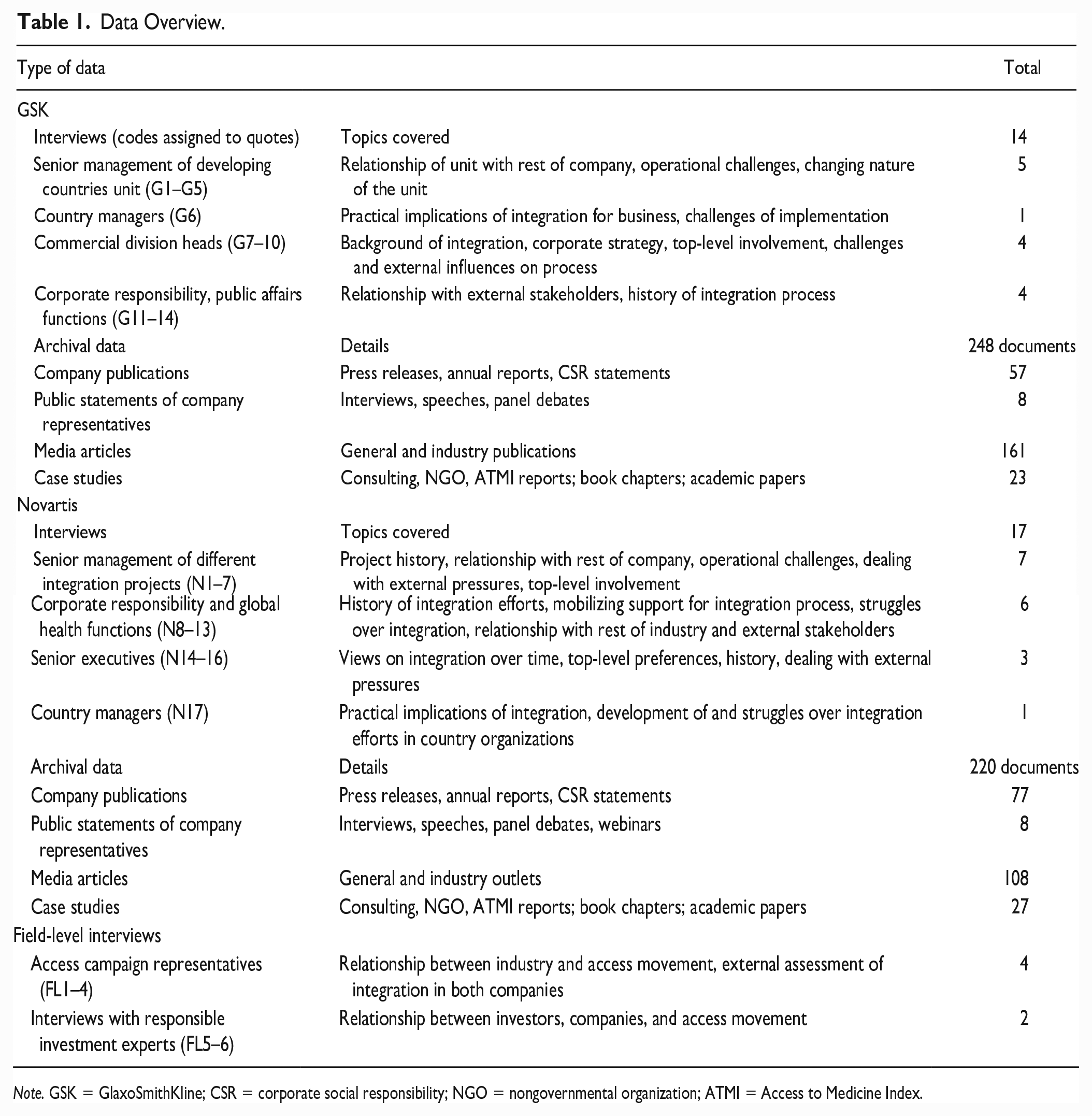
We collected data from primary and secondary sources covering the years 2000–2019. We conducted 37 semi-structured interviews with current and former company representatives at different levels in both organizations as well as with external stakeholders. We also collected archival data from sources such as the biennial ATMI, reports of nongovernmental organizations (NGOs), and media coverage on the topic going back to the year 2000. We present an overview of our data in Table 1.
Data Overview.
Note. GSK = GlaxoSmithKline; CSR = corporate social responsibility; NGO = nongovernmental organization; ATMI = Access to Medicine Index.
We conducted interviews in two phases (see Table 1). In a first exploratory phase, between November 2018 and April 2019, we contacted and interviewed senior commercial and corporate responsibility managers whom we had identified as central protagonists in implementing and sustaining integrated access efforts between 2000 and 2019. Initially, we sought to understand the trajectories of individual access efforts, including their emergence, their links to different areas of the organization, and their changes over time. From this exploration, we gained a more nuanced understanding of the role that integration played in both cases.
In a second phase, between July and November 2019, we probed our emerging insights in additional interviews with organizational representatives whom we identified through our exploratory interviews and archival research. Collecting additional interview data and increasing the diversity among interviewees helped us to avoid potential groupthink among a smaller number of closely involved actors. We followed up with selected interviewees to corroborate insights and validate emerging narratives. In addition, we interviewed several experts from NGOs and the investor community to include an external assessment of narratives. We conducted interviews in different constellations of team members and compared notes in debriefing meetings to mitigate interviewer bias. Interviews lasted between 30 and 140 min. We obtained the interviewees’ consent to recordings and subsequently transcribed all interviews in their original language of English or German.
Aware of the challenge of relying on retrospective interview accounts, we undertook several measures to assure validity. First, we made sure to only discuss events that interviewees directly experienced to avoid speculative accounts. Therefore, we interviewed many former protagonists who were no longer working for either of the two companies. Second, following scholars discussing historical approaches in organization studies (Golder, 2000; Kipping et al., 2014), we used triangulation, relying strongly on archival data to confirm events in the earlier days of our research period. Triangulation also entailed asking different interviewees about the same events to identify inconsistencies. Where we identified such inconsistencies, we excluded these elements from our theorizing. For example, interviewees at Novartis shared conflicting accounts about the main driver of the initial social business projects, and thus our article does not theorize the antecedents of integration efforts, as we found the data unreliable in this regard.
Analytical Approach
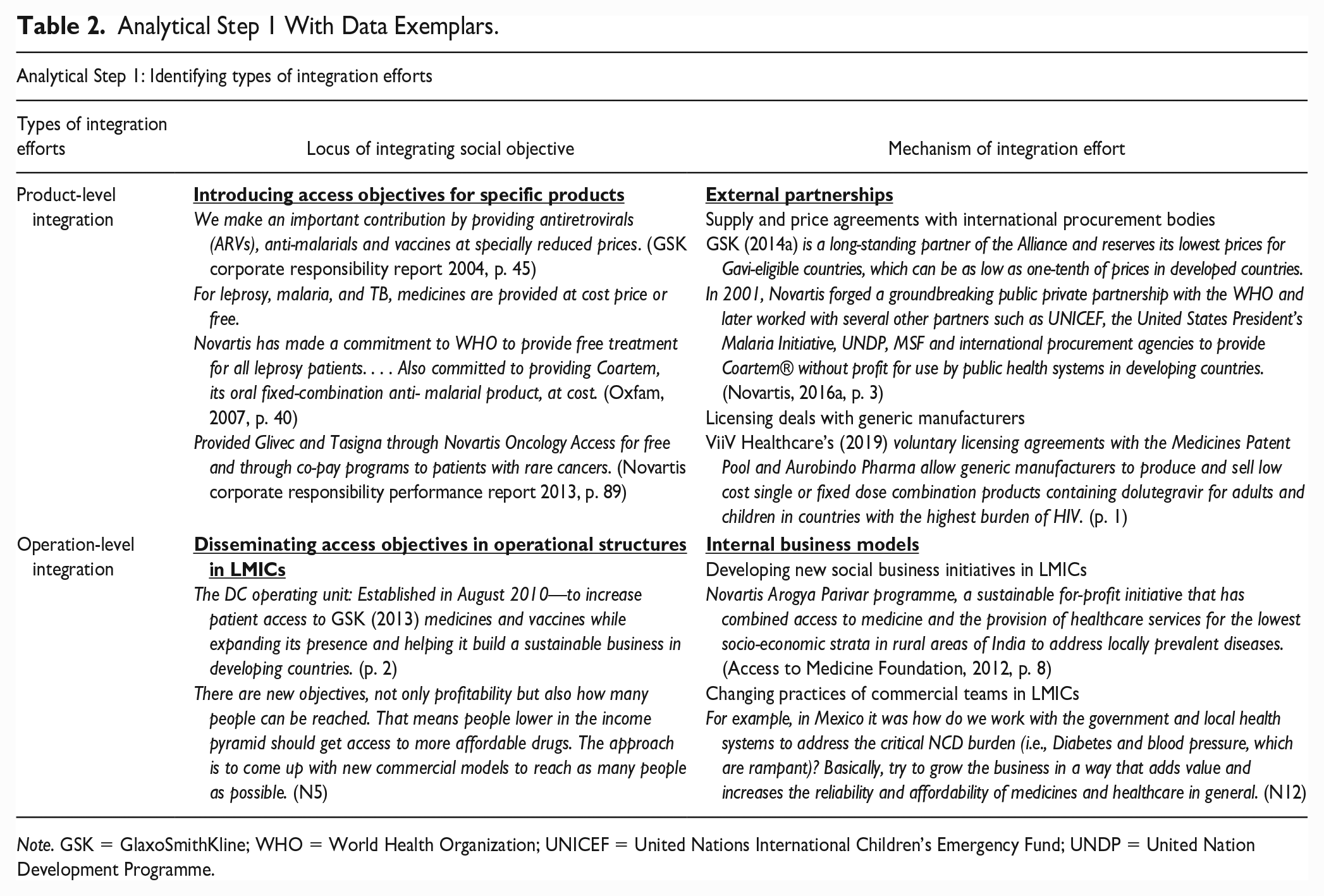
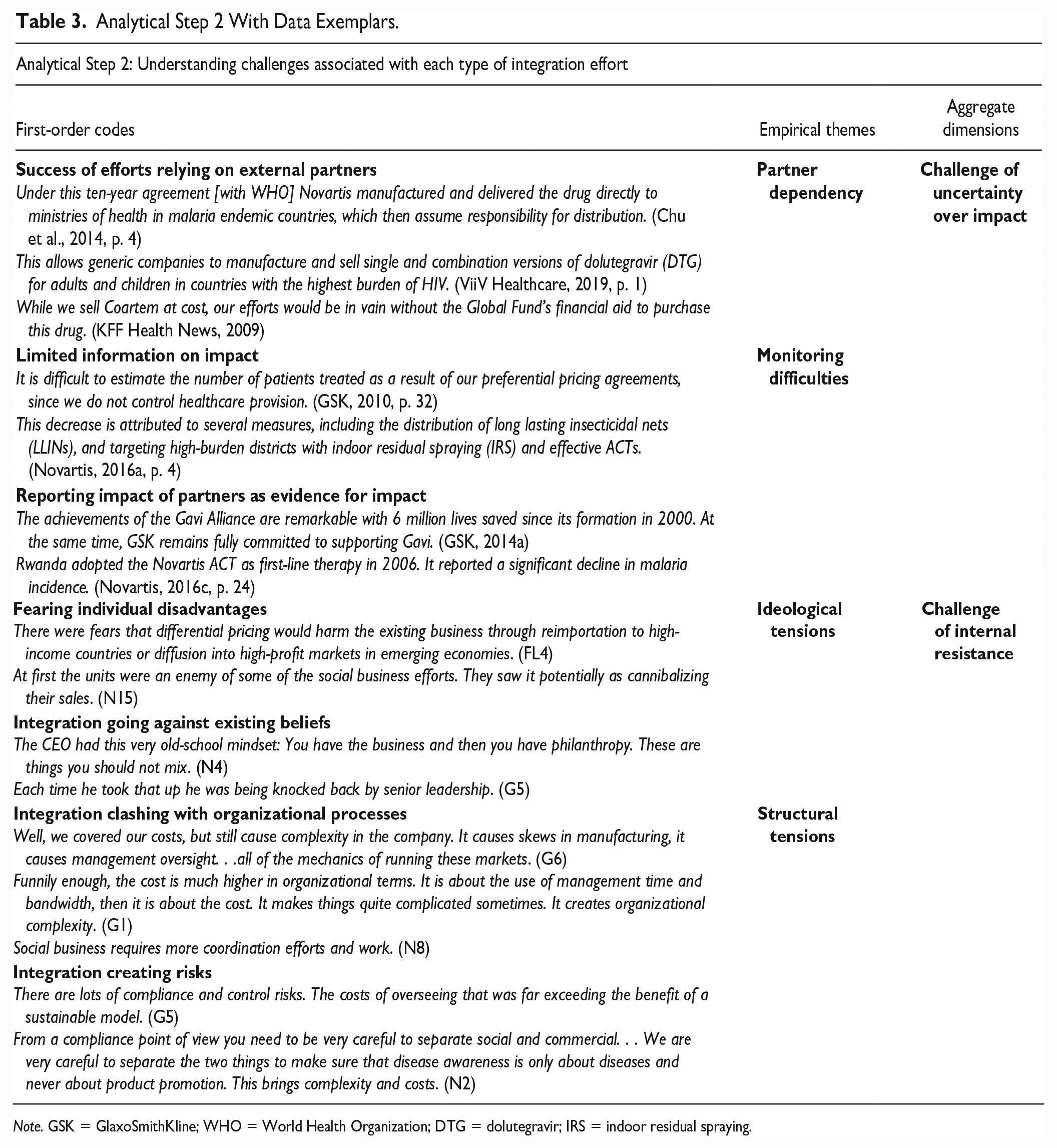
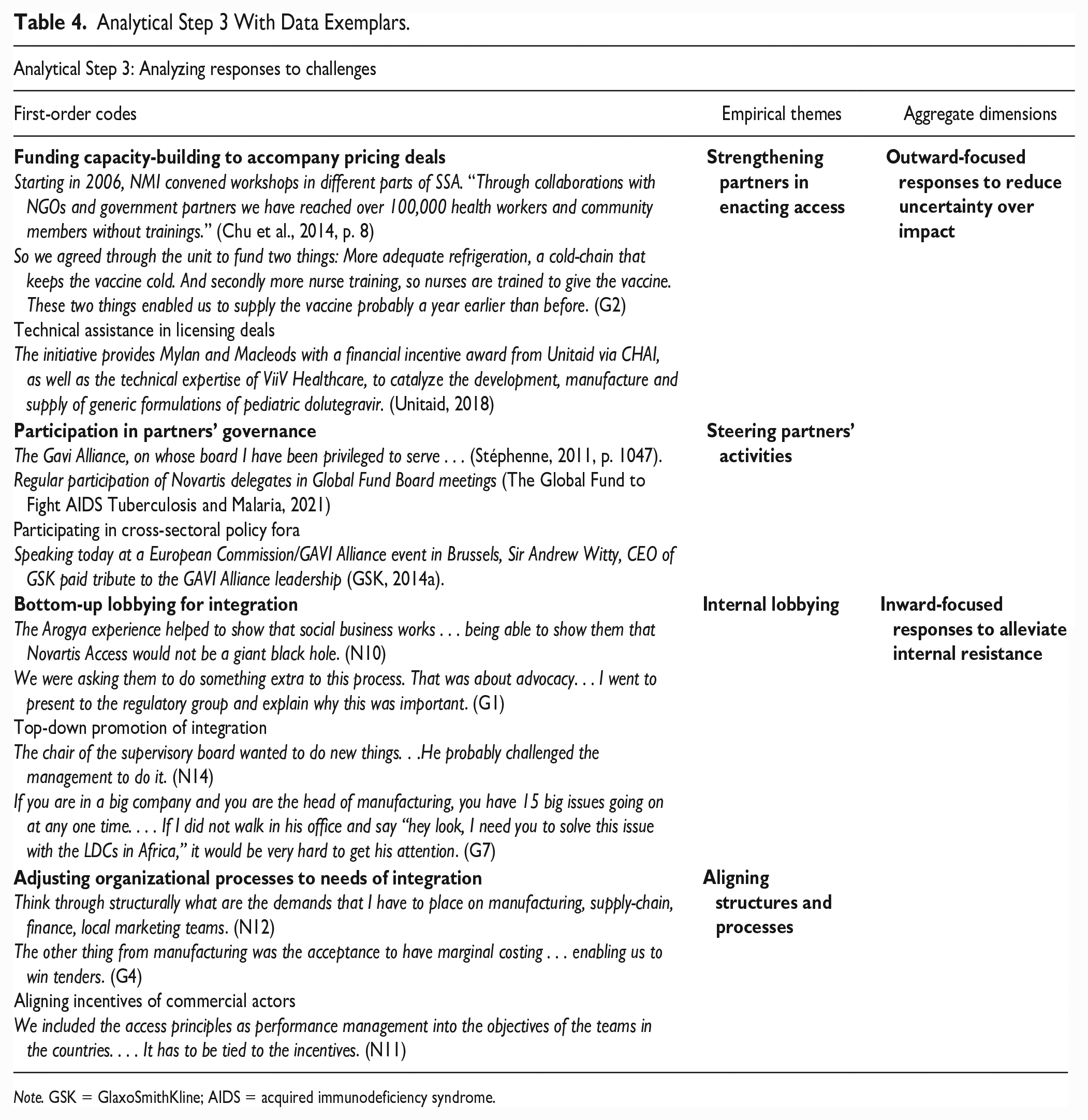
We followed an abductive approach in our analysis, moving back and forth between data and literature (Charmaz, 2006). In three steps discussed below, two authors independently reviewed and coded interview transcripts and archival documents. The abductive approach meant that we approached the coding of the data with different broad guiding topics emerging from our literature review for each step of the analysis, such as “differences in integration efforts” and “challenges to integration.” Emerging codes and themes were compared and discussed in the team of all three authors and considering the themes we had identified from our review of the literature. Based on the initial discovery of different types of integration efforts in Step 1, the inductive coding in Steps 2 and 3 then enabled us to uncover important features of integration that were not found in existing work and to “case” integration in new theoretical ways to understand how it can be sustained (Timmermans & Tavory, 2012; Vila-Henninger et al., 2022). An overview of the entire analytical process, including all first-order codes with data exemplars as well as the resulting empirical themes and aggregate dimensions, can be found in Tables 2, 3, and 4.
Analytical Step 1 With Data Exemplars.
Note. GSK = GlaxoSmithKline; WHO = World Health Organization; UNICEF = United Nations International Children’s Emergency Fund; UNDP = United Nation Development Programme.
Analytical Step 2 With Data Exemplars.
Note. GSK = GlaxoSmithKline; WHO = World Health Organization; DTG = dolutegravir; IRS = indoor residual spraying.
Analytical Step 3 With Data Exemplars.
Note. GSK = GlaxoSmithKline; AIDS = acquired immunodeficiency syndrome.
Step 1: Identifying Types of Integration Efforts
First, drawing on our archival data, we took stock of the various efforts the two companies deployed in their approach to integrating access principles into their businesses (see Figure 1) and developed detailed timelines of access efforts for each company. We reviewed GSK’s and Novartis’s annual and corporate responsibility, NGO, and ATMI reports to identify efforts that aimed at improvements in the access to the companies’ products in LMICs. In line with our research focus, we excluded upstream aspects of access to medicine around research and development of new drugs. Our interview data helped to corroborate these findings, to uncover additional efforts not found in archival data, and to contextualize efforts with respect to genesis and evolution over time.
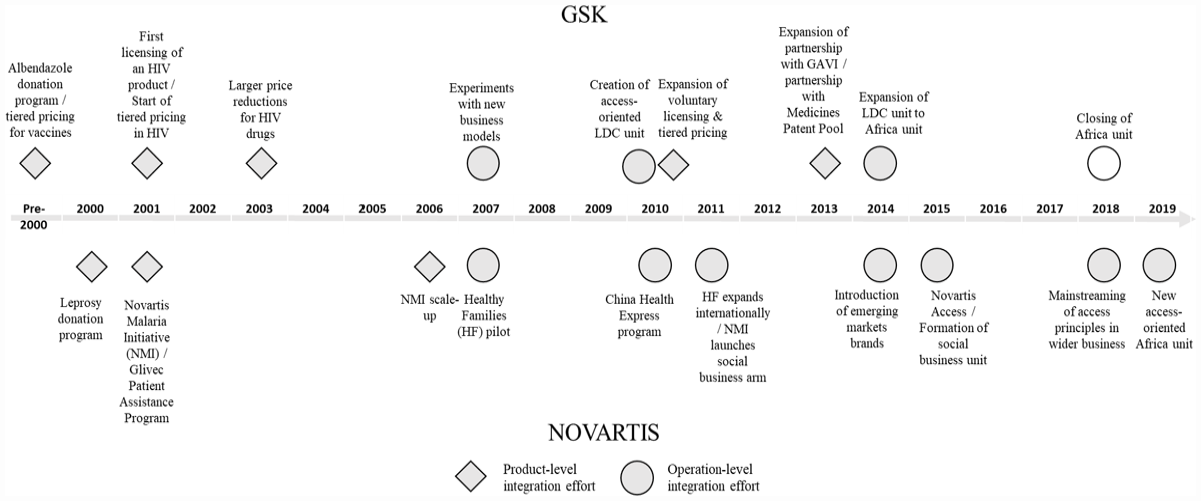
Integration Timelines: Mapping of Most Important Integration Efforts.
Aware of potential differences in integration efforts based on previous research, we examined approaches to access to medicine in both companies with two questions in mind: (a) How and where are explicit access to medicine objectives integrated into core commercial activities? And, (b) how are these efforts meant to enable progress toward expanding access to medicine? Leveraging archival and interview data, we identified two types of integration efforts present in both cases. The first type, product-level integration, refers to companies integrating access objectives around a specific product that they or their stakeholders consider important from a global health perspective. In the case of product-level integration efforts, companies predominantly leverage external partnerships to enable access to their medicines. The second type, operation-level integration, refers to integrating access objectives into commercial structures and practices in specific LMICs, developing new business models to enable access. We built our further analysis of how integration can be sustained around these two types of efforts.
Step 2: Understanding Challenges Associated With Each Type of Integration Effort
Mindful of literature that has pointed to challenges arising due to integration (Hengst et al., 2020), we systematically examined challenges that arose in connecting with both types of integration efforts. We particularly looked for challenges that made the integration of social objectives more difficult or compromised their legitimacy, potentially resulting in a diminished commitment to these objectives. Our initial overview of the history of social objectives in each company revealed several instances where a company made significant changes to its integration efforts. To that end, we engaged in an iterative process of coding and categorizing our data (Grodal et al., 2021), gradually diving more deeply into emerging insights while being guided in the development of our concepts by challenges that had been described in the literature. Probing our data, we saw that several access efforts in both companies introduced new demands on the organization and its people, leading to a challenge of internal resistance to integration. This challenge was especially visible in the case of operation-level integration efforts. In the case of product-level integration and its reliance on external partners, we observed that companies struggled to monitor and assess the impact or effectiveness of their access efforts in the face of systemic constraints around access to medicine.
Step 3: Analyzing Responses to Challenges That Threaten Sustained Integration
Building on these insights, we went back to the data looking for evidence of how actors in the company counteracted the two challenges and thus were able to sustain integration over time. This final round of coding brought out important differences in responses to address the two challenges. We found that product-level integration was particularly associated with what we describe as outward-focused responses to mitigate constraints of relying on external partners, whereas operation-level integration was associated with inward-focused responses intended to alleviate resistance to organizational change.
Findings
Types of Integration
We identified variation in how both companies integrated access objectives into commercial activities. As a result, we distinguish between two types of integration efforts.
Product-Level Integration
This first type of integration starts with the company or its stakeholders identifying an access need around a specific product of the company. To address this need, the company introduces a specific new practice such as donations, tiered pricing, or voluntary licensing to the management of this product with the aim to increase its affordability to patients in need (GSK, 2006; Novartis, 2016c). Access objectives are integrated through centralized access program structures that may draw on certain business functions such as manufacturing or regulatory affairs, but otherwise remain organizationally and financially separated from commercial operations in countries of need (Chu et al., 2014). Instead, companies form structured partnerships with external organizations such as large-scale supply agreements with multilateral procurement bodies, national distribution projects with LMIC governments, or licensing agreements with generics manufacturers. Yet, the companies’ direct role in access creation stops at price reduction. To address constraints to access such as the availability of the product and its uptake in countries of need, companies rely on external organizations and governments distributing their products. (“While we sell Coartem at cost, our efforts would be in vain without the Global Fund’s financial aid to purchase this drug” Novartis CEO quoted in KFF Health News, 2009).
Thus, the underlying mechanism to reach the organizations’ access objectives relies on enabling external partners to increase access by providing them with a cheaper supply of health products. Both companies, for instance, have committed to long-term structured donation programs related to neglected tropical diseases, following calls by WHO and its partners. These donation programs draw upon corporate resources and business functions and are run by centralized global health units. Besides neglected tropical diseases, GSK also came under pressure by the global health community to improve access to its HIV treatments in the early 2000s. It initially responded by integrating tiered pricing practices into the management of its HIV portfolio, offering price reductions to WHO, its partners, and LMIC governments (GSK, 2006). Later on, the company started granting licenses to generics manufacturers to produce low-cost versions of its HIV drugs for sale in LMICs. In this way, GSK integrated access objectives at the product management level without involving its operations in LMICs. Instead, it relied on partners to produce and distribute its products. Another large product-level integration effort revolved around vaccines. The vaccine business of GSK (2019) has a long tradition of adjusting its prices to countries’ income levels. Since the creation of Gavi, the multilateral vaccine procurement organization, most of GSK’s vaccines for LMICs are supplied through this channel. This partnership is managed centrally in the vaccine business but had few touchpoints with GSK’s business in recipient countries, as pointed out by this corporate responsibility manager: They [local teams] did not have a role in this program. Products went directly from GSK to WHO and they distribute it. The local General Manager played no part in that, and they could not have, would be unmanageable. (G12)
In addition to a donation program targeting leprosy, Novartis runs a large product-level integration effort for its antimalarial drug, Coartem. When it developed the drug in the 1990s, the company and multiple external stakeholders saw a great potential to improve malaria care and formed a partnership in 2001. Novartis launched its Malaria Initiative, which is a centrally hosted access program that supplies Coartem at an at-cost price to WHO and its partner. They in turn manage Coartem’s distribution in endemic countries (Novartis, 2016a).
Operation-Level Integration
This second type of integration effort focuses on integrating access objectives into commercial activities within LMICs. Instead of introducing new practices to reduce the cost of a drug, the integration of an access objective at the operation level induces organizational actors to develop new business models with commercial practices that address multiple dimensions of access. The locus of integration is not a specific product, but rather a company’s regional or country units, making it considerably more decentralized than product-level integration. The tools to address external constraints to access vary across different business models, but overall they rely much more strongly on the work of internal actors. Rather than enabling external partners, operation-level integration aims at enabling organizational actors to assume full responsibility for diagnosing and overcoming these constraints through commercial operations on the ground: There are new objectives, not only profitability but also how many people can be reached. That means people lower in the income pyramid should get access to more affordable drugs. The approach is to come up with new commercial models to reach more people. (N5)
To illustrate, Novartis (2019) announced that it would reorganize its operations in Africa by integrating access objectives alongside financial ones and by mandating its local operations to find tailored commercial solutions to improve access to the company’s products in each country. Before this wide-reaching decision, Novartis had already engaged in more scattered operation-level integration efforts in LMICs. In 2007, a small team within Novartis India was mandated to develop a new business model with the objective to improve access to Novartis’s products in rural areas while securing a sustainable profit. The team launched the Healthy Families (HF) program, building new private-sector distribution channels in combination with activities to raise health awareness. HF grew in revenue, broke even in 2010, and expanded to additional countries in 2012 (Novartis, 2017). Other country organizations experimented with similar ideas: Novartis’s China business, for instance, launched the Health Express program, which borrowed from the HF idea. Moreover, the corporate responsibility department worked with managers in LMICs to develop and sometimes implement new business models that could expand market shares in emerging economies through tackling access challenges. In 2014, the company launched the Novartis Access initiative, which developed locally adjusted social business models in several countries. This initiative tasked local managers to improve access to a portfolio of drugs by using a new pricing model combined with the strengthening of local health systems by, for example, strengthening supply chains and training health care workers (Novartis, 2016b). Similarly, in 2009, GSK created a new Developing Countries and Market Access (DCMA) unit that grouped the company’s existing operations in least developed countries (LDCs) and mandated general managers in the respective countries to increase the access to GSK’s portfolio in their markets, which led them to come up with new pricing models, develop localized distribution models, and strengthen local health systems by reinvesting 20% of their profits into projects around health worker training, supply chains, or health infrastructure (Miller & Parker, 2013).
To conclude, we found that both companies gradually expanded both types of integration efforts over the study period. Product-level integration efforts at GSK started with vaccines and an individual HIV drug, involving a business of more than US$2 billion turnover (more than 11% of its total pharmaceutical turnover) in the early 2000s (GSK, 2003). While it is hard to make comparisons due to repeated acquisitions and divestments affecting the size and scope of the business, in 2018 tiered pricing covered 60% of its products and large-scale licensing deals for two products were in place (Access to Medicine Foundation, 2018). At Novartis, integration of access objectives began with the Malaria product, which was negligible from a business perspective, but in 2018 already 57% of products fell under tiered pricing models (Access to Medicine Foundation, 2018). A first voluntary licensing deal was struck after our study period in 2022. Operation-level integration at Novartis also started out in a single country unit, India. With the Access Principles and the new Africa Unit, access objectives are planned to be implemented in all operational units (Novartis, 2018). GSK started with pilot projects in three countries in 2007. Its DCMA unit included 50 country organizations of the pharma business with a total of 650 employees (GSK, 2013), which more than doubled in terms of employees and turnover when larger African markets and the consumer health care business were integrated in 2014 (GSK, 2014b). Even if this still only represented a fraction of total turnover, this expansion meant that the entire support organizations were strongly involved in access integration efforts. As GSK eventually scaled down operations in Africa in 2018, access objectives remained in place throughout the organization, but the company prioritized product-level efforts from here onward.
Emerging Challenges
Despite the apparent progress of integration over time, the two companies faced different challenges that threatened the growth or even survival of integrated social objectives. In this section, we report on the specific challenges that emerged as a result of each type of integration effort.
Challenges of Internal Resistance
In both companies, the introduction of integrated access objectives at the operation level increased organizational complexity, creating tensions between the access efforts and established activities and objectives within the organization. These structural and ideological tensions resulted in open resistance to integration efforts whenever changes to everyday practices of commercial actors were especially pronounced. Structural tensions result from the increasing demand on the various necessary parts of the organization to facilitate operation-level integration of access objectives. This is in contrast to the more centralized manner of enacting social objectives in the case of product-level integration. For example, at GSK, new social business models required the product registration department to put in a lot of additional work, or the manufacturing department to flexibly supply small amounts of products that were needed to build up a presence in a small African market. Similarly, using unconventional commercial activities to expand into markets beyond the urban centers of developing countries exposed the company to compliance threats, as the companies had more direct interactions with doctors and hospitals on the ground. This required more oversight and created extra costs. Such inherent complexities made operation-level integration an uphill battle in organizations that were premised on maximizing profitability: It causes skews in manufacturing; it causes management oversight . . . all of the mechanics of running these markets. Also risk—in terms of compliance—is very high in these markets. So you need very good people who know what they are doing to run these markets. And those people are not cheap. (G6)
Operation-level integration also creates ideological tensions. At Novartis, in the 2000s, the top management was ideologically opposed to operation-level integration. Interviewees argued that “the CEO had this very old-school mindset: Business and philanthropy are things you should not mix” (N12). In other cases, it was mid-level management in country organizations that worked against operation-level integration, as they feared that additional access tasks would cut into their profits and thereby into their personal incentives. Managers monitoring the Healthy Families project explained that the commercial units’ fears “led to very difficult funding situations for the project, because once it came close to their markets, they would convince the upper management of the regions not to support it” (N15). Together, structural and ideological tensions created resistance to operation-level integration. This resistance threatened the legitimacy of such efforts, preventing them from scaling up or even leading to their shutdown, even if they have proven to be effective. At GSK, for instance, access objectives were slowly carved out of the DCMA unit once GSK came under more financial pressure and the tolerance for complexity decreased. Instead, the company prioritized its product-level integration efforts.
In contrast, we found only limited evidence for tensions caused by-product-level integration efforts within the time span of our analysis. The introduction of tiered pricing efforts at GSK, for example, was accompanied by fears that differentiating prices of HIV drugs would lead to low-priced versions flowing back into high-income markets, delegitimize higher prices in these markets, and negatively affect the established business (Reich, 2002). However, once these initial feared outcomes did not materialize, further tiered pricing efforts were met with less resistance (Yadav, 2010). The Novartis Malaria Initiative also had to deal with organizational complexity as it scaled up and required more management oversight and resources (Chu et al., 2014). Yet, we did not find evidence that these integration efforts created notable internal resistance, partly because the initiative remained organizationally and financially separated from many commercial activities. For example, as it was managed from headquarters, most actors within country organizations faced no changes to established practices and did not have to contribute resources to these efforts.
Challenges of Impact Uncertainty
The second challenge that emerged from our analysis is that, as product-level efforts evolved over time, both companies realized that they struggled to monitor their impact upon access-related objectives. As described earlier, product-level integration makes use of external partnerships to enact access objectives, because reducing a product’s price or allowing another company to produce generics does not automatically improve access for patients. This entails two problems: the difficulty of finding a capable and willing partner as well as monitoring the impact of the effort. First, companies depend on the capacity and willingness of external partners to enact access objectives via product-level integration. A GSK manager describes how the inaction of local partners initially limited the impact of product-level integration efforts for HIV products: We modified the approach, we introduced new pricing policies. We introduced voluntary licensing. It helped to put the company and industry out of the firing line, but it did not help much with access, as IP was never the real problem. Price wasn’t even the real problem. It was the fact that the supply chains were very weak, that governments were in denial. (G14)
In South Africa, the government denied that HIV was the cause of AIDS and, hence, rejected the use of antiretroviral drugs. Chigwedere and colleagues (2008) show that 330,000 lives could have been saved if the South African government had accepted low-cost or donated products as soon as they were offered. In addition, in some product domains such as noncommunicable diseases (NCD) or hard-to-reach geographical areas, there are very few organizations that are active on the ground. Thus, companies struggle to identify partners whose work they can support through the provision of cheaper medicines. As reliance on partners to enact integration increases, so can uncertainty over the potential impact and effectiveness of product-level integration efforts.
Second, even when partnerships exist and are functional, companies still struggle to monitor the impact of their own contribution. This is reflected in how companies officially reported on the impact of their product-level integration effort. In its 2010 corporate responsibility report (GSK, 2010, p. 32), for instance, GSK suggested that it is “difficult to estimate the number of patients treated as a result of our preferential pricing agreements, since we do not control healthcare provision.” Similarly, in a factsheet on its Malaria Initiative, Novartis admitted that the contribution of its efforts to decreasing Malaria prevalence cannot be singled out amid a multitude of partners’ initiatives. Instead, both companies underline the performance of their external partners such as Gavi or distinct LMIC governments and report such performance as evidence of a positive impact of corporate product-level integration efforts. Taken together, governance and impact uncertainty constitute a key challenge for product-level integration.
In contrast, we find that impact uncertainty constitutes a less salient challenge for operation-level integration efforts. Integrating access-related objectives at the operation level enables a greater level of control over the outcomes of these efforts, as the companies assume responsibility for tackling external constraints and are able to monitor impact more directly. To illustrate, integration efforts are not limited to price reductions; they may also entail investing in distribution networks, training health professionals, or directly signing up patients for access programs on the ground. As such, they are less dependent on the work of external actors in reaching their access objectives, as one GSK manager explains: When big companies make investments in the corporate responsibility area, they are sort of relying on NGOs to tell you what needs doing . . . but what we felt is that [we] should not be relying on that. We had 700 people in my unit, so what about their expertise? This is a really strong point that we could leverage and utilize our own expertise much better. (G2)
Moreover, engaging the company’s local operations in access efforts allows the company to get a better insight into what works and where gaps in effectiveness remain. One way to do this is through the relationships that local operations can establish with local stakeholders. A social business manager at Novartis gave an example of how their local involvement allowed them to improve their model of increasing access to NCD care in Ethiopia specifically: We asked where are gaps, what should we do, what is your opinion? For example, we worked together with the Ethiopian government and local organizations to think how we could decentralize awareness creation around NCDs to make sure that consulting does not only exist in tertiary care hospitals but in the community. (N5)
We also found evidence that Novartis had invested in monitoring the impact of operation-level integration efforts. The company conducted a formal impact assessment for its Novartis Access program in Kenya, which allowed it to locally adjust the model and close gaps (Rockers et al., 2019). Building on this experience, it also decided to roll out social impact monitoring throughout the entire access-oriented Africa business unit.
Overall, impact uncertainty can be problematic for sustaining product-level integration when it induces perceptions of ineffectiveness among organizational actors. If unaddressed, this perceived ineffectiveness may undermine the legitimacy of integrated social objectives and ultimately lead to companies scaling down their commitment to these objectives.
Responses to Integration Challenges
Thus far, our analysis has shown that each type of integration effort comes with distinct challenges. Next, in line with our research question, we analyzed how both companies sought to overcome these challenges and thereby ensured that social objectives remained a part of the organization’s strategy. We found that distinct and deliberate responses to effort-specific challenges enabled companies to sustain the strategic integration of social objectives.
Outward-Focused Uncertainty Reduction for Product-Level Integration
To ensure that partner organizations were able to address health systems constraints in LMICs that increased uncertainty around the impact of companies’ product-level integration efforts, we found that both companies tried to actively support partners in two ways. First, both GSK and Novartis started adding capacity-building programs to their product-level integration efforts to improve their partners’ effectiveness in addressing access constraints external to the company. Starting in 2006, for instance, the Novartis Malaria Initiative began to work together with NGOs and governments to host workshops training the heads of national malaria programs and local health workers in sub-Saharan Africa to improve the uptake and use of the supplied antimalarials (Chu et al., 2014). Similarly, after realizing that licensing alone did not directly improve access to the licensed product, GSK started to work more closely with selected generics manufacturers, supporting them with technology transfers and guiding them through regulatory approvals (Access to Medicine Foundation, 2010). However, these backup initiatives were also implemented through the centralized access program units at the company headquarter and did not involve local operations in LMICs.
The second approach we identified was that both companies became involved in steering partners’ activities to ensure that partnerships remained effective. They did so by joining governance bodies of global health partnerships that in turn played a leading role in creating access to the products that lay at the center of product-level integration. This enabled them to monitor whether working through these partnerships still enabled the achievement of access objectives and to steer partner activities in the desired direction. Multiple presidents of GSK’s vaccine business, for instance, have sat on the board of Gavi, the Vaccine Alliance, while Novartis Malaria Initiative representatives regularly participate in board meetings of the Global Fund to Fight AIDS, Tuberculosis and Malaria. Moreover, both companies actively participated in disease-specific coordination bodies to stay in contact with the broader set of actors and align the contributions of their product-level integration efforts to activities of other actors. GSK’s management, for instance, would regularly join cross-sectoral discussion fora around vaccines and HIV topics; Novartis would equally be present in many conferences on malaria or leprosy where the focus of its product-level integration efforts lies.
Inward-Focused Resistance Alleviation for Operation-Level Integration
We also identified two ways through which supporters of operation-level integration sought to alleviate the structural and ideological tensions around this type of integration effort. In this case, responses focused on internal challenges to integration. For one, we found that operation-level integration was accompanied by top-down and bottom-up lobbying efforts. By trying to change attitudes of individuals toward operation-level integration, supporters wanted to broaden the coalition behind this type of integration. At Novartis, proponents of operation-level integration consisting of a few individuals in business units as well as the corporate responsibility department began by convincing company leadership of the merits of their Healthy Families pilot program by inviting them for field visits and sharing promising data. Subsequently, they tried to sensitize the wider organization for the business opportunities and strategic relevance of operation-level integration. For example, in 2010, the corporate responsibility and human resource departments jointly developed an Entrepreneurial Leadership Program that exposed mid- to senior-level managers to public health challenges and tasked them to develop new commercial models for such problems: The leadership development program helped to change mindsets, build skillsets, and develop their toolkits to become our champions. (N12)
Building and sharing positive experiences with pilot projects helped supporters of operation-level integration at Novartis. When they proposed rolling out Novartis Access as a social business model for NCD, they could use the Healthy Families case to show “that Novartis Access would not be a giant black hole” (N10). At GSK, we also saw that integration advocates, including top management, invested considerable time to keep up internal support for integration by explaining their needs transparently to affected organization members and communicating broadly about the progress made around access integration: We were asking them to do something extra to this process. That was about advocacy. . . . For instance, I went to present to the regulatory group and explain why this was important. (G1)
Once company leaders became supportive of operation-level integration efforts, they also engaged in aligning organizational processes and structures to reduce structural tensions. For example, at Novartis, the CEO of the pharma business agreed to centrally pick up the costs of the Healthy Families project to reduce conflicts between financial and social objectives for commercial managers in the India business. At GSK, the head of the emerging markets business explained how they would help to align organizational processes with the needs of the new DCMA unit, for example, working with the manufacturing department to prioritize deliveries for African country units and introduce a different way of internal costing that would make it easier for access-oriented business models to become financially sustainable. Similarly, representatives from both companies explained that, in the areas where operation-level integration should take place, it was important to align the personal financial incentives of general managers with the new access objectives of their units to prioritize this new mandate for traditionally commercial actors. This has become an important element of the rollout of Novartis’s latest access strategy, which strengthened operation-level integration efforts: We included the access principles as performance management into the objectives of the teams in the countries. . . . It has to be tied to the incentives. (N11)
A Framework of Sustaining Integration
Based on our analysis, Figure 2 visually summarizes how companies can sustain integration of social objectives as a long-term organizational commitment. This framework directs analytical attention to two types of integration efforts that, while potentially coexisting within companies (as they do in both of our cases), differ in their locus and mechanism of enacting social objectives. Based on these insights, we theorize that companies can sustain the strategic integration of social objectives if they address the distinct challenges that come with both product and operation-level integration.
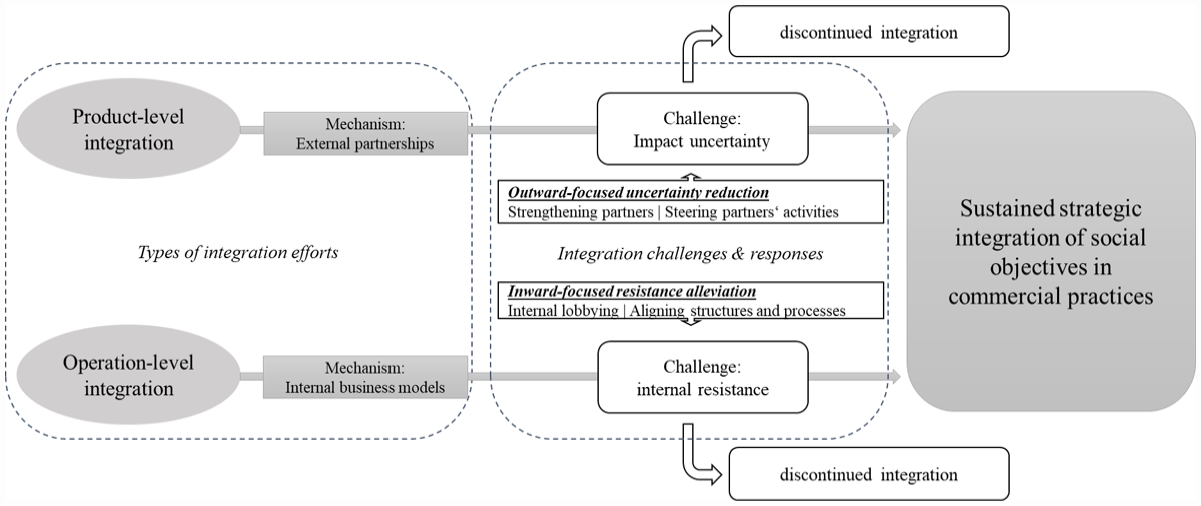
A Framework of How Strategic Integration is Sustained.
Product-level integration combines changes to features of individual products with external partnerships as a mechanism to enact the social objective. Companies that integrate social objectives at the product level reduce potential internal resistance but rely on partner organizations to overcome external constraints such as defunct public health systems. As a result, this type of effort is more at risk to induce challenges of assessing and monitoring if and how an effort can be linked to perceived effectiveness. Uncertainty over impact may undermine product-level efforts over time. Companies can sustain product-level integration efforts and reduce impact uncertainty through outward-focused responses, including strengthening partners and getting involved in the governance of the system to strengthen and assess the effectiveness of partnerships. Operation-level integration, in turn, relies on intraorganizational efforts of altering and developing social business models. This way of enacting social objectives involves various changes to organizational structures and practices beyond product features. It, therefore, induces a pronounced challenge for advocates of social objectives to overcome internal resistance. Our findings highlight the structural and ideological tensions underlying operation-level integration that can lead to the demise of social objectives or a reduction in their organizational scope. Such challenges can be addressed by alleviating these internal constraints, which involves internal lobbying and the active alignment of social objectives with existing activities.
Discussion and Conclusion
Contributions to the Literature on the Integration of Social Objectives
By analyzing how companies can sustain the strategic integration of social objectives over time, we advance knowledge on the role of companies in addressing complex societal challenges and offering solutions to specific social problems that are central to their mandate, such as access to medicine for pharmaceutical companies. Specifically, our findings contribute to the study of integration and to research on the role of business in global health in three ways.
First, our study clarifies how the strategic integration of social objectives can be enacted in commercial organizations to address pressing societal challenges. Research has begun to conceptualize potential variety of integration efforts (Halme & Laurila, 2009; Yuan et al., 2011) and shown that such efforts may be linked to improved social and environmental outcomes (Eccles et al., 2014; Halme et al., 2020). Hence, while we have initial evidence that the strategic integration of social objectives might lead to allocating corporate resources and attention to a societal challenge over the long term, we have thus far known little about how and why this can unfold. Our study offers an answer to this question by expanding the analytical focus toward the locus and mechanism of strategic integration efforts to understand why social objectives do or do not take hold in companies (Soderstrom & Weber, 2020). By linking these analytical categories to distinct challenges and responses, we extend a body of research interested in the tensions involved in integrating social objectives and how these can be resolved, but which thus far examined this in the context of more abstract “sustainability strategies” (Hahn et al., 2015; Hengst et al., 2020). Specifically, we clarify the conditions under which specific forms of tensions and respective response strategies arise with regard to both the locus and mechanism of integrated objectives. As such, our study encourages and informs additional research on the types and trajectories of successful and abandoned strategic integration efforts across a wider sample of efforts, companies, and industries using variance-based research designs.
Importantly, our study suggests that strategically integrating social objectives into commercial activities should not be seen as a silver bullet to ensure that companies make progress on societal challenges, given the multiple and distinctive legitimation and governance challenges that occur once the initial decision for integration has taken place. Future research will need to take into account the varied challenges that may derail companies’ integration trajectories, complementing research on other ways in which companies fail to maintain a long-term commitment (Wright & Nyberg, 2017). While we base our theorizing on the two types of strategic integration efforts that emerged from our case, we do not exclude the possibility that the locus and enactment mechanism of integrated social objectives may yet differ. Future studies covering various industries may also examine the conditions under which product- and operation-level efforts emerge, to which our framework does not speak. Such conditions may include differences in field-level pressures, organizations’ product portfolios, or preferences of individuals advocating for integration. This research could shed light on why the sequences of and emphasis on specific integration effort types differ across companies.
Second, we inform and bring together two important research streams in the wider CSR and sustainability literature that both focus on why companies fail to contribute to addressing societal challenges, but that have operated on different assumptions. One stream of literature, focusing on organizational dynamics, has examined internal resistance to social objectives within companies, and how actors advocate for such objectives (Augustine, 2021; Hengst et al., 2020; Olsen & Boxenbaum, 2009). This literature has viewed integration largely as a matter of legitimation by internal advocates. A second stream of literature considers integration mainly as a governance issue and speaks to the difficulties of assessing the effect of corporate efforts on the societal challenges they are meant to address. This research has emphasized the complexity of societal challenges and difficulties of determining the external impact of CSR efforts (Bromley & Powell, 2012; Mair & Seelos, 2021; Wijen, 2014). We show that legitimation and governance challenges can become equally salient in the course of integration, such that both assumptions ought to inform the study of integration and specifically work on factors that enable organizations to sustain social objectives (Vallaster et al., 2021). This research may thus look, for example, into the role of staff selection and organizational structures to address internal legitimation challenges (Girschik, 2020; McDonnell et al., 2015) as well as the institutional infrastructure of a given social issue that in turn shapes governance challenges (Stadtler & Karakulak, 2021; Zietsma et al., 2017).
Finally, with our study we answer calls for more research on the role of business in addressing global health challenges as an issue area where the potential for positive and negative corporate contributions have been recognized (Bünder et al., 2022; Park et al., 2022; Vakili & McGahan, 2016). We go beyond the discussion of whether the pharmaceutical industry may play a role in facilitating access (Santoro & Shanklin, 2020) by articulating the product and operation level as key markers of distinction of integration efforts in this industry. Both product-level and operation-level integration efforts have made inroads across the entire pharmaceutical industry, with the two companies we studied having a major influence given the depth and length of their engagement. Beyond our industry context, enabling access to essential products and services constitutes both a challenge and an objective for many different companies. Financial service providers as well as energy and technology companies all offer products and services that could help to solve social problems if only people had sufficient access to them (Ault & Spicer, 2014; Seelos & Mair, 2007). Thus far, the salience of access as an objective may not have reached similar levels in these industries compared with the pharmaceutical industry. Yet, research suggests that challenges of sustaining, for example, operation-level integration efforts in a telecommunication and energy company (Halme et al., 2012), are in fact similar. We, therefore, think that our findings are relevant for future studies on a wide array of corporate efforts to ensure access to essential products and services.
From Studying Commitment to Studying Impact
Assessing the causal effect of corporate initiatives on societal outcomes constitutes an important and complex challenge for business and society scholarship (Barnett et al., 2020). Our research design focused on understanding how companies can sustain their commitment to a societal challenge that is closely related to their mandate. Similar to other studies on the strategic integration of social objectives (Halme et al., 2020; Risi et al., 2022), we do infer rather than show impact. At the same time, the field of global health represents a highly promising setting for business scholars to tackle impact measurement and benefit from an interdisciplinary approach. Public health scholarship, for example, has shown a growing interest in monitoring and quantifying the impact of initiatives in the pharmaceutical industry (Nusser et al., 2018; Rockers et al., 2018, 2019). Future business and society research can contribute to these efforts and inform research design aspects by highlighting differences in, among others, the organizational locus and mechanism of integrated social objectives.
Implications for Practice
Our findings can help actors in companies committed to social objectives to conceptualize and strategize how to integrate social objectives into everyday commercial activities, particularly in ways that increase the likelihood of a long-term commitment to such objectives. Faced with an array of potential integration efforts, practitioners need to pay attention to how characteristics of different efforts influence their continued existence and effectiveness in specific organizational and field-level contexts. For example, to improve access to essential products and services, pharmaceutical company managers need to consider whether they can achieve their objectives through a model of providing products through external partnerships, or whether they need to build internal structures and programs in LMICs. Although external partnerships appear to be the easier route in some ways, as they create less internal resistance, in some geographical and product areas companies may not find suitable partners and may fare better by leveraging their own operations on the ground. Whichever route is chosen, our article also highlights the challenges that practitioners need to watch for in the design and implementation of both types of integration efforts. For one, they may want to identify where established interests will be hurt through integration efforts and where existing structures clash with new demands for the organization. Anticipating these problems will help to scale faster and create more sustainable initiatives. Second, when relying on external partnerships to minimize internal changes, practitioners should be aware that these partners may need help addressing external systemic hurdles that limit access. Thus, companies may need to go beyond the provision of products or other resources, instead becoming more actively involved in such partnerships by engaging in capacity-building or co-governing to ensure the effectiveness of joint efforts.
Footnotes
Acknowledgements
We thank our editor Lea Stadtler for her encouraging guidance and support throughout the review process, and the three anonymous reviewers for their constructive engagement and helpful suggestions. We especially thank all our interviewees for taking the time to speak with us and for sharing their insights and their patience. Comments by seminar participants at the EGOS 2019 subtheme “Revealing Obscured and Emerging Issues in Organizational Responsibilities,” the 1st STaR Research Conference on Responsible Innovation at WU Vienna, the ARCS online seminar series, and the AOM 2022 symposium on “Doing Good Better: Limitations of Firm-Led Social Impact Efforts and Solutions Moving Forward” are gratefully acknowledged.
Declaration of Conflicting Interests
The authors declared no potential conflicts of interest with respect to the research, authorship, and/or publication of this article.
Funding
The author(s) disclosed receipt of the following financial support for the research, authorship, and/or publication of this article: Tobias Bünder has been funded by a doctoral scholarship of the Heinrich Böll Foundation.
Author Biographies
 )
)
)
)