




Abstract
Although the concept of value is central to sustainable business models (SBMs), the field has struggled to clarify what value is. SBM research accounts for multiple forms of value directed at multiple stakeholders. We argue that this diversity challenge should be addressed not by seeking a field-unifying definition of value but by developing methodological guidelines for a field-specific approach to defining value in SBM contexts. Based on Aristotelian logic and philosophical phenomenology of value, we develop an analytical framework that can be used for generating good definitions of value. We use this framework to explore approaches to value in extant SBM literature, highlight problematic patterns in applications of this concept, and suggest ways to avoid these patterns. The result is a guide to assist SBM researchers in exploring and defining value, and in applying their definitions consistently in theory building efforts.
Originally emerged within the context of business models literature, sustainable business model (SBM) research has rapidly become relevant beyond strategic management and is now established as a field of study in its own right (Massa et al., 2017). This impetus has been driven by the growing prominence of questions of sustainability in business research more broadly (Aagaard, 2019). Although SBMs have been distinguished from traditional business models in many ways, consensus seems established around two key distinctions: (D1) SBMs create value that is not just economic but also social and/or environmental; and (D2) SBMs create value not just for the firm and its customers but for multiple categories of stakeholders (see, for example, Gorissen et al., 2016; Peric et al., 2017; Schaltegger et al., 2012; Stubbs, 2017; Yang, Evans, et al., 2017; Yang, Vladimirova, & Evans, 2017). Although the concept of value has proven fundamentally important for the evolution of business model research in general (Osterwalder & Pigneur, 2010; Teece, 2010), it has become specifically important for SBMs, in virtue of their distinctive definition in terms of expanding on types of value (D1) and categories of value beneficiaries (D2).
In this alternative, sustainability-based understanding of a business model, both distinctions (D1 and D2) reinforce value as central to the concept of SBM (Bocken et al., 2015; Yang et al., 2014; Yang, Vladimirova, & Evans, 2017). Yet, despite the fundamental importance of value for identifying and designing SBMs, this concept is beset with ambiguities and lacks specification—as already noted in the general business models literature (Osterwalder & Pigneur, 2010; Peric et al., 2017; Seddon et al., 2004; Teece, 2010). As a result, business model theorists, both general and SBM-specific, have signaled a stringent need for clear definitions of value (see, for example, Joyce & Paquin, 2016; Lüdeke-Freund, 2009; Peric et al., 2017; Upward & Jones, 2016; Yang, Evans et al., 2017).
As the concept of value is focal in so many studies and applied in many different ways (including different types of value, beyond economic aspects, considered through different value transformation processes), the SBM literature offers new insights into multiple aspects of value that were not previously considered in general business model research (Abdelkafi & Täuscher, 2016; Bocken et al., 2015; Boons & Lüdeke-Freund, 2013; A. Jablonski, 2016; Roome & Louche, 2016; Schaltegger et al., 2012, 2016). However, the scarcity of explicit definitions of value can lead to conceptual and terminological inconsistencies: The term is used in a variety of phrases with overlapping meanings, making it difficult to define derived concepts as well (see Peric et al., 2017 on business model and value proposition).
As a foundational and defining element of SBM, “value” can only be left undefined if its meaning is self-evident and clear (i.e., not vague and not ambiguous, Cohen, 2011). The difficulties highlighted by theorists such as Joyce and Paquin (2016), Lüdeke-Freund (2009), and Upward and Jones (2016) indicate that the meaning of value in SBM is neither clear nor self-evident. This prompts us to look for more significant obstacles to explicitly defining value, beyond accidental omission or neglect. The main sources of these obstacles are diversity and relativity.
With respect to diversity, value in SBMs is, implicitly, a much broader concept than in the traditional strategic management and business models literature, as it can refer to intangible, nonmaterial forms of value (Cantino et al., 2019; Gauthier & Gilomen, 2016; Karlsson, 2019), “bringing . . . subjective dimensions, such as belonging, eco-footprint and meaningful life” (Evans et al., 2017, p. 600) into the conceptualization of value. Hence, the relatively clear and consistent theoretical foundations inherited from economic theory (see Coase, 1960; Marx, 1863/1951; Smith, 1776/1976; Williamson, 1975), which underpin our understanding of value in traditional business models, are no longer sufficient for supporting the multitude of forms of noneconomic value that SBMs may refer to (see D1).
With respect to relativity, SBMs often include the creation of value for stakeholders other than the firm and its customers (see D2), for example, employees (Dembek & York, 2019), suppliers (Whalen, 2019), local communities (Weissbrod & Bocken, 2017), the natural environment (Bocken et al., 2014), and future generations (Morioka et al., 2017). In SBMs, the perspectives of these diverse categories of stakeholders need to be considered in defining value (Freudenreich et al., 2020; Stubbs & Cocklin, 2008). Hence, in contrast with the general business models literature, SBM research is much more open to exploring new types of value, relative to a broader range of stakeholders whose perspectives on value need to be increasingly acknowledged.
To allow for appropriate responsiveness to diversity and relativity, which pose unprecedented challenges to assigning a single unifying meaning to value in SBMs, we need to take a step back and consider, instead, the very process of defining concepts. What is missing, therefore, is not one definition but, more fundamentally, a field-specific approach to developing definitions of value, which could assist SBM researchers in consolidating the conceptual underpinnings of their empirical work.
Our study responds to this challenge by proposing an analytical framework for developing definitions of value, based on Aristotelian logic and philosophical phenomenology of value. Guided by this framework, we explore how the concept of value is used in the extant SBM literature, identify use patterns that may create problems of interpretation, and provide suggestions on how such problems may be avoided. The result of our analysis is a guide that suggests possible ways of addressing different aspects of defining value for SBM research and helps to develop the concept of value in future theorizing.
In this article, we first undertake an overview of uses of “value” in the SBM literature, identify the knowledge gap, and explain the motivation of our study. We then present and justify the methodological approach we adopted, develop an analytical framework that can be used to articulate good definitions of value, and explain its philosophical underpinnings. Following that, we analyze the existing SBM literature to derive key insights about value, and apply the proposed framework to identify problematic patterns in speaking about value. After presenting the results of our analysis, we discuss them (by summarizing the key issues and proposing solutions), provide a researcher’s guide to defining value, and conclude with the significance and contributions of our findings for research and practice, as well as suggestions for future research.
Overview of “Value” in SBM Research: Motivation of This Study
Due to the diversity and relativity characterizing SBMs, it is common for researchers to argue about what forms of value should be considered and who (which stakeholder categories) should be the beneficiaries of this value (see, for example, the value mapping tool introduced by Bocken et al., 2013). This debate is based on the premise that different stakeholders may have different perspectives on value, which in turn justifies taking new forms of value into account (see: Baldassarre et al., 2017; Biloslavo et al., 2018; Davies & Doherty, 2019; Gallo et al., 2018; Jolink & Niesten, 2015; Karlsson, 2019; Mokhlesian & Holmén, 2012; Oskam et al., 2018; Ribeiro et al., 2018; Verboven & Vanherck, 2016; Yang, Evans, et al., 2017). It is therefore not surprising to find repeated calls for expanding the concept of value beyond its established meaning in traditional business models. For example, Yang, Evans, and colleagues (2017) state that “[t]o develop new business models for sustainability, it is essential to consider the integration of social and environmental goals into a more holistic meaning of value in business models” (p. 1795).
What is surprising, however, is the recurrent mention of “value” in positions of central importance to understanding what an SBM is and how it works (e.g., in terms of value proposition, value creation, value delivery, or value capture)—without clarifying the nature of the “thing” that is being proposed, created, delivered, or captured (see Battistella et al., 2018; Biloslavo et al., 2018; Bocken et al., 2014; Evans et al., 2017; Gallo et al., 2018; Karlsson, 2019; Laasch, 2018; Lee & Chang, 2019; Lozano, 2018; Roome & Louche, 2016). The absence of explicit definitions of value in such contexts leaves considerable room for unexamined and unverified variations of meaning, blurring boundaries between “value” and related concepts such as “impact” or “benefits” (see Abdelkafi & Täuscher, 2016; Battistella et al., 2018; Bocken et al., 2014; Brehmer et al., 2018; Davies & Doherty, 2019; Diaz-Correa & Lopez-Navarro, 2018; Laasch, 2018; Lee & Chang, 2019; Oskam et al., 2018; Schaltegger et al., 2012).
A lack of explicit “value” definitions can also obscure important distinctions that may have crucial practical implications. Two obvious examples come to mind. First, value can be interpreted as the nature or essence of a good, in which case it will be described as a quality, or as the volume or extent of a good, in which case it will be measured quantitatively. Each of these two interpretations leads to fundamentally different assumptions about the ways in which value can be created, delivered, and destroyed, and about any possibility of having it distributed or captured, in the context of implementing an SBM. Second, value (be it economic, social or environmental) can be conceived as public or private (see, for example, Moore, 1995), which in turn determines how it is delivered—with distribution, transfer, and capture processes becoming problematic if the nature of the value referred to is not clarified upfront. In the case of public value, delivery is about access rather than distribution, and about inclusion rather than transfer. Furthermore, whether it could or should be captured by any particular set of private interests is (or at least should be) open to debate. Here, it is not sufficient to say that value is shared, as in Porter and Kramer’s (2011) notion of shared value: It matters fundamentally whether value is shared out (as in distribution of private benefits) or shared in (as in access to common use or public benefit). Collective action problems may also appear (Bridoux & Stoelhorst, 2022), complicating such value distribution scenarios even further. This is not a trivial matter, given that recent research has demonstrated the role of organizations’ value distribution processes in proliferating economic inequalities at societal level (Bapuji et al., 2018).
Describing what an SBM consists of in terms of the types and forms of value it creates, as well as the processes by which it creates this value, helps us distinguish it from other types of business models to some extent. However, in the absence of explicit definitions of value, we simply do not have all the semantic elements needed to clearly understand what assumptions we would be justified to make about how a particular SBM is supposed to work in a particular context, or about the nature and functionality of SBMs in general.
Therefore, explicit definitions of value seem necessary. However, achieving conceptual consistency and unity may not be straightforward in a field that continues to open to multiple forms of value and stakeholder perspectives. For example, despite broader initial descriptions, social and environmental value are sometimes reduced to their material aspects, to make them commensurable with economic value (Boons & Lüdeke-Freund, 2013; Lozano, 2018). This position contrasts with that of other studies, where claims about incommensurability of noneconomic value are made instead (see Upward & Jones, 2016 on the concept of strong sustainability). We anticipate that identifying a common conceptual-theoretical foundation to somehow bring together such radically different positions would be quite challenging.
We therefore argue that the lack of clear definitions of value in SBM literature is not necessarily due to neglect or oversight but to the theoretical difficulties created by the proliferation of multiple-perspective accounts of value. This is a new challenge, not nearly as widely experienced by traditional business model research. Such difficulties may require a rethinking of the very foundations of SBM researchers’ methodological approach to defining this key concept: rather than aiming to achieve conceptual consistency by formulating a universal definition of value (which may prove impossible), one should aim for consistency at a higher, meta-theoretical level (i.e., by developing a more rigorous, well-considered way of accounting for multiple, context-dependent definitions of value). We therefore propose a field-specific approach to defining value. For this purpose, we have developed an analytical framework and applied it in two ways: first, to interrogate and evaluate the extant SBM literature regarding its approaches to value; and second, to provide a guide for SBM researchers in defining the concept in the context of their studies. Our methodology is presented in more detail below.
A Methodological Perspective on Defining Value: Our Study’s Approach
To gain a comprehensive overview of how value is conceptualized in the context of SBMs, we first built a framework for developing good definitions of value in SBMs, using principles of Aristotelian logic and philosophical phenomenology of value. This framework comprises seven elements that structure a good definition of value (namely, genus proximus [GP], differentia specifica [DS], Subject [S], Predicate [PR], Direct Object [DO], Indirect Object [IO], and Complements [CO]), which are defined and explained in the next section.
We then collected the relevant research published in academic journals in the last two decades and selected it for analytic induction (Pascale, 2011; Preissle, 2008). For this purpose, we conducted searches in five databases: Business Source Ultimate, Emerald Insight, ProQuest Central, Scopus, and Web of Science. These databases were chosen to include the most widely used business resources and to open the search to related disciplines where SBM research can be relevant (e.g., energy, production). We searched for a combination of the terms “business model/s” with “sustainable” or “sustainability” in abstract or title (or just in the title, as in Web of Science searching by abstract was not available). These terms were chosen for two reasons: first, to include a broad range of articles combining business model and sustainability, even if they do not use the exact term “sustainable business model”; and second, to address different terminology used in SBM research (e.g., “sustainable business models” vs. “business models for sustainability”). After removing repeated and nonjournal publications, we obtained a sample of 2,279 articles.
We then conducted a content analysis of the abstracts of these articles. The purpose was to identify those articles that adopt value as a central concept in an SBM and treat it in a nontrivial way. The reason why value was not included as a search term in the first place was to ensure the inclusion of articles where value was not mentioned explicitly, yet discussed centrally by using other terms, such as benefits. Furthermore, we assumed that the centrality of value would be reflected in the abstract of the study, and selected those articles that engaged value in their core argument. The analysis of abstracts resulted in a final sample of 163 articles.
Next, we engaged in an in-depth analysis and discussion of this sample using our framework to discover what the literature tells us about value, why the use of value is problematic, and how we could remedy the problems. Hence, we were guided by three questions: (a) What does the literature indicate to us about the nature of value in an SBM? (b) What are the patterns in the use of “value” that prevent us from clearly establishing what the term is referring to? And, (c) how can the encountered challenges be addressed?
To respond tothese questions, we first conducted a full-text content analysis where we identified parts of the texts that referred to value. We grouped these parts according to the value topics they were referring to: for example, “definition of value,” “value creation,” “value capture.” In this process, we included large adjacent parts of the text to document the context in which “value” was mentioned. We then coded the identified parts of the text into our seven elements of the framework. We analyzed the texts in relation to each of the seven elements, looking for what they tell us, explicitly and implicitly, about the nature of value. We then applied the philosophical principles of good definitions developed earlier to identify, in each element, the problems that prevent us from clearly establishing what value refers to. This element-by-element analysis is presented in the “Key Insights and Problematic Patterns” section.
Noting that most problems have overlapping effects, created by confusion and/or omission of key elements of good definition, we proceeded to discuss the problematic patterns, synthesized them, and used our framework again, together with the broader literature on value, to provide suggestions for addressing the problems. These discussions are reported in the “Integrated Discussion of Problematic Patterns” and, respectively, the “Discussion of Suggested Solutions.” As a result, we provide a researcher’s guide to defining value. The next section outlines the development of our analytical framework, based on Aristotelian logic and philosophical (Husserlian) phenomenology of value, and explains the seven elements needed to structure a good definition of value.
Philosophical Foundations of Defining Value: Developing the Analytical Framework
Using “good” definitions is essential for clarifying the meaning of the terms we use (Locke, 2003, p. 396), especially when we refer to concepts that are foundational to other concepts and/or theories (Copi et al., 2019). One such concept is “value”—which is, as previously discussed, foundational to the concepts of SBM and business model in general, and therefore also foundational to any theory using value-based definitions of these concepts.
Consequently, we examine what an SBM researcher should consider to formulate a definition of value that would be “good” in a functional-operational sense, in that it would constitute the “epistemological foundation of scientific progress” (Locke, 2003, p. 395) in their research context. This means ensuring that the definition provides enough information about the meaning of the concept so that it can reliably be used to develop logically coherent and scientifically rigorous theory about the phenomenon (or phenomena) it seeks to explain. To identify and apply the relevant conditions for a good definition of value, we draw on Aristotelian logic and philosophical phenomenology of value. We require premises from both traditions because, beside Aristotle’s logical conditions for good definitions of any concept (in general), philosophy of value emphasizes conditions that are pertinent to the concept of value in particular.
Given the crucial epistemic relevance of definitions for research, more attention and rigor than in everyday usage is required to define key concepts, in accordance with certain logical principles (Copi et al., 2019). Accordingly, a good definition “accomplishes two things: (a) it ties the concept to reality, and (b) it distinguishes the concept from other concepts” (Locke, 2003, p. 396), and it does so by meeting two interdependent logical conditions: (a) identification, and (b) distinction (Aristotle, 1933; Aristotle, 1960; Aristotle, 2012; Cohen, 2011).
Under the condition of identification, the definition statement establishes a clear connection between the language used to denominate the concept (usually, a word or a phrase) and a particular phenomenon or part of reality. This clarity means one-to-one correspondence between the concept and the reality referred to. Hence, vagueness (i.e., failure to establish this correspondence due to insufficient information) and ambiguity (i.e., availability of multiple but alternative correspondence relations, with insufficient information to choose the most appropriate relation in context) are significant obstacles to achieving identification (Aristotle, 2012; Cohen, 2011; Copi et al., 2019).
Under the condition of distinction, the definition statement enables us to clearly distinguish between the hereby defined concept and other concepts. For example, if, according to Marshall’s (1890/2013) economic theory, we consider value to represent a (usually monetary) measure of the benefit provided by an output (e.g., product or service) to a participant in market transactions, then this definition helps us distinguish, for instance, between measure of benefit (value) and use-based explanation of benefit (usefulness) as well as between measure of benefit (value) and measure of significant change (impact).
We learn from here that a good definition has a basic structure, which is a first step toward achieving clarity. According to Aristotelian logic, this structure combines two elements: (a) a supra-ordinate category (GP; that is, a broader concept that includes the defined concept entirely: e.g., “a Dalmatian is a [kind of] dog”), and (b) a (finite) set of subordinate categories (DS; that is, narrower concepts that identify different aspects of the hereby defined concept in such a way that it can be clearly and unambiguously distinguished from all other concepts in the supra-ordinate category [“dog”], for example, “with black and white spots, short hair, drooping short ears, elongated face, long thin legs. . .”). Hence, a good definition has the form: X = kind of “thing” (T) with distinctive characteristics (C1, C2, . . ., Cn).
In addition to this general structure (or syntax), a definition of value may require its own, more specific, syntax. If a foundational premise (as suggested in SBM research) is that the concept of value should account for diverse perspectives held by multiple stakeholders of a firm implementing an SBM, then philosophical phenomenology of value is particularly useful in indicating the basic logical elements that form the concept of value.
As value is increasingly acknowledged to be dependent on (and therefore varying with) the different experiences of different stakeholders, it is more appropriate to consider value not as an attribute inherent in objects (as seems to be assumed in most of the business model and SBM literature so far) but as an outcome of experiential processes of valuing. Husserlian phenomenology of value documents valuing as a special kind of perceiving (or experiencing) the world—with its outcome, value, as a special kind of perception or experience (Husserl, 1913/2014; Hart, 1997). Among the four basic forms of perceiving—namely, being aware, believing, valuing, and acting (Marietta, 1997)—valuing is distinctive in that it implies intention: “all forms of intentionality may be understood by a generic sense of valuing, e.g., desiring, tending, loving or willing. . .” (Hart, 1997, p. 7).
Hence, a phenomenological critique of descriptions of value emphasizes the need to move away from speaking as though an object possesses value and, instead, to speak of experiences of valuing as encounterings (Erlebnisse, in Husserl, 1913/2014)); that is, of “objects as they present themselves to or are encountered by the personal or communal subject in question”; Embrée, 1997, p. 50). Accordingly, the researcher’s language should reflect the underlying process(es) of valuing by using a syntax that makes explicit who is valuing what: In other words, it should specify a S (who), a PR (is valuing), and a DO (what). The intentionality dimension also highlights the need to recognize that valuing is performed for a purpose (which may also imply a recipient or beneficiary), in specific conditions of time, place, and mode (and possibly other relevant conditions).
It may be argued that such complex structures for expressing value may not be needed when discussing business models. Indeed, in many traditional contexts of business model analysis, the valuing agent (S) and the valued object are self-evident and unproblematic: the former is clearly the firm adopting and implementing the business model, whereas the latter refers to the goods and/or services produced by the firm through its commercial activities. However, as previously illustrated, SBM research is expanding its normative agenda, seeking to make business models (more) sustainable by broadening the significance of firm activities beyond economic production (to include at least social and environmental outcomes) and by directing or relating these multiple forms of value to multiple recipients. According to some theorists (see Freudenreich et al., 2020), the production process itself is no longer confined to the firm but becomes “value co-creation” within a network of stakeholders in which the firm may have a (dynamic and contestable) managing-coordinating role. As a consequence, the scope of valuing processes has become so wide and eclectic that assumptions of self-evidence are no longer reliable. Far from unproblematic, the underlying syntax of value in SBMs requires careful attention.
In sum, the intentionality of “value” and “valuing” is expressed and enacted through a process that can be defined using the following basic logical structure: An agent (S) is valuing (PR) an object (DO) for a beneficiary (IO) under particular conditions (CO). In other words, any mention of “value” implies that there is someone who is valuing, under certain conditions, a particular object to the advantage of oneself or someone (something) else. Importantly, even if one chooses to omit some of these elements from their explicit definition (e.g., for example, because they are self-evident), the respective elements are always logically present in the structure of the concept; hence, one needs to keep them in mind.
Our study examines the SBM literature using an analytical framework that includes the basic logical categories of good definitions in general (GP and DS) and the basic syntactic categories for good definitions of value in particular (PR, S, DO, IO, and CO). The framework is designed to be applied within any particular research context, to make these seven elements explicit. Accordingly, the GP is identified by eliciting contextual information about the nature of value (what kind of “thing” it is), whereas the DS is found by examining, also in context, what distinguishes value from related concepts. In addition, identifying the PR entails finding text (usually verbs) that signals the presence of a valuing process, the S explicitly identifies who is doing the valuing, the DO indicates what is being valued, the IO refers to whom the value is for, and various CO may point to the conditions under which the valuing process occurs (such as valuing mode, place or time). We have applied this framework in our analysis, by using its seven key questions (as illustrated in Figure 1) to interrogate the literature and generate our findings.
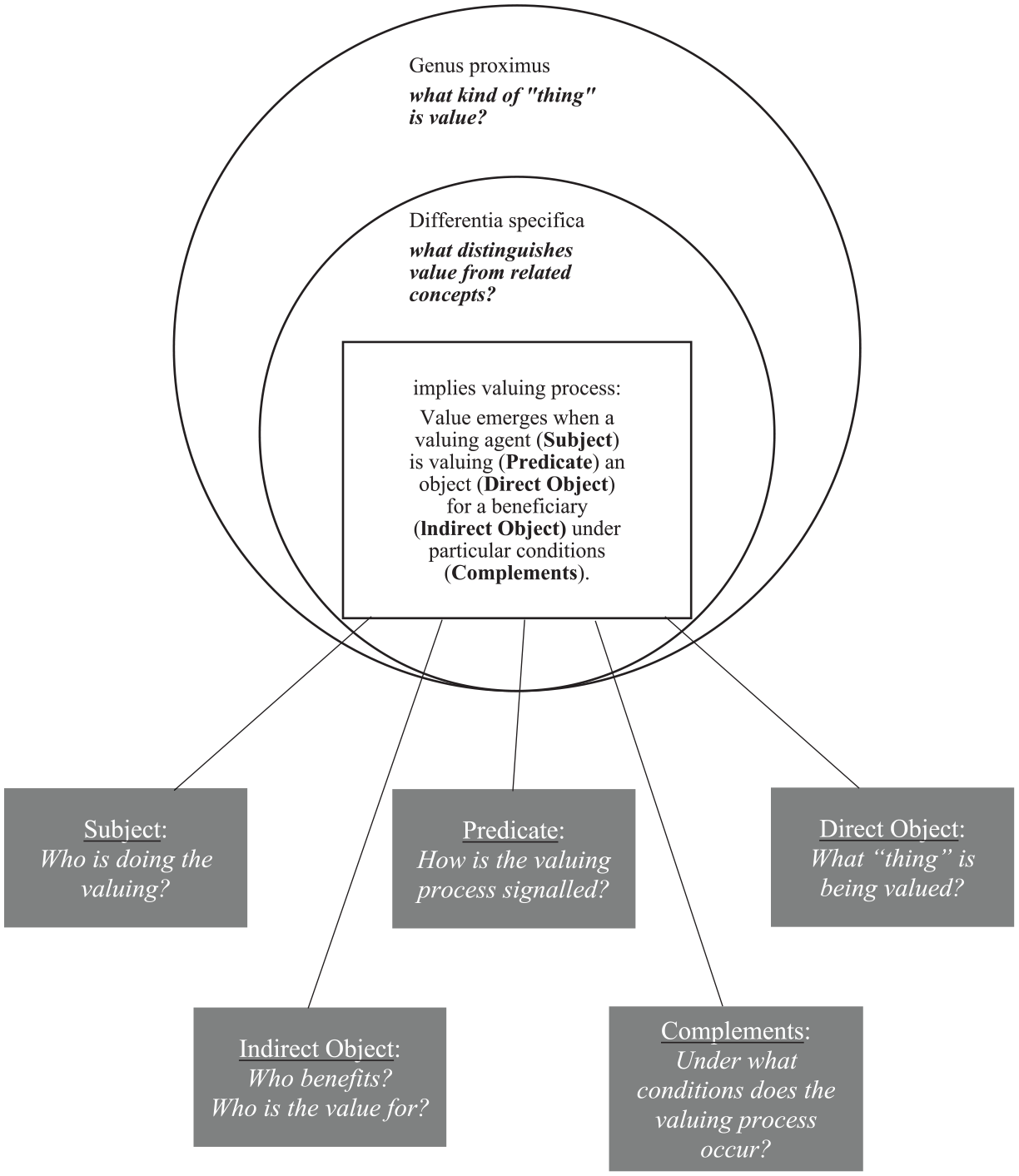
Analytical Framework for Defining Value.
The Concept of Value in SBM Literature: Analysis and Discussion
We now present and discuss our findings. First, we document how the concept of value is understood and applied in SBM literature. We do so by summarizing and illustrating key insights and problematic patterns related to each of the seven elements outlined in the framework: key insights refer to useful learnings from common uses and contexts in which these elements appear (or from which they can be inferred), whereas problematic patterns (P1 to P9) refer to obstacles to knowledge or rigor that can be created by these common uses. Second, we discuss these findings, integrating all problematic patterns to produce a synthesis of key issues that can synergistically be addressed by developing and applying good definitions of value. Third, we continue our discussion by suggesting solutions for these key issues and for the problematic patterns in relation to each element of our framework. Based on this framework, we then propose an analytical tool-that SBM researchers can use to improve conceptual clarity and theoretical innovation in the field.
Analysis: Key Insights and Problematic Patterns
Although the syntactic structure proposed in our framework is not explicitly used in SBM literature, fragments of this structure do appear, in various forms, in explanations or suggestions that can provide important (albeit incomplete) insights into how the concept of value is understood to function in the context of explaining the inner workings of SBMs. Table 1 summarizes our findings (both key insights and problematic patterns) in relation to each of the seven elements in our analytical framework, which are then elaborated on in seven corresponding subsections.
Analysis of Value (V) in SBM Literature: Summary of Findings.
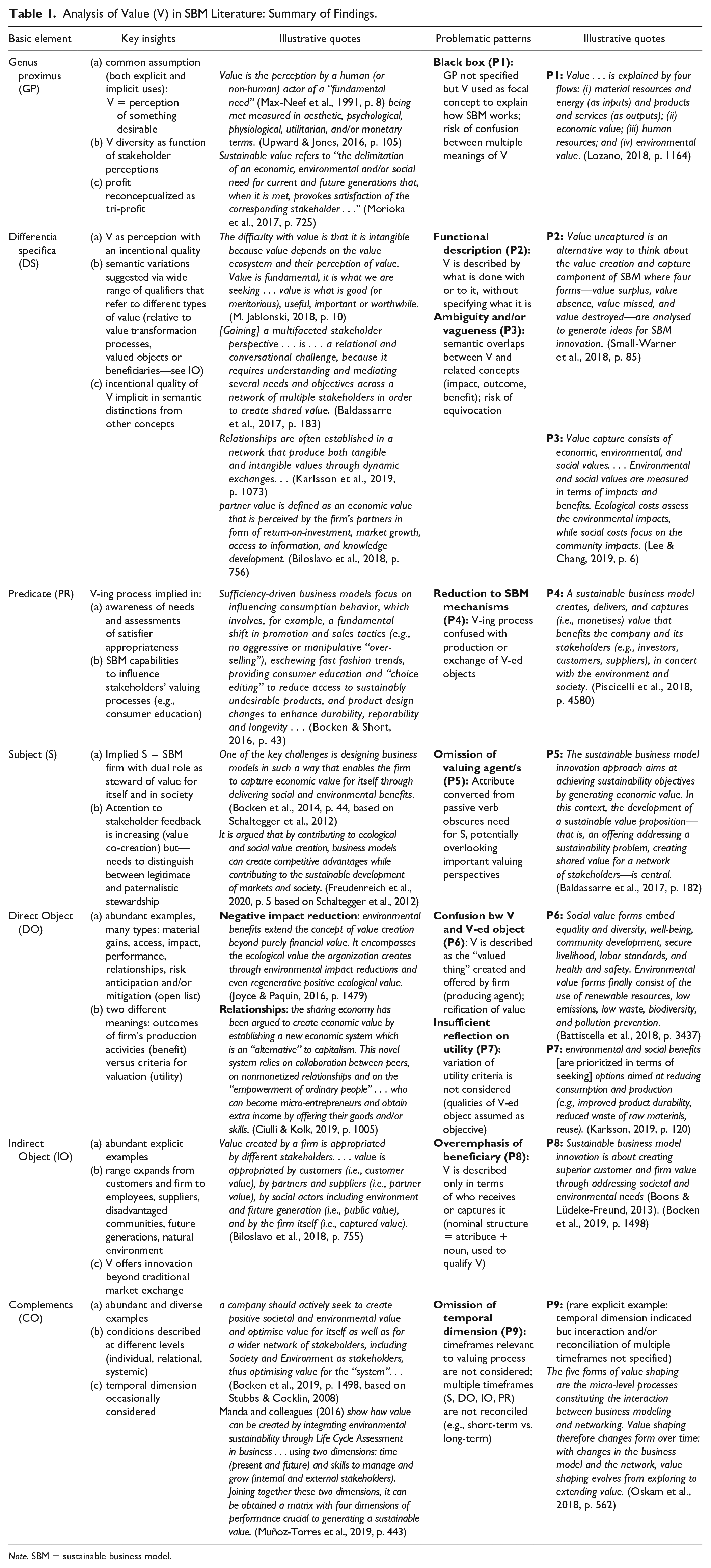
Note. SBM = sustainable business model.
GP: What Kind of “Thing” is Value?
As previously defined, the GP indicates the nature of value, suggesting a broader concept of which “value” is a part. Using this question (what kind of thing is value?), we have identified several explicit definitions of value, which refer to it as a “broad set of benefits derived by a stakeholder from an exchange” (Yang et al., 2014, p. 314), or as “balance between the effort and the result,” or “the benefit one gets versus the cost” (M. Jablonski, 2018, p. 3122, based on Mahajan, 2017), or “the delimitation of a . . . need . . . that, when it is met, provokes satisfaction in the corresponding stakeholder” (Morioka et al., 2017, p. 725). At first sight, a unifying thread may be difficult to discern—yet we note as distinctive an increased recognition that value is a perception (e.g., value is positive if “the perceived effort is less than the perceived result”; M. Jablonski, 2018, p. 3122) or value is “the perception by a human (or non-human) actor of a ‘fundamental need’ (Max-Neef et al., 1991, p. 8)” (Upward & Jones, 2016, p. 105). Furthermore, perception is also an underlying key theme when expressed indirectly, by reference to judgments that are based on perception (Bocken et al., 2015; Laasch, 2018), to beliefs as motivational forces shaping perception (Breuer & Lüdeke-Freund, 2017) or to satisfaction from benefits, which is also an intentional form of perception (Morioka et al., 2017). We infer from these examples that value in SBMs is a perception of something desirable in relation to addressing different needs, interests or wants. This confirms phenomenological perspectives on value as appropriate theoretical foundations for examining value in SBMs.
As value can be appraised from multiple and diverse perspectives, it is recognized as a multifaceted concept reflecting various aspects of human life. According to stakeholder theory, [w]hat constitutes value is defined separately in each [firm-stakeholder-n.n.] relationship and may include various types of value. Therefore, the value created through a business model is a portfolio or a blend of different forms of value, rather than a single outcome. . . (Freudenreich et al., 2020, p. 11)
In this context, Upward and Jones’s (2016) treatment of value can be highlighted as a promising, coherent theory of SBMs, whereby value represents the perception of economically, socially, and environmentally desirable outcomes as they satisfy stakeholders’ needs. According to these authors, the purpose of an SBM is not to achieve profit for the firm applying the respective business model (as in Osterwalder, 2004) but strong sustainability informed by an integration of the natural, social, and system sciences. The appropriate measure of this type of sustainability is tri-profit (i.e., profit as measure of integrated outcomes that are economically, socially, and environmentally desirable at the same time). This leads to a significant reconceptualization of triple bottom line accounting (Elkington, 1998; Norman & Macdonald, 2004).
Notwithstanding these conceptual advances, a predominant pattern in SBM literature is the recurrent mention of value in descriptions or explanations of SBMs, and especially in positions of central importance to understanding how an SBM works, without defining it. While this black-box pattern (P1) may not be an obstacle when the meaning of “value” can be considered self-evident, it does become an issue when assumptions of value as perception suggest plurality of stakeholder perspectives, as significant differences in ontological assumptions about value (from one context to another) may go undetected. This problem is compounded by the fact that, on the backdrop of a general lack of preoccupation for defining value, none of the definitions available in SBM literature is gaining sufficient ground to establish a distinguishable followership trend: the most seminal example, provided by Upward and Jones (2016), has been used in only five subsequent articles, with only two (Bradley et al., 2020; Morioka et al., 2017) engaging with this definition to build on it for theoretical purposes.
DS: What Distinguishes Value From Related Concepts?
The DS points to those characteristics that constitute the concept of value as distinct from other concepts to which it appears to be synonymous (such as benefit). Like the GP, under the dominant black-box pattern the DS is also seldom made explicit. M. Jablonski’s (2018) explanation of value as a perception with an intentional quality (see Table 1) is a rare exception. However, different DS can be inferred from different contexts, where an abundance of qualifiers is used for describing different types of value—thus allowing for variations in what constitutes value (semantic variations). The term also appears in context with other concepts, which are semantically related and yet different from it (semantic distinctions).
With regard to semantic variations, although qualifying value by describing the various forms it can take does not clearly map the scope and boundaries of the concept, it does provide insights into the sorts of “things” that are assumed to constitute or represent value. Qualified “value” is usually expressed in short phrases that contain an attribute preceding the noun (e.g., “shared value,” “brand value,” “customer value”). These attributes (a) sometimes refer to value transformation processes (i.e., processes by which the firm creates or delivers valued objects for various stakeholders), (b) other times to the valued objects themselves, and (c) yet other times to beneficiaries or recipients of value.
Accordingly, group (a) types can be blended value (Emerson, 2003; Reficco et al., 2018), collective value (Gauthier & Gilomen, 2016), exchange value versus use value (Bocken et al., 2013; M. Jablonski, 2018), functional value (Joyce & Paquin, 2016), shared value (Al-Saleh & Mahroum, 2015; Baldassarre et al., 2017; Bittencourt Marconatto et al., 2016; Bocken et al., 2013), sustainable value (Abdelkafi & Täuscher, 2016; Bocken et al., 2019; Evans et al., 2017; Maassen, 2018), value (un)captured, value destroyed, and value missed (Yang, Evans, et al., 2017), among others. Some group (b) examples are monetary/financial value, as appreciation of monetary benefits such as profitability (Gallo et al., 2018; Ribeiro et al., 2018; Small-Warner et al., 2018), brand value as appreciation of the organization’s image (Høgevold et al., 2016), economic value versus noneconomic value (Battistella et al., 2018; Ciulli & Kolk, 2019), and tangible versus intangible value (Evans et al., 2017; Karlsson, 2019). Group (c) is illustrated by customer value (Calvo & Villarreal, 2018; Di Tullio et al., 2018; Geissdoerfer et al., 2018), partner value (Biloslavo et al., 2018), stakeholder value (Karlsson, 2019), and public value (Biloslavo et al., 2018), to mention a few.
Although contributing further insights into the concept of value, these nominal phrases can also induce confusion between functional descriptions (which refer to value in terms of what is done with or to it, in relation to what objects, and to whose benefit) and proper definitions (which are meant to specify what value consists of). As a problematic pattern (P2), functional descriptions (see Small-Warner et al., 2018; Yang, Evans, et al., 2017 in Table 1) can also create confusion between different elements of the valuing process, as discussed further under DO and IO below.
With regard to semantic distinctions, value is often referred to in context with other concepts, such as impact (Battistella et al., 2018; Diaz-Correa & Lopez-Navarro, 2018; Long et al., 2018), outcome (Battistella et al., 2018; Laasch, 2018; Schaltegger et al., 2012), and benefit (Davies & Doherty, 2019; Oskam et al., 2018). Although sometimes contexts are helpful enough to identify the implicit distinctions made between value and these other concepts, other times they are not—and this leads to semantic overlaps. The resulting ambiguity and vagueness (P3) are problematic because, instead of establishing the rigor expected from well-defined concepts, they blur the conceptual boundaries of both “value” and the related terms, allowing for them to be used interchangeably when their meanings are actually distinct or allowing for value to be explained through equally vague concepts.
In distinguishing value from related concepts, some approaches prove more effective than others. We have found, in the more successful examples, that value is considered as a perception of the (positive or negative) worth of an object or situation (Jolink & Niesten, 2015), impact is the (positive or negative) effect of an outside factor that induces changes inside an object or system (Impact Frontiers, 2022), outcome is any (positive or negative) result of an action or process (Bocken et al., 2019), and benefit is an outcome that is positive for a particular recipient, or beneficiary (Lee & Chang, 2019). However, these rare explicit or implicit interpretations of value and related concepts are not consistently used in SBM research. For example, while value is to be understood as a function of (both positive and negative) impact in the Impact Management Project (now Impact Frontiers, 2022), in other studies it is considered in terms of impacts as negative outcomes only, while positive outcomes are labeled as benefits (see Lee & Chang, 2019 in Table 1). Furthermore, blurred boundaries between value and impact can also conceal important assumptions built into a particular business model, thus overlooking alternative conditions under which the model may not work. In the case of Thanks (as examined by Bocken et al., 2019), for instance, we note that the objective to reduce energy use in office buildings by empowering “office workers to make an impact by making a small donation to NGOs . . . every time they perform a sustainable action” (Bocken et al., 2019, p. 1505) makes sense only when employees appraise the impact created by NGOs as being positively valuable—a condition that cannot be taken for granted.
PR: How is the Valuing Process Signaled?
In our framework, the PR is the expression (in language) of the presence of a valuing process (e.g., through the use of verbs or verbal phrases such as “to value” or “to consider worthy”). Although we have seldom encountered the PR in these forms, we have been able to infer implicit assumptions of valuing processes in two types of contexts. First, there are descriptions of the emergence of perceived customer needs, based on awareness of stakeholder experiences. For example, in the Homie case study undertaken by Bocken and colleagues (2019), the organization implements a circular business model by introducing washing as a service, providing high-end appliances to people’s homes and charging per wash service. The analysis is centered on stakeholders’ capacity to establish in what sense a proposed object (in this case, the washing service) is to be valued (e.g., a sweet spot between positive ecological impact and convenience) and found appropriate (or not) as a result of this valuing process. One cannot discern whether the business model examined here is effective or not unless (the meanings of) the valuing processes at work are acknowledged and specified.
Second, there are occasional suggestions that SBMs have mechanisms to influence implied valuing processes to create a more sustainable and inclusive future. These mechanisms include communication, stakeholder engagement, as well as education and training. For example, sufficiency-driven SBMs explored by Bocken and Short (2016) aim to reduce resource consumption by decreasing demand for unsustainable fashion products. For this purpose, consumer engagement and education are used to prioritize genuine needs satisfaction over unlimited wants.
The absence of predicates that signal valuing processes obscures the need to acknowledge the processes that underpin the shaping of value as a perception. This, in turn, creates a significant obstacle against the firm’s access to stakeholders’ perspectives on what should be valued, why, and how. Without such access, the effectiveness of SBMs is likely to be severely impaired. We note that this absence of insight into valuing processes has two main sources. First, a preference for short nominal phrases for describing value (attribute + noun, as previously illustrated) has the more general effect of privileging outcomes (or entities) over processes. Second, an abundance of descriptions of value transformation processes (value creation, value delivery, value capture, etc.), combined with the tendency to use functional descriptions of what is being done with valued objects as a substitute for definitions of value itself (P2), crowds out the space for distinguishing between (a) descriptions of valuing objects (by forming intentional perceptions about them) and (b) descriptions of transforming valued objects (to prepare them for use as valued at (a)). SBM literature provides ample knowledge about different value-related processes or mechanisms that occur within business models—starting from offering, creating, delivering and capturing value (considered as the pillars defining a business model, as in Richardson, 2008), and extending to a wide range of value transformation processes, including redirecting, exchanging and migrating value (M. Jablonski, 2018), and shaping value (see Geissdoerfer et al., 2018, p. 713 for “value circle”). However, we find that reduction to SBM mechanisms, by which valuing processes are confused with production or exchange of valued objects, is a widespread problematic pattern (P4) and one of the main issues to be addressed, due to its far-reaching implications for theorizing on value in SBMs more generally (as highlighted in the Integrated Discussion section below).
S: Who is Doing the Valuing?
The S identifies the person or entity that performs the valuing process. Hence, making S explicit may clarify how (and what) contextual characteristics of the valuing agent may have a bearing on this process. As previously mentioned, in the SBM literature there is an increased recognition that the firm should create and deliver value for multiple stakeholders, and that these stakeholders’ valuing perceptions matter (Baldassarre et al., 2017; Gorissen et al., 2016; Schaltegger et al., 2012; Stubbs, 2017). However, explicit engagement of multiple stakeholders as valuing agents is not common. Implicitly, the main (if not the only) valuing agent that structures the valuing process within the SBM is still assumed to be the firm implementing the business model. In contrast with traditional business models, SBMs innovate here by suggesting a dual role for the firm: valuing for itself and, respectively, valuing for (i.e., on behalf of) customers and other stakeholders (Bocken et al., 2015; Schaltegger et al., 2012).
In the context of managing multiple valuing agents, exercising stewardship can become quite complex, emphasizing at least two important dimensions: a stakeholder’s ability to represent themselves in a valuing process, and their ability to provide feedback about themselves to assist a valuing process. When taking these dimensions into account, one can identify not just one type of stakeholder but four different types. Beside customers who are assumed to be capable of both valuing for themselves and providing feedback (Bocken et al., 2018, 2019; Freudenreich et al., 2020 on value co-creation), other stakeholders may require representation (for example, children, as illustrated in Biloslavo et al., 2018), or may prove unable to provide feedback (e.g., beneficiaries of donations, with certain disabilities, as discussed in Biloslavo et al., 2018; Bittencourt Marconatto et al., 2016), or may lack both capabilities altogether, as in the case of nonhuman entities, ecosystems (Yang, Evans, et al., 2017) and future generations (Morioka et al., 2017).
In the absence of explicit distinctions between multiple valuing agents, it is difficult for the firm to ascertain when its valuing stewardship is needed, and therefore perhaps legitimate, and when it may risk sliding into unjustified paternalism. On one hand, if ignored as valuing agents, any stakeholders could be rendered voiceless and powerless when value-related decisions are made—as shown in the Ecoelce case, where a new business model implemented by an energy company initially excluded Base-of-Pyramid stakeholders and brought them in only after a strong backlash (Bittencourt Marconatto et al., 2016). On the other hand, ignoring feedback from value recipients creates a risk of “blind spots” that could prevent the firm from noticing significant changes in stakeholders’ perceived value, thus leading it to producing irrelevant outputs (see the case of Tom Shoes in Aziz, 2021). The risk of ignoring the perspectives of significant valuing agents such as the ones mentioned above is amplified in SBM literature by a tendency to qualify “value” through attributes converted from passive verbs, as in “blended value” or “shared value”. This problematic pattern (P5) obscures the need to identify an S altogether, let alone distinguish between perspectives of multiple valuing agents. For example, in developing an SBM that aims at “creating shared value for a network of stakeholders” (Baldassarre et al., 2017, p. 182), it remains unclear whose valuing process(es) are called to define the shared value in question.
DO: What “Thing” is Being Valued?
The DO refers to the entity to which value is assigned. SBM literature is rich in examples of what is being valued. As the valuing agent (usually the firm) assesses a particular outcome of the firm’s activities, this valued outcome ranges from physical objects (such as products) to intangible, abstracted notions (such as reputation, accessibility or comfort). The valued objects we identified can be grouped into six categories: access (availability of goods and services, such as access to electricity or health care for the poor, as in Angeli & Jaiswal, 2016; Bittencourt Marconatto et al., 2016), economic gains (improved economic results, such as increased income, savings, cost reduction on energy, as in Abdelkafi & Täuscher, 2016), impact (as impetus for changes to experiences of stakeholders or to systems, such as social impact created by NGOs valued by employees or customers, as in Bocken et al., 2019), performance (effectiveness and/or efficiency of current or future activities, such as greater convenience, simplification of processes, better skills, competencies and capabilities, as in Ciulli & Kolk, 2019), relationships (connections with relevant stakeholders, such as reputation, trust, social status, as in Baldassarre et al., 2017), and (inversely valued) risk (likelihood of worse results, such as potential of financial loss due to noncompliance with applicable regulations, as in Al-Saleh & Mahroum, 2015). These categories of valued objects provide a good indication of what is being valued but should not be treated as a complete or exhaustive list. Indeed, what can be represented as a valued object remains open to unlimited possibilities.
However, this diversity is also a source of conceptual confusions. Often, the term “value” does not refer to the perception resulting from a valuing process but to the “valued thing” (DO) that is created and offered by a producing agent (the firm), whether it is labeled as economic (Battistella et al., 2018), social (Ciulli & Kolk, 2019), or ecological (Joyce & Paquin, 2016) value. This reification of value is a problematic pattern (P6), as it represents yet another way of obscuring the underlying valuing process (by omitting the PR) and the identity of valuing agents (by omitting the S).
Furthermore, we note that the meaning of “what is being valued” may vary between concrete outcomes of the firm’s production activities, such as safe and affordable drinking water (Sousa-Zomer & Miguel, 2018), and more abstract reasons for valuing, such as customer comfort and well-being (Yang & Evans, 2019) or collaboration and empowerment (Ciulli & Kolk, 2019). Both meanings can be legitimate if clearly distinguished and consistently applied—and, in both cases, the highlighted benefits (expressed as actual positive outcomes for various value recipients) and the resulting utility of these outcomes (expressed as criteria for valuing these outcomes as positive) need to be considered together. For example, in the case of a coffee roaster company (as value recipient or beneficiary) that sources products through a FairTrade cooperative, we can ascertain that the cooperative offers the company a benefit in terms of direct access to raw material producers (e.g., producers of coffee grains). Using the analysis of Harrison and Wicks (2013), we can associate this benefit with at least four different types of utility—such as goods (inputs or resources for its production process), organizational justice (contributions to a fairer economy supporting the just treatment of poor farmers), affiliation (connection with the recognized FairTrade brand and its values), and opportunity cost reduction (resource flow stability that protects the firm from fluctuations in availability, quality and cost increases). Therefore, what is being valued here is not just the access to producers but a number of utilities experienced by beneficiaries through this access. Each of these utilities represents differently “what is valued” in the offer made by the firm (the cooperative) to its customer (the coffee roasting company).
This example illustrates why insufficient (or lack of) reflection on the utility (or utilities) underpinning received benefits is a problematic pattern (P7), as it may limit our understanding of the interplay between (a) the qualities of the offered goods or services, and (b) the contextual needs of the beneficiaries, in constituting valued objects. This lack of understanding may further support misleading assumptions that the qualities of valued objects are somehow objective, inherent in the objects themselves, rather than evolving with users’ motivations.
IO: Who Benefits? Who is the Value for?
The IO identifies the target, the entity toward which value is directed, and is usually referred to as beneficiary or recipient of value. In response to the IO questions, we have found abundant explicit references to beneficiaries of value in SBM literature, and a significantly increased diversity of types of beneficiaries. While traditional business models assume the customer and/or the firm as target beneficiaries (via value propositions and, respectively, value capture processes—see, for example, Osterwalder & Pigneur, 2010), SBMs expand the range considerably, aiming to create value for multiple and diverse stakeholder groups at the same time (Lüdeke-Freund & Dembek, 2017; Stubbs & Cocklin, 2008). These include traditional stakeholders such as customers, employees, suppliers, and possibly other participants in the value chain (Joyce & Paquin, 2016; Upward, 2013) as well as nontraditional stakeholders, such as disadvantaged individuals and/or communities (see Dembek et al., 2018 on Base-of-Pyramid stakeholders), future generations (Biloslavo et al., 2018), and nonhuman stakeholders such as the natural environment (Yang, Evans, et al., 2017).
Another important insight is that proposing value to widelydiverse beneficiaries involves exploring and innovating beyond traditional value offer practices. For example, it may mean including poor communities in the supply chain by sourcing products or services from them (Dembek et al., 2022). Similarly, value can be received through more than just traditional economic exchange and, for the perception of value to be established and utility judgments to be made, considerations of impact may become important. For instance, Hahn and colleagues (2018) study the case of a company that, for each new paying customer, provides clean energy for one family in a developing country. The paying customers value positive impacts that access to renewable energy can provide for people in developing countries, such as better children’s education and school attendance, better health, and less environmental pollution.
However, with this expanded attention to beneficiaries also come confusions with other syntactic categories in the valuing process, especially the valuing agent (S) and valued object (DO). As illustrated in our discussion of DS and PR, preference for nominal phrases (of the type attribute + noun) instead of explicit definitions can produce problematic effects: when value is qualified only in terms of who receives or captures it (P8), as in firm value, customer value, or stakeholder value (Bocken et al., 2019; Pal & Gander, 2018), it is still unclear whether these beneficiaries have been considered as valuing agents as well (i.e., whether their perceptions of value are the ones directing the assumptions of value grounding the firm’s business model), and what kinds of criteria are being used for constituting the offered products as valued objects (e.g., material gains, access, impact, etc.).
CO: Under What Conditions Does the Valuing Process Occur?
CO indicate the particular conditions or circumstances (such as modes of valuing, locations or timeframes) in which the valuing process takes place. We have found that both explicit and implicit references to CO are frequent in SBM studies.
In addition to this broad insight, we can discern certain predilect contexts of “value” and relate them to the individual and systemic conditions of shaping value perception identified by Dembek and York (2019). Individual conditions refer to particular physical, psychological, cultural, and economic aspects of the valuing agent. These may include health, physical characteristics or values (as life norms) held by an individual. Examples of individual conditions commonly analyzed in SBM studies are economic disadvantage and low income (see Hahn et al., 2018; Reficco et al., 2018). With respect to systemic conditions, which refer to the various complex systems that influence the valuing process at different levels, such as economic systems, society, and ecological-environmental systems (Dembek & York, 2019), in some studies SBMs are from the start defined as business models aiming to impact stakeholders through a system’s change (Bocken et al., 2019; Dentoni et al., 2021; Lüdeke-Freund & Dembek, 2017; Stubbs & Cocklin, 2008). Thus, systems (i.e., these three types of systems in particular) are assumed to have a significant role in how stakeholders experience life and perceive value.
Furthermore, we find that particular attention is given to the role of relationships in influencing perceptions of value, especially in analyses of relationships between the firm and its stakeholders. While in Dembek and York (2019) relationships are treated as individual conditions, some SBM researchers analyze value as an outcome of mutual relationships between various stakeholders and stakeholder networks (Freudenreich et al., 2020). Often, relationships are mentioned in the context of value creation and exchange processes rather than in forming a value perception (see Yang, Evans, et al., 2017). Some authors, however, do include suggestions of the latter. For example, Boons and Lüdeke-Freund (2013) indicate the role of relationships with and between different stakeholders in recognizing sustainability challenges, or in forming assumptions of responsibility, both affecting the outcome of the valuing process. This emerging perspective on relationships leads to increasing awareness of a multitude of individual conditions, beyond one privileged valuing agent. Hence, we note relational conditions emerging as an important and distinctive category of CO.
Our third insight is that the temporal dimension is implicit in most contexts, with only occasional explicit references, such as in life cycle assessments (see Manda et al., 2016; Muñoz-Torres et al., 2019). Insufficient (or lack of) use of CO of time in most contexts is, however, a notable problematic pattern (P9), as the timeframe or time horizon in which the valuing process occurs remains under- or un-specified. Beside overlooking relevant timeframes, this also obliterates opportunities to reconcile multiple timeframes used in relation to different elements of the value definition (S, DO, IO, PR; see Oskam et al., 2018), and especially opportunities to address common tensions between short-term and long-term timeframes (Bansal & DesJardine, 2014; Cosenz et al., 2020). Effects of losing sight of important timeframe differences, in both processes and outcomes of valuing, are further discussed in the next section.
Integrated Discussion of Problematic Patterns
In this section, we bring together the puzzle pieces that have resulted from our analysis of the seven elements of the valuing process as they appear in the SBM literature, to identify common features and overlaps between the nine problematic patterns, and thus facilitate synergistic solutions. We do this in two steps. First, we provide a synopsis summarizing the problematic patterns of using the concept of value and their wider implications for theory building in the field. These patterns (illustrated in Table 1) tend to reinforce each other and can be grouped into two broad categories: confusions and omissions. Second, we highlight reduction of valuing processes to SBM mechanisms (P4) and omission of time CO (P9) as the furthest reaching and most impactful patterns, and select them for further discussion of leverage-point solutions in the next section.
The first category of patterns is represented by confusions, which are mostly due to ignoring significant (universal and contextual) characteristics and coordinates of the valuing process underpinning “value”. These can in turn be grouped into three subcategories: functional, semantic, and syntactic. First, a typical functional confusion occurs when the intention to formulate a definition (i.e., as an explanation of what value is) is announced—but, instead, what follows is a description of what is done to or with value (i.e., value transformation processes). This pattern (P1) obscures the need to identify the nature of value (as a phenomenon) and to establish the scope and boundaries of ”value” (as designating term). Consequently, while the transformation processes are elucidated in detail, the content or substance of what exactly is being transformed remains a black box. Second, semantic confusions occur when competing concepts (such as value, outcome, benefit, impact, values) are used with overlapping meanings, and at times even interchangeably, as if these terms were close synonyms (P3). Semantic ambiguity between related concepts increases the risk of engaging in fallacies of equivocation, whereby different meanings of the same term are used in different premises of an argument, thus invalidating its conclusion (Cohen, 2011). Offering descriptions of processes by which valued objects are transformed as explanations of value (P2, P4) is also a semantic confusion, which leads to ignoring the multiple valuing processes that take place via multiple stakeholders of the firm. Third, syntactic confusions appear when one logical category in the valuing process is over-emphasized (e.g., DO [P6], or IO (P8)).
The second category of patterns, omissions, is often the result of the confusion patterns mentioned above. For instance, P5, P6, and P8 lead to obscuring the S, thus excluding legitimate valuing agents from positions of voice and power in negotiating valuing processes. Furthermore, failure to distinguish between valuing (as forming the perception of value) and “doing things with value” (P2, P4) leads to omitting the PR—which should be made explicit through the use of verbs that indicate or describe acts of valuing (i.e., valuing as desiring, caring, appreciating—as different from creating, delivering or capturing value). Finally, insufficient reflection on utility criteria involved in valuing (P7) or on its temporal dimension (P9) hinders our understanding of key aspects of valuing—such as, in what context(s) and timeframe(s) the utility of a valued object to a beneficiary, or its appropriateness for satisfying an identified need, is to be established.
Upon examining all nine patterns together, we highlight two key issues that affect all critical elements of good definition of value: (a) insufficient recognition of the pervasive and essential role of time in the valuing process (as illustrated by P9); and (b) reduction of value to production or transformation mechanisms within the business model (as mainly illustrated by P4). We also emphasize the role of specific theoretical frameworks underpinning SBM studies (e.g., resource-based view, stakeholder theory) in favoring some value definition elements over others.
With respect to the role of time, even assuming that SBM research should aim to focus on these mechanisms rather than on valuing as a process of perceiving (which may be considered too abstract), it is difficult to appraise the production outcomes in the absence of a specified timeframe or time horizon in which the relevant underlying valuing processes occur. Thus, omitting the temporal dimension of valuing creates two wider problems. First, the horizon of sustainability that SBMs are set to advance requires an important shift from short-term to long-term thinking and decision-making, as it has been found that “[s]hort-termism can lead to suboptimal outcomes for both the firm and society” (Bansal & DesJardine, 2014). Second, without a clear understanding of the temporal dimension we can never achieve a full understanding of value because this dimension affects each of the seven elements of the valuing process. For example, value recipients (IO) and valuing agents (S) may apply different timeframes and, in some cases (such as future generations), they can only be identified as a function of time. Valued things (DO) may be designed to last more or less time, or may take various time spans to degrade. Conditions of valuing (CO) also include assumptions about the timeframes within which they apply—such as how long a physical characteristic or a relationship lasts—thus affecting the individual, relational, or systemic conditions experienced by the valuing agent or the value recipient. Consequently, losing sight of timeframe differences between valuing agent, valued object(s) and/or beneficiaries can fundamentally impair our understanding of the need to reconcile multiple timeframes to make holistic sense of a valuing process.
Regarding the propensity of SBM research to reduce the concepts of value and valuing to production mechanisms within the business model, we note that this pattern occurs mainly when explaining what business models are and describing how they function. Although such descriptions are informative, they fail to properly define SBMs because the concept of value itself (which is used as a central element of the concept of business model) remains undefined. This pattern (P4) has a fundamental role in generating the range of confusions and omissions represented in Table 1.
In addition to the far-reaching effects of P4 and P9, we note that theories used to frame the concept of value in SBMs may also contribute to these patterns, as they tend to favor one logical element of the valuing process over others. For example, prevalent discourse in the resource-based view (see Bowman & Ambrosini, 2000) is likely to emphasize the DO (valued objects) and reify value (P6), whereas stakeholder theory is likely to focus on the IO (beneficiaries) instead (see Freudenreich et al., 2020), often favoring the use of nominal phrases (P8). However, when one explicitly identifies the GP of “value” as perception (as reflected by Upward and Jones’ concept of tri-profit), it becomes easier to pay due attention to all the relevant elements of the perceiving process, without reifying needs and satisfiers into “objective” entities that are independent of perceptions. This expanded and balanced attention is particularly justified in the SBM field, both theoretically and practically, as the widely recognized purpose of SBM-developing firms is to both transact in “valued objects” and convince an increasing range of stakeholders that what the firm creates is of value to them.
Discussion of Suggested Solutions
We propose the analytical framework for defining value developed in this study as a source of synergistic solutions to avoid the problematic patterns identified. To start with, the deliberate, reflective application of the complete logical-syntactic structure of a good definition of value significantly reduces the risk of omissions and/or confusions of key elements that constitute value as outcome of a valuing process. In recommending this application as a background check for conceptual rigor, we do not suggest, however, that all studies need to produce a full definition of value and address or analyze all its elements—but only that the expressed elements need to be recognized for what they are and, where appropriate, not assumed to be sufficient in defining value. Furthermore, using the framework does not mean adopting one universal definition of value but understanding how this definition may emerge contextually and also change over time.
In this context, Table 2 provides a guide for using the analytical framework proposed in this study to formulate good definitions of value, avoid each of the problematic patterns previously identified, and develop theories of value in future research. Accordingly, the issue of omitting the temporal dimension is addressed by specifying CO of time when describing the valuing processes of all relevant Ss, and the issue of reducing valuing to SBM mechanisms is mitigated by using language that clearly signals valuing processes as different from value transformation processes. In addition, integrated reflection on potential research questions suggests that SBM theorizing is in need of theories of value that pay attention to all elements of the concept (i.e., having something to say about the ontological status of value and its distinctive attributes), and explaining valuing processes in terms of relevant characteristics of valuing agents, valued objects, beneficiaries, and conditions of valuation (in particular, timeframes).
Analytical Guide for Developing Good Definitions of Value in SBMs.
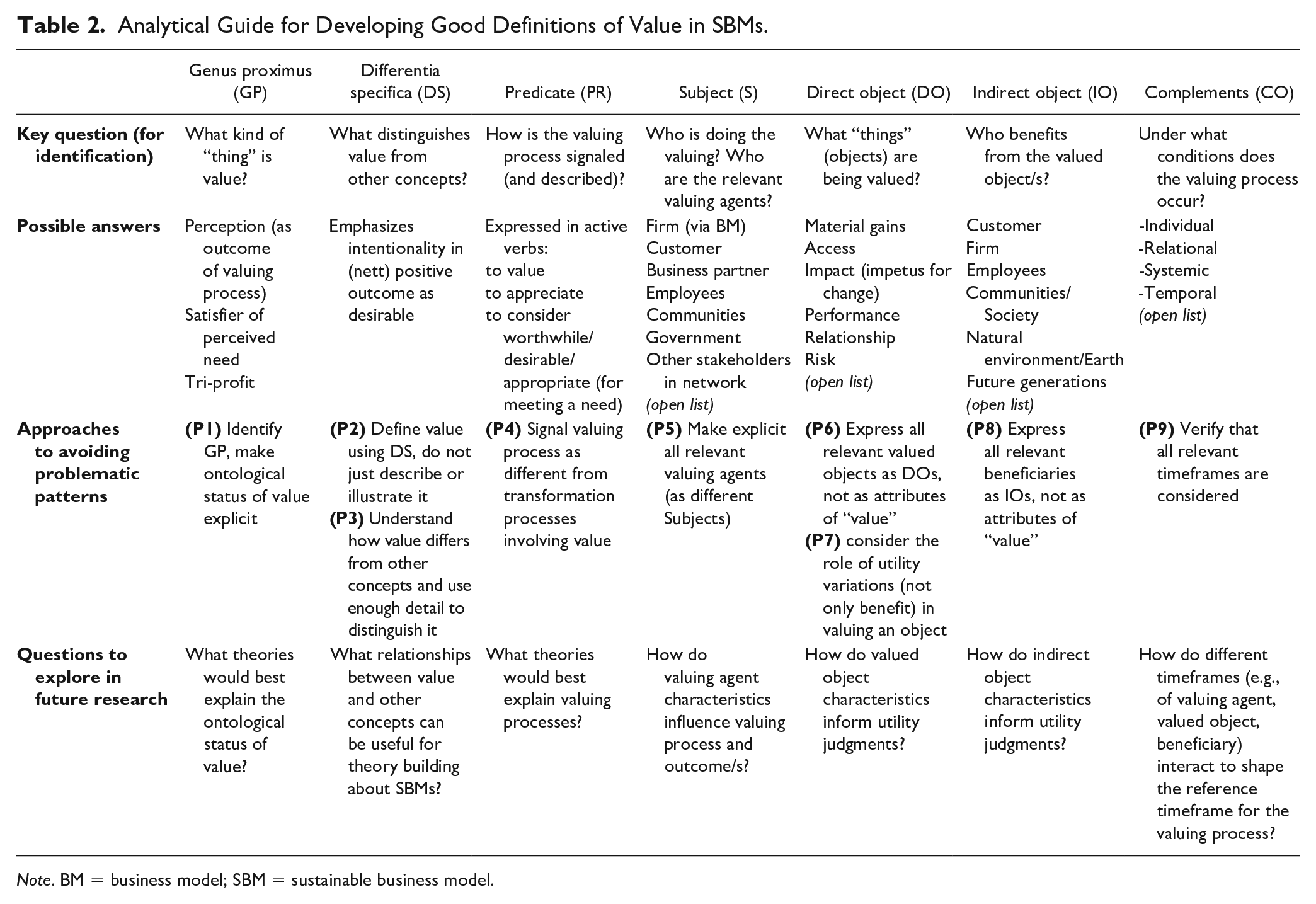
Note. BM = business model; SBM = sustainable business model.
Conclusion and Future Research
To assist in developing a field-specific approach to defining value in SBMs, we articulated a framework for good definition of value and analyzed a selection of key articles that refer to value in SBM context. Our study shows that value in SBMs is, overall, treated as a perception of economically, socially, and environmentally desirable outcomes that satisfy the needs of various stakeholders. Within this scope, researchers use and describe value based on attributes that refer to value transformation processes, valued objects, and beneficiaries.
We identify and make explicit the reasons for problematic patterns in using the concept of value in SBM research, investigate the reasons for them, and propose ways to address them. Furthermore, we confirm through our analysis of the literature that, due to the diversity of perspectives on value in varying contexts of firm-stakeholder relationships, the pursuit of one universal definition of value is conceptually improper. In other words, the concept of value in SBM cannot be universally defined, due to the inherent aspects of relativity and diversity (of different stakeholder perspectives). Hence, the conceptual treatment of value in SBM needs to allow for the possibility of adding new units of meaning to it, with semantic and cognitive effects that cannot be entirely predicted. To appropriately address this in the field of SBM research in particular, researchers should focus on what value means in their specific context of study. Our proposed framework offers a way to explore the context-specific meaning of value by acknowledging that value appears as a result of a valuing process, whereby an agent (stakeholder) is valuing an object for a beneficiary (who can be the same or another stakeholder), under particular conditions.
A comprehensive (full) definition of value specifies a GP (what kind of thing is value), DS (how value is distinguished from other concepts), a S (who), a PR (is valuing), a DO (what), an IO (for whom), and CO (under particular conditions of time, place, and mode). Developing a good definition of value in SBMs, in the logical sense explained in this article, does not require every study to provide, each time, a full definition of value that explicitly identifies all seven elements. In particular contexts, some of these elements may be self-evident and therefore do not need to be mentioned in the definition. In other instances, researchers may only study some aspects of value in an SBM without addressing the full concept, in which case they need to bear in mind what aspects of the definition of value are not dealt with in their study, instead of assuming that value is already sufficiently defined. Doing so will help to avoid problematic patterns that are currently hindering our understandings of value and their integration into coherent and seminal theories.
Contributions to Research
Underpinned by principles of Aristotelian logic and ontological premises of philosophical phenomenology of value, our analysis and framework provide three key contributions to research on business models and beyond. First, our study introduces a purposive distinction between agent and beneficiary, with consequences for theory and practice. Conceptually, this signifies a paradigm shift in understanding firm-stakeholder relationships in SBMs as well as relationships among different stakeholders. By considering stakeholders in active roles as valuing agents rather than passive recipients of value, our framework makes a contribution to stakeholder engagement literature by specifying procedural guidance for developing constructive firm-stakeholder relationships in the context of an SBM. Our framework does not only specify the need for a valuing agent (S): It also indicates a pathway for making explicit all valuing agents (as different Ss). Researchers and practitioners can draw on stakeholder theory and associated frameworks to identify who the relevant agents (stakeholders) are in a given SBM context. Considering the multiple roles that stakeholders can take in our perspective, the conception of the firm as a stakeholders’ network in which value emerges (as discussed and applied, for example, in Freudenreich et al., 2020) becomes particularly relevant.
Second, we clearly identify the GP of value in SBMs (the supra-ordinate category that clarifies what kind of “thing” is value), which has so far been mostly assumed and not explicitly discussed. This provides an important insight about value creation: we find that, to create value, SBMs must first create or provide opportunity for a change that a stakeholder experiences and/or desires. In other words, it is necessary to create or provide the stakeholder with an opportunity for an outcome or impact that is relevant to her. What then converts this outcome or impact into value is its recognition (as such) by the stakeholder. We hope that this insight, based on a fundamental understanding of value as perception, will help to address the confusion that currently exists in the literature around the difference between value and other concepts such as outcome, impact, and benefit. This can also usefully reform the (still) predominant perspective on business model—from a concept focused on creating financial benefits (primarily to the firm) to one focused on delivering changes perceived as being worthwhile, in multiple (including non-financial) ways, to and by stakeholders.
Third, our framework provides insights into how different forms of value can be identified. We hope this will help researchers to identify explicitly what form(s) of value they focus on, to further avoid confusions with other concepts, and to discover new forms of value in need of definition. Given that a business model is set to create multiple and mixed types of value to satisfy multiple stakeholder groups (Freudenreich et al., 2020), the capacity to identify the specific forms of value that are relevant to specific stakeholder groups becomes essential.
Contributions to Practice
Similarly, our analysis of value and our framework provide three key contributions for managers and other practitioners who design and implement business models. First, our study helps to better systematize the process of value creation. This is important for all managers, and especially for those in sustainability-oriented organizations such as benefit corporations and social enterprises, as they face the challenging jobs of delivering change to for different stakeholders and tracking their different valuing processes. To assist in this work, our framework indicates what needs to be monitored.
Second, more explicit focus on the valuing process (PR) and conditions of valuing (CO), as well as on observing how these may change over time, will help companies to keep their value offers relevant and appreciated by customers and other stakeholders. As the Toms Shoes example illustrates, doing so is vital for company survival and development. The framework helps monitor these vital aspects of value by providing the relevant structure.
Third, our framework can be used as a tool supporting business model design. It can be particularly helpful in designing value propositions of business models. It could be used together with tools such as Bocken et al.’s (2013) value mapping. Being aware of all the elements of our framework and exploring them in various contexts can help to identify value opportunities, value missed, and value destroyed.
Future Research
We contribute to the literature on SBM and value by integrating the proposed analytical framework with the results of our analysis and discussion into a guide for researchers, as summarized in Table 2. The last row of this table also contains potential future research questions, resulted from our reflections on each of the seven elements of the framework.
Based on the abundant examples of value cited in our analysis, we note that forms of value in SBM research go well beyond the established economic-social-environmental construct established through the triple bottom line framework, and that the potential for discovering new, relevant forms may be unlimited. We therefore suggest that further studies are needed to generate comprehensive classifications of different forms of value. Given significant changes in meanings of “value” in the transition from general business models to SBM research, we argue that the latter can no longer rely on classical economic theory for documenting its theories of value and, therefore, should develop value theories of its own. Future research should focus on this field-significant endeavor.
Furthermore, the results of our study could be applied to several potentially interesting avenues for SBM research, based on suggestions already made in the wider business model literature. For example, in the concept of normative business models introduced by Randles and Laasch (2016), of particular interest is the notion of caring agents who embed a values orientation in the organization. Our framework can assist in exploring how this new concept influences the concept of value emerging in such organizations populated by caring agents. Another example is Laasch’s (2019) concept of value logics as embodied in organizational members. Using the framework, one can examine the defining elements of the different value logics and how they influence value as perceived by stakeholders. Furthermore, processes of value negotiation (Hale, 2021) can be investigated as contexts for identifying and analyzing the valuing processes carried out by different potential partners in building partnerships.
In concluding our study, we should not exclude the possibility that the very meaning of value as perception (i.e., outcome of a distinctive kind of perceiving process) can change over time, as more nuanced understandings of sustainability emerge. A methodologically rigorous (re)construction of the concept of value cannot be assured without periodic assessments of how use patterns of the value definition’s key elements may have shifted over time.
Footnotes
Acknowledgements
We are very grateful to Prof. Jonatan Pinkse (Associate Editor) and the two anonymous reviewers for their constructive feedback. The manuscript could not have improved so significantly without their guidance.
Declaration of Conflicting Interests
The authors declared no potential conflicts of interest with respect to the research, authorship, and/or publication of this article.
Funding
The authors received no financial support for the research, authorship, and/or publication of this article.
