




Abstract
This article examines how corporate social responsibility (CSR) can serve as an external source of rents for governments that depend on foreign financing for state-building and development. The strategic, instrumental use of CSR has been overlooked in previous research on governments and CSR, especially in the Global South. To understand how CSR can serve as a lever for rents, the concept of “extraversion” is introduced to describe the way in which rent-seeking African governments instrumentalize their asymmetric external relations for political and private benefit. The connection between CSR and rent-seeking is analyzed through a case study of large gas investments in Tanzania. The article finds that the government has set up regulation that enables local and central government authorities to appropriate, mediate, reclaim, or possibly trick CSR practices to gain rents. Based on the study, two contributions are made to the literature on CSR and governments. First, the instrumental use of CSR in the Global South is added to the variety of perspectives that can be taken when studying government agency. Second, CSR is conceptualized as a potential stream of rents for governments to exploit. The article ends with discussing that the outcome of CSR in a rent-seeking environment depends on whether the leveraged resources are managed well to support peaceful and locally beneficial economic development or whether they serve private accumulation through corruption.
Some years ago, a Tanzanian Member of Parliament (MP) explained in a research interview I conducted, how his government had to optimize the corporate social responsibility (CSR) stream among other potential streams, such as taxes and royalties, from foreign investment. In the interview, I wanted to know what he thought of CSR interventions by large gas investors and how important they were from the viewpoint of the Tanzanian state. His answer inspired the development of the present article, which assesses what it can mean to consider CSR as a potential stream of resources for governments to exploit. CSR refers here to the (mostly Western) discourse about, and the related practices by, private businesses to generate socioeconomic and environmental benefits for societies (Banerjee, 2008; den Hond et al., 2007).
Although a growing body of literature on governments and CSR has been calling for deeper engagement with state policies, strategies, and power in relation to CSR (Cashore et al., 2021; Dentchev et al., 2017; Kourula et al., 2019; Schrempf-Stirling, 2018), this instrumental perspective has been largely overlooked. In the Western world, research has described how CSR has been used as an instrument for corporate elites and their political allies to preempt government intervention (Kaplan, 2015; Kinderman, 2012; Marens, 2012), but in the context of the Global South, research has not systematically adressed instrumentality. Previously identified forms of government agency in relation to CSR, such as “mandating,” “facilitating,” “partnering,” and “endorsing” (Fox et al., 2002; see also Knudsen & Moon, 2017; Steurer, 2010) or “competition,” “rejection” and “repurposing” (Cashore et al., 2021; Marques & Eberlein, 2021), have been explained by different variations in capitalism and political systems (Gjølberg, 2011; Gond et al., 2011; Hofman et al., 2017; Matten & Moon, 2008; Midttun et al., 2015) and, from a more interest-based perspective according to strategic suitability with domestic interests, policy agendas, industry strategies, and developmental capacity (Marques & Eberlein, 2021).
While there could be many ways to address instrumentality, this article looks in particular at CSR as a lever for rents and at rent-seeking as a form of agency. It sets out to answer the question: How is CSR instrumentalized into a source for rents? The approach is based on the presumption that the asymmetrical integration of countries into the global economy causes rent-seeking among governments that depend heavily on external resources for state-building and the generation of welfare. By “rent” is meant an incremental change in incomes or benefits, and “rent-seeking” refers to “activities which seek to create, maintain or change rights and institutions on which particular rents are based” (Khan, 2000b, p. 5).
Fossil fuel exporting states have been commonly linked to rentierism, where states acquire substantial amounts of national revenue through oil-related business. In the context of sub-Saharan Africa that this article addresses empirically, many governments have acquired substantial amounts of national revenue also through foreign financial flows in the form of development aid, loans, and investments throughout their 60 years of independence. Against this context, Jean-Francois Bayart (2000, 2009) has introduced the concept of “extraversion” to describe the outward-leaning strategy of interaction between African governments and their external environment. Through extraversion, African governments mobilize rents derived from their unequal relationship with the rest of the world. In this article, extraversion serves as a conceptual lens to understand how CSR can be a source of excess financial and material income.
This approach is operationalized through a qualitative case study of large foreign investments in the liquefied natural gas (LNG) sector in Tanzania. Tanzania is an interesting case to study because of its history as one of Africa’s most aid-dependent countries with rent-seeking being common among government actors (Cooksey & Kelsall, 2011; Gray, 2013, 2015; Kelsall, 2018; Whitfield et al., 2015). Furthermore, Tanzania is one of the sub-Saharan African countries where large discoveries of fossil fuels have been made during the past decade. The discoveries have caused an influx of some of the world’s largest oil multinationals to the country with subsequent rollouts of CSR initiatives combined with very high expectations about improved socioeconomic development among the country’s population.
The article is structured as follows. The first two sections lay out the theoretical context. These sections discuss previous literature on CSR and governments and explain how research on rent-seeking governments can contribute to this literature. Thereafter, research methods and materials will be presented. The empirical part presents the rent-seeking strategies that the Tanzanian government on central and local levels has employed in relation to gas investors’ CSR. In the discussion, the article’s two central contributions to the literature on CSR and governments are presented. These contributions are the addition of the instrumental use of CSR in the Global South into the variety of perspectives that can be taken when studying government agency, and the conceptualization of CSR as a potential stream of rents for governments that are used to generating a considerable part of their resources from external sources. Finally, the research-related and practical implications of rent-seeking as a government approach to CSR are discussed.
CSR, Governments, and Rentierism
Although governing CSR has a significant cross-border dimension (Knudsen & Moon, 2017; Midttun et al., 2015; Renckens, 2021) through its intention to make Western companies more responsible in spaces where government regulation is presumed to be weak or absent (Scherer & Palazzo, 2011; Schneider & Scherer, 2019), research on government agency at the “receiving-end” of CSR remains scarce. From previous research we know that governments in the Global South tend to translate, edit, and adapt foreign (Western) imposed ideas of CSR to suit the local context (Jamali et al., 2017), for example, to address colonial and apartheid legacies (Adanhounme, 2011; Amaeshi et al., 2006; Hamann & Reddy, 2018; Idemudia, 2009; Kolk & Rivera-Santos, 2018; Muthuri, 2013). Furthermore, Fox and colleagues (2002) have argued that government approaches to CSR in all parts of the world tend to fit under the labels of “mandating,” “facilitating,” “partnering” and “endorsing.” This quite general categorization and variations of it have been later applied and further confirmed in several studies that have been predominantly focused on the Global North (Albareda et al., 2007; Knudsen et al., 2015; Knudsen & Moon, 2017; Steurer, 2010). In addition to mainly collaborative and complementary approaches, government strategies toward externally imposed private norms in the Global South have been identified to be competitive or antagonistic (Cashore et al., 2021; Marques & Eberlein, 2021). In Asia, mandating CSR has been prevalent among several governments (Bartley, 2018; Gond et al., 2011; Hofman et al., 2017). Institutional reasons behind various forms of government agency have been found in different types of historically evolved policymaking systems, national business systems, and variations in capitalism (Albareda et al., 2007; Gjølberg, 2011; Knudsen et al., 2015; Matten & Moon, 2008; Midttun et al., 2015). The asymmetrical integration of states into the global economy has been overlooked, despite it causing structures of dependency and interdependency that can spur rent-seeking behavior.
In addition, little is still known about the instrumental use of CSR by governments, especially in the Global South. In the United Kingdom and the United States, CSR has been identified to be a tool used by neoliberally inclined political and economic elites to avoid government intervention (Kaplan, 2015; Kinderman, 2012; Marens, 2012). In the context of the Global South, scholars have pointed out that government approaches to externally imposed private norms depend on how those norms strategically fit domestic interests, policy agendas, industry strategies, and developmental capacity and how they are embedded in domestic distributional struggles (Marques & Eberlein, 2021). CSR has also been found to relieve the state from its responsibilities (Jamali et al., 2017), and rentierism has been claimed to prevent CSR from succeeding (Idemudia, 2010). More explicit analysis of CSR as a source of resources has been done in countries such as India and Mauritius that have mandated companies to spend a certain monetary amount on CSR (Gatti et al., 2019; Mahadeo, 2021; Waagstein, 2011). However, no previous studies have systematically investigated the instrumental use of CSR as a source for externally derived rents.
Typically, rentier states have been considered to be fossil fuel-rich countries, especially in the Middle East and North Africa that derive a substantial amount of their national income from rents paid by foreign private and public actors (Beblawi, 1987; Mahdavy, 1970; Yates, 1996). These governments that are dependent on foreign resources are not as dependent on taxing their citizens, which in turn can have negative effects on democratic and economic development and lead to the so-called “resource curse” (Collier, 2010; Ross, 2015). The idea of rentierism has also been applied to other forms of income than oil rents. In the context of sub-Saharan Africa, where many states have relied heavily on income from foreign aid, loans, and investments for state-building, rent-seeking has also been prevalent. Against this context, Jean-Francois Bayart (2000, 2009) has introduced the concept of “extraversion” to describe the “creation and capture [by African states] of a rent generated by dependency” (Bayart, 2000, p. 228). The next section looks more deeply into extraversion and at how CSR can be analyzed as a foreign source of rents for governments in the Global South that have a weak domestic resource base.
Extraversion and Rent-Seeking as Political Strategies
In this article, “extraversion” is used as an analytic to describe the outward-leaning political strategy of interaction between African governments and their external environment. Despite being drawn from research in the African context, similar extraverted tendencies have been noted, for example, in Afghanistan and Cambodia (Cock, 2010; Kahler, 2009). Through extraversion, African governments mobilize rents derived from their unequal relationship with the rest of the world. Foreign rents make them less reliant on local revenue income, which can be useful and politically desirable when the population is largely unable or unwilling to provide substantial revenue due to widespread poverty.
The conduct of extraversion has evolved during colonial and post-colonial times. After the end of formal colonialism, dependency theorists such as Walter Rodney (1972) and Samir Amin (1976) paid attention to Africa’s position in the global economy as exporters of raw materials and concluded that wealthy states continued to be dependent on poor states’ raw materials and thus continued to impoverish them while enriching themselves. While at the time making path-breaking analyses of inequality and capitalism’s colonial history, dependency theorists generally did not consider the agency of the subordinated African states and overlooked the fact that external resources became crucial for the ongoing making of statehood and the survival of political elites in the newly independent but resource-weak states. Instead of dependency, the relationship between African states and the rest of the world is better characterized as one of interdependency where African states must gain access to different streams of external resources to manage the ongoing process of establishing authority and legitimacy over the territories that they legally rule (Bayart, 2000). In addition to accessing resource streams, a tendency of “gatekeeping” this access to sources of revenue has been identified as a common character in post-colonial African states (Cooper, 2002).
A significant external resource for many African countries has been development cooperation funding, which Western states have injected to solve “problems” in African countries. Since the end of colonialism, former colonial powers have supported African states through development and humanitarian aid, loans, investment, and other resources. Therefore, ever since most African states gained independence in the 1960s, actors external to Africa, such as Western states, international organizations, and non-governmental organizations (NGOs), have become major resources in processes of political centralization, economic accumulation, and power struggles within African states (Brett & Gissel, 2018; Hagmann, 2016; Peiffer & Englebert, 2012; Pommerolle, 2010; Tull, 2011). During the 2000s, private companies have also become “development actors” in the transnational aid industry (Blowfield & Dolan, 2014), which supports the idea that extraversion can also be applied to CSR from foreign investors.
In his writing, Bayart (2000) makes a generalist claim that across Africa, six forms of conduct have recurred between Africa and external actors during the 20th century. These six forms are “trickery,” “flight,” “mediation,” “appropriation,” “rejection,” and “coercion.” According to Bayart, trickery refers to the manipulation of foreign forces, which are too powerful to be confronted directly but can be turned into being useful for one’s own purposes. Examples of trickery can be found, for example, in development projects turned “Potemkin villages” where not much is happening behind the façade. Flight refers to operating within the informal sphere away from the control of formal rules and regulations. Mediation is practiced by actors who in different ways act between the foreign and the domestic context. An example could be a person working for an international NGO in his or her locality of origin. Appropriation refers to the adoption of external concepts, cultures, and objects; rejection to the dismissal of a foreign power; and coercion to the use of force by centralized power to govern over people. These modes of action can be intertwined and happen concurrently, such as mediation and trickery or even appropriation and rejection in situations where, for example, anti-Western militant groups adopt Western military technology or cultural references (Bayart, 2000, pp. 254–264). Bayart has been criticized for culturalist and personalist interpretations of Africans and African political elites (Dorman, 2018). While not supporting Bayart’s claim that these six forms of conduct are exhaustive of some general “African behavior,” this study analyzes whether these forms have relevance for understanding the relationship between rent-seeking and CSR.
In addition to the modes of extraversion, this study analyzes policies and institutions that facilitate rent-seeking. This part of the analysis draws from the work of Mushtaq Khan (2000a, 2000b, 2010, 2018) on rent-seeking in the Global South. Khan’s understanding of rents and rent-seeking is more nuanced than what mainstream economic theory usually beholds. For mainstream economic theory, rent-seeking means market inefficiency and corruption. In contrast to this conventional understanding of rent-seeking, Khan argues that in developing countries where perfect market conditions, including simply available new technology, formal property rights, costlessly managed labor and free and symmetric information are far from being a reality, rents can be necessary to create incentives and distributional transfers to maintain a political settlement. Political settlement means a consistency between the distribution of benefits with the distribution of power in society. The distribution of benefits must be supported by institutions and policies such as property rights and has to be sustainable over time for rent management to succeed (Khan, 2010, p. 4). By success, Khan (2000a, 2000b, 2010, 2018) means that rents can be “developmental” if they are managed well. In contrast, rents can be non-developmental if they are managed poorly. It is unfortunately beyond the scope of this case study to assess whether acquired rents are or will be developmental or corrupt in character. However, the implications of good and poor CSR-related rent management will be discussed at the end of the article.
Through the combination of Bayart’s modes of extraversion and Khan’s definition of rent-seeking, this study addresses the following more specific research questions:
In the following section, the material and operationalization of the theoretical framework will be presented.
Method and Empirical Material
This article is based on material collected through a qualitative case study that aims for analytical generalization (Yin, 2014). The material includes semi-structured interviews and written, secondary sources. The secondary sources include natural resource sector legislation acts and policies between 2015 and 2017 1 and newspaper articles in one of Tanzania’s national newspapers, The Citizen. The research was initiated in 2015. The interviews have been conducted in 2018 followed by four verifying interviews and an NGO roundtable in 2022. The newspaper articles cover the years between 2016 and 2020. The research has been done primarily during the presidency of the late John Pombe Magufuli and the results reflect his time in power. In this period, Tanzania took an authoritarian turn (Paget, 2017) and the research topic was considered politically sensitive by most informants.
Snowballing was used as a tactic (Noy, 2008) to access and identify interviewees who were relevant actors for this study. Snowballing, or being referred from one interviewee to another, was necessary for gaining trust in a matter that was deemed sensitive by many interviewees. Initial interviews were acquired through the author’s existing contacts mainly within internationally connected Tanzanian NGOs. The overall study includes 51 semi-structured interviews with a total of 81 people. This study draws primarily from interviews conducted with Tanzanian government officials. Of all interviews, 16 have been conducted with persons who represent the government as officials, ruling party members, or both. These interviewees range from directors in government institutions to village-level officials. Interviews have been conducted with both central and local government authorities.
The material also includes interviews with representatives from NGOs, corporations, donor governments, and communities. These interviews serve as contextual material for this article. The interviewees from Tanzanian and international NGOs have implemented the corporations’ CSR activities or been involved in capacity building or advocacy related to the gas investments. In addition, interviews have been held with representatives of four investors, Equinor, Shell, ExxonMobil, and Ophir Energy, as well as donor governments that support CSR and development projects with the oil investors. Finally, group interviews have been conducted in villages affected by existing and upcoming gas investments in the regions of Lindi and Mtwara. Due to requests from several interviewees, all interviewees have been granted confidentiality, and therefore citations are not attributed to specific people or organizations.
The analysis consisted of two parts. One analyzed extraversion as a conduct and the other analyzed rent-seeking through the setting up of policies and institutions. The first analysis included both inductive and deductive reasoning. Initially, the government interviews and newspaper articles were coded inductively according to emergent opinions about the practice of CSR. In a second cycle, these codes were merged into more general themes on both central and local government levels (Figure 1). This stage was followed by a deductive coding process, where the themes were labeled according to Bayart’s six modes of extraversion (trickery, flight, mediation, appropriation, rejection, and coercion). In the process, the codes “flight” and “coercion” were found redundant and dropped, and “reclaim” was introduced as a new mode to describe extraversion on central government level. Trickery was not found in government conduct toward CSR, but because suspicions of trickery were found in the interview material with NGOs and companies, trickery as an extraversion mode will be discussed in the analysis section.
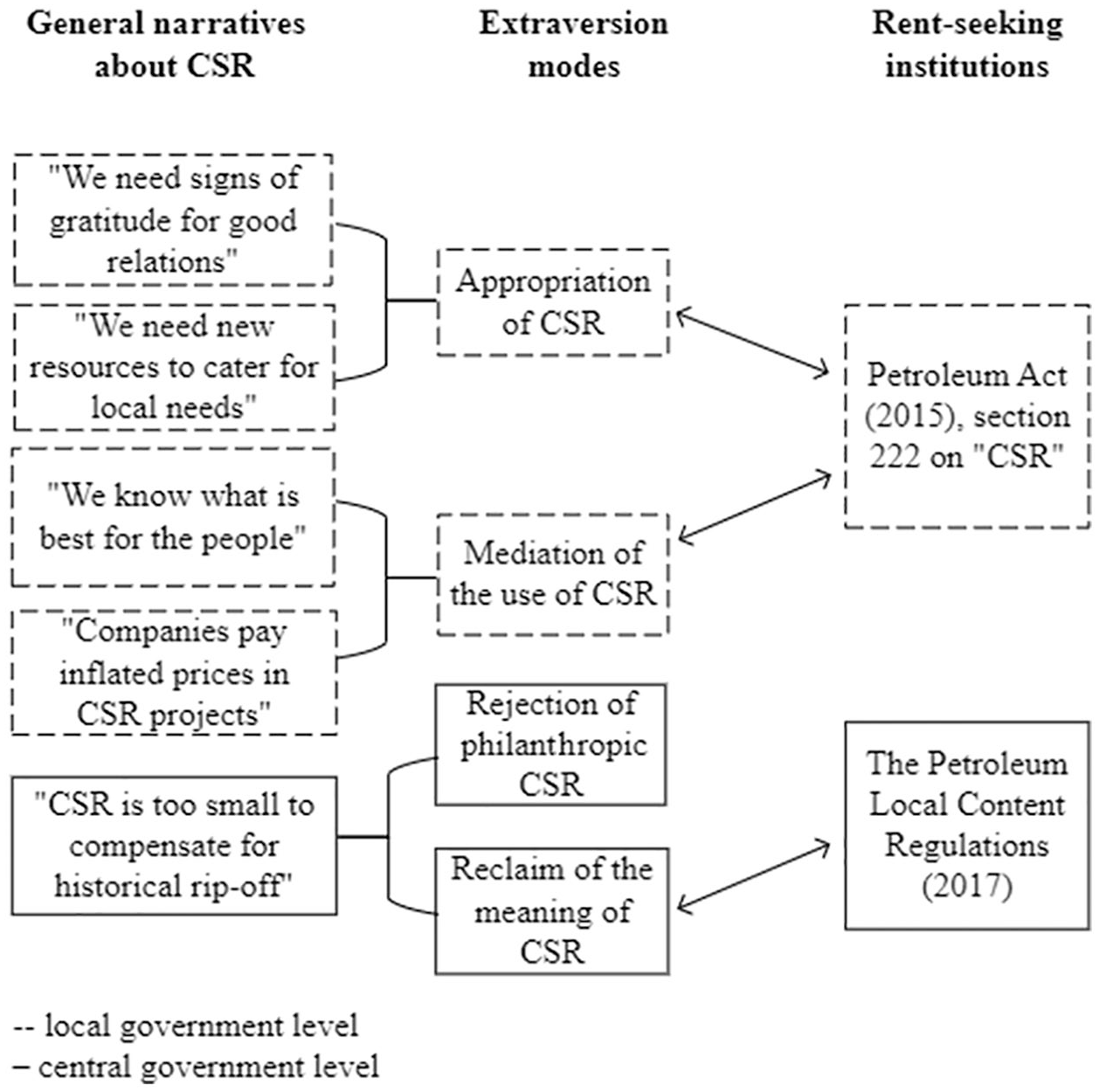
Coding tree.
The second part of the analysis consisted of content analysis of oil and gas-related legislation acts to assess what kind of institutions had been set up to enable rent-seeking. From the six legal acts that were analyzed due to their relevance for the oil and gas sector, two were found relevant for understanding rent-seeking in light of CSR as they set up formal rules for how potential rents from the practice of CSR could be appropriated, mediated, or reclaimed (see Figure 1). These are the Petroleum Act of 2015 with its section 222 on CSR and the Petroleum Local Content Regulations of 2017.
Research Context
The BG Group (shares later on taken over by Shell) and Statoil (later on renamed Equinor) made significant gas discoveries mainly between 2012 and 2015 off the Indian Ocean Coast outside the towns of Mtwara and Lindi in South-Eastern Tanzania. The discoveries spurred a project together with the Tanzania Petroleum Development Corporation and the minority partners ExxonMobil, Ophir Energy, and Pavilion Energy. The project comprises three offshore blocks, a network of offshore pipelines, and an onshore processing plant, commonly known as the “LNG plant.” These three offshore blocks hold the great majority of Tanzania’s discovered natural gas. The gas from the blocks will be piped onshore to the LNG plant in Lindi region (Scurfield & Mihalyi, 2017). When realized, the US$ 30 billion LNG plant will be the largest foreign investment in Tanzanian history. The gas plant with an adjacent business park will be built on the lands of two village communities, Mto Mkavu and Likong’o. Between 2020 and 2022, 693 people from these villages have been compensated for the loss of livelihoods, mainly consisting of fruit and cashew trees, and a few people have been resettled.
The presence of some of the world’s largest companies ignited a lot of expectations in Tanzania and in particular in Lindi and Mtwara, which are among the poorest and most neglected regions in Tanzania (World Bank, 2019, p. 35). When gas was discovered, up to four million Tanzanians were expected to be employed by the gas sector, and 59% of the population expected that the natural gas deposits would improve their lives (Twaweza, 2015). However, the negotiations about gas production and the plant have stalled for years as the government and the companies have not been able to agree on a Host Government Agreement. This delay means that the investment process has been ongoing during the time of research, and the results combine realized and anticipatory elements. Nevertheless, the gas exploration phase was accompanied by a number of CSR activities in Mtwara as the town’s port served the companies during the time. Although the future of the LNG plant has been uncertain for several years, Shell and Equinor have also had some CSR activities in the region of Lindi where the plant is planned to be built. Jointly, the companies have sponsored eight CSR projects in cooperation with donor governments, international and local NGOs, and government institutions in Mtwara and Lindi. These projects have mostly focused on supporting entrepreneurship and professional skills. The companies have also donated school desks, built a school and classrooms, and donated health care services.
Tanzania’s history of aid dependence and its first-ever large fossil fuel investments make the country an interesting case to study in terms of CSR and rent-seeking. Since its independence in 1961, Tanzania has received significant amounts of external resources under the general aim of “development.” Tanzania’s heavy dependence on foreign aid can be seen as a proxy for the prevalence of extraversion in the country’s foreign relations. In fact, Tanzania has been one of the most aid-dependent countries in sub-Saharan Africa and among the two largest development aid receivers on the continent. At best, donors have financed over a quarter of the national budget and up to 80% of the state’s so-called development budget (Tripp, 2012). In addition to the government, various public and nongovernmental organizations in Tanzania receive development aid through projects. Although reliance on development aid is decreasing, it still accounts for about 10% of government spending (Development Partners Group Tanzania, n.d.). Rent-seeking and political settlements in Tanzania have been researched previously (Cooksey & Kelsall, 2011; Gray, 2013, 2015; Kelsall, 2018; Whitfield et al., 2015), but none of these previous works have included aspects around CSR. In general, CSR-related research on Tanzania is scarce, with a few exceptions (Fulgence, 2016; Ponte et al., 2021).
CSR-Related Rent-Seeking Strategies by Local and Central Government Authorities
This section analyzes the rent-seeking strategies employed toward CSR by local and central government authorities. Before turning to the actual analysis, some words about the use of the term “CSR” are necessary. The concept and practice of Corporate Social Responsibility, CSR, is “foreign” to Tanzanians. It has entered into Tanzanian legal and policy speak through interaction with foreign actors. Based on interviews, a key foreign CSR promoter has been the Canadian High Commission. As part of its policy to promote CSR in developing countries where Canadian extractive industry operates (Government of Canada, 2009), the High Commission has organized Corporate Social Responsibility Forums in Tanzania since 2011. One of the world’s largest gold mining companies, the Canadian Barrick Gold Corporation, operates three mines in Tanzania. The High Commission has also advised the Tanzanian government to draft a CSR policy, which was prepared in 2015 but never published. Instead, “CSR” was explicitly included in the Petroleum and Mining Acts of 2015 and 2017. In the Petroleum Act, government participation in CSR is defined in section 222. In brief, the act requires all petroleum license holders and contractors to prepare annual, credible CSR plans that are jointly agreed by the relevant local government authorities. The plans shall consider environmental, social, economic and cultural activities based on local government priorities of host communities (United Republic of Tanzania, 2015b). No further definition of CSR is provided in regulation conserning the oil and gas sector.
The understanding among all groups of Tanzanian interviewees, government officials, politicians, NGOs, and researchers is overwhelmingly that CSR refers to philanthropic, voluntary donations on local community level. This finding resonates with earlier research on CSR in Africa that has found a strong emphasis on CSR as local philanthropy (Adeleye et al., 2020; Amaeshi et al., 2006; Dartey-Baah & Amponsah-Tawiah, 2011; Kühn et al., 2018; Muthuri, 2013; Visser, 2006). Therefore, when interviewees were asked explicitly about “CSR,” they spoke of voluntary donations to communities, mostly into various forms of social services or materials. A philanthropic definition of CSR was dominant although Shell and Equinor’s CSR projects generally relate to entrepreneurship, skills development and education that have more long-term “productive” aims than one-off donations into communities’ social services might have.
When asked more generally about socioeconomic contributions that the gas companies were expected to make for the benefit of Tanzania, some respondents pointed to the importance of the so-called Service Levy, which corporations are expected to pay to the local government authority at a maximum rate of 0.3% of their turnovers. The revenue income from the levy is not earmarked to be spent on socioeconomic development in the same way as the CSR stream is expected to, but NGOs in Tanzania have called for it to be allocated for developmental purposes (Policy Forum, 2015). In addition, respondents from all interviewee groups raised the importance of “local content policies,” meaning different localization or indigenization measures that would ensure that Tanzanians gain jobs, business opportunities, and skills from the investments and that technological transfer takes place. For analytical purposes, this study discusses these local content policies under the term “localization CSR,” although this term has not been used by respondents to describe them. Localization policies and CSR have been previously connected by several scholars, especially in South Africa in relation to the country’s Black Empowerment Program (BEE; Alessandri et al., 2011; Arya & Bassi, 2009; Juggernath et al., 2011). The BEE encourages businesses to integrate black people into the labor market, supports black businesses, and supports black communities affected by land repossession. In other words, this article makes a difference between the empirical use of CSR in Tanzania (philanthropy) and the analytical use of CSR as an umbrella term covering socioeconomic contributions from investors for the benefit of society more generally. In the next two sections, the CSR-related rent-seeking strategies on local and central government levels will be analyzed.
Local Government Strategy: Appropriation and Mediation of “Philanthropic CSR”
The analysis finds that at the local government level in the regions of Mtwara and Lindi, the government uses the modes of appropriation and mediation to gain potential CSR rents. In addition, the interview material with nongovernmental actors includes fears and suspicions of trickery. Appropriation, meaning the use of external concepts, cultures, and objectives, concerns “philanthropic CSR.” Appropriating philanthropic CSR resonates with local expectations of community-level, voluntary, philanthropic donations. Interviewees emphasize that making donations is necessary for the establishment of good relations between the companies and the communities, just as making them would be between any external and/or powerful actor that enters a community. “At the community level they [companies] can do CSR, we also do it as MPs”, 2 describes a Member of Parliament. Donations to communities are seen to be about collaboration, about creating trust and building relationships. Interviewed villagers talk about “thanking” (shukrani) when they speak of CSR to refer to how they have to be thanked for the gas that is taken from their lands and waters.
In addition, appropriation as a strategy supports the local government’s need for additional resources to provide services to people. Communities expect a lot of new benefits and improvements in the provision of health care and education services and local officials are keen to see those expectations being met with corporate support. An interviewed ward officer explained that if people expect 15 new classrooms and the government has been able to provide for 8, the corporations should be able to support the construction of the rest. 3
In addition to appropriation, mediation, meaning ways to act between the foreign and domestic contexts, is a prevalent mode of conduct among local government authorities. Local government officials claim that companies come with their own agendas without listening to the needs of people in Tanzania and in affected communities. Officials further emphasize that they know what is needed in the communities because they regularly collect community needs and make 5-year regional development plans based on them. According to interviewed government officials, corporations should abide to these plans. Finally, mediation is also considered important to ensure that companies are not tricked into paying inflated prices when subcontracting local companies to construct donated health or education facilities. Government officials are keen to control the contracting to ensure that the pricing is right.
While no trickery was observed during the research period or in the interview material with government officials, fears of trickery by the government was expressed by other interviewees, especially those representing NGOs. Some interviewees pointed to past evidence of service levies paid by companies being used for local councilors’ sitting allowances or for building a regional director’s house, which means that the money was not really reaching communities. One NGO interviewee feared that the government wanted to mediate the contracting of CSR-related construction projects not to avoid inflated prices but to make sure that the selected subcontractors were from the authorities’ own inner circles. 4
Appropriation and mediation have been formalized by new policies that the government has set up through the Petroleum Act of 2015. As described above in the introduction to the analysis section, its section 222 uses the actual term “Corporate Social Responsibility” and gives powers to local government authorities to oblige investors to, jointly with them, prepare credible CSR plans annually. These plans do not only have to be prepared together but also be approved by the government authorities (United Republic of Tanzania, 2015b, p. 142). The regulation, therefore, institutionalizes the process for distributing potential rents through CSR on the local level (see Table 1 for summary).
Summary of Findings on Local Government Level.
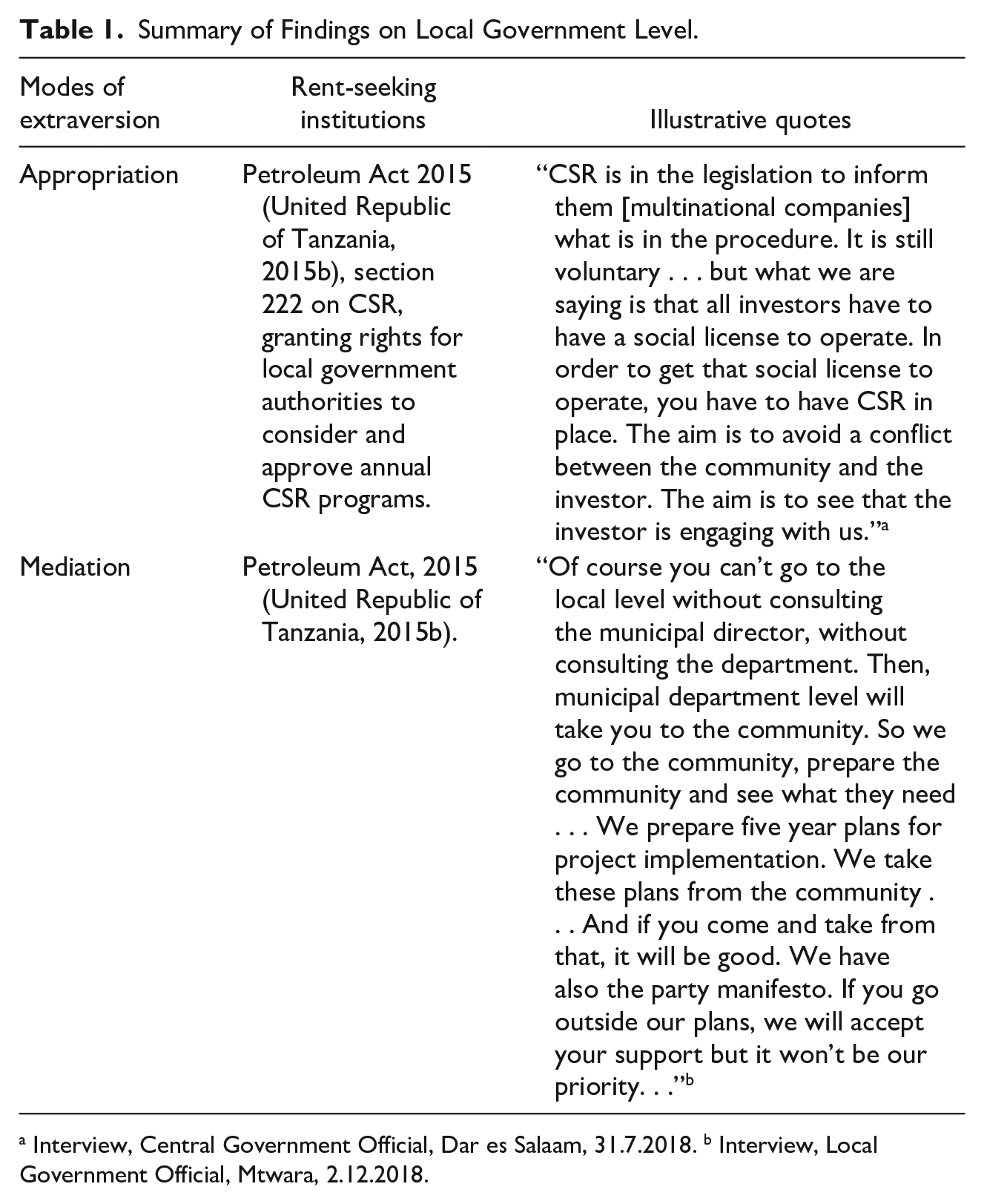
Interview, Central Government Official, Dar es Salaam, 31.7.2018. b Interview, Local Government Official, Mtwara, 2.12.2018.
The mediating role is also well supported by the Tanzanian state’s wide-reaching bureaucratic structures. Each community has its Village Executive Officer and hence interacting on the community level is impossible without formal government involvement. Villages are steered by Village Committees that are chaired by Village leaders. Village leaders work with the Village Executive Officers to pass on the needs, news, and opinions up to higher levels of government. Any external actor, whether a multinational company, an NGO, or a researcher, is expected to go through a well-defined bureaucratic process to gain permission and access any region or village community.
Central Government Strategy: Reclaiming CSR for “Localization”
On the central government level, rejection toward “philanthropic CSR” comes up in interview materials. However, rejection is more present among NGO interviewees than among government representatives. NGOs express criticism toward the voluntary, philanthropic nature of CSR and refer to window dressing, green and white washing and the smallness of the amounts of the donations. Several NGO interviewees complain that companies can account CSR as an expense, which decreases the government’s revenue income from the investments.
In combination with newspaper articles, several nongovernmental interviews draw up a history of “rip-off” caused by multinational companies that have influenced attitudes toward foreign investors and their CSR. Tanzanians commonly think that they have been exploited by foreign gold and gemstones mining companies since the 1990s. Back then, multinational mining companies such as the Canadian Barrick Gold negotiated contracts that have not favored Tanzanians. Public anger toward the sector has grown and fighting back against mining multinationals has become a political priority in the country. These sentiments of grievance toward mining companies were central to president Magufuli’s politics and reflected on the oil and gas multinationals.
In addition to this more recent mistrust toward multinational companies, politics in Tanzania continues to be influenced by the country’s first president Julius Nyerere (Fouéré, 2014). Since independence in 1961, he emphasized self-reliance and liberation from foreign dependence as important factors for the development of the country. Nyerere was reluctant to support foreign investment. He did not believe that foreign private companies could make the quantity and quality of investment required to overcome poverty if left uncontrolled. (Nyerere, 2011). The ideas of self-reliance and sovereignty continued being leading ideas in Tanzanian politics during Magufuli’s rule through an emphasis on domestic industrialization and a will to pursue economic protectionism to the extent possible. In this context, philanthropic CSR has not been very popular.
However, for the central government, criticism toward philanthropic CSR has not meant that companies should not make socio-economic contributions to the society, quite the contrary. As has been shown in the previous section, the central government has appropriated CSR to be mediated by local government authorities as stipulated in the Petroleum Act of 2015. In addition, the analysis finds that the central government has reclaimed what it means to be a responsible gas investor in Tanzania through what is called for the present analytical purpose “localization CSR.”
This process of reclaim culminated in 2017 when the government supplemented the Petroleum Act of 2015 with local content regulations that aim to indigenize the gas sector. Through the regulation, the government wants to maximize benefits to Tanzanians by ensuring their participation in the gas value chain through three approaches. First, the regulation ensures that Tanzanian citizens are given priority in employment, training, technology transfer, research, development, and innovation in any matter relating to the industry. Furthermore, preference has to be given to goods and services provided, manufactured or locally available in the country. In cases of procurement of goods, works, and services, bidding processes must privilege Tanzanian companies although they would not be bidding at the lowest price. If a non-Tanzanian company provides goods and services, it has to form a joint venture with a Tanzanian company. The regulation also determines certain Tanzanian sectors that must be given priority in any petroleum-related operations. These are the insurance sector, the financial sector, the legal sector, and engineering services. Gas operations must be insured by Tanzanian insurance companies, financial transfers and bank accounts have to be handled by Tanzanian banks and Tanzanian legal and engineering services have to be prioritized over foreign service providers. The government has provided investors with detailed schedules and percentages according to which the indigenization process is expected to take place. Breaching the regulations leads to substantial fines or up to 5 years of imprisonment (United Republic of Tanzania, 2017c).
Although Shell, Equinor, ExxonMobil, and Ophir Energy have funded CSR projects that aim to enhance local entrepreneurial and professional capacities for increased participation in the gas value chain, these voluntary efforts have not satisfied the government. The government has wanted to make sure through new legal institutions that Tanzanian people and businesses benefit and gain rents from the gas value chain (see Table 2 for summary).
Summary of Findings on Central Government Level.
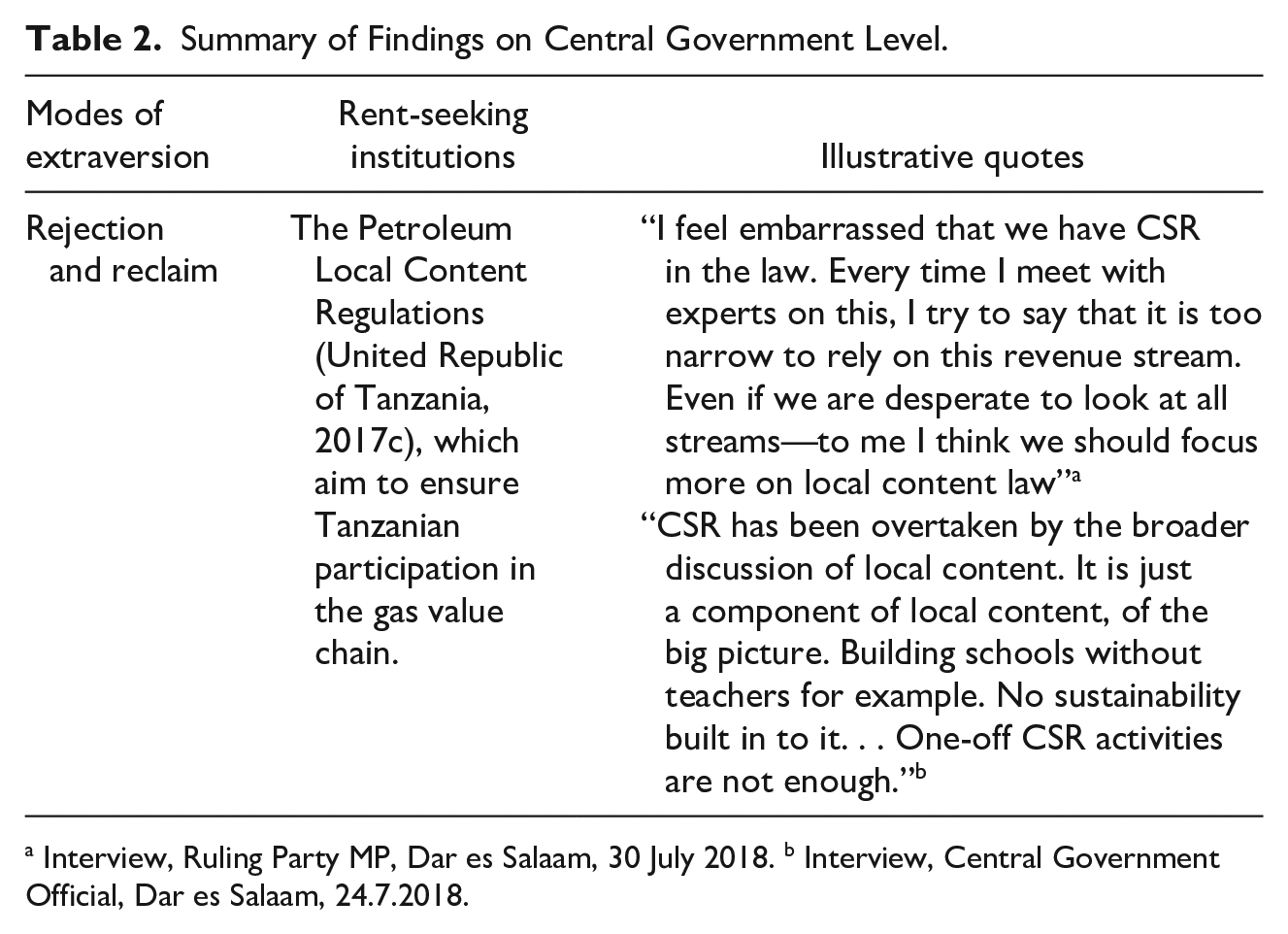
Interview, Ruling Party MP, Dar es Salaam, 30 July 2018. b Interview, Central Government Official, Dar es Salaam, 24.7.2018.
Tanzanian indigenization policies reflect a continent-wide trend. During the 2000s, economic policies that aim to economically empower local populations have increased in number all over Africa, especially since new petroleum discoveries have been made. The previously mentioned BEE Act of 2003 in South Africa was among the first on the continent and has been succeeded by different citizenship or race-based policies in many sub-Saharan countries, such as Ghana, Uganda, Mozambique, Kenya, Liberia, Guinea, Nigeria, the Democratic Republic of Congo, and Angola (Ovadia, 2016).
Imposing strict localization regulations reflects a balancing act between the state’s vision to liberate Tanzania from a history of exploitation by foreign private actors while simultaneously seeking to benefit from global capitalism through the creation of institutions that generate rents for local actors. While “philanthropic CSR” could be seen as a source of rents for maintaining political stability on a local level, “localization CSR” on the central level seeks to establish institutions for creating a national political settlement and, in the long-term, spurring the growth of a productive black capitalist class, which so far has remained small in the country (Hansen et al., 2016; Khan, 2010; Whitfield et al., 2015).
Finally, it is worth mentioning that no trickery was found in relation to “localization CSR.” In fact, finding trickery was impossible at the time of research because delays in the investment were also delaying the implementation of the local content regulation. However, the risk for corruption in the implementation of local content policies has been raised by both researchers and NGOs across Africa (Natural Resource Governance Institute [NRGI], 2015; Nwapi, 2015).
Discussion
The analysis shows how CSR can be instrumentalized into a source of foreign rents, at least through appropriation, mediation, reclaim, and more speculatively, trickery. The analysis also shows that different, almost conflicting approaches to CSR can coexist on different administrative levels of government, although they are united by the aim to gain rents. In relation to the body of research on governments and CSR, this article makes two contributions. First, it adds the instrumental use of CSR in the Global South into the variety of perspectives that can be taken when studying government agency. Second, it conceptualizes CSR as a potential stream of rents for governments that are used to generating a considerable part of their resources from external sources.
This article uses “extraversion” and its six forms of conduct (appropriation, mediation, rejection, flight, coercion, and trickery) as its analytical lens. In light of previous studies that have in a more inductive manner identified forms of a government agency, such as ”mandating,” ”facilitating,” ”partnering” and ”endorsing” (Fox et al., 2002); ”translating,” “editing,” and ”adapting” (Jamali et al., 2017); and ”adopting,” ”substituting,” ”repurposing,” ”replacing,” or ”rejecting” (Marques & Eberlein, 2021), this study brings out two completely new elements, namely, reclaim and trickery. The other identified approaches, namely appropriation and mediation, can be considered to be similar to previously identified “adoption” and “facilitation,” although in this case we know that what drives these conducts is rent-seeking, not an institutionally or ideologically determined will to collaborate.
Reclaim can be considered a novel government approach because even if it is similar to the previously discovered “repurposing,” reclaim involves an element of taking back control, in this case over the definition and practice of CSR. Furthermore, Bayart’s original six forms of extraversion conduct did not include reclaim, and as such, this article also makes a contribution to research on extraversion with the addition of “reclaim” as a mode of rent-seeking from foreign sources. Furthermore, trickery is a completely new approach in light of previous research on governments and CSR. No clear evidence of trickery was found in the interview material, but it included fears and anecdotes about how CSR-related money had been used, and how the government probably wanted to control subcontracting of CSR-donated construction projects to gain contracts for their inner circles. Further research would be necessary to properly assess the governmental use of trickery in relation to CSR.
Understanding CSR as a lever for external rents has considerable implications for future research, practice, and policymaking on CSR. Drawing from Khan’s work, this study concludes that two analytical processes are crucial to undertake for assessing the outcomes of CSR in a rent-seeking context. These processes include (a) analyzing the political settlement (i.e., the distribution of relational power among individuals and organizations surrounding the investment) and (b) assessing whether CSR-related rents are “developmental” or lead to private accumulation through corruption.
In light of future research, thinking in terms of political settlements is crucial because it provides a picture of what rents are expected in relation to a particular investment and who are in key positions to distribute them. A mega-size natural resource investment like the one studied in this article creates huge and diverse expectations for rent-seeking, and CSR should be considered a slice of the overall “resource cake” that is being distributed to create a new political settlement. For Khan (2010, 2018) political settlement analysis implies a description of the distribution of power across organizations that are relevant for analyzing a specific institutional or policy problem. The distribution of power is defined as the relative holding power of different groups and organizations contesting the distribution of resources. Holding power is based on economic capabilities, on whether they include “elites,” and primarily on their organizational capabilities to mobilize and enthuse as well as to identify and reward the right people through informal and formal networks. In the case of Tanzania, for example, the local and regional party and state officials in Lindi and Mtwara play a key role in how resource streams from philanthropic CSR are distributed and, therefore, in pacifying possible local resistance toward the investment. The relational power and the rent expectations of at least local businesses, trading boards, village leaders, women’s groups and community-based organizations influence the emergence of a political settlement. Researching these kinds of political settlements requires in-depth case studies. According to Khan (2018), the assessment of a political settlement requires a deep understanding of the history, sociology, and ideological and identity cleavages in a country and how they have been mobilized around resource issues (Khan, 2018, p. 640).
A focus on political settlement also has practical implications. In recent years, political settlement analysis has gained popularity within research and policymaking on development aid and good governance (Behuria et al., 2017; Kelsall, 2016), which management studies can learn from. Its proponents have cautioned that to be successful, external aid interventions should adapt to local political settlements, and that hence, project implementers should have an understanding of the distribution of power in relation to their particular interventions (Kelsall, 2016). The same can be argued about CSR interventions by private investors: If they bypass formal–informal political settlements and hamper political stability, they are unlikely to attain their goals to generate positive social impacts. If a political settlement is not supported, political and economic power holders and their intermediaries might aim to control the resources related to CSR interventions more firmly. In practice, assessing political settlements requires local knowledge and sufficient resources in organizations that implement CSR.
Furthermore, the way in which CSR-related rents can positively support local economic development presents an important topic for further research and policymaking on CSR. As described earlier, Khan argues that rents can have socially desirable effects in view of economic development if they are managed well (Khan, 2000b, pp. 53–58). Among different types of rents, such as monopoly rents, natural resource rents, Schumpeterian rents, rents for learning, and management rents; rents based on political transfers are particularly relevant for creating a political settlement. Transfer rents can aim to create capitalist property for enabling primitive accumulation and the emergence of a productive capitalist class. The creation of private property rights or protectionist measures are examples of rent-seeking institutions that spur local capitalist development. Transfer rents can also be used to smooth political turmoil that might occur due to an unfair process of primitive accumulation (Khan, 2000b, p. 38). Important for future research would be to understand what kind of rents CSR can generate and how those rents can be managed well to create a political settlement and generate positive, socio-economic impacts.
Finally, future studies could examine the use of CSR as a source of rents for private accumulation. If rents are misused through corruption, they obviously do not benefit the wider economy. This study indicates that CSR-related resource streams opened opportunities for corruption. A more systematic understanding of these opportunities that facilitate the misuse of CSR resources would be important not only for future research but also for improving policymaking on CSR both in the Global South and North.
Conclusion
This article presents an instrumentalist perspective on the research on CSR and governments in the Global South. It examines how CSR can serve as a lever for externally acquired rents to governments, in this particular case to the government of Tanzania. The analytical framework of the article is based on the concept of “extraversion” (Bayart, 2000, 2009) and its related six forms of conduct (appropriation, mediation, trickery, flight, coercion, and rejection) as well as Mushtaq Khan’s (2000a, 2000b, 2010, 2018) work on rent-seeking in the Global South. Based on the analysis, the article concludes that the local government authorities in the investment area appropriate and mediate philanthropic CSR to serve their needs for more resources and peaceful relations with communities living in the vicinity of the investment areas. Local government officials also want to mediate the distribution of CSR donations to different construction projects to avoid inflated prices. These conducts have been supported by the Petroleum Act of 2015, which gave local authorities the power to assess and improve corporate CSR plans annually. On the central level, the government has reclaimed CSR into “localization CSR,” meaning the creation of opportunities for Tanzanian labor, businesses, and certain sectors to be included in the gas value chain. The so-called local content regulation has created new institutions for rent-seeking for businesses in the country. The article concludes that the instrumental use of CSR as a lever for rents means that future research, practice, and policymaking on CSR should analyze the relevant political settlement to understand the expectations for rents that surround an investment. Furthermore, the concrete outcomes of CSR in a rent-seeking environment should be assessed in light of whether the acquired rents have developmental outcomes or lead to private accumulation through corruption.
Footnotes
Acknowledgements
The author is thankful to Martin Fougère and Frank den Hond for valuable feedback and support during numerous versions of this article. She also thanks associate editor Elke Schuessler for her constructive feedback and very helpful guidance, as well as two anonymous reviewers. In addition, she thanks Juhani Koponen and Teivo Teivainen for their important comments.
Declaration of Conflicting Interests
The author declared no potential conflicts of interest with respect to the research, authorship, and/or publication of this article.
Funding
The author disclosed receipt of the following financial support for the research, authorship, and/or publication of this article: The research leading to these results received funding from the Finnish Cultural Foundation (grant no. 00210775), the Hanken Support Foundation, Oskar Öflunds Stiftelse and Marcus Wallenberg Foundation.
