




Abstract
Employee participation is essential to organizations’ corporate social responsibility (CSR)-related environmental initiatives (EIs). Employees’ attitudes to participating in pro-environmental behaviors are addressed in workplace literature drawing upon the theory of planned behavior. However, antecedents to employees’ attitude formation, including perceptions of the costs and benefits of participating in EIs, have not been adequately researched. Greater understanding of EI attitude formation can support efforts to foster EI participation. This study explores employees’ perceptions of EI costs and benefits to employees personally, to their organization, and to society by applying goal framing theory. A sample of 120 survey participants described 150 initiatives and identified personal, organizational, and societal costs and benefits of the EIs. Cost and benefit categories are presented along with a taxonomy and themes. The findings of this study provide a reference point for researchers and managers in understanding how employees view EIs and how employees might be encouraged to participate.
Keywords
Employees’ pro-environmental behaviors (PEBs) play an essential role in environmental corporate social responsibility (CSR) initiatives as employees initiate, implement, and maintain these projects (Afsar et al., 2018; Boiral et al., 2015; Jenkin et al., 2011). Soliciting employees’ support for such environmental sustainability initiatives is a priority for organizations because employees are key contributors and stakeholders (Ditlev-Simonsen, 2015; Gregory-Smith et al., 2015; Unsworth, 2015). In this article, environmental CSR initiatives or EIs are defined as all types of efforts or programs (formal and informal, voluntary and required) in and by organizations that protect or benefit the natural environment (adapted from Boiral et al., 2015). EIs include activities initiated by employees or managers such as green innovation and advocacy, reducing energy use, and recycling (Ones & Dilchert, 2012). Understanding employees’ motivation to engage in EIs is essential to maximizing their participation.
The small body of studies on employees’ perceptions of the personal benefits of CSR, where EIs are a type of CSR (Endrikat et al., 2021), reports that employees experience positive outcomes such as pride in their organization, job satisfaction, a feeling of contributing to society, skills development, and higher self-esteem (Bhattacharya et al., 2008; Gond et al., 2017; Koch et al., 2019). Ajzen’s (1991) theory of planned behavior (TPB) is prominent among the theories that have been applied in explaining PEBs (Ruepert et al., 2015) and has been found to be valid across multiple fields in explaining motivations for engaging in specific behaviors (Fishbein & Ajzen, 2010; Klöckner, 2013). The TPB states that positive or negative attitudes to engaging in a behavior (e.g., EI participation) are the net result of intuitive analyses of costs and benefits of the behavior’s outcomes and can predict intentions to engage in and actual engagement in a behavior. Yuriev, Dahmen, and colleagues (2020) conclude that there is a lack of studies applying the TPB to employees’ workplace green behavior. While many factors drive employees’ PEBs (Gond et al., 2017; Ruepert et al., 2015), meta-analytic studies (Klöckner, 2013) suggest that TPB constructs like attitudes and intentions are important antecedents.
Research has generally neglected to examine the specific costs and benefits of PEBs that employees consider and how they are weighted in forming employees’ attitudes toward EI participation. Greater understanding of employees’ views of the costs and benefits of EI participation may identify opportunities to enhance attitudes to EI participation, such as improving awareness of EIs’ benefits (Gregory-Smith et al., 2015; Unsworth, 2015). In addition, employees’ perceptions of costs and benefits to important groups with which they identify (Lindenberg, 2001; Lindenberg & Steg, 2013), such as their organization and community (group goal frames), also appear to be underexamined (Gregory-Smith et al., 2015). Goal frames influence “the way people process information and act upon it” (Lindenberg & Steg, 2007, p. 117) in specific situations. Goal framing theory (Lindenberg & Steg, 2013) suggests that employees would not only examine costs and benefits through a personal lens, but that indirect benefits received through groups may also influence employees’ attitudes.
Knowledge of employees’ perceptions of the costs and benefits of EI participation to them personally, to their organization, and to society may enhance understanding of antecedents to EI participation. This knowledge can support the development and refinement of workplace PEB and CSR participation models (Ruepert et al., 2015), where costs and benefits are considered along with other antecedents such as norms, beliefs, and values (Gond et al., 2017; Klöckner, 2013). Observing the lack of attention to the costs and benefits that employees consider in forming attitudes to EI participation and recognizing that costs and benefits are likely to include both personal and group level evaluations, this novel study applied both TPB and goal framing theory to explore costs and benefits within different goal frames. This exploratory study, therefore, asked, “What personal, organizational, and societal costs and benefits do employees perceive to participating in EIs?” This study’s contribution is a taxonomy of personal, organizational, and societal costs and benefits of EI participation from an employee perspective, expanding the range of antecedents to be considered in future theoretical EI participation models and studies.
Literature Review
The literature on employees’ roles in supporting their organizations’ environmental sustainability has steadily expanded in the last two decades, often captured under the term PEBs (Robertson & Barling, 2015). Relevant literature on PEBs, the TPB, goal framing, and the costs and benefits of CSR initiatives and specifically EIs are reviewed below. This review spans both the microfoundations of employees’ PEBs, rooted in the fields of psychology and organizational behavior, and the broader context of the CSR literature, where organizations’ commitment and accountability to society are considered.
Pro-Environmental Behavior
Boiral et al. (2015) define employees’ PEBs as, “all types of voluntary or prescribed behaviour undertaken by individuals at work that aim to protect the natural environment or improve organizational practices in this area” (p. 21), emphasizing that EIs “rely almost entirely on employees’ goodwill and individual behaviours” (p. 12). Like the present article’s definition of EIs, Boiral, Paillé, and Raineri’s definition includes both voluntary and prescribed behaviors. They note that while a growing number of PEBs are required by codes, procedures, or standards (e.g., ISO14001), 70% to 85% of PEBs are voluntary, aligning with the concept of extra-role behaviors (Lamm et al., 2013) or organizational citizenship behaviors for the environment (Boiral et al., 2015). Even for mandatory participation, attitudes to EI participation are likely to influence employees’ engagement, effort, and extra-role behaviors. Ones and Dilchert’s (2012) taxonomy of how employees support their organization’s sustainability includes (a) avoiding harm (e.g., preventing pollution); (b) conserving (e.g., reducing use); (c) working sustainably (e.g., work redesign); (d) influencing others (e.g., educating others); and (e) taking initiative (e.g., advocating). PEB antecedents include employees’ awareness and knowledge of environmental problems and solutions, pro-social and environmental values, and skills relevant to PEBs (Wiernick et al., 2018).
Theory of Planned Behavior
Ajzen’s (1991) TPB has been applied in workplace and non-workplace PEB studies (Ruepert et al., 2015). In the TPB (Fishbein & Ajzen, 2010), the likelihood of individuals engaging in certain behaviors (behavioral intentions) depends on the interaction of three antecedents (right side of Figure 1): (a) Attitudes or dispositions (e.g., favorableness) toward a behavior are based on the perceived costs and benefits of the behavior’s expected outcomes; (b) Subjective norms or social pressure to engage in the behavior; and (c) Perceived behavioral control or perceptions of one’s ability to perform the behavior, which may be influenced by factors like skills, resources, and opportunities. Attitudes are the product of awareness of costs and benefits from factors like personal experiences, media exposure, and the influence of family and colleagues (Fishbein & Ajzen, 2010). Attitudes, subjective norms, and perceived behavioral control are then believed to influence the formation of behavioral intentions, which in turn influence actual behavior.
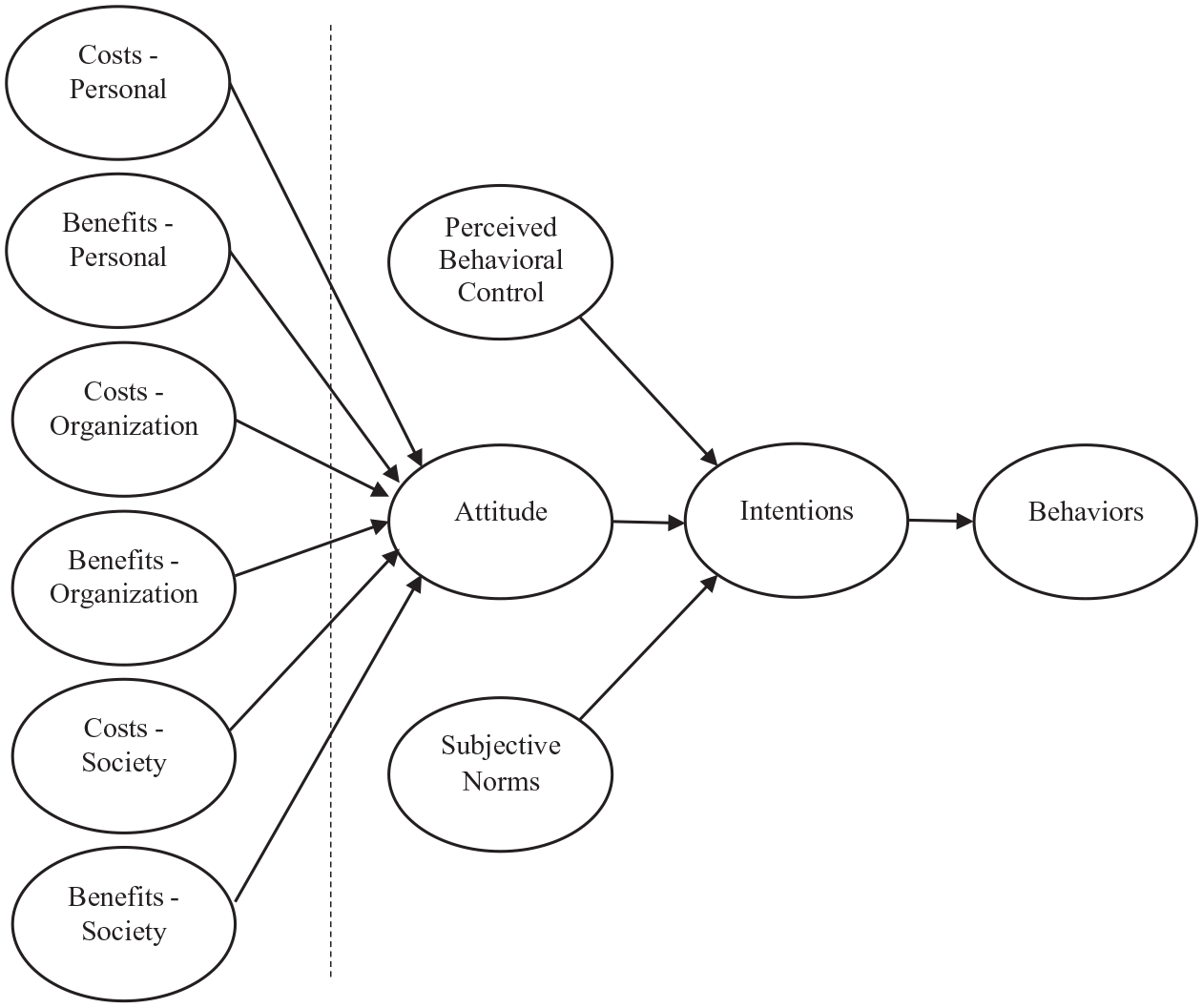
Theory of planned behavior model (right of dashed line) with costs and benefits contributing to attitude formation (left).
While behavioral intentions do not guarantee engagement in actual behavior, meta-analysis (Klöckner, 2013) shows intentions are strongly correlated (r = .55) with PEBs. In studies, the three antecedents are typically measured in sequential but time-separated surveys (e.g., weeks or months apart) before and after the measured behavior, making the model useful in predicting specific behaviors. Although not without its criticisms (Yuriev, Dahmen, et al., 2020), the TPB has an extensive history of research in a broad range of behaviors, supporting its value (Fishbein & Ajzen, 2010; Klöckner, 2013; Yuriev, Dahmen, et al., 2020). Even habitual behaviors (e.g., recycling), which are cognitively processed at lower levels of awareness and never become fully automated, can be investigated using the TPB (Fishbein & Ajzen, 2010).
Yuriev, Dahmen, and colleagues’ (2020) systematic review of 126 previous TPB environmental sustainability studies, including workplace and nonworkplace studies, found that attitudes, subjective norms, and perceived behavioral control explained between 2% and 85% of the variance in behavioral intentions and between 6% and 81% of the variance in actual behaviors. Yuriev, Dahmen, and colleagues (2020) acknowledge that situational complexity and the reviewed studies’ methodological flaws might explain variations in the model’s predictive abilities. Focusing just upon the subset of workplace studies (18 of 126 studies), the TPB model explained 27.3% more variance in behavioral intentions than in actual behaviors. Despite employees’ EI-related intentions, actions are subject to real-time, situation-specific factors (e.g., new information or constraints; competition with other available behaviors) that differ from the context within which intentions are initially formed (Fishbein & Ajzen, 2010). Yuriev, Boiral, and Guillaumie (2020) concluded that attitudes were the most strongly correlated factor in determining intentions to engage in workplace PEBs in the TPB model. Klöckner’s (2013) meta-analytic findings in nonworkplace settings provide similar support for the TPB model’s ability to predict PEBs.
Goal Framing Theory
Goal framing theory emerged predominantly from social-cognitive psychology to examine the influence of goals on cognitive processing (Lindenberg, 2001, 2006; Lindenberg & Steg, 2007, 2013). Goals frame what individuals pay attention to, the attitudes and knowledge that comes to the fore, their evaluations, and the alternative actions they consider. The hedonic goal frame addresses the short-term goal of feeling good (e.g., avoiding inconvenience, having positive thoughts). The gain goal frame focuses on middle- to long-term gains in resources or prevention of their loss (e.g., financial or job security, saving money). A normative goal frame addresses appropriateness (e.g., behaving in expected ways, meeting others’ expectations).
Goal framing provides a supplementary perspective in the current study by emphasizing that cost and benefit determinations are not just based on personal gains or losses. Lindenberg and Steg (2007, 2013) point to the social nature of human beings who evolved to form groups (e.g., hunting parties) to gain collective benefits. Behavioral choices are, therefore, not just an outcome of individual costs and benefits but also engage perceptions of group costs and benefits (normative goals). Multiple goal frames may be relevant to a situation but frames can be individually prompted. This has been shown in experiments where a social dilemma game is framed as a community or competition (gain) game, resulting in varying approaches to the dilemma by participants (Lindenberg, 2008). Individuals may align themselves with normative goals, or what is appropriate for the group, rather than shorter term hedonic or gain goals on a temporary basis to access collective goods (e.g., working for a company with a positive reputation). Social marketing research has also demonstrated that social benefits influence employees’ or customers’ PEBs (Gregory-Smith et al., 2015).
As the organization is an important social group to which they belong, employees’ concern for their organization’s success and the normative pressure to assist their organization in achieving its goals seem likely to influence employees’ attitudes (Afsar et al., 2018; Paillé & Valéau, 2021; Tosti-Kharas et al., 2017). Society—an employee’s broader community including their family, local community, or humanity in general—is an additional group that can normatively influence cost or benefit perceptions (Kim & Choi, 2005; Liu & Sibley, 2012). Each situation uniquely prompts certain goals in a modular way to simplify cognitive processing of inputs and decisions, while other goals are believed to stay in the background with less influence (Lindenberg, 2008). Prompting employees to think about EIs through a particular lens (personal, organizational, societal) may reveal costs and benefits in both the personal and group frames.
Group goal frames do not appear to be substantially addressed in the existing workplace PEB antecedent research. CSR and PEB research (Gond et al., 2017; Klöckner, 2013) acknowledges the antecedent role of individuals’ broader values and norms (e.g., green values) but overlooks the role of multiple goal frames related to a specific initiative in forming attitudes. This study, therefore, proposes that costs and benefits to the employee personally, to their organization, and to society are practically and theoretically relevant to understanding the scope of considerations that might influence EI participation. Figure 1 displays Ajzen’s (1991) TPB model with personal, organizational, and societal costs and benefits as inputs to employees’ attitudes to EI participation. This figure reflects this study’s theoretical proposition that the specific costs and benefits that employees perceive to EI participation are potentially valuable information to researchers and leaders in understanding the influences on employees’ attitudes to EI participation, and that those costs and benefits can be understood in both the personal and group goal frames for more acuity in differentiating sources of or opportunities for influence.
Costs and Benefits of Environmental Initiatives (EIs) and CSR Initiative Participation
A literature search of peer reviewed journals and academic book chapters revealed few studies on employees’ perspectives of either costs or benefits of EIs. The terms costs and benefits and advantages and disadvantages are both used in the TPB literature to refer to anticipated positive and negative outcomes of an action. Search terms like motivations, value, antecedents, drivers, and losses were also used. After a small volume of literature was discovered, the search was expanded to include the more extensive CSR literature which has relevance to EIs. While EIs are a type of CSR, CSR is not a monolithic concept and different types of CSR (e.g., charitable giving, fairtrade, labor policies) vary in their antecedents and outcomes necessitating a unique focus on EIs in studies (Halme et al., 2020). Resonating with the present review of EI literature, Gond and colleagues (2017) and Aguinis and Glavas (2012) note that there is a lack of attention to the psychological microfoundations or individual perspective (micro-CSR) in the CSR literature.
Gond and colleagues’ (2017) review of the micro-CSR literature provides insight into the drivers of employees’ CSR-related behaviors, as well as their evaluations of and reactions to CSR. However, Gond and colleagues’ review does not include the TPB literature or examine the role of costs in employees’ cognitive evaluations. The deliberations in the CSR and workplace PEB literature regarding costs and benefits more frequently relate to organizations and rarely examine costs and benefits through employees’ eyes. Few empirical studies were identified addressing EIs. Societal costs and benefits are also infrequently addressed. The bulk of the literature concentrates on benefits rather than costs, and tends to focus on costs and benefits to either the employee, organization, or society, but rarely all three (Aguilera et al., 2007).
Aguilera and colleagues (2007) and Gond and colleagues (2017) state that multiple motives are often present and working together to drive CSR-related engagement. Motivation for EI participation is unlikely to be explained by a single benefit and may engage multiple goal frames. For example, an employee may perceive EI-related learning or a greater sense of community as having a personal, organizational, and societal benefit. Costs and benefits may overlap and compete at times when EIs provide concurrent costs and benefits to the individual, organization, and society (e.g., gaining skills may offer personal and organizational benefits, but the discomfort of learning is a personal cost). The aim of this study is not to provide a rigid or mutually exclusive categorization at the individual, organizational, or societal level or an absolute cost and benefit dichotomy, but rather to discover the various influences on employees’ EI-related attitudes. Ajzen (1991) states that attitudes are not the product of conscious and rational deliberation of individual costs and benefits but rather the overall outcome of simultaneous awareness of advantages and disadvantages, resulting in a holistic evaluation of the favorableness of a specific and contextualized action.
Costs and benefits to the organization
Literature focused on the costs and benefits of EI and CSR initiatives to organizations is more extensive compared with literature on costs and benefits to employees or society. The broader body of literature has been described as organization-centric (Tosti-Kharas et al., 2017). Benefits are more frequently addressed than costs (Carroll, 2021; Endrikat et al., 2021), reflecting a thematic goal among authors to make the case for such CSR initiatives (Kennedy et al., 2015).
Costs and benefits to the organization, from an employee perspective, would align with the normative goal frame (Lindenberg & Steg, 2013). These costs and benefits do not ascend to a meso- or macro-level of analysis in that they reflect employees’ outcomes perceptions (attributes of the individual) which exist at the micro-level, rather than being actual organizational costs and benefits (attributes of the organization) at the macro-level. However, as Schnake and Dumler (2003) note, there is likely some overlap between employees’ perceptions of organizational outcomes and actual organizational level outcomes. While employees may not have perfect knowledge of organizational-level costs and benefits or decision making (Ditlev-Simonsen, 2015; Jenkin et al., 2011), their perceptions of outcomes for their organization still influence them and, therefore, require investigation.
The literature discussed below is not from an employee perspective, due to the lack thereof, but provides a sense of the scope of EI costs and benefits to organizations, which might parallel what employees perceive. Existing empirically derived (Hambrick, 1984) benefit taxonomies include Bansal and Roth’s (2000) three motivations (competitiveness, legitimation, ecological responsibility) for corporate ecological responsiveness. Existing conceptually derived typologies (Hambrick, 1984) include Aguilera and colleagues’ (2007) three motives (instrumental, relational, and moral) for organizations engaging in CSR. Weber (2008) identifies CSR as having “positive effects on company image and reputation . . . employee motivation, retention, and recruitment . . . cost savings . . . revenue increases from higher sales and market share . . . [and] CSR-related risk reduction or management” (pp. 248–249).
Bansal and Roth’s (2000) conceptualization and similar approaches can be critiqued for being overly reductive when collapsing employee-, customer-, and product-related benefits into a single corporate competitiveness and profit benefit category. Examining specific benefits (e.g., improved customer relationships) might be inherently valued by employees outside of their effects on competitiveness and profit (Aragón-Correa et al., 2013; Tosti-Kharas et al., 2017; Weber, 2008). Aguilera and colleagues (2007) note that competitiveness benefits are founded in self-interest, legitimation benefits center on improved relations with others (social license to operate), and environmental responsibility benefits center on ethics. Competitiveness and legitimation can also be differentiated on their monetary and non-monetary (intangible) benefits (Weber, 2008).
In the surveyed literature, costs to organizations are typically discussed in terms of the costs of environmental damage, the financial costs of EIs, or cost-savings (Adomako & Nguyen, 2020). Costs are often mentioned as a broad category without specifying the nature of the costs (e.g., cost of training). Analyses or classifications of costs seem absent from the literature. Papagiannakis and Lioukas (2012) stress that because benefits include intangible benefits, costs of EIs should also consider intangible costs (e.g., employee morale).
Costs and benefits to individuals
Personal costs and benefits are examined here not just in terms of their effects on the individual as an employee, but within a whole person perspective (Aguinis & Glavas, 2012). This includes impacts on their work and nonwork life (e.g., work life balance, sense of meaning, purpose, and community). These personal costs and benefits align with goal framing theory’s hedonic and gain goal frames.
There is a lesser focus in the EI literature on the personal costs and benefits from an employee perspective, with this topic lately having gained more attention (Tosti-Kharas et al., 2017). Koch and colleagues (2019) examined employees’ views on the benefits of CSR participation using Alderfer’s existence, relatedness, and growth theory. The findings show that employees identified functional, emotional, and meaning and morality benefits. Earlier studies by Bauman and Skitka (2012), Bhattacharya et al. (2008), and Slack et al. (2015) also examined the benefit of CSR initiatives to employees. Graves and Sarkis (2018) specifically investigated employee motivations to engage in PEBs. Bhattacharya et al. (2009) categorized employee benefits into functional, psychosocial, and values benefits, while Aguilera and colleagues (2007) classified individuals’ CSR motives as instrumental, relational, and moral. Other specific benefits noted in the literature include safety and security (Bauman & Skitka, 2012), opportunities for self-enhancement, and work–life integration (Bhattacharya et al., 2008, 2009). Personal costs were not examined in these previous studies.
Costs and benefits to society
Costs and benefits to society include the employees’ local community but also includes known others (friends, family, neighbors) and humanity in general, aligning with a normative goal frame. The costs and benefits of CSR initiatives and EIs for society appear to be largely taken for granted in comparison to the more developed literature related to organizational benefits (Koch et al., 2019). Often societal costs and benefits are discussed with reference to the broad effects of business operations (rather than EIs) on society and the environment, such as the effects of pollution from production (Epstein & Roy, 2001). Broad and nonspecific claims of societal benefits are also evident. However, research on what employees perceive as the costs and benefits of EIs to society appear absent.
Aguilera and colleagues’ (2007) multilevel theory of social change in organizations proposes that CSR is driven at the national and transnational levels (by NGOs, government, and intergovernmental entities) by instrumental (e.g., strengthening the economy by expanding competitiveness), relational (e.g., promoting social cohesion between labor, businesses, and communities in solving problems), and moral (e.g., collective responsibility for social conditions and human flourishing including the environment and well-being of future generations) motives. While Aguilera and colleagues did not focus on society directly, or employees’ perceptions of societal impact, their national and transnational categories provide an indication of likely benefits of EIs to society. Banerjee (2007) highlights CSR’s costs to society created by deceptive practices such as greenwashing, as well as the injustice of the unequal distribution of CSR’s burdens and benefits.
Research Method
Braun and colleagues (2020) argue that qualitative surveys are “especially useful when researching an un- or underexplored area” (p. 2). A qualitative online survey with open-ended questions was used to collect data from employed EI participants. The format allowed anonymity, responses in the participants’ own words, access to a national U.S. sample, and ease of participation relative to interviews. A qualitative survey was appropriate to this exploratory study as it provided a wide-angle lens with a larger and more diverse sample capturing varied voices, experiences, and sensemaking to inductively identify and categorize employees’ perspectives on EI costs and benefits (Braun et al., 2020).
Sample and Data Collection
The study’s target population was working adult U.S. residents employed at organizations with at least one EI. This ensured that participants’ responses were based on a specific EI (episodic memory) rather than on perceptions of EIs in general (semantic memory), as discussed by Hansbrough and colleagues (2021). Goal framing theory (Lindenberg & Steg, 2013) suggests that goals are situation-bound and, therefore, cost and benefit considerations are best assessed in a specific, rather than in a hypothetical or generalized manner.
Purposeful sampling (Bell et al., 2019) was used to recruit 120 participants by (a) focusing on two sampling frames (described below) where the intended population could be located, and (b) clarifying who should participate in the survey invitation. Two samples were collected sequentially to maximize the sample’s diversity. Diverse sampling aligns with the study’s goal of scoping the range of costs and benefits employees consider which could not be achieved with a homogeneous sample from a few organizations where EI-types were similar.
The overall sample of 120 fits into the upper-end (over 100) of Braun and colleagues’ (2020) reported sample sizes for qualitative surveys. Tran and colleagues (2017) provide a practical and less subjective logic for determining a saturation or stopping point for sampling in qualitative surveys based on the velocity of code accumulation. They recommend an initial sample size of at least 50 participants. As only one new code emerged through adding the second sample, saturation was reasonably assumed as the code accumulation velocity approached zero. The survey was closed once 120 participants had completed the survey.
For the first sample, the researcher invited 192 professional contacts to participate through LinkedIn, intentionally limiting invitations to participants from any one industry to ensure variety. The majority of the sample were professional graduates who were intended to ensure a balance with the second more junior and nonprofessional sample described below. The first sample’s survey was closed when 62 individuals had participated, exceeding the initial goal of 50 participants. Three incomplete or irrelevant responses were deleted, resulting in 59 usable surveys. While the response rate appeared to be low (32.3%), the target sample size was achieved within a week, and some nonrespondents replied weeks after the survey closed noting that they log into LinkedIn infrequently or were preoccupied during the data collection period. This may introduce some nonrespondent bias.
Using the same survey, the second sample was drawn from Amazon Turks (MTurk) using a premium filter for full-time working adults (>35 hours per week) with the goal of including 60 employees from non-professional and junior positions in the overall sampling frame. Aguinis and colleagues (2021) acknowledge the growing popularity of MTurk for business and management research and suggest best practices for using MTurk. These best practices were applied, such as screening for inauthentic responses and compensating participants fairly ($5 for approximately 15 minutes of participation). Ninety-two surveys were received within three days, yielding 61 usable responses. The remaining responses were excluded because they were incomplete, unclear or poorly written (preventing interpretation), or not relevant (e.g., inattentiveness, web robot responses). The nature of responses (descriptions of initiatives and their context, costs, and benefits) suggested that participants represented a range of industries and included blue-collar and entry-level positions.
Demographic questions were included after the main survey. As the first sample included the researcher’s contacts, demographic questions were optional and only 28 (23.3%) of the 120 participants provided responses, summarized as nine males and 19 females; 14 employees, 12 managers, and two preferring not to say; five from organizations with less than 100 employees, 13 from organizations with 100 to 999 employees, and 10 from organizations with more than 1,000 employees; and 12 industries represented (chemical, education, health, mining, engineering, oil and gas, government, retail, food, transportation, utilities, electricity gas, and “others”).
Instrument
An online survey with 21 open-ended questions was developed and then reviewed by five experts in survey development or PEB research for face and content validity (Bell et al., 2019). Revisions were made between sequential reviews. An initial question asked participants to think of a specific EI at their organization and to describe it. Six further questions asked about the costs and benefits (a) of participating in the EI to respondents personally, (b) of the EI to their organizations, and c) of the EI to society (see Table 1). Participants typed responses into a multi-line text box with no word limit. The seven questions were then repeated twice, asking participants to think of a second initiative, and then think of “employees’ individual efforts or the informal efforts of groups of employees.” This approach ensured participants considered informal and small-scale initiatives (Boiral et al., 2015). Participants could skip the additional questions if they could not think of further initiatives. Hence, participants responded to between seven and 21 open-ended questions, remaining within Braun and colleagues (2020) guidance for qualitative survey length.
Instrument Focus: Personal, Organizational, and Societal Costs and Benefits.
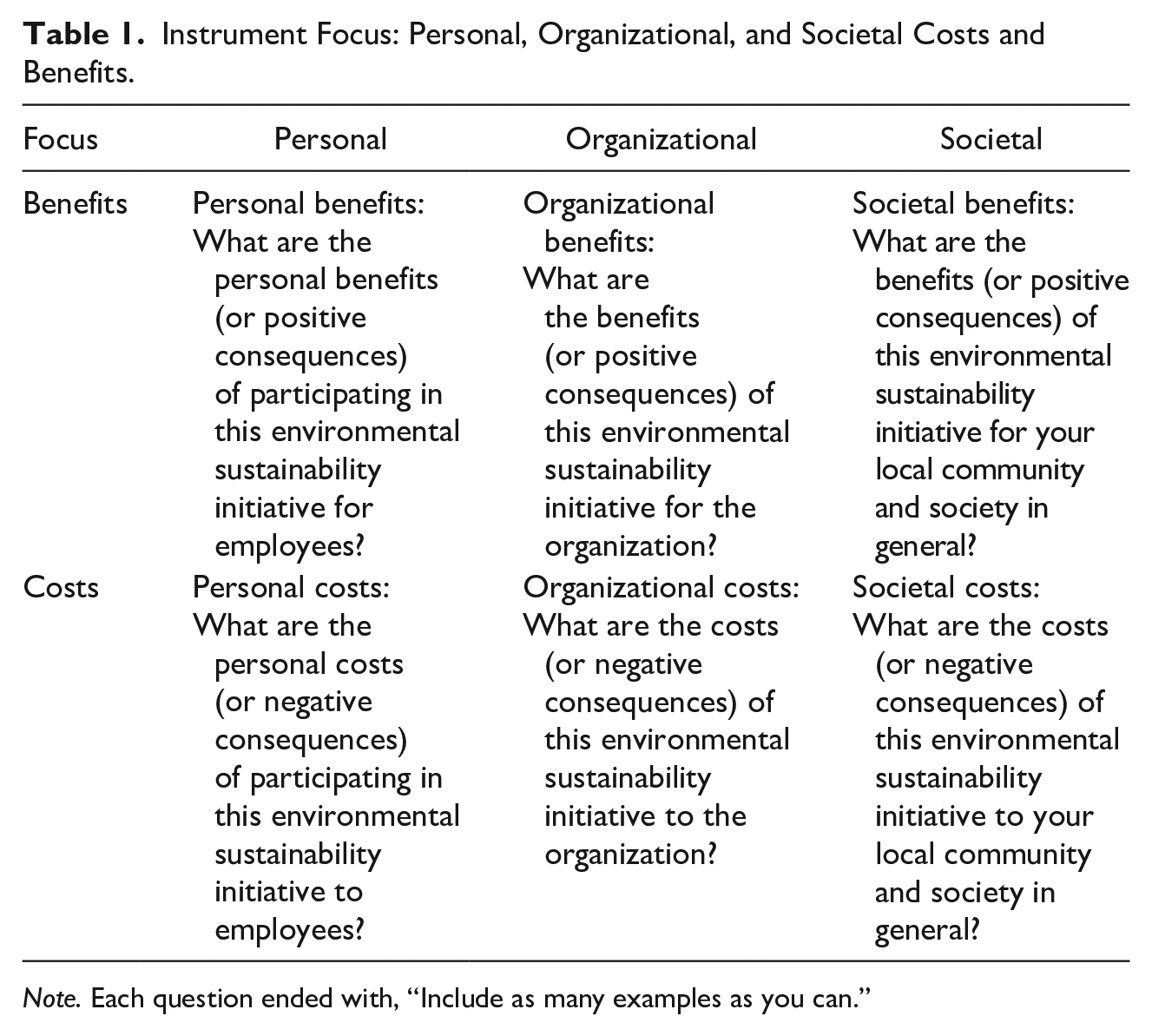
Note. Each question ended with, “Include as many examples as you can.”
Data Analysis
Content analysis, which combines both qualitative and quantitative approaches to data analysis (Bell et al., 2019; Krippendorff, 2018), was applied in analyzing and categorizing participants’ responses. Content analysis involves unitizing terms or meanings from text using codes that are theoretically or inductively generated (qualitative aspect) and quantifying the units for descriptive or inferential purposes.
Participants’ descriptions of initiatives were coded according to a predetermined list of initiative types adapted from Ones and Dilchert (2012) and Ones and colleagues (2018), as shown in Table 2. Content analysis was then used to inductively unitize participants’ responses to the cost and benefit questions. Responses varied from one to eight sentences, with most being two to three sentences. By identifying common terms and meanings in responses (Bell et al., 2019), a draft list of codes was created for personal, organizational, and societal costs and benefits and tested against the data for completeness (e.g., concepts or meanings not captured in the codes), before a codebook was created, and frequencies of codes were determined.
Initiative Types by Sample.
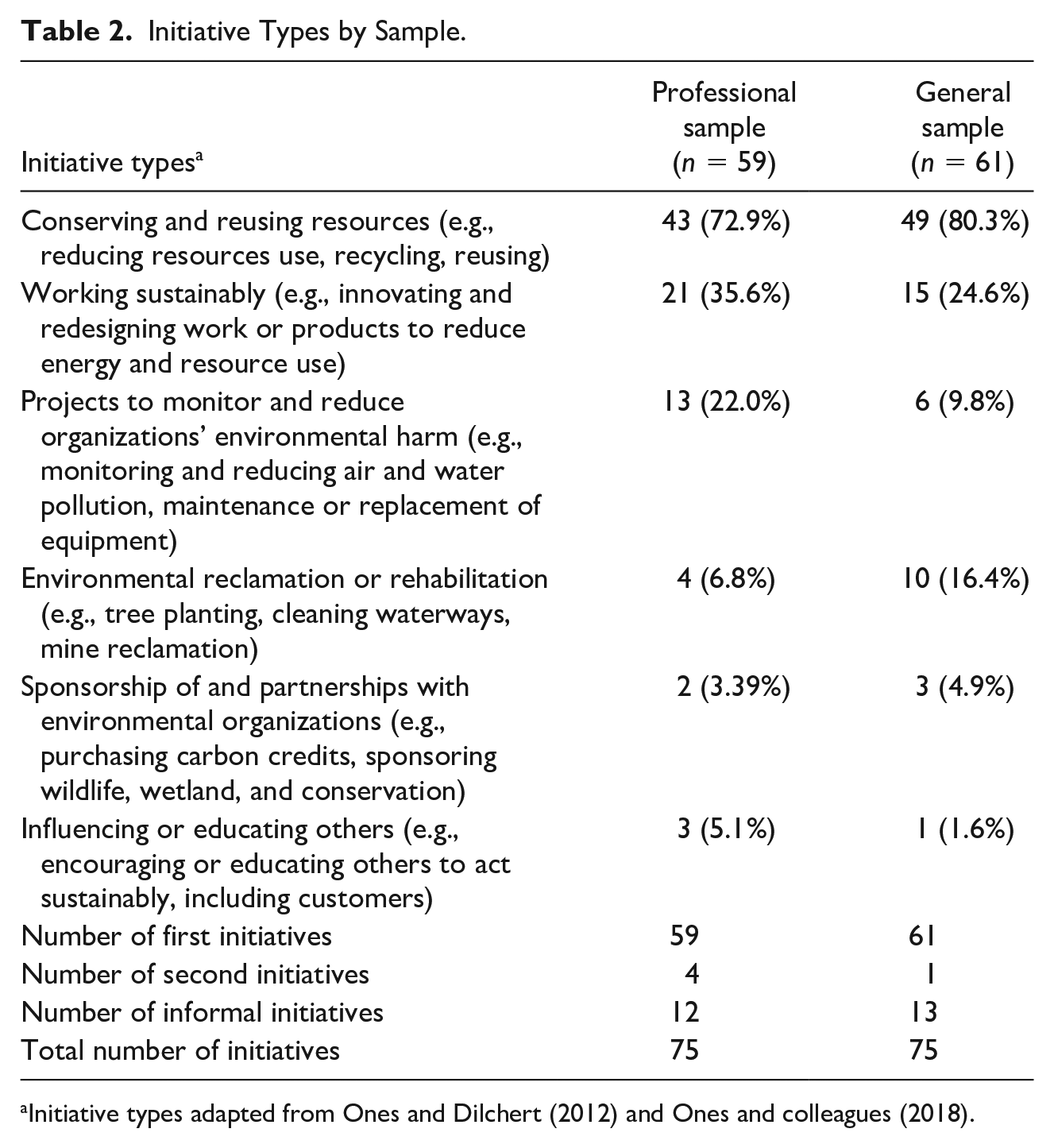
Initiative types adapted from Ones and Dilchert (2012) and Ones and colleagues (2018).
In line with Braun and colleagues’ (2020) suggestion to treat the qualitative survey data set as a whole rather than focusing on single questions, responses were considered across the questions. This process included transferring some portions of responses to questions where participants mentioned costs and benefits that were relevant to other questions (e.g., personal benefit in response to a question regarding organizational benefits).
The researcher initially coded the data alone using the codebook for consistency (Bell et al., 2019), before requesting a colleague with qualitative research expertise to independently review the full data set and audit the code book and coding. The auditor completed the review and suggested revisions. A discussion followed to resolve discrepancies before the final coding. Code frequencies were determined based on the total number of initiatives where a code applied. Codes were also used to generate categories which identified common topics in personal, organizational, and societal costs and benefits by examining the full code list, along with examples from the original data, for patterns in words, phrases, and meaning.
Findings and Discussion
First, the types of EIs that participants described are reviewed, then the personal, organizational, and societal costs and benefits of the EIs are reported and discussed using codes and frequencies, and finally categories of codes are presented forming the basis of a taxonomy introduced at the end of the section. The findings and discussion are presented together to support understanding given multiple concepts in the underlying model.
In Tables 3 to 5, codes with frequencies over 10% are provided with examples, and codes below 5% are briefly listed. In addition, the tables include exemplary quotations from participants (for high-frequency codes) to provide the reader with a richer sense of the data. While some previous taxonomies use just a few benefit categories (Bansal & Roth, 2000), this can be problematic when benefits are reduced to their ultimate financial impacts (e.g., improved employee morale increases competitiveness and revenue). Rather, a higher level of detail was retained in the codes to communicate the nuances in participants’ perspectives more authentically. Code categories are listed in the tables’ final columns.
Personal Benefits and Costs (Ranked by Frequency).
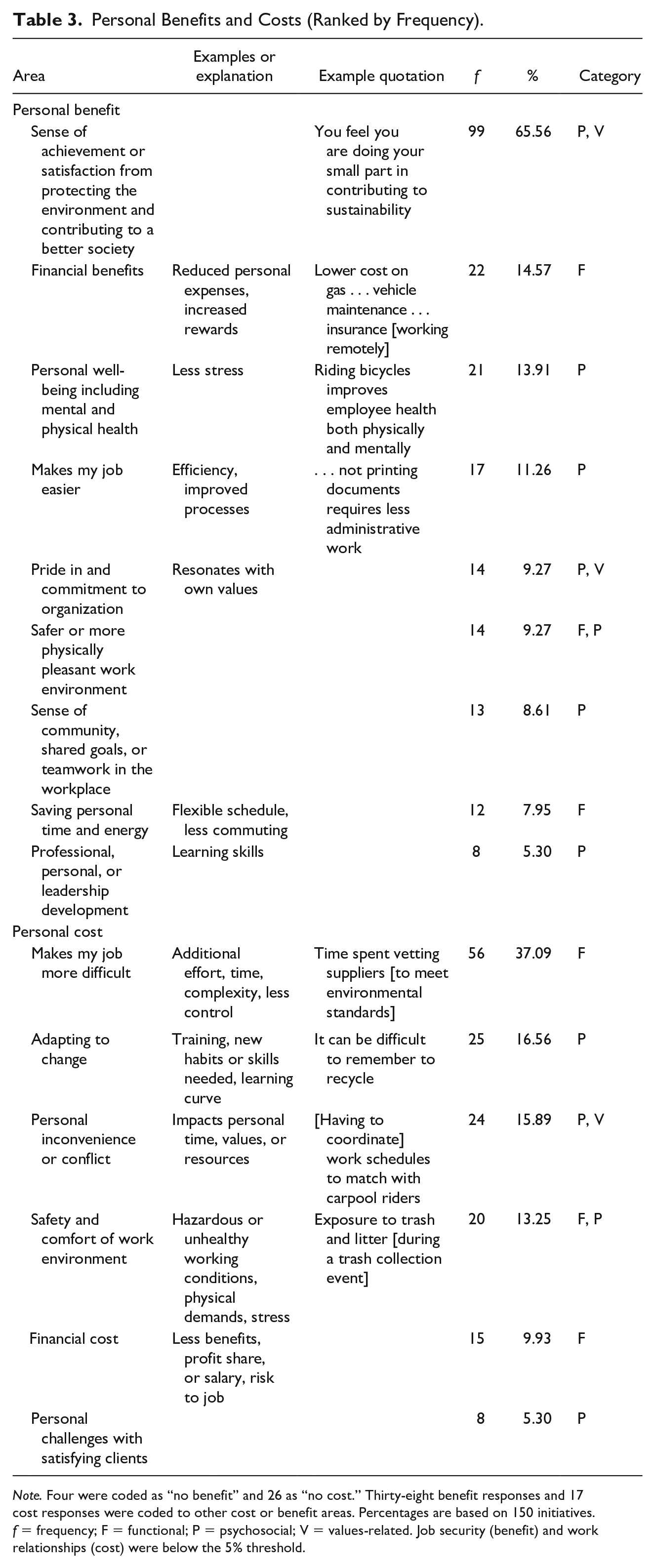
Note. Four were coded as “no benefit” and 26 as “no cost.” Thirty-eight benefit responses and 17 cost responses were coded to other cost or benefit areas. Percentages are based on 150 initiatives. f = frequency; F = functional; P = psychosocial; V = values-related. Job security (benefit) and work relationships (cost) were below the 5% threshold.
Organizational Benefits and Costs (Ranked by Frequency).
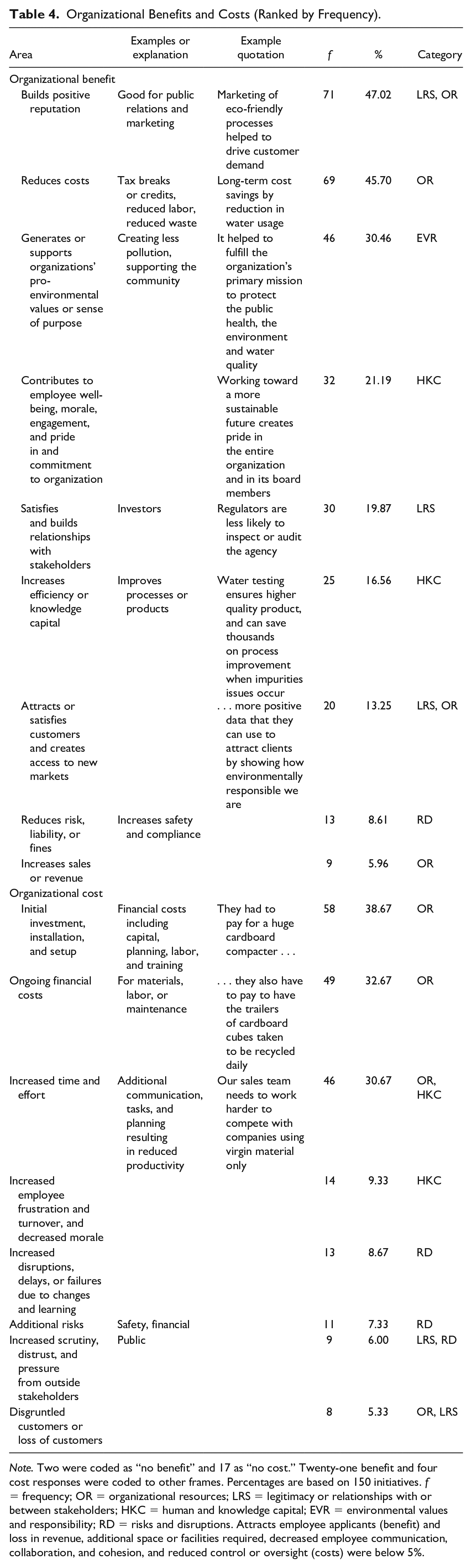
Note. Two were coded as “no benefit” and 17 as “no cost.” Twenty-one benefit and four cost responses were coded to other frames. Percentages are based on 150 initiatives. f = frequency; OR = organizational resources; LRS = legitimacy or relationships with or between stakeholders; HKC = human and knowledge capital; EVR = environmental values and responsibility; RD = risks and disruptions. Attracts employee applicants (benefit) and loss in revenue, additional space or facilities required, decreased employee communication, collaboration, and cohesion, and reduced control or oversight (costs) were below 5%.
Societal Benefits and Costs (Ranked by Frequency).
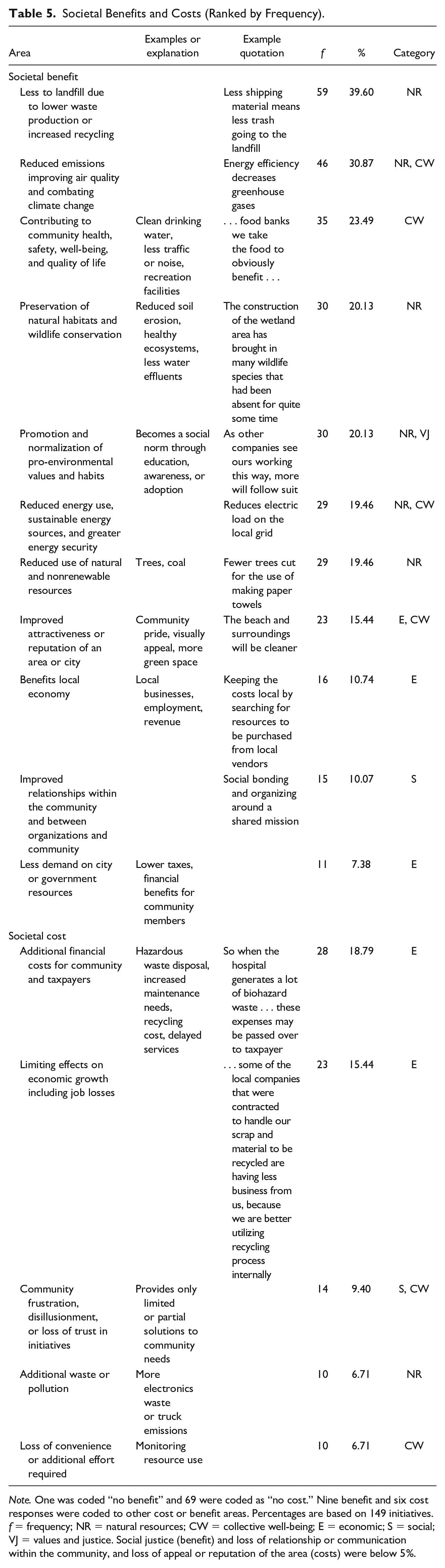
Note. One was coded “no benefit” and 69 were coded as “no cost.” Nine benefit and six cost responses were coded to other cost or benefit areas. Percentages are based on 149 initiatives. f = frequency; NR = natural resources; CW = collective well-being; E = economic; S = social; VJ = values and justice. Social justice (benefit) and loss of relationship or communication within the community, and loss of appeal or reputation of the area (costs) were below 5%.
Data from the two samples are reported as one group given that this exploratory study’s goal is to identify the range of costs and benefits employees might consider, rather than to differentiate perceptions and costs or benefits based on the nature of the subsamples or initiative characteristics. An initial examination of the codes for the two samples did not suggest that a separate presentation of the codes for each sample would provide a more meaningful or accurate representation of the scope of meaning. The samples showed similarities in the frequencies of initiative types (Table 2). Due to the limited demographic data, further comparison (e.g., by industry) of the two samples’ demographics was not possible.
Initiative Types
Six initiative types were represented in the 150 initiatives collected (see Table 2). Percentages show the representation of initiative types by sample, with some exceeding 100% due to initiatives fitting multiple initiative types. Some participants’ initiative descriptions represented multiple initiative categories or described multiple initiatives within a single answer. This prevented comparisons of the costs and benefits for different initiative types, as costs and benefits could not be isolated to a specific initiative.
The innovating and advocating (e.g., sharing innovations, lobbying with government or industry bodies) and commercial and financial investment (e.g., investing in eco-friendly businesses, buying locally) initiative types were not represented in the collected data despite being listed as one of eight examples in the survey instructions. Conserving and reusing resources and working sustainably were the most common initiative types. As one example, “Our company sends volunteers weekly to clean up at the riverbank here locally” was coded as environmental reclamation or rehabilitation. A further example, “Monitoring ground water for pollutants and its impact on local environment. The project is an extension program developed by a local coal mine . . .” was coded as projects to monitor and reduce organizations’ environmental harm.
Personal Costs and Benefits
Table 3 presents employees’ perceptions of the personal costs and benefits of EI participation. Predominant benefits of participation (>10% of initiatives) were sense of achievement or satisfaction from protecting the environment and contributing to a better society; financial benefits; personal well-being including mental and physical health; and makes my job easier. The most frequent personal costs from EI participation mentioned by participants related to makes my job more difficult; adapting to change; personal inconvenience or conflict; and safety and comfort of work environment. Twenty-six initiatives (17.3%) were stated to have no personal cost (see Table 2 notes). For example, one participant stated that their company’s addition of solar panels had no personal disadvantages (see Table 2 notes), whereas other initiatives such as commuting programs had both costs and benefits. It seems evident that only some EIs created personal costs for participants, but most resulted in benefits.
Some costs and benefits appeared related. For example, EIs were said to increase well-being (e.g., reducing commuting stress through remote work) and decrease well-being (e.g., added stress due to new complex work procedures). Table 3 includes categories of costs and benefits (functional, psychosocial, and values-related) in the final column. Codes may fit multiple categories, but only the best-fitting categories were listed. Given the absence of prior systematic studies on personal costs of EIs (beyond incidental mentions), it is challenging to make comparisons to previous literature. Compared with previous studies on personal benefits of CSR initiatives (Bhattacharya et al., 2008, 2009; Koch et al., 2019), however, the present list of benefits appears to be more comprehensive and focuses specifically on EIs.
Despite differences in the codes, the present study found a similar categorical structure (see last column in Table 3) to previous benefit studies. The costs and benefits inductively identified in this study align with Koch and colleagues’ (2019) and Bhattacharya and colleagues’ (2009) categories of benefits of CSR participation: functional (meeting one’s own material or physical needs e.g., financial), psychosocial (meeting psychological or social needs e.g., belonging), and values-related (addressing needs for meaning and morality related to higher-order values, e.g., protecting the environment). The term psychosocial (Bhattacharya et al., 2009) was used, rather than Koch and colleagues’ emotional benefits category, as emotions are typically short-term reactions to events (Russell & Friedrich, 2015). The present study’s participants appeared to describe enduring experiences of costs and benefits, with few descriptions of emotions. In contrast to Koch et al., Bhattacharya et al., and others who excluded costs from their study, the present study found that the functional, psychosocial, and values-related categories suited the categorization of the costs as well. The present study’s findings did not contradict existing CSR-related categorizations of personal costs and benefits and affirmed the relevance of these categories to EIs’ costs and benefits, but identified some nuances in costs and benefits (e.g., safety and comfort of the workplace) that seem likely to differ from CSR initiatives (Halme et al., 2020).
Organizational Costs and Benefits
In Table 4, seven organizational benefit codes exceeded the 10% threshold. Organizational benefits that employees perceived included builds positive reputation; reduces costs; and generates or supports organizations’ pro-environmental values or sense of purpose. Personnel-related benefits centered on collective benefits which contributes to employee well-being, morale, engagement, and pride in and commitment to the organization. Other major benefits included satisfies and builds relationships with stakeholders; increases efficiency or knowledge capital; and attracts or satisfies customers and creates access to new markets.
Only three cost codes applied to more than 10% of initiatives. Financial costs were discussed both in terms of initial investment, installation, and setup and ongoing financial costs such as material, labor, service, or maintenance costs. Increased time and effort was not coded as a financial cost (unless participants expressed it as a financial cost) as it was evident that organizations often used existing resources or capacity.
As with Table 3, some costs and benefits appeared to be related (e.g., gains or reductions in morale). More of the organizational cost and benefit codes had high frequencies (>19.9%). Only three cost codes were associated with more than 30% of the initiatives. While the organizational benefits identified in this study agree with those reported in literature, the costs stand out as being unique due to the absence of previous studies that comprehensively list costs, especially from an employee perspective. Some of the specific costs and benefits, particularly those emphasizing intangible costs (e.g., frustration, delays), are also overlooked in other studies or taxonomies that are more reductive or focus only on the organization’s perspective rather than employees’ understanding.
Codes were inductively summarized into five categories (last column Table 4), which are comparable to Bansal and Roths’s (2000) benefit taxonomy but add two new categories and alter the other three. The organizational resources category includes increases or decreases in profit, sales, employee time, facility space, materials, taxes, and other use or generation of resources. The broader language of resources was used rather than the narrow financially orientated terminology used in previous taxonomies (Bansal & Roth, 2000), which emphasized profit, competitiveness, and shareholder interests. This allows the category to incorporate non-profit and other organization types included in the sample but also acknowledges the broader conceptualization of the generation or use of resources, including intangible types, in participants’ responses. Legitimacy or relationships with or between stakeholders brings together the codes that address organizations’ social license to operate or social legitimacy (Aguilera et al., 2007) while emphasizing relationships. This places organizations within a broader network of social relationships with and between stakeholders, where EIs might improve or negatively impact relationships, trust, credibility, and social capital.
Human and knowledge capital categorizes codes that describe attracting new employees, employees’ learning and growth, improved processes, and collective employee well-being (including attitudes toward their organization such as pride and employee morale), which provide a basis of human and knowledge capital to support the organization. This category stands apart from previous taxonomies as it has not been included and considers intangibles. Environmental values and responsibility clusters codes focused upon the organization’s sense of responsibility for the natural environment, including higher-order values such as valuing the environment inherently rather than just as a resource, and also expresses the benefits or costs of initially shaping and ultimately fulfilling the organization’s mission where it includes an environmental focus (e.g., being environmentally sustainable). This is similar to Bansal and Roth’s ecological responsibility category. Risks and disruptions addresses multiple types of risks (e.g., financial, health and safety, fines), as well as disruptions to organizations’ functioning such as delays during EI implementation, also being a novel addition to previous taxonomies.
The five categories were intended to group cost and benefit codes. For example, risks and disruptions can increase (cost) or decrease (benefit). The codes and categories that emerged from the data seemed to emphasize the perceived needs of organizations (e.g., the need for legitimacy within society) as a reference point for employees in determining whether an EI produces benefits and costs, which can be understood through theories such as institutional theory and the resource-based view of the firm (Yang et al., 2018).
It also seemed likely that there was overlap in the personal and organizational costs and benefits when seen through the employee’s perspective. Employees are expected to be subjective in what they assume is beneficial to the organization and their evaluation would only be based on their knowledge. For example, an employee might base their evaluation of customer relations or collective employee morale on their own experiences in their department or their own perceptions and attitudes (e.g., job satisfaction).
Societal Costs and Benefits
Table 5 focuses on EIs’ costs and benefits to society from the employee perspective. Ten benefit codes applied to at least 10% of the initiatives. Societal benefits that were mentioned in at least 20% of the initiatives included less to landfill due to lower waste production or increased recycling; reduced emissions improving air quality and combating climate change, contributing to community health, safety, well-being, and quality of life; preservation of natural habitats and wildlife conservation; and promotion and normalization of pro-environmental values and habits. Additional codes with 10% to 20% representation included reduced energy use, sustainable energy sources, and greater energy security; reduced use of natural and nonrenewable resources; improved attractiveness or reputation of a city or area; benefits the local economy; and improved relationships within the community or between communities and organizations.
It was notable that “no costs” (or similar responses) were reported for 69 (46%) of the initiatives. Only two costs exceeded 10%: additional financial costs for community and taxpayer; and limiting effects on economic growth including job losses. Opposing costs and benefits were evident in codes relating to jobs and the economy.
Societal costs and benefits have received limited coverage in the business literature, with little detailed discussion of actual types and examples of EI’s societal benefits. In the present study, the overall volume of responses regarding costs and benefits to society was lower than personal and organizational costs and benefits. A broader range of benefits than costs was identified in participants’ responses. As previously noted, this may suggest less actual costs or a lack of awareness of costs. However, less actual costs seems more likely based on the literature review. Six benefits in the top 10 benefits were related to the natural environment, such as reductions in pollution and climate change or preservation of natural resources. The two cost codes were related to financial costs to the community and taxpayers, and the limiting effects on economic growth including job losses.
When structured into categories, five groupings emerged. Natural resources included any impact on the natural environment and its resources such as damage and pollution (costs) and protection, preservation, or restoration (benefits). The collective well-being category centered on contributions to the quality of life, health, security, or functioning of communities. Economic summarized codes that reflected increased losses or gains in financial resources or jobs for the local community. The social category incorporated relationships and cohesiveness in the community, including with organizations (e.g., trust). Finally, values and justice captured increases and decreases in the enactment of prosocial values including pro-environmental action and supporting minorities.
These five inductively derived categories appear to reflect aspects of Aguilera and colleagues’ (2007) national motives. However, the present study inquired about employees’ perceptions of EI’s impacts on the local community and society in general, rather than on the national level. For example, Aguilera and colleagues’ competitiveness category (instrumental motive) emphasizes innovation, community goodwill, environmental protection, and high-performing workplaces to support the economy at the national level, whereas the present study’s economic category addressed more local concerns such as availability of jobs, the area’s attractiveness, and the financial well-being of local government. There is also some similarity between Aguilera and colleagues’ social cohesion (relational motive) and the present study’s social category and between Aguilera and colleagues’ collective responsibility (moral motive) and the present study’s values and justice category. However, the present study’s natural resources and collective well-being categories introduces new elements. Given the different foci and purposes of the taxonomies, the present study offers unique insight into employees’ perspectives of EIs’ costs and benefits to society.
Taxonomy
Considering Hambrick’s (1984) distinction between typologies and taxonomies as classification schemes, the present study introduces a taxonomy (empirically derived) rather than a typology (conceptually derived). In the first two columns, Table 6 shows how the categories from the present study create a taxonomy of the perceived costs and benefits employees reported for themselves, their organizations, and society. Categories capture similar meaning across both cost and benefit codes. The 13 categories were aggregated into three themes (column 3), as common patterns of meaning were evident in the categories (and their underlying codes). Repeated themes related to (a) the availability of resources or supportive conditions that allow thriving, (b) well-being (individual or collective) and relationships within or between stakeholder groups, and (c) achievement of higher order values and purpose related to the environment. Some categories connect to more than one theme. For example, human and knowledge capital represents gains or losses in process knowledge (theme a), and employee morale (theme b).
Taxonomy and Themes: Employee’s Perceptions of the Costs and Benefits of Environmental Initiative (EI) Participation.
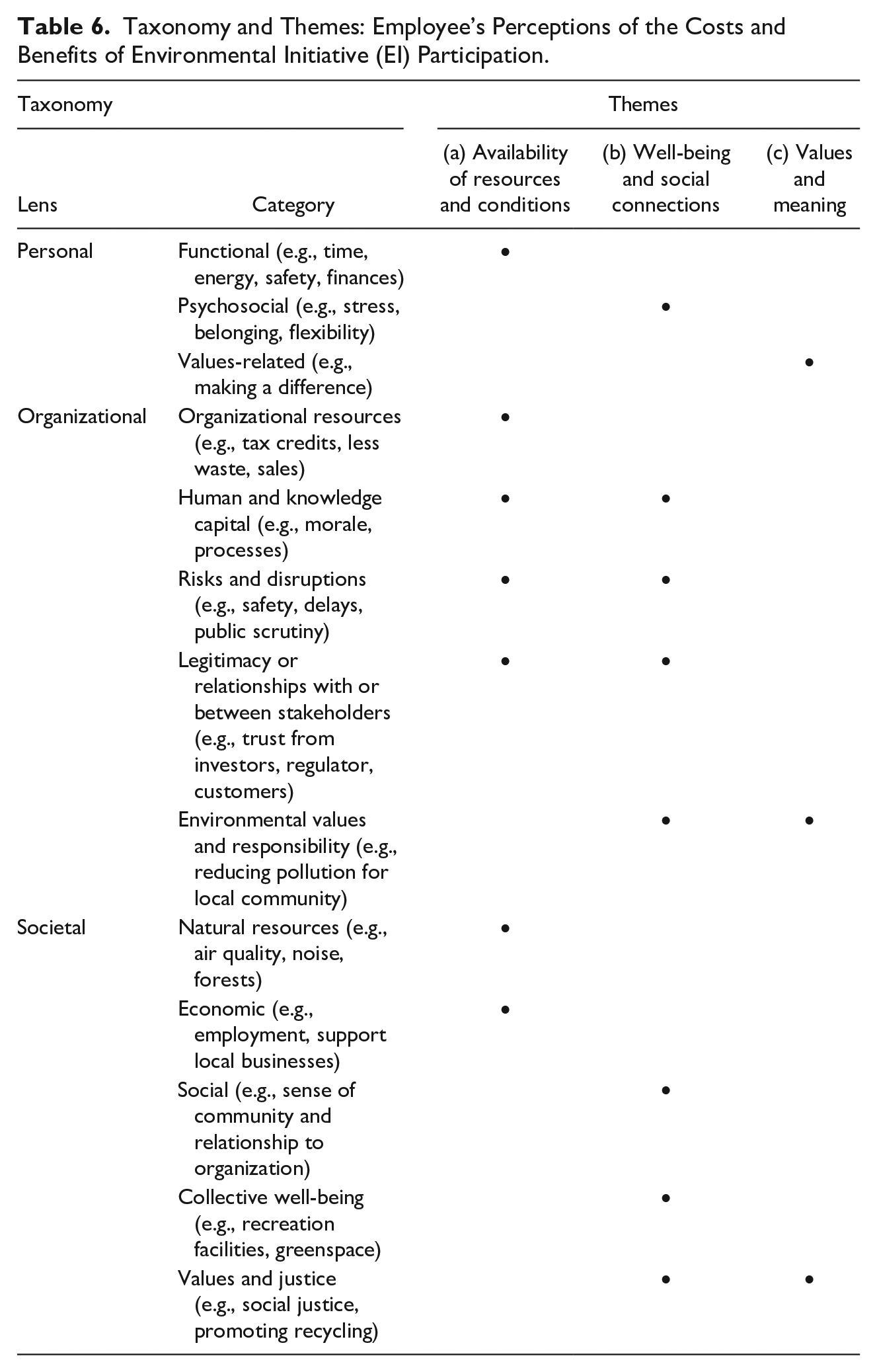
The three themes bear some similarity to previous categorizations already discussed, such as Gond and colleagues’ (2017) and Aguilera and colleagues’ (2007) instrumental, relational, and moral drivers or motives and Koch and colleagues’ (2019) functional, emotional, and meaning and morality benefit clusters. However, the present study’s taxonomy uniquely includes personal, organizational, and societal outcomes; was empirically derived; includes both costs and benefits; and was focused more narrowly on EIs rather than CSR initiatives. As for many taxonomies, the personal, organizational, societal, and cost-benefit distinctions are only theoretical and may not represent the way information is stored or processed in employees’ minds (Hambrick, 1984). While individuals may consciously identify multiple advantages and disadvantages to a behavior, only some will be consequential for often-unconscious behavioral choices (Fishbein & Ajzen, 2010).
Contribution and Implications
This study uniquely examined employees’ perspectives of EI participation’s costs and benefits using multiple goal frames, advancing a clearer understanding of employees’ motivation to engage in EIs which has been absent from research to date. A central contribution of this study is the creation of a taxonomy of the costs and benefits that might influence employees’ attitudes to EI participation. The TPB (Ajzen, 1991) was applied through the theoretical assumption that employees’ perceptions of the costs and benefits of EI participation determine their EI-related attitudes and influence their behavioral intentions and actual behavior. However, workplace TPB studies typically focus on the net outcome of cost and benefit analyses by measuring the resulting attitude rather than understanding specific antecedent costs and benefits. The present taxonomy can support future research on employees’ motivation to participate in EIs and may lead to insights on how categories of costs and benefits play a role in PEB motivation. Inevitably the isolation of specific costs and benefits is a reductive representation of complex and intuitive process that results in an attitude. However, understanding the role of different costs and benefits is valuable in terms of identifying types of information (e.g., knowledge or perceptions of personal career-related benefits) that might be used to influence attitudes and even behavior. The taxonomy is then applicable to the internal marketing of EI participation as discussed below.
This study also applied goal framing theory (Lindenberg & Steg, 2013) to provide a more nuanced understanding of EI participation’s costs and benefits by separately examining employees’ perceptions of the outcomes for the employee, their organization, and society. Goal framing theory’s focus on both personal and group goal frames, as well as the notion of accessing collective benefits through the groups with which one identifies, highlights the need to focus on more than just personal costs and benefits (Koch et al., 2019). Participants could identify both unique and related costs and benefits through the personal, organizational, and societal lenses. As suggested by Aguilera and colleagues (2007), multiple motivations are likely to underpin any behavior. These findings provide evidence that goal framing is a valuable approach to analyzing how employees perceive the advantages and disadvantages of EI participation, which is not evident in prior studies. The relative influence of the various costs and benefits in the different frames on employees’ attitude to participate in EIs can be examined in future studies using the taxonomy (Table 6) and cost and benefit categories (Tables 3–5). Such research could also clarify the role of self-interest and group-orientation in employees’ motivation to participate in EIs, which has implications for how EIs are promoted within organizations.
This study also found patterns in cost and benefit perceptions. Participants were aware of both benefits and costs, but more benefits were identified, and the benefits identified were applicable to a higher percentage of the initiatives than the costs. The balance of benefits to costs is to be expected, as without a greater number of benefits, the EIs would likely not exist, be continued, or have attracted employees to be involved in the EIs they described (Ruepert et al., 2015). As previously noted, a focus on benefits over costs is reflected in the literature. The TPB emphasizes that perceived behavioral control (e.g., limited opportunity or low self-efficacy) and subjective norms (e.g., lack of peer and manager support for EIs) may inhibit employees from participating despite perceptions of a net positive benefit. For this reason, the taxonomy presented here only partly addresses why employees may or may not participate in EIs. The broader literature on antecedents (e.g., personality, values) to initiative participation should also be considered (Gond et al., 2017).
In summary, this study’s contribution is the combined application of TPB and goal framing to examine employees’ perceptions of the costs and benefits of EI participation, which has not been comprehensively studied before. Previous studies have predominantly focused on benefits to organizations or employees (Koch et al., 2019), or have focused on the broader realm of CSR rather than on environmental sustainability. Some costs and benefits (e.g., safety and comfort) are unlikely to apply to CSR, suggesting EI is worthy of unique consideration as a specific type of CSR initiative (Halme et al., 2020). Although attitudes have largely been treated as the starting point for theorizing about EI participation using the TPB, the present study suggests that costs and benefit perceptions are also an important preceding consideration, speculating that it is not just the attitude to behavior that is important, but also the cognitive evaluation of favorableness of the behavior that must be understood to exercise influence on the attitude. In addition, in the absence of attention to employees’ perceptions of EI costs and benefits, costs and benefits have remained poorly defined without consideration of the potentially complex nature of costs and benefits, where goal frames might only be one way of categorizing EIs. Using the present study as a foundation, further research can determine the relative importance of different types of costs and benefit in influencing attitudes to EI participation. This study therefore supports the broader project of understanding the micro-foundations of employees’ support for EIs and its approach (focus on costs and benefits, use of frames) may also potentially apply to the study of CSR initiatives.
In practice, the codes, categories, and taxonomy from this study can guide organizations in better understanding employees’ attitudes to EI participation and how such perceptions can be influenced in positive ways (Unsworth, 2015). This information may be especially valuable given that it is based on actual EIs, rather than on hypothetical costs and benefits, and provides a more detailed analysis of employees’ perceptions. Managers might promote positive attitudes to EI participation through internal marketing (Gregory-Smith et al., 2015) by highlighting the benefits, while providing accurate information about potential costs. Sharing such information may build trust, demonstrate transparency, and reduce potential skepticism about the balance of costs and benefits. Internal social marketing interventions that focus on EIs’ benefits to society have been shown to influence employees’ pro-environmental perceptions and behavior (Gregory-Smith et al., 2015). Sharing information can increase commitment to and decrease resentment related to such initiatives (Ditlev-Simonsen, 2015).
Employees may lack awareness of specific benefits and costs to themselves, their organization, and society, and revisiting such analyses might induce attitude changes (Unsworth, 2015). This information might be shared through internal communications such as informational presentations, training, and quarterly updates (e.g., electronic newsletter). It seemed apparent that some participants had limited awareness of the possible benefits of initiatives, especially with regard to the societal lens where fewer benefits were listed. Focused information on social benefits seems likely to impact behavior (Gregory-Smith et al., 2015; Unsworth, 2015). The employees themselves should be consulted through surveys or focus groups to gain further insights on their perceptions of costs and benefits in the various categories and themes in the taxonomy unique to the EI and context. Costs that employees are concerned about, or benefits they are attracted to, could be highlighted in subsequent internal marketing (Unsworth, 2015).
In employee-centered or participative cultures (Aragón-Correa et al., 2013), the examination of costs and benefits to employees personally, to their organization, and to society may contribute to the selection and design of EIs that the organization can start, expand, or discontinue. This may increase voluntary participation in EIs and could also support engagement with multiple stakeholders (including the community) to align business and societal needs (Kujala et al., 2022). Insights on personal benefits might also suggest rewards that can be offered to encourage employees’ participation (Gregory-Smith et al., 2015; Unsworth, 2015).
Study Limitations and Suggestions for Further Research
This study was limited by its moderately sized U.S.-only sample introducing potential cultural biases (Carroll, 2021), by the lack of two-way interaction with participants preventing further exploration of responses, and by the lack of complete demographic information. A larger and more representative sample would be needed to ensure generalizability of the findings to the U.S. working population. Further analysis was also limited by the way participants described multiple initiatives or initiatives that spanned multiple initiative types. Further information on the nature of participation would also be advantageous (e.g., voluntary-mandatory, routine-substantive initiatives, collective-individual). The comparison of costs and benefits between initiative and participation types might be the subject of future research. However, the findings combined with the literature suggest that the taxonomy reflects most outcomes employees are likely to consider.
TPB research’s reliance on longitudinal data collection with predictor and criterion variables measured at different times may help to clarify which costs and benefits in the personal, organizational, and societal lenses are most predictive of actual behavior. With the foundation created by this predominantly qualitative study, future quantitative studies might include larger and more diverse samples of participants and use surveys to determine the ability of the taxonomy and identified categories to predict attitudes to EIs, behavioral intentions, and actual EI participation in a full TPB model. Future research can also explore the factorial validity of the model proposed in Figure 1 and taxonomy proposed in Table 6. This should include ascertaining the independence of personal, organizational, and societal costs and benefits and whether seemingly related costs and benefits are uni-dimensional or multi-dimensional (e.g., gains or reductions in morale).
Conclusion
While some previous CSR studies and conceptual writings have examined aspects of costs and benefits to the employee, organization, or society, this study addressed a gap in the literature by contributing a focused empirical investigation on EIs from the employee perspective and by exploring perceived costs. This exploratory study creates a foundation for further investigation of employees’ motivation to participate in EIs using the TPB model, recognizing that different goal frames might influence employees as they consider outcomes of actions for themselves, their organizations, and society. By understanding employees’ perceptions, organizations can work toward increasing employees’ motivation to participate in the EIs, and PEBs in general, which complement the organization’s environmental management strategy.
Footnotes
Declaration of Conflicting Interests
The author declared no potential conflicts of interest with respect to the research, authorship, and/or publication of this article.
Funding
The author received no financial support for the research, authorship, and/or publication of this article.
