




Abstract
Business & Society’s 60th anniversary affords an opportunity to reflect on the journal’s achievements in the context of the wider field. We analyze editorial commentaries to map the evolving mission of the journal, assess the achievement of the journal’s mission through a thematic analysis of published articles, and examine Business & Society’s distinctiveness relative to peer journals using a machine learning approach. Our analysis highlights subtle shifts in Business & Society’s mission and content over time, reflecting variation in the relative emphasis on scholarly quality versus policy/practice relevance, and building the journal and its academic community versus addressing issues of concern to wider society. While Business & Society’s intended missions have been substantially and sequentially achieved, an increased emphasis on the society-business nexus and a critical approach to interdisciplinarity could further enhance Business & Society’s leading role within business and society research and attract new generations of contributors and readers.
This journal is meant to furnish a balance and a relief from the intense preoccupation with techniques of management which characterizes many similar publications. We will try to provide perspective of the businessman [or woman] not merely in his [or her] desk chair but in a world, or perhaps it’s wise these days to say a universe, which he [or she] helps to shape. (Thain, 1960) Global society is increasingly grappling with grand challenges, such as climate change, human rights violation, global poverty, socioeconomic inequalities, mass migration, and institutional corruption . . . as more journals enter into the discussion of business and society themes . . . there is greater room for fragmentation [that] does not advance the search for long-lasting and impactful solutions to complex problems and issues. (Bapuji et al., 2020)
Arguably, one of the distinguishing characteristics of Business & Society research and scholarship is an intent to contribute to the betterment of the world by addressing issues and challenges that face contemporary business and society. Indeed, both the journal’s first editorial “declaration of interdependence,” and the latest editorial statement of intent regarding the future of Business & Society are underpinned by a deep commitment to illuminating contemporary issues and challenges. Normativity is deeply ingrained in Business & Society research (Swanson, 1999), and as a community, we are unashamedly concerned with the way things should be, rather than simply how they are or how they could be. The 60th anniversary of Business & Society is a timely occasion on which to evaluate how well we have accomplished the founding mission articulated for our community over the last six decades.
We ground our critical evaluation of the scholarly work published in Business & Society in the fertile debates regarding the objectives and impacts of business and management scholarship that have proliferated in the last two decades (e.g., Carton & Mouricou, 2017; Hodgkinson & Rousseau, 2009; Rynes et al., 2001; Starkey et al., 2009; Starkey & Madan, 2001). This research has examined the objectives and achievements of specific journals within the broader evolution of management and business studies as a scholarly field of study (Kieser & Leiner, 2009) and has been largely critical of much of the contemporary management research undertaken (Alvesson et al., 2017; Tourish, 2020). Recognition of the criticisms of the state of management research has led to calls for management researchers to pay greater attention to “grand challenges” (e.g., Brammer et al., 2019; Buckley et al., 2017; Ferraro et al., 2015; George et al., 2016). This conversation encourages management researchers to engage more deeply and consistently with “ambitious but achievable objectives that harness science, technology, and innovation to solve important national or global problems and that have the potential to capture the public’s imagination” (US Office of Science and Technology Policy, 2014, p. 7). Relatedly, the field is beginning to pay significant attention to what constitutes responsible research, both methodologically and regarding scholarly impacts and outputs (McKiernan & Tsui, 2019). The upsurge in interest across business and management scholarship to increase the societal impact of research provides a fertile context for a review that examines the specific opportunities and challenges of achieving such goals in the context of business and society research.
We perceive a significant opportunity for our review to enable readers of Business & Society and our associated communities to reflect on the evolving mission of our research, impediments, and barriers to realizing that mission, and approaches to alleviating the hurdles that are specific to our goals for business and society research. To do so, we conduct a detailed, comprehensive, and longitudinal review of 60 years of Business & Society research, with a particular focus on how the journal has defined its mission over time, the extent to which the mission is reflected in the journal’s content, and the distinctiveness of Business & Society relative to peer journals. We ask the following four research questions: (a) How has Business & Society defined its intended mission, and how has the intended mission evolved over its 60 years? (b) to what extent has Business & Society realized its intended mission through its published research? (c) in what ways is research published in Business & Society distinctive relative to that published in peer journals, and how has this evolved over time, and (d) what could be done to further advance the distinctiveness and positioning of Business & Society in the future? To address these questions, we begin by briefly reviewing research regarding how academic journals define their mission and which factors at multiple levels shape this process. Next, we analyze editorial commentaries published in Business & Society to map the evolving mission of the journal, assess the achievement of the journal’s mission over time through a thematic analysis of its articles, and examine Business & Society’s distinctiveness relative to peer field journals using a machine learning approach.
The Mission(s) of Academic Journals
A fertile debate regarding the objectives of academic publishing has flourished throughout the social sciences, including numerous sub-fields of business and management, in the last two decades (Aram & Salipante, 2003; Baldridge et al., 2004; Carton & Mouricou, 2017; Daft & Lewin, 2008; Hodgkinson & Rousseau, 2009; Kieser & Leiner, 2009; Rynes et al., 2001; Starkey et al., 2009; Starkey & Madan, 2001). While much of the debate regarding the mission and achievements of business research has focused on a relatively macro-/field-level of analysis, some research has examined the specific missions and purposes of individual academic journals and how these evolve (e.g., Calabretta et al., 2011; Colquitt & Zapata-Phelan, 2007; Daft & Lewin, 2008; Van Fleet et al., 2006).
Many journals have their origin as showcases of the research effort of particular groups and focus on the development of specific academic fields or disciplines. For example, the Journal of Management originated from a desire to provide exposure to the research of members of the Southern Management Association (Van Fleet et al., 2006). It was recognized early on that “to achieve first-rate status, the journal would have to feature the discipline’s best work, not just the leading work of authors within SMA’s then-limited geographic boundaries” (Van Fleet et al., 2006, p. 487)—which involved recruiting an editorial board comprising nationally reputed scholars, indexing the journal in major databases, and implementing a constructive review process to improve article quality. These initiatives reflect broader attempts to build the legitimacy of business research which was lacking throughout its early development because of its initial proximity to practice (Kieser & Leiner, 2009).
A further academic community-centric mission often articulated and pursued by academic journals is their role in creating spaces for research addressing specific phenomena, theoretical orientations, or methodological questions. In so doing, these journals define their communities in opposition to various “other” communities and generate enhanced opportunities for their defined research priorities. For example, Organization, a leading critical management journal established in 1994, defined its mission as “establishing a field of study, neo-disciplinary, [with] a focus on an agreed theoretical object—the concept of organization” (Burrell et al., 1994, pp. 9–10). While the potential irony of slowly becoming part of the institutional apparatus of business and management was both anticipated by its founders and has not been lost on its community since (Parker & Thomas, 2011), Organization continues to play an active role in encouraging and sustaining critical management scholars and scholarship. Nonetheless, there have been long-standing concerns regarding whether self-sustaining communities of scholarship are isolated from developments (and needs) in the wider world and might not have a practical application or value (Bennis & O’Toole, 2005; Palmer, 2006; Podolny, 2009; Schoemaker, 2008). To overcome these concerns, many journals encourage improved pedagogy in their given field. Perhaps surprisingly to contemporary eyes, the founding mission of the Academy of Management Journal emphasized the importance of disseminating research through management education, suggesting that “articles published should be primarily those which deal with the teaching of management subjects, curriculum building and scholarly discussions of interest to students of management” (Adams & Davis, 1986, p. 90).
Other journals have explicitly moved away from catering toward specific academic communities or fields, and define their mission in relation to “outward-facing” needs. Reflecting the generalized concern to advance relevance in business research, a commonly cited mission among business journals is a desire to enhance contributions to management practice. For example, in their inaugural editorial for Organization Science, Daft and Lewin (1990) lamented that “the body of knowledge published in academic journals has practically no audience in business or government” (p. 1). Other critical voices have proposed that business research has too narrowly focused on managerial/organizational phenomena and has paid too little attention to social change and improvement, and remains unsatisfying if it is not able to provide answers to major social and societal issues facing the contemporary world (Podolny et al., 2009). To progress relevance, research would need to abandon the dominant managerialist and short-term agenda (Ferlie et al., 2010) in favor of establishing a link between the world of businesses and “grand societal challenges” such as climate change, poverty, food and water shortages, and social inequality, or by exploring implications that are relevant for public policies (e.g., Adler & Jermier, 2005; Dutton, 2005; Ferlie et al., 2010; Podolny, 2009; Schoemaker, 2008; Von Glinow, 2005; Walsh et al., 2003; Willmott, 2012).
Factors Shaping the Realization of Journal Mission(s)
Even the most critical discussions of business research concede that the variety, overall volume, reach, and inclusivity of business and management research have increased dramatically over the last 30 or 40 years (Alvesson et al., 2017). At the same time, there is concern with the growing tendency toward “nonsense” in business research—that is, concern regarding whether research addresses a fundamentally productive social role, or is merely an unproductive intellectual game serving only the advancement of academic careers (Alvesson et al., 2017; Tourish, 2020)—and widespread dissatisfaction with the extent to which many journals have realized their extra-academic roles. What factors then shape a journal’s capacity to achieve its goals—the advancement of the interests of particular academic groups or impacts on practice or the needs of the wider society?
Much of the narrative regarding the conditions that shape a journal’s capacity to achieve its mission is highlights institutional constraints within academic systems of knowledge creation. For example, systems of recruitment, reward, and recognition have institutionalized conditions of “publish or perish” (Clark & Wright, 2009; Lambrechts et al., 2011). Moreover, building academic credibility for management research within the broader social sciences has privileged “scientific” approaches to management research which have been problematic in terms of encouraging relevant and “engaged” scholarship (McKelvey, 2006; Van de Ven & Johnson, 2006; Van de Ven & Zlotkowski, 2005). The dramatic increase in the number of published outputs, their inaccessible style, and the emphasis on making theoretical contributions are well-documented (Alvesson et al., 2017; Tourish, 2020). The style and nature of academic communication are often ill-suited to generating content accessible beyond academia (Boland et al., 2001; DeNisi, 1994; Rousseau & McCarthy, 2007), implying that the academic community needs to be encouraged to innovate in relation to the extent and forms of communication of research findings (Cummings, 2007; Hambrick, 2005; Hitt, 1998). Despite calls for greater practical relevance, editors and researchers have noted that practitioners and management researchers occupy distinct knowledge eco-systems, each of which is substantially self-referential, meaning that aspirations to effect wider societal influence through academic research face considerable challenges (Kieser & Leiner, 2009; Rasche & Behnam, 2009) and might be “naïve aspirations” (Daft & Lewin, 2008, p. 181).
While institutional factors are undoubtedly important, academic journals and their editorships play an important role in shaping both the missions that journals define for themselves and their achievement. Editorial statements reflect the definition and boundaries of specific academic communities and those communities have themselves shown to follow predictable developmental pathways. March (2005) demonstrated that research communities, and by extension journals as totemic emblems of those communities, evolve naturally toward narrowness and parochialism within geographic, linguistic, and even cultural constraints. Research in several disciplines suggests that, over time, journals coalesce on relatively distinct and narrow issues/topics, as well as methodological and theoretical foci (e.g., Miller, 2006) despite espoused intent to publish more varied research. To some extent, this process might reflect theoretical or methodological biases and preferences of editors and reviewers (Miller, 2006; Starbuck, 2003).
Ultimately, individual academics also have an important role to play in shaping academic debates. Notwithstanding prevailing incentives and pressures, individual academics conduct, write, submit, and peer review research submitted to journals. Academics substantially determine the nature of the research supplied to journals for review, as well as shape published research through editorial and review processes. It is hard to imagine how journals could achieve their mission without the active participation of individual academics. Given that improving the societal relevance of business research (especially to address “grand challenges”) requires fundamental changes in the intrinsic character of the research being undertaken, academic agency is critical in relation to methods and approaches that produce Mode 2 research (Bartunek, 2011; Tranfield & Starkey, 1998), such as action or intervention research (Avenier, 2010; Hatchuel, 2001; Hodgkinson & Starkey, 2012), the co-production of knowledge between academics and practitioners (Starkey et al., 2004), and more “engaged scholarship” (McKelvey, 2006; Van de Ven & Johnson, 2006; Van de Ven & Zlotkowski, 2005).
What might this discussion mean for Business & Society, and its evolution over 60 years? We tentatively propose the following three broad issues that stem from the debates occurring in relation to wider management scholarship. First, there is a broad question regarding how Business & Society’s editorial mission has evolved over time, and how this relates to trends and pressures experienced more widely in management research. Within this, there are two further issues. First, how has Business & Society’s relative emphasis on academic quality and practice/policy relevance have evolved over time? Second, how has the relative emphasis in Business & Society between external foci and purposes versus internal/field-building activities evolved over time?
Methods
To answer our questions about the evolution and achievement of Business & Society’s mission over time, we undertake two complementary analyses: one qualitative, one quantitative. First, to identify how the journal has defined and realized its mission and how this has evolved, we use qualitative thematic analysis to identify the following: (a) The stated editorial mission of Business & Society in editorial statements and letters and how the mission changed over time, and (b) the extent to which the journal’s objectives are reflected in the journal’s content. Second, we complement the qualitative analysis of Business & Society’s content with an automated topic extraction and burst detection analysis based on machine learning which allows us to identify how Business & Society is positioned within the social issues research landscape vis-à-vis other peer journals: Journal of Business Ethics (JBE), Business Ethics, the Environment and Responsibility (BE:ER, formerly Business Ethics: A European Review), Business Ethics Quarterly (BEQ), and Business & Society Review (BSR). This approach has been successfully used in other systematic reviews (e.g., Marrone et al., 2020), and us to identify “topic bursts” in the large dataset of articles (11,486 articles across the four journals), that is, periods during which topics receive heightened attention. We detail the method for each element of our analysis below.
Dataset
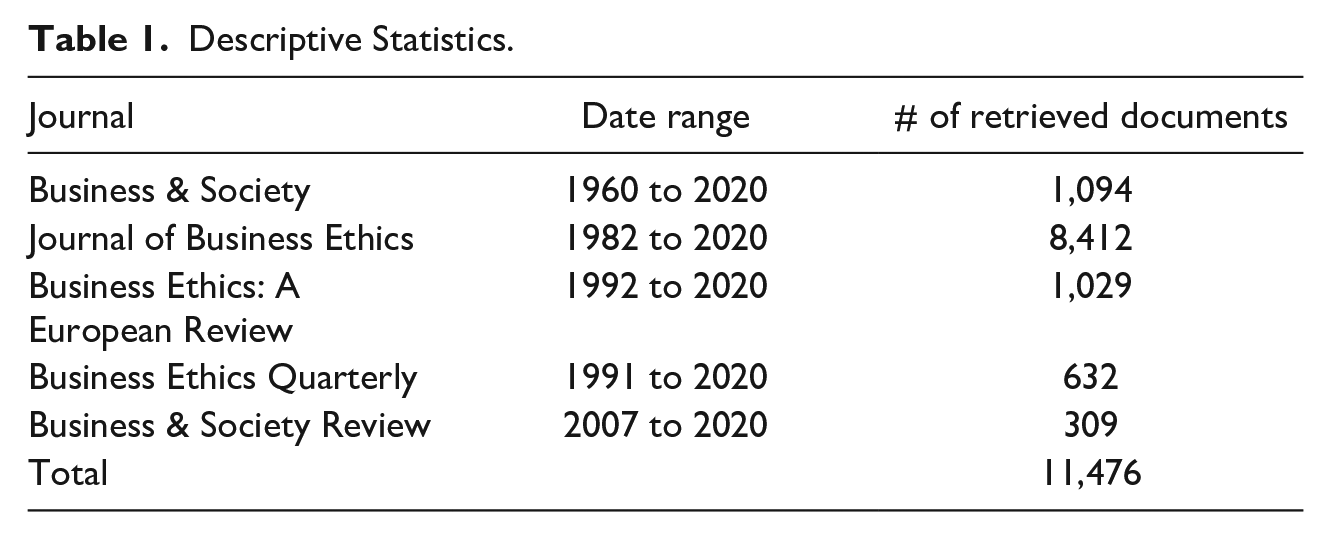
We systematically identified and retrieved all available Business & Society articles from the Scopus database, retrieving 1,094 articles (928 research articles, 34 review articles, and 132 other document types such as editorials published in the journal since 1960 and up to September 2020). In a second step, we exported both the citation data and full text for these articles. For comparative purposes, citation data were also collected from the four closely related titles mentioned earlier: JBE, BE:ER, BEQ, and BSR. Most journals are indexed in the Scopus database except for BE:ER, where we had to collect data from multiple different sources (Web of Science, ProQuest, and the journal’s website). We exported all available records over each journal’s entire history as a comma-separated-values (CSV) file (one file for each journal), noting some missing data for earlier records, which can likely be attributed to the retrospective digitization of citation data. Each CSV file includes information of journal citation records such as author details, title, year, and abstract for each article. Given that every journal has a different start year, we have an unbalanced dataset. Descriptive statistics for the retrieved data files are presented in Table 1.
Descriptive Statistics.
Method for the Qualitative Analysis of Business & Society’s Content
Our qualitative analysis of Business & Society’s content takes place in two steps. First, in recognition of Business & Society’s strong tradition of editorial communication with the journal’s readership and wider community, we analyze editorial content in the journal to map its evolving objectives over time. Editorial commentaries have varied in character to some extent—beginning with a tradition of editorial introductions to the articles featured in particular issues, including periodic reflections on Business & Society’s positioning and role in the context of the wider field—often around editorial transitions, and more recently involving longer and more fully developed narratives regarding the journals’ editorial perspective on particular issues (contribution, context, theory, etc.). In total, we identified 116 available editorial documents in the journal’s history that we included in our analysis. For context, in Table 2, we provide an overview of the history of Business & Society’s editors, along with their tenures, the numbers of issues and articles published during each editorial teams’ tenure, and the numbers of editorial prefaces/articles/commentaries included in our analysis.
Business & Society’s Editorial Teams.
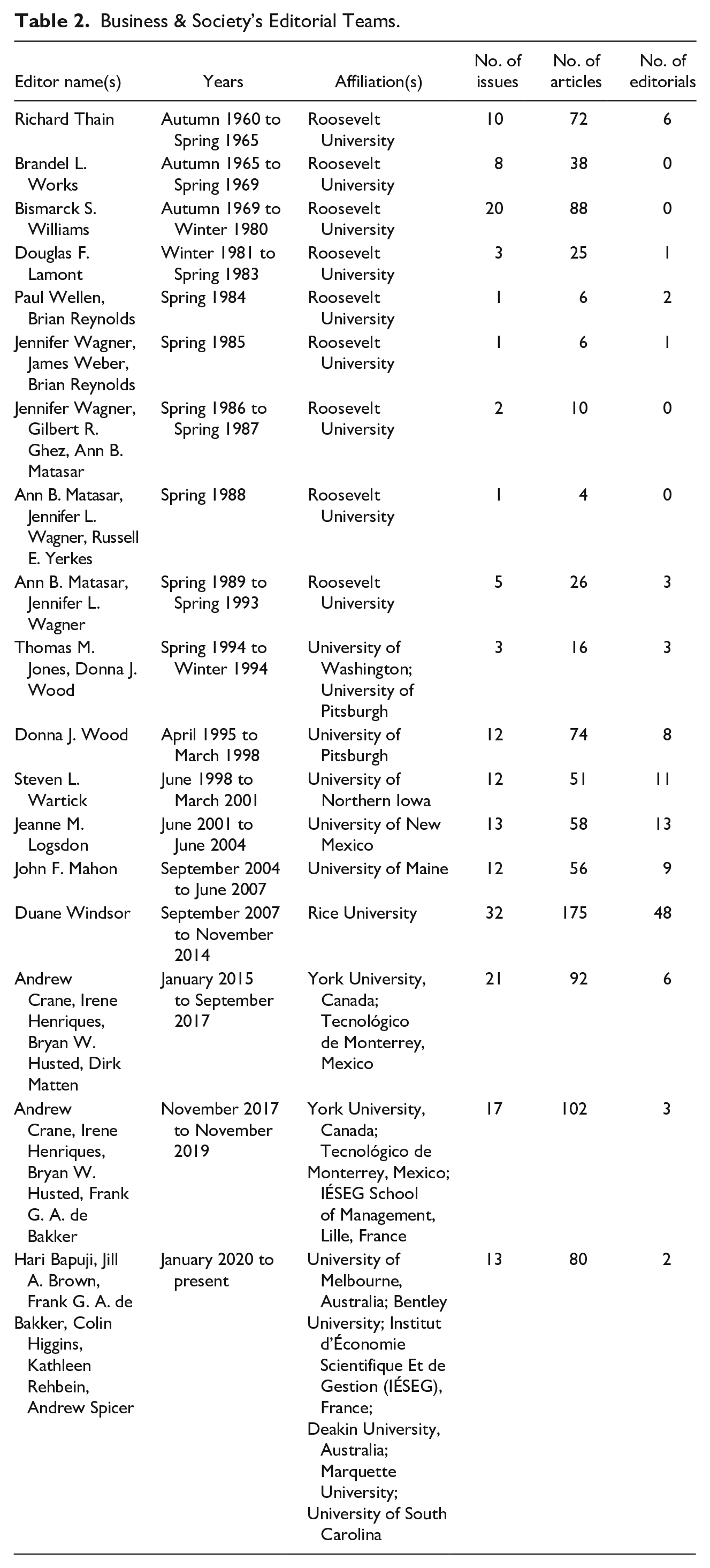
All 116 editorials were imported into the qualitative data analysis software NVivo 12 for coding and then analyzed in detail by two of the authors. The goal of analyzing editorials was to map out Business & Society’s evolving priorities, perspectives, issues, and concerns as they were seen and represented by the journal’s editors. While transitions between editors present opportunities for journal priorities and perspectives to evolve, we were keen not to take this for granted and for evolving issues to be surfaced naturally through our analysis. We therefore drew on Langley’s (1999, 2009) temporal bracketing approach to identify when there was “a certain continuity in the activities within each period” and where “there are certain discontinuities at its frontiers” (Langley, 1999, p. 703). This approach allowed us to identify seven phases in the evolution of the journal’s mission. Once phases were identified, a broadly inductive approach (Glaser & Strauss, 1967) was taken to identifying and surfacing themes and issues as they emerged in the editorials. In evaluating the editorials, we paid particular attention to identifying themes related to the following: (a) priorities and expressed editorial objectives for the journal, and (b) reflections on the state of the development of the wider business and society field, and the relevance and impacts of this on Business & Society. Having identified themes within the editorials, two of the authors engaged in an inter-rater reliability process by iteratively reflecting on how these themes clustered across time to map out stages of Business & Society’s evolving mission.
The second element of our qualitative analysis uses the phases identified to structure our analysis of the published content of the journal over the same periods. This part of the analysis aimed to map the evolving nature of the field across time by examining the textual content of all articles published in Business & Society between 1960 and 2020 systematically and rigorously. All articles published in Business & Society were downloaded as PDFs and imported into the qualitative software analysis package NVivo 12Plus. Articles were organized in NVivo through the use of the case and attribute functions to enable the sorting of articles according to the phase of the journal’s history they belonged to. Two members of the team read and re-read the articles included in the dataset. From these initial readings, the team established a coding template to enable a micro textual analysis of the evolution of foci and content in Business & Society’s output across time. Codes reflected the issues/phenomena under study, the theoretical perspectives being examined or developed (if any), the context of the study (if any), the methods being applied (if any), and the characteristics of the author teams (disciplines, location, practice/academic). Where possible, codes were generated in NVivo. For example, terms such as interdependence, critique, and interdisciplinarity were derived from the journal’s first published editorial. Next, using NVivo, the articles were coded by one member of the team and then re-coded by a second team member to ensure inter-coder reliability. In a small number of cases (due to the file format of some Business & Society articles), it was not possible to code in NVivo; in these cases, verbatim quotations that represented key themes were transcribed from the article and then re-uploaded to NVivo for analysis. This combined approach enabled us to critically evaluate the evolving mission of Business & Society and to identify exemplar articles that illustrate the evolving mission in the journals’ content.
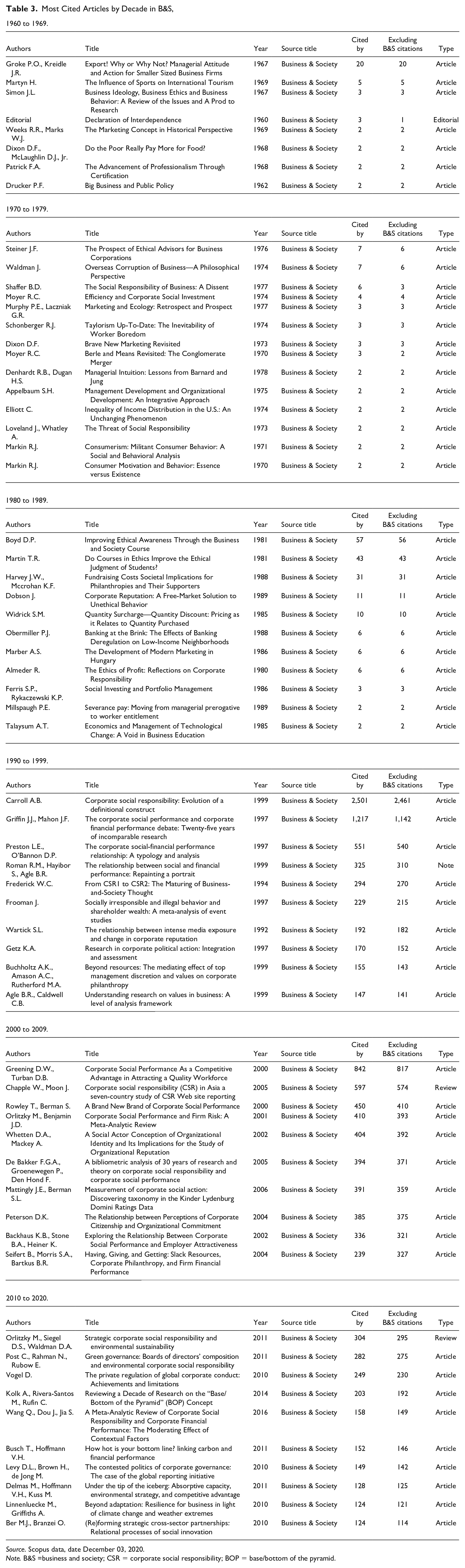
We also identified the top-cited journal articles in Business & Society per decade, using Scopus data and citation counts as of December 3, 2020, to gain an understanding of which articles attracted attention within the academic debate (Table 3). We note the inherent limitations associated with citation counts but find that these data are providing useful information regarding the growing academic influence of the journal in the field.
Most Cited Articles by Decade in B&S,
Source. Scopus data, date December 03, 2020.
Note. B&S =business and society; CSR = corporate social responsibility; BOP = base/bottom of the pyramid.
Method for the Burstiness Analysis
In addition to the qualitative analysis, and for purposes of situating Business & Society within the social issues research landscape, we conducted an automated topic extraction and burst detection analysis for articles published in the journal and other peer journals, identified earlier. Analysis was carried out separately for each journal and CSV file created in the previous step; the different time frames and publication volumes did not allow us to combine files into one dataset. We focused the analysis on the titles and abstracts of articles, rather than the entire article, for several reasons: (a) Abstracts contain a concise summary and the most important aspects of the articles they describe, and (b) prior research has found no clear advantage of using full-text versions (Crawford et al., 2006). The analysis of the textual data involves several different steps and was run in Python 3.
The first step involves an entity linking process, that is, a process that recognizes and disambiguates unique “entities,” or topics, within the text. The Python code used for the analysis is available on Github (see Marrone, 2020) and calls on the TAGME tool (see https://tagme.d4science.org/tagme/), which executes a process that scans the text and assigns meaningful topic mentions (i.e., topic “tags” or labels) to the text. The tool is not simply based on a frequency count of words in the text; instead, the tool uses algorithmic technology to assign relevant topics based on the text of the title and abstract of each article, disambiguates the topics from other topics, and evaluates the relevance of the topics for the overall context based on a confidence measure. Essentially, the analysis carries out a form of automated “coding,” similar to coding typically used in qualitative analysis. For example, an article discussing carbon capture and storage solutions and low carbon energy technologies would be tagged with terms such as “carbon capture and storage,” “energy,” and “low carbon.” Disambiguation is achieved during the machine learning process by comparing the text elements to large bodies of online textual data to ensure that the tool does not falsely assign tags—for example, an article mentioning “Mercury” could be about the planet, singer, or the chemical element (Marrone et al., 2020). The disambiguation thus allows the program to recognize the context in which the word is used (e.g., chemistry) to determine the meaning of the topic (e.g., Mercury = a chemical element).
In the last step, we subjected the extracted topics to a burst detection algorithm (based on Kleinberg, 2003), which identifies periods in which some topic is unusually popular. For instance, using COVID-19 as an example, we would see a substantial burst in publication activity related to topics such as COVID-19, vaccine development or health care since early-2020 due to the substantially heightened global attention toward this topic. Specifically, burst detection models can help to identify bursts as state transitions in document streams. In other words, a topic burst signifies that there are new developments in a particular area, or a sudden surge of publications in a topic area (e.g., a special issue on a certain topic; Cai et al., 2019).
Findings
Business & Society’s Evolving Editorial Mission(s)
As Business & Society’s inception, the journal’s mission—as articulated by its Editors in their editorial commentaries—has evolved considerably. In 1960, Business & Society began with the mission of producing content relevant to “literate” readers (Thain, 1960, p. 4) in support of their endeavors to shape society. By 1993, the journal’s stated mission began to shift, with Editorial aspirations increasingly focused on building the journal’s legitimacy. By the mid-1990s, journal editorials increasingly focused on creating, legitimizing, and developing the business and society field. A decade later, editors reflected on how the field of business and society had consolidated, and the journal sought to redefine its distinctiveness through a more inward-looking focus on how the journal could boost scholarly quality and theoretical rigor. More recently, there has been a return to the journal’s original outward-looking mission, with editorial calls for research that can “advance the search for long-lasting and impactful solutions to complex problems and issues” (Bapuji et al., 2020).
Building on the discussion in the “Findings” section, Figure 1 presents this evolution on a two-dimensional space: the vertical axis reflects the relative emphasis on scholarly quality and policy/practice relevance, and the horizontal axis captures the relative emphasis on the journal’s orientation toward building the journal and its academic community versus an orientation toward society, stakeholders, and practice. The emphasis on relativities in Figure 1 is important—for example, while we consider the relative emphasis in recent years to have shifted toward relevance from academic quality, that in no way implies an absolute decline in academic quality. Next, we unpack six phases in the evolution of Business & Society’s mission.
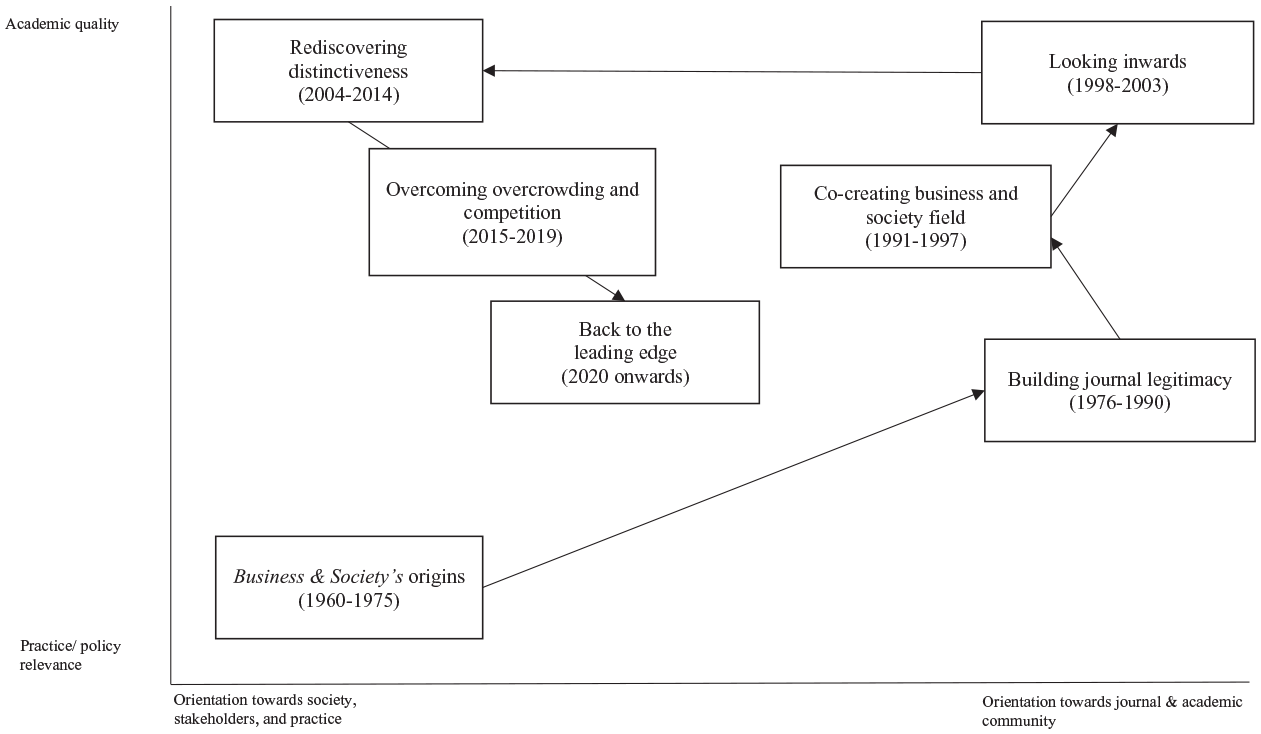
Business & Society’s evolving relative editorial emphasis on academic quality, practice/policy relevance, journal and society.
Business & Society’s origins (1960-1975)
The journal’s origin phase lies in the bottom left-hand quadrant of Figure 1—clearly emphasizing a concern with societal challenges and an orientation to informing practice. In our analysis, this stage of the journal’s development lasts for roughly 15 years from the foundation of the journal in 1960. Business & Society began its life as a “little magazine” that stressed “the interdependence of business and all the other disciplines which contribute to society” (Thain, 1960, p. 3). To a contemporary eye, Business & Society’s early aim to encourage writing (of various types) that spoke to the interdependence between business and society through an interdisciplinary approach may not seem revolutionary. Yet, in the context of the 1960s encouraging “intellectual ferment” and “criticism too-not of literature but the institutions of our society and the individuals within these institutions” (Thain, 1960, pp. 3–4) represented a radical departure from the technical emphasis of much early business and management scholarship and education. Despite the journal’s initial call for social critiques of business, interdependence was at first interpreted broadly (i.e., any business task that involves social impacts) and without substantial reference to ethical considerations. The journal’s initial broad orientation captures the complexity of interdependence but also reflects Business & Society’s enduring preoccupation with practical relevance. The journal encouraged letters and commentaries from its readers and did not shy away from publishing those that were challenging the value of academic research, as evidence by the publishing of the following statement from a Business Executive: “It is possible that half of all academic enthusiasms and projects are sterile exercises. But you never know which half” (Thain, 1962, p. 1).
Building journal legitimacy (1976-1990)
The journal’s second phase occurred around 1985, and lies in the middle of the two right-hand quadrants of Figure 1—migrating toward a concern for academic quality, while retaining a focus on policy/practice relevance, and an orientation toward the journal and its academic community. This phase saw a transformation of Business & Society from a “little magazine” to an academic journal publishing both conceptual and empirical research. This transformation is evident in a developing focus on academic quality, “thanks to our readers who have reviewed these articles prior to their publication and who have given the editorial staff and the authors critical suggestions on improving the flow of ideas presented by authors” (Lamont, 1983, p. 1). Initially, this change in focus appeared to create an emerging tension between the journal’s origins (commitment to business and societal relevance) and its emerging aspiration for academic legitimacy and rigor. This tension would become a key motif throughout this second phase of the journal’s development. This evolution also corresponds to a shift in emphasis toward building credibility for the academic study of business and society beyond the journal, which would eventually contribute to the creation of a legitimate and vibrant field of study.
Co-creating the business and society field (1991-1997)
The journal’s third phase began in the early 1990s and lies in the middle of the top two quadrants of Figure 1—migrating toward a focus on the journal’s role in co-creating the broad shape, structure, and boundaries of the business and society field. In 1993, Wartick (1993) wrote that “through this journal we have now provided a missing piece of the puzzle of academic legitimacy for our area. Let’s make it work” (p. iv). Business & Society and its editors, in collaboration with the International Association of Business and Society (IABS), therefore played a key role in legitimizing business and society as an academic field. Prior to Business & Society’s development into a fully-fledged journal, there had not been an easy home for business and society research. Jones (1994) wrote, “for over two decades, the academic world has lacked a peer-reviewed scholarly journal devoted solely to topics of interest to researchers in business and society” (p. 3). For example, Frederick’s (1994) highly cited article on CSR 1 and CSR 2 originally lacked publication opportunity. Contributing factors included the lack of awareness and understanding of the business and society field by scholars in other management areas (Wood & Jones, 1994). Consequently, this opened opportunities for the journal to promote, as its mission, an exclusive focus on research at the intersection between business and society:
Through editorial policies adopted by IABS, we plan to make Business & Society the premier scholarly journal devoted exclusively to our field. When new scholars in our area want to know the state-of-art or want to assess who we are and what we do, we want them to turn to our journal. When current members of IABS and other Business and Society scholars start new research projects, we want them to turn to our journal. In short, the high-quality articles published in our journal will reflect the “leading edge” of Business and Society scholarship. (Wartick, 1993, p. iii)
At the same time, Editorials also began to emphasize opportunities to grow and broaden the business and society field:
There’s so much happening in our field. I can’t really express how exciting it is for me to observe the growth and development of research and thinking in business and society. The variety and quality of work represented in this issue gives just a sample of what’s out there. (Wood, 1997, p. 4)
By the end of this phase Business & Society’s success in legitimizing the field was beginning to present its own challenges. As the publication options for business and society research grew, the journal appeared to be confronted by a new dilemma relating to competition for both its authorship pool and audience.
Looking inwards (1998-2003)
The journal’s fourth phase arose in the late 1990s and lies in the top right-hand quadrant of Figure 1—migrating toward a focus on academic quality and an orientation toward the journal and its academic community. Nearly four decades after the journal’s inception, the field of business and society was showing signs of consolidation. While no single dominant paradigm had emerged in the journal, the field had been formalized through its defined empirical focus and core theoretical concerns. This period involved both a continued commitment to academic quality and a turn toward a review process aimed at “boosting the quality of research and theory in our field” (Wood, 1998, p. 3). Editors started to reflect on the extent to which the journal had managed to realize this mission, commenting that
As far as publishing the best work, I think the evidence is mounting that Business & Society (B&S) is indeed the premier journal for research and theory in our field. Citations are beginning to boom; reputation and quality studies are taking note. We’re a journal on the move. (Wood, 1998, p. 4)
Subsequent editorials (e.g., Wartick, 1999b) echoed these sentiments and offered additional introspective observations, for instance, regarding the increasing focus of the journal on high-quality empirical work which was instrumental in establishing Business & Society as a premier outlet.
Rediscovering distinctiveness (2004-2014)
The journal’s fifth phase began in the mid-2000s and lies in the top left-hand quadrant of Figure 1—migrating toward a focus on academic quality and a return to an orientation toward society, stakeholders, and practice. By this time, the legitimacy and significance of the business and society field were widely recognized, and Editors started to return their attention to broader societal issues. Logsdon (2004), for instance, reflected on the increasing complexity of the socio-political and physical environments, arguing that it is not surprising to see an increasing interest in business and society topics by executives, policy makers, and educators. Editorials frequently emphasized the importance of global issues and events (i.e., national elections and international conflicts), arguing that they are “important considerations” in the intellectual and practical lives of business and society scholars (Mahon, 2004, p. 331). There was also heightened awareness of corporate and individual irresponsibility, highlighting the continuing mission of the journal to help address these (often unresolved) challenges:
We are at the end of another calendar year. Two chief executive officers of major corporations have had to resign for improprieties in their decision-making. Reports of cheating in MBA programs and classes note that more than 50% of students admit to cheating, which only suggests that the real number is probably even higher still. It should be very clear to readers of Business & Society that the need for covering topics in the field of business and society, corporate social responsibility/citizenship, corporate social performance, ethics, and other related topics is as strong or stronger than ever before. (Mahon, 2006, p. 411)
The continuing importance of Business & Society to wider societal issues was recognized in a series of Editorials by Windsor, arguing that Business & Society lies at the intersection of “fundamental questions” with important contributions to topics such as stakeholder activism and the study of corporate political activity (e.g., Windsor, 2009).
Overcoming overcrowding and competition (2015-2019)
The journal’s fifth phase remains toward the top right-hand quadrant of Figure 1—retaining a focus on academic quality and an orientation toward society, stakeholders, and practice. By 2015, the reach of business and management research had extended to mainstream business and management forums, conferences, and journals. Field legitimacy combined with broader changes in academic publishing systems had led to business and society expertise being more broadly distributed between an ecosystem of journals:
Our field is experiencing considerable growth while being tasked with enhancing both the rigor and the relevance of our research. Also, the scholarly space we look to occupy is becoming increasingly competitive, whether in terms of getting the best work out there submitted to the journal, finding willing expert reviewers, or getting the attention of people who we think should be reading and citing what we publish. (Crane et al., 2015, p. 3)
These conditions created competition from both field-specific journals (e.g., Business Ethics Quarterly, Business Strategy & the Environment, Corporate Social Responsibility, and Environmental Management), but also from top management and strategy journals that started to publish an increasing number of articles directly related to the field. While the greater attention to business and society issues contributed to the acknowledgment of the importance of the field, the increased competition also meant that Business & Society sought to adapt its mission.
Crane et al. (2015) stated,
We believe that Business & Society can and should become a top tier management journal, however such rankings might be devised . . . To carry out this vision, the journal shall be built on three important, yet mutually interdependent aspirations: openness to diversity, scholarly excellence, and timely decision making. (p. 5)
Toward the end of the 2010s, a commitment to multiple senses of diversity, and a focus on societal issues become important features of editorials. This pluralism is striking because it signals a return to a broader scope of focus for both the journal and the field:
One of the core values of Business & Society is openness to diversity . . . This diversity is exemplified by the considerable range of subjects and theoretical approaches addressed in the articles we publish, as well as the different methods applied, and the scholarly disciplines that the articles (and their authors) draw from. (de Bakker et al., 2019, p. 443)
Back to the leading edge (2020 to onwards)
The journal’s sixth phase sits toward the middle of Figure 1—balancing a focus on academic quality and policy/ practice relevance, and an orientation toward both the journal and its academic community, and society. As we write in 2020, a new Editorial team is guiding Business & Society. This team was concerned with both the issues that motivate the business and society research field and the challenges faced by Business & Society in navigating the competition that this salience brings (Bapuji et al., 2020):
An emerging challenge relates to the possibility of competition between journals and the fragmentation of conversations within them. (Bapuji et al., 2020, p. 794)
The 2020 Editorial team emphasized both a continuity with the journal’s origins and the need for reinvention:
While the mission of the journal has remained constant over the last 60 years, the initial founders of Business & Society needed to expend considerable effort in differentiating the journal from a broader academic landscape that at times seemed indifferent to societal concerns . . . As new co-editors, we wish to build on these successes, emphasizing continuity with respect to the domain of the journal and continuing the strides made by past editors . . . Furthermore, in the midst of this growth, we see opportunities for expanding research topics and perspectives—largely driven by phenomena whose impacts stretch across academic disciplines and societal domains. (Bapuji et al., 2020, pp. 791–792)
By drawing on the language of grand challenge, Business & Society situates itself once again at the broad juncture between business and society, in the realm of relevance, and at the intersection of disciplines.
Business & Society’s Realized Mission(s)
In this section, we review articles published in Business & Society over the last six decades. Building on the analysis in the preceding section, we structure our review according to the temporal phases uncovered in the analysis of editorials (except for the latest phase, the fruits of which are not yet evident). We aim to highlight both how Business & Society’s content has evolved, and the accomplishment of the mission and foci articulated in editorial statements over time.
Business & Society’s origins (1960-1975)
As we discussed earlier, Business & Society focus from the outset has regarded business and society as interdependent, and has drawn to the attention of readers—initially practicing managers—issues of wider social and economic importance. In that sense, the journal’s original positioning and editorial focus lay firmly toward policy/practice relevance. It is notable, given the direction that Business & Society later took, that the concern with interdependence in this era is implicitly instrumental rather than value-based. This, in turn, shaped the nature of the issues that were addressed, how they were introduced to the audience and the contributors to the journal. It is also notable that the lens on business and society in this period is US-oriented (something not explicit in the journal’s editorial mission, but a product of the period)—the dominant concern is with American business and its role and place in the wider world.
Prominent issues discussed in the journal’s initial phase included those of enduring relevance to business and society scholarship, and those that eventually became the focus of other academic fields. In the former category are articles on central debates regarding the appropriate role of business in society (e.g., Davis & Bromstrom, 1975; Drucker, 1962, 1963; Leys, 1961; Preston, 1973; Reuschling, 1968; Weisskopf & Thain, 1960), as well as articles that addressed a range of issues and themes that would rise in prominence over the decades. Among the latter category of articles are those that concern race (Bunke, 1965), poverty and inequality (Dixon & McLaughlin, 1968; Elliott, 1974), corporate foundations (Sager, 1964), religion and business (e.g., Webber, 1966), peace and disarmament (e.g., Kast & Rosenzweig, 1961), environmental issues (Dvorsky, 1972; Fox, 1971), and economic aid and development (Lewis, 1964; Voorhis, 1962).
In the latter category are articles concerned with international business, especially developments in Europe, South America, and their importance for US companies exports and internationalization (e.g., Byrne, 1969; Cullinan, 1969; Daniels, 1963; Groke & Kreidle, 1967), marketing, especially the advent of mass marketing and the possibilities and challenges it brings to business (e.g., Alderson, 1962; Dixon, 1973; Ewing & Yoshino, 1966; Hulbert, 1968), and human resource management, especially the impacts of mechanization on work and management skill development (e.g., Kotler, 1961; Rago, 1965). There is also a cluster of articles that focus on business-government relations, albeit in a different way to the focus that would later emerge in the journal. These articles focus on electoral processes and outcomes, fiscal policy, and its impacts (e.g., Heller, 1966; Kurtz & Trussell, 1969; Mitchell, 1966).
Overall, reflecting a desire for the journal to be read widely by practitioners, the style of articles takes an “essay” or “perspective” format in which an argument or point of view is advanced, often without any significant formal theoretical development or empirical evidence being presented. Partly reflecting this orientation, most articles are sole-authored, the vast majority by male authors, and they are short by contemporary standards. Notably, the journal’s commitment to influence practice is reflected in a significant number of articles being authored by practice writers (e.g., Cassell, 1968; McDermid, 1964; Neisser, 1968; Petersen, 1966; Sager, 1967). Also notable is the extent of that the journal’s early content was highly varied and included much interdisciplinary work—even discounting the social scientific fields of economics and sociology in which much of contemporary business research is grounded, articles in this period were authored from a wide range of disciplinary standpoints including those of the historian (Arnstein, 1962), geo-chemist (Brown, 1963), geographer (Fellmann & Slutsky, 1962), political scientist (Runo, 1960), and psychologist (Perloff, 1964). Article contributions ranged from compulsory motor insurance (Hashmi, 1967), the markets for art (Cole, 1964), trading stamps (Fox, 1969), Sunday shopping (Gordon, 1966), the influence of sports on tourism (Martyn, 1969), and the depiction of corporate executives in fiction (Sarachek, 1965).
Building journal legitimacy (1976-1990)
Business & Society’s content in this phase, reflecting editorial concerns, was oriented toward establishing the journal’s legitimacy. Consistent with explicit editorial intention in this period, we characterize this phase as encompassing the following three core elements: (a) Focusing attention on a more specific sense of business-society “interdependence,” (2) an implicit shift in emphasis to establishing a legitimate academic field of study, and (3) elevating the academic quality of work published in the journal. The journal continued to publish some articles on issues concerned with evaluating the fortunes of American business, especially in comparison with Japanese and European enterprise (e.g., Gregory, 1985; Marber, 1986), and informing marketing efforts of US-firms, especially internationally (Rosenfeldt & Halatin, 1984; Widrick, 1985). That said, the emphasis in the journal on issues broadly concerned with the social responsibilities of business strengthened considerably in this period both through increased attention to the moral or ethical dimensions of issues emerging in other fields of business and management, and through a strengthening of the conceptual and empirical heart of business and society research.
This phase of Business & Society saw both continuities of philosophical/conceptual debates regarding the social responsibilities of businesses (e.g., Almeder, 1980; Waters, 1980). Contributions included articles on the responsibilities of firms regarding the health impacts of new technologies (Samuels et al., 1989), job dissatisfaction as a multi-faceted social issue (McKenna & Oritt, 1981), the social policy and practice of equal employment opportunities (Paul & Sullivan, 1984), the challenges of policy and practice concerning employee severance (Jennings, 1988; Millspaugh, 1989), and sexual harassment in workplaces (Stanley, 1984). While relatively little of the prior emphasis on marketing and international business continued in this period, a new emphasis on the societal and ethical dimensions of accounting emerged. For example, Ratcliffe and Munter (1980) review social accounting models, Garrett (1980) explores the ethics of accounting for social impacts, and Holtzblatt and Fox (1983) evaluate the challenges of establishing international accounting standards. Anti-trust issues also attracted significant attention in this period (e.g., Lippit & Oliver, 1986; Mote, 1987), as did the impacts of regulation on particular industry sectors, especially banking (Gilbert, 1987; Scott, 1987).
In addition, this phase also saw a stronger empirical focus. In the first study of its kind, Cox (1983) reports the results of a study of over 1,000 senior and middle managers, documenting, among other things, the low priority to society among managers, and the need for broader “more experimental” thinking. Other empirical research trail blazed strands that would come to much greater prominence. Barach and Zimmer (1983), for example, studied the corporate giving activities of US department stores using a survey method, establishing for the first time the broad scale of giving (c. 2.45% of pre-tax income), and that national publicly owned stores gave at a higher-than-average rate of 2.73%. Similarly, Thoma (1983) examined the variation in the scale of corporate political action committees across firm size and industry sectors. A new strand of articles also raised the attention given to ethics education (e.g., Boyd, 1981; Martin, 1982; Schick et al., 1985).
Overall, this period saw a greater focus on specific interdependencies that concerned issues of social responsibility and/or regulation/public policy. The focus of the journal remained almost exclusively with the United States, but articles were typically longer, were more often authored by multiple co-authors, and there was an increasing prevalence of female authors. At the same time, the emphasis on interdisciplinarity was greatly reduced in this period with a much lower rate of authorship from outside of schools of business or management. Practice authors were almost absent in this period.
Co-creating the Business and Society field (1991-1997)
The third phase of Business & Society’s history heralded profound changes in the journal’s focus and aspiration in the context of a rapidly developing field. To some degree, these shifts flowed from the establishment of a formal relationship between the journal and IABS, which heralded several key shifts in the journal’s focus and espoused editorial purposes (see Wood & Cochran, 1992). At the same time, these shifts were also a reflection of a maturing of some strands of research that could meaningfully be reviewed and consolidated upon for the first time. Regarding the breadth of content in the journals, this period saw a “shake-out” in which some of the breadth and diversity in prior phases of the journal’s development were lost to a greater focus on a more well-defined scope. To some extent, the narrowing of the focus of Business & Society reflected challenges the field was facing at the time. Carroll (1994) conducted an empirical analysis of how community members understood the business and society field in 1992, noting that methodology, the quality of the scholarship, and the lack of a theoretical base were the principal weaknesses of business and society research as the community then understood them. Interestingly, while the diversity of the field was found to be a key strength, a lack of focus, and the fragmentation of the community were key deficiencies.
Two trends evident in this phase of the journal’s evolution reflected the intention to improve academic quality. First, a concerted effort to formally theorize business and society interdependencies became evident. Distinct theoretical contributions arose in the journal in the arena of issues management (Bigelow et al., 1993; Wartick & Mahon, 1994), corporate social responsibility (CSR) (Frederick, 1994), and collaboration for social problem solving (Hood et al., 1993). For the first time, theorizing in the field encompassed attempts to take stock of the state of the field. For example, Wartick and Mahon’s (1994) synthesis of the corporate issues management literature formulated a more precise conceptualization of corporate issues and illuminated phases in the evolution of issues. While the theoretical concentration was a key theme in the journal in this phase, it is notable that there was also space for, to our mind and even to contemporary eyes, rather radical conceptual developments. Freeman and Gllbert (1992) offered an analysis of the current state of business and society and encouraged the field to re-discover its critical roots.
Second, elevating academic quality during this phase of Business & Society was characterized by the emergence of robust and rigorous empirical analysis in the field. Notably, in almost every case, the empirical analysis was quantitative, often drawing on survey data. For example, Meznar and Nigh (1993) studied the structure and effectiveness of corporate public affairs functions in maintaining corporate legitimacy, Lerner and Fryxell (1994) examined the relationship between CEO attitudes and corporate social activities—finding weaker than expected relationships, and Wartick (1992) analyzed the influence of media coverage of firms and changes in their reputations. The exception to the quantitative emphasis is Sharfman’s (1994) historical narrative analysis of the evolution of corporate philanthropy.
Reflecting the growing maturity of both the journal and the field, this phase included several significant and highly cited contributions to consolidating field boundaries and foci through reviewing prior research. The first review published in this phase was Jones’s (1996) critique of social responsibility. Jones’s critique was essentially that literature on social responsibility had failed to be explicit regarding the historical and institutional context in which it was grounded, contributing to a lack of attention to wider economic and social systems. While this perspective was met with some criticism (see Edlund, 1996), the de-institutionalization of the business and society field would nonetheless be recognized and re-emerge decades later. A second review by Griffin and Mahon (1997) surveyed research on the relationship between CSR and financial performance—a body of research they describe as “incomparable.” This article is notable for the fact that it draws together the state of knowledge concerning the largest cluster of empirical studies in the business and society field, and thus provides a window into the empirical state-of-the-art of business and society research, which was largely under-theorized and empirically heterogeneous. In addition, Griffin and Mahon (1997) conducted their own empirical enquiry and offered several notable advances by incorporating multiple measures of both financial and social performance, and by focusing on a single industry setting. Getz (1997) reviewed a third central strand of business and society research on corporate political action, distinguishing between which firms engage in corporate political action, why and how they do so, and, to a lesser extent, when and where corporate political action is undertaken. Getz (1997) built on the strong history of public affairs research in the journal, demonstrating the variety of theoretical frames and empirical issues examined in the research.
Finally, beyond these major contributions to taking stock of business and society research, this phase was characterized by the growth of non-North American voices in the journal—especially Scandinavian and European authors and perspectives (e.g., Antal et al., 1997; Huse & Eide, 1996; Lachman & Wolfe, 1997; Nasi et al., 1997).
Looking inwards (1998-2003)
Building on the prior phase which brought considerable focus and consolidation, the years around the turn of the millennium found Business & Society in an introspective mood. Wood (2000) perhaps captures the core dimensions of the mood best. She notes what she refers to as “the sweetness of marginality” among business and society scholars, observing that “B&S is on the edge of the world and about to fall off, and this is the edge to which those in the field are accustomed and so often prefer” (Wood, 2000, p. 360). However, by being on the edge, business and society (journal, field, and individual members of the community) remain inhibited regarding a capacity for both scholarly and practice influence. Notwithstanding this, Wood notes that while “B&S scholars are on the edge of real breakthroughs in theory and research . . . people in this field tend to get caught in their own glass bead games” (Wood, 2000, p. 365), suggesting that “if we want to lead the parade, we need to start [by] bolstering our knowledge and doing so with vision [by doing so] we can assert credibility, seek visibility, and build influence” (Wood, 2000, p. 376).
Consolidation, especially of the theoretical core of the field, continued during this period. Carroll (1999), the most highly cited article in the journal’s history, is a historical analysis of the evolution of the concept of CSR and its role and position in the business and society field. As well as charting the origin and evolving nature of CSR, Carroll (1999) situated the concept as it is deployed in business and society research in the 1990s (and, we would argue, since). He notes that “very few unique contributions to the definition of CSR occurred in the 1990s” (Carroll, 1999, p. 288), observing that “the CSR concept served as the base point, building block, or point-of-departure for other related concepts and themes” (Carroll, 1999, p. 288).
In parallel, several contributions flagged important empirical issues that also required attention (Griffin, 2000; Mitnick, 2000; Rowley & Berman, 2000). The challenges of measurement of the field’s central construct—corporate social performance chief among them—attract particular attention. Underlying much of what these critiques offer is the sense that business and society scholars have tended to deploy data as they are available, and not always with as much care and attention to its relationship to theoretical constructs, validity, reliability, or interpretation. Rowley and Berman (2000) go so far as to suggest that “CSP is neither a theoretically nor an empirically viable construct . . . labeling work in this area as CSP, no matter what independent and dependent variables are used, has similarly hindered the cumulation of findings” (Rowley & Berman, 2000, p. 415), concluding that more specific and precisely described studies are required to advance the field empirically.
Rediscovering distinctiveness (2004-2014)
Having consolidated and established greater clarity and confidence regarding Business & Society’s contributions, the period between 2004 and 2014 was characterized by a dramatic profusion of diverse research in Business & Society. To a significant extent, the content of the journal in this period reflected the editorial intent to better reflect the diversity and complexity, as well as the increasingly global nature, of interdependencies between business and society. In addition to the continuity of research on some central themes, including corporate political action (Blumentritt & Rehbein, 2008; Kolk & Pinkse, 2007; Mantere et al., 2009), whether social performance pays off financially (Tetrault Sirsly & Lamertz, 2008), the management of stakeholder relationships, and theorizing the role of business in society, this period saw a return to a diversity of issues not seen since the 1980s. Clusters of articles addressed corporate governance (Bernardi et al., 2006), human rights (Blanton & Blanton, 2006), corruption (Lennerfors, 2009), the ethics of advertising (Nairn & Berthon, 2005), whistleblowing (Peeples et al., 2009), and environmental reporting (Rodríguez Bolívar, 2009). Several studies focused on micro-employee-organization studies of attitudes and experiences of ethical conduct (Herrbach & Mignonac, 2007; Peterson, 2004; Sims, 2009).
In this period, Business & Society became notably more diverse in some other notable senses, including by addressing diverse organizational contexts by incorporating a focus on Small and Medium-Sized Enterprises (SMEs) (Burton & Goldsby, 2009; Peterson & Jun, 2009), diverse geographical contexts (e.g., Chapple & Moon, 2005, undertaking a study of CSR website reporting in seven Asian countries; Sims, 2009, comparing Taiwanese and US employee attitudes to unethical practices), and diversity in author nationality (including contributions from authors from Australia, China, Sweden, Spain, the United Kingdom, Netherlands, Portugal, New Zealand, France, Switzerland, Finland). This phase also saw a significant methodological shift in empirical research that had previously been almost exclusively quantitative. Qualitative studies using content analyses of corporate reports and documentation, interview data, websites, and media coverage appeared (Aggestam & Keenan, 2007; Butterfield et al., 2004; Campbell & Slack, 2008; Chapple & Moon, 2005; Derry & Waikar, 2008; Driscoll, 2006).
Alongside more plural methods, more sophisticated and varied approaches to quantitative analysis were also deployed in Business & Society research, including bibliometric analysis of the literature (de Bakker et al., 2005) and significant innovation in how secondary data were used to shed light on theoretical debates (Mattingly & Berman, 2006).
Overcoming overcrowding and competition (2015-2019)
This most recent phase of Business & Society is characterized by a breathtaking diversity of issues, concepts, and methods. Articles in the journal are committed to examining issues of contemporary significance, including privacy and the governance of technology (Chenou & Radu, 2019; Flyverbom et al., 2019), poverty and food security (Elmes, 2018), marriage equality (Waddock et al., 2020), economic inequality (Carney & Nason, 2018), human trafficking (Van Buren et al., 2021), the role of non-governmental organizations (NGOs) in areas of limited statehood (Arda & Banerjee, 2021), and female employees with disabilities (Boucher, 2017). At the same time, issues that were salient in prior periods also continued to attract significant attention. This period saw a strengthening of research concerned with climate change and environmental issues (Backman et al., 2017; Delmas & Lessem, 2017; Rekker et al., 2021), and significant attention to ethical issues in the context of supply chains (Allet, 2017; Altura et al., 2021; Egels-Zandén, 2017). There was also a considerable amount of research on CSR in SMEs, corporate reputation, and bottom of the pyramid markets, in part reinforced by special issues or sections of the journals that encouraged attention to these issues. In many senses, the variety and specificity of research in the journal are greater than at any period as the journal’s establishment. Alongside this diversity, there is some evidence of a return to interdisciplinarity, albeit within the relatively proximate social sciences.
At the same time, research in this phase builds on the achievements made in prior periods—especially regarding the commitment to novelty and innovation in theory, and the application of greater methodological and analytical rigor and variety. Novel conceptual articles provide distinctive contributions to theorizing transparency (Albu & Flyverbom, 2019), the moral psychology of reputation (Alzola, 2019), multi-level theorizing of the importance of context for CSR (Athanasopoulou & Selsky, 2015), firm contributions to economic inequality (Bapuji et al., 2018), institutional lenses on forms of CSR (Blindheim, 2015), and grief in organizations (Friedrich & Wüstenhagen, 2017), among other things.
Methodologically, techniques and approaches deployed included discussing ethnographic research in CSR (Bass & Milosevic, 2018), reflexive historical case study (Stutz & Sachs, 2018), experimental methods (Barnett & Leih, 2018; Døskeland & Pedersen, 2021), qualitative comparative analysis (Delmas & Pekovic, 2018), and sentiment analysis of social media data (Etter et al., 2018). The contexts being researched were also notably more varied than in prior phases of the journal, with some research being explicitly comparative (Grosvold et al., 2016; Jain, 2017), and other studies examining much more diverse forms of organizational context than previously seen in the journal with studies examining cooperatives (Davila & Molina, 2017), labor unions (Dawkins, 2016), the military (de Graaff et al., 2019), NGOs operating in extreme operating environments (Barin Cruz et al., 2016), social enterprises (Engelke et al., 2016) alongside a continuation of emphasis on small and entrepreneurial business (Casson & Pavelin, 2016). Notwithstanding the proliferation of novel research found in the journal in this period, the journal continued to publish contributions that took stock of the state of some significant areas of business and society research. For example, Barnett’s (2019) critique of research concerned with the business case for CSP, a review of the role of financial markets in promoting sustainability (Busch et al., 2016), and Wood et al.’s (2021) reflection on 20 years of stakeholder salience.
The Distinctiveness and Field Impact of Business & Society
While the previous sections have focused on the intended mission of Business & Society and how these have shaped the content of the journal over time, this section analyzes how the journal is positioned within the social issues research landscape vis-à-vis other journals, and provides some brief discussion of Business & Society’s field impacts. Table 4 below shows results (topic bursts) for every journal and decade. It is possible to identify the exact year (and even issue/volume) for individual bursts, however, given the breadth of topics we have decided to summarize results per decade. We have summarized similar concepts that are often used synonymously (e.g., social responsibility and CSR) to save space in the table. Important here to note is that the topic bursts show years with heightened attention toward a particular topic.
Bursting Topics.
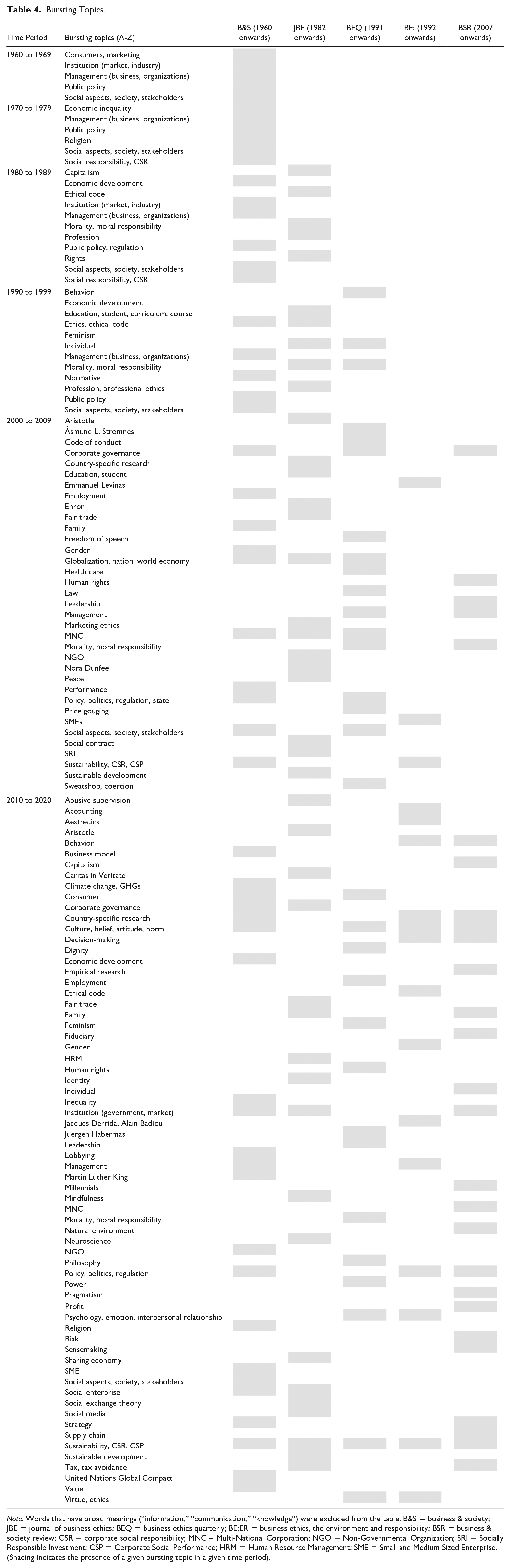
Note. Words that have broad meanings (“information,” “communication,” “knowledge”) were excluded from the table. B&S = business & society; JBE = journal of business ethics; BEQ = business ethics quarterly; BE:ER = business ethics, the environment and responsibility; BSR = business & society review; CSR = corporate social responsibility; MNC = Multi-National Corporation; NGO = Non-Governmental Organization; SRI = Socially Responsible Investment; CSP = Corporate Social Performance; HRM = Human Resource Management; SME = Small and Medium Sized Enterprise.
(Shading indicates the presence of a given bursting topic in a given time period).
The reader will find the discussion in our previous sections reflected in Table 4. As evident from the table, Business & Society faced limited competition until the 1990s and occupied a unique niche that allowed it to attract contributions that were closely aligned with the aims of establishing the journal’s distinctive positioning (1960-1975) and building journal legitimacy (1975-1990). Business & Society’s distinctiveness grew out of early contributions in the journal—including those through letters and commentaries—focused heavily on debating contemporary issues in society in a very tumultuous decade, and reflected critically on the socio-political tensions as well as the changing social, political, and technological landscape at the time, but also debating significant social and cultural issues, ranging from the expansion of mass communication and impacts on consumers to the implications of economic growth (and growing economic equality) to questions around the role of business in modern society. Business & Society’s exclusive focus on the interdependencies between business and society, its theoretical, substantive, and methodological agnosticism, and its intent to be broadly contributed to and read by, are all defining elements of the journal’s distinctiveness. Despite the transformation toward a more orthodox academic journal during the 1980s, the topic focus per se has remained relatively consistent with the early intention of the journal to be situated at the intersection of business and society.
The journal faced increased competition from other publications from the 1980s and 1990s onwards. Initially, topic overlap in publications was limited, as evidence by the distinct focus on topics such as the social responsibilities for which they were limited alternative publication outlets. As also reflected in our analysis above, the journal saw a substantial profusion of diverse research from the mid-2000s onwards, with work starting to focus on a larger number of salient social and environmental issues, with a greater focus on global issues, including the role and impacts of multinational enterprises. In the last decade, in particular, a proliferation of topics occurs, and articles show much greater attention to a larger range of pressing social and environmental issues (including climate change and growing issues around inequality as well as the role of non-governmental organizations in addressing pressing social and environmental issues).
Interestingly, and while editors certainly perceived the increasing competition from other journals, the journal has not shared much topic overlap with other journals throughout its history: topic overlap in periods common to all journals in the analysis is limited to issues such as corporate governance, globalization, and an increasing interest in issues related to sustainability, CSR, and corporate social performance. As such, we conclude that the journal was certainly successful in creating a unique place for its scholarly community; the increasing range of topics also shows the commitment of the journal to examining issues of contemporary significance (which are becoming increasingly diverse and complex). However, a challenge for the journal will certainly be to retain a unique positioning among the growing topic proliferation.
Examining Field Impact
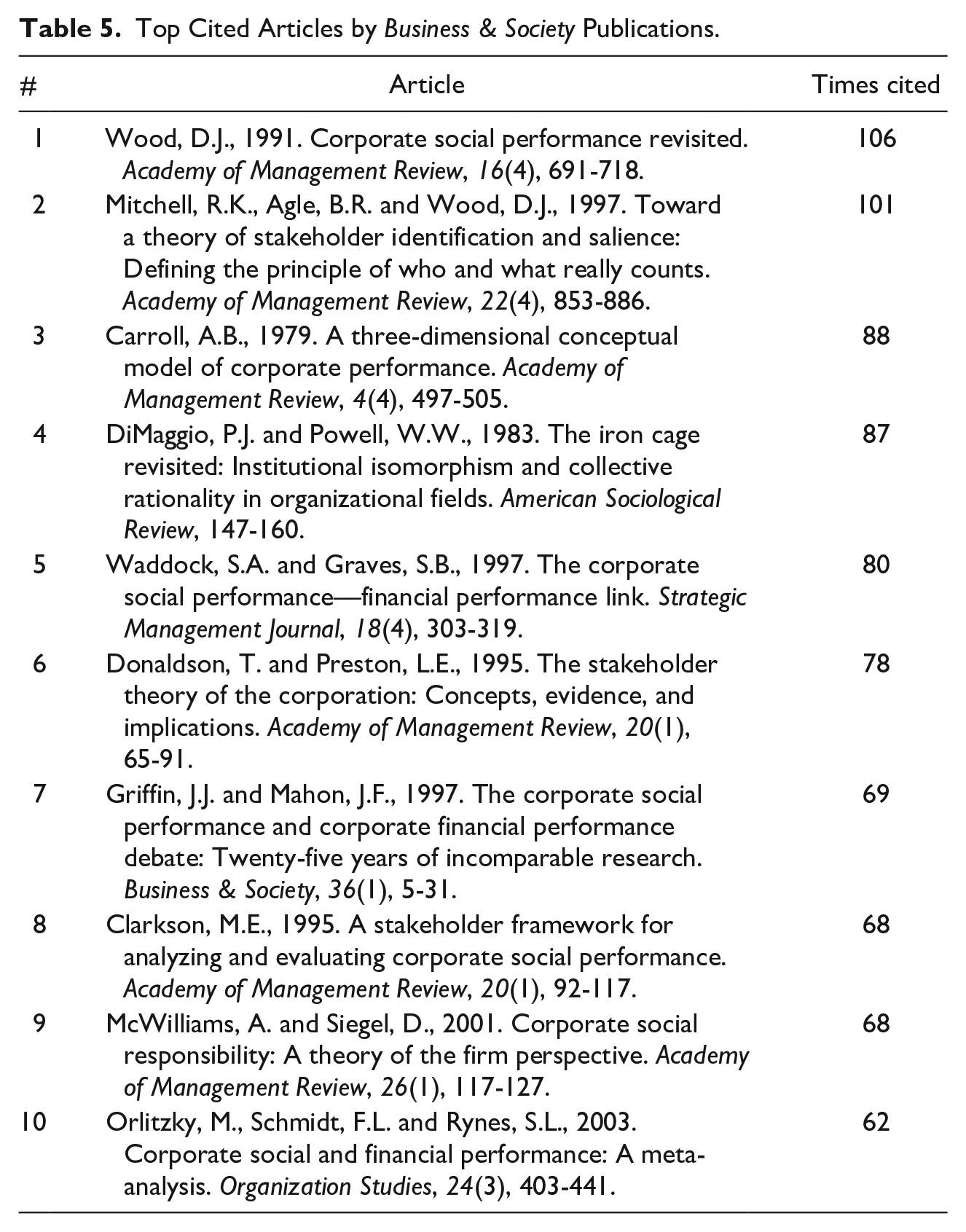
A question that arises is how Business & Society scholarship is linked within the broader academic debate—the question is an inherently difficult one to answer, as it can never be known to what extent the readership of one journal was aware of and/or intellectually engaged with the contributions published in other journals. One (albeit limited) way is to use cross-citation data as a possible proxy measure to examine to what extent scholars in Business & Society have cited contributions in other journals, and vice-versa. Table 3 (above) provides information regarding the top-cited publications within Business & Society. As evident, those include seminal articles on CSR and the relationship of corporate social performance and corporate financial performance (Carroll, 1999; Griffin & Mahon, 1997). Examining the top-cited articles cited by contributions within Business & Society (Table 5), we find a strong citation flow from the top management journals to Business & Society, specifically the Academy of Management Review. To some extent this might be an outcome of the attention toward academic rigor; to some extent, it also demonstrates the journals connectedness to important ongoing debates on the relationship between social and financial performance as well as stakeholder management, which became dominant streams of research across the wider management research landscape (Linnenluecke & Griffiths, 2013).
Top Cited Articles by Business & Society Publications.
Newer measures to identify impact beyond academia have become available in recent years with the arrival of Altmetric (see altmetric.com), which is an attempt to capture how research is integrated into public policy documents, mainstream media, and other outlets, such as social media. Altmetric was founded in 2011 which means that access to historical (non-digital) impact data are limited; however, we can nonetheless identify impactful contributions of Business & Society toward public policy and media debates. Altmetric data as of April 2022 shows that Business & Society articles tracked on Altmetric received over 12,900 social media mentions, 235 mentions in news and blogs, 62 mentions in policy documents, and 16 mentions in sources such as Wikipedia and videos. Examining those articles that have the highest number of Altmetric mentions provides us with some evidence regarding the journal’s broader impact: Top-ranked contributions are van der Kolk’s (2022) article on performance measurement, Griffin et al.’s (2021) article on stakeholder engagement after a exogenous shock, Mitnick’s (2000) article on the metrics of measurement of CSR, Brankovic’s (2021) article on rankings, Scully et al.’s (2018) study on the mobilization of wealthy activists; Grosvold et al.’s (2016) study on women on corporate boards, Caruana et al.’s (2021) article on modern slavery in business, and (perhaps not surprisingly) Carroll’s (1999) article on the construct of CSR, which is also the highest cited article of the journal.
Regarding comparisons of non-academic impact across social issues/business ethics journals, Business & Society (12,888) ranks second to the Journal of Business Ethics (16,441) in total altmetric mentions, and lies considerably ahead of Business Ethics: the Environment and Responsibility (385), Business Ethics Quarterly (1,372), and Business & Society Review (1,419). However, when one controls for differences in the numbers of articles published in each journal, Business & Society has a significantly higher ratio of mentions per paper (25.4) than the other four field journals (JBE—5.79; BE:ER—2.78; BEQ—4.75; BSR—14.48), suggesting that research published in Business & Society is contributing more substantially to broader issues of social importance than other field journals.
Discussion: Mission(s) Accomplished? Where Next?
Overall, our analysis shows that Business & Society has largely achieved its founding mission—certainly, the last 60 years have seen the huge growth and institutionalization of research at the intersection of business and society. We have also shown that the missions that Business & Society has pursued have evolved across time, reflecting shifting concerns to build the legitimacy and credibility of the journal and the wider field responding to evolving external conditions, including the greater acceptance and receptivity to business and society research in general management journals, shifts in the external issue environment, and the growing theoretical and methodological sophistication of academic research. Business & Society’s mission has pivoted continuously over time, both because essential elements of prior mission statements had largely been achieved, and as a reflection of new opportunities and challenges facing both field and journal. Perhaps Business & Society’s principal enduring achievement, reflecting a key goal of academic writing (Carton & Mouricou, 2017), is the creation of a space for business and society research and legitimating both the journal and the wider field through a consistent commitment to exploring issues at the interface between business and society.
In many ways, Business & Society’s journey reflects those of many sub-fields of business and management in that the growing fortunes of the journal and its community have legitimized academic business and society research (Kieser & Leiner, 2009). At the same time, Business & Society has maintained a distinctive positioning of the journal from the outset that and provided a distinctive role for the journal that stands apart from the imperatives to “publish or perish” that have driven many intellectual communities in business and management. Business & Society has largely maintained this distinctively “external” positioning over a long period characterized by significant changes both in the wider societal contexts of business and society, and profound shifts in the academic study of business and management. In part, staying this distinctive course was enabled by clarifying the sub-set of business and society interfaces that would be of particular concern to the nascent business and society field—those concerned with business-government relations, and the social responsibilities of business. Over time, the journal has played (and continues to play) an important role at the leading edge of defining the business and society field through defining and re-defining the scope and boundaries of the field in light of emergent theoretical and empirical imperatives. By being the first journal to exclusively focus on business and society issues, the journal and its community have a credible claim to have played an important role in shaping both the field globally and practice globally. Overall, Business & Society continues to reflect the most relevant contemporary issues at the interface between business and society and remains “external” in its focus on emergent issues and themes that have not yet become of widespread concern in business and management research.
As our analysis shows, Business & Society has certainly played an important role both in generating influential outputs, albeit mostly through the development and legitimation of a field that has, in turn, shaped practice thinking and action. As others have noted (see Daft & Lewin, 2008), it is likely naive to think that policymakers and practitioners read academic research. Nonetheless, through the development of an accepted knowledge-base, journals like Business & Society have undoubtedly helped to increase the salience of a wide range of social issues, firm behaviors, as well as ways of thinking about the roles and responsibilities of businesses and the relative contributions of business and government to addressing social and environmental issues. It is certainly difficult to make direct attributions between academic research and societal impact, but this should not undermine our collective recognition of the achievements made in the last 60 years regarding the influence of both the journal and the field. As the first journal exclusively focused on business and society, the journal should accept its share of the accolades associated with the transformation in policy and practice seen over 60 years. Equally, we should recognize the work still to be done. Overall, Business & Society has contributed to the development of a growing and fertile academic field.
Where Next for Business & Society?
In considering potential futures for Business & Society, we first unpack a central challenge regarding the evolution of the journal before considering what practical steps might be taken to encourage business and society scholarship to address it. Reflecting on our analysis, it is clear that, notwithstanding some ebb and flow, Business & Society has been preoccupied with “business” to a greater extent than “society” in the following two important ways: (a) its principal focus has been on the organization, often the corporate form, rather than the wider contexts—the “society”—that organizations inhabit and (2) its emphasis has been on instrumental, rather than normative or critical, perspectives on the relationships between organizations and wider society. We discuss these points in detail in the following sections.
Regarding (a), the lack of coherent and consistent attention to “society” in Business & Society research is both a puzzle and a significant opportunity. Society has tended to fade into the background of most business and society research, which have either tended to be rather decontextualized as a result or have treated “society” as being synonymous with “issue,” “pressure,” or as “stakeholders.” Most surprisingly, even the growth of institutional accounts of business-society relationships over the last 10 to 15 years has not led to greater theoretical and empirical attention to “society,” and differences in its structure, evolution, and composition in business and society research. We attribute some of this narrowness to a failure to capitalize on the conviction expressed early in Business & Society’s evolution that many of the important issues of the day required expertise and insight beyond that traditionally found in business schools or business practice for their full implications to be understood. In that sense, one might characterize Business & Society’s emphasis as multi-disciplinary in the sense that multiple perspectives shed complementary and useful light on issues.
Certainly, much of the initial content in the journal was authored by non-business academics who sought to share their perspective with business practitioners through writing for the journal. From that point, the emphasis on interdisciplinary voices declined dramatically—business and management research came to dominate business and society research because of its capacity to endow the nascent field with academic rigor and, through this, legitimacy (Carton & Mouricou, 2017; Kieser & Leiner, 2009). While some of the developments in the journal (especially those laying the conceptual foundations of the field), entail some transdisciplinary integration, but, the journal lost its emphasis on interdisciplinarity for the significant majority of its history. Only relatively recently has inter- and multi-disciplinary research begun to strengthen once again in the journal, alongside a concern to contribute to significant large-scale social and environmental challenges that require the insight and tools of multiple disciplines. Overall, despite the greater attention to incorporating theoretical and empirical approaches from other fields in the last 10 years or so, the overall commitment to interdisciplinary explorations of business-society interdependencies has been rather low. We see this as an enormous opportunity to advance an inter- and multi-disciplinary agenda that has, from time to time, been articulated for Business & Society and to continue to claim a distinctive positioning within the now relatively well-established social issues in management/business and society field. Incorporating, and contributing to, knowledge development in sociology, political science, economics, economic geography, and development studies would, we think, equip Business & Society research with new theoretical and empirical insights.
Regarding (b), the emphasis on business and society research with instrumental considerations is well-documented (e.g., Barnett, 2019), but remains problematic from both intellectual and pragmatic standpoints. Business & Society began as a rather radical publication, seeking to challenge prevailing ways of thinking about the scope and nature of issues deserving of management attention. From our contemporary standpoint, it is easy to dismiss the profound novelty of Business & Society’s founding mission. Unfortunately, the journal, and the wider field, did not remain particularly radical for long, perhaps because of a desire to maximize influence and build an audience, perhaps because the militant origins were forgotten in the enthusiasm of building the journal. Nonetheless, successive phases in the development of the journal have strengthened the social scientific and orthodox orientation of the journal, leading to a shift away from its radical roots. While, from time to time, contributions have sought to remind us of those roots (e.g. Jones, 1996), these attempts have not generally been particularly successful in rekindling the flame of foment.
While the diversity of perspectives and issues that have characterized the recent 5 or so years of the journal’s history have encompassed some more critical voices and edgy perspectives, our overall evaluation is that strengthening and rediscovering the critical orientation of the founding mission could offer an opportunity to extend and enrich Business & Society’s agendas and impacts. Intellectually, retaining a dominant, and relatively narrowly construed instrumental conception of the business and society interface misses an opportunity to consider the wider, institutional, institutionalized, and systemic nature of many of the world’s most pressing problems. In turn, pragmatically speaking, decontextualized accounts of social and environmental issues are unlikely to be persuasive or impactful beyond our Business & Society conversation. Increasing the volume of critical and normative voices in Business & Society would help address these concerns. That is not to suggest that Business & Society becomes a critical management studies journal or that the journal abandons its positioning as a business and management journal. Rather, we suggest that both goals could be achieved with subtle shifts in emphasis of the current trajectory of the journal. Being critical connotes increased attention to the taken-for-granted structures and power relations that underpin relationships between business and society and maintaining a skeptical and questioning orientation to the search for theory and empirical evidence regarding the interdependencies between business and society. Interdisciplinarity is in many ways essential to continuing to make significant contributions to theorizing and analyzing the global scale, complex challenges that face contemporary society, and to continuing to ensure that Business & Society remains a relevant and exciting intellectual forum.
Having articulated two key challenges that currently face Business & Society, we move on to consider how they could be addressed in practice. In our view, neither redressing the lack of focus on “society” (with its expansive, interdisciplinary potential) nor strengthening the normative/critical orientation within Business & Society will occur rapidly through organic processes. Having led and encouraged the development of a now mature, sophisticated, and energized sub-field of study, the time is ripe to consider what role Business & Society might play in forging its next steps. Strengthening Business & Society’s engagement with wider societal and business challenges, both intellectually and pragmatically, requires, we think, pro-active attempts to raise the visibility of, and appreciation for, respectively (a) potentially relevant theoretical and empirical approaches in other disciplines, (b) policy and practice perspectives on emerging issues and phenomena and their potential impact on prominent domains of business and society research. Addressing (a) could be encouraged by inviting prominent scholars in wider social science disciplines to collaborate with established business and society researchers to write “interface” articles that lay out research agendas for Business & Society that leverage insights from parallel disciplines and encourage and enable fruitful interdisciplinary dialogues to be opened. Interface articles such as “A contemporary macro-sociological agenda for Business & Society” or “Exploring corporate political activity through the lens of political science” would help open up interdisciplinary frontiers that help promote the reach, distinctiveness, and conceptual diversity of Business & Society research.
Addressing (b), and strengthening the appreciation for how those outside of academia understand business and society issues and domains, will require innovations in how we publish. Establishing brief “policy” or “practice” perspectives will help strengthen the alignment of Business & Society with external issues and trends. As for enhancing interdisciplinary, affording the wider community with deeper insights would provide an enduring source of distinctiveness for Business & Society. Raising the emphasis on these aspects of the founding mission of the journal will require some relaxation of the norms of business and management research—in the ways that research is written up and presented, and in the bar applied regarding contributions. Given the huge change we have witnessed in the forms, styles, content, contexts of research published in Business & Society over six decades, we are confident that these challenges can be overcome.
Progressing practice and policy relevance (Ferlie et al., 2010) and establishing a link between business and “grand societal challenges” (Brammer et al., 2019; Buckley et al., 2017; Ferraro et al., 2015; George et al., 2016) require a greater intellectual diversity and a turn toward issues of societal level importance that Business & Society is particularly well placed to respond to. Addressing the second sense in which Business & Society has traditionally been “more business, less society” can, we feel, largely be achieved within the current publishing paradigm, perhaps with an extension of the journal’s very successful special issues series and through a continued commitment to strong editorial voice and commentary. We sense that there is already a receptivity to more normative and critical perspectives in the Business & Society community and that some relatively modest encouragement to explicitly including a range of perspectives in special issues or topic fora, could pay significant dividends.
Conclusion
Business & Society has led the development of business and society research for six decades, playing a guiding role in creating a space for exclusive attention to business and society issues, and acting as the launchpad for novel theoretical and empirical research. In this article, we have reflected on the achievements of Business & Society in the context of an opportunity to reflect on the achievement of the mission articulated by the journal’s founders six decades ago, as reinterpreted and nuanced by editorial teams since. Our systematic analysis of editorial commentaries, thematic evaluation of contributions to the journal, and use of big data analytics to evaluate the distinctiveness of Business & Society compared to peer journals has allowed us to examine subtle shifts in emphasis in Business & Society’s mission over time, the evolving nature of contributions to the journal, and its distinctive place among peer journals. In many senses, the journal has accomplished the mission set out by its founders, creating an opportunity to reflect on possible new directions. Our analysis suggests that while much of the founding mission of Business & Society has been achieved, there remains important work to do in the arenas of interdisciplinarity and institutional critique. Emphasis on these areas could continue to see Business & Society maintain its position as a premier outlet for business and society research and to attract new generations of contributors and readers.
Footnotes
Declaration of Conflicting Interests
The authors declared no potential conflicts of interest with respect to the research, authorship, and/or publication of this article.
Funding
The authors received no financial support for the research, authorship, and/or publication of this article.
