




Abstract
Although present research shows that ambitious corporate sustainability objectives improve employee engagement in business organizations, there is scarcity of research showing how employees engage in corporate sustainability objectives and become autonomous sustainability thinkers. We suggest that a strong, individual level of psychological ownership of corporate sustainability is a precondition for the development of sustainability thinking, and examine the factors that influence the emergence of such feelings of ownership. Our qualitative study, based on 29 interviews conducted in seven Finnish local business units from three different technology-oriented multinational enterprises (MNEs), shows that several key factors can have contradictory effects, both strengthening and hindering the routes to psychological ownership of corporate sustainability. While these contradictory effects may potentially lead to confusion among employees, our findings may help managers to avoid pitfalls in developing a more sustainability-oriented organizational culture. Moreover, by applying the theory of psychological ownership, our study contributes to the business sustainability research by providing new theoretical opportunities to understand the process of how individuals may become engaged in enhancing business sustainability.
Keywords
Despite the widespread awareness of current social and environmental crises, activities promoting sustainable transformation remain modest (Accenture, 2019; Folke et al., 2019; Sachs et al., 2021). Thus, the need for corporates to seriously address sustainability has become increasingly important. Businesses are expected to meet the needs of their indirect and direct stakeholders, both current and future (Dyllick & Hockerts, 2002), through actions, such as cleaner production, contributions to society, and economic development (Ike et al., 2019). To better respond to these expectations, the majority of multinational enterprises (MNEs)—which are often seen as either the saviors or pariahs of businesses’ social and environmental impacts (Burritt et al., 2020)—have included sustainable development goals (SDGs) in their agendas and integrated financial and sustainability-related non-financial data in their annual reports (KPMG, 2020). However, additional integrated reporting has not necessarily increased businesses’ sustainable behavior (Deegan, 2017; Milne & Gray, 2013; Thomson, 2015). Growth and short-term profit targets continue to dominate, supported by quarterly financial reporting. This inability to consider the long-term value of sustainability is likely to undermine the possibilities for introducing more sustainable business practices (Bansal & DesJardine, 2014; Slawinski et al., 2017).
Previous research has suggested that in order for an MNE to willingly integrate corporate sustainability into the sustainability practices throughout the organization, different levels of formal and informal authority need to be allocated to managers both at headquarters and in the local business units (Arenas & Ayuso, 2016; Burritt et al., 2020; Husted & Allen, 2006). However, Bondy and Starkey (2014) found that, in contrast with the spirit of local responsiveness embedded in sustainability thinking, global–local integrated internationalization strategies tend to mirror headquarters’ global strategies and marginalize local issues. Similarly, Barkemeyer and Figge (2014) used the concept of the “headquartering effect” to refer to developments in which sustainability-related strategic decision-making focuses primarily on MNE headquarters, while the perspectives of local subsidiaries become increasingly restricted over time (see also Ike et al., 2021). As a response to these concerns, Liou and Rao-Nicholson (2021), for example, have suggested that MNEs need to link their subsidiary (local business unit) identities with the United Nations’ (UN) SDGs to integrate unique local perspectives in their sustainability agendas and thus allow for better acknowledgment and consolidation of both parent and local stakeholders’ demands. These studies indicate, that to broaden our understanding of corporate sustainability transitions, there is a need for research that explicitly focuses on how local business units perceive corporate sustainability (see also Burritt et al., 2020; Jamali et al., 2020). For example, adopting a local viewpoint on the implementation of corporate sustainability strategies, Engert and Baumgartner (2016) identified two focal factors, namely employee motivation and internal communication that have been largely ignored in the studies on implementation of corporate sustainability strategies.
Although employees are expected to contribute to the design and practice of corporate sustainability, implementation of sustainability has primarily been studied at the organizational level (Aguinis & Glavas, 2012; Glavas, 2016). Only recent business sustainability research has broadened the agenda by including the individual level into the analyses (Gond et al., 2017), but studies have typically addressed the influence of corporate sustainability objectives on employee outcomes (e.g., employee engagement in business organization and job satisfaction) including related mediators and moderators (Glavas, 2016). Empirical studies focusing on the engagement of employees in corporate sustainability objectives are rare (however, see Hejjas et al., 2019) and little theoretical and conceptual attention has been paid on the processes of how individuals become engaged in corporate sustainability (apart from a few exceptions, such as Bhattacharya, 2019; de Roeck & Maon, 2018) which is critical for designing management implications. To address this gap, we will in this empirical study move beyond the MNE global-level sustainability strategies and, using the theory of psychological ownership, focus on factors that influence the sustainability engagement of individuals within their local business units.
We suggest that to initiate positive change and to enable genuine sustainable development, we need to better understand how people in local business units might contribute to sustainability thinking in the context of MNEs. Inspired by Porter and Derry (2012), we define sustainability thinking within a business organization as sense-making concerning sustainability issues. Sustainability thinking focuses on understanding the needs and benefits of sustainable business and seeks creative solutions for sustainability problems. In short, sustainability thinking is reflecting from a sustainability perspective and with an innovative mind-set upon “what we do?,” “how we do?,” and “why we do?”
We argue that a precondition for the development of sustainability thinking is that individuals can feel corporate sustainability as their own. Therefore, to examine how individuals in local business units can become more engaged in sustainability issues and, consequently, develop their own sustainability thinking, we adopt the theoretical discussion of psychological ownership. Psychological ownership refers to the state in which individuals feel as though the target, whether material or immaterial, or a piece of it is “theirs” (Pierce et al., 2001, p. 299). This theory has been widely utilized in management research focusing on both organization-based and job-based settings (Dawkins et al., 2017). It has been used to study, for example, workplace motives, attitudes, behaviors (Liu et al., 2012; Pierce et al., 2009; Van Dyne & Pierce, 2004), leadership styles (Avey et al., 2012; Park et al., 2013), and the provision of manager and employee autonomy (Henssen et al., 2014). Even though the psychological ownership construct can be easily linked to sustainability, the theory has been largely overlooked by sustainability researchers. Only recently have Bhattacharya (2019) and Süssenbach and Kamleitner (2018) conceptually linked psychological ownership to the field of sustainability, and there are few empirical studies (however, see the quantitative study by Chang et al., 2020). Accordingly, we ask:
What factors strengthen or hinder the development of psychological ownership of corporate sustainability at the individual level in local business units in an MNE context?
Our study contributes to business sustainability research by providing the theoretical view of psychological ownership which helps to understand the process of how individuals in local business units can become more engaged in corporate sustainability and, consequently, develop their own sustainability thinking. The present study also responds to the call to broaden the scope of theories utilized in business sustainability research, especially at the individual level (Aguinis & Glavas, 2012; Frynas & Yamahaki, 2016). Our study further demonstrates the contradictory elements in the factors that impact the emergence of psychological ownership of corporate sustainability. From a managerial standpoint, our study also identifies how the routes to psychological ownership can be cultivated to support the sustainability transition of local business units.
Our article is structured as follows. We first introduce the theory of psychological ownership and establish its link to the emergence of sustainability thinking. Second, we describe our procedures for the identifying and coding of the data. Third, in the findings, we describe the factors and link them to the routes of psychological ownership. Finally, in the discussion, we elaborate the theoretical contributions and practical implications of our findings.
Psychological Ownership as a Precondition for Sustainability Thinking
In the corporate context, sustainability is often referred to as a company’s continuing commitment to integrate ecological, social, and economic concerns into its business operations and its interactions with stakeholders (Hahn et al., 2014; Schaltegger et al., 2016; van Marrewijk, 2003). Hence, corporate sustainability criteria are only met when the entire company is organized in a sustainable manner (Meuer et al., 2020). Following the integrative view, corporates need to accept and embrace the tensions inherent in corporate sustainability and acknowledge the need to combine different desirable but seemingly incompatible sustainability aspects without emphasizing one aspect over others (Hahn et al., 2015). The challenge for corporates is to understand how sustainability is socially constructed in a specific context and how to take this into account when business strategies and operations are developed (Dahlsrud, 2008) and communicated (Winkler et al., 2020).
To become embedded in an organization, sustainability needs to be included in the organization’s strategy and be part of its daily routines and operations (Glavas, 2016). In this setting, organizational psychology research provides the required bridging element to complement the macro-orientation with micro viewpoints (Aguinis et al., 2011; Glavas, 2016). Psychological ownership theory provides a promising and well-structured framework through which the transition of business practices toward sustainability can be described and understood in an organizational context. Furthermore, it offers a practical management approach to engage individuals in the development of sustainability thinking, and consequently, enhance the sustainability of all business activities.
The Theory of Psychological Ownership
The core of psychological ownership entails a feeling of possessiveness and a sense of being psychologically tied to an object (Pierce et al., 2001, p. 299). Conceptually, Pierce et al. (2001, 2003) defined psychological ownership as the state in which individuals feel as though the target of ownership or a piece of that target is “theirs” (i.e., “It is mine!”). They also argued that psychological ownership incorporates both affective and cognitive elements. As expressed by Etzioni (1991, p. 466), ownership is a “dual creation, part attitude, part object, part in the mind, part real.” Psychological ownership differs notably from legal ownership, even if they are possibly related (Pierce et al., 2003). While legal ownership is typically recognized by others and sustained by the legal system, psychological ownership is acknowledged principally by the individuals having a feeling of ownership. Although often connected to person–object relations, feelings of ownership can also be directed toward other people or immaterial objects, such as ideas, words, artistic creations (Pierce et al., 2003), groups, organizations, work, and jobs (Van Dyne & Pierce, 2004).
Pierce et al. (2001, 2003) suggested three fundamental human motives as the primary cause of psychological ownership: (a) efficacy and effectance, (b) self-identity, and (c) a sense of place (belongingness). Efficacy as a motive reflects the basic human need to feel capable in a given domain (Bandura, 1977). The desire to experience causal efficacy, that is, to shape and control the environment, generates attempts to take possession and leads to the emergence of ownership feelings (Pierce et al., 2003). Self-identity as a motive is about how we define ourselves. Individuals establish, maintain, and transform their sense of identity through interactions with possessions and by reflecting upon their meaning (Dittmar, 1992). The feeling of ownership creates a bond between an object and a person. Because of this bond, everything that affects the object also to some extent affects the owner (Kamleitner, 2014). Sense of place (belonging) has been considered a central human need and has been linked to feelings of ownership by a number of scholars (Duncan, 1981; Pierce et al., 2001, 2003; Porteous, 1976). Feelings of psychological ownership originate from an object becoming a “home” or an individual’s own place (Pierce et al., 2001). In an organizational context, belongingness in terms of psychological ownership relates to being a member of a group or an organization, in which one’s social and socio-emotional needs are met (Avey et al., 2009).
Pierce et al. (2001) identified three major routes through which psychological ownership emerges: (a) having control over the object, (b) developing deep knowledge of the object, and (c) investing the self in the object. The three routes to psychological ownership (as with the motives for psychological ownership) are distinct, complementary, and additive in nature (Pierce et al., 2003). Thus, any single route can result in a sense of ownership independent of the others, although multiple routes are likely to strengthen the feeling of ownership. In addition, the emergence of psychological ownership is likely to be a lengthy and dynamic process (Pierce et al., 2003).
The ability to control something most often leads to feelings of ownership toward it. The more control and power individuals exercise over an object, the more they view it as an extension of themselves (Furby, 1978). The existence of control requires a degree of freedom or autonomy in relation to and in interaction with the object (Pierce et al., 2009). One aspect of control relates to the effects of participating in decision-making. While people are likely to embrace psychological ownership of decisions that they have been part of, (e.g., in relation to corporate sustainability), the decisions become “their decisions,” and they feel that they are “the cause” (Jussila et al., 2015). When individuals associate themselves with a particular object, and develop deep knowledge, feelings of ownership arise (Pierce et al., 2001). Furthermore, “the more information and better knowledge an individual has about the object, the deeper the relationship is between self and the object, and hence, the stronger the feeling of ownership is toward it” (Pierce et al., 2001, p. 301). It can be assumed that MNEs would provide local business units’ information related to, for example, their sustainability goals. While information alone may not be sufficient to create a sense of ownership, the intensity of the association influences the outcome (Pierce et al., 2001). A longer, wide-ranging association with corporate sustainability is likely to lead to a perception of deeper understanding of it and, as a result, to a sense of ownership of corporate sustainability. The investment of the self into an object allows individuals to see themselves reflected in the object and to feel that its existence is in part due to their efforts (Pierce et al., 2003, p. 93). Hence, the more time, effort, skills, and attention individuals devote to sustainability issues in their work, the stronger their sense of ownership of corporate sustainability.
A feeling of psychological ownership is typically connected to positive outcomes, for example, to enhanced self-esteem, an increased sense of responsibility, and citizenship behaviors with respect to the object (Pierce et al., 2003; Van Dyne & Pierce, 2004). However, it should be noted that under certain circumstances, a sense of ownership can also have potentially detrimental outcomes, such as harmful behavior caused by an individual’s unwillingness to share the object or because of a need to retain exclusive control over it (Pierce et al., 2003; Wang et al., 2019). Moreover, the feeling of responsibility may grow to become a crushing burden (Pierce et al., 2003).
Interplay Between Sustainability Thinking and Psychological Ownership
Bhattacharya (2019) recognized that the characteristics of sustainability make it a prime candidate for feelings of psychological ownership. He argued that sustainability provides people with opportunities to fulfill the three motives outlined by Pierce and colleagues: individuals can contribute to meaningful solutions with measurable effects, express personal values and identities through work, and to be part of something larger. The vast scope of the world’s environmental and social problems may leave people with a feeling that they are ineffectual and unable to have an impact. However, taking ownership of sustainability can potentially induce positive actions and proactive attempts to shape the environment; that is, people are more likely to create solutions for sustainability problems (Bhattacharya, 2019).
Building on the routes to psychological ownership and translated into the context of sustainability, this notion implies that any perceived increase in control over actions that positively impact sustainability, any perceived increase in knowledge about sustainability issues and their related impacts, and any personal investment people make in improving sustainability may lead to an increased sense of ownership of sustainability. Consequently, in this study, we examine how sustainability thinking can be embedded in the MNE context by identifying the factors that influence the individual ownership of corporate sustainability in local business units through the different routes to psychological ownership (Figure 1).
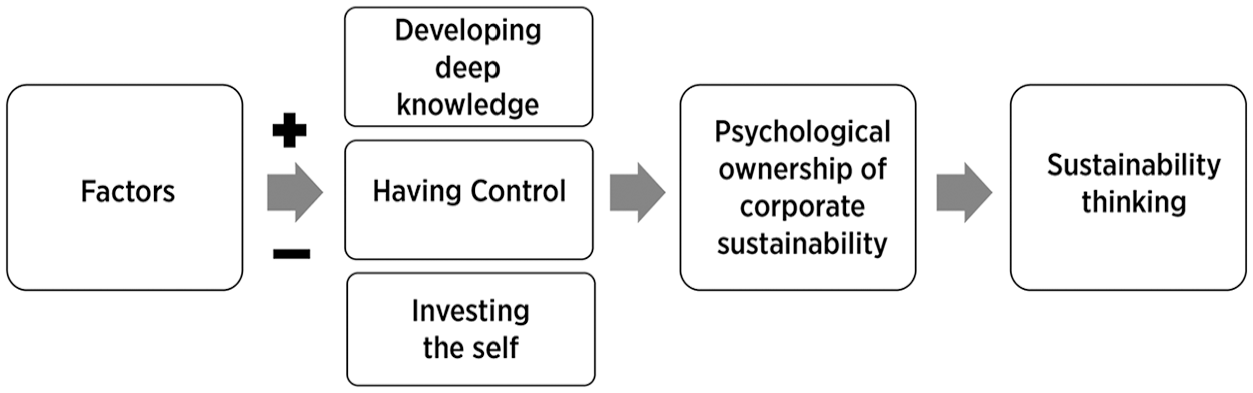
The process of the development of sustainability thinking through psychological ownership.
Research Methodology
We adopted an interpretative research approach (Patton, 2002) to study the psychological ownership of corporate sustainability. Even though the theory of psychological ownership provided a guiding framework, we did not aim to test the theoretical concepts of psychological ownership; instead, we employed a more abductive approach to the analytical process. Accordingly, our analysis is based on the iterative dialogue between the empirical data and the existing theory (Timmermans & Tavory, 2012; Van Maanen et al., 2007).
Research Data
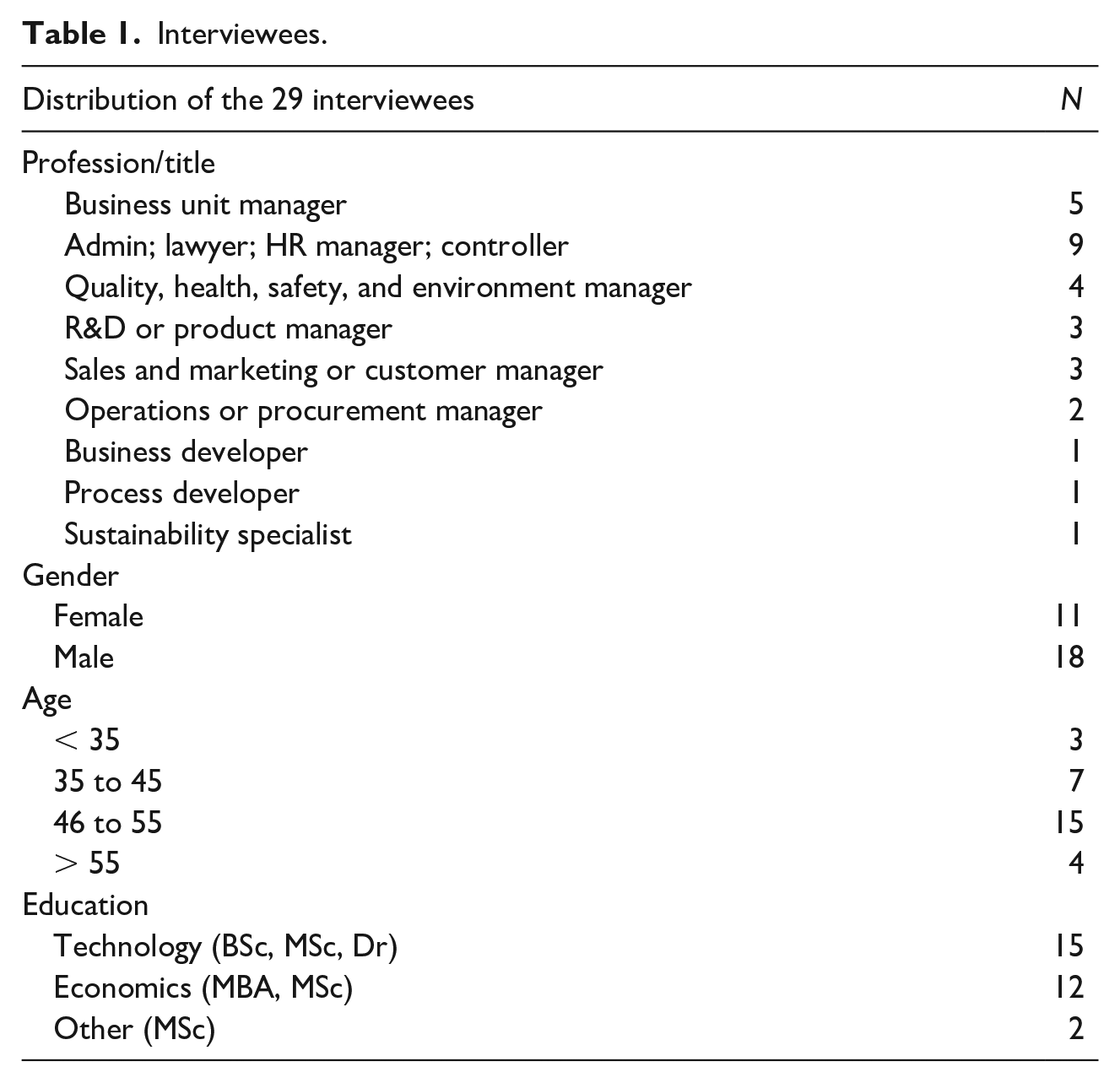
The data consist of 29 semi-structured interviews. The selection of the interviewees was based on the purposive sampling method (Patton, 2002) using criteria in two steps. First, all the interviewees worked in Finnish local business units of MNEs that operate within the technology industry and serve the energy and transport sector. By setting the first step criteria, we wanted to ensure a certain contextual congruence in our data. Thus, common for all the companies was that they can be regarded as generally responsive within the context of sustainability; they aim to find new solutions to enable further sustainable development and are included in focal sustainable development indices. They all report their sustainable development in accordance with the Global Reporting Initiative Standards that are aligned with the UN’s SDGs. Furthermore, in Finland, as one of the Nordic welfare states, the governmental attitudes toward sustainable development are frequently positive and social awareness (and pressure) is rapidly increasing (Sachs et al., 2021). Therefore, it is reasonable to suggest that while enhancing sustainable development at the societal level, the relevant cultural aspects also reinforce sustainability thinking in the chosen local business units (Marano & Kostova, 2016). As a result, the present study was conducted in seven local Finnish business units that are part of three different MNEs. Second, the interviewees represented different managerial positions within the local business units (Table 1). By setting the second step criterion, we wanted to capture a wide range of perspectives relating to sustainability thinking at the managerial level. Thus, while all the interviewees were working in technology industry, we still aimed for variation and multiple insights.
Interviewees.
We adopted these criteria to ensure informative but still manageable data. While the aim of this study was to gain a deeper understanding of the phenomenon and not to make sample-to-population generalizations (Englander, 2012), the set of interviewees was assessed through the credibility of the empirical qualitative data rather than representativeness (Englander, 2012; Kvale & Brinkmann, 2009 p. 113). Furthermore, to obtain an overview of each company’s initiatives regarding their sustainability activities, the sustainability reports for 2019, the websites of the MNEs and, presentation material of the local business units were used as information sources.
Two pilot interviews were conducted in June 2020, and the subsequent interviews were carried out between August and December 2020. The original intention was to conduct live face-to-face interviews, but because of the COVID-19 pandemic, only six of the interviews were done face-to-face and the remaining interviews were completed via an online video connection using Zoom. The interviewees were conducted in either Finnish or English and varied in length, ranging between 1 and 2 hours, with an average time of 1 hour and 15 minutes. With the interviewees’ permission, all but one of the interviews were recorded and transcribed verbatim. With regards to the exception, written notes were taken because of a technical malfunction during the recording of the interview.
At the start of each interview, the interviewee was shown a picture of the UN SDG map to stimulate the conversation and to provide a common framework for the different aspects of sustainability. The interviews covered the following themes: the sustainability aspects present in the operations of the local business unit; the role of sustainability perspectives in the interviewee’s own work and their own ability to promote sustainability; the perceived MNE global-level involvement; the enabling versus the hindering factors in improving sustainability; the methods for managing a sustainability transition; the consideration of sustainability aspects in private life versus work; the expectations regarding the local business unit’s citizenship behavior; the knowhow related to sustainability; the cooperation between functions; and the reporting and measuring of sustainability issues. These topics were openly discussed from the viewpoint of the interviewees’ experiences and expectations. This approach allowed for rather flexible conversations to take place while still ensuring that all the interview themes and key issues were discussed with every interviewee (Legard et al., 2003).
Data Analysis
The interviews were analyzed following the established procedures for qualitative content analysis with three interlinking phases (Miles & Huberman, 1994). During the first phase, all of the interviews were carefully read, and open coding of the empirical material was initiated to condense the data. We searched for the factors influencing corporate sustainability in a local business unit context by paying particular attention to how individuals perceived corporate sustainability and the ways in which it is communicated, how they described their own roles in regard to the corporate sustainability issues, and how they viewed the general sustainability-related trends. We then examined the coded text instances and grouped the codes into larger categories based on their content. Accordingly, we distinguished three different key categories based on the characteristics of the factors: (a) the complexity of sustainability (object related), (b) organizational culture and operations (internal related), and (c) views on stakeholder influence (external related). We then revisited our theoretical framework and analyzed each factor with regard to enablers and hinderers of the routes to psychological ownership of corporate sustainability.
To ensure the quality of the results and the credibility of the research, we, the two authors, analyzed and interpreted the data through close collaboration and iterative discussions (Patton, 2002). The first author has extensive work experience in MNEs, which supported the analysis and interpretation. The analytical process was facilitated by the Atlas.ti 9 Mac software. A number of interview citations are presented in the “Findings” section to increase the transparency of the data analysis and to facilitate the reader’s evaluation of our interpretations.
Findings
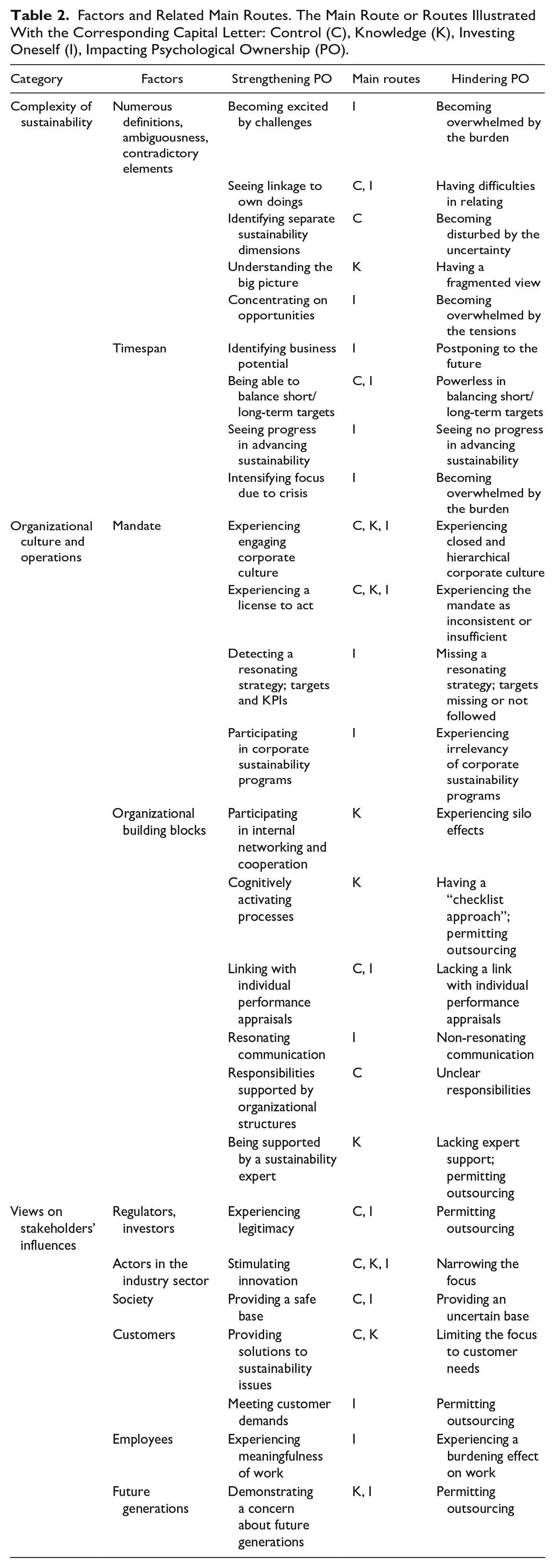
In this section, we introduce in more detail the three identified key categories: (a) the complexity of sustainability, (b) organizational culture and operations, and (c) views on stakeholder influence. More specifically, in each category we present the factors influencing the three routes to psychological ownership of corporate sustainability at the individual level. In addition, we discuss their contradictory nature; the factors that may simultaneously strengthen and hinder the routes to psychological ownership. In the end of this section, Table 2 summarizes the factors and their links to the various routes to the psychological ownership of corporate sustainability.
Factors and Related Main Routes. The Main Route or Routes Illustrated With the Corresponding Capital Letter: Control (C), Knowledge (K), Investing Oneself (I), Impacting Psychological Ownership (PO).
Inspired by or Lost in the Complexity of Sustainability
Every interviewee highlighted the complexity of sustainability. Previous studies (Brown et al., 2014) have noted that complexity increases psychological ownership. Our findings support this statement partly, while many interviewees saw solving the “wicked problems” related to corporate sustainability as stimulating. One of the interviewees (26) summarized this position by saying that for him, the ambiguousness of sustainability represents “absolutely an interesting challenge, full of opportunities.” Many interviewees found business potential in advancing sustainability as a driving force that provides numerous opportunities, such as cost savings, brand enhancement, improved competitiveness, and risk mitigation. If they can concentrate on such opportunities, striving for sustainability can be empowering, intensifying the route of investing the self. Moreover, the ambiguousness of sustainability may stimulate need to understand the big picture, that is, how everything is linked to sustainability. If materialized, the desire to deepen and broaden one’s knowledge of sustainability will strengthen the development of psychological ownership of corporate sustainability.
. . . the point when you realize that I don’t really know about this, it triggers the desire for knowledge and the need to broaden the understanding. (Interview 9)
However, in contrast to previous research, our findings indicate that the complexity of an object can also be detrimental to feelings of ownership. Many interviewees mentioned that the broad nature of sustainability and its numerous definitions can cause difficulty in determining the role of a business in advancing sustainability. Some interviewees were unsettled by the complexity, as they identified that it could lead to potential misjudgments and false conclusions when the underlying facts and causalities proved difficult to control.
The matter [sustainability] is somehow so broad that you can count in so many things—or count out [. . .] This involves a great risk, and who ensures that the calculations are properly done? (Interview 2)
The interviewees also perceived inherent contradictions in reconciling economic, environmental, and social sustainability demands, thus adding to the perception of complexity. Operating in unsustainable markets or the expectations of constant growth were given as examples of somewhat incompatible and paradoxical elements encountered when organizations strive for sustainability. Experiencing ambiguousness alongside contradictory elements may weaken the development of psychological ownership for corporate sustainability, as it negatively impacts all three routes to psychological ownership. In other words, corporate sustainability may be perceived as too difficult to control, too fragmented to develop deep knowledge, or too ambiguousness to invest the self.
The interviewees shared the need to find ways to deal with the complexity. While most perceived an understanding of the whole as essential, they also held important to cut the “elephant” into smaller pieces, it is, identifying the separate dimensions of sustainability. Thus, many noted that it would be advantageous to focus on areas of sustainability in which the local business unit could make a difference or exercise sufficient control. For example, the interviewees mentioned their limited opportunities to recognize and/or influence issues related to sustainability because global operations often involve lengthy value chains with suppliers and customers who operate in distant and diverse environments. To decrease their sense of powerlessness and gain a degree of control, they regarded it as necessary to limit their focus to the closest partners in the chain and to rely on them to take further responsibility. Considering the development of psychological ownership, such a focused sphere of influence would typically bolster the route of control.
While many noted that even small actions or innovations contribute to the effort to enhance sustainability, the interviewees also identified the importance of explicitly linking actions or innovations to their own work.
Certainly, the understanding will then [when linked] materialize on the individual level as well, so that it is not only haze and hype. (Interview 4)
The interviewees emphasized that taking part in sustainability efforts through, for example, piloting and benchmarking serve as powerful ways to actualize sustainability for individuals. Participation provides an opportunity to share knowledge and invest both time and expertise (i.e., investing the self in corporate sustainability). Thus, concreteness and linkage enable the individuals to understand their own role and impact in the sustainability transition.
Based on the interviewees’ accounts, the time span can be a difficult factor that adds to the tensions and complexity of corporate sustainability. Some interviewees saw the business potential of sustainability as being too far in the future. This view of a remote future demonstrated a diminishing interest in the sustainability agenda, which in turn may prevent the activation of the route of investing the self. Furthermore, the interviewees broadly recognized that individuals tend to spend their time on operative tasks and issues that are current or focused on the very near future; in contrast sustainability-related actions typically require perseverance and long-term solutions.
But then for issues needing more long-range development, which typically also applies to these sustainability issues, there is not always enough time [. . .] the interpretation of what this [sustainability] means for us needs more thought and time. (Interview 5)
Short-term thinking is supported by the quartile economic expectations, which leads to the perception of a potential contradiction between sustainability aims and short-term profit targets. However, many interviewees acknowledged this as a given fact, viewing it more as a boundary condition that must be taken into consideration rather than an excuse for compromise. They wanted to view both profit and sustainability as imperative, and they typically felt that they had the power and means within the current framework to prioritize and balance their actions. Consequently, despite the potential contradictions, the routes of control and investing the self may be activated and thus strengthen the development of psychological ownership of corporate sustainability.
The interviewees experienced the progress of the sustainability transition thus far as slow, which they feared will undermine positive attitudes toward it. This fear was acknowledged, for example, by one of the interviewees (17), who identified in the sustainability transition a “lot of high-flown speeches and even greenwashing.” This type of distrust may potentially decrease the willingness of individuals to invest themselves in sustainability-related matters, even if they consider such matters important. On the other hand, the interviewees were certain that the sustainability transition would become more urgent in the future. While the speed of the transition was questioned, a form of crisis was considered as an effective means of stimulating sustainability-related thinking.
The most powerful driver is always a crisis. If a crisis raises the matter, it is quite clear. (Interview 5)
A sustainability-related crisis would likely intensify the focus on corporate sustainability and justify the time and skills spent on the issue. Accordingly, a crisis may favor the development of psychological ownership of corporate sustainability through the route of investing the self, provided it does not provoke a sense of overwhelming burden.
Having a Mandate and the Means to Engage
An MNE’s different global organizational levels and functions, hereinafter referred to as corporate, were seen to have a significant impact on grounding sustainability in the local business units. The interviewees highlighted the significance of an organizational culture that acknowledges corporate sustainability. They mentioned that an open and transparent culture encourages employees to discuss and participate in sustainability efforts. Furthermore, they recognized that sustainability needs to be embedded in the overall organizational culture in order for it to be present in all business activities. Embeddedness signals a strong mandate from corporate to act on behalf of sustainability; a clear corporate directive to advance sustainability provides an important foundation for further routes to psychological ownership in the local business units. Such mandates increase the ability of employees to take charge, have an influence, and invest their time and efforts. The interviewees typically felt that corporate had provided them a general mandate to drive the sustainability transition.
We have a mandate. In principle we are given only the sandbox, where we play and are allowed to—more and more—to take charge. [. . .] Or the focus areas are maybe directed, but then we are allowed to decide on how we reach the best result. (Interview 13)
The interviewees emphasized the importance of corporate strategy and its communication in further defining the corporate mandate through prioritization of the sustainability standards and targets. They described sustainability-related key performance indicators (KPIs) as clear and supportive signals of corporate’s interests and commitment of sustainability and, accordingly, as a central tool for directing focus and giving license to act. KPIs were considered an instrument that could be utilized to bring people together and initiate sustainability discussions; they also help employees recognize the impact of their own actions from a sustainability perspective. Thus, KPIs can support a willingness to invest oneself in corporate sustainability. Similarly, the interviewees mentioned corporate-driven social sustainability programs, which were often related to health and safety, diversity, wellbeing, or integrity, as a significant means to engage local business units in corporate sustainability. While the social aspects of sustainability had largely been embedded in the local business units by the corporate-driven programs, the interviewees clearly regarded the programs as their own, indicating awakened psychological ownership.
I see that in a global enterprise, these kinds of issues are included in the way of thinking and into all these programs. That provides us a higher standard than what is possible in small local firms. And as it is our global standard, it is also our local standard. (Interview 20)
However, the interviewees expressed mixed feelings when discussing the strength of the corporate mandate, which may suppress the development of psychological ownership of corporate sustainability. The interviewees noted that the sustainability-related information provided by corporate was rather fragmented and did not necessarily materialize at the local level. Restrictive interference with resourcing, a lack of emphasis on sustainability in budgeting, and complex, hierarchal decision-making processes were provided as examples of issues that undermined the corporate mandate and, accordingly, hindered the willingness to invest the self. Moreover, the interviewees felt that organizational complexity led to the uncoordinated dissemination of sustainability-related information via multiple streams, leaving only a limited overview and a vague links to the local business unit’s operations.
. . . at a corporate level, this is often like declarations—we do this, aim at this and that [. . .] but in our world, the concrete doing takes place in the units. (Interview 17)
Inconsistent corporate messages and engagement emerged in the discussions as disruptive phenomena. The interviewees mentioned the dominance of finance-related KPIs, which appeared to undermine the importance of sustainability. Accordingly, some identified the risk of sustainability-related targets being out of phase with other targets. For instance, even though corporate reportedly valued the sustainability transition and set sustainability-related targets and KPIs, sustainability-related issues other than health and safety were rarely discussed in operative business reviews or target-setting meetings. Similarly, potential local sustainability-related KPIs were seldom followed-up or jointly discussed. The interviewees felt that the weight of these KPIs prevented sustainability from being fully integrated into the operative levels.
Clearly, there are evident contradictions. On the one hand, there are speeches about more soft values and good things. However, in the project review only the euros matter. No one is interested in any explanations about greener choices or something. (Interview 26)
The experienced inconsistency in the corporate messages and engagement may hinder the development of psychological ownership of corporate sustainability, as it leads to mistrust and reduces any inclinations to invest oneself in the issues.
While the mandate to act was considered as a precondition to the level of focus allocated to sustainability, the interviewees recognized additional concrete organizational building blocks for advancing sustainability. Incorporating sustainability aspects and considerations into operative processes (both local and global) was seen as a powerful means to support a sustainability transition. From the perspective of psychological ownership development, well-planned processes can emphasize the importance of sustainability and encourage individuals to broaden their sustainability-related knowledge. On the other hand, some processes, such as those with built-in checklists, may give the illusion that sustainability aspects have been considered. In such cases, the processes do not necessarily drive the acquisition of deeper knowledge of sustainability; instead, they merely suggest a straightforward way to act appropriately.
These matters do not proceed, and that is the problem, if they are set aside or at some upper level. How would that get down to the work? But it is part of the integrated business planning process, and when we are in the offering review, together, looking each other into the eye, and we say that let’s do it this way, the engagement in the doing will evolve. (Interview 17)
Moreover, as acknowledged in the previous sub-section, the link between corporate sustainability and an individual’s work tasks needs to be internalized to activate the routes of control and investing the self. Many interviewees considered the integration of sustainability indicators into employee performance appraisals as a beneficial means to create such a linkage. In addition, the interviewees emphasized the importance of corporate encouraging networking and collaboration between different units, functions, and experts. These corporate initiatives were seen to provide opportunities for knowledge sharing that could develop competence in sustainability thinking and thus enhance the route of developing deep knowledge.
The need for constant formal and informal communication via different forums at the local business unit level was addressed by the participants as an important but difficult means to advance the sustainability transition due to a great variety among individuals. To make it easier to relate to sustainability, the visibility of progress through localized KPIs, notable success stories, and concrete examples was perceived as useful. Resonating communication was described as reinforcing the identification of their own efforts in the progress toward sustainability, which is likely to strengthen the route of investing the self.
For our whole community, for ourselves, but especially for our personnel, subcontractors, and so forth [. . .] telling the story of our actions [. . .] what follows from our work [. . .] and through that finding a purpose for the work that is related to saving the world . . . (Interview 3)
Most interviewees viewed sustainability as a common topic that cannot be delegated to a single function or person. However, they also recognized the need to have a sustainability-supportive organizational structure at the local business unit level. While a well-established organizational structure helps to define responsibilities, clarify the division of labor, and cement actions, it simultaneously catalyzes the route of control at the individual level. Furthermore, many interviewees identified an advantage in having a “sustainability owner,” someone who understands the overall concept of sustainability and coordinates the related organizational program. For example, such an owner can support functions, coordinate collaboration, ensure an open and visible information flow, and help individuals in finding linkages and developing deeper understanding of sustainability. However, some interviewees saw sustainability knowledge as a skill maintained by few experts. Thus, employing a key sustainability person would seemingly strengthen the route of developing deep knowledge but also trigger a tendency to outsource ownership to the experts.
Occasionally, it feels that if someone in sales or product management gets a question related to these issues, they just quickly slip the mail forward. . . (Interview 12)
Stakeholders—Insourcing vs. Outsourcing Sustainability Thinking
Interviewees interpreted current public opinions and debates, EU economic stimulus plans, and the interests of investors as clear signals of the increasing role of sustainability-defining business, and providing legitimacy for a sustainability focus. This sense of legitimacy supports the development of psychological ownership, as it justifies investing the self in the relevant issues. Many interviewees noted that sustainability-related regulations, including national and international laws and standards set by, for example, the EU or the technology industry, constitute a significant external factor impacting the corporate sustainability transition. Most identified increasing regulations as an essential tool to successfully manage the complexity of sustainability, as it does not appear to be controlled by the market economy. Regulations support the development of psychological ownership in individuals by directing sustainability thinking, by guiding the interpretation of sustainability, and by controlling and making concrete the expected actions.
In my opinion, it [sustainability] is best forwarded by standards or de facto established practices. If you by yourself start to control different things, you will, as noted, get too many players and too many details. (Interview 3)
The interviewees’ discussions, however, also included indications that the primary purpose of regulations is not necessarily linked to advancing sustainability. Instead, the regulations may be evaluated from a marketing point of view, with a focus on how they impact competitiveness. Without visible linkages, regulations cannot directly strengthen psychological ownership of corporate sustainability. Moreover, regulations seem to have an outsourcing effect, as regulators were expected to take the responsibility for advancing the sustainability transition.
It is beneficial, with [standards] it will turn. I do not think we would be smart enough to think [ourselves]. (Interview 18)
The interviewees all acknowledged that because of the inherent commercial basis of business operations, the sustainability transition needs to be linked to the business and its actions. They frequently addressed the significance of their own business sector, the technological industry, in providing solutions to sustainability-related problems. The interviewees described their industry directing attention toward sustainability issues, and they explained that sustainability aspects are considered and actively discussed. This generated a feeling of participation in a larger operation and a sense of pride in their involvement.
We are participating in that business. During this last year, there have been ongoing big discussions on revolutionary solutions. The whole market round the world is discussing [this]. (Interview 26)
According to the interviewees, actors in the technology industry typically invest time and resources in advancing research and innovative thinking. When aimed at sustainability-related solutions, technology industry operations seem to offer a natural foundation for strengthening all three of the routes to psychological ownership of corporate sustainability: having control, developing deep knowledge, and investing the self. The more time, effort, and energy individuals may spend on corporate sustainability in their work, the stronger becomes their sense of ownership. On the other hand, some interviews indicated that the technology-oriented mind-set may also limit the development of psychological ownership, as a strong focus on the technology behind the solutions may prevent an overall understanding of sustainability and its links to one’s own business operations and doings.
Analogous with the technological industry, many interviewees suggested that Finnish society, and by extension Nordic society, also supports the sustainability transition. They viewed the Nordic countries as especially progressive in social matters, such as equality and access to education. Many interviewees regarded these social matters as fundamental and deeply internalized by individuals in the local business units, thus they provide a feeling of control and a safe base to further engage (i.e., invest the self). However, some interviewees also noted that participation in global business requires a good understanding of the varying circumstances around the world.
Most of the interviewees noted that customer demand for sustainability represents the most significant external pressures on businesses. Customer demand is easily relatable and makes the transition to greater sustainability more acceptable and understandable; that is, customer demand legitimizes investing the self in sustainability.
I feel that the pressure should come, and it is best when it comes, from the customer. In other words, it gets a higher priority when it comes from the customer. (Interview 27)
At its best, innovative thinking, such as seeking solutions and new opportunities for the business, stimulates all the routes to psychological ownership. For example, solving a customer’s sustainability-related problem will likely lead to a search for new knowledge and an increased familiarity with different sustainability aspects. Simultaneously, the impact of one’s own efforts becomes more tangible. However, an eagerness to do business by solving customers’ sustainability problems may narrow the perspective, leaving, for example, less attention on the sustainability aspects of the own operations. Hence, the necessary broad-mindedness and deeper understanding of sustainability may not develop. This point also emerged in the discussions addressing the expectation that customers should be the initiators of sustainability-related issues, thus placing the responsibility for the sustainability transition on their shoulders.
It should not be the trigger that we wait until a large enough number of customers ask for it [. . .] we should at once start to drive the topic. (Interview 13)
The interviewees typically believed that advancing the sustainability transition increases employees’ sense of meaningful work, indicating that it can support individuals’ need to express their personal values and identities through work, and to be part of a larger initiative. However, if their relationship to corporate sustainability remains remote, it may have a burdening effect on work. Moreover, possible generational differences were mentioned in interviewees’ narratives concerning employees. Whereas, some interviewees stated that the interest in sustainability issues is significantly stronger among the younger generations, others considered such an argument reflecting stereotypical thinking. However, most acknowledged that the younger generations have been more aggressively exposed to sustainability issues, for example, in school and through the media, than is the case with the older generations. While the younger generations were strongly viewed as future employees, among the older employees they triggered a need to understand new and varying perspectives and needs. Consequently, older employees must devote more time and attention to sustainability issues in their work, which most likely strengthens the routes of investing the self and developing deep understanding.
. . . they preferably want to see that our generation, that we understand the concern and that we are involved so to say. That we do our best that we can pass down something that is sustainable. (Interview 23)
When speaking about sustainability, several interviewees spontaneously mentioned their own children or grandchildren. An obvious concern about future generations, reinforced by thoughts of one’s own descendants, may open up avenues for the routes to psychological ownership among older employees when familiarizing themselves with new ideas and acknowledging their importance. At the same time, and similar to the case with regulators or customers, the interviewees described an outsourcing of the sustainability transition to younger generations.
Somehow, I see, and maybe naively believe or think, that the new generations have just different kinds of attitudes. (Interview 4)
Summary of Findings
We identified several factors that both strengthen and hinder the development of psychological ownership and presented them under three categories. First, the broad and complex nature of sustainability concept causes confusion because sustainability can simultaneously be fascinating, overly ambiguous, and even paradoxical. It is difficult to capture a complete overview of sustainability and link it to the constant stream of related and updated information. Moreover, the extended time spans of sustainability issues add to the confusion, as it is challenging for individuals to relate to something that is far away in the future. Sustainability-related actions typically require perseverance and long-term solutions.
Second, MNE organizational factors impact the emergence of psychological ownership. The dynamics between corporate and the local business unit levels have a far-reaching influence. When setting and defining its vision, strategies, KPIs, standards, and procedures, corporate expresses the importance of the sustainability transition. Hence, it determines the level of autonomy and the mandate to act at the local business unit level. In addition, the dynamics within the local business units, such as, organizational culture, structures, and collaborations, have a strong impact. Our findings show that the signals from both corporate and local business unit levels can create confusion.
Third, the perceived stakeholder views (e.g., regulators, customers, employees) and stakeholder roles in the sustainability transition of the local business units play a considerable role in the development of psychological ownership. According to our findings, stakeholder views can frequently support the routes to psychological ownership. However, our findings also reveal a tendency to outsource responsibility for the sustainability transition to different stakeholders. Hence, even the view on stakeholders appears to have a confusing nuance that is similar to the other two categories.
In Table 2, we recap how different factors may both strengthen and hinder the emergence of psychological ownership of corporate sustainability at the individual level. We also recognize that depending on the factor, different routes tend to be more dominant, even if all three routes typically become activated when exposed to a factor for a longer time. For some factors, all routes can be very strong and may overlap.
Discussion
When linking the theory of psychological ownership to corporate sustainability, Bhattacharya (2019) recognized the need for understanding how psychological mechanisms can be influenced. Our empirical study supports the explanatory power of the theory of psychological ownership in the development of sustainability thinking through three routes. Thus, our study expands the theoretical perspective and provides conceptual tools for business sustainability research, particularly at the individual level. Accordingly, we distinguished three major categories of factors that impact the development of psychological ownership of corporate sustainability at the individual level. Distinctive to all categories, the factors can have a contradictory effect, that is, both strengthening and hindering the route/routes to psychological ownership of corporate sustainability. Our findings are in line with those of Hejjas et al. (2019), who identified some common drivers that affect both employee sustainability engagement and disengagement. Furthermore, while this contradictory phenomenon should be acknowledged in the management of an MNE sustainability transition, our findings move beyond identification of impacting factors and provide new insights in how individual-level engagement to enhance corporate sustainability may be addressed.
The Relevance of Psychological Ownership of Corporate Sustainability
In order for psychological ownership of corporate sustainability to develop in an MNE context, our findings highlight the need for employees to have license to work toward sustainability and participate in related decisions. Previous research has argued that people are likely to embrace psychological ownership of decisions when they have played an active role, that is, the decisions become “their decisions” and they feel that they are “the cause” (Jussila et al., 2015). Thus, by giving the managers of local business units, an explicit mandate to advance the sustainability transition and actually execute that mandate, MNEs can encourage them to take control and develop psychological ownership of corporate sustainability in their unit. Likewise, local business unit managers need to pass the mandate on to all of the employees in the units. However, our findings show that the mandate alone is presumably not sufficient to generate strong psychological ownership of corporate sustainability. While mandates can be considered as a precondition for promoting psychological ownership, we have demonstrated that there are numerous ways to strengthen the different routes to psychological ownership, with all requiring support.
Süssenbach and Kamleitner (2018) noted that while the routes of having control and investing oneself are active routes, the route of developing deep knowledge is more passive. By following the active routes, individuals “do something” related to the object of ownership, but when following the passive route, they tend to “get something” from the object. They suspect that developing deep knowledge may provide a more comprehensive approach in an environmental context. However, although knowledge seems to be central in the initial awakening of awareness and is often involved in the success of other routes, we did not determine that the route of deep knowledge is the prevailing path. Rather, our findings show that the route of investing the self, which impacts the willingness to engage, is dominant. While the sustainability transition is in practice a value-bounded process of change, we suggest that to gain psychological ownership in this process, active individual involvement is required. This may explain the dominance of the route of investing the self.
The emergence of psychological ownership of corporate sustainability will likely be a long and dynamic process (Pierce et al., 2003), and the intensity (Pierce et al., 2001) and quality (Jussila et al., 2015) of the association to corporate sustainability influence the outcome. The feeling of ownership is exposed to changes in routes, the characteristics of objects and individuals, and the interaction between them, which can even dissipate an existing sense of ownership (Pierce et al., 2003). Thus, we suggest that a dynamic understanding of the process of the development of sustainability thinking through psychological ownership is crucial. For example, our findings show that the ambiguousness of sustainability creates uncertainty regarding how well businesses can in reality identify or impact the underlying facts and causalities and thus address the actual sustainability problems. Such doubts about means–ends decoupling (Bromley & Powell, 2012), that is, doubts concerning the effectiveness or suitability of the business methods employed to cope with the complexities of sustainability (Haack & Schoeneborn, 2015), presumably constrain the development of psychological ownership of corporate sustainability. However, even the “ends” become mobile via constant increase in knowledge, thereby facilitating new avenues for the routes to psychological ownership and, consequently, sustainability (re)thinking.
Within the emergent literature of sustainability communication, the question of the relationship between sustainability communication and practices has become a focal concern (Crane & Glozer, 2016). In our study, the essence of balanced reciprocal communication, at both a formal and informal level, is recognized as a central but a difficult component in the internalization of advancing sustainability. Winkler et al. (2020) suggested that to accomplish a committed corporate sustainability mind-set, rhetorical shifts toward inclusiveness in communication are necessary. They argued that a more inviting, attentive, and rearticulating rhetoric is required to promote individual responsibility toward advancing sustainability. This formative “talking the walk” view highlights how sustainability communication can become influential if appropriate methods are used to advance sustainability in corporate practices (Schoeneborn et al., 2020). This perspective resonates with our findings on the emergence of individual psychological ownership of corporate sustainability. Invitational, multifaceted communication encourages individuals to participate and allows for independent thought and a genuine exchange of ideas, all of which strengthen feelings of efficacy and belongingness. Simultaneously, our findings show, that inconsistency between sustainability communication and practice is experienced as disruptive; thus, potentially undermining the development of psychological ownership. From the standpoint of developing a sense of psychological ownership, the needs regarding communication appear to be complementary and somewhat contractionary. On one hand, psychological ownership can be fostered by the “talking the walk” approach; on the other hand, a “walking the talk” approach may prevent mistrust and promote a willingness to invest oneself. This in the sense that sustainability communication also loops back on the sustainability practices that initiated the communication in the first place (Schoeneborn et al., 2020).
At the corporate level, it is well-known that sustainability involves tensions, trade-offs, paradoxes, and conflicts (Hahn et al., 2015; Schneider, 2020; Van der Byl & Slawinski, 2015; Wannags & Gold, 2020). Tensions typically exist between present and future temporal contexts or between the competing elements of economy, environment, and society (Slawinski & Bansal, 2012). Recent corporate sustainability studies have indicated that it would be beneficial if managers would accept the tensions in corporate sustainability and simultaneously pursue different sustainability aspects, even if they seem to be contradictory (Gao & Bansal, 2013; Hahn et al., 2015). This entails moving away from treating the tensions between the multiple logics as trade-offs (Santos et al., 2015) and instead viewing them as a source for transformational innovation and rethinking (Pedersen et al., 2021).
Interestingly, our study shows that the inherent confusion in corporate sustainability is also apparent in the individual interpretations of the factors that impact the routes to psychological ownership of corporate sustainability. Accordingly, the same factors that may strengthen the route/routes to psychological ownership of corporate sustainability may also hinder the route/routes. Our study clearly indicates that the routes to psychological ownership are more likely strengthened if individuals are able to advance their own ideas and develop autonomous thinking regarding corporate sustainability. That is, the emergence of psychological ownership is more passive if impacting factors are “exhaustively served,” and the effect on psychological ownership can even be negative if the “service” is experienced as imposed from above. In parallel with the acceptance of corporate sustainability tensions, we suggest that it is essential to recognize and acknowledge the ambivalence of elements in the emergence of individual psychological ownership. When accounting for such tensions, a more controlled approach would support the contradictory impacting factors in a positive way. Simultaneously, creative and autonomous sustainability thinking at the corporate level is fostered by psychological ownership of sustainability at the individual level.
What Managers Can do to Cultivate Sustainability Thinking
In the sustainability transition, MNE management has a critical role in establishing how sustainability is represented in the community, by stakeholders, and by the employees in local business units. To enhance the employees’ ownership of corporate sustainability at the local business unit level, our study shows that MNE management should focus on invitational and multifaceted communication and support sustainability-related collaboration, networking, and participation, not only internally but also cross-sectionally. In addition, the local business units require substantial management efforts. As highlighted by our study, feelings of psychological ownership of corporate sustainability, can be enhanced if the local employees understand that they have a license to act on forwarding sustainability; they also need clear directives and prioritization to link sustainability to their daily work. It is difficult for a single person or function to significantly further sustainability issues if they are not directly addressed by management. Furthermore, while sustainability issues need cross-functional attention, support must come from the whole management team.
Pierce et al. (2009) argued, and Brown et al. (2014) empirically showed, that complex and enriched jobs promote the emergence of psychological ownership feelings for one’s job. The complexity of sustainability and the creative thinking required to solve sustainability problems provide a considerable stimulus to the job. Hence, MNEs can simultaneously strengthen the organization and employees’ psychological ownership of their jobs by encouraging sustainability thinking through, for example, organizational culture and climate, corporate goals and vision, attitudes of management, corporate policies and procedures, and job design. In an organizational work context, the sense of possession is markedly linked to work-related attitudes, which include commitment and satisfaction, organizational-based self-esteem, and behaviors related to performance and organizational citizenship (Avey et al., 2009; Peng & Pierce, 2015; Van Dyne & Pierce, 2004).
Furthermore, our study confirms that sustainability may provide employees (and other stakeholders) with a new sense of purpose in their work (Aguinis & Glavas, 2019; Bhattacharya, 2019). It is likely that valuable sustainability-related knowledge already exists in the local business units, and managers have the opportunity to recognize the expertise and the value of their employees. When presented with opportunities, suitable people will step forward to act as ambassadors in advancing the sustainability issues (Girschik, 2020). Simultaneously, these ambassadors need managerial support to counteract burdening tensions that may emerge because the overall organizational capability in sustainability thinking is not at the same level (Bansal, 2003; Hunoldt et al., 2020; Wannags & Gold, 2020).
Finally, both at the MNE global level and at the local business unit level, managers need to consider how to recognize and relate to the contradictory characteristics of the factors when advancing psychological ownership of corporate sustainability. While a single factor may act both as a catalyst and a brake, it is essential to find a balance; that is, to prevent the tendency to outsource, managers should not to serve “ready” solutions that are extensively predefined or simplified. The summary presented in Table 2 provides managers with strategies to address this complexity while outlining how different factors impact the emergence of psychological ownership of corporate sustainability.
Conclusion
This study contributed to the business sustainability research by utilizing the structured framework of the psychological ownership theory to provide new insights into how corporate sustainability is perceived at the individual level. We argued that the emergence of a sense of psychological ownership is an important precondition for individuals to become part of the sustainability transition effort and to develop into creative and autonomous sustainability thinkers. In the context of corporate sustainability, our study showed that the factors that impact the emergence of the routes to psychological ownership may have both strengthening and hindering effects and thus act in a contradictory manner. With this in mind, by encouraging individuals’ own reflection and effectively supporting the three different routes, employees from across all levels of a business can develop psychological ownership of corporate sustainability.
Our research has certain limitations. First, although it is known that individual values, preferences, and backgrounds play a role in the emergence of psychological ownership, this study did not address these impacts. Moreover, while the technology industry is often involved in solving sustainability-related problems, sustainability is probably not as politicized as it is in some other industries, for example, in agriculture or the oil industry. Thus, other industries may deliver additional insights into the development of psychological ownership of corporate sustainability. Similarly, Nordic society is considered progressive in terms of acknowledging sustainability issues and thus presumably provides a more solid foundation for the development of psychological ownership in the context of corporate sustainability.
Future research could broaden the understanding of the development of sustainability thinking by examining the impact of different contextual issues on the emergence of psychological ownership of corporate sustainability at the individual level. Moreover, it could be beneficial to study the roles of individuals in developing system-level expertise, for example through cross-sector collaboration and networking outside their own organizations. This research would further identify how corporate sustainability is perceived at the individual level when working in a broader, collaborative environment, and it would also address how sustainability thinking can collectively develop. Finally, while our findings indicated that investing the self is a dominant route in an MNE sustainability context, it would be of interest to further explore the influence of this route and the possible relational dependencies.
Footnotes
Acknowledgements
The authors thank associate editor and the three anonymous reviewers for their time and the fruitful comments which helped us develop our original paper. Furthermore, they are grateful to Professor Marko Järvenpää and Professor Sami Kurki for their friendly reviews, constructive comments, and suggestions.
Declaration of Conflicting Interests
The authors declared no potential conflicts of interest with respect to the research, authorship, and/or publication of this article.
Funding
The authors declared the following potential conflicts of interest with respect to the research, authorship, and/or publication of this article: The authors disclosed receipt of the following financial support for the research, authorship, and/or publication of this article: Martina Kurki received funding from Liikesivistysrahasto – Foundation for Economic Education.
