



Abstract
Stakeholder engagement has grown into a widely used yet often unclear construct in business and society research. The literature lacks a unified understanding of the essentials of stakeholder engagement, and the fragmented use of the stakeholder engagement construct challenges its development and legitimacy. The purpose of this article is to clarify the construct of stakeholder engagement to unfold the full potential of stakeholder engagement research. We conduct a literature review on 90 articles in leading academic journals focusing on stakeholder engagement in the business and society, management and strategy, and environmental management and environmental policy literatures. We present a descriptive analysis of stakeholder engagement research for a 15-year period, and we identify the moral, strategic, and pragmatic components of stakeholder engagement as well as its aims, activities, and impacts. Moreover, we offer an inclusive stakeholder engagement definition and provide a guide to organizing the research. Finally, we complement the current understanding with a largely overlooked dark side of stakeholder engagement. We conclude with future research avenues for stakeholder engagement research.
Keywords
Stakeholder engagement has grown into a widely used construct in business and society research and related streams of literature. The construct has gained traction under the premise that it is highly applicable to understanding and explaining the relationships between organizations and stakeholders, such as employees, customers, suppliers, competitors, local communities and citizens, and the various outcomes of these relations (Aakhus & Bzdak, 2015; Business Roundtable, 2019; Freeman et al., 2017; Greenwood, 2007; Kujala & Sachs, 2019; J. R. Mitchell et al., 2022; Noland & Phillips, 2010; Sachs & Kujala, 2021b). In this article, we follow the widely used understanding of stakeholders as individuals, groups, or organizations that affect or are affected by organizational activities (Freeman, 1984). Research has provided insight into the importance of stakeholder engagement in crucial organizational activities, such as value creation (Freudenreich et al., 2020; Harrison et al., 2010; Harrison & Wicks, 2013), strategic planning and decision-making (Castelló et al., 2016; Noland & Phillips, 2010; Ramus & Vaccaro, 2017), innovation (Alvarez & Sachs, 2021; Baltazar Herrera, 2016; Bendell & Huvaj, 2020; Goodman et al., 2017; Scuotto et al., 2020; Watson et al., 2020), learning and knowledge creation (Desai, 2018; J. R. Mitchell et al., 2022; Phillipson et al., 2012), and accounting and reporting (Böhling et al., 2019; Johansen, 2008; Manetti & Toccafondi, 2012; O’Riordan & Fairbrass, 2014) as well as corporate social responsibility (CSR) and sustainability (Arenas et al., 2009; Banerjee & Bonnefous, 2011; Dobele et al., 2014; Lindgreen & Swaen, 2010). In addition, prior research has explained the politics and democratic principles of stakeholder engagement (Dawkins, 2015, 2021; Holzer, 2008) and examined how stakeholder activism influences organizational activities (de Bakker et al., 2013; den Hond & de Bakker, 2007).
However, while stakeholder engagement research has provided prominence and theoretical and practical relevance for the construct, the research has resulted in a heterogeneous or even fragmented research area. Many authors, especially in the business and society as well as the management and strategy literature, draw on stakeholder theory (Freeman, 1984; Freeman et al., 2010) and approach stakeholder engagement as a way of practicing the ideas of stakeholder theory (Freeman et al., 2017; Greenwood, 2007). Stakeholder engagement research drawing on stakeholder theory has typically focused on conceptual and theoretical development (Dawkins, 2015; Desai, 2018; Greenwood, 2007; Patzer et al., 2018) as well as the organizational and societal benefits of stakeholder engagement (Cheng et al., 2014; Gupta et al., 2020; Henisz et al., 2014; Jones et al., 2018; Lumpkin & Bacq, 2019). In addition, the related environmental management and environmental policy literature has complemented stakeholder engagement research with a distinctively more practice-oriented approach drawing on stakeholder theory or policy literature or their combinations (Papagiannakis et al., 2019; Reed et al., 2009; Shackleton et al., 2019).
The lack of a shared understanding of the essentials of stakeholder engagement and its variance to related constructs (Suddaby, 2010) hinders the progress of stakeholder engagement research. Some scholars have attempted to provide general frameworks for research on stakeholder engagement (Freeman et al., 2017; Kujala & Sachs, 2019), while others have elaborated on how stakeholder engagement differs from strategic management, stakeholder integration, or stakeholder theory (Noland & Phillips, 2010; Pedrini & Ferri, 2019; Svendsen, 1998). While previous literature reviews exist on stakeholder theory, definition, and salience (Laplume et al., 2008; Miles, 2017; Wood et al., 2021), to our knowledge, a dedicated literature review on stakeholder engagement is lacking. This is a shortcoming for several reasons. Without a settled and comprehensive view of the essentials of the construct, research in stakeholder engagement cannot establish internal identity or external distinctiveness. A fragmented conceptual base hinders the operationalization of the construct, thus hampering both the empirical development and subsequent practical relevance of the research (Aguinis et al., 2018; Antolin-Lopez et al., 2019; Suddaby et al., 2017). In the end, the legitimacy, validity, and practical relevance of the construct are at risk, and scholarly attempts for rigorous research become deterred.
The purpose of this article is to clarify the construct of stakeholder engagement to unfold the full potential of stakeholder engagement research and inspire its further development. In doing so, we ask: How to understand and organize the fragmented stakeholder engagement research? Furthermore, to capture the essentials of stakeholder engagement, we ask one simple but highly relevant question: What are the components and contents of stakeholder engagement? To address this question, we conduct a literature review on stakeholder engagement articles in leading academic journals. A systematic search and close screening of articles in the Business Source Complete and Web of Science databases resulted in 90 articles published in 15 top journals for a 15-year period from 2006 to 2020. The focus is on three streams of literature with notable developments in stakeholder engagement research: (a) business and society, (b) management and strategy, and (c) environmental management and environmental policy. Acknowledging the broad and partly overlapping nature of these streams of literature (Kourula & Laasonen, 2010; Wood & Logsdon, 2019), we maintain that they offer comprehensive and relevant coverage of stakeholder engagement research. We analyze the articles combining the systematic, interpretive, and problematizing literature review procedures (Aguinis et al., 2018; Alvesson & Sandberg, 2020; Suddaby et al., 2017). First, for an overview of the fragmented research area, we follow the idea of a systematic literature review (Aguinis et al., 2018; Kolk et al., 2014; Snyder, 2019). With the systematic approach, we are able to provide a theoretical and empirical description of the past and current state of stakeholder engagement research. Second, the interpretive literature review (Suddaby et al., 2017) enables us to specify the construct of stakeholder engagement, organize the current state of the research, and identify the overlooked areas. Third, to advance the field beyond taken-for-granted assumptions, we refer to the idea of a problematizing literature review (Alvesson & Sandberg, 2020). The problematizing approach challenges the current positive stance of stakeholder engagement and enables us to address the dark side of stakeholder engagement (Abosag et al., 2016; R. W. Griffin & O’Leary-Kelly, 2004; Harrison et al., 2019).
This article contributes to the previous literature by providing a comprehensive review of stakeholder engagement research. First, we present a descriptive analysis of stakeholder engagement research in leading academic journals for a 15-year period. Second, we identify the unifying components and contents of stakeholder engagement. Third, we offer an inclusive definition of stakeholder engagement: Stakeholder engagement refers to the aims, activities, and impacts of stakeholder relations in a moral, strategic, and/or pragmatic manner. Fourth, we provide a guide for organizing stakeholder engagement research. Finally, we complement the positive stance prevailing in the literature with a discussion of its largely overlooked dark side and suggest that their integration is necessary for advancing stakeholder engagement research.
In the following sections of this article, we provide an overview of the emergence of stakeholder engagement research, discuss the method of conducting the literature review, and present our findings. We close the article with a discussion on the future avenues of stakeholder engagement research.
The Emergence of Stakeholder Engagement Research
Although some early notions of engaging with stakeholders appeared in the 1990s (Coff, 1999; Gregory & Keeney, 1994; R. K. Mitchell et al., 1997; Savage et al., 1991; Svendsen, 1998), stakeholder engagement as a construct started to gain prominence in the stakeholder literature at the beginning of the 2000s (Andriof et al., 2002). The construct was introduced to make a distinction to the “one-sided management of stakeholders” and to delineate between “enhancing shareholder value” and “engaging stakeholders for long-term value creation” (Andriof et al., 2002, p. 9, emphasis in original). Scholars and practitioners have since used the construct stakeholder engagement to refer to various processes and strategies that firms and other organizations implement in their stakeholder relations (Aakhus & Bzdak, 2015; Calton, 2006; Freeman et al., 2017; Greenwood, 2007; Kujala & Sachs, 2019; J. R. Mitchell et al., 2022; Noland & Phillips, 2010).
Most business and society, as well as management and strategy, researchers base stakeholder engagement research on stakeholder theory (Greenwood, 2007; Henisz et al., 2014; Lindgreen & Swaen, 2010; Noland & Phillips, 2010). Stakeholder theory places stakeholders at the center of strategic thinking and positions relationships with stakeholders as a focus of analysis (Freeman, 1984). As stakeholder theorists have focused on understanding the interaction and relationships between organizations and their stakeholders (Andriof et al., 2002; Bridoux & Stoelhorst, 2016, 2020; Bundy et al., 2018; Harrison & Wicks, 2013; Jones et al., 2018; R. K. Mitchell et al., 2015), stakeholder engagement research is a natural continuum for stakeholder theory. Typically, this line of research applies the stakeholder engagement construct to operationalize stakeholder theory (Freeman et al., 2017; Greenwood, 2007; Sachs & Rühli, 2011).
Research has utilized the stakeholder engagement construct in exploring numerous issues. The overlap of the business and society and the management and strategy literatures is evident, as the literatures of both disciplines focus on similar issues. Exemplary focal issues include the relationship between CSR and stakeholder engagement (Greenwood, 2007; Hine & Preuss, 2009; Kujala & Korhonen, 2017; Lindgreen & Swaen, 2010; J. R. Mitchell et al., 2022; O’Riordan & Fairbrass, 2014), the moral dimension of stakeholder engagement (Calton, 2006; Noland & Phillips, 2010), organizational legitimacy (Arenas et al., 2009; Beelitz & Merkl-Davies, 2012; Castelló et al., 2016; Desai, 2018; Provasnek et al., 2018; Scholz et al., 2019), responsible leadership (Maak, 2007; Miska et al., 2014; Patzer et al., 2018), and deliberative democracy (Corus & Ozanne, 2012; Dawkins, 2021; Goodman & Arenas, 2015; Passetti et al., 2019). More recently, researchers have devoted increasing attention to innovation (Baltazar Herrera, 2016; Bendell & Huvaj, 2020; Chen & Liu, 2020; Scuotto et al., 2020; Watson et al., 2020) and entrepreneurship (Alvarez & Sachs, 2021; Leonidou et al., 2020; Nair, 2020). The diverse issues related to distinct theoretical backgrounds reveal the richness and fragmentation of stakeholder engagement research.
While the business and society and the management and strategy literatures share many similarities, some distinct features are noteworthy. The instrumental perspective of stakeholder engagement has attracted notable attention in the management and strategy literature. Researchers have, for example, explicated the links between stakeholder engagement and firm financial performance (Cheng et al., 2014; Gupta et al., 2020; Henisz et al., 2014; Jones et al., 2018), yet the link has also been addressed within the business and society literature (Hasan et al., 2018). In addition, a somewhat distinct research discussion focusing on stakeholder engagement related to CSR and sustainability accounting and reporting has emerged mainly in the business and society literature. Researchers have utilized stakeholder engagement to understand how various actors can participate in reporting, accounting, and accountability processes (Johansen, 2008; O’Riordan & Fairbrass, 2014). Stakeholder engagement in accounting has developed into a distinct area of research where some authors make explicit connections to stakeholder theory (Manetti & Toccafondi, 2012; O’Riordan & Fairbrass, 2014; Reynolds & Yuthas, 2008), and subsequent research utilizes the constructs provided by these authors without repeating connections to stakeholder theory or stakeholder engagement research (Böhling et al., 2019; Boiral et al., 2019; Morrison et al., 2018). This marks a typical feature of stakeholder engagement research; as the construct becomes part of a research discussion, it might be partially detached from its stakeholder theory origins and evolve into a topic of its own.
In addition, the environmental management and environmental policy literature has developed a distinctively practice-oriented approach to stakeholder engagement. While the other streams of literature have devoted considerable effort to the theoretical development of stakeholder engagement, environmental management and environmental policy research has focused on explaining the processes through which various stakeholders can be included and acknowledged in decision-making and policy-making processes, especially related to environmental and sustainability issues. Furthermore, much of the environmental management and environmental policy research does not explicitly refer to stakeholder theory or stakeholder engagement research in business and society or management literature (Garard & Kowarsch, 2017; Geaves & Penning-Rowsell, 2016; Legacy, 2010).
An often-cited article on stakeholder engagement in environmental management and environmental policy literature was presented in 2009 by Reed and colleagues. The article provides an influential typology of stakeholder analysis methods for natural resource management, combining stakeholder analysis approaches from stakeholder theory (Freeman, 1984) with policy analysis and participatory natural resource management (Brugha & Varvasovszky, 2000; Fraser et al., 2006; Stringer et al., 2006). Reed and colleagues (2009, p. 1935) noted that the participatory approach utilized in natural resource management “advocates ongoing and evolving involvement of stakeholders beyond stakeholder analysis, at every stage of the project cycle.” Accordingly, the subsequent environmental management and policy literature has paid considerable attention to understanding the dynamic processes of stakeholder engagement through the duration of various projects and beyond (Geaves & Penning-Rowsell, 2016; Novoa et al., 2018; Shackleton et al., 2019; Vogel & Henstra, 2015). Environmental management and policy researchers have devoted distinct attention to the dynamics of organization–stakeholder–nature relations and have examined stakeholder engagement in relation to, for example, CSR and sustainability (Banerjee & Bonnefous, 2011; Dobele et al., 2014; Kumar et al., 2019), climate change and climate forecasts (Challinor, 2009; Luís et al., 2018; Tompkins et al., 2008; Vogel & Henstra, 2015), empowerment and remediation processes (Butler & Adamowski, 2015; Cundy et al., 2013), participatory processes (López-Rodríguez et al., 2020; O’Toole et al., 2013; Reed et al., 2013), and environmental resource management (Butler & Adamowski, 2015; Mease et al., 2018). While environmental management and policy research has considered organization–nature relations, the focus has been largely on human stakeholder engagement related to environmental issues, and nature has been approached as an object of stakeholder activities—a view that has been criticized as insufficient to understand the embeddedness of organizations in the natural environment (Shrivastava, 1995; Starik, 1995; Waddock, 2011).
Relation to Other Constructs
A cross-cutting feature of stakeholder engagement research is the diversity concerning the definition of stakeholder engagement and how it is related to other stakeholder theory constructs. Multiple diverging definitions of stakeholder engagement have been presented. In 2007, Greenwood clarified the relationship between CSR and stakeholder engagement, suggesting that stakeholder engagement is primarily a morally neutral practice. Greenwood’s (2007, pp. 317–318) definition of stakeholder engagement as “the practices that the organization undertakes to involve stakeholders in a positive manner in organizational activities” has since become the most-cited definition in the business and society literature. In a similar fashion, Manetti and Toccafondi (2012, p. 365) stress that stakeholder engagement constitutes “a process that creates a dynamic context of interaction, mutual respect, dialog, and change, not a unilateral management of stakeholders.”
Although it is widely accepted that stakeholder engagement is distinct from stakeholder management, some confusion persists in the literature, and sometimes stakeholder engagement is used as a variation of stakeholder management (for a recent discussion, see Nair, 2020). In contrast to the idea of reciprocity innate in stakeholder engagement, stakeholder management is inherently unilateral because when organizations conventionally manage their stakeholders, they “take steps to defend themselves from the demands of stakeholders” (Pedrini & Ferri, 2019; Svendsen, 1998, p. 3). Other related constructs include, for example, stakeholder collaboration, stakeholder inclusion, and stakeholder democracy. Stakeholder collaboration typically refers to joint activities with external stakeholders, and it can be depicted as a means for organizations “to pursue goals that would otherwise be difficult to achieve internally” (Desai, 2018, p. 220). Stakeholder collaboration can also embrace how stakeholders come together to identify and develop solutions to wicked issues (Savage et al., 2010; Schneider & Sachs, 2017). Stakeholder inclusion often refers to the presence of stakeholders in organizational activities, such as decision-making, to include stakeholders’ perspectives and knowledge in improving value creation (R. K. Mitchell et al., 2015). Finally, stakeholder democracy refers to the idea that “stakeholders participate in processes of organizing, decision making, and governance in corporations” (Matten & Crane, 2005, p. 6). These constructs cover specific aspects and contents of the stakeholder engagement construct.
However, stakeholder engagement is more comprehensive, and its essentials need further clarification. Next, we explain how we conducted our literature review to clarify the construct and organize as well as problematize stakeholder engagement research.
Method
The Article Selection Procedure
To clarify the construct of stakeholder engagement, we conducted a literature review. We targeted our data collection to leading academic journals in (a) business and society, (b) management and strategy, and (c) environmental management and environmental policy literatures. To identify the relevant journals, we utilized the Academic Journal Guide 2018, which was the valid edition at the time of the search. We included the sections “General Management, Ethics, Gender, and Social Responsibility,” “Strategy,” and “Regional Studies, Planning, Environment,” and chose all journals with a quality level from 3 to 4*, which resulted in 38 journals (Table 1).
Journals Included in the Literature Search (38) and the Final Review Sample (15*).
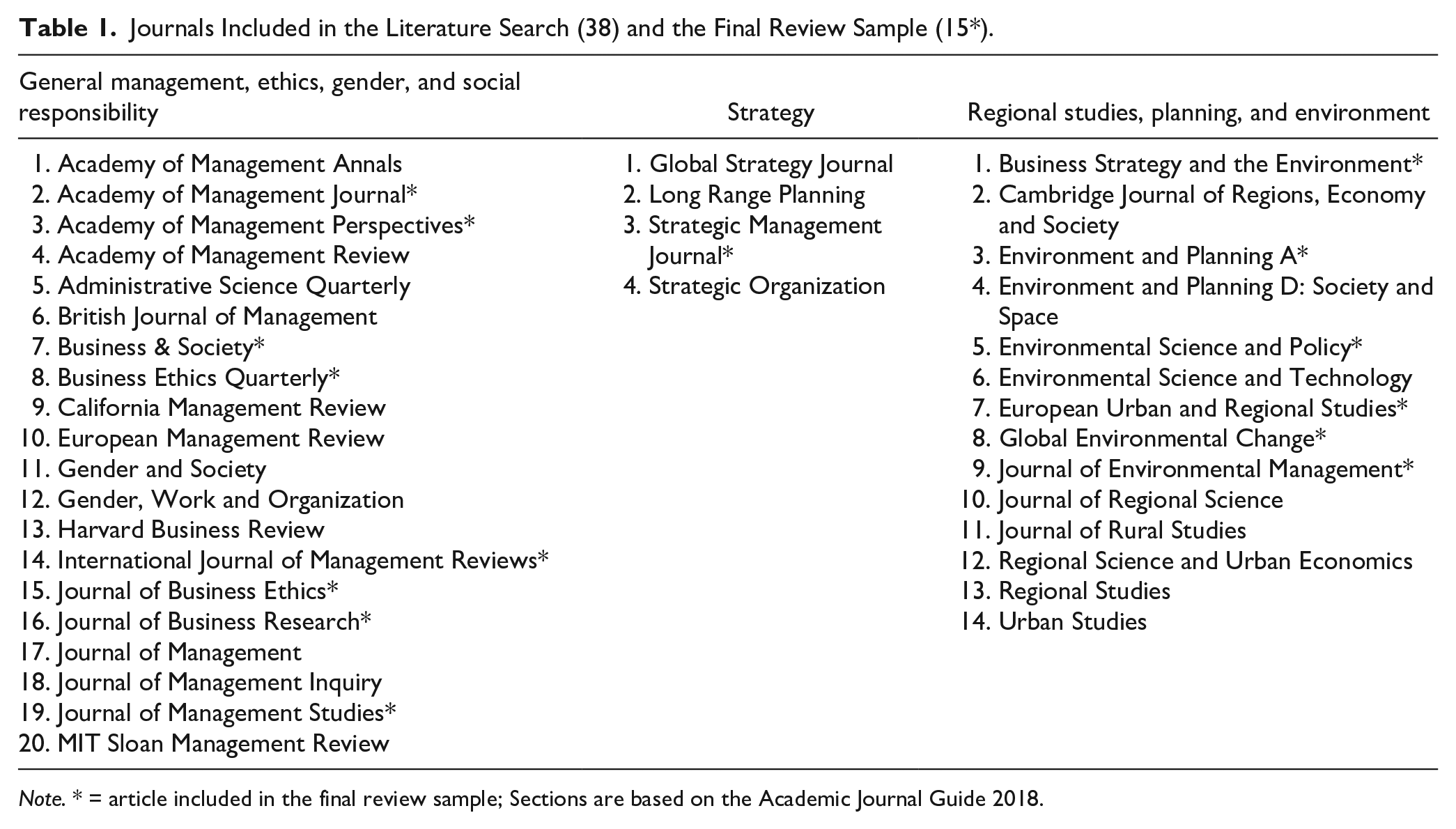
Note. * = article included in the final review sample; Sections are based on the Academic Journal Guide 2018.
To find the relevant articles within the journals, we used the search term “stakeholder engagement” and restricted the search to the article titles, abstracts, and keywords. The decision on a univocal search term was purposeful in that it allowed us to identify the articles in which the authors have linked their research directly to the construct of stakeholder engagement, and, thus, to leave out research that does not provide this clear connection. The starting point of our search timeline was left open for full coverage, and we searched for all articles published until December 31, 2020. Also Online First articles were included, and they were later published in 2021 or 2022 journal issues. Excluding duplicates between the Business Source Complete and Web of Science databases, the search generated 263 articles. In reviewing the search results, we noticed that many articles used stakeholder engagement in an ad hoc or random manner instead of using it as a theoretical or empirical construct. Therefore, we continued screening the relevance of the articles and excluded articles that did not mention stakeholder engagement in the full text or mentioned it only once or twice. After a close screening, we further decided to exclude those articles that did not provide an explicit definition of stakeholder engagement in the full text or did not provide a theoretically, conceptually, or empirically relevant contribution to stakeholder engagement research. As a result, our final review sample consists of 90 scholarly articles that provide either an explicit definition of stakeholder engagement (50 articles) or a relevant contribution to stakeholder engagement research (40 articles). The selected articles were published between 2006 and 2020, and thus, our review covers a 15-year period during which stakeholder engagement has evolved into a prominent construct and research area.
Analysis
The systematic phase
In the analysis, we first followed the idea of a systematic literature review (Aguinis et al., 2018; Kolk et al., 2014; Snyder, 2019) to provide a theoretical and empirical description of the past and current state of the research. After selecting the relevant articles, we started a systematic coding by first focusing on the 50 articles that provided an explicit definition of stakeholder engagement, as these can be seen as essential for the development of the construct and the research area more broadly. A team of four authors participated in the coding procedure. Each article was first coded independently by two authors to ensure reliability and interpretive validity (Gioia et al., 2012). After that, we cross-checked the results and discussed them in pairs. When there were discrepancies, we processed them with the whole team. Different interpretations and disagreements were used as opportunities for the refinement of the codebook and clarifying the topic. After the systematic double coding of the first 50 articles, one of the authors coded the remaining 40 articles with the same codebook.
The coding was done using a formalized codebook that consists of 32 codes (Appendix A). To develop the codes, we relied on former literature reviews (Kolk et al., 2014; Laplume et al., 2008; Miles, 2017; Nobre & Morais-da-Silva, 2021; Wood & Logsdon, 2019; Zaman et al., 2022). The codes consisted of the stakeholder engagement definition (1 code), descriptives (17 codes), boundary conditions (4 codes), underlying assumptions (3 codes), and qualitative elements (7 codes). As a result of the systematic phase, we provide a description of the development and current state of stakeholder engagement research.
The interpretive phase
After the systematic phase, we followed an interpretive literature review approach (Suddaby et al., 2017) to organize stakeholder engagement research. The coding results from the systematic phase provided the basis for the interpretive phase. We conducted an interpretive content analysis of the 50 stakeholder engagement definitions and analyzed the stakeholder engagement construct regarding the moral, strategic, and pragmatic components (Mayring & Fenzl, 2014; Suddaby, 2010) and the aims, activities, and impacts of stakeholder engagement. As a result of the interpretive phase, we provide a guide for stakeholder engagement research and offer an inclusive definition of stakeholder engagement. Moreover, the interpretive phase informed our suggestions for future research on stakeholder engagement.
The problematizing phase
In the light of the findings of the interpretive phase, it was apparent that the stakeholder engagement research has overemphasized positive issues and forms of engagement, which provides an incomplete view of stakeholder and business relationships. As a result, we decided to utilize the problematizing literature review approach (Alvesson & Sandberg, 2020) to provide insights into the overlooked questions in stakeholder engagement research. Without opening up the stakeholder engagement research and starting new conversations (Huff, 2016; Patriotta, 2017), the research area is at risk of becoming a consistent and self-sufficient box due to the systematizing nature of literature reviews elaborating only on previously acknowledged gaps.
We followed the advice of Alvesson and Sandberg (2020) and considered some additional articles that offer related views on the stakeholder engagement literature. As a result, we discuss the dark side of stakeholder engagement with a few selected articles that question and challenge the taken-for-granted assumptions, such as jointness of interest, trust, and positive outcomes of stakeholder engagement, in stakeholder engagement research (R. W. Griffin & O’Leary-Kelly, 2004; Harrison et al., 2019; Weibel et al., 2020). In particular, we explore the intentional and unintentional harmful and negative aspects of the aims, activities, and impacts of stakeholder engagement. In doing so, we provide new lenses to reflect on, challenge, and rebuild the existing literature (Alvesson & Kärreman, 2007; Okhuysen & Bonardi, 2011). By challenging the assumptions of stakeholder engagement literature with the dark side, we can provide avenues for future research.
Descriptive Analysis
The first article that filled our selection criteria was published in 2006 (Calton, 2006). Since then, we found a total of 90 relevant articles for our literature review, with a continuous increase especially in the last 3 years (Figure 1).
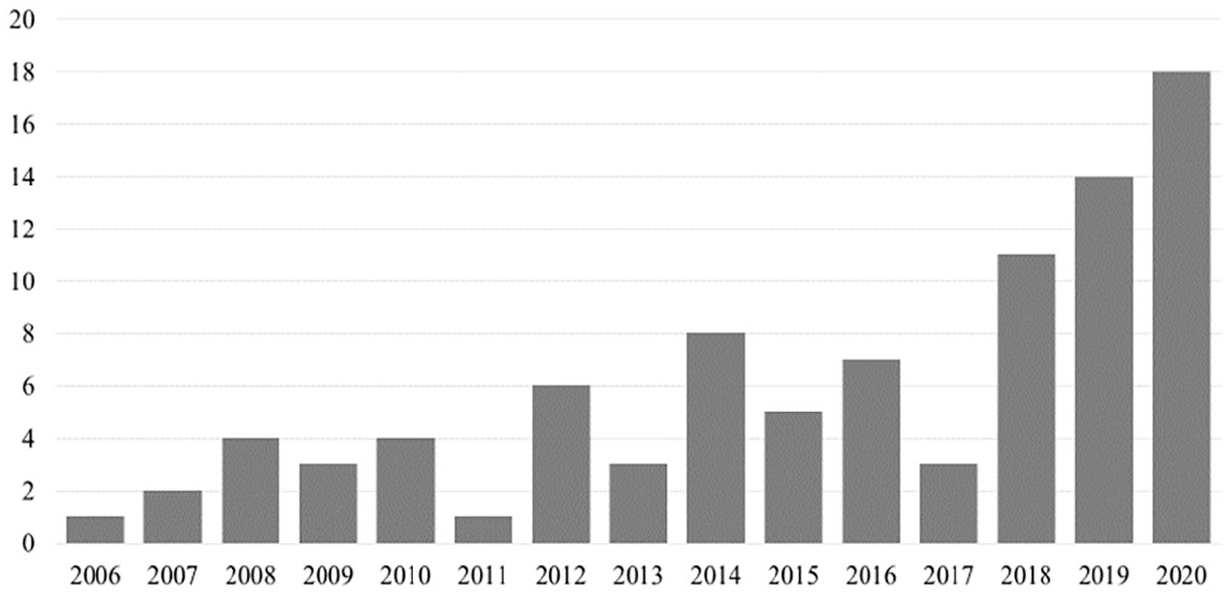
The number of publications included in the literature review in years 2006–2020.
The 90 articles in our review sample were published across 15 different journals. Thirty-eight articles were published in journals representing the business and society literature (Table 2), where the most popular outlet is the Journal of Business Ethics with a total of 29 stakeholder engagement articles; in fact, the first three articles of our review sample were all published in this journal (Calton, 2006; Greenwood, 2007; Maak, 2007). Other journals representing the business and society stream of literature are Business & Society, in which five stakeholder engagement articles were published, and Business Ethics Quarterly, with four publications.
The Journals and Focal Issues of the Business and Society Literature Articles (n = 38).
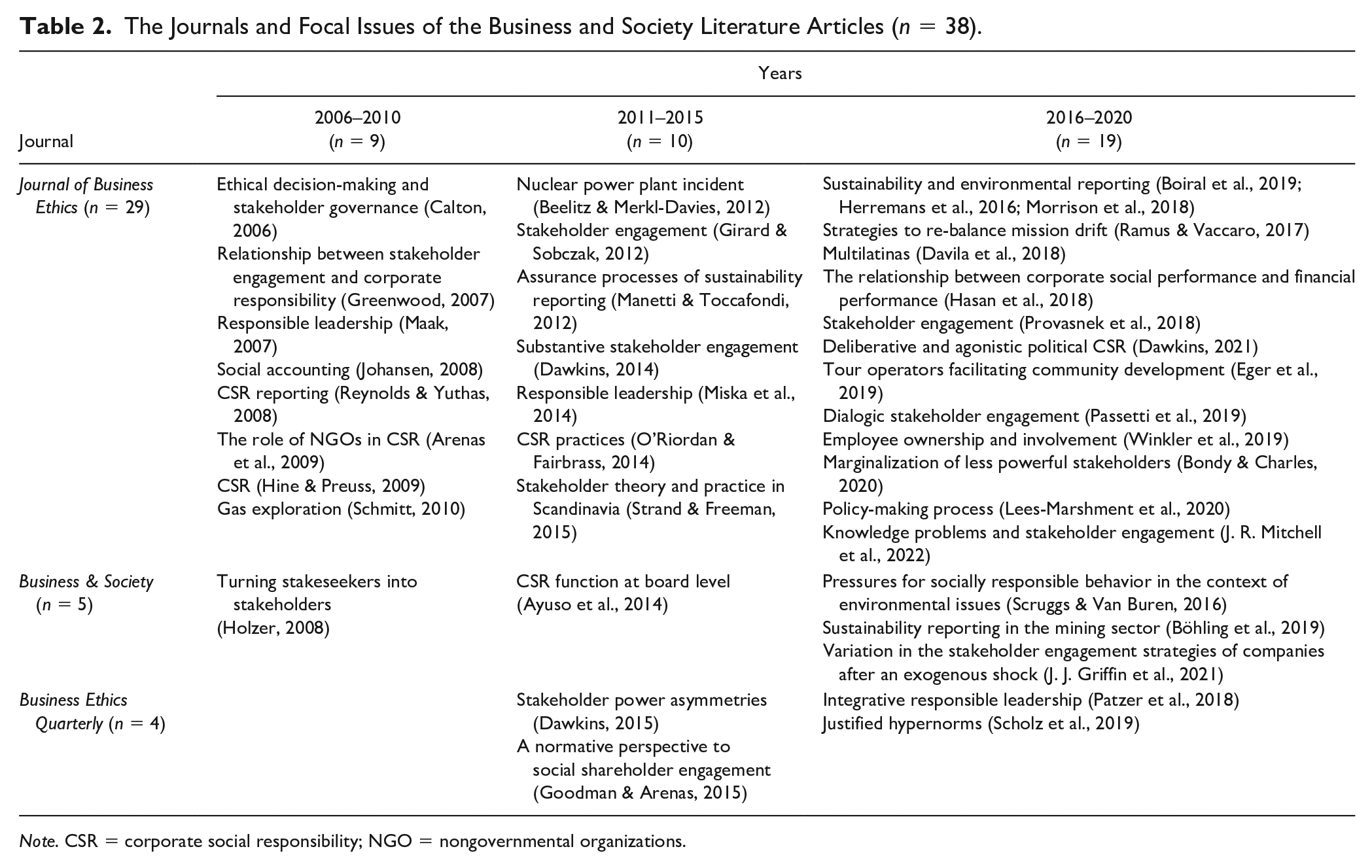
Note. CSR = corporate social responsibility; NGO = nongovernmental organizations.
Twenty-two articles were published in six different journals representing the management and strategy literature (Table 3). The journal with the largest number of publications on stakeholder engagement (n = 14) is the Journal of Business Research. This is largely due to a 2020 special issue on innovation management and entrepreneurial development from the perspective of stakeholder engagement, where 11 of our review sample articles were published. The first two articles in this literature were published in the International Journal of Management Review and addressed CSR in action (Lindgreen & Swaen, 2010) and moral engagement (Noland & Phillips, 2010). Notably, the leading academic management and strategy journals in our dataset, namely, Strategic Management Journal, Journal of Management Studies, Academy of Management Journal, and Academy of Management Perspectives, published only a few articles on stakeholder engagement.
The Journals and Focal Issues of the Management and Strategy Literature Articles (n = 22).
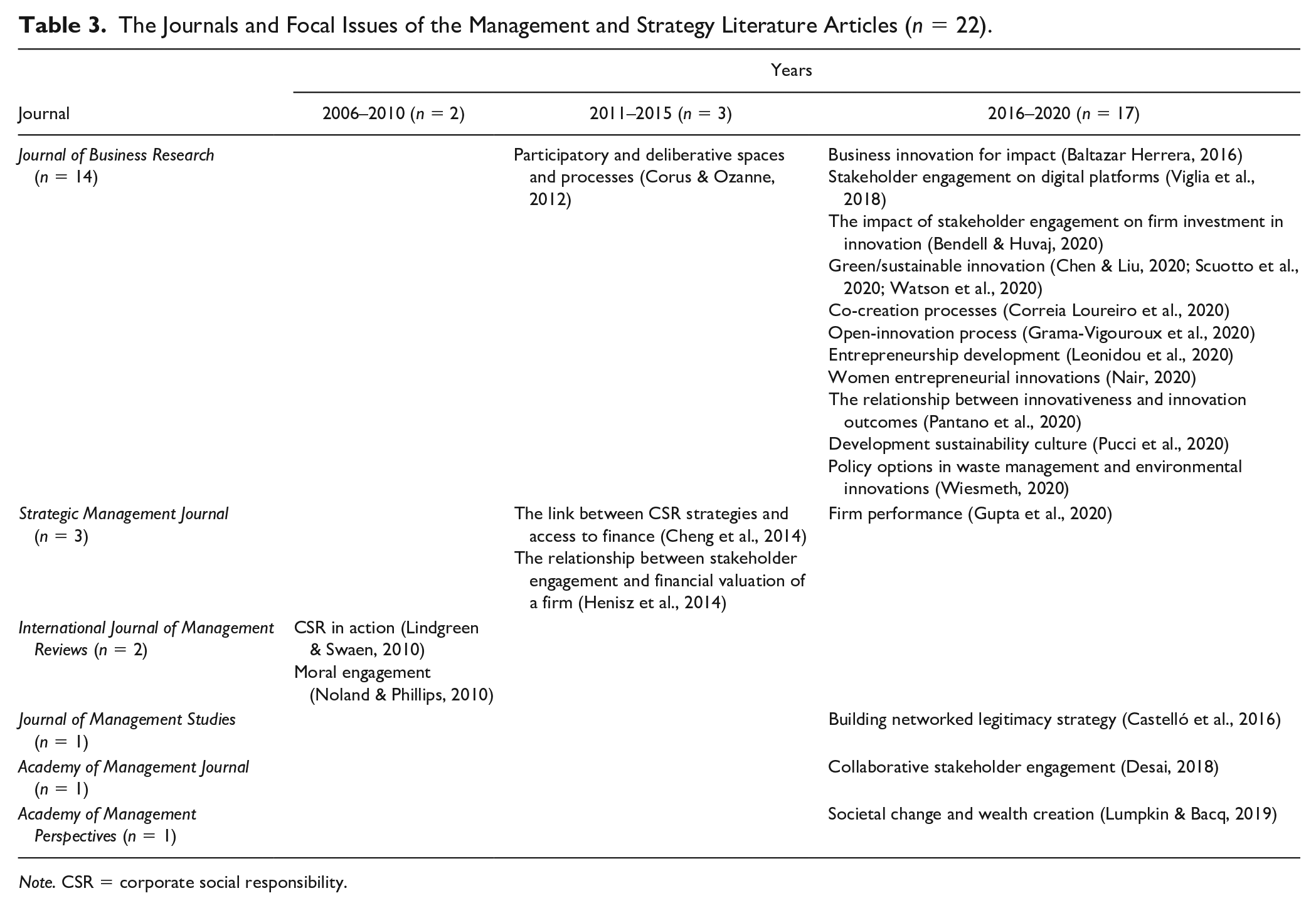
Note. CSR = corporate social responsibility.
Finally, 33 of the articles were published in six different journals in environmental management and environmental policy literature (Table 4). Most of these articles (n = 12) were published in the Journal of Environmental Management, while Environmental Science and Policy published nine articles and Business Strategy and the Environment six articles. Environment and Planning, European Urban and Regional Studies, and Global Environmental Change published one article each.
The Journals and Focal Issues of the Environmental Management and Environmental Policy Literature Articles (n = 30).
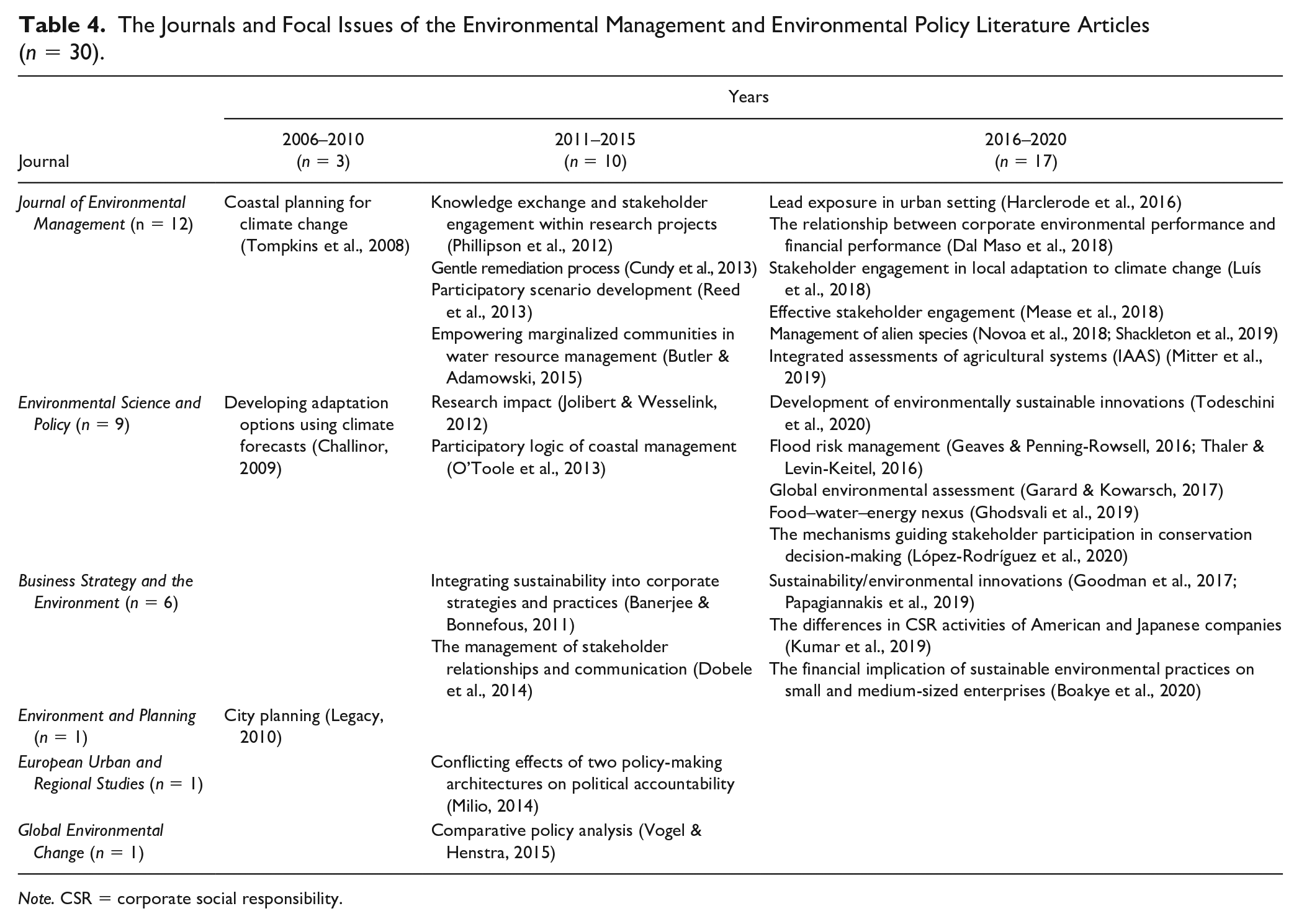
Note. CSR = corporate social responsibility.
The fragmentation of stakeholder engagement research can also be seen in the focal issues of the articles. All in all, in the 90 analyzed articles, there were no particularly prominent focal issues and, rather, a wide variety of issues were addressed. Ten of the articles focused on CSR, of which six were published in the Journal of Business Ethics. Innovations and innovativeness were addressed in nine articles, and six of these articles were published in the 2020 special issue of the Journal of Business Research. Moreover, reporting was the focal issue in four articles, three of which were published in the Journal of Business Ethics.
As a part of the coding, we also identified all theoretical and conceptual discussions used in the articles (Appendix B). The findings show that stakeholder engagement has been utilized in connection with a total of 75 theoretical and conceptual discussions. The broad variety of these discussions further suggests that the stakeholder engagement literature is dispersed instead of fixed and that the construct has attracted wide interest. The most commonly associated theoretical and conceptual discussions include stakeholder theory (n = 64), CSR (n = 36), and ethics (n = 25), thus reflecting the origins of stakeholder engagement research in business and society literature. Moreover, stakeholder engagement is typically connected to such discussions as innovation (n = 16), sustainability (n = 15), reporting and accounting (n = 10), as well as natural resource management (n = 7).
With regard to the research methods applied, 71% of the articles are empirical studies (n = 64), and 29% represent conceptual or theoretical work (n = 26; Appendix C). The empirical studies are heavily dominated by qualitative analyses (n = 42), with the main data sources being interviews (n = 27), secondary data (n = 25), and observations and experiments (n = 17). Quantitative empirical analyses (n = 18) use secondary data (n = 12) such as databases (n = 8), company reports (n = 5), and surveys (n = 7). Four articles use a mixed-methods approach combining interviews (n = 3), secondary data (n = 3), surveys (n = 2), and observation (n = 1). Figure 2 depicts the type (theoretical or empirical) and the different empirical types (qualitative, quantitative, or mixed methods) of the articles.
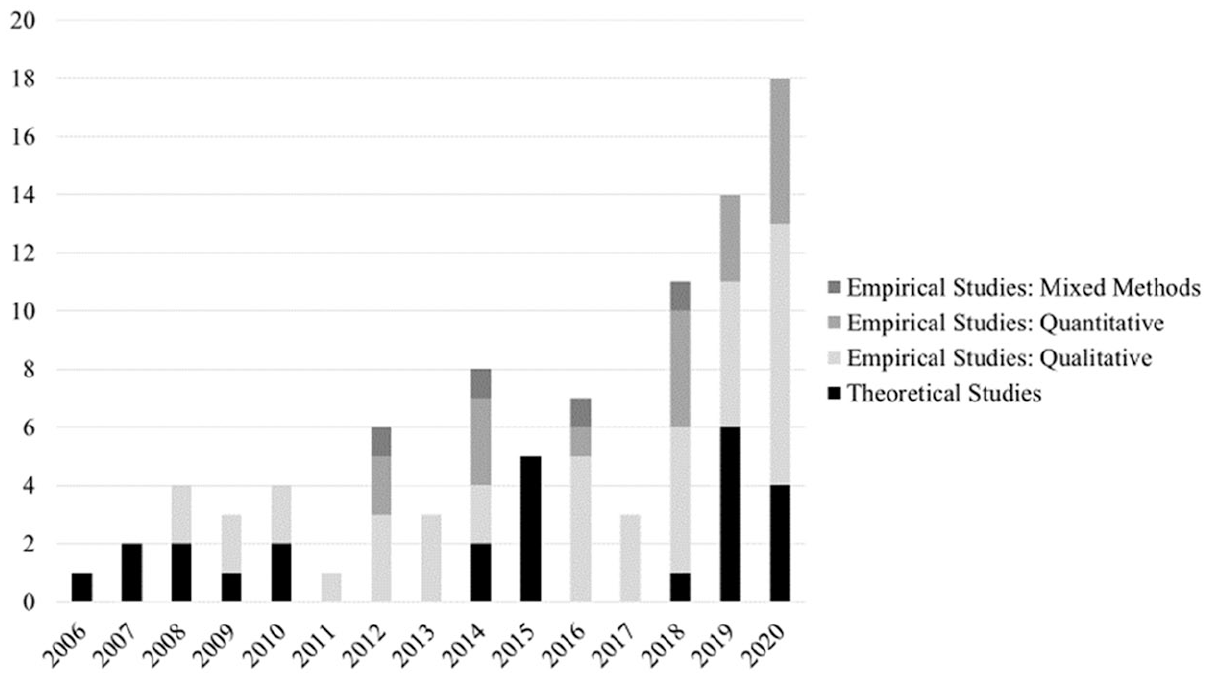
Research approaches of stakeholder engagement articles.
Among the empirical studies (n = 64), 94% of the articles have a defined geographical focus (Appendix C). Almost half of the empirical studies (n = 29) have a European focus. Specifically, the United Kingdom is highly represented in Europe as the only or one of the country contexts (n = 14). While some studies focus on North America (n = 7) and South America (n = 4), only a few empirical studies are contextualized in Asia (n = 2), Australia (n = 2), and Africa (n = 1). Most empirical works center on a single industry (n = 42) and examine for-profit organizations (n = 40). These findings suggest that there is room for more research on stakeholder engagement in various geographical and organizational contexts.
Components and Contents of Stakeholder Engagement
To organize our interpretive findings in this section, we first discuss the components of stakeholder engagement—the moral, strategic, and pragmatic—and how these components are represented in the stakeholder engagement definitions. Then, we discuss the contents of stakeholder engagement—the aims, activities, and impacts—and organize them along with the three components.
Components of Stakeholder Engagement
While stakeholder engagement has steadily gained popularity for the last two decades, the definitions of the construct are divergent and emphasize diverse aspects. According to our review, however, most authors relate a moral connotation to stakeholder engagement. Stakeholder engagement is moral if the organization has good intentions and/or the relationship is reciprocal and voluntary. Several scholars propose that stakeholder engagement is morally positive if it involves recognition and respect (Noland & Phillips, 2010), doing good (Miska et al., 2014), empowerment of stakeholders (Ghodsvali et al., 2019), or the consideration of stakeholders’ wants, needs, and capabilities (Todeschini et al., 2020). Indeed, as the use of the stakeholder concept itself is an indicator of the understanding of business actions as moral actions (Purnell & Freeman, 2012), stakeholder engagement literature often implicitly indicates the moral component.
In addition to the moral component, stakeholder engagement entails strategic and pragmatic components (Dmytriyev et al., 2021; Donaldson & Preston, 1995). Stakeholder theory is originally a theory of strategic management (Freeman, 1984), and the strategic dimension in stakeholder engagement focuses on stakeholders’ willingness to participate in business value creation. Typically, participation relies on resource contribution to improve various outcomes, such as firm performance, reputation, or competitive advantage. In this realm, the strategic component connects to the stream of literature in stakeholder theory aiming for a competitive advantage by integrating the resource-based view (Barney, 2018; Jones et al., 2018). Moreover, stakeholder research applying quantitative methods has primarily focused on testing the premise of the instrumental stakeholder theory, arguing that the stakeholder orientation of the firm has a positive influence on its financial performance (Ayuso et al., 2014; Berman et al., 1999; Gupta et al., 2020; Hillman & Keim, 2001).
The pragmatic component relates to pragmatism as a philosophical orientation (Dmytriyev et al., 2017), concerns action and problem-solving in practical contexts (Freeman, 1994; Freeman et al., 2017), and emphasizes the practical consequences of the actions that aim to improve the stakeholders’ way of life (Dewey, 1920; Voparil & Bernstein, 2010). Thereby, the acknowledgment of various stakeholders and the measurement of the practical consequences of stakeholder engagement are elementary parts of the pragmatic component. The pragmatic component refers to the context embeddedness emphasizing how a shift in the boundary conditions impacts the contents of stakeholder engagement. With the philosophical orientation of pragmatism, we can capture “the logic of practice” embedded in a specific context (Sandberg & Tsoukas, 2011, p. 338). The pragmatic component of stakeholder engagement points out how stakeholder engagement takes action in the social and natural environment and considers which activities might be appropriate for the specific context and case (Sandberg & Tsoukas, 2011). The pragmatic component of stakeholder engagement also denotes the time aspect, including temporary processes with a starting and ending point, and the ongoing nature of stakeholder engagement.
To specify the three components of stakeholder engagement, we provide examples of stakeholder engagement definitions collected from the literature.
Moral, strategic, and pragmatic
Almost half of the definitions embrace all three components. For example, J. R. Mitchell et al. (2022, p. 77) define stakeholder engagement as “the interaction among a firm and its stakeholders that address knowledge problems to improve correspondence in understanding between managers and stakeholders, thereby to assist in resolving ethical challenges faced by managers.” O’Riordan and Fairbrass (2014, p. 123) understand stakeholder engagement as “all those activities which are undertaken to create opportunities for dialogue between an organization and one or more of its stakeholders with the aim of providing an informed basis for the organization’s decisions.”
Moral and strategic
Many definitions combine the moral and strategic components without reference to the pragmatic aspects. For instance, building on Greenwood’s (2007) definition, Noland and Phillips (2010, p. 40) strengthen the moral dimension by defining stakeholder engagement as a “type of interaction that involves, at minimum, recognition, and respect of common humanity and how the actions of each may affect the other.” In these definitions, the moral component acknowledges the intrinsic value of humans, while the strategic component refers to the consequences of the action.
Moral and pragmatic
Quite a few definitions contain the moral and pragmatic components but not the strategic. These definitions embrace the involvement of stakeholders in organizational decision-making or collaboration and cooperation with stakeholders, often in ethical or CSR-related issues. For example, Hine and Preuss (2009, p. 383) define stakeholder engagement as “the practical mechanism through which social responsibility can be enacted in corporate decision making as a counterweight to the primacy of shareholder value.” In addition, the moral and pragmatic components are combined in definitions that emphasize dialogical and dynamic processes. Such a definition is presented by, for example, Manetti and Toccafondi (2012, p. 365) who define stakeholder engagement as constituting “a process that creates a dynamic context of interaction, mutual respect, dialog, and change, not a unilateral management of stakeholders.” In a similar manner, Cundy et al. (2013, p. 285) define stakeholder engagement as “a broad inclusive and continuous process between a project and those potentially affected by it.”
Strategic and pragmatic
Some authors also combine the strategic component with the pragmatic. For example, Leonidou et al. (2020, p. 246) define stakeholder engagement as “procedures, solution development and/or usage, co-creation, interactions and/or relevant, marketing-based forms of service exchange, of all stakeholders within the micro- and macro-environment of an organization in the spirit of entrepreneurship development.” Likewise, Novoa et al. (2018, p. 294) describe stakeholder engagement as “the process by which an organization involves all who may be affected by or can influence the implementation of its decisions in a decision making procedure.”
Finally, some authors emphasize only one of the three components. For example, Gupta et al. (2020, p. 1871) rely on the strategic component when they define stakeholder engagement as “strategies [that] are linked to performance in combination with firm-level factors.” Viglia et al. (2018, p. 404), however, build on the pragmatic component by defining stakeholder engagement as an “interactive experiential process based on actors’ engagement with a focal organization, but more intensively with other stakeholder community members.”
To conclude, the components clarify the multiplicity of the stakeholder engagement construct. The moral component emphasizes the morally positive impact of stakeholder engagement through moral conduct and inclusive stakeholder engagement, whereas the strategic component underlines instrumental engagement and reciprocal economic advantages. The pragmatic component combines these two aspects to establish practical solutions for the involved stakeholders to improve their lives. Thus, from the perspective of who is benefiting from stakeholder engagement and how, the moral component is on one side of the continuum of stakeholder engagement, representing the multiple-value perspective, and the strategic component on the other, representing the economic-value perspective (Tapaninaho & Kujala, 2020). The pragmatic component, by its integrative nature, is in the middle, combining the strategic and moral views for joint value creation.
Understanding the richness of the existing stakeholder engagement research and the underlying combinations of the moral, strategic, and pragmatic components helps us to develop the research further in a more rigorous way. To deepen our understanding of the richness of the existing research, we move now to examine the contents of stakeholder engagement.
Contents of Stakeholder Engagement
To organize stakeholder engagement research, we move now to examining the contents of stakeholder engagement and organize it according to aims, activities, and impacts. Stakeholder engagement is an intentional activity with explicit or implicit aims linked to participants’ interests (Nalick et al., 2016). In addition to the term aims, stakeholder engagement research also uses purpose (Viglia et al., 2018), reasons (Shackleton et al., 2019), and incentives (Miska et al., 2014). We choose to follow Novoa et al. (2018) and use the concept of aims to describe the goals of stakeholder engagement relating to both the stakeholders’ and the focal firms’ expectations of stakeholder relations.
According to O’Riordan and Fairbrass (2014), stakeholder engagement refers to a variety of activities that enable dialogue between an organization and its stakeholders. As stakeholder engagement activities are frequently iterative and nonlinear, and may embrace a full range of various involvements (Cundy et al., 2013), our interpretation does not intend to show a process or a flow of activities but instead to shed light on the multitude of stakeholder engagement activities. The literature uses a variety of terms referring to stakeholder engagement activities, such as mechanisms (Pucci et al., 2020), levels (Mitter et al., 2019), strategies (Herremans et al., 2016), methods (Nair, 2020; Shackleton et al., 2019), steps (Novoa et al., 2018), forms (Viglia et al., 2018), interventions (Watson et al., 2020), approaches (Shackleton et al., 2019), types (Jolibert & Wesselink, 2012), and degrees (Mitter et al., 2019). We follow Greenwood (2007) and O’Riordan and Fairbrass (2014) and use the term activities referring to, for example, communication, collaboration, consultation, dialogue, and joint decision-making. These can be one-way activities, such as informing stakeholders, or mutual and reciprocal two-way activities.
The impacts of stakeholder engagement refer most often to an improved competitive advantage or social and ecological well-being and concern the participating stakeholders and beyond (Dawkins, 2015; Shackleton et al., 2019). Other related terms are outcomes (Shackleton et al., 2019), implications (Dawkins, 2015), and contributions (Jolibert & Wesselink, 2012). We chose to use the concept of impacts to illustrate the intended or unintended changes that follow stakeholder engagement.
Aims of stakeholder engagement
Almost all articles in our review sample included an explicitly stated aim for stakeholder engagement. More than half of the articles embrace the moral component either alone or combined with other components in the aims of stakeholder engagement. Many authors see legitimacy (Banerjee & Bonnefous, 2011; Castelló et al., 2016; Legacy, 2010; Provasnek et al., 2018; Thaler & Levin-Keitel, 2016), trust (Eger et al., 2019; Thaler & Levin-Keitel, 2016), and fairness (Davila et al., 2018) as important moral aims of stakeholder engagement. Likewise, CSR and responsibility (Kumar et al., 2019; Lees-Marshment et al., 2020; Lindgreen & Swaen, 2010; Passetti et al., 2019; Winkler et al., 2019), environmental and sustainability concerns (Jolibert & Wesselink, 2012; Luís et al., 2018; Scuotto et al., 2020), and enhancing inclusive stakeholder engagement (Mease et al., 2018) are seen as important moral aims. Research suggests that specific relational models, such as communal sharing, are particularly well suited to creating high-quality relationships (Bridoux & Stoelhorst, 2016; Jones et al., 2018). Recently, there has been a call to include moral issues, such as the core values of stakeholders, to examine stakeholder relations (Bundy et al., 2013, 2018). Stakeholders need to be able to negotiate their subjective interpretations of a focal issue to develop joint solutions (Bridoux & Stoelhorst, 2020; Roloff, 2008; Rühli et al., 2017).
Half of the articles in our review sample discussed strategic aims such as improved financial and operational performance (Boakye et al., 2020; Gupta et al., 2020; Henisz et al., 2014) or environmental and social risk management (Cundy et al., 2013; Geaves & Penning-Rowsell, 2016; Thaler & Levin-Keitel, 2016). Interestingly, moral and strategic aims are often presented together. For example, Papagiannakis et al. (2019) combine knowledge creation and trusting stakeholder relationships, and Beelitz and Merkl-Davies (2012) link effectiveness and responsibility as important aims of stakeholder engagement. Strategic aims often represent an instrumental view emphasizing the economic survival of and the benefits for the focal company (Dobele et al., 2014; Hine & Preuss, 2009; Todeschini et al., 2020).
One-third of the articles in our review sample considered the pragmatic aims of stakeholder engagement. Examples of pragmatic aims are strengthened stakeholder relationships, collaboration, and dialogue (Davila et al., 2018; Garard & Kowarsch, 2017; Geaves & Penning-Rowsell, 2016; Passetti et al., 2019), co-generation of knowledge (Reed et al., 2013), problem-solving and reaching consensus (Manetti & Toccafondi, 2012, Patzer et al., 2018), and bringing change that benefits societies (Geaves & Penning-Rowsell, 2016; Lumpkin & Bacq, 2019). Reducing and resolving conflicts of interest also relate to informing, consulting, and making joint decisions with stakeholders (Laude, 2020; Morsing & Schultz, 2006).
Activities of stakeholder engagement
Stakeholder engagement relates to a variety of activities. Moral activities often focus on bottom-up stakeholder engagement approaches (Davila et al., 2018; Harclerode et al., 2016), empowering and reaching out to silent or nonvisible stakeholders (Davila et al., 2018), and are supported by positive firm involvement in the community and long-term partnerships (Kumar et al., 2019; Milio, 2014; Reynolds & Yuthas, 2008; Strand & Freeman, 2015). Thus, moral stakeholder engagement activities relate to the creation of social infrastructure institutions and alliances or agreements, such as community and employee involvement activities.
The strategic stakeholder engagement activities consist of one-way information flows, two-way communication, and internal structures. One-way information flow from the focal company to stakeholders—that is, informing stakeholders—is a common activity that can take many forms, such as presentations and talks, written reports, newsletters, brochures, and other publications, websites, and databases (Jolibert & Wesselink, 2012; O’Riordan & Fairbrass, 2014). While one-way activities serve the stakeholders to some extent, they do not allow for stakeholder interaction. To collect feedback, firms may use polls (Davila et al., 2018) or interviews and participant observation (Ghodsvali et al., 2019).
Two-way communication activities add mutuality and reciprocity to one-way information flows. Most of the reviewed articles mentioned formal or informal two-way communication activities. Examples of two-way activities are roundtable meetings, one-on-one conversations and negotiations, workshops, training, conferences, and open-house days (Jolibert & Wesselink, 2012; Provasnek et al., 2018). Many authors also acknowledge external partnerships (Ayuso et al., 2014; Cundy et al., 2013; Girard & Sobczak, 2012; Goodman et al., 2017) and exchange of information (Dobele et al., 2014; Hasan et al., 2018) as elementary stakeholder engagement activities.
Notably, strategic stakeholder engagement activities need supportive internal structures (Cundy et al., 2013; Dawkins, 2014; Garard & Kowarsch, 2017; Papagiannakis et al., 2019; Shackleton et al., 2019). Moreover, relationship building needs mediators (Dawkins, 2014), moderators (Garard & Kowarsch, 2017), and developers or consultants who do the initial design work (Cundy et al., 2013). Top management commitment to stakeholder engagement is important as well (Holzer, 2008; Reynolds & Yuthas, 2008).
The pragmatic component of stakeholder engagement activities is closely related to the quality of activities, which is manifested in building and strengthening dialogue and collaboration through, for example, activation, ability to interact, and willingness to maintain a relationship (Girard & Sobczak, 2012; Manetti & Toccafondi, 2012; Viglia et al., 2018). Dialogue and collaboration enable mutual understanding, learning, educating, and building awareness (Papagiannakis et al., 2019; Shackleton et al., 2019) as well as the exchange of knowledge and other resources (Novoa et al., 2018). Dialogue is also often seen as a way for organizations to interact in the context of challenging issues (Golob & Podnar, 2014). However, there is little advice for engagement with critical or silent stakeholders (Harrison & Wicks, 2021; Weibel et al., 2020). Learning with and from stakeholders involves stakeholder engagement activities that offer organizations an opportunity to continuously learn and develop (Burchell & Cook, 2006; Calton & Payne, 2003; Payne & Calton, 2004). Companies can use criticism and feedback as opportunities for value creation (Lee et al., 2015; Mena & Chabowski, 2015) and view stakeholder engagement as a continuous learning process (Post et al., 2002; Sachs & Rühli, 2011). In addition, a pragmatic view is related to cooperative initiatives such as, for instance, implementing collaborative interventions (Legacy, 2010; Shackleton et al., 2019) and interactive opportunities and consensus-building (Ghodsvali et al., 2019; Harclerode et al., 2016) that improve the quality of activities and participation.
Finally, co-creation and co-production activities as a form of high-quality collaborative relationship (Bridoux & Stoelhorst, 2016) mean working together to diagnose the challenge, jointly produce knowledge, develop capabilities (Papagiannakis et al., 2019; Shackleton et al., 2019), and design solutions (Baltazar Herrera, 2016). Co-creation and co-production activities are also about informing jointly owned decisions (Shackleton et al., 2019) and implementing solutions (Baltazar Herrera, 2016). Interaction and solution development simultaneously build positive relationships and effective strategies related to co-creative stakeholder engagement activities (O’Toole et al., 2013; Pantano et al., 2020).
Impacts of stakeholder engagement
Most of the articles discussed the impacts of stakeholder engagement. Moral impact relates to legitimacy (Beelitz & Merkl-Davies, 2012), credibility (Manetti & Toccafondi, 2012; O’Riordan & Fairbrass, 2014), and trust among the focal company and stakeholders (Davila et al., 2018; Winkler et al., 2019). In addition, examples of moral impacts include strengthening societal well-being (Lindgreen & Swaen, 2010), ensuring a good life (Noland & Phillips, 2010), goodwill (O’Riordan & Fairbrass, 2014), fairness (Winkler et al., 2019), and shared responsibility (Schmitt, 2010).
A concrete example of strategic impact is efficiency, which was a common denominator in many articles: efficiency in the form of reduced transaction costs (Herremans et al., 2016) and firm performance measured as ROE (Ayuso et al., 2014), effective use of resources (Chen & Liu, 2020; J. J. Griffin et al., 2021; Harclerode et al., 2016), competitive advantage (Scruggs & Van Buren, 2016), reducing uncertainty (Herremans et al., 2016), achieving control (Passetti et al., 2019; Winkler et al., 2019), and maintaining corporate autonomy and flexibility of operations (Dawkins, 2014; Herremans et al., 2016). In addition, improved profitability, lower agency costs, a significant impact on the market value, and revenue/profit-generating potential are examples of strategic impacts (Boakye et al., 2020; Cheng et al., 2014). Other examples of strategic impact relate to innovation outcomes (Bendell & Huvaj, 2020; Pucci et al., 2020), reputation and image (Scruggs & Van Buren, 2016), and aiding stakeholders to endorse and champion the corporate message and reports (Boiral et al., 2019), eco-efficiency (Watson et al., 2020) as well as improved knowledge generation and learning (Baltazar Herrera, 2016; Luís et al., 2018; Wiesmeth, 2020). Finally, stakeholder engagement may assist in the communication of complex scientific information to stakeholders and reveal stakeholder willingness to support various courses of action (Tompkins et al., 2008).
Regarding the pragmatic component, stakeholder engagement was seen to lead to ethical decision-making processes (Noland & Phillips, 2010). Particular examples of pragmatic impacts are behavioral activation for a common vision (Viglia et al., 2018) and the encouragement of stakeholders to believe in the norms, values, and objectives of the company (Girard & Sobczak, 2012) as well as partnership (Reed et al., 2013) and consensus-building (Beelitz & Merkl-Davies, 2012; Novoa et al., 2018). When ambiguity is solved through consensus, a greater realization of the jointness of interests among stakeholders will be achieved (J. R. Mitchell et al., 2022; Strand & Freeman, 2015).
To conclude, the analysis of the contents—the aims of stakeholder engagement relating to both the stakeholders’ and the focal firms’ expectations of stakeholder relationships, the one- and two-way activities, and the intended or unintended impacts of stakeholder engagement—deepen our understanding of the richness and variety of the existing stakeholder engagement research. To summarize our findings from the existing stakeholder engagement research and inspire further research, we next offer a guide for organizing stakeholder engagement research.
A Guide for Stakeholder Engagement Research
Our analysis shows that the stakeholder engagement construct can be organized along with the moral, strategic, and pragmatic components, and the aims, activities, and impacts as its contents. With this insight, we propose a new definition for stakeholder engagement: Stakeholder engagement refers to the aims, activities, and impacts of stakeholder relations in a moral, strategic, and/or pragmatic manner. This definition is inclusive and centered on stakeholder engagement and thus complements and broadens the previous understandings of the construct that have been company-centric (Greenwood, 2007; Papagiannakis et al., 2019), focused on selected components (Gupta et al., 2020; Hine & Preuss, 2009), or narrow in understanding the contents of stakeholder engagement (Beelitz & Merkl-Davies, 2012; Ghodsvali et al., 2019; Harclerode et al., 2016). We offer this definition as a broad understanding of the construct to increase rather than limit its applicability to various theoretical and empirical contexts. Furthermore, we do not intend to suggest that all research needs to integrate or cover all aspects brought forward in the definition.
To further increase the applicability of the construct and to inspire research in some or all aspects of the definition, we offer a guide for organizing stakeholder engagement research (Table 5). The guide provides an overview of the main insights of the research categorized along with the definition of stakeholder engagement. It also enables researchers to situate their research within the so far fragmented stakeholder engagement literature, which in turn helps in developing rigorous and relevant research. In addition, the guide gives a possibility to identify research gaps along the components and the contents of stakeholder engagement and elaborate on those areas of research that have been overlooked so far.
Guide for Stakeholder Engagement Research.
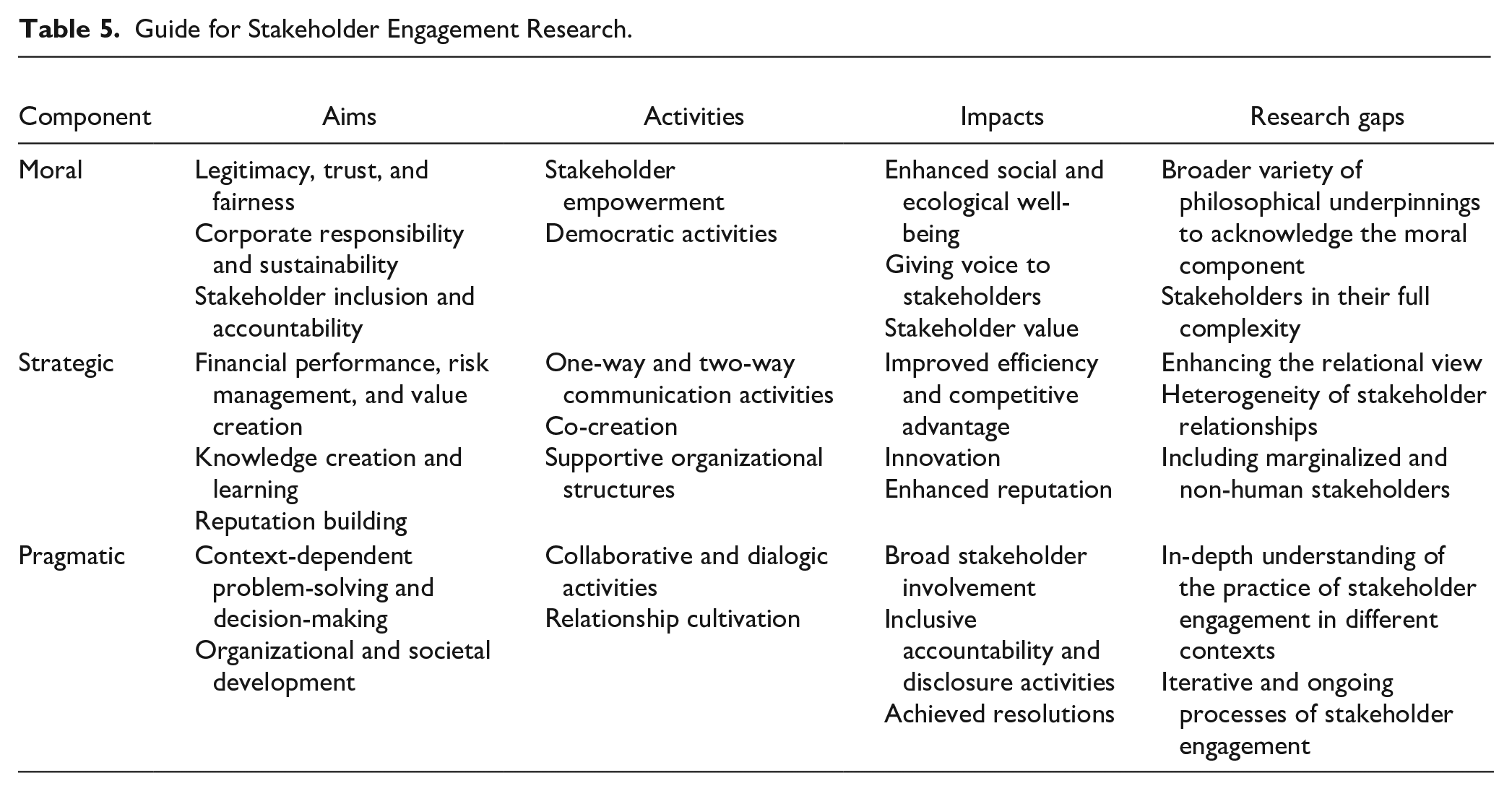
The moral component of stakeholder engagement brings forth issues related to stakeholder relations and the organization. Moral aims include the expectation for legitimacy, trust, and fairness in stakeholder engagement, which can lead to such activities as stakeholder empowerment and/or the democratization of the relations between the organization and the stakeholders. Furthermore, the moral component relates to morally desirable impacts for the stakeholders and the organization, such as enhanced social and ecological well-being, giving voice to stakeholders, or stakeholder value. Developing a more nuanced understanding of the moral component calls for further discussion on the nature of the firm (Noland & Phillips, 2010) and on exploring a broader variety of philosophical underpinnings for stakeholder engagement (Winkler et al., 2019), such as the humanized view (Harrison et al., 2019; Sachs & Kujala, 2021a). Also, how to understand stakeholders in their full complexity (Freeman et al., 2010; Waddock, 2011) is a relevant question for advancing the moral component.
The strategic component of stakeholder engagement emphasizes purposeful and goal-oriented aspects and typically has a focus on the organization, while stakeholder engagement is seen as a means for organizational benefits. Accordingly, the strategic aims are concerned with influencing the involved stakeholders to improve the firm’s value creation, knowledge creation, or reputation. The strategic activities are mainly transactional and build on benefit improvement and risk reduction, which lead to impacts that strengthen firm performance in many ways. In future research, it is critical to understand the relational view of stakeholder engagement in a more nuanced way and stakeholder relations as the links between business, society, and stakeholders (Freeman et al., 2017). The relational view of stakeholder engagement concerns both the heterogeneity of the relationships and the relations to a wide variety of stakeholders including marginalized and nonhuman stakeholders.
As for the pragmatic component, it is essentially context-embedded and time-sensitive. Accordingly, pragmatic aims seek to establish and maintain functioning relationships for organizational and societal change. These aims can inspire collaborative activities and activities seeking the cultivation of many types of stakeholder relationships. In turn, the pragmatic impacts embrace stakeholder inclusion, conflict resolution, and consensus-building. For future research, the pragmatic component highlights that it is essential to study stakeholder engagement as a contextual phenomenon occurring in a certain time and place. Thus, explicating the boundary conditions of stakeholder engagement research is extremely important to take the research field forward. To further understand the pragmatic component, more research on the iterative and ongoing stakeholder engagement processes is needed.
The guide presented in Table 5 can be used to advance understanding of the contents of stakeholder engagement, too. Regarding aims, there is a lack of understanding of the (in)compatibility of the various aims. While the literature raises a wide variety of aims and expectations on the firm and stakeholder side, problematic or even malicious purposes are rarely considered, and thus, there is a lack of research on the dark side in comparison to the positive stance (Harrison et al., 2019; Weibel et al., 2020). Furthermore, research on activities is needed to explain how activities can be harmonized to provide solutions and opportunities and when linking activities leads to harmful impacts. Most of the activities implicitly assume that stakeholders are involved in a positive way, and the destructive side of activities is rarely acknowledged. However, a few authors recognize that stakeholder engagement may have negative consequences, such as challenges when solving wicked issues (Schmitt, 2010), difficulties and conflicts between political leaders and stakeholder groups (Thaler & Levin-Keitel, 2016), marginalization, or more restricted outcomes than expected (Schmitt, 2010; Thaler & Levin-Keitel, 2016) as well as a paralyzed implementation of the interventions due to a high level of participation and ineffective political action (Milio, 2014).
To examine the negative insights further, we discuss the dark side of stakeholder engagement more carefully in the next section. We do that by challenging the taken-for-granted assumptions of research. The prevailing assumptions need to be re-evaluated to acknowledge the dark side, as has been done in other fields of organization studies. Our discussion of the dark side will reveal avenues for future research and point to a need to develop an integrated view that embraces both the bright and the dark side.
The Dark Side of Stakeholder Engagement
The persistent questions of morality, amorality, and immorality of management (Carroll, 1987) have inspired numerous authors in the business and society field. Ghoshal (2005, p. 86) indicated that the assumptions of management theories—primarily related to the exclusion of human intentionality, morals, and ethics from these theories—need to be critically examined because they run a risk of ruining “good management practices.” The interlinks and interdependencies of business and ethics have been at the core of stakeholder theory from the outset, and accordingly, stakeholder theory has pursued an ethically informed understanding of human beings and management and their contribution to organizational value creation and the well-being of stakeholders (Donaldson, 2012; Freeman, 1984; Freeman et al., 2010; Friedman & Miles, 2006; Laplume et al., 2008; R. Phillips et al., 2003). Also, in the stakeholder engagement literature, the most-cited definition by Greenwood (2007, pp. 317–318) understands stakeholder engagement as positive practices to involve stakeholders in organizational activities. As our literature review has revealed, stakeholder engagement has resulted in an understanding that overemphasizes positive issues and forms of engagement. Taken-for-granted assumptions of the bright side, such as jointness of interests and values, positive reciprocity among firms and stakeholders, trust in relationships, and the favorable impacts of stakeholder engagement, need to be evaluated and reframed to open up the stakeholder engagement research systematically to the dark side as in other fields of organization studies.
Although there is some evidence of literature that focuses on the dark side of stakeholder relationships, there is no systematic inclusion of the dark side in the stakeholder engagement literature (Bosse & Phillips, 2016; Bundy et al., 2018; Harrison & Wicks, 2021; Lange et al., 2022; R. K. Mitchell et al., 2015; Schormair & Gilbert, 2021; Weibel et al., 2020). We must also consider that the negative and harmful impacts of stakeholder engagement for organizations, stakeholders, or society can occur due to destructive aims, malintent, unengaged stakeholders, or intractable stakeholder conflicts. Therefore, there is a need to critically examine the underlying assumptions of stakeholder engagement to arrive at an integrated view of stakeholder engagement. The integrated view embraces both the bright and the dark sides that are often manifested in business relationships, too (Abosag et al., 2016; R. W. Griffin & O’Leary-Kelly, 2004; Sapegina & Weibel, 2017).
We consider that the dark side can occur both intentionally and unintentionally. In unintended situations, individuals and organizations do not want to harm others or destroy any value purposefully, but it occurs due to a mistake, misalignment, misconduct, or ignorance of a different context (Abosag et al., 2016; Linstead et al., 2014). However, harm and damage may also be purposely caused by individuals or organizations. In these situations, false claims and destruction of commitment and cooperation trigger intractable conflict (Abosag et al., 2016; Linstead et al., 2014). We include the intended and unintended negative consequences to be aware of these aspects concerning the aims, activities, and impacts of stakeholder engagement and to formulate future research avenues that can inspire more equal and inclusive stakeholder engagement research. Furthermore, we must consider that there is a blurred zone between unintentionality and intentionality on the dark side. Table 6 depicts the origins, aims, activities, and impacts of the unintentional and intentional dark sides of stakeholder engagement.
Dark Side of Stakeholder Engagement.
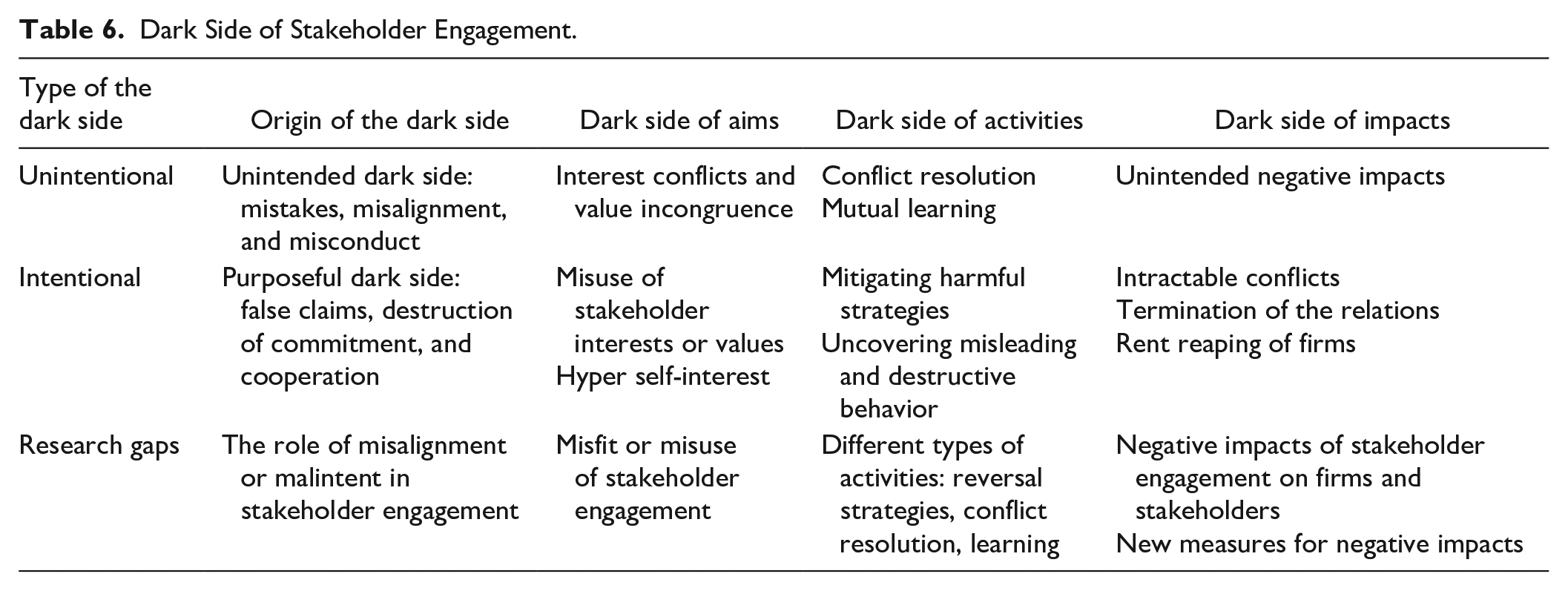
The Dark Side of the Aims of Stakeholder Engagement
On the dark side, there are conflicting views in the relationship, as Abosag et al. (2016, p. 6) point out: “Conflict may arise from differing goals, expectations, or the clashing of cultural norms.” Conflicting aims contrast with the often-imposed assumption of jointness of interests and values (Harrison et al., 2019). Stakeholder activism research has paid attention to how strong ideological differences regarding specific social issues occur in stakeholder relationships, as stakeholder activists aim to redirect corporate social change activities by boycotts or voluntary actions (den Hond & de Bakker, 2007). New stake-seekers may emerge and destabilize the power coalition (Holzer, 2008). In addition, internal stakeholder activism and internal relations agents are driven by high engagement in specific social issues, which may cause skepticism and fierce opposition toward highly engaged stakeholders by other internal or external stakeholders (Wickert & de Bakker, 2018).
Furthermore, local communities and multinational corporations often experience power imbalances, cultural clashes, and/or stakeholder perception gaps, leading to a misalignment of interests and values for stakeholder engagement (Calvano, 2008; Gonzalez-Porras et al., 2020; Lehtimäki & Kujala, 2017). Misalignment of interests and/or values can occur and result in a misfit between the aims of stakeholders and the firm (Bundy et al., 2018). “Blurred responsibilities” prevent an alignment of interests (Milio, 2014, p. 384), and moral legitimacy is risked when firms are not open to stakeholder engagement (Scholz et al., 2019). The misalignment can occur due to disinterest or ignorance, and typically normative forces dominate over negotiable values and beliefs such as religion or ideology (Bundy et al., 2018; Lange et al., 2022; Linstead et al., 2014; Schormair & Gilbert, 2021).
In the intended dark side, aims are driven by malintent, and false claims are made, which is often overlooked in stakeholder engagement research (Bijlsma-Frankema et al., 2015; Linstead et al., 2014). To overcome the assumptions of jointness and “doing good for stakeholders,” Harrison and Wicks (2021, p. 406) addressed firm strategies that stakeholders perceive as harmful and developed a spectrum of unethical behavior. Furthermore, there is also evidence of greedy CEOs in the “dark end of the self-interest continuum—that is, hyper-self-interest” (Sajko et al., 2021, p. 961), who establish individualistic cultures and neglect strong stakeholder relations. We maintain that malintent in aims warrants research attention.
The Dark Side of Stakeholder Engagement Activities
There is a fine line between the bright and the dark sides of stakeholder engagement activities. Research is yet to explicate whether there is a single continuum from the bright to the dark side, or whether these take place along more than one continuum. Suppose the dark side is due to unintended misconduct or a mistake (Lee et al., 2015). In that case, remedying the harm might need activities such as conflict resolution and effective learning between the firm and its stakeholders (Abosag et al., 2016; Vaughan, 1999). When the activities are intentionally harmful, stakeholders or organizations seek to destroy or negatively impact the other party, for example, through pressuring, delaying payments, or coercion (Harrison & Wicks, 2021).
The implicit assumption in the stakeholder engagement literature is that stakeholders’ bonds are either commitment-based or calculative (Bosse & Coughlan, 2016). However, there are other psychological bonds, such as acquiescence (Bosse & Coughlan, 2016; Klein et al., 2012), which may lead to involuntary participation in stakeholder engagement (Clarkson, 1995; Post et al., 2002). Furthermore, most stakeholder engagement research relies on the assumption of (low) trust (Bundy et al., 2018; Harrison & Wicks, 2021). Therefore, the construct of stakeholder distrust might enhance the understanding of the dark side of stakeholder relations (Bijlsma-Frankema et al., 2015; Weibel et al., 2020).
The Dark Side of Stakeholder Engagement Impacts
The stakeholder engagement literature is mainly concerned with demonstrating positive impacts, and the negative impacts have hardly been discussed. A few exceptions have explicated, for example, difficulties and conflicts that arise in stakeholder engagement (Thaler & Levin-Keitel, 2016), poorly informed decision-making and exclusion of stakeholder voices (Mease et al., 2018), and stereotyping and marginalization of stakeholders (Schmitt, 2010). Moreover, organizations cannot always avoid trade-offs or destroying value for stakeholders (R. K. Mitchell et al., 2015). The attribution theory-informed approach to corporate irresponsibility has discussed the corporation’s culpability for the negative effects or undesirable social impacts of corporate actions on specific stakeholders (Lange & Washburn, 2012). In this view, firms act to intentionally impose an undesired effect on stakeholders. Stakeholders’ perception of the focal stakeholder matters, since their evaluation depends on comparing inequity or functional losses (Lange et al., 2022). Stakeholder engagement literature has explicated how value destruction, via harming the stakeholders, can be avoided and how trust in the relations can be repaired (Brown et al., 2016; Harrison & Wicks, 2021; R. K. Mitchell et al., 2015).
In some cases, stakeholder engagement results in deadlocked relationships due to intractable conflicts (Abosag et al., 2016; Weibel et al., 2020). Stakeholder value dissensus can be essentially high if values are protected and hardly negotiable (Schormair & Gilbert, 2021). It will be essential to understand how conflicts in these relations can be mitigated and the termination of critical relations prevented (Weibel et al., 2020). Finally, measuring these pluralistic and value-laden impacts presents a challenge (Harrison & Wicks, 2021).
While the connection of CSR and stakeholder engagement conceptualizes a strong link between good citizenship and financial performance, it also foresees that if firms behave unethically, the license to operate is at stake (Freeman et al., 2010; Post et al., 2002). But even when confronted with big scandals, firms such as Shell, Nike, Glencore, or UBS can still be successful and continue their business-as-usual operations (Banerjee, 2008). Such cases of powerful corporations highlight the need for accepted indicators for legitimacy and financial performance.
To conclude, there is a need for more theoretical and empirical research on the dark side of stakeholder engagement. While we have suggested that the dark side can occur unintentionally and intentionally, little is known about the overall dynamics of unintentionality and intentionality and about the role of misalignment or malintent in stakeholder engagement. Regarding the aims of stakeholder engagement, issues such as misfit or misuse of stakeholder engagement for firms’ or stakeholders’ purposes, or how the characteristics of the aims relate to moral reasons such as value incongruence, strategic reasons such as interest conflicts, and/or pragmatic reasons such as wicked social issues, remain largely underexplored. While stakeholder engagement activities have attracted considerable research interest, more research is needed to further understand both unintentional and intentional activities, such as reversal strategies, conflict resolution, or effective learning between the firm and its stakeholders. Finally, differentiation of intended and unintended negative moral, strategic, and pragmatic impacts is needed for an elaborated understanding of how the impacts relate to the firm’s and stakeholders’ development and well-being as well as how these impacts can be measured.
Suggestions for Future Avenues of Stakeholder Engagement Research
Like stakeholder theory, stakeholder engagement needs new narratives that shape the understanding of what business and management are about (Freeman et al., 2010; Purnell & Freeman, 2012). Based on our analysis, we have concluded that the moral, strategic, and pragmatic components, along with the aims, activities, and impacts of stakeholder engagement, offer a guide for organizing the focal elements of the research. Moreover, we have discussed the dark side of stakeholder engagement in terms of what is currently overlooked or taken for granted. Our findings reveal some critical research gaps as discussed in the concluding remarks in the previous sections. Next, we offer future research avenues that contribute to developing an integrated view including the bright and dark sides of stakeholder engagement.
Philosophical Underpinnings
Previous literature suggests that further discussion is needed on the nature of the firm (Noland & Phillips, 2010) and the philosophical underpinnings of stakeholder engagement (Winkler et al., 2019). The related contemporary call to humanize stakeholder engagement to improve human well-being (Harrison et al., 2019; Sachs & Kujala, 2021a) requires a move from a single objective function emphasizing the economic value to stakeholder welfare and value creation beyond economic measures (Tapaninaho & Kujala, 2019). The humanized philosophical underpinning emphasizes a multitude of different stakeholder values and provides a nuanced understanding of the social value enabled by stakeholder engagement. Here, the eudaimonic well-being outcomes are valued over hedonistic ones. Eudaimonic well-being refers to the realization of one’s full potential, not in an individualistic sense but in a universal sense, while hedonic or psychological well-being can be understood as a call for stakeholder happiness that enhances pleasure and reduces pain (Diener, 2006; Haybron, 2016; Jones & Felps, 2013, p. 227; Ryff, 1989). The assumption that stakeholders are humans in their full complexity (Freeman et al., 2010) can change the moral component of stakeholder engagement, which future research on stakeholder engagement needs to take seriously. In addition, we call for awareness of the dark side of humans’ and organizations’ interests. Why do individuals and organizations purposefully make false claims regarding their aims in engaging stakeholders? What are the reasons for humans to take advantage of trade-offs in stakeholder relations?
We have used the philosophical orientation of pragmatism (Dmytriyev et al., 2017; Voparil & Bernstein, 2010) as a basis for understanding stakeholder engagement. In this realm, further research is needed—for example—on how stakeholder engagement activities and organizational decision-making evolve (Cundy et al., 2013; Herremans et al., 2016; Miska et al., 2014), how stakeholder dialogue is cultivated in various organizations (Arenas et al., 2009), and how to advance collaborative activities through real-world applications (Ghodsvali et al., 2019). Especially, more studies based on the deliberative-agonistic literature shedding light on the capacity, willingness, risks, and difficulties of stakeholder engagement and participatory processes are required (Passetti et al., 2019). Furthermore, pragmatism allows for capturing “the logic of practice” embedded in a specific context (Sandberg & Tsoukas, 2011, p. 338) and questions how stakeholders can act in the social and natural environment, which activities might be appropriate for a specific context and case, and how the stakeholders benefit in their life quality based on the developed solutions (Sandberg & Tsoukas, 2011). Related to the context embeddedness, future research on stakeholder engagement activities is requested in various contexts, such as emerging economies (Davila et al., 2018), SMEs (Lindgreen & Swaen, 2010), and biodiversity governance (Jolibert & Wesselink, 2012). Moreover, our review has shown that in terms of geographical context, Europe and the United Kingdom in particular are overrepresented in the literature. Thus, more research on a variety of geographical and cultural contexts is needed. In addition to broadening the geographical focus, more research is required on multiple industries and nonprofit organizations to balance the organization type and industry focus in empirical studies so far.
In addition, according to pragmatism, research should pay attention to the practical consequences of stakeholder engagement (Dmytriyev et al., 2017). Logically, the aims and impacts of stakeholder engagement should eventually come together. The pragmatic approach allows for examining the alignment of the aims, activities, and impacts of stakeholder engagement as it underlines the contextual and situational aspects. Correspondingly, we call for future research on the value of various types of stakeholder dispute mechanisms (Dawkins, 2014), the outcomes of various ways to align private and public interests (O’Riordan & Fairbrass, 2014), the effects of corporate culture and collaboration (Papagiannakis et al., 2019), and the consequences of using various elements of dialogue (Arenas et al., 2009).
Regarding the dark side, we need to understand which social and ecological issues are prompted by malintent and unethical behavior and how organizations and stakeholders can be excluded if they intend to prevent conflict solutions. Related to the (mis)alignment of the contents of stakeholder engagement, we call for future research on situations where the aims, activities, and impacts are misaligned, especially from the viewpoint of how and why such misalignment occurs and what its consequences are. Moreover, we also need to understand why certain organizations and stakeholders prevent solutions by providing intentional “fake news” and disseminating false information. In this realm, we need a more refined understanding of non-stakeholders as dangerous groups (e.g., terrorists, plotters) or groups with no voice (Ali, 2017). Furthermore, we need more insight into how scandals can act as catalysts to fringe stakeholders (Daudigeos et al., 2020).
The Relational View of Stakeholder Engagement
As the current global economy is a relational economy, it is critical to understand stakeholder relations as the links between business, society, and stakeholders (Freeman et al., 2017). However, according to our analysis, half of the reviewed articles are not relationship-focused but entity-focused (organization or stakeholder). As stakeholder-oriented relational approaches are replacing the economic-based perspective, the importance of understanding cooperative relationships and collaborative processes is increasing (Civera & Freeman, 2019). Thus, to understand stakeholder engagement more profoundly, we need to examine stakeholder relationships (Jahansoozi, 2006; Kujala & Sachs, 2019) and focus on their complexity and dynamic nature (Lehtimäki & Kujala, 2017; Myllykangas et al., 2010; Windsor, 2010). Stakeholder engagement needs to be examined as a relational process (Maak, 2007; R. K. Mitchell et al., 2016) rather than as a transactional process. In this regard, co-creation (Papagiannakis et al., 2019; Shackleton et al., 2019) and collaboration (Girard & Sobczak, 2012; Goodman et al., 2017) are the most promising avenues for future research.
Moving away from a merely transactional relationship to a communal sharing approach may improve outcomes for the focal company and stakeholders (Bridoux & Stoelhorst, 2016; Jones et al., 2018). While some scholars assume that an organization has uniform (homogeneous) relationships with its various stakeholders (Berman et al., 1999; Brickson, 2005, 2007; Harrison et al., 2010; Jones et al., 2007; Jones et al., 2018), others emphasize that an organization has potentially different and heterogeneous stakeholder relationships (Bosse & Coughlan, 2016; Bridoux & Stoelhorst, 2016; Frooman, 1999; Laude, 2020; Onkila, 2011; Polonsky et al., 2002). This leads us to call for research on the relationships with particular stakeholder groups—for example, consumers (Scruggs & Van Buren, 2016), employees (Girard & Sobczak, 2012; O’Riordan & Fairbrass, 2014), and the media and the nongovernmental organizations (NGOs; O’Riordan & Fairbrass, 2014). Moreover, we need to recognize the importance of giving a voice to marginalized or less powerful stakeholders (Derry, 2012). The inclusion of fringe stakeholders should become an elementary part of the stakeholder engagement research focusing, for example, on stakeholder participation in decision-making and the inclusion of stakeholders’ voices (Winkler et al., 2019).
Another important topic—closely related to marginalized stakeholders—is the relationship between firms and the natural environment. In particular, the environmental management and policy literature has discussed the connections between firms, stakeholders, and nature but mostly from a perspective where human stakeholders are seen as intermediaries or advocates for nature (Banerjee & Bonnefous, 2011; Butler & Adamowski, 2015; Reed et al., 2009; Shackleton et al., 2019). It has been suggested that there can also be direct, affective, embodied, material, and ethical elements in relations between firms and nature (Driscoll & Starik, 2004; M. Phillips, 2019; Starik, 1995). We join the idea of nature-inclusive stakeholder engagement (Heikkinen et al., 2019; Kujala et al., 2019) in which the natural environment is seen as the “primary and primordial” stakeholder (Driscoll & Starik, 2004), supporting the idea that we are all stakeholders of the Earth (Waddock, 2011). Thereby, we need future research addressing the various forms of environmental commitment of managers (Henriques & Sadorsky, 1999) and how stakeholder engagement research can take the current sustainability crisis seriously and find ways to include and acknowledge nature as a stakeholder, or at least as an influential and noteworthy entity, in stakeholder engagement research.
Using a structural network approach (Goodman et al., 2017; Rowley, 1997; Winkler et al., 2019) could strengthen the stakeholder engagement research to move the focus from uniform to heterogeneous stakeholder relations, especially in the context of wicked issues (Rühli et al., 2017), such as climate change or biodiversity loss. Recently, Bridoux and Stoelhorst (2020) proposed three governance models referring to the degree of complexity of the focal issue and the heterogeneity of the included stakeholders with the agency. To conclude, different stakeholder agency models (Greenwood, 2007) should be distinguished, keeping in mind that involvement with one stakeholder may affect engagement with others, as Winkler et al. (2019) have shown.
Finally, we need to understand why and how relations to specific stakeholders are intentionally blocked or excluded. For example, we need to know how powerful organizations block or exclude fringe stakeholders despite having urgent claims (Chowdhury et al., 2021; Jensen & Sandström, 2011; R. K. Mitchell et al., 1997). Furthermore, some corporations even instrumentalize radical groups to boycott other corporations or regulators (McDonnell & Werner, 2016). Finally, how can involuntary stakeholders be approached if they are already misused, and which activities might be fruitful to mitigate such complex conflicts (Kujala et al., 2016; Weibel et al., 2020)?
New Ways of Measurement
Most empirical studies on stakeholder engagement use qualitative methods (Stutz & Sachs, 2018). This can be attributed to the fact that stakeholder engagement presents a relatively new area of research compared with others. In stakeholder theory more broadly, studies that apply quantitative methods focus mostly on testing the premise of instrumental stakeholder theory that stakeholder orientation has a positive influence on firm financial performance (Ayuso et al., 2014; Berman et al., 1999; Gupta et al., 2020; Hillman & Keim, 2001). However, the literature lacks validated measurement models of stakeholder engagement so that scholars can test its relationship with firm financial performance (Laude, 2020). Thus, in the first step, stakeholder theorists need to develop valid quantitative models to measure stakeholder engagement and learn from previous mistakes in measurement development. For instance, scholars should address the issue of correct measurement specification because more than just a few previous measurement models in stakeholder theory were likely misidentified as reflective measures, while formative specification would have been more appropriate (Agudo-Valiente et al., 2015; Kaptein, 2008; Mazur & Pisarski, 2015; Plaza-Úbeda et al., 2010). In addition, the existing measurement models in stakeholder theory tend to aggregate all stakeholders of an organization or its stakeholders of a particular type (Agudo-Valiente et al., 2015; Kaptein, 2008; Mazur & Pisarski, 2015; Plaza-Úbeda et al., 2010). This is problematic because organizations tend to have very different relationships and engagement mechanisms with their various stakeholders—even within the same stakeholder group or type (Bosse & Coughlan, 2016; Bridoux & Stoelhorst, 2016; Jones et al., 2007; Kujala et al., 2017). Future measurement models should not ignore these differences but account for them.
To improve theorizing on stakeholder engagement, we need to reexamine the measures and pay attention to, for example, the body of insights into the effective involvement of internal stakeholders in decision-making (Winkler et al., 2019), the impacts of various ways to align private and public interests (O’Riordan & Fairbrass, 2014), the effects of corporate culture and collaboration (Papagiannakis et al., 2019), and the consequences of using multiple elements of dialogue (Arenas et al., 2009). Moreover, the field of social and environmental accounting is an evolving topic in stakeholder literature (Morrison et al., 2018; Passetti et al., 2019), and further research and field studies to develop alternative measures of social accounting and stakeholder engagement are needed (Winkler et al., 2019).
Finally, regarding the dark side of stakeholder engagement, we should ask how unintended and intended negative impacts can be measured not only in financial terms but also based on other measurements such as legitimacy or social and ecological well-being. This discussion should also consider the negative consequences of measurement and indicator development. The measurement of practical consequences needs to be based on the mutual agreement of the involved stakeholders (Rühli et al., 2017). We maintain that the importance of issues can and should be indicated in ways other than via measurement, although we acknowledge the inherent value of measurement for conceptual and practical impacts.
Conclusion
The research on stakeholder engagement has gained increasing attention in the 2000s. This article offers a comprehensive review of stakeholder engagement research to unfold its full potential and inspire future research in the business and society field. The findings explicate the past and present state of research, offer an inclusive definition and a guide to organizing the research, and discuss the largely overlooked dark side of stakeholder engagement. We conclude that future stakeholder engagement research should explore new philosophical underpinnings. In addition, the relational view offers new possibilities concerning the phenomenon of stakeholder engagement research and highlights the importance of the heterogeneity of the involved stakeholders. By developing new ways of measurement, stakeholder engagement research can increase its theoretical rigor and practical relevance. Finally, the positive stance of stakeholder engagement is supplemented by including the dark side of stakeholder engagement and, as a result, an integrated view on stakeholder engagement is suggested as necessary for further developing the research.
Footnotes
Appendix A
Appendix B
Theories and Conceptual Discussions Used in the 90 Review Sample Articles.
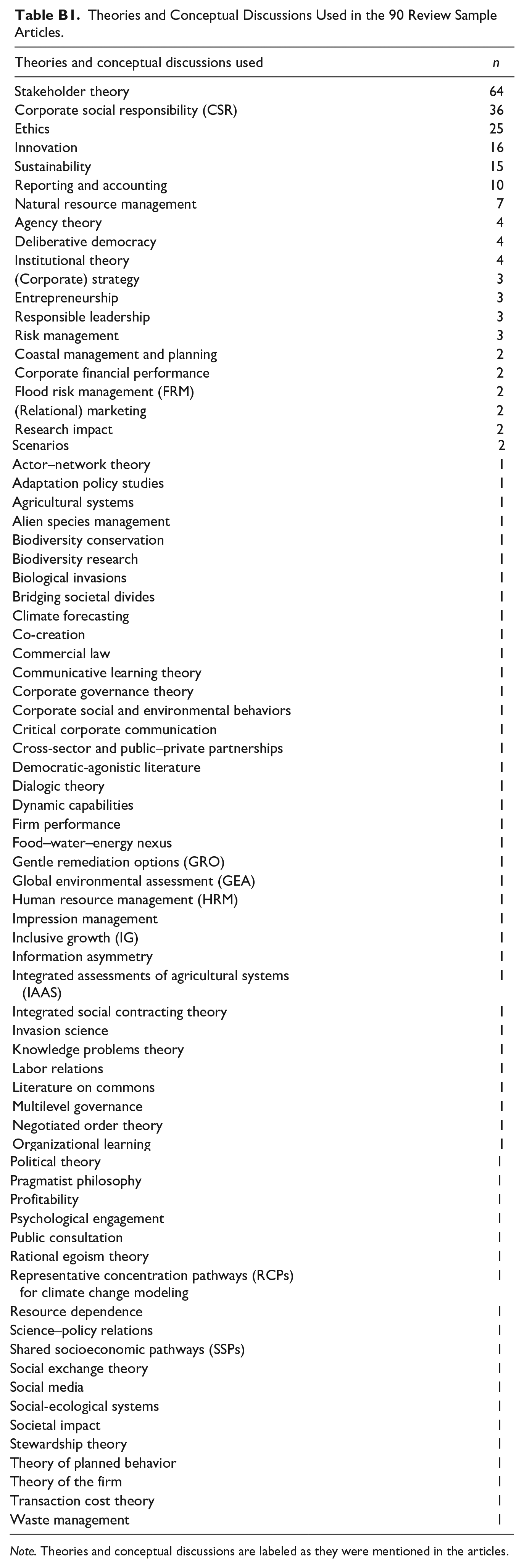
| Theories and conceptual discussions used | n |
|---|---|
| Stakeholder theory | 64 |
| Corporate social responsibility (CSR) | 36 |
| Ethics | 25 |
| Innovation | 16 |
| Sustainability | 15 |
| Reporting and accounting | 10 |
| Natural resource management | 7 |
| Agency theory | 4 |
| Deliberative democracy | 4 |
| Institutional theory | 4 |
| (Corporate) strategy | 3 |
| Entrepreneurship | 3 |
| Responsible leadership | 3 |
| Risk management | 3 |
| Coastal management and planning | 2 |
| Corporate financial performance | 2 |
| Flood risk management (FRM) | 2 |
| (Relational) marketing | 2 |
| Research impact | 2 |
| Scenarios | 2 |
| Actor–network theory | 1 |
| Adaptation policy studies | 1 |
| Agricultural systems | 1 |
| Alien species management | 1 |
| Biodiversity conservation | 1 |
| Biodiversity research | 1 |
| Biological invasions | 1 |
| Bridging societal divides | 1 |
| Climate forecasting | 1 |
| Co-creation | 1 |
| Commercial law | 1 |
| Communicative learning theory | 1 |
| Corporate governance theory | 1 |
| Corporate social and environmental behaviors | 1 |
| Critical corporate communication | 1 |
| Cross-sector and public–private partnerships | 1 |
| Democratic-agonistic literature | 1 |
| Dialogic theory | 1 |
| Dynamic capabilities | 1 |
| Firm performance | 1 |
| Food–water–energy nexus | 1 |
| Gentle remediation options (GRO) | 1 |
| Global environmental assessment (GEA) | 1 |
| Human resource management (HRM) | 1 |
| Impression management | 1 |
| Inclusive growth (IG) | 1 |
| Information asymmetry | 1 |
| Integrated assessments of agricultural systems (IAAS) | 1 |
| Integrated social contracting theory | 1 |
| Invasion science | 1 |
| Knowledge problems theory | 1 |
| Labor relations | 1 |
| Literature on commons | 1 |
| Multilevel governance | 1 |
| Negotiated order theory | 1 |
| Organizational learning | 1 |
| Political theory | 1 |
| Pragmatist philosophy | 1 |
| Profitability | 1 |
| Psychological engagement | 1 |
| Public consultation | 1 |
| Rational egoism theory | 1 |
| Representative concentration pathways (RCPs) for climate change modeling | 1 |
| Resource dependence | 1 |
| Science–policy relations | 1 |
| Shared socioeconomic pathways (SSPs) | 1 |
| Social exchange theory | 1 |
| Social media | 1 |
| Social-ecological systems | 1 |
| Societal impact | 1 |
| Stewardship theory | 1 |
| Theory of planned behavior | 1 |
| Theory of the firm | 1 |
| Transaction cost theory | 1 |
| Waste management | 1 |
Note. Theories and conceptual discussions are labeled as they were mentioned in the articles.
Appendix C
Methodological Characteristics of the 90 Review Sample Articles.
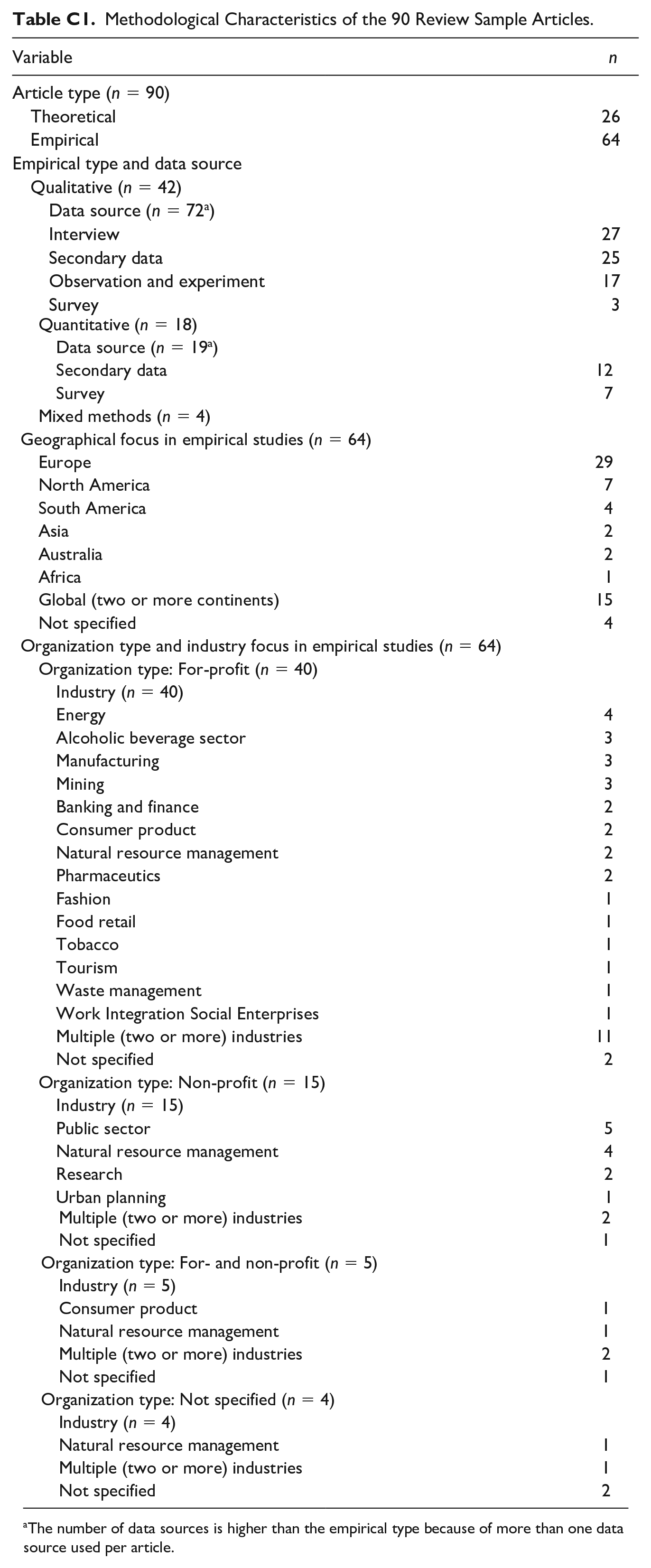
| Variable | n |
|---|---|
| Article type (n = 90) | |
| Theoretical | 26 |
| Empirical | 64 |
| Empirical type and data source | |
| Qualitative (n = 42) | |
| Data source (n = 72 a ) | |
| Interview | 27 |
| Secondary data | 25 |
| Observation and experiment | 17 |
| Survey | 3 |
| Quantitative (n = 18) | |
| Data source (n = 19 a ) | |
| Secondary data | 12 |
| Survey | 7 |
| Mixed methods (n = 4) | |
| Geographical focus in empirical studies (n = 64) | |
| Europe | 29 |
| North America | 7 |
| South America | 4 |
| Asia | 2 |
| Australia | 2 |
| Africa | 1 |
| Global (two or more continents) | 15 |
| Not specified | 4 |
| Organization type and industry focus in empirical studies (n = 64) | |
| Organization type: For-profit (n = 40) | |
| Industry (n = 40) | |
| Energy | 4 |
| Alcoholic beverage sector | 3 |
| Manufacturing | 3 |
| Mining | 3 |
| Banking and finance | 2 |
| Consumer product | 2 |
| Natural resource management | 2 |
| Pharmaceutics | 2 |
| Fashion | 1 |
| Food retail | 1 |
| Tobacco | 1 |
| Tourism | 1 |
| Waste management | 1 |
| Work Integration Social Enterprises | 1 |
| Multiple (two or more) industries | 11 |
| Not specified | 2 |
| Organization type: Non-profit (n = 15) | |
| Industry (n = 15) | |
| Public sector | 5 |
| Natural resource management | 4 |
| Research | 2 |
| Urban planning | 1 |
| Multiple (two or more) industries | 2 |
| Not specified | 1 |
| Organization type: For- and non-profit (n = 5) | |
| Industry (n = 5) | |
| Consumer product | 1 |
| Natural resource management | 1 |
| Multiple (two or more) industries | 2 |
| Not specified | 1 |
| Organization type: Not specified (n = 4) | |
| Industry (n = 4) | |
| Natural resource management | 1 |
| Multiple (two or more) industries | 1 |
| Not specified | 2 |
The number of data sources is higher than the empirical type because of more than one data source used per article.
Acknowledgements
The authors are grateful to the editors of Business & Society for stimulating the journal’s 60th-anniversary special issue and especially for editor Frank de Bakker for guidance along the way. In addition, we thank the anonymous reviewers who offered helpful comments to revise our manuscript and move it along to publication. Finally, the authors thank the research team of the Institute of Strategic Management Stakeholder View of HWZ, University of Applied Sciences for Business Administration in Zurich, and the RESPMAN Responsible Management Research Group at Tampere University for their valuable comments on prior versions.
Declaration of Conflicting Interests
The authors declared no potential conflicts of interest with respect to the research, authorship, and/or publication of this article.
Funding
The authors disclosed receipt of the following financial support for the research, authorship, and/or publication of this article: The authors gratefully acknowledge the financial support from the Academy of Finland (decision number 298663) and the Strategic Research Council at the Academy of Finland (decision numbers 320194 and 320206).
Author Biographies

.