




Abstract
Using Giddens’s structuration theory and empirical data from a study with social enterprise stakeholders, the article explores how social entrepreneurs and the structure co-create one another. We show that the development of the contemporary significance of social entrepreneurialism lies in a combination of complex context-specific structural forces and the activities of agents who initiate, demand, and impose change. Social entrepreneurs intentionally tackle social challenges, but their actions bring unintentional results, such as the transfer of state responsibilities onto communities. Direct outputs of their activities introduce indirect outcomes, bringing wider changes in culture and policy. The evolving nature of entrepreneurship and a number of factors that interplay in time and space, and enable and constrain social entrepreneurs, confirm the applicability of Giddens’s theory in the field of social entrepreneurship. The originality of this article derives from revealing mechanisms that enable social entrepreneurs to emerge and reasons for structural change. We also build a “co-creation model of structure and agency” that can be used to “engineer” the process of social entrepreneurship.
“There is the expression of selfishness and there is the expression of selflessness—but economists or theoreticians never touched that part. They said: ‘Go and become a philanthropist’. I said, ‘No, I can do that in the business world, create a different kind of business—a business based on selflessness’.”
Muhammad Yunus, one of the world’s most famous social entrepreneurs and civil society leaders, became an icon and an advocator of social entrepreneurship—an enterprise activity with social goals, generating profit for reinvestment in the social venture (Mair & Marti, 2006) that links efforts to resolve poverty, inequality, and other social malaises with entrepreneurial approaches (Markman et al., 2019). The selfishness of entrepreneurs has been challenged by the selflessness of social entrepreneurs—“actors”/“agents” motivated to address social problems using entrepreneurial techniques (Austin et al., 2006), who contribute to social capacity-building, with economic development as an adjunct rather than a primary focus (Sharir & Lerner, 2006). Unlike commercial entrepreneurs, social entrepreneurs combine entrepreneurial flair with a commitment to supporting communities (Parkinson & Howorth, 2008) through addressing and mitigating inequalities. As such, rather than being perceived as philanthropists, they represent a particular type of entrepreneur with specific business and social motivations and spheres of operation (Acs et al., 2013).
Over the last 20 years, there has been growing interest in social entrepreneurs, the processes they are immersed in, the activities they are involved in and the ventures they create (Bacq et al., 2016; Dees, 1998; Littlewood & Holt, 2018). The number of those identified as social entrepreneurs has significantly increased in recent years (Bosma et al., 2016; Organisation for Economic Co-operation and Development [OECD], 2017). Indeed, while realizing that governments alone are not able to effectively tackle all public problems (Chliova et al., 2020; Markman et al., 2019; Porter & Kramer, 2011), the importance and potential of social entrepreneurs in combatting social challenges have been acknowledged in many policy documents in developing and developed countries (Steiner et al., 2019). Described by Bill Drayton as “governments’ best friends,” 1 social entrepreneurs have begun to receive national and international financial support (Mazzei & Steiner, 2020; Vanderhoven et al., 2020). From having been a fairly unknown field situated at the edge of business and entrepreneurship, a potential contribution of social entrepreneurship in enhancing the sustainability of our planet and societies has been acknowledged internationally with social entrepreneurs seen as actors that can contribute to tackling many wicked global problems, including poverty, hunger, water-shortages, social and economic inequality, and climate change (Ashoka, 2021). A testimony of the growing importance of social entrepreneurship is expressed through, for example, the United Nations’ (UN) “World Youth Report: Youth, Social Entrepreneurship and the 2030 agenda,” which promotes youth social entrepreneurship as part of the Sustainable Development Goals (UN, 2018), as well as organizations such as the OECD and the European Union that started working together to boost social entrepreneurship and ensure “smart, sustainable and inclusive growth” (OECD, 2013). Indeed, a growing number of transnational organizations as well as national and regional governments create policies, strategies, support and investment mechanisms, and a variety of incentives to facilitate social entrepreneurship. One challenge in this domain is that such documents and interventions are frequently developed without a clear understanding of the emergence of social entrepreneurs. This is surprising considering a political and public appetite to grow the number and influence of social entrepreneurs (Ashoka, 2021; OECD, 2013; UN, 2018). Indeed, we believe that academic research has a role to play in informing policy and practice, and, considering underpinnings of structuration theory, we offer an explanation of mechanisms that enable social entrepreneurs to emerge and reasons for structural change. We also build a “co-creation model of structure and agency” that can be used to “engineer” the process of social entrepreneurship.
Our article recognizes that, as a growing phenomenon, social entrepreneurship has been researched and described in many studies. A high volume of academic work has focused on who social entrepreneurs are and what they do (Bacq et al., 2016; Mottiar et al., 2018; Sharir & Lerner, 2006; Stephan & Drencheva, 2017), their highly collaborative nature (Perrini et al., 2010), how they manage the tensions they experience (Di Domenico et al., 2010; Smith & Besharov, 2019), how they make sense of these tensions (Child, 1997), and how they may experience challenges, crises, or mission drift (Battilana & Dorado, 2010; Ometto et al., 2019; Ramus et al., 2018; Renko, 2013; Tykkyläinen & Ritala, 2021). A detailed literature review of all these dimensions is beyond the scope of this article. We note, however, that in current discussions, questions arise over how social entrepreneurs emerge (Bacq et al., 2016) and how they interact with the environment in which they operate (Engelke et al., 2016; Littlewood & Holt, 2018). Indeed, Stephan and Drencheva (2017) criticize existing studies in the field for omitting the importance of context and call for research to systematically explore interactions between the environment and social entrepreneurs. Given that policymakers and communities see the importance of social entrepreneurs and their role in developing innovative solutions that address social problems, addressing this call is essential.
In addition to pragmatic matters associated with policy and practice, there are also calls for theoretical developments in the field of social entrepreneurship (Parhankangas & Renko, 2017; Rawhouser et al., 2019; Sarason & Dean, 2019; Zahra et al., 2009). Indeed, (commercial) entrepreneurship studies have attracted a number of theories including, for example, the Theory of Effectuation (Sarasvathy, 2001), the Feedback Loop Theory (Ries, 2011), the Jack-of-all-Trades Theory (Cho & Orazem, 2014), the O-Ring Theory (Kremer, 1993), the Theory of Resources and Capabilities (Helfat & Peteraf, 2003), the Theory of the Optimal Triangle (Saiz-Álvarez, 2020), Institutional Theory (Brieger et al., 2021), Social Practice and Critical Theories (Feldman, 2004; Sarason & Dean, 2019). Although social entrepreneurship research is becoming more theoretically rigorous (Ebrashi, 2013; Germak & Robinson, 2014; Santos, 2012; see also Pangriya, 2019), as a relatively new field of enquiry, it still has further to develop (Markman et al., 2019; Rawhouser et al., 2019). For example, when describing social entrepreneurs, very few studies apply theory when presenting empirical findings, treating the two—theory and practice—separately. The latter particularly applies to studies investigating the emergence of social entrepreneurs. However, in this article, we show that “theories have the potential to explain a phenomenon” (Crane et al., 2016, p. 784) and that applying a theoretical lens to the study of social entrepreneurs helps identify patterns in complex social interactions and explain, in a systematic way, ambiguous processes associated with the emergence of social entrepreneurs and changes occurring in time and space. Here, we integrate theory and empirical data, and address presented gaps in knowledge. By doing so, we lay the theoretical foundations for future studies to further develop and/or challenge the findings in the social entrepreneurship field.
Using existing knowledge in the field and primary data, we build evidence of how social entrepreneurs co-construct wider environment and context (i.e., structure) and how the environment/structure in which they operate shapes their activities. We apply Giddens’s (1984) structuration theory and work on entrepreneurial embeddedness (Granovetter, 1985), and considering the two to be interdependent, we question: What is the impact of social entrepreneurs on the structure? and How does the structure influence the activities of social entrepreneurs? We explore, therefore, a duality in how social entrepreneurs and structure co-construct each other.
Considering structure as a set of rules and resources within social systems, we apply Giddens’s (1984) theoretical underpinnings to empirical data collected in Scotland—a country frequently praised for creating a vibrant social enterprise environment (Steiner & Teasdale, 2019). We show that the emergence of social entrepreneurs is related to contextual factors and that social entrepreneurs are simultaneously actors within, and creators of, the social entrepreneurship movement (Giddens, 1984). A duality whereby the agent (social entrepreneur) and the structure (social system/the context) co-construct each other is apparent in evidence from our study, demonstrating the applicability of Giddens’s (1984) theory in the field of social entrepreneurship.
Our study contributes to the entrepreneurship and business literatures in several significant ways. We respond to calls for a better understanding of social entrepreneurs and research in the field to enrich theory building (Markman et al., 2019; Rawhouser et al., 2019; Zahra et al., 2009). We show appreciation of Sarason et al.’s (2006) remarks stating that “the presentation of structuration theory offers a robust, and hereto underrepresented, perspective of the entrepreneurial process” (p. 286). Using structuration theory, we challenge, on one hand, interpretative sociologies that accord actions and meanings primacy in the explication of human conduct (i.e., an imperialism of the subject) and, on the other hand, functionalism, in which structure has primacy over action (i.e., an imperialism of the social object; Giddens, 1984). We show that human social activities are recursive and agents reproduce the conditions that make specific actions possible. As social systems embrace regularized relations of interdependence between individuals or groups, they should be analyzed as recurrent social practices. Social systems, described as the situated activities of human objects, exist in the flow of time. They produce structures that are characterized by the absence of a subject and which make actions possible. Every process of action produces something new—each existing in continuity—with the past supplying the means of initiation, making the emergence and popularity of social entrepreneurs possible (Figure 1).
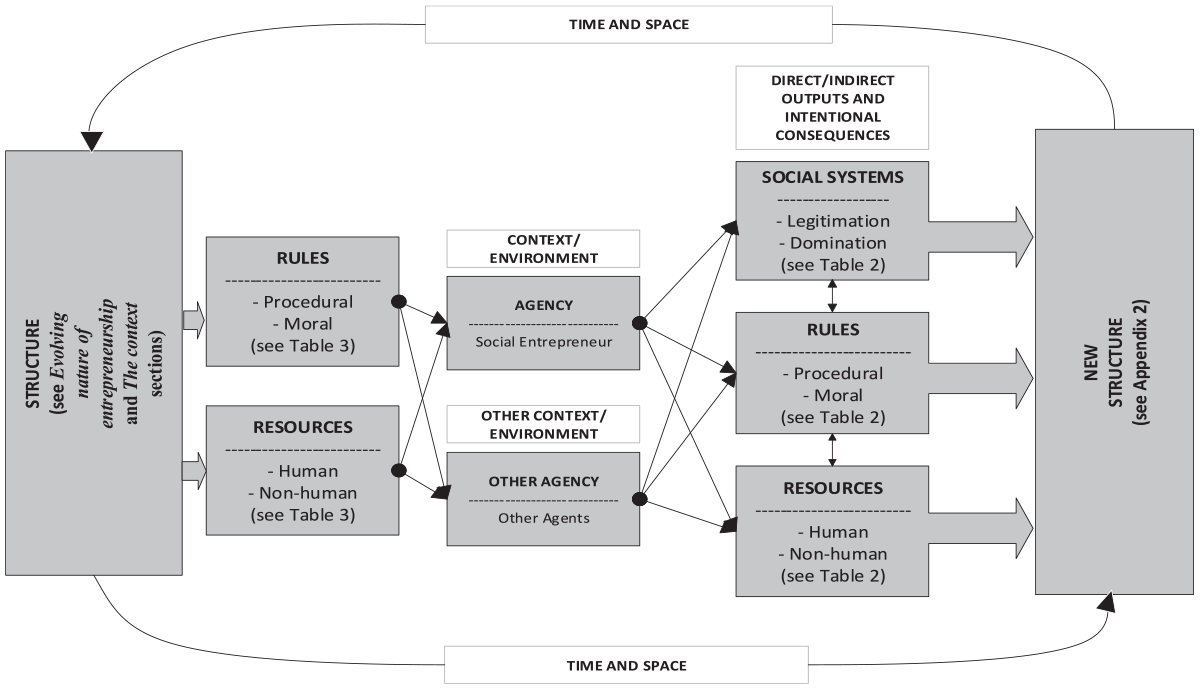
Co-creation model of structure and agency.
We explore Welter’s (2011) findings indicating that “context is important for understanding when, how, and why entrepreneurship happens and who becomes involved” (p. 165). We also respond to De Bruin and Lewis’s (2015) suggestion that the ways in which context and enactment interact are worthy of exploration and Sarason et al.’s (2006) recommendation that when considering entrepreneurial activities, it “is necessary to employ a theoretical lens that accounts for both individual and structural elements” (p. 303). Indeed, we show the importance of the context in which social entrepreneurs operate and how, to build and strengthen their own ventures and create social value, they rely on local networks and resources. Importantly, we note that the context should not be perceived as a barrier to action. In line with structuration theory, we show that the structure simultaneously enables and constrains social entrepreneurship, with social entrepreneurs being present in a variety of contexts (Stephan et al., 2015; Stervinou et al., 2021), including developing and developed counties and different political systems with different business support (Bosma et al., 2016).
Like Parkinson and Howorth (2008), we acknowledge the complexity of the studied subject but taking an exploratory approach means that our findings are driven by the experiences of social entrepreneurs and other stakeholders. We note that, through advancing knowledge in the field and offering explanations of the increasing importance of social entrepreneurship, as well as factors underlying the changing nature of entrepreneurs and the emergence of social entrepreneurs, our findings can assist in developing policies aimed at supporting social entrepreneurs. Understanding mechanisms that enable social entrepreneurs to emerge and reasons for structural changes can also help design more efficient interventions and anticipate the future development of social entrepreneurship.
Evolving Nature of Entrepreneurship
Entrepreneurship, Entrepreneurs, and the Operating Environment
Entrepreneurship is a process that depends on individuals and the ways in which they enact their environment (Hessels et al., 2008). Personal characteristics as well as the context and its influence can affect the shape of entrepreneurial behavior (DeBruin & Lewis, 2015). As a result, there are many kinds of entrepreneurs with a number of values that differentiate them; for example, entrepreneurs differ systematically in their willingness to forego private payoffs to avoid loss to others (Weitzel et al., 2010) and have a variety of motives that reflect economic as well as noneconomic goals.
In one way, and as highlighted by Mottiar and colleagues (2018), “the literature is dominated by the supposition that traditional entrepreneurs are almost exclusively motivated by self-interest; especially in regard to maximising profit, and an individual’s personal utility” (p. 78). Many entrepreneurs act ingeniously to increase personal wealth, power, and prestige without considering the effects of their activities on others and the wider economy (Weitzel et al., 2010). As such, Hessels et al. (2008) state that “hardly anybody starts a business in order to achieve innovation, job creation, or economic growth at the national level. Instead, people desire personal profits, or autonomy” (p. 324). Murphy et al. (1991) refer to entrepreneurs focusing on “the highest private returns, which need not have the highest social returns” (p. 506), and Weitzel et al. (2010) identify a group of entrepreneurs who behave selfishly and are likely to accept collateral damage by practicing privately profitable, but socially unproductive or even destructive, activities. Despite this, entrepreneurship can be socially embedded (Jack & Anderson, 2002) and, as a “social undertaking,” the phenomenon should be understood within the context of social systems (Sarason et al., 2006).
Enacting the environment involves an understanding of the rules and social systems that shape the practices of that environment (Zahra et al., 2009). These give meanings and values to the structure in which entrepreneurs operate and influence how they function. For instance, the social structure can affect resources for entrepreneurship by encouraging resource allocation, making resources available or withholding them (Jack, 2010). In their study, for example, Bhatt et al. (2019) comment on how institutions interact with social entrepreneurship, emphasizing that Western and non-Western institutional contexts may differ significantly in terms of the roles of market, state, and other institutional structures. For example, the popularity of social entrepreneurship has led to supportive regulatory and new legal forms of low-profit limited liability and flexible-purpose corporations in the United States, community interest companies in the United Kingdom, and community contribution companies in Canada; on the other hand, in China, social entrepreneurs face unique challenges associated with a lack of support for social enterprises. More specifically, the norms of actors dominating the social space (e.g., government) leave little place for social enterprises; non-supportive and unclear rules and regulations along with fear of violating them act as a deterrent to starting social enterprises; and deeper sociocultural values and beliefs prioritize materialism and lead to social issues becoming “orphans” and lacking traction, thereby deterring social enterprises and their goals. (Bhatt et al., 2019, p. 618)
At the same time, however, the authors provide suggestions as to how social entrepreneurs may engage with purposive activities to overcome such challenges. Importantly, the operating environment is multidimensional and can also relate to a more localized context: for example, unique social norms, beliefs, power structures and hierarchies that accentuate resource challenges for social entrepreneurs can exist in specific geographical rural and urban areas (Hota et al., 2019). Nevertheless, in many cases, despite challenging conditions, social entrepreneurs assemble resources and, by breaking social norms, combine and align principles of business strategy and social value creation to bring economic and social change. Although challenging socially constructed norms can be difficult, refusal to follow what “has always been done” can lead to success (Sarkar, 2018, p. 437).
The above discussion suggests that when exploring how social entrepreneurs impact their environment and how the environment shapes their activities, recognition should be given to the social context, the embedded nature of entrepreneurial behavior (Granovetter, 1985; see also a discussion about agency, social embeddedness and embedded agency by Qureshi et al., 2021, and links between agents and structure, Giddens, 1984).
Emergence of “Social” in Entrepreneurship
Economic challenges within communities drove the emergence and proliferation of “good entrepreneurs” involved in societal development (Gonzalez-Rodrıguez et al., 2015). Alongside the movement towards corporate social and environmental responsibility, we observe that frequently, entrepreneurship is becoming more socially aware. Indeed, the number of entrepreneurial firms embracing sustainable operations has increased in recent decades (Sarason & Dean, 2019), with entrepreneurship being seen as a way to develop solutions to the world’s biggest challenges in a financially, socially, and environmentally sustainable fashion (Markman et al., 2019). Peredo and Chrisman (2006) also talk about community-based enterprise as a strategy for sustainable local development, with Steiner and Atterton (2015) seeing entrepreneurs as contributors to developing communities and their social, economic, and environmental resilience. Hessels et al. (2008) stress that entrepreneurs introduce novel products that facilitate the lives of customers, indicating entrepreneurs’ potential in creating and changing societal norms to achieve sustainable community development. Indeed, many commercial enterprises have started pursuing purpose beyond profits, seeking to establish and enact societal values (Chliova et al., 2020). As “commercial entrepreneurship can be socially responsible and ethical in practice” (Acs et al., 2013, p. 787), entrepreneurs possess the ability to shape ethical attitudes (Fassin et al., 2011) and create social value in addition to economic value. In some cases, the desire for positive social outcomes is becoming the focus of entrepreneurial activity with entrepreneurship being viewed as a societal and collective phenomenon that is constructed during the social interactions between individuals and their environment (Stervinou et al., 2021). Hence, entrepreneurship evolves and diversifies (Tykkyläinen & Ritala, 2021), with strands of entrepreneurship becoming more social and some entrepreneurs expanding their interests beyond profit generation.
What Do We Know About Social Entrepreneurship and Social Entrepreneurs?
The birth of the term “social entrepreneurship” can be dated back to the 1990s (Dees, 1998). As already highlighted, over the years, it became a popular and rapidly growing area of academic enquiry (McMullen et al., 2020; Sarason & Dean, 2019).
Social entrepreneurship is about exploiting entrepreneurial opportunities for social change and improvement, rather than profit maximization (Nicholls, 2010), and it has been described as the “use of entrepreneurial processes for social purpose” (Parkinson & Howorth, 2008, p. 291): “the activities and processes undertaken to discover, define and exploit opportunities to enhance social wealth by creating new ventures or managing existing organizations in an innovative manner” (Zahra et al., 2009, p. 525), and a process that “creates social value directly through addressing problems” (Acs et al., 2013, p. 788). Indeed, most definitions of social entrepreneurship relate to values, authenticity, stakeholder relationships, change, and the roles of government, charity, and business in society (Sarason & Dean, 2019), emphasizing the impact of entrepreneurial activities and deemphasizing the commercial/noncommercial divide (Markman et al., 2019). Nonetheless, with the concept being described as a “marriage between opposing values” and “the challenge of balancing social and commercial objectives” (Tracey & Phillips, 2007, p. 267), it has been suggested that due to significant differences in modi operandi, knowledge about commercial entrepreneurship might not apply to social entrepreneurship (McMullen et al., 2020).
Enacting social entrepreneurship, social entrepreneurs have become highly visible agents of change, with their work being described as a “panacea to failure in market and state mechanisms” (Parkinson & Howorth, 2008, p. 292) and a way “to overcome many types of pressing societal issues through innovative products and services previously overlooked by the private and public sectors” (Weerawardena et al., 2021, p. 762). In this context, social entrepreneurs “identify and exploit market opportunities and assemble the necessary resources in order to develop products and/or services that allow them to generate entrepreneurial profit for a given social project” (Tracey & Jarvis, 2007, p. 671).
Social entrepreneurs create “hybrid organisational entities” (Weerawardena et al., 2021, p. 763) and work towards a merged value proposition that blurs the traditional view that the creation of economic value is separate from its social equivalent; indeed, social impact is not only a result of operational processes but an integral part (Nicholls, 2010). Decisions and actions of social entrepreneurs need to account for creating economic and social value, and their work must focus on business efficiency as well as social effectiveness (Ostertag et al., 2021). Noting complexity in the field, it is not surprising that Thompson (2002) highlights confusion when identifying social entrepreneurs, with some who might be described in this way not recognizing themselves as such. It might be that the difficulties in identifying social entrepreneurs derive from a substantial heterogeneity in their personalities, as noted by Stephan and Drencheva (2017) in their systematic review of 50 articles about social entrepreneurs. The review indicates the diversity in motivations and identities of different types of social entrepreneurs who frequently take different decisions about organizational goals, legal forms, accessing resources, growth strategies, markets, clients, and beneficiaries. Although more recent academic contributions have begun to develop our understanding about social entrepreneurs (Bacq et al., 2016), most of the existing studies research social entrepreneurs “without consideration of context,” and there are calls to systematically explore interactions between the environment and how it shapes socially entrepreneurial actions (see Stephan & Drencheva, 2017, for detailed literature review of social entrepreneurs and research gaps). Indeed, understanding the context in which social entrepreneurs operate is crucial considering the socio-commercial hybridity of their organizations (Battilana & Dorado, 2010) and the resource-constrained environment to which social entrepreneurs are exposed. The former implies that in social-business hybrids, tensions around the divergent goals, competing demands, structures, practices, and identities associated with social and business missions are likely to appear. Nevertheless, hybridity can be sustained by stability and adaptation taking place at the same time, with adaptation creating a response to potential tensions experienced by social entrepreneurs (Smith & Besharov, 2019). For instance, through practicing “social bricolage” (undertaken out of necessity or through personal choice; Desa & Basu, 2013), social entrepreneurs refuse to be constrained by resource limitations and use their governance and stakeholder networks to access and construct resources, and deploy persuasive tactics to build legitimacy and financial sustainability (Di Domenico et al., 2010; Hota et al., 2019). With this in mind, even among the poorest populations, there is a reservoir of potential entrepreneurs capable of producing efficient solutions to pressing social problems (Sarkar, 2018). Indeed, “the lack of resources pushes social entrepreneurs to use all available means to acquire unused or underused resources that are capable of being leveraged in a different way to create social value” (Di Domenico et al., 2010, p. 699). As such, social entrepreneurs who have well-developed networks and skillfully present their dedication and commitment are more likely to access resources to succeed. At the same time, however, social entrepreneurs without access to “privileged social networks” or the “bank of mum and dad” might miss out on potential support and, therefore, growth opportunities (Steiner & Teasdale, 2016). Again, the latter shows the significance of the environment in which social entrepreneurs are embedded, with those who engage different internal and external stakeholders in socially entrepreneurial decisions being able to benefit from the adoption of innovations that help balance commercial and social performance (Ramus et al., 2018). In a similar vein, Ciambotti and Pedrini (2021) show that although hybrid organizations that combine the for-profit and nonprofit domains continuously face various resource constraints, social entrepreneurs use this hybridity, translating it into opportunity through social partnerships, social networking, local cluster development, customer empowerment, and inclusive employment.
Considering the above remarks as well as ongoing calls for further research considering and contributing to theoretical developments in the field (Rawhouser et al., 2019), we identify theoretical underpinnings that help understand how social entrepreneurs and the structure co-create one another.
Searching for Theoretical Underpinnings in the Field
As an academic field, when compared with commercial entrepreneurship, social entrepreneurship is still very much in its infancy. Although in recent years some studies have begun to propose and/or experiment with the use of theories when investigating social enterprise (e.g., social enterprise stakeholders’ theory, Gonin et al., 2013) and social entrepreneurship (e.g., behavioral theory of social entrepreneurship, Ebrashi, 2013), very few studies have researched the activities of social entrepreneurs and their relation with the environment in which they operate through a theoretical lens (Germak & Robinson, 2014).
One theory that has been cited as particularly useful for studying social entrepreneurs and their embeddedness (Granovetter, 1985) is structuration theory. Importantly, while recognizing the importance of other theories in the field, Mair and Marti (2006) suggest that “structuration theory provides a promising lens to examine how the context enables and constrains the appearance of social entrepreneurship and how social change occurs” (p. 40). Indeed, by its very definition, social entrepreneurship is about agency to change the status quo (Mair and Marti, 2006; Zahra et al., 2009) and research exists on how formal and informal institutions, as elements of structure, influence social entrepreneurship (Stephan et al., 2015), as well as how agency and structure interact (Chliova et al., 2020). Despite this, the role of agency and structure, and their interaction in social entrepreneurship is rarely analyzed through the lens of structuration theory (Steinerowski & Steinerowska-Streb, 2012). The latter might be because structuration theory “provides little guidance on how to investigate the way in which everyday action revises or reproduces structure” (Barley & Tolbert, 1997, p. 112). Frequently perceived as being “not easy to apply empirically” (Whittington, 2010, p. 145), structuration theory “largely remains a process theory of such abstraction that it has generated few empirical studies” (Barley & Tolbert, 1997, p. 93).
In this article, we address calls to apply Giddens’s (1984) structuration theory (Mair & Marti, 2006), using it as an analytical framework for our empirical data analysis. Given that “structuration theory offers a more subjective or reflexive ontological view . . . opens new ways about thinking of the entrepreneurial process that has been historically absent from the literature . . . [and] presents an alternative to the positivists’ and post-positivists’ perspectives that have dominated the field (Sarason et al., 2006, p. 290),” in this article, we use structuration theory to better understand the emergence of social entrepreneurs and how changes in the structure occur.
Application of Giddens’s Structuration Theory
Structuration Theory
In structuration theory, Giddens (1984) explains that structure is not definitive but forming and re-forming. Agency is not only shaped by the structure but also, over time, able to reconstruct and influence structure. Every process of action produces something new: each existing in continuity, with the past supplying the means of initiation. As a consequence, prior interactions influence the way people interact today. Thus, the structure simultaneously enables and constrains current processes. Therefore, both continuity and change take place.
Agents
Agency relates to human action. Giddens (1984) acknowledges the duality of agents; they can explicitly make choices, but equally their actions can be driven by “subconscious” norms, rules, and cultural attitudes (i.e., aspects of “the structure”). Simultaneously, agents influence and shape the structure. The action of agents depends on the knowledge and the interpretation(s) of knowledge they hold; this informs their action which reproduces social structures and enforces (or changes) the dynamics of action.
In their actions, agents follow “rules” (Sewell, 1992, calls these schemas) and are facilitated and/or restrained by “resources”; agency arises from the actor’s (conscious or unconscious) control of resources. The existence of agency ensures the existence of structure (i.e., without human actions, there would be no structure). All humans possess a capacity for agency (e.g., forming intentions, acting creatively). This capacity for agency, however, is limited (e.g., agency is formed by specific cultural roles/schemes and resource availability, Sewell, 1992).
Structure
Giddens (1984) suggests that structure consists of rules and resources organized as properties of social systems and produced and reproduced in social interaction. Rules can be regarded as patterns that people follow and “generalisable procedures applied in the enactment/reproduction of social life” (Giddens, 1984, p. 21). Rules have the ability to generate social practices and social systems. Resources include human-generated resources (e.g., physical strength, knowledge, and emotional commitments) and non-human resources (e.g., objects, animate or inanimate, naturally occurring or manufactured). Both types of resources are media of power and are unevenly distributed throughout society. Finally, social systems are formed by the patterns of enacted conduct, the repeated forms of social action and interaction, or the “enduring cycles of reproduced relations” (Giddens, 1984, p. 131). Structures enable social action and, simultaneously, social action creates, recreates, and changes structures.
Structure is enacted by practices that are informed by procedural rules (i.e., “rules” about how the practice is performed) and moral rules (i.e., “rules” about appropriate forms of enactment of social action). All structures are formed and informed by practices and enacted human conduct which maintain and reproduce these structures. If enacted forms of conduct change, either because individuals make conscious decisions to change, or through less conscious forms of adjustment, adaptation, and practice, then this can result in structural change.
Giddens (1984) recognizes three elements of structures in social systems: legitimation structures, which provide the evaluative criteria around norms; domination structures, which relate to power (control) over resources (both material and human); and signification structures, which facilitate meaning in social interactions. While any social system incorporates all three types of structures, in our data analysis, we directly refer to legitimation structures and domination structures, with signification structures being evident as they reflect the “meaning” captured from the interviewed social entrepreneurs. Indeed, Giddens recognizes the intersection and tension between different social systems—an aspect that has been frequently neglected in previous studies (Whittington, 1992).
Time and Space
Time and space are two aspects of Giddens’s (1984) theoretical perspective that are significant to structure and agency. Space is formed by social systems enacting (i.e., is the area in which the structure is formed and re-formed). Agents make structure, and the structure influences agents in space. Time is a product of the changes that take place as structure is enacted and adapted and as it evolves and collides with people in the production of events. Space and time are of interest in our study as the research took place in Scotland (representing a specific sociopolitical context) and explored social entrepreneurs’ activities at a particular stage in time when the concept of social entrepreneurship started becoming increasingly popular.
Methodology and Research Design
The Context
Around the globe, social entrepreneurship is increasingly being promoted as one way to address social problems. The way in which entrepreneurship operates depends, however, on the economic environment within any given country (Acs et al., 2008). At the U.K. level, as a result of public-spending cuts, ongoing financial pressures on the public delivery system, and demographic changes, social enterprises have become important players and contributors to public policy and are increasingly looked on to provide a proportion of social services (Teasdale et al., 2012). In Scotland, one of the four U.K. countries, responsibility for developing social enterprise policies lies with the devolved Scottish Government.
Social enterprises are seen by Scottish policymakers as “key to the sustainable delivery of public services” (Scottish Government, 2016, p. 14). Indeed, with the downsizing of its welfare state and the introduction of increasingly neoliberal policies (Markantoni et al., 2018), Scotland presents an example of a state where the growth and development of social enterprises is being emphasized, almost as a necessity, by policymakers at all levels (Steiner & Teasdale, 2019). This is part of a neoliberal shift concerning the way in which public services are to be delivered in the future (Farmer et al., 2008). The intention is to reduce reliance on the welfare state and build the capacity of communities and individuals to become more responsible for their own destinies (Muñoz et al., 2015). As a consequence, social entrepreneurs—described in Scottish policy documents as individuals “driven by an overriding passion to improve the world in which they live” who “. . . are making a difference, in big ways and small, . . . can-do people . . . introducing new ways of tackling social issues . . . offering inspiration and impetus that can bring about wider changes in . . . public services and society” (Scottish Government, 2016, p. 29)—are expected to play a more prominent role in addressing a range of social issues.
In Scotland, a country of just more than 5 million people, there are more than 6,000 social enterprises generating 88,000 full-time equivalent jobs and an annual income of £4.4 billion (Social Enterprise Census, 2019). Scotland’s economic strategy recognizes social enterprises as important contributors to a balanced economy, with diversified businesses that help achieve sustainable economic growth and tackle inequality (Scottish Government, 2015). Together with a 10-year social enterprise strategy (Scottish Government, 2017), Scotland’s national policies aim to create an environment in which social entrepreneurship can thrive. This context offered an interesting environment in which to investigate how social entrepreneurs and structure impact each other. Data presented in this article were collected in the Scottish Highlands—a region with the highest number of social enterprises per capita in Scotland (Social Enterprise Census, 2019). The study was funded by Highlands and Islands Enterprise—a public agency interested in social enterprise development and responsible for strengthening communities as well as building economic development in the north of Scotland. The study looked at promoters of and barriers to social enterprise and the activities of social entrepreneurs. The primary data generated enabled us to discuss how social entrepreneurs and the structure co-create one another.
Research Design
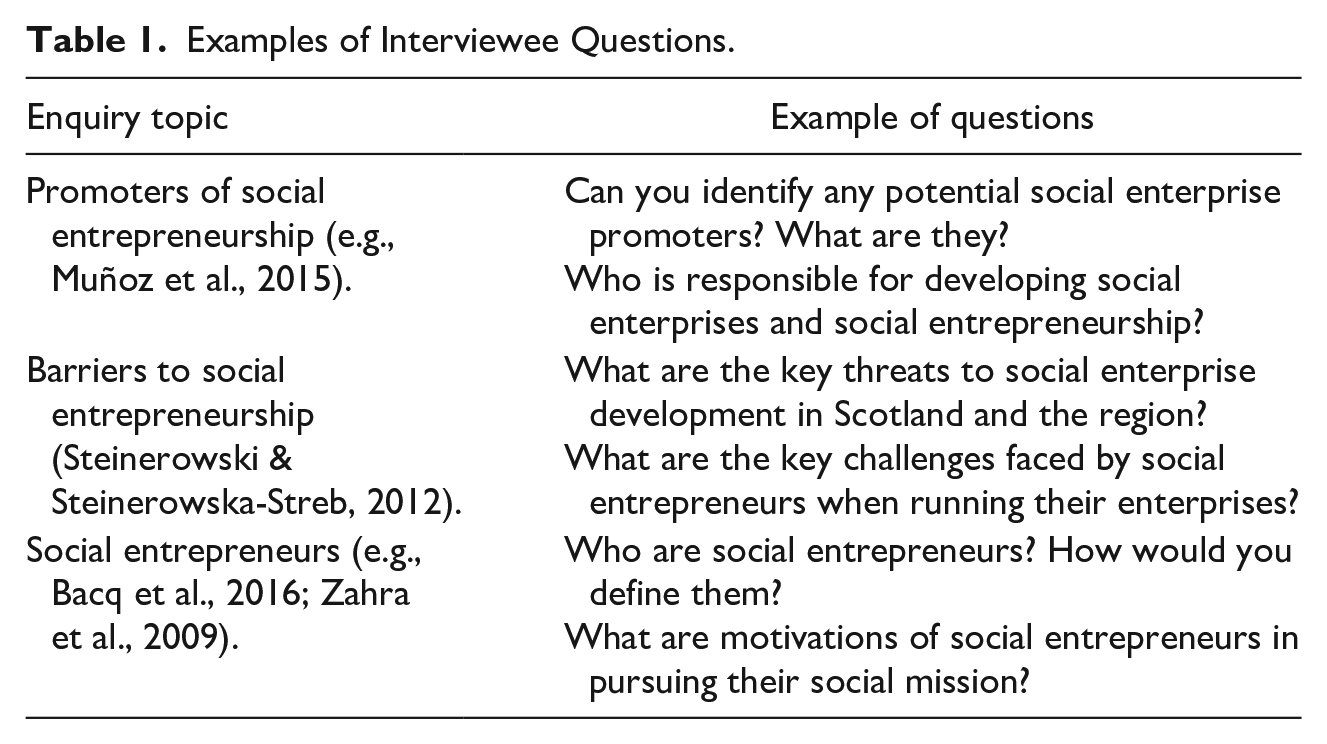
This study used an exploratory approach and multiple qualitative methods including interviews and focus groups (FGs). Qualitative methods were selected as they “produce a wealth of detailed information” about people and processes (i.e., key aspects of our investigation; Patton, 1990, p. 14), are well-suited to building an understanding of phenomena that are not well-understood (Marshall & Rossman, 1995), and contribute to developing existing theory “by pointing to gaps and beginning to fill them” (Siggelkow, 2007, p. 21). Face-to-face, semi-structured interviews enabled a focus on the main topics, while allowing for elaboration of who, why, and how questions (Davidsson, 2004), examining feelings and attitudes “according to the interests, experiences and views of the interviewees” (Valentine, 2005, p. 111). A topic guide for data collection was developed based on a literature review of the area under investigation, with enquiry topics and example questions presented in Table 1.
Examples of Interviewee Questions.
Snowball sampling was used to identify interviewees, with the contact details of an initial six social enterprise stakeholders—locally recognized as experts in the field—being provided by a local social enterprise development. All interviewees were first contacted via email, offering a brief description of the study and a request for consent to interview. Those who agreed to be interviewed provided contact details for potential new interviewees familiar with running and/or supporting the activities of social enterprises (i.e., those with life-experience and knowledge of our topics of enquiry). All interviews were conducted by the lead researcher in the respondents’ workplaces. The semi-structured nature of the interviews facilitated flexible and relaxed conversations between the researcher and respondents, enabling rapport-building and fostering willingness to contribute to consecutive stages of the study (i.e., FGs). During the interviews, brief notes of key points were taken to enable follow-up as the interview progressed.
Simultaneous data collection and ongoing data analysis enabled the team to “discover” the point of theoretical saturation (Davidsson, 2004), defined here as “the point at which no new information or themes are observed in the data” (Guest et al., 2006, p. 59). In total, 35 in-depth, semi-structured interviews (lasting 40–60 min) were conducted with four categories of social enterprise stakeholders: 10 social entrepreneurs (i.e., our study subject; here defined as individuals who set up social enterprises; denoted in this article as SE); 15 managers, employees, and volunteers working in social enterprises delivering a variety of services and products (MSE; a group of social enterprise stakeholders directly supporting social entrepreneurs in pursuing their goals); five health and social care professionals interested in entrepreneurial community health and care service coproduction (HCP); and five politicians responsible for developing regional support structures for social enterprises (P) (see Appendix A for detailed characteristics of interviewees). This diversity of stakeholders allowed the inclusion of perspectives from those with reflective views on social entrepreneurs. Single researcher interviewing helped overcome potential inter-interviewer problems with reliability. Nonetheless, data collection completed by only one researcher could be influenced by unconscious beliefs and, as such, be subjective. To overcome this issue and to verify and extend interview findings, we conducted three FG discussions.
FG participants were randomly selected using contact details gathered during the first stage of the study. Each FG had between five and eight participants, lasted 3 hr, and began with a brief presentation of the interview findings, given by the researcher. The FGs were heterogeneous (i.e., with different social enterprise stakeholders), possessing varying experiences and opinions. All FG participants were asked to comment on the presentation, adding or challenging presented findings. As such, FGs relied on a free-flowing conversation rather than a prescribed and structured discussion. This enabled diverse lines of argument and enthusiastic conversation among participants in an open space. Engagement of study participants in interviews and, thereafter, FGs allowed deep immersion in participants’ experiences, offering a fruitful opportunity for theory building (Dyer & Wilkins, 1991).
Interviews and FGs were recorded, with consent, and subsequently transcribed, generating a large amount of data and 595 pages of transcripts. All transcripts were read by the lead researcher, and samples were also independently read by the co-authors. Emerging themes were discussed and consensus reached on an initial coding schedule. This formed the basis for systematic analysis of transcripts using N-Vivo qualitative data software that assisted in developing tree nodes and grouping related themes (Gibbs, 2002). Although key themes included promoters and barriers to social entrepreneurship and the characteristics of social entrepreneurs, as our data analysis progressed, new themes emerged and a tree structure developed (e.g., participants talked about the impact of social entrepreneurship on the local community, service delivery, and the changing nature of entrepreneurship; see Table 2). Although the anonymity of participants was preserved throughout the data processing and presentation processes, the coding system indicated stakeholder group so that these could be aligned with emerging themes.
Social Entrepreneurs/Agents’ Ability to Co-create the Structure.
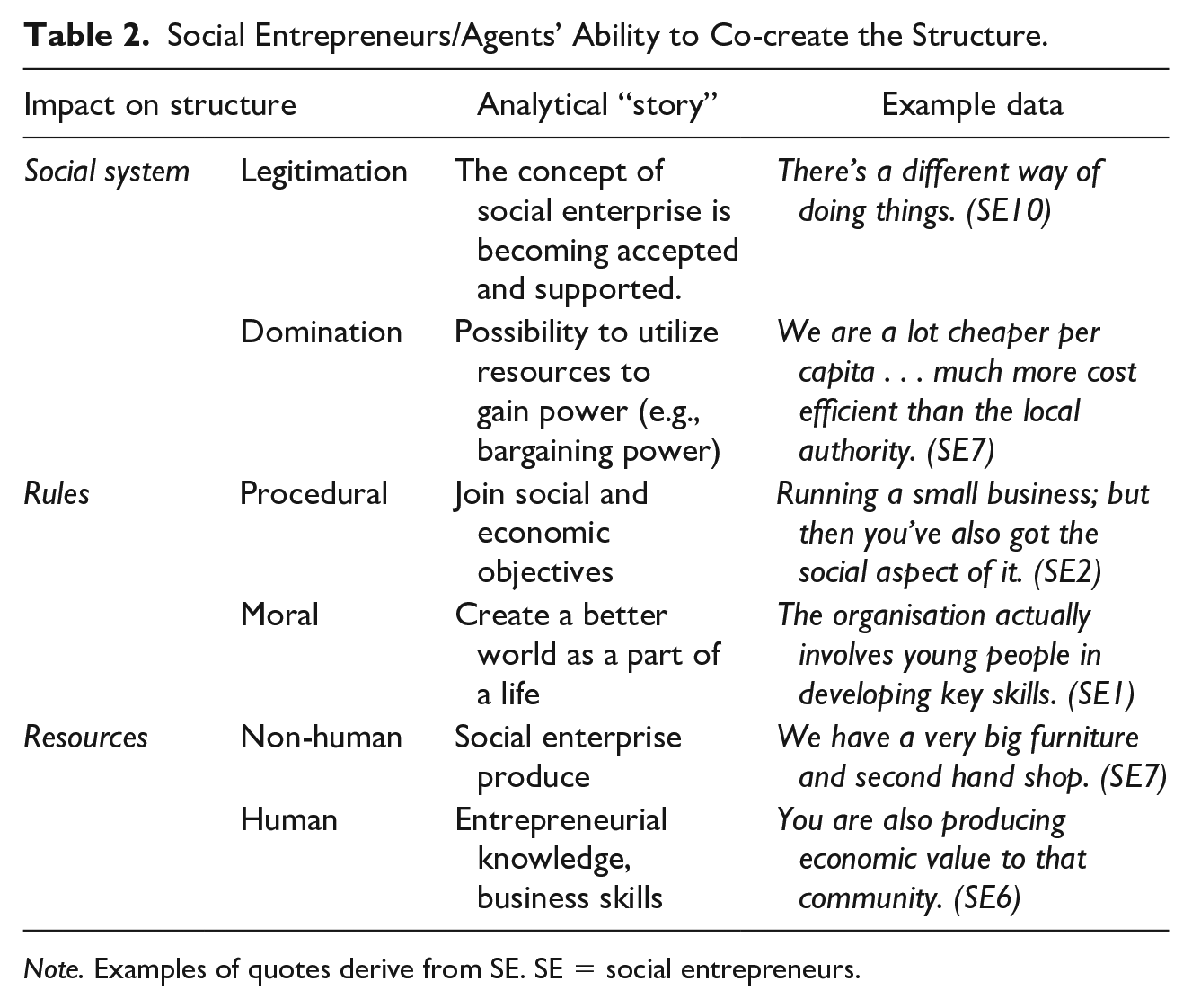
Note. Examples of quotes derive from SE. SE = social entrepreneurs.
Our qualitative data analysis was inductive, although data were also compared against a framework of factors associated with the themes developed from the literature (Table 1). In addition, the constant comparison method was used, which involves breaking data down into discrete “incidents” (Glaser & Strauss, 1967) or “units” (Lincoln & Guba, 1985) that are then coded to categories. Categories arising from this method helped identify themes significant to the study’s focus-of-inquiry and produced both descriptive and explanatory categories (Lincoln & Guba, 1985). Emerging categories underwent content changes as units and incidents were compared and categorized, and as our understanding of the properties of categories and the relationships between categories developed and refined over the course of the analytical process. Hence, the themes presented in the findings were not predetermined but emerged from the data as they were analyzed, before being applied to our structuration theory framework, which recognizes aspects of social systems, rules, and resources as well as different structural elements including procedural and moral rules, human and non-human resources (as presented in Tables 2 and 3). Thereafter, and considering existing literature in the field and the context of our study (i.e., time and space), we developed a co-creation model emerging from our study (Figure 1). Consequently, our analysis goes beyond “first-order description” and moves from descriptive quotes to findings, their structural theoretical analysis, and further to a co-construction model that links together existing literature, context and findings with theory, context, time, and space.
Structural Elements and Their Effects on Social Entrepreneurs as Agents.
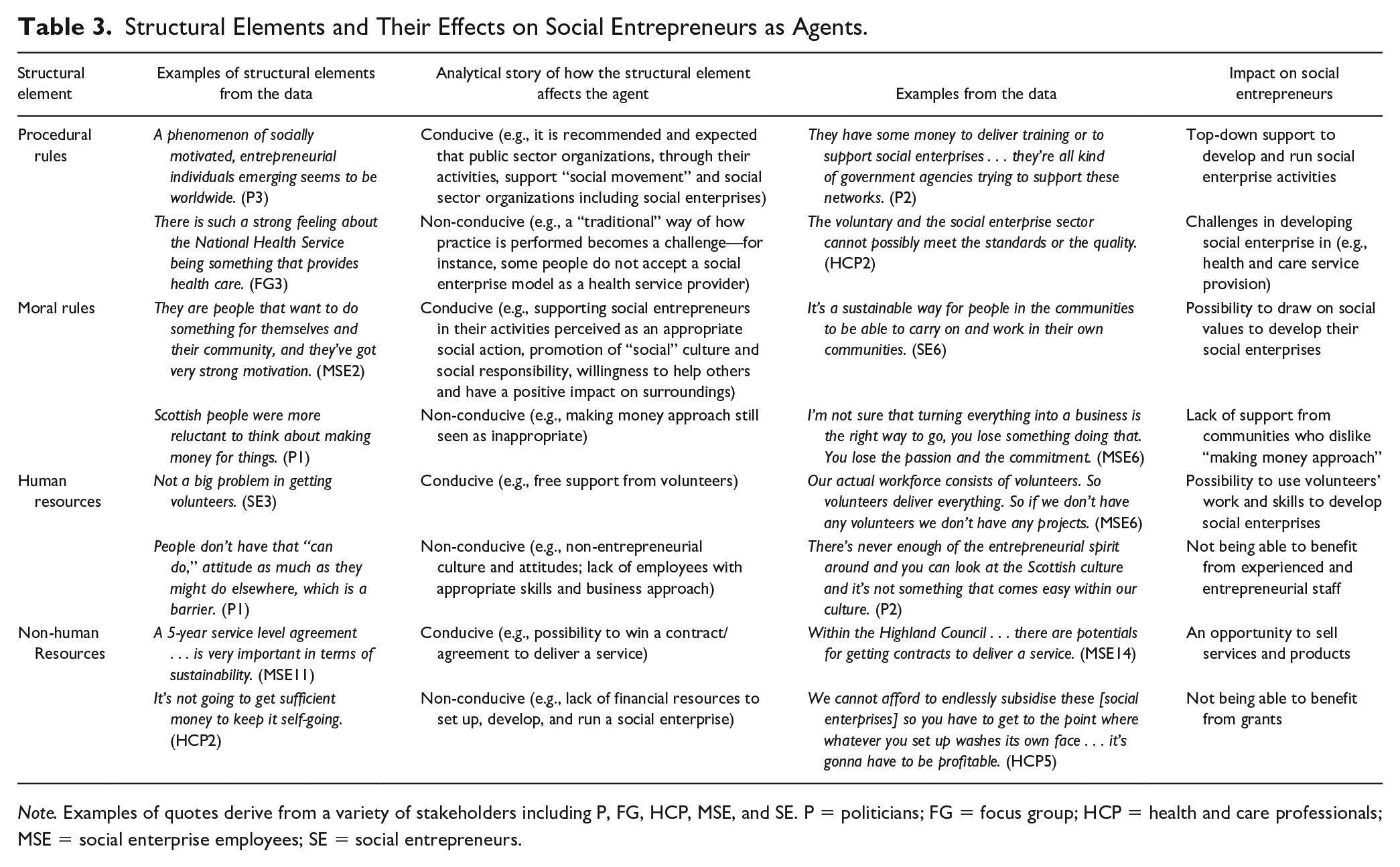
Note. Examples of quotes derive from a variety of stakeholders including P, FG, HCP, MSE, and SE. P = politicians; FG = focus group; HCP = health and care professionals; MSE = social enterprise employees; SE = social entrepreneurs.
Triangulation of the data (from the literature review, interviews, and FG discussions), as recommended in previous studies in the field (Sarason et al., 2006), increased the credibility and validity of the study results. Although the literature review enabled the construction of a schedule for data collection, the exact categories describing the theme under investigation emerged during the data analysis. The key points identified during interviews were compared with FG data, thus verifying and extending observations made by interviewees, supporting confidence in the study findings. Furthermore, identifying patterns across the data helped overcome potential challenges associated with single-method use. For example, reliance on FGs alone might introduce issues of social desirability bias. The combination of three data sources elicited detail about social entrepreneurs and their relationships with the structure, enabling us to build the co-creation model of structure and agency presented in Figure 1.
Findings
Using Giddens’ structuration theory and empirical data from a range of stakeholders, our findings present evidence that helps answer our research questions; first, we show how social entrepreneurs bring about structural changes and, second, how structure influences the activities of social entrepreneurs. Presented data show a dilemma, revealed by our participants, in relation to the origins of social entrepreneurs and their co-creations with the structure.
Social Entrepreneurs as Agents and Their Ability to Co-Create Structure
As structuration theory indicates, change in the structure is affected by agency. Here, a key question is the extent of instrumentality (i.e., the ability to focus on actions that can help achieve more distant goals). In case of this article, the question is as follows: To what extent can agents intentionally “engineer” the structure? Drawing on structuration theory and elements of structure including social systems, rules, and resources (see section “Application of Giddens’ Structuration Theory”), Table 2 presents empirical evidence illustrating examples of social entrepreneurs’ ability to co-create the structure. As such, it serves as a “snapshot,” helping answer our research question: What is the impact of social entrepreneurs on the structure?
Social entrepreneurs perform their action utilizing their entrepreneurial skills (human resources): “this is a phenomenon of socially motivated, entrepreneurial individual” (P3); “The social entrepreneur . . . makes things happen regardless of resources, regardless of barriers. They just go and make it happen. And they put their own personal reputation on the line . . . they believe passionately in it [the social cause] . . . so they drive it forward” (SE1); their action brings them individual satisfaction and facilitates a societal change (moral rules): “social enterprise is about helping people to help themselves” (MSE2); “The profit that we make isn’t monetary, it’s not financial. The profit is wider social benefit because you’re helping people to keep well, you’re helping people to have more confidence and self-esteem. You’re helping their families because if people come off benefits they feel better . . . It’s got to be better for everybody” (SE3).
Through setting up and running a social enterprise, social entrepreneurs “break conventional rules” (e.g., interviewees frequently mentioned that businesses exist to make money and that the two words “social” and “enterprise” traditionally do not go together) to create social enterprises (procedural rule):
Social enterprise is the new model . . . the new capitalism. This is the new business . . . I came across a phrase by Albert Einstein who recognised that if you have a crisis, it’s no good using the methodology that got you to that crisis, to solve it you have to come up with new models. Social enterprise is the new model. There’s no doubt. (MSE7)
Social entrepreneurs use a historically known “business-mode,” but they do so to generate a social outcome. This is achieved through delivering services and/or producing products (non-human resources). Through their actions, social entrepreneurs impact social systems and their legitimation structures (e.g., social enterprises are popularized and supported)—We’re just at the very early stages of an evolution in public policy . . . It’s happening now . . . in 10 years it will become mainstream. Yes, we’re watching it. It’s the same as Mrs Thatcher. What she started doing in 1979–80 was very revolutionary. But by 1995-1996, 15 years later, it became quite normal, not just in this country but everywhere (P3)—and domination structures (e.g., as the number of successful social enterprises grows, the sector is able to influence the decision-making of, for example, policymakers/politicians). Thus, social entrepreneurs intentionally influence rules, resources, and social relationships, which are produced and reproduced in social interaction. They have the ability to change social conditions and the way people act. However, their actions might also bring unintentional effects (e.g., the general perception that social enterprises deliver cheap services and aim to subsidize the state’s activities).
Structure and Its Ability to Co-create Social Entrepreneurs as Agents
Structure simultaneously enables and constrains agents and the processes in which they are involved. In this section, we address our second research question and provide evidence about how structure shapes what agents do. This counterbalances the view that the agent is the primary force in the structure, free from external pressures. Organized around the elements of structure (see section “Application of Giddens’ Structuration Theory”), Table 3 presents selected data supporting the proposition that structure co-creates agents and the ways in which they act; the “impact on social entrepreneurs” column helps answer the question of how the structure influences the activities of social entrepreneurs. As presented, there are elements of structure which co-create the behavior of agents. Different agents might act and react differently to the same stimuli. Empirical data discussed in this section also supplement and add to contextual information presented in section “The context” (e.g., austerity and public-spending cuts, persistent social problems) that could be associated with the emergence of social entrepreneurs.
Table 3 shows conducive and non-conducive structural elements which co-create social entrepreneurs as agents. As shown, there are elements of structure that actively pull agents in different directions. For instance, social entrepreneurs can benefit from training and networking support structures to enhance the development of their social enterprises: “They have some money to deliver training” (P2); We can all work together as well, and support each other if we’ve got a problem. The [local] Bank, for example, had a chap who understood social enterprise and was willing to give bank loans with no interest. So I thought “Right, that’s someone that I can contact” (MSE3), At the same time, however, social enterprise grants and subsidies are seen as unsustainable: “We cannot afford to endlessly subsidise [social enterprises]” (HCP5). It could be that the structure is in a state of flux, or, alternatively, that there are always push and pull factors within the structure.
Thus, how are social systems and social entrepreneurs being co-created? Table 3 highlights selected quotes from study participants (i.e., the “examples from data” column) to show how social entrepreneurs are influenced by aspects of structure (i.e., the “analytical story” and “impact on social entrepreneurs” columns); these are classified according to particular structural elements (i.e., the “structural elements” column).
Beginning with structural moral rules, as noted by the study respondents, “social culture” (as relates to helping others, supporting the neighborhood, volunteering) exists and this influences how agents think and act. For instance, this social culture “produces” people and communities who support the activities of social entrepreneurs. As a result, agents adapt their behavior to general norms and are directed by certain moral rules. Social entrepreneurs draw on moral rules (i.e., social responsibility) to develop social enterprises: This other lady who comes in is involved in a whole load of community projects. She doesn’t have a job but she wants to help. This social enterprise was started by a group of people who wanted to help their community. (SE5)
Thus, moral rules might have a positive impact on agents who facilitate social enterprise development. However, there are also structural moral rules which may hinder development. For example, a “money-making approach” is often perceived as being in some way “immoral”: “I’m not sure that turning everything into a business is the right way to go” (MSE6); “I get the sense that some charities are a bit precious about their charitable status and the making profit wouldn’t be seen as fitting with what they do” (MSE11). This is one reason why some in the social sector do not support the social enterprise model. Thus, there are moral rules that influence the way that agents think and, thereafter, act.
Procedural rules impact agency. For example, the emergence of entrepreneurship that is social in its approach, encouraged some public sector organizations to promote social enterprises by creating support that impacts upon the activities of social entrepreneurs, social enterprise managers, employees, and volunteers: “government agencies trying to support these networks” (P2); They have just produced a strategy so in all the political parties mention social enterprise in some shape or form so there would appear to be a growing recognition of the worth of social enterprise, that it provides a model for public service that is less dependent on government (SE2). Procedural rules might also have an impact on agents and their negative approach towards social enterprise: “[the] social enterprise sector cannot possibly meet the standards or the quality” (HCP2); “I don’t think the communities themselves are always the right people to do it because you don’t then include everybody in the community. You need somebody to facilitate, to just make sure that you are including all the groups” (MSE12). For instance, the normative behavior (i.e., how practice is performed) may hinder agents from introducing new ways of behaving. An example is health and social care delivery and the challenges of co-producing health services with social enterprises. The bureaucratic “rules” and protocols of health services discourage social entrepreneurs (and health managers) from looking at more socially entrepreneurial means of service delivery. Consequently, current service providers cannot take advantage of social enterprises delivering elements of health and social care services. Hence, although not perceived as a material entity, rules influence agents’ behavior.
There are also human and non-human resources influencing agents’ behavior. For instance, difficulties with recruiting capable staff might discourage social entrepreneurs from setting up a social enterprise: “There’s never enough of the entrepreneurial spirit around” (P2); “The reason why there’s no priority given to the transfer of voluntary organisations to social enterprise is because voluntary organisations don’t easily turn into social enterprises because the mind-set is different; because those who work in the voluntary sector have a different set of skills and a different mind-set from those who work in social enterprise (HCP2). On the other hand, the availability of a high number of volunteers and their free labor might encourage social entrepreneurs to invest and develop social enterprises: You’ll always get volunteers; volunteers will be attracted to an organisation that is supportive and treats you well. That would be more important than anything. And if the social enterprise still keeps to that ethos and doesn’t get carried away with production and targets and that side of it, you’ll always attract people. (MSE1), our actual workforce consists of volunteers. (MSE6)
The above examples indicate that structural elements (rules, resources) can impact upon agents’ behavior and, therefore, structure influences agents’ activities. The way that agents act is not entirely “free,” but instead is influenced by structure. However, the structure does not preclude divergent behavior among agents. Instead, it could be suggested that structure gives the normative direction of action.
Co-Creation in Time and Space
With regards to the emergence of social entrepreneurs, this section explores structural elements of time and space. Some interviewees argued that the emergence of social entrepreneurs is not new but began many years ago: “This concept . . . about social entrepreneurs . . . I would call it a new form of philanthropy” (MSE3); It became most well-known in the 19 century, when people like Carnegie, who was a Scotsman, made a huge amount of money in America and he invested some of that money back into Scotland in things like libraries. So that’s the nineteenth century version of a social entrepreneur and you could argue that people like Robert Owen who came to Scotland in the eighteen hundreds and he set up . . . almost like a model community: it had its own schools, its own shops, the workers got paid reasonable wages and their working conditions were a lot better than most of the factories in those days. And he was a social entrepreneur of that age (MSE5). Interviewees suggested that social entrepreneurs are not a newly emergent species, but they evolved from their philanthropic predecessors who used their entrepreneurial skills and wealth to foster social justice. Hence, through an intentional action, those philanthropic predecessors aimed to change the reality and influence the structure in which they operated. On the other hand, and referring to present times, some respondents indicated that people are not destined to be either commercial or social entrepreneurs—they can move between or even occupy hybrid positions:
All these individuals who cannot achieve what they want to, in commercial business, because they’re constrained, they come out and they start their own new organisations, which is why social enterprises tend to be new organisations. Not new people but new organisations. (P2)
Dissatisfaction with the existing structure creates entrepreneurs who set up social enterprises to address social challenges. As such, we can observe push and pull factors, agents and structure co-creating one another. This co-creation process means that agency influences the structure and the social entrepreneurship movement, and structure changes agency and influences the emergence of social entrepreneurs. Social entrepreneurs shape the structure but, simultaneously, the structure facilitates and/or hinders their emergence. As in Giddens’ structuration theory, this evolutionary process continues ad infinitum and “co-constructive mutuality” exists between the structure and agency.
Discussion
Exploring the impact of social entrepreneurs on the structure and the influence of the structure on the activities of social entrepreneurs, we see the applicability of Giddens’ (1984) structuration theory by evidencing that while social entrepreneurs have a distinctive role in shaping the structure, the structure can facilitate or hinder their emergence. Considering presented empirical findings, structural elements of procedural and moral rules, human and non-human resources, agency as well as aspects of time and space, we systematize generated knowledge and present pathways of interactions, co-creation and mutual dependency between structure and agents (Figure 1). We observe a series of factors that interplay in time and space and that had, and still have, an impact on the emergence and growing number of social entrepreneurs. There is no primacy of structure or agency; instead, they co-create building blocks of what constitutes the current structure and agency. The visual representation of processes described in our findings and discussed in detail below, assists in developing our understanding about interactions between structure and agency and, as such, addresses our research questions.
As noted, forms of social entrepreneurship have existed for many years. Predecessors and “parents” of modern social entrepreneurs, such as Robert Owen who is known worldwide for his philanthropic approach to social reform in the 1700–1800s, acted as agents of change in their time and have influenced and encouraged contemporary social entrepreneurs to emerge (Davis & O’Hagan, 2014). The activities of those predecessors, however, were a reaction to structural imperfections in their age including, for example, poor working conditions, food shortages, and lack of education. These “imperfections” acted as stimuli for their action. Importantly, however, these stimuli are in constant flux. In recent years, in addition to persistent challenges associated with poverty, hunger, education, and ill-health, aspects of climate change and, more recently, negative consequences of the Covid-19 pandemic have come to the forefront of political and social agendas.
Presently, we observe that the actions of social entrepreneurs who erode existing business rules and establish enterprises are constructed in spite of, or because of, environmental factors that are inhospitable or favorable. The decision framework about venture creation could be perceived as “irrational” because social entrepreneurs select market areas where the private sector does not want to invest due to unprofitability or where the public sector will not invest due to high costs. Social entrepreneurs deliberately influence some of the rules, resources, and social relationships which are produced and reproduced in social interaction (e.g., social entrepreneurs purposively set up social enterprises aiming to support a selected group of disadvantaged people); they utilize available resources, engage people, develop networks, and ultimately change the lives of individuals. Their actions may also bring unintentional effects (e.g., a perception that social enterprises deliver cheaper services than the public or private sectors). Thus, social entrepreneurs are not able to predict all of the outcomes of their deliberate actions (i.e., the structure can be formed, but its shape depends upon the interplay of structural factors). To achieve social objectives, social entrepreneurs perform action utilizing their entrepreneurial skills (human resources); their action brings them an individual satisfaction and facilitates a societal change (moral rules).
Social entrepreneurs change a conventional perception of social enterprises (procedural rule) and have an impact on the social system (e.g., social enterprises are popularized and supported [legitimation structures] and as the number of successful social enterprises grows, the sector becomes more influential [domination structures]). Thus, influenced by the structure, social entrepreneurs reshape it to create an environment in which social enterprises can thrive. Their role could be perceived as “catalysts” who enable social change to happen—a finding that supports and adds to the work of Mottiar and colleagues (2018) about the impact of social entrepreneurship on community development. Social entrepreneurs themselves are underpinned by an assemblage of past events, structural forces, and other agentic actions and their context, as well as individual experiences of the current structure and willingness to bring about change by addressing social issues in an entrepreneurial way. Interactions between structure and agents lead to the development of a “new structure” (Appendix B), which, once again, influences the activities of agents.
Therefore, we observe that the application of Giddens’ structuration theory (1984) enhances understanding about links and mutually interacting impacts of social entrepreneurs and their structure (Crane et al., 2016). While created and influenced by the structure, social entrepreneurs are change-makers who reject social injustice and, through their entrepreneurial activities, reinforce social change. This change has multiple dimensions. Tackling social challenges and supporting disadvantaged people could be perceived as an output of their activities and a direct work-motive. However, considering structuration theory, the long-term outcome of their work brings about impact on the structure and its social systems, rules, and resources. This is largely an indirect impact of socially entrepreneurial activities that relate, for example, to changing the culture (e.g., societal expectation that entrepreneurs contribute to societal development), influencing policies (e.g., support from policymakers who see social entrepreneurship as a viable way of tackling social challenges) or bringing together what could be perceived as antagonistic concepts (e.g., acceptance of being entrepreneurial for social reasons).
Due to the complexities of social structure and the way it is shaped and reshaped, the activities of social entrepreneurs bring both intentional and unintentional results. This finding is important as, even with best intentions, activities of social entrepreneurs can bring unforeseeable unwanted consequences, potentially harming or limiting the social entrepreneurship movement. Nonetheless, although social entrepreneurs do not control the structure, they are capable of shaping it and, therefore, their actions should be carefully thought through and implemented to bring desired benefits. Over time, those intentional and unintentional results become a part of a cycle in which social entrepreneurs and the structure co-construct one another. The social entrepreneurs and the structure are not static but flexible, adaptive, and evolutionary as they develop and change. As it is impossible to detach the agent from the structure, the structure becomes implicated as a distinguishing feature of the activities performed by social entrepreneurs. The contextual environment is implicated in shaping social entrepreneurs and fostering their passion for addressing social issues. The types of enterprises set up by entrepreneurs depend on the environment from which they emerge. As such, they are created through existing structures that, thereafter, are reshaped by their activities.
Although social entrepreneurs co-construct the structure, they are also constrained by moral and procedural roles as well as human and non-human resources. Social entrepreneurs alone might be limited in the way they influence structural changes. Policymakers, as a group of powerful agents, are also in a position to influence the existing social systems, rules, and resources to support the development of social entrepreneurship. Creating an environment that supports social entrepreneurs could contribute to solving social policy challenges. Specific support for social entrepreneurs might include embracing their services into mainstream public service provision. Perceiving the activities of social entrepreneurs simply as a cheap way of delivering services has negative consequences on socially entrepreneurial culture. Social entrepreneurs should be identified in policy documents as a unique type of entrepreneur, and policies should be tailored to support their work. For instance, in addition to competitive pricing, government contracts should consider social impact and added value created by social entrepreneurs and their ventures.
Holistically, social entrepreneurs play a role in addressing possibly “unsolvable” social challenges, urgent but “unpopular” social issues and addressing the needs of “unreachable” marginalized people. With the growing movement toward social entrepreneurship, the changing structure might help maximize benefits generated by social entrepreneurs. The proposed co-creation model of structure and agency can assist in better understanding the emergence of social entrepreneurs and how to create efficient policies and support interventions that strengthen social entrepreneurship.
Conclusion
Increasingly, the activities of entrepreneurs bring wider social good. There is a case for moving away from a polarized perspective in which entrepreneurial acumen is viewed as being tainted—and entrepreneurs as selfish operators who build self-facing empires (Mottiar et al., 2018; Weitzel et al., 2010). We live in a world in which entrepreneurship for business and social mission merges, develops, hybridizes, mutates, and evolves. As an answer to imperfections created by capitalism, social entrepreneurship is becoming increasingly popular and contributes to creating a new capitalism—neoliberal capitalism—in which an individual, often described as a “hero” with “magical qualities” (Dees, 2004, p. 18), uses the foundations of a free-market economy as well as their own entrepreneurial and business skills to address what they perceive as a social problem. As such, social entrepreneurs could be perceived as a neoliberal solution to neoliberal problems.
By asking, “Are they really a new species?,” we have explored the emergence of social entrepreneurs and their interaction with the environment—a theme that is still understudied in the existing literature, despite the growing popularity of social entrepreneurship policy and practice. We see that the development of the contemporary significance of social entrepreneurialism lies in a combination of complex structural forces and the activities of agents who initiate, demand, and impose changes. Agents make change happen and the structure enables and constrains them in their intentional and unintentional attempts to modify it. It also shapes their perceptions of the external world and informs their activities. These findings align with Welter’s (2011, p. 165) statement suggesting that “context is important for understanding when, how, and why entrepreneurship happens and who becomes involved” as well as Stervinou and colleagues’ (2021) remarks that “in entrepreneurship processes in general and social entrepreneurship processes in particular, meanings, interpretations, expectations around contexts may impact how social entrepreneurship is enacted and sustained over time.”
Our study integrates and extends existing research on the emergence of social entrepreneurs. The main contributions and originality of our article lie in the following:
Advancing theory by showing the applicability of structuration theory when analyzing empirical data and to the wider entrepreneurship, business, and society literatures (Crane et al., 2016)—an approach which has been perceived as challenging, with theory and practice frequently being considered as separate matters and, until recently, theory being rarely applied in empirical articles describing social entrepreneurs. Indeed, responding to Zahra and colleagues’ (2009) call for a better understanding of social entrepreneurs through theory development and following Sarason, Dean, and Dillard’s (2006) suggestion of “presenting structuration theory as a framework for future research into the nature of entrepreneurial ventures” (p. 288), we find Giddens’ (1984) structuration theory apposite in expanding our knowledge of how social entrepreneurs—as agents—influence and are influenced by the external environment. Interestingly, despite recognition that structuration theory might represent a useful lens for exploring our understanding of entrepreneurship (Sarason & Dean, 2019) and social entrepreneurship (Mair & Marti, 2006; Zahra et al., 2009), little research about social entrepreneurs has applied structuration theory in great depth. We counteract this in our article using structuration theory to discuss empirical multi-stakeholder experiences as well as multifaceted social interactions in a detailed way (Crane et al., 2016). Indeed, the article advances theory and existing knowledge by refining and extending our understanding of who is implicated in the emergence of social entrepreneurs and why and how they emerge.
Generating timely discussions given the growing importance of addressing wicked global problems and reducing inequalities in a sustainable manner (Markman et al., 2019)—issues thrown into greater relief by the global Covid-19 pandemic. Structuration theory (Giddens, 1984) helped us theorize the interdependence of structure and agents across time and space, including how social entrepreneurs grow in the complex multi-actor processes that stimulate change. Our discussion responds to recent attempts to understand the mechanisms and processes that contribute to eradicating poverty, therefore informing actions undertaken by transnational organizations such as the United Nations (e.g., UN, 2018), the OECD, and the European Union (e.g., OECD, 2013), as well as national governments interested in changing structures to support the activities of social entrepreneurs and their attempts to form a better and more equal society. Indeed, as shown in our study, powerful agents are in a position to further influence the work of social entrepreneurs: a fact that should be harnessed if the desire to support the social entrepreneurship movement is authentic and genuine.
Informing the development of practice by highlighting how social entrepreneurs (and other agents) are implicated in duality and the interdependence between agents and structure. Globally and locally, social entrepreneurs operate according to local rules, resources, and social systems. In the Scottish context, for example, in addition to unpacking how social entrepreneurs interpret and influence their world to accomplish their purposes and influence structure, we show unintended and negative consequences of actions undertaken by social entrepreneurs. For example, a perception that social enterprises deliver cheaper services than the public or private sectors can lead to underpaid contracts being offered to social entrepreneurs, creating contextual constraints and limiting the development of social entrepreneurship—despite a supportive policy context. Indeed, financial sustainability issues experienced by social entrepreneurs have been described in previous studies exploring social entrepreneurship in Scotland (Vanderhoven et al., 2020). This shows the unpredictability and complexity of the ever-evolving web of interconnected relationships between agents and structure, and that the success of social entrepreneurship depends on a well-balanced dualism of structure and agency evolving through a Darwinian “trial and error process.” Considering what we know, the question is how to maximize positive intentional consequences and minimize unwanted unintentional consequences of actions undertaken by agents, to avoid potential future constraints on social entrepreneurship practice. More research in this area is therefore needed.
So what does it all really mean? Our co-creation model of structure and agency suggests that the social entrepreneurship movement can be, to an extent, promoted and further co-constructed by agents. It enables us to capture literature developed over the course of many years, look at historical facts and current directions in policy and practice, and combine these with primary multi-stakeholder data to identify links between problems and solutions, actions and reactions from different stakeholders, in different spaces and at different times. Importantly, the model helps “to translate Giddens’ essentially static portrayal of structuration into a more dynamic model that links action to maintenance and change . . . and that provides a framework for empirical research” (Barley & Tolbert, 1997, p. 100). In particular, our co-creation model becomes relevant when researching a variety of different structures and “extreme contexts” (e.g., Western vs. non-Western, rural vs. urban; Bhatt et al., 2019; Hota et al., 2019) and activities social entrepreneurs, and contributes to addressing “the nature of challenges faced by social entrepreneurs [which] largely stems from the institutional environment in the context” in which they operate (Bhatt et al., 2019, p. 617). Knowledge about the processes, actors, and factors that influence the evolution of social entrepreneurship can be used by policymakers and public organizations to design interventions that further assist the emergence and activities of social entrepreneurs. Indeed, understanding those mechanisms can help design targeted support policies and investment mechanisms creating fertile ground for social entrepreneurs to grow. This would suggest that, with appropriate knowledge, social entrepreneurship can be “engineered”—this to normalize social entrepreneurship, channel it in particular directions, and shape it to tackle specific social and environmental needs. For instance, this can include social entrepreneurship in healthcare service provision, education, or tackling climate change challenges. Assuming that this “engineered social entrepreneurship” is possible, our article also highlights elements of uncertainty that include both intentional and unintentional impacts of social entrepreneurs and other agents. Structuration theory does not offer suggestions as to how to study and predict those intended and unintended outcomes of agents’ actions. This raises potential concerns when it comes to the development of “engineered social entrepreneurship” and the need for social entrepreneurship policy and practice to be both proactive and reactive, as well as flexible enough to tackle existing and new challenges through the united and systematic efforts of many different actors.
We recognize some limitations of our study and recommend future research to address these. First, given that structuration theory considers social interpretations of events embedded in historical, social, and economic phenomena associated with a specific place and time, we note that findings deriving from the use of structuration theory are context-sensitive. This does not mean, however, that structuration theory should not be used when studying social entrepreneurship. Instead, it demonstrates that the use of structuration theory can offer detailed interpretations, grounded in social theory, of the processes of evolution in entrepreneurship, and the changing nature of businesses and their relationship with societies in different contexts. Second, considering that entrepreneurial policies need to be informed by the dynamics of context-specific variables (Steinerowski & Steinerowska-Streb, 2012), testing our findings internationally would add further understanding, especially in relation to the impact of policies on the agency of social entrepreneurs. Third, testing our findings using alternative theoretical and analytical frameworks may also expand our knowledge in the field. Finally, longitudinal studies observing the field of entrepreneurship and social entrepreneurship would help identify changing patterns of commercial and social entrepreneurship and show how and why specific changes occur over time.
Footnotes
Appendix
Examples of Changing Aspects of Structure.
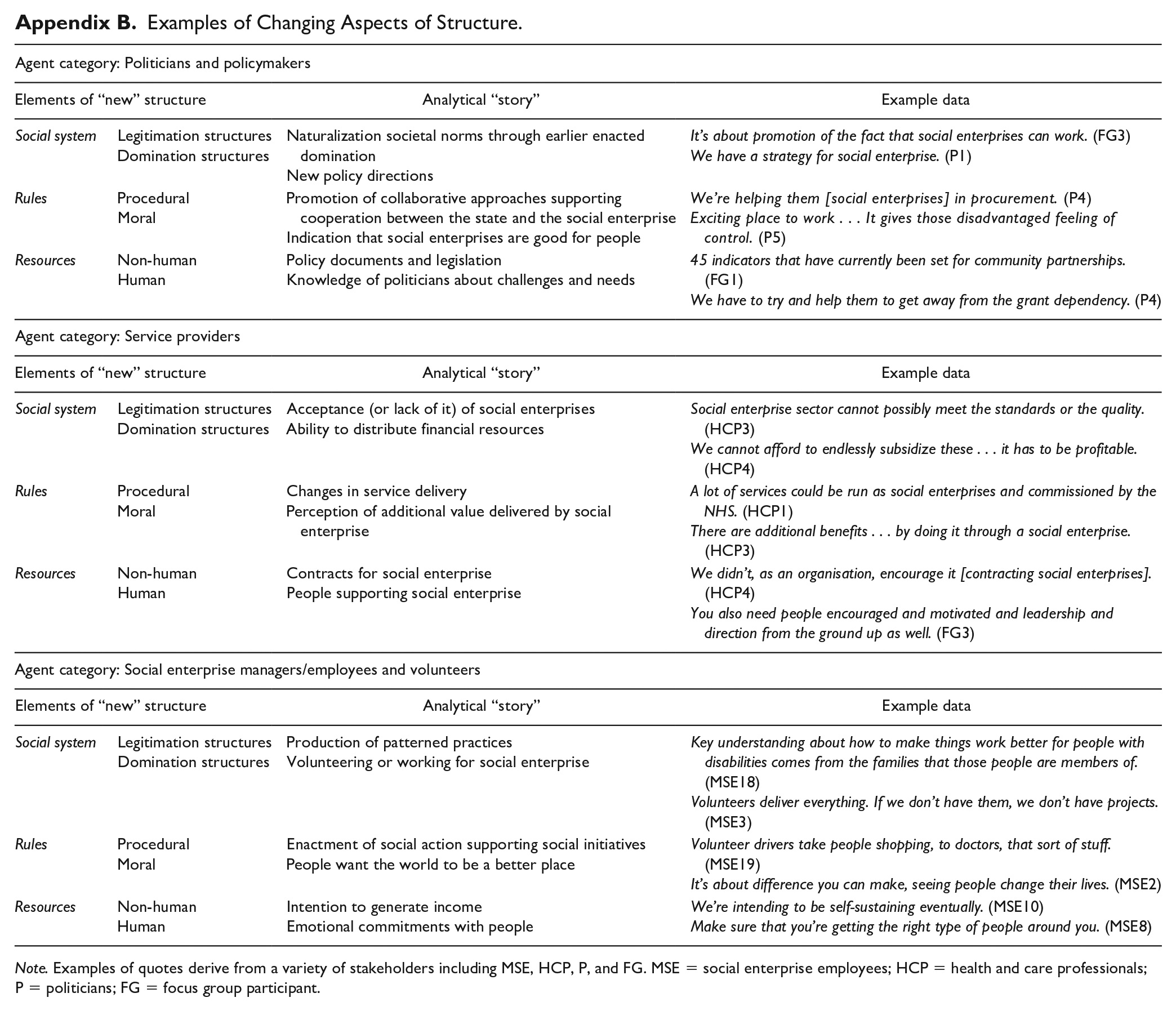
| Agent category: Politicians and policymakers | |||
|---|---|---|---|
| Elements of “new” structure | Analytical “story” | Example data | |
| Social system | Legitimation structures Domination structures |
Naturalization societal norms through earlier enacted domination New policy directions |
It’s about promotion of the fact that social enterprises can work. (FG3) We have a strategy for social enterprise. (P1) |
| Rules | Procedural Moral |
Promotion of collaborative approaches supporting cooperation between the state and the social enterprise Indication that social enterprises are good for people |
We’re helping them [social enterprises] in procurement. (P4) Exciting place to work . . . It gives those disadvantaged feeling of control. (P5) |
| Resources | Non-human Human |
Policy documents and legislation Knowledge of politicians about challenges and needs |
45 indicators that have currently been set for community partnerships. (FG1) We have to try and help them to get away from the grant dependency. (P4) |
| Agent category: Service providers | |||
| Elements of “new” structure | Analytical “story” | Example data | |
| Social system | Legitimation structures Domination structures |
Acceptance (or lack of it) of social enterprises Ability to distribute financial resources |
Social enterprise sector cannot possibly meet the standards or the quality. (HCP3) We cannot afford to endlessly subsidize these . . . it has to be profitable. (HCP4) |
| Rules | Procedural Moral |
Changes in service delivery Perception of additional value delivered by social enterprise |
A lot of services could be run as social enterprises and commissioned by the NHS. (HCP1) There are additional benefits . . . by doing it through a social enterprise. (HCP3) |
| Resources | Non-human Human |
Contracts for social enterprise People supporting social enterprise |
We didn’t, as an organisation, encourage it [contracting social enterprises]. (HCP4) You also need people encouraged and motivated and leadership and direction from the ground up as well. (FG3) |
| Agent category: Social enterprise managers/employees and volunteers | |||
| Elements of “new” structure | Analytical “story” | Example data | |
| Social system | Legitimation structures Domination structures |
Production of patterned practices Volunteering or working for social enterprise |
Key understanding about how to make things work better for people with disabilities comes from the families that those people are members of. (MSE18) Volunteers deliver everything. If we don’t have them, we don’t have projects. (MSE3) |
| Rules | Procedural Moral |
Enactment of social action supporting social initiatives People want the world to be a better place |
Volunteer drivers take people shopping, to doctors, that sort of stuff. (MSE19) It’s about difference you can make, seeing people change their lives. (MSE2) |
| Resources | Non-human Human |
Intention to generate income Emotional commitments with people |
We’re intending to be self-sustaining eventually. (MSE10) Make sure that you’re getting the right type of people around you. (MSE8) |
Note. Examples of quotes derive from a variety of stakeholders including MSE, HCP, P, and FG. MSE = social enterprise employees; HCP = health and care professionals; P = politicians; FG = focus group participant.
Acknowledgements
The authors would like to thank all respondents for their time and willingness to contribute to the study. The authors also thank all three reviewers and the associate editor professor Israr Qureshi and the rest of the editorial team of Business & Society for their useful comments and contribution to the article, and an authentic engagement in co-constructing this article. The authors thank the Highlands and Islands Enterprise for funding this research.
Declaration of Conflicting Interests
The authors declared no potential conflicts of interest with respect to the research, authorship, and/or publication of this article.
Funding
The authors disclosed receipt of the following financial support for the research, authorship, and/or publication of this article: This work was funded by Highlands and Islands Enterprise.
Notes
Author Biographies
