




Abstract
“Modern slavery,” a term used to describe severe forms of labor exploitation, is beginning to spark growing interest within business and society research. As a novel phenomenon, it offers potential for innovative theoretical and empirical pathways to a range of business and management research questions. And yet, development into what we might call a “field” of modern slavery research in business and management remains significantly, and disappointingly, underdeveloped. To explore this, we elaborate on the developments to date, the potential drawbacks, and the possible future deviations that might evolve within six subdisciplinary areas of business and management. We also examine the value that nonmanagement disciplines can bring to research on modern slavery and business, examining the connections, critiques, and catalysts evident in research from political science, law, and history. These, we suggest, offer significant potential for building toward a more substantial subfield of research.
Modern slavery is an urgent societal problem that has increasingly grabbed the attention of policy makers, civil society, the general public, and even business leaders. Acknowledgment of both the scale and illegitimacy of modern slavery has led to new legislation such as the California Transparency in Supply Chain Act, 2010 in the United States and the Modern Slavery Act, 2015 in the United Kingdom, urging the business community to prevent modern slavery from entering their supply chains. As Paul Polman, former CEO of Unilever, said in 2018 on the launch of the B-Team’s guide for CEOs to eradicate modern slavery, “Modern slavery is unacceptable and it is incumbent upon us, as business leaders, to use our leverage both individually and collectively to do everything we can to eradicate this scourge.” 1
Given all the attention, it is hardly surprising that the rise of the term “modern slavery” to describe particular forms of extreme exploitation has prompted growing scholarly interest from within the business and management field (LeBaron & Crane, 2019; Phung & Crane, 2019). While contributions to date have been largely theoretical and primarily focused on supply chain management (SCM; Gold et al., 2015; New, 2015), the literature is beginning to expand and diversify in terms of theory, method, and scope.
However, we argue in this article that the “field” of study focused on the business of modern slavery within the discipline of business and management remains highly underdeveloped. Although there is well-intentioned movement toward a business and management perspective on modern slavery, much of this literature tends to provide unhelpful caricatures of modern slavery, for example, as good/bad for business, as simply an economic externality, or by invoking modern slavery in a nebulous, superficial, or undefined way that tends to conflate it with exploitation or “sweatshops.” Ironically, business and management accounts overlook the dynamics most closely aligned with their disciplinary focus, namely, an in-depth analysis of the business of modern slavery, including the nature and prevalence of modern slavery within the businesses and supply chains of various sectors and parts of the world; the organizational and supply chain dynamics that give rise to it; and the business actors and models through which it flourishes.
At the outset of this special issue process, we were excited to showcase key insights from the field of business and modern slavery within a special issue of this journal. In the end, we have come up somewhat short, with just three articles and an invited commentary accepted for publication. Therefore, notwithstanding the excellent contributions in what has turned out to be a special section rather than a full special issue, we have come to appreciate that the “field” of modern slavery in business and management overall is in a sad and sorry state. That is, there are very few high-quality contributions that have been published to date, and there is little evidence of a flourishing body of work in progress. Even after more than 20 years since the original publication of Kevin Bales’ (1999) groundbreaking book on modern slavery, Disposable People, modern slavery is hardly in fact a field at all in business and management. To all intents and purposes, it is a nonfield.
The limited quality and quantity of business and management research on the topic of modern slavery belies its potential relevance to a wide range of business and management disciplines, from SCM to human resource management (HRM) and organizational behavior through to finance, accounting, strategy, and marketing. The relative lack of attention from these disciplines until now in part reflects a historical tendency to exclude slavery from accounts of modern management (Cooke, 2003). This is an unfortunate (and inaccurate) omission, given that some preindustrial forms of slavery such as plantations exhibited labor techniques associated with modern industrial capitalism—performance monitoring, division of labor, and the separation of ownership and control (Cooke, 2003).
Yet, all is not doom and gloom. The tendency to ignore the business and management side of modern forms of slavery is slowly diminishing. Although much of the intellectual thrust for this comes from outside of the business and management discipline, there are a few notable examples of progress from within, especially in the subfield of SCM. We hope that this article and collection will help to catalyze the nascent insights of this burgeoning (non)field and spur new scholarship.
In this article, our aim is to develop a platform to inspire and inform those seeking to explore modern slavery from a business and management lens, and to locate the contributions published in this special themed section. To establish this platform, we do two things (summarized in Figure 1, below). First, we identify some key disciplinary areas of scholarship within business and management and (a) map out the theoretical developments that have occurred so far in each area, (b) identify where the main drawbacks are in the theoretical resources of each subdiscipline which inhibit knowledge creation on modern slavery and business, and (c) explore potential deviations where the distinctiveness of the issue of modern slavery might prompt new pathways for theory in each area. Specifically, we focus on SCM, accounting, HRM, marketing, strategy, and social issues in management (SIM), as six areas where we considered modern slavery might be most relevant and therefore most likely to have been addressed.
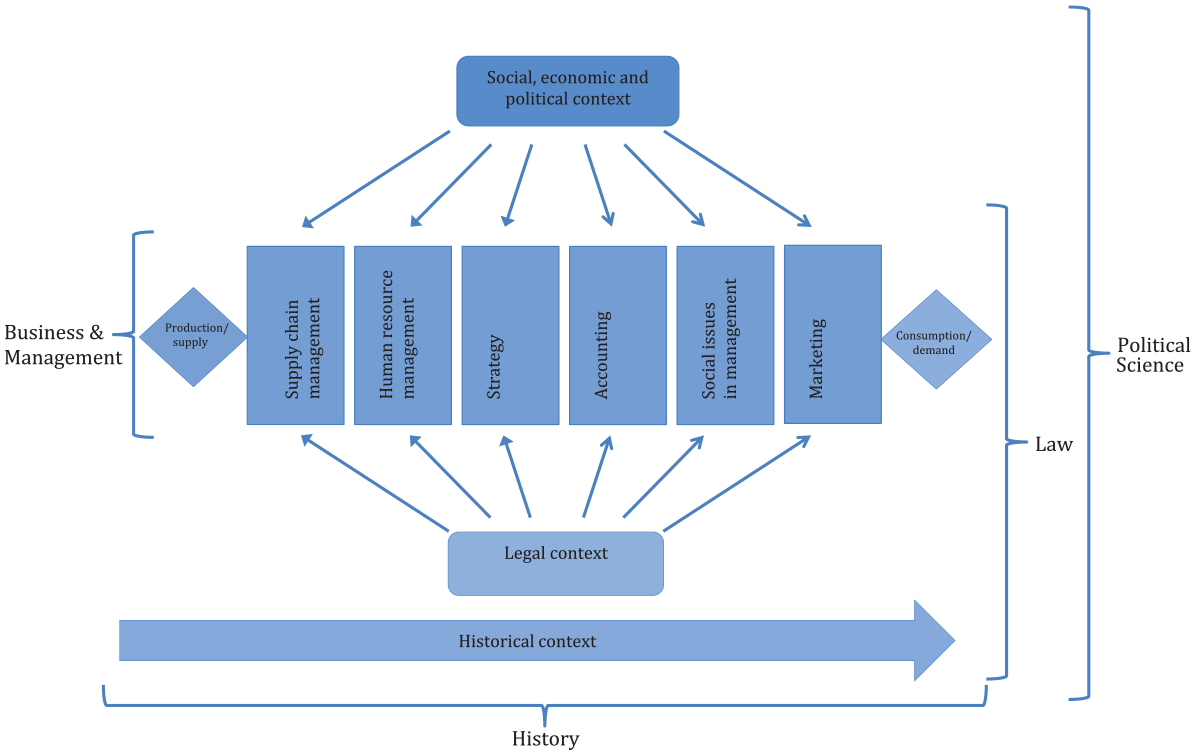
A multidisciplinary perspective on modern slavery research in business and management.
Second, we enrich this analysis by reference to some key disciplines beyond business and management studies where modern slavery has been more extensively researched, and where issues related to modern slavery in business specifically have been addressed. For the sake of brevity, we focus on three disciplines that we believe have particular relevance for modern slavery research in business and management: law, political science, and history. Within each, we (a) map out existing connections between extant research on modern slavery in the discipline and issues relevant to business and management, (b) identify important critiques of the understanding of modern slavery in business and management studies from that discipline, and (c) explore potential catalysts where research from the discipline and research from business and management studies might be fruitfully brought together. Although not intended as a review of all the research on modern slavery outside business and management, our analysis of these three disciplines should provide a solid foundation for future interdisciplinary research and hopefully spark significant contributions to the literature.
Before proceeding, it is important to note that modern slavery is a contested term. According to the International Labour Organization (ILO), the term modern slavery is an umbrella term that describes a number of coercive labor practices such as indentured labor, debt bondage, forced labor, servitude, and human trafficking. However, some scholars and activists reject the term modern slavery, seeing it as a nebulous, poorly and inconsistently defined catch-all term with little explanatory power. They note that those who use this term frequently misrepresent the nature of the problem of severe labor exploitation (Beutin, 2019; LeBaron, 2018; O’Connell Davidson, 2015) and may even unwittingly reinforce the problems they claim to challenge (Bunting & Quirk, 2017; Shih, 2015).
We are using the term modern slavery in this article and in the special section because it is the term most commonly used by scholars of business and management studies. By modern slavery, we refer to “situations of exploitation that a person cannot refuse or leave because of threats, violence, coercion, deception, and/or abuse of power” (ILO, 2017, p. 9). However, unlike the ILO definition, we are not including forced marriage within our object of study, and further, we acknowledge that economic coercion—namely the threat of destitution—can be an important factor shaping vulnerability to forced labor (for discussion of economic coercion, see LeBaron & Gore, 2019). In the next section, we turn to our review of research on modern slavery in some of the main business and management subdisciplines, before proceeding to examine broader disciplines beyond business and management.
Research on Modern Slavery in Business and Management Subdisciplines
While there has been a gradual increase in research on modern slavery within business and management, it is still very limited in both scope and depth. SCM scholars have been relatively early adopters of the topic so far but what contributions have been made from other subdisciplines? Have, for example, scholars of accounting and finance shed light on the financial mechanisms that keep illegal streams of revenue flowing from modern slavery operations? Or have marketing scholars identified the specific role of consumption in creating and maintaining coercive labor practices? We articulate the developments, drawbacks, and deviations of six key subdisciplines (summarized in Table 1).
Developments, Drawbacks, and Deviations in Business Subdisciplines.
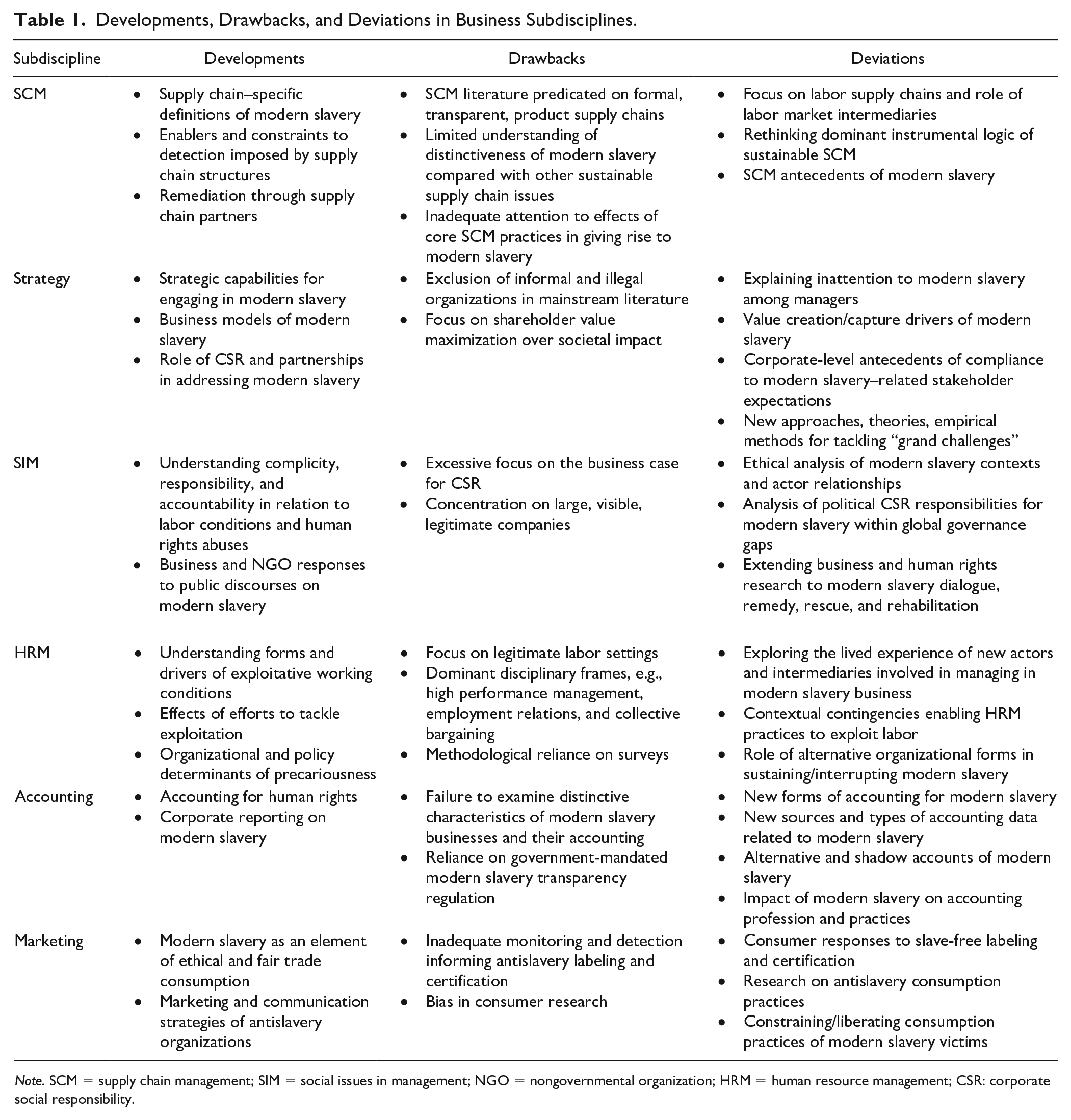
Note. SCM = supply chain management; SIM = social issues in management; NGO = nongovernmental organization; HRM = human resource management; CSR: corporate social responsibility.
SCM
In terms of developments, the SCM literature has paid more attention to modern slavery than any other subdiscipline of business and management, particularly in terms of definitions, detection, and remediation of modern slavery within supply chain partnerships. For example, an early definition of modern slavery in the SCM literature is provided by Gold and colleagues (2015) “as the exploitation of a person who is deprived of individual liberty anywhere along the supply chain, from raw material extraction to the final customer, for the purpose of service provision or production” (p. 487).
Theory building in this field has helped SCM scholars recognize the unique characteristics of modern slavery that influence effective management (Stevenson & Cole, 2018). Gold and colleagues (2015) see the main impediments to the practice of slavery detection connected to the restricted visible horizon (Carter et al., 2015) that prevents the focal company fulfilling its monitoring role in global supply chains (Busse et al., 2017). As Kim and Davis (2016) have demonstrated in relation to conflict minerals, the greater the level of diversification and dispersal of supply chain, the less able the firms are to vouch for their sources. For others, the problem is more conceptual in nature. For example, New (2015) has suggested that labor supply chains have been largely overlooked, with SCM scholars prioritizing flows of commodities, rather than people (see also Allain et al., 2013). The suggestion that modern slavery is linked to the supply chain of workers as well as the supply chain of materials may go some way to explain why modern slavery may evade traditional supply chain mapping techniques (Crane et al., 2019; New, 2015). This kind of thinking has encouraged novel approaches to remediation, such that horizontal (rather than vertical), multitier (rather than singular), and bottom-up (vs. top-down) conceptions of supply chain relationships may reveal new opportunities for collaborating with supply chain partners against modern slavery (Benstead et al., 2018; Russell et al., 2018; Wilhelm et al., 2016).
Turning to drawbacks, it has been widely argued that modern slavery is distinct in important ways from other social issues dealt with by SCM, especially in that it is illegal, often hidden, and involves a range of labor market intermediaries (Crane et al., 2019; New, 2015; Stevenson & Cole, 2018). The SCM literature, however, is predicated on understanding formal, relatively transparent, product supply chains, which means that much of the extant theory is limited in its ability to adequately conceptualize modern slavery issues. This necessitates new SCM approaches regarding standard setting, risk avoidance, detection, and remediation (Stevenson & Cole, 2018). This might usefully begin with some sustained introspection on fundamental SCM thinking, which may unwittingly continue to nurture ripe contexts for slave labor, given the unswerving emphasis placed on exerting buyer power over intermediaries to achieve ever-lower prices (Kraljic, 1983).
In terms of deviations, one key issue could be to refocus on the labor supply chains that fuel operations, in addition to the traditional focus on material and finance supply chains (Crane et al., 2019; New, 2015; Stevenson & Cole, 2018). This could give rise to new conceptualizations of the role of labor market intermediaries in supply chains, building on nascent work on intermediaries in sustainable SCM (Reinecke et al., 2018; Soundararajan & Brammer, 2018; Soundararajan et al., 2018). Another possible deviation could be the distinct readjustment of the foundations of sustainable SCM research and business practice (Matthews et al., 2016). Departing from dominant instrumental logics and profit focus (Pagell & Shevchenko, 2014), sustainable SCM could shift attention to a more caring stance for people and the surrounding environment, for example, by assuming the theoretical perspective of “recognition” as proposed by Gold and Schleper (2017). This may precipitate a shift away from labor “risk” toward labor “care” or “stewardship” along supply chains. Finally, and more broadly, there is an opportunity for SCM research to better recognize and make sense of the role of conventional SCM practices in giving rise to modern slavery in business in the first place. Rather than seeing modern slavery as an aberration or an unexpected feature of global supply chains, SCM research could shift toward identifying the forms, contexts, and dynamics of SCM in which modern slavery is likely to emerge in more or less predictable ways.
Strategy
The strategy area has made some more limited developments into understanding modern slavery, specifically how it can be an outcome of strategic decisions by firms, as well as how firms might develop strategies to tackle modern slavery in their own operations. Crane’s (2013) article on modern slavery as a management practice represents probably the first systematic attempt to explain modern slavery in terms of strategy concepts. Specifically, Crane (2013) explores the institutional contexts conducive to slavery, and the distinct strategic competences that firms need to exploit these contexts and sustain slavery, despite its illegality. More broadly, a number of studies have shown how firm strategies that rely on low-cost and subminimum wage labor, high levels of outsourcing, contract labor, and global supply chains are likely to be associated with greater modern slavery risks (Allain et al., 2013; Crane et al., 2019; Lalani & Metcalf, 2012; Stringer & Michailova, 2018). This has given rise to more detailed analysis of “business models for oppression” (Martí, 2018), including, for example, the elaboration of a typology of different business model innovations of modern slavery (Crane et al., 2018), and estimates of the profitability of different slavery business models (Kara, 2009, 2017).
In terms of corporate strategies to tackle modern slavery, SCM has been the most prominent approach, but there has also been some limited attention paid to the potential and limits of corporate social responsibility (CSR), self-regulation, and cross-sector collaboration (Foot, 2015; New, 2015). In the main though, contributions to these debates have primarily come from outside management—and usually in the form of critiques of corporate practice and private governance initiatives—as we will discuss below.
Turning to drawbacks, it is clear that strategy researchers have been slow to capitalize on the early attention toward modern slavery, with barely a handful of published studies to date. Partly, this is probably due to the general exclusion of consideration of informal and illegal organizations in the mainstream strategy literature (Webb et al., 2014), as well as a prevailing focus on issues relating to organizational performance and shareholder value maximization over societal impact (Walsh et al., 2003). Involuntary labor does not fit easily within a subject that, at best, considers social issues as “market frictions” (Luo & Kaul, 2019).
Given that “theory contributions in strategic management extend, clarify, or apply received theories in new and interesting ways,” (Makadok et al., 2018, p. 1530), we suggest that there are numerous ways that a focus on modern slavery could prompt novel deviations in our understanding of common strategy concepts and approaches. At the microlevel, this could include theories relating to top management teams, managerial cognition, and managing paradoxes that might explain why the issue of modern slavery is or is not recognized and acted upon by companies, in the same way that corporate inattention to climate change is being increasingly better understood (T. Hahn et al., 2014; Slawinski et al., 2017). At the firm and value chain level, theories of value creation and value capture (Lepak et al., 2007) could shed light on both the drivers of modern slavery as well as potential pathways for interventions. At the level of corporate strategy, theories explaining corporate structure and ownership, corporate political action (Lord, 2000), as well as strategic responses to institutional pressures (Oliver, 1991) could feed into explanations of how companies resist, comply, or evade growing expectations to tackle modern slavery. For example, the article in this special section by Monciardini and colleagues (2021) draws on endogeneity of law theory developed by Edelman suggesting how managerialization of modern slavery law may drive merely symbolic business responses to modern slavery. The study underlines that going “beyond compliance” per se does not imply effective corporate action, highlighting the leading role of organization’s internal and external compliance professionals in framing ambiguous rules and devising organizational response strategies to modern slavery legislation.
More broadly, a key development in the attention of strategy researchers to modern slavery could potentially be the recent reinvigoration of management research in relation to “grand challenges” of which modern slavery is explicitly incorporated (Ferraro et al., 2015; George et al., 2016). This marks a shift in emphasis from strategy research focusing primarily on firm performance toward the application of strategy concepts to enhancing our understanding of how firms and other organizations can tackle the major societal problems of our time. This indicates growing recognition that the conceptual tools of the strategy field might be usefully redeployed toward addressing problems such as modern slavery, or even that new approaches are emerging that might be better suited for this purpose.
SIM
Social problems have been the main focus of the SIM subfield, and so this is perhaps the most obvious area to find research on modern slavery. Surprisingly though, there has been little explicit attention to the issue. Most of the developments in the SIM field to date have been concerned with “sweatshop” labor arrangements (Miklós, 2019; Pines & Meyer, 2005; Radin & Calkins, 2006) and human rights abuses (Cragg et al., 2012; Wettstein, 2010) with human trafficking and modern slavery only entering these conversations at the margins. A notable example of SIM research that does specifically address modern slavery is Dahan and Gittens’ (2010) investigation of business and nongovernmental organization (NGO) responses to public discourses on modern slavery. In their study, rather than finding a distinct, consensual definition of modern slavery, the contribution lies in illustrating how the term can be deployed heterogeneously depending on actor interests: “the industry tends to refer to the issue as ‘abusive labor conditions’, which sounds a lot less dire than ‘forced labor’ or ‘worst forms’ of labor . . . while only NGOs and activists use the terms ‘slavery’ and ‘torture’, to catch the public’s attention” (Dahan & Gittens, 2010, p. 234).
While slender at present, the body of literature in SIM on business, human rights, and working conditions should provide a solid foundation for research on modern slavery, given the contributions so far to understanding issues of complicity, responsibility, and accountability in relation to multinational corporations. For example, the article by Van Buren and colleagues (2021) within this special section synthesizes recent research on business responsibility and culpability for forced labor in supply chains from literatures across the social sciences, and demonstrates its relevance to SIM literature on due diligence approaches to combat human trafficking.
With respect to the drawbacks, a key issue is the fixation in the field on the “business case” for socially responsible behavior (Carroll & Shabana, 2010). Adopting this lens is likely to lead scholars to overlook some of the unique characteristics of modern slavery, seeing it primarily in terms of potential reputational risk rather than an important problem in its own right. Moreover, in common with other areas of business and management, there is a strong proclivity to focus on large, visible, and legitimate organizations in the SIM domain. Very little research is done in the shadows where smaller and more informal labor arrangements may occur, but exactly where modern slavery knowledge is required.
This is precisely where the potential deviations in the field may arise. While, for example, it might be helpful to show how deontology provides a more robust rationale against sweatshop labor than does utilitarianism (Radin & Calkins, 2006), ethical questioning could fruitfully be extended to the study of victim–perpetrator, victim–victim, and victim–rescuer relationships in business. We know, for example, that certain cultural contexts render slavery morally permissible, despite its illegality. It could be useful then to ask what ethical manipulations, distortions, or silent moral complicities structure and maintain key relationships around modern slavery businesses? Also, applying theories of political CSR (Scherer & Palazzo, 2011), and corporate citizenship (Matten & Crane, 2005), where companies are seen as key actors in administering social, political, and civil rights, could give rise to novel analyses of corporate roles in addressing modern slavery within global governance gaps where there is little infrastructure to administer rights. We note, for example, that there has been some research in the area of business and human rights. While it presently operates “at the edges” of the SIM literature, between either supply chain (Hampton, 2019) or compliance and law (Mehra & Shay, 2016; Ruggie & Sherman, 2015; Van Dijk et al., 2018), it could be an area of great scholarly potential, given its focus upon human rights abuses. Work here could investigate a number of substantive corporate practices in administering rights beyond codes of conduct and other private governance regimes to include issue-raising dialogue with local authorities such as police, NGOs and communities, rescue and rehabilitation centers as well as extended microcredit facilities to the extremely poor.
HRM
Another subfield that would seem to be a likely place to find a significant stream of research on modern slavery is the main business and management area concerned with employer–employee relationships, namely, HRM. However, as with SIM, while there is a considerable body of work in HRM on exploitative working practices, most stops short of addressing slavery-like practices specifically. In terms of developments then, the main contribution is probably from illustrating the specific labor management aspects of global commodity chains (Alamgir & Banerjee, 2019; Khan et al., 2007). Soundararajan and colleagues (2018), for example, identify that Western firms typically lack an understanding of the local labor dynamics necessary to improve poor working conditions. “Boundary work” done by sourcing agents can, they suggest, lead to better governance by bridging supplier–buyer relationships. More critically, Khan and colleagues (2007) highlight the unseen effects of attempts to institutionalize the eradication of labor exploitation, finding that in child labor projects, “the benefits for children were questionable” (Khan et al., 2007, p. 1056). The HRM study that comes closest to specifically addressing modern slavery is Yea and Chok’s (2018) exploration of migrant workers. They explicitly discuss the term “unfree labor,” connect it to temporal and spatial precariousness, and outline the array of labor mechanisms (e.g., wage theft and document manipulation) that combine to extort labor under duress, adding that when these “operate in concert with migration and labour policies that curtail migrant workers’ rights and bargaining power, this renders precarious workers unfree at particular junctures in their sojourns” (Yea & Chok, 2018, p. 926).
The drawbacks of HRM principally concern the unswerving focus upon conventional HRM practices and mechanisms in legitimate labor settings, with a significant orientation toward instrumental, “strategic” HRM. This may present significant challenges for HRM scholars seeking to investigate modern slavery within recognizable disciplinary frames such as high performance management, employment relations, and collective bargaining. Some may not see the phenomenon of modern slavery as falling within the purview of their area at all or, for some more critical scholars, may simply become a political vehicle to highlight the failings of modern management practices. Research design represents a final potential drawback with HRM research often favoring surveys and other quantitative methods over the ethnographic “work in the field” that is typically needed to unlock modern slavery practices.
Nonetheless, modern slavery offers several interesting deviations for motivated HRM scholars. First, it offers the opportunity to explore the lived experience of pivotal agents within and around modern slavery businesses. For example, from the above discussion of Soundararajan and colleagues (2018), it might be possible to explore the “boundary work” of actors located in “darker” parts of the global supply chain, where agents work between both legitimate (e.g., local authorities) and illegal organizations (e.g., organized crime gangs). Second, there are opportunities to explore the HRM practices used to extort labor, at specific moments, under certain circumstances and in unique combinations. For, as Yea and Chok (2018) noted of migrant labor, the capacity to extort work was achieved by cumulatively extending migrant vulnerability through a toxic combination of practices administered at precarious moments in time. A final deviation may be attributed to the organization theory literature. Research into (alternative) organizing could help throw light on how different organizational forms can be deployed to both sustain as well as interrupt coercive labor practices. For example, the article in this special section by Rosile and colleagues (2021) testifies to the possibilities of transforming labor oppression via new forms of organizing that they describe as “Ensemble Leadership,” thus providing resilient grounds for establishing worker-led social responsibility.
Accounting
The accounting subfield has probably the most substantial literature within business and management on earlier forms of slavery, where accounts from plantations and slave traders have provided a rich resource for understanding the business of historical slavery (Pinto & West, 2017; Rodrigues & Craig, 2018; Tyson et al., 2004). Despite this, the discipline has been surprisingly slow to attend to more contemporary forms of slavery. What developments there have been thus far have mainly followed two trajectories. First, there is a stream of research that addresses the accounting practices of legitimate businesses but under the general label of human rights rather than modern slavery per se. O’Brien and Dhanarajan (2016), for example, state recent tendencies toward governmental directions encouraging business to exert human rights due diligence, especially in high-risk conflict areas such as the Democratic Republic of the Congo (DRC; Hofmann et al., 2018). A second, related, stream of literature has begun to examine modern slavery reporting specifically, such as in response to, or readiness for, transparency in supply chain (TISC) legislation (Birkey et al., 2018; Christ et al., 2019). Although limited in scope so far, this research has generally shown a relative lack of substance and quality of disclosure in modern slavery reporting.
A major drawback for the development of a rich accounting perspective on modern slavery is the failure thus far to examine the distinctive characteristics of modern slavery businesses. Due to the scale, distribution, and covert nature of coercive revenue yield, traditional auditing and accounting systems—even those adapted toward human rights—will struggle to capture and interpret indicators of slavery. Another drawback could arise from excessive reliance on governments as standard setters for accounting and reporting on slavery (similar to highly regulated financial accounting). There is some recent evidence that the effectiveness of government regulation is likely to be diluted by lobbying activities, as for example, by major professional consultancy and audit companies who promote transnational labor governance regimes that are regulated by soft law (Fransen & LeBaron, 2019).
Despite the relatively limited response from accounting scholars so far, there are numerous opportunities for attention to modern slavery to spur significant deviations and advancements in research on accounting and accountability. For example, the problems of visibility indicated above might prompt attention to new sets of indicators and veer away from an idea of the accountant as focal information-absorbing entity. As such, accounting for modern slavery could increasingly be conceived as decentralized, driven by the availability of big data (Teoh, 2018), new technologies such as distributed ledger (Kokina et al., 2017), and new tools of data analysis such as agent-based modeling (Chesney et al., 2017).
A key challenge in developing accounting research on modern slavery (especially in contrast to many historical forms of slavery) is the lack of access to reliable data, given that practices in this area are often illegal and informal. One way beyond this would be to take inspiration from studies of other similar contexts, like drugs and prostitution (LeBaron & Crane, 2019), undocumented workers (Neu, 2012), and migration (Agyeman & Lehman, 2013). Another alternative would be to strengthen links with other disciplines such as SCM discussed above and informatics to tap new sources of data such as satellite images and internet-based financial transactions (Gao & Xu, 2009), and to use new technologies that allow for decentralized data collection, for example, via smartphones. In this way, official accounts and alternative—so-called shadow accounts (Rodrigue, 2014)—may be effectively integrated into the overall puzzle set.
Looking forward, there are at the time of writing two special issue calls for papers in the accounting field specifically dedicated to modern slavery. These also clearly offer potential for important new directions in scholarship. For example, the call in the British Accounting Review seeks insights into how modern slavery will “shape the future of the accounting profession,” while the call in the Accounting, Auditing and Accountability Journal frames modern slavery issues in terms of how they are “transforming the accounting landscape.” 2 Time will tell whether such ambitions are realized.
Marketing
Scholarly research on modern slavery from the marketing subfield has been scant. That said, there is a related body of work on ethical consumption and fair trade more generally that could provide a platform for future developments (Ballet et al., 2014; Devinney et al., 2010; Harrison et al., 2005; McDonagh, 2002). The general thrust of this literature is that a consumer, well informed about human rights, forced and child labor, may seek to translate their concerns into product purchases that are slavery-free or boycott those that are not (N. C. Smith, 1990). To date, there is mixed evidence on whether labor practices in the supply chain are likely to prompt consumer responses of these kinds, especially without some kind of direct consumer-related benefit such as quality, price, or convenience (Carrigan & Attalla, 2001; Devinney et al., 2010; Valor, 2007).
Of these studies, few explicitly examine the specific context of modern slavery. One early study that does, emphasizes the specific role of marketing communications of NGOs like Anti-Slavery International (ASI) in leveraging consumer activism in the domain of labor exploitation: “ASI used the right of the citizen to be informed about products s/he consumes to harness her/his power as a consumer to change organizational practices” (McDonagh, 2002, p. 652). More recently, A. Smith and Johns (2020) have explored the emergence and fragility of slave-free market categories through historical research of antislavery consumer campaigns, while research from Carrington and colleagues (2018) has examined the lack of action among consumers in translating concern about modern slavery into purchasing through the various neutralization techniques that they use to justify inaction. Much work remains to be done.
There are, however, several important drawbacks that must be considered in trying to apply marketing logics to coercive labor practices. Not dissimilar to the problems facing other subdisciplines such as SCM, certification schemes (upon which consumers may base their product choices) rely on the availability of accurate information about product sourcing. Even for companies in legitimate industries, it may be impossible to guarantee slave-free sourcing or to prevent underreporting of instances of labor exploitation (Yu, 2008). Given academic and media exposés of child and forced labor on certified worksites, recent studies have argued that ethical certification schemes are an ineffective means of combating modern slavery (LeBaron, 2018, 2020). Moreover, it is well documented within the marketing literature that consumers often overemphasize their ethical concerns when asked in surveys, but fail to translate them into actual purchases (Crane, 2001; Devinney et al., 2010). The morally charged term “modern slavery” is only likely to add to this bias, making opinion polls showing consumer readiness to reward slave-free products as highly suspect. 3
In terms of possible deviations, then, there could be fruitful advances made by exploring how consumers actually respond to “slave-free” or other modern slavery–related claims, as well as their response to various rankings and ratings of firms regarding their antislavery efforts (Isaac & Schindler, 2014). Ethnographic work from beyond marketing also points to the potential for developing novel theoretical insights from consumer research on emerging forms of antislavery consumption, including human trafficking “reality tours,” products made by former victims, and other ostensible “freedom markets” (Bernstein & Shih, 2014; Shih, 2017).
Another deviation for the marketing literature would be to move beyond the possibilities of free consumers alleviating the unfree labor of others, to look more closely at the unfree aspects of consumption engaged in by victims of modern slavery. As Bone et al. (2014) have shown for marginalized groups of consumers in financial markets, “Choosing loans is an involved consumer choice journey, and encountering systemic, chronic, and uncontrollable restrictions on choice at any level of the goal/choice hierarchy limits and even prohibits minorities’ ability to make desired choices” (Bone et al., 2014, p. 451). This research could be usefully extended into settings where there is no real market (in the formal or legal sense) and where the coerced consumption of goods and services becomes a key mechanism for extorting labor. We know, for example, that the consumption of vital goods (e.g., food and housing) and services (e.g., loans and recruitment) can be used as a mode of manipulation in the process of recruiting and locking-in labor through debt bondage (Crane et al., 2018). And, while wider disciplines have observed much about the lived experiences of victims (Howard, 2018), we know next to nothing about the constraining (or liberatory) potential of consumption for victims of modern slavery.
Research on Modern Slavery in Business in Disciplines Beyond Business and Management
As our review of research on modern slavery in business in some of the main business and management subdisciplines shows, there has been very limited attention to date on the specific issue of modern slavery, even though in most areas, there is a reasonable literature base that could be usefully drawn on to develop some important and potentially quite novel insights. Going forward, it will be important for business and management scholars to take inspiration from, and build on, such research, rather than replicating it, or worse, ignoring the important insights that have already been established. In the following subsections, we therefore consider three key disciplines where modern slavery and business has already, to various degrees, been addressed with a view to identifying existing connections with business and management, likely critiques of a business and management approach, and potential catalysts for novel theoretical and empirical research contributions (see Table 2).
Connections, Critiques, and Catalysts in Disciplines Beyond Business and Management.
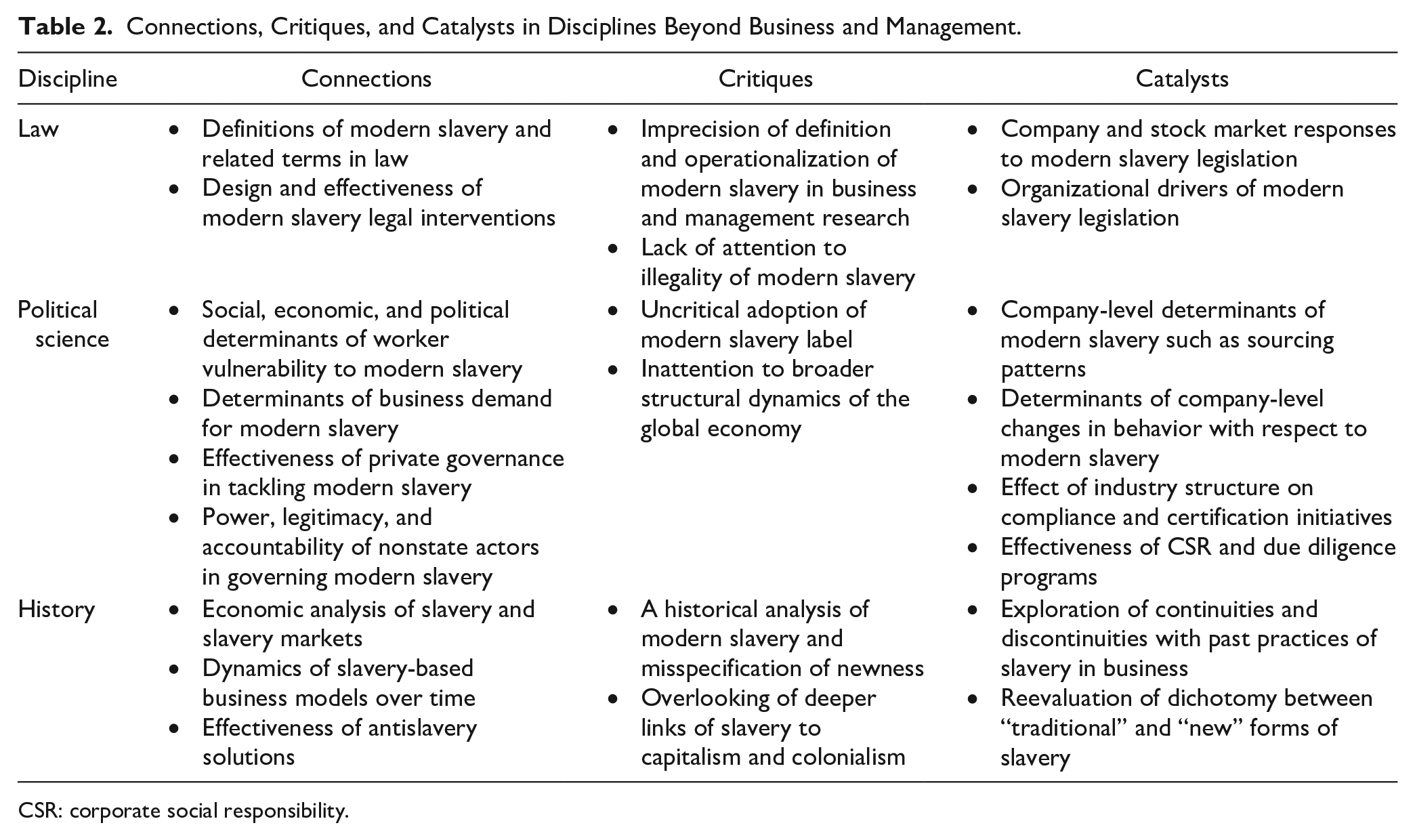
CSR: corporate social responsibility.
Law
In terms of connections, law scholarship has produced an important body of literature that is of relevance to modern slavery and business. This begins with basic questions of the appropriate definition of modern slavery, which has been explored in some depth in the law literature. Allain (2009), for example, has argued that contemporary interpretations of modern slavery in international law should be predicated on the 1926 League of Nations definition of slavery as constituting an exercise of “any or all of the powers attached to the right of ownership” over somebody. As he argues, this definition marks a shift from de jure slavery based on legal ownership to de facto slavery based on practices of control over others without a formal legal title. This provides the basis for considerable, and continued, debate about the definition of modern forms of slavery in law and has formed the basis for more recent elaborations, such as the Harvard–Bellagio guidelines on the legal parameters of slavery (Allain, 2012, 2013).
As a distinct term, however, “modern slavery” has barely been incorporated into formal international law, and legal scholarship has tended to focus on related terms such as human trafficking and forced labor. These have been more extensively incorporated into legal and quasi-legal instruments including the Palermo Protocol and the International Labour Office’s Forced Labour Convention. As a result, a stream of legal analysis has explored the different legal definitions of such contemporary forms of slavery, and the intent and implications of their instantiation into specific legal instruments in practice (Fuks, 2006; Mantouvalou, 2010; Rassam, 1998; Ryf, 2002; Siller, 2016).
These contributions to our understanding of the legal definition of modern slavery and related terms have provided important starting points for definitions used by some business and management scholars (Crane, 2013; Stringer et al., 2016). As a new topic in the management field, modern slavery typically requires at least a basic definition, and legal interpretations represent an important starting place for distinguishing modern slavery from other, perhaps more common or regular, forms of labor exploitation that have already been explored in the literature such as human rights abuses and sweatshop working conditions.
Other important connections have emerged from the stream of law literature concerned with the design and effectiveness of legal interventions. Where these interventions concern business, then there is an obvious overlap with management scholars interested in the response of companies to regulatory and other forms of institutional change around modern slavery. For example, law scholars have usefully contextualized new TISC regulations in the context of a broader shift to “reflexive” or “soft” law governing the conduct of global business and explored how business actors have helped shape new laws around modern slavery (Chuang, 2015; LeBaron & Rühmkorf, 2017, 2019; Wen, 2016). In general, this research has identified serious deficiencies in current approaches to the regulation of business in relation to modern slavery (LeBaron & Rühmkorf, 2017, 2019; Mehra & Shay, 2016).
The main critiques that an understanding of legal scholarship would bring to the typical business and management approaches to understanding modern slavery would concern the lack of precision regarding how modern slavery is defined and operationalized empirically, and the lack of attention to illegality in business scholarship. With respect to imprecision, there is the very real danger that the careful and detailed work of legal scholars will be overlooked or misrepresented by business and management scholars in the rush to engage in theory building about an apparently “new” topic. According to legal analysis, there are key distinctions between these more extreme forms and other, more typical forms of labor exploitation (and indeed between different extreme forms) that can easily be glossed over. In particular, as empirical research on modern slavery increases, business and management scholars need to be extremely mindful of how they operationalize carefully developed legal definitions of slavery, forced labor, and human trafficking in the field. Most examples of worker exploitation observed in the field, at least when viewed in isolation, do not on their own meet the high bar of slavery or forced labor and so need to be treated accordingly.
Turning to illegality, modern slavery is distinct from many other violations of labor standards, in that it is, almost everywhere, and in most forms, an illegal practice, subject to criminal prosecution. So, although it will tend to be tackled in business and management research through the lens of CSR, multistakeholder initiatives, responsible sourcing, and other typical accouterments of new governance, it is, in fact, also the subject of “hard” law. Business and management scholar should therefore be cautious in framing modern slavery in the context of social responsibilities “beyond” the law, and will need to integrate their theories with appropriate legal analysis too.
Finally, with respect to catalysts, there are numerous ways that insights from law and criminology could further inform business and management research on modern slavery and vice versa but two are particularly worthy of note. One important area for new research that is already underway, including in this special section, concerns the business response to new legislation in this area. While legal scholars are adept at analyzing degrees of compliance and evaluating regulatory effectiveness, business and management scholars can bring new insights based on analysis of firm-level determinants of compliance as well as broader institutional-level influences, as has been evident in the swathe of research exploring firm-level responses to environmental, social, and corporate governance regulation and self-regulation (Grosvold et al., 2016; King & Lenox, 2000). Likewise, accounting and business communication researchers are well placed to reveal companies’ different communicative strategies in disclosing details of their modern slavery programs, in the same way that they have explored sustainability reporting and CSR communication more broadly (Cho et al., 2010; Crane & Glozer, 2016; R. Hahn & Kühnen, 2013). A particularly revealing intersection of law and business can be found in analysis of stock market reactions to modern slavery “shocks” such as new legislation, scandals, and other announcements (Cousins et al., 2020).
Another intriguing area of future research concerns the organizational dynamics behind both the emergence of modern slavery legislation and organizational responses to it. While law scholars tend to analyze such developments at a macrolevel, business and management researchers are adept at investigating the interorganizational and intraorganizational interactions underlying these developments. In particular, closer attention to the lobbying efforts of firms to precipitate, shape, or prevent legislation can inform existing legal analysis, while examinations of new organizational, market, and legal categories framed around the label of “modern slavery” (Caruana et al., 2018) can help explain better why particular interpretations of the law, and the principles behind it, become institutionalized in particular organizational contexts.
Political Science
Scholars within the discipline of political science have been exploring the forms of severe labor exploitation encompassed within the term “modern slavery” for over two decades. Connections between the business and management and political science literatures are abundant. The reasons for this no doubt lie in the disciplines’ shared interest in the dynamics of global value/supply chains. Moreover, this literature also includes contributions from the burgeoning interdisciplinary literature focused on labor standards in global value/supply chains, and global production networks, which cuts across economic geography, development studies, sociology, and other social science disciplines. We will focus on four key connections here.
In the first case, business scholars and political scientists share an interest in the economic dynamics that create a supply of people vulnerable to forced labor, and in what makes some people victims, but not others. Within the political science literature, scholars have analyzed the links between forced labor and globalization (Bales, 1999; Barrientos et al., 2013), poverty (Bales, 1999; Phillips, 2013; Phillips & Sakamoto, 2012), migration status (Elias, 2013; McGrath, 2013; Strauss, 2013), gender, race, and ethnic identity (Barrientos, 2019; LeBaron & Gore, 2019; McGrath, 2013), and changing patterns of social and labor protections (LeBaron & Ayers, 2013; LeBaron & Phillips, 2019). These supply-side factors are captured by a typology proposed by LeBaron et al. (2018).
Second, business scholars and political scientists are both interested in the question of what creates business demand for forced labor in supply chains. Research within political science has investigated this question across several sectors and parts of the world, analyzing how the demand for forced labor within supply chains differs across geography, different types of companies, destination markets, and sectors (Barrientos et al., 2013; LeBaron, 2018, 2019; McGrath, 2013; Phillips, 2013). They have also investigated how the presence of certain types of organizations, such as labor contractors, within supply chains affects upon forced labor (Barrientos, 2013).
Third, political scientists share business and management scholars’ interest in the effectiveness of private voluntary CSR initiatives as governance strategies to address forced labor. Political science research has investigated the effectiveness of transparency or “home state” legislation in driving changes in corporate policy around modern slavery (LeBaron & Rühmkorf, 2017, 2019; Phillips et al., 2018). It has also investigated the effectiveness of CSR programs such as codes of conduct, social auditing, and ethical certification in raising labor standards and addressing and preventing forced labor (LeBaron, 2018; LeBaron & Phillips, 2019; Locke, 2013; Locke et al., 2012).
Fourth, like business scholars, political scientists are interested in the power, legitimacy, and accountability of nonstate actors—including industry actors and civil society organizations—within the modern slavery governance arena. This strand of research includes analysis of the politics and power of antislavery and antitrafficking NGOs (Bunting & Quirk, 2017; O’Connell Davidson, 2015), corporations and industry associations (LeBaron & Rühmkorf, 2017), multistakeholder initiatives (Fransen, 2012), and auditing and accounting firms, including the Big 4 (Fransen & LeBaron, 2019).
There are two key critiques of business and management approaches that come from the political science literature. First, the very term “modern slavery” tends to be adopted and used uncritically in the management literature. However, in political science and other social science disciplines, there is considerable contestation about the label. Scholars have argued that it fails to accurately capture the nature of the problem (O’Connell Davidson, 2015), the agency often exhibited by workers entering into coercive labor relations (LeBaron, 2018; LeBaron et al., 2018), and the continuities between so-called “free” and “unfree” labor (Strauss, 2013).
Second, business scholars tend to focus only on dynamics inside corporations, but rarely go beyond firm-level analysis. As such, they potentially miss a lot of relevant explanations and can have a superficial understanding of the mesolevel and macrolevel causes of forced labor in the global economy. Because their unit of analysis tends to be either individual companies or individual workers, they often miss the structural political, economic, and social dynamics that shape the global economy within which these individual companies and people exist and act.
Turning finally to catalysts, it is evident that because political scientists are focused on the global political economy and international relations in broad terms, they tend not to have an understanding of the nitty-gritty details of how businesses actually function. New research could usefully expand the discipline’s existing strand of research on forced labor in global supply chains, leveraging business knowledge, data, and expertise on questions including the following: What drives changes in sourcing patterns within a company? What leads to changes in corporate behavior with respect to modern slavery? How are ethical certification, social auditing, or other compliance programs changing in the face of corporate monopolization and concentration? How effective are various CSR and due diligence programs in detecting and addressing forced labor in supply chains? More granular understandings of business and corporations would complement political scientists’ existing coverage of private and public policy initiatives, such as the factors that shape the prevalence of labor exploitation and the role of states and national governments in facilitating or eradicating forced labor.
History
Historians have long studied the business of slavery. There are several literatures within history that should be of keen interest to business scholars, including those on the multinational business dynamics of the transatlantic slave trade (Davis, 1998; Eltis & Richardson, 2015), the economic history of slavery (Fogel & Engerman, 1980), the role and value of slavery in the economic development of capitalism (Baptist, 2016; Beckert, 2015; Johnson, 2013), labor organizing, fair trade, and boycott movements as solutions to slavery (Pawel, 2010; Peck, 2000), and on how various forms of unfree labor, and gender and racial difference persisted in the face of the formal abolition of slavery (Blight & Downs, 2017; Glenn, 2004). Thus, many topics that are currently being investigated, or could be explored, in relation to the contemporary business of modern slavery have been analyzed by historians in relation to earlier systems of slavery. We will focus on three key connections here.
First, just as contemporary business scholars are interested in the economics, financial, and commercial dynamics of slavery, historians have studied the economics of slavery in various eras of the global economy and across different models of national economic development (Eltis & Richardson, 2015; Fogel & Engerman, 1980; Schermerhorn, 2015; Williams, 1944). Historians have analyzed the economic efficiency of slavery (Rioux et al., 2019), the profitability and productivity of slave labor compared with wage labor (Genovese, 1989; Tomich, 2017), and the role and value of slavery in creating and facilitating markets and trade in commodities, such as cotton and sugar (Baptist, 2016; Beckert, 2015; Johnson, 2013). They have mapped in impressive empirical detail how various slave markets—as well as connected industries like shipping and insurance—functioned and evolved (Davis, 1998; Eltis & Richardson, 2015).
Second, paralleling business scholars’ interest in the business models of modern slavery, historians have examined how slavery-based business models have changed as laws, social norms, dynamics of credit and payments, and international trade evolved. Historians have chronicled this in relation to single sectors, like cotton (Beckert, 2015; Johnson, 2013), as well as across various jurisdictions (Baptist, 2016; Foner, 2002; Johnson, 2013; Schermerhorn, 2015). This has included the motivations of those exploiting slaves. Davis (1966), for instance, has examined how business actors within the northern American colonies balanced their demand for cheap labor alongside their commitments to racial equality, and how this changed over time.
Third, historians share business scholars’ interest in the effectiveness of activist, worker, and industry-led solutions to slavery in global supply chains. Historians have documented antislavery activists’ use of boycotts and fair trade movements to put commercial pressure on businesses that use slavery, as a strategy to eradicate it from supply chains (Bardacke, 2012; Garcia, 2014; Pawel, 2010). They have debated the politics and trade-offs between worker and slave-led activism and organizing, and the abolitionist movements pioneered by civil society and religious movements (Blight & Downs, 2017; Davis, 1966; Swanson & Stewart, 2018).
Turning then to critiques, the disciplinary lens offered by historians elucidates that many of the dynamics that business scholars think are new are in fact very old. Long and complex global labor supply chains; organizations configured to profit from illegal labor practices; labor contractors profiting from indebtedness; and labor market intermediaries who help to source, control, and profit from forced labor—these are just a few of the dimensions of the business of slavery that are often presumed to be modern, but historians would say are in fact very old practices. Similarly, historians urge us to ask big questions about the historic links between capitalism, colonialism, and slavery, and challenge us to consider why—when global capitalism has never existed without slavery—it could be eradicated in the present day. Business and management scholars tend to overlook such broader connections.
Finally, there are several promising veins of new research that could be catalysts for linking research in business and management studies with historical work. A key part of new research is accurately understanding how we got here, and whether contemporary dynamics of modern slavery are simply a continuation and maturation of early iterations of capitalism and corporations documented by historians. Another key task for researchers is asking, “how new is this really?” about several of the business dynamics that are widely considered exclusive to modern slavery. In so doing, there is a need for scholars to reevaluate the dichotomy and binary that is often posited between “traditional” and “new” forms of slavery—does this hold up, once the history of various forms of slavery are better understood?
Conclusion
Taken together, our analysis suggests five key observations. First, it is clear that attention to the topic of modern slavery in business and management research is emerging but does not as yet constitute a meaningful body of research. Across the range of subdisciplines, the state of business and management research is severely limited, effectively representing as we indicated in the introduction a “non-field.” This is not because the business and management subdisciplines fundamentally lack the right conceptual building blocks—and indeed we have shown that there are numerous opportunities for novel theory building and empirical work—but that modern slavery has largely been overlooked due to prevailing norms and approaches in each subdiscipline. Business and management scholars could usefully look to the broader disciplines of law, politics, and history (as well as others) for stimulus in developing a more concerted—and indeed impactful—program of research on the topic.
Second, then, we would advocate for business and management scholars to embrace, where possible, interdisciplinary research in addressing issues of modern slavery. Other disciplines have clearly taken more of a lead in investigating the phenomenon to date, but business scholars should be well positioned to unpack the individual- and organizational-level business dynamics and address important gaps in our current understanding. Interdisciplinary research is difficult and risky, but its value in tackling complex business and society issues such as modern slavery is clear (de Bakker et al., 2019).
Third, we offer a cautionary note about the distinctiveness of modern slavery. There appear to be two separate tendencies likely to emerge in the business and management literature: either scholars will treat modern slavery as equivalent to other social issues and so will simply apply the usual disciplinary tools to investigate it without accounting for any critical differences, or they might overemphasize the uniqueness of modern slavery and thereby ignore all the insights we already have in the field about dealing with poor working conditions, human rights abuses, and supply chain irresponsibility. Going forward, researchers will have to carefully navigate this issue of distinctiveness to build better theory. Attention to legal definitions, the politics of different labels, and (dis)continuities with historical forms of exploitation is clearly part of the solution. Moreover, business and management researchers can also chart a new course in reconciling these tensions by considering the types of business models and management practices that make particular forms or degrees of exploitation more or less likely—or even coexist—rather than seeking to make absolute distinctions. The exploration of modern slavery as an isolated and anomalous issue—rather than as a phenomenon that gives us crucial insights into a range of contemporary business dynamics—is, we believe, a key reason that the literature remains so underdeveloped. So long as modern slavery is thought to require special lenses to understand, in isolation from the broader theoretical and empirical research toolkit available to business scholars, it will fail to benefit from the discipline’s key insights and strength of inquiry.
Fourth, our analysis has suggested a wealth of important new pathways for further theoretical and empirical development on the subject of modern slavery and business. The field is replete with research opportunities. In light of the distortion of typical assumptions about economic exchanges brought by modern slavery (e.g., that actors have agency in entering such exchanges and freedom to exit them; that value chains relate to products not labor; that economic actors have formal, legal status, etc.), future scholarship will need to be both creative and forward-looking, but also mindful of what has already been achieved. We are at an important moment that provides an opportunity to reflect on the efficacy of existing business and management theory and to revise or extend our theoretical resources to achieve greater explanatory power.
Fifth and finally, part of the challenge of making important new contributions on modern slavery and business relates to the difficulties of conducting empirical research on this topic. Business and management researchers would do well here to note some of the challenges previously identified surrounding different aspects of research design and execution in this respect. This includes issues of measurement, definition, bias, and ethics (LeBaron, 2019) not to mention the personal safety of the researcher (Stringer & Simmons, 2015), and of course, difficulties in accessing appropriate data about business and modern slavery (LeBaron & Crane, 2019; Rühmkorf, 2019). However, if the discipline of business and management is going to address the sad and sorry state of its nonfield of modern slavery, researchers will need to engage in bold and creative solutions.
Footnotes
Declaration of Conflicting Interests
The authors declared no potential conflicts of interest with respect to the research, authorship, and/or publication of this article.
Funding
The authors received no financial support for the research, authorship, and/or publication of this article.