




Abstract
Business and society (B&S) scholarship that uses the theoretical perspective of institutionalism combines different research approaches to values. Within the B&S literature drawing on institutionalism, we identified and categorized the research on values according to a spectrum of normative and/or descriptive approaches (including both and neither approaches). Primarily, we focused on how the normative and descriptive approaches interrelate and integrate. We argue that drawing on John Dewey’s pragmatism and Philip Selznick’s institutionalism can help further an integrative approach, which holds great potential for advancing theorization in the B&S field while increasing its practical relevance.
Keywords
In recent years, institutionalism has evolved into a dominant theoretical lens that researchers adopt in management studies (Greenwood et al., 2017), and a particularly useful perspective for researching how business and society (B&S) interact (Brammer et al., 2012). For example, both in 2017 and 2018, the Academy of Management Review “Paper of the Decade Award” was given to articles exploring the concept of corporate social responsibility (CSR) used for managing B&S interactions through an institutional lens (Campbell, 2007; Matten & Moon, 2008). Hence, it is well accepted that the many contexts of B&S can benefit from institutionalism.
Yet, when looking at the body of research that combines institutionalism with a focus on B&S, it becomes obvious that there are varying approaches to the notion of “values”—a seminal topic to B&S researchers (Wicks, 1996)—and these approaches seem to divide on descriptive and normative lines. Institutionalism conceives values as beliefs that guide human actions as they specify “the things that are worth having, doing, and being” (Kraatz & Flores, 2015, p. 356). Values make institutions meaningful for actors (Voronov & Weber, 2016) as well as bond actors to institutions and promote actors’ practices (Zietsma & Toubiana, 2018). In institutionalism, values are thereby perceived as central to descriptive research (Gehman et al., 2013; Suddaby et al., 2010). However, in the context of broader societal issues, scholars appear to imply that values might be also approached from a normative standpoint. As noted by Crane and Matten (2010, p. 8), studying how the economic imperatives interact with a business’s responsibilities to society involves examining “values [. . .] embedded in social processes which define right and wrong” and applying “reason to elucidate specific rules and principles that determine morally acceptable courses of action.” Similarly, Wicks (1996) suggests that investigating values from a descriptive perspective and reflecting on them from a normative perspective are both integral parts of B&S research. In sum, these approaches to understanding and applying values seem to diverge in that institutionalism relies more on a descriptive approach, while B&S research tends to integrate both descriptive and normative approaches to the role of values.
With this in mind, a review of the B&S literature drawing on institutionalism seems appropriate. Within this literature, we identify and categorize the research on values according to a spectrum of normative and/or descriptive approaches (including both and neither approaches). Such categorization relates to the long-standing discussion about the nature of the relationship between normative and descriptive theories in B&S research—how they interrelate in general and how they integrate in particular (Garriga & Melé, 2004; Harris & Freeman, 2008; Newbert, 2018; Swanson, 1999; Wicks, 1996). We look more closely at an integrative approach and argue that pragmatist philosophical thinking in the tradition of John Dewey and institutionalism in the tradition of Philip Selznick can both serve as possible theoretical avenues to advancing integrative research. The conviction that the normative and the descriptive investigation of values is inseparably linked is central to both perspectives.
Integrating a descriptive examination of the role values play in B&S interactions with a normative examination of existing and novel values and alternative forms of such interactions contributes to B&S research in two ways. First, it can benefit theorization, as the integrative approach suggests that scholars reflect on their normative convictions and on the assumptions underlying their research. This kind of reflection involves intensive analysis of how a researcher and the objects of her or his research are interlinked. For example, a researcher may engage at the theoretical level with the relationship between a conception of CSR that suggests a certain way of managing B&S interactions and, at the same time, with the specific way taken to research that very same conception. Second, an integrative approach can help increase the practical relevance of B&S research as it urges scholars to give constant thought to the practical intentions that have motivated their work from the outset. The provision of practical instructions to inform the resolution of societal challenges is thereby the driving force and the main criterion when assessing the raison d’être of any scholarly activity.
This article is structured as follows: The first section investigates how the normative and descriptive perspectives on studying the role of values interrelate in the B&S literature drawing on institutionalism. The second section introduces two resources that can help stimulate scholarship that integrates normative and descriptive theories in this field. These include Deweyian pragmatism and Selznick’s institutionalism that both rest on the conviction that normative and descriptive examination are inseparable. Following that, we discuss how an integrative approach can advance theoretical research in the B&S field and increase the practical relevance of such research. The article concludes with suggestions for the future direction of B&S scholarship.
The Role of Values in B&S Research Drawing on Institutionalism
Within the B&S literature using institutionalism, we categorize the research on values according to a spectrum of normative and/or descriptive approaches (including both and neither approaches). Equally addressing these approaches relates to the controversy over the fact–value dichotomy in social sciences, economics, and philosophy of science. The fact–value dichotomy refers to the discussion about the possibility of separating “values” from “facts” and the issue of whether the distinction between the descriptive and the normative paradigms is feasible. While “classical” social scientists, such as eminent sociologist Max Weber (1949) and eminent economist Joseph Schumpeter (1943/2003), argued for such a separation, several philosophers of science (Putnam, 2002; Searle, 1964), social scientists (Gouldner, 1962; Sen, 1987), and B&S scholars (Harris & Freeman, 2008; Wicks, 1996) argue that research should include both descriptive and normative components. An illustrative example of how researchers might study CSR illustrates four possible approaches to the question about how and why companies engage in CSR.
Using the inattentive approach to research on values, a researcher would address the research question by means of a descriptive examination of cultural-cognitive conditions (e.g., common logics of action, collectively shared beliefs) and regulative institutional conditions (e.g., laws, regulations). The researcher then might examine whether these conditions encourage or inhibit specific types of CSR activities.
To study the same research question, a researcher following a descriptive approach to research on values might do a descriptive examination of cognitive and regulative as well as normative institutional conditions (e.g., values, norms) that further or hinder certain types of CSR engagement.
A researcher deciding on a normative approach to research on values has yet another take on the same research question. He or she might examine why companies should (not) engage in certain types of CSR under certain cultural-cognitive and regulative institutional conditions.
Finally, taking an integrative approach, a researcher might address the question in a descriptive way by examining the influence of certain cognitive, regulative, and normative institutions on specific types of CSR activities in combination with a normative examination of why firms should (not) engage in these same activities.
Table 1 below lists studies that are representative of these four approaches. 1 In the following, we discuss each approach in detail.
Some Representative Studies Related to the Four Different Approaches of Business and Society Research Drawing on Institutionalism.
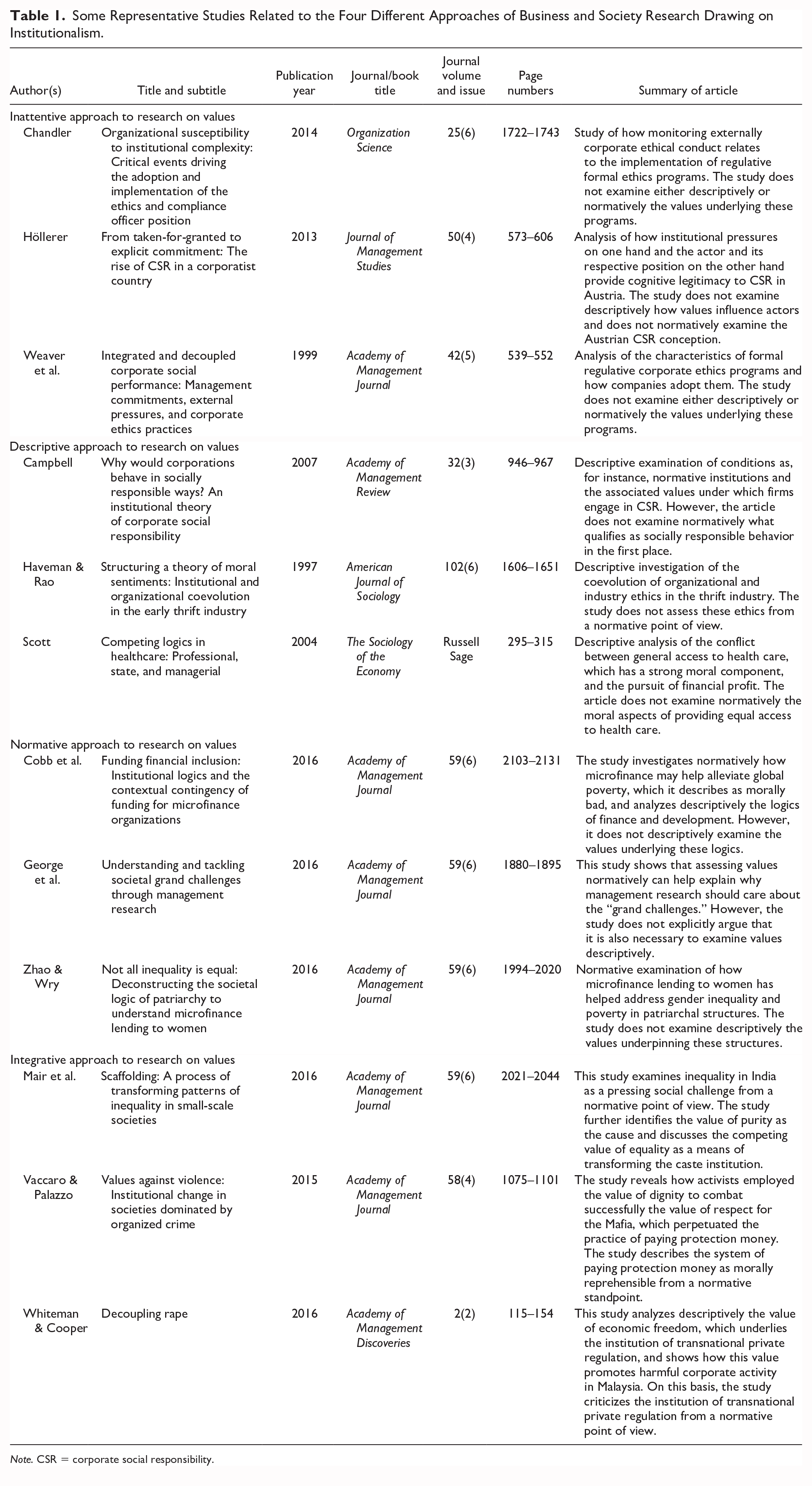
Note. CSR = corporate social responsibility.
The Inattentive Approach to Research on Values
B&S studies drawing on institutionalism that exhibit an “inattentive” approach to research on the role of values in institutions are not concerned with such values either descriptively or normatively. In the view of DiMaggio and Powell (1991, p. 14–15; our emphasis), institutionalism explicitly excludes the investigation of values:
Organizational forms, structural components, and rules, [. . .] are institutionalized”; and “not norms and values but taken-for-granted scripts, rules and classifications are the stuff of which institutions are made.
The arguments cited above suggest that separating “values” from “facts” allows researchers to focus more sharply on the regulative and cognitive aspects of institutional life. Moreover, as Suddaby (2015) argued, shifting the analytical focus from normative aspects to the more measurable cultural-cognitive and regulative elements of institutional life may have helped this research field to achieve higher scientific status.
In line with the views of DiMaggio and Powell (1991), institutionalism concentrates mainly on the cognitive and regulative elements of institutions. For example, while Höllerer (2013) investigates how CSR gains cognitive legitimacy and how, in turn, this reinforces its institutionalization among Austrian companies, the author does not look at empirical evidence or discuss the impact that values may have on a corporate actor’s stance on CSR and on the decision to adopt CSR principles or not. Another point with regard to the same study (Höllerer, 2013) is that it does not evaluate normatively commitment to CSR in the Austrian corporate world and refrains from assessing, for example, how the concept of CSR may help Austrian companies achieve ethical goals.
Other studies in the same literature focus on formal regulative aspects. For example, Weaver et al. (1999) examined how the institutional environment and the degree of commitment that the top management shows to formal corporate ethics programs influence corporate decisions to adopt such programs or not and explain differences between comparable programs. Interestingly, the authors point out that they refrained from researching their topic in normative and descriptive terms. Specifically, Weaver and colleagues (1999, p. 53) underline that they “consciously chose not to focus on more informal modes of control, such as informal norms [even though] these more informal modes of control are likely to be important in many organizations” and that their “study does not address the ethical propriety of formal ethics programs” (Weaver et al., 1999, p. 53).
Chandler (2014), who studied formal corporate ethics programs, similarly refrained from researching the role of values either normatively or descriptively. The author argues that in cases of corporate ethical misconduct, actors such as the government, nongovernmental organizations and the media more closely monitor the company’s internal practices and processes and put high pressure on the exposed company to implement a corporate ethics program. The study shows that organizations that have become involved in corporate misconduct dedicate particularly high amounts of resources to implementing specific components of corporate ethics programs—for instance, by creating a CSR management position to ensure that the organization’s conduct complies with ethical standards.
Studying regulative aspects of responsible business practices, however, provides only limited insights into how such practices become institutionalized. Risi and Wickert (2017) have argued that as CSR becomes increasingly institutionalized in an organization, formal CSR structures gradually disappear. Similarly, Strand (2014) reported that when an organization dismantles its formal CSR department, the implications for the entire organization range from neglecting calls for more responsible behavior to the successful integration of CSR.
Another problem with downplaying the normative aspect of institutionalizing meaningful B&S interactions—such as CSR—is that the actors involved tend to be highly driven by specific values. Risi and Wickert (2017) emphasize that CSR managers are highly motivated, while Hemingway and Maclagan (2004) have described these actors as “moral agents.” In sum, it can be argued that the actors involved in B&S interactions tend to live up to their values through the practices they implement or promote and thus create an organizational commitment to the moral principles associated with these values. The influence such actors can have on the institutionalization, for example, of an organization has been described as “infusion with value” (Selznick, 1996, p. 271). The process of this kind of infusion is important because, generally, people only support an issue when they believe that those who champion it also believe in the values they propagate (Stinchcombe, 1997). Creating and maintaining this belief is of paramount importance because values can only have a real influence in practice if people treat them as real (Thomas & Thomas, 1928). This implies that the cognitive taken-for-grantedness and, more specifically, the shared understanding of moral issues within a firm are inseparably interwoven with and fundamentally driven by the values that are associated with these issues.
Several institutional theorists have argued something very similar, namely, that where values are concerned, cognition and emotions are intertwined (Creed et al., 2010, 2014; Fan & Zietsma, 2017; Friedland, 2017; Lok et al., 2017; Toubiana & Zietsma, 2017; Voronov & Vince, 2012). Voronov and Weber (2016, p. 461), for example, acknowledge that “ideals, values, and moral judgements” lie at the heart of the cognitive dimension of institution which rests on taken-for-granted understandings and the regulative momentum of institutions characterized by regulatory processes as, for instance, rule setting, monitoring, and sanctioning (see Scott, 2014). Values infuse institutions with meaning. Furthermore, people who can identify with the values that an institution espouses may feel more connected to that institution (Fan & Zietsma, 2017; Zietsma & Toubiana, 2018). This view concurs with the idea that merely focusing on regulative and cognitive aspects comes at certain limitations. More specifically, extrapolating from how formal regulative structures are established in institutions to the institutionalization, for example, of CSR will not yield sufficient insights into how the latter is accomplished.
The pursuit of institutional theorists (Voronov & Weber, 2016) of linking cognition and emotions through the study of values is in line with moral psychology research. After the mid-20th century, rationalist-cognitive perspectives dominated moral psychology (Haidt, 2012). These perspectives were based on the assumption that people draw on rational, logical thinking to make value judgments (Kohlberg, 1969). In the early 21st century, moral psychologists shifted their attention from cognition to emotional intuitions in connection with people confronting value issues (Haidt, 2003). However, psychological experiments on group behavior have shown that logical thought and emotional intuition may go hand in hand (Haidt, 2012; Pizarro & Bloom, 2003). Haidt (2012) suggested that people are able to influence the values of others through logical arguments that trigger new emotional intuitions in others. But because values are inextricably linked to emotions, influencing others not only involves presenting logically convincing arguments but also evoking novel emotional intuitions (Haidt, 2001).
In a nutshell, focusing on values can yield key insights into the process through which responsible ways of managing B&S interactions become institutionalized. As Aguinis and Glavas (2012, p. 943) put it in the context of CSR, a company engages in managing such interactions also “due to normative reasons that lie in the firm’s values.”
The Descriptive Approach to Research on Values
The descriptive approach to research on values applies an empirical social science methodology to study the role of values in B&S interactions through the lens of institutionalism but does not address normative questions. The following studies illustrate this approach quite well.
Haveman and Rao (1997) studied the coevolution of organizational and industry ethics in the thrift industry (i.e., in savings and loan associations). However, the authors only assessed descriptively the values they studied, not from a normative point of view, leaving readers to draw their own conclusions. Similarly, Scott (2004, p. 295) examined the “competing logics in health care” in an account of how the conflict between general access to health care and the pursuit of financial profit arose. Access to health care for all citizens is undeniably a matter of public policy with a strong moral component. However, Scott (2004) did not examine whether the principle that everyone should have equal access to health care is morally justifiable. Finally, the “institutional theory of corporate social responsibility” that Campbell (2007, p. 946) proposed includes several factors that determine whether firms behave in socially responsible ways. Campbell (2007, p. 947) examined “under what conditions [. . .] corporations [are] more likely to act in socially responsible ways than not” and discussed a set of economic and institutional conditions that influence the extent to which firms engage in responsible behavior. However, this study fails to normatively address the question of what qualifies as socially responsible behavior in the first place.
These three studies illustrate the conclusion that “the vast majority of contemporary social scientists have distanced themselves from moral reflection” (Thacher, 2015, p. 317). Similarly, and with regard to B&S research drawing on institutionalism in particular, Baur and Arenas (2014, p. 163) have noted that “the contribution of institutional theory is largely descriptive rather than normative.” On the whole, works in this field of research do not reflect normatively on the role of organizations in the conflicts that arise or on the risks and benefits that B&S interactions involve (see Argenti, 2004; Doh & Guay, 2006).
We argue that scholars should not refrain from reflecting on themselves and their research (Slife & Williams, 1995; Weick, 1999). A “reflexive” scholar is aware of the “inevitable circularity of knowledge of epistemological and ontological issues [and that] any theory of knowledge presupposes knowledge of the conditions in which knowledge takes place” (Johnson & Duberley, 2003, p. 1281). Slife and Williams (1995) explained such circularity with the historically grown and path-dependent nature of knowledge acquisition. More specifically, past theoretical explanations and related scientific methods specify the path of thinking about current matters (Slife & Williams, 1995). This circularity suggests that B&S scholars engage in this kind of self-reflection through thinking about the normative convictions and assumptions underlying their scholarly work. This kind of contemplation involves analyzing intensively how the objects of research and the researcher are interlinked (Johnson & Duberley, 2003).
The case of CSR, for example, helps us illustrate the link between researchers and their work. To determine whether a firm pursues CSR or not, it is necessary to define first what the research object—namely CSR—is. Garriga and Melé (2004) identified four ways of conceptualizing CSR. First, CSR may be seen as an instrument for maximizing profit, in line with the neoclassical view, according to which financial performance is a company’s only responsibility toward society (Friedman, 1970). Second, CSR may be seen as a consequence of the greater social power that some businesses acquire, which leads to greater responsibility in the political arena in particular and toward society in general. The corporate citizenship concept assumes that companies administer aspects of citizenship not only to traditional stakeholders but also to groups with indirect transactional relations (Matten & Crane, 2005). Third, CSR can be seen as a means of achieving societal recognition and as a set of principles that businesses integrate into their strategy and operations because this is what societal stakeholders expect of them. Wood’s (1991) corporate social performance model underlines the integration of societal demands and simultaneously emphasizes the importance of institutional legitimacy, ultimately attributing legitimacy and power to organizations. Fourth, CSR can be seen as an ethical obligation toward society that businesses have to honor. An ethical understanding, such as, for instance, upheld by normative stakeholder theory (Donaldson & Preston, 1995; Freeman, 2010), suggests that CSR consists of normative guidelines that describe what firms have to do beyond their economic purpose and legal requirements.
These different conceptualizations of CSR span a spectrum ranging from an instrumental understanding with a pure market orientation to an ethical understanding, according to which CSR is a moral obligation (Garriga & Melé, 2004; Wickert & Risi, 2019). From each of these four perspectives, B&S interactions are viewed differently. For that reason, it follows that any analysis of CSR requires that the researcher assesses normatively what qualifies as CSR. In turn, this assessment depends on defining what aspect of social reality matters most to the particular researcher: economics, politics, social integration, or ethics (Garriga & Melé, 2004; see also Parsons, 1961). This makes clear that choosing a particular aspect of social reality has certain implications for B&S research, as this choice specifies how a researcher investigates CSR (Gond & Matten, 2007). In sum, the example of CSR illustrates why it is necessary to investigate what links researchers to their object of research.
Omitting from descriptive research the kind of normative reflection we have described may also have negative effects on practical relevance. According to Thacher (2015, p. 317), the fact–value dichotomy “can fatally sever inquiry’s connection to the practical concerns that originally motivated it.” These considerations make it easy to understand why there have been calls on scholars to increase the practical relevance of institutionalist research. For instance, Kraatz (2009, p. 86) critically noted that institutionalism “says very little about how to govern, reform, or productively improve any given existing social institution.” Kraatz and colleagues (2010, p. 1521) suggested that institutionalism should pay more attention to the question of how we can design and defend administrative structures that protect “precarious organizational values.” In a similar vein, Scott (2014, p. 275) problematized the fact that institutional scholars are reluctant “to advance suggestions for reform or policy descriptions.”
In sum, studies that only descriptively investigate values offer limited insights because they fail to take into account the normative examination of whether a specific way of managing B&S interactions is morally “right” or “wrong.” Furthermore, the descriptive approach reduces the practical relevance of B&S research because, without the normative component, the practical implications of such research tend to be ignored. The next section discusses research that examines values from a normative, but not from a descriptive perspective.
The Normative Approach to Research on Values
The normative approach to research on values uses a normative methodology to study the role of values in B&S interactions through the lens of institutionalism, without conducting a descriptive investigation of values. Many institutional scholars use Max Weber’s work, notably his ground-breaking book The Protestant Ethic and the Spirit of Capitalism (Weber, 1952), as a starting point. For example, DiMaggio and Powell (1983, p. 147) begin their influential article as follows:
In The Protestant Ethic and the Spirit of Capitalism, Max Weber warned that the rationalist spirit ushered in by asceticism had achieved a momentum of its own and that, under capitalism, the rationalist order had become an iron cage in which humanity was, save for the possibility of prophetic revival, imprisoned “perhaps until the last ton of fossilized coal is burnt” (Weber, 1952, pp. 181–182).
This quote from Weber represents a normative examination of the status quo: Weber described the trend for rationalization as an increasingly restrictive form of imprisonment for humankind. In Weber’s eyes, bureaucracy promotes oligarchy and its unstoppable extension is “combined with the strict avoidance of all spontaneous enjoyment of life” (Weber, 1952, p. 53).
Some more recent institutional studies on B&S examine the role of values in institutional contexts from an explicitly normative perspective, without considering the descriptive aspects of their subject matter. For example, Cobb et al. (2016) have described poverty as a morally bad thing. The authors evaluate their research on microfinance as “a promising tool for addressing the grand challenge of global poverty” (Cobb et al., 2016, p. 2103); however, they base their study of microfinance organizations’ lending activities only on the logics of finance and development. Zhao and Wry (2016, p. 1994) studied gender equality and poverty reduction, which they describe as “society’s biggest problems,” in developing countries, also in the context of microfinance lending. Their study examines how patriarchy as an institutional logic affects microfinance lending to women; however, it does not examine descriptively the value systems that underpin patriarchal structures. All the studies mentioned above illustrate that adopting a normative perspective can help clarify the practical issues that motivate a study.
More recent efforts to make management research more relevant for addressing actual problems of globalized society illustrate the inherent normative nature of research. George et al. (2016) explained how normatively assessing the role of values in an institutional context can illustrate the real-world reasons for management research. The authors discuss “the grand challenges” of global society and why management scholars should care about them. While the authors indicate that studying institutional contexts is important to address the grand societal challenges, they do not explicitly suggest a descriptive investigation of values in such contexts. However, George and colleagues (2016, p. 1888) acknowledged, at least implicitly, that descriptive examination is important: In their reference to Hollensbe and colleagues (2014), they argued that “an organization with purpose likely embraces certain values such as dignity, solidarity, plurality, subsidiarity, reciprocity, and sustainability, and targets its efforts at a common good in addition to the pursuit of its own goals” (George et al., 2016, p. 1888).
B&S research that examines the role of values in institutions from an explicitly normative perspective but not from a descriptive perspective also has some limitations. Selznick (1992), for example, argued against abandoning descriptive research on values in favor of normative reflection. The normative pillar of institutional life, as the author has pointed out, plays an important role because values may point to possible solutions to past challenges and inspire solutions to current and future challenges. On these grounds, examining the role of values also in descriptive terms can provide insight into the practices and challenges that people try to meet (Kitcher, 2011; Thacher, 2015).
Another potential problem with exclusively normative research in this field is that it tends to decouple moral reflection from actual business practice. This insight is in line with Sen’s (1987) argument (p. 9) that “the distance that has grown between economics and ethics” has been “unfortunate [also] for the latter.” Harris and Freeman (2008, p. 543) expressed a similar view, arguing that “questions of ethics in business are overly stylized unless considered within the rich context of value creation, organizational dynamics, and stakeholder pressures.” The next section will review research that combines the normative and the descriptive perspectives to examine the role of values in institutional contexts.
The Integrative Approach to Research on Values
The integrative approach to research on values combines the normative and descriptive examination of values in institutions. Joining these two approaches presents a great methodological challenge, as examples in the context of CSR show (Garriga & Melé, 2004). This challenge is reflected in the rather modest number of institutional studies on B&S that combine the normative and descriptive perspectives (Baur & Arenas, 2014). This modest number also applies to the major B&S journals (Business & Society, Business Ethics Quarterly, and Journal of Business Ethics). In these journals, we however find theoretical efforts to unite the descriptive and the normative paradigms (Harris & Freeman, 2008; Nielsen & Massa, 2013) and literature reviews suggesting that normative scholars intensify the descriptive examination of institutional contexts (McLeod et al., 2016). There, we also find exemplary work for an integrative approach. For example, Karam and Jamali (2013) document how corporations introduce the value of gender equality through their CSR activities in the Arab Middle East. This novel value helps deprive the moral basis of the gender institution and initiate institutional change toward gender equality. In addition to the work from Karam and Jamali (2013), the following three studies further exemplify the idea of an integrative approach, involving B&S scholars’ reflection on and active engagement with their own normative convictions, particularly well.
Mair and colleagues (2016, p. 2021) examined what they describe as “one of the most pressing grand challenges”: social inequality in Indian rural villages. In India, the institution of castes is interlinked with the value of purity that propagates fundamental inequality. Purity suggests that higher castes avoid contact with lower castes, as they otherwise get polluted and lose their superiority. This explains, for example, why the members of superior castes believe that they will be tainted if they use water from the same source as members of inferior castes. In their case study, Mair and colleagues (2016) show how a nongovernmental organization was able to convince local elites to participate in inclusive water sanitation programs that involved all castes and both genders. Through those programs, the organization managed to introduce to local societies in rural Indian villages the novel, in that context, value of equality and thus had an impact on the dominance of the caste institution and the underlying value of purity. In a nutshell, the study integrates normative and descriptive perspectives on studying the value of purity and the competing value of equality that allows for transforming the caste institution.
Vaccaro and Palazzo (2015) conducted a case study on ways of combating the morally reprehensible Mafia system in Sicily. The authors show how young Sicilian activists successfully fought the traditional value of respect for the Mafia, which perpetuated the payment of protection money (“pizzo”) to local Mafiosi, by introducing alternative values associating such payment with a lack of dignity. The activists’ campaign eventually succeeded in changing the values of the local community and, as a result, in tackling the institutionalized practice of paying protection money. More specifically, the study combined the normative and descriptive perspectives to investigate how those activists introduced the value of dignity to fight successfully the value of respect for the Mafia perpetuating the practice of paying protection money.
The third exemplary study is by Whiteman and Cooper (2016). The authors criticized the institution of transnational private regulation from a normative point of view but based their critique on descriptive analysis. Their case study focuses on a Malaysian logging company that was certified as sustainable by the Forest Stewardship Council (FSC), even though its operations indirectly led to environmental damage and serious human rights violations. The authors argue that the limits of transnational private regulation are connected to its underlying value of economic freedom, according to which companies should face only few restrictions and are not responsible for the indirect consequences of their actions. In short, this work combines normative and descriptive examination of the value of bounded responsibility underlying the institution of transnational private regulation.
An integrative approach links an investigation with its potential practical implications. For example, the study by Mair and colleagues (2016) analyzes sanitation programs that successfully promote the value of equality and help tackle inequality within the caste system in India. At the same time, the authors provide practical instructions on how nongovernmental organizations should implement such programs. Similarly, the insights that Vaccaro and Palazzo (2015) provide into how dignity as a value can be employed to combat the practice of paying protection money and the value associated with this practice can help activists around the world organize their fight against racketeering and extortion by organized crime. The study by Whiteman and Cooper (2016) on the serious social and environmental consequences of the value of economic freedom suggesting that companies have bounded responsibilities provides stakeholders such as human rights organizations with a strong case for arguing that alternative values emphasizing more extensive responsibilities should guide relevant transnational regulations. Finally, the work by Karam and Jamali (2013) on the novel value of gender equality in the Arab Middle East also has practical implications. The two authors develop a framework comprising different forms of CSR activities that have the potential to withdraw the moral basis of the subjugation of women in the Arab Middle East. In sum, an integrative approach to research on the role of values in institutional contexts establishes a bridge between research and the practical concerns that prompt such inquiries in the first place.
From this review, one can see that in the context of B&S research drawing on institutionalism, the fact–value dichotomy is problematic because of two reasons: First, without any examination of researchers’ own normative convictions, the tight link between researchers’ theoretical assumptions and their descriptive research on values remains unreflected. Second, keeping descriptive and normative analysis separate decouples B&S research from its practical purpose and dilutes the motives that drove such a scholarly endeavor in the first place. The few studies that have managed to overcome the fact–value dichotomy demonstrate that the integrative approach helps both theoretically unpacking the relationship between the researcher and the object of research and establishing the link between research and its initial practical aims.
Beyond the Fact–Value Dichotomy in B&S Research Drawing on Institutionalism
An integrative approach aligns with what previous works have pointed out, namely, that the descriptive and normative paradigms are normally kept separate in the B&S field (Baur & Arenas, 2014; Garriga & Melé, 2004; Swanson, 1999; Wicks, 1996). The first three approaches (the inattentive, the descriptive, and the normative approaches) follow the tradition established by classical social scientists, such as Weber (1949) and Schumpeter (1943/2003), who uphold the separation between the normative and the descriptive paradigms. In contrast, an integrative approach reflects the views of scholars who oppose the fact–value dichotomy, such as Putnam (2002) and Searle (1964) in the philosophy of science, Gouldner (1962) and Sen (1987) in the social sciences, Baur and Arenas (2014), Harris and Freeman (2008), and Newbert (2018) in B&S research, and Kraatz and Block (2017) and Thacher (2015) in institutionalist research. Two theoretical platforms can help stimulate research in line with an integrative approach: John Dewey’s pragmatism and Philip Selznick’s institutionalism. Both these platforms rest on the conviction that normative and descriptive examination is inseparable. In this vein, Harris and Freeman (2008, p. 542) have advocated the work of philosophical pragmatists as, for instance, Dewey as a means of overcoming the separation between descriptive business research and normative business ethics. Within pragmatist philosophy, Dewey’s work is particularly interesting because it focuses on solving problems and challenges in the real world (Gale, 2004; Wicks & Freeman, 1998). Selznick made Dewey’s tradition of thought fruitful for institutionalism (Kraatz et al., 2020) and conceives such research as “an inherently normative enterprise” driven by practical intentions that favor society (Thacher, 2015, p. 319). The next section looks at Deweyian pragmatism.
Deweyian Pragmatism
Philosophical pragmatism originated in the United States around 1870 and was initiated by Charles Sanders Peirce and William James. While Peirce and James mainly focused on theorizing inquiry, the nature of meaning, and the underlying condition of truth, the next generation was keen on applying pragmatism to education, politics, and other tiers of social progress, under the major influence of John Dewey (Legg & Hookway, 2019). This explains the striking similarities and differences between pragmatists such as Dewey and James (see Gale, 2004), and Dewey’s conviction that philosophy should address real-world social issues and challenges:
First, it [philosophy] develops a theory of inquiry from an empirical examination of which method of problem solving has worked best in the past. Second, it applies this method to solving or ameliorating the vast problems of men in society—social, political, and economic. (Gale, 2004, p. 161)
Deweyian pragmatism helps informing an integrative approach. First, Dewey depicts normative theoretical reflection and empirical investigation as inseparable. Combining the two provides the basis for identifying novel and alternative values that ultimately help improve society. Second, Dewey conceptualizes pragmatism as an intellectual enterprise that continually reflects on its practical intentions. Contributing to the “human good” (Dewey, 2008c, p. 7) is, therefore, conceived as the driving force behind research, and it constitutes the raison d’être of any scholarly activity.
Pragmatist philosophers assume that all living beings are interconnected within the social contexts through which they gather experience (Joas, 1993). Therefore, pragmatists draw on existentialists such as Søren Kierkegaard, Friedrich Nietzsche, and Jean-Paul Sartre, who argue that any philosophical inquiry begins with experience of the feeling, thinking, and acting individual human being. A high degree of social interconnectedness means that any action has consequences for the interests of others. Considering how an action, or a particular practice, affects others and how this action and its consequences are interconnected with the elements of its broader or specific context (e.g., a specific situation) involves normative thinking—in other words, it involves differentiating between “right” and “wrong” (Dewey, 2008b; James, 1974). In that sense, from a pragmatist perspective, examining normative questions and examining empirical phenomena are parts of the same endeavor.
Emphasizing the continuities between normative and descriptive research illustrates the intellectual proximity of the integrative approach to pragmatism. More specifically, Dewey (1963) does not think of ethics as a discipline whose main purpose is to reflect theoretically on morality in isolation from empirical reality. Instead, Dewey (1963) emphasizes the circular and inseparable relationship between empirical experience and normative theoretical reflection and argues that an empirical examination is what will enable us to distill ideas on morality. Distilling moral ideas from practical knowledge is, however, only possible through normative theoretical reflection: “Without the intervention of thought, enjoyments are not values but problematic goods. They become values when they re-issue in a changed form from intelligent behavior” (Dewey, 1929, p. 259).
Pragmatism suggests a world in flux in which people make their own observations and gain their own experiences. Dewey (2008a) assumes that people have the intelligence to interpret their observations and experiences and handle the challenges of moral life. Intelligence also enables people to form and realize plans that project a better future. However, in the first instance, the plans people make are merely hypothetical and must be tested in practice. Consequently, such plans are accepted, expanded, or rejected, depending on whether they are useful and good or useless and poor guides to moral behavior. Dewey (2008a, p. 466) termed these plans “programs of action.” Given that the world is permanently changing, programs of action are flexible and also prone to change. Sustaining such programs of action requires monitoring continually their actual consequences and whether the people who plan them have a constant willingness to learn and the courage to readjust (Dewey, 2008d). Briefly put, Dewey suggests that researchers have a moral obligation to serve humankind (Gale, 2004). This means that research is a normative endeavor and that the normative and descriptive aspects of research are inseparable. While the pragmatist idea of this kind of inseparability is present in the integrative approach, it similarly flows through the works of early institutional theorist Philip Selznick, which we discuss below.
Selznick’s Institutionalism
So-called old institutionalists, such as Philip Selznick, stress the normative character of institutional analysis (Suddaby, 2015; Thacher, 2015). In that vein, Selznick (1996) suggests providing metaphors that may help people understand better both themselves and their world and drawing attention both to values and to the ongoing construction of social reality that people pursue. In view of the potential impact such metaphors can have, the principal objective of Selznick’s institutionalism is to provide metaphors that are ethical because unethical metaphors could influence negatively both people and institutions (Selznick, 1996).
Selznick (1949, 1951, 1957) sets a clear focus on values. In that respect, institutional analysis explicitly goes beyond the study of merely regulative institutional elements and taken-for-granted cognitive structures. However, as Kraatz and Flores (2015, p. 356) point out with regard to Selznick’s legacy, “to say that values are real and consequential is not to say that they are the only things that matter.” In other words, the emphasis that Selznick places on the normative pillar of institutions and on values, in particular, does not diminish the importance of other institutional processes, such as the sedimentation of taken-for-granted understandings and the introduction of new laws. Selznick (1996) attaches similar importance to both cognitive and regulative processes. This also applies to an integrative approach as is illustrated, for example, by Mair and colleagues (2016) who showed how the value of purity interlocks with regulative elements, such as the political and legal power structure of local government bodies, and cultural-cognitive beliefs about castes in Indian villages.
While the philosopher Dewey reaches his full potential when informing the normative side of the integrative approach, the sociologist Selznick is particularly helpful in instructing us about the descriptive side. Dewey and Selznick put similar emphasis on value pluralism because they both regard values as things that are “genuinely ‘desirable’ and not necessarily (or even usually) oppositional” (Kraatz et al., 2020, p. 16). Dewey and Selznick thereby count on the human ability of tolerating and internalizing multiple values whereby, according to both scholars, the values that matter most are those that are directly lived and can actually be experienced (Kraatz et al., 2020).
Selznick (1992) mentioned that values are widely accepted solutions which have proven successful in solving past problems and become empirically manifest in practice—for example, as specific organizational routines or systems. Due to its underlying intention of improving society (Selznick, 1996), Selznick’s institutionalism combines the descriptive examination of values with posing the question of how a set of values may be either strengthened or modified (Selznick, 1992). In that respect, institutional analysis is not limited to examining critically conventional organizational models and the premises of management but aims to develop models and premises that are morally more justifiable than, for example, “the still-dominant view that the corporation is a voluntary association of shareholders who own the enterprise and are the only members who really count” (Selznick, 1996, p. 272).
In sum, Selznick’s institutionalism presents a fruitful intellectual source for the integrative approach as it stands for “a more empirical approach to moral inquiry” (Thacher, 2015, p. 346) that does not shy away from normative questions when studying values, communicates transparently its normative underpinnings and emphasizes the importance of providing practical contributions toward society.
Potential Implications of Overcoming the Fact–Value Dichotomy
An integrative approach overcomes the fact–value dichotomy, creating opportunities to improve B&S research that uses institutionalism in a number of ways. For example, while institutionalism offers a useful theoretical lens for studying the B&S interface (Brammer et al., 2012; Risi, 2018), management scholars should, however, make the values that inform their work explicit and use their good position to contribute to solving normative issues (Etzion & Gehman, 2019). Management scholars’ unique position and the associated imperative that they should participate in the solution of normative issues can be explained as follows: While management scholars have the methodological and theoretical tools to illustrate those complex issues from various perspectives, due to their consulting and teaching activities, they often have close contacts to business executives and have the communication skills to actually convince them of their ideas (Etzion & Gehman, 2019).
An integrative approach helps establish a close link between B&S research and practice because it allows for combining normative research, which concerns the reasons for which it is important to investigate a specific normative issue, and descriptive research, which examines how certain values affect that issue. For example, on one hand, taking a normative stance on values helps initiate and stimulate management research on grand societal challenges as, for instance, sustainable development, which concerns numerous organizations internationally (George et al., 2016). On the other hand, descriptive research can show how and why certain values influence an organization’s ability to achieve its sustainable development goals and which values play a key role in realizing such goals (Hollensbe et al., 2014).
Ensuring the continuity between research and practice is one way of responding to the calls on institutional scholars to demonstrate greater social engagement (Hampel et al., 2017; Kraatz & Block, 2017; Scott, 2014). To achieve greater engagement, it is necessary to reflect on the practical intents behind a research project. As Salaiz and Vera (2017, p. 100) argued, it is important not to “‘decouple’ ourselves in our role as academics from seeing our research as a powerful tool to raise our voice and trigger positive change.” An integrative approach enables researchers to achieve this objective, precisely because it is driven by the aim to develop models that can improve society. Whether these models will be adopted and applied in practice, however, remains at the discretion of the actors—for example, managers—to whom such research is relevant.
Harris and Freeman (2008) argue that academic work eventually finds its way into practice and that theories and academic ideas can influence organizational practice, as managers tend to adopt the worldviews that theorists propose (Ferraro et al., 2005; Ghoshal, 2005). For that reason, as the authors suggest, the fact–value dichotomy entails two risks. First, separating descriptive research from normative ethics tends at the very least to obscure the moral consequences that business decisions have. For example, research that does not consider jointly facts and values could be used to justify the quest for maximum profit at any price (Friedman, 1970) as well as a company’s decision to carry out mass layoffs even if it is flourishing economically, merely for the sake of improving financial performance.
Second, research in which ethical considerations are systematically depreciated and considered less “real” than business considerations can easily, albeit paradoxically and unintentionally, end up promoting ethical norms that do more harm than good (Harris & Freeman, 2008). Propagating research in which the ratio of ethics and business is uneven is particularly problematic in view of the fact that theories can have performative effects on, for example, financial markets (MacKenzie, 2006; MacKenzie & Millo, 2003), public policies (Marti & Scherer, 2016), practices of middle managers (Wickert & Schaefer, 2015), and the practice of management in general (Ferraro et al., 2005; Ghoshal, 2005). An integrative approach to research on values mitigates these risks because it aims to develop theories that reveal the potential moral consequences of managerial behavior and underline the necessary balance between ethics and business.
The integration of normative and descriptive research on values could also help strengthen theorization in the B&S field. In line with the concept of reflexivity in the management literature (Janssens & Steyaert, 2009; Johnson & Duberley, 2003; Weick, 1999), an integrative approach considers the connection between research object and researcher. More specifically, an integrative perspective takes into account that each CSR conceptualization differently shapes B&S interactions and draws upon a different aspect of social reality (Garriga & Melé, 2004). Consciously choosing a specific CSR conceptualization and the associated aspect of reality suggests that researchers reflect on the normative principles and assumptions that inform their approach to research B&S interaction.
Studying values from an integrative perspective promotes this kind of fruitful reflexivity. An integrative perspective also gives researchers room to reflect critically on how B&S interact and provides a basis for considering alternative ways in which such interactions could be conducted. For example, descriptive research on the value of economic freedom and the closely associated concept of bounded responsibility, which underpins transnational private regulation, has revealed their negative implications for the environment and for society (Whiteman & Cooper, 2016). By contrast, normative research on the topic has generated arguments for extending corporate responsibility and the role of businesses in private regulation (Whiteman & Cooper, 2016). This example illustrates how an integrative approach helps form a normative core of critical reflection on how business is conventionally viewed and at the same time opens up new ways of conceptualizing the B&S interaction.
While we have shown that an integrative approach can potentially help improve theory development and increase the practical relevance of B&S research, we acknowledge at least two limitations. First, based on Deweyian pragmatism and Selznick’s institutionalism, such an approach suggests doing two different things simultaneously, that is to descriptively and normatively investigate the role of values in institutions. While, for example, Selznick was able to combine the two disciplines—institutionalism and normative philosophy—because of his substantial expertise in both areas, bridging them has become a great methodological challenge due to the growing specialization of disciplines (see, e.g., Garriga & Melé, 2004). For that reason, B&S scholars tend to refrain from normative examination requiring a wider normative ethical discussion (see, e.g., Scherer et al., 2013).
Another limitation lies in the circumstance that the quest for higher scientific status tends to go together with a move away from the normative paradigm toward the empirical descriptive paradigm that is closer to economic and positivist science. Suddaby (2015, p. 95) depicted this for the case of institutionalism, which “has been quick to abandon its key theoretical tenets” of normative and reflexive scholarship “in its attempt to acquire ‘scientific respectability.’” In a nutshell, the two limitations help us make sense of why B&S scholars may decide against a combination of normative and descriptive investigation, even if they might agree in principle with the integrative approach.
Dewey (2008c) and Selznick (1996) suggested engaging in more reflective and value-oriented scholarship because only through combining the two paradigms do scholars manage to fulfill their moral duty to contribute to social progress. While mobilizing the legacy of those two scholars, an integrative approach similarly incorporates more recent thinking such as, for instance, the idea that the fact–value dichotomy has caused institutionalism to lose its “focus and coherence” (Suddaby, 2010, p. 14) and “theoretical reflexivity” (Suddaby, 2015, p. 94) and impedes theory-building in the B&S field (Garriga & Melé, 2004; Swanson, 1999; Wicks, 1996).
Harris and Freeman (2008, p. 541) argued in favor of value-oriented research because “distinguishing ‘business’ concerns from ‘ethical’ concerns is not only an unfruitful and meaningless task, it is also an impossible endeavor.” Several other scholars have similarly pointed out that separating descriptive and normative matters is actually impossible (Freeman, 1994; Newbert, 2018; Wicks, 1996). Harris and Freeman (2008) built their argument on the idea that values are inseparably intertwined with their institutional context. Their argument implies that it is not possible to isolate values as “facts” from their context. In line with Sen (1987), Harris and Freeman (2008) also indicated that ignoring that economic issues are inseparable from normative issues and adhering to either a normative philosophical or a descriptive social science perspective have stunted research.
To sum up, the integrative approach takes into account that in B&S research drawing on institutionalism the fact–value dichotomy is both blurred and theoretically impossible and that a positive practical contribution to society is the underlying motivation of scholarship. However, overcoming the fact–value dichotomy is far from easy. We hope that this article will stimulate research in line with an integrative approach that reviews critically the premises underlying the conventional models of B&S interactions and develops new models that can help overcome these challenges. The following section discusses some of the possible avenues that such research could take at all levels of academia.
Potential Avenues for Future Research and Teaching
This article opens up several directions for B&S research. First, insights from Deweyian pragmatism and Selznick’s institutionalism can help B&S researchers to combine a normative philosophical with a descriptive social science perspective in the investigation of how values become manifest in various practices and what consequences those practices have. With this in mind, we suggest that transdisciplinary work that brings together social scientists and philosophers might be more conducive to B&S research than research conducted exclusively within the bounds of a single discipline.
Second, pragmatist thinking could help strengthen the practical relevance of B&S research. Management scholars should help solve major societal challenges as they can draw on various methodologies to illustrate complex value-laden issues, often engage with business leaders through consulting and executive education and have the communication skills to convince those leaders (Etzion & Gehman, 2019). However, scholars need to avoid treating values as mere data, to preserve the connection between their research and their own practical motives (Thacher, 2015). For example, if scholars conceive of CSR as independent from practice, CSR research is unlikely to be relevant to managers. Second, scholars must preserve a distance to the research object because otherwise they would lose their independence and objectivity (Burawoy, 2005). Drawing on the Deweyian idea that research should serve society and that only society itself should define what is morally right or wrong can help B&S scholars avoid these pitfalls.
This article has also certain implications for B&S teaching. Buchholz and Rosenthal (2001) mentioned two categories of business school teachers. The first category emphasizes sterile and abstract ethical theories and applies them to specific business cases. However, there is often little connection between those theories and the actual business world. The second category tends to use empirical material, such as case studies, without any theoretical foundation. This form of teaching is limited to an exchange of opinions and does not provide students with theoretical frameworks for examining ethical problems.
The Deweyian idea of a tight link between thought and action encourages academic teachers to bridge the two pedagogical concepts. Teaching based on an integrative approach is driven by the conviction that theory incorporates practice and that people are the agents who handle the moral challenges of practical life (Buchholz & Rosenthal, 2001; see also Dewey, 2008a). Furthermore, such teaching can help provide students with the skills they need to make and interpret their own observations and to deal with moral problems. As Dewey (2008a) put it, it is about developing their intelligence and their ability as humans for self-directed learning and moral growth.
Indeed, simulating a “real-life” business context in the classroom can be a way of enabling students to achieve moral growth. In this respect, Freeman and colleagues (2015) suggest that business-school teachers should draw on the creative arts, especially literature and theater, which often portray human life in all its complexity. A prime example is the course entitled “Eschenbach‘s Parzival: Lessons to bring (business) ethics alive” held by Professor Florian Wettstein, Director of the Institute for Business Ethics of the University of St. Gallen, and Thomas S. Ott, actor and theater director. In their course, the students (a) work in small groups on selected scenes and normative topics from the novel (e.g., freedom, altruism/compassion, competition, and fairness), (b) present the scenes in the plenary, and (c) discuss those scenes and topics in the plenary. The course thus allows the students to initially act out the novel’s normative topics and, second, provides them the necessary space for a reflective access to those topics before transferring them to a business context.
Implementing the Deweyian idea of a tight link between thought and action in teaching could strengthen students’ reflexivity. As in the course on Eschenbach’s Parzival, acting out the novel’s normative content in combination with an intellectual examination of this content helps the students develop a more reflective access to values. In fact, Nahser and Ruhe (2001) have provided some evidence that students who were taught along pragmatist lines became more responsible managers. However, Deweyian pragmatism also suggests that education cannot be reduced to the classroom because self-directed learning and moral growth continues throughout a person’s life (Buchholz & Rosenthal, 2001).
Conclusion
This article outlined that institutionalism often examines values descriptively; however, in the B&S field, researchers tend to attach similar importance to the descriptive and normative investigation of values. In view of these differences, we investigated the relationship between the descriptive and the normative paradigms in this field of research. We identified four different approaches to B&S research that uses the theoretical perspective of institutionalism: the “inattentive” approach represents research that is not concerned with the study of values either descriptively or normatively. The “descriptive” approach represents works that examine values exclusively in descriptive terms, while the “normative” approach represents research that examines values exclusively from a normative point of view. These three approaches propagate the complete separation between normative and descriptive paradigms. Only the fourth approach, an “integrative” approach, combines these two paradigms.
This article adds to the long-standing discussion in the B&S field about the relationship between normative and descriptive theories in general and their potential integration in particular. We introduced Deweyian pragmatism and Selznick’s institutionalism as possible theoretical avenues that could lead to research in line with an integrative approach and explained how drawing on these bodies of thinking can help improve theorization and increase the practical relevance of B&S research at all levels of academia. We hope that this article inspires and supports B&S scholars in their endeavor to advance this field of research and to tackle the grand societal challenges.
Footnotes
Acknowledgements
I thank the associate editor Jill A. Brown for her excellent guidance throughout the review process as well as four anonymous reviewers for their constructive comments. I am also indebted to numerous colleagues who gave valuable feedback on earlier versions of this article, in particular Patrick Haack, Matthew S. Kraatz, Tom Lawrence, Emilio Marti, and Florian Wettstein. I further benefited extensively from discussions with participants of the GRONEN Reading Group Session 2019 hosted by the Hertie School of Governance.
Declaration of Conflicting Interests
The author declared no potential conflicts of interest with respect to the research, authorship, and/or publication of this article.
Funding
The author disclosed receipt of the following financial support for the research, authorship, and/or publication of this article: This research project was partially funded by the Basic Research Fund (GFF) of the University of St. Gallen, Switzerland.
