




Abstract
In this article, we posit that a cross-scale perspective is valuable for studies of organizational resilience. Existing research in our field primarily focuses on the resilience of organizations, that is, the factors that enhance or detract from an organization’s viability in the face of threat. While this organization level focus makes important contributions to theory, organizational resilience is also intrinsically dependent upon the resilience of broader social-ecological systems in which the firm is embedded. Moreover, long-term organizational resilience cannot be well managed without an understanding of the feedback effects across nested systems. For instance, a narrow focus on optimizing organizational resilience from one firm’s perspective may come at the expense of social-ecological functioning and ultimately undermine managers’ efforts at long-term organizational survival. We suggest that insights from natural science may help organizational scholars to examine cross-scale resilience and conceptualize organizational actions within and across temporal and spatial dynamics. We develop propositions taking a complex adaptive systems perspective to identify issues related to focal scale, slow variables and feedback, and diversity and redundancy. We illustrate our theoretical argument using an example of Unilever and palm oil production in Borneo.
It is inconceivable that anyone will successfully steer companies, or countries, through our volatile world without understanding the interdependencies between the systems on which we depend.
This is easier said than done. A recent review of the systems literature in management studies shows there are very few studies that describe the complex dynamics of managing for organizational resilience across nested social-ecological systems (A. Williams, Kennedy, Philipp, & Whiteman, 2017). A nested social-ecological system is an “integrated system of ecosystems and human society with reciprocal feedbacks and interdependence” (Folke et al., 2010, p. 20). In contrast, the field of natural science has developed a large body of literature on managing resilience across nested social-ecological systems (Biggs et al., 2012; Biggs, Schlüter, & Schoon, 2015; Walker et al., 2006). Key to this work has been the recognition that constellations of organizations and ecosystems co-evolve through the collective adaptive capacity of actors (including humans and ecological species) who identify and respond to interdependencies between and within social and ecological systems at the planetary, regional, and local scales over time. Resilience thinking from a systems perspective necessitates the management of complex systems across scales.
Furthermore, social-ecological resilience is the buffering capacity of a system to cope with change and unforeseen disturbances while safeguarding the ecological systems on which human activity depends (Berkes & Folke, 1998; Folke, Biggs, Norström, & Reyers, 2016). The resilience of a social-ecological system is determined by the capacity of the actors in the system to learn from experience, gather knowledge and respond to changing conditions, or in other words, its adaptive capacity (Folke et al., 2010). Patterns of low and high resilience in social-ecological systems are described by the adaptive cycle, developed by globally recognized scientists Gunderson and Holling (2002). The adaptive cycle proposes that systems cycle through four phases: growth, conversation, release, and renewal. As systems pass from growth to conversation the resilience of the system contracts because it becomes brittle and fragile (Holling, 2001). Then, resilience increases as the system renews allowing for experimentation and novelty (Holling, 2001). Adaptive cycles are nested, “within each other across space and time scales” (Holling, 2001, p. 396).
While resilience thinking is not new to organizational scholars, the dominant focus has been on building organizational resilience to external threats (Linnenluecke, 2015; Weick, 1993), or on enhancing intraorganizational reliability (Weick & Roberts, 1993). A more holistic and dynamic understanding of multilevel resilience across social, ecological, and organizational remains underdeveloped (Linnenluecke, 2015; T. A. Williams, Gruber, Sutcliffe, Shepherd, & Zhao, 2017). In this article, we consider the potential disconnect between building organizational resilience and that of social-ecological resilience. To address the disconnect, we integrate knowledge on social-ecological resilience from natural science to what we know about organizational resilience and present propositions for future research that are multilevel and systemic. More specifically, we assess conceptually how natural science insights on nested adaptive cycles can help organization scholars to better understand the interactions and vulnerabilities inherent in the complex nested systems of humans and nature (King, 1995).
To date, only a few studies incorporate the concept of adaptive cycles within organization studies. These have focused on firm or community level dynamics such as organizational change in response to extreme weather events (Linnenluecke & Griffiths, 2010), external conditions (Yang, Bansal, & DesJardine, 2014), ecological adversity (Clément & Rivera, 2016), and ecosystem dynamics (King, 1995). While valuable for understanding certain aspects of organizational vulnerability, these studies do not consider how adaptive cycles are nested over spatial and temporal scales beyond organizational boundaries. We address this gap in the literature by developing conceptually a cross-scale perspective of resilience for organization studies drawing upon the natural sciences.
We advance organizational theory on resilience in two ways. First, we aim to bridge the literature on organizational and social-ecological resilience and we offer an explanation to address why these two concepts are currently disconnected. Research in organization studies focuses on how to build organizational resilience to external threats (Linnenluecke, 2015; A. Williams et al., 2017; T. A. Williams et al., 2017), and can benefit from conceptual developments from outside the field that seek to understand complex dynamics of social-ecological systems to build cross-scale resilience (Biggs et al., 2012; Biggs et al., 2015). In this article, we suggest that insights from the natural sciences—specifically nested adaptive cycles—can help us bridge these two fields of inquiry.
Second, we develop propositions for future research encouraging an understanding of resilience for organizational studies across spatial and temporal scales. We suggest that focal scale, slow variables and feedback, and diversity and redundancy are important factors underlying managerial approaches to managing cross-scale resilience. Following each proposition, we illustrate our conceptual argument with an example of Unilever and Borneo (Whiteman, Walker, & Perego, 2013) using previously published material and publicly available documents.
Our article is organized as follows. First, we introduce the theory of cross-scale resilience from the natural sciences and then discuss four articles in organization studies that have applied the adaptive cycle. In this section, we also offer an explanation about why these two concepts are disconnected. Second, we develop propositions for a cross-scale perspective of organizational resilience and at the same time we illustrate our conceptual argument with an example of Unilever and Borneo. Finally, we discuss how the advances we make differ from the existing literature and can provide valuable insights for organizational resilience.
Nested Cross-Scale Resilience in Natural Sciences
The natural sciences adopt a complex adaptive systems approach to resilience to understand social-ecological dynamics and integrate underlying assumptions of time and space. When resilience theory in the natural sciences was initially formulated in the 1980s (Holling, 1986), the theory “stood in stark contrast to previous ecological theories which tried to understand steady state dynamics” (Whiteman et al., 2013, p. 6). In this article, we consider how insights on social-ecological resilience from the natural sciences have important theoretical implications for organization studies and demand attention to form a more complete understanding of resilience.
Social-ecological systems are conceptualized as a nested set of adaptive cycles over spatial scales. By the term system, we refer to “a set of elements or parts that is coherently organized and interconnected in a pattern or structure that produces a characteristic set of behaviors, often classified as its ‘function’ or ‘purpose’” (Meadows, 2009, p. 188). In this article, we refer to nested systems and the interactions between organizational, economic, societal, and environmental systems. Higher level systems are large in size and change slowly, while lower level systems are small and change quickly. Changes in the adaptive cycle at one level can potentially cascade across systems, influencing the adaptive cycle at other levels and the combined dynamics of the entire set of systems (Gunderson & Holling, 2002). We build on knowledge from the natural sciences and suggest that cross-scale interactions between systems may have important consequences for organizational resilience and demand greater attention to gain a more complete understanding of managing for resilience.
System resilience is not a fixed concept, but instead expands and contracts over time (Gunderson & Holling, 2002). When a system’s components become increasingly connected they become more stable, but also more rigid as dependency upon existing structures and processes increases. Rigidity may result in a loss of resilience and an increase in vulnerability to external and internal shocks. For instance, when a firm reduces its product offerings in pursuit of efficiency, the firm will become increasingly vulnerable to any disruptions in the supply chain of those products. Conversely, when a system’s components become more loosely connected, they become more flexible, permitting experimentation and new combinations of components. For example, following a climate-related disaster a firm may recover from the disaster and experiment with new ways to respond to future climate-related disasters.
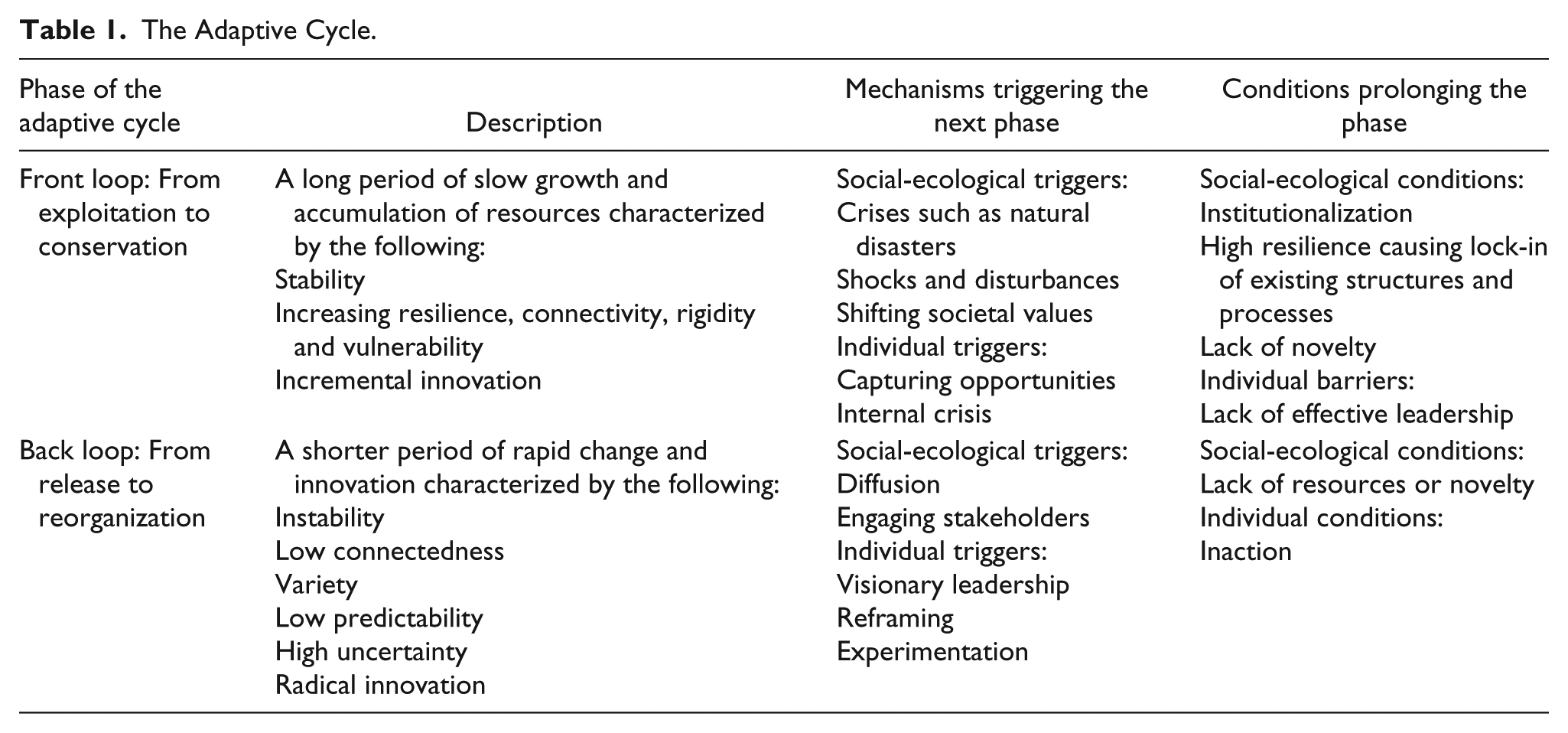
The patterns by which resilience expands and contracts are explained by the adaptive cycle (Holling, 1986). The adaptive cycle challenges stable equilibrium views of the world by emphasizing rapid change and nonlinearity (Folke, 2006). In the front loop of the adaptive cycle, systems grow until maturity and systems dynamics are relatively stable (Gunderson & Holling, 2002). The front loop is characterized by a transition from exploitation of resources to conservation. In the back loop of the adaptive cycle, a disturbance, shock, or disaster pushes the system into a phase of creative destruction before reorganizing (Gunderson & Holling, 2002). Periods of stability and instability are not always predictable and systems do not always progress sequentially from exploitation and conservation and then to release and reorganization (Walker, Holling, Carpenter, & Kinzig, 2004). The emergent dynamics may cause systems to remain in one phase for longer or initiate regression back to a previous phase. In Table 1, we summarize the adaptive cycle and identify the triggering mechanisms which incite change and a shift to another phase.
The Adaptive Cycle.
Natural sciences also acknowledge that changes to the resilience of a system do not “take place in a vacuum” and cross-scale interactions influence the dynamics of complex systems (Folke et al., 2016, p. 40; Gunderson & Holling, 2002). Adaptive cycles are interconnected and nested without implying top-down control (Simon, 1974). Higher level systems are large in size and change slowly, while lower level systems are small and change quickly. The pace of change in nested adaptive systems is relative to each specific case. Changes to the adaptive cycle of one system will interact with other connected adaptive cycles and have consequences for their functioning and resilience.
A focal system is directly connected to the systems one level below and one level above it (Walker & Salt, 2006), but impact is also possible across all scales, bottom-up or top-down. Change in systems can cascade up and impact the dynamics of higher level systems: known as a revolt force. During the creative destruction phase (release) of an adaptive cycle, the effects of the collapse and change can cascade upward. These effects will be larger if the higher level systems are not resilient to the disturbance. For example, influential individual leaders can implement firm-level sustainability strategies that drive organizational change, and this may cascade further to higher levels in which the organization is embedded such as industry levels. Higher level systems may also influence the dynamics of lower level systems: known as a remember force. In the reorganization phase of the adaptive cycle, knowledge from previous experiences emerges and determines the attributes of the new system. Higher level systems may act to constrain the potential, and opportunities, for renewal of lower level systems. For example, highly institutionalized practices within an industry or the memory of existing processes and structures may prevent organizational change (Allen, Angeler, Garmestani, & Gunderson, 2014). An example of the remember force occurs when the company’s operations are disturbed by a climate-related disaster. The disaster may shift the company from the front loop into the back loop of the adaptive cycle.
Organization Studies and Resilience
Organization scholars have explored issues such as organizational resilience to external threats (Weick, 1993), intraorganizational reliability (Weick & Roberts, 1993), employee strengths as sources of resilience (Luthans, 2002), and the role of institutional work in developing social capital and enabling resilient institutions (Barin Cruz, Aguilar Delgado, Leca, & Gond, 2016). Research has found that managers may build organizational resilience through approaches such as sensemaking and monitoring (Weick, 1993; Whiteman & Cooper, 2011), learning from previous experiences (Berkes & Folke, 2002) and building diversity, redundancy, modularity, and short information feedback (Folke et al., 2016). Yet, while organizational resilience continues to garner increased scholarly attention, only a subset of scholars have sought to go beyond a firm-level or supply chain interpretation of resilience to consider potentially important cross-scale interactions (Linnenluecke, 2015; A. Williams et al., 2017; T. A. Williams et al., 2017). Therefore, an important question to consider is if a disconnect between organizational and social-ecological resilience exists and why.
Cross-scale interactions may be considered along two dimensions of temporal and spatial scales. Studies focusing on temporal aspects have shown that firm-level sustainability practices contribute to the long-term resilience of the organization (DesJardine, Bansal, & Yang, 2017; Ortiz-de-Mandojana & Bansal, 2016). This research suggests that a focus on short-term profits may harm organizational resilience (Ortiz-de-Mandojana & Bansal, 2016). Research focusing on spatial scales illustrates how organizations can contribute to the resilience of broader social systems such as communities or cities (Barin Cruz et al., 2016; McKnight & Linnenluecke, 2016). Research has suggested that organizations have both a dependence on ecosystem functions and an important impact on their provisioning (Clément & Rivera, 2016; Whiteman et al., 2013; A. Williams et al., 2017; Winn & Pogutz, 2013); however, few studies have gone beyond recognizing this dependence to suggest specific managerial strategies to manage cross-scale resilience. Overall, we find that the organizational resilience is disconnected from broader concerns of social-ecological resilience. We now explain why this disconnect might exist.
At present, four articles explicitly apply the adaptive cycle from Gunderson and Holling. The adaptive cycle (Gunderson & Holling, 2002) was introduced to the organizational literature by King (1995) in an article that conceptualized ecosystem dynamics and based on insights from historical analysis suggested how to manage natural resources to avoid an ecological surprise. More recently organizational scholars have drawn on the adaptive cycle to explain organizational resilience to external conditions (Yang et al., 2014), extreme weather events (Linnenluecke & Griffiths, 2010), and ecological adversity (Clément & Rivera, 2016).
Most prior work applied the adaptive cycle to the organizational level or (within firm level of analysis). Although these works aim to integrate insights from the natural sciences and the social-ecological resilience literature they have adopted an understanding of resilience focused on building organizational resilience (Clément & Rivera, 2016; Linnenluecke & Griffiths, 2010; Yang et al., 2014). For example, these works defined resilience as “the organization’s capability to bounce back and learn from adversity” (Yang et al., 2014, p. 8) or “the amount of disturbance the organization can absorb before it looses it structure and function” (Linnenluecke & Griffiths, 2010, p. 495). Therefore, although acknowledging that resilience from a social-ecological perspective is a systems concept, prior attempts to integrate the adaptive cycle continued to examine organizational resilience (Clément & Rivera, 2016, p. 4; Linnenluecke & Griffiths, 2010, p. 487; Yang et al., 2014, p. 4). In this sense, prior work applied the adaptive cycle and its tenants as a “basis of organizational resilience operating at different levels of the organization” (Linnenluecke & Griffiths, 2010, p. 491) and missed the opportunity to consider how to build resilience across broader social and ecological systems. Clément and Rivera (2016) do acknowledge interdependencies between organizational and ecological resilience; however, do not put forth specific approaches based on natural science to manage ecosystem resilience (Whiteman et al., 2013, p. 310).
Exceptionally, the early research of King (1995) linked organization theory to ecosystem dynamics by integrating lessons from long standing traditional communities. King’s article is different from other more recent applications of the adaptive cycle because in this article the adaptive cycle is applied to understand ecosystem dynamics and propose how managers can influence ecosystem resilience. The article showed that human interference with the adaptive cycles of natural ecosystems can fundamentally change the behavior of a system. For instance, when managers optimize one variable of the system, such as maximizing the growth of one productive tree species, the ecosystem will become more vulnerable to shocks and disturbances such as disease that may cause the ecosystem to collapse. This work provided valuable insights from traditional communities on managing ecosystems and raised questions about the applicability of the lessons for modern organizing. However, subsequent work focused on identifying factors which contribute to organizational resilience in response to organizational disturbances, rather than identifying elements of ecosystem management to avoid disturbances (King, 1995). This observation is part of a larger trend in sustainability management research. While early research in sustainability management called for a systemic perspective across spatial and temporal scales (Shrivastava, 1995b; Starik & Rands, 1995), later work focused on the firm level of analysis (Whiteman et al., 2013; A. Williams et al., 2017) due to a convergence with the corporate responsibility literature (Bansal & Song, 2017).
These studies together form a solid conceptual ground for us to further consider the time and space of organizational resilience in the face of dynamic social-ecological systems. However, this work can be extended further to consider how managerial approaches to build cross-scale resilience are achieved through interpreting social-ecological systems as complex adaptive systems and by identifying and monitoring slow variables, diversity, and redundancy across systems. A nested systems analysis of resilience is critical due to linkages and interdependencies. That means actions on one scale influence the system behavior and resilience of systems across scales. Managing for sustainability without appreciation of the cross-scale dynamics may neglect vital information on how higher and lower order systems may respond to firms’ actions. This may lead to firms unwittingly pursuing the goals of a subsystem at the expense of the total system (Meadows, 2009) and to cross over critical ecosystem boundaries that define the safe operating space for humanity (Rockström et al., 2009b). As such, we seek to build upon the existing body of work by offering a nested systems analysis of organizational resilience, thus, paving the way for future research to consider cross-scale resilience.
A Systemic Framework for Managing Cross-Scale Resilience
In this section, we take a deeper dive into the literature on nested adaptive cycles from the natural sciences to develop propositions that examine resilience across temporal scales and nested systems for future organizational resilience theory. Following each proposition, we illustrate our conceptual argument with an example of Unilever and Borneo. To build this illustration of our conceptual argument, we gathered information from published documents in academic journals, nongovernmental organization (NGO) and industry reports, Unilever’s website and reports, and news articles. This approach is in accordance with other organization scholars that have illustrated their conceptual argument with an example. For example, Marti and Gond (2018) illustrate their conceptual argument that explains when theories become self-fulfilling with an example explaining the conditions that may cause theories explaining the link between corporate social performance and corporate financial performance to become self-fulfilling.
Illustrative Example: Background
Unilever is an Anglo-Dutch multinational company in fast-moving consumer goods. In 2017, Unilever’s annual revenue was in excess of €50 billion; it employed 161,000 people, and held around 400 brands across four categories of personal care, refreshment, food, and home care (Unilever, 2018e). Many of these brands contain palm oil, such as products in spreads and cooking oils, deodorants, laundry detergents, shower gels and shampoos, and skin care. Akin to its competitors, Unilever sources much of its palm oil from Borneo, with 95% of its known crude palm oil mills located in either Indonesia or Malaysia (Unilever, 2014). In our illustration, we consider how Unilever might build resilience across scales to manage not only organizational resilience but also the resilience of the social and ecological systems that the company depends on in Borneo.
We also propose that cross-scale resilience cannot be enhanced through a siloed approach which focuses on building organizational resilience in response to extreme weather events, in isolation from the vulnerabilities palm oil production places on the global climate system. By pursuing organizational resilience without fully appreciating cross-scale interactions, Unilever is at risk of neglecting important dynamics and causing unforeseen adverse consequences for ecosystem resilience. That is, the ecosystems of Borneo are responding to adversity in complex ways, which may not be recognized or anticipated in more linear organizational responses to the adversity.
Complex Adaptive Systems and Focal Scale
One explanation why organizational researchers have yet to address issues of cross-scale resilience is a focal scale bias. Many studies (and managers) take a firm-centric supply chain approach to organizational resilience. For example, existing organization studies account for both mitigation and adaptation strategies to build organizational resilience to the effects of climate change (Linnenluecke, Griffiths, & Winn, 2013; Winn, Kirchgeorg, Griffiths, Linnenluecke, & Günther, 2011). To prevent disasters from occurring, mitigation strategies include reducing environmental impacts and corporate greening (Winn et al., 2011). When affected by adversity, organizational responses are implemented to restore performance (Linnenluecke & Griffiths, 2010). In this sense, indicators of adaptive capacity to maintain organizational resilience include the firm’s rate of recovery and the maximum impact tolerable (Linnenluecke & Griffiths, 2010). However, the literature has yet to consider corporate efforts to restore ecosystem services across different, yet interconnected geographies (Pogutz & Winn, 2016; Winn & Pogutz, 2013), thereby enhancing cross-scale resilience. Due to this focal scale bias, pressing issues inherent in complex social-ecological dynamics may go unnoticed and the resilience of the systems that organizations depend on continue to decline.
In contrast, a review of the literature on enhancing ecosystem resilience finds that an understanding of social-ecological systems as complex adaptive systems fosters appropriate actions and decision making for managing ecosystem resilience (Biggs et al., 2012). While a complex adaptive systems view does not directly influence resilience, empirical studies in conservation have shown that it does influence managerial cognition during the process of noticing and responding to ecological cues: abundant empirical evidence of conventional resource management practices that optimize provision of a narrow set of [ecosystem services] on the basis of linear, reductionist mental models of ecosystems, which inadvertently undermine the ability of these systems to continue producing [ecosystem services] in the face of disturbance and change. (Biggs et al., 2012, p. 432; Holling & Meffe, 1996)
Likewise here, we suggest that studies of organizational resilience too narrowly define the focal scale to the firm and/or supply chain level; thereby, missing important cues in other focal scales and ecosystems and leading to an overall reduction in resilience (Whiteman & Cooper, 2011).
A complex adaptive systems view emphasizes holism and understanding how individual components of a system give rise to the overall system dynamics, as opposed to reductionism and understanding individual system components in isolation from the larger system (Biggs et al., 2012). Since, systems are nested across temporal and spatial scales, and changes at one scale can potentially influence the entire system, managing resilience by focusing on one system in isolation from the rest is incomplete (Walker & Salt, 2006). Due to the potential of shocks to cascade across nested adaptive cycles, feedback due to declining social-ecological resilience is not necessarily felt in the same spatial scale where the disruption that degrades resilience occurs. While much of the organizational resilience literature focuses on organizational responses to environmental threats, the focal scale is centered on the feedback felt by organizations, rather than on the cause of the feedback driven by declining social-ecological resilience at another spatial scale. Therefore, due to a spatial scale bias, organizations are building resilience to the effects of the problem, rather than addressing the problem at its core.
However, research in conservation management suggests that appreciating the properties of complex adaptive systems provides benefits to the management of ecosystem resilience. Furthermore, “Examples of transformations in ecosystem management suggest that changes in underlying mental models that acknowledge that characteristics of [social-ecological systems] as [complex adaptive systems] can lead to improvements in the resilience of [ecosystem services]” (Biggs et al., 2012, p. 432). Extending this insight into organizational studies, we propose the following:
We now turn to our illustrative example and discuss how a spatial scale bias, that is, focusing on the effects of climate change at a different spatial scale, leads to declining social-ecological resilience in Borneo. In 2015, Unilever CEO Paul Polman stated, We are seeing the effect of climate change in our own business. Shipping routes cancelled because of hurricanes in the Philippines. Factories closing because of extreme cold weather in the United States. Distribution networks in disarray because of floods in the UK. Reduced productivity on our tea plantations in Kenya because of weather changes linked to deforestation of the Mau forest. We estimate that geo-political and climate related factors cost Unilever currently up to €300 million a year. (Polman, 2015)
Paul Polman’s reflections demonstrate that the company is aware of the consequences of deforestation and the feedback felt on Unilever’s supply chain. Unilever and its supply chain are in turn directly affected by climate change, representing the remember connection in nested adaptive cycles from the planetary to the firm level. Supply chain disruptions and reduced productivity through water scarcity and adverse growing conditions have caused significant increases in costs to its global operations. Climate-related instabilities and disturbances have directly affected the resilience of Unilever.
Tackling climate change and its consequences is a core component to Unilever’s Sustainable Living Plan, which seeks to decouple the company’s economic growth from its environmental footprint. Under the Sustainable Living Plan, Unilever set an ambitious target to halve its greenhouse gas emissions associated with production and consumption by 2030. In pursuit of this strategy, the firm has taken steps to reduce the carbon footprint of its operations. For instance, products have been redesigned to enable reduced consumer usage such as concentrated laundry detergents, packaging has been reduced such as for compressed deodorants, and new low-carbon products have been developed such as dry shampoos (Unilever, 2018a).
Furthermore, the Sustainable Living Plan seeks to reduce greenhouse gases and manage natural capital by addressing the environmental degradation caused by palm oil, a primary raw material used in many of its products. Unilever has committed to achieving zero net deforestation by 2020 and states that it is “determined to work with the palm oil industry to drive deforestation out of its supply chain” (Unilever, 2014, p. 3).
The company’s Sustainable Living Plan also aims to improve health and well-being of more than one billion people. To do so, Unilever leverages its resources and networks to prepare for natural disasters and the increasingly more frequent effects of climate change (Unilever, 2018b). Unilever helps their businesses, companies in their supply chain and communities to prepare for disasters and ensure business continuity (Unilever, 2018d). After disaster strikes, the company provides emergency relief by contributing expertise, products and financial support.
Much of this work, reduction of greenhouse gases (mitigation) and disaster preparedness (adaptation), can be seen to improve Unilever’s organizational resilience, its ability to achieve preferable outcomes despite adversity from climate-induced extreme weather events (Sutcliffe & Vogus, 2003) and to reduce its environmental impact. While Unilever is working to reduce greenhouse gas emissions, halt deforestation, and prepare for climate-related disasters (in other words, it is building its organizational resilience to cope with adversity), the ecosystem resilience of one of its major sources of supply, Borneo, continues to decline. Unilever’s climate proofing strategy to mitigate against the growing costs of climate change has yet to effectively address social-ecological vulnerability in Borneo. Unilever’s strategy to halt deforestation can prevent further increases in greenhouse gas emissions. However, a preventive strategy focusing on supply chain resilience to climate-related extreme weather events and environmental impact reductions are unlikely to restore ecosystem resilience.
A cross-scale understanding of organizational resilience may prevent unintended consequences such as the transfer of ecological impact from one natural system to another that may result from a narrower view (Shrivastava, 1995a). In addition, it may prevent optimization of the resilience in one system at the expense of resilience in another system (Carpenter, Walker, Anderies, & Abel, 2001). For example, in the illustration of Unilever, by focusing on responding to the effects of climate-related natural disasters rather than building the resilience of social-ecological systems, the company could potentially optimize organizational resilience at the expense of the resilience of the ecosystems the company depends on.
Managing for Slow Variables and Feedback
Studies of organizational resilience have examined firm responses to external threats from the natural environment, and changes to fast changing variables such as weather patterns (Linnenluecke et al., 2013; Winn et al., 2011). While some of these studies overlook the interactions and feedback between variables operating at varying speeds that determine the structure of social-ecological systems (Walker & Salt, 2006), others have identified the need for managers to pay attention over longer time period to ecological cues from slow-moving variables such as climate (Whiteman & Cooper, 2011). Ecosystem functioning and resilience cycles are related to both fast- and slow-moving variables, such as level of rainfall, insect populations or amount of soil organic matter, climate, atmospheric gases, and fresh water (among others) which collectively determine social-ecological system behavior and critical changes (Walker et al., 2006; Walker & Salt, 2006). Ecosystem regime shifts occur due to changes in slow variables in combination with a disruption to the adaptive cycle that pushes social-ecological systems over a threshold point (Biggs et al., 2012). Managing for cross-scale resilience requires the identification of the slow variables that govern the behavior of specific social-ecological systems and if thresholds are in danger of being exceeded (Walker & Salt, 2006).
Time delays are a key factor in efforts to manage and respond to changes driven by slow variables (Meadows, 2009). For instance, research suggests that the indicators of a potentially consequential change in ecosystems may occur too late for management to avert the shift (Biggs, Carpenter, & Brock, 2009). Due to system inertia, there is a time delay between recognizing an impending threshold and society’s response to the warning signals (Steffen et al., 2015). Managers experience perception delays in identifying changes to the behavior of social-ecological systems (Meadows, 2009). Managerial efforts to build cross-scale resilience seek prompt discovery and use of information relating to the pace of change within ecosystems and the global, regional, and local thresholds of social-ecological systems. By acting early, a firm is in a better position to avoid ecosystems crossing tipping points and activating ecological feedback loops (Whiteman & Cooper, 2011). Therefore, we propose the following:
In our illustrative example, it took Unilever many years to fully acknowledge changes to the functioning of the Bornean ecosystem and the wider consequences of these changes. Preserving social-ecological resilience would require recognizing an impending threshold with a sufficient time-lag to respond to the threshold and avert the consequences. To this end, a planetary boundary of both land use change and biodiversity loss in Borneo negatively affect an important buffer between the predicted safe operating space and crossing a biophysical threshold (Steffen et al., 2015). Because of the importance of the Borneo ecosystems to the global climate system, managerial attention to slow-moving variables such as climate and biodiversity loss is important aspects of cross-scale resilience. For example, climate change and land use change both created vulnerabilities in Borneo which made it susceptible to widespread wildfires—natural scientists estimate that in 1997 such fires released carbon “equivalent to 13–40% of the mean annual global carbon emissions from fossil fuels” (Page et al., 2002; Rockström et al., 2009a, p. 15, Appendix 1).
Second, there are delays in organizational responses as firms make only partial adjustments until the trends of reduced resilience become increasingly evident. Time delays such as these can be caused by the lack of appropriate information flows or geographically dispersed operating structures. Our Bornean example illustrates that firms may make slow and measured changes to their supply chain toward reducing deforestation. According to natural science studies, “A globalized world of human actions tipped the interplay between climate events and biodiversity into an undesirable dynamics and created vulnerable landscapes of Borneo” (Rockström et al., 2009a, p. 15, Appendix 1).
By better understanding slow variables and feedback to the adaptive cycle of the Bornean ecosystems, Unilever would be able to identify if and why the ecosystem may be advancing in its front loop toward becoming vulnerable to collapse. Identifying thresholds would enable Unilever to understand when global, regional, and local ecosystem may enter into alternate regimes (Walker & Salt, 2006) that may be unfavorable. Unilever would seek to identify the points at which the ecosystems could no longer recover to the same functioning by considering variables such as the minimum level of forest cover.
Managing Diversity and Redundancy
Slack resources, diversity and redundancy, absorb the shocks of adversity and build resilient supply chains (Linnenluecke, 2015). However, it is less clear how failure to monitor diversity and redundancy beyond the supply chain level influences cross-scale resilience. Research suggests that diversity and redundancy influence the resilience of ecological systems as the backbone of ecological functioning (Elmqvist et al., 2003; Rosenfeld, 2002; Walker et al., 2006). Different kinds of diversity including “variety (how many different elements), balance (how many of each element), and disparity (how different the elements are from one another)” influence the resilience of social and ecological systems (Biggs et al., 2012, p. 425). Redundancy is “a system property that describes the replication of particular elements or pathways in a system” (Biggs et al., 2012, p. 425).
Response diversity and functional redundancy are useful system components in response to disturbances to the adaptive cycle (Biggs et al., 2012; Walker et al., 2006). Response diversity is the number of alternative ways in which the system is capable of responding to a disturbance. Functional redundancy is the ability of different system elements to perform substitute functions (Biggs et al., 2012). Response diversity enables ecosystems to persist in their functioning when suffering a shock because the variability in species responses maintains the ecosystems capacity for renewal and reorganization (Elmqvist et al., 2003). Functional redundancy reduces the impact of disruptions on ecosystem functioning when events such as disease or habitat loss cause select species to decline, there are other species available to fulfill the same roles (Rosenfeld, 2002).
Diversity in species influences the adaptive capacity of ecosystems: Species play different roles in ecosystems, in the sense of having different effects on ecosystem processes and/or different responses to shifts in the physical or biotic environment (i.e., they occupy different niches). Species loss, therefore, affects both the functioning of ecosystems and their potential to respond and adapt to changes in physical and biotic conditions. (Rockström et al., 2009a, p. 32)
When ecosystems have low response diversity they are more vulnerable to the loss of select species as ecosystem functions can no longer be performed. However, managerial approaches that maintain a balance of both diversity and redundancy are ideal. High levels of diversity and redundancy are inefficient and costly to maintain leading to inefficiency (Biggs et al., 2012). While low levels of diversity and redundancy cause brittleness and vulnerability (Biggs et al., 2012). Vulnerability can be caused by both low and high levels of diversity (Biggs et al., 2012). When systems are fragile even small disturbances can have a large effect (Holling, 2001). Furthermore, the effects of disruption do not stop at the system directly connected to the disturbance, but change also cascades across scale to other connected systems (Gunderson & Holling, 2002).
While ecosystems have a natural capacity to adapt, this capacity is only able to withstand impact up to a certain threshold. Once this threshold is passed, the resilience of the system declines when it is no longer able to adapt to the intensity and frequency of the impact from corporate activities. After the threshold is past, the ecosystem starts to operate in a different regime, cycling through different patterns of resilience and driven by different controlling variables. In a new regime, the ecosystems that corporations depend on are vulnerable to new feedback and the system behaves in a different manner than before (Walker & Salt, 2006). Therefore, we suggest the following propositions:
We illustrate these propositions with our example by showing how the collective impact of palm oil and tropical timber production disturbs the natural adaptive cycle of local and regional ecosystems. The Bornean rainforests naturally shift through phases of destruction, reproduction, and growth. The natural adaptive cycle of the rainforests is driven by El Niño events which trigger local droughts and then mass reproduction of trees and fauna (Rockström et al., 2009a, Appendix 1; Whiteman et al., 2013). El Niño events trigger the renewal phase by regenerating the forest and biodiversity which are the source of the ecosystems’ long-term resilience. “The rainforest has evolved ecologically to turn crisis . . . into opportunity for continuous development” (Rockström et al., 2009a, p. 6, Appendix 1).
However, mass production of palm oil and timber extraction disrupts the natural ecosystem cycling of the rainforests. Fueled by the economic demand for palm oil and tropical timber, these large-scale production activities cause land use change and biodiversity loss. Indonesia is the largest producer of palm oil worldwide and together with Malaysia accounts for more than 80% of the global supply (Levin, Ng, Fortes, Garcia, & Lacey, 2012). Production of palm oil continues to increase annually in Borneo with further virgin forest cleared, peatland drained, and land burned for (often illegal) expansions of palm oil plantations. Between 2005 and 2015 palm oil plantations on Borneo expanded from 2.4 million ha to 7.0 million ha (Wulffraat, Greenwood, Sucipto, & Faisal, 2016). Combined with El Niño events they act as destructive forces preventing natural regeneration and resulting in degradation of the rainforest. The ecosystem is unable to enter the renewal phase of the adaptive cycle thereby regenerating the forest. The aggregated effect of firms demanding palm oil represents a revolt connection in nested adaptive cycles, cascading upward to disrupt the adaptive cycle of the rainforest. As a result the region is more vulnerable to extreme weather events generated at a global level which causes more droughts, and fires intensifying the release of carbon into the atmosphere, further adding to climate change.
Unilever is aware of ecosystem degradation in Borneo and actively works to address the issue. Unilever co-founded the Roundtable on Sustainable Palm Oil (RSPO), a multistakeholder initiative established to promote the production and use of sustainable palm oil, in 2004. The RSPO provides voluntary certification to palm oil producers based on a set of principles and criteria for social and environmental practices. Unilever continues to work with the platform and is committed to 100% physically traceable and certified sustainable palm oil by 2019 (Unilever, 2018d). By 2016, 36% of its sourced palm oil was certified (Unilever, 2018d), above its target of 30% for the year (Unilever, 2016). Currently, the RSPO has certified a total of 11.83 million tons of industry palm oil annually representing 19% of the global market (RSPO, 2018).
The RSPO has anecdotally realized many local improvements for environmental, social and economic criteria, but is yet to fully “demonstrate real impact at a macro-level” (RSPO, 2017, p. 3). In addition, the RSPO has faced fierce criticism from international NGOs, who have accused it of insufficient sustainability criteria and legitimizing deforestation, while some members of RSPO have been found in breach of set standards (Greenpeace, 2008). In 2014, Paul Polman reflected that Unilever’s efforts are not yet tackling deforestation at the scale required (Polman, 2014b). The gap between Unilever’s environmental strategy and declining ecosystem resilience is not lost on Paul Polman (2014b): “Deforestation is not just one of the great challenges in the fight against climate change . . . It is the most important, immediate and urgent challenge, in my opinion. We are not yet acting at either the speed or scale that the problem demands. But we can win this battle.” It is becoming increasingly clear that the RSPO has to date been unable to allow the Bornean ecosystem to re-enter its natural adaptive cycle and effectively stop the removal of vital carbon sinks that mitigate climate change.
In January 2018 at the World Economic Forum, Unilever announced a further commitment to sustainable palm oil production practices and ending deforestation (Unilever, 2018c). In hopes of accelerating sustainable palm oil production, Unilever signed a memorandum of understanding with a government owned palm oil production company in Indonesia. Unilever positions the agreement as unique to the industry and hopes it will halt deforestation, development on peat and human rights violations. In February 2018, the company revealed the details of its palm oil production supply chain (Eco-Business, 2018). Transparency in the supply chain is thought to radically transform the industry and continue the company’s efforts to make sustainable palm oil production a reality. In January 2018, the company furthered its commitment to addressing deforestation.
Despite these efforts, the social-ecological systems of Borneo, a major supplier of palm oil to Unilever and its competitors, remain under threat in a prolonged state of environmental crisis (Rockström et al., 2009a; Whiteman et al., 2013; Wulffraat et al., 2016). In fact, Borneo continues to lose ecosystem resilience at an alarming rate. Lowland rainforests, which represent critical habitats for many rare species but are also optimal sites for palm oil plantations, have become particularly degraded, being decimated to only 43% of their original coverage by 2015, and projected to be only 32% by 2020 (Wulffraat et al., 2016). Borneo’s forests remain in a prolonged state of crisis because of a loss of response diversity and functional redundancy—by replacing a more diverse forest cover with mono-cultural palm oil plantations, the forest is less able to utilize El Nino events, withstand drought and forest fire threats. The RSPO is unlikely to be able to tackle such cross-scale resilience because it does not explicitly integrate adaptive nested cycles into its management principles.
Discussion
By diving deeper into the cross-scale dynamics of nested adaptive cycles and social-ecological resilience concepts, this article contributes to a conceptual basis that examines resilience across temporal scales and across nested social-ecological systems which affect and are affected by organizational action. Our illustrative example has helped to demonstrate how organizational action alters the natural adaptive cycles of ecosystems (King, 1995; Nyström & Folke, 2001) and organizational resilience is influenced by dynamics of these broader systems. Organizational resilience is thus interconnected with the provision for ecosystem services and the impacts on ecosystems will feed back to organizations over time (Clément & Rivera, 2016).
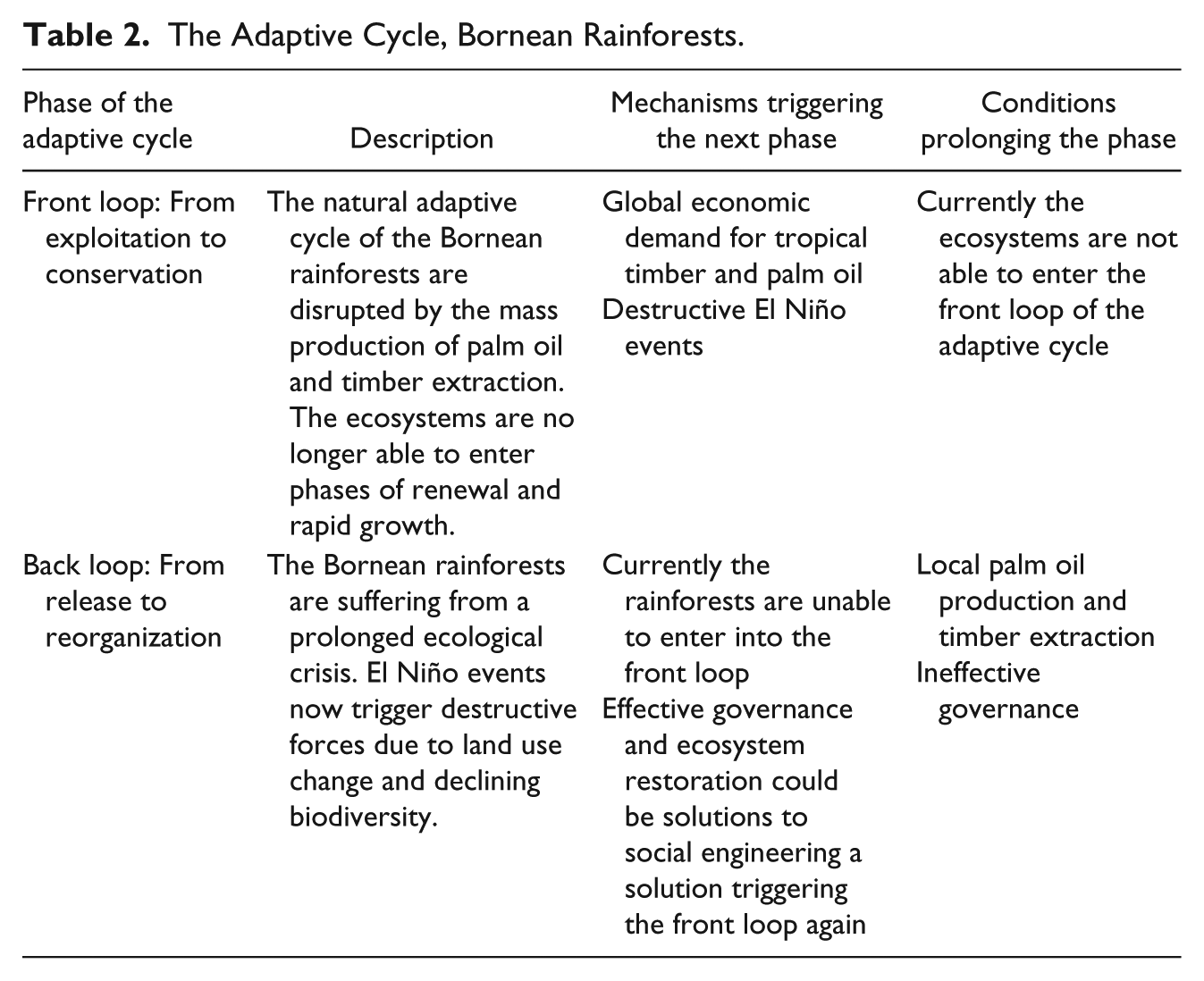
In Figure 1, we take a focal scale of the Bornean Rainforests and depict the disruption caused by collective corporate impact to the natural cycling of the ecosystems in Borneo (see also Table 2). We also show how changes to the cycling of the rainforests in Borneo also affect ecosystems at different scales and the livelihood of local communities. We discuss this diagram in detail now.
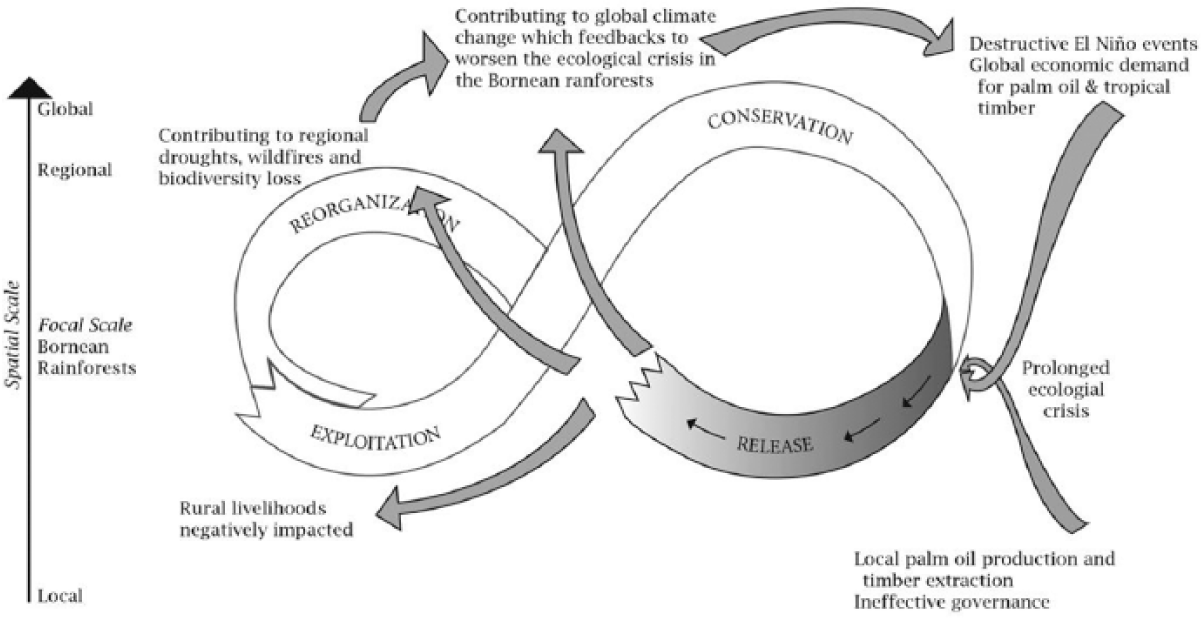
Cross-scale resilience and vulnerability in the Bornean rainforests.
The Adaptive Cycle, Bornean Rainforests.
On the right hand side of Figure 1, are the natural, economic, and social factors contributing to the prolonged ecological decline and vulnerability of the Bornean rainforests. The extraction of timber and production of palm oil (as a result of global economic demand by companies such as Unilever) results in clearing of virgin forest. The replacement of virgin forests with mono-cultural palm oil plantations reduces biological diversity and redundancy leading to a decline in resilience. Because the ecosystems are in a fragile state, when El Niño events strike, the impact of the events are too great for the ecosystems to adapt. Despite best efforts, governance mechanisms such as the RSPO have yet to effectively restore local ecological resilience. The combination of these factors overtime disturbs the natural adaptive cycle of the Bornean Rainforests, contributing to a decline in ecosystem system resilience.
The inability of the ecosystems to adapt, or to transition from the release to the reorganization phase of the adaptive cycles, leads to a number of cross-scale social and ecological consequences. The consequences of loss of ecosystem resilience are shown at the end of the arrows steaming from the broken adaptive cycle. Local social systems are affected through property damage, loss of life, and loss of economic activity. Loss of resilience contributes to regional droughts, wildfires, and biodiversity loss. The effects cascade across scale and affect the global climate system and strengths the effects of the El Niño events. Consequently, the cascading effects feedback to further worsen ecological fragility in the Bornean rainforests.
Figure 1 demonstrates important social-ecological dimensions that are not currently captured by organizational resilience scholars. While the organizational literature has begun to recognize that nested adaptive cycles are a useful framework to analyze organizational resilience across spatial and temporal scales of organizational subsystems (Yang et al., 2014), due to a spatial scale bias (Proposition 1), this work remains detached from the functioning of broader social-ecological systems beyond the firm level (for an exception, see King, 1995). Some work suggests that organizational resilience is dependent on the resilience of broader systems (Clément & Rivera, 2016), but stops short of providing specific examples of how managers might approach this dependency. Our key contribution is to conceptually show how the adaptive cycle of cross-scale resilience may be relevant for a multinational corporation (such as Unilever) that has significant impacts on social-ecological ecological resilience across scales. We also argue how, issues of scale (Proposition 1), slow-moving variables (Proposition 2), and diversity and redundancy (Proposition 3) are important for enhancing social-ecological resilience (Biggs et al., 2012; Biggs et al., 2015). In our illustration, declining ecosystem diversity and redundancy has cascading effects across social and ecological systems (see Figure 1). To restore cross-scale resilience, managers can influence the levels of diversity and redundancy in the systems in which they operate (Proposition 3).
In Figure 2, we take a different focal scale and show how changes in Borneo (which leave it vulnerable to massive wildfires) affect the global climate system and affect the planetary adaptive cycle which increases the incidence of extreme weather events. In turn, these extreme weather events can disrupt Unilever’s supply chain in other geographic regions. On the right side, Figure 2 shows that effects of extreme weather events felt in Unilever’s supply chain are in part due to the decline in social-ecological resilience in Borneo due to its effects on the global climate system. Figure 2 demonstrates that Unilever (and other companies) suffer the consequences of declining resilience in Borneo when the effects contribute to climate change at a global scale and feedback causing a climate-related disruption in the company’s supply chain—in adaptive cycle terminology, this causes a shift from the front loop of the adaptive cycle to back loop.
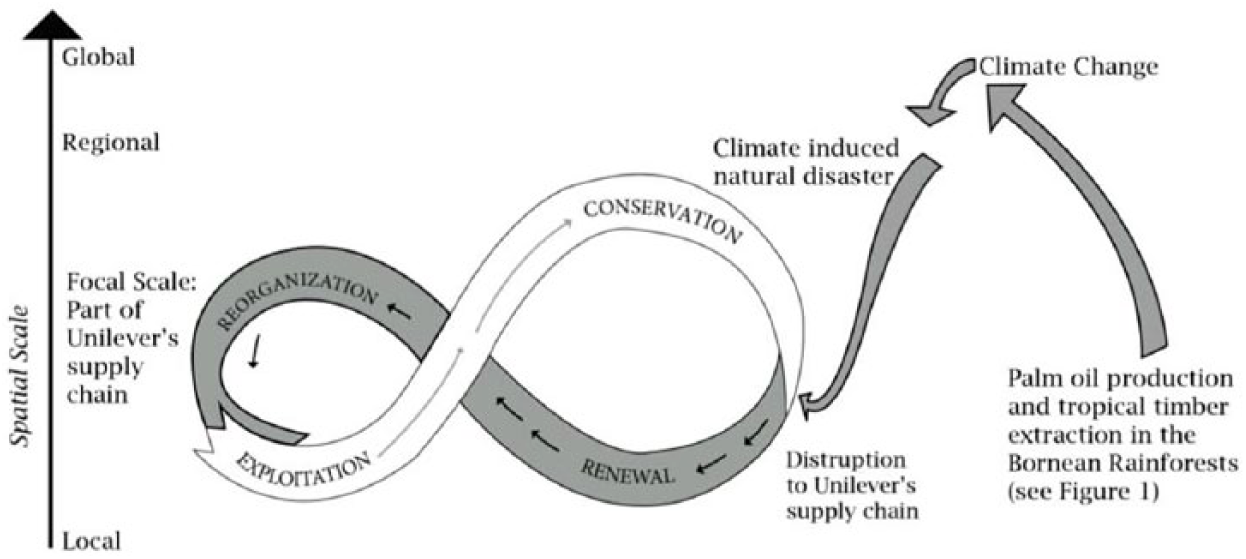
Cross-scale climate change–related feedback in Unilever’s supply chain.
From a firm-level or supply chain perspective, the adaptive cycle demonstrates that organizations suffer decreases in organizational performance due to extreme weather events and respond to the impacts of events to quickly return to normal levels of performance (Linnenluecke & Griffiths, 2010). This work focuses on the consequences of loss of ecosystem resilience and organizational responses to those consequences. Due to a spatial scale bias (Proposition 1), this work potentially overlooks the role of organizations in creating and driving abrupt ecological change at other scales (see Figure 1). Instead of building organizational resilience to “climate change and weather extremes” (Linnenluecke & Griffiths, 2010, p. 498), taking a systemic perspective, managers could build cross-scale resilience including the systems on which organizations depend.
We found no public evidence that Unilever is connecting the dots between such slow and fast-moving variables with respect to the focal system of Borneo as described above. However, we argue that the company could do so. A cross-scale approach requires knowledge about the functioning of broader social and ecological systems (see Figure 1), managerial approaches that take a complex adaptive systems perspective (Proposition 1), monitoring of slow variables and feedback (Proposition 2), and strategies to maintain important system elements such as diversity and redundancy (Proposition 3).
Managerial Implications
Intervening in social-ecological systems to build resilience across scales requires careful managerial attention focusing on the spatial and temporal dimensions of nested adaptive cycles. Firms need to develop an understanding of the interconnections between their activities and these higher and lower order systems (Proposition 1). Managers may seek to answer questions such as “How may lower order systems act to disturb organizational behavior?” and, “How may higher order systems influence the behavior of organizations?” and, “How might strategies and processes contribute to building resilience of the entire system?” This information is not used in search of simplifying or controlling the complexity of the system, but rather to exploit complexity to unlocking mechanisms that may support building resilience (Waddock, Meszoely, Waddell, & Dentoni, 2015). To manage systemic cross-scale change, understanding the structure of the system allows for identification of leverage points to intervene in the system to fundamentally change the behavior of the system (Meadows, 2009).
Firms may also need to change the focal scale in which they place managerial attention (Proposition 1) to develop capabilities to search for and interpret information about the cycling of higher and lower order systems (King, 1995; Linnenluecke & Griffiths, 2010). Information concerning the phase in the adaptive cycle and patterns of resilience may help firms to gain clarity regarding how to intervene to build cross-scale resilience. For instance, by identifying that local ecosystems are increasingly vulnerable due to loss of diversity and redundancy, a manager may proactively seek organizational strategies that help to build and monitor diversity and redundancy (Proposition 3) to push the ecosystem into the renewal phase of the adaptive cycle. This may then avoid the negative consequences of ecosystem collapse for the organization itself.
An outstanding question is, how could Unilever change its corporate strategy and actions regarding Borneo? How can managerial practices adapt to foster cross-scale resilience? First, Unilever could take a complex adaptive systems view of cross-scale resilience (Proposition 1). This approach would pay attention to subtle social-ecological dynamics in the systems in which the company operates. Our propositions suggest that slow-moving variables (Proposition 2) and levels of diversity and redundancy (Proposition 3) are several factors for Unilever’s managers to consider. Unilever could then develop strategies that build cross-scale resilience. For instance, Unilever could consider how it can restore ecosystem resilience in Borneo as the company has already started to do in other geographical areas (Winn & Pogutz, 2013). Land restoration practices help to mitigate climate change by reducing emissions and improving sequestration while also addressing the consequences of climate change by reducing risks at the landscape level (Food and Agriculture Organization, & The Global Mechanism of the United Nations Convention to Combat Desertification, 2015). Product diversification may reduce the negative effects of large-scale monocropping resulting in biodiversity loss. As a result, Unilever would both support the ecosystem to circulate the adaptive cycle from collapse into renewal and help to protect the long-term health of its own organization.
Conclusion
In the wake of increasing ecosystem volatility induced by climate change, interest in organizational resilience is growing with managers keen to become more adaptive and protect their organizational assets and revenue streams. Yet, we currently have little knowledge of how efforts to enhance organizational resilience may interfere with the natural adaptive cycle of ecosystems, detract from social-ecological resilience and feed back to the organization over time and across spatial scales. We believe that the natural sciences offer organizational scholars the conceptual basis to move toward a more holistic understanding of cross-scale resilience and the crucial role of organizations. We invite organizational resilience scholars to further explore both the ways in which managers may understand cross-scale connections, and how managers may form organizational strategies that seek to build the social-ecological resilience that their firms depend upon for long-term survival.
Footnotes
Acknowledgements
The authors thank the special issue editor Sandra Waddock and the two anonymous reviewers for their guidance and dedication. They also appreciate the feedback and support from their colleagues, especially Emilio Marti, Joep Cornelissen, and Kate Horton.
Declaration of Conflicting Interests
The authors declared no potential conflicts of interest with respect to the research, authorship, and/or publication of this article.
Funding
The authors disclosed receipt of the following financial support for the research, authorship, and/or publication of this article: This work was supported by the EU Marie Skłodowska-Curie Training Network funding scheme: Innovation for Sustainability (I4S) Grant Agreement n° 316604.
Author Biographies
 .
.