




Abstract
Scholars have studied the various pressures that companies face related to socially responsible behavior when stakeholders know the particular social issues under consideration. Many have examined social responsibility in the context of environmental responsibility and the general approaches companies take regarding environmental management. The issue of currently unregulated, but potentially hazardous, chemicals in consumer products is not well understood by the general public, but a number of proactive consumer product companies have voluntarily adopted strategies to minimize use of such chemicals. These companies are exceeding regulatory requirements by restricting from their products chemicals that could harm human or environmental health, despite the fact that these actions are costly. They do not usually advertise the details of their strategies to end consumers. This article uses interviews with senior environmental directors of 20 multinational consumer product companies to investigate why these companies engage in voluntary chemicals management. The authors conclude that the most significant reasons are to achieve a competitive advantage and stay ahead of regulations, manage relationships and maintain legitimacy with stakeholders, and put managerial values into practice. Many of the characteristics related to the case of chemicals management are extendable to other areas of stakeholder management in which risks to stakeholders are either unknown or poorly understood.
Keywords
Consumer products are a common part of our daily lives. Although most consumer products are made from or treated with chemicals, the average consumer does not typically think about or understand the chemical content of such products. Consumers generally assume that products are safe if they can be sold to the public, and further assume that there are adequate laws in place to prevent human and environmental exposure to hazardous chemicals (Shapiro, 2007).
However, chemical regulations historically have been weak and do not provide consumer product companies with incentives to ensure that the chemicals used in their products are safe (Wilson, Schwarzman, Malloy, Fanning, & Sinsheimer, 2008). News continues to surface about various products, such as toys, furniture, electronics, and clothes, that contain possibly hazardous chemicals (Shapiro, 2007; D. A. Taylor, 2010). It can be difficult and expensive for consumer product companies to determine (a) exactly which chemicals are being used in the supply chain to create a particular product and (b) the risks to human and environmental health from the chemicals that are used in their products. Such determinations are challenging for many reasons. For instance, large companies’ supply chains are often vast and not vertically integrated. Supply chains can be complex and opaque, making it difficult for companies to obtain information about the identity of or hazards associated with chemicals that were used to make products. Companies have reported that needed information can be unavailable, conflicting, protected by trade secrets, or lost in supply chains (Scruggs & Ortolano, 2011).
Based on these observations about chemical use in the marketplace, the authors would expect companies to choose not to internalize costs related to determining (a) which chemicals are used in their supply chains and products and (b) the risks associated with those chemicals. After all, if the primary consideration for a corporate environmental policy is “minimizing tangible pollution costs, then any firm going beyond compliance would forfeit the profits it could gain from simply (and legally) continuing to externalize those costs” (Russo & Fouts, 1997, p. 535). In other words, we would expect companies to choose chemicals and accept products from their suppliers based only on function, price, and performance, attempting to restrict otherwise-suitable dangerous chemicals from their products only if those chemicals become regulated.
However, the authors’ research demonstrates that the above prediction does not hold true in all cases, and particularly so for leading-edge companies. Our research is based on recent data collected from interviews with representatives from 20 multinational consumer product companies that were nominated as leaders in chemicals management by several non-governmental organizations (NGOs) and government agencies. The participating companies were based in the United States and Europe, and at least seven of the European companies were Swedish. 1 The authors conducted one in-depth, semi-structured interview per company, with either one or two participants per interview. The participating companies expended significant resources to determine which chemicals were being used in their supply chains and to minimize or avoid use of potentially hazardous, but currently unregulated, chemicals in their products. The case of chemicals in consumer products is particularly interesting because it is largely invisible to the typical consumer, and companies tend not to advertise their efforts around removing hazardous chemicals from products. Researchers have yet not examined why consumer product companies would take action on this issue when their customers are generally unaware of the problem.
This article explores the factors driving the 20 companies’ adoption of proactive chemicals management strategies. Aside from interview data, the authors draw upon various literatures to help explain why the 20 companies have adopted proactive behavior around chemicals issues. Our findings suggest that companies that wish to have a competitive advantage should follow strategies that are differentiated by stakeholder expectations and abilities to exercise influence. Consultation is often superior to conflict when dealing with stakeholders on issues such as chemicals management, organizations benefit from being anticipatory rather than reactive in this social responsibility domain, and managerial values have a significant if hidden effect on company decision making. This article contributes to the organizational theory literature by explaining why some companies choose to take action on “invisible” issues for which no immediate commercial benefit is sought, and our results have implications for future research and practice. We posit that our analysis of company uses of chemicals is extendable to other contexts in which stakeholders either do not understand or lack awareness of risks associated with business behaviors.
This article begins with a “Background” section that briefly covers the implications of chemical regulations for consumer product companies. The literature on the motivations behind corporate responsibility is also summarized, along with an explanation of why proactive behavior around chemicals may be different from previously reported behavior related to other corporate responsibility issues. The next section contains a description of research methods, after which we present the results of our 20 interviews. The main reasons that interviewees gave for trying to minimize chemical hazards in their products fell into categories related to competitive advantage, stakeholder influences, and company values. The “Results” section is organized according to these themes and also includes insights into why the companies generally chose not to advertise their chemicals management strategies. The final sections include a discussion of the findings and their implications as well as study limitations and future research.
Background
Chemicals Regulations
The companies interviewed for this research were headquartered in the United States and the EU. The major regulations governing chemical manufacture, importation, distribution, and use in these locations are the Toxic Substances Control Act (TSCA) of 1976 and the Registration, Evaluation, Authorization, and Restriction of Chemicals (REACH) of 2006 in the United States and EU, respectively.
At the time this research was conducted in 2009, some consumer product companies had adopted voluntary chemicals management strategies as a result of long-standing gaps in U.S. and European chemicals policies. Managing chemicals in products and supply chains has been largely discretionary for consumer product companies because most chemicals used in consumer products are not regulated. Thus, each company makes its own decisions about which chemicals are safe for use in its products. Discretion provides an interesting case to investigate why companies would adopt voluntary socially and environmentally responsible behaviors, such as chemicals management programs, in the absence of regulatory constraints.
Motivations and Pressures for Corporate Responsibility
The legitimacy of corporate social responsibility (CSR), including domains such as environmental responsibility, has long been contested by economists and other observers. In 1962, Milton Friedman (1962/1982) famously stated that
there is one and only one social responsibility of business—to use its resources and engage in activities designed to increase its profits so long as it stays within the rules of the game, which is to say, engages in open and free competition, without deception or fraud. (p. 133)
Others have voiced similar arguments through the ensuing decades. Crook (2005) performed a survey of global CSR efforts and concluded that four varieties of CSR existed, only one of which—“good management”—could raise social welfare and company profits simultaneously. This conceptualization of CSR assumes that “merely by running a profitable company, [successful managers] are likely to be advancing the public good as well” (Crook, 2005, p. 4). This excessively narrow view of a multidimensional issue fails to account for the numerous, more subtle ways in which CSR can benefit both companies and society. Thus, despite some economists’ skepticism, many companies have responded to motivations, pressures, and field-level norms by voluntarily adopting socially and environmentally responsible business practices (Hoffman, 2001; Vogel, 2006).
Motivators for CSR
An important factor in businesses’ decisions to adopt CSR practices is a desire to establish, enhance, maintain, or repair organizational legitimacy with key stakeholders (Jiang & Bansal, 2003; Suchman, 1995; Weaver, Trevino, & Cochran, 1999). This desire is especially true for highly visible companies, such as those that make brand-name consumer products (Chiu & Sharfman, 2011; González-Benito & González-Benito, 2006; Vogel, 2006). Engaging in CSR can also help visible, multinational companies limit damages caused by negative externalities, which in turn helps them protect their corporate reputations and instills trust and confidence among the public (Sethi, 2008). Heine and Willard (2006) explained additional benefits to companies of engaging with stakeholders: clarification of societal needs, good business management, and development of robust solutions. They described in detail a multistakeholder process that can be used in product or process design, development, and deployment.
Adoption of environmental management strategies can provide companies with a competitive advantage, ultimately contributing to their financial success. For instance, Hart (1995) and Starik and Rands (1995) stressed that creating “ecologically sustainable” organizations is important to companies’ future competitiveness. Porter and van der Linde (1995) theorized that companies can gain a competitive advantage through innovations related to environmental performance and differentiation. Bansal and Roth (2000) discussed “competitiveness motivation,” whereby companies engage in the development of environment-related initiatives in response to external pressures, with the goal of gaining a competitive advantage.
Companies can also gain competitive advantage through preemption. Starik and Rands (1995) discussed “rais[ing] the floor of environmental performance” (p. 923) by pioneering sustainable solutions that eventually may be required by law. Marshall and Toffel (2005) stated that first-movers stand to gain an advantage by developing solutions before competitors; they can then lobby government authorities to recognize their solutions as best practice or a basis for regulatory requirements, which could lead to revenue from licensing fees or gains in market share.
External stakeholder pressures
Companies face pressures from a variety of external stakeholders to behave in a socially responsible manner. For example, government agencies, NGOs, consumers, and the media exert various pressures on businesses. These stakeholder groups influence companies’ practices related to protection of human and environmental health in a number of different ways.
Coercive pressures applied by governmental entities or the threat that they will impose regulations are motivators for some businesses to adopt environmental management systems and remain vigilant regarding environmental regulations (Delmas & Montes-Sancho, 2011; Delmas & Toffel, 2004). Businesses want to avoid the legal liabilities and penalties that come with regulatory non-compliance (Jiang & Bansal, 2003). Some proactive businesses also see a competitive advantage to staying ahead of environmental regulations (Aragón-Correa, 1998).
Social and environmental NGOs, which lobby legislators and publicize poor corporate environmental performance, frequently apply pressure on businesses to address perceived environmental or social wrongs (Vogel, 2006). These groups play an important role in exercising social control over businesses and industries (den Hond & de Bakker, 2007) and are motivated by desires to enact particular values. Historically, activist groups have tried to affect business behavior by attempting to influence laws and regulations, but increasingly have been confronting businesses directly. This upward trend in direct challenges to companies is due to an increasing shift in responsibility for addressing social issues from the state to the private sector (den Hond & de Bakker, 2007).
Meeting customer demands and protecting brand or reputation can be motivating forces behind companies’ environmental initiatives. In the pulp and paper industry, some environmental managers cited market pressure as the most influential factor affecting their companies’ environmental management decisions: Environmental programs were largely driven by customer demands within their supply chains (Jiang & Bansal, 2003). Consumers around the world are increasingly holding businesses accountable for numerous actions, leading some researchers to see adoption of CSR as a business imperative (de Man & Coulter, 2005). However, while the majority of consumers claim to desire products with environmental attributes, some researchers believe that consumers generally are not willing to pay a premium for those attributes if comparable products without environmental attributes are cheaper (Hoffman, 2001; Vogel, 2006). Many large consumer product companies know this and consequently choose not to advertise their CSR activities because doing so will not likely lead to increased sales. Plus, advertising CSR initiatives can attract unwanted scrutiny from media and NGOs, which has the potential to do more harm than good to a company’s reputation (Vogel, 2006).
The media provides the public with information about environmental issues and helps to shape values and opinions (Starik & Rands, 1995), sometimes even by taking an active, political role in forming public debate (Hoffman, 2001). It can therefore influence the reputation of individual businesses or entire industries by exposing practices that affect the environment or human health. Media exposure increases company visibility and lessens information asymmetries between the company and its stakeholders, and a better understanding of company actions may increase stakeholder expectations (Chiu & Sharfman, 2011). Negative attention in the media can motivate businesses to take steps to restore their legitimacy, for instance, by conforming to public influence (Greening & Gray, 1994).
Businesses that are willing to be environmentally responsive incur associated costs, and thus they must make choices about whether or how to respond to specific stakeholder expectations. Banerjee (2001) found that businesses focus on environmental initiatives that improve financial performance and tend to be more responsive to stakeholders who have the potential to affect profitability. He also suggested that “many firms prefer voluntary environmental management standards like ISO 14000 as they . . . provide both guidelines and legitimacy” (Banerjee, 2001, p. 508). Jiang and Bansal (2003) found that businesses generally committed to the additional costs of environmental standards like ISO 14001 certification only if (a) customers or regulators demanded the certification, or (b) their work was highly visible to the public or the environmental impacts of their activities were difficult to measure or communicate. Thus, rather than functional value, the certification provided “external recognition, credibility, and procedural legitimacy” (Jiang & Bansal, 2003, p. 1063). In a similarly critical vein, Lannelongue and Gonzalez-Benito (2012) found that certification schemes may serve to respond to the pressures of some stakeholders while leaving out others (particularly external and secondary stakeholders); in this way, certification schemes can potentially buffer an organization from stakeholder pressures rather than bridge to them via engagement.
Internal stakeholder pressures
Internal pressures can also affect businesses’ decisions to adopt socially or environmentally responsible behaviors. For instance, company leaders personally committed to environmental stewardship can drive a company’s corporate social responsiveness (Fukukawa, Balmer, & Gray, 2007). Researchers have indicated that top managers may even hold primary responsibility for weaving CSR into the fabric of the company, stating “executive commitment is essential” (Weaver et al., 1999, p. 550). Scholars cite numerous examples of businesses’ commitments to the environment because of their leaders’ core values (Starik & Rands, 1995; Weaver et al., 1999). Starik and Rands (1995) suggested that such leaders develop environmental strategies “based on consideration of external threats and opportunities, internal strengths and weaknesses, obligations to society, and their own values and preferences” (p. 915), sometimes acting well in advance of normative or coercive pressures. Weaver et al. (1999) added that these leaders “express concern for integrity, fair treatment of others, and ‘doing the right thing’ for its own sake, and not merely for instrumental benefits” (p. 543). Also, this leadership commitment has the potential to influence organizational culture and engage employees throughout different levels of the organization (Weaver et al., 1999), and impacts the degree to which activities are formalized and internalized in the company (Greening & Gray, 1994). In the environmental domain, Paulraj (2009) found that motivations for organizational action based on ethical values of managers—in particular, promoting the common good—were a stronger basis for superior environmental performance than coercive or competitive motivations.
Vesilind, Heine, Hendry, and Hamill (2006) examined the morality of business leaders’ decisions regarding environmental responsibility. They argued that leaders’ actions have “moral worth” when they benefit “the greater society and future generations,” not when they are “beneficial to the survival and profitability of the firm (p. 33).” Compliance with the law, where non-compliance brings punishment, or switching to less costly, resource efficient practices, which are coincidentally more environmentally beneficial, are not considered morally admirable; these actions are considered to be at the “legal” and “financial” levels of moral development, respectively. While such actions may enhance a company’s reputation, only actions that are taken to benefit others are considered to be at the “ethical” level of moral development.
Shareholders concerned about liabilities and reputational damage can be another source of internal pressure. For example, investors filed 90 shareholder resolutions related to toxic chemicals in U.S. companies between 2006 and 2010 (Investor Environmental Health Network, 2010). Woodward (2008) noted that “pension funds, state controllers, institutional investors, and even investment bankers” have pressured businesses to increase their commitments to environmental sustainability to avoid legal ramifications or reputational damage, which could lead to declines in investment value(p. 52). Also, Hoffman (2001) observed that banks and insurers increasingly take account of customers’ environmental performance in their own business decisions.
How Is Proactive Behavior Related to Chemicals Different From Other CSR Domains?
The literature has focused primarily on companies’ motivations to engage in CSR programs when their activities are in the public eye or when stakeholders are aware of the need for such programs (Brammer & Pavelin, 2004; Nikolaeva & Bicho, 2011). But what if stakeholders are unaware of the need, as is the case with consumer product companies’ customers who are ignorant of chemicals management issues? Why then would a consumer product company adopt voluntary, proactive measures to minimize use of possibly hazardous, but currently unregulated, chemicals in its products and supply chain at substantial cost?
Stakeholders are often not in a position to exert a powerful influence on consumer product companies regarding chemicals safety. Information asymmetries make it difficult for companies to track which chemicals are used in their products and supply chains and to obtain information about the hazards associated with those chemicals (Scruggs & Ortolano, 2011); this problem is even more challenging for external stakeholders. A complete list of chemical ingredients is seldom provided with consumer products. But, even if information about consumer product ingredients was more transparent, many stakeholders would lack the training or technical background to effectively utilize that information to pressure companies regarding product safety (Scruggs & Ortolano, 2011). Also, negative effects of chemical exposure can take years to manifest and it is difficult to determine which of thousands of chemicals was responsible (Schwarzman & Wilson, 2009). These issues keep stakeholder pressures related to the safety of chemicals in consumer products at a relatively low level.
Meanwhile, scientific evidence that some unregulated chemicals can cause problems for human and environmental health is mounting (as summarized in Schwarzman & Wilson, 2009; Wilson & Schwarzman, 2009). Studies show that hundreds of industrial chemicals with links to adverse health effects are present in a representative sample of American children and adults (Centers for Disease Control and Prevention, 2009; Woodruff, Zota, & Schwartz, 2011). According to Roome (1992), this combination of high scientific significance with low public perception makes it possible for companies to adopt a proactive stance on chemicals management. Quoting Roome (1992), “A company aware of the emerging scientific evidence is reacting to the threat from this information but a pro-active response is possible because the company does not yet face pressure from the public and from legislation” (p. 17). If the scientific significance is eventually acknowledged in the “wider public domain,” this will likely make legislative pressure stronger (Roome, 1992, p. 17), and non-proactive companies will be forced into reactive responses to adapt.
It is reasonable to consider whether isomorphism plays a role in adoption and design of voluntary chemicals management strategies. Environmental management is defined largely at the organizational field level (Hoffman, 2001), and managerial decisions are strongly influenced by coercive, normative, and mimetic isomorphism within an organizational field (DiMaggio & Powell, 1983). While the companies participating in this research shared some common stakeholders and regulations, most did not share the same competitors, professional and trade associations, suppliers, customers, and so on, and thus do not appear to fit squarely in the same organizational field. For this reason, DiMaggio and Powell’s (1983) institutional mechanisms may not play a strong role in adoption and design of voluntary chemicals management strategies among the companies participating in this research. While one might argue that these companies share some institutional linkages, the present lack of convergence in strategies and perspectives around voluntary chemicals management cannot guide the “field’s membership toward organizational homogeneity” (Hoffman, 2001, p. 40); the issue lacks prominence and urgency due to the general ignorance among policy makers, companies, and the public about the consequences and scope of possible problems resulting from unsafe chemical use and exposure. We believe that the companies participating in this research are innovators—early adopters of proactive chemicals management strategies—and a “critical threshold” of proactive companies has not yet been reached for widespread adoption and institutional change to occur (Hoffman, 2001, p. 158). However, over time more and more companies may adopt the kinds of innovations detailed in this article for a new consensus about prudent chemicals management.
Researchers have not yet examined why individual companies adopt proactive, voluntary policies to manage human and environmental health issues that are not understood by the general public. The 20 consumer product companies interviewed for this research have developed individual strategies to manage currently unregulated, but potentially hazardous, chemicals in their products, and the reasons why they take these actions, as well as why they do not aggressively advertise their efforts, are not clear. Their strategies have broader applicability for stakeholder management generally, especially in domains similar to chemicals in which stakeholder knowledge and awareness are lacking.
Research Design
The authors used a grounded theory approach (Glaser & Strauss, 1967) to explore why some consumer product companies choose to reduce or eliminate certain unregulated chemicals from their products at significant expense to themselves and without aggressively advertising their efforts. We gathered data without preconceived notions with a goal of building theory to explain this phenomenon where the existing literature was not adequate. Our data set was created from interviews with representatives from 20 multinational companies as described below.
Participant Selection 2
In-depth, semi-structured interviews were conducted on condition of anonymity with representatives from 20 multinational consumer product companies. The participating companies and representatives were selected for interviews based on recommendations from NGOs and government agencies that work to protect human and environmental health from hazardous chemicals. The participating companies were seen by these NGOs and agencies as leaders in chemicals management, going beyond regulatory mandates in controlling for hazardous chemicals. This strategy for participant selection based on “extreme/deviant cases” is in line with that described by Flyvbjerg (2006, pp. 229-230; see also Spreitzer & Sohenshein, 2004, on positive deviance) to achieve the richest possible data set. Thus, the sample is not representative of consumer product companies as a whole, as it is comprised of willing participants in an already small field of companies that are considered leaders in chemicals management.
Participant selection was based on NGO and government agency recommendations because these entities had information on companies’ proactive chemicals management strategies that was not publicly available. The NGOs and government agencies obtained the chemicals management information from the companies while working with them in the past on chemicals management issues, and the information was considered to be sensitive. In contrast to situations of gross malfeasance, where there is a paper trail and an opportunity to select on the dependent variable, informants were needed to help find appropriate participants for this research.
Companies
The participating companies were selected from a range of industry sectors to see whether common themes emerged regarding reasons for adopting voluntary chemicals management strategies. Table 1 shows the company descriptors, most of which were prepared in collaboration with interviewees. The companies were divided into general categories for purposes of this discussion, even though some companies could fit multiple categories.
Participating Company Descriptors.
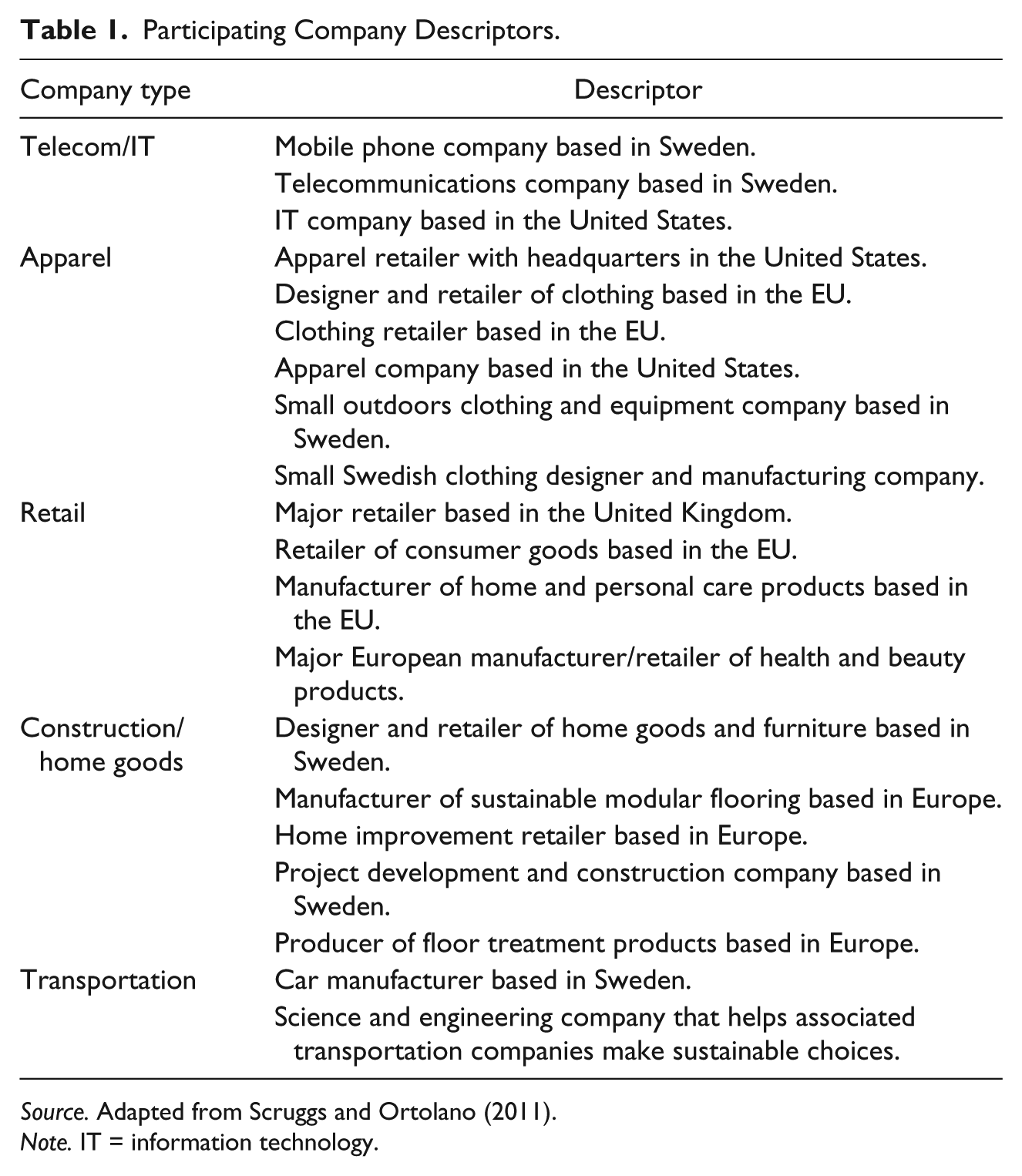
Source. Adapted from Scruggs and Ortolano (2011).
Note. IT = information technology.
Eighteen of the participating companies were very large, while two were small. About two thirds of the companies were privately held; the remaining companies, which were publicly held, had market values in U.S. dollars ranging from 5 billion to more than 100 billion at the time of the interviews.
Interviewees and Interviews
Senior environmental managers were targeted for interviews, as previous research has shown that these managers play an important role in developing and implementing environmental strategies and policies (Banerjee, 2001). Interviewees from the large companies had titles such as Director of Environment, Health, and Safety; Manager of Safety, Environmental, and Regulatory Affairs; and Senior Vice President of Sustainability. The Founder/CEO was interviewed from each of the small companies. Interviewees were intimately involved with the development and implementation of their companies’ chemicals management programs and, in all but the two small companies, worked with in-house chemicals management teams on these issues. Almost all interviewees had scientific backgrounds.
The objectives of the interviews were to learn about strategies to avoid or reduce use of hazardous chemicals in the companies’ supply chains and products, and to understand how and why such strategies were developed. Interview questions were centered on these issues, and the interviews were semi-structured to accommodate discussion of additional issues of importance to the interviewees. One or two representatives from each of the 20 companies participated in the interviews, which were typically of 60- to 80-minute duration. Thirteen interviews were conducted in person and the remaining 7 interviews were conducted by telephone. The interviews were conducted during the autumn of 2009.
Data Analysis
All interviews were digitally recorded, transcribed, and coded using Researchware Inc.’s HyperRESEARCH™ software. Following Charmaz (1995) and Creswell (1998), codes were created as the data were systematically studied; coding software was used in “applying grounded theory” to more easily allow codes to “emerge from the text” (Jiang & Bansal, 2003). Interviews were initially coded for any information related to influences regarding companies’ voluntary chemicals management strategies. Pieces of text from the transcribed interviews were tagged with one or more codes as a way to organize and more easily view the vast amount of interview data. Once the first round of coding was complete, related codes were grouped and other codes were refined into more descriptive codes. The iterative process continued, and codes were combined, added, and refined as themes emerged. The final set of codes 3 regarding why the companies adopted proactive chemicals management strategies fell into three categories related to competitive advantage, stakeholder influences, and company values. A fourth major theme emerged regarding the pros and cons of advertising companies’ proactive strategies. The “Results” section is organized around these four main ideas.
Results
Why Companies Endeavor to Minimize Chemical Hazards in Products
The 20 consumer product companies participating in this research could not predict with certainty which chemicals would eventually be found to be dangerous or become the targets of NGO or media campaigns, so their chemicals management strategies were designed to restrict use of (or find substitutes for) as many potentially hazardous chemicals as possible. Interviewees discussed the reasons and influences driving their companies’ proactive chemicals management strategies to reduce or eliminate currently unregulated, but potentially hazardous, chemicals from their products and supply chains. These reasons are discussed according to themes that emerged from the data analysis: competitive advantage, stakeholder influences, and company values.
Competitive advantage
Staying ahead of the regulatory curve and preempting legal problems
Based on responses from 15 interviewees, the most common reasons to stay ahead of chemical regulations were to (a) maintain product quality and ensure access to resources while working at the companies’ own pace, and (b) ensure that products were compliant with possible upcoming regulations prior to their anticipated date of sale. Interviewees indicated that both of these reasons required proactive strategies; reacting to regulations left companies vulnerable to using low-quality solutions and losing profits.
The interviewees who emphasized working at their own pace to maintain high product quality described numerous situations where this strategy gave them an advantage over competitors. They related stories about specific chemicals for which they worked for years to find substitutes. When these chemicals were eventually regulated, the interviewees watched their competitors react and struggle to find solutions, while the interviewees’ companies’ sales continued as normal or increased. Three illustrative comments related to this idea are shown below: If you can predict what’s going to happen in regulation, and also if you can predict the next, quote, “dodgy” chemical, it gives you a competitive advantage. Because you can do your work in the background, at your own time, and you can take a few years [to find a safer substitute]. And regulation takes a long while, and for chemicals to prove “dodgy,” for want of a better word, takes a long while. So you can actually do it before anyone is even aware of it. So when [the new regulation] does hit, you can stand there quite smug and say, “We did that two years ago. Why don’t you ask some of our competitors what they’re doing?” So . . . this is not just a “nice to have,” there’s a real business reason for doing this . . . to stay ahead of the game—it makes good business sense . . . If we wait until regulation is imposed on us, it costs us a lot more money to redevelop products. [We want to] have time enough to substitute [for undesirable chemicals] so we don’t get bad quality or bad technical solutions. Because that takes quite a long time to figure out what substance you are going to [use] instead. If you’re a forerunner in the industry, it will take a long time before it is possible [to find substitutes for undesirable chemicals] because you need to have some time to convince people and to find new technologies. Lead-free implementation or bromine-free implementation or halogen-free implementation are some examples where in the beginning we had a lot of resistance from the suppliers—they will tell you that it is very, very expensive, it’s very, very technically hard in some cases. And you need time to really [make it happen].
For other companies, predicting future regulations well in advance was paramount to coordinating and maintaining control over product design and product release schedules. An interviewee explained how critical it was for his company to have sufficient lead time in implementing new chemical restrictions: When a [regulatory] requirement comes along that forces a change, you’re never going to make that change to products which have already gone into manufacturing. That is a very, very wasteful way of executing change. What you want to do is incorporate the new [chemical restriction] into the new products which have yet to be developed. So what that means is—for a company like us which operates on [about a two year] product schedule—we’ve got to be able to plan at least [two years] ahead . . . so the principle here for doing this cost-effectively means you have to get [new chemical restrictions] in at the front of a brand new product line . . . By being ahead of regulations, we can maintain control over our product intro dates, which very closely plays into our overall marketing strategy. Being able to release a [product] in August as opposed to June, for example, could be the difference of tens of millions of dollars in revenue . . . So our mandate is that we go years ahead of [possible regulatory] requirements so we have all of the flexibility we ever need.
While no interviewees specifically indicated a goal of influencing regulations with their chemicals management programs, interviewees from eight companies acknowledged that many of their chemicals restrictions eventually became regulations. For instance, an apparel interviewee said, “We’ve seen it time and time again where we’ve taken a stand [on restricting a chemical] because it’s the right thing and the law catches up 10 years later, and we’re well positioned for that.”
Staying ahead of regulations can also be important in preventing legal problems and sales interruptions. A retailer said her goal was to never be in a position where “suddenly we can’t sell [certain products] because of the chemicals that are in them.” An apparel interviewee explained the legal benefits of her company’s proactive chemicals management strategy: Staying ahead of the legislation—that’s a big reason for having the RSL
4
and continuously updating it . . . for example, now with REACH . . . [restricting newly regulated chemicals from our products] hasn’t been a big problem because we already banned them earlier. So . . . we don’t have to change our products, and we can keep on having our products on the market . . . And we don’t have to employ a lot of lawyers to figure out should we do this or that, we simply . . . phase out the substance if it is technically possible and that has shown us to be the easiest way to cope with it. And we can work at our own pace. We are not surprised by new legislation.
Only three companies, all from the apparel industry, mentioned lawsuits related to chemical use, and just one company said that lawsuits were a driver behind its chemicals management strategy. This may be due in part to the fact that many of the companies participating in this research were based in Sweden; one Swedish interviewee, when asked about the threat of lawsuits filed by consumers, seemed baffled and said, “That’s not the Swedish way—I don’t think Swedish people act like that.” Another Swedish interviewee said that lawsuits were a concern for her company, “because we have [over a hundred] stores in the US.”
Protecting corporate reputation and engendering trust
Interviewees from 12 companies said that protection of their brand images or corporate reputations was a driver behind their chemicals management strategies. An interviewee from an electronics company explained, Protection of brand [is very important]—it’s not good to have negative publicity. Chemical issues can always be turned against the companies and you can never win a debate with media regarding hazardous substances.
A retailer also emphasized the importance of protecting brand value: “If you imagine [my company’s] brand, it’s worth nine billion—it’s our key asset.”
Interviewees from eight companies said that being deemed “trustworthy” by customers was paramount, and keeping possibly hazardous chemicals out of products was critical to this goal. Four of these eight companies were major consumer product retailers; the remaining four included two apparel retailers and two companies that make floor-related products.
Interviewees said their customers were busy people who wanted to buy products from companies they believed handled product safety for them. The companies felt that maintaining customer trust required constant vigilance over product quality and safety related to chemicals. A few retailers periodically performed customer satisfaction surveys to gauge this level of trust. Example quotes illustrate two of the large retailers’ perspectives on trust: To be honest, most people haven’t got the time or the effort to worry about every last thing they buy. We have a certain level of trust given to us by our customers, that they’ll be buying something that’s “right.” They expect us to take care of the details and what factory it’s made in and what it’s made of. So that’s one of the primary reasons [we have a chemicals management strategy], to satisfy that trust that’s given to us by our customers . . . the last thing the business wants is to lose that trust, because then customers will presumably vote with their feet and go somewhere else. Trust is the biggest thing that differentiates us from other retailers . . . if there’s a chemical risk or a scare that happens out there, we would expect that people would come to us. So if all of a sudden all laundry powder was found to be contaminated, given the brand reputation that we have, we would expect that people would come to us . . . And we could sell more. So there’s obviously a commercial aspect to it. But I really do think, number one is about trust because of our positioning as a business . . . we offer products where people can trust where it’s come from, and feel confident about the safety of those products. That’s paramount for us.
Product and brand differentiation
Seven companies saw opportunities to differentiate their product lines from competitors’ in subtle ways. For example, a retailer explained that European law required disclosure of any allergen ingredients in fragrance products, allowing an opportunity for differentiation in the market: We need to say whether the allergens may cause an irritation, or in extreme cases, [we] have to [include on the product label] the symbols [illustrating] the hazard information—the environmental information about killing fish, killing trees, etc. We’ve decided as a business we’re not going to include any fragrances which would require us to put a dead fish or a dead tree onto the [labels]. That’s partially commercial, because when we’ve looked around the market, everyone who we compete with, they do have dead fish and dead trees, and we’re saying, “Actually, that’s a good point of difference.”
Another interviewee described broad design goals related to product quality and aesthetics: We wanted to make sure that as our designs become renowned the world over for their quality and their aesthetic excellence, that substances like mercury and arsenic are not getting in the way of the holistic impression of those designs. We wanted them to be as clean on the inside as they look on the outside . . . and the presence of toxic chemicals lessens product quality.
A proactive chemicals management strategy is “good for business”
Interviewees from five companies said that having a robust chemicals management strategy to keep possibly hazardous, unregulated chemicals out of their products was simply “good for business.” As an apparel interviewee summarized, I think a lot of the things that we’ve done—even though there might have been a cost to doing them—in the end showed us [that] if you take the right calculated decisions and do the right thing, it’s going to reward you as a business in the end.
Stakeholder influences
Interviewees specified a variety of stakeholders that influenced their companies’ actions related to use of unregulated, but possibly hazardous, chemicals. In an attempt to avoid reactive behavior, companies tried to stay abreast of issues that were important to their stakeholders, and in some cases, engaged with them to address concerns.
Consumers and societal expectations
Interviewees from 13 companies said they were influenced by consumer concerns, which ranged from avoiding use of allergens in products to meeting broad societal expectations. Consumers generally communicated their concerns to companies through company websites, by phone, to company employees in retail locations, and by mail. Companies also tried to gauge public concerns and expectations by following media and NGO activities.
Four retailers considered public perception as well as science in their chemical restrictions. For example, a health and beauty product retailer’s approach was as follows: The retailer determined which chemicals were in the “public domain,” both by listening to customer concerns and paying attention to media, NGO, and other developments. The company then calculated a “social amplification factor” for each public domain chemical. Chemicals with high values were included on a list on the company website, with information regarding (a) why the chemical was in the public domain, (b) how and why the company used the chemical, (c) the company’s official position on the chemical, and (d) if and when the chemical would be phased out.
Chemicals with high social amplification factors were candidates for phase-out. The retailer explained, [Our restrictions list] has science behind it, but also perception . . . because perception can be just as damning as science. If people don’t want [us] to use [a certain chemical], we won’t use it. We have no allegiance with any chemical—we’ll phase it out . . . We’re not in cahoots with the chemicals industry. We’ve not got any contracts with the chemicals industry or anything like that. We decide what will go in our products.
If a certain chemical was perceived negatively by a small subset of customers, but strongly believed by the company to be safe, the company offered two product lines: one with and one without the chemical. This approach allowed for consumer choice, even at added expense to the company.
Interviewees from six companies, all based in Sweden, said that a main driver behind their chemicals management strategies was a desire to meet both societal and customer expectations. Interviewees from three of these companies saw environmental stewardship and proactive chemicals management as an obligation and a “Swedish tradition”: It is both a request from customers and from the society in general. This is what people expect from companies—to take responsibility for the production and the products . . . and not exploit either people or nature . . . It’s a very big issue.
Interviewees from the remaining three Swedish companies stressed their dedication to fulfilling customer expectations related to excellence in chemicals management. For example, [A past incident] made us aware of the importance of [chemical] issues to our customers . . . So after that, there has never been any doubt that this is important to customers and therefore we need to take it very seriously and live up to what we promise . . . we try to pick out what is the expectation from our customers. That’s the main thing.
NGOs
Numerous international NGOs have an interest in protecting human and environmental health from hazardous chemicals. Some of these NGOs have launched public campaigns against certain chemicals or the companies using them, while others have developed lists of chemicals they deem hazardous to raise awareness and stimulate action toward chemical restrictions. Interviewees from nine companies discussed how NGOs have influenced their companies’ chemicals management strategies.
A retailer related an example of a NGO campaign against his company, which was rooted in a lack of information and led to increased public communication about the company’s chemicals policies: Because we’re a manufacturer, we’ve got a lot of guys in white coats who are experts in the field, and we’ve always thought, “We know what we’re doing. It’s what we’ve been doing for [over a hundred] years.” In the late 90s environmental NGOs really started attacking retailers. And not because they thought retailers were particularly bad, but they couldn’t get any traction with the chemicals industry, because the chemicals industry wasn’t consumer facing. So people like Friends of the Earth, WWF, Greenpeace, all had a toxics campaign . . . And they could attack retailers simply because we [had hundreds of stores] and they could walk around campaigning outside . . . And their campaign was, “You don’t know what you’re doing with chemicals, tell us what your strategy is.” And back in the late 90s, the mentality then was, “We know what we’re doing, go away.” Which probably isn’t the best strategy for dealing with an environmental NGO.
The retailer eventually had a series of meetings with the NGOs and other stakeholders, found that they had common goals and concerns, and realized that the main problem was the retailer’s lack of communication about its chemicals management strategy. This realization led to creation of a publicly communicated strategy about the chemicals used in the company’s products, which satisfied stakeholders.
Interviewees from all nine companies described ways in which they kept abreast of NGO concerns and collaborated with them. Many interviewees saw NGOs as being at the front of breaking news on chemicals: “Of course we do follow the NGOs and their campaigns—so very often that’s where things start to roll out.” An interviewee from apparel said, I should admit that whatever NGOs are doing and whatever governments are looking at we take into account when we update the RSL. Absolutely . . . [If they suggest a chemical is dangerous], we would consider, “is that substance a risk for us, is it used in our products?”
Others commented that NGOs were a particularly good source of chemicals information when regulations were lacking. For instance, a home products interviewee said, “In many, many of our [products], [legislation] is not that strict . . . [so we] follow what’s happening among our different stakeholders, like NGOs.” Interviewees also discussed past collaborations with NGOs on various chemicals-related initiatives. For example, a major retailer partnered with international NGOs to support and promote the REACH legislation, and a home products company worked with NGOs in phasing polyvinyl chloride (PVC) out of its products.
Government
Interviewees from 12 companies said that government activities, or lack thereof, had influenced their companies’ policies that restrict certain unregulated chemicals from their products. A common approach to eliminating possibly hazardous chemicals well in advance of regulations involved following government activities worldwide to keep abreast of both proposed legislation and chemical-related investigations performed by government authorities; interviewees saw such actions as indications that new regulations could be imminent. Interviewees had different perspectives on governments’ roles and effectiveness in creating meaningful, timely chemicals regulations, three of which are shown below.
An interviewee from electronics thought that emerging legislation relevant to his company’s products was problematic, partly because it contained loopholes and took a gradual, piecemeal approach to restriction of hazardous chemicals. His preference was to restrict all chemicals of concern prior to designing new products, rather than having to continually redesign his products as legislators gradually introduced new restrictions. Of the emerging legislation, he said, “We thought it left too much engineering uncertainty . . . and wanted to dictate ourselves when and how we were going to eliminate these substances.”
Other interviewees expressed a concern that there were not enough regulations covering the chemicals used in their products. An outdoors apparel interviewee felt that meaningful regulations in his industry were a long way off, so his company joined other outdoor outfitters in using the service bluesign® to manage chemicals in their products and supply chains: Regulations are a very slow process. Even after chemists and biologists say that a chemical is dangerous, it takes much, much too long before regulations come. But [the bluesign®] process is not depending on any regulations. Here the industry is proactive. And we don’t have to negotiate with all EU countries, with US, with UK, China . . . We can implement this process immediately . . . and it’s also possible for the consumer to evaluate it. So the industry and bluesign® sort of forget about legislation and governments, which take too long, and we have a strategy to solve the problem.
A retailer said that while he kept up to date on governments’ activities, he was skeptical about their efforts to regulate hazardous chemicals in consumer products. When asked if governmental entities provided helpful direction regarding upcoming chemicals restrictions, he said, “It would make it a lot easier, but what they tend to do instead is let [chemicals-related concerns] out and not do anything about it and hope industry will manage it.”
Media
Media (i.e., television, Internet, newspapers, and magazines) raises public awareness about certain topics, and can help companies predict or understand new concerns in the public domain. Interviewees from 11 companies discussed how media influenced their chemicals management strategies. Although no company made chemicals management decisions exclusively based on media reports, media provided one route for them to learn about emerging chemical concerns and avoid potential publicity problems.
As an example of a typical perspective, an interviewee from a personal care products company explained the media’s influence on his company’s chemicals policy: It is of course important to follow the media . . . because that does give us a certain direction on how [the public] might react and how [the public] is experiencing what we are doing and what their impression is of how we work. So that’s something that we have to take into account, but that’s not always the basis and the direct input for our decisions. It’s only one of the factors that we use.
Some interviewees admitted that fear of negative publicity was another reason to stay abreast and ahead of the latest news on chemicals. For instance, We are a producer of outdoor equipment for outdoor people. Dangerous substances like fluorocarbons, for example, I learned about myself. What if my customers learned about them too? And one day there will be a big television program speaking about fluorocarbons and this awareness will jump up very fast. And then I don’t want to be caught as a bad guy with a lot of fluorocarbons [in my products]. I would feel terrible.
Others described how their companies suffered from negative publicity in the past, and how this experience increased their efforts to minimize hazardous chemicals in their products. An apparel interviewee described how past problems led his company to develop such a robust, proactive chemicals policy that the company has emerged unscathed from recent media exposés, such as a television program highlighting dangerous chemicals in jeans, which aired just prior to the interview: Negative publicity—that has happened in the past and caused harm. Absolutely. And nowadays we have concrete examples where our RSL has helped us to avoid negative publicity, so it’s really good for that . . . Like with this TV show, or there are test magazines and NGOs testing products, we can see that we often get very good results or they don’t find the substances that they are looking for, but they do find them in some of the competitors’ [products] . . . And we know that these substances are not legislated in [those] products. But we do restrict [them] anyway. If we hadn’t, they would probably be in our products as well. And then we would be on the black list.
Peer companies
Some interviewees said that interactions with peer companies and industry organizations helped them learn about chemical-related issues of concern. However, these groups could also hamper proactive companies’ efforts to restrict unregulated chemicals. Interviewees from five companies described challenges related primarily to standardization of chemical restrictions and supplier reporting tools. These were particular challenges when many suppliers were shared among brand owner companies. Proactive companies were inclined to increase the number of chemical restrictions, but knew that it was difficult for suppliers to satisfactorily meet different requirements for many different brand owners. However, it was difficult to convince competitors to add voluntary chemical restrictions because they feared it would lead to stricter regulations. An electronics interviewee elucidated the challenge of creating robust, common standards in an industry: Our wish would be to get a common standard for material declarations. It improves the quality if all companies ask the same things [of suppliers]; it’s easy to get good quality, and it’s easier for the suppliers. But we would wish [the standard] to be quite extensive. Not just matching the regulations, but longer, [including] information to cover future needs . . . Different companies think differently, so there’s no agreed approach [regarding] how many substances should be included. I think one issue is the fear that if we start asking our suppliers openly about certain substances, then [those substances] will also be included in the legislation. It’s a view from some companies—that it might be a risk.
Shareholders
Influences from shareholders in this domain were rare. Only two companies, both of which were publicly owned, mentioned shareholder influences on their chemicals policies. In both cases, protecting public and environmental health from possibly hazardous chemicals was requested by a group of shareholders.
Company values and ethics
Values of management and employees
Interviewees from 15 companies said that their chemicals management strategies were developed, at least in part, because of the values held by upper-level management, and successful implementation of these strategies was possible because of strong support from the top. Interviewees described the desire to protect human and environmental health from hazardous chemicals as being part of their companies’ core values, and felt that the values were embedded in the way their companies did business. Two examples of interviewees’ comments on this topic are shown below: You could say based on the policies from management that our products should be safe and healthy. I also believe it’s very clear through the organization that these environmental and chemical issues are strongly supported at the highest levels. The decisions to go beyond legal demands [in banning certain chemicals from our products]—top management has been involved. For instance, when we decided to move away from PVC, that came from top management. And then it was “worked through the system,” so to speak. I think there’s a belief, certainly within our business—we’re here to make money, don’t get me wrong—but there’s a right way of doing it, and there’s a socially responsible way of doing it . . . there are a lot of people within the business who are personally motivated by [chemicals management issues], and that’s probably why the business recruits them because it fits the ethics of the business.
For four companies, a robust chemicals management strategy was a critical part of the founders’ visions. For example, one interviewee/company founder said, The truth of this is that I have a university degree in biology—you learn so much about nature and human activities that you become very conscious about what we humans do to nature, so I think it’s a very basic ethical state of mind that has been very clear for me.
Some interviewees discussed ways that upper management supported them in making decisions to ban chemicals, even when those decisions would be financially detrimental to the company. Others mentioned specific ways that upper management promoted an understanding of chemicals issues among employees, such as by sponsoring employee trainings to raise “consciousness and awareness of environmental and health issues connected to our products.”
Interviewees from three companies emphasized that successful chemicals management depended on the values of individual employees at all levels. For instance, an interviewee from a flooring company said, I think people who work for the company, they have a certain pride. It’s not just going to work to be paid—I think people feel as if they’re making a good contribution to the world, in a sense. And I think they are very motivated as a result of that. I think that the good feeling that comes from that extends down throughout the whole depth of the company.
Ethics and safety are part of company or brand image
Interviewees from eight companies felt that ethics and product safety were a part of their brand images. Restricting possibly hazardous chemicals from their products was a logical part of their approach. An interviewee from a flooring company explained how he thought his company’s proactive approach on chemicals contributed to its image as an ethical brand: The share price has done well and investors have been quite pleased, and no doubt a lot of that was due to the environmental stance that we’ve had. And I think a lot of major companies have bought product from us rather than from elsewhere because they’d like to be associated with a supplier with good environmental credentials.
Another interviewee also commented that her company’s reputation as a safety-conscious, ethical retailer has benefited business and led to a loyal consumer base. She said, “Even without messages [about chemicals restrictions], people come back to us [because] we’re known . . . to be people who are ethical.” Similarly, an interviewee from the automotive sector explained that her company had a long tradition of taking health and safety related to chemicals very seriously, and that customers had come to expect this of the brand: We have the environment as a brand value—it’s a core value: safety, environment, and quality . . . That’s where we want to really be good. And with the environment, you can also link it to safety . . . [Our brand] is very connected to safety.
“It’s the right thing to do”
Interviewees from 13 companies said that their companies chose to take action on minimizing currently unregulated, but possibly hazardous, chemicals in their products because (a) “it’s the right thing to do,” (b) they had gained knowledge about chemical hazards and felt compelled to use this knowledge to make their products safer, or (c) they believed it was the duty of large companies to be “responsible” with chemicals. Companies were evenly split among these three reasons, with some interviewees citing multiple reasons. Interviewees who said, “It’s the right thing to do” referred to restricting possibly hazardous chemicals from products, as well as trying to understand chemicals’ effects on product users, the environment, and production workers.
Many companies had come to realize, through various means, that certain chemicals could be dangerous in certain product applications and felt obligated to minimize use of possibly hazardous ingredients in their products. For instance, an interviewee from an apparel company said that his company had “gathered a lot of knowledge about substances” used in clothing in response to a “natural” clothing fad in the early 1990s. After the fad ended, The company took all of this information that they had gathered and just applied it to every product. Because they had learned that, “Ok, wow—there’s a lot of chemicals involved here and we should probably do something about it.” And ever since then, the RSL has been updated every second year or so.
Another apparel interviewee described the numerous reasons, based on scientific data and company experience, that he and his colleagues were working to rid their products of PVC: We’re doing our best to get out of that because . . . well, there’s a number of reasons. The first is, there’s not a lot in nature that breaks down that carbon-chlorine bond. Once it’s created and it’s in a molecule like that, it keeps the product from degrading very well. So it’s what we call, “environmentally persistent.” The second problem that we feel is that if you burn it, and it’s burned at the wrong temperature, it can create dioxins, which are another carcinogen. In order to make it flexible, a lot of times they’ll blend phthalates into it, and phthalates are plasticizers that help it flex. There’s emerging legislation on [phthalates]. The other piece against it would be some of the metals sometimes that are blended in order to color it—cadmium or lead are some examples of metals that can be used in pigments that might be in there. Now, none of these have to be in there, but originally they used to be. And if you’re not careful how you source these, they will be.
Other companies realized that they were large players with the power to have a huge impact on human and environmental health, as well as their supply chains, based on their chemical choices. These companies saw it as their duty to be “responsible” users of chemicals. A retailer described his perspective: We are [one of the] biggest retailer[s] in the world, so this gives us a huge responsibility. And that is the main reason . . . it’s being responsible.
He further explained that because his company was so large, it had the opportunity to influence the rest of the supply chain with its chemicals management strategy. This position of influence caused his company to weigh chemicals decisions very carefully.
Interviewees from several companies saw their companies as leaders in various aspects of chemicals management. They exhibited pride in the fact that their companies led the way on numerous chemicals-related issues, such as being first in their industry with a code of conduct or a chemicals management policy based on the precautionary principle.
Table 2 summarizes the reasons that consumer product companies provided for trying to minimize potentially hazardous chemicals in their products, along with a tally of how many companies gave each reason. Based on the number of companies mentioning each category of reason—39, 52, and 36 for competitive advantage, stakeholder influences, and company values and ethics, respectively—it appears that stakeholder influences are the most important motivators for the companies involved in this research.
Reasons Companies Endeavor to Minimize Chemical Hazards in Products.
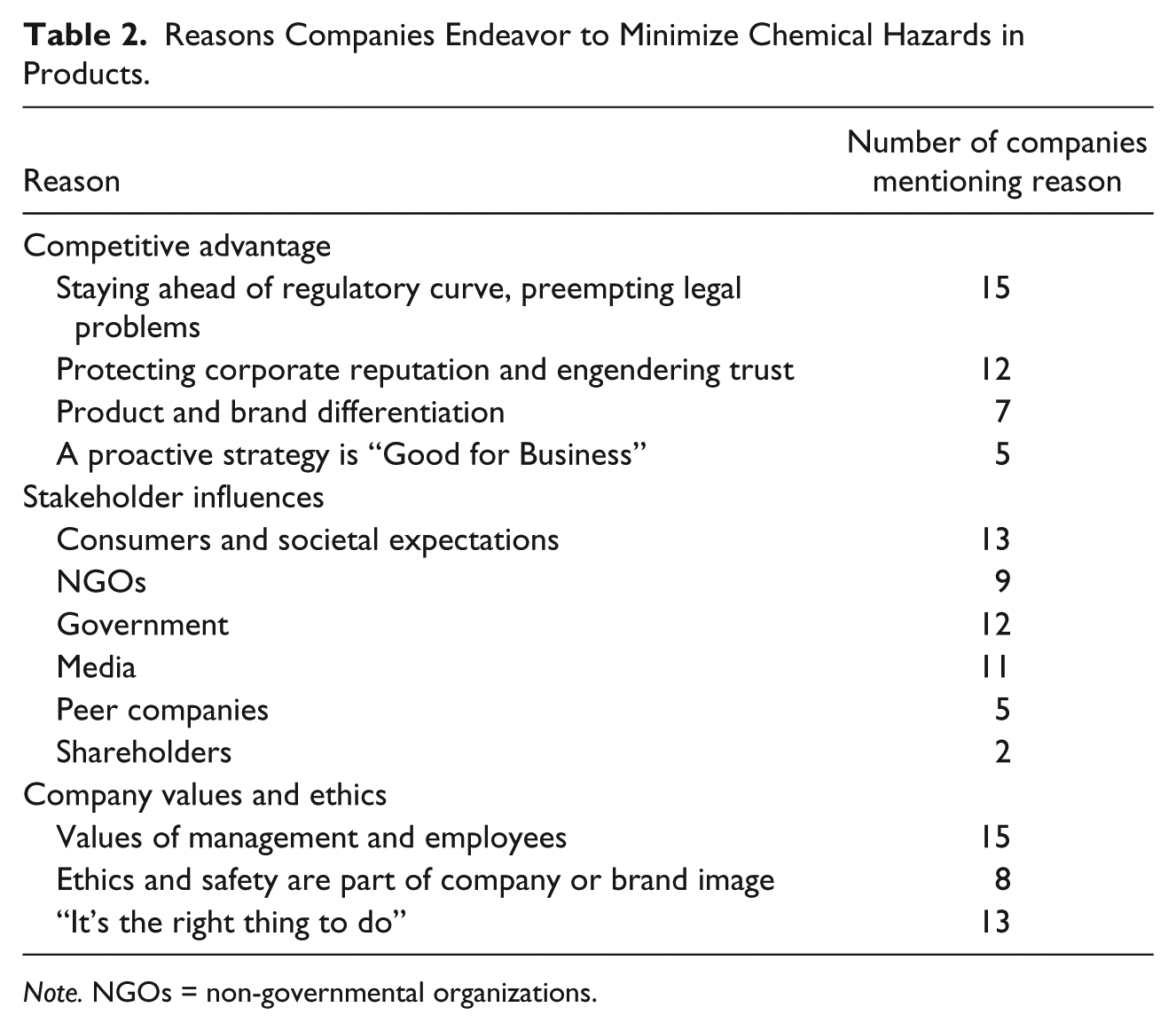
Note. NGOs = non-governmental organizations.
The Pros and Cons of Advertising Safer Products
While the companies participating in this research adopted proactive, voluntary strategies to manage hazardous chemicals beyond what was required by law, they typically did not advertise details about these strategies. In fact, no company engaged in aggressive chemicals-related advertising, such as launching campaigns to inform consumers about the unregulated chemicals they avoided using in their products, which may be present in competitors’ products. In most cases, one must dig deep into the companies’ websites to find information regarding their chemicals policies. Interviewees from 13 companies chose to discuss their thoughts regarding the pros and cons of advertising their chemicals management efforts.
Reasons not to advertise
A retailer explained, “I don’t think we’ve got a huge message out there about chemicals because, although it’s a very big part of our business—of course, chemicals touches everything—I don’t think the customer would see it like that.” This expression was a common belief among interviewees that the majority of their customers did not understand or was unaware of chemicals issues; customers assumed that products were safe if they could be legally sold to the public. Companies did not design their advertising to exploit consumer ignorance. Another retailer said, “We have a consumer approach that is not based on fear . . . advertising the ingredients we do not use is not the proper way of talking to consumers or [the way to] maintain consumer confidence.” A third retailer explained how his company thought about this issue, due in part to a survey it conducted of its customers: We did some research . . . a poll of probably about a thousand people . . . And [what] it says is . . . 90% of people didn’t have any scientific understanding, but they were concerned about chemicals. And the reason they were concerned about chemicals is . . . [it sounds] scary. Because most people don’t believe products are made of chemicals. They believe it’s a pink shampoo and that’s all they see. They don’t see some extra 15-20 chemicals—they see a pink shampoo. But they trust us to manage the chemicals for them. They don’t want to be bothered with concerns about it.
Another interviewee explained that apprising customers of the latest chemicals to be phased out of the newest product models is tricky because it can raise fears about the safety of older models: For most [of these possibly hazardous] substances, we think that in general the public is not aware that these things are in the [product]. It’s rather that they take for granted that it’s not in the [product]. When they [use the product], they take for granted that they are not exposed to anything hazardous. And that makes it hard for us to say, “Ok now, you don’t have lead in your [product].” [The customer would say], “What?! We had lead in our [product]?!” So it’s hard to sell the public health or environmental safety features because people assume that they’re already there. And also, you don’t want to worry your older customers about last year’s [model], and make them think they have a dangerous [product]. So you don’t want to push too hard and say, “Yes, this [substance] was there and it’s so dangerous, but now it’s gone! But you bought it last year—don’t worry, it’s fine! I’m sure you’ll be ok.”
Interviewees from two companies, which each had a section of their websites dedicated to their environmental-related projects and accomplishments, discussed the danger of bragging about their chemicals management successes. One interviewee said that just participating in interviews about his company’s chemicals management strategy made him nervous: “If we provide our frank answers, the risk is that they will be publicly held up, with someone saying, ‘[The company] said this, but look what’s happened afterwards.’” Another interviewee related a story about a competitor that, after much research and development, released a product it advertised as being “green.” Greenpeace harshly criticized the product for not being “green enough,” and the company subsequently withdrew the product from the market.
As discussed earlier, other interviewees said that they did not try to get “credit” for their chemicals management efforts for ethical reasons. One interviewee remembered his company president’s response when someone suggested marketing their chemicals management strategy: “Listen guys, we do this because it’s the right thing to do, not to sell more [product]—if we can’t do this, then I’m going to go out of business.”
Reasons for some level of advertising
In only three situations did a few companies believe that some chemicals-related advertising was prudent: when companies were pressured to do so by the public, when their competitors were doing it, or to differentiate their products. To cater to the small percentage of the public that expressed concern about chemicals in consumer products, interviewees stressed that they tried to be as transparent as possible about their chemicals strategies. Concerned customers, NGOs, and others could obtain details about chemicals policies and/or product contents through the companies’ websites, customer hotlines, restricted substance list (RSL) postings, and other resources. One interviewee reasoned, “If you’re not transparent, eventually you’ll end up having to talk about it anyway,” likely in a confrontational setting.
A retailer gave a specific example about creating a publicly communicated chemicals management policy to satisfy NGOs that were campaigning against it; the NGOs assumed that the company’s lack of advertising meant that it did not have a chemicals management plan. The interviewee summarized, “So the way we’ve done things hasn’t really changed, but the way we’ve communicated has.” While the company saw this communication policy as necessary and useful, it also increased vulnerability: “In some ways, you almost attract [attention]; from our point of view, you can keep your head below the parapet and people might not even ask you the question.”
Two other companies decided to introduce general descriptors such as “non-toxic” to their product labels in reaction to competitors’ actions. Interviewees said they saw their competitors including “environmentally friendly” claims on their product labels, and realized a need to stay competitive by calling more attention to what they were doing. This was especially important because interviewees felt that their products were environmentally superior to their competitors: “We said, ‘We’re much better than them, [our competitors] are not that good; therefore, we must do more.’”
The founders of the two small apparel companies felt a need to differentiate their products to gain market share. Both incorporated the non-toxic attributes of their products into their branding and provided some details about product contents and the benefits of non-toxic products on their websites. One interviewee emphasized that to cover the costs of his chemicals initiatives, his company’s products were about 5% more expensive than competitors’ products, so some consumer education was essential to motivate them to choose his products. Aside from information on his company’s website, he also tried to educate consumers using an “eco-index” label on each product, which was intended to help customers evaluate the company’s different products based on numerous environment-related features (including chemical content). He explained, We can be a bit ahead of our competitors, but we need to move the consumers forward so that they make the right choices in order for us to move forward as well . . . So we work on two fronts: we do the research to improve our products, and we try to educate the consumers so that they are willing to pay the price, because there is a price for a more environmentally friendly product.
Discussion and Implications
The preceding analysis of qualitative data gleaned from companies with proactive chemicals management policies makes a contribution to the literature and has implications for future research and practice. Concentrating on companies that were acknowledged to be relatively exemplary by knowledgeable observers allowed for a focus on what is being done well rather than poorly. Such an approach is consistent with work in positive organizational studies (Caza & Caza, 2008; Dutton, Quinn, & Cameron, 2003) and positive deviance (Spreitzer & Sonenshein, 2004; Warren, 2003). Thus, this study’s emphasis is not on organizational deficits about chemicals management (and by extension, other domains of corporate responsibility), but rather on what attributes of organizations and managers make positive deviance and voluntary responsible behavior more likely.
The literature discussed in the “Background” section of this article focused primarily on companies’ motivations to engage in CSR programs when their activities are in the public eye or when stakeholders are aware of the need for such programs. Surprisingly, the existing literature also explains companies’ reasons for adopting proactive chemicals management strategies to address problems that are not acknowledged in the wider public domain. For example, our findings are consistent with analyses, suggesting that large, visible, multinational companies can protect their reputations and gain a competitive advantage by engaging in proactive CSR activities (Brammer & Pavelin, 2004). Our interviewees cited numerous ways in which their proactive chemicals management strategies gave them an advantage over competitors, for instance, by staying ahead of regulations, engendering trust with stakeholders, avoiding negative publicity, and providing an opportunity to differentiate their products. These examples fall under the “financial” level of Vesilind et al.’s (2006) moral development model. Firms that are less environmentally responsible may find it useful to develop organizational, strategic, and financial capabilities that allow them to respond to environmental concerns (Murillo-Luna, Garcés-Ayerbe, & Rivera-Torres, 2011).
The authors’ analysis also provides evidence about the role of managerial values in CSR decision making. For the businesses involved in this study, managerial values played a role in deciding to take on the costs of voluntary chemicals management, apart from more strategic considerations such as building trust and managing risk; such actions can be said to have moral worth (Vesilind et al., 2006). The irony is that actions based on managerial values often are superior means of bringing about externally focused results—for example, enhanced social and market position (Prajogo, Tang, & Lai, 2012). Managerial values also map onto managerial vision—“the process of projecting a desired future organizational state that, when effectively communicated, empowers followers to enact the vision”—which is a critical element of proactive environmental strategy (Walls, Phan, & Berrone, 2011). Even though our sample was identified based on exemplary characteristics defined by industry observers and not selected randomly, the fact that the interviewees discussed values as being important supports the broader observation that managerial values make a difference with regard to social responsibility. Indeed, these findings confirm the relevance of managerial values in a variety of social responsibility domains.
In accordance with research on maintaining legitimacy with key stakeholders (Suchman, 1995), our analysis illustrates the importance of anticipatory thinking. The companies included in this study learned to engage in proactive behavior that anticipated critical stakeholders’ chemicals-related concerns to respond to them in a satisfactory manner. The findings suggest that leading-edge companies should proactively reach out to certain critical stakeholder groups, such as NGOs, and alleviate their concerns rather than wait for these stakeholders to raise issues. Once a stakeholder group has identified a concern with a particular company, the task of building (or rebuilding) trust is much harder than if the company had anticipated the issue and responded affirmatively and proactively.
In addition, this study’s findings are in agreement with previously reported literature regarding stakeholder management strategies. The companies included in the study had clearly differentiated stakeholder strategies, and managers did not consider all stakeholders to be equally important in focusing their actions on improving relations, a well-known insight in the stakeholder literature (Freeman, Harrison, & Wicks, 2007; Mitchell, Agle, & Wood, 1997). For example, improving relations with stakeholder groups such as NGOs required a strategy of disclosure and consultation as these stakeholders possessed the expertise to deal with technical issues in an informed way. In line with the stakeholder literature on consultation (e.g., Clarkson, 1995; Heine & Willard, 2006; Taylor & Scharlin, 2004), the authors also found that companies often sought to achieve collaboration rather than confrontation with stakeholder groups, such as NGOs and government regulators, with which they were trying to build trust. Companies seeking to improve stakeholder management might improve their capacities to consult (and collaborate) with those stakeholder groups whose actions can do much to define whether they are perceived as responsible or irresponsible actors (Morsing & Schultz, 2006). Here, Noland and Phillips (2010) offered the suggestion that organizational managers think of themselves as “Ethical Strategists” who must think of stakeholder engagement as integral to organizational strategy rather than as an ancillary activity.
The authors note, however, that more stakeholder engagement is not necessarily better or more responsible. Following Greenwood (2007), stakeholder engagement on its own can be understood as morally neutral; for it to lead to more responsible behavior, stakeholder engagement must move beyond reporting (as important as that is) or simple strategic concerns to encompass respect for the interests and agency of stakeholders. While much of the literature on stakeholder engagement processes is in its infancy, the authors find Sloan’s (2009) distinction between outward (focused on communications, monitoring, and managing the risks that stakeholders pose to the firm) and inward (focused on genuine collaboration and organizational transformation) stakeholder engagement to be helpful in the present analysis. Here, while organizations do need to be conscious of stakeholder risk—consistent with externally oriented stakeholder engagement—the organizations represented in our sample seemed to be able to combine this concern with inward-focused engagement that engendered real dialogue and collaboration with key stakeholder groups whose concerns about chemicals were salient.
While companies worked to build trust with informed stakeholders (here, governments and NGOs), they handled relationships with their customers differently; surprising and novel findings from this research thus relate to advertising and consumer relationships. Companies chose not to advertise their chemicals management strategies instead of using advertising to gain a potential competitive advantage. As previously mentioned, other researchers have reported company decisions not to advertise their CSR efforts because it does not improve sales and attracts attention from media and NGOs. In the case of chemicals, the reasons appear to be more complex.
While the companies involved in this research perceived that their chemicals management strategies helped them build or maintain trust with their customers, the interview results suggest that they were also avoiding distrust with this stakeholder group. Companies did so by diligently working on chemicals management issues in the background to try to prevent any chemicals-related problems associated with their products; this is an unusual strategy for brand differentiation, reputation protection, or gaining a competitive advantage in that it is based on what does not go wrong with a company’s products. The safety of chemicals in consumer products is a taken-for-granted issue; consumers assume that products are safe based on cognitive legitimacy, and companies do not want to disrupt this taken-for-grantedness and awaken scrutiny about product safety by advertising their strategies (Suchman, 1995). Companies also wanted to avoid alarming customers about older model products that contained chemicals that were eliminated from newer models.
Analysis of these differentiated strategies for managing relationships with informed stakeholders and consumers suggests that the informed stakeholders act as de facto arbiters of trust between the consumer product companies and the public. By building trust with informed stakeholders and satisfying their concerns, companies could avoid becoming the targets of negative media and NGO campaigns, allowing them to avoid disrupting consumers’ taken-for-granted beliefs about product safety, which could engender public distrust. This approach also puts the informed stakeholders in a position of power and allows them defend their interests better than otherwise would be the case—thus respecting their agency (Greenwood, 2007).
Limitations and Future Research
Often, trade-offs must be made in obtaining rich qualitative data. Such trade-offs may be especially prominent in situations where the information desired is non-public and sensitive and can only be obtained from busy, high-level business people. The authors acknowledge a number of limitations to this study.
A first set of possibly problematic issues related to the interviews. When government agency and NGO contacts made introductions to company representatives, the representative was usually the company employee who knew the most about that company’s chemicals management program. Often, this person was recruited as an interviewee. Sometimes, however, the authors ended up with two interviewees. This circumstance happened when either (a) the initial company contact felt that he or she had a broader knowledge of the company’s chemicals management strategy and wanted to bring in another employee who had more on-the-ground experience with strategy implementation, or (b) the initial company contact felt that other employees’ combined experience might be most helpful in answering our detailed questions, and delegated the interview to these two people.
Any of the above scenarios could pose problems. An interview with only one person per company provides only a single perspective on company operations. Interviewing two people at once might also be problematic, as one interviewee’s presence could prevent the other from being entirely honest or forthcoming. Furthermore, it was impossible to know if any interviewee was lying, exaggerating, or withholding information. However, based on the first author’s deep knowledge of this topic, she believed the interview data to be more candid and forthcoming than any information published to date. A study like this one has not been performed before, and company information on chemicals in consumer products is considered sensitive; the researcher was grateful to the companies for granting these interviews and did not feel in a position to put conditions on the number of people participating per interview. Even though the characteristics of the interviews were not ideal, the situation did not allow for changes, and the resulting data were rich and unique. 5
Another possibly problematic issue related to the sampling method. As the participating companies knew that they had been recommended for the study by government agencies and NGOs, they may have been inclined to paint a particularly rosy picture of their companies. In addition, it is likely that there are other companies unknown to our government agency and NGO contacts that were also being proactive on chemicals management. Had the researcher contacted one of these companies without an introduction, and a representative agreed to be interviewed, it is impossible to know if or how the results would have been different.
Research based on grounded theory offers many opportunities for future scholarly work, and this study is no exception. Given this study’s findings that companies often sought to achieve collaboration rather than confrontation with stakeholder groups with which they were trying to build trust, future research could focus on case studies of companies seeking to improve stakeholder management. Case studies could be used to try to understand how consultation could help companies resolve challenging problems such as chemicals management; for instance, a company might pursue a strategy of eliminating a possibly problematic chemical substance from its products by collaborating with a NGO or government agency. The research could examine the dynamics and results of such collaboration, which could help inform other companies’ future strategies.
While the trust–distrust relationship has been studied by others (Ring & Van de Ven, 1992; Wicks, Berman, & Jones, 1999), future research in the CSR domain of chemicals management could further elucidate consumer attitudes regarding chemicals in consumer products to confirm company perceptions about consumer understanding and concerns. Such information might be gleaned through a large survey of consumers. This additional information could advance understanding of the trust–distrust relationship between consumer product companies and their customers. Also, it could be interesting to conduct separate surveys in the United States and Europe to see if/how consumer attitudes differ. Furthermore, characteristics related to the case of chemicals management, such as where risks to stakeholders are either unknown or poorly understood, are extendable to other areas of stakeholder management.
Similarly, this study’s analysis is extendable to other contexts in which regulatory regimes may evolve. Related to chemicals management, researchers might conduct a similar study in the future to see whether/how circumstances have changed for companies: for example, their chemicals management strategies, their lack of advertising, their communications with consumers, and so on. One of the interviewees from this study said that she thought chemicals in consumer products would be an issue much more in the public eye by about 2020. As public awareness about chemicals in consumer products increases, information about company actions will likely be more publicly available, and this has the potential to significantly change the way consumer products are made and advertised. Any of these suggested studies could be enhanced by use of mixed qualitative and quantitative methods.
Footnotes
Acknowledgements
The authors thank Leonard Ortolano, Megan Schwarzman, Michael Wilson, and Donald Kennedy for playing instrumental roles in design of this research; in addition to these scholars, we thank Raymond Levitt, Shawn Berman, Michelle Westermann-Behaylo, and three anonymous reviewers for reviewing drafts of this manuscript. The authors are also grateful to the numerous individuals who gave their time to participate in this research or helped to identify appropriate participants.
The article was accepted during the editorship of Duane Windsor.
Declaration of Conflicting Interests
The author(s) declared no potential conflicts of interest with respect to the research, authorship, and/or publication of this article.
Funding
The author(s) disclosed the receipt of the following financial support for the research, authorship, and/or publication of this article: The research described in this article has been funded in part by the EPA under the Science to Achieve Results (STAR) Graduate Fellowship Program. The EPA has not officially endorsed this publication and the views expressed herein may not reflect the views of the EPA. The Morris K. Udall and Stewart L. Udall Foundation’s Dissertation Fellowship and the Stanford University William C. and Jeanne M. Landreth Fellowship provided additional support. The University of New Mexico Community and Regional Planning Program provided funding to make this an open access publication.