



Abstract
The arts and creative sectors in Australia are facing unprecedented challenges. Since 2018 there has been a consistent reduction of available creative arts courses in Australian universities and in the TAFE sector, and a decline in enrolments in many senior secondary school arts subjects. The impacts of Job-Ready Graduates policy, introduced in 2020 and implemented from 2021, which substantially increased the cost of arts and creative courses, have coincided with declining enrolments, closure of courses, reduction in subject offerings, and courses being placed under institutional review. This discussion will share national data about the extent of this decline and considers its implications for realising the ambitions outlined in Australia’s National Cultural Policy Revive: a place for every story, a story for every place (2023). It will posit that there is a profound incongruity between rhetoric about a thriving arts and cultural sector, and the explicit winding back of arts education in senior schooling and higher education.
Introduction
Australians value the arts and creative industries. The most recent national arts participation report commissioned by Creative Australia (2023) indicates that 97% of Australians engage with the arts. The report also found that 74% of Australians surveyed agreed that the arts should be an important part of education (Throsby & Petetskaya, 2024), and yet Australia continues to see decreased provision of arts education in primary schools (NAAE, 2025a), declines in arts education enrolments at secondary school level (Thomson, 2024), and a scaling back of creative arts degree courses in higher education (NAAE, 2025b). This article will illustrate how enrolment in Year 12 arts subjects and enrolments in creative arts degree courses have, in most cases, declined over recent years. This scaling back runs counter to the national cultural policy, Revive: a place for every story, a story for every place (Commonwealth of Australia, 2023) that underscores that creativity and the arts are crucial for workforce development, aligning with Australian trends in education and employment. The policy emphasises the need for secure pathways into cultural and creative jobs for Australia’s 3.2 million young people aged 15–24. Revive strives to build sustainable careers in the creative industries across all career stages, beginning with arts education, and continuing through vocational training, mentorships, fellowships, internships, grants, and lifelong learning opportunities. Creative Australia and Service and Creative Skills Australia (2025) highlight the urgent need to address significant gaps in education and training, “including a disconnect between formal education and industry needs; …; declining enrolments in creative courses; … and low diversity among early entrants into creative careers due to structural barriers, including a lack of affordable education, training and career pathways” (p.29).
The Arts Workforce
The metanarrative about the creative arts sector is that it makes a significant contribution to the Australian economy. The arts and culture sector employs more people than the resources sector in Australia (Cunningham, 2022) and requires highly trained and skilled graduates for it to maintain international competitiveness. The sector employs 193,600 people, more than finance (190,600), heavy and civil engineering construction (107,700), accommodation (97,500), electricity supply (65,000), and coal mining (49,600) (Browne, 2020). From a workforce perspective, there are approximately 47,100 practicing professional artists working in Australia according to a report commissioned by Creative Australia (Throsby & Petetskaya, 2024). Half of all Australian artists, “apply their creative skills outside the arts (52%)” (Throsby & Petetskaya, 2024, p.27). Artists are applying their creative skills in education and research (42%), with the charity, community, and not-for-profit sector (41%) (Throsby & Petetskaya, 2024). Additionally, half of all community and cultural development artists apply their creative skills in consulting and training (Throsby & Petetskaya, 2024). The report also found that “artists are more highly educated than the workforce at large; three-quarters of them hold a university degree, compared to only 36% in the wider labour force” (Throsby & Petetskaya, 2024, p.5). Recent data from the Bureau of Communications, Arts and Regional Research indicate that the cultural and creative sector contributed $67.4 billion to Australia’s economy in 2023–2024 (2.5% of Australia’s GDP), representing a 6.6% increase from 2022–2023 (Department of Infrastructure, Transport, Regional Development, Communications, Sport and the Arts, n.d).
The Arts, 21st Century Skills, and Creativity
However, the dominant purpose of creative arts training in universities or school-based arts subjects is not solely on developing artists. Only a small number of students at schools and universities studying creative arts areas (except for those studying fine arts degrees specifically designed for artist training) will go on to become professional artists, others will be employed as arts workers, working for arts, cultural, entertainment, and creative industries, while others will be employed as arts teachers. Although now dated, the Organisation for Economic Co-operation and Development’s (OECD) Arts for Arts Sake? (Winner et al., 2013) found that arts graduates are commonly involved in product innovation and are more likely than other tertiary graduates to hold highly innovative jobs. Creative arts learning, at primary and secondary school, and university, develops a range of highly valuable 21st century skills. The term “21st century skills” refers to “the knowledge, life skills, career skills, habits, and traits that are critically important for student success in today’s world, particularly as students move on to college, the workforce, and adult life” (Buckle, n.d). This skill set includes a variety of skills, such as problem-solving, creativity and innovation, criticality, communication skills, project management, and social intelligence, but is commonly truncated to the 4Cs – creativity, communication, critical thinking, and collaboration (NEA, 2013; Partnership for 21st Century Skills, 2011; Tight, 2021). Unique to the arts is that, unlike other disciplines, creativity is not a byproduct of arts learning, but central to the arts disciplines. Several important research reports, including The Heart of the Matter (American Academy of Arts and Sciences, 2013), Humanities Graduates and the British Economy: The Hidden Impact (Kreager, 2013), and Australia’s Future Workforce? (CEDA, 2015), argue that creativity and innovation will be key to 21st century economies, particularly in developing responses to multi-perspective or “wicked problems” (Rittel & Webber, 1973). These reports note that in the knowledge economy, new workplace skills and the fostering of an innovative, creative, and agile workforce will prove to be vital to national and international creative economies.
A significant, yet slightly dated Oxford University study by Frey and Osborne, The Future of Employment: How susceptible are jobs to computerisation? examined 702 occupations in the United States of America and found that 47% of employment is at risk (Frey & Osborne, 2013) of being replaced either entirely or partially by computerisation. Frey and Osborne note that jobs may not be entirely replaced by computerisation but rather aspects of many jobs will be. It is important to note that the research was published before the emergence of Generative Artificial Intelligence as a mainstream tool. The research concluded by stating that “... as technology races ahead, low-skill workers will reallocate to tasks that are non-susceptible to computerisation – that is tasks requiring creative and social intelligence. For workers to win the race, however, they will have to acquire
Creativity has been identified as one of the most important 21st century skills to develop within an education system since the turn of the millennium (Creative Australia and Service and Creative Skills Australia [SaCSA], 2025; OECD, 2024). In the United States of America, the National Education Association (NEA), through the Partnership for 21st Century Skills project, identified four essential skills needed for young people to be prepared for college, work, and life. These became known as the 4Cs: critical thinking, communication, collaboration, and creativity (NEA, 2013). Internationally, creativity has been identified in the OECD’s Learning Framework 2030 as an important competency to transform society and shape the future (OECD, 2018). The Programme for International Assessment (PISA) (a triennial international test of 15-year-old students) included creative thinking as one of their assessment modules in the 2022 suite of international tests, highlighting again the importance of developing creative thinking skills in young people. Australia ranked 4th among participating countries, receiving a mean score in creative thinking of 37 points, which was significantly higher than the OECD average of 33 points (the scale ranged from 0 to 60 points). Singapore, with an average score of 41 points, scored the highest in creative thinking (OECD, 2024).
Within Australia’s national vision and goals for education, the Alice Springs (Mparntwe) Education Declaration (Education Council, 2019), creativity is again embedded. Goal 2 states that ‘All young Australians become: confident and creative individuals, successful lifelong learners, [and] active and informed members of the community’ (Education Council, 2019, p.4). In addition, Australia’s national curriculum recognises the importance of creativity through its inclusion as a general capability: critical and creative thinking (ACARA, n.d). The creative arts not only foster the development of artistic skills for art making – the creative arts also teach skills in creativity, collaboration, innovation, experimentation, resilience, confidence, and communication. Australian research has found that students who engage in The Arts (Dance, Drama, Media Arts, Music, and Visual Arts) do better academically in their non-Arts subjects (like English, Mathematics, and Science) than those students who do not participate in The Arts (Martin et al., 2013). The 2013 report, Arts education, Arts for Art’s Sake?, focused on the relationship between the Arts and innovation and found that: Arts graduates are likely to have the complex set of skills that are useful in highly innovative occupations. Innovation usually tends to focus on skills in science and engineering. However, artistic skills are often involved in the innovation process. The analysis of two international databases of tertiary education professionals (Reflex and Hegesco) by Avvisati et al., 2014 shows that arts graduates are among the most likely to have a highly innovative job 5 years after graduation. Fifty-four percent of arts graduates have a highly innovative job dealing with some type of innovation. They rank second for product innovation, and they come fifth and seventh for innovation of technology and innovation of knowledge (Winner et al., 2013, p.17).
This study also suggested that The Arts “develop a bundle of skills that matter for innovation” (Winner et al., 2013, p.18). Despite this, Bamford (2009) notes that “the arts appear in the educational policy in almost every country in the world [and] there is a gulf between the “lip service” given to arts education and the provisions provided within schools” (p.11). The following sections outline why this appears to be true in Australia today.
Methods
The discussion in this article employs a desktop review methodology. This research approach involves the collection, analysis and synthesis of existing data and literature to answer specific research questions (Booth et al., 2016). This methodology is particularly useful for obtaining an understanding of a topic without the need for primary data collection. Rather than generating new data through fieldwork or experiments, a desktop review relies on reviewing and synthesising existing literature, reports, databases, academic articles, government publications, statistical data, and online resources. The primary objective of a desktop review is to gather relevant information to understand a particular topic, assess the current state of knowledge, identify trends, or inform decision-making. In this discussion we draw on academic literature, industry reports, Australian government policy, public commentary, and statistics harvested from publicly available Australian federal government and state government databases. A desktop review typically involves defining research questions or in the case of this investigation, scoping the narrative for what we have described as a polycrisis for arts, culture, and creativity in the Australian context. For this discussion we have been driven by a quest to understand the relationship, if any, between declining enrolments in arts subjects in secondary schools nationally, the impact of Australian government policy related to training and employment, and the downturn in enrolments in creative arts degree courses by young people. The resultant discourse has produced, what we believe, is the first Australian analysis of contemporary data from secondary schools and universities that demonstrate the outcomes of policy and practice that have diminished the efficacy of training in creative arts disciplines for young Australians.
This discussion has been led by our significant and continued engagement with leadership of peak associations and national advocacy work related to arts education at state, national and international levels. Additionally, both authors work in two separate universities where the impact of the downturn in access to creative arts degree courses and creative arts subject offerings is current lived experience. This currency of practice will not be included in the discussion but informs the shape of the investigation.
The polycrisis described in this article is the demonstrable interrelationship between declining enrolment numbers in Year 12 arts subjects in Australian states and territories, the reduction of creative arts degree courses and enrolments at Australian universities, and the continued impact of Job-Ready Graduates policy which increases the cost of arts, society and culture degree programs by 116%, and creative arts degree programs by 19%, compared with teaching, mathematics, and agriculture (McIlroy, 2024) creating inequities and barriers to creative arts education (Barton & Riddle, 2022). This current pathway of problems from creative arts enrolments from senior secondary to post-compulsory schooling will develop into long-term implications for Australia’s “creative ecology” (policy, processes, people, place, products) (Harris, 2016).
Findings and Discussion
To begin the discussion about the multidimensional nature of the crisis in the provision of and uptake of arts and creative education, we look in detail at enrolments in senior secondary schools both at a national and state/territory level.
Enrolment in Arts Subjects in Australian Secondary Schools
Evidence garnered from the Australian Curriculum, Assessment and Reporting Authority (ACARA) points to declining enrolments across Australia in arts subjects (Dance, Drama, Media Arts, Music, and Visual Arts) in secondary schools. ACARA’s aggregated data indicate that over a 10-year period from 2012 to 2022, enrolments in the arts had steadily declined nationally. In 2012, 22.2% (or 23,854) of male-identifying students in Year 12 enrolled in an arts subject. In 2022, this declined to 15.8% (17,603), a decrease of 6.4% points (6,251 students). For female-identifying students, a more substantial decrease was noted. In 2012, 37.6% (42,956) of female-identifying students enrolled in a Year 12 arts subject, and this had dropped to 26.9% (31,888) in 2022, a decrease of 10.7% points (11,068 students) (ACARA, 2025).
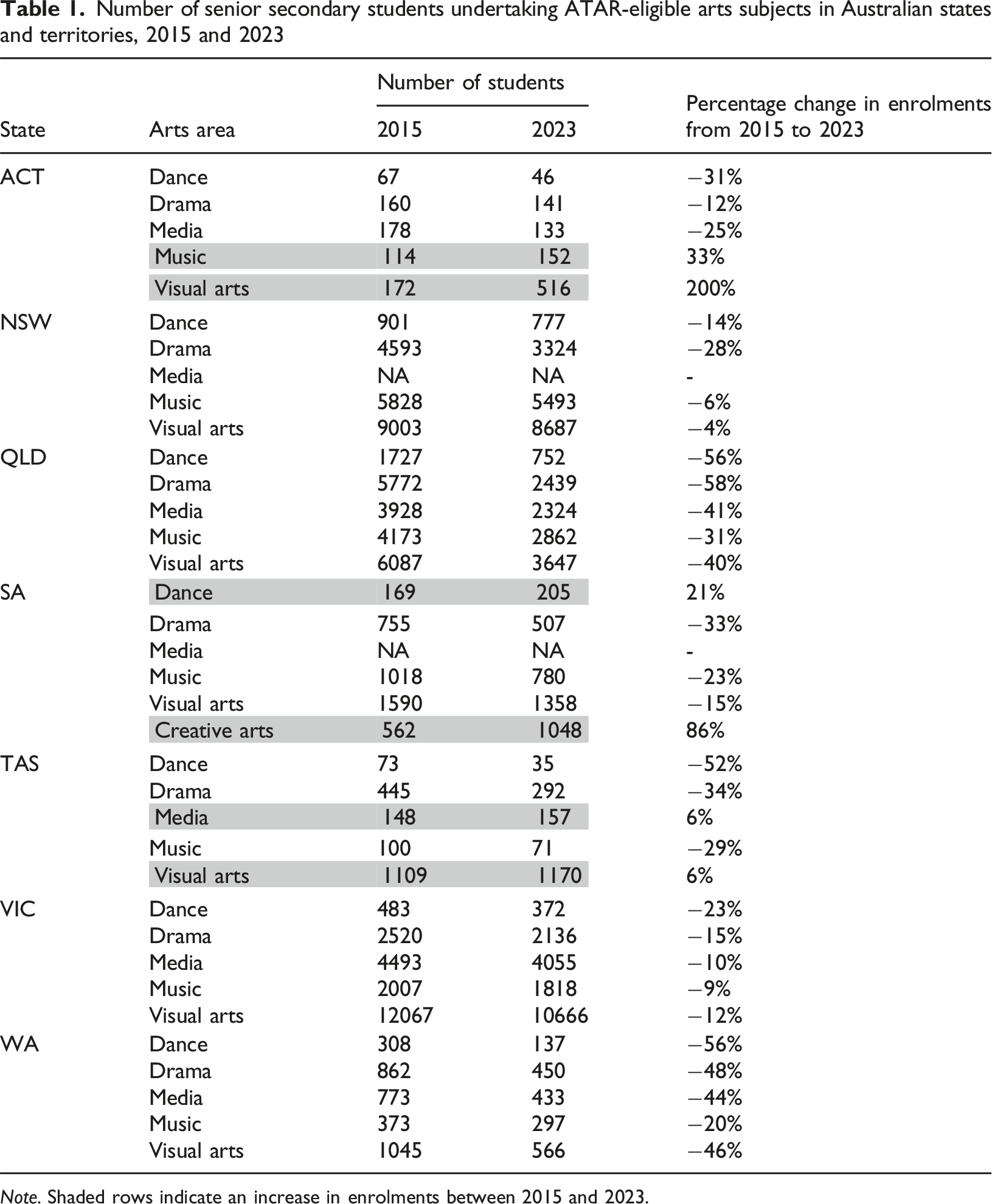
Number of senior secondary students undertaking ATAR-eligible arts subjects in Australian states and territories, 2015 and 2023
Note. Shaded rows indicate an increase in enrolments between 2015 and 2023.
Table 1 indicates the state/territory jurisdiction, the number of students enrolled in each arts area in 2015 and in 2023 and a percentage change in enrolments from 2015 to 2023. Comparison of senior secondary subject enrolment data is inherently complex due to changes in curriculum structures over time, variations in syllabus nomenclature across jurisdictions, and differences in reporting practice. While some jurisdictions report student enrolments, others report subject completions. Consequently, the data presented in Table 1 should be interpreted as providing an approximate national overview, rather than a precise or directly comparable dataset.
Queensland (−45%) and Western Australia (−44%) experienced the most substantial declines in ATAR arts enrolments between 2015 and 2023. Victoria (−12%), New South Wales (−10%), Tasmania (−8%), and South Australia (−5%) also recorded consistent decreases, albeit to a lesser extent. The Australian Capital Territory was the only jurisdiction to report an increase (43%) in ATAR arts enrolments, driven largely by growth in Music and Visual Arts. Nationally aggregated data across the arts subjects indicate that Drama (−39%) and Dance (−38%) experienced the sharpest reductions in enrolments, while Media (−25%), Music (−16%), and Visual Arts (−14%) demonstrated more moderate, though still considerable, declines. While not immediately evident in Table 1, several jurisdiction-specific conditions may contribute to these patterns. Queensland recorded the most severe overall decline nationally, with a reduction of 45% across all arts subjects combined. Queensland provides a unique context for analysis, as the state introduced a new senior curriculum and assessment system in 2019, including publicly available data on intersubject scaling. The impacts appear profound and suggest that the scaling of arts subjects has an impact on students’ and parents’ perceived value of the subjects (Sanders & Saunders, 2024). Tasmania’s participation rate in senior secondary is substantially lower than other states, with Year 12 attainment rates reaching 53% in 2022 (Lohberger & Balden, 2024). This means there are considerably fewer students completing senior school therefore impacting rates of participation in arts subjects. In Victoria and New South Wales, enrolments in Dance and Drama, both collaborative, practical, and embodied subjects, were likely affected by extended lockdowns in these jurisdictions during the COVID-19 pandemic. Comparing 2015 to 2023 ATAR Arts subject enrolments nationally, Australia has seen an overall decline in participation of 21%.
The state-by-state data indicates a strong downward trend in enrolments in senior secondary ATAR arts subjects across almost all arts discipline offerings in each state, yet little has been written about why this is occurring. Sanders and Saunders’ (2024) research highlights that Year 12 Drama enrolments are decreasing due to poor quality curriculum and assessment practices that are inauthentic, and the way the subject scales when ATAR scores are calculated. Scaling, or intersubject scaling, is a process employed by tertiary admissions centres to adjust raw Year 12 subject results to scaled scores to enable comparison across subjects, based on assumptions about cohort academic strength and subject difficulty. As a case study, Queensland is an interesting comparison, as, before 2019, all Year 12 subjects had 100% internal assessment, and subjects did not have a single external assessment task. Assessment was internally designed and marked and externally moderated. Scaling did occur through the Queensland Core Skills Test, however the scaling results focused on schools rather than individual subjects, and the scaling data were not made public. Following a significant system change, all new syllabi and assessment instruments were developed, and all ATAR subjects contained an external written exam at the end of Year 12. Subjects are scaled and this data is published annually, a practice that is widely used across Australian states. Therefore, Queensland’s enrolment data provide a unique opportunity to identify if subject scaling plays a role in student and parent subject choice. Very little research has explored this issue; however, media articles have certainly supported this claim, with leaders of professional teaching associations in Queensland indicating this is a major reason for declining enrolments in senior Arts subjects (Eeles, 2022; Mancinone, 2022). The academic research in this area tends to focus on why students are choosing arts subjects, rather than why many are not (Rogerson, 2021). As Dean and colleagues pointed out, ‘There is an implicit understanding that more advanced courses generally attract higher scaled mean scores, and thus contribute to an overall higher ATAR ranking’ (Dean et al., 2021, p.249). In addition, when critiquing the Western Australian ATAR system, Rovis-Hermann (2024) reflect that: The emphasis on standardised testing as the primary measure of success also reinforces the idea that certain types of knowledge and skills are more valuable than others. This focus on academic achievement in traditional subjects often marginalises students who may excel in other areas, such as the arts or vocational education. (p.264).
Despite the rapid decline in enrolments in senior secondary arts subjects in Australian schools, there has not been a single national government initiative to address the issue. In contrast, in 2014, Australia’s Chief Scientist released a report, Science, Technology, Engineering and Mathematics: Australia’s Future (Chubb, 2014). Chubb cautioned that “Australian schools also show a decline in the rates of participation in “science” subjects to the lowest level in 20 years” (p.11) and warned “this has consequences for the general level of science literacy in the community and the future workforce” (p.11). The report rang alarm bells for education ministers throughout Australia and was a catalyst for the Education Council (a council made up of all Australian education ministers) to develop the National STEM School Education Strategy 2016 - 2026 (Education Council, 2015). The Chief Scientist's report cited that “We do know that there is now a shortage of qualified science, mathematics and information and communications technology teachers, and the participation rates of Australian school and tertiary students in STEM disciplines remains a matter of concern” (p.21). The report indicated that around 40% of middle school mathematics classes were taught without a qualified mathematics teacher. Chubb made a range of recommendations, including a focus on developing science literacy, recommending that “every primary school has at least one teacher with specialist STEM skills” and “helping schools to teach STEM as it is practiced, in ways that engage students, encourage curiosity and reflection, and link classroom topics to the “real-world”” (p.23).
Australian school students have an entitlement to arts education in schools that has been enshrined in the development of the national curriculum: The Australian Curriculum for the Arts will be based on the assumption that all young Australians are entitled to engage with the five Arts subjects and should be given an opportunity to experience the special knowledge and skills base of each (ACARA, 2011, p.4).
This promise is yet to be realised. Government prioritisation of STEM is also reflected in financial investment. The Commonwealth’s national cultural policy, Revive, dedicated $2.6 million to in-school arts initiatives over a 5-year period (Commonwealth of Australia, 2023). This contrasts with an investment of $75.6 million from the Commonwealth government over the same period for STEM Education initiatives (Department of Education, n.d).
Three years prior to the publication of Revive, a separate policy was implemented with a focus on what the then Federal government saw as the agenda for jobs of the future. The next section will outline how actions arising from a training and employment policy have made significant and detrimental changes to the higher education landscapes for arts and humanities courses.
The Job-Ready Graduates Policy in Australia
The Job-Ready Graduates (JRG) policy, introduced by the Australian government in 2020, represents a significant shift in the funding and structure of higher education in the country. The policy aimed to ‘align higher education funding with national employment priorities by adjusting student contribution fees across various disciplines’ (McIlroy, 2024). The JRG policy introduced a new funding model for Australian universities, which linked government funding to the study areas that were in high demand by the labour market. Under this model, courses in fields like nursing, teaching, engineering, and IT were subsidised at a much higher rate than those in fields like the humanities, social sciences, and creative arts. As a result, creative arts programs saw a substantial reduction in government funding, making them less financially viable for universities to offer at the same scale. This shift created an environment in which students were incentivized to pursue more “practical” or “job-ready” qualifications over courses in the creative disciplines.
Impacts of the JRG Policy on Enrolments and Course Costs
The JRG policy was designed with the goal of aligning university education with perceived industry needs, predominantly in STEM fields and aimed to increase the employability of graduates and to reduce financial burden on students. Under this policy, student contributions for some STEM degrees, including mathematics and statistics, were reduced by 59% (Kabatek & Coelli, 2023; Yong et al., 2023). However, the impact of this policy on various fields, particularly in the Society and Culture, Communications, and Creative Arts, has sparked debate and concern, especially regarding how it may be affecting enrolment patterns and course offerings in Australian universities.
Data from Australian Academy of the Humanities, 2025Australian Academy of the Humanities (2025) suggest that the Job-Ready Graduates package is failing to meet its intended goals, resulting in negative consequences for students, particularly those in fields like teaching and nursing. Between 2019 and 2022, there was a decline in student enrolment in teacher and nursing programs, with a decrease in student numbers from 26,676 to 25,467 in teaching and from 26,493 to 24,177 in nursing (Australian Academy of the Humanities, 2025), despite increased government incentives including Commonwealth Teaching Scholarships and Commonwealth Prac Payments (Commonwealth of Australia, 2026b). The JRG has disproportionately impacted students from equity groups, including Indigenous, low-SES, and regional students, driving them away from courses that develop crucial 21st century skills. Specifically, the price hikes in society and culture courses, including history, philosophy, and media studies, have led to a 7.3% decrease in applications for these subjects. Data also show that women were more price-sensitive than men regarding these changes (Australian Academy of the Humanities, 2025). Humanities graduates, including those in fields like history, literature, and philosophy, contribute significantly to the workforce, with these degrees offering skills in critical thinking, creativity, and problem-solving. Humanities graduates are more likely to complete their courses, find employment quickly, and report higher job satisfaction. Despite this, the JRG has made these degrees more expensive, hurting students and undermining their value in the 21st century workforce.
Creative arts fields, which often rely on smaller class sizes and substantial investments in resources such as equipment and facilities, were also hit by the policy. These disciplines, which include fine arts, performing arts, music, and design, are often seen as less directly linked to immediate job opportunities compared to fields such as engineering or health care. Under the JRG policy, creative arts courses were placed among some of the least subsidised funding bands, leading universities to face difficult decisions about course offerings. For example, courses in the visual and performing arts were seen as non-essential in comparison to other disciplines, leading to fewer resources allocated to these areas.
Fees for creative arts courses (including performing arts, visual arts, and design) increased by 19% under the JRG scheme from 2020 to 2021, and by 42% from 2020 to 2026 (Commonwealth of Australia, 2026a). In 2026, a student studying mathematics will make an annual contribution of $4,738, while a performing or visual arts student will pay just over double that figure at $9,537 per year (Commonwealth of Australia, 2026a). However, courses such as media, communications, curatorial and museum studies, other society and culture degrees, along with the humanities, experienced the full impact of the JRG scheme, with degree costs increased by 116%, from 2020 to 2021, and by 160% from 2020 to 2026. Under the 2026 JRG settings, students in curatorial studies, communication, media studies, or other society and culture fields pay almost four times the annual fees of mathematics students, at $17,399 per year, comparable to law and higher than medicine (Commonwealth of Australia, 2026a).
The Australian Universities Accord – Final Report recommended “…that the Australian Government reduce student contributions for those affected by JRG and move towards a student contribution system based on potential lifetime earnings” (Department of Education, 2024b, p.5). The warning from the Universities Accord was echoed by NAAE to the Federal education and arts ministers’ advisors in late 2024 (NAAE, 2025a). At the time of writing, no action to address these concerns has been implemented.
The financial constraints introduced by the JRG policy had direct consequences on student enrolments. In creative arts, where career pathways are often less predictable and involve a combination of freelance work, teaching, and performance, the higher tuition fees created a barrier for prospective students. The idea of a “job-ready” graduate, which underpins the policy, does not easily align with the nature of creative careers, where success is often based on talent, networking, and portfolio-building rather than formal qualifications. Many students began to question whether pursuing a creative arts degree would offer sufficient return on investment, given the higher costs and the uncertain job prospects in these fields. The policy’s emphasis on ‘job-ready’ skills reinforced a broader societal perception that vocational and technical education were more valuable than artistic or cultural pursuits. This approach risks reducing the diversity of skills in the workforce, ignoring the critical role that the creative industries play in the Australian economy and society. The arts sector alone contributes billions to the Australian economy each year and employs hundreds of thousands of people, yet the JRG policy undermines the importance of these contributions by placing creative disciplines at a financial disadvantage.
The JRG policy has clearly had a negative effect on enrolments in creative arts programs, as prospective students are increasingly opting for courses they perceive to be more financially viable and directly linked to the labour market. The Job-Ready Graduates policy was designed to enhance employability and reduce the financial burden on students, yet its effects on creative arts enrolments in Australian universities have been largely negative. The policy’s focus on aligning university education with the job market has led to reduced funding for creative disciplines, higher tuition fees, and declining enrolments. This situation underscores the importance of recognising the intrinsic value of the creative industries, which are vital to Australia’s cultural and economic fabric. Moving forward, it will be crucial for both policymakers and universities to strike a balance between industry demand and the need to support and sustain creative disciplines.
Declining Enrolments in and Provision of Creative Arts Degree Courses at Australian Universities
From the data related to the declining enrolments in arts subjects by senior secondary school students and the discussion about direct consequences of JRG policy on costs for creative arts courses in higher education, it is possible to draw a direct line to the downturn in the enrolments in creative arts degree courses, and the provision of creative arts degree courses by Australian higher education providers. While enrolment data reflect realised participation, rather than student applications or preferences, national application data by field of education are not publicly available, limiting the ability to distinguish between student choice and institutional constraints.
Universities Australia’s 2022 Higher Education Facts and Figures shows creative arts disciplines experienced a 10% decline in enrolments between 2008-2020 (Universities Australia, 2022). Reports show that since 2020 many Australian universities have either closed or significantly reduced their creative arts degree programs, including creative arts offerings as part of Initial Teacher Education (ITE) (NAAE, 2025b). Recent ITE reforms (TEEP, 2023) overlook creativity entirely. The parallel impact of both the JRG and reduced enrolments in Creative Arts degree course offerings across Australian universities has seen an overall decline in the availability of education and training opportunities for the creative and cultural sector.
Creative arts Degree Enrolments
The most recent data from Selected Higher Education Statistics – 2023 Student data (Department of Education, 2024a) starkly demonstrate that undergraduate-level degree enrolments are at their lowest point across the 6-year period from 2018 to 2023. This could be seen as young people making a deliberate choice to turn away from creative arts degree courses due to the increased cost impact of JRG. The data in Figure 1 demonstrate the steep decline in enrolments since the introduction of JRG in 2021. Number of student enrolments in undergraduate degrees in creative arts, 2018 to 2023 (Source: Australian Government, Department of Education, 2024a)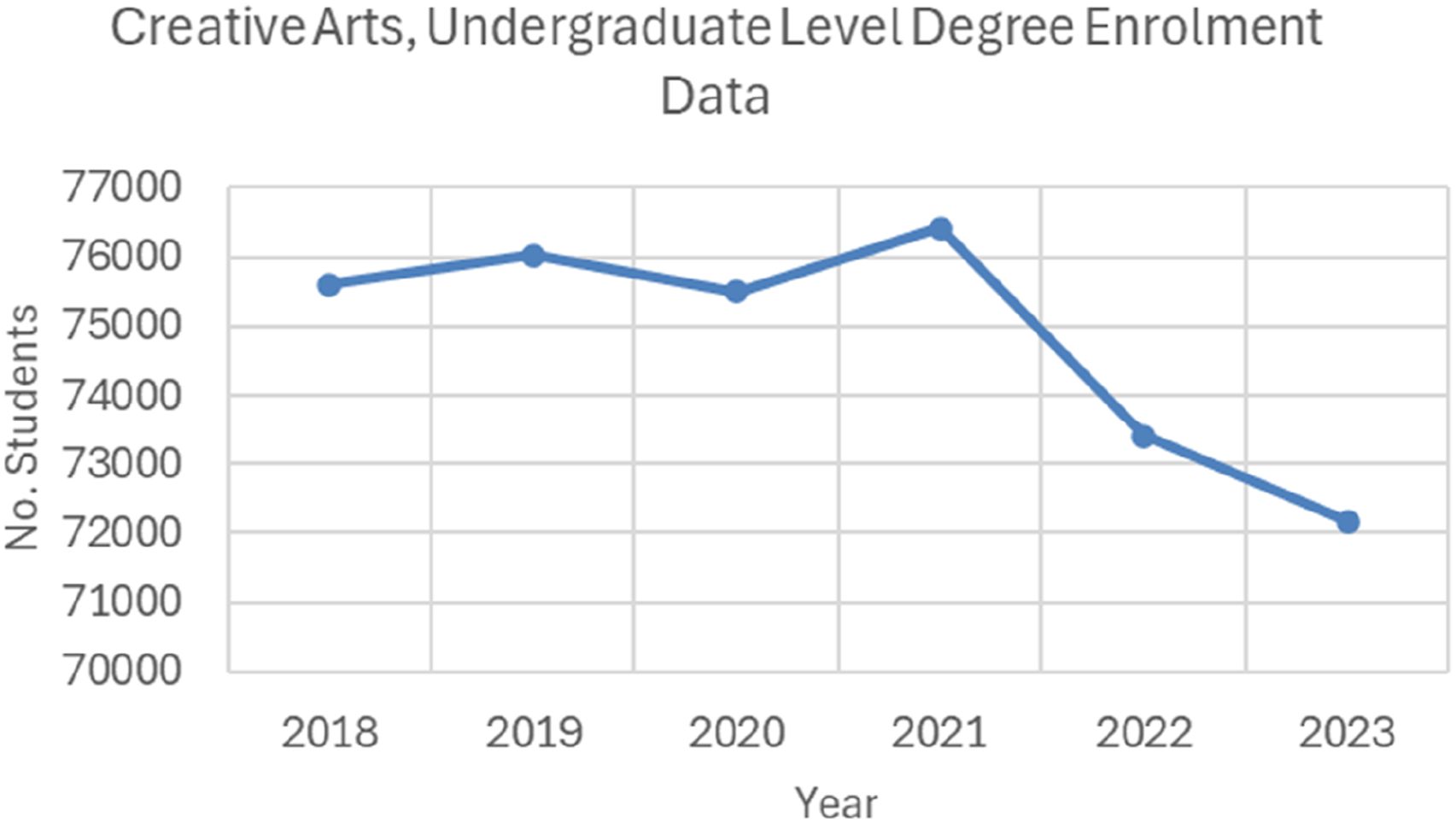
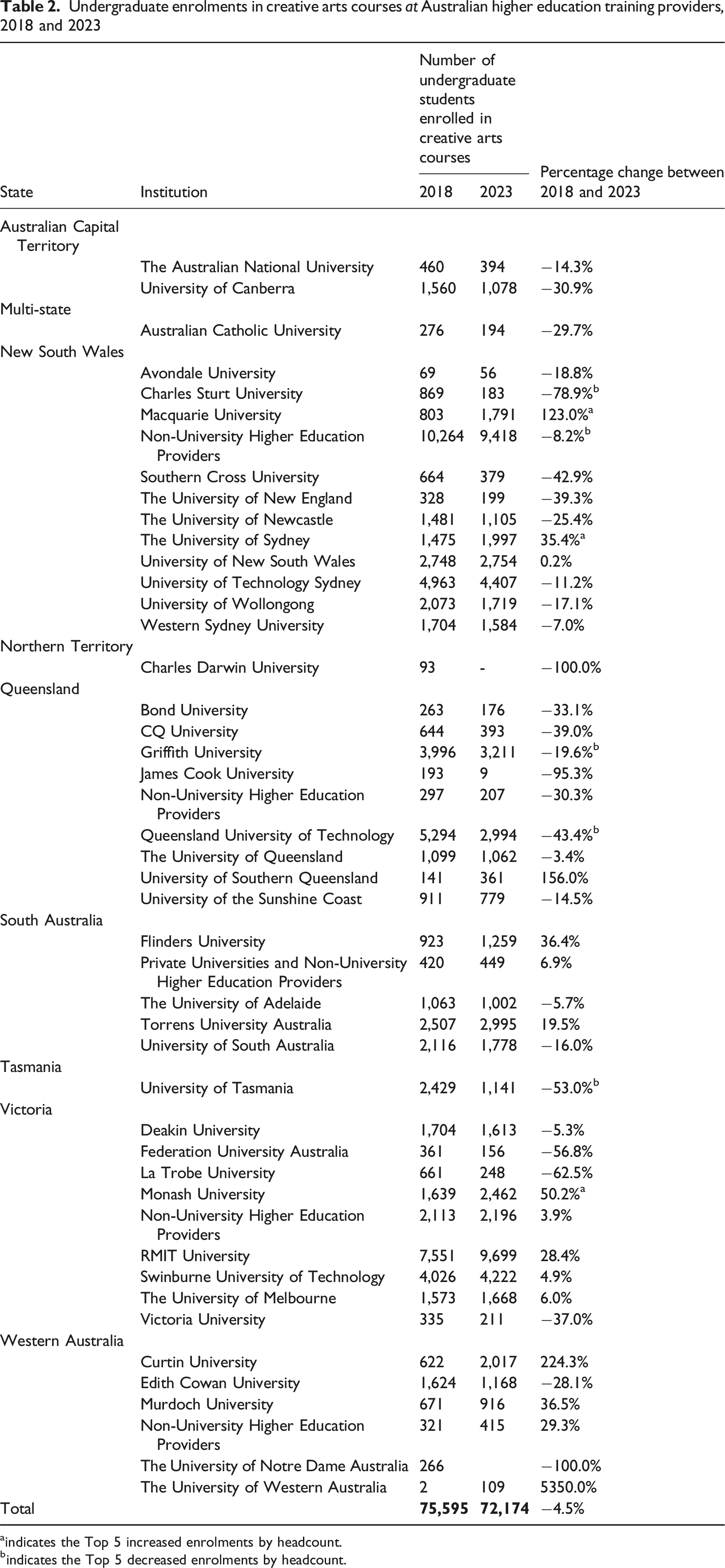
Undergraduate enrolments in creative arts courses at Australian higher education training providers, 2018 and 2023
aindicates the Top 5 increased enrolments by headcount.
bindicates the Top 5 decreased enrolments by headcount.
Of the 46 higher education providers (noting that non-university higher education providers are aggregated in the data by the Australian Government), 30 institutions reported declines in enrolments, and 16 reported increases. The data suggest that regional, outer-metropolitan, or universities with multiple campuses outside of large metropolitan cities (Sydney and Melbourne) generally show larger declines in enrolments. Charles Sturt University, University of Tasmania, Federation University, La Trobe University, University of New England, Southern Cross University, James Cook University, University of Wollongong, University of Newcastle, and Central Queensland University experienced substantial falls in enrolments between 2018 and 2023. Concerningly, many of the above-mentioned universities are the only higher education providers in particular geographic locations. Several of these institutions have experienced declines in enrolments in excess of 40% across the period. The pattern suggests that regional universities may be particularly exposed to changes within higher education fee structures.
In contrast, several large metropolitan universities recorded enrolment growth over that period, including three Group of Eight (Go8) institutions (Monash University, the University of Sydney and the University of Melbourne), as well as a number of non-Go8 metropolitan universities such as RMIT University, Curtin University, Macquarie University, and Flinders University. However, not all metropolitan institutions experienced growth. Queensland University of Technology, Griffith University, and the University of Technology Sydney recorded enrolment declines, indicating that metropolitan location alone does not explain enrolment outcomes and that the pattern is more nuanced. Overall, the data reveal that creative arts enrolments are becoming more concentrated across a smaller number of institutions in larger metropolitan cities. These data provide only a partial account of sector change, as they do not capture unfilled places, courses that did not proceed due to low demand, or institutional decisions to reduce the number of creative arts places offered.
Creative Arts Courses Offerings
Another important consideration in examining creative arts participation in higher education is the range and availability of course offerings. In 2025 the National Advocates for Arts Education (NAAE), a national alliance of peak arts and arts education associations, conducted research into the cuts to creative arts and arts education courses offered by Australian universities and TAFEs (NAAE, 2025b). Following two sector surveys in 2025, NAAE reported that 48 Creative Arts degrees had been discontinued between 2018 and 2025. Twenty-one of these were in Victoria, 14 in Queensland, 12 in New South Wales, and one in Western Australia. In addition, the NAAE reported that eight courses and majors had significant reductions (through reductions in unit offerings and majors, decreased face-to-face teaching time, or a shift from in-person to online delivery), five of these were Queensland, two in New South Wales, and one in Victoria.
In some cases, the closure of courses meant the removal of an entire disciplinary pipeline, not only from the provider, but within a particular region or state. In some cases, the changes reported to NAAE indicated downgrading majors to minors, or collapsing standalone degrees into generic umbrella degrees. A review of discontinued degrees and majors reveals substantial overlap with institutions experiencing the largest enrolment declines over the same period. The alignment between declining enrolments and program withdrawal suggests a mutually reinforcing relationship, in which reduced student numbers and diminished institutional commitment operate in tandem. Taken together, enrolment decline and program discontinuation appear to form a self-reinforcing cycle.
Impact on Supply of Teachers
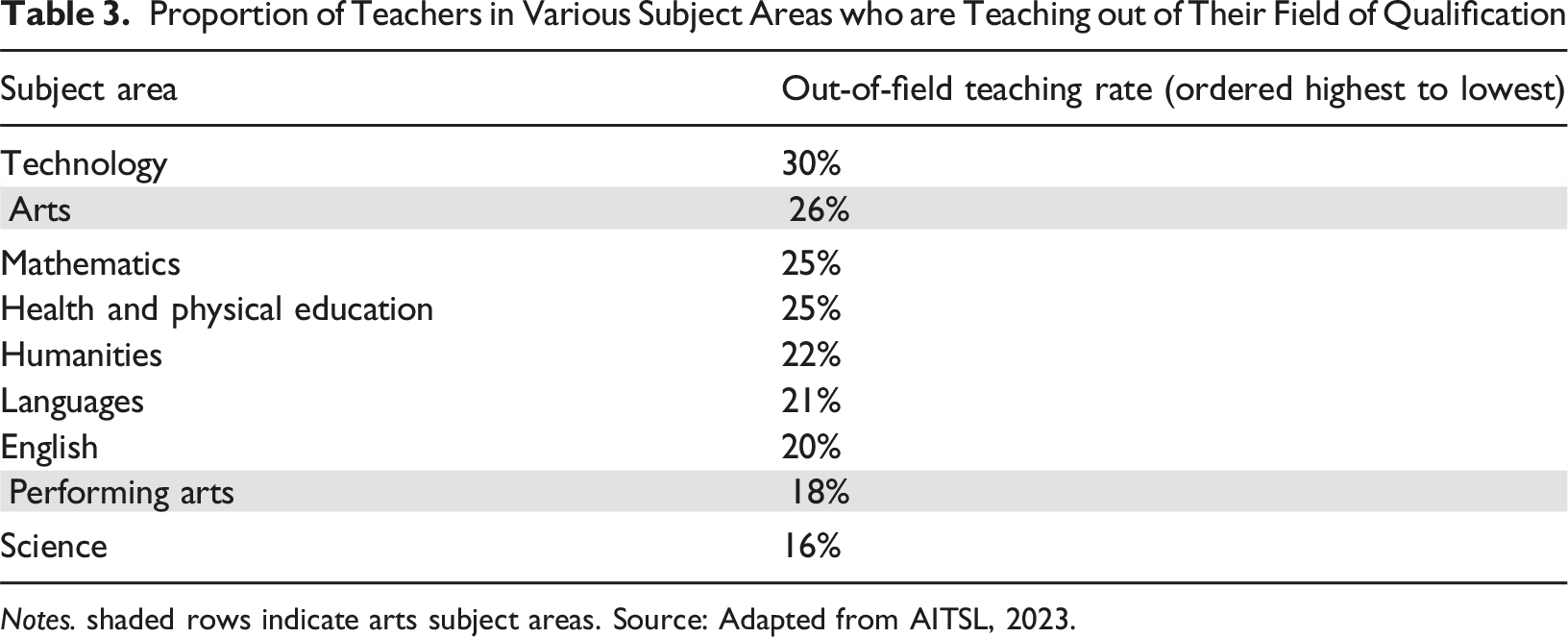
Proportion of Teachers in Various Subject Areas who are Teaching out of Their Field of Qualification
Notes. shaded rows indicate arts subject areas. Source: Adapted from AITSL, 2023.
The data point to a shortage of teachers trained in the arts subjects across Australia. As mentioned earlier in this article, when the Australian Chief Scientist alerted education ministers that a high level of middle school mathematics classes were being taught by teachers without qualified mathematics teachers (Chubb, 2014), this triggered a range of important and needed national STEM education initiatives to encourage STEM workers into teaching, and to increase the numbers of teachers holding a specialisation in STEM areas (Education Council, 2015). In contrast, there have been no similar initiatives for the arts, despite the recommendation for action in national cultural policy. Revive called to, “… review Australia’s higher education system and develop the Australian Universities Accord which will, as part of the Terms of Reference, consider the impact of changes made under the 2020 Job-Ready Graduates reforms, including changes to student contribution amounts” (Commonwealth of Australia, 2023, p. 63).
In 2024, the Commonwealth Government commissioned the Australian Universities Accord which recommended “that the Australian Government reduce student contributions for those affected by JRG and moves towards a student contribution system based on potential lifetime earnings” (Department of Education, 2024b, p.5), presenting a potential pathway towards a better and fairer education system. A call for accessibility for creative training and education for Australian children and young people is echoed in Creative Australia and Service and Creative Skills Australia (SaCSA) (Creative Australia and Service and Creative Skills Australia SaCSA, 2025), who state that creative arts education should be available from, … the first day at school to the last day at work
Despite these calls and recommendations, reforms to redress the negative impact of the Job-Ready Graduates scheme have not been enacted by the Australian Government to date.
Conclusion
The Australian Academy of the Humanities (2025) asked the question “[i]f the Government wants to increase participation, why is it deliberately driving students away from courses that provide 21st century skills?” (n.p.). The driver the Academy is referring to is the Australian government’s JRG policy that has been impacting the higher education sector since 2021. This single policy, as our discussion demonstrates, is having impacts beyond universities by rippling into the subject choices of young people in senior secondary schooling. Importantly, the JRG is situated in opposition to another government policy that espouses the crucial role of arts, culture, and creativity to the ongoing development of Australian identity, life, and workforce. Revive: a place for every story, a story for every place – Australia’s Cultural Policy for the next 5 years ambitiously states that: The intention of this policy is to change the trajectory of the creative sector, to deliver new momentum, so that Australia’s artists and arts workers, organisations and audiences thrive and grow, and our arts, culture and heritage are re-positioned as central to Australia’s future. (Commonwealth of Australia, 2023, p.15)
With the JRG policy in place and the emphasis on STEM, it may be difficult to realise the ambition of Revive.
As noted at the commencement of this article, we have been driven to understand the relationships, if any, between declining enrolments in arts subjects in secondary schools nationally, the impact of Australian government policy related to training and employment, and the downturn in uptake of creative arts degree courses by young people. We have argued that data from a range of sources suggests links between current government policy and practice as it relates to arts subject enrolments in senior schooling throughout Australia and the JRG policy that has profoundly impacted enrolments in creative arts degree courses offered by Australian universities. The steep national decline in university enrolments in 2022, one year on from the introduction of JRG, is mirrored in declines in enrolments in many senior secondary arts subjects across the states and territories. Given that secondary school enrolments in creative arts subjects were generally higher in 2015 than in 2023, we suggest that between 2021 and 2023 young people considering post-compulsory options in creative arts degrees courses may have understood the ramifications of the JRG, thereby turning away from humanities and creative arts degrees as these courses became substantially more costly. The patterns apparent in both sets of enrolment data (secondary school subjects and undergraduate courses) may show that young people were considering future financial risk and debt when making secondary school subject choices, as well as plans for post-secondary education. The financial inaccessibility of undergraduate creative arts degrees discourages and disincentivizes students from studying arts subjects in senior school.
Parallel to the impact of the Job-Ready Graduates policy, the pattern of enrolment data in schools seems to reflect the government’s investment and emphasis on STEM education from 2015. The significant investment in STEM education, poor subject scaling, and the creative arts being devalued by government policy, including through the Job-Ready Graduates policy, have impacted enrolments in schools. This has subsequently flowed on to fewer school leavers having completed a Year 12 ATAR Arts subject, and therefore the pool of potential tertiary creative arts students has diminished.
Reversing this trend is essential if the ambitions of Revive are to be realised. Ensuring equitable access to high-quality arts education across school and higher education is not only a matter of cultural participation, but a necessary investment in creativity, critical thinking, collaboration, and communication capabilities. These capabilities are widely recognised as fundamental to 21st century learning and work, and explicitly identified in the Alice Springs (Mparntwe) Education Declaration (Education Council, 2019) as central to the development of young Australians. Without urgent deliberate policy reform to redress the cumulative impacts of current funding arrangements and policy messages sent to students and institutions, Australia risks undermining the very creative capacity its national cultural policy seeks to strengthen.
Footnotes

Funding
The authors received no financial support for the research, authorship, and/or publication of this article.
Declaration of Conflicting Interests
The authors declared no potential conflicts of interest with respect to the research, authorship, and/or publication of this article.
Statement of Originality
To the best of our knowledge the manuscript has not been published elsewhere, in part or in full, and has not been submitted simultaneously for publication elsewhere.