



Abstract
Remote teaching during the COVID-19 pandemic provided a unique opportunity for parents of early years students to gain insights into instructional methods used to teach reading and spelling. We used this opportunity to seek parents’ perspectives about the instructional content and materials provided during periods of remote teaching in Australia. Nineteen parents were interviewed individually, and data were examined using deductive and inductive thematic analyses. Parents acknowledged teachers’ extraordinary efforts; however, some reported unexpected and concerning insights that their child appeared to be behind their peers in reading. While some parents described satisfaction with the reading instruction provided, many independently sought contemporary information about evidence-based reading instruction methods. Some reported an uncomfortable dissonance, noting that practices that they understood to align with scientific evidence were not routinely part of the pedagogical approach at their child’s school. Although our study focused on an unusual time period, our findings are illustrative of the variability present in early years classrooms with respect to reading instruction.
Introduction
Reading proficiency is a critical predictor of academic success, prosocial behaviour and lifelong meaningful engagement in the social and economic mainstream (e.g. Buckingham et al., 2013; Snow, 2016). As reading is a biologically secondary skillset (Geary, 2008), the responsibility to teach students to read rests primarily with schools (Moats, 2020). Accordingly, educators have an ethical obligation to apply methods that are aligned with the best available empirical evidence when teaching children to read and spell. Moreover, parents should be able to assume that this is business-as-usual practice in schools. In addition, because English has a semi-transparent orthography, the way that literacy is taught takes on particular significance (Moats, 1994; Seidenberg, 2017). Children who make a strong start with learning to read and spell typically remain academically ahead of slower progressing readers and spellers in the later years of school (Cabell et al., 2013; Catts et al., 2008). Conversely, poor reading proficiency by the end of third grade is predictive of later academic struggle (AECF, 2010; CPE, 2015). Spira et al. (2005) reported that after Year 3, students’ reading trajectory remains relatively stable across the years, and further, Williams et al. (2023) identified that fewer than 20% of students who are behind in reading at Year 3 catch up and maintain proficient reading achievement over time. This means that students who progress well in the initial stages of learning to read (along with learning to write and spell) are well-placed for continuing success, but those who do not are likely to experience ongoing difficulties.
The debate about reading instruction
Hulme et al. (2006) refer to the science of reading ‘as the vast, interdisciplinary body of knowledge accumulated over the last five decades about how children learn to read and write, the cognitive processes required for skilled reading and effective approaches to assessment, instruction and intervention (see also: Seidenberg et al., 2020; What is the Science of Reading, 2022)’. From a pedagogical viewpoint, this accumulated evidence favours a structured and systematic approach to reading instruction, often referred to as ‘structured literacy’ (Spear-Swerling, 2019; Wilkins, 2021). Structured literacy is not a single program or method but rather an approach to reading instruction where teachers carefully design their teaching and sequence the essential knowledge and skills for proficient reading by adopting evidence-based teaching principles to deliver their instruction in a systematic, explicit and cumulative way (IDA, 2024).
A structured literacy approach starts by teaching students a small set of grapheme-phoneme correspondences (GPCs) to segment and blend phonically controlled words so that they can be read and written. Using a defined scope and sequence, instruction is designed to build students’ GPC knowledge cumulatively. Students are given multiple opportunities to read decodable (phonically controlled) books that contain the GPCs that they have learnt or are currently learning. In this way, the students are not being asked to read word structures and GPCs that have not yet been taught, thereby eliminating a reliance on a cornerstone of balanced literacy teaching, which encompasses an eclectic combination of predominantly whole language approaches with (some) phonics instruction, usually analytic rather than synthetic (Snow, 2020b). Ultimately, and with much practice, students become proficient in their ability to orthographically map representations of an ever-growing bank of words and word parts such that their reading becomes fluent, accurate and efficient in the face of unfamiliar and increasingly complex text (Ehri, 2020). This structured, systematic approach to reading instruction has the strongest evidence when teaching children to read and spell (e.g. Castles et al., 2018; Stainthorp, 2020). Further, this approach to reading instruction aligns with more recent evidence emerging from neuroimaging studies that demonstrate neural connections that form as the alphabetic code is mastered in a timely fashion during early reading instruction (Dehaene, 2020; McCandliss et al., 2003; Wolf et al., 2017).
Despite the strength of evidence supporting a structured literacy approach to reading instruction (e.g. Ehri, 2023; Stainthorp, 2020), widespread policy and practice consensus is lacking and debate about how best to teach reading persists in many English-speaking countries (Castles et al., 2018; Goldberg & Goldenberg, 2022). Longstanding tensions centre on whether students are best served when being taught to systematically master the alphabetic code, or whether they should acquire reading in a naturalistic and immersive way. This latter approach privileges a problem-solving method described by Goodman (1967) as ‘a psycholinguistic guessing game’ using a variety of cues (e.g. pictures, semantic and syntactic context), to decipher words on the page. In the 1970s and 80s, this approach became known as ‘whole language’ and was recommended for reading instruction. This approach promoted children’s literacy-learning through an early emphasis on meaning, in a literature-rich environment, rather than on explicit and cumulative teaching of GPCs (Clay, 1977; Goodman, 1967; Pinnell, 1989). It is ironic that in the years following the release of the US Report of the National Reading Panel (2000), which served in part as a reminder about the importance of systematic phonics instruction, that balanced literacy approaches became more prominent in Australian schools (Willson & Falcon, 2018), despite the fact that their evidence remained weak (Moats, 2018). In a balanced literacy classroom, beginning and struggling readers are typically encouraged to look at the pictures or infer meaning from context to identify unknown words, rather than using their GPC knowledge and blending skills to decode the word. Importantly, phonics instruction in a balanced literacy classroom does not follow a set scope and sequence, nor is it delivered using an explicit pedagogical approach. Empirical evidence for balanced literacy is limited (Ehri, 2020; Snow, 2020a) and this is also realised at a practical level through stagnant and, in some cases, falling rates of reading proficiency among Australian students (ACARA, 2023; Hunter et al., 2024). A further matter of concern in balanced literacy classrooms is the low levels of teacher knowledge about reading-related linguistics that are tolerated (e.g. Stark et al., 2016).
The role of parents prior to and during the COVID-19 pandemic
Parents 1 are frequently encouraged to partner with teachers as an adjunct, to support their child’s reading progress, particularly in the early years of school. This support typically involves listening to their child read take-home books and may entail volunteering to listen to children read in the classroom. In the context of the COVID-19 pandemic, particularly in Australia, there were multiple and extended periods of remote learning that required parents to provide daily oversight of their children’s literacy learning to a far greater extent than previously, and this was occurring at home. It should be noted that Australia experienced significant and extended periods of lockdown, including Melbourne which was reported to be one of the most locked down cities in the world (Garside, 2021; Jose, 2021; Vally & Bennett, 2021, Dec 17).
Although students still had some, albeit varying, access to their classroom teacher online, parents were asked to play an elevated and more active role in ensuring their children engaged in work set by the classroom teacher. Therefore, parents had the opportunity to become more informed about the nature and the process of reading instruction as it was occurring for their child/ren, and as such, could choose to be a more active stakeholder and advocate as needed (Getfield, 2022) or as Li and Lin (2022, p. 165) note, parents moved from ‘spectator’ pre-COVID to ‘facilitators and supervisors’ during the pandemic. While acknowledging that teachers may not have directly transposed their typical classroom practice to the online platform, these circumstances provided a unique opportunity for parents to observe instructional practices and materials used in early years’ classrooms.
Rationale for this study
We took the opportunity to explore the perspectives and experiences of parents specifically about their child’s reading instruction, given the unprecedented episodes of remote learning in Australia during the COVID-19 pandemic. Since the foundations of reading success are typically formed in the early years of school (Spira et al., 2005; Williams et al., 2023), we sought the views of parents whose children were in the first two years of school during the height of pandemic-related remote learning (2020 and 2021).
The purpose of the current study was to describe and understand the views, perspectives and experiences of parents about the instructional guidance and the materials offered by their children’s teachers for reading and spelling instruction during the enforced remote learning periods throughout the COVID-19 pandemic. With specific reference to those periods, we asked parents to reflect on the nature of instructional practices, materials and scheduling that schools prescribed for reading and spelling. We also asked parents to describe anything that they had learned about their child’s reading and spelling abilities that emerged for them during periods of remote learning.
Methodology
This qualitative study adopted phenomenology as the methodological framework. Phenomenology is a theoretical perspective that seeks to generate knowledge about how individuals experience the phenomenon under exploration and to understand and describe these experiences (Hesse-Biber & Leavy, 2011). On occasion, this knowledge contributes to the development of practices and policy (Creswell & Poth, 2016). Phenomenology was chosen as the methodology because we aimed to understand and describe the views, perspectives and lived experiences of parents about the instruction, guidance and materials offered by their children’s teachers for reading and spelling instruction during the enforced remote learning periods throughout the COVID-19 pandemic in Australia. Research ethical approval was received prior to commencing the study from the La Trobe Human Research Ethics Committee (REF: HEC20321).
Participants
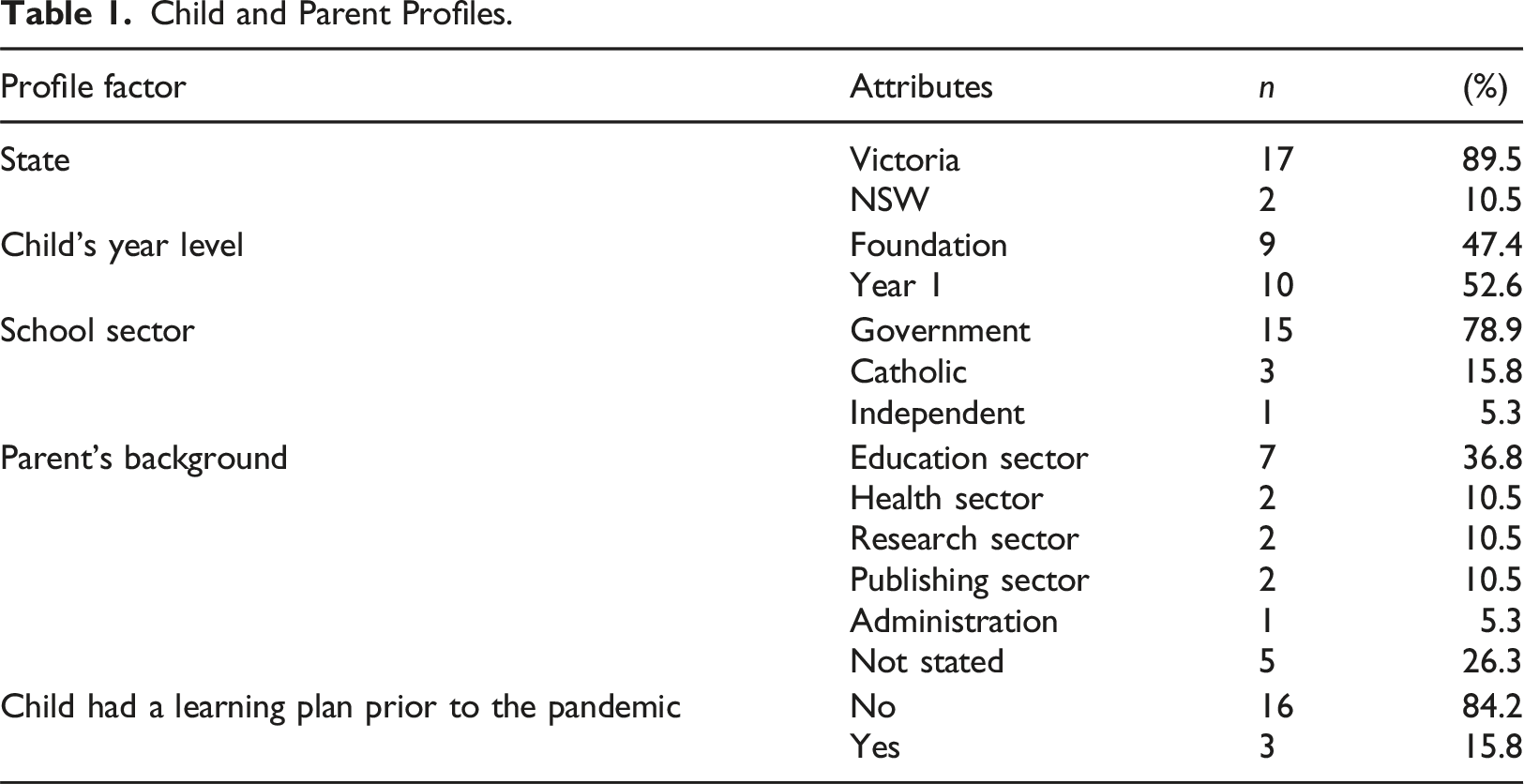
Child and Parent Profiles.
Data collection
A series of probes guided the discussion for each interview (Appendix 1) whilst also allowing for spontaneity in the conversation. Probes were developed by the first three authors based on theoretical and practical aspects related to reading instruction as it pertains to the early years and pedagogical practices. The remaining authors independently reviewed the interview guide and provided feedback. The version used for data collection was developed through discussion until consensus was achieved. Each parent participated in an individual, semi-structured interview with the second author. Interviews were conducted via Zoom™ (n = 16) or phone (n = 3) and ranged in duration from 25 to 59 minutes (mean = 42.51 minutes; SD = 9.64 minutes). The same author conducted all 19 interviews. There was no difference between the length of interviews conducted by Zoom and phone. Interviews were audio-recorded for ease and accuracy of verbatim transcription, which was conducted by an external transcription service.
Data analysis
Prior to data analysis, interview transcripts were confirmed for transcription accuracy by the second author. This involved listening to the recordings whilst reading and checking the accuracy of the written transcripts. No changes were made to the interview transcripts during this process. Both deductive and inductive analytic methods were applied to our data. This was appropriate to first make sense of the reading instruction that participants described during the remote learning periods (i.e. deductive approach) before then exploring and understanding participants’ experiences and perspectives in the context of this instruction (i.e. inductive approach). Our overall analytic approach was therefore both theory-driven, in that we sought to describe the reading instruction provided during remote learning periods and data-driven, in that we gave voice to participants to share their perspectives and experiences of this instruction (Braun & Clarke, 2022). The deductive thematic analysis (Braun & Clarke, 2022) performed as an initial organisational step described the reading and spelling instruction and materials provided during remote learning, therefore providing context to interpret themes generated through the inductive analysis. Inductive thematic analysis involved coding and organising the data at increasing levels of abstraction (Braun & Clarke, 2006, 2019).
Deductive thematic analysis
The 19 transcripts were distributed relatively evenly among the five authors and one research assistant to undertake the deductive thematic analysis as the first step. Following a training session involving discussion of the coding process, each member coded deductively based on the key components of reading to describe the instruction, according to a matrix that consisted of six predefined categories aligned to the general aims of the study. These six categories were as follows: (1) learning materials; (2) weekly teaching schedule; (3) teaching; (4) home tasks for reading and spelling; (5) home tasks for writing and grammar; and (6) take home readers. This initial deductive orientation provided an interpretative lens in which to code and make meaning of participants’ descriptions of the literacy instruction their child received during remote learning periods (Braun & Clarke, 2022).
Reflexive and inductive thematic analysis
In phase two, Braun and Clarke’s (2006, 2019, 2021) reflexive and inductive thematic analysis was used. Reflexive and inductive thematic analysis is a theoretically flexible method for identifying, analysing and reporting patterns within data. This involves reflective and iterative engagement with the data and analytic process. In the current study, inductive analysis was used to give voice to participants’ accounts and to understand their experiences and perspectives of the reading and spelling instruction being provided to their child during remote learning periods. Reflexive and inductive thematic analysis began with the second author conducting multiple readings of the transcripts to re-familiarise herself with the data. Notes and reflections were recorded during these readings. The second author then systematically generated and assigned codes to extracts of text in the interview transcripts using NVivo (version 12). These initial codes were then sorted into potential themes. To do this, the second author printed the list of codes from NVivo, cut these up and physically sorted them into potential themes. Consideration was given to the relationship between codes and how these contributed to formation of potential themes and sub-themes. These were then developed, reviewed and refined in discussion with the first author. Consideration of internal homogeneity (i.e. meaningful coherence within themes) and external heterogeneity (i.e. identifiable distinctions between themes) occurred through examination of the coded text extracts associated with each theme. The second author determined whether candidate themes accurately reflected the overall meaning evident in the data corpus. This involved referring back to notes made during data collection and data familiarisation. Themes were then named and defined to accurately communicate their core proposition. The final phase of the thematic analysis involved the in-depth analysis and write-up of the report.
Rigour criteria employed in qualitative research
Thoroughness and rigour were achieved using an audit trail for transparency of methods and data analysis decisions (Haq et al., 2023; Lincoln & Guba, 1985; Maher et al., 2018). Verbatim quotes from the interview transcripts assisted with data immersion (Shaw & Anderson, 2018) and supported interpretations (Liamputtong & Serry, 2021). The data analysis process was collaborative, involving regular discussions between members of the research team to consider interpretations and perspectives about the data. A process of reflexivity was maintained throughout the data analysis process through a reflexive journal kept by the second author and regular meetings with the first author to discuss possible themes and perspectives.
During data collection, the interviewer, the second author, disclosed her professional background, the scope of her clinical experiences and her workplace; that latter of which revealed her pedagogical beliefs and theoretical orientation towards reading instruction. This disclosure was a deliberate act of honesty and transparency by the interviewer to facilitate a true understanding of participants’ accounts in which the interviewer could be receptive in listening to, and understanding, participants’ experiences in a non-judgemental way. Furthermore, the interviewer reflectively acknowledged and discussed her own preconceptions, interpretations and perspectives with the first author during regular meetings to ensure that the participants’ accounts were interpreted authentically.
Within two weeks of their interview, participants received their written transcript and were invited to check for accuracy and to add further comments and/or remove any or content they did not want included in the analysis. Of the 19 participants, 10 replied. Of these 10, seven made no changes to their transcript. Changes made by the remaining three participants were minor and included removal of potentially identifying information and adding the name of an intervention program for clarification. At this point, all 19 transcripts were deidentified in preparation for analysis.
Results and discussion
Deductive thematic analysis
The deductive thematic analysis revealed that most parents accessed learning materials online, either through school platforms or via email, that they were required to print. Some parents commented that hard copy resource packs with learning materials were sent home every 3–4 weeks or that they collected these hard copy resource packs from school. Delivery of literacy instruction varied in frequency, duration and purpose. Many participants described daily online meetings with the classroom teacher ranging between 10 and 60 minutes to explicitly teach children new concepts and skills followed by independent practice offline. Pre-recorded videos were also commonly mentioned although some parents felt that this delivery method posed challenges as ‘lots of things can get lost in translation’ [P12]. Other instances of online meetings were commonly for ‘welfare, not instruction’ [P19] or to ‘keep the kids connected to their classroom and the teacher and their classmates’ [P19].
A variety of reading schemes and/or approaches were mentioned by parents but most commonly, the commercial program Sound Waves (6 of 19, 31.6%) was listed along with general encouragement of ‘reading stamina’ (3 of 19, 15.8%) and ‘get a book and read it’ (3 of 19, 15.8%). A wide variety of take-home readers were mentioned by participants including Little Learners Love Literacy, Sunshine Online, PM Online, Fitzroy Readers, Lexile Readers Online, hard copy predictable texts and the Epic Reading Platform.
Spelling instruction was most commonly described as having children learn lists of words by rote; one parent noted that their child received a list of words containing the ‘ch’ sound. It seemed apparent that many children were encouraged to learn whole words, rather than learning skills associated with sublexical analysis, as references made by parents to phrases such as ‘camera words’, ‘bubble words’ and ‘wonderful words’ were frequent. Of note, several parents indicated that they did not observe any specific spelling instruction. Across both reading and spelling, there were a number of references to students ‘doing a sound per week’. This would seem to be a reference to the common balanced literacy approach of ‘letter of the week’, which reading scientists have advised against for some thirty years (e.g. Reutzel, 1992)
Inductive thematic analysis
Themes and Subthemes.
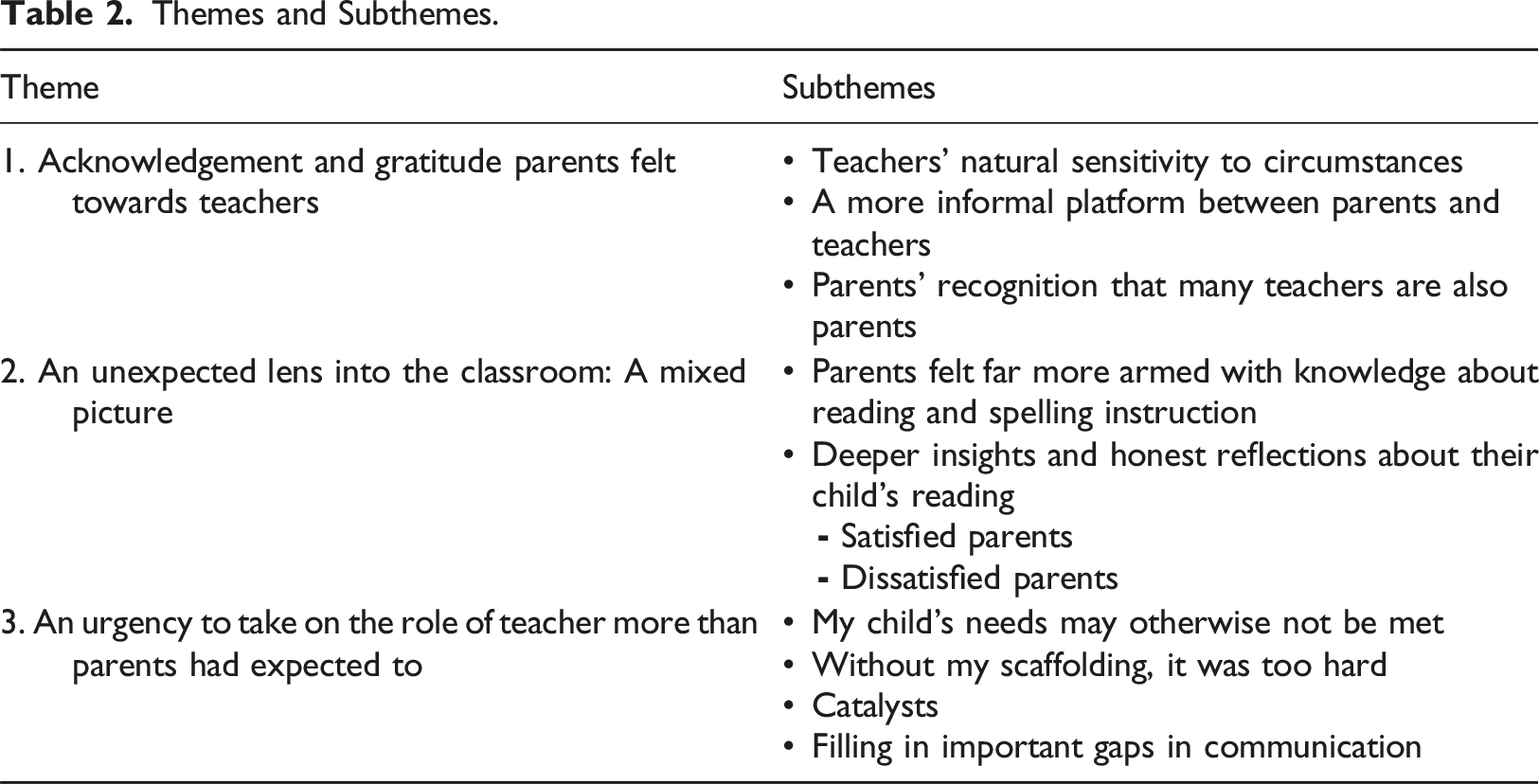
Theme 1: Acknowledgement and gratitude parents felt towards teachers
Teachers’ natural sensitivity to circumstances
Parents valued teachers’ sensitivity and frequently referred to their On the forms that we got sent ..., there was always a sentence saying don't worry if you can’t do all this, be kind to yourself, be flexible [P21]. ...the school sent out an email saying, ‘The happiness of your family is more important than getting through all the lessons’ [P17].
This compassion extended to teachers occasionally relaxing expectations about attending all online sessions or completing all set work. In some instances, this sensitivity was also demonstrated by teachers staying online with children for longer, knowing that their parent was preoccupied with other tasks: ...there were times where I was exhausted and really, really struggling. And they said, ‘That’s okay. You’ve done a whole heap of work. We can see the progress that she’s making. Be a bit easier and kinder on yourself’ [P13]. She knew which kids had parents working, and she would often go, ‘Is mum on a call? I’m going to help you with that, just sit a minute and we’ll have a chat together, you and I, and work that out’ [P10].
A more informal platform between parents and teachers
Parents valued a shift towards a more casual manner for communicating with teachers as it seemed to facilitate greater access and more authentic dialogue. And I liked having that direct contact with the teacher, because normally we have to go through the main email account that goes through the admin staff [P19].
Many hoped that this level of communication would continue beyond remote learning periods. And so it was extremely helpful to have one-to-one meetings with my daughter and the teacher and (child’s name) once a week. That was just wonderful, and I wish that could continue because that really broke down a lot of teacher-parent barriers [P21; grandparent].
Parents’ recognition that many teachers are also parents
Alongside teachers’ apparent regard for their students and families as perceived by parents, most also recognised the complexities of being a classroom teacher during the pandemic. Parents acknowledged the challenge of teachers having to rapidly prepare for and transition to remote learning to continue to deliver the curriculum effectively in such unusual circumstances. I think we have to remember that the teachers had families at home, and a lot of them were doing their own remote learning on top of their professional duties. So, I think while we can sort of see areas that could have been delivered better or more effectively, under the circumstances they really did an amazing job [P12]. They tried hard under exceptionally difficult circumstances, so I think their effort should be commended, absolutely. Nothing is perfect. And I think what stood out was they did try. You can’t argue that they didn’t try, so that has to be acknowledged [P3].
Theme 2: An unexpected lens into the classroom: A mixed picture
Parents felt far more armed with knowledge about reading and spelling instruction
The remote learning period provided parents with an unexpected and unique opportunity to observe the reading and spelling teaching strategies and resources used day-to-day in the classroom. Many parents appreciated this opportunity, commenting that this was, ‘interesting’ [P6], ‘fascinating’ [P16], ‘a privilege’ [P17] and ‘helpful’ [P3]. Some parents mentioned that prior to remote learning, they had a general ‘gist’ [P13] about how reading and spelling were taught at their child’s school but did not necessarily understand this well or fully appreciate how their child was responding to the instruction. Armed with greater insights about classroom instructional practices, many parents felt more equipped to work with their child during remote teaching, as well as more comfortable to ask questions of teachers in relation to the instruction that was provided: I feel more confident in being able to help them [child] with their reading now, because I kind of know what they’re [teachers] talking about. So, doing the spelling was fantastic for me, because now I know ‘or’ (the sound) in draw is ‘aw’ and ‘ea’ (the grapheme), is (can be pronounced) ‘ee’, ‘e’ and ‘ay’
Deeper insights and honest reflections about their child’s reading
Eleven parents commented that remote teaching offered a deep insight into their own child’s reading and spelling abilities and allowed them to more accurately determine how their child was progressing. For some parents, however, an unexpected realisation emerged that their child was struggling. .…it really gave us that chance to look at what is expected. Then look at what our child could actually do [P13]. I can see some really big gaps in their learning[P3].
Parents described a range of responses to these insights, from gratitude to frustration, and for some, a trigger to become more informed about the evidence-base for the reading instruction methods being used in their child’s school. Some parents believed that if not for enforced remote learning, their child’s reading difficulties would have remained undetected and classroom instruction would have continued without being responsive to their child’s particular needs. Typically, parents reacted negatively to classroom practices that privileged a cueing-based approach to reading instruction rather than ensuring that code-based skills were being mastered: It gave us a really good chance to entrench some good core skills for her…. I think if she’d stayed on that system, we would have definitely would have had a few more problems probably coming up now [P13]. ....it gave us the opportunity to really have some focused one-on-one time, like hours of it every day just reading, just working on her reading. And it's really paid off [P19]. Well, thank goodness we had an opportunity to intervene [P21].
Seven of the nineteen parents described feeling satisfied with the instruction provided. One described feeling ‘absolutely gobsmacked’ [P17] by the high quality of the instruction provided. Nevertheless, 10 parents overtly raised concerns about their child’s reading ability with their teachers while another two parents chose not to, despite their disquiet. Accordingly, many less satisfied parents undertook their own initiatives in an attempt to help their child’s literacy progress. This often involved purchasing sets of decodable readers and starting again as noted by P18, who said: I scrapped everything that they were doing, and I just did my own thing with him. Got SSP*
3
books from SPELD SA and followed sequence, Australian Decodable books as well.
Similarly, P13 described purchasing their own materials (e.g. Little Learners Love Literacy decodable texts) and facilitating the teaching themselves, with pleasing results: … having six months, we really got to entrench those good core, sounding it out strategies and that real phonics-based thing. So, I felt that was really good.
Of note, several parents commented that tasks and home practice seemed to set their child up for failure. This included, as described by P12, being asked to write a reflection yet ‘they [their child] hadn’t actually been taught how to construct a sentence’ or asking students to read 10 high frequency words but they ‘haven’t been taught the sounds or how to decode that word’ [P12].
Parental frustration was also evident when tasks seemed poorly scaffolded or uninspiring as P13 and P19 noted, respectively: …when you’re teaching kids to sound out, they need to have words that were specific to that concept rather than starting [by] looking at the picture [P13]. ...the types of activities that they were assigning tended to be pretty monotonous, like, ‘Here, write your spelling words four times over, and now write them again with all of the sounds broken down’. She just finds that really tedious and not very interesting, so she doesn't really want to do it [P19].
Satisfied parents
Characteristics of satisfied parents were twofold. Either they had a child who they believed was progressing well with reading, and/or their child attended a school that provided reading instruction aligned with the science of reading or, that parents specifically mentioned as aligning to the ‘science of reading’ [P1, P3 and P6] or ‘science of learning’ [P17]. Some parents described enjoying the remote learning experience because of the opportunity to spend more time together with their child, as well as the opportunity to learn more about literacy instruction. I just feel like I learnt more about teaching reading and writing and spelling, and I enjoyed that aspect of it. So yeah, overall, very positive [P1].
Parents were also inclined to feel satisfied if their child attended a school that they knew delivered or could now see delivered a structured literacy model of instruction that aligned with the science of reading. One parent reported feeling ‘lucky’ [P17] to be in the catchment zone for their school; another expressed gratitude for the recent changes their school had made to their literacy instruction: I’m just absolutely gobsmacked at how my son’s progressed with learning. I can’t believe that going into to term four he’s reading novels. I just can’t praise the methodology and everything enough [P17]. I really liked the way that they’re teaching the spelling... when my
Dissatisfied parents
Dissatisfaction arose from parents feeling that their child was struggling with reading and spelling, and/or parents’ somewhat negative reactions to balanced literacy or multi-cueing methods of teaching reading and spelling. Poor reading progress was a trigger for dissatisfaction and five parents in particular were not previously aware that their child was struggling until remote learning occurred. This prompted referrals to psychologists, speech-language pathologists and tutors. Parents’ lack of awareness into their child’s difficulties was attributed to a lack of communication between parents and teachers, the nature of assessment and reporting methods used in schools and the level of teachers’ awareness of at-risk readers: ......we had her language assessed by her speech pathologist she hadn’t seen since kindergarten and that was a real eyeopener and I’m really pleased. And we wouldn’t have been able to do that if it wasn’t for a pandemic because you just probably wouldn’t have seen it. And like I said, the reporting structures just don’t allude to that [P3]. I was aware of the sort of things that could be red flags…And I was astonished that the teacher had not identified these because it was very obvious to me [P21].
A second subgroup of dissatisfied parents was those whose children who attended schools they described as using cueing-based and non-systematic methods of teaching reading and spelling. These parents expressed concerns around the cueing strategies (such as using picture prompts and syntax cues) that teachers were encouraging children to use when they encountered an unfamiliar word. One parent described the use of these strategies as ‘illogical’ [P6]. Two parents described feeling ‘confused’ [P13 and P6] as to why these strategies were used as an initial step rather than encouraging children to look at the letters and the word. Others believed that their school’s literacy program took children’s attention away from the letters on the page: So, I guess how non-evidence-based it is and how much it’s just illogical. It’s not relying on them looking at the sounds and the words [P6]. I felt like it was just one extra thing for them to learn that took away from the letters [P12].
One parent reported that their child was able to articulate this same view: And she says, ‘we have these strategies, Mummy’. And I said, ‘Well, do the strategies work for you?’ And she said, ‘No, Mummy. Sounding out works for me’ [P6].
Similarly, for spelling, many parents expressed concern about the instructional routines offered. This included writing lists of words ‘backwards’ [P2], rote-learning lists of words that ‘didn’t really connect in any way’ [P6] and the use of commercial programs that both parents and children found ‘confusing’ [P3].
Parents’ growing awareness about evidence-based reading instruction
The unexpected lens into classroom practices was a trigger for close to half of all participants to advance their own knowledge about the evidence for how best to teach reading based on the science of reading. Typically, this knowledge-seeking was undertaken when parents felt dissatisfied with the classroom instruction and/or if their own child was not progressing with reading and spelling as parents expected. Armed with more information, some parents were then able to identify aspects of the school’s instructional approach for literacy that were not aligned with the science of reading. Some felt confident to provide constructive feedback to their child’s school in relation to this; however, most agreed that it was important to ‘pick your battles’ [P3] and to proceed with caution: I know he’s my child and I know what he needs, but she’s also the teacher and I have to sort of tread that line of like trusting her judgment as well [P6]. .... about four that I know who are really concerned and I just try and encourage them to talk to the school. But people are scared. They don’t want to stick their head out [P6].
Of those parents who did approach their school leaders, some described how their principal was ‘receptive’ [P12] and considered adopting some changes based on their feedback. Others felt their feedback went unheard: ...sent them a long e-mail with all my concerns and concerns about the spelling program as well. It’s a very whole word approach.......they invited me to an hour Zoom meeting with them to discuss it. And in that hour Zoom meeting, it was very clear that they weren’t going to engage in this topic. I provided lots of evidence. I sent them all the podcasts. I sent them everything.... they basically said that I need to trust them [P6].
Another subset of parents used their knowledge of the science of reading to support other parents, for example, by posting videos or information on closed Facebook pages. So, I posted a couple of the Nessy
4
videos because I thought other parents must be struggling with their kids spelling [P6].
Of note, three of the nineteen participants, who were also qualified teachers, noted that remote learning with their own child allowed them ‘to see really where children start’ [P12] and prompted them to reflect or ‘rethink’ [P13] their own professional teaching practices: .... when I was a teacher in a classroom, it was all using levelled readers......that’s all I knew, and I guess that’s what I thought was the way that you did it, because I didn’t know any better. So, I think having a daughter and realising this just doesn’t make any sense, I think when you’ve got that time to sit one-on-one with a child and watch them from the very beginning, it’s just a really eye-opening experience [P12].
Seeing that their own child was not responding well to the classroom literacy instruction also prompted some teacher-parents to engage in a quest to learn more about evidence for how best to teach reading and spelling. I did my own research into how kids learn to read, because she wasn’t really responding to the work that we were being given [P14].
For them, the remote learning experience shifted their beliefs to align with science of reading principles to the extent that some reported they would now find it ‘hard’ [P3] to go into a school that taught reading and spelling in ways they had previously taught, prior to remote learning: I feel a bit nervous of the idea if I went back to a school......and I was expected to teach using levelled readers and things that I don’t really agree with now because I just know they’re not the right way [P12].
For others, this recently gained knowledge raised new challenges and feelings of discomfort: ....it is a difficult position to be in once you start getting more knowledge because then you know more and you're like, ‘Oh, I want this to be happening at my child's school’ [P6]. I think now I’m at the place where I’m a little bit frustrated...it just shouldn’t be this hard. Kids should just be able to access the right type of teaching and learning in classrooms. Unfortunately, they aren’t [P12].
Theme 3: An urgency to take on the role of teacher more than parents had expected to
My child’s needs may otherwise not be met
In principle, the sudden and enforced transition to remote learning still positioned the teacher at the centre of instructional decision-making and design, albeit where parents took on a more active intermediary role between the classroom and the student. Nevertheless, many parents described why they believed the need to go beyond being an intermediary and step into what they perceived as a more substantive role as a teacher.
Catalysts for feeling the need to be the actual teacher were varied but the common thread was the perception that the learning needs of their child in reading would not be met without doing so. The most frequently occurring reason centred on what was collectively seen as minimally guided instruction being provided online. For some, their child’s teacher provided initial instruction for completing a task, ‘but pretty much as soon as they were set up, that was it’ [P7]. Other parents described minimal or no contact between their child and their classroom teacher during remote learning, which meant they felt they were left with no other choice but to take on the role of teacher. So, there was no instruction; it was just work sent home [P3]. ....it would be 15 minutes, everyone got to say good morning to the teacher......but no, all of the actual learning was completely and utterly me and him [P26].
Without my scaffolding, it was too hard
Parents also felt driven to adopt the role of teacher based on their views about the quality and/or the complexity of the materials and activities provided for remote learning: But no way she could begin to read. So, a lot of the material that was supplied from the school really was not appropriate for her [P21]. .... the quality of what was being sent home, in my view, was quite poor quality [P3]. She could read the instructions, but she couldn't really comprehend what she was supposed to do next, so we had to go through it with her and then show her what to do [P23].
A need to modify materials and activities was identified by seven parents as a key reason for stepping into the role of a teacher. Modifying tasks was often required regardless of whether their child was perceived to be struggling or whether they needed extending. But we would often be asked to write three sentences about what I did on the weekend. Those were absolute agony for (child’s name). She just was nowhere near being able to do that [P21]. ...don’t just send home things where the kids are actually at. Try and have things that they can extend to, as well [P13]. And the learning wasn't differentiated at our school, and it sounds like that was for a lot of schools [P12].
Four parents, whose children reportedly had complex learning and communication needs, described heavily scaffolding or modifying their child’s work. Parents’ roles included acting as a scribe for their child, developing more scaffolded learning materials that targeted the same goal, for example, by breaking tasks down into smaller and more manageable steps, reducing the number of spelling words to focus on each week and reducing the demands of a task, for example, asking their child to write one sentence of a procedural text rather than a complete procedure. He’s really good at verbally talking, but when it comes to writing it down, the wheels fall off. So, in the first lockdown period, instead of him trying to handwrite out his sentence, he would tell me his sentence, and then I would write it out [P16]. I might scaffold that for him and come up with a little template myself or something. So, I was doing a lot of scaffolding to support him with the tasks [P2].
Catalysts
Seven of the nineteen parents had a professional background as a primary teacher, secondary teacher or speech-language pathologist. These parents described feeling greater agency to direct their child’s learning (compared to parents who were not in the education/allied health field), including how to extend their child, where to look to find additional information or seek out resources to support their child’s learning. I’m an English language teacher too, so I understand a bit about teaching English [P1]. I loved sitting down listening to them read. I kind of know the strategies too. If they’re stuck on a word, I don’t need a lot of help from the teachers to do that sort of thing [P4].
Challenging remote learning experiences were sometimes reported by parents to be associated with child-related factors. These included having a child at home with additional learning needs. For these parents, it took their child longer to work through remote learning activities and they required significantly more support. He’s got ADHD and autism and stuff, so we actually found remote learning quite tricky.... I think my child was kind of the worst out of the class.... I’m not really sure there were many with worse experiences than I… Yeah, look to be honest, I don’t think my grade one [child] is suitable for home learning [P16]. He was diagnosed at the beginning of this year with ADHD......so it was quite a difficult task with him to get him to do the tasks with me [P2].
Other child-related factors that parents perceived as challenging during remote learning included their child’s high level of distractibility due to the learning environment, children’s reluctance to accept their parent as a teacher, ‘stress and anxiety’ [P19] experienced by children because of being out of the classroom, children lacking motivation during remote learning due to the repetitive nature of some tasks, children only wanting to do the ‘absolute minimum’ [P2] and children missing the social aspect of school. These perspectives were exemplified in comments such as follows: It’s hard because it’s that fractious sort of, when it’s your own child and they don’t have really a lot of respect for you’re (sic) the teacher, they’re like, ‘Why do you have to be my teacher?’ My son really struggled with that [P2]. I really had to phrase it as if they’re not my lessons, they’re not my instructions. Look, it’s here, it’s written down, I’m just facilitating what your teacher has told you to do [P17].
Filling in important gaps in communication
Remote learning was challenging for some parents due to a sense that communication was ‘one-way’ [P3]. This included a perceived lack of communication between parent and teacher, and teacher and child with one parent commenting, ‘Our school are very funny about communication….we’re not allowed to have teachers’ direct email addresses ...we didn’t have any way of direct contact with teachers’ [P10]. Some parents described having no direct access to their child’s teacher during remote learning. One commented that use of the ‘chat’ function as the only method of communication in online lessons made it difficult for their child to contribute to the group and communicate with their teacher. For example: They said, ‘Does anyone have any examples for ‘i’ words?’ Then she could type an answer. But I had to sort of sit there and do that, so she was quick enough to get those answers across [P15].
Communication also included the feedback that teachers did or did not provide on children’s work. Many parents commented that feedback ‘wasn’t anything tangible’ [P16] or ‘meaningful’ [P10]. This meant that some children started to ‘disengage’ [P20] during remote learning. For parents, the lack of feedback meant they were unsure as to whether their child’s work was at standard and also about how they could improve the support they were providing their child during remote learning. They would say things like, ‘great effort’ and ‘we can tell you tried really hard’, but there wasn’t really any feedback that I could draw out and then use to make tomorrow better [P16]. ...often it was just, ‘fabulous’... the reading diary, we haven’t had any comments in there for the whole year and we haven’t had any updates on what they’re doing now that they’re back [P12].
For many families, the mode and the structure of delivery of remote teaching was perceived as a source of pressure and anxiety. These pressures arose in relation to the number of live sessions or direct teaching provided by teachers, the schedule for the school day, the amount of content to work through and the level of parental support required for remote learning activities.
There were aspects of it that didn’t work, because at five or six years old you can’t complete a lot of stuff independently [P7].
Bringing the three themes together
Due to the recency of the COVID-19 pandemic, research into mainstream remote teaching and student learning is in its infancy. Although the full impact of the COVID-19 lockdowns is yet to be realised, parental involvement in their children’s learning provided a greater level of access to the teaching approach in their children’s classroom and the opportunity for parents to learn more about their child’s progress. It is important to note that the COVID-19 pandemic imposed unprecedented challenges on school systems and teachers with respect to adopting remote teaching at extremely short notice. We are unable to account for the degree to which teachers felt compelled to change their approach and/or their delivery of lesson content to accommodate remote teaching constraints. Nevertheless, in the current study, we adopted a particular lens on remote teaching by investigating parents’ perspectives about what they observed with respect to reading (and spelling) instruction provided to their children during these periods. We focused on parents of students in the first two years of school on the basis that reading outcomes in the early school years lay critical foundations for children’s academic trajectories (e.g. Spira et al., 2005). Rather than exploring enablers and barriers to successfully implementing remote teaching per se, we used the enforced lockdown periods to gain insights, via the parental lens, specifically into teaching practices provided to novice readers and how parents perceived the instruction, particularly in relation to their child’s progress.
Our participants were appreciative of the dedication and commitment demonstrated by teachers to minimise disruptions to students’ learning during remote teaching periods. Many also acknowledged the significant burden placed on teachers, along with school leaders, who were all required to respond to an emergency situation with little preparation or professional learning to support the transition (Clinton, 2020).
Despite participants’ recognition of the teachers’ tireless efforts to continue delivering the curriculum and monitoring the wellbeing of their students and parents, concerns pertaining to the nature and the quality of the instruction were raised. In our study, many parents concluded that encouraging students to adopt strategies such as using multiple cues to identify words was not helpful and, in fact, as noted by one parent, was ‘illogical’. This realisation drove several parents to delve into the literature about the science of reading and arrive at an uncomfortable realisation that not only was their child’s school not implementing practices supported with the best available evidence (Buckingham & Wheldall, 2020; Ehri, 2023; Stainthorp, 2020), but their children were also being taught to use techniques that characterise poor readers (Adams et al., 2004). This gave rise to some parents feeling more informed about initial reading instruction than their child’s teacher. Some parents described becoming vocal advocates for changes to the way reading was taught while others preferred to take action as a matter of perceived necessity. Many reported spending money on resources such as decodable book series.
Nevertheless, a subgroup of participants described the instruction and associated materials indicative of a structured literacy approach, which is, as noted above, in line with evidence related to the science of reading. While this may be considered positive for those particular children, and their families, our findings suggest that participants did not uniformly see or experience an explicitly taught, structured literacy curriculum during remote teaching, which in turn suggests that structured literacy may not be the default approach to reading instruction. Although our study is small in size and scope and did not attempt to recruit a representative sample, our findings may well be a tiny window into variability that may exist from classroom to classroom for early years’ students. Mandates implemented in 2025 (after our study was completed), such as the Victorian State Government’s Victorian Teaching and Learning Model 2.0 (VTLM 2.0) and the Sandhurst Diocese Magnify strategy (CEB., 2025), provide non-negotiable directives on how to implement structured literacy in early years classrooms. Such initiatives provide a means of scaling up the delivery of evidence-based structured literacy instruction to all students (within their sectors), such that parents can be assured that their child’s school is providing effective, efficient and evidence-based reading instruction.
Limitations
Several limitations must be considered when interpreting the study findings. First, it is likely that our sample was biased towards parents who were strongly invested in their child’s reading and spelling instruction. This potential bias was also reinforced by the fact that more than one-third of the sample had a background in education and/or health. Further, although we sought participants from both New South Wales and Victoria on the basis that they had the most prolonged lockdown periods in the country, the majority of parents were from Victoria. Finally, our findings reflect only the parents’ views and experiences of the instruction and materials provided; teachers may have viewed these dimensions differently, but their perspectives were not included. Further, we note that remote teaching during the pandemic was a unique requirement, and practices employed in that time may or may not reflect classroom practices under regular conditions.
Conclusions
Our study took advantage of an unexpected opportunity to examine parents’ perspectives on classroom reading instruction during periods of remote teaching when COVID-19 was rampant. Participants embraced the opportunity to engage more actively in their children’s reading, and for many, this was an unexpected opportunity to learn more about the evidence base for different reading instruction approaches. The remote learning periods seemed to act as a catalyst for breaking down some of the barriers between parents and their children’s classrooms. Findings from this study suggest that as a result of their involvement in remote teaching during the COVID-19 pandemic, many parents of beginning readers became more actively involved in and aware of the early reading instruction process. There are potential benefits to be derived from this exposure, in terms of parents being better informed as ‘consumers’ about conflicts in the ways that reading is taught and the fact that they cannot assume that this is ‘set and forget’ in their local school. Although parents being better informed in this way may trigger some tensions in interactions with teachers and school staff and leaders, it does stand to promote a greater level of transparency and accountability with respect to the reading instruction approaches adopted. Moreover, our findings might contribute to educational policy whereby educational leaders are required to inform parents about and justify to them the reading instructional practices adopted in their child’s school. We suggest that this may further the debate about how to ensure that low-variance, evidence-based methods become commonplace in all classrooms.
Footnotes
Acknowledgements
The authors gratefully acknowledge the contributions of their colleague, Emina McLean (Research Assistant), and the parents and carers who contributed their time and experiences to the project.
Author contributions
Tanya Serry: Lead author, contact author, research design and planning, data analysis and manuscript preparation. Lisa Furlong: Research planning, data collection and analysis and manuscript preparation. Pamela Snow: Research planning, data analysis and manuscript preparation. Tessa Weadman: Research planning, data analysis and manuscript preparation. Caitlin Stephenson: Research planning, data analysis and manuscript preparation.
Declaration of conflicting interests
The author(s) declared no potential conflicts of interest with respect to the research, authorship, and/or publication of this article.
Funding
The author(s) disclosed receipt of the following financial support for the research, authorship, and/or publication of this article: This project received no funding other than in-kind support from La Trobe University.
Ethical statement

Data Availability Statement
Data is available on request from lead author, Professor Tanya Serry.