



Abstract
This longitudinal study used regression path models to predict the influence on students’ reading comprehension ability of three self-perception variables (reading self-concept; reading/English effort; academic self-handicapping); three teacher rating behaviour variables (attentive behaviour; sociable behaviour; and settled behaviour) and past reading comprehension. As part of the study, a 12-item reading/English effort scale was developed, and its psychometrics characteristics reported (N = 254) The participants were Australian primary school students, followed from Years 3 and 4 to Years 5 and 6 (n = 127). The first path model identified that attending behaviours, low levels of self-handicapping, and reading self-concept were the main predictors of reading achievement. Reading achievement was reassessed two years on, with this path model including past reading attainment. In this model past reading achievement and self-handicapping predicted reading achievement. This research reiterates: the relevance of social-emotional and cognitive variables in education; the need to teach reading across the school years; and the need to enhance students’ sense of control and certainty over their learning.
Keywords
Introduction
How students’ academic self-perceptions, in-class behaviours, and academic outcomes interact continues to be a significant ongoing research topic in education and the social sciences (Chen et al., 2021; Kasperski & Vaknin-Nusbaum, 2022; Harter, 2012; Török et al., 2018). The topic is linked to the role of motivation and engagement as key factors in the learning process of students (Eccles & Wigfield, 2020; Herrera et al., 2020) and the relevance of cognitive, psychological, and social variables on students’ academic achievement and wellbeing (Chodkiewicz & Boyle, 2017; Merrell et al., 2020; Senler, 2022). The assertion is, students’ learning is multidimensional involving affective, behavioural, and cognitive dimensions (Kelly et al., 2023; Wang et al., 2019; Wong & Liem, 2021). Understanding the inter-relationships between students’ self-beliefs, behaviours, and achievement is important to education because these variables are considered to be interactive (Coudevylle et al., 2011; Dent & Koenka, 2016; Zimmerman, 2008) and reciprocal (Chapman & Tunmer, 2003; Chen et al., 2018; Wu et al., 2021). Thus, the claim is that self-beliefs, behaviours, and academic performances are correlated and inform and influence each other (Ju et al., 2013; Mega et al., 2014).
Much of research into students’ self-beliefs, behaviours, and academic achievement has focussed on reading as the outcome academic measure (Hattie, 1992; Kortteinen et al., 2021). For example, children’s reading achievement has been linked to their emotional status (Arnold et al., 2005; Livingston et al., 2018), self-beliefs (Kasperski & Vaknin-Nusbaum, 2022; Kortteinen et al., 2021), reading effort (Barber & Klauda, 2020), task engagement and self-control (Morgan et al., 2008), and in-class behaviours (Bruhn & Watt, 2012; Hay & Fielding-Barnsley, 2009). This focus on reading and reading comprehension, in part, reflects the importance of early and sustained reading acquisition on students’ educational progression and development (Snowling & Hulme, 2021).
Reading development
Reading is regarded as the ability to extract and construct meaning from all kinds of text, with reading comprehension regarded as the core to students’ academic progress, because it underpins the content-area learning within all subjects (Navarrete, 2019; Smith et al., 2021). The evidence suggests that students’ reading comprehension relies heavily on students’ language and word knowledge, along with their working and long-term memory performance (Hoover & Tunmer, 2020; Smith et al., 2021).
Clarifying this study
Although the interactions between students’ self-perception, behavioural, and academic performance variables are acknowledged, Zusho (2017) argued that knowing this is not sufficient, and researchers need to better identify which interactions are more influential and articulate this knowledge to teachers and practitioners. Zusho has also claimed that because much of self-perception and behavioural research has typically been conducted on one or two variables at a time, the relative interactions and relevance of different variables on students’ in-class learning and achievement was still unclear. Zusho’s concerns are a demonstration that researchers need to better understand how a range of variables interact and influence students’ learning (Callingham & Hay, 2018; Darling-Hammond et al., 2020). Hence, the focus of this study is on clarifying the relative interactions and significance of past reading achievement and different self-perception and behavioural variables on students’ in-class reading comprehension.
The self-variables
Students’ self-variables have historically been investigated using the term self-perception variables which encompasses several self-belief variables, including self-concept, self-esteem and self-handicapping (Hay & Ashman, 2018; Morin, 2017). Their collective interactions have been referred to as the self-system (Hattie, 1992). A positive academic self-perception is considered to be an important outcome of students’ education and an agent that is interconnected with students’ motivation, behaviour, and academic achievement (Herrera et al., 2020; Schunk, 2012).
Research suggests that students’ self-perceptions are multidimensional and are typically formed and maintained by personal experiences, feedback received from significant others, and the comparison group individuals utilise (Harter, 2012; Hay & Ashman, 2018). Because of the multidimensional construct of the self-system, there needs to be a logical link between the specific academic domain under investigation and its corresponding academic self-system variables, for example reading achievement and reading self-concept (Chapman & Tunmer, 2003; Hay et al., 1997). Academic achievement has been demonstrated to be substantially related to academic self-concept, but only weakly related or unrelated to general self-concept and non-academic components of self-concept (Marsh, 1998).
Academic self-concept (Herrera et al., 2020; Susperreguy et al., 2018), academic self-effort beliefs (Senler, 2022; Shih, 2019), and academic self-handicapping (Török et al., 2018) have each been identified as correlating with students’ academic achievement and performance. Thus, these three self-variables are the ones of interest in the current study.
Self-concept
Self-concept is conceptualised as a personal and subjective evaluation (i.e. I am tall; I am good at reading), and it is considered to be multidimensional with individuals having different self-concepts across different domains (Hattie, 1992; Marsh, 1988). Specifically, reading self-concept has been defined as an individual’s sense of competence with reading, and the role the individual ascribes to reading (Conradi et al., 2014).
Reviews of the self-concept research have noted that although it is malleable, once it is established it is regarded as a moderately enduring variable, constructed over time and from feedback provided by others (Chapman & Tunmer, 2003; Herrera et al., 2020). Students’ reading achievement scores and their reading self-concept scores are considered to influence each other (Hay et al., 1997; Mensah, 2014) and are mutually reinforcing (Marsh & Martin, 2011; Wu et al., 2021). In addition, students with higher levels of reading self-concept are rated by their teachers as being more popular, cooperative, and persistent in-class, showing greater effort and leadership, and lower levels of anxiety (Hay et al., 1998). Mensah (2014) also reported a positive relationship between students’ in-class behaviour adjustment and their academic self-concept.
Academic effort beliefs
Self-effort beliefs have been defined as students’ self-beliefs in their own abilities to organise and execute effort and to self-regulate their performance to attain and accomplish designated outcomes (McCoach & Siegle, 2003; Senler, 2022). Academic self-effort is linked to students’ self-evaluation of their capability and likelihood for success with an academic task (Maddux & Gosselin, 2012; Robbins et al., 2004). Students’ reading self-effort beliefs and their reading achievement are deemed to be connected (Barber & Klauda, 2020). In the student reading engagement model of Guthrie and Klauda (2016) reading motivation and expenditure of effort, with the reading task, produced reading engagement, which promoted the students’ reading achievement. The claim is, students’ academic self-effort beliefs influence their level of self-regulation of behaviours and their selected use of appropriate strategies to persist and persevere with a specific task (Bouffard-Bouchard et al., 1991; Cattelino et al., 2019; Meltzer et al., 2004). In addition, Van Damme and Mertens (2000) reported that academic effort mediated the relationship between students’ academic self-concept and their academic achievement.
Self-handicapping
Self-handicapping is considered to be a psychological, self-sabotaging action by which individuals reduce effort and engagement and increase their level of procrastination and disengagement, to protect their sense of self-worth and self-esteem (Schwinger et al., 2014; Török et al., 2018). Self-handicapping in the classroom has been defined as individuals creating impediments to the successful performance of tasks, that they regard as important (Thomas & Gadbois, 2007). Such impediments to task performance can be the result of intended actions (e.g. staying up late before an exam) or inactions (failing to study for an exam). Self-handicapping involves a behaviour (or a lack of behaviour) that occurs prior to, or simultaneously with the achievement activity (such as an exam or project completion) (Urdan & Midgley, 2001). It enables a student to externalise an academic failure (I went out the day before the exam, I am still ‘ok’ as I have an excuse), but internalise an academic success (I was successful, even though I went out the night before) (Gadbois & Sturgeon, 2011; Thomas & Gadbois, 2007). Individuals with higher levels of uncertainty and a lower sense of control about their own abilities, typically apply more self-handicapping strategies (Török et al., 2018). Over-time, self-handicappers demonstrate a greater reduction in effort and a reduction of intrinsic motivation and thus achievement (Zuckerman & Tsai, 2005). Gupta and Geetika (2020) have argued that although the evidence is students’ self-handicapping is an influence on students’ learning, it is still a poorly understood construct in education and not well addressed within the classroom context.
In-class behaviours and school achievement
Research suggests that children who have faced past challenges in their literacy and reading development are more likely to avoid complex literacy and reading tasks, reduce their contact and connection with their teachers’ literacy instruction, and reduce their engagement with texts (Prior, 2022; Woolley, 2011). These avoidance behaviours, in turn, are likely to reduce the children’s development of their vocabulary, content, and background knowledge, which is required to successfully comprehend text (Fuchs et al., 2010; Smith et al., 2021). This pattern of interactions demonstrates a mutual and/or bi-directional relationship between children’s reading behaviours and their reading achievement (Barnes et al., 2022; Bathelt et al., 2018; Roberts et al., 2021). There is also evidence that both ‘poor’ attending behaviours and ‘poor’ reading development are the consequence of a common antecedent variable, such as difficulties with working memory, processing speed, and executive functioning (Astle et al., 2022; Choi & Lee, 2021; Hay et al., 2019).
Of particular interest to this research is the role that attention, restlessness, and social behaviours have on children’s learning, given the claim by Rowe and Rowe (1999) that these three behaviours are correlated with children’s learning. Positive in-class attentive behaviours have demonstrated a positive connection with children’s academic achievements (Dent & Koenka, 2016; Klenberg et al., 2001). Maintaining attentive behaviours to the learning task is considered to be allied with students’ executive functioning and their ability to self-regulate (Dent & Koenka, 2016), which in turn impacts on students’ academic achievement (Best et al., 2011; Zimmerman, 2008). Inattentive behaviours are also associated with children who have a reduced concentration span and a poorer working memory (Mulder et al., 2011). Thus, students who demonstrate more in-class inattentive behaviours typically have poorer reading performance outcomes, compared to their peers who are more attentive (Rowe & Rowe, 1999).
In terms of sociability and friendship behaviours, there is a debate as to if, and how these behaviours influence children’s school achievement. On the one hand, there is support for the claim that students with more school friends and who are more sociable have higher academic achievement (Flook et al., 2005; Wentzel et al., 2021). On the other hand, students often select their in-class peer friendships on more than just an academic criteria. Sport and outside of school connections often influence peer relationships as well as temperament compatibility and shared common interests (Bourgeois et al., 2014; Simmons & Hay, 2010).
With respect to the severity of emotional and behavioural problems between poor and typical readers, Arnold et al. (2005) reported higher rates of depression, trait anxiety, and somatic complaints but no differences in delinquent or aggressive behaviours among the poorer readers. Again the bi-directionality between severity of emotional and behavioural problems and poorer reader achievement indicates an interaction effect between the two sets of variables (Bruhn & Watt, 2012; Roberts et al., 2021).
Given the findings that certain sociable, attentive, and settled in-class behaviours have an influence on students’ academic achievement, this study aims to explore which of these behaviours are more influential. To operationalise this, this study used the Rowe and Rowe (1997a, 1997b) student behaviour rating scale.
Research question
The research summarised above has noted that students’ past academic performance, academic self-concept, academic self-effort, and academic self-handicapping beliefs, along with their in-class behaviours have an influence on students’ academic achievement. Which of these variables are regarded as the ‘best’ predictor of students’ achievement is, however, still a debated issue within education research. To operationalise this research, primary school students’ reading comprehension achievement was selected as the academic achievement measure because of its role in education attainment (Navarrete, 2019; Smith et al., 2021). Thus, the research question is: In terms of primary school students, which of these measures: past reading performance; reading self-concept; reading/English effort; academic self-handicapping; sociable behaviour; attentive behaviour; and settled behaviour have the most influence when predicting students’ reading comprehension achievement.
Methodology
The research approach is quantitative, using a group data collection longitudinal design involving children completing paper and pencil surveys and reading assessment instruments and their teachers completing a student behaviour questionnaire.
Ethical approval to conduct the research was authorised in accordance with the Australian National Statement on Ethical Conduct in Research involving humans, and administered by the university’s human research ethics committee (approval number H10466, University of New England, NSW
Participants
The 254 participants (48% boys, 52% girls) included in the first data analysis were drawn from two co-educational, non-government primary schools located in provincial semi-rural Australian towns. The cohort was drawn from Years (Grades) 3–6 students (aged 8–12), with a mean age of 10 years, 5 months (Year 3 n = 63; Year 4 n = 64; Year 5 n = 62; and Year 6 n = 65). The two selection criteria were willingness to participate in the study and a completed consent form. No child was excluded based on any learning, behavioural, cultural, or social profile. Both schools clustered around the national socio-economic status (SES) school average, mean of 1000, as identified using the Australian Index of Community Socio-Educational Advantage (Australian Curriculum, Assessment and Reporting Authority, 2020). The full sample of 254 students was used in the identifying of the Reading/English scale’s factorial structure. In the two-year longitudinal study, investigating which variables were more predictive of reading achievement, only those students originally in Years 3 and 4 (n = 127) are included in the analysis, of their reading performance in Year 5 and 6.
Instruments
Five measures were used in this study; a standardised reading comprehension test, a teacher in-class student behaviour rating scale, a student reading self-concept measure, a student self-handicapping measure, and a student reading/English self-effort measure. Each measure will be briefly described.
Reading assessment
The Tests of Reading Comprehension (TORCH) (Mossenson et al., 1987) was the selected reading comprehension test. The TORCH is a set of untimed reading passages designed for Australian primary and early secondary school students (Years 3–10) to identify the students’ reading comprehension skills. It has been used extensively throughout Australian schools to ascertain students’ reading performance (Van Kraayenoord et al., 2012) and has been shown to be correlated with other reading comprehension tests and teachers’ own ratings of their students’ reading ability (Burgon, 1988). It was designed to be administered in a group or whole class setting. After reading a page of age-appropriate text, the readers are required to complete a cloze exercise related to the read passage. Sadeghi (2021) has stated that the use of a cloze procedure is valid when assessing students’ literacy and reading comprehension proficiency.
Although different passages were read by the children at different times, all of the TORCH passages and the children’s answers were scaled onto a common continuous reading comprehension scale, identified as the student’s TORCH scaled score. The test’s authors reported a test-retest reliability coefficient of 0.91–0.93 for the different TORCH passages. The participating children’s TORCH scaled scores were recorded for this study.
Academic self-handicapping measure
The academic self-handicapping measure was the How True is This of You Survey, designed by Urdan et al. (1998) and is regarded as a valid measure in the identification of students’ level of academic self-handicapping behaviours (Gupta & Geetika, 2020). Each item asks about a self-handicapping strategy children may use. A sample item is: ‘Some students put off doing their schoolwork until the last minute so that if they do not do well in their work they can say that is the reason. How true is this of you?’ Other items referred to ‘fooling’ around before a test, not trying hard, getting involved with a lot of activities, allowing friends to distract you, looking for reasons not to study. Each item was measured using a 5-point Likert scale: (1) not true; (2) a little true; (3) sometimes true; (4) mostly true; or (5) true. Urdan et al. (1998) stated a Cronbach alpha reliability score of 0.84 for the scale, that factored onto a single dimension with a Norm Fit Index of 0.90. Given there were five items used in this survey, children’s total self-handicapping scores ranged from a low of 5 to a high of 25. A lower total academic self-handicapping mean score is considered a more positive learning attribute.
Reading self-concept measure
The reading self-concept measure was extracted from the Self-Description Questionnaire-1 (SDQ-1) (Marsh, 1988). The SDQ has been shown to be a valid and reliable measure of children’s self-concepts (Leach et al., 2006; Marsh, 1988). The children read 10 declarative sentences related to reading, such as I am good at reading; I am interested in reading. The children selected one of five Likert responses: false (1); mostly false (2); sometimes false/sometimes true (3); mostly true (4); and true (5). Thus, the children’s reading self-concept score could range from 10 (very low) to 50 (very high). Marsh (1988) reported a Cronbach alpha reliability score of 0.89 for the reading self-concept scale.
Reading/English effort measure
The Student Reading English Effort Scale (SREES) was developed as part of this study because the authors had difficulty in identifying a relevant instrument. The scale was adapted from the Meltzer et al. (2004) children’s academic effort scale. The Meltzer et al. self-report effort scale is a general classroom academic effort scale, and in this research it was modified to produce the reading/English effort scale.
During the development of the SREES teacher feedback noted that they preferred the term reading and English effort, rather than just the narrower term reading effort. This is because in the Australian primary school years, reading comprehension was taught and assessed within the curriculum subject English. Children’s reading comprehension ability is also highly connected to their English vocabulary, language, and text structure knowledge (Castles et al., 2018; Woolley, 2011).
Student Reading/English Effort Scale: Factorial Structure, N = 254.
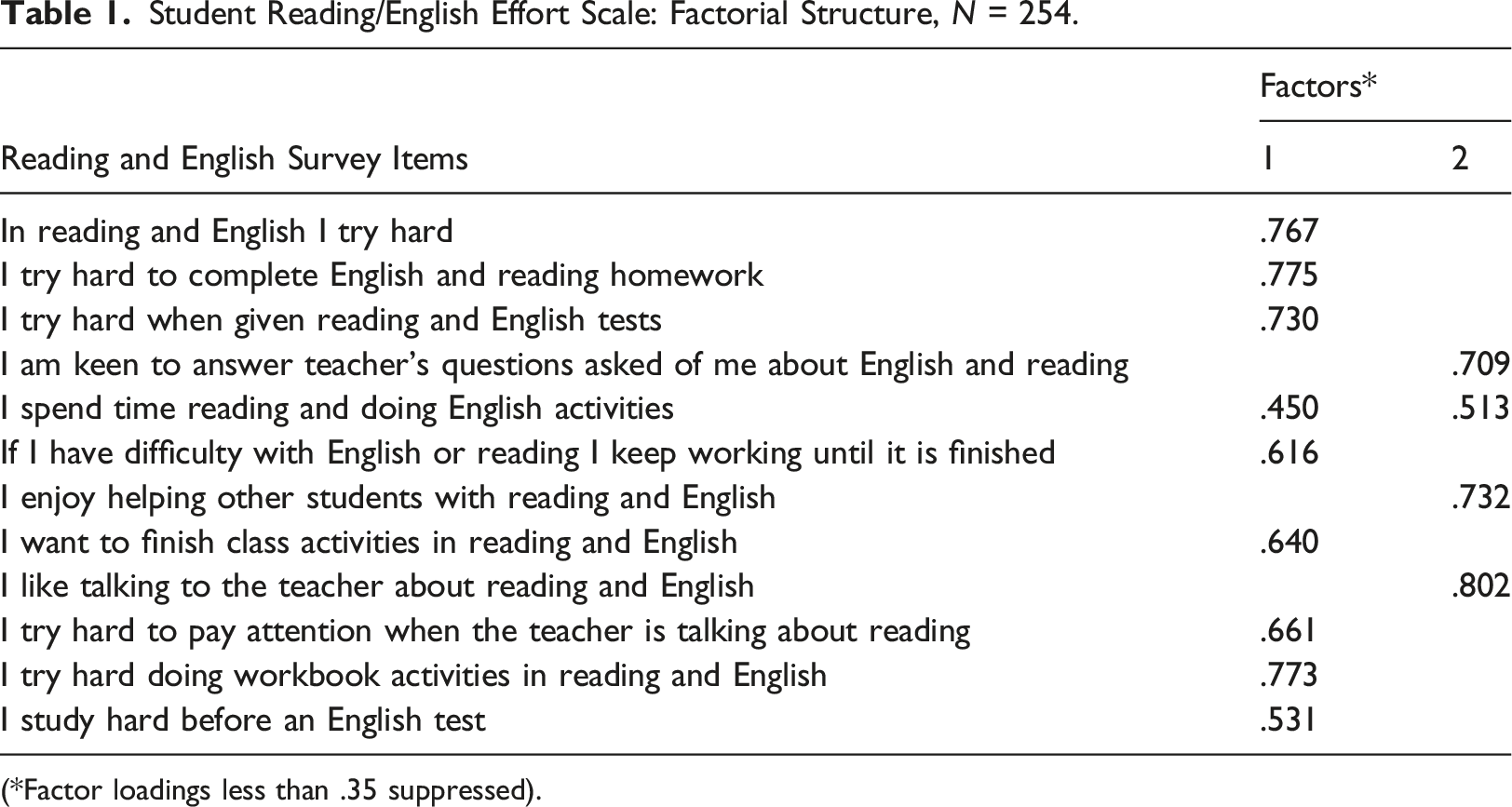
(*Factor loadings less than .35 suppressed).
Students in-class behaviour scale
The Rowe Behavioural Rating Inventory (RBRI) (Rowe & Rowe, 1997a, 1997b) assessed the children’s in-class behaviours using a teacher survey of 12 pairs of behaviour statements, ranked using a 5-point rating scale. The teacher was asked to select, on a continuum, which of the 5 points, best described an individual child’s in-class behaviour for that item. The 12-item RBRI is divided into three sub-behaviour scales. There are five items on the irritable/antisocial-sociable subscale, relating to the child’s ability to control behaviour, to be co-operative and to be friendly with others, four items on the inattentive-attentive subscale relating to persistence, concentration, and purposeful behaviours, and three items on the restless-settled subscale, relating to level of excessive motor activities. A higher score on each subscale is associated with more positive in-class behaviours. In this study the three sub-scales are reported. The minimum score is 1 for each subscale but a maximum score of 25 for sociable, 20 for attentive, and 15 for restlessness.
The RBRI is untimed, and most teachers completed it on their students within 40 minutes. It is reported that the RBRI is a reliable and valid teacher assessment of their students’ in-class behaviours (Li & Bornholt, 2009) and that the RBRI has sound psychometric properties, with a Cronbach alpha reliability score of 0.92 (Rowe & Rowe, 2004).
Procedure
At the first data collection point (Time 1), the self-report and reading achievement data were collected from the participating students during class time by one of the researchers. The student behaviour rating data were completed by the students’ regular classroom teachers in the teachers’ own time and returned to the researcher in a sealed confidential envelope. The second data collection point occurred 24 months later (Time 2) and involved re-assessing the students’ reading ability using the TORCH reading comprehension test. All data were coded into SPSS (Version 22) for analysis.
Results
The structure of the SREES: Because the SREES was a newly designed instrument its psychometric properties are reported in more detail in this article. The SREES was administered to 254 students (121 boys, 133 girls) from Years 3–6 within the participating two schools. The SREES produced a high level of internal consistency (Cronbach alpha = 0.89) and a high level of test re-test reliability (r = 0.83) (Tabachnick & Fidell, 2019). An exploratory factor analysis was conducted on the student data, identifying two factors from the 12 items. The first factor identified (9 items) related to effort and trying hard in reading and English. The second factor related to students’ involvement and in-class participation in reading and English (3 items), see Table 1.
To further validate the internal structure of the SREES, a Confirmatory Factor Analysis (CFA) was conducted using AMOS in SPSS (Version 22). The fit indices for the two-factor model were above the 0.9 criteria point (Schreiber et al., 2006): Norm Fit Index = 0.966; Comparative Fit Index = 0.977. The Root Mean Square of Error of Approximation was low = 0.046 and below the .06 criteria point (Schreiber et al., 2006).
Self and behaviour variables interactions on reading achievement Time 1
Correlations, Time 1 (T1) Reading Achievement, Reading/English Effort, Reading Self-Concept, Self-Handicapping, and In-class Behaviours (n = 124).
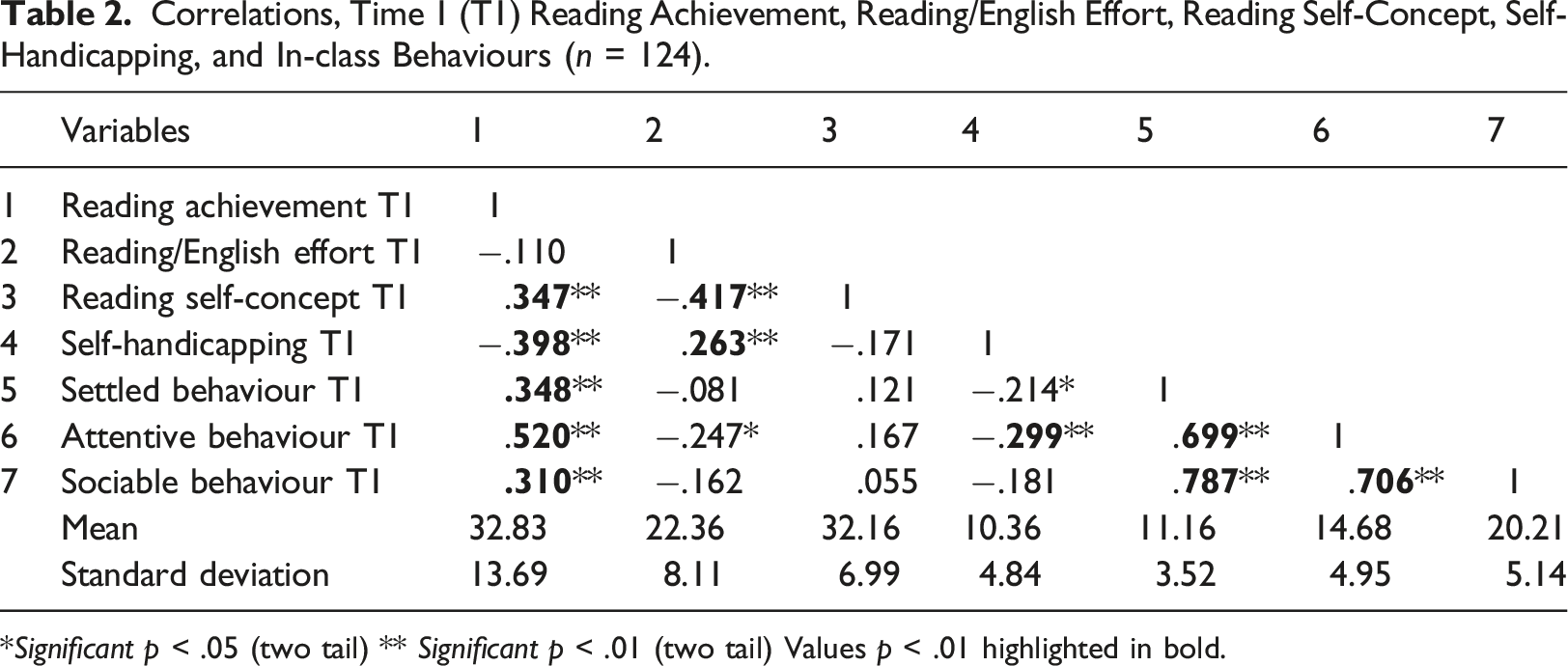
*Significant p < .05 (two tail) ** Significant p < .01 (two tail) Values p < .01 highlighted in bold.
First path model of self and behaviour variables on reading achievement Time 1
Beta (β) Values of Time 1 (T1) Reading/English Effort, Reading Self-Concept, Self-Handicapping, and In-class Behaviours on Reading Achievement T1) (n = 124).
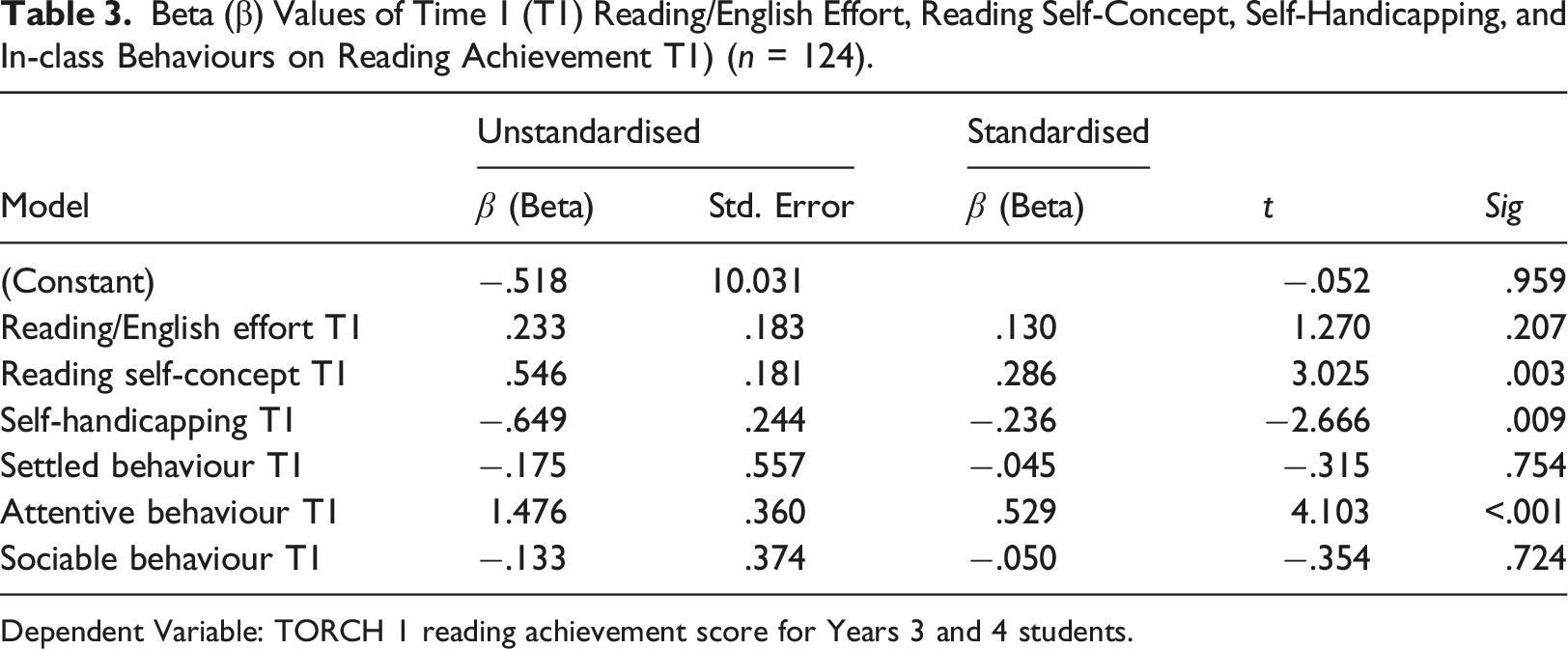
Dependent Variable: TORCH 1 reading achievement score for Years 3 and 4 students.
Time 2 data analysis
This stage of the analysis focused on the predictive influence that previous student self and behaviour variables had on students’ future reading achievement. There was a small reduction in sample size from the first data collection point to the second data point, due to students transferring out of the school or away when the second data sample was collected. The sample size at Time 2 was n = 113, which is still above the sample size of 50 that Sauro and Lewis (2016) considered as acceptable when undertaking correlation and regression analyses. The Time 1 TORCH scores had a mean of 32.83 (sd = 13.69) and at Time 2 it had a mean score of 49.22 (sd = 12.52), producing a positive Pearson correlation of r = .69 (p < .001). A Pearson correlation analysis also identified that students’ reading comprehension achievement scores (Time 2) were significantly correlated (p < .01) with students’ Time 1 scores for self-handicapping (r = .59), in-class attending behaviour (r = .42), and reading self-concept (r = .30), but weakly correlated (p < .05) with settled behaviour (r = .25, sociable behaviour (r = .24), and reading/English effort (r = .20).
Second path model
Beta (β) Values of Reading/English Effort, Reading Self-Concept, Self-Handicapping, and in-class Behaviours (T1) on Reading Achievement Time 2 (T2).
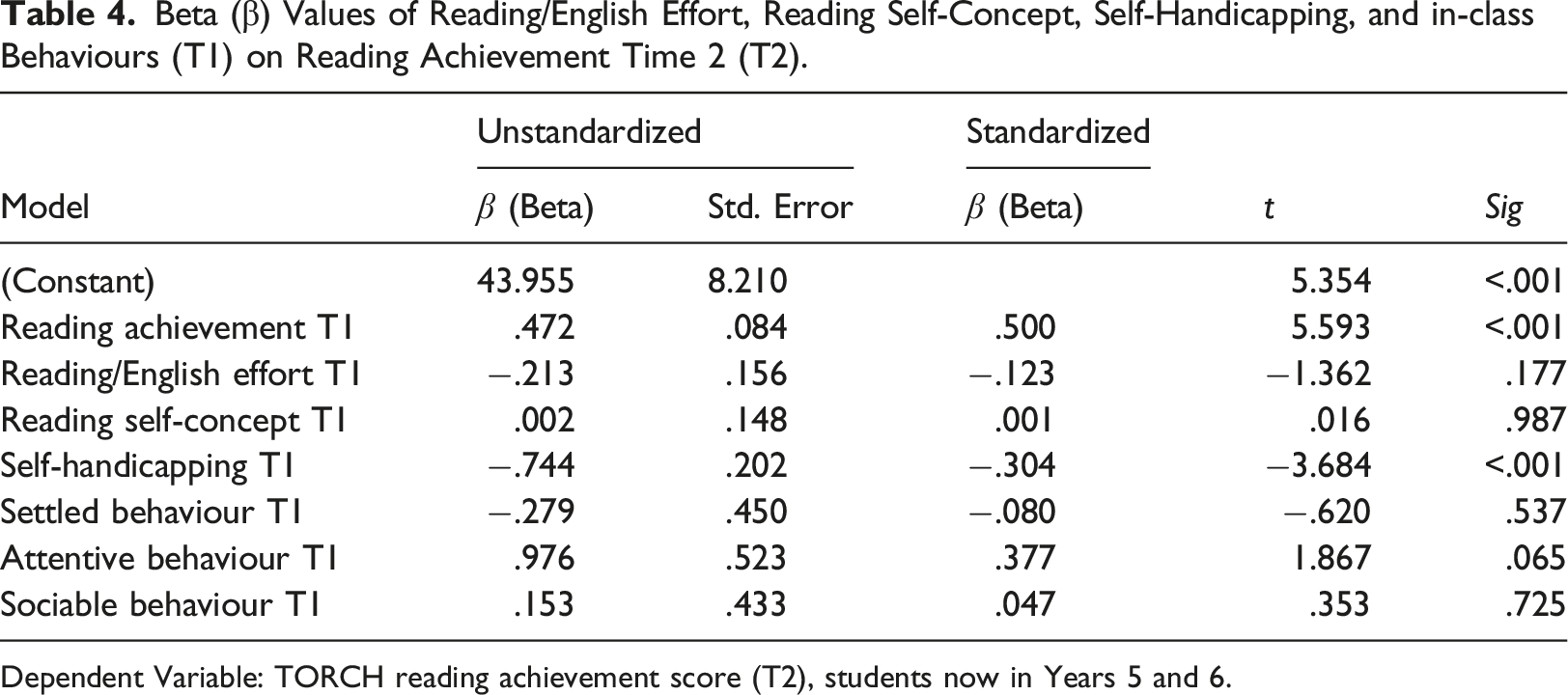
Dependent Variable: TORCH reading achievement score (T2), students now in Years 5 and 6.
Discussion
This study supports previous findings that an assortment of self-perception and behavioural variables are associated with students’ reading achievement (Chapman & Tunmer, 2003; Israel & Duffy, 2014; Merrell et al., 2020) along with their past reading achievement (Prior, 2022; Smith et al., 2021). The first linear model, based on the students’ Years 3 and 4 self and behaviour scores, demonstrated that attentive behaviour, self-handicapping, and reading self-concept predicted students’ reading achievement. By the time the Years 3 and 4 students were in Years 5 and 6 the variance explained increased to 57% with past reading achievement along with self-handicapping now predicting reading achievement.
Students’ past reading performance was a significant predictor of their future reading performance, a finding that is consistent with the reading research literature (Hoover & Tunmer, 2020; Smith et al., 2021; Snowling & Hulme, 2021). This finding also links to a body of research often identified as the ‘Matthew effect’ in students’ reading development (Cunningham & Stanovich, 1997). That is, younger students who are good readers continue to extend their reading ability over time, however, younger students who are poorer readers are more likely to continue to struggle and have lower reading achievement compared to their peers. Closing this initial gap requires teachers to actively teach specific reading and comprehension skills and strategies that are necessary to advance students’ reading performance (Darling-Hammond et al., 2020; Israel & Duffy, 2014).
Reading/English effort was not highly correlated with the students’ reading comprehension achievement suggesting that in terms of effort, persisting with a school-based task may be necessary but not sufficient to achieve academic success. This is more likely the case if students are required to persist and struggle with a task that is not appropriate to their level of capacity, skill, and/or competence (Fuchs et al., 2010).
The current study identified that of the three in-class behaviours investigated (attentive, sociable, restlessness) attentive behaviours had the strongest correlation with reading achievement and was predictive of reading achievement in the first path model. This finding is consistent with previous research investigating students’ in-class attentive behaviours and their school achievement (Klenberg et al., 2001; Mulder et al., 2011; Rowe & Rowe, 1999). Sociable behaviour did not predict reading achievement in either of the path models. This finding is supportive of the notion that students are able to maintain positive social and friendship with others in the classroom, even if they have different academic performance scores to their classroom peers (Bourgeois et al., 2014; Hay, 2000). Students’ levels of restlessness also did not predict their reading achievement in either of the path models.
These findings suggest that the more positive in-class sociable behaviours and the more settled in-class behaviours are not always demonstrated by students who are the more able readers. This could be because some higher achieving readers may be less motivated or even bored in the classroom and so find the schoolwork less challenging and so they may be more restless (Granero-Gallegos et al., 2020; Renninger et al., 2015). Certainly, there are students who find sitting still a challenge, but who can still perform at an adequate standard on academic tasks (Gibbs, 2023). A related explanation for why restlessness and settled behaviours were poor predictors of students’ reading achievement could be that some students with poorer reading achievement may display more passive and less active behaviours in the classroom (Bada & Olusegun, 2015). That is, they do not want to draw attention to their performance or to themselves. The concern is, students who are too settled, too silent, and/or too passive, compared to their peers, may have unrecognised learning needs and difficulties, and are often overlooked by their teachers (Hall, 2007).
Reading/English effort is also an interesting variable in this research study. It was not significantly correlated with children’s reading performance, and it did not predict reading achievement within either of the path models. This outcome is not unique to this research, with Hall (2006, 2007) noting that contrary to popular assumptions and beliefs, many students who are less competent in their reading ability, compared to their peers, do invest effort and are not ‘lazy or unmotivated’. Typically, these students recognised that they have to work hard and have to make persistent and sustained efforts with their reading, but they still achieve, at times, limited improvements in their reading proficiency.
Meltzer et al. (2004) also reported that younger and middle primary school students, including those with some level of reading difficult, typically judged themselves as hard workers, who invested effort in their schoolwork. In an extension to Meltzer et al.’s research, Lackaye and Margalit (2006) noted that older primary school students with reading difficulties were less hopeful that their use of effort transferred to their academic progress, and they identified a disconnect between their effort inputs and their achievement outcomes. Increasingly, over time those students with slower academic progress to their peers, developed more negative academic self-perceptions, which had a negative impact on their academic achievement, by withdrawal of sustained effort (Lackaye & Margalit, 2006). It is claimed that such a strategy is connected to self-handicapping as a displacement activity, when the outcome of academic effort is uncertain (Barutçu Yıldırım & Demir, 2020). In the current study the finding that lower levels of academic self-handicapping significantly correlated with and predicted higher reading achievement, lends support to the hypothesis that students’ ability to self-regulate their behaviours can impact on their academic achievement (Mega et al., 2014; Shih, 2019).
Limitations and future directions
There are limitations with this current study that need to be acknowledged. The participants were drawn from two co-educational primary schools located in regional towns in Australia. Therefore, there may be specific cultural, age, and/or social factors associated with these students that may influence the generalisability of the findings. There are also likely to be home variables (Hay & Fielding-Barnsley, 2009; Terry et al., 2022) and instructional variables (Grigorenko et al., 2020; Hay & Fielding-Barnsley, 2012) that could also have had an influence on children’s reading comprehension, but these other variables were not included in this specific study.
The inclusion of a self-effort scale, rather than a self-efficacy scale was a deliberate choice in this study, and based on the assertion that students’ academic achievement is associated with higher academic effort, plus higher academic self-concept (Hay et al., 1998; Van Damme & Mertens, 2000). In general terms, one of the differences between a self-effort scale and a self-efficacy scale is the inclusion of items related to self-confidence, as well as self-effort items in the self-efficacy scale (Bandura, 2006; Bong & Skaalvik, 2003; Robbins et al., 2004).
Accepting that not having a reading self-efficacy scale may be a limitation, there is also an ongoing debate about the true similarity and difference between different self-perception measurements (Robbins et al., 2004; Watkins & Dhawan, 1989) and the reliability of young children’s self-confidence judgements (Schneider, 2008; von der Linden & Roebers, 2006; Weil et al., 2013). The researchers, however, acknowledge the research that academic self-efficacy influences academic performance with older students (Hay et al., 2015) and that academic self-efficacy influences reading achievement, particularly when it is the main variable in the analysis (Chen et al., 2021).
Another consideration when interpreting the findings is the dependent variable in this research was students’ reading ability. If the dependent variable was another curriculum domain, such as mathematics, the results may be different.
Implications
This research lends support to three theoretical perspectives. The first is, students’ learning is multidimensional involving affective, behavioural, and cognitive dimensions and these three dimensions are typically interactive (Bruhn & Watt, 2012; Kelly et al., 2023; Wang et al., 2019; Wong & Liem, 2021). The second is, given the strength of past reading comprehension on future reading comprehension, teachers need to continue to improve children’s reading performance using evidence-based interventions and strategies (Fielding-Barnsley & Hay, 2012; Snowling & Hulme, 2021). The third supported theoretical perspectives is, self-handicapping needs to be given more attention as an important factor that contributes to students’ learning and education (Török et al., 2018).
To actively address students’ self-handicapping behaviour in the classroom teachers need to continue to recognise that students’ levels of self-handicapping, fear and anxiety increase when students cannot predict an outcome, or they have a low sense of control and certainty over a coming event (Barutçu Yıldırım & Demir, 2020). Students’ sense of control and certainty over their own learning increases when students’ sense of engagement and success with the content and the task increases (Barber & Klauda, 2020; Coudevylle et al., 2011; Robbins et al., 2004).). Students’ sense of academic control is also facilitated when the teacher encourages a positive classroom ‘social climate’ that provides regular opportunities for all students to talk with the teacher about their understanding of the content and the context of their learning (Fuchs et al., 2010; Hay et al., 2024; Schunk, 2012).
For students, a lower sense of control over a coming event is typically associated with assessment tasks (Török et al., 2018). Thus, when students have to take examinations teachers need to assist students to prepare for these events, so they understand the expectations as well as the task. Teachers also need to manage students’ nervousness and fears about tests and assignments by talking with them about the purpose of such activities (Brady et al., 2018). When providing feedback to students, having them reflect on their previous performance encourages them to have a higher sense of control and understanding of their own learning (Dent & Koenka, 2016; Pressley et al., 2020).
In conclusion
This research used regression path models to identify that primary school students’ previous reading performance and their level of self-handicapping significantly predicted students’ reading comprehension performance. This research reiterates three important constructs within education and teaching. First, reading and reading comprehension must be actively taught across the school years. Second, teachers need to actively work to enhance students’ sense of control and predictability over their learning. Third, both social-emotional and cognitive variables are predictive of student’ school achievement.
Footnotes
Declaration of conflicting interests
The author(s) declared no potential conflicts of interest with respect to the research, authorship, and/or publication of this article.
Funding
The author(s) received no financial support for the research, authorship, and/or publication of this article.
